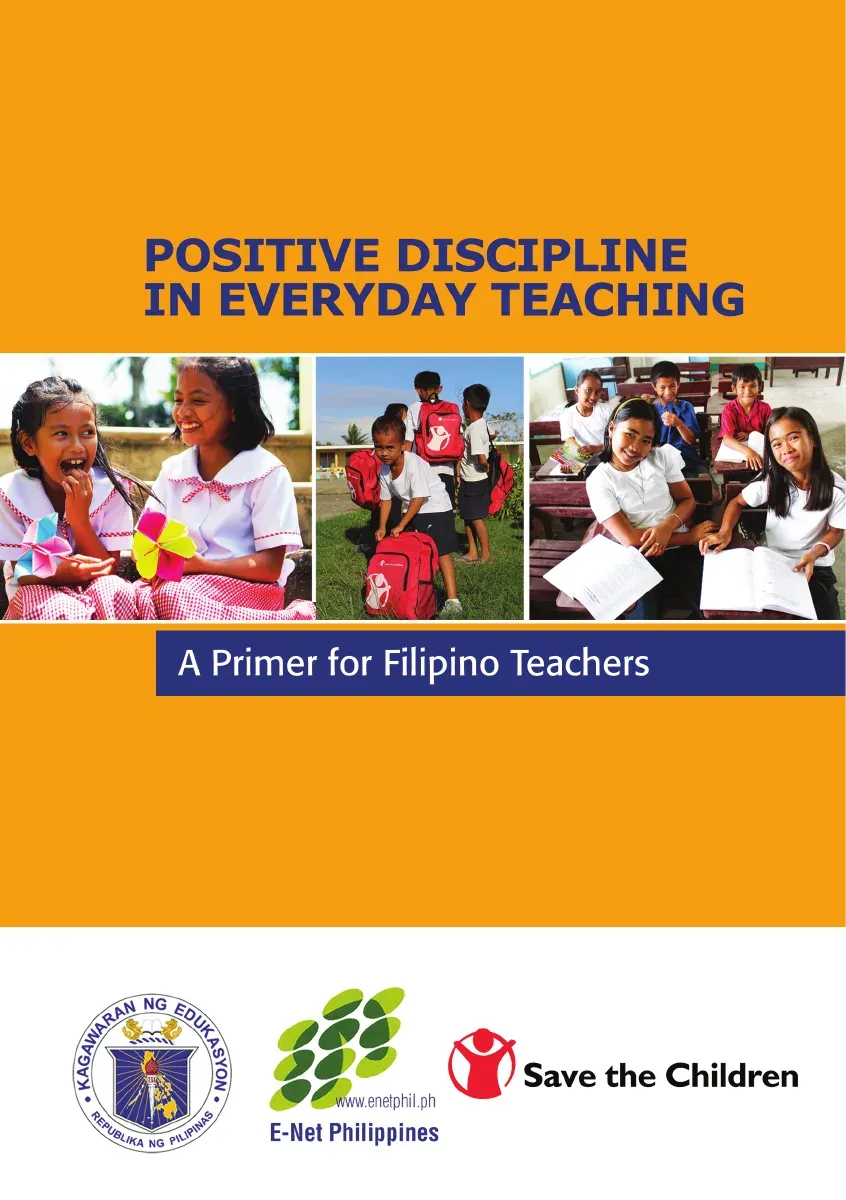
Positive Discipline in Everyday Teaching: A Primer for Filipino Teachers is dated November 2015 and was prepared by the Department of Education, E-Net Philippines and Save the Children; DepEd launched it in June 2016. Its foreword states its purpose: “to help teachers apply a positive discipline approach in classroom management. It outlines steps teachers can follow and situations they can refer to in applying positive and non-violent discipline.” The download is the full 48-page primer, its pages unchanged. Its copyright page lists the three organizations and reads “All rights reserved.”
Is it still current?
Yes, as guidance. As of November 8, 2026, the policy it rests on, DepEd Order No. 40, s. 2012, the DepEd Child Protection Policy, is still in force. DepEd Order No. 006, s. 2026 on a safe and motivating learning environment defines positive discipline “as defined in DepEd Order No. 40, s. 2012”, strictly prohibits corporal punishment, and says it “does not amend or repeal” the child protection rules it lists.
DepEd’s yearly child protection fund orders named it as the training text for positive discipline seminars, from DO 43, s. 2018 to DO 046, s. 2021.
One rule the primer cites has changed. DepEd Order No. 55, s. 2013, the earlier implementing rules of the Anti-Bullying Act, was repealed by the revised implementing rules that DM 090, s. 2025 disseminated. The child protection and anti-bullying guide has the rules in force.
What is inside
- Part One, corporal punishment: what it is, its magnitude and effects, and the legal basis for prohibiting it, from the UN Convention on the Rights of the Child (Articles 19 and 28(2)) to DO 40, s. 2012.
- Part Two, the Positive Discipline in Everyday Teaching (PDET) model: identifying long-term goals, providing warmth, providing structure, understanding child development, recognizing individual differences, and problem solving.
- Part Three, examples of responding with positive discipline: ten common classroom cases, each worked through the same five steps (the possible reasons, long-term goals, warmth, structure, and a response):
- kindergarten: continuous crying, grabbing others’ belongings, and toilet accidents;
- grade school: disruptive talking in class, fighting, and rudeness;
- high school: missing assignments or projects, cutting classes, absenteeism or tardiness, and violating rules such as vandalism.
- Part Four, the conclusion. After it come a note on teachers’ well-being and stress management and a reading list of publications and websites.
The foreword says the ten cases were compiled from focus group discussions with teachers, learners and experts that E-Net Philippines and Save the Children held, and reinforced with information on the common cases reported to DepEd.
Why it matters for aspiring school heads
In the Philippine Professional Standards for School Heads (PPSSH, DO 024, s. 2020), the primer bears on Domain 3: strand 3.8 (learner discipline), whose first indicator asks for knowledge and understanding of “existing national and local policies related to learner discipline”, and strand 3.6 (learning environment). The primer is not one of those policies, but it shows how to apply the positive discipline that DO 40, s. 2012 requires. A school head who coaches teachers on classroom management can use its cases as they are written.
School culture, climate and positive discipline in DepEd and the child protection guide cover the school-wide side: policies, committees, training and reporting.