Republic Act No. 12080, the Basic Education Mental Health and Well-Being Promotion Act, approved on December 6, 2024, requires DepEd to run a School-Based Mental Health Program, to set up a Care Center in every public school and a Mental Health and Well-Being Office in every schools division office, and to create School Counselor and School Counselor Associate positions. Its implementing rules took effect on March 21, 2025. EDCOM II found that the law arrives in schools where international assessments rank the Philippines among the countries with the highest bullying prevalence and about 79% of DepEd’s guidance counselor posts are unfilled (Final Report, pp. 198–199).
The sections below cover what EDCOM II found, what RA 12080 and DepEd’s issuances require, and what a school head must put in place. The guide is written for teachers preparing for the National Assessment for School Heads (NASH) and for researchers.
EDCOM II is the Second Congressional Commission on Education, created by Republic Act No. 11899. The guide draws on its Year One Report (2024), Year Two Report (2025) and Final Report, Turning Point (2026), and on EDCOM’s news releases. The steps for handling a bullying or abuse case are in the guide to DepEd child protection and anti-bullying duties; this post does not repeat them.
Key findings
- Bullying is common and falling slowly. In SEA-PLM 2024, the Philippine figure for head teachers reporting bullying among pupils at least once a month was 50%, down from 63% in 2019; EDCOM II calls it “far above the roughly 4–20% range in Cambodia, Lao PDR, and Vietnam” (Final Report, pp. 196–197; SEA-PLM 2024 report, pp. 117, 119). In PISA 2022, 43% of girls and 53% of boys themselves reported being bullied at least a few times a month (Final Report, p. 584; EDCOM 2, January 21, 2025).
- Official counts miss most of it. DepEd’s helpline resolved 38 of 339 reported cases from November 2022 to July 2024 (Year Two Report, pp. 24, 157). School heads and Child Protection Committee members describe “strong informal pressure to keep official bullying counts low” (Final Report, p. 199). In November 2024, DepEd officials told a House hearing that 10,018 public schools had no localized anti-bullying policy (EDCOM 2, November 13, 2024).
- Most counselor posts are empty. About 79% of DepEd guidance counselor posts, 4,460 items, are unfilled (Final Report, pp. 198, 547). The country had 4,069 licensed guidance counselors in 2022, against “more than 50,000 needed” for one per 250 students (p. 547).
- RA 12080 builds the structure. It requires a Care Center in every public school, a Mental Health and Well-Being Office in every division, and new positions from School Counselor Associate I (Salary Grade 11) to Schools Division Counselor (Salary Grade 24) (Secs. 5, 7 and 9).
- The people are still being hired. The National Education Plan targets 40,853 new School Counselor Associate I items by 2028, toward 51,572 required (Final Report, p. 452). The 2026 budget funds 10,000, but none had been hired by late June 2026; their qualification standards were approved on June 30, 2026 and adopted in DepEd Order No. 019, s. 2026.
- DepEd acted on EDCOM’s bullying recommendations. The revised Anti-Bullying IRR, in effect since August 6, 2025, makes the school head designate a Learner Formation Officer and says zero reporting “shall not automatically be construed as a reflection of positive performance of the school” (DepEd Memorandum No. 090, s. 2025, Secs. 11.1 and 24.1).
What EDCOM II found about bullying in schools
How common bullying is
The Year One Report (2024) left this priority area for the Commission’s second year (p. 127). The Year Two Report (2025) opened with PISA 2018: “65% of Grade 10 students in the country experienced bullying a few times a month—the highest among all participating countries” (p. 24). PISA 2022 “indicated a slight decline”, but “one in three students still reported weekly bullying” (p. 157). The Final Report (2026) leads with the Southeast Asia Primary Learning Metrics (SEA-PLM).
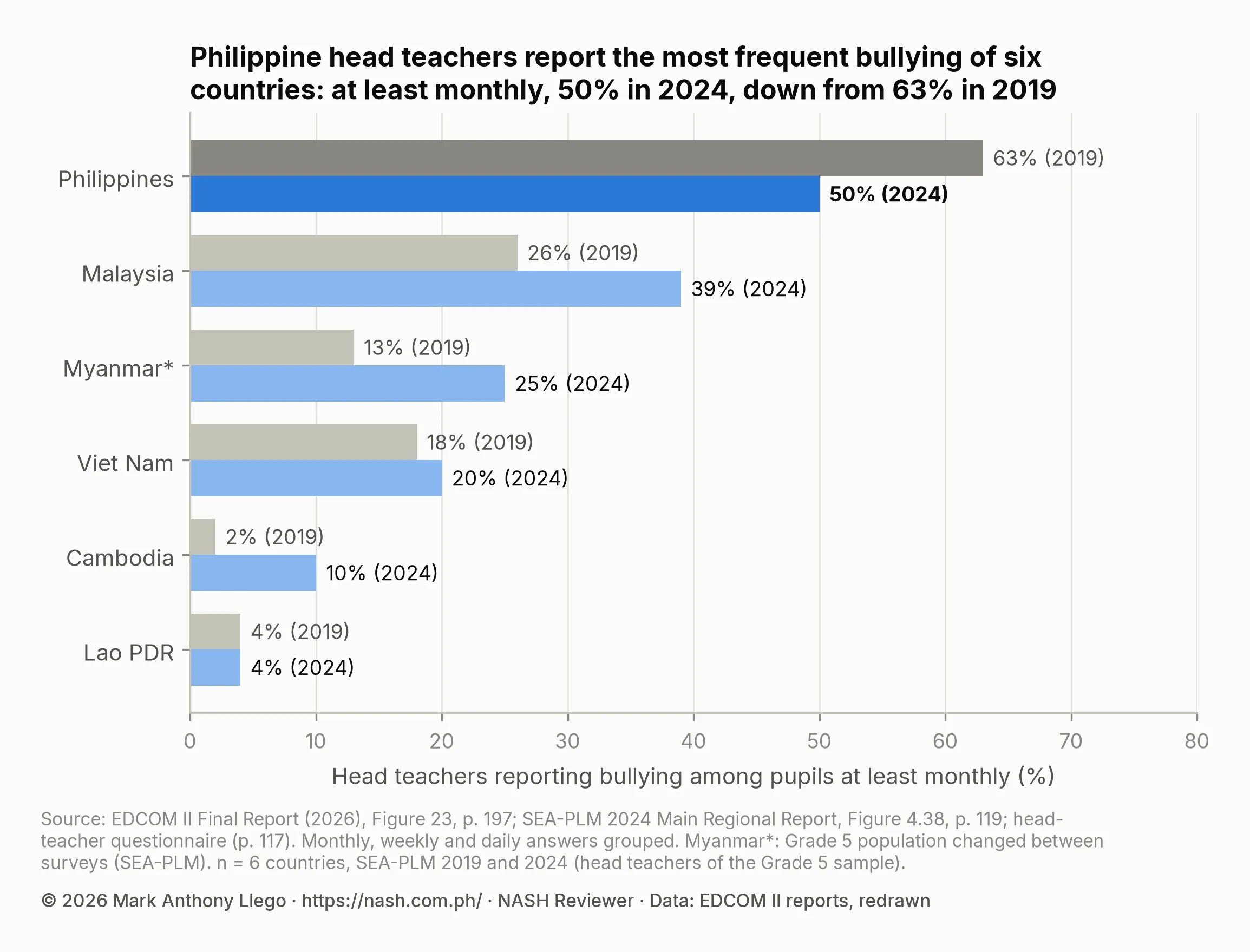
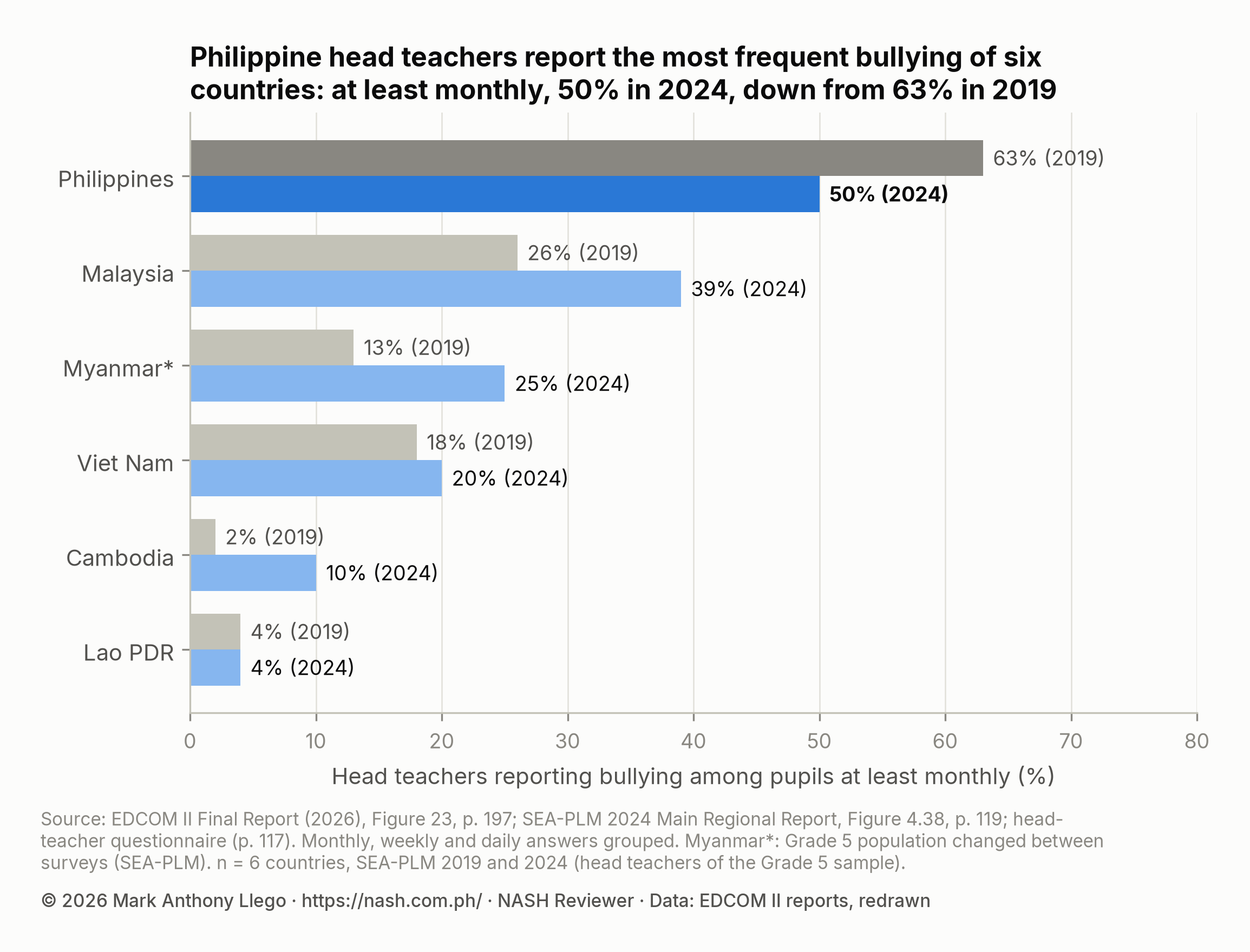
The Final Report’s text says Grade 5 students “report being bullied at least once a month”, but its figure is titled “as Reported by School Heads” (p. 197), and in the SEA-PLM 2024 regional report it cites, the numbers come from head teachers, who answered how often bullying occurs among children in their school, counting monthly, weekly and daily answers together (pp. 117, 119). The Final Report does not reconcile the two descriptions.
The measures EDCOM cites use different ages, thresholds and respondents, so they are not one trend:
| Measure | Respondents | Result | Source |
|---|---|---|---|
| PISA 2018 | Grade 10 students | 65% bullied a few times a month | Year Two Report, p. 24 |
| PISA 2022 | PISA students | 43% of girls and 53% of boys at least a few times a month | Final Report, p. 584; EDCOM 2, January 21, 2025 |
| SEA-PLM 2019 and 2024 | Head teachers, Grade 5 sample | 63%, then 50%, report bullying among pupils at least monthly | Final Report, pp. 196–197; SEA-PLM 2024 report, p. 119 |
| Longitudinal Cohort Study on the Filipino Child | Children aged 10 in 2016, followed up | Emotional bullying 46% at baseline, 27% six years later | Final Report, p. 585 |
The Final Report says studies “link these hostile environments to poorer reading and mathematics performance, weaker sense of belonging, and higher absenteeism among Filipino learners” (p. 196). In TIMSS 2019, Grade 4 students never bullied scored 351 in mathematics, against 269 for those bullied weekly (EDCOM 2, November 13, 2024). These are associations, not proof of cause.
Why official counts stay low
Of the cases reported to DepEd’s Learner Rights and Protection Office (LRPO) helpline, “only 38 out of 339 (approximately 11%)” were resolved between November 2022 and July 2024. Regions IV-B, XII and BARMM had one reported case each as of June 2024, which “may not necessarily reflect actual differences in the incidence of bullying but rather the effectiveness of the reporting mechanisms in place” (Year Two Report, p. 157). DepEd told a June 13, 2024 EDCOM 2 subcommittee meeting that the division reports it collates “remain unverified”; they showed reported cases rising from 1,158 in 2013 to 20,172 in 2018 (EDCOM 2, June 13, 2024).
The Final Report finds that Child Protection Committees “often operate with limited time, training, and authority, which continues to encourage underreporting”, and field visits show they “are often activated only after serious incidents” (p. 199). Schools feel pressure to keep counts low “because high case numbers can be interpreted as poor performance in division monitoring”, so some resolve cases informally or call them “misbehavior” (p. 199). The Year Two Report had found that “zero bullying cases are included as an indicator” in the Individual and Office Performance Commitment and Review Forms (p. 161).
What was wrong with the 2013 rules
From January to July 2024, EDCOM II ran a technical working group with DepEd on the rules under Republic Act No. 10627, the Anti-Bullying Act of 2013 (Year Two Report, p. 158). The old rules, DepEd Order No. 55, s. 2013, defined bullying narrowly as “repeated acts”, gave schools “little guidance” for their policies, and did “not address how school heads, teachers, and CPCs should be trained and supported” (p. 158). The report recommended amending the rules, localized policies in all schools “with sufficient guidance and support from DepEd”, clear roles for counselors and “a new position for discipline officers”, and resources and training (p. 25).
Violence at home and learners’ mental health
EDCOM treats violence at home as part of the same problem. More than one in three children experience parental violence in late childhood (Final Report, p. 197), and exposure at age 10 is associated with “52–57% lower odds of school enrollment by age 14” (p. 25). In the cohort study, 33.7% of children had witnessed physical violence at home in 2016 and 17.9% in 2022; in EDCOM’s words, “poor attendance is often a symptom of hidden harm at home or in school” (p. 585).
The reports print no national prevalence of learners’ mental health conditions. They report signals: DepEd’s Bureau of Learner Support Services (BLSS) “has noted an uptick in mental health–related cases”, including self-endangering behavior and prolonged absenteeism, without matching increases in trained staff (p. 172), and at Batino Elementary School “homeroom guidance sessions frequently substitute for psychosocial intervention” (p. 172). An EDCOM release cites 5,371 crisis hotline calls to the National Center for Mental Health from people aged 17 and under in 2019 to 2023 (EDCOM 2, March 5, 2025).
The shortage of guidance counselors in DepEd
“Around 79% of DepEd guidance counselor posts (4,460 items) remain unfilled, with some regions having vacancy rates above 80% and cases where a single counselor covers multiple campuses” (Final Report, p. 198). Earlier, “less than half of guidance counselor posts were filled from 2018 to 2021” (p. 588). The result is teachers and school heads left “to manage complex psychosocial cases with few specialized supports” (p. 198).
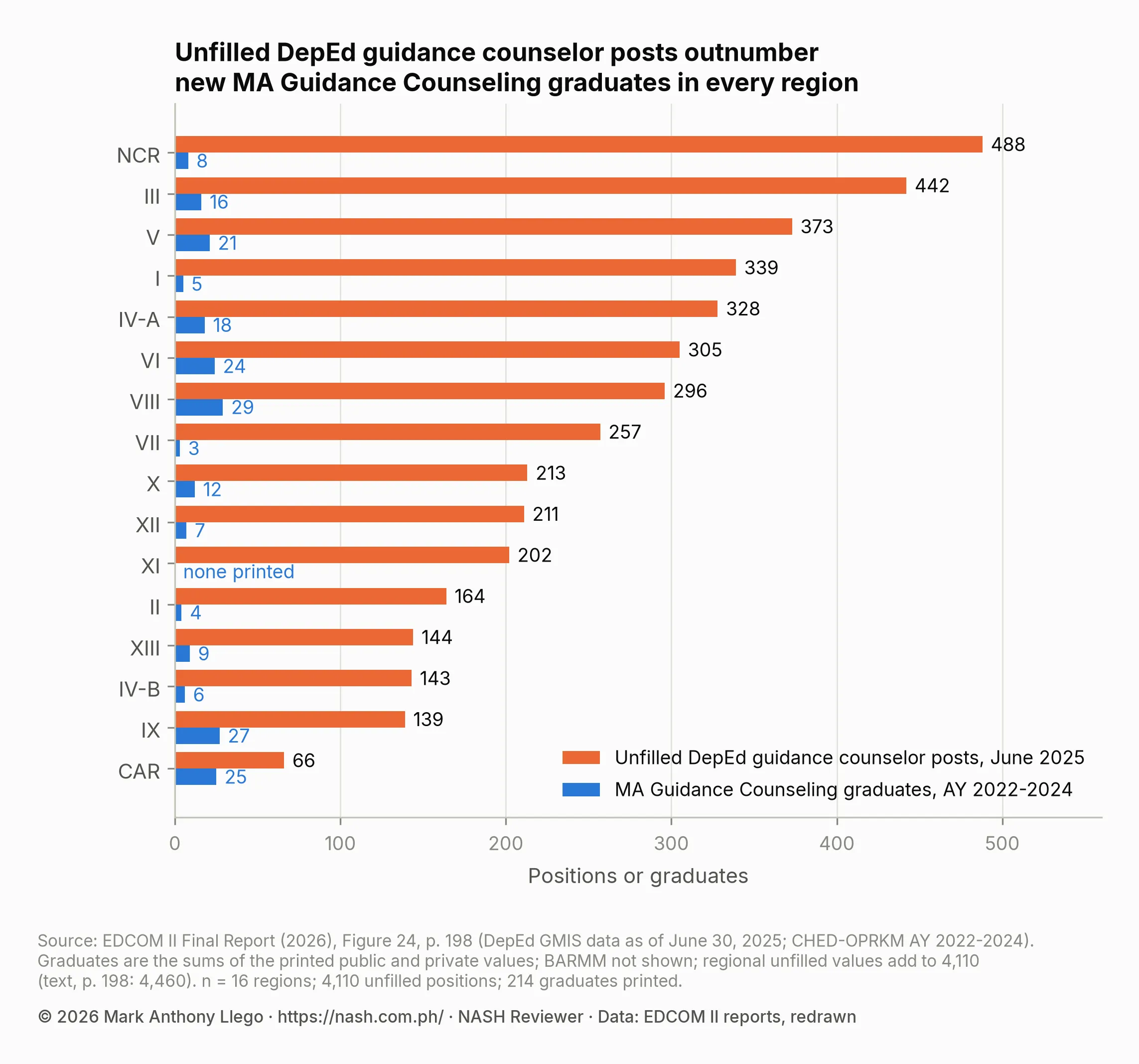
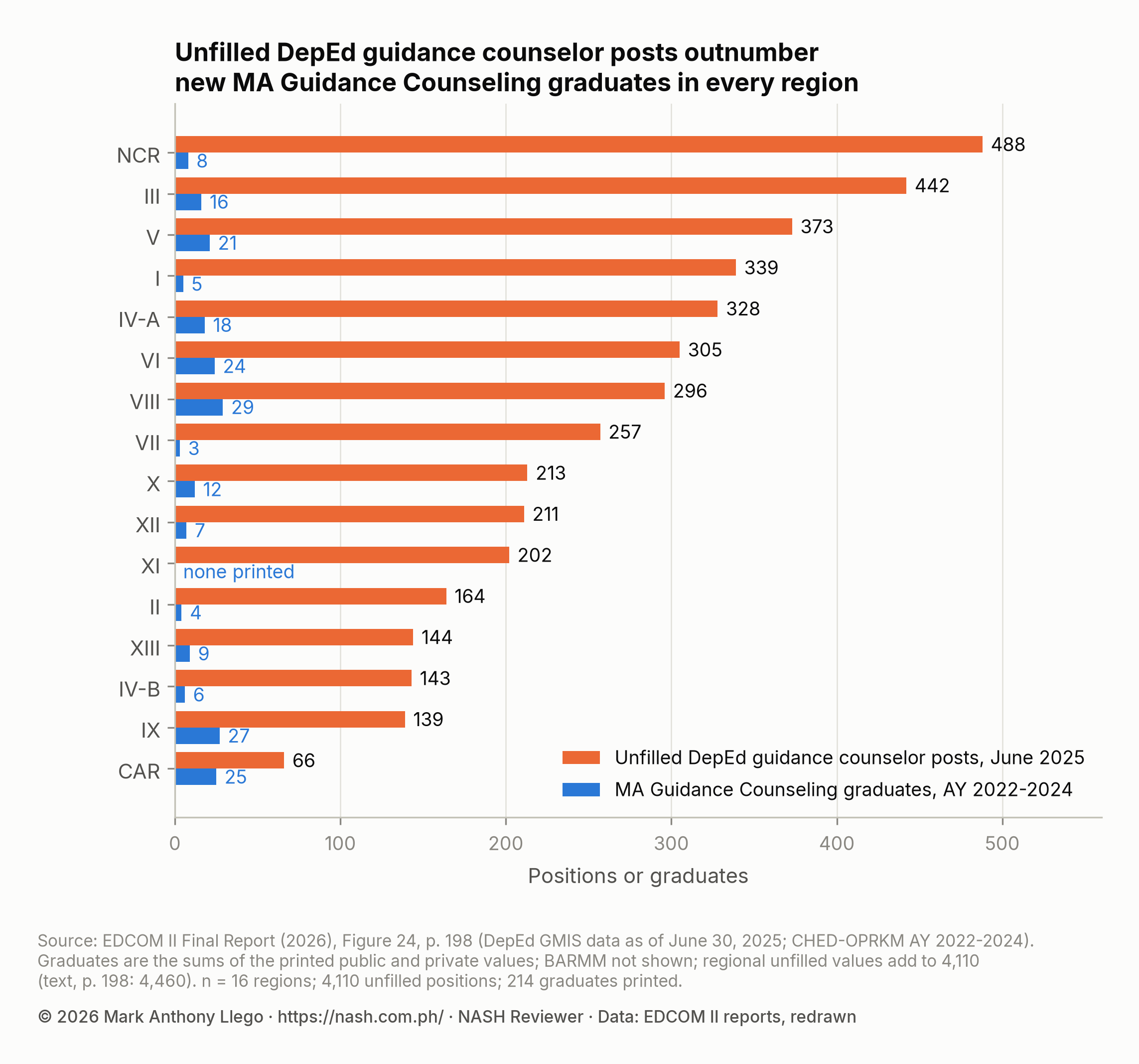
Two cautions for anyone citing this figure. Its 16 regional values add up to 4,110, not the 4,460 in the text on the same page and on p. 547. And the Final Report says MIMAROPA and Region VIII “have not had any graduates in Master’s programs related to Guidance and Counseling since 2018” (p. 547), while Figure 24 prints 6 graduates for Region IV-B and 29 for Region VIII in AY 2022-2024. The report explains neither difference.
Why the supply is thin
“Since 2008, only a little over 3,000 individuals have passed the PRC licensure exam in Guidance and Counseling” (Final Report, p. 198). EDCOM blames the “rigid requirements” of Republic Act No. 9258, the Guidance and Counseling Act of 2004, which “mandates both a specialized master’s degree and licensure for all counselor posts”, and past DepEd pay of Salary Grade 11 to 12, which pushed graduates toward private institutions and clinical practice (p. 198). An EDCOM release counts “fewer than 300” Master of Arts in Guidance Counseling graduates nationwide in SY 2023-2024 (EDCOM 2, January 8, 2026).
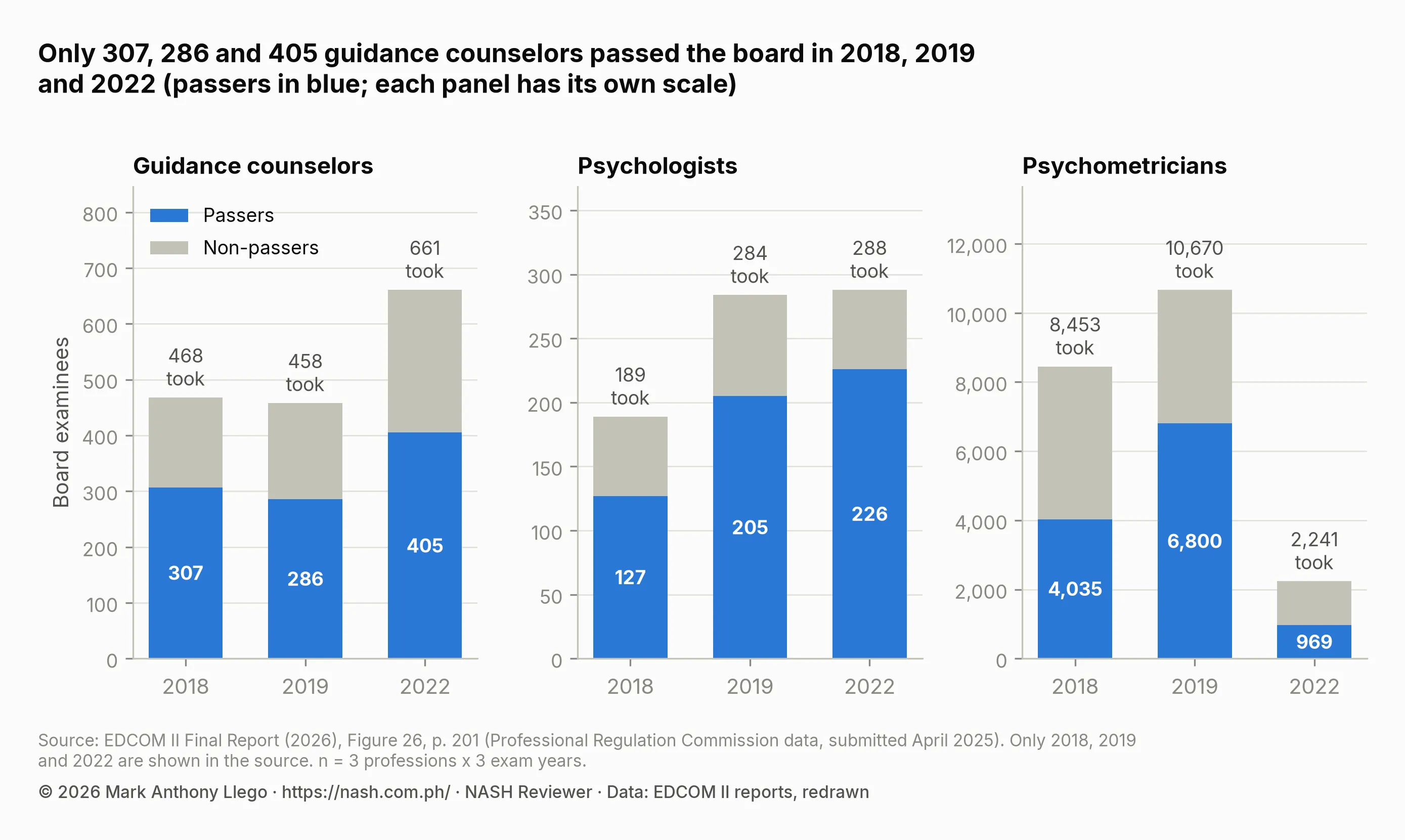
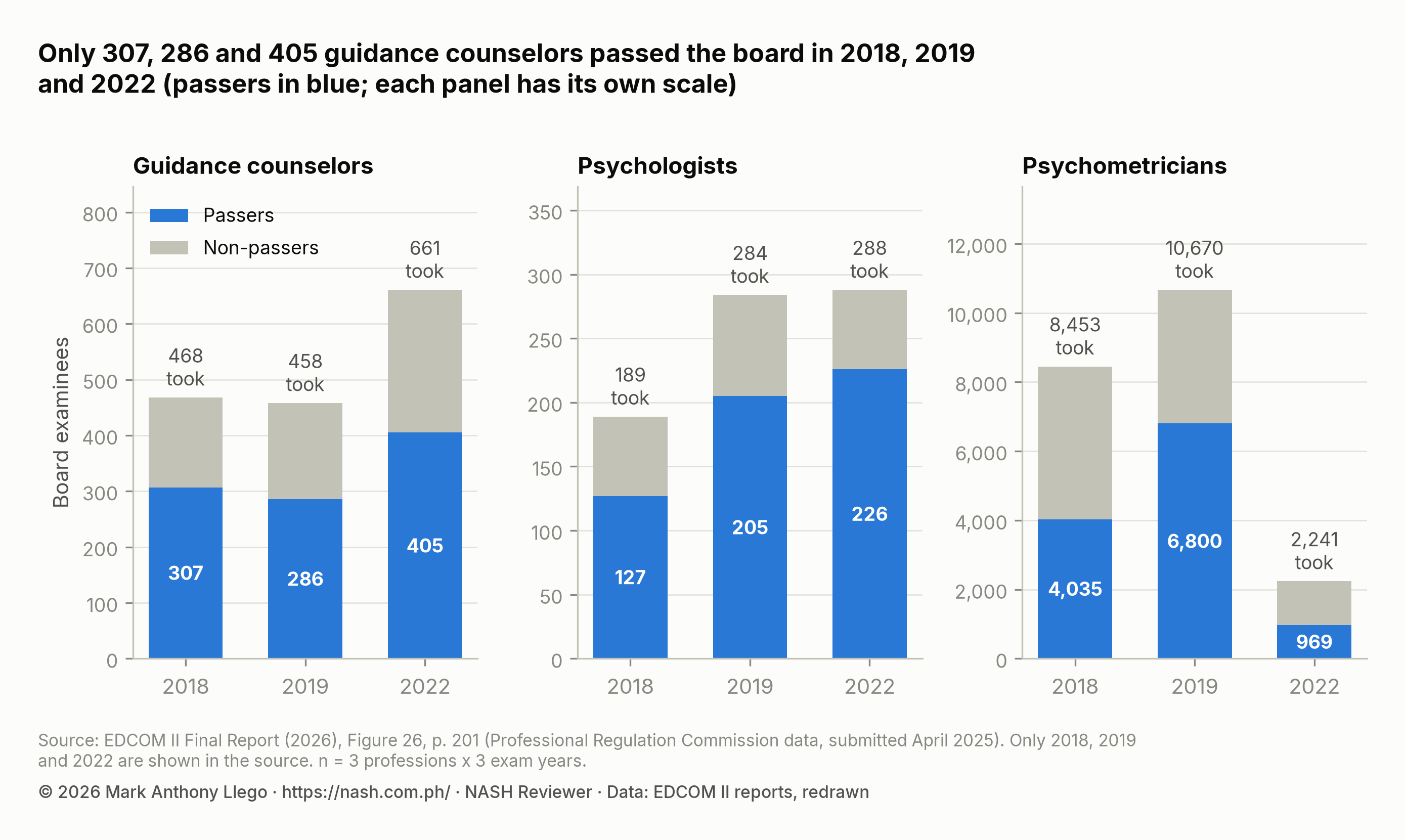
| Profession | 2018 | 2019 | 2022 |
|---|---|---|---|
| Guidance counselors passing | 307 of 468 | 286 of 458 | 405 of 661 |
| Psychologists passing | 127 of 189 | 205 of 284 | 226 of 288 |
| Psychometricians passing | 4,035 of 8,453 | 6,800 of 10,670 | 969 of 2,241 |
A few hundred new licensees a year cannot fill 4,460 posts soon. RA 12080 adds a second tier, the School Counselor Associate, open to bachelor’s degree holders (Sec. 3(g)).
What the National Education Plan targets
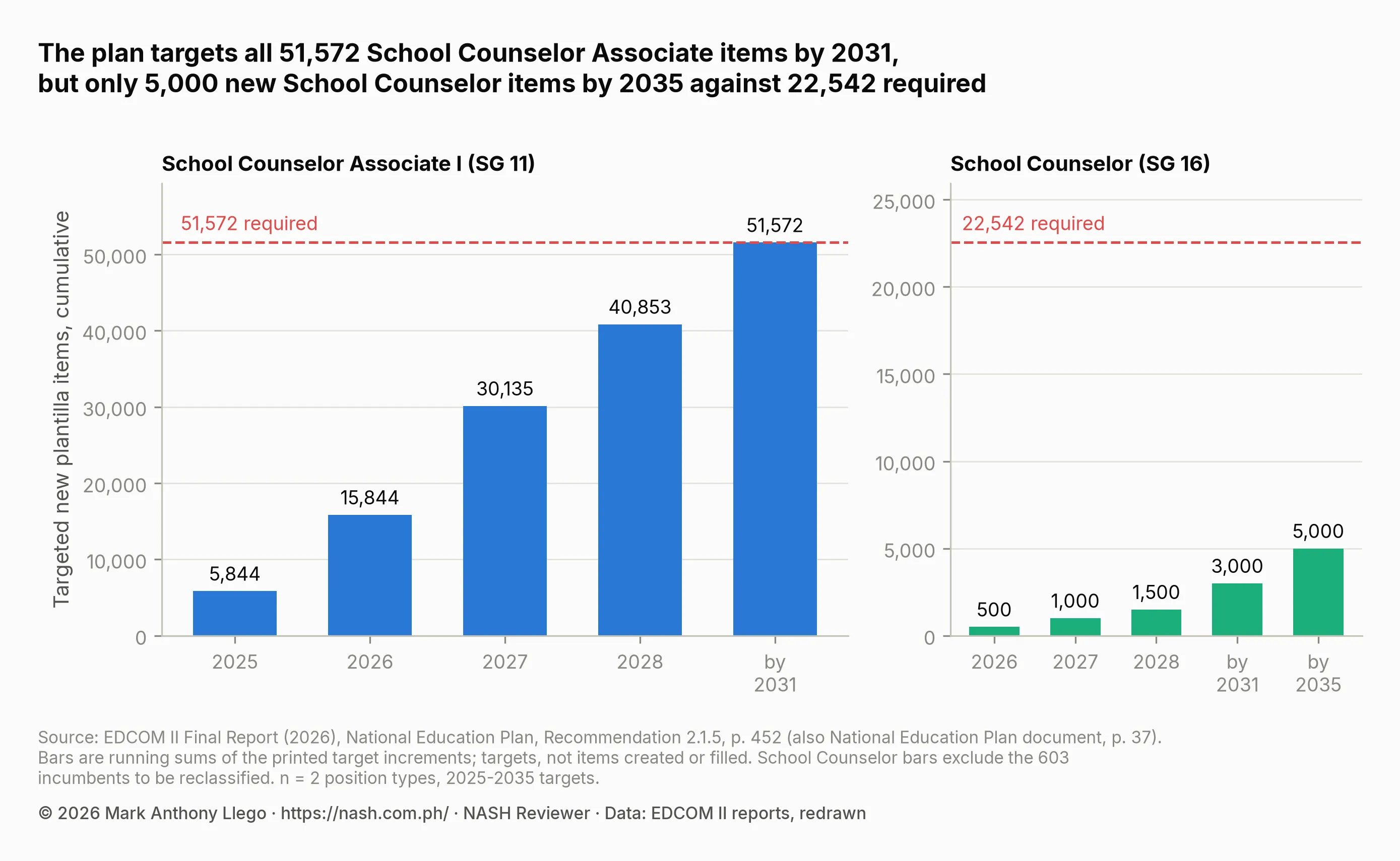
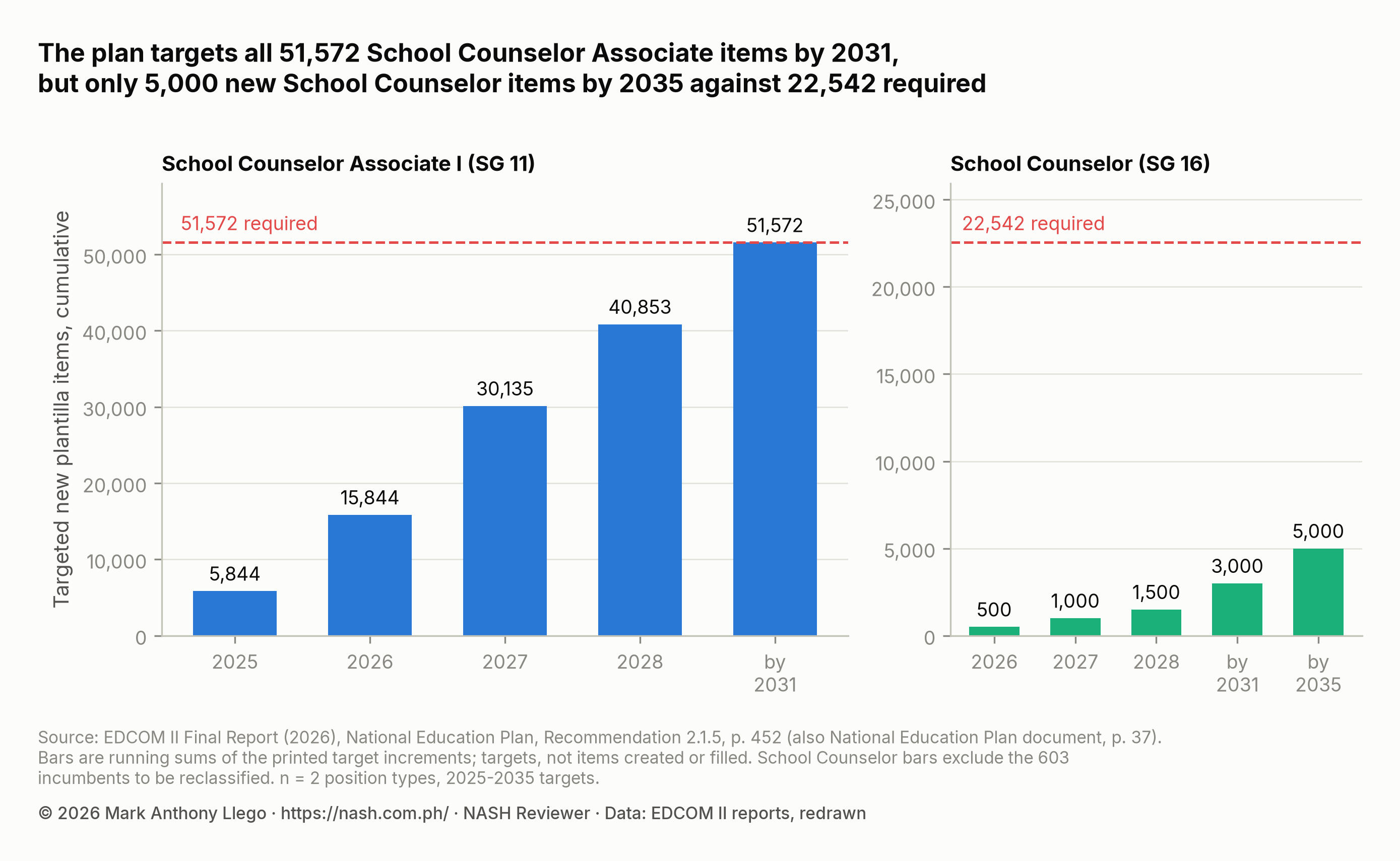
| Position | Baseline | Target new items | Required |
|---|---|---|---|
| School Counselor Associate I (SG 11) | 0 existing positions | +40,853 by 2028 (5,844 in 2025 through scrap and build, 10,000 in 2026, 14,291 in 2027, 10,718 in 2028); +10,719 by 2031 | 51,572 |
| School Counselor (SG 16) | 603 registered guidance counselors and psychologists to be reclassified | +1,500 by 2028 (500 a year); +1,500 by 2031; +2,000 by 2035 | 22,542 |
Source: EDCOM II Final Report (2026), Recommendation 2.1.5, p. 452; National Education Plan document (2026), p. 37. Targets, not items created.
The plan targets every School Counselor Associate item required by 2031, but only 5,000 new School Counselor items by 2035 against 22,542 required. It sets no School Counselor item target beyond that. For supply, it targets master’s programs in Guidance and Counseling in three more regions in 2026, from 13 regions in AY 2023-2024 (p. 472), and says the supply of program providers will be recalibrated once the plantilla positions for the Care Centers are approved (pp. 473, 476; National Education Plan document, pp. 62–63, 67). RA 12080 also requires scholarships, with return service, for teachers who train as associates or counselors (Sec. 11). The plan’s two tables differ on 2026: p. 453 counts 1,000 School Counselor positions targeted for 2026, including 603 incumbents to be reclassified, while p. 452 schedules 500 new items that year. It aims to fill 75% of School Counselor Associate I items in 2026 and all from 2027 (p. 453; National Education Plan document, p. 38). The Final Report lists an “Initial allocation of 10,000 school counselor associates in DepEd schools for 2026” among its collective accomplishments (p. 69); an EDCOM release puts it at ₱2 billion (EDCOM 2, July 9, 2026). The National Education Plan guide covers the plan’s other staffing targets, and the SY 2023-2024 staffing report shows that 3.3% of public schools then reported any guidance position.
What EDCOM II recommends
The Final Report’s two policy recommendations for this priority area are to “Fully implement the strengthened Anti-Bullying IRR through practical tools, staffing support, and monitoring and accountability mechanisms” and to “Address shortages in guidance and mental health personnel” and strengthen family support and referral systems, “including minimum service packages aligned with Republic Act No. 12080” (p. 26). The chapter has seven recommendations (pp. 200–201), set out below with what has happened since.
| Final Report recommendation (pp. 200–201) | Since then |
|---|---|
| 1. Implement the revised IRR with model policies, templates and coaching that favor “accurate reporting over ‘zero incidents’” | DO 006, s. 2026 adds a template policy (Annex D); DM 055, s. 2026 sets interim rules for Learner Formation Officers |
| 2. A multi-year counselor workforce strategy, with scholarships and more School Counselor Associates | 10,000 associates funded for 2026; more than ₱182 million for master’s scholarships (EDCOM 2, January 8, 2026); DO 019, s. 2026 |
| 3. “Minimum service packages for mental health support in small, medium, and large schools”, with ratios and referral protocols | DM 059, s. 2026 sets screening, first-aid and referral tasks; no issuance yet sets service packages |
| 4. Flexible, stigma-free parenting support | DepEd’s Kaagapay Program for parents, including bullying prevention, ran in SY 2025-2026 (DM 002, s. 2026); DO 014, s. 2026 still refers schools to it (para. 40). The DSWD’s Parent Effectiveness Service is outside this guide |
| 5. Screening questions in homeroom guidance, with confidential referral | Screening during Homeroom Guidance in qualified schools (DM 059, s. 2026, Encl. 1, Sec. B.3.c) |
| 6. Teacher training in socio-emotional learning and trauma-informed practice through NEAP and LAC sessions | Mandatory capacity-building for personnel, through LAC and INSET (DO 006, s. 2026) |
| 7. A unified monitoring system, ideally in Project BUKAS | DO 006, s. 2026 tasks BLSS with a standardized reporting database (Sec. IX.A.5) |
What RA 12080 requires of DepEd and public schools
Republic Act No. 12080 is “An Act Strengthening the Promotion and Delivery of Mental Health Services in Basic Education by Developing School-Based Mental Health Programs, Establishing Schools Division Mental Health and Well-Being Offices and Care Centers, Prescribing the Creation of New Plantilla Positions, and Hiring and Deploying Schools Division Counselors, School Counselors, and School Counselor Associates in the Department of Education, and Appropriating Funds Therefor”. Passed on September 4, 2024, it was approved on December 6, 2024 (Official Gazette; also Year Two Report, p. 36). The Final Report calls it “the most comprehensive legislative advancement for learner welfare to date” and lists it among the collective accomplishments of the Commission, Congress and the agencies (pp. 69, 199).
| Requirement | What the law says | Section |
|---|---|---|
| School-Based Mental Health Program | Covers all schools, including suicide prevention, through “prevention, intervention, postvention, and recovery”. Services include screening and monitoring, mental health first aid, and a crisis response and referral system | 4 |
| Mental Health and Well-Being Office in every SDO | Headed by a Schools Division Counselor (SG 24); approves school programs “particularly if the head of the Care Center is not a School Counselor”; counsels learners where a school has none | 5–6 |
| Care Center in every public school | Facilities in a space “where confidentiality is maintained”; existing guidance offices converted; headed by a School Counselor, assisted by a School Counselor Associate | 7 |
| Care Center functions | Writes a localized program; counsels, or refers to the Schools Division Counselor when it has only associates; keeps case notes; trains teachers on “early warning signs”; refers to outside agencies; reports to the division | 8 |
| New positions | School Counselor Associate I to V (SG 11 to 15), School Counselor I to IV (SG 16 to 22), Schools Division Counselor (SG 24) | 9 |
| Interim staff | Until posts are filled, DepEd “may assign teachers” to deliver services, under supervision, after training, with honoraria | 10 |
| Training for all staff | Equip all teaching and non-teaching personnel “to detect learners who may need mental health support and refer them to the Center” | 12 |
| Privileged communication | Confidential except for “a clear and imminent risk of harm to the learner or others”, a legal duty to disclose, or consent | 14 |
| Funding and oversight | A separate budget line after initial funding; a joint oversight committee; annual reports to Congress from three years after the act takes effect | 17–19 |
Has the IRR of RA 12080 been issued?
Yes. The law gave the CSC, DBM, DepEd and PRC 90 days to issue rules (Sec. 20). They signed them on March 4, 2025, published them on March 6, and the rules “took effect on March 21, 2025” (DepEd Memorandum No. 077, s. 2025, para. 2). The rules add points a school head needs:
- The Care Center acts “In coordination with the Child Protection Committee, Disaster Risk Reduction and Management (DRRM) Team, and other school-based committees”, and its priority groups include “learners involved in bullying” (IRR, Sec. 12(e)).
- “The absence of a physical Care Center shall not prohibit the School from providing school-based mental health services under the SMHP” (Sec. 20).
- Guidance offices become Care Centers once they meet minimum standards to be set by the DepEd Central Office (Secs. 8–9), and DepEd “shall issue separate guidelines” (Sec. 27). As of October 30, 2026, no issuance had set those standards; DepEd Order No. 019, s. 2026 says details on the division offices and the deployment of counselors “shall be provided in separate issuances” (para. 8).
RA 12080 timeline
| Date | Event | Source |
|---|---|---|
| December 6, 2024 | Approved | RA 12080 (Official Gazette) |
| March 21, 2025 | IRR takes effect | DM 077, s. 2025, para. 2 |
| June 2026 | DepEd tells a House hearing that no School Counselor Associate has been hired | EDCOM 2, June 29, 2026 |
| June 30, 2026 | CSC Resolution No. 2600920 approves the standards | DO 019, s. 2026, para. 2 |
| July 2026 | DepEd tells the Senate it has cut hiring to 35 days and hopes to deploy the 10,000 by September | EDCOM 2, July 9, 2026 |
| July 22, 2026 | DO 019, s. 2026 adopts the standards | DO 019, s. 2026 |
| August 10 to December 14, 2026 | Recommended window for mental health screening in qualified schools | DM 059, s. 2026, para. 3.c |
As of October 30, 2026, no figure for associates hired had been published. Under DO 019, s. 2026, the positions are “related-teaching positions” (para. 4). A School Counselor I needs a master’s degree in guidance and counseling or psychology and RA 1080 eligibility; a School Counselor Associate I needs a qualifying bachelor’s degree and second-level eligibility (Enclosure, CSC Resolution No. 2600920).
What DepEd’s current issuances require
These issuances were in force on October 30, 2026, except DM 002, s. 2026, which lapsed at the end of SY 2025-2026.
| Issuance | What it requires of schools | Status |
|---|---|---|
| Republic Act No. 10627, Anti-Bullying Act of 2013 | Every elementary and secondary school adopts policies to prevent and address bullying | In force |
| DepEd Order No. 40, s. 2012, Child Protection Policy | A Child Protection Committee in every school (Sec. 10) | In force |
| Revised IRR of RA 10627 (DepEd Memorandum No. 090, s. 2025) | Standard anti-bullying policy, Learner Formation Officer, quarterly case review, annual reports | In effect from August 6, 2025; repealed DO 55, s. 2013 (Sec. 27) |
| DepEd Order No. 006, s. 2026, safe and motivating learning environment | Localized anti-bullying policy sent to the division; procedures, incident records, risk assessment, case database | Dated March 24, 2026 |
| DepEd Memorandum No. 055, s. 2026 | A Learner Formation Officer in every school “by October 9, 2026” | Dated September 17, 2026 |
| IRR of RA 12080 (DM 077, s. 2025) | School-based mental health services, with or without a Care Center | In effect from March 21, 2025 |
| DepEd Memorandum No. 059, s. 2026, school health services | Mental health and psychosocial screening in qualified schools; referral mechanisms | For SY 2026-2027 |
| DepEd Order No. 014, s. 2026, learning continuity in emergencies | Training in mental health and psychosocial support for school counselors, associates and guidance advocates (para. 37); capacity-building for parents (paras. 39–41) | Dated June 4, 2026 |
| DepEd Memorandum No. 002, s. 2026, Kaagapay Program | Parent sessions on values formation, learning support and bullying prevention | Effective “until the end of the school year 2025–2026” (para. 4); not renewed as of October 2026 |
DepEd has acted, in part, on all four Year Two recommendations. The revised IRR replaced DO 55, s. 2013, after EDCOM submitted a proposed revision on January 21, 2025 (EDCOM 2, January 21, 2025). Standard policies are “to be cascaded by the DepEd Central Office” (IRR, Sec. 5), and DO 006 offers a template schools adopt “in full or in part” (Sec. VI.A.3). The Learner Formation Officer covers the discipline role, but as an interim designation of existing personnel (DM 055, s. 2026, Sec. II.a), not the “new position for discipline officers” EDCOM asked for (Year Two Report, p. 25); DO 006 still tasks the Bureau of Human Resource and Organizational Development to “Provide guidelines for school discipline officers and coordinators” (Sec. IX.A.3.b). DO 006 makes capacity-building mandatory (Sec. VI.B.4) but names no new funding, only “available and appropriate funding sources” (Sec. X). The Final Report, written before DO 006, says the revised IRR “significantly strengthened the policy framework” but “full implementation is still pending” (p. 199).
DM 059, s. 2026 recommends universal mental health and psychosocial screening “beginning August 10, 2026” and “until December 14, 2026”, during the Homeroom Guidance Program, only in schools that have, or can call on, trained personnel and have “a functional referral network for psychosocial concerns” (para. 3.c; Encl. 1, Sec. B.3.c). Teachers may be asked to observe signs of mental health concerns, “provide psychological first aid as necessary, if trained, and report to the Care Center” (Enclosure No. 1, Sec. C.3), and findings from health services “shall not, in themselves, constitute grounds for the imposition of penalties pursuant to DO 006, s. 2026” (para. 9). DepEd Order No. 009, s. 2026 schedules mental health services “preferably outside class hours” (para. 14) and gives learners a four-day and teachers a two-day wellness break in each End-of-Term Block (paras. 23–24).
What this means for school heads
RA 12080 and the revised Anti-Bullying IRR ask the school head for one system: find learners in distress early, refer them, and report honestly. With 5,000 new School Counselor items targeted by 2035 for 45,928 schools, most schools will run it for years without a School Counselor. The PPSSH strands involved are 3.6 (learning environment), 3.8 (learner discipline) and 5.3 (inclusive practice); see the Domain 3 guide and the Domain 5 guide.
Committees and people
| Who | What to do | Rule |
|---|---|---|
| Child Protection Committee | Keep it constituted and active, chaired by the school head; review the school child protection policy every three years | DO 40, s. 2012, Sec. 10 |
| Learner Formation Officer | Designate by October 9, 2026: an assistant school head designate or head teacher first, a teacher only if neither is available; never the School Counselor, associate, guidance advocate or non-teaching staff. A teacher needs a designation order signed by the SDS with the teacher’s concurrence, and priority goes to teachers with less than six hours of teaching load or no advisory class. The officer recommends; the school head decides any sanction | IRR, Sec. 11.1.a.i; DM 055, s. 2026, Secs. I.d and II |
| Guidance personnel | Name who delivers mental health services now, and ask the division who supervises them | RA 12080, Sec. 10; IRR, Secs. 16 and 20 |
| Quarterly review | School head, counselor or associate, and Learner Formation Officer “convene on a quarterly basis to review all reports of bullying” | IRR, Sec. 11.1 |
Policies and plans
- Anti-bullying policy. Adopt the standard policy using the DO 006 template, send it to the division, put it in the learner handbook, post it “in at least three (3) conspicuous places” and online, discuss it at the opening orientation, and update it every three years (IRR, Secs. 5–7; DO 006, s. 2026, Sec. VI.A.3).
- Procedures. Write the school’s roles, timelines, reporting channels and investigation steps (DO 006, s. 2026, Sec. VII.A).
- Mental health program. Write a localized program and submit it to the division “for review and approval particularly if there is no School Counselor” (RA 12080, Sec. 8(a)).
- School Improvement Plan. Put training, the referral directory and the review meetings into the School Improvement Plan so they are funded and scheduled.
The referral pathway
| Step | Who | Rule |
|---|---|---|
| Notice signs of distress, give psychological first aid if trained, report to the Care Center or guidance personnel | Any teacher | DM 059, s. 2026, Encl. 1, Sec. C.3 |
| Counsel, or refer to the Schools Division Counselor if the school has no School Counselor | Care Center | RA 12080, Sec. 8(b) |
| Refer to outside agencies, then monitor the learner | Care Center | RA 12080, Sec. 8(g) |
| Link to the unified health referral system and keep a directory of local providers | School, with division health staff | DM 059, s. 2026, paras. 3.e and 7; Encl. 1, Sec. B.6 |
| In an emergency, call 911, 1383 (MAKABATA), 1553 (National Center for Mental Health) or (02) 8632-1372 (Learners’ Telesafe), then file the incident report | Any personnel | DO 006, s. 2026, Sec. VIII |
| For any learner-protection incident (bullying, abuse, violence, harassment), refer the incident report to the Disciplining Authority within 48 hours | Personnel who took the report | DO 006, s. 2026, Sec. VII.A.2.a |
Confidentiality binds every step: counseling communications are privileged except for “a clear and imminent risk of harm”, a legal duty or consent (RA 12080, Sec. 14), and incident records are kept “solely by the Registered Guidance Counselor or the designated CPC personnel” (DO 006, s. 2026, Sec. VII.A.2).
Records and reports
| Record or report | Rule |
|---|---|
| Counseling case notes: learner information, interventions, referrals | RA 12080, Sec. 8(c) |
| Incident Report and Intake Sheet; Initial Risk Assessment Form for a probable case | DO 006, s. 2026, Sec. VII.A.1–2 |
| A centralized incident database, from number and nature of incidents to case status | DO 006, s. 2026, Sec. VII.C.1 |
| A public record of bullying statistics, with the names of learners who bullied kept confidential | IRR, Secs. 11.1.a.viii and 11.1.c.iv |
| First week of each school year: report on the previous year’s bullying cases to the division | IRR, Sec. 23; DO 006, s. 2026, Sec. VII.A.2.d |
| Annually (the first within six months of the IRR’s effectivity, by February 6, 2026): updated policies, case reports and intervention programs to the division | IRR, Sec. 23 |
| Within 30 calendar days of a report: investigation results to the SDS and Regional Director | DO 006, s. 2026, Sec. VII.A.2.c |
| Periodically: Care Center reports to the division office | RA 12080, Sec. 8(j) |
Read your numbers honestly
The SBM checklist of DepEd Order No. 007, s. 2024 still asks whether “The school has zero bullying incidence” (Annex A, indicator 9). The revised IRR makes teachers report incidents “including incidents already resolved by the teacher or other school personnel” (Sec. 11.1.d.iii) and holds the school administrator “accountable for the non-compliance with the anti-bullying policy of the school” (Sec. 24.1). Set targets on reporting and follow-up, not on zero. The SBM guide explains the checklist.
Use the calendar
Orient parents and learners on the policy and the referral channels in the Opening Block, send the bullying report in the first week, screen between August 10 and December 14 if the school meets DM 059’s conditions, hold the quarterly reviews, protect the wellness breaks, and run learner rights and protection campaigns in November, National Children’s Month (DO 006, s. 2026, Sec. VI.C.1.e). Teachers count too: the Care Center refers personnel who need counseling, while their overall welfare rests with the division’s human resource unit (IRR, Sec. 12(m)), and DepEd personnel may take up to five days of wellness leave a year, including for mental health care (DepEd Order No. 002, s. 2026, Enclosure, Sec. I). The Domain 4 guide covers staff welfare.
How the NASH may test this
Under DepEd Memorandum No. 069, s. 2025, the NASH covers “conceptual and situational critical thinking questions” aligned with the PPSSH, “using the SOLO (Structure of the Observed Learning Outcome) taxonomy as an underpinning framework” (para. 3). The two items below are original practice items, scored 3 (Relational), 2 (Multistructural), 1 (Unistructural) or 0 (Prestructural).
Question 1
Indicator 5.3.1, Inclusive practice. Career Stage 1, Situational, Moderate.
A Grade 8 adviser tells the school head that a learner wrote in her journal that she does not want to wake up anymore, and asked the adviser to keep it secret. The school has no School Counselor yet. A teacher has been designated to handle guidance, and the division has named personnel for counseling referrals. What should the school head do?
- A. Respect the learner’s request and ask the adviser to watch her quietly, since RA 12080 makes all mental health communications privileged and confidential.
- B. Have the designated guidance teacher see the learner that day, inform her parents, refer her through the school’s pathway to the division’s counseling personnel or a health facility, and share the case only with those who must act.
- C. Ask the designated guidance teacher to talk with the learner privately and give her the 1553 crisis hotline number of the National Center for Mental Health.
- D. Refer the learner to the division’s counseling personnel and record the referral, then wait for their assessment before contacting her parents about the case.
Answer and explanation
Best answer: B. Points: A = 0, B = 3, C = 1, D = 2.
- A (0 points, Prestructural). RA 12080 lifts confidentiality when there is “a clear and imminent risk of harm to the learner or others” (Sec. 14).
- B (3 points, Relational). It connects the risk, the confidentiality exception, the referral to the division when the school has no School Counselor (Sec. 8(b)), the parents, and a small circle of information.
- C (1 point, Unistructural). It gives the learner one line to help but leaves out the parents, the referral and the record, though the lack of a Care Center does not stop the school from providing services (IRR, Sec. 20).
- D (2 points, Multistructural). The referral and the record are right, but the parents are told late and no one sees the learner that day, although the risk of harm lifts confidentiality (Sec. 14).
Why. RA 12080 makes the school responsible for detection and referral before it has a School Counselor. The relational answer acts on the risk and keeps the information with those who need it.
Indicator 5.3.1: Demonstrate knowledge and understanding of inclusive practices, such as gender sensitivity, physical and mental health awareness and culture responsiveness, to foster awareness, acceptance and respect.
Sources: Republic Act No. 12080, Secs. 8 and 14; IRR of RA 12080 (DepEd Memorandum No. 077, s. 2025), Sec. 20; DepEd Memorandum No. 059, s. 2026; DepEd Order No. 006, s. 2026, Sec. VIII; DepEd Order No. 024, s. 2020.
Question 2
Indicator 1.3.1, Policy implementation and review. Career Stage 1, Situational, Moderate.
A newly designated principal finds that her school has reported zero bullying cases to the division for three years, and its SBM self-assessment marks “zero bullying incidence” as always manifested. Parents, meanwhile, have complained on social media about learners being teased and shoved during breaks. Which course of action best follows the revised Anti-Bullying IRR?
- A. Keep the current rating, since no case has been recorded and the SBM checklist treats zero bullying incidence as a strength of the school.
- B. Have teachers report every incident to the Learner Formation Officer, including those they resolve in class, open an anonymous channel, review all reports quarterly, and send the division the actual figures.
- C. Hold an anti-bullying symposium for learners and parents during National Children’s Month to show the community that the school takes the issue seriously.
- D. Designate a Learner Formation Officer and open an anonymous reporting channel, then review the anti-bullying policy and the year’s figures at the end of the school year.
Answer and explanation
Best answer: B. Points: A = 0, B = 3, C = 1, D = 2.
- A (0 points, Prestructural). Zero reporting “shall not automatically be construed as a reflection of positive performance of the school” (IRR, Sec. 24.1).
- B (3 points, Relational). It links the teachers’ duty to report resolved incidents (Sec. 11.1.d.iii), the anonymous channel (Sec. 11.1.c.ii), the quarterly review (Sec. 11.1) and the annual report (Sec. 23).
- C (1 point, Unistructural). Campaigns are encouraged (DO 006, s. 2026), but a symposium does not fix a reporting system that misses incidents.
- D (2 points, Multistructural). It sets up the officer and the anonymous channel (Sec. 11.1.c.ii), but without the teachers’ duty to report every incident and the quarterly review, the count can stay low, the gap EDCOM II traced to “strong informal pressure to keep official bullying counts low” (Final Report, p. 199).
Why. The revised IRR answers the gap EDCOM II found by making reporting a duty and zero a question rather than a goal. The relational answer applies the rules together and accepts that the numbers may rise.
Indicator 1.3.1: Demonstrate knowledge and understanding of policy implementation and review to ensure that school operations are consistent with national and local laws, regulations and issuances.
Sources: Revised IRR of Republic Act No. 10627 (DepEd Memorandum No. 090, s. 2025), Secs. 11.1, 23 and 24.1; DepEd Order No. 007, s. 2024, Annex A; EDCOM II Final Report (2026), p. 199; DepEd Order No. 024, s. 2020.
Nothing in this guide reproduces or predicts examination content.
Frequently asked questions
What does RA 12080 require of public schools?
Republic Act No. 12080, approved on December 6, 2024, requires a School-Based Mental Health Program, a Care Center in every public school headed by a School Counselor, and a Mental Health and Well-Being Office in every schools division office (Secs. 4, 5 and 7). The Care Center monitors learners, counsels or refers them, keeps case notes and reports to the division (Sec. 8). Until posts are filled, DepEd may assign teachers to deliver the services, with honoraria (Sec. 10).
Is a guidance counselor required in every public school?
RA 12080 makes a School Counselor, who must be a registered guidance counselor or psychologist, the head of every public school’s Care Center (Secs. 3 and 7), but the posts are still being created and filled. The National Education Plan targets the 51,572 School Counselor Associate I items required by 2031, but only 5,000 new School Counselor items by 2035 against 22,542 required (EDCOM II Final Report, p. 452). Schools without a counselor must still provide services and refer learners to the division (IRR, Sec. 20; RA 12080, Sec. 8(b)).
How many guidance counselor positions are vacant in DepEd?
EDCOM II reports that around 79% of DepEd guidance counselor posts, 4,460 items, remain unfilled, with rates above 80% in some regions (Final Report, pp. 198, 547). Its regional chart, from DepEd data as of June 30, 2025, adds up to 4,110 across 16 regions (Figure 24, p. 198). The country had 4,069 licensed guidance counselors in 2022 (p. 547).
Download the data
- wellbeing-bullying-sea-plm.csv: head teachers reporting bullying among pupils at least once a month in six countries, SEA-PLM 2019 and 2024, with the figure’s printed title and the respondent (Final Report, Figure 23, p. 197; text pp. 25, 196; SEA-PLM 2024 Main Regional Report, pp. 117, 119).
- wellbeing-counselor-vacancies-by-region.csv: unfilled DepEd guidance counselor positions and MA Guidance Counseling graduates of public and private institutions, by region (Final Report, Figure 24, p. 198).
- wellbeing-board-exam-passers.csv: board examinees, passers and non-passers for guidance counselors, psychologists and psychometricians, 2018, 2019 and 2022, with computed passing rates (Final Report, Figure 26, p. 201).
- wellbeing-counselor-items-plan.csv: targeted new School Counselor Associate I and School Counselor items by period in the National Education Plan, with running totals and required items (Final Report, p. 452; National Education Plan document, p. 37).
The CSVs and charts may be reused only with written permission: email support@nash.com.ph. The numbers themselves come from the EDCOM II reports, which you can cite directly.
How to cite this post
Llego, M. A. (2026, October 30). RA 12080, Bullying and School Mental Health: EDCOM II. NASH Reviewer. https://nash.com.ph/blog/school-mental-health-bullying-ra-12080-edcom-ii
The EDCOM II reports:
- Second Congressional Commission on Education. (2024). Miseducation: The failed system of Philippine education (EDCOM II Year One Report). https://edcom2.gov.ph/media/2024/02/EDCOM-II-Year-One-Report-PDF-022924.pdf
- Second Congressional Commission on Education. (2025). Fixing the foundations: A matter of national survival (EDCOM II Year Two Report). https://edcom2.gov.ph/media/2025/01/EDCOM-2-Year-2-Report-Fixing-the-Foundations-2025.pdf
- Second Congressional Commission on Education. (2026). Turning point: A decade of necessary reform (2026–2035) (EDCOM II Final Report). https://edcom2.gov.ph/media/2026/01/EDCOM-II-Y03-for-web-012626_final.pdf
- Second Congressional Commission on Education. (2026). The National Education Plan (2026–2035) [Part of Turning point: A decade of necessary reform, EDCOM II Final Report]. https://edcom2.gov.ph/media/2026/01/EDCOM-II_Y03_National-Education-Plan.pdf
Sources
- EDCOM II, Final Report (2026), pp. 25, 26, 69, 172, 196–201, 452–453, 472–473, 476, 547, 584–585, 588.
- EDCOM II, Year Two Report (2025), pp. 24, 25, 36, 157, 158, 161.
- EDCOM II, Year One Report (2024), p. 127.
- EDCOM 2, High incidence of bullying in PH public schools alarming – EDCOM 2, June 13, 2024.
- EDCOM 2, 10,018 DepEd schools without anti-bullying policy, November 13, 2024.
- EDCOM 2, EDCOM 2 calls on DepEd to amend Anti-Bullying IRR, January 21, 2025.
- EDCOM 2, New implementing rules on mental well-being in schools signed, March 5, 2025.
- EDCOM 2, PhP 182 million in scholarships in the 2026 budget to address national shortage of guidance counselors and specialists, January 8, 2026.
- EDCOM 2, CSC told: Fast track approval of qualification standards for School Counselor Associates, June 29, 2026.
- EDCOM 2, Aquino pushes School Safety Bill to strengthen violence prevention in schools, July 9, 2026.
- Republic Act No. 12080, Basic Education Mental Health and Well-Being Promotion Act, approved December 6, 2024 (Official Gazette), Secs. 3–12, 14, 17–20.
- Republic Act No. 10627, Anti-Bullying Act of 2013 (Official Gazette).
- DepEd Order No. 40, s. 2012, DepEd Child Protection Policy, Sec. 10.
- DepEd Order No. 007, s. 2024, Policy Guidelines on the Implementation of the Revised School-Based Management (SBM) System, Annex A, indicator 9.
- DepEd Memorandum No. 069, s. 2025, Administration of the National Assessment for School Heads for Fiscal Year 2025, para. 3.
- DepEd Memorandum No. 077, s. 2025, Dissemination of the IRR of Republic Act No. 12080, para. 2; IRR Secs. 8, 9, 12, 16, 20, 27 and signing page.
- DepEd Memorandum No. 090, s. 2025, Dissemination of the Revised IRR of Republic Act No. 10627, para. 2; Revised IRR Secs. 5–7, 11.1, 23, 24.1, 27.
- DepEd Order No. 006, s. 2026, Guidelines on Ensuring a Safe and Motivating Learning Environment, Secs. VI.A.3, VI.B.4, VI.C.1, VII.A, VII.C, VIII, IX.A.3.b, IX.A.5 and X.
- DepEd Order No. 009, s. 2026, Guidelines on the Implementation of the Three-Term School Calendar in Basic Education, paras. 14, 23–24.
- DepEd Order No. 019, s. 2026, Qualification Standards for Positions Created Under Republic Act No. 12080, paras. 2, 4 and 8, and Enclosure (CSC Resolution No. 2600920).
- DepEd Memorandum No. 055, s. 2026, Clarificatory Guidelines on the Designation of Learner Formation Officers in Schools, Secs. I.d and II.
- DepEd Memorandum No. 059, s. 2026, Guidelines on the Delivery of School Health Services for School Year 2026-2027, paras. 3.c, 3.e, 7, 9 and Enclosure No. 1, Secs. B.3.c, B.6 and C.
- UNICEF & SEAMEO. (2025). SEA-PLM 2024 Main Regional Report, pp. 117 and 119 (Figure 4.38).
- Second Congressional Commission on Education. (2026). The National Education Plan (2026–2035) [Part of Turning point: A decade of necessary reform, EDCOM II Final Report], pp. 37–38, 62–63, 67.
- DepEd Memorandum No. 002, s. 2026, Implementing Guidelines of Kaagapay Program: Empowering the School Community for Values Formation, Learning Support, and Bullying Prevention, paras. 1–2 and 4.
- DepEd Order No. 002, s. 2026, Guidelines on the Grant of Wellness Leave for the Department of Education Personnel, Enclosure, Sec. I.
- DepEd Order No. 014, s. 2026, Guidelines on Learning Continuity in Emergencies, paras. 37 and 39–41.
- DepEd Order No. 024, s. 2020, National Adoption and Implementation of the Philippine Professional Standards for School Heads (indicators 1.3.1 and 5.3.1).
The EDCOM II series
The reports:
- What EDCOM II Achieved, 2023-2025: Laws, Budgets, Policies
- EDCOM II’s Three Reports: How the Key Numbers Changed
- EDCOM II Final Report: Guide for Aspiring School Heads
- National Education Plan 2026-2035: Guide for School Heads
- 100 Years After the Monroe Report: Education Commissions
- Is the Philippines Spending Enough on Education?
- Education Data, Transparency and Research: EDCOM II
Learners and learning:
- Mass Promotion and Lost Instructional Time: EDCOM II
- PISA, TIMSS, SEA-PLM and the NAT: What EDCOM II Found
- Mother Tongue After RA 12027: Language of Instruction
- Why DepEd Bought Only 27 Textbook Titles in 2012-2023
- RA 12080, Bullying and School Mental Health: EDCOM II (this post)
- RA 11650 and Learners With Disabilities: EDCOM II Findings
- Senior High School and Jobs: EDCOM II Workforce Findings
Schools, teachers and governance:
- Teacher Workload and Accountability: EDCOM II Findings
- Local School Boards and the Special Education Fund
- Local Education Models in EDCOM II: What the Evidence Shows
- Education in the Bangsamoro: EDCOM II Findings for BARMM
Written by Mark Anthony Llego for NASH Reviewer. Sources: EDCOM II Year One (2024), Year Two (2025) and Final (2026) Reports; EDCOM II news releases, 2024–2026; Republic Acts No. 10627 and 12080 and the IRR of RA 12080; National Education Plan document (2026); SEA-PLM 2024 Main Regional Report; DepEd Orders No. 40, s. 2012, 024, s. 2020, 007, s. 2024, and 002, 006, 009, 014 and 019, s. 2026; DepEd Memoranda No. 069, 077 and 090, s. 2025, and 002, 055 and 059, s. 2026. Charts may be reused only with written permission from support@nash.com.ph.