Teachers and parents told EDCOM II that learners in Philippine public schools are routinely moved up a grade whatever they have learned, and the Commission found that schools hold fewer class days than the calendar promises. Below are what EDCOM II found about “mass promotion” and about lost instructional time, what it recommends, what DepEd policy says on October 30, 2026, and what a school head should do about both, for teachers preparing for the National Assessment for School Heads (NASH) and for researchers who need the page behind each number.
EDCOM II is the Second Congressional Commission on Education, created by Republic Act No. 11899. Page numbers below refer to its Year One Report (2024), its Year Two Report (2025) and its Final Report, Turning Point (2026). EDCOM’s news releases cover mainly events after the Final Report, and the DepEd orders and memoranda cited are those in force today. The guide to the EDCOM II Final Report gives the wider picture; this post goes deeper on one priority area.
Key findings
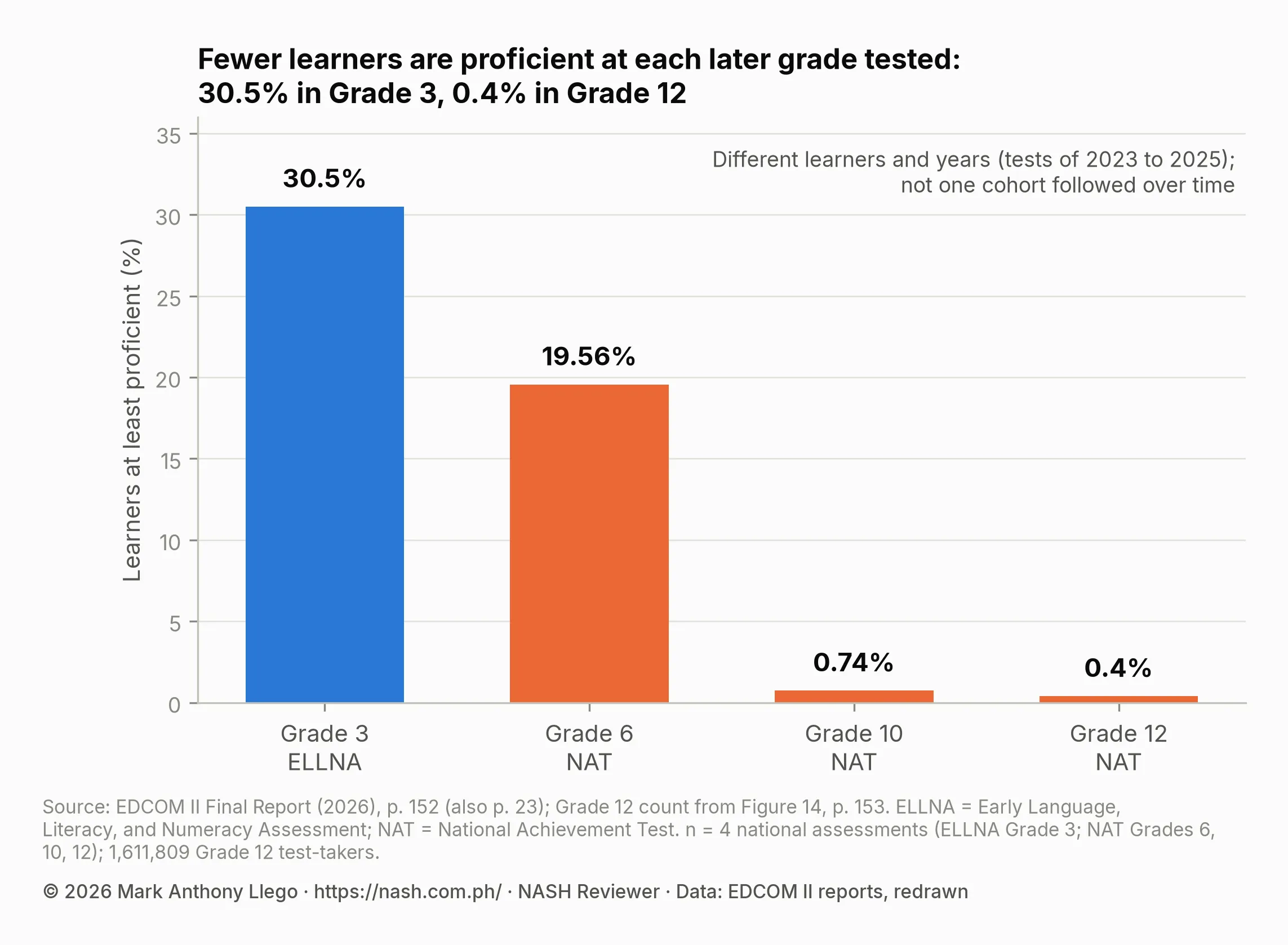
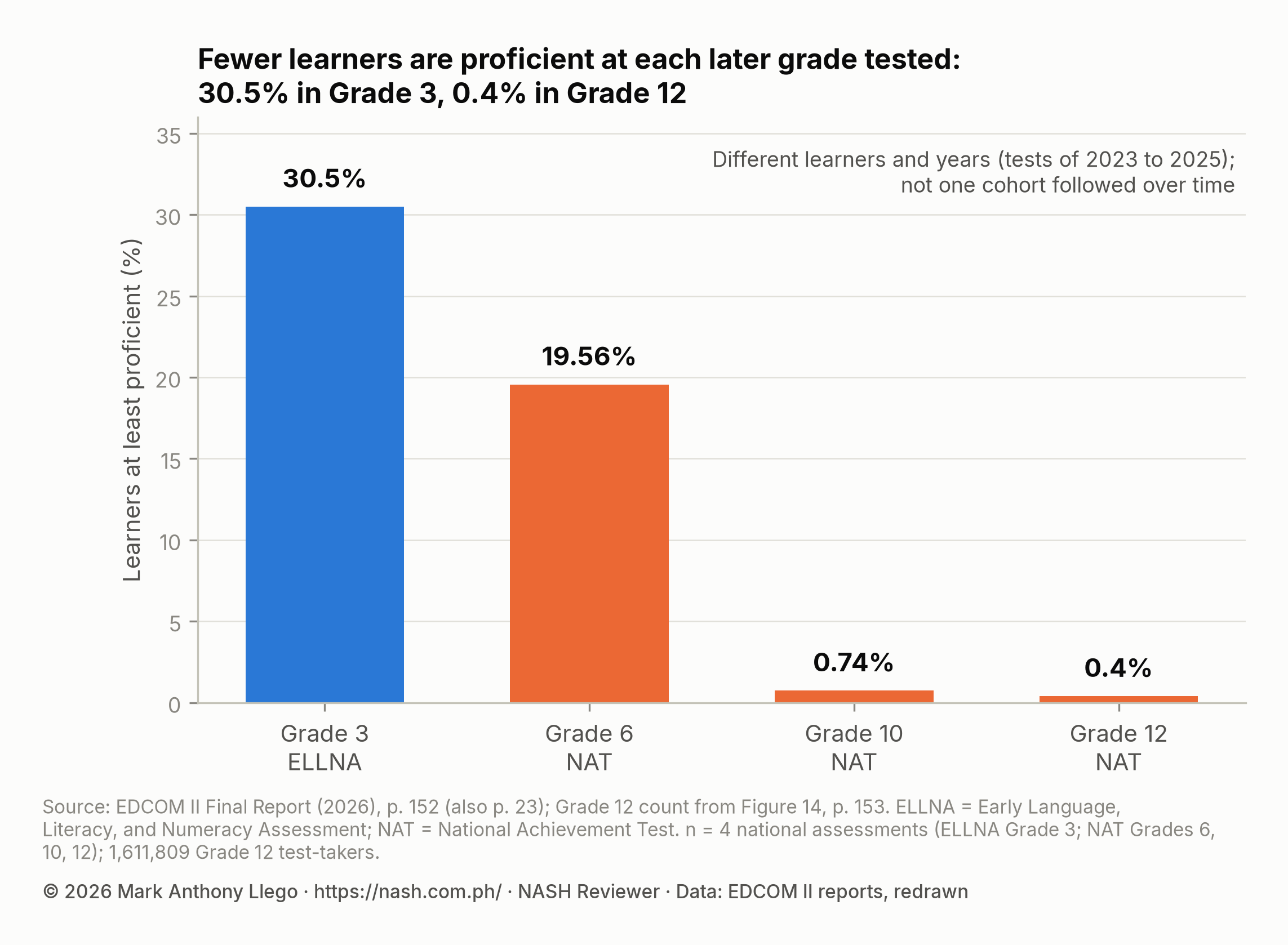
- Proficiency falls at each later grade tested. At least 30.5% of Grade 3 learners were proficient on the Early Language, Literacy, and Numeracy Assessment (ELLNA), against 19.56% in Grade 6, 0.74% in Grade 10 and 0.4% in Grade 12 on the National Achievement Test (NAT). EDCOM reads this as “the possible consequences of ‘mass promotion’ practices” (Final Report, p. 152).
- No policy requires automatic promotion, but the system rewards it. Teachers told EDCOM that promotion, completion and dropout rates are “headline metrics” in many IPCRFs and OPCRFs, that failing a learner triggers rounds of documentation, and that some principals “discourage or prohibit failing learners” (Final Report, pp. 161–162).
- The old grading table hid the gap. Under DepEd Order No. 8, s. 2015, an initial grade of 60.00 became a passing 75, and a 0 became a 60 (Final Report, p. 163). DepEd Order No. 015, s. 2026 replaced it: 70.00 is now needed for a 75 in SY 2026-2027, and grades are reported without transmutation from SY 2027-2028 (DO 015, s. 2026, paras. 48 and 50).
- EDCOM’s Recommendation 2.1.4 is to end mass promotion. It asks DepEd to fully implement the ARAL Program, revise RPMS, OPCRF and General Appropriations Act (GAA) targets in 2026, and phase out transmutation in 2027-2028 (Final Report, p. 451).
- Schools hold fewer class days than prescribed. EDCOM’s review of DepEd calendars since 2018 finds “around 191 actual class days per year”, against the 205 days of DepEd Order No. 9, s. 2005, and at least 28 nationally observed activities and contests each year (Final Report, pp. 168–169).
- Disasters take the most days. In the first two quarters of SY 2024-2025, the Cordillera Administrative Region (CAR) lost 35 of 80 school days, and six more Luzon regions lost 20 or more (Year Two Report, p. 143).
- DepEd’s 2026 calendar moves activities out of the Instructional Block. DepEd Order No. 009, s. 2026 sets 201 class days for SY 2026-2027, holds legislated activities “strictly within the classroom”, and moves Central Office activities and contest eliminations to the End-of-Term Blocks (DO 009, s. 2026, paras. 4, 18 and 20).
What EDCOM II means by “mass promotion”
EDCOM uses the term for a practice, not a policy. Issue 4 of Priority Area 7 is titled “Mass promotion practices must be decisively addressed and phased out immediately.” It describes “de facto mass promotion practices” that persist “even though no DepEd policy formally mandates automatic promotion” (Final Report, p. 161). Teachers and parents told the Commission that learners are advanced “regardless of demonstrated proficiency”, and that report card grades diverge from what children can do at home and in class.
The Year One Report had already raised the concern. It questioned a literacy survey that counts every high school completer as functionally literate, “particularly in light of the issues related to grading practices and ‘mass promotion’” (Year One Report, p. 100).
What the assessment results show
The Final Report lays out four national results side by side (Final Report, p. 152). They come from different learners tested from 2023 to 2025, so they are not one cohort followed through school. EDCOM’s reading is still blunt: the share of proficient learners collapses as learners move up the grades.
The Grade 12 NAT of SY 2023-2024 shows where the learners sit (Final Report, Figure 14, p. 153):
| Proficiency level | Learners | Share |
|---|---|---|
| Not Proficient | 80,938 | 5.02% |
| Low Proficient | 1,113,757 | 69.10% |
| Nearly Proficient | 410,596 | 25.47% |
| Proficient | 6,518 | 0.40% |
| Total | 1,611,809 |
In the report’s words, 74% “did not meet the minimum level of skills tested” (p. 154). In schools in geographically isolated and disadvantaged areas (GIDA), Last Mile Schools, Indigenous Peoples Education schools, Madrasah Education Program schools and hardship posts, 266 of 210,350 Grade 12 learners (0.13%) reached Proficient (p. 154).
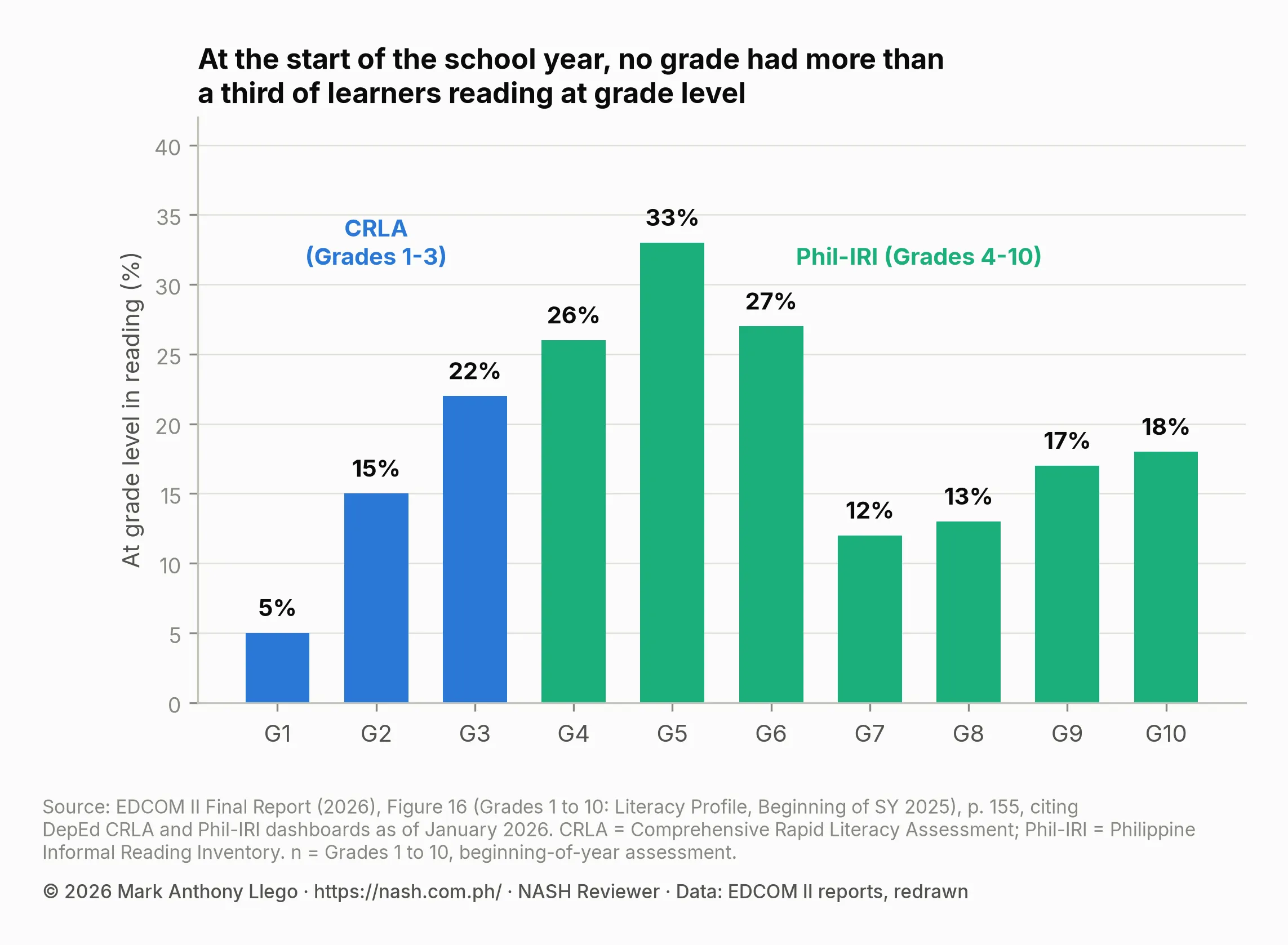
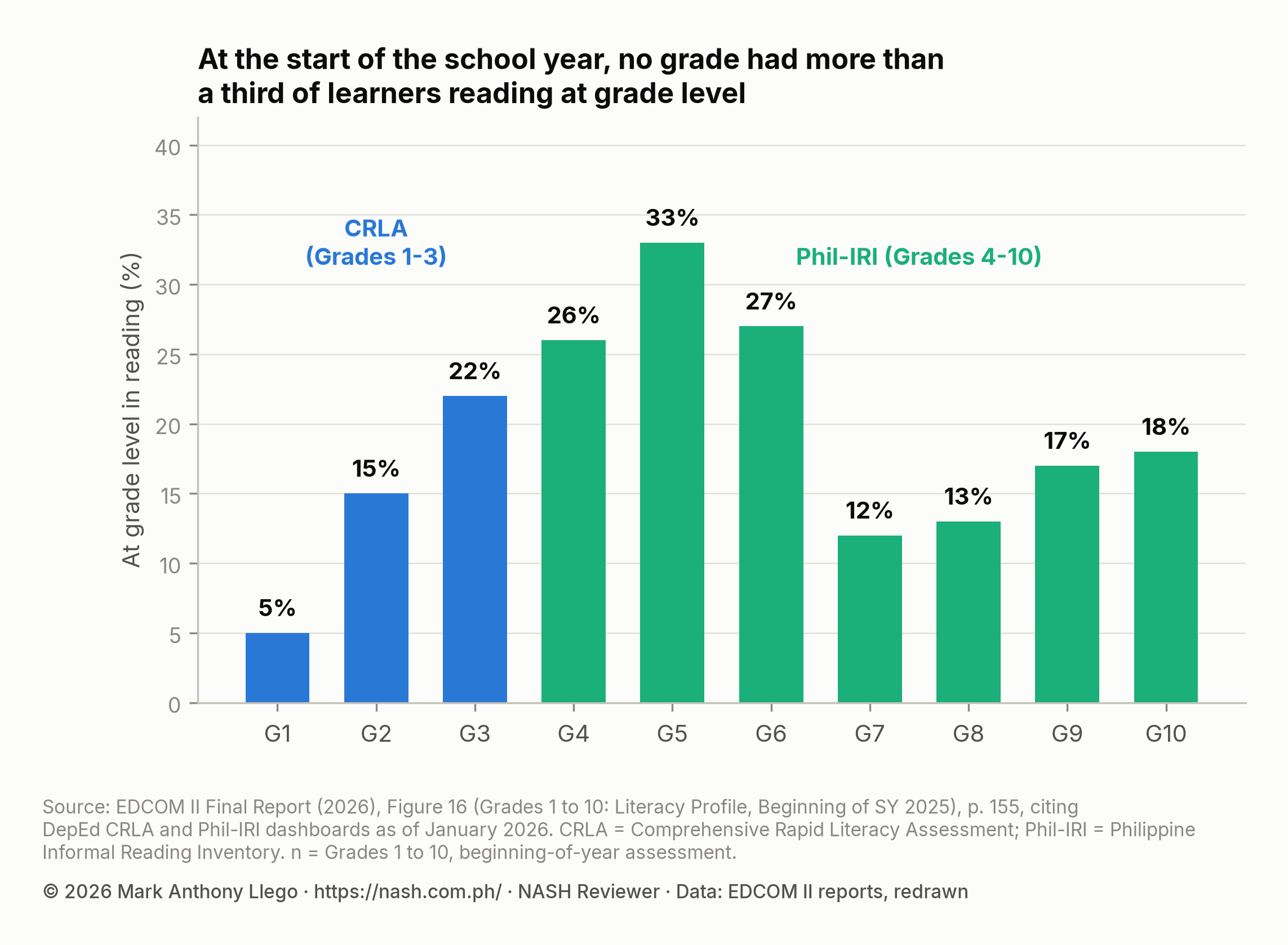
Reading tells the same story. When DepEd assessed reading at the start of the school year in Grades 1 to 10, “the majority of students, particularly among Grades 4 to 10, are struggling readers”. In Grades 4 to 10, the share of struggling readers ranged from 67% in Grade 5 to 88% in Grade 7, and 40% to 52% of junior high school learners were at least two grade levels down on the Philippine Informal Reading Inventory (Phil-IRI) (Final Report, p. 155). EDCOM again calls this evidence of “the urgency of addressing ‘mass promotion’”.
| Grade | 1 | 2 | 3 | 4 | 5 | 6 | 7 | 8 | 9 | 10 |
|---|---|---|---|---|---|---|---|---|---|---|
| At grade level | 5% | 15% | 22% | 26% | 33% | 27% | 12% | 13% | 17% | 18% |
| Tool | CRLA | CRLA | CRLA | Phil-IRI | Phil-IRI | Phil-IRI | Phil-IRI | Phil-IRI | Phil-IRI | Phil-IRI |
The Comprehensive Rapid Literacy Assessment (CRLA) covers Grades 1 to 3 and the Phil-IRI Grades 4 to 10, so the two halves use different tools. In every grade, most learners started the year below the level the grade assumes. The CRLA results for SY 2025-2026 show the gap school by school.
Why teachers pass learners who have not mastered the grade
EDCOM names three forces behind the practice.
1. The grading rules. The transmutation table of DepEd Order No. 8, s. 2015 converted “very low raw scores into passing or near passing final grades” (Final Report, p. 162). The report reprints the table as Table 5 (p. 163): an initial grade of 60.00 to 61.59 became 75, and 0 to 3.99 became 60. Teachers said this made it hard “to flag learners for referral to ARAL or BBMP, or to explain to parents why a child who appears to be ‘passing’ is still unable to read independently” (p. 162).
2. The performance targets. Retaining a learner brings “additional layers of approval, close scrutiny from school heads, and the risk of being blamed for a ‘high failure rate’”, because “promotion, completion, and dropout indicators are still used as headline metrics in many Individual and Office Performance Commitment and Review Forms (IPCRF and OPCRF) and in school report cards” (Final Report, p. 162). The report adds: “Principals, in turn, feel pressure to maintain high promotion rates, and some explicitly discourage or prohibit failing learners even when non mastery is evident.” The link between the Performance-Based Bonus (PBB) and the student promotion rate was removed in 2019, yet the practice persists (p. 451).
3. The burdens that land on the teacher. Failing a learner “triggers extensive administrative requirements, including documentation of multiple rounds of remediation and home visits” (p. 161). Teachers cited absenteeism, child work, unstable caregiving and parents with low literacy. Some reported being “confronted or threatened by parents”, with the Child Protection Policy occasionally invoked “in adversarial ways” (p. 162). EDCOM concludes that teachers “remain the default ‘shock absorbers’ of wider social and household factors that drive mass promotion”. One Facebook comment reprinted in the report gives the field’s version: “Wala Kang karapatang mambagsak kung DI MO GINAWA LAHAT” (“You have no right to fail anyone if you have not done everything”) (p. 164).
The report’s conclusion is about evaluation. Teachers and school heads should be “evaluated on the quality of assessment, remediation, and communication with families”, not “informally judged by how close they come to ‘zero failures’ each year” (p. 166).
Ending mass promotion is not the same as retaining learners
EDCOM’s own data warn against reading the problem as too few retentions. In the 2024 Southeast Asia Primary Learning Metrics (SEA-PLM), 28% of Filipino Grade 5 students had repeated a grade, and grade repetition “consistently emerges as one of the strongest predictors of low proficiency” (Final Report, p. 150). That is an association, not proof that repetition causes low scores, but it rules out retention as a cure on its own.
EDCOM’s executive director said as much when the plan was handed over: “Ending ‘mass promotion’ must not be simplistically interpreted as retaining students. It means vigilantly monitoring struggling students, improving how lessons are delivered day-to-day, and providing robust remediation and learner support.” He added that learners who missed too many classes or refused remediation should not be “automatically promoted” (EDCOM 2, January 30, 2026).
What EDCOM II recommends on mass promotion
Ending mass promotion is the seventh of the National Education Plan’s 20 priority reforms (Final Report, pp. 40–41). Its full wording on page 451 is: “RECOMMENDATION 2.1.4. End ‘mass promotion’ in schools (Fully implement ARAL; Revise RPMS, OPCR and GAA targets; and Rescinding the grade transmutation policy).” The plan’s summary table words it as “aligning RPMS, OPCR and GAA targets with learning outcomes” (p. 444).
| Output | Baseline | Target and timeline | Agency |
|---|---|---|---|
| 2.1.4.a Fully implement the ARAL Program (Republic Act 12028) | Initial implementation in reading for SY 2025-2026 | Continuous refinement to support learners in reading, math and science | DepEd |
| 2.1.4.b Amend the RPMS, OPCRF and other targets that lead to mass promotion | Persisting practice despite the removal of the link between the PBB and student promotion rate in 2019 | 2026: review all policies and plans that “unintendedly encourage mass promotion (e.g. GAA DepDev targets)”; set context-specific targets at every level; revise the RPMS to remove “the link between school principals’ incentives and student promotion”; add safeguards for teacher autonomy. 2027-2035: implement the revised RPMS and OPCRF | DepEd and DepDev |
| 2.1.4.c Phase out the grade transmutation policy | DO 8, s. 2015 under review | 2027-2028: phaseout | DepEd |
| 2.1.4.d Train teachers in functional literacy and remediation | To be set in ARAL’s implementation in SY 2025-2026 | 100% in 2028, 2031 and 2035 | DepEd |
| 2.1.4.e Vision screening for all Kindergarten learners (Republic Act 11358) | Full implementation from 2026, with catch-up for older batches | 100% | DepEd |
Source: EDCOM II Final Report (2026), Recommendation 2.1.4, p. 451.
The text under the table is the part that concerns school heads most. DepEd should revise the RPMS and the OPCRF “to ensure that targets or incentives within these systems are not linked, directly or indirectly, to student promotion or dropout rates” (p. 451). The guide to the National Education Plan covers the targets and costs of Recommendation 2.1.4.
Three other passages fill in the details:
- Grading reform (Priority Area 6, Recommendation 4, p. 146): phase out the transmutation table, adopt “a more descriptive or criterion‑referenced grading approach”, and add “clear safeguards” for teachers’ “professional autonomy in deciding learner promotion, preventing coercion”.
- ARAL as part of teaching (Priority Area 7, Recommendation 3, p. 177): plan ARAL on classroom assessments and progress data, and “schedule sessions without eroding regular instructional time”.
- Prevention as well as remediation (p. 454): fund “preventive K-3 instruction” and remediation through “distinct budget lines”, including “protected daily time, teacher coaching, production of decodable texts, early identification, and family engagement”.
EDCOM II lists among its collective accomplishments a pushed revision of DepEd’s OPCR and a letter to DepEd, DepDev and the Department of Budget and Management “to reconsider targets that unitendedly reinforce mass promotion practices on the ground” (p. 76). On February 3, 2026, the Senate adopted the plan through Senate Concurrent Resolution No. 8. In EDCOM’s account, “A central mandate of the plan is the definitive end to ‘mass promotion’ in schools” (EDCOM 2, February 3, 2026).
What DepEd policy says now about grading and promotion
DO 015, s. 2026 replaced the 2015 transmutation table
DepEd Order No. 015, s. 2026, issued June 4, 2026, repeals DepEd Order No. 8, s. 2015 and DO No. 36, s. 2016 on awards, and applies to public schools from SY 2026-2027 (order, paras. 3 and 6). Its rationale names the same problems EDCOM did: “grade inflation, overreliance on transmutation, inconsistent promotion standards, and the limited use of assessment evidence to inform instruction” (Enclosure, para. 3).
- SY 2026-2027: an adjusted transmutation table in which “a raw grade of 70 corresponds to a transmuted passing grade of 75” (para. 48).
- From SY 2027-2028: “a zero-based grading system” for Key Stages 2 to 4, with term grades “based directly on computed IGs without transmutation, with 75 as the minimum passing grade” (para. 50). The lowest grade on the report card stays at 60 (Annex D, para. 18).
That schedule matches the 2027-2028 phaseout in output 2.1.4.c. The order itself does not cite EDCOM.
The order states the zero-based scope two ways. Paragraph 50 (and para. 86) says Key Stages 2 to 4, but Annex D, para. 13 names only “KS2 (Grades 4-6) to KS3 (Grades 7-10)”, so senior high school should watch for a clarifying issuance. Grade 3 also uses zero-based grading in SY 2027-2028 (para. 57), and SHS Grade 12 keeps DO 8’s component weights in SY 2026-2027 while using the adjusted table (para. 49).
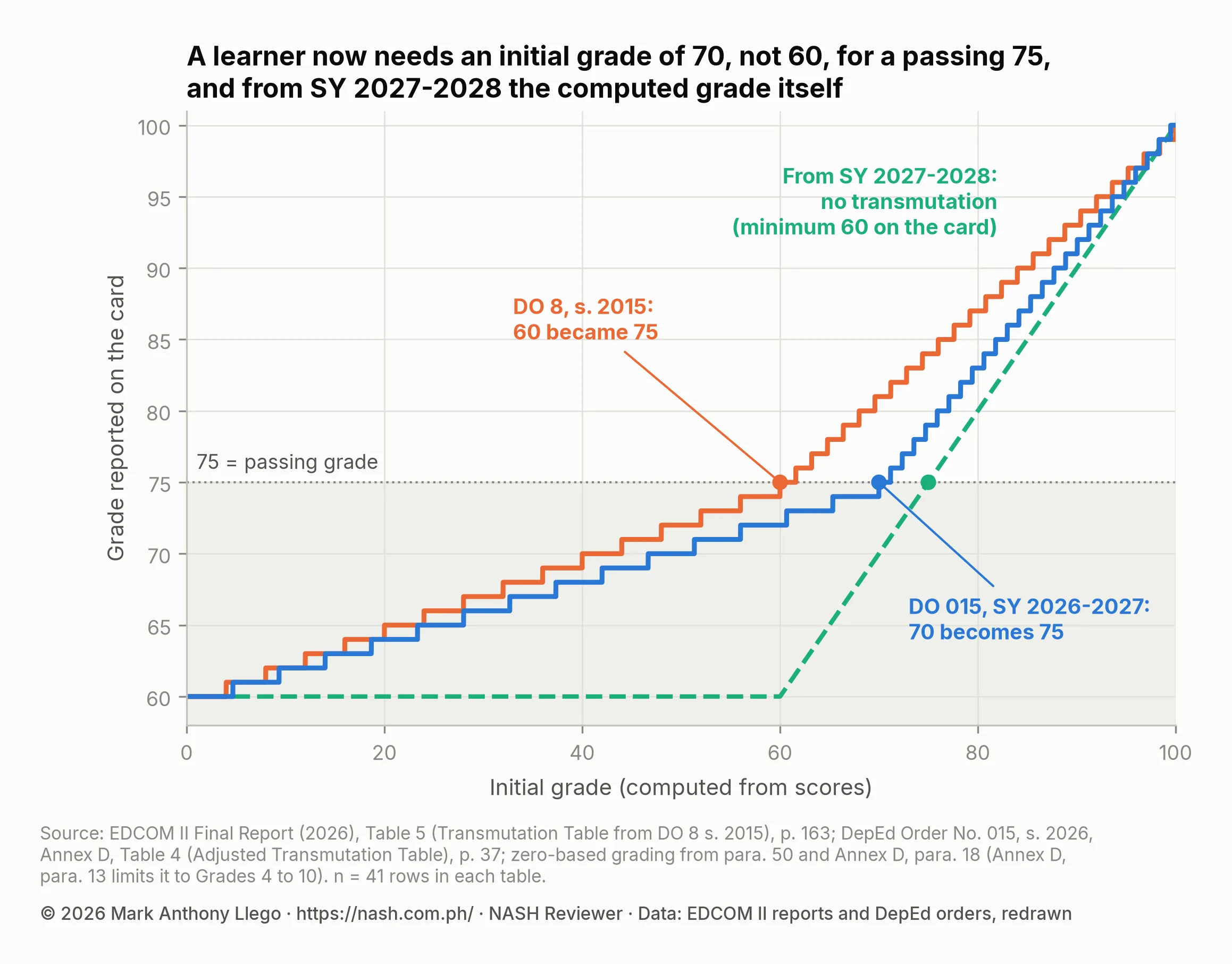
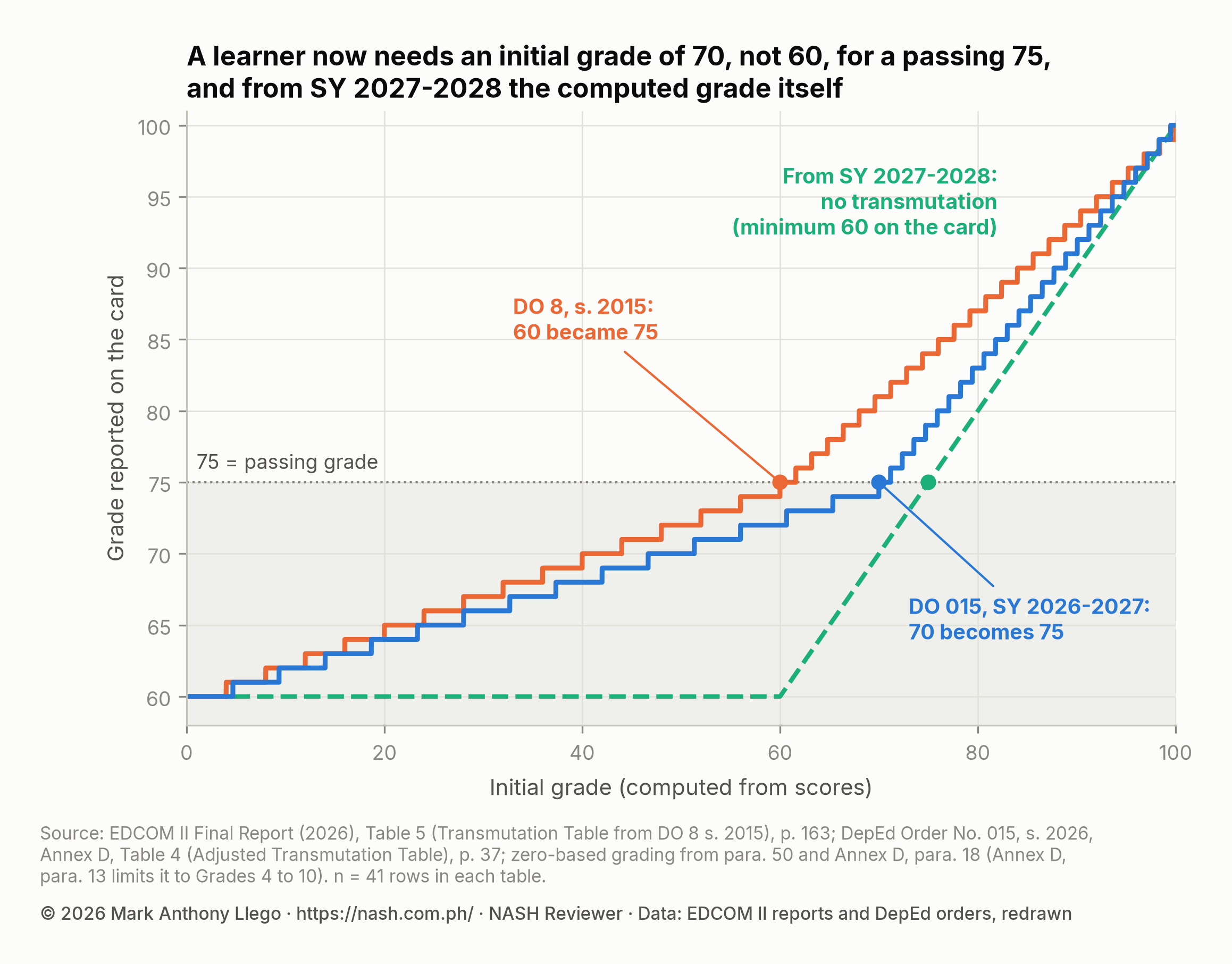
| Initial grade | DO 8, s. 2015 | DO 015, SY 2026-2027 | DO 015, from SY 2027-2028 |
|---|---|---|---|
| 50 | 72 | 70 | 60 (the minimum) |
| 60 | 75 (passed) | 72 | 60 |
| 70 | 81 | 75 (passed) | 70 |
| 75 | 84 | 79 | 75 (passed) |
The DO 8 and DO 015 SY 2026-2027 columns are rows of the two printed tables; the last column applies the zero-based rule and its minimum of 60. The guide to DO 015, s. 2026 explains the weights, descriptors and awards.
Promotion now depends on intervention as well as grades
Section VIII of DO 015 starts from the principle that assessment results “inform instruction, provide appropriate support, and promote continuous improvement, rather than serve as punitive measures” (para. 62).
- Kindergarten to Grade 3: promotion is “developmentally appropriate and non-punitive”. Learners “shall not be retained solely based on age, a single assessment result, or academic performance”. Retention may be recommended, with the parents, only after “sustained interventions and support” (paras. 63–65).
- Grades 4 to 12, and Grades 2 and 3 while still graded numerically: learners below standard “shall receive timely, targeted, and documented remediation integrated within instruction”, and promotion “shall consider both achievement and participation in required interventions” (para. 67). A learner who fails at most two learning areas attends the Summer Remedial Class; one who still fails is conditionally promoted with back subjects; one who fails more than two is retained.
- Timing: remediation “shall begin as early as Week 5 following the first ST [summative test]”, through classroom interventions, ARAL or other school strategies (para. 68). Teachers act with parents “by the end of Term 1 or when a learner reaches approximately twelve (12) absences” (para. 70). Absences beyond 20% of class days mean a failing grade unless justified, and the school head may grant documented exemptions (Annex D, para. 22).
DO 015 does not remove the documentation that EDCOM said discourages failing grades; it makes documented remediation part of the decision. Kept well, that record shows the school intervened before it decided, and it backs the teacher who reports a failing grade.
ARAL: Republic Act No. 12028 and DO 018, s. 2025
Republic Act No. 12028, the “Academic Recovery and Accessible Learning (ARAL) Program Act”, was approved on October 16, 2024. EDCOM describes it as “a free national learning intervention program for kindergarten to Grade 10 learners who are returning after a furlough, are below minimum proficiency in reading, mathematics, and science, or are failing examinations” (Final Report, p. 166). DepEd adapted it through DepEd Order No. 018, s. 2025, which makes ARAL the “umbrella program” for learning recovery, with Reading, Mathematics, Science and Summer components (para. 3). The law’s implementing rules were disseminated through DepEd Memorandum No. 058, s. 2025, ARAL-Reading runs under DepEd Memorandum No. 064, s. 2025, and tutors are engaged under DepEd Memorandum No. 001, s. 2026, as amended by DepEd Memorandum No. 061, s. 2026, which makes the engagement of DepEd teachers as ARAL tutors “not … mandatory” (enclosure, item 6.d).
The Final Report dates ARAL’s start two ways: “In SY 2024-25, DepEd began implementation of the ARAL Program” (p. 167), but DepEd “is in its first year of implementing the ARAL program for SY 2025-26” (p. 166), and the plan’s baseline is “Initial implementation in reading for SY 2025-2026” (p. 451). DepEd’s own guidelines start ARAL-Reading “in the second quarter of school year (SY) 2025–2026” (DepEd Memorandum No. 064, s. 2025, para. 2). For SY 2025-2026 that memorandum prioritized “Low and High Emerging learners in Key Stage 1 and learners in the Frustration level in Key Stages 2 and 3” (Enclosure No. 1, para. 7), a narrower group than the profiles below.
The rules a school head applies:
- Who is in it. Learners tagged in the Learner Information System as returning from a furlough, learners below minimum proficiency on the CRLA, Phil-IRI or Rapid Mathematics Assessment (RMA), and learners failing classroom tests (para. 35). In reading, that means CRLA “Emerging,” “Developing,” and “Transitioning” and Phil-IRI “Frustration” and “Instructional” (para. 39.1).
- Classroom first. Learners who miss lesson objectives “may not necessarily become ARAL learners”; they first receive the teacher’s interventions, and are referred if they still fall behind (para. 25).
- How sessions run. No more than one hour per learning area on weekdays, or two hours on weekends (para. 61); a recommended ratio of 1:5, or small groups of up to 1:15 where teachers are short (para. 64). Teachers “shall not serve as tutors of their own learners” (para. 49.1). DO 018 also allows pull-out sessions “during regular class hours” (para. 60.1). DepEd Memorandum No. 060, s. 2026 does the same for Mathematics (para. 16.1), sets “a 1:10 or a maximum of 1:15” ratio (para. 19), and starts ARAL-Mathematics “in Term 2 or once schools are fully prepared” in SY 2026-2027 (para. 2).
- When. Under the three-term calendar, structured ARAL sessions are held “after classes, for a duration of 30-60 minutes on designated days, two (2) to four (4) times per week” (DO 009, s. 2026, para. 13), both “within the Instructional Block and during the End-of-Term Block” (para. 33).
- When it is not working. Learners who do not improve are reported to the school head (para. 44.3), and Grades 2 to 10 learners with signs of learning difficulty are referred to the multidisciplinary team of an Inclusive Learning Resource Center (para. 46).
DepEd also set the 2026 ARAL Summer Programs for May 6 to June 2, 2026 under DepEd Order No. 010, s. 2026.
EDCOM credits early results: in the Bawat Bata Makababasa Program pilot in Region IX, an impact evaluation found that learners gained “up to 1.3 years worth of schooling” in a 20-day remediation, and in the national Literacy Remediation Program “96% of ‘low emerging readers’ moved up by at least one proficiency level following the 18-day program” (Final Report, p. 167). These are different runs, a regional pilot and the national run, with different measures, so the two results should not be added or compared. EDCOM also warns that programs have focused on the lowest readers, “still leaving more than 1.6 million transitioning readers who need targeted comprehension support” (p. 167).
Performance targets have not yet been revised
Output 2.1.4.b was due in 2026. As of October 30, 2026, no DepEd order or memorandum has revised promotion or dropout targets in the RPMS or the OPCRF. The OPCRF guide describes the form school heads use now and the PPSSH-based tools DepEd is drafting. Until a new issuance appears, the choice of targets is largely the school head’s and the division’s.
Lost instructional time: what EDCOM II found
Fewer class days than the calendar promises
The executive summary puts the problem in one sentence. While Republic Act No. 11480 “recommends no more than 220 days in the school calendar” and DepEd Order No. 9, s. 2005 “prescribes 205 school days devoted to ‘engaged time-on-task’”, public schools operate “with an average of only about 191 actual class days per year” (Final Report, p. 24). The analysis covers DepEd calendars since 2018 (p. 168).
Activities crowd the days that remain. The report counts “at least 28 nationally observed activities, commemorations, and contests each year”, from the National Schools Press Conference and the Palarong Pambansa to the National Festival of Talents (p. 168). Many “progress from school to division, regional, and national levels, with corresponding try outs, practices, and documentation” (p. 168). DepEd intends Araw ng Pagbasa as a one-hour activity, yet teachers describe “substantial preparation and reporting requirements” around it (p. 169). Table 6 of the report lists sample observances legislated from 1954 to 1999 (pp. 170–171).
The report gives two totals for legislated activities: “over 120” in the executive summary (p. 24) and “around 150” in the chapter (p. 168). It does not explain the difference. A March 2026 EDCOM release, citing the Final Report, speaks of “115+ mandated celebrations, commemorations, and contests” (EDCOM 2, March 4, 2026). Take the order of magnitude, not the exact count. The same release reports a Senate hearing that urged DepEd “to ensure that the minimum number of 180 instructional days are strictly protected and met”; the release does not define “instructional days”.
The Year One Report had cited an estimate that teachers spend “approximately 70 out of 220 school days entering data into the DepEd system”, based on an Analytics Association of the Philippines analysis “which EDCOM is currently confirming” (Year One Report, p. xlviii). Treat that figure as unconfirmed.
Disasters, heat and class suspensions
Natural calamities, such as high heat in April and May and typhoons, cause the largest disruptions (EDCOM 2, March 4, 2026). Figure 13 of the Year Two Report counts school days lost out of 80 in the first two quarters of SY 2024-2025.
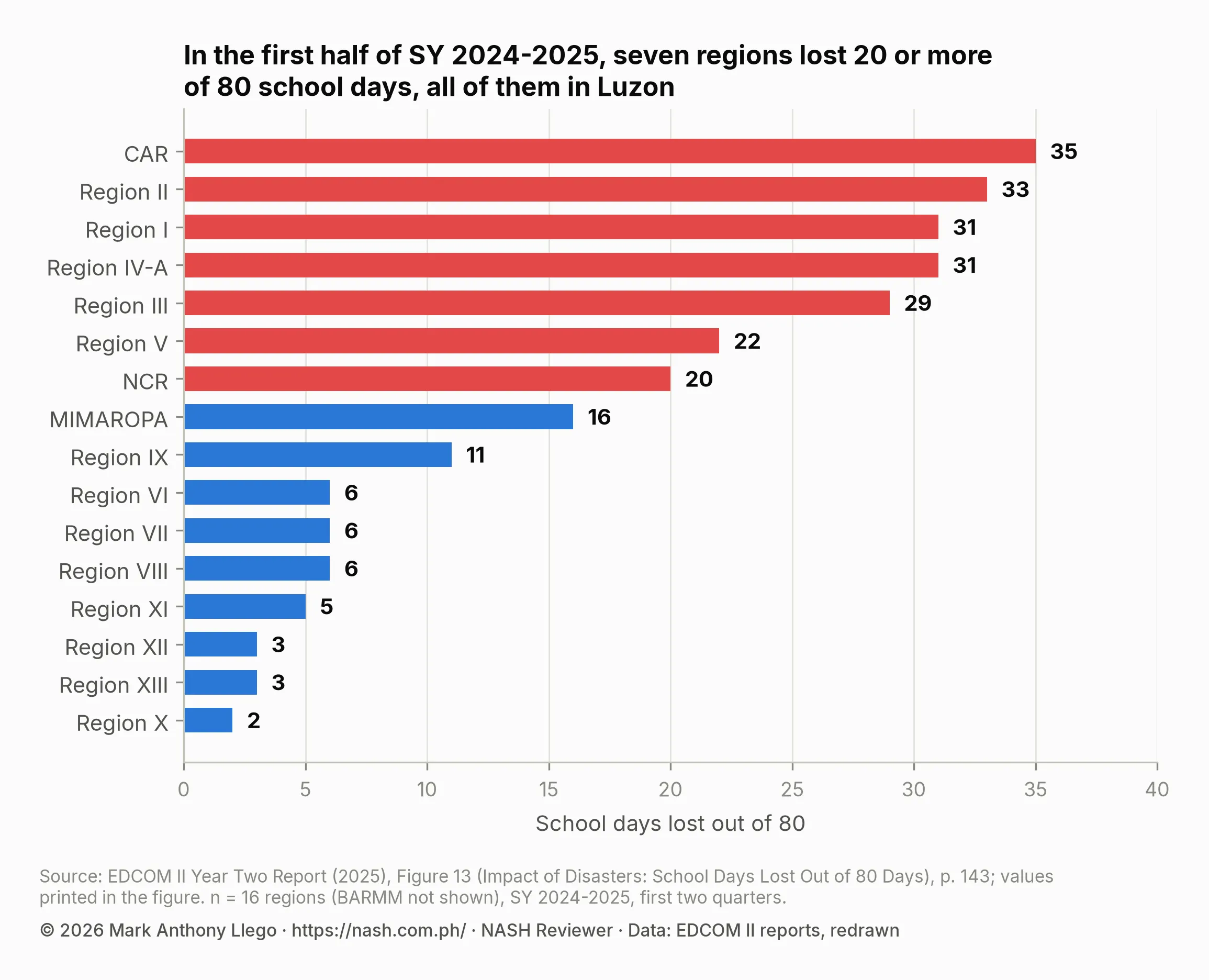
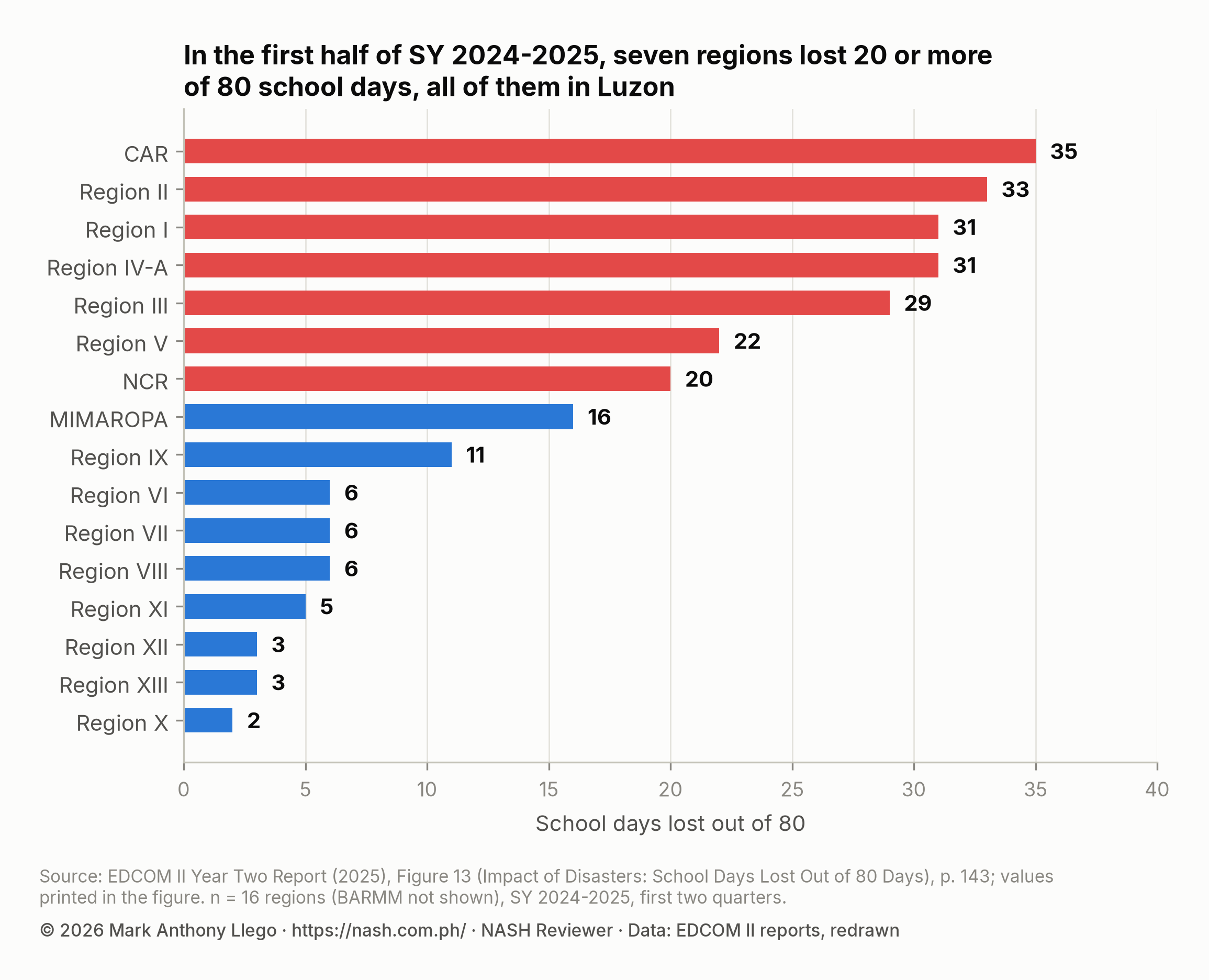
The same figure notes that 42% of the public school K-12 population, 11 million learners, “lost over 20 days due to class suspensions in SY 2023-2024” (Year Two Report, p. 143). The report’s text gives other counts. Its executive summary says DepEd data “as of November 2024” show “as many as 42 learning days in CAR, followed by Region IV-A (38 days), Region II (36 days), and Region I (33 days)” (p. 23), while the chapter puts 42 days in CAR and 27 in NCR in SY 2023-2024 (p. 142). The report does not reconcile these with the figure. The Final Report later says “some regions lose up to 42 days” (p. 168).
The learning cost is large. Citing a TIMSS-based study, the Final Report says each additional day of suspension linked to schools used as evacuation centers “results in a 12 to 14% of a standard deviation decline in Grade 4 mathematics and science scores” (p. 187).
Teaching days lost to non-teaching tasks
A Philippine Institute for Development Studies (PIDS) study gave the first total. Its preliminary findings, from 35 schools piloting the MATATAG curriculum, estimated that “fifty-three (53) teaching days were lost in the school year 2023-2024” to non-teaching tasks, calamities and local holidays. Of the 53, 32 were affected by “the high heat index and other calamities”, and teachers recalled missing an average of 25 teaching days from September 2023 to March 2024 (EDCOM 2, June 19, 2024). The Year Two Report’s executive summary renders the finding as “about 53% of 180 teaching days” (p. 23), while the release equates 53 days to “up to 30% of the 180 days”. The two do not match, and the report does not explain the difference; the release gives the breakdown.
Newer findings in 2026 (preliminary)
EDCOM’s 2026 releases extend the count. They are not part of the three reports, and EDCOM marks some as preliminary.
- An average of 15 school days lost per year to calamity-related suspensions across SY 2024-2025 and SY 2025-2026, as an unweighted average per Schools Division Office; Negros Occidental lost 71 days to the Kanlaon Volcano eruption (EDCOM 2, August 20, 2026).
- In SY 2025-2026, “a typical public elementary school lost approximately 20 teaching days to hazard-related suspensions”. From August 1 to September 15, 2026, “12 out of 28 class days were cancelled across the National Capital Region and several provinces” (EDCOM 2, September 15, 2026).
- The same policy note’s preliminary estimate is that each suspended day costs “approximately 1.4 days of reading progress” in Grades 1 to 3. It proposes amending Executive Order No. 66, s. 2012 so that school heads can suspend classes, and resume them, based on conditions at their own school. DepEd already lets a school head suspend classes when there is no automatic or LGU suspension, in coordination with the local chief executive and the Schools Division Superintendent (DepEd Order No. 022, s. 2024, Sec. III.5.h; for heat, DepEd Memorandum No. 064, s. 2026, Sec. 5.2.2). The note would put that authority, and the power to resume classes, into the executive order.
What EDCOM II recommends on instructional time
- Protect instructional time “by reducing overload from non-instructional activities and improving governance of school calendar disruptions” (Final Report, p. 26, Policy Recommendation 12).
- Review every mandate against “relevance to curriculum standards, evidence of impact, equity of participation, and opportunity cost in terms of class days lost”. Integrate, merge or move observances outside class days, “with explicit reference to the time-on-task protections in DepEd Order No. 9, s. 2005”. Congress “may also adopt a stricter standard for creating new legislated school-based observances” (p. 177, Recommendation 4).
- Keep contests from displacing classes. National events are mostly held during the summer break, but the district, division and regional rounds “are held during the school year and cause disruptions in classes”; preparation should happen “within co-curricular periods rather than displacing core subjects” (p. 177, Recommendation 5).
- Make suspensions science-based. DepEd, EDCOM and other agencies have begun work to amend Executive Order No. 66 “to ensure that class suspensions are science-based and ensure learning continuity” (p. 67).
What DepEd policy says now about instructional time
DO 9, s. 2005 is still the base rule
DepEd Order No. 9, s. 2005 remains in force, and 2026 issuances still cite it. It states that “the prescribed 205 school days shall be strictly spent on engaged time-on-task” (para. 2) and sets these rules:
- Observances are integrated into lessons; classes are not suspended for them (para. 4a).
- Contests that support national programs “shall be conducted outside of school hours” (para. 4b).
- Athletic meets and academic and non-academic competitions, “including practices”, are allowed only if “held after class hours and days”, and delegations include only “the competitors, their coaches, and officiating personnel” (para. 4h).
- Every school prepares a calendar of day-to-day activities in consultation with learners, the parent-teacher community association and the local government unit (para. 5a). A planned suspension is filed with the Schools Division Superintendent a week ahead, with a make-up schedule (para. 5b).
- The actual number of school days held “shall be used in the performance appraisal of schools, their respective school heads, and the schools division superintendents” (para. 5c).
Its 205-day figure is not the current count: DO 009, s. 2026 sets 201 class days for SY 2026-2027 and modifies inconsistent issuances (paras. 4 and 41).
DO 009, s. 2026: the three-term calendar
DepEd Order No. 009, s. 2026 sets SY 2026-2027 from June 8, 2026 to April 8, 2027, with 201 class days (para. 4). Each term has an Instructional Block for teaching and an End-of-Term Block for grades, report cards, remediation, training, co-curricular activities and a wellness break.
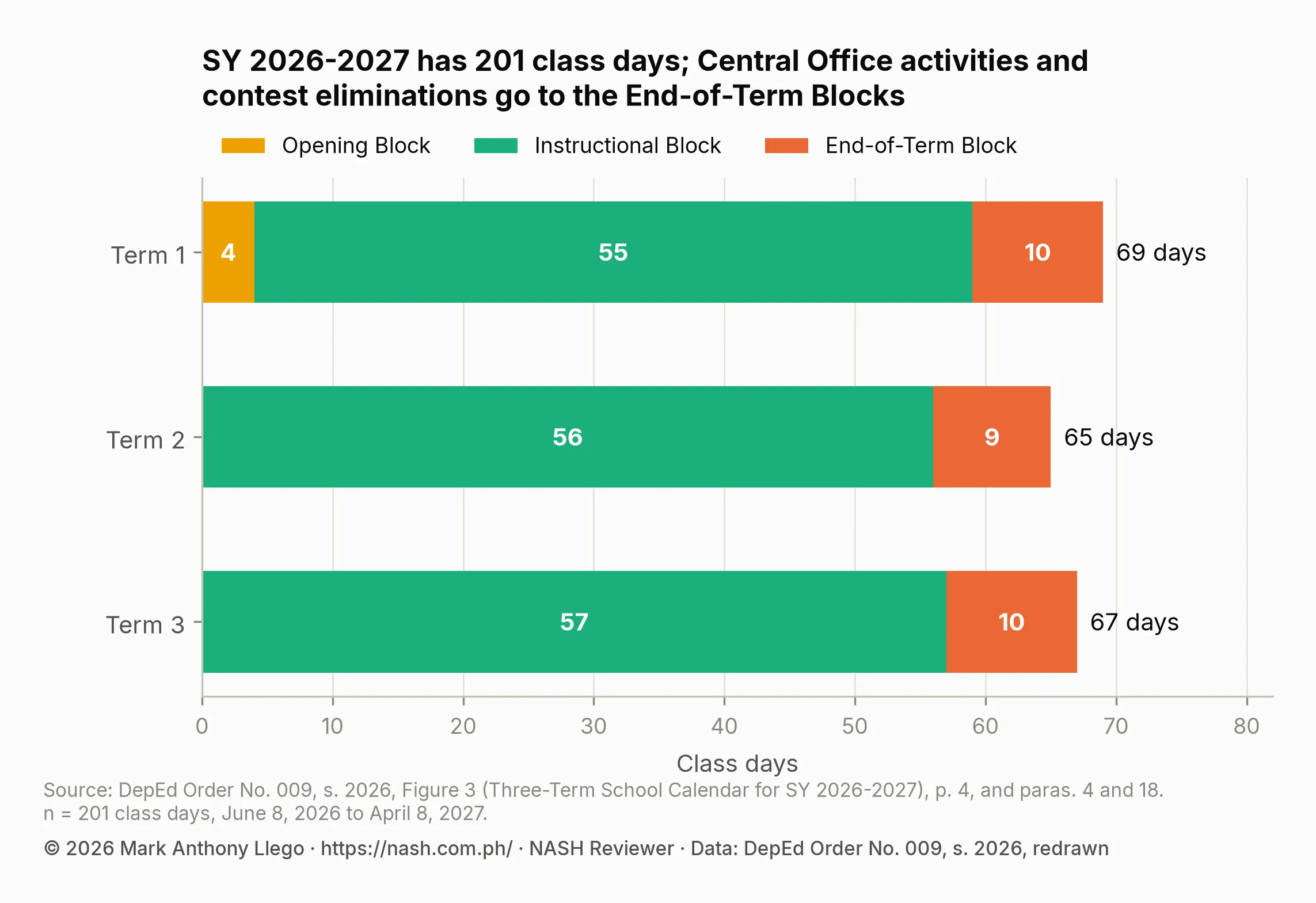
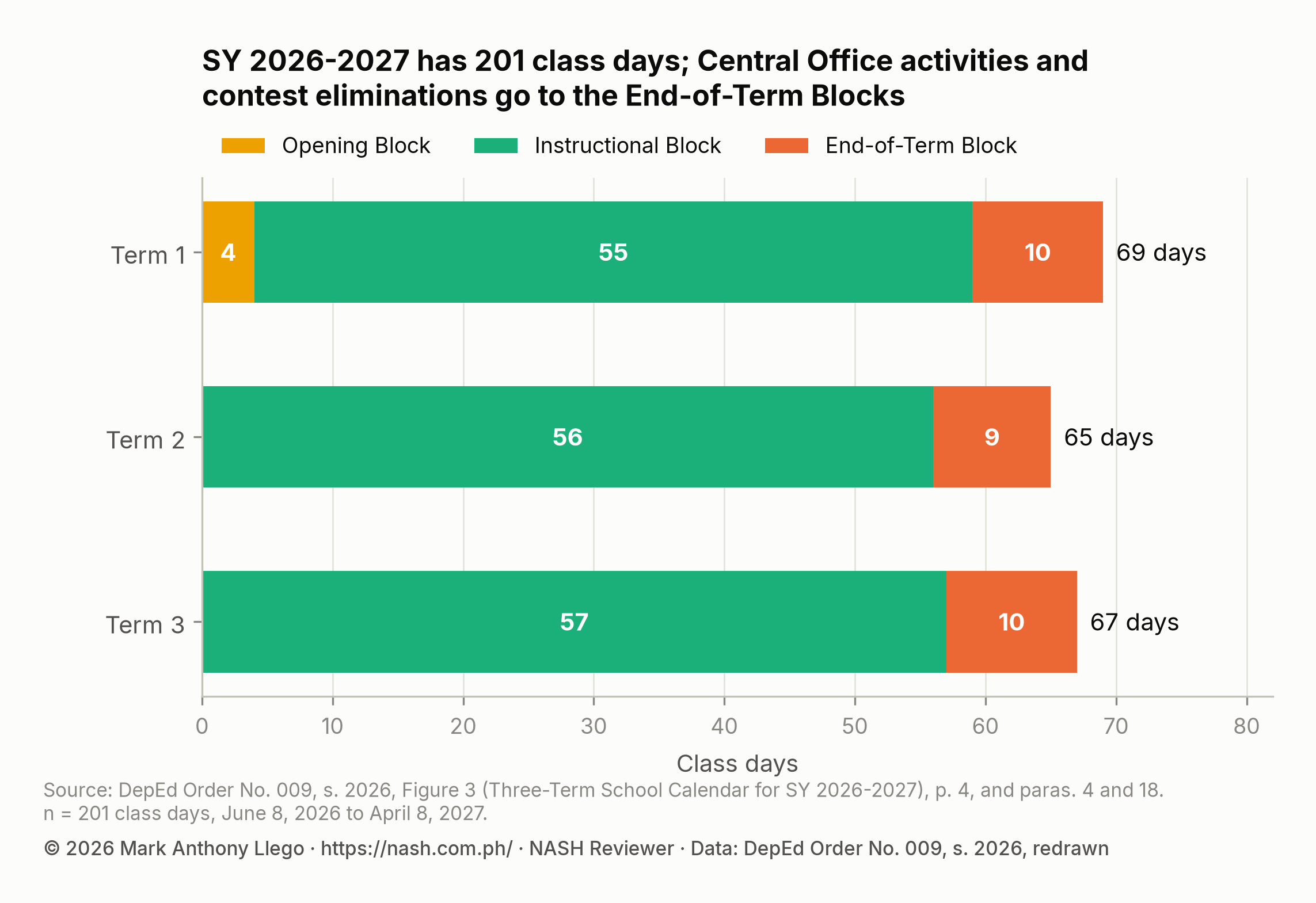
| Term | Opening Block | Instructional Block | End-of-Term Block | Class days |
|---|---|---|---|---|
| Term 1 | 4 | 55 | 10 | 69 |
| Term 2 | 56 | 9 | 65 | |
| Term 3 | 57 | 10 | 67 |
Added up, 168 of the 201 class days are Instructional Block days. The order’s rules on activities answer much of EDCOM’s Issue 6:
- Central Office activities for learners and teachers are held in the End-of-Term Block, and regional offices schedule “layered activities and eliminations within the End-of-Term Blocks” (para. 18). National-level activities happen during the end-of-school-year break (para. 19).
- Legislated activities “shall be conducted strictly within the classroom” through lessons (para. 20.i). When a local holiday or celebration falls in the Instructional Block, schools use asynchronous activities or make-up classes in the End-of-Term Block (para. 20.ii).
- Activities such as the School-Based Feeding Program or mental health services are scheduled “preferably outside class hours” (para. 14).
- Professional development takes two days during the End-of-Term Blocks, for at least 32 hours a year, while Learning Action Cell sessions stay in the Instructional Block (paras. 21–22).
- Alternative delivery is allowed “only during local holidays and other class disruptions for a maximum of five (5) days per term” (para. 32).
Later memoranda apply these rules. The Division Science and Technology Fair was set for September 2–4, 2026 and the regional fair for December 9–11, 2026, “within the End-of-Term Block in compliance with DO No. 9, s. 2005” (DepEd Memorandum No. 058, s. 2026, item 8). The national fair itself is set for February 27–28, 2027, a weekend inside Term 3 rather than the end-of-school-year break, with travel on February 26 allowed “provided that classes will not be disrupted” (items 1 and 17). The 2026 Nutrition Month memorandum states that its activities “shall not hamper instructional time and must comply with DO 009, s. 2026” (DepEd Memorandum No. 045, s. 2026, para. 7).
Teachers’ administrative tasks, class suspensions and make-up classes
DepEd Order No. 002, s. 2024 removed administrative tasks from teachers’ workload. “School Heads and non-teaching personnel shall have the sole responsibility” for personnel administration, property custodianship, general administrative support, financial management, records management and program management, including feeding and school disaster risk reduction (Section V.A.1). The Year Two Report says DepEd told divisions to implement it within 60 days and to cluster up to three schools where non-teaching staff were short (p. 215). The National Education Plan guide covers the staffing targets behind it.
When suspensions pile up, DepEd Order No. 014, s. 2026 applies: “Makeup classes shall be required if the number of actual class days, considering class suspensions and holidays, falls below 90% of the mandatory contact days outlined in the school calendar”, and “Scheduling of makeup classes shall be left to the discretion of the school heads” (para. 68). Who may suspend classes is set by DepEd Order No. 022, s. 2024, which DO 014 complements (Enclosure, para. 5). Where there is no automatic suspension and no LGU declaration, “the school heads … may suspend classes and work” for listed causes such as flooding, long power outages and classroom heat, “provided that there is the necessary coordination with the LCE and SDS” (Sec. III.5.h). For heat, DepEd Memorandum No. 064, s. 2026 adds that “The school head shall coordinate with the SDS for school-level suspension and shift to appropriate distance learning modalities” (Sec. 5.2.2). The El Niño continuity guide explains the learning continuity levels and the annual continuity plan.
What this means for school heads
EDCOM’s diagnosis puts the school head at the center of both problems: principals feel the pressure to keep promotion rates high, and they decide what interrupts class days. Five practices follow from the reports and the orders now in force.
1. Set targets on learning, not on promotion rates
When you draft the OPCRF and the School Improvement Plan, write learning targets: the share of Grade 1 to 3 learners at grade level on the end-of-year CRLA, ARAL learners who exit the program, learners who clear back subjects. Avoid targets such as “100% promotion rate” or “zero failures”, which EDCOM links to mass promotion (Final Report, pp. 162, 166, 451). If your division still asks for promotion and dropout rates, report them honestly beside the learning targets. The OPCRF guide shows where such targets go, and the Domain 4 guide covers performance management under the Philippine Professional Standards for School Heads (PPSSH).
2. Intervene before the promotion decision
DO 015 and DO 018 give a sequence. Put it in the school calendar and the School Improvement Plan.
| When | What happens | Who acts | Rule |
|---|---|---|---|
| Opening Block | Beginning-of-year CRLA, Phil-IRI and RMA; list learners for ARAL | Teachers, reading and ARAL coordinators | DO 009, para. 12; DO 018, para. 35 |
| From Week 5 after the first summative test | Remediation for learners consistently below expectations | Class teacher | DO 015, para. 68 |
| End of Term 1, or about 12 absences | Feedback and intervention with parents | Adviser, with the school head | DO 015, para. 70 |
| Throughout the year | ARAL sessions after class, 30 to 60 minutes, 2 to 4 times a week; progress checks | ARAL tutors and teachers | DO 009, para. 13; DO 018, para. 43 |
| When a learner does not improve | Names go to the school head; referral to an Inclusive Learning Resource Center team where needed | School head | DO 018, paras. 44.3 and 46 |
| End of the school year | Promote, send to the Summer Remedial Class, conditionally promote or retain | Teachers and school head | DO 015, para. 67 |
DO 018 times its midline assessment “after the second quarter examination” (para. 47), wording written for the old quarterly calendar. Follow your division’s schedule for the three-term year.
3. Protect teachers who grade honestly
DO 015 makes you the validator: class records are “subject to validation by school heads” (para. 54), and you “monitor the consistent application of grading policies” (Section X.D.d). Validate the evidence; do not change a grade that the evidence supports. Ask a teacher who reports failing grades for the remediation record, not for a lower failure count. EDCOM asks for safeguards for teacher autonomy “preventing coercion” (p. 146), and a school head can provide that protection now, without waiting for a new RPMS.
Tell parents early. DO 015 asks the school to orient parents and give “clear, timely, and constructive feedback” (Section X.D.c and e). A parent who saw a Developing descriptor and an intervention plan in Term 1 is less likely to be surprised in April. The Domain 5 guide covers communication with parents.
4. Guard the Instructional Block
Before you approve any activity that takes learners or teachers out of class, ask four questions. Is it a Central Office activity or a contest round? Then it belongs in the End-of-Term Block (DO 009, para. 18). Is it a legislated observance? Then it is taught within the lessons (para. 20.i). Is it a practice or a delegation? Then it runs after class hours, with only competitors, coaches and officials (DO 9, s. 2005, para. 4h). Is it a health or feeding service? Then schedule it outside class hours where you can (DO 009, para. 14). When a division memorandum sets a contest inside the Instructional Block, raise the conflict with the division in writing. For ARAL, prefer sessions after class to pull-outs, which take learners out of the lessons they are behind in. The Domain 1 guide treats this as policy implementation.
5. Count the days you actually teach
Keep a running count of class days held against the calendar, with the cause of each lost day. DO 9, s. 2005 still makes the actual days held part of the school head’s appraisal (para. 5c), and DO 014, s. 2026 requires make-up classes below 90% of contact days (para. 68). EDCOM asks that “Each cancelled school day should be recorded” (September 15, 2026 release). The count is also your evidence when you ask for a target to be recalibrated after a disaster.
Records to keep
| Record | Why | Rule |
|---|---|---|
| Class records, assessment tools, rubrics, raw scores and feedback, for at least one school year | Supports every grade and promotion decision | DO 015, para. 61 |
| Remediation and intervention records for each learner below standard | Promotion considers participation in interventions | DO 015, paras. 67–68 |
| ARAL list, progress checks and exits | Shows who was served and who moved | DO 018, paras. 35, 43–45 |
| Attendance, absence interventions and documented exemptions | The 20% absence rule | DO 015, para. 70; Annex D, para. 22 |
| Certificates of Recomputed Final Grade | Clears Summer Remedial Class and back subjects | DO 015, Annex D, para. 21 |
| School calendar, suspension requests, make-up class reports and days actually held | Time on task and make-up rules | DO 9, s. 2005, para. 5; DO 014, s. 2026, para. 68 |
These records are also what the Domain 3 guide calls using learning outcomes for data-based interventions, and what the Domain 2 guide treats as managing school data.
How the NASH may test this
Under DepEd Memorandum No. 069, s. 2025, the NASH covers “conceptual and situational critical thinking questions” aligned with the PPSSH, “using the SOLO (Structure of the Observed Learning Outcome) taxonomy as an underpinning framework” (para. 3). The two items below are original practice items, scored 3 (Relational), 2 (Multistructural), 1 (Unistructural) or 0 (Prestructural).
Question 1
Indicator 3.5.1, Learning assessment. Career Stage 1, Situational, Moderate.
It is the last week of Term 3 in SY 2026-2027. A Grade 5 adviser reports that four learners have final grades below 75 in Mathematics, and one learner fails three learning areas. Two parents have threatened to complain to the division. A senior teacher suggests that the adviser “review” the grades so that everyone passes, as was done in past years. What should the school head do?
- A. Ask the adviser to raise the grades to 75, since retaining learners lowers the school’s promotion rate and invites complaints that the school cannot afford.
- B. Validate the class records and the remediation done since Term 1, enroll the four learners in the Summer Remedial Class, and meet the parents with the evidence, including why DO 015 retains a learner who fails more than two learning areas.
- C. Retain all five learners immediately, because their grades show they have not mastered Grade 5 and the transmutation table no longer protects them.
- D. Enroll the four learners in the Summer Remedial Class and leave the learner with three failing grades for the adviser to settle with the parents.
Answer and explanation
Best answer: B. Points: A = 0, B = 3, C = 1, D = 2.
- A (0 points, Prestructural). Raising grades without evidence is the practice EDCOM II calls mass promotion. It falsifies the record and overrides the teacher’s judgment.
- B (3 points, Relational). It connects the evidence (validated records and documented remediation), the rule (Summer Remedial Class for at most two failed learning areas, retention for more than two) and the stakeholders (parents met with the evidence).
- C (1 point, Unistructural). It is right for the fifth learner, but DO 015 sends learners who fail at most two learning areas to the Summer Remedial Class first, it skips the check of records and remediation, and the adjusted transmutation table still applies in SY 2026-2027 (para. 48).
- D (2 points, Multistructural). The remedial class decision is right, but it leaves the hardest case and the parents to the adviser, without validating the records the decision rests on.
Why. Under DO 015, s. 2026, promotion “shall consider both achievement and participation in required interventions” (para. 67), and class records are “subject to validation by school heads” (para. 54). EDCOM II found that some principals “discourage or prohibit failing learners even when non mastery is evident” (Final Report, p. 162). The relational answer applies the order’s sequence and backs the teacher with evidence.
Indicator 3.5.1: Demonstrate knowledge and understanding of learning assessment tools, strategies and utilization of results consistent with curriculum requirements.
Sources: DepEd Order No. 015, s. 2026; EDCOM II Final Report (2026), pp. 161–166.
Question 2
Indicator 1.3.1, Policy implementation and review. Career Stage 1, Situational, Moderate.
In the middle of Term 2, a district coordinator asks a school head to release 30 learners and six teachers for three weekdays of practice before a district contest scheduled for the following week, also in the Instructional Block. The same week, the school’s Grade 6 teachers plan a whole-day program for a legislated observance. Which response is most consistent with DepEd policy in SY 2026-2027?
- A. Approve both, since contests and observances are part of holistic development and the teachers can catch up on lessons after the term examination.
- B. Approve the practice only after class hours with competitors, coaches and officials, ask the district in writing to hold the round within the End-of-Term Block, and have the Grade 6 teachers integrate the observance into their lessons.
- C. Decline both activities and tell the coordinator that the school will not join contests this school year.
- D. Approve the practice only after class hours and have the Grade 6 teachers integrate the observance into their lessons, without raising the contest schedule with the district.
Answer and explanation
Best answer: B. Points: A = 0, B = 3, C = 1, D = 2.
- A (0 points, Prestructural). It gives away three class days for the practice and a full class day for the observance, and it ignores both DO 9, s. 2005 and DO 009, s. 2026.
- B (3 points, Relational). It applies each rule to its activity: practices after class hours with a limited delegation (DO 9, s. 2005, para. 4h), contest rounds in the End-of-Term Block (DO 009, s. 2026, para. 18), and observances “strictly within the classroom” (para. 20.i). It also uses the proper channel to raise the conflict.
- C (1 point, Unistructural). It protects class time but treats the contest as illegitimate, which DepEd policy does not; the issue is when it is held.
- D (2 points, Multistructural). It applies DO 9, s. 2005 to the practice and DO 009, s. 2026 to the observance, but it leaves a contest round scheduled in the Instructional Block unchallenged, so the conflict will recur.
Why. EDCOM II found that division and regional rounds “are held during the school year and cause disruptions in classes” (Final Report, p. 177). DO 009, s. 2026 answers this with the End-of-Term Block, and DO 9, s. 2005 still governs practices and delegations. A school head who knows both can say yes to the contest and no to the lost days.
Indicator 1.3.1: Demonstrate knowledge and understanding of policy implementation and review to ensure that school operations are consistent with national and local laws, regulations and issuances.
Sources: DepEd Order No. 9, s. 2005; DepEd Order No. 009, s. 2026; EDCOM II Final Report (2026), pp. 168–169, 177.
Nothing in this guide reproduces or predicts examination content.
Frequently asked questions
What is mass promotion in DepEd?
It is EDCOM II’s term for the practice of moving learners to the next grade “regardless of demonstrated proficiency” (Final Report, p. 161). EDCOM stresses that “no DepEd policy formally mandates automatic promotion”; the practice comes from grading rules, performance targets and the burdens of failing a learner (pp. 161–162). Its remedy is Recommendation 2.1.4 (p. 451).
Does DepEd have a no-fail policy?
No. Under DepEd Order No. 015, s. 2026, learners in Grades 4 to 12, and in Grades 2 and 3 while they are still graded numerically, who fail more than two learning areas are retained, and those who fail one or two go to the Summer Remedial Class (para. 67). In Kindergarten and Grade 1, and in Grades 2 and 3 once descriptive grading reaches them, promotion is “non-punitive”, and retention is possible only after sustained interventions and consultation with parents (paras. 55, 63–65).
Is the 2015 transmutation table still used?
No. DO 015, s. 2026 repealed DO 8, s. 2015 (and DO 36, s. 2016 on awards), whose table turned an initial grade of 60 into a 75 (Final Report, p. 163). In SY 2026-2027 an adjusted table needs an initial grade of 70.00 for a 75, and from SY 2027-2028 grades are reported without transmutation (DO 015, paras. 48 and 50).
How many class days are there in SY 2026-2027?
There are 201 class days, from June 8, 2026 to April 8, 2027, under DepEd Order No. 009, s. 2026 (para. 4). EDCOM II found that schools have averaged about 191 actual class days a year in calendars since 2018 (Final Report, pp. 24, 168).
Can schools hold contests during class days?
Not during the Instructional Block. Under DepEd Order No. 009, s. 2026, Central Office activities and contest eliminations are held in the End-of-Term Blocks, which count among the 201 class days, and national events during the end-of-school-year break (paras. 8b, 18–19). Practices must still be held “after class hours and days”, with delegations limited to competitors, coaches and officials (DO 9, s. 2005, para. 4h). DepEd memoranda treat End-of-Term Block scheduling as complying with DO 9 (DM 058, s. 2026, item 8).
Download the data
- promotion-proficiency-by-grade.csv: share of learners at least proficient on the Grade 3 ELLNA and the Grade 6, 10 and 12 NAT, with the printed wording (Final Report, pp. 23, 152–153).
- promotion-grade-level-readers.csv: share at grade level in reading at the start of the school year, Grades 1 to 10, with the counts printed in the figure (Final Report, Figure 16, p. 155).
- promotion-transmutation-tables.csv: all 41 rows of the DO 8, s. 2015 table (Final Report, Table 5, p. 163) and of the DO 015, s. 2026 adjusted table (Annex D, Table 4, p. 37).
- promotion-days-lost-by-region.csv: school days lost out of 80 in the first two quarters of SY 2024-2025, by region (Year Two Report, Figure 13, p. 143).
- promotion-calendar-2026-2027.csv: class days by block and term in SY 2026-2027 (DepEd Order No. 009, s. 2026, Figure 3, p. 4).
The CSVs and charts may be reused only with written permission: email support@nash.com.ph. The numbers themselves come from the EDCOM II reports, which you can cite directly.
How to cite this post
Llego, M. A. (2026, October 30). Mass Promotion and Lost Instructional Time: EDCOM II. NASH Reviewer. https://nash.com.ph/blog/mass-promotion-instructional-time-edcom-ii
The EDCOM II reports:
- Second Congressional Commission on Education. (2024). Miseducation: The failed system of Philippine education (EDCOM II Year One Report). https://edcom2.gov.ph/media/2024/02/EDCOM-II-Year-One-Report-PDF-022924.pdf
- Second Congressional Commission on Education. (2025). Fixing the foundations: A matter of national survival (EDCOM II Year Two Report). https://edcom2.gov.ph/media/2025/01/EDCOM-2-Year-2-Report-Fixing-the-Foundations-2025.pdf
- Second Congressional Commission on Education. (2026). Turning point: A decade of necessary reform (2026–2035) (EDCOM II Final Report). https://edcom2.gov.ph/media/2026/01/EDCOM-II-Y03-for-web-012626_final.pdf
Sources
- EDCOM II, Final Report (2026), pp. 23, 24, 26, 40–41, 67, 76, 146, 150, 152–155, 161–171, 176–177, 187, 444, 451, 454.
- EDCOM II, Year Two Report (2025), pp. 23, 142–143, 215.
- EDCOM II, Year One Report (2024), pp. xlviii, 100.
- EDCOM 2, 53 teaching days lost in SY 2023-2024 – EDCOM 2, PIDS, June 19, 2024 (preliminary PIDS findings).
- EDCOM 2, EDCOM 2 “NatPlan” targets 90% Grade 12 proficiency and 5.5% GDP education spending by 2035, January 30, 2026.
- EDCOM 2, Senate adopts EDCOM’s 10-year national education plan, February 3, 2026.
- EDCOM 2, EDCOM 2 to DepEd: Protect 180 instructional days in proposed three-term calendar shift, March 4, 2026.
- EDCOM 2, EDCOM 2 pushes for granular class suspensions and strengthened learning continuity programs, August 20, 2026.
- EDCOM 2, Blanket class suspensions could deepen literacy challenges, new policy note warns, September 15, 2026 (preliminary estimates).
- Republic Act No. 12028, Academic Recovery and Accessible Learning (ARAL) Program Act, approved October 16, 2024 (Official Gazette).
- DepEd Order No. 9, s. 2005, Instituting Measures to Increase Engaged Time-on-Task and Ensuring Compliance Therewith, paras. 2, 4–5.
- DepEd Order No. 8, s. 2015, Policy Guidelines on Classroom Assessment for the K to 12 Basic Education Program (repealed by DO 015, s. 2026; table as reprinted in the Final Report, p. 163).
- DepEd Order No. 002, s. 2024, Immediate Removal of Administrative Tasks of Public School Teachers, Section V.A.
- DepEd Order No. 018, s. 2025, Implementing Guidelines of the Academic Recovery and Accessible Learning Program, paras. 3, 25, 35, 39, 43–47, 49, 60.1, 61, 64.
- DepEd Order No. 009, s. 2026, Guidelines on the Implementation of the Three-Term School Calendar in Basic Education, paras. 4, 8b, 12–14, 18–22, 32–33, 41 and Figure 3.
- DepEd Order No. 010, s. 2026, Guidelines for the Implementation of the 2026 Summer Remediation Programs, para. 2.
- DepEd Order No. 022, s. 2024, Revised Guidelines on Class and Work Suspension in Schools During Disasters and Emergencies, Sec. III.5.h.
- DepEd Order No. 014, s. 2026, Guidelines on Learning Continuity in Emergencies, Enclosure, paras. 5 and 68.
- DepEd Order No. 015, s. 2026, Revised Guidelines on Classroom Assessment, Grading System, and Awards and Recognition for the K to 12 Basic Education Program, order paras. 3 and 6; Enclosure paras. 3, 48–50, 54–57, 61–70, 86, Section X.D; Annex D, paras. 13, 18, 21–22 and Table 4.
- DepEd Memorandum No. 045, s. 2026, 2026 Nutrition Month Celebration, para. 7.
- DepEd Memorandum No. 058, s. 2026, National Science and Technology Fair for School Year 2026-2027, items 1, 8 and 17.
- DepEd Memorandum No. 058, s. 2025, Dissemination of Implementing Rules and Regulations of Republic Act No. 12028.
- DepEd Memorandum No. 064, s. 2025, Implementing Guidelines for the Academic Recovery and Accessible Learning Program in Reading for Key Stages 1 to 3, para. 2 and Enclosure No. 1, para. 7.
- DepEd Memorandum No. 001, s. 2026, Guidelines on the Engagement of Academic Recovery and Accessible Learning Program Tutors and Support Aides.
- DepEd Memorandum No. 061, s. 2026, Amendments to DepEd Memorandum No. 001, s. 2026, enclosure item 6.d.
- DepEd Memorandum No. 064, s. 2026, Anticipatory Action, Preparedness, and Protective Measures for the 2026-2027 Super El Niño, Sec. 5.2.2.
- DepEd Memorandum No. 060, s. 2026, Guidelines on the Implementation of the Academic Recovery and Accessible Learning Program in Mathematics, paras. 2, 16.1 and 19.
- DepEd Memorandum No. 069, s. 2025, Administration of the National Assessment for School Heads for Fiscal Year 2025.
- DepEd Order No. 024, s. 2020, National Adoption and Implementation of the Philippine Professional Standards for School Heads (indicators 1.3.1 and 3.5.1).
The EDCOM II series
The reports:
- What EDCOM II Achieved, 2023-2025: Laws, Budgets, Policies
- EDCOM II’s Three Reports: How the Key Numbers Changed
- EDCOM II Final Report: Guide for Aspiring School Heads
- National Education Plan 2026-2035: Guide for School Heads
- 100 Years After the Monroe Report: Education Commissions
- Is the Philippines Spending Enough on Education?
- Education Data, Transparency and Research: EDCOM II
Learners and learning:
- Mass Promotion and Lost Instructional Time: EDCOM II (this post)
- PISA, TIMSS, SEA-PLM and the NAT: What EDCOM II Found
- Mother Tongue After RA 12027: Language of Instruction
- Why DepEd Bought Only 27 Textbook Titles in 2012-2023
- RA 12080, Bullying and School Mental Health: EDCOM II
- RA 11650 and Learners With Disabilities: EDCOM II Findings
- Senior High School and Jobs: EDCOM II Workforce Findings
Schools, teachers and governance:
- Teacher Workload and Accountability: EDCOM II Findings
- Local School Boards and the Special Education Fund
- Local Education Models in EDCOM II: What the Evidence Shows
- Education in the Bangsamoro: EDCOM II Findings for BARMM
Written by Mark Anthony Llego for NASH Reviewer. Sources: EDCOM II Year One (2024), Year Two (2025) and Final (2026) Reports; EDCOM II news releases, 2024–2026; Republic Act No. 12028; DepEd Orders No. 9, s. 2005, 002, s. 2024, 022, s. 2024, 018, s. 2025, 009, s. 2026, 014, s. 2026 and 015, s. 2026; DepEd Memoranda No. 058 and 064, s. 2025 and 001, 045, 058, 060, 061 and 064, s. 2026. Charts may be reused only with written permission from support@nash.com.ph.