Republic Act No. 12027 ended the mother tongue as the required medium of instruction from Kindergarten to Grade 3. It lapsed into law on October 10, 2024, without the President’s signature. Filipino and English are now the media of instruction, regional languages are auxiliary media, and a mother tongue may still be the medium only in a monolingual class whose language meets five requirements in the law. DepEd Order No. 020, s. 2025 turns this into four language scenarios, and DepEd Order No. 035, s. 2025 sets the language mapping that decides each class’s scenario, starting in SY 2026-2027.
Below are why EDCOM II supported the law, where its evidence is mixed, what DepEd requires, and what school heads should do about language, materials, the Comprehensive Rapid Literacy Assessment (CRLA) and parents, for National Assessment for School Heads (NASH) takers and researchers.
EDCOM II is the Second Congressional Commission on Education, created by Republic Act No. 11899. Page numbers below refer to its Year One Report (2024), Year Two Report (2025) and Final Report, Turning Point (2026); the DepEd issuances are those in force on October 30, 2026. For CRLA results by language, see CRLA by Language: Mother Tongue, Filipino and English.
Key findings
- RA 12027 lapsed into law on October 10, 2024, without the President’s signature (RA 12027; Year Two Report, p. 35).
- The mother tongue survives in qualifying monolingual classes. The language needs a KWF orthography and vocabulary, literature, a grammar book and trained teachers in the school (RA 12027, Sec. 2). DepEd counts a class as monolingual when at least 70% of learners share a first language, a threshold the law does not set (DO 035, s. 2025, para. 10.17).
- MTB-MLE used 19 languages in a country of about 245, “only 8% of all languages listed in the census” (Final Report, p. 160). DO 020, s. 2025 lists 33 languages with a KWF-approved orthography and vocabulary (Annex B).
- The home-language gap among test-takers. In SEA-PLM 2019, 6% of Filipino test-takers spoke the language of instruction at home most of the time, against the figure’s 67% average (Year One Report, Figure 10, p. 101).
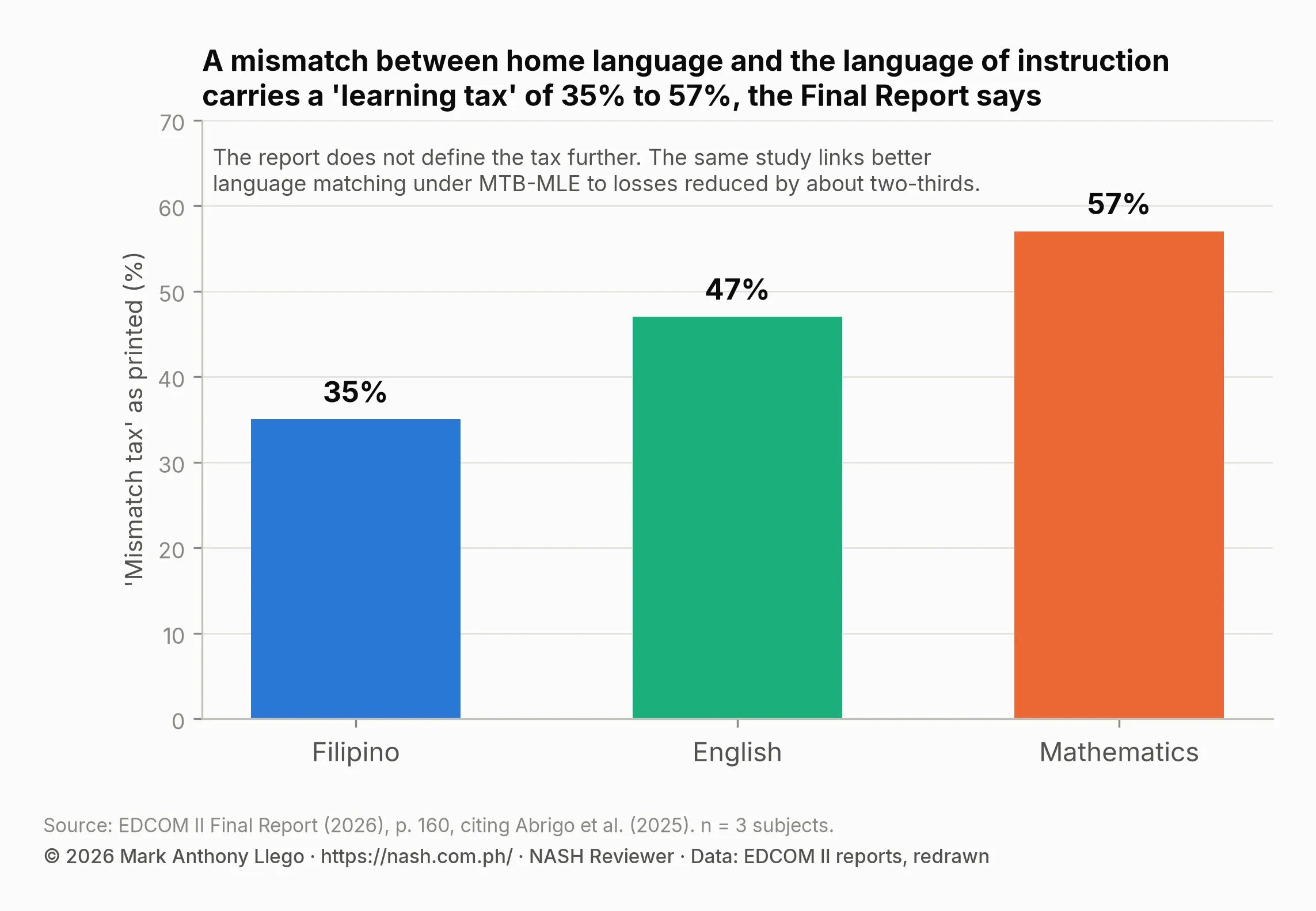
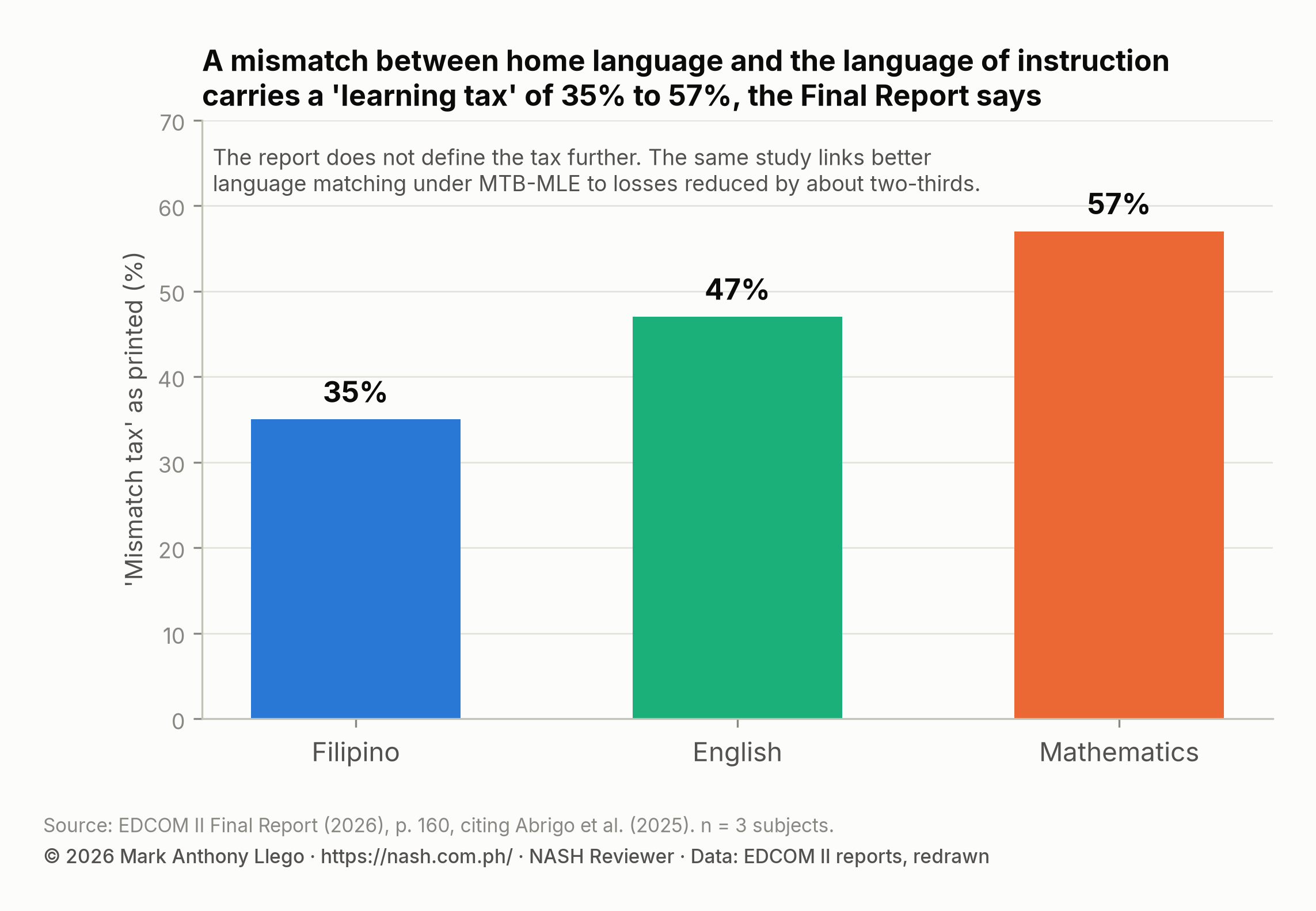
- The evidence on MTB-MLE is mixed. One study the Final Report cites puts the “mismatch taxes” of a language gap at 35% to 57% and links better matching under MTB-MLE to 9 to 12 percentage points more continuation from Grade 1 to Grade 6; another estimates Grade 6 scores about 0.67 standard deviations lower in some contexts, for fully exposed cohorts (pp. 160–161).
- Schools must plan language in the SIP, with “targets for literacy in L1, Filipino, and English” (DO 020, s. 2025, para. 39), and give the CRLA in the classroom’s medium of instruction (para. 36).
- EDCOM II asks for a managed transition that “preserves the benefits of first-language instruction” (Final Report, p. 177).
What RA 12027 changed about the mother tongue
Title, date and status
The full title is An Act Discontinuing the Use of the Mother Tongue as Medium of Instruction from Kindergarten to Grade 3, Providing for Its Optional Implementation in Monolingual Classes, and Amending for the Purpose Sections 4 and 5 of Republic Act No. 10533, Otherwise Known as the “Enhanced Basic Education Act of 2013”. The law has no short title.
The Senate passed it as Senate Bill No. 2457 on July 23, 2024, and the House adopted it as an amendment to House Bill No. 6717 on August 6, 2024. It lapsed into law without the signature of the President on October 10, 2024, under Article VI, Section 27(1) of the Constitution; the Year Two Report gives the same date (p. 111). It takes effect “fifteen (15) days after its publication” (Sec. 9).
Quote the law from the Official Gazette’s certified copy.
What the law discontinued
Republic Act No. 10533 had required that “for kindergarten and the first three (3) years of elementary education, instruction, teaching materials and assessment shall be in the regional or native language of the learners” (Sec. 4). RA 12027 discontinues that use of the mother tongue and provides: “The medium of instruction shall revert to Filipino and, until otherwise provided by law, English, pursuant to Article XIV, Section 7 of the 1987 Constitution. The regional languages shall serve as auxiliary media of instruction” (Sec. 1).
When a school may still teach in the mother tongue
Section 2 allows MTB-MLE (“may be applied”) in monolingual classes, meaning “a group of learners who speak the same Mother Tongue and are enrolled in the same grade level in a given school year”. The mother tongue may be the medium only if it meets every requirement below, and violations are “subject to administrative sanctions based on relevant laws” (Sec. 4).
| Requirement in RA 12027, Sec. 2 | What a school would need to show |
|---|---|
| “an official orthography developed and published by the Komisyon sa Wikang Filipino (KWF)” | The language is on the KWF list (33 in DO 020, s. 2025) |
| “officially documented vocabulary published by the KWF such as glossary, dictionary, encyclopedia, or thesaurus” | A KWF vocabulary for the language |
| “literature on languages and culture, such as big books, small books, picture stories, or wordless picture books” | Reading materials in the language |
| “grammar book” | A grammar book for the language |
| “availability of teachers in the school who speak and are trained to teach in the Mother Tongue” | Named teachers in that school, fluent and trained |
DepEd, with the KWF, had to “develop a language mapping policy within one (1) year from the effectivity of this Act” (Sec. 2). Every three years, DepEd must review the optional use of MTB-MLE and report to the President and Congress “not later than June 30 following the year of review”, including whether “to continue or discontinue the optional use of the Mother Tongue” (Sec. 3).
Language policy from 2009 to 2026
| Date | What happened | Source |
|---|---|---|
| July 14, 2009 | DO 74, s. 2009 institutionalizes mother tongue-based multilingual education | DO 74, s. 2009 |
| February 17, 2012 | MTB-MLE in Kindergarten to Grade 3 of all public schools from SY 2012-2013, in 12 languages | DO 16, s. 2012, paras. 1, 3 |
| May 15, 2013 | RA 10533 makes the learners’ “regional or native language” the medium in Kindergarten to Grade 3 | RA 10533, Sec. 4 |
| July 5, 2013 | Seven languages added from SY 2013-2014 | DO 28, s. 2013, para. 1 |
| August 22, 2019 | DO 21, s. 2019 lists the 19 MTB-MLE languages | DO 21, s. 2019, Annex 4, para. 11 |
| February 6, 2023 | The House approves House Bill No. 6717 on third reading | Year One Report, p. xxxix |
| October 10, 2024 | RA 12027 lapses into law | RA 12027; Year Two Report, p. 35 |
| February 26, 2025 | The implementing rules, signed January 21, take effect | DM 059, s. 2025, para. 2 |
| July 3, 2025 | DO 020, s. 2025 sets the medium of instruction from SY 2025-2026 | DO 020, s. 2025 |
| October 31, 2025 | DO 035, s. 2025 sets the language mapping process | DO 035, s. 2025; Final Report, p. 67 |
| June 8, 2026 | SY 2026-2027 opens; the first mapping cycle runs in the Opening Block | DO 009, s. 2026, paras. 4, 12; DO 035, para. 2 |
Why EDCOM II supported RA 12027
The Final Report lists the law’s passage among the “Collective Accomplishments” it shares with Congress and the agencies (p. 67). The Year Two Report says “EDCOM II supported the passage of RA 12027” to “address the challenges of implementing mother tongue instruction in a linguistically diverse nation” (p. 111). EDCOM II’s House commissioners had approved House Bill No. 6717, “a bill suspending the implementation” of MTB-MLE (Year One Report, p. xxxix).
Year One: a sound idea the system could not deliver
The Year One Report starts from “a wide consensus that using the learner’s first language is optimal for learning” (p. 123), and concludes that “it has been difficult to implement due to the highly centralized structure of DepEd” (p. xxviii). Its reasons (pp. 125–126):
- Too many languages for one central program. The KWF has identified “at least 130 indigenous languages”, the 2020 census “at least 245”, and “as much as 15% of Filipinos migrated internally” from 2013 to 2018.
- Too few languages and materials. DepEd’s policy “covers only 19 languages” (the list is in DO 21, s. 2019, Annex 4, para. 11), and schools “struggle to curate and develop their learning resources”.
- Classroom problems. Teachers translated materials themselves, some were “unfamiliar with the orthography of the local mother tongue”, and learners “might need to relearn concepts when they transition to Grade 4”.
The report adds a qualifier: one study found that “effective teacher training and improved pupil–book ratios could mediate the effects of mismatch” (p. 126).
The language gap in assessments
The Philippines was the only country that took SEA-PLM 2019 in English, “even though 93% of the students who took the test did not regularly speak English at home”, and in PISA 2018, 94% of Filipino 15-year-olds mainly spoke another language at home (Year One Report, p. 101).
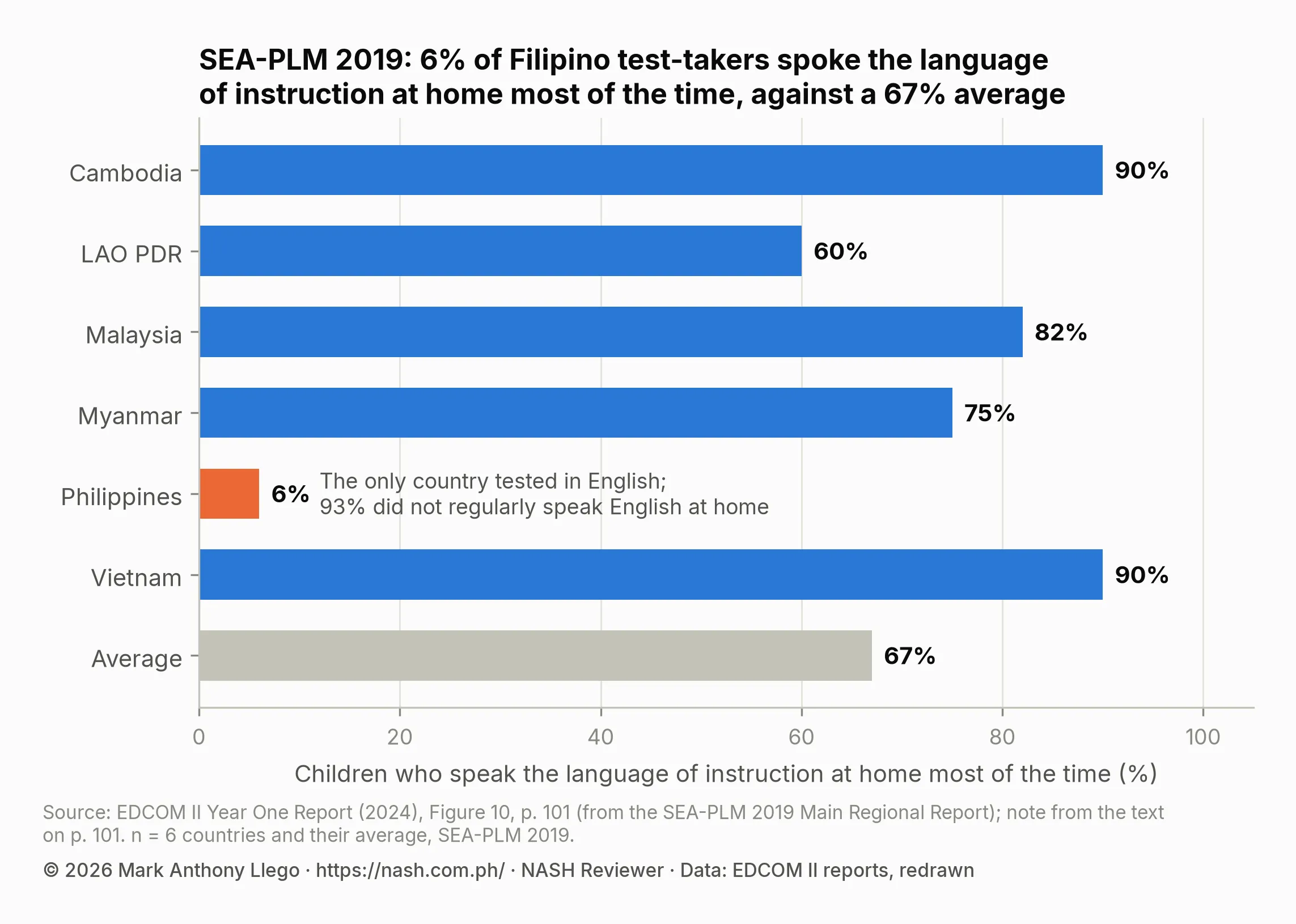
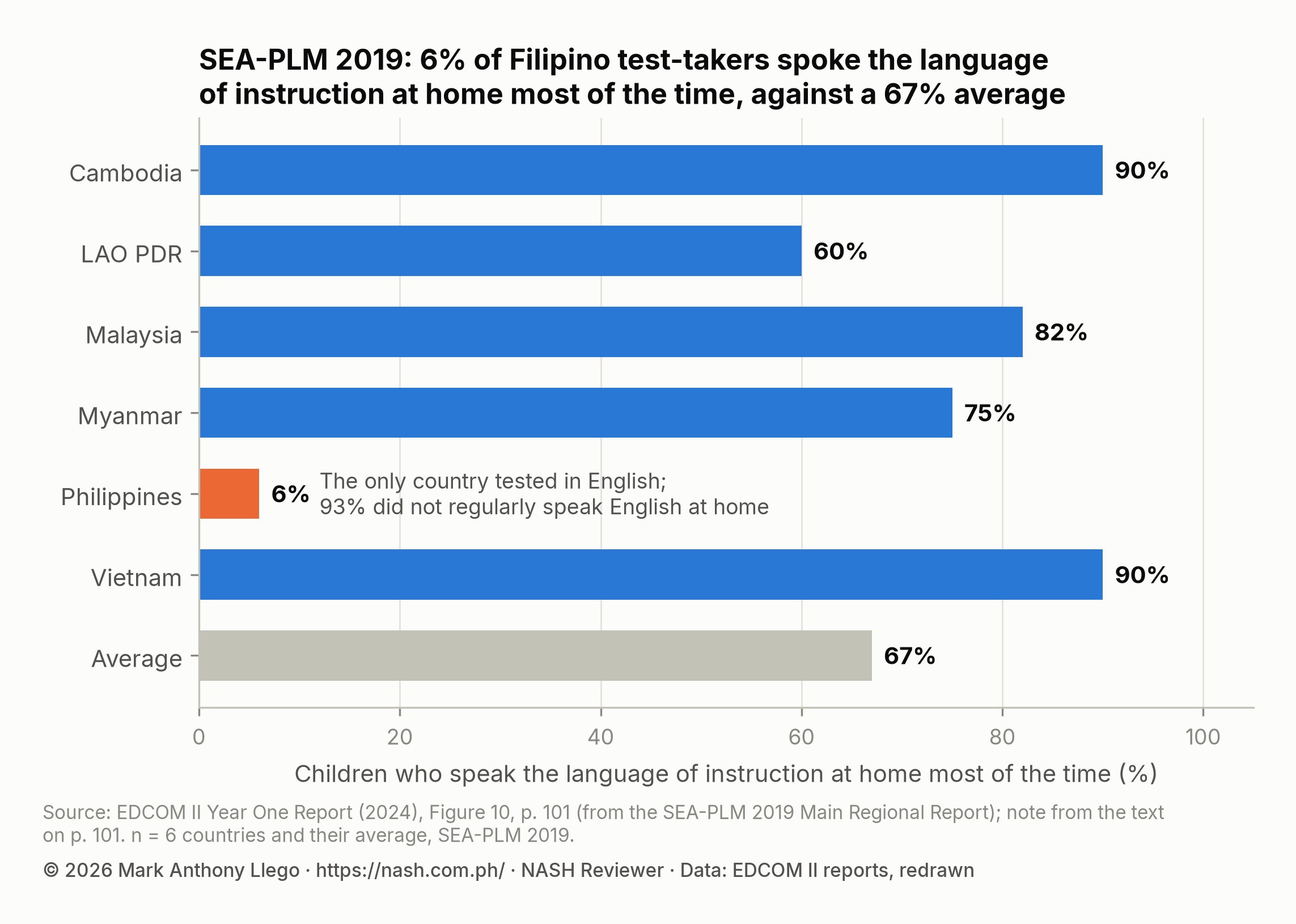
| Cambodia | Lao PDR | Malaysia | Myanmar | Philippines | Vietnam | Average |
|---|---|---|---|---|---|---|
| 90% | 60% | 82% | 75% | 6% | 90% | 67% |
The report’s conclusion was that DepEd “should consider the results of the recent ILSAs as valuable feedback for evaluating and potentially revising the current language policy” (p. 102).
The Final Report’s evidence: potential and risk
The Final Report’s issue on MTB-MLE is titled “Emerging local evidence shows potential of MTB-MLE to improve learning, but only if implemented properly, highlighting the need to build readiness of the system” (p. 160). It calls RA 12027 a shift “away from a universal MTB-MLE mandate toward a more conditional approach”, in a country of “around 245 languages” where MTB-MLE was “limited to 19 authorized languages” (p. 160).
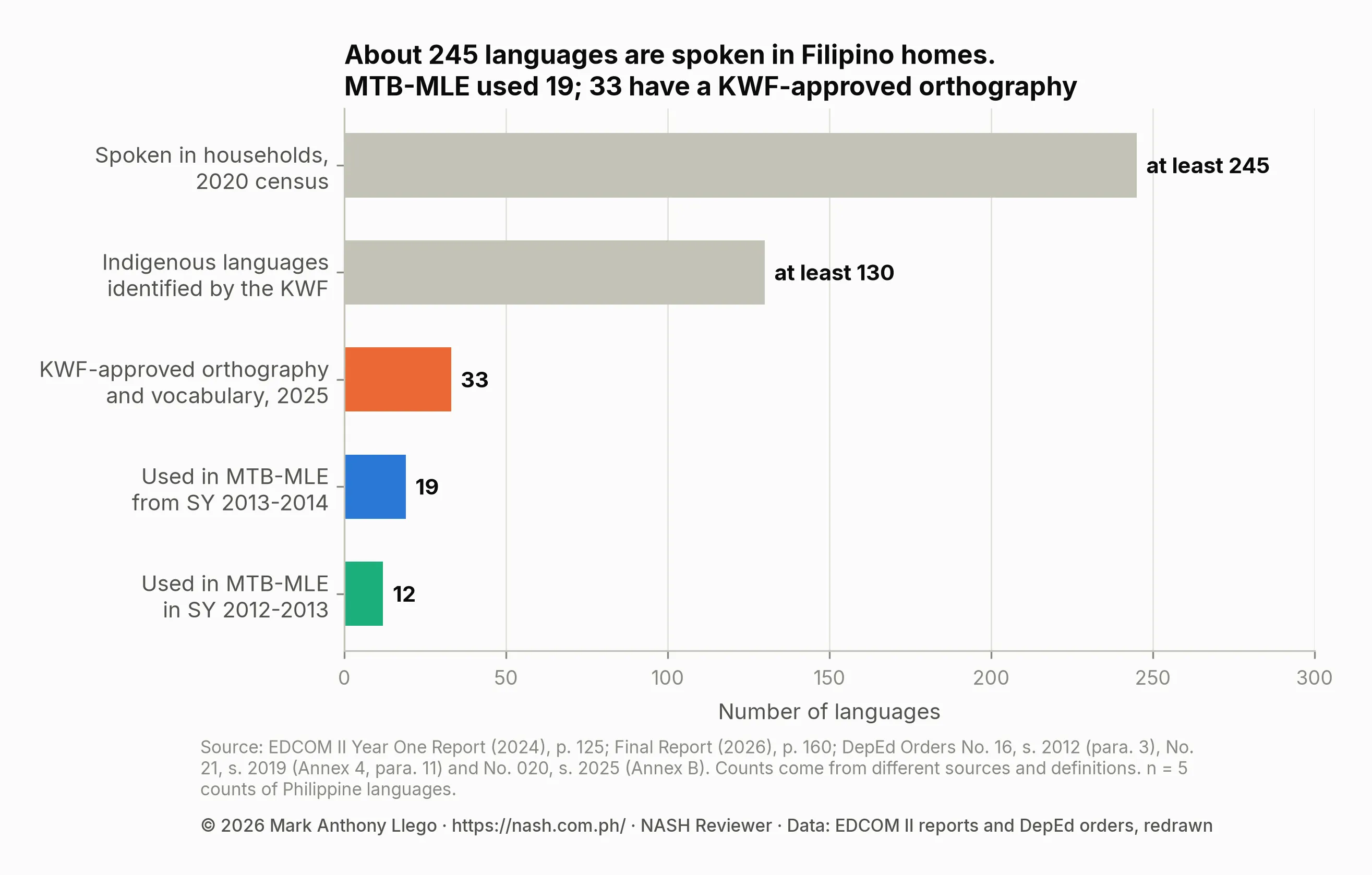
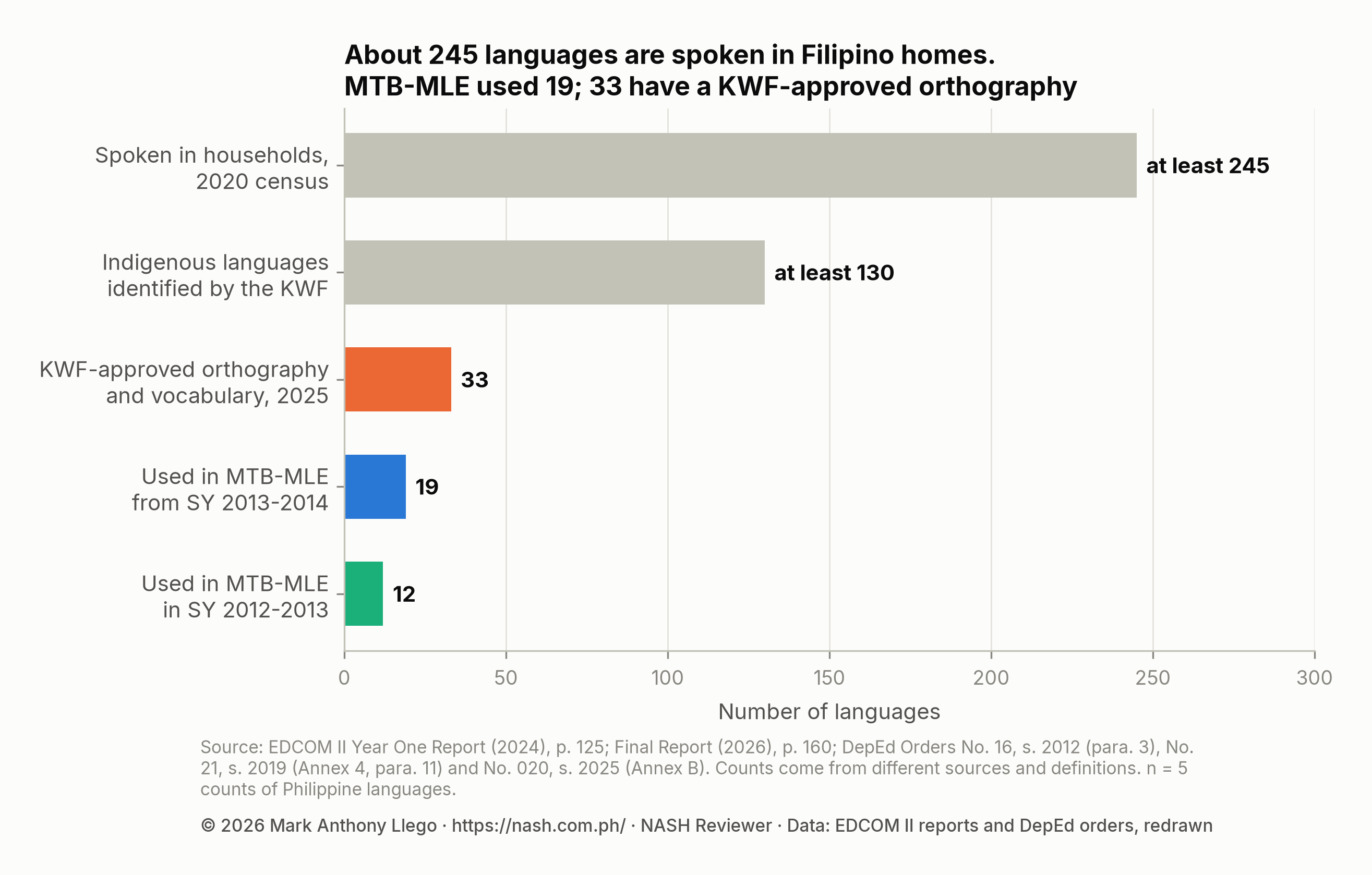
Recapping Year One, the report says weak implementation “in some contexts, may have contributed to poorer outcomes”, and that DepEd guidance “effectively pushed schools to select a single mother tongue even in linguistically mixed communities” (p. 160).
It then sets two studies side by side. The first, cited as Abrigo et al. (2025), calls the gap between home language and language of instruction a “learning tax”: “Each unit reduction in mismatch is associated with large achievement gains, translating to mismatch taxes of 35% in Filipino, 47% in English, and 57% in Mathematics” (p. 160). The report does not define the tax further. From this study it concludes that linguistic alignment “can strengthen both learning and progression when it accurately reflects learner language profiles and is supported by enabling conditions” (p. 160).
The second, a quasi-experimental study (Lloyd and Yang, 2024), finds that MTB-MLE “can generate learning risks when implemented as a language ‘switch’ without adequate supply-side readiness” (p. 160).
| Evidence the Final Report cites | Finding as printed | Page |
|---|---|---|
| Abrigo et al. (2025): cost of mismatch | Under a bilingual regime an average learner “could operate 27% to 45% below their learning frontier” | 160 |
| Abrigo et al. (2025): better matching under MTB-MLE | “reduced potential losses by roughly two-thirds and was associated with 9 to 12 percentage point improvements in continuation from Grade 1 to Grade 6” | 160 |
| Process evaluation cited by Lloyd and Yang (2024): readiness | “only 9% of sampled schools completed all expected learning-resource development activities” | 160 |
| Lloyd and Yang (2024): outcomes | “declines of roughly 0.67 standard deviations in Grade 6 test scores and around 0.3 fewer years of completed schooling for fully exposed cohorts” | 160–161 |
| EDCOM II consultations | “abrupt shifts in the medium of instruction” and “chronic scarcity of materials in the relevant mother tongues” | 161 |
Its conclusion for policy: “The near-term policy task is therefore to execute a structured transition that protects early-grade literacy and equity, especially for Indigenous and linguistically minority learners who face the highest mismatch risks” (p. 161).
Where the reports qualify the case
- The law is conditional. The Final Report describes DepEd’s guidance as managing “the transition as an alignment strategy rather than a uniform ‘end’ to first-language support” (p. 161).
- Familiar language still matters. In SEA-PLM 2024, learners “who speak the test language at home … have lower odds of being low performing”, so “efforts to strengthen use of familiar languages in early grades … remain critical” (p. 150). The page also says “The Philippines has a relatively small share of learners who take the assessment in a language that is not used at home, and a subsample sat the test in Filipino rather than English”; it gives no figure, and the report does not reconcile this with the 2019 data in the Year One Report (p. 101).
- An essay in the Final Report warns against reversing programs. Aniceto Orbeta, Vicente Paqueo and Michael Abrigo write that MTB-MLE and senior high school “were rooted in sound international evidence but were severely hampered by poor implementation on the ground”, and that “the tendency has been to reverse entire programs” (pp. 640–641). The essay does not name RA 12027.
- DepEd’s own reading is two-sided. MTB-MLE “yielded gains, especially in monolingual classes where learners shared a common first language”, while “its broader rollout revealed limitations” (DO 020, s. 2025, Rationale, para. 2).
What EDCOM II recommends for the transition
The Final Report recommends to “Manage the transition away from compulsory MTB-MLE under Republic Act No. 12027 as a structured, evidence-based reform that preserves the benefits of first-language instruction while clearly defining the roles of Filipino and English” (p. 177). DepEd should “implement robust language mapping, clear school-level language plans, and bridging programs”, use the law’s reviews “to monitor impacts on early grade reading and equity, particularly for indigenous and linguistically minority learners”, and fund “language mapping, local development of materials, and training of teachers and para-teachers” (p. 177).
In the National Education Plan, output 2.1.2.a is to “Establish comprehensive MTB-MLE instructional materials and learning resources, for Key Stage 1”. Its baseline reads “2026: Language mapping completed”, and the target that follows is “Development of learning resources in the mother tongue, and conduct of teacher training, for monolingual classes” (p. 450). The stand-alone National Education Plan document prints the same output (National Education Plan document, p. 34), and its costing table has no separate line for it, only Recommendation 2.1.2 on textbooks as a whole (pp. 115–116). That recommendation is fifth of the plan’s top 20 (Final Report, p. 432). The report also asks the National Book Development Board to support “mother tongue languages where such materials remain lacking” (p. 137). The National Education Plan guide covers the textbook targets.
What DepEd requires now: DO 020 and DO 035, s. 2025
The implementing rules
DepEd and the KWF signed the rules on January 21, 2025; DepEd Memorandum No. 059, s. 2025 says they “took effect on February 26, 2025” (para. 2). They add an “annual review” (Sec. 12), have schools “collaborate with the local communities, Parent-Teacher Associations, higher education institutions, and local language experts” in mapping (Sec. 6), and let DepEd set “the minimum number or percentage of learners per monolingual class” (Sec. 7).
DO 020, s. 2025: four language scenarios
DepEd Order No. 020, s. 2025, issued July 3, 2025, applies to all public and private schools offering Kindergarten to Grade 3 (paras. 6, 45). “Beginning School Year 2025–2026, the primary media of instruction for Kindergarten to Grade 3 shall be Filipino and English, with Filipino Sign Language (FSL) for deaf learners” (para. 11). It rescinds the Key Stage 1 language provisions of DepEd Order No. 010, s. 2024 on the MATATAG curriculum (para. 4). Each class’s scenario rests on a survey of learners’ languages, since “there is no ‘assigned’ Mother Tongue for any learner” (para. 18).
| Scenario | When it applies | Medium of instruction | Para. |
|---|---|---|---|
| A | Learners have different first languages, no monolingual class can be formed, and they share no common language | Filipino and English; Filipino or English for Science and Mathematics | 21 |
| B | As in A, but learners share a regional language that does not meet RA 12027’s criteria | Filipino and English, with the regional language as auxiliary | 22 |
| C | A monolingual class can be formed, or learners share a regional language, and the language meets the criteria | The learners’ language, “with gradual introduction to Filipino and English” | 23–24 |
| D | Indigenous Peoples Education schools whose classes are fully or dominantly IP learners | The IP language, if it has a working orthography, word list, primer and grammar book, quality-assured resources and a teacher who can teach in it | 27 |
FSL is the medium for deaf learners in all four scenarios (para. 28).
Which languages qualify
DO 020 lists 33 languages with an orthography and vocabulary approved and published by the KWF, and promises “succeeding memoranda” for more (para. 25 and Annex B). Where a school used a mother tongue not on the list, “the MOI will revert to Filipino and English”, with the learners’ language as auxiliary, until the KWF approves it and the other criteria are met (para. 26).
Of the 19 languages of the old program, 11 are on the KWF list, some under another spelling (Sebwano for Cebuano), and 8 are not.
| The 19 MTB-MLE languages (DO 21, s. 2019) | On DO 020’s list? |
|---|---|
| Bikol, Hiligaynon, Ilokano, Kapampangan, Maguindanaon, Maranao, Pangasinan, Sinugbuanong Binisaya/Cebuano, Tagalog, Waray, Yakan | Yes (11) |
| Akeanon/Akianon, Chavacano, Ivatan, Kinaray-a, Sambal, Surigaonon, Tausug, Ybanag/Ibanag | Not under any matching name (8) |
As of October 30, 2026, no memorandum has added languages to the list. Schools that taught in one of the eight should check with their division.
Transition, support and assessment
The pace is set: “In the early years (Kindergarten to Grade 1), greater emphasis shall be placed on the learners’ L1”, Filipino and English are “increasingly used” in Grades 2 and 3, “leading to full academic use of Filipino and English by Grade 4, especially in Mathematics and Science” (para. 30). Every school “shall provide appropriate linguistic support for learners whose L1 is not the medium of instruction” (para. 32).
The CRLA “shall be consistent with the medium of instruction (MOI) implemented in the classroom” (para. 36), as Annex D sets out:
| Grade | Scenarios A and B | Scenarios C and D |
|---|---|---|
| 1 | Filipino | L1 (if available) |
| 2 | Filipino | L1 (if available) and Filipino |
| 3 | Filipino and English | Filipino and English |
Without a validated CRLA in the local or IP language, “Filipino and/or English shall be used with oral scaffolding support” (para. 36).
The SIP and reporting
Each school “shall integrate a localized language learning strategy into its School Improvement Plan (SIP), identifying the selected MOI arrangement, targets for literacy in L1, Filipino, and English, and corresponding plans for teacher development and instructional resource support” (para. 39). For SY 2025-2026, school heads were to submit “a form indicating their implementation scenario” (para. 41).
DO 035, s. 2025: the language mapping process
DepEd Order No. 035, s. 2025, dated October 31, 2025, is the mapping policy the law required, and the Final Report lists it among the collective accomplishments (p. 67).
- Who is mapped. All Key Stage 1 learners in SY 2026-2027; after that, only Kindergarten entrants and unmapped transferees (para. 5).
- What counts as monolingual. “At least 70% or more of the class” share a first language (para. 10.17). The law sets no percentage; the IRR lets DepEd set “the minimum number or percentage of learners per monolingual class” (IRR, Sec. 7).
- Four phases: Collect, Confirm, Encode, Implement (para. 18). Parents give language data on the enrollment form and teachers validate it; below 70%, teachers give a Language Identification Tool “within the first two weeks of classes” (paras. 19–20). “School Heads review accuracy and completeness before endorsement to the SDO” (para. 21).
- Minority learners and readiness. In classes of 70% to 99%, “the rest of the class (30% or less) shall benefit from various linguistic support”. Schools with classes not yet ready for the L1 “shall indicate strategies in their SIP to build readiness through training and materials development” (para. 22).
School administrators’ eleven duties include “consensus-building on MOI use with parents, barangay, and cultural leaders” (Section VIII.2.f). Mapping is funded “from authorized and available sources” (Section IX) and protected by the Data Privacy Act (para. 9), and the 2026 calendar collects it in the Opening Block (DepEd Order No. 009, s. 2026, para. 12).
Other issuances, and whether they are in force
- ARAL-Reading. Grade 1 learners are grouped on “Results of CRLA in Mother Tongue (MT) or Filipino”, Grade 2 on Filipino and Grade 3 on English (DepEd Memorandum No. 064, s. 2025, Enclosure No. 2, para. 3.1 and Table 2).
- The ELLNA. “Pursuant to Republic Act (RA) No. 12027”, the SY 2025-2026 Grade 4 ELLNA tested language and literacy in English and Filipino and numeracy in English (DepEd Memorandum No. 087, s. 2025, paras. 3–4).
- The old MTB-MLE orders. DO 74, s. 2009, DO 16, s. 2012, DO 28, s. 2013 and the MTB-MLE rules in DO 21, s. 2019, Annex 4 were not repealed by name. Their rules on the mother tongue as the required medium no longer apply, because RA 12027 (Secs. 1, 8) and DO 020, s. 2025 (para. 45) repeal or modify inconsistent issuances.
As of October 30, 2026, no DepEd issuance has amended or repealed DO 020 or DO 035, and DepEd has not published the separate issuances DO 020 promised on CRLA language versions, scenario forms and review templates (paras. 36, 41, 44). The curriculum contextualization guide covers adapting lessons.
What this means for school heads
DO 020 recognizes “the local autonomy of schools and CLCs, and divisions in determining the most context-appropriate language arrangements” (para. 13), and DO 035 makes the school head answerable for the data. Seven practices follow.
1. Run the mapping in the Opening Block. Orient Key Stage 1 teachers, schedule the Language Identification Tool for classes below 70%, and review the encoded data before you endorse it (DO 035, paras. 19–21). The Domain 2 guide covers school data.
2. Decide class by class, with the evidence on file. A 70% majority is not enough for Scenario C. Check all five requirements of RA 12027 for the class’s language (for IP languages under Scenario D, the requirements in DO 020, para. 27). If any is missing, teach in Filipino and English, using the learners’ language as auxiliary support (DO 020, paras. 12, 22, 26, 33), and write the steps to close the gap into the SIP (DO 035, para. 22). The Domain 1 guide covers policy implementation.
3. Put the language plan in the SIP: each class’s scenario, literacy targets in the first language, Filipino and English, and the teacher development and materials behind them (DO 020, para. 39). The School Improvement Plan guide shows where they go.
4. Fill the materials gap. “Learning materials in the mother tongue may continue to be used as supplemental materials” (DO 020, para. 38). Ask the division for other regions’ materials, report shortages, and invite elders to contribute stories (DO 035, Section VIII.2.g, i, j). The textbook guide explains why national supply has been slow.
5. Assign and train teachers by language. For monolingual classes, hiring “should include proficiency in the learner’s language as a key consideration”, and schools may “tap community learning facilitators” (DO 020, para. 37). The Domain 4 guide covers professional development.
6. Match the CRLA to the medium, and read results by language. Give the CRLA in the languages Annex D sets and record the language of each result. Where a grade is assessed in two languages, read both; CRLA by Language shows how much they can differ. The Domain 3 guide covers assessment.
7. Bring parents in early. Under MTB-MLE, some schools “struggled to solicit support from stakeholders, especially parents” (Year One Report, p. 126). Show parents the mapping result and the scenario at Opening Block meetings, and share each child’s language profile (DO 035, Annex 1, Form 4). The School Governing Council and PTA guide, the SIP communication plan and the Domain 5 guide cover the channels.
| Record to keep | Why | Rule |
|---|---|---|
| Enrollment-form language items, validation notes, Language Identification Tool results | Basis of each learner’s identified language | DO 035, paras. 19–20 |
| Class language profiles and the endorsed LIS data | Basis of each class’s scenario | DO 035, para. 21 |
| Evidence on RA 12027’s five requirements (Scenario C) or DO 020 para. 27’s requirements (Scenario D) | Proof the class may use the mother tongue | RA 12027, Sec. 2; DO 020, paras. 24, 27 |
| The SIP language strategy and targets | Required in every school | DO 020, para. 39 |
| CRLA results by grade and language | The CRLA must match the medium | DO 020, para. 36, Annex D |
| Scenario form and midyear and year-end evaluations | Feed DepEd’s reviews under the law | DO 020, paras. 41, 43; IRR, Sec. 12 |
How the NASH may test this
Under DepEd Memorandum No. 069, s. 2025, the NASH covers “conceptual and situational critical thinking questions” aligned with the PPSSH, “using the SOLO (Structure of the Observed Learning Outcome) taxonomy as an underpinning framework” (para. 3). The two items below are original practice items, scored 3 (Relational), 2 (Multistructural), 1 (Unistructural) or 0 (Prestructural).
Question 1
Indicator 1.3.1, Policy implementation and review. Career Stage 1, Situational, Moderate.
In SY 2026-2027, language mapping shows that 82% of one Grade 1 class speak Waray at home. Waray is on DO 020’s KWF list, and the school has Waray big books, but it has no Waray grammar book and neither Grade 1 teacher is trained to teach in Waray. What should the school head do?
- A. Approve Waray as the medium of instruction, since more than 70% of the class speak it and it is on the KWF list.
- B. Have the class taught in Filipino and English with Waray as auxiliary support, write steps to close the gaps (a grammar book, teacher training) into the SIP, report the gaps to the division, and explain the decision to parents.
- C. Have the class taught in Filipino and English only, and tell teachers to stop using Waray in class, since the class does not meet the law’s requirements.
- D. Have the class taught in Filipino and English with Waray as auxiliary support, and wait for the division to say when the class is ready for Waray.
Answer and explanation
Best answer: B. Points: A = 0, B = 3, C = 1, D = 2.
- A (0 points, Prestructural). RA 12027 also requires a grammar book and trained teachers, which the class lacks.
- B (3 points, Relational). It applies the law’s requirements, keeps Waray as an auxiliary medium, builds readiness through the SIP, and involves the division and parents.
- C (1 point, Unistructural). The medium is right, but banning Waray ignores DO 020’s rules on linguistic support and auxiliary media.
- D (2 points, Multistructural). It leaves readiness to the division, though DO 035 asks the school to plan it.
Why. RA 12027 requires all five conditions (Sec. 2). DO 020, s. 2025 allows local languages as auxiliary media (para. 12) and requires linguistic support (para. 32), and DO 035, s. 2025 asks schools to plan readiness “in their SIP” (para. 22). EDCOM II warns of risks “without adequate supply-side readiness” (Final Report, p. 160).
Indicator 1.3.1: Demonstrate knowledge and understanding of policy implementation and review to ensure that school operations are consistent with national and local laws, regulations and issuances.
Sources: Republic Act No. 12027; DepEd Orders No. 020 and No. 035, s. 2025; EDCOM II Final Report (2026), pp. 160–161.
Question 2
Indicator 5.4.2, Communication. Career Stage 2, Situational, Moderate.
A school teaches Grade 1 in Hiligaynon under Scenario C. At an SPTA meeting, some parents ask for English only “because the national tests are in English”; others want Hiligaynon kept. Several learners are transferees who do not speak Hiligaynon. What should the school head do?
- A. Switch the Grade 1 classes to English, since most parents at the meeting asked for it.
- B. Tell the parents that DepEd sets the medium of instruction and the matter is closed.
- C. Present the mapping results and the scenario, explain how DO 020 moves learners to Filipino and English by Grade 4 and which languages the CRLA and ELLNA use, describe the support for transferees, and agree with the SPTA on regular progress reports.
- D. Present the mapping results, explain DO 020’s transition, and forward the parents’ concerns to the division.
Answer and explanation
Best answer: C. Points: A = 0, B = 1, C = 3, D = 2.
- A (0 points, Prestructural). The medium follows the mapping and the law, not a vote.
- B (1 point, Unistructural). True, but refusing to explain ignores the duty to address parents’ concerns.
- C (3 points, Relational). It links the evidence, the rules, the minority learners and the parents’ role, and keeps communication open.
- D (2 points, Multistructural). The explanation is right, but it passes the concern up instead of answering it with the school’s data.
Why. DO 020, s. 2025 puts “greater emphasis” on the first language in Kindergarten to Grade 1 and aims at “full academic use of Filipino and English by Grade 4” (para. 30), with support for learners whose first language is not the medium (DO 020, para. 32; DO 035, para. 22). In SY 2025-2026 the ELLNA tested literacy in English and Filipino (DM 087, s. 2025, para. 4), and DO 035, s. 2025 asks school heads to “address parent/community concerns” (Section VIII.2.e).
Indicator 5.4.2: Communicate effectively in speaking and in writing to teachers, learners, parents and other stakeholders, through positive use of communication platforms, to facilitate information sharing, collaboration and support.
Sources: DepEd Orders No. 020 and No. 035, s. 2025; DepEd Memorandum No. 087, s. 2025.
Nothing in this guide reproduces or predicts examination content.
Frequently asked questions
Is the mother tongue still used in Kindergarten to Grade 3?
Yes, in two ways. A mother tongue may be the medium in a monolingual class whose language meets all five requirements of RA 12027, Section 2, and learners’ languages “may continue to be used as auxiliary media of instruction, particularly in linguistically diverse or transitional classrooms” (DO 020, s. 2025, para. 12). EDCOM II calls the law a shift “toward a more conditional approach” (Final Report, p. 160).
Did the President sign RA 12027?
No. The Official Gazette’s certified copy shows that RA 12027 lapsed into law on October 10, 2024 without the President’s signature, under Article VI, Section 27(1) of the Constitution. The Year Two Report gives the same date (pp. 35, 111).
What is a monolingual class under DepEd’s language mapping?
The law defines it as learners “who speak the same Mother Tongue and are enrolled in the same grade level in a given school year” (RA 12027, Sec. 2). DO 035, s. 2025 sets the threshold at “at least 70% or more of the class” (para. 10.17), under the IRR’s leave to set “the minimum number or percentage” (IRR, Sec. 7). Even then, the class may use the mother tongue only if the law’s five requirements are met.
In what language is the CRLA given after RA 12027?
The CRLA follows the classroom’s medium of instruction (DO 020, s. 2025, para. 36). In Scenarios A and B, Grades 1 and 2 are assessed in Filipino and Grade 3 in Filipino and English. In Scenarios C and D, Grade 1 is assessed in the first language if a validated tool exists, Grade 2 in the first language and Filipino, and Grade 3 in Filipino and English (Annex D).
Which languages can still be used as the medium of instruction?
DO 020, s. 2025 lists 33 languages with a KWF-approved orthography and vocabulary (Annex B), and each still needs a grammar book, literature and trained teachers in the school (RA 12027, Sec. 2). Eight of the 19 old MTB-MLE languages, including Chavacano, Kinaray-a, Surigaonon and Tausug, do not appear on the list under any matching name.
Download the data
- language-sea-plm-2019-home-language.csv: share of SEA-PLM 2019 test-takers who speak the language of instruction at home most of the time, six countries and their average (Year One Report, Figure 10, p. 101).
- language-counts-census-kwf-mtb-mle.csv: five counts of Philippine languages, with the printed wording of each (Year One Report, p. 125; Final Report, p. 160; DepEd Orders No. 16, s. 2012, No. 21, s. 2019 and No. 020, s. 2025).
- language-mismatch-learning-tax.csv: the “mismatch taxes” by subject, with the printed wording and related findings (Final Report, p. 160).
The CSVs and charts may be reused only with written permission: email support@nash.com.ph. The numbers themselves come from the EDCOM II reports, which you can cite directly.
How to cite this post
Llego, M. A. (2026, October 30). Mother Tongue After RA 12027: Language of Instruction. NASH Reviewer. https://nash.com.ph/blog/language-of-instruction-ra-12027-edcom-ii
The EDCOM II reports:
- Second Congressional Commission on Education. (2024). Miseducation: The failed system of Philippine education (EDCOM II Year One Report). https://edcom2.gov.ph/media/2024/02/EDCOM-II-Year-One-Report-PDF-022924.pdf
- Second Congressional Commission on Education. (2025). Fixing the foundations: A matter of national survival (EDCOM II Year Two Report). https://edcom2.gov.ph/media/2025/01/EDCOM-2-Year-2-Report-Fixing-the-Foundations-2025.pdf
- Second Congressional Commission on Education. (2026). Turning point: A decade of necessary reform (2026–2035) (EDCOM II Final Report). https://edcom2.gov.ph/media/2026/01/EDCOM-II-Y03-for-web-012626_final.pdf
- Second Congressional Commission on Education. (2026). The National Education Plan (2026–2035) [Part of Turning point: A decade of necessary reform, EDCOM II Final Report]. https://edcom2.gov.ph/media/2026/01/EDCOM-II_Y03_National-Education-Plan.pdf
Sources
- EDCOM II, Final Report (2026), pp. 67, 137, 150, 160–161, 177, 432, 450, 640–641.
- EDCOM II, National Education Plan document (2026), pp. 34, 115–116.
- EDCOM II, Year Two Report (2025), pp. 35, 111.
- EDCOM II, Year One Report (2024), pp. xxviii, xxxix, 101–102, 123–126.
- Republic Act No. 12027, An Act Discontinuing the Use of the Mother Tongue as Medium of Instruction from Kindergarten to Grade 3, Providing for Its Optional Implementation in Monolingual Classes, and Amending for the Purpose Sections 4 and 5 of Republic Act No. 10533, lapsed into law October 10, 2024 (Official Gazette, certified copy), Secs. 1–4, 8 and 9.
- Republic Act No. 10533, Enhanced Basic Education Act of 2013, approved May 15, 2013 (Official Gazette), Sec. 4.
- Implementing Rules and Regulations of Republic Act No. 12027, signed January 21, 2025, Secs. 6, 7 and 12.
- DepEd Memorandum No. 059, s. 2025, Dissemination of Implementing Rules and Regulations of Republic Act No. 12027, para. 2.
- DepEd Order No. 020, s. 2025, Policy on the Medium of Instruction for Kindergarten to Grade 3 Effective School Year 2025-2026, order para. 4; Enclosure, Rationale para. 2, paras. 6, 11–13, 18–39, 41, 43–45, Annexes B and D.
- DepEd Order No. 035, s. 2025, Guidelines on the Language Mapping Process for Key Stage 1, order para. 2; Enclosure, paras. 5, 9, 10.17, 18–22, Sections VIII.2 and IX, Annex 1 (Form 4).
- DepEd Order No. 009, s. 2026, Guidelines on the Implementation of the Three-Term School Calendar in Basic Education, paras. 4 and 12.
- DepEd Memorandum No. 064, s. 2025, Implementing Guidelines for the Academic Recovery and Accessible Learning Program in Reading for Key Stages 1 to 3, Enclosure No. 2, para. 3.1 and Table 2.
- DepEd Memorandum No. 087, s. 2025, Administration of the Early Language, Literacy, and Numeracy Assessment for School Year 2025-2026, paras. 3–4.
- DepEd Order No. 010, s. 2024, Policy Guidelines on the Implementation of the MATATAG Curriculum (Key Stage 1 language provisions rescinded by DO 020, s. 2025).
- DepEd Order No. 21, s. 2019, Policy Guidelines on the K to 12 Basic Education Program, Annex 4, para. 11.
- DepEd Order No. 28, s. 2013, Additional Guidelines to DepEd Order No. 16, s. 2012, para. 1.
- DepEd Order No. 16, s. 2012, Guidelines on the Implementation of the Mother Tongue-Based Multilingual Education (MTB-MLE), paras. 1 and 3.
- DepEd Order No. 74, s. 2009, Institutionalizing Mother Tongue-Based Multilingual Education (MLE), para. 2.
- DepEd Memorandum No. 069, s. 2025, Administration of the National Assessment for School Heads for Fiscal Year 2025, para. 3.
- DepEd Order No. 024, s. 2020, National Adoption and Implementation of the Philippine Professional Standards for School Heads (indicators 1.3.1 and 5.4.2).
The EDCOM II series
The reports:
- What EDCOM II Achieved, 2023-2025: Laws, Budgets, Policies
- EDCOM II’s Three Reports: How the Key Numbers Changed
- EDCOM II Final Report: Guide for Aspiring School Heads
- National Education Plan 2026-2035: Guide for School Heads
- 100 Years After the Monroe Report: Education Commissions
- Is the Philippines Spending Enough on Education?
- Education Data, Transparency and Research: EDCOM II
Learners and learning:
- Mass Promotion and Lost Instructional Time: EDCOM II
- PISA, TIMSS, SEA-PLM and the NAT: What EDCOM II Found
- Mother Tongue After RA 12027: Language of Instruction (this post)
- Why DepEd Bought Only 27 Textbook Titles in 2012-2023
- RA 12080, Bullying and School Mental Health: EDCOM II
- RA 11650 and Learners With Disabilities: EDCOM II Findings
- Senior High School and Jobs: EDCOM II Workforce Findings
Schools, teachers and governance:
- Teacher Workload and Accountability: EDCOM II Findings
- Local School Boards and the Special Education Fund
- Local Education Models in EDCOM II: What the Evidence Shows
- Education in the Bangsamoro: EDCOM II Findings for BARMM
Written by Mark Anthony Llego for NASH Reviewer. Sources: EDCOM II Year One (2024), Year Two (2025) and Final (2026) Reports and the National Education Plan document (2026); Republic Acts No. 10533 and No. 12027 and the IRR of RA 12027; DepEd Orders No. 74, s. 2009, 16, s. 2012, 28, s. 2013, 21, s. 2019, 010, s. 2024, 020 and 035, s. 2025 and 009, s. 2026; DepEd Memoranda No. 059, 064 and 087, s. 2025. Charts may be reused only with written permission from support@nash.com.ph.