For more than a decade, DepEd bought new textbooks for only a few grades and subjects. EDCOM II counted 27 textbook titles procured for Grades 1 to 10 from 2012 to 2023, and only Grades 5 and 6 had a complete set. The sections below explain why so few textbooks reached learners, how DepEd’s procurement worked and where it broke down, what changed in 2024 and 2025, and what is still unfixed.
The post is written for aspiring school heads preparing for the National Assessment for School Heads (NASH), and for researchers who need page-level citations. EDCOM II is the Second Congressional Commission on Education, created by Republic Act No. 11899. The post draws on its three reports: the Year One Report, Miseducation (2024); the Year Two Report, Fixing the Foundations (2025); and the Final Report, Turning Point (2026), which contains the National Education Plan 2026-2035.
Key findings
- 27 titles in 2012-2023. EDCOM II’s analysis of Bureau of Learning Resources data found that “only 27 textbooks have been procured since 2012” for Grades 1 to 10, and that since K to 12 began only Grades 5 and 6 had their textbooks successfully procured (Year One Report, pp. 83-84).
- The money was allocated but mostly not spent. Of ₱12.648 billion allocated for textbooks and other instructional materials in 2018-2022, 35.3% was obligated and 7.5% was disbursed (Year One Report, p. 83).
- One title could take three to five years. DepEd bought each manuscript separately from the printing and delivery of the book, so a complete procurement cycle for one title could run three to five years (Year One Report, pp. 86, 89; Final Report, p. 129).
- The new curriculum started short of books. In the Year Two Report’s status figures, drawn from DepEd data of January 6, 2025, no Grade 4 or Grade 7 textbook line is marked 100% delivered, against 5 of 24 Grade 1 lines (Year Two Report, pp. 102-103).
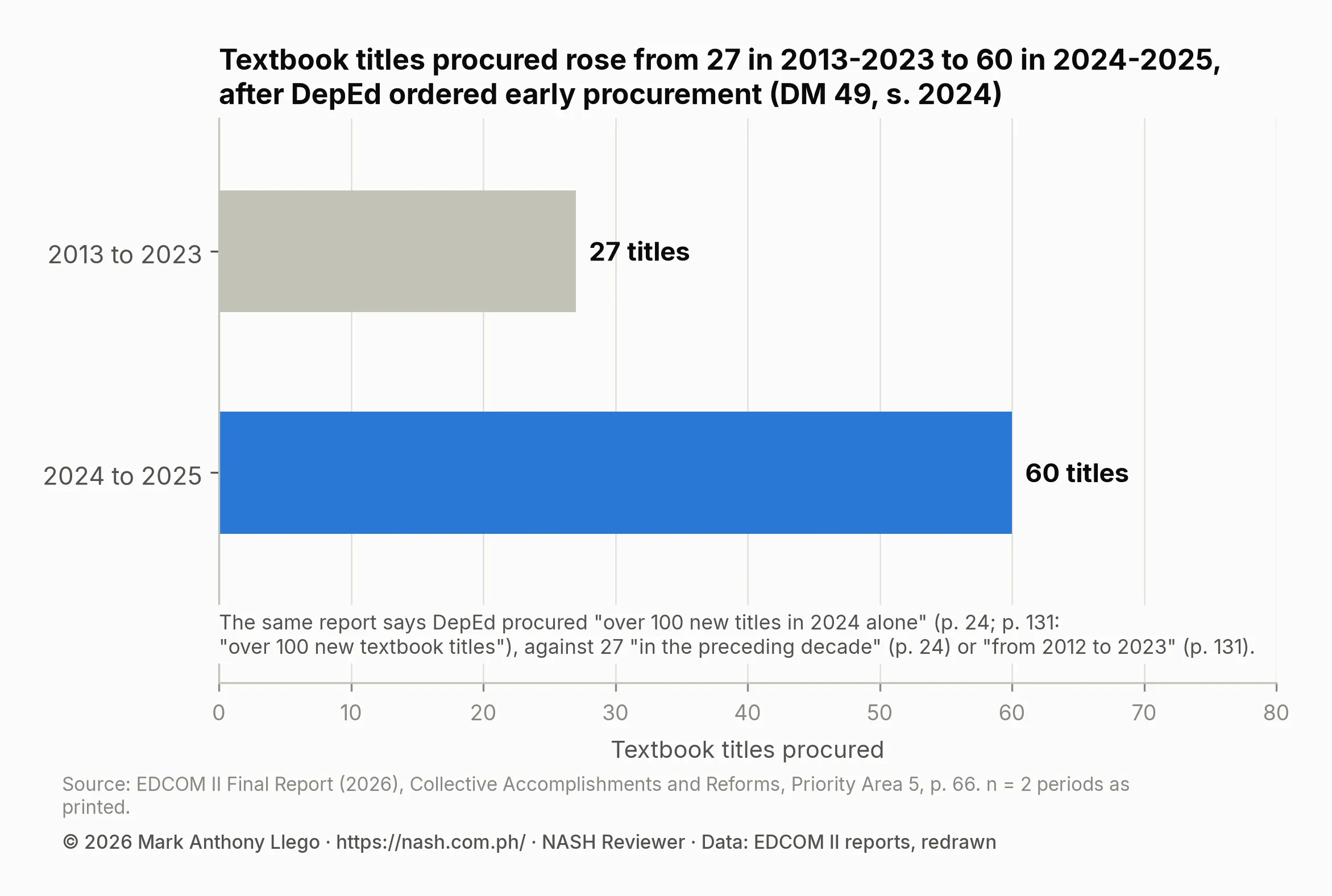
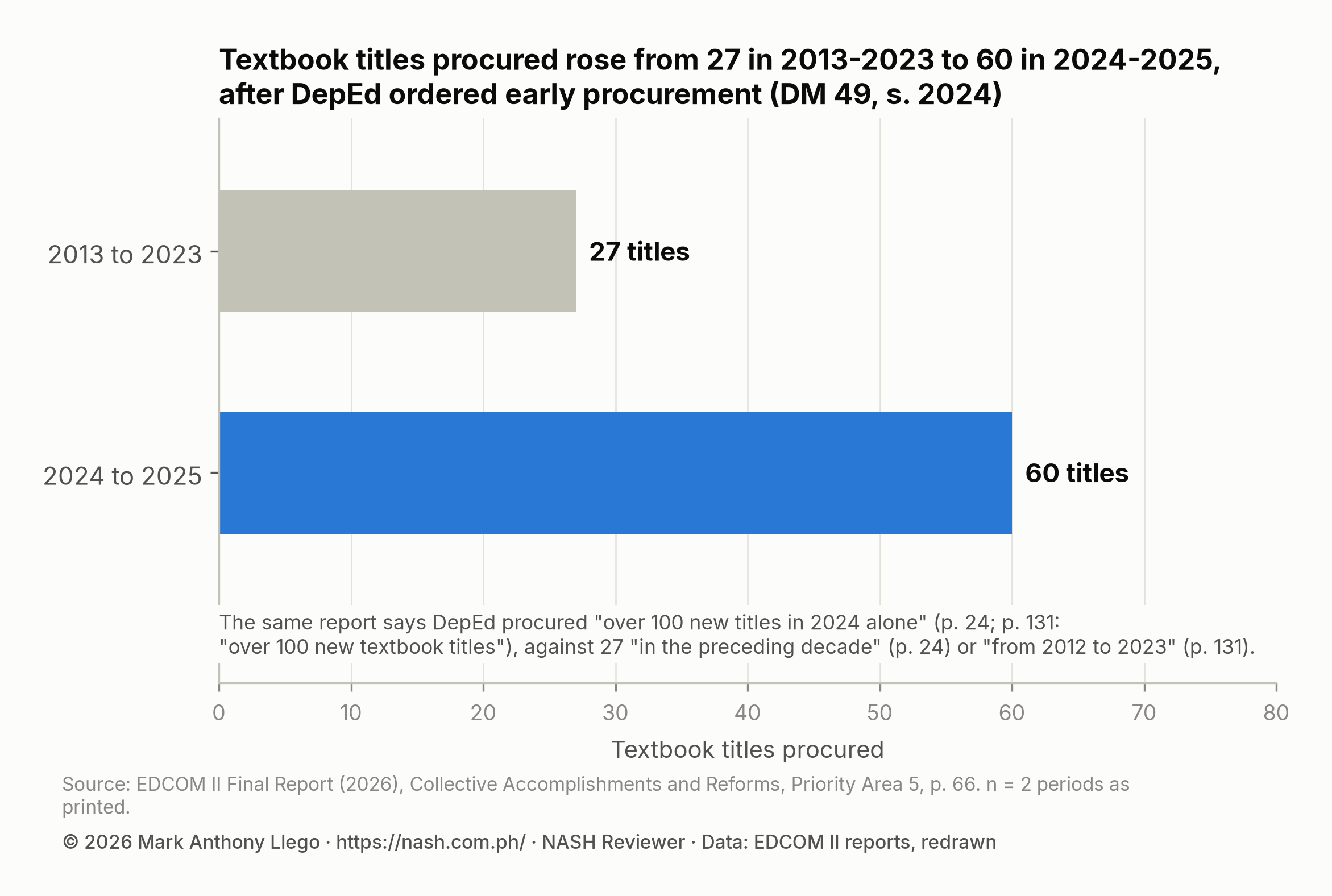
- The count rose in 2024-2025. The Final Report credits DepEd Memorandum No. 49, s. 2024 on early procurement with raising textbook titles procured from 27 in 2013-2023 to 60 in 2024-2025 (p. 66). Elsewhere it reports “over 100 new titles in 2024 alone” (p. 24; p. 131 has “over 100 new textbook titles”) and a procurement timeline cut from 210 days to 60 calendar days (p. 134).
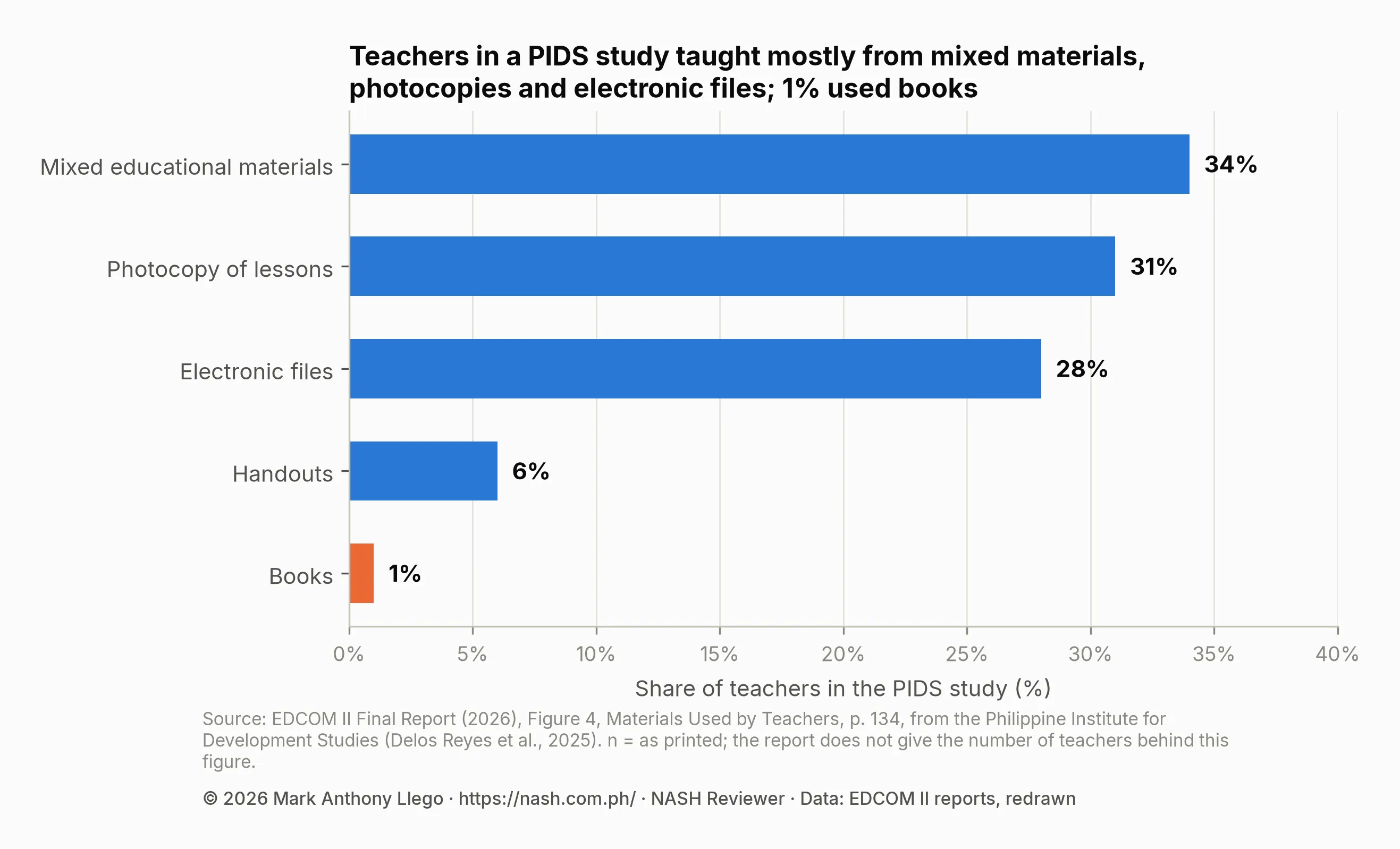
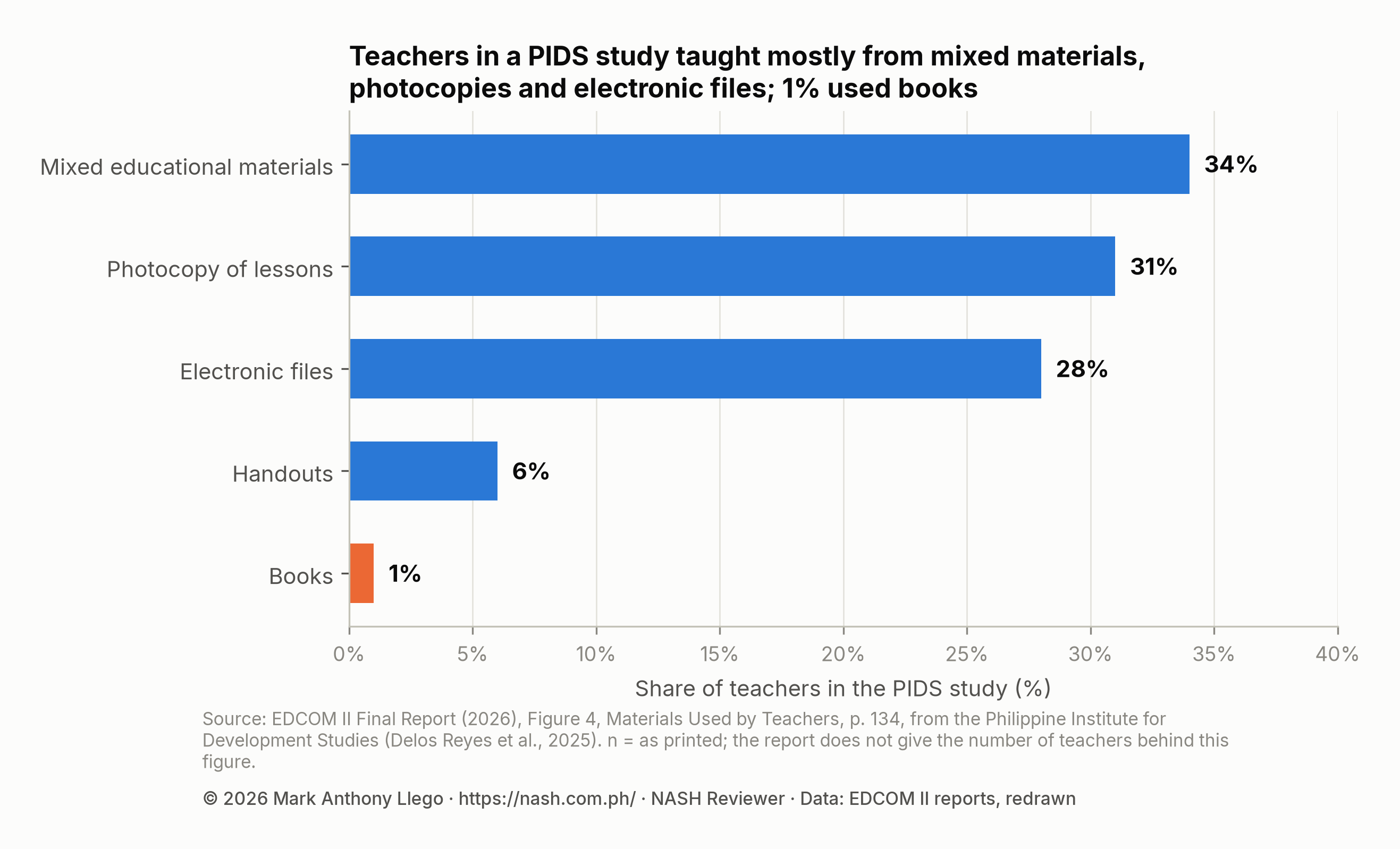
- Classrooms ran on substitutes. In a PIDS study cited by the Final Report, 34% of teachers relied mainly on mixed materials, 31% on photocopied lessons and 1% on books. In a Camiguin survey of 42 teachers, 21.43% had received no textbooks at all (p. 134).
- The target is a complete set for every elementary learner by 2028. The National Education Plan aims for all 14,748,764 elementary learners to have a complete set of textbooks by 2028, up from about 10,001,702 of 13,335,603 in SY 2023-2024 (Final Report, p. 450).
How few textbooks reached learners, 2012 to 2023
For its first year, EDCOM II narrowed its work on learning resources to one question: whether public schools have textbooks (Year One Report, p. 83). The report calls textbooks “critical inputs to education” that, aligned with lesson plans, teacher training and mentoring, make structured teaching possible. Its key finding is blunt: “for the past decade, even if the budget is available, textbooks are not procured on time” (p. 83).
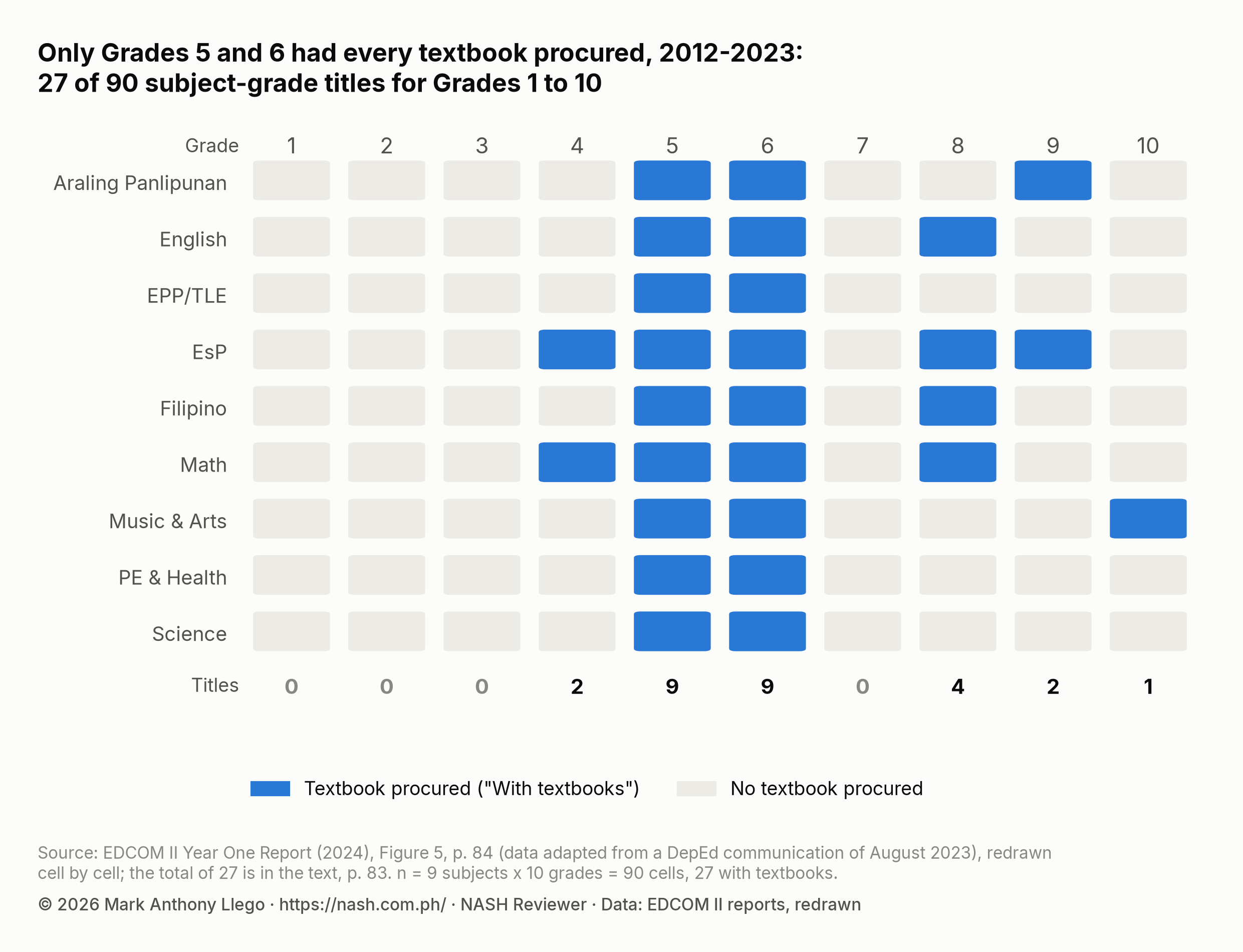
Figure 5 of the Year One Report (p. 84), adapted from data DepEd submitted in August 2023, shows the result subject by subject and grade by grade. Figure 1 redraws it cell by cell.
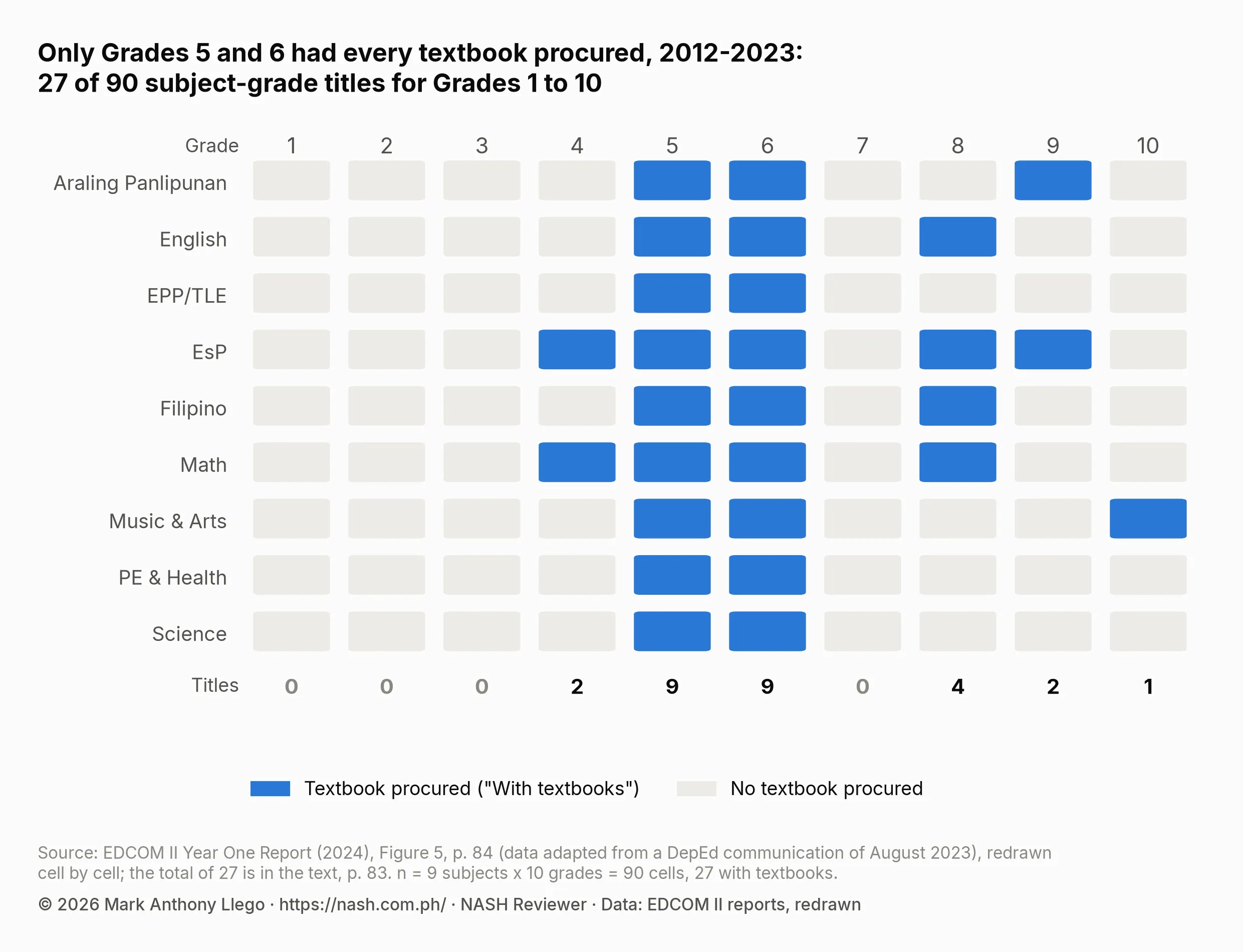
| Grade | 1 | 2 | 3 | 4 | 5 | 6 | 7 | 8 | 9 | 10 |
|---|---|---|---|---|---|---|---|---|---|---|
| Subjects with a procured textbook (of 9) | 0 | 0 | 0 | 2 | 9 | 9 | 0 | 4 | 2 | 1 |
Three things stand out. Grades 1, 2, 3 and 7 had no procured textbook in any subject. Grades 5 and 6 were complete, which is why the Final Report later wrote that only “two out of ten grade levels” had a complete set of textbooks “since the K to 12 curriculum was first implemented” (p. 131). And the count is of titles, not copies. A procured title can still leave learners sharing: in the 2019 Southeast Asia Primary Learning Metrics (SEA-PLM), at least 1 of 5 participating Grade 5 students shared a textbook, even though DepEd had reported successful procurement for that grade (Year One Report, p. 84). In the 2019 Trends in International Mathematics and Science Study (TIMSS), 95% of participating Grade 4 students were in schools where shortages of learning materials affected instruction in both science and math (p. 84).
The pandemic widened the gap. DepEd told EDCOM II that it deprioritized textbook printing from FY 2020 to 2023 and focused on self-learning modules instead (Year One Report, p. 83; Year Two Report, p. 101). When DepEd piloted the new curriculum in Kindergarten and Grades 1, 4 and 7, EDCOM II found that the pilot schools “lack textbooks and are relying on lesson exemplars and loose activity sheets” (Year One Report, p. 118).
Which years does the 27 cover?
The number 27 does not change across EDCOM II’s documents, but the period attached to it does. A citation should name the source it relies on.
| Source | Wording | Page |
|---|---|---|
| Year One Report, text | “only 27 textbooks have been procured since 2012” | p. 83 |
| Year One Report, Figure 5 | “Summary of Successful Procurement of Textbooks (2012–2023)” | p. 84 |
| Year Two Report | “only 27 titles acquired in the past decade” | p. 100 |
| Final Report, executive summary | “only 27 new titles procured in the preceding decade” | p. 24 |
| Final Report, accomplishments table | “just 27 from 2013 to 2023” | p. 66 |
| Final Report, Priority Area 5 | “the 27 titles procured in the entire preceding decade from 2012 to 2023, as cited in the EDCOM Year 1 Report” | p. 131 |
| EDCOM II news release, September 16, 2025 | “the 27 titles procured in the entire preceding decade (2014-2023)” | web page |
None of these documents explains why the start year differs. The original source, Figure 5 of the Year One Report, gives 2012-2023.
The money was there; spending was not
The Year One Report states the issue in its heading for this priority: delays in textbook procurement “despite budget allocations” (p. 83). Citing the Agency Budget Notes of the Congressional Policy and Budget Research Department for FY 2020 to FY 2024, it reports that from 2018 to 2022 alone, ₱12,648,000,000.00 was allocated to textbooks and other instructional materials. Of that, ₱4,470,900,000.00 (35.3%) was obligated and ₱951,900,000.00 (7.5%) was disbursed (p. 83).
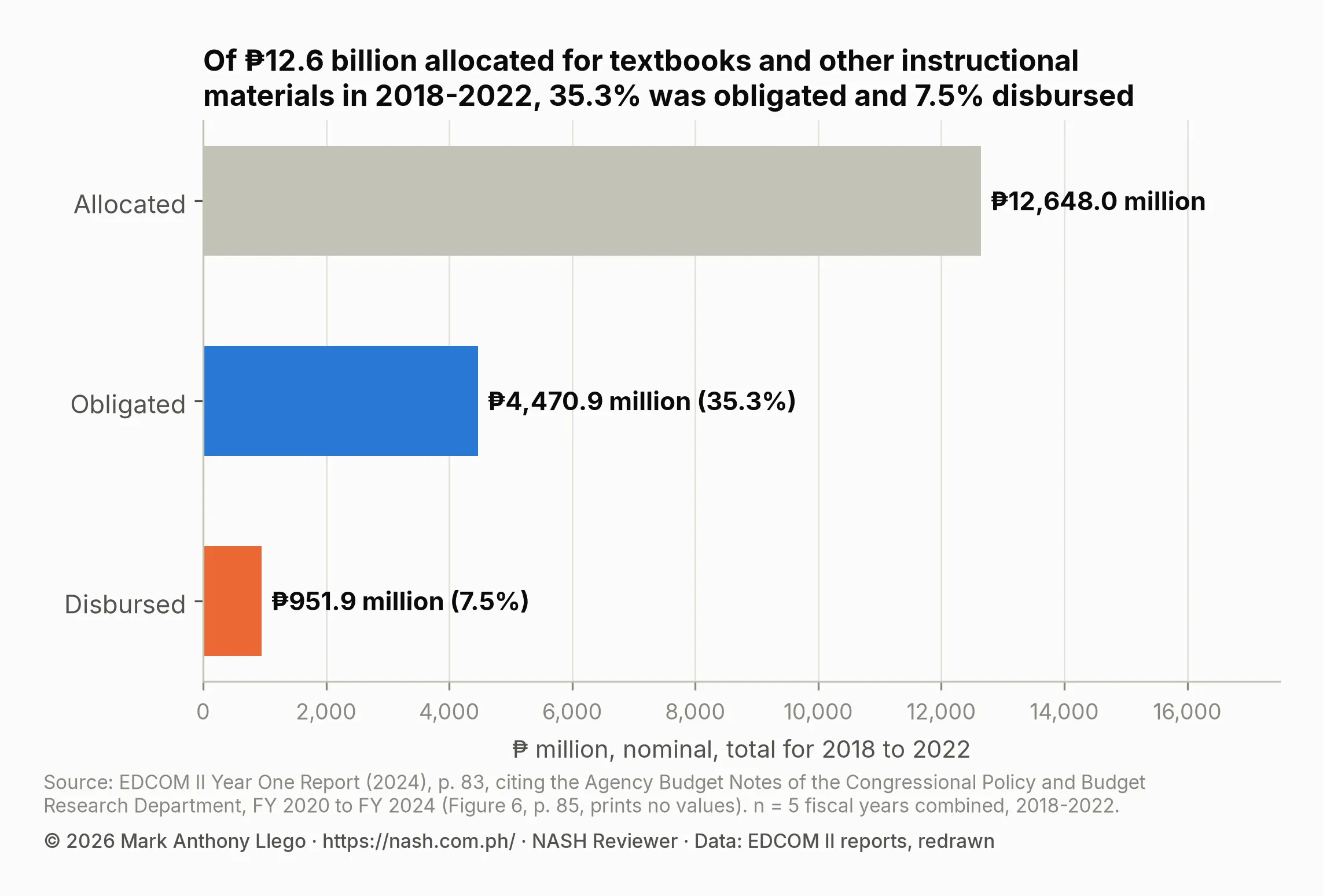
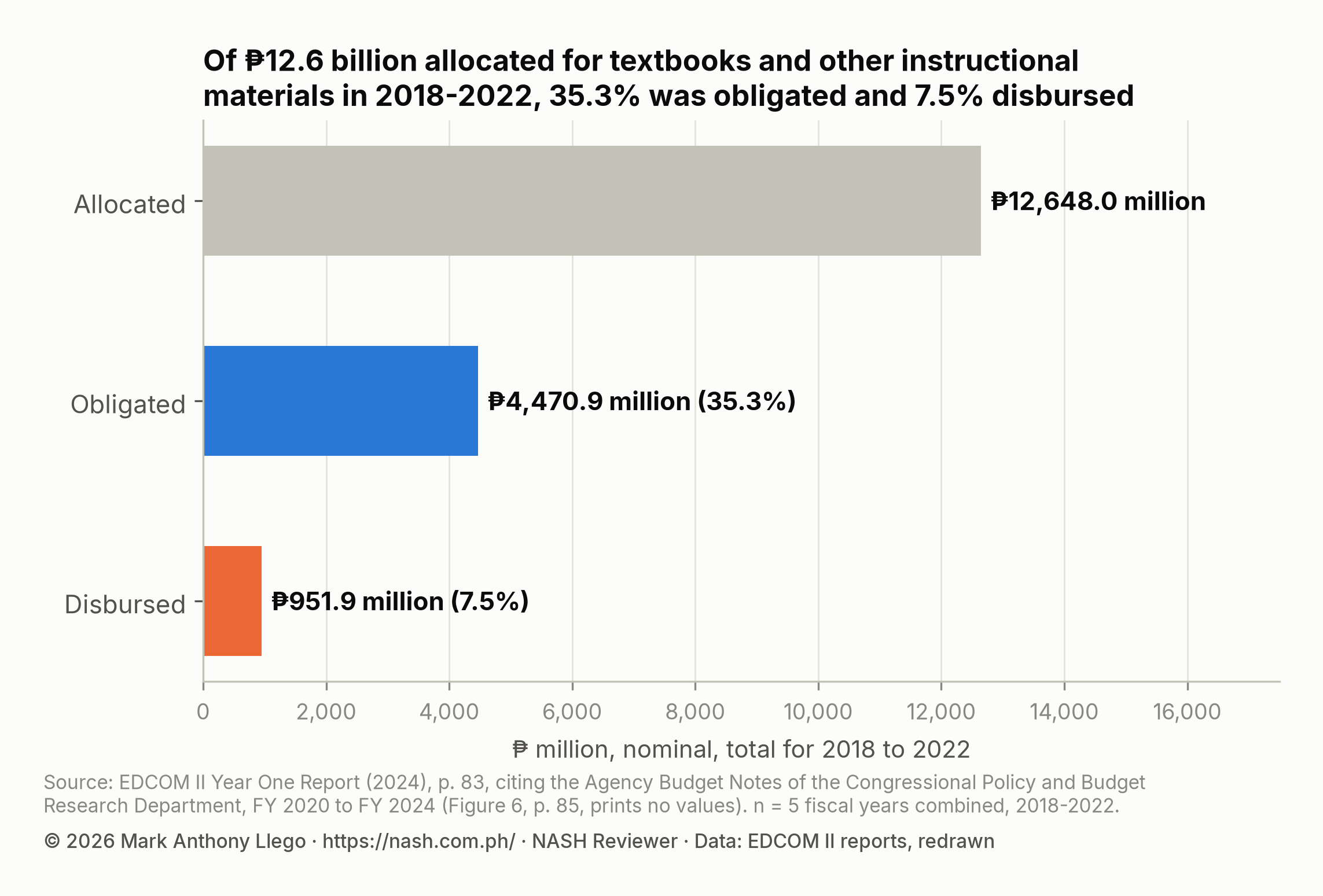
| 2018-2022 combined | ₱ million, nominal | Share of allocation |
|---|---|---|
| Allocated | 12,648.0 | |
| Obligated | 4,470.9 | 35.3% |
| Disbursed | 951.9 | 7.5% |
The Year Two Report ties the low spending to the procurement failures: the shortfall in titles “has led to the chronic underutilization of allocated funds” (p. 100). The Final Report finds the same pattern for learning tools and equipment in STEM and technical-vocational programs, where “only 12.59% of allocated funds have been disbursed annually” over five years (p. 128). Its Figure 1 gives yearly disbursement rates by type of equipment from 1.54% to 50.93% (p. 130); the report does not explain how the two figures relate.
How DepEd procured a textbook before 2023
Three rules shaped the system the reports describe.
Republic Act No. 8047 (1995), the Book Publishing Industry Development Act, moved textbook publishing to the private sector. It directed the education department to “phase out its elementary and secondary textbook publication and distribution functions” and to limit itself to setting minimum standards, reviewing manuscripts from private publishers and assisting in distribution (Year One Report, p. 89). It created the National Book Development Board (NBDB) and abolished DepEd’s Instructional Materials Development Center (Final Report, p. 129). The Year One Report reads the law as one that “prohibits schools from producing their own textbooks” (p. 88).
DepEd Memorandum No. 289, s. 2004, Textbook Policy (July 7, 2004), stated DepEd’s textbook policy. The Department “shall endeavor to provide one textbook per pupil (elementary) and student (secondary)”, at minimum the same title per class or school per subject; it oversees a textbook evaluation process; and textbooks by subject “shall be purchased for the entire student population every five years following a published schedule” (DM 289, items I.1, I.2 and I.4.1; Final Report, p. 129).
Government Procurement Policy Board (GPPB) Resolution No. 01-2010 approved Volume V of DepEd’s customized procurement manual, for the manuscripts of textbooks and teacher’s manuals, aligned with Republic Act No. 9184. Under it, DepEd procured the manuscript separately from the printing and delivery of the book (Final Report, p. 129; Year One Report, p. 89). DO 008, s. 2025 describes the resolution the same way (Enclosure, p. 1).
The Year One Report’s Figure 8 (p. 92) sets out the resulting cycle in ten steps:
- DepEd announcement to bid (with publishers)
- Publisher submission to DepEd
- DepEd evaluates manuscripts
- DepEd awards contract
- Editorial review for payment
- Print-ready manuscript creation
- Print-ready manuscript submission to DepEd
- Review and approval of print-ready manuscript
- Procurement for printing and delivery
- Printing and delivery
Step 9 could not start until step 8 was done: “the procurement for printing and delivery only starts after the approval of a print-ready version of the manuscript” (Year One Report, p. 89). Two procurements had to succeed one after the other before a learner saw a book. From its consultations with the NBDB and private publishers, EDCOM II reports that the complete cycle for a single title “can extend over 3 to 5 years” (Year One Report, p. 86; Final Report, p. 129).
The delay is old. The first EDCOM’s 1991 report found that developing a textbook took three years on average (Year One Report, p. 85). DepEd’s own 2025 order says that under Volume 5, providing textbooks and teacher’s manuals to schools “took an average of three years to complete” (DO 008, s. 2025, Enclosure, p. 1).
Which procurement law applied
The years the reports examine fall under Republic Act No. 9184, the Government Procurement Reform Act, approved on January 10, 2003. DepEd’s 2024 memorandum on early procurement still rests on the 2016 Revised Implementing Rules and Regulations (IRR) of RA 9184 (DM 049, s. 2024, item 1). Republic Act No. 12009, the New Government Procurement Act, which revises RA 9184, was approved on July 20, 2024. As DepEd quotes its transitory provision, RA 9184 and its IRR stayed in force until the new law’s IRR took effect (DO 014, s. 2024, footnote 1). A study commissioned by EDCOM II (Malaluan and Maribojoc, 2024) called for more research and consultations “as the New Government Procurement Act (RA 12009) is rolled out” (Year Two Report, p. 101), and by March 2026 DepEd was issuing emergency procurement guidelines under RA 12009 and its IRR (DO 005, s. 2026). The textbook failures of 2012-2023 happened under RA 9184.
Where the process failed
EDCOM II’s first hearing on learning resources was on June 1, 2023 (Year Two Report, p. 100). From that hearing and later work, the reports find a failure point at nearly every step of the cycle. The Final Report sums them up as central pricing below market cost, a six-month manuscript window, high participation costs, review processes that “push procurement timelines beyond 200 days”, and “chronic understaffing in curriculum and procurement units” (p. 128).
Too little time to write
The NBDB told EDCOM II that a textbook typically takes 18 months to develop, but DepEd often gave only six months from the textbook call. Publishers therefore submitted premade drafts with minor revisions, which took longer to edit and revise (Year One Report, p. 86). The report’s Figure 7 states the minimum as “at least 9 months” (p. 87), still more than the six months allowed.
Fees with no guarantee
Publishers paid evaluation fees of ₱25,000 per title. A publisher submitting Grades 1 to 6 of one subject paid ₱150,000 “without guarantee that their manuscripts will be selected for publication” (Year One Report, p. 86).
Slow and conflicting reviews
The Bureau of Learning Resources (BLR) had no dedicated review staff, so personnel of the Bureau of Curriculum Development reviewed manuscripts on top of their regular duties, and publishers received conflicting comments from different reviewers (Year One Report, p. 86). In the data DepEd submitted, “most of the bottleneck delays are caused by technical reviews of the textbooks” (Year Two Report, p. 101). A DepEd official also raised the need to hire project management and procurement experts (Year One Report, p. 88).
Prices below cost
DepEd required 70 GSM newsprint instead of the 50 GSM common in private school books, because public school textbooks are replaced only about every five years. Yet the agreed price stayed fixed even when material costs rose before the contract was awarded (Year One Report, pp. 86-87). Publishers told the NBDB that earlier bidding failures came from contract prices that ignored the location of the regions bid out, the capacity of publishers there and the cost of materials and logistics in those areas (Final Report, p. 136).
Failed biddings
Secretary Sonny Angara told the Senate Committee on Finance that DepEd had seven failed biddings for a single subject, MAPEH, because of requirements such as integrated, multi-component textbooks that publishers could not meet (Final Report, p. 130). For Grade 1, Regions 1, 6 and 10 “experienced failure of bidding for Ilokano, Hiligaynon, & Sinugbuanong Binisaya, respectively”, and so procured Filipino textbooks and teacher’s manuals instead (Year Two Report, p. 102).
A thin market
The NBDB lists 328 active publishers, yet “only 10 publishers won all 60 lots in the latest DepEd bidding” (Final Report, p. 132). A study by the Philippine Institute for Development Studies (PIDS) mapped book enterprises and found them heavily concentrated in Luzon: most northern Visayas provinces had none, and Mindanao had only a handful of publishers and printers (Delos Reyes et al., 2025, cited in Final Report, p. 132).
The last mile
Even when awards were made, deliveries were often late or incomplete, “with some textbooks stranded in warehouses because logistics are procured under separate contracts” (Final Report, p. 128). Materials often cross two to four islands before reaching remote or upland schools, most regional offices rely on temporary or rented storage, and schools often get no advance notice of a shipment (p. 133). The PIDS study’s rapid survey of teachers in Camiguin shows what that means in a classroom.
| Rapid survey of 42 teachers in Camiguin | Share |
|---|---|
| Received DepEd textbooks, but not on time and incomplete | 42.86% |
| Received complete sets on schedule | 11.9% |
| Received no textbooks at all | 21.43% |
Source: EDCOM II Final Report (2026), p. 134, citing Delos Reyes et al. (2025). The report does not give the remaining share.
What teachers used instead
When textbooks were not procured, “learners and teachers use learners’ manuals, self-learning modules, activity sheets, and other locally developed learning resources” (Year One Report, p. 88). DepEd issued learners’ manuals and teacher guides as interim materials during the shift to K to 12. From 2020 to 2022 it funded self-learning modules (SLMs) under the Basic Education Learning Continuity Plan, charged to learning resources under the flexible learning options rather than to textbook funds (p. 88). Writing SLMs often fell to teachers, quality assurance varied across regions and divisions, and errors led DepEd to launch an Error Watch in SY 2020-2021 (p. 88).
The Year One Report also records a legal concern. At EDCOM’s June 1, 2023 consultation, “concerns were raised about teachers extracting content from copyrighted textbooks for SLMs, effectively circumventing RA 8047, as these supplementary learning resources are often treated in schools as substitutes for textbooks” (p. 88).
The PIDS study cited in the Final Report shows how far the substitutes went. Figure 3 gives the main materials that teachers in the study used.
| Material (as labeled) | Mixed educational materials | Photocopy of lessons | Electronic files | Handouts | Books |
|---|---|---|---|---|---|
| Share of teachers | 34% | 31% | 28% | 6% | 1% |
The Final Report names the cost of this “shadow system of learning resources”. Improvised materials skip DepEd’s formal quality assurance, and schools with more MOOE or local government support produce cleaner materials while poorer schools depend on low-quality photocopies or handwritten modules (p. 134). In SEA-PLM, access to individual reading textbooks “declined sharply from 74% in 2019 to 54% in 2024” (p. 150).
What changed, 2023 to 2025
Between 2023 and 2025 DepEd issued four rules on how textbooks are bought and delivered, and the GPPB confirmed that preselecting titles is allowed.
| Date | Issuance | What it did | Status on October 30, 2026 |
|---|---|---|---|
| September 19, 2023 | DO 025, s. 2023 | Bundled the manuscript, printing and delivery into one procurement; let regional offices choose titles from a central menu and run their own procurement; allowed several titles per subject and grade in smaller lots (Final Report, p. 129; Year One Report, p. 93) | Repealed by DO 008, s. 2025 |
| March 11, 2024 | DO 004, s. 2024 | Supply and delivery strategy: the contractor delivers goods to their final destinations, and payment is demandable only after DepEd inspects and accepts them there (item 3). Listed in the Final Report (p. 129) as “DO No. 24 s. 2024”; see the note below | Not amended as of October 2026 |
| June 19, 2024 | GPPB clarification | Preselecting textbook titles “does not equate to prequalification and is therefore a valid procurement option” (Year Two Report, p. 100) | Not a DepEd issuance |
| September 18, 2024 | DM 049, s. 2024 | Ordered early procurement activities for FY 2025 under DO 051, s. 2021, including textbooks and instructional materials | Covered the FY 2025 procurement |
| March 28, 2025 | DO 008, s. 2025 | Evaluates and selects titles from publishers before procurement, within an indicative 85-calendar-day selection stage | In force |
The Final Report’s Table 1 lists the 2024 delivery reform as “DepEd DO No. 24 s. 2024”, which “Requires all procurement activities to include delivery to the end user in the contract” (p. 129). No DepEd Order No. 24, s. 2024 exists; the rule described is in DO 004, s. 2024, whose rule V.A.1 bars, unless specially approved, “Procurement for the supply of goods and a separate Procurement for the forwarding or hauling services to transport the goods to the final destinations”.
Early procurement under DM 49, s. 2024
DepEd Memorandum No. 049, s. 2024, dated September 18, 2024, defines early procurement activities as the conduct of procurement “from posting of the procurement opportunity, if required, until recommendation of the Bids and Awards Committee (BAC) to the Head of Procuring Entities (HoPE) as to the award of the contract”, for goods to be delivered in the following fiscal year, “pending approval of their respective funding sources” (item 2). Contracts “shall only be awarded after approval of FY 2025 budget as General Appropriations Act, or as reenacted, if applicable” (item 9). In other words, the bidding runs while Congress is still deliberating the budget, so that awards can follow soon after it passes.
DM 49 did not create early procurement. It applies DO 051, s. 2021, Guidelines on the Conduct of Early Procurement Activities (EPA) at the Department of Education (November 25, 2021), which the memorandum cites (item 5). That order allows procurement to proceed “even pending approval of the General Appropriations Act (GAA)” and stays “in force unless otherwise repealed/amended” (items 1 and 4). As of October 2026, no later order has repealed or amended it, and DO 022, s. 2026 still refers to projects “subject to Early Procurement Activities (EPA)” for FY 2027 funding. DM 49 itself lists the FY 2025 projects, amounts and timelines.
For the BLR’s textbooks and instructional materials, Enclosure No. 1 lists ₱5,321,002,790.69 for textbooks and materials and ₱168,469,982.02 for Kindergarten activity sheets, ₱5,489,472,772.71 in all. The Central Office timeline set bidding for October to December 2024 and the award and contract for January 2025 (Enclosure No. 2).
The Final Report presents DM 49 as DepEd’s “amendment of previous policy which bundled procurement of textbooks” (p. 66), that is, of DO 25, s. 2023. The memorandum itself neither cites nor amends DO 25: its only listed reference is DO 051, s. 2021, and it applies early procurement to FY 2025 projects across several programs. DO 25 was later repealed by DO 008, s. 2025.
Selection before purchase under DO 8, s. 2025
DO 8, s. 2025 explains why DO 25, s. 2023 was replaced. DO 25 “was intended to cut the procurement and provision of TXs and TMs to at least a year”, but DepEd noted “the non-procurement of all required titles across learning areas and grade levels, as well as delays caused by extensive review processes” (Enclosure, p. 1). The new order evaluates and selects finished titles before any purchase, “leveraging available titles in the market” (Enclosure, p. 1). That is close to what EDCOM II recommended in 2024, buying books “already available in the market rather than engaging publishers to develop new ones” (Year One Report, p. 93), and repeated in 2025: “procuring textbooks already available in the market and systematizing internal review to expedite the procurement process” (Year Two Report, p. 101). Learning Resource Evaluators assess each title on four criteria: compliance with the curriculum, accuracy of content including errors and plagiarism, instructional design suited to Philippine culture, and language and readability (Final Report, p. 135).
Before a round begins, DepEd issues the call for submissions, orients publishers and trains its evaluators, on a timeline set by the Office of the Undersecretary for Curriculum and Teaching. The order’s Figure 1 then sets an indicative timeline (Enclosure, p. 3). Submissions are processed within 5 calendar days. The selection stage runs within 85 calendar days: content evaluation (15 days), corrections by publishers (20), review of the revised copies (16), finalization by publishers (17), final review (15) and release of results (2). These are the 85 calendar days that the Final Report cites (p. 136). Titles that pass “shall no longer be subject to any further revisions” and go to procurement “in printed and/or electronic forms” (Enclosure, p. 10).
Where things stood in January 2025
The Year Two Report charts DepEd’s status data for the new curriculum’s Grade 1, 4 and 7 textbooks and teacher’s manuals, as of January 6, 2025 (pp. 102-103). Each subject line ends in a marker in the column of the stage it had reached. Figure 4 counts the lines at each stage.
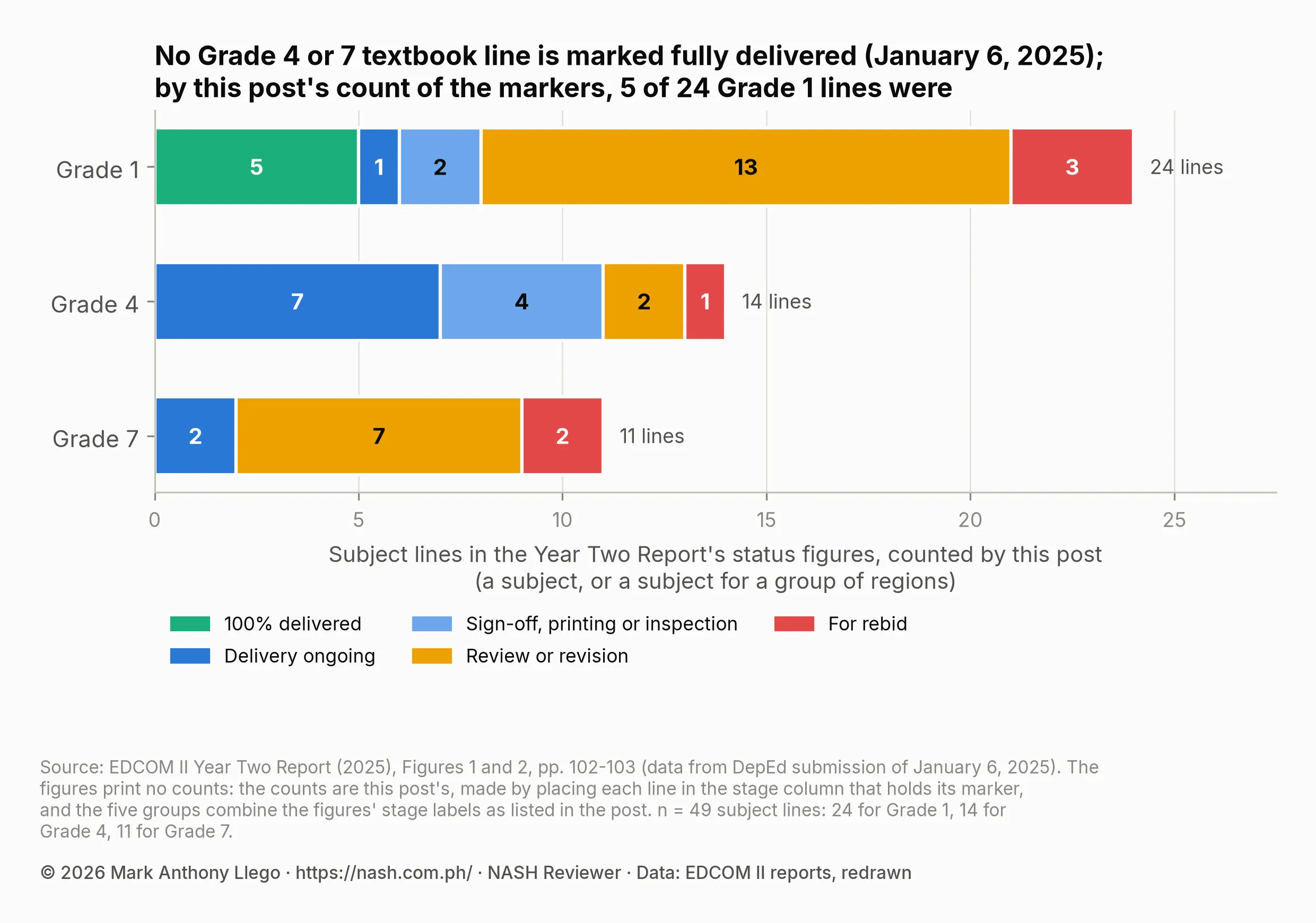
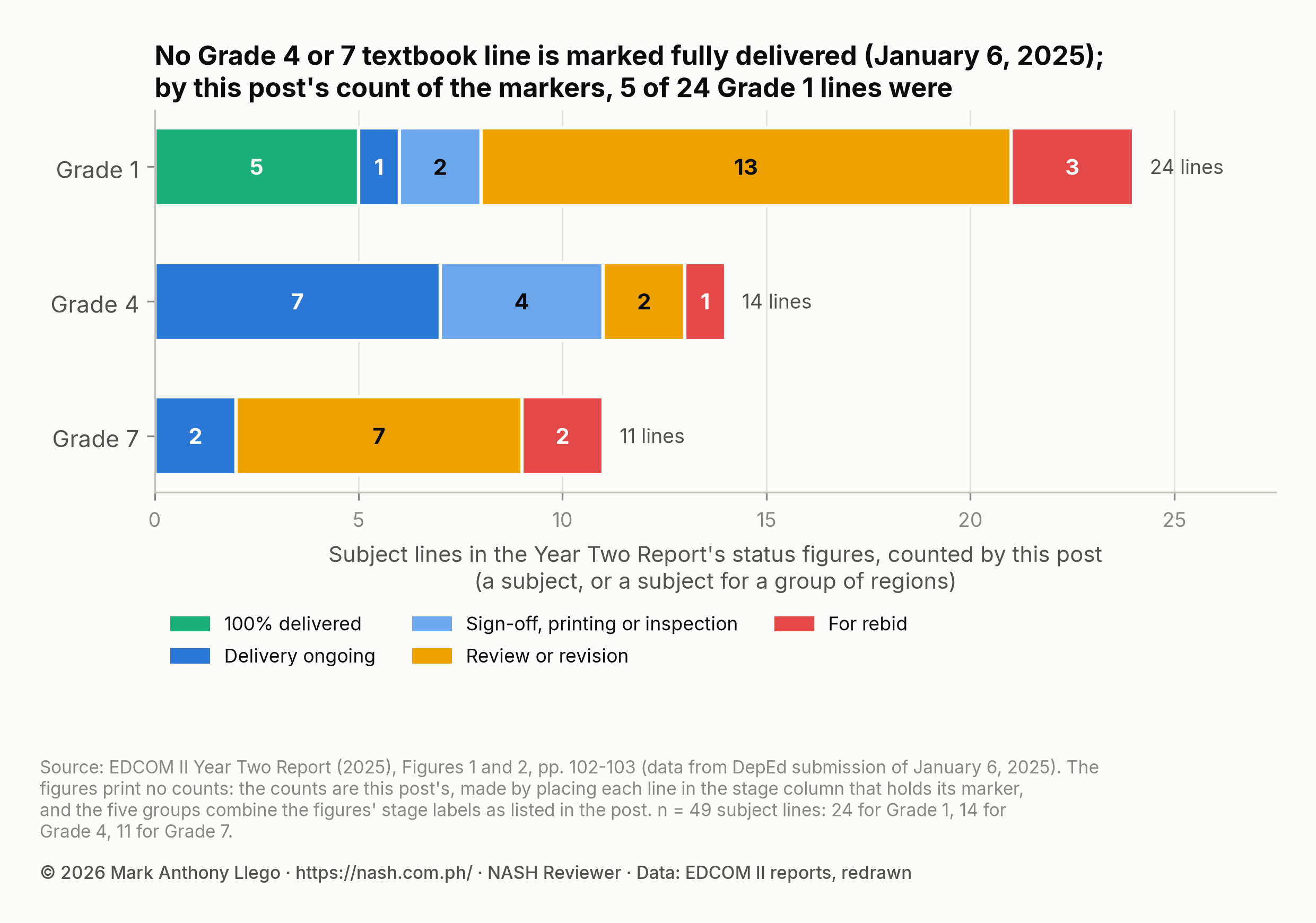
| Stage (labels from the figures) | Grade 1 (24 lines) | Grade 4 (14 lines) | Grade 7 (11 lines) |
|---|---|---|---|
| 100% Delivered | NCR Reading & Literacy; Waray (Region 8), all four subjects | None | None |
| Ongoing Delivery | NCR Good Manners and Right Conduct | Araling Panlipunan; Filipino; Science; English (Regions I-V, CAR, NCR); Math (Regions VI-VIII, NCR); PE and Health (Regions V, NCR); EPP (Regions VI-VIII) | Maths; Science (Regions V-XII, NCR, Region XIII) |
| Sign Off & Printing, Preproduction Inspection, For PDI | Bicolano (Region 5) Good Manners and Right Conduct and Makabansa | Good Manners and Right Conduct; English (Regions VI-XII, Region XIII); PE and Health (Regions I-IV, VI-VIII, CAR); EPP (Regions I-V, IX-XII, CAR, NCR, Region XIII) | None |
| For Finalization, For Review, For Revision, Review of Revised | NCR Makabansa and Language; Region 5 Reading & Literacy and Language; Region 1 all four; Region 6 Good Manners and Right Conduct; Region 10 all four | Math (Regions I-IV, IX-XII, CAR, Region XIII); PE and Health (Regions IX-XII, Region XIII) | Araling Panlipunan; English; Filipino; PE and Health; Technology and Livelihood Education; Values Education (Regions VI-XII, Region XIII); Science (Regions I-IV, CAR) |
| For Rebid | Region 6 Makabansa, Reading & Literacy and Language | Music and Arts | Music and Arts; Values Education (Regions I-IV, CAR, NCR) |
Figure 2 of the Year Two Report states it outright for Grades 4 and 7: “NONE 100% DELIVERED” (p. 103). For Grade 1 Mathematics, lesson exemplars and worksheets were provided instead (p. 102). The same report’s executive summary gives a different count for Grades 4 and 7: “only 35 out of 90 textbooks titles have been fully delivered as of January 2025, halfway through school year (SY) 2024–2025” (p. 22). The report does not reconcile the two.
EDCOM II had warned of this. Its Year One Report noted that procurement under the new policy was estimated to take one year, so DepEd “must be prepared to provide alternative teaching and learning resources if it intends to roll out the MATATAG curriculum in SY 2024–2025” (p. 93), and it recommended that DepEd formulate a contingency plan (p. 118).
What the Final Report credits
A year later, the Final Report lists the textbook reforms in its table of “Collective Accomplishments and Reforms” for 2023 to 2025. It credits DM 49, s. 2024: “This has resulted in the increase of textbook titles procured from just 27 from 2013 to 2023, to 60 in 2024 to 2025 alone” (p. 66).
The report and EDCOM II’s news releases give several figures for the same improvement.
| Claim | Source |
|---|---|
| Titles procured rose from 27 (2013-2023) to 60 (2024-2025) | Final Report, p. 66 |
| “procuring over 100 new titles in 2024 alone”, “representing a 289% increase” over 27 | Final Report, p. 24 |
| “procured and delivered over 100 new textbook titles in 2024 alone” | Final Report, p. 131 |
| “procured and delivered 60 new textbook titles in 2024 alone” | EDCOM II news release, September 16, 2025 |
| 87.27 million textbooks delivered as of October 2025 | Final Report, p. 134 (DepEd presentation on the FY 2026 budget) |
| Procurement timeline cut “from 210 days to just 60 calendar days” | Final Report, p. 134 |
| Delays that “in the past took up to 451 days” cut to 60 days, with 110 days to finish printing and delivery | Secretary Angara’s essay in the Final Report, p. 204 |
| “In 2024 alone, DepEd delivered over 87 million textbooks and procured more than 100 new titles” | EDCOM II news release, February 13, 2026 |
The reports do not explain the differences between 60 and “over 100”, or between 2024 alone and 2024-2025. The “over 100” titles and the 87.27 million textbooks are reported as DepEd’s figures (pp. 24, 134).
What remains to be fixed
The Final Report’s seven recommendations on learning resources (pp. 135-137) are:
- A two-year runway for textbooks and teacher’s manuals, with DO 8’s four criteria applied to all learning resources, self-learning modules included (p. 135).
- Work with the NBDB on the capacity of regional publishers. Publishers blamed earlier failed lots on low contract prices. The report anchors the fix on the rules implementing RA 8047, under which the NBDB helps smaller publishers while DepEd allows multiple titles and smaller bid lots (p. 136). It still cites DO 25, s. 2023 here for regional selection of titles, although DO 008, s. 2025 had repealed it.
- Stronger, timelier quality assurance of textbooks and teacher’s manuals (p. 136).
- The same quality assurance for self-learning modules. DepEd’s Error Watch was reiterated in 2025 “due to the rising number of recent errors found in delivered textbooks” (p. 136).
- Books that learners can borrow and take home. In the 2023 National Readership Survey, 47% of children aged 8 to 17 read non-school books, mostly printed and borrowed copies (p. 137).
- NBDB training on book development, distribution and intellectual property rights (p. 137).
- Spot checks on learning tools and equipment after delivery (p. 137).
The National Education Plan turns the textbook problem into Recommendation 2.1.2, “Revise procurement guidelines to ensure complete and timely delivery of textbooks”, one of the plan’s twenty priority reforms (Final Report, pp. 40, 450). Its target is every elementary learner with a complete set, one to one: all 14,748,764 by 2028, against about 10,001,702 of 13,335,603 in SY 2023-2024, with updated textbooks delivered on DepEd’s five-year cycle after that (p. 450). The plan also asks DepEd for a two-stage pipeline, pre-evaluation and pre-selection first and procurement only from the pre-selected list, and for digital copies of textbooks as a procurement requirement (p. 454). The guide to the National Education Plan covers these targets and their costs.
Two problems sit outside DepEd’s procurement rules. The first is distribution: the PIDS study traced late textbooks to weak warehousing, long transport routes, delayed release of budgets and poor coordination along the supply chain (Final Report, p. 133). The second is digital access. The Final Report describes Senate Bill No. 122, the “E-Textbook Para Sa Lahat Act” filed by Senator Bam Aquino, which would require approved textbooks to be available in digital form free of charge (p. 135). It is a bill described in the report, not a law.
The research behind the Year Two Report adds longer-term options: a textbook policy set in law, pre-evaluation and preselection of textbooks, an amendment to RA 8047 allowing DepEd to develop textbooks “under extraordinary circumstances”, and a study of decentralized procurement (Malaluan and Maribojoc, 2024, cited in Year Two Report, pp. 100-101).
What this means for school heads
A school head cannot fix national procurement, but the school is where a missing book becomes a learner without one. Several current DepEd issuances give the school a defined part.
Check every delivery before anyone signs for it. For goods that the Central Office procures, DO 004, s. 2024 sets out the school’s part (Enclosure, items B.1.2 and B.3). The supplier must coordinate with the school at least three working days before delivery. The school property custodian or supply officer checks the quantity, physical form and condition of the goods against the allocation list and the delivery documents. The school inspection team inspects them: one inspector in a school with fewer than six personnel, two otherwise, all in plantilla positions. The custodian or supply officer then accepts. Inspection must begin within 24 hours of delivery, and representatives of the parents-teachers association or the barangay may be invited to observe. Damaged or defective goods are rejected and not received, and the school head reports them to the SDS within three working days (B.3.4). Latent defects found later are reported within 30 working days of their discovery (B.3.6). Goods that do not match the allocation list, and incomplete deliveries, are noted on the Inspection and Acceptance Report (IAR) and the delivery receipt (B.3.8). Payment becomes demandable only after inspection and acceptance at the final destination (item 3). A delivery receipt signed as complete makes a short delivery look like a full one.
Report delivery, distribution and use. DO 008, s. 2025 gives the Office of the School Principal, through the property office and the library where there is one, the task to “monitor and provide reports on the delivery, distribution, and utilization of TXs and TMs” and to “provide feedback on the quality” of the books in use (Enclosure, pp. 10-11). The division’s Curriculum and Instruction Division reports for the division. If your school keeps no running count of textbooks by grade and subject, it cannot report a shortage with numbers.
Use the forms that already exist. DO 006, s. 2025 keeps School Form 3, “Book Issued and Returned”, among the homeroom forms that teachers accomplish (Enclosure No. 2). The same order keeps a “Learning Resource Management Section (LRMS) Needs” report with learning area chairs (Enclosure No. 3). Before classes open, the School Preparedness Checklist of the 2026 Brigada Eskwela guidelines asks whether “sufficient textbooks, modules, and other learning materials are available” (DM 027, s. 2026, Annex A). Together these give the school its inventory, its gaps and a channel to report them.
Report errors. DO 8 asks schools for feedback on the quality of textbooks in use, and the Final Report notes that DepEd’s Error Watch runs at the Central Office and in the regions (p. 136). An error found by a teacher should go up through the division, not only into a corrected handout.
Fill gaps without copying textbooks. DepEd’s Learning Resources Portal is the first place to look for materials that DepEd has released for teachers. Activity sheets that teachers write themselves are the usual stopgap. Copying content from copyrighted textbooks into modules is the practice that participants in EDCOM II’s June 1, 2023 consultation said was “effectively circumventing RA 8047” (Year One Report, p. 88).
Do not buy textbooks with MOOE. DO 008, s. 2019 states that “in no case” shall school MOOE be used to procure textbooks or other supplementary learning resources, which include publications, periodicals and review materials. The guide to school MOOE covers what the fund may pay for.
Build the library through the supplementary learning resources process. Under DO 024, s. 2023, as amended by DO 014, s. 2024, the school head creates and chairs the School SLR Committee, which identifies the supplementary titles the school library needs on the basis of actual need, the current inventory and the budget ceiling. It consults the faculty, the student government and the parents’ association, and donated books go through the same evaluation. The 2024 amendment allows competitive bidding or other procurement methods, and lets schools that are implementing units buy supplementary books with allowable funds from other sources. This is the school’s part in the Final Report’s call for books that learners can borrow and take home (p. 137).
In the Philippine Professional Standards for School Heads (PPSSH), most of this is strand 2.3, school facilities and equipment, which covers “acquisition, recording, utilization, repair and maintenance, storage, and disposal” (Domain 2). Donations and partnerships for books belong to Domain 5, and making the curriculum work with whatever materials the school has belongs to Domain 3.
How the NASH may test this
These two practice items are original and follow the format of the NASH practice questions with answers. The facts in the stems come from the sources above; the schools and people are fictional.
Question 1
Indicator 2.2.1, Financial management. Career Stage 1, Conceptual, Moderate.
A division memorandum says the division will start bidding in October for learning resources that schools will receive next year, although the General Appropriations Act for next year has not yet been approved. A teacher asks how the division can bid for items that have no approved budget. Which statement best explains the rule?
- A. Early procurement lets the division run the bidding up to the committee’s recommendation of award ahead of time, but no contract may be awarded until the budget is approved.
- B. Early procurement lets the division award the contracts before the budget is approved, as long as the items are already listed in the expenditure program sent to Congress.
- C. Early procurement is only a survey of prices and suppliers, so the division has to repeat the whole bidding once the General Appropriations Act is finally approved.
- D. Early procurement lets the division post the opportunity, open the bids and evaluate them ahead of time, so the contracts can be signed on the first day of the new year.
Answer and explanation
Best answer: A. Points: A = 3, B = 0, C = 1, D = 2.
- A (3 points, Relational). This connects what may be done early, everything up to the recommendation of award, with the condition that makes it lawful: the award waits for the approved budget.
- B (0 points, Prestructural). Awarding a contract before the budget is approved is exactly what the rule forbids; a listing in the expenditure program is not an appropriation.
- C (1 point, Unistructural). It correctly senses that nothing is final before the budget passes, but early procurement is a real procurement whose results carry over, not a survey to be repeated.
- D (2 points, Multistructural). The early steps are right, but it drops the condition: the contract may be awarded only after the budget is approved, which may not be the first day of the year.
Why. This aligns with Career Stage 1 expectations because indicator 2.2.1 asks the aspiring school head to understand the policies on procurement. DepEd Order No. 051, s. 2021 allows early procurement “even pending approval of the General Appropriations Act (GAA)”, and DepEd Memorandum No. 049, s. 2024, which applies it to FY 2025, defines early procurement activities as the steps from posting the opportunity to the Bids and Awards Committee’s recommendation of award, “pending approval of their respective funding sources”, and says contracts “shall only be awarded after approval of FY 2025 budget as General Appropriations Act, or as reenacted”. EDCOM II’s Final Report credits this memorandum with raising textbook titles procured from 27 to 60 (p. 66). The option that ends with signing on the first day of the year gets the early steps right but misses the budget condition.
Indicator 2.2.1: Demonstrate knowledge and understanding of policies, guidelines and issuances in managing finances such as allocation, procurement, disbursement and liquidation aligned with the school plan.
Sources: DepEd Order No. 051, s. 2021; DepEd Memorandum No. 049, s. 2024; EDCOM II Final Report, Turning Point: A Decade of Necessary Reform (2026-2035), January 2026; DepEd Order No. 024, s. 2020.
Question 2
Indicator 2.3.2, School facilities and equipment. Career Stage 2, Situational, Moderate.
You are the school head of a public elementary school. The Central Office’s supplier delivers the new Grade 4 textbooks. For two subjects the delivery is 30 copies short of the quantity on the school’s allocation list, and five copies of a third subject have misprinted pages. Classes open in a week. What is the most appropriate action?
- A. Have the delivery checked against the allocation list and delivery receipt, reject the five misprinted copies, note them and the shortage on the receipt and inspection report, report to the division within three working days, and issue the good copies through School Form 3.
- B. Sign the delivery receipt and the inspection report as complete so that the supplier is paid on time, then use the school’s MOOE to buy the missing copies from a local bookstore so that every Grade 4 learner has a book.
- C. Issue all the copies on hand, the misprinted ones included, to the learners who need them most, ask the Grade 4 teachers to prepare activity sheets for the rest, and settle the delivery records at the end of the school year.
- D. Have the delivery checked against the allocation list and delivery receipt, reject the five misprinted copies, note them and the shortage on the receipt and inspection report, report to the division, and keep all the copies in storage until the full set arrives.
Answer and explanation
Best answer: A. Points: A = 3, B = 0, C = 1, D = 2.
- A (3 points, Relational). This links the record, the report and the use of the books: defective copies are rejected, the shortage is noted where DepEd’s rules require, the division hears of it within the deadline, and the good copies reach learners with a record of who has them.
- B (0 points, Prestructural). Signing a short delivery as complete is a false acceptance, and school MOOE may not be used to buy textbooks.
- C (1 point, Unistructural). Getting books to learners matters, but issuing misprinted copies and leaving the records for later loses the evidence that the division needs to have the supplier deliver and replace.
- D (2 points, Multistructural). The inspection, the notations and the report are right, but holding every copy back leaves learners without books that the school already has.
Why. This aligns with Career Stage 2 expectations because indicator 2.3.2 asks the school head to manage school resources in adherence to the policies on acquisition, recording and utilization. Under DepEd Order No. 004, s. 2024, the school checks a delivery against the allocation list and the delivery documents, rejects damaged or defective goods and reports them to the SDS within three working days, and notes incomplete deliveries on the Inspection and Acceptance Report and the delivery receipt (Enclosure, B.3.3, B.3.4 and B.3.8). DepEd Order No. 008, s. 2025 asks the school to report on the delivery, distribution and use of textbooks and on their quality, School Form 3 records books issued and returned, and DepEd Order No. 008, s. 2019 bars school MOOE from buying textbooks. EDCOM II’s Final Report records schools that received incomplete deliveries or none at all (p. 134). The option that stores every copy until the full set arrives keeps the records straight but forgets the learners.
Indicator 2.3.2: Manage school facilities and equipment in adherence to policies, guidelines and issuances on acquisition, recording, utilization, repair and maintenance, storage and disposal.
Sources: DepEd Order No. 004, s. 2024; DepEd Order No. 008, s. 2025; DepEd Order No. 006, s. 2025; DepEd Order No. 008, s. 2019; EDCOM II Final Report, Turning Point: A Decade of Necessary Reform (2026-2035), January 2026; DepEd Order No. 024, s. 2020.
Nothing in this guide reproduces or predicts examination content.
Frequently asked questions
How many textbook titles did DepEd procure from 2012 to 2023?
EDCOM II’s Year One Report found that only 27 textbook titles were procured for Grades 1 to 10 since 2012, and its Figure 5 covers 2012 to 2023 (pp. 83-84). Only Grades 5 and 6 had every subject covered; Grades 1, 2, 3 and 7 had none. The Final Report dates the same 27 titles to 2013-2023 in one table (p. 66) and to 2012-2023 elsewhere (p. 131).
Why did textbook procurement take so long?
Under the 2010 procurement manual, DepEd bought each manuscript first and only then procured its printing and delivery, so a single title could take three to five years (Year One Report, pp. 86, 89). Short writing windows, ₱25,000 evaluation fees per title, slow and conflicting reviews, fixed prices below cost, failed biddings and separate logistics contracts each added delay (Year One Report, pp. 86-88; Final Report, pp. 128-133).
What is DepEd Memorandum No. 49, s. 2024?
It is the memorandum of September 18, 2024 that ordered early procurement activities for FY 2025, so that bidding could run before the budget was approved and contracts could be awarded once it was. It applies DepEd’s standing rules on early procurement in DepEd Order No. 051, s. 2021. It covered ₱5.49 billion for the BLR’s textbooks, materials and Kindergarten activity sheets (Enclosure No. 1). The Final Report credits it with raising textbook titles procured from 27 in 2013-2023 to 60 in 2024-2025 (p. 66).
Can a public school use MOOE to buy textbooks?
No. DepEd Order No. 008, s. 2019 says school MOOE shall “in no case” be used to procure textbooks or other supplementary learning resources such as publications, periodicals and review materials. Textbooks come through DepEd’s own procurement, and library books through the process in DepEd Order No. 024, s. 2023 as amended by DO 014, s. 2024.
What does the National Education Plan target for textbooks?
Recommendation 2.1.2 targets a complete set of textbooks for every elementary learner, all 14,748,764 of them, by 2028, from about 10,001,702 of 13,335,603 learners in SY 2023-2024 (Final Report, p. 450). After 2028, DepEd is to deliver updated textbooks on its five-year cycle (p. 450), and the plan asks for pre-selection of titles before procurement and digital copies of every textbook (p. 454).
Download the data
- textbooks-procured-grid.csv: the 90 subject-grade cells of the Year One Report’s Figure 5, each marked “With textbooks” or “No textbooks”, 2012-2023 (Year One Report, pp. 83-84).
- textbooks-budget-utilization.csv: the amounts allocated, obligated and disbursed for textbooks and other instructional materials, 2018-2022 combined, in ₱ million, nominal (Year One Report, p. 83).
- textbooks-teacher-materials.csv: the shares of teachers by main material used, from the PIDS study (Final Report, Figure 4, p. 134).
- textbooks-procurement-status-2025.csv: the 49 Grade 1, 4 and 7 subject lines in the Year Two Report’s status figures (DepEd data of January 6, 2025), with the stage label of each, read from the markers, and the grouping used in Figure 4 (Year Two Report, pp. 102-103).
- textbooks-titles-procured.csv: textbook titles procured in 2013-2023 and 2024-2025, as printed (Final Report, p. 66).
The CSVs and charts may be reused only with written permission: email support@nash.com.ph. The numbers themselves come from the EDCOM II reports, which you can cite directly.
How to cite this post
Llego, M. A. (2026, October 30). Why DepEd Bought Only 27 Textbook Titles in 2012-2023. NASH Reviewer. https://nash.com.ph/blog/deped-textbook-shortage-edcom-ii
The EDCOM II reports:
- Second Congressional Commission on Education. (2024). Miseducation: The failed system of Philippine education (EDCOM II Year One Report). https://edcom2.gov.ph/media/2024/02/EDCOM-II-Year-One-Report-PDF-022924.pdf
- Second Congressional Commission on Education. (2025). Fixing the foundations: A matter of national survival (EDCOM II Year Two Report). https://edcom2.gov.ph/media/2025/01/EDCOM-2-Year-2-Report-Fixing-the-Foundations-2025.pdf
- Second Congressional Commission on Education. (2026). Turning point: A decade of necessary reform (2026–2035) (EDCOM II Final Report). https://edcom2.gov.ph/media/2026/01/EDCOM-II-Y03-for-web-012626_final.pdf
Sources
- EDCOM II Year One Report, Miseducation: The Failed System of Philippine Education (2024), Priority 5, Learning Resources, pp. 83-89, 92-93, and Priority 7, p. 118. PDF.
- EDCOM II Year Two Report, Fixing the Foundations: A Matter of National Survival (2025), executive summary, p. 22, and Year One Updates, Priority Area 5, pp. 100-103. PDF.
- EDCOM II Final Report, Turning Point: A Decade of Necessary Reform (2026-2035) (2026), pp. 24, 40, 66, 128-137, 150, 204, 450 and 454. PDF.
- EDCOM II, “EDCOM commends DepEd efforts: From 27 textbook titles in 10 years, to 60 titles in just one year”, news release, September 16, 2025. Web page.
- EDCOM II, “EDCOM II proposes regional solutions to support DepEd’s textbook reforms”, news release, February 13, 2026. Web page.
- DepEd Memorandum No. 289, s. 2004, Textbook Policy, July 7, 2004: items I.1, I.2 and I.4.1.
- DepEd Order No. 051, s. 2021, Guidelines on the Conduct of Early Procurement Activities (EPA) at the Department of Education, November 25, 2021: items 1 and 4.
- DepEd Memorandum No. 049, s. 2024, Conduct of Fiscal Year 2025 Early Procurement Activities by the Central, Regional and Schools Division Offices, September 18, 2024: items 1, 2, 5 and 9; Enclosures No. 1 and 2.
- DepEd Order No. 025, s. 2023, Guidelines on the Procurement and Quality Assurance of Textbooks and Teacher’s Manuals, September 19, 2023 (repealed by DO 008, s. 2025).
- DepEd Order No. 004, s. 2024, Guidelines in the Procurement of Goods Using the Supply and Delivery Strategy, March 11, 2024: item 3; Enclosure, V.A.1, B.1.2, B.3.1, B.3.3, B.3.4, B.3.6 and B.3.8.
- DepEd Order No. 008, s. 2025, Guidelines in the Selection of Textbooks and Teacher’s Manuals, March 28, 2025: items 2 and 4; Enclosure, pp. 1, 3, 10-11.
- DepEd Order No. 024, s. 2023, Guidelines on the Provision of Supplementary Learning Resources for Public School Libraries and Library Hubs, September 19, 2023, as amended by DepEd Order No. 014, s. 2024, October 9, 2024.
- DepEd Order No. 006, s. 2025, Guidelines on the Streamlining of School Forms and Reports Accomplished by Teachers, March 20, 2025: Enclosures No. 2 and 3.
- DepEd Order No. 008, s. 2019, Revised Implementing Guidelines on the Direct Release, Use, Monitoring and Reporting of MOOE Allocation of Schools, May 2, 2019.
- DepEd Memorandum No. 027, s. 2026, 2026 Brigada Eskwela Implementing Guidelines, May 5, 2026: Annex A.
- DepEd Order No. 022, s. 2026, September 24, 2026: item 7.
- DepEd Order No. 024, s. 2020, National Adoption and Implementation of the Philippine Professional Standards for School Heads (indicators 2.2.1, 2.3.1 and 2.3.2).
- DepEd Order No. 005, s. 2026, March 19, 2026.
- Republic Act No. 9184, Government Procurement Reform Act, approved January 10, 2003, Official Gazette.
- Republic Act No. 12009, New Government Procurement Act, approved July 20, 2024, Official Gazette.
- DepEd Learning Resources Portal.
The EDCOM II series
The reports:
- What EDCOM II Achieved, 2023-2025: Laws, Budgets, Policies
- EDCOM II’s Three Reports: How the Key Numbers Changed
- EDCOM II Final Report: Guide for Aspiring School Heads
- National Education Plan 2026-2035: Guide for School Heads
- 100 Years After the Monroe Report: Education Commissions
- Is the Philippines Spending Enough on Education?
- Education Data, Transparency and Research: EDCOM II
Learners and learning:
- Mass Promotion and Lost Instructional Time: EDCOM II
- PISA, TIMSS, SEA-PLM and the NAT: What EDCOM II Found
- Mother Tongue After RA 12027: Language of Instruction
- Why DepEd Bought Only 27 Textbook Titles in 2012-2023 (this post)
- RA 12080, Bullying and School Mental Health: EDCOM II
- RA 11650 and Learners With Disabilities: EDCOM II Findings
- Senior High School and Jobs: EDCOM II Workforce Findings
Schools, teachers and governance:
- Teacher Workload and Accountability: EDCOM II Findings
- Local School Boards and the Special Education Fund
- Local Education Models in EDCOM II: What the Evidence Shows
- Education in the Bangsamoro: EDCOM II Findings for BARMM
Written by Mark Anthony Llego for NASH Reviewer. Sources: EDCOM II Year One Report (2024), Year Two Report (2025) and Final Report (2026); DepEd Memoranda No. 289, s. 2004 and 049, s. 2024; DepEd Order No. 051, s. 2021; DepEd Orders No. 025, s. 2023, 004, s. 2024, 008, s. 2025, 024, s. 2023, 014, s. 2024, 006, s. 2025 and 008, s. 2019; DepEd Memorandum No. 027, s. 2026; Republic Acts No. 9184 and 12009. Charts may be reused only with written permission from support@nash.com.ph.