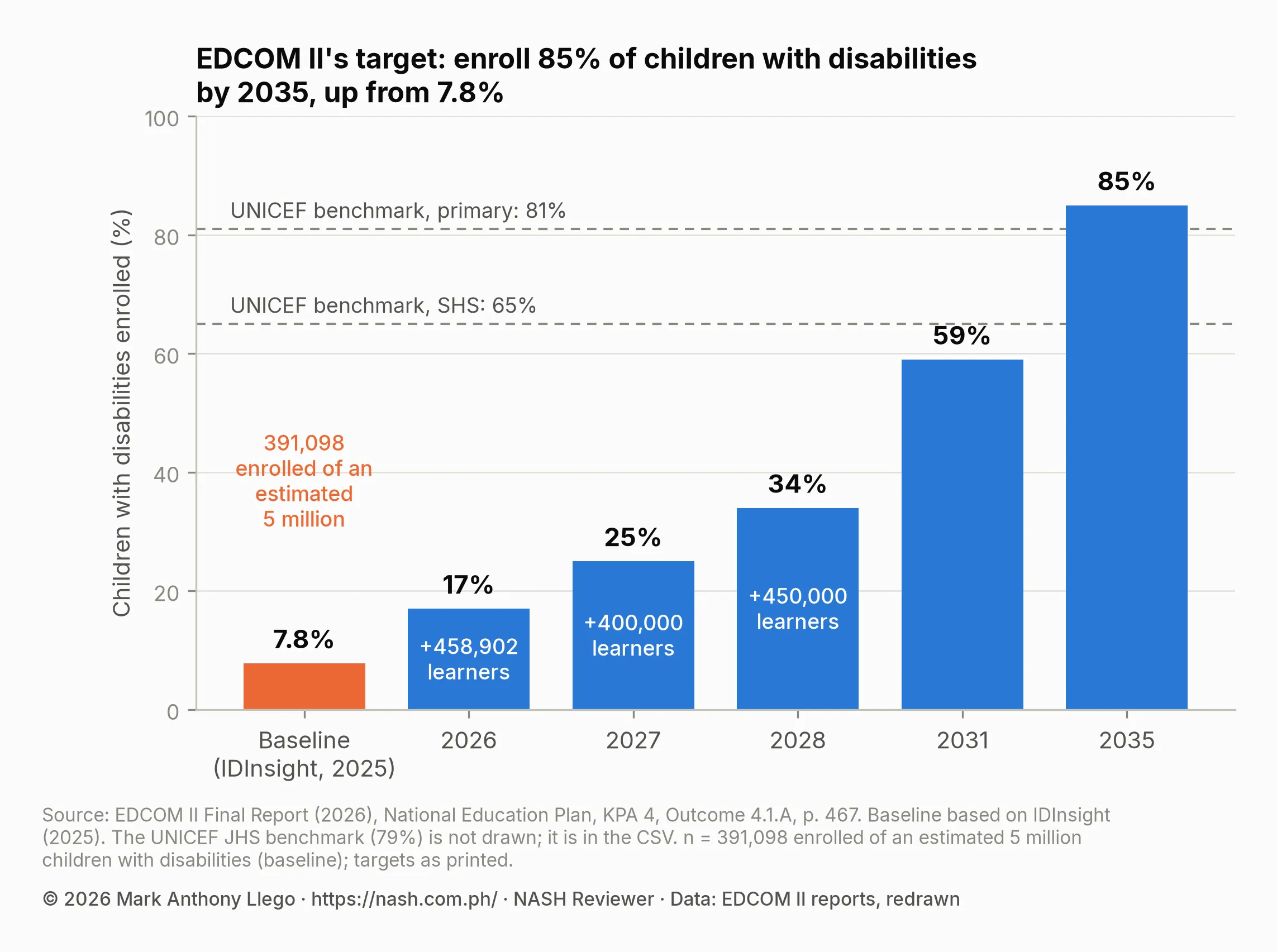
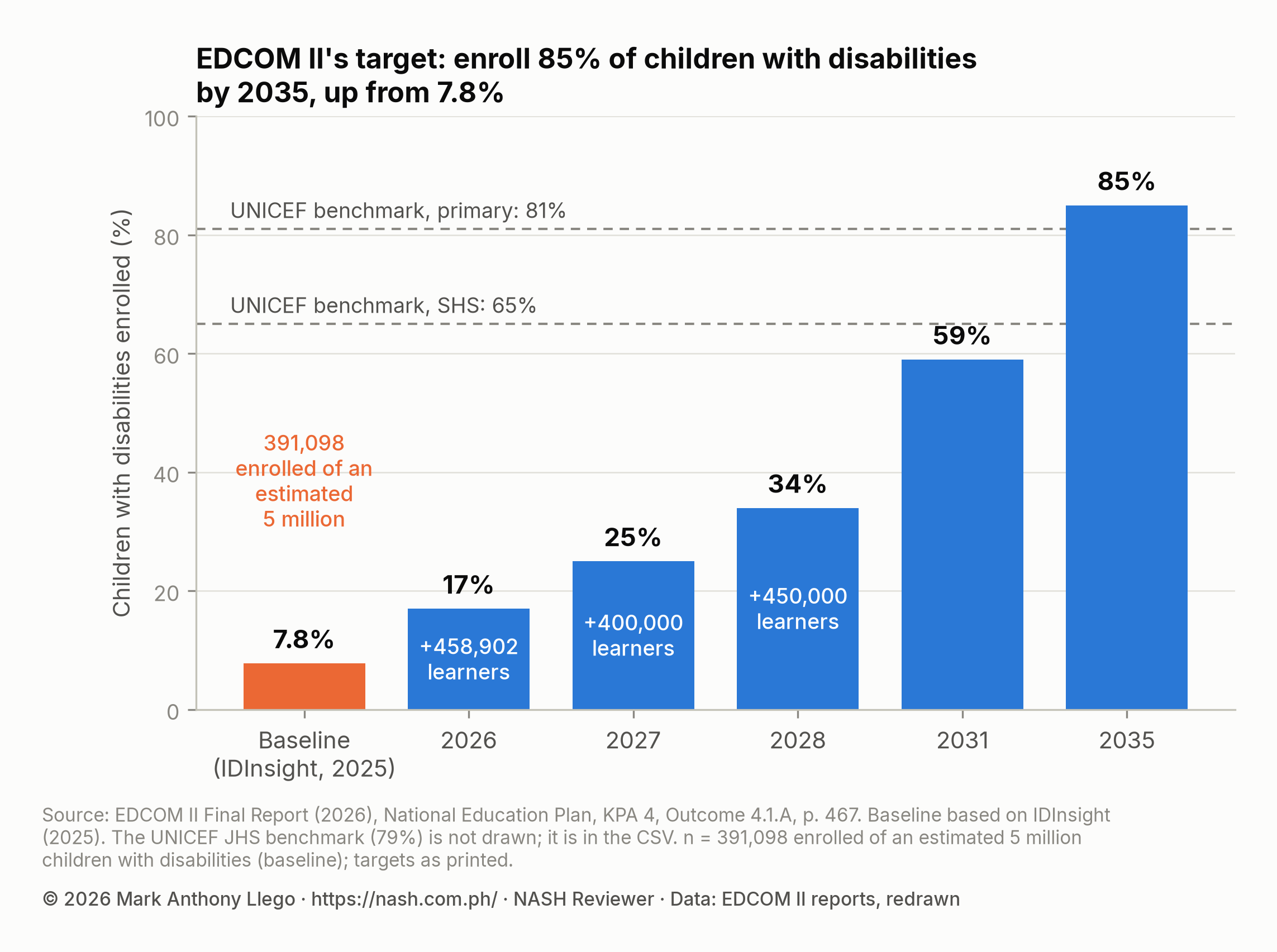
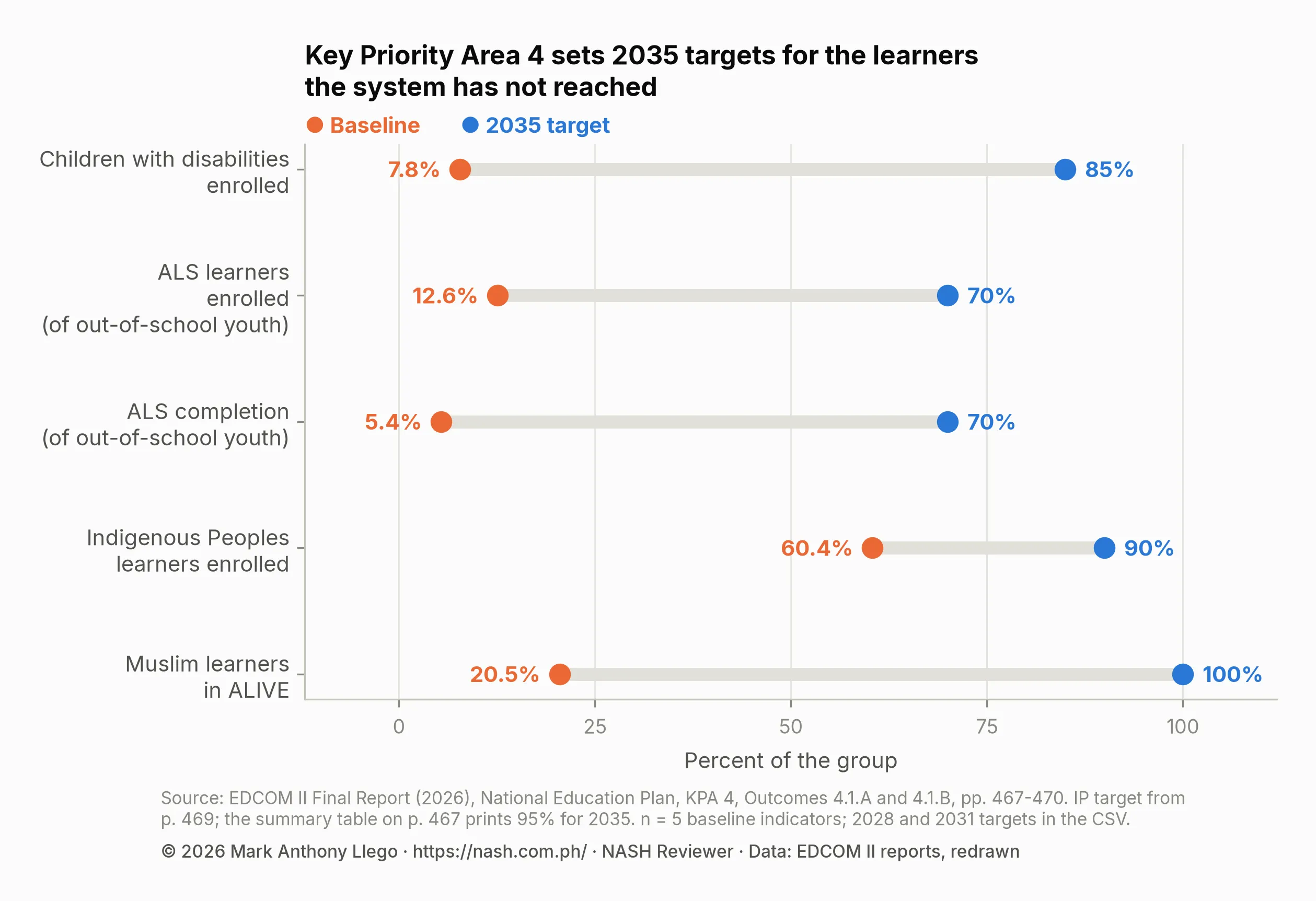
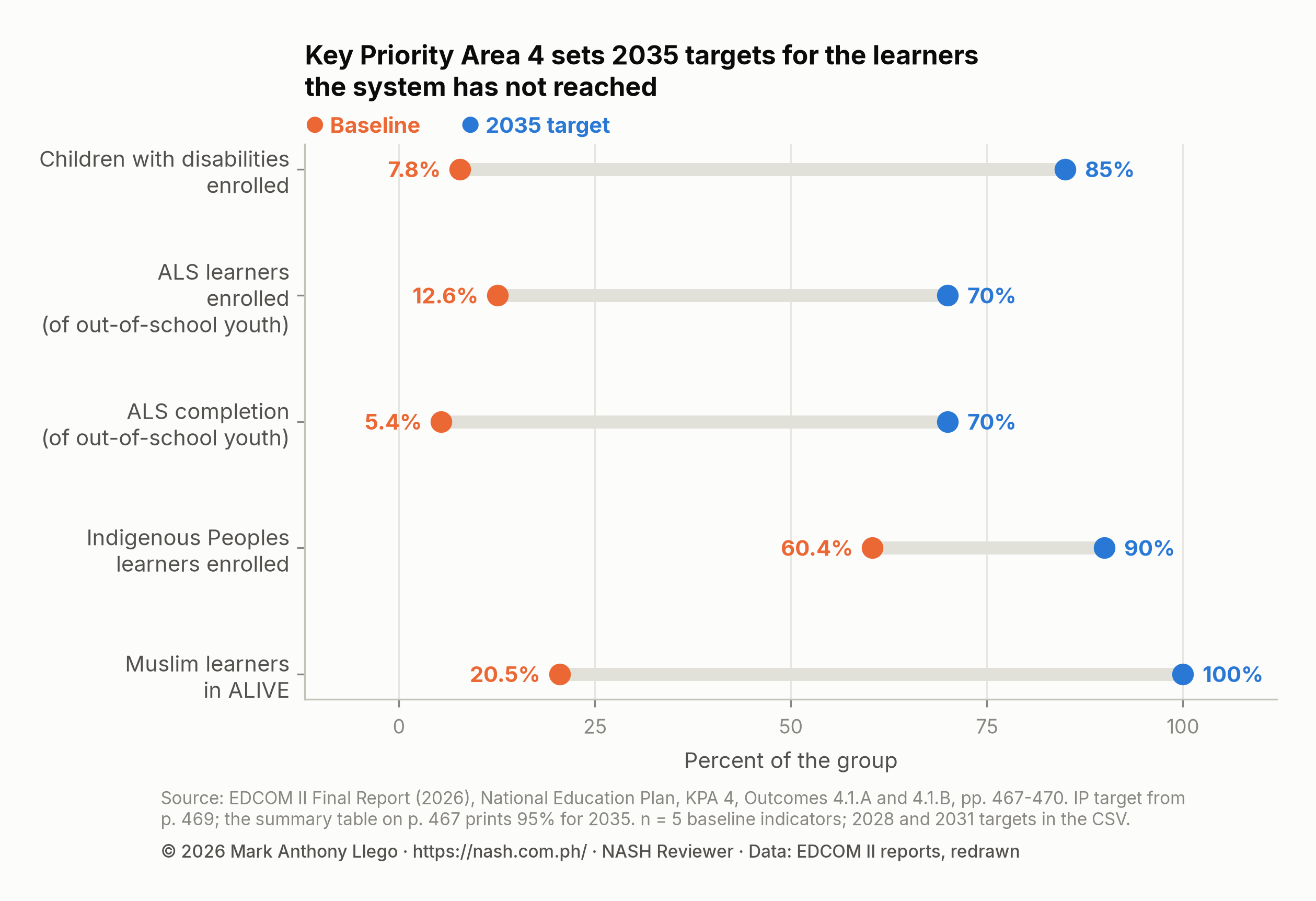
Republic Act No. 11650, the Instituting a Policy of Inclusion and Services for Learners with Disabilities in Support of Inclusive Education Act, requires every public and private school to admit learners with disabilities and serve them through an Individualized Education Plan (IEP), backed by an Inclusive Learning Resource Center (ILRC) in every city and municipality. EDCOM II’s Final Report finds the system far from that promise: about 391,098 learners with disabilities are enrolled out of an estimated 5 million children with disabilities (7.8%), and none of the 32 ILRCs is fully operational (Final Report, pp. 467, 470). Its National Education Plan aims for 85% enrollment by 2035.
Below are what EDCOM II found, what the law and DepEd’s issuances in force on October 30, 2026 require, and what a school head should do, for teachers preparing for the National Assessment for School Heads (NASH) and for researchers. EDCOM II is the Second Congressional Commission on Education, created by Republic Act No. 11899. Its Year One Report (2024) and Year Two Report (2025) touch the subject only in passing; most of what follows comes from its Final Report, Turning Point (2026), and the stand-alone National Education Plan document (2026), which adds detail to the plan’s tables.
How each DepEd program runs in a school is in the guide to DepEd’s ALS, inclusive education and special programs; this post is about the evidence.
Key findings
- Most children with disabilities are not in school, or not identified. The National Education Plan’s baseline is “391,098 enrolled out of estimated 5 million” children with disabilities, or 7.8% (Final Report, p. 467). Schools identify 1% to 2% of learners as having a disability, against an estimated prevalence of 10% to 12% (p. 171).
- Most identified learners have no diagnosis. About two-thirds of learners with disabilities in DepEd’s Learner Information System (LIS) are tagged “without formal diagnosis, relying only on teachers’ observations” (p. 106).
- Most are in regular classes without specialist support. Seventy-five percent are in general education classes (p. 470), and 60% attend schools with no special needs education program, center, ILRC or teacher (EDCOM 2, November 20, 2025).
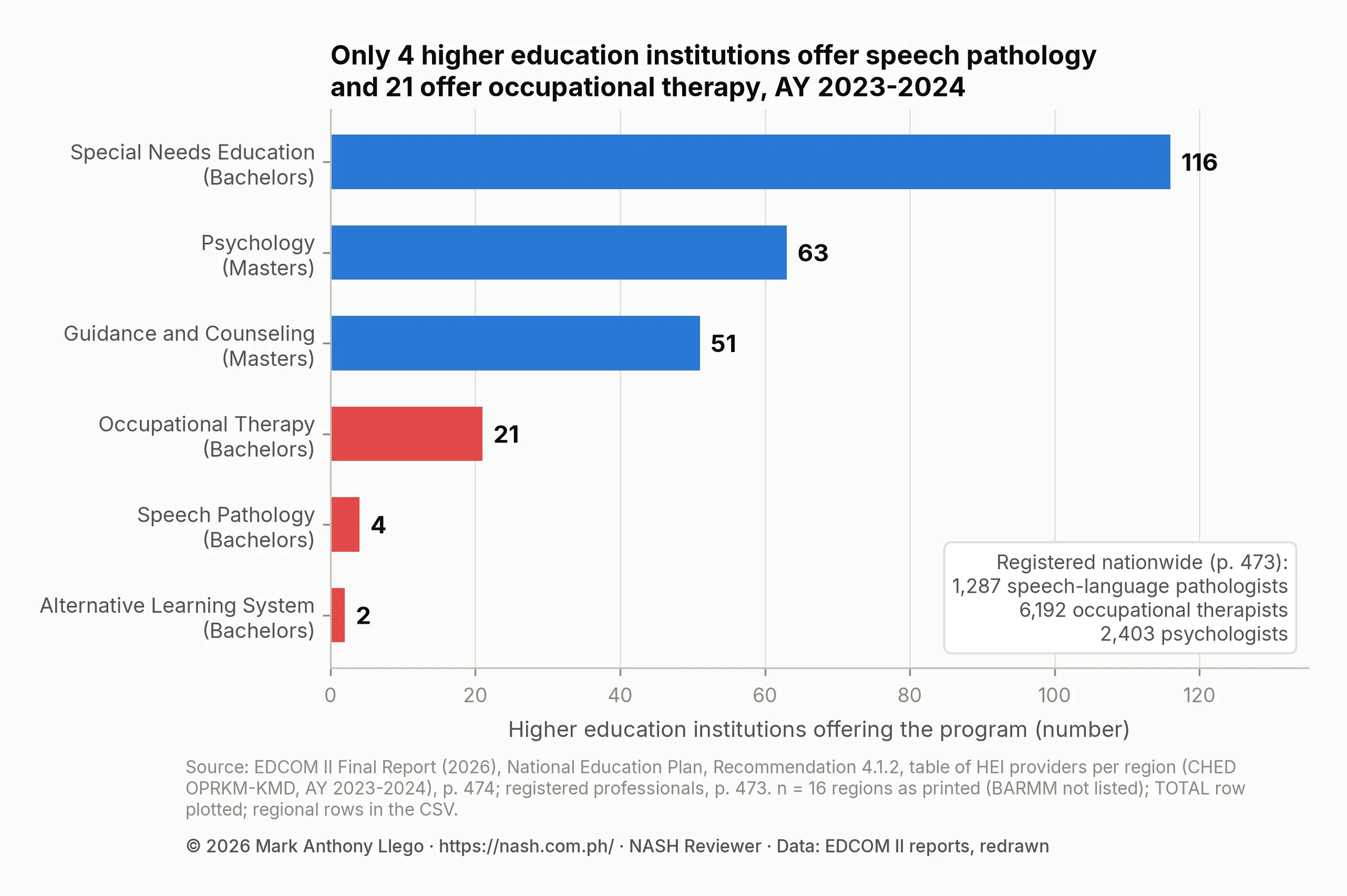
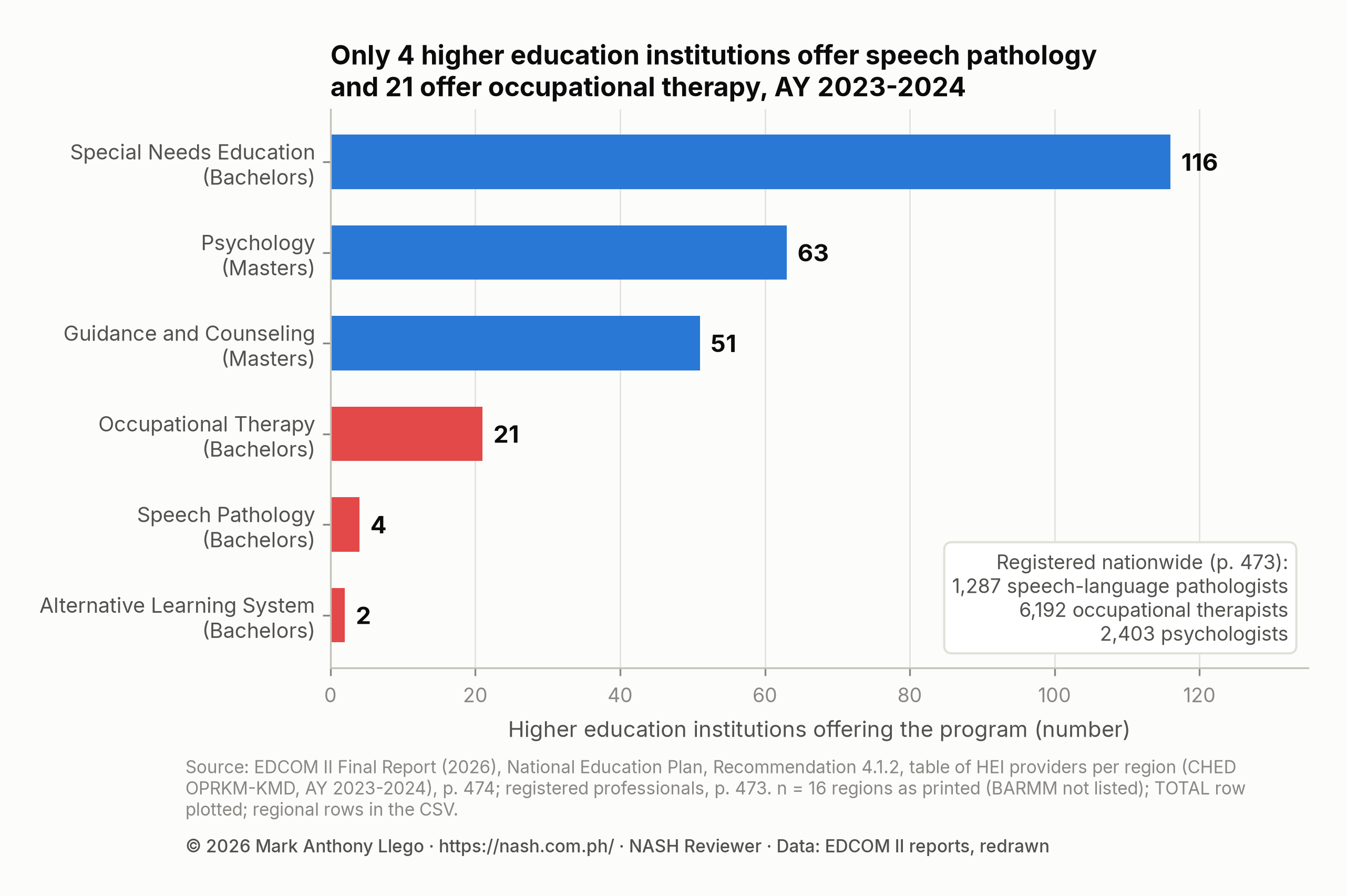
- The centers and specialists the law requires are missing. Thirty-two of 226 divisions have an ILRC, “but none are fully operational” (p. 470), and the Department of Budget and Management (DBM) offered four of the seven ILRC positions DepEd asked for (pp. 472–473). Four higher education institutions offer speech pathology (p. 474), and about 787 Special Needs Education (SNEd) teacher positions were vacant in June 2025 (p. 471).
- The rules came late and are still incomplete. The law was signed on March 11, 2022; its rules took effect on January 11, 2025 (p. 68; DepEd Memorandum No. 043, s. 2025). In July 2026, four of ten operational guidelines were still pending (EDCOM 2, July 3, 2026).
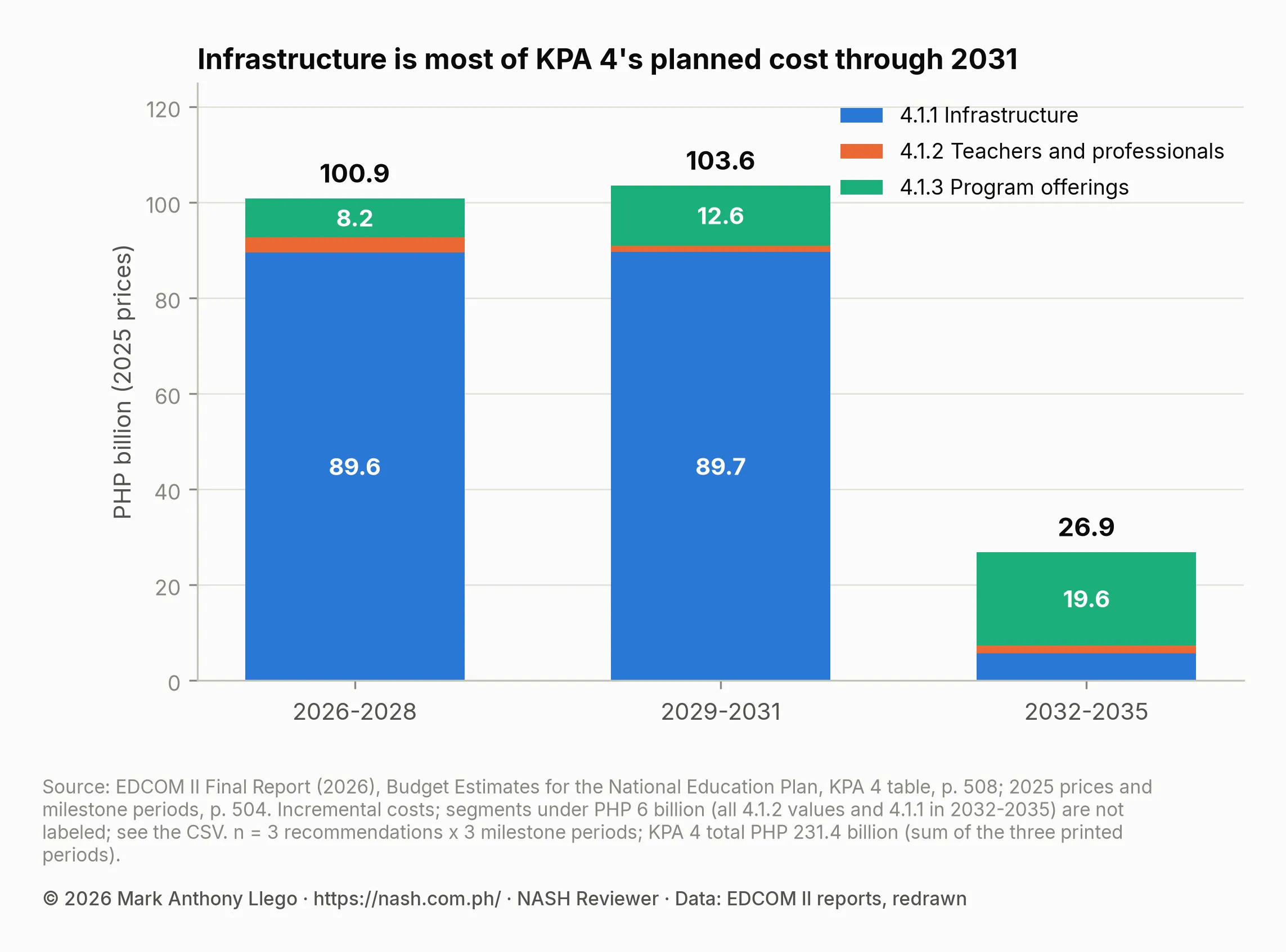
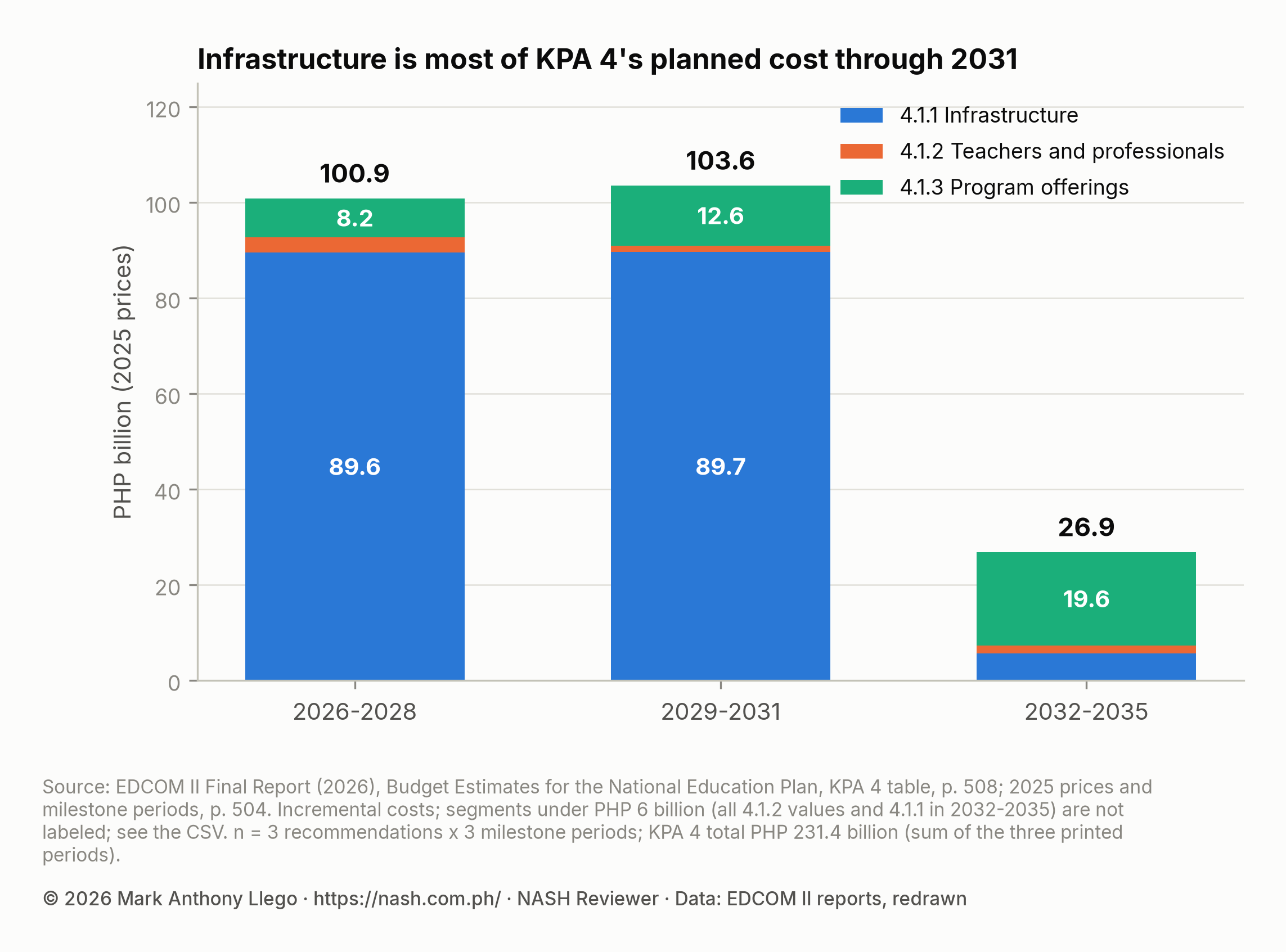
- The plan’s answer is Key Priority Area 4. It targets 34% enrollment of children with disabilities by 2028 and 85% by 2035, a SPED Center in every municipality and city and fully operational ILRCs in 49% of divisions by 2035, at an incremental cost of PHP 100.9 billion in 2026–2028 for the whole priority area (pp. 467, 470, 508).
How many children with disabilities are in school?
The total is an estimate: recent estimates range from 4.7 million to 5.1 million children with disabilities, and “measurement approaches and classifications of disabilities vary” (National Education Plan document, p. 56; IDInsight brief, p. 2). EDCOM’s figures come from a study by IDInsight, done with EDCOM and DepEd from January to August 2025 using administrative data, consultations and a survey of 1,994 teachers (EDCOM 2, November 20, 2025).
| What is counted | Number | Source |
|---|---|---|
| Learners with disabilities enrolled in public schools | 391,098 | Final Report, p. 467; plan document, p. 56 |
| The same, in the plan’s note and the study, SY 2024-2025 | 391,089, “8% of the estimated 5.1 million” | Final Report, p. 470; IDInsight brief, p. 1 |
| Estimated children with disabilities | 5 million (estimates range from 4.7 million, UNICEF 2023, to 5.1 million, PhilHealth 2018) | Final Report, p. 467; plan document, p. 56; brief, p. 2 |
| With a formal diagnosis / with manifestations only | 148,869 / 242,220 | Plan document, p. 56 |
| In non-graded or self-contained programs | 25% (97,772); the other 75% are in general education classes | Final Report, p. 470 |
An analysis by ECAIR, reported by EDCOM in 2026, counted 204,964 formally diagnosed learners with disabilities in public and private schools, 37.7% of them with autism, 18.1% with intellectual disability and 10.8% with learning disability (EDCOM 2, October 19, 2026).
Where the gaps are
Identification. Citing IDInsight (2025), Issue 7 of the Final Report says “the majority of children with disabilities remain unidentified in schools”, with identification rates that “hover between 1% and 2%”. School heads say screening tools are “often inaccessible, inconsistently used, or cognitively inappropriate for the Filipino context” (p. 171). Learners end up “misclassified as ‘slow’”, and IEPs “are either absent or generic” (p. 172). The Year One Report lists the Multi-Factored Assessment Tool (MFAT), given to all Grade 1 learners at the start of the school year, as DepEd’s tool to “identify learners with special needs” (Table 1, p. 97).
Diagnosis and data. “About two-thirds of LwDs are tagged without formal diagnosis”, and screenings “are often administered by untrained teachers and used reactively rather than proactively” (p. 106). One teacher in four reports learners with manifestations who are not tagged, “largely due to parental refusal or the hesitation to pursue formal assessments” (brief, p. 4). Disability information “is rarely encoded in a consistent manner in DepEd’s LIS and school records”, “making tracking and case management nearly impossible” (p. 172).
Support in school. Only 32% of enrolled learners with disabilities have a SNEd teacher assigned to their school, and even if all 772 vacant positions were filled, nearly half would still be without one. Most SNEd teachers (82%) use IEPs, against 13% of receiving teachers, the regular teachers who hold most mainstreamed learners (brief, pp. 5–6).
Who stays out, and after. Disability was the reason given by 8.2% of out-of-school children aged 5 to 11 and 9.8% of those aged 12 to 15 in the 2019 survey reprinted in the Year One Report (Figure 8, p. 49). The Year Two Report says learners still scoring extremely low after learning camps should be retained “or referred to special education services and further assessment to determine presence of disability” (p. 107). Only 30% of learners with disabilities complete secondary education (Final Report, p. 484), and the plan’s completion baseline is “Data pending from DepEd as of Sept 26, 2025” (p. 469).
What Republic Act No. 11650 requires
Republic Act No. 11650 was signed on March 11, 2022. Its full title in the Official Gazette is “An Act Instituting a Policy of Inclusion and Services for Learners with Disabilities in Support of Inclusive Education, Establishing Inclusive Learning Resource Centers of Learners with Disabilities in All Schools Districts, Municipalities and Cities, Providing for Standards, Appropriating Funds Therefor, and for Other Purposes”. EDCOM calls it the Inclusive Education Act (p. 172). It predates EDCOM II, whose work began in January 2023 (p. 44), but the Final Report lists its passage among the policy targets “collectively achieved from 2023 to 2025” with Congress, the President and the agencies (pp. 64, 68).
| Section | What it requires |
|---|---|
| Sec. 4(q) | Reasonable accommodation is “necessary and appropriate modification and adjustments not imposing a disproportionate or undue burden” that let learners with disabilities exercise their rights |
| Sec. 5 | Inclusion in all public and private early and basic education schools, “such that no learner shall be denied admission on the basis of disability”, with “services and reasonable accommodation based on the IEP” |
| Sec. 6 | At least one ILRC in all cities and municipalities, set up by DepEd with local government units (LGUs); all SPED Centers become ILRCs; LGU satellite ILRCs in schools go in the School Improvement Plan (SIP) |
| Sec. 8 | Each ILRC has a supervisor and a multidisciplinary team drawn from 16 listed professionals and specialists. “The school head for school-based ILRC and the general education teachers are likewise members” |
| Sec. 12 | IEPs are prepared by schools, child development centers and ILRCs, with the SNEd teacher, in collaboration with the multidisciplinary team and with the parents’ consent, based on the team’s assessment; parents get a copy; review at least once a year |
| Sec. 24(g) | Local School Boards may set aside part of the Special Education Fund (SEF) for sites, assistive devices, materials, teacher training, health services and assessments |
| Sec. 29 | Schools and ILRCs have “not more than five (5) years from the effectivity of this Act” to comply (the IRR’s own Sec. 29 counts the five years from the IRR’s effectivity instead) |
| Sec. 30 | A Program Support Budget for learners with disabilities as a line item in DepEd’s budget |
The law also replaces the term “Special Education (SPED)” with “Special Needs Education” (Sec. 4(r)).
The implementing rules arrived late
| Date | Step | Source |
|---|---|---|
| March 11, 2022 | RA 11650 signed; the IRR is due within 90 days (Sec. 32) | Official Gazette |
| July 18, 2024 | Implementing rules and regulations (IRR) signed | EDCOM 2, December 4, 2024 |
| December 12, 2024 | IRR published in the Philippine Daily Inquirer | DM 043, s. 2025 of May 9, 2025, para. 3; Final Report, p. 68 |
| January 11, 2025 | IRR takes effect | DM 043, s. 2025, para. 3 |
| July 3, 2026 | Four of ten operational guidelines still pending | EDCOM 2, July 3, 2026 |
| 2027 | Five years from the Act’s effectivity in 2022 end; the Act took effect 15 days after publication | RA 11650, Secs. 29, 36 |
| January 2030 | Five years from the IRR’s effectivity (January 11, 2025) end, under the IRR’s own transitory provision | IRR, Sec. 29; DM 043, s. 2025, para. 3 |
The law and its IRR count the five-year compliance period from different dates: the law from its own effectivity, the IRR from the IRR’s. No DepEd issuance says which it applies. The accomplishments table says the law “was fully implemented on January 11, 2025” (p. 68), the IRR’s effectivity date; the synthesis is more cautious, since with the rules signed “about two years later, with publication further delayed”, “many of its detailed provisions have remained inoperative for several school years” (p. 172).
The IRR requires admission with accommodation, facilities that comply with the Accessibility Law (Batas Pambansa Blg. 344), a “pre-referral and assessment process to ensure early detection and identification of disabilities”, and referral of learners with disabilities “and children who are at risk of disabilities” to the ILRCs (Sec. 6).
EDCOM’s July 2026 review found four guidelines still pending: the IEP framework (IRR Sec. 13), curricula for alternative, early intervention and transition programs (Sec. 8.9), the inter-agency referral system (Sec. 8.7) and private-sector incentives (Sec. 24). Two were partial: DO 032, s. 2025 covers building ILRCs but not running them, and DepEd Order No. 23, s. 2022 covers Child Find only above age 5. The coordinating council, advisory committee, budget line item and Multi-Year Roadmap were in place.
Inclusive Learning Resource Centers
An ILRC is “a physical or virtual center” for assessment, accessible materials and related services (Sec. 4(f)); under the IRR, each needs a trained supervisor, SNEd teacher, para-teacher, learning support aide and multidisciplinary team (Sec. 7.3). DepEd converted 32 SPED Centers, two per region (EDCOM 2, December 4, 2024). In 2025, 69% were physically constructed, but “critical gaps in staffing, funding guidelines, and service delivery” kept all of them from full operation, and every ILRC interviewed lacked multidisciplinary team professionals (IDInsight brief, pp. 1, 8). DepEd asked DBM in June 2025 for seven ILRC positions, including therapists and Braille and Filipino Sign Language specialists; four were approved for 2026 (Final Report, pp. 472–473).
Some LGUs did not wait. Valenzuela City’s ValSpEd Center, “the first locally-funded Special Education institution in the country” (p. 478), was allocated PHP 62.71 million by the city for 2024 and 2025 (p. 479). Its Special Needs Program grew from 58 learners in early 2016 to 325 in 2025-2026 (plan document, p. 69; Final Report, p. 478). The post on local education models covers EDCOM’s case studies.
What funding the law sets, and what reaches schools
The law sets three channels: a Program Support Budget line item for the Child Find System, specialists, related services and assistive devices, “used solely” for learners with disabilities and the ILRCs (Sec. 30); separate line items in the budgets of DepEd and the health, social welfare and public works departments (Sec. 31); and the SEF (Sec. 24(g)). Private donors get a 50% additional deduction (Sec. 23). DepEd’s budget carries a Special Education Program sub-program under its Inclusive Education program (Year Two Report, Figure 10, p. 344).
EDCOM reports that SNEd Program funding grew from PHP 100 million in 2020 to PHP 1.04 billion in 2026, with a 2026 Program Support Fund of over PHP 537 million. DepEd estimates PHP 1,400 per learner, but some schools received PHP 488 or PHP 333 per learner for the year, usually in August or September. A hearing aid costs about PHP 35,000, while DepEd’s fund rules cap device purchases at PHP 15,000 (EDCOM 2, July 21, 2026; brief, p. 6). The joint circular on the SEF now explicitly covers inclusive education (Final Report, p. 36), yet SEF resources are “still underutilized” (p. 585); the post on Local School Boards and the SEF explains the fund.
What EDCOM II found about implementation
Issue 7, “DepEd’s inclusive education policies and programs need urgent review to improve responsiveness”, diagnoses “a broader systemic misalignment between legal mandates and operational capacity in inclusive education” (pp. 171, 173). Many centers “still lack assessment tools, psychologists, therapists, or trained SPED teachers” (p. 172). A quotation in the report puts it plainly: “Mahirap ang mainstreaming kapag isang teacher ang may 40–50 learners tapos may 5–8 pa na may special needs” (“Mainstreaming is hard when one teacher has 40 to 50 learners and 5 to 8 more with special needs”), and “inclusion becomes a promise the system cannot realistically deliver” (p. 172). Hindrance 6 adds that “families, in turn, bear the private cost of what should be a public guarantee” (p. 585).
Elsewhere the report finds overcrowding most severe for “learners with disabilities”, among others (p. 178), and its effects magnified where there are “inadequate spaces for learners with disabilities” (p. 187); it asks that staffing standards cover “SPED Centers, ILRCs” (p. 300) and funding formulas carry “targeted boosters” for inclusive education (p. 367), including a School MOOE weight for “schools with SPED learners” (p. 497).
The specialists and teachers are missing
The country has 1,287 registered speech-language pathologists, 6,192 occupational therapists and 2,403 psychologists (p. 473). Bachelor’s programs in speech pathology are offered in three regions and occupational therapy in seven (p. 472). Learning Support Aides, whom the law names as ILRC personnel, have “no formal position” in DepEd’s staffing standards (p. 473). EDCOM reported 109 certified developmental-behavioral pediatricians and, as of June 30, 2026, 14 PhilHealth-contracted facilities providing Z Benefit Packages for children with disabilities, with seven regions having none (EDCOM 2, August 3, 2026).
SNEd teacher counts depend on the date:
| Date of data | Authorized positions | Vacant | Source |
|---|---|---|---|
| August 2024 | not stated | 772 | IDInsight brief, p. 5 |
| June 2025 | 6,869 (6,082 filled, 88.54%) | about 787 | Final Report, p. 471 |
| February 11, 2026 | 6,613 | 717 (10.8%) | EDCOM 2, October 19, 2026 |
The October 2026 release adds that 1,906 schools have learners in non-graded SNEd programs but no SNEd teacher in the inventory, and that the ratio of SNEd teachers to formally diagnosed learners reaches 1:902 in Iloilo. EDCOM also reported that a DepEd memorandum of July 23, 2026 (DM-OUHRODI-2026-2591) told regional and division offices to defer the publication and appointment of vacant and newly created SNEd teacher positions until the Civil Service Commission approves revised qualification standards, while incumbents’ retitling and reclassification continue (EDCOM 2, August 4, 2026).
Mainstreaming without support
Two in three teachers surveyed lacked the training and tools to support learners with disabilities, and they named the lack of health professionals to consult (47%), long IEP documents (38%) and lack of training (37%) as barriers to IEPs (brief, pp. 1, 6). At a June 2026 House hearing, EDCOM 2 Co-Chairperson Rep. Roman Romulo said many schools “have proceeded directly to mainstreaming” without the ILRC assessments and IEPs the law envisions. EDCOM reads RA 11650 as two obligations that “must go hand in hand”: no denial of admission, and reasonable accommodation through assessment, multidisciplinary support and individualized planning (EDCOM 2, June 29, 2026). Teachers also reported a 15:1 ratio applied in mainstream classes “regardless of learners’ needs” (release, October 19, 2026).
What EDCOM II recommends: Key Priority Area 4
Two of the plan’s 20 priority reforms concern learners with disabilities. The executive summary lists them as priority 12, “Expand programs for learners with disabilities”, and priority 13, “Invest in teachers and professionals in inclusive education” (pp. 40–41); the results framework reverses the order and numbers them 4.1.3 and 4.1.2 (p. 432). The KPA 4 chapter, however, titles 4.1.3 “Expand inclusive education program offerings” and fills it entirely with science high school, Indigenous Peoples Education and Madrasah targets; none of its outputs concerns learners with disabilities (pp. 474–476). The budget table’s totals for the priority recommendations add up from 4.1.1 and 4.1.2, not 4.1.3 (p. 508). The report does not explain the difference.
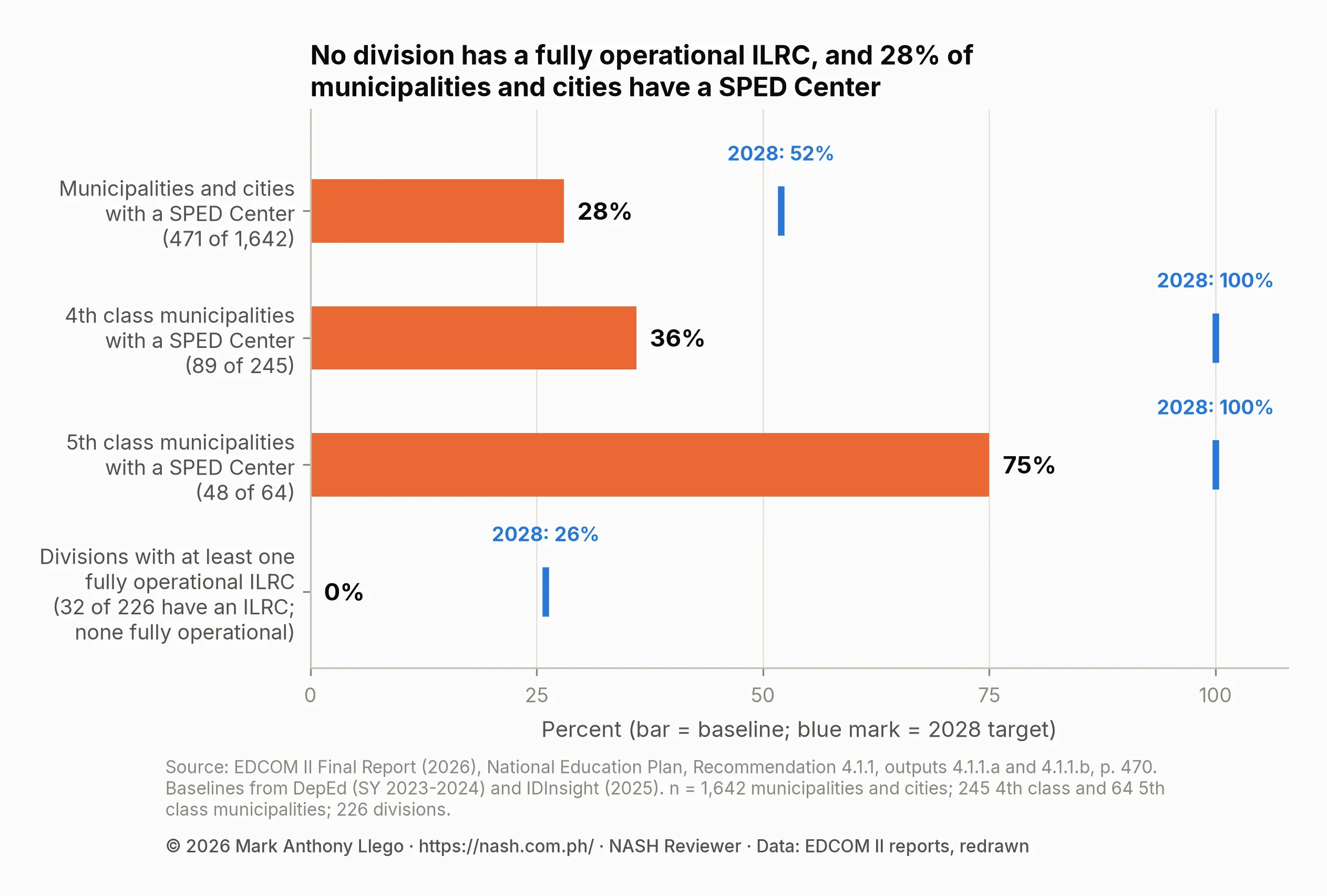
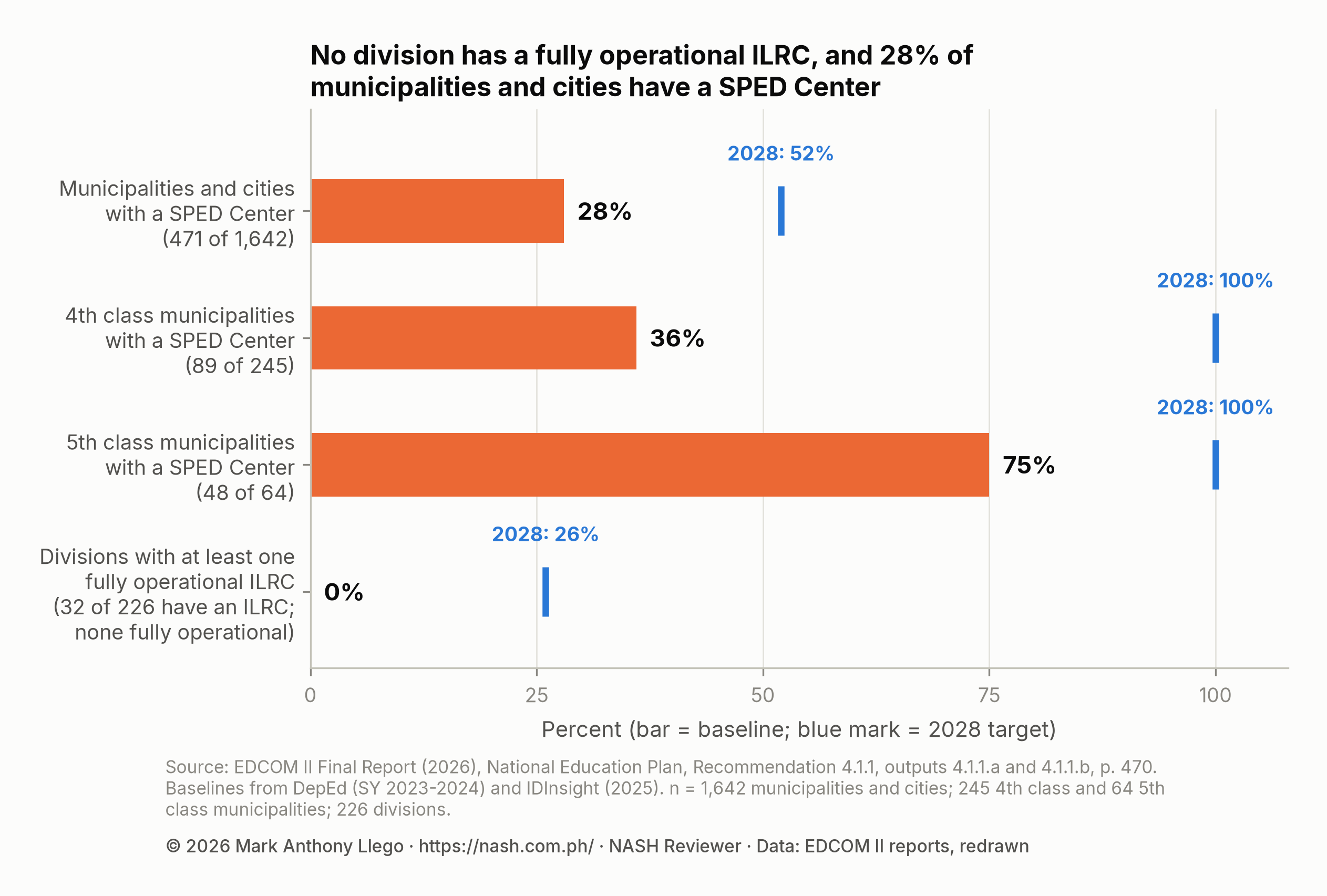
Recommendation 4.1.1, infrastructure. Raise the share of municipalities and cities with a SPED Center from 28% (471 of 1,642) to 52% by 2028 and 100% by 2035, covering every fourth- and fifth-class municipality by 2028. Raise the share of divisions with a fully operational ILRC from 0% to 26% by 2028 and 49% by 2035, by making the 32 existing ILRCs fully operational in 2026, converting 21 SPED Centers (seven a year) and building five new ILRCs in each period (p. 470).
Recommendation 4.1.2, people (targets for 2028, Final Report, pp. 471–473; plan document, pp. 61–62):
| Output | Baseline | 2028 target |
|---|---|---|
| 4.1.2.a SNEd bachelor’s programs | 16 regions | add BARMM |
| 4.1.2.b SNEd scholarships | to be implemented | 1,000 active scholars |
| 4.1.2.c Train receiving teachers | TBD | TBD |
| 4.1.2.d SNEd teacher positions filled | 88.54% | 100% |
| 4.1.2.e Speech pathology / occupational therapy programs | 3 / 7 regions | add 13 / 9 regions |
| 4.1.2.f Multidisciplinary team positions filled | 0% | 50% of positions for 58 ILRCs; the plan document counts 232 positions, so 116 (p. 62) |
The documents agree on the 2028 scholar target but not on the path: 500 new scholars a year and 1,000 and 3,000 completers by 2031 and 2035 in the Final Report (p. 471), against 240, 456 and 304 a year and 696 and 1,912 completers in the plan document (p. 61).
Actions due in 2026 and 2027 (p. 476). DepEd should operationalize the Child Find System “as mandated by the Inclusive Education Act” and train teachers “focusing on tools and the creation of IEPs”; in 2027, DepEd, the Department of the Interior and Local Government (DILG) and the Department of Health should explore the Doctors to the Barrio program to supply developmental pediatricians and other specialists to ILRCs. DILG should support Child Find in LGUs for “every at-risk child and child with disabilities under five years old” (p. 440). The synthesis adds standardized screening tools “across all schools” and “uniform disability coding, mandatory tagging protocols, and automated validation rules” in the LIS (p. 175).
The cost. KPA 4’s incremental cost is PHP 100.9 billion in 2026–2028, PHP 103.6 billion in 2029–2031 and PHP 26.9 billion in 2032–2035, at 2025 prices (pp. 504, 508; the same table is on p. 117 of the plan document). It covers the whole priority area, including ALS, science high schools, Indigenous Peoples Education and Madrasah, so it is not a disability budget.
The guide to the National Education Plan places KPA 4 among the other priorities, and the post on education spending compares its cost.
Indigenous Peoples, Muslim and other excluded learners
The Final Report treats disability alongside the other reasons learners are left out: “children with disabilities, Indigenous and Muslim learners, and those experiencing emotional or behavioral difficulties are disproportionately likely to experience school failure, disengagement, and exclusion” (p. 173). Under Issue 8, about half of Indigenous and Muslim learners “do not progress beyond elementary education, compared to less than one‑third among non-Indigenous peers”, and around 20% of Muslim ethnic groups and 10% of Indigenous Peoples lack birth registration (p. 173). On the Grade 10 National Achievement Test, 4 learners in Indigenous Peoples Education (IPEd) schools reached proficient or highly proficient, against 2,847 of all test-takers (p. 174).
| Region | Participation rate of Indigenous learners | Major IP groups named |
|---|---|---|
| Region XII (SOCCSKSARGEN) | 87% | T’boli, B’laan, Manobo |
| MIMAROPA | 74% | Mangyan groups |
| BARMM | 62% | Badjao, Tausug, Maranao, Maguindanaon |
Source: EDCOM II Final Report (2026), Figure 17 and text, pp. 173–174 (DepEd-LIS, SY 2024-2025, as of January 30, 2025).
Only 3,763 of 19,948 schools with IP learners (18.9%) implement IPEd, and the plan asks DepEd to “train principals and teachers on culturally responsive school improvement planning and IPEd implementation” (p. 475). Other posts go deeper: the IP, ALIVE and Balik-Aral learner data, education in the Bangsamoro, the language of instruction after RA 12027, and the Assisi Development Foundation’s partnerships for Indigenous education (Final Report, p. 480) in the post on local education models.
What DepEd’s current issuances require of a school
The IEP framework and the ILRC operations guidelines are not yet out, so a school works from the law, its IRR and orders that partly predate them. None of the issuances below has been repealed as of October 30, 2026. DO 017, s. 2025 was amended in part by DO 009, s. 2026 (transfer and late enrollment), and DO 010, s. 2026 modified DO 018, s. 2025 for the 2026 summer remediation programs only. DepEd Order No. 44, s. 2021 predates the law and still says SPED, but DepEd’s 2025 and 2026 issuances still cite it (DO 018, s. 2025; DM 042, s. 2026).
| Issuance | What it requires of the school |
|---|---|
| RA 11650 IRR (DM 043, s. 2025) | Admission conditions, pre-referral and assessment, referral to the ILRC (Sec. 6); IEPs (Sec. 13); LIS data (Sec. 18) |
| DO 44, s. 2021 | Schools are the “primary implementers”: the school head keeps learners with mild to moderate disabilities in regular classes, puts their programs in the SIP and Annual Implementation Plan (AIP), sets up a resource room, keeps LIS data correct and builds a referral system (Sec. VIII.A). “Every learner with disability shall have an IEP” (Sec. VI.A.4) |
| DO 023, s. 2022, Child Find Policy | Child Find before early registration; MFAT screening as an interim basis while a diagnosis is pending; a written request to partners when services are lacking; LIS tagging by diagnosis or manifestations; “no late enrollees for LWDs” (Secs. V–VI) |
| DO 017, s. 2025, enrollment, as amended by DO 009, s. 2026 | Registration campaigns reach learners living with disability (Sec. V.B); a PWD ID or diagnosis is submitted “if available” (Sec. V.C). DO 009 admits late enrollees who meet 80% of class days or enroll by Term 1’s second summative test (para. 34), without mentioning learners with disabilities or expressly repealing DO 023 |
| DO 042, s. 2021, amended by DO 018, s. 2022 | The SNEd Program Support Fund follows the number of learners with disabilities and difficulties in the LIS and EBEIS; it may pay for formal assessment, devices up to PHP 15,000, training and learner activities, and its items go in the AIP (Secs. 6.1–6.2) |
| DO 018, s. 2025, ARAL | Grades 2 to 10 learners who fail assessments and show delays or “manifestations of learning difficulties” go to the ILRC’s multidisciplinary team or other professionals (para. 46) |
| DO 015, s. 2026, assessment | Assessment accommodations in time, format, setting and response mode, “planned, documented, and consistently implemented” with parents and specialists (Enclosure, para. 30) |
| DO 016, s. 2026, lesson planning | The IEP “shall serve as a critical reference in lesson planning”, with reasonable accommodations (para. 15) |
DO 032, s. 2025 favors schools with the most learners with disabilities in the BEIS as ILRC sites, and DM 042, s. 2026 pilots the mapping and referral of learners with disabilities in ALS in SY 2026-2027. The guides to DO 015 and DO 016, s. 2026 explain those orders.
What this means for school heads
EDCOM’s findings point to the school as the place where the law succeeds or fails: learners are identified there, IEPs are written there, and the LIS is filled there. Until the missing guidelines arrive, six practices follow from the rules in force.
1. Find the learners. Run Child Find with the barangay before early registration, and make the registration campaign reach families of children with disabilities (DO 023, s. 2022, Sec. V; DO 017, s. 2025, Sec. V.B). Refer Grades 2 to 10 learners who fail assessments and show delays or manifestations of learning difficulties to the ILRC’s multidisciplinary team or other professionals (DO 018, s. 2025, para. 46). An identification rate of 1% to 2% (p. 171) means most schools have learners they have not yet seen.
2. Admit and accommodate from the first day. No learner may be refused because of disability (RA 11650, Sec. 5). Accommodation starts at admission (IRR, Sec. 6) and does not wait for a diagnosis, since DO 023 allows screening as an interim basis for services. Check access too: our report on school toilets found that 28.6% of public schools had a toilet designated for learners with disabilities in SY 2023-2024.
3. Get an IEP written, used and reviewed. Seek the parents’ consent before assessment (DO 44, Sec. VI.A.1.3). Have the SNEd teacher prepare the IEP with the multidisciplinary team, which includes the general education teachers, and with the parents’ consent, based on the team’s assessment; give the parents a copy and review it at least once a year (RA 11650, Secs. 8(b), 12). Teachers plan lessons and tests from it (DO 016, para. 15; DO 015, para. 30); with only 13% of receiving teachers using IEPs (brief, p. 6), Learning Action Cell time is well spent here.
4. Keep the LIS accurate. Tag each learner by diagnosis or manifestation and update the tag as diagnoses arrive (DO 023, Sec. VI; DO 44, Sec. VIII.A.2.6). The fund follows the tags (DO 018, s. 2022), and ILRC sites go to schools with the most learners with disabilities in the BEIS (DO 032, s. 2025). Keep medical records and IEPs confidential (RA 11650, Sec. 17).
5. Build the referral network. Until ILRCs have their teams, partners stand in: the nearest ILRC or SPED Center, the rural health unit, the Persons with Disability Affairs Office and the DSWD office. When services are lacking, give parents a written request to partners (DO 023, Sec. V.B.4), and ask the Local School Board for SEF support (RA 11650, Sec. 24(g)). The Domain 5 guide covers strand 5.3, inclusive practice.
6. Plan and fund it in the SIP. Put the program in the School Improvement Plan and the AIP, consult learners and parents, and list the fund’s items there (DO 44, Sec. VIII.A.2.3; DO 042, Sec. 6.2). The Domain 2 guide and the MOOE guide cover the school’s other funds.
| Record to keep | Rule |
|---|---|
| Child Find list: located, screened, referred | DO 023, s. 2022, Annex 1 |
| Parental consent and referral letters | DO 44, Sec. VI.A.1.3; DO 023, Sec. V.B.4 |
| IEP, the parents’ copy and the annual review | RA 11650, Sec. 12 |
| Accommodations in class and in tests | DO 015, s. 2026, Enclosure, para. 30 |
| LIS tags and their basis | DO 023, Sec. VI; DO 018, s. 2022 |
| SIP and AIP entries; fund liquidation | DO 042, s. 2021, Sec. 6.2 |
The Domain 3 guide treats this as strand 3.6, the learning environment, and the Domain 1 guide as strand 1.3, policy implementation.
How the NASH may test this
Under DepEd Memorandum No. 069, s. 2025, the NASH covers “conceptual and situational critical thinking questions” aligned with the PPSSH, “using the SOLO (Structure of the Observed Learning Outcome) taxonomy as an underpinning framework” (para. 3). The two items below are original practice items, scored 3 (Relational), 2 (Multistructural), 1 (Unistructural) or 0 (Prestructural).
Question 1
Indicator 5.3.1, Inclusive practice. Career Stage 1, Situational, Moderate.
In the second week of SY 2026-2027, a mother asks to enroll her undiagnosed seven-year-old son, who speaks only in single words and is distressed in crowds, in Grade 1. The school has no SNEd teacher, and the adviser, who has 42 learners, suggests the SPED Center 20 kilometers away. What should the school head do?
- A. Advise the family to enroll at the SPED Center, since the school has no SNEd teacher and the class is already large.
- B. Enroll the learner and let the adviser handle him as she sees fit until the family obtains a medical diagnosis.
- C. Enroll the learner; with the mother’s consent, have him screened and referred to the ILRC or a specialist; agree on interim accommodations with the adviser and the division’s SNEd support; tag him in the LIS by his manifestations; and plan an IEP with the family.
- D. Enroll the learner, ask the mother’s consent for screening and referral, and make no change in class or in the LIS until the assessment results arrive.
Answer and explanation
Best answer: C. Points: A = 0, B = 1, C = 3, D = 2.
- A (0 points, Prestructural). Sending the family away denies admission on the basis of disability, which RA 11650, Sec. 5 forbids.
- B (1 point, Unistructural). It gets admission right and nothing else: no screening, referral, accommodation or record.
- C (3 points, Relational). It connects admission, consent, screening, referral, interim accommodation, the LIS record and the IEP, the sequence of the IRR and DO 023, s. 2022.
- D (2 points, Multistructural). Admission and referral are right, but waiting leaves the child without accommodation and untagged, although DO 023 allows interim screening and tagging by manifestations.
Why. The IRR requires admission with accommodation and a “pre-referral and assessment process”, and referral of learners at risk of disabilities to the ILRCs (Sec. 6). EDCOM II found that schools identify only 1% to 2% of learners with disabilities (Final Report, p. 171).
Indicator 5.3.1: Demonstrate knowledge and understanding of inclusive practices, such as gender sensitivity, physical and mental health awareness and culture responsiveness, to foster awareness, acceptance and respect.
Sources: RA 11650 and its IRR; DepEd Orders No. 023, s. 2022 and No. 44, s. 2021; EDCOM II Final Report (2026), p. 171.
Question 2
Indicator 2.2.1, Financial management. Career Stage 1, Situational, Moderate.
In August, a school receives its SNEd Program Support Fund, computed from its 41 tagged learners with disabilities. The SNEd teacher wants a specialist to assess six learners tagged only by manifestations; a receiving teacher wants a PHP 35,000 hearing aid for a deaf learner. The fund’s items are not yet in the AIP. What should the school head do?
- A. Buy the hearing aid, since the need is urgent and the law entitles learners with disabilities to assistive devices.
- B. Return the fund to the division, since it is not in the AIP.
- C. Use the fund for the six assessments, as the SNEd teacher proposed, and tell the receiving teacher there is no money for the device.
- D. Enter the items in the AIP and use the fund for the assessments; seek the hearing aid through the Local School Board’s SEF or a donor; and check that every learner with a disability is correctly tagged in the LIS.
Answer and explanation
Best answer: D. Points: A = 1, B = 0, C = 2, D = 3.
- A (1 point, Unistructural). It sees the need but ignores the PHP 15,000 cap on devices and the AIP rule in DO 042, s. 2021.
- B (0 points, Prestructural). It misreads the rule: the fix is to put the items in the AIP, not to give up the fund.
- C (2 points, Multistructural). The assessments are allowed, but the deaf learner is left without a path, and the AIP and the data that set next year’s fund are skipped.
- D (3 points, Relational). It links the fund rules (allowed items, the cap, the AIP), the other legal channels (the SEF, which may fund assistive devices under RA 11650, Sec. 24(g), and donors under Sec. 23) and the LIS data that drive allocation under DO 018, s. 2022.
Why. DO 042, s. 2021 allows formal assessment by specialists and devices up to PHP 15,000, with the items in the AIP (Secs. 6.1–6.2). EDCOM II reported in July 2026 that a hearing aid costs about PHP 35,000 while some schools receive PHP 333 to PHP 488 per learner.
Indicator 2.2.1: Demonstrate knowledge and understanding of policies, guidelines and issuances in managing finances such as allocation, procurement, disbursement and liquidation aligned with the school plan.
Sources: DepEd Orders No. 042, s. 2021 and No. 018, s. 2022; RA 11650, Secs. 23 and 24(g); EDCOM 2 release of July 21, 2026.
Nothing in this guide reproduces or predicts examination content.
Frequently asked questions
What is RA 11650, the Inclusive Education Act?
Republic Act No. 11650, signed on March 11, 2022, makes inclusion of learners with disabilities the policy of all public and private early and basic education schools. It requires IEPs, an Inclusive Learning Resource Center in every city and municipality, a Child Find System and a Program Support Budget (Secs. 5–7, 12, 30). Its rules took effect on January 11, 2025 (DM 043, s. 2025).
Can a public school refuse to enroll a learner with a disability?
No. RA 11650, Sec. 5 says “no learner shall be denied admission on the basis of disability”, in public and private schools alike, and DO 023, s. 2022 lets learners with disabilities enroll at any time of the school year. DO 009, s. 2026 (para. 34) sets a general cutoff for late enrollees but does not mention learners with disabilities, and it does not expressly repeal DO 023. EDCOM II stresses that admission must come with reasonable accommodation, assessment and an IEP (EDCOM 2, June 29, 2026).
What is an Inclusive Learning Resource Center?
An ILRC is a physical or virtual center that assesses learners with disabilities, leads their IEPs, provides therapies and accessible materials, and trains teachers and parents (RA 11650, Secs. 4(f), 7). The plan’s baseline is 32 of 226 divisions with an ILRC, none fully operational (Final Report, p. 470).
Does every learner with a disability need an IEP?
RA 11650 requires IEPs for learners with disabilities “who require specially designed instruction and educational support services and programs” (Sec. 12), and DO 44, s. 2021 says every learner with disability shall have one (Sec. VI.A.4). The IEP is reviewed at least once a year. The IDInsight study done with EDCOM found that 82% of SNEd teachers but only 13% of receiving teachers use IEPs (brief, p. 6).
Download the data
- inclusion-cwd-enrollment-targets.csv: enrollment rate of children with disabilities, baseline and targets to 2035, with the printed increases and UNICEF benchmarks (Final Report, p. 467).
- inclusion-kpa4-baselines-targets.csv: baselines and 2028, 2031 and 2035 targets for children with disabilities, ALS, Indigenous Peoples and Muslim learners, with printed counts and the discrepancy note (Final Report, pp. 467–470).
- inclusion-sped-centers-ilrcs.csv: SPED Center and ILRC coverage, baselines and targets (Final Report, p. 470).
- inclusion-hei-programs.csv: higher education institutions offering six programs, by region, AY 2023-2024 (Final Report, p. 474), with registered professionals (p. 473).
- inclusion-kpa4-cost.csv: KPA 4 incremental cost by recommendation, annualized and by milestone period, PHP billion at 2025 prices (Final Report, pp. 504, 508).
The CSVs and charts may be reused only with written permission: email support@nash.com.ph. The numbers themselves come from the EDCOM II reports, which you can cite directly.
How to cite this post
Llego, M. A. (2026, October 30). RA 11650 and Learners With Disabilities: EDCOM II Findings. NASH Reviewer. https://nash.com.ph/blog/learners-with-disabilities-ra-11650-edcom-ii
The EDCOM II reports:
- Second Congressional Commission on Education. (2024). Miseducation: The failed system of Philippine education (EDCOM II Year One Report). https://edcom2.gov.ph/media/2024/02/EDCOM-II-Year-One-Report-PDF-022924.pdf
- Second Congressional Commission on Education. (2025). Fixing the foundations: A matter of national survival (EDCOM II Year Two Report). https://edcom2.gov.ph/media/2025/01/EDCOM-2-Year-2-Report-Fixing-the-Foundations-2025.pdf
- Second Congressional Commission on Education. (2026). Turning point: A decade of necessary reform (2026–2035) (EDCOM II Final Report). https://edcom2.gov.ph/media/2026/01/EDCOM-II-Y03-for-web-012626_final.pdf
- Second Congressional Commission on Education. (2026). The National Education Plan (2026–2035) [Part of Turning point: A decade of necessary reform, EDCOM II Final Report]. https://edcom2.gov.ph/media/2026/01/EDCOM-II_Y03_National-Education-Plan.pdf
Sources
- EDCOM II, Final Report (2026), pp. 36, 40–41, 44, 64, 68, 106, 171–175, 178, 187, 300, 367, 432, 440, 466–480, 484, 497, 504, 508, 585.
- EDCOM II, The National Education Plan (2026–2035) (2026), stand-alone document, pp. 55–57, 61–62, 69, 117.
- EDCOM II, Year Two Report (2025), pp. 107, 344.
- EDCOM II, Year One Report (2024), pp. 49, 97.
- EDCOM 2 and IDinsight, Accelerating Support for Learners with Disabilities (policy brief, 2025), pp. 1–2, 4–6, 8.
- EDCOM 2, Gatchalian calls out DepEd over delays in Inclusive Ed implementation, December 4, 2024.
- EDCOM 2, 5 million Filipino children with disabilities remain underserved – EDCOM 2 study, November 20, 2025.
- EDCOM 2, Romulo calls out DepEd over special needs students being mainstreamed without support, June 29, 2026.
- EDCOM 2, Four of 10 operational guidelines for Inclusive Education Law still pending 16 months after IRR issuance, July 3, 2026.
- EDCOM 2, EDCOM 2 seeks clarity on accessible learning resources for SNEd learners, July 21, 2026.
- EDCOM 2, EDCOM 2: Many regions underserved due to lack of PhilHealth accredited clinics, and shortage of specialists, August 3, 2026.
- EDCOM 2, DepEd issues interim guidance for hiring, promotion of special needs education teachers, August 4, 2026.
- EDCOM 2, EDCOM 2 flags shortages in Special Needs Education teachers nationwide, October 19, 2026.
- Republic Act No. 11650, Instituting a Policy of Inclusion and Services for Learners with Disabilities in Support of Inclusive Education Act, signed March 11, 2022 (Official Gazette), Secs. 4–8, 12, 17, 23–24, 29–32, 36.
- Implementing Rules and Regulations of RA 11650, Secs. 6–8, 13, 18, 29.
- DepEd Memorandum No. 043, s. 2025, Dissemination of the IRR of RA No. 11650, para. 3.
- DepEd Order No. 44, s. 2021, Policy Guidelines on the Provision of Educational Programs and Services for Learners with Disabilities in the K to 12 Basic Education Program, Secs. VI.A, VIII.A.
- DepEd Order No. 042, s. 2021, Guidelines on the Utilization of Program Support Funds for Special Education Program, Secs. 6.1–6.2, and DepEd Order No. 018, s. 2022, its amendment.
- DepEd Order No. 023, s. 2022, Child Find Policy for Learners with Disabilities Towards Inclusive Education, Secs. V–VI, Annex 1.
- DepEd Order No. 017, s. 2025, Revised Basic Education Enrollment Policy, Secs. V.B–V.C and the enrollment form.
- DepEd Order No. 009, s. 2026, Guidelines on the Implementation of the Three-Term School Calendar in Basic Education, paras. 5 and 34.
- DepEd Order No. 018, s. 2025, Implementing Guidelines of the Academic Recovery and Accessible Learning Program, para. 46; modified for the 2026 summer programs by DepEd Order No. 010, s. 2026, paras. 72–73.
- DepEd Order No. 032, s. 2025, Guidelines on the Selection of Recipients and Minimum Requirements for the Construction of Inclusive Learning Resource Centers.
- DepEd Order No. 015, s. 2026, Revised Guidelines on Classroom Assessment, Grading System, and Awards and Recognition for the K to 12 Basic Education Program, Enclosure, para. 30.
- DepEd Order No. 016, s. 2026, Guidelines on Lesson Planning and Learning Design, para. 15.
- DepEd Memorandum No. 042, s. 2026, Guidelines on the Pilot Implementation of Mapping and Referral Mechanism for Learners with Disabilities in the Alternative Learning System in Select Schools Division Offices, para. 1.
- DepEd Memorandum No. 069, s. 2025, Administration of the National Assessment for School Heads for Fiscal Year 2025, para. 3.
- DepEd Order No. 024, s. 2020, National Adoption and Implementation of the Philippine Professional Standards for School Heads (indicators 2.2.1 and 5.3.1).
The EDCOM II series
The reports:
- What EDCOM II Achieved, 2023-2025: Laws, Budgets, Policies
- EDCOM II’s Three Reports: How the Key Numbers Changed
- EDCOM II Final Report: Guide for Aspiring School Heads
- National Education Plan 2026-2035: Guide for School Heads
- 100 Years After the Monroe Report: Education Commissions
- Is the Philippines Spending Enough on Education?
- Education Data, Transparency and Research: EDCOM II
Learners and learning:
- Mass Promotion and Lost Instructional Time: EDCOM II
- PISA, TIMSS, SEA-PLM and the NAT: What EDCOM II Found
- Mother Tongue After RA 12027: Language of Instruction
- Why DepEd Bought Only 27 Textbook Titles in 2012-2023
- RA 12080, Bullying and School Mental Health: EDCOM II
- RA 11650 and Learners With Disabilities: EDCOM II Findings (this post)
- Senior High School and Jobs: EDCOM II Workforce Findings
Schools, teachers and governance:
- Teacher Workload and Accountability: EDCOM II Findings
- Local School Boards and the Special Education Fund
- Local Education Models in EDCOM II: What the Evidence Shows
- Education in the Bangsamoro: EDCOM II Findings for BARMM
Written by Mark Anthony Llego for NASH Reviewer. Sources: EDCOM II Year One (2024), Year Two (2025) and Final (2026) Reports and the National Education Plan document (2026); the EDCOM 2 and IDinsight policy brief on learners with disabilities (2025); EDCOM II news releases, 2024–2026; Republic Act No. 11650 and its implementing rules; DepEd Orders No. 44, s. 2021, 042, s. 2021, 018, s. 2022, 023, s. 2022, 017, s. 2025, 018, s. 2025, 032, s. 2025, 009, s. 2026, 010, s. 2026, 015, s. 2026 and 016, s. 2026; DepEd Memoranda No. 043 and 069, s. 2025 and 042, s. 2026. Charts may be reused only with written permission from support@nash.com.ph.