EDCOM II’s three reports present more than 20 local programs as models, among them Project BRIGHT in Norzagaray, Bulacan, Valenzuela City’s Education 360°, Iloilo’s strengthened Local School Boards and DepEd’s reading pilot in Region IX. Only two of their results come from an impact evaluation or a comparison with control schools: an evaluation of the Region IX Bawat Bata Makababasa Program, which found that learners gained “up to 1.3 years worth of schooling” in a 20-day remediation, and Iloilo’s proof of concept, where Grade 3 learners in experimental schools scored 88% against 81% in control groups (Final Report, pp. 167, 502). The other results are monitoring figures, school heads’ reports, older studies whose designs are not described, or counts of learners served, and several models print no result at all.
The sections below take each model in turn: what it did, who ran and paid for it, what result the reports print and on what evidence, what it cost, what the reports say made it work, and what a school head can adapt. The guide is written for teachers preparing for the National Assessment for School Heads (NASH) and for researchers who need the page behind each number.
EDCOM II is the Second Congressional Commission on Education, created by Republic Act No. 11899. The guide draws on its Year One Report (2024), Year Two Report (2025) and Final Report, Turning Point (2026), the stand-alone National Education Plan document published with the Final Report, and a few EDCOM news releases that add detail or report later events. The National Education Plan guide summarizes the plan’s case studies, and the mass promotion guide covers the national reading remediation programs; this post goes deeper into the models and their evidence.
Key findings
- Only two results come from an impact evaluation or a control-group comparison. An evaluation by YouthImpact found that learners in the Region IX Bawat Bata Makababasa Program (BBMP) gained “up to 1.3 years worth of schooling” in 20 days; in Iloilo, Grade 3 learners in experimental schools averaged 88% against 81% in control groups (Final Report, pp. 167, 502). The BBMP evaluation’s design is not described; the Iloilo box describes pre- and post-tests in experimental and control schools but not how schools were assigned or how many learners were tested.
- Project BRIGHT’s area beat the national figure, with no baseline. The Final Report says 60.73% of students in Norzagaray, Bulacan read at grade level against a national 47.74% (pp. 456, 608); the National Education Plan document’s chart labels the same 60.73% as the Bulacan Schools Division Office’s (p. 43). Norzagaray paid teachers a PHP 7,000 incentive for summer reading camps (Final Report, p. 456).
- The national Literacy Remediation Program reports progress, not proof. After 18 days, “96% of ‘low emerging readers’ moved up by at least one proficiency level” (Final Report, p. 167), with no comparison group.
- Local nutrition spending came with lower reported stunting. Manolo Fortich cut stunting from 4% in 2022 to 2% in 2024; in Bacnotan, combined stunting and severe stunting fell from 5.66% to 3.2% over 2021 to 2024 as the Nutrition Office budget rose from PHP 50,000 in 2020 to over PHP 5 million in 2024, with over PHP 50 million for all nutrition-related programs (Final Report, pp. 441–442).
- Valenzuela’s Education 360° has an award, not printed results. It won a Galing Pook award in 2015 (Final Report, p. 455); no report prints a learning result for it.
- Low budgets did not stop two Gapan schools. In a city whose Special Education Fund (SEF) income was 40.03% of the average for its income class, two schools “outperformed over 90% of the 342 public and private schools” in the National Capital Region that took the SY 2022–2023 NAT (Year Two Report, p. 359).
Which local models the EDCOM II reports present
The Final Report’s National Education Plan closes each of its six Key Priority Areas with “Case Studies and Illustrative Practices”: twelve boxes on pp. 441–502 (Final Report, p. 431), which the stand-alone National Education Plan document prints with some charts and labels the Final Report leaves out (pp. 43, 69). The rest sit in the reports’ chapters, mainly the Final Report’s learning recovery section (p. 167) and reflections (pp. 607–608), the Year Two Report’s early childhood (p. 97) and finance chapters (pp. 358–359, 377), and the Year One Report’s nutrition chapter (pp. 35–36). Two essays in the Final Report add context: “Moving Communities to Action” by Dr. Milwida Guevara (pp. 122–125) and “Success Will Not Write Itself” by Education Secretary Sonny Angara (pp. 202–205).
Results and evidence at a glance
An impact evaluation or a comparison with control schools can support a claim that a program caused a change. A before-and-after figure, a comparison with a national average, or a school’s own report cannot, because other things changed at the same time; the pretest-posttest guide shows how large gains appear from ordinary teaching alone.
| Model | Result the report prints | Kind of evidence | Pages |
|---|---|---|---|
| Bawat Bata Makababasa Program, Region IX | “up to 1.3 years worth of schooling” in a 20-day remediation | Impact evaluation by YouthImpact; design not described | Final, pp. 23, 167, 204 |
| Iloilo Local School Boards proof of concept | Grade 3: 88% in experimental schools, 81% in control groups (p<0.01); Pavia 67% to 82% | Pre- and post-tests in experimental and control schools; assessor, assignment and sample not stated | Final, p. 502 |
| Literacy Remediation Program (national) | 96% of “low emerging readers” up at least one level after 18 days | DepEd before-and-after data, no comparison group | Final, pp. 23, 167 |
| Pasay City reading program | Almost all non-readers up at least one level; about 96% of Grade 3 summer learners showing progress in weekly check-ins | School heads’ reports | Final, p. 167 |
| Project BRIGHT, Norzagaray | 60.73% at grade level against 47.74% nationally, which the text gives for Norzagaray and the plan document’s chart for the “Bulacan SDO”; progress scores of 42.8 to 61.6 in ten schools | CRLA results set against the national average; no baseline | Final, pp. 456, 608; Plan, p. 43 |
| Navotas City reading programs | “a 65% increase in the number of children identified as ‘grade-ready’” by the end of SY 2024–2025 | Reported change; no counts or baseline printed | Final, p. 608 |
| Two Gapan City schools and five others | Grade 10 NAT skill scores of 43.1 to 71.7, against national averages of 42 to 45 | One-time comparison with averages (UNICEF analysis) | Year Two, pp. 358–359 |
| Manolo Fortich, Bukidnon | Stunting from 4% (2022) to 2% (2024) | Local government figures | Final, p. 441 |
| Bacnotan, La Union | Stunting and severe stunting from 5.66% to 3.2%, 2021 to 2024; wasting and underweight down | Local figures; no source printed | Final, p. 442 |
| A Western Visayas municipality | Stunting from 5.45% (2015) to 0.2% (2022) | Policy brief excerpt: “A part of this drop may be attributed to these local initiatives” | Year One, p. 36 |
| Barangay Taloot, Argao, Cebu | Malnutrition from 7.03% to 1.78% and nonreaders from 6.01% to 1.48%, 2013 to 2023 | Before-and-after figures; no comparison group or source printed | Year Two, p. 97 |
| Knowledge Channel Foundation | NAT scores up “by at least 2%”; users outperformed nonusers “by up to 45%” | Studies from 2008 and 2015; designs not described | Year Two, p. 82 |
| Valenzuela City Special Education Center | Enrollees by program (2016 and 2025–2026) and by service (2016 and 2025) | Counts of learners served | Final, pp. 478–479; Plan, p. 69 |
| Assisi Development Foundation | Over 48,000 Indigenous learners supported; three schools made independent | Counts | Final, p. 480 |
| Arnold Janssen Catholic Mission Foundation | 4,868 Alternative Learning System graduates, 2019–2025 | Counts | Final, p. 477 |
In the Pages column, “Plan” is the stand-alone National Education Plan document. These results are measured in different units: years of schooling, test scores, shares of learners at a level, prevalence rates and head counts. They cannot be ranked against each other.
Reading remediation: BBMP, the LRP and Pasay City
What the programs did
- BBMP was a DepEd pilot in Region IX, the Zamboanga Peninsula, that ran in May 2025 alongside the national LRP (Final Report, p. 23); p. 167 presents it as part of DepEd’s Summer Literacy Remediation Program. It was a 20-day remediation (p. 167). Secretary Angara’s essay says it “reached nearly 66,000 low-to-developing readers” and that DepEd plans to expand it nationwide (p. 204).
- The LRP was DepEd’s national summer program, for Grade 3 learners in Angara’s essay (p. 204); the accomplishments table describes the “Recalibration of DepEd’s National Learning Camp to its Summer Literacy Remediation Program”, which “focused on targeted interventions for Grades 1 to 3” (p. 68). Angara counts 59,620 participants (p. 204). EDCOM’s July 2025 release gives the design: groups of 1 to 12 learners, two hours a day, Monday to Thursday, with training for teachers and school leaders (EDCOM 2, July 6, 2025).
- Pasay City has used the SEF for reading for years. The city “has maintained a two decade partnership with the local government to deploy dedicated reading teachers, use CRLA and Phil IRI results to group learners by level, and run daily pull out sessions for the most struggling readers” (Final Report, p. 167).
Results and evidence
For BBMP, “an impact evaluation study by YouthImpact evinced that learners gained up to 1.3 years worth of schooling during the 20-day remediation” (Final Report, p. 167). The executive summary drops the “up to” (“equating to 1.3 years of schooling”, p. 23); the chapter’s wording is the safer one. The report describes no design, sample or comparison group, and cites no reference for the study.
For the LRP, “96% of ‘low emerging readers’ moved up by at least one proficiency level following the 18-day program” (p. 167). The July 2025 release’s partial post-test had 1,827 of 49,957 learners still at the lowest level, so about 96% moved up, with 8,300 reaching Grade 3 level (EDCOM 2, July 6, 2025). As reported, it compares the program’s own learners before and after; no group that did not attend is mentioned.
For Pasay, school heads “reported that almost all pupils flagged as non readers at the beginning of the year were able to progress at least one level by the end of the remediation cycle”, and that LRP summer classes improved decoding and fluency “with around 96% registering some form of progress in their weekly check ins” (p. 167).
The 1.3 years and the 96% measure different things in different runs and should not be compared or added, as the mass promotion guide also notes.
Cost
No report prints a peso cost for BBMP, the LRP or Pasay’s program. For the follow-on Bayang Bumabasa Initiative, launched in December 2025, DepEd identified priority sites “including 131 schools with negative literacy results”, and each priority school “may apply for up to PHP 1 million in literacy grants” for tutors, decodable texts, remedial classes and teacher training (Final Report, pp. 167–168). The report gives no results for it.
What made them work, according to the reports
The Final Report credits the design: “short but tightly structured programs that combine clear diagnostics, scripted lessons, and regular progress monitoring can accelerate foundational reading when implemented with fidelity” (p. 167). Pasay shows “how intensive, level based support can deliver rapid gains when time and personnel are protected” (p. 167). In 2023, groups that ran pandemic learning recovery gave EDCOM a similar list, including grouping learners “according to their level of proficiency rather than their grade level” and mobilizing parents and the community (Year One Report, p. 123).
The limits are named too. Programs “largely prioritized low emerging readers, still leaving more than 1.6 million transitioning readers who need targeted comprehension support”, teachers deliver remediation “on top of full teaching loads”, and learners flagged for help often do not attend (Final Report, p. 167).
Project BRIGHT in Norzagaray, Bulacan
What it did, and who paid
Project BRIGHT (BRIdging Gaps through Helpful Tools) began in 2023 as “a collaboration between the DepEd schools, teachers, parents, and local government officials” (Final Report, p. 456). In the three schools EDCOM and DepEd visited, teachers used “learning through play strategies”, games on phonics, vocabulary and comprehension, “story reading during lunch breaks, one-on-one tutorials for students, and even songs and online games”. The municipality paid: “Norzagaray Mayor Merlyn Germar’s administration provided a Php 7,000 incentive to teachers for summer reading camps and ensured a quarterly supply of literacy materials” (p. 456). The report does not say how many teachers received it or what the materials cost, so no total can be given.
What the report prints as results
The box credits the project with “eliminating illiteracy among their Grades 1 to 3 students” and gives figures from DepEd’s Comprehensive Rapid Literacy Assessment (CRLA) (p. 456): 60.73% of students in Norzagaray “are now reading at their grade level, far exceeding the national average of 47.74%”; the “School District Office of Bulacan” posted “an average progress score of 23.72%” in SY 2024–2025, against a national 20%; and the three schools visited posted progress scores of 61.6%, 52.7% and 47.1%. The stand-alone National Education Plan document prints the same box with two charts (p. 43). The first compares the CRLA reading profiles of the “National Average” and the “Bulacan SDO”, and puts the 60.73% on the Bulacan SDO, one of five Schools Division Offices in the province according to a note on the same page. The second ranks ten schools’ progress scores, from 61.6 down to 42.8, against a national average; neither document says where the seven schools not named in the text are. So the text gives the 60.73% to Norzagaray and the chart gives it to the Bulacan division, and neither document explains the difference. The reports’ “School District Office of Bulacan” appears to be the same Schools Division Office.
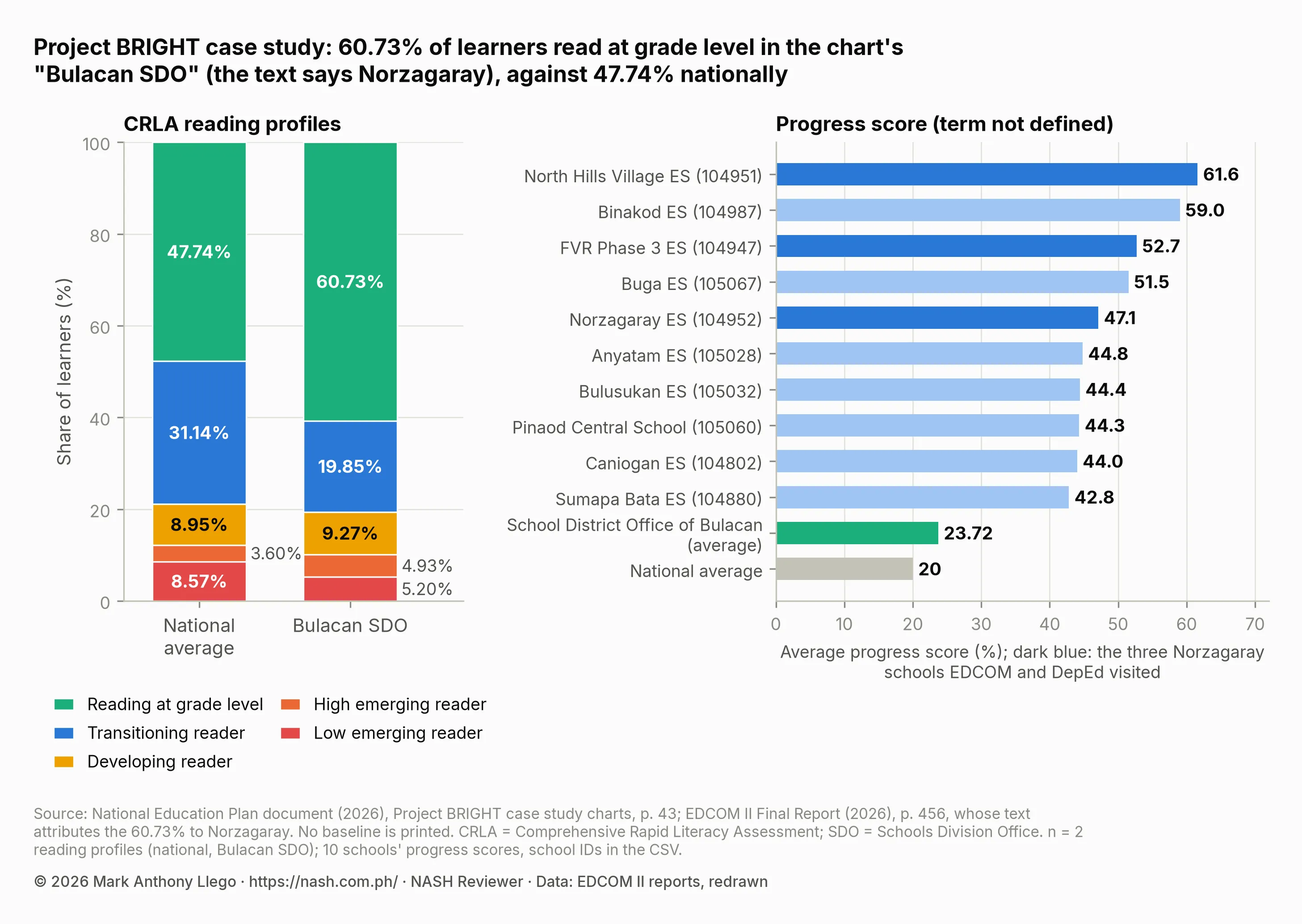
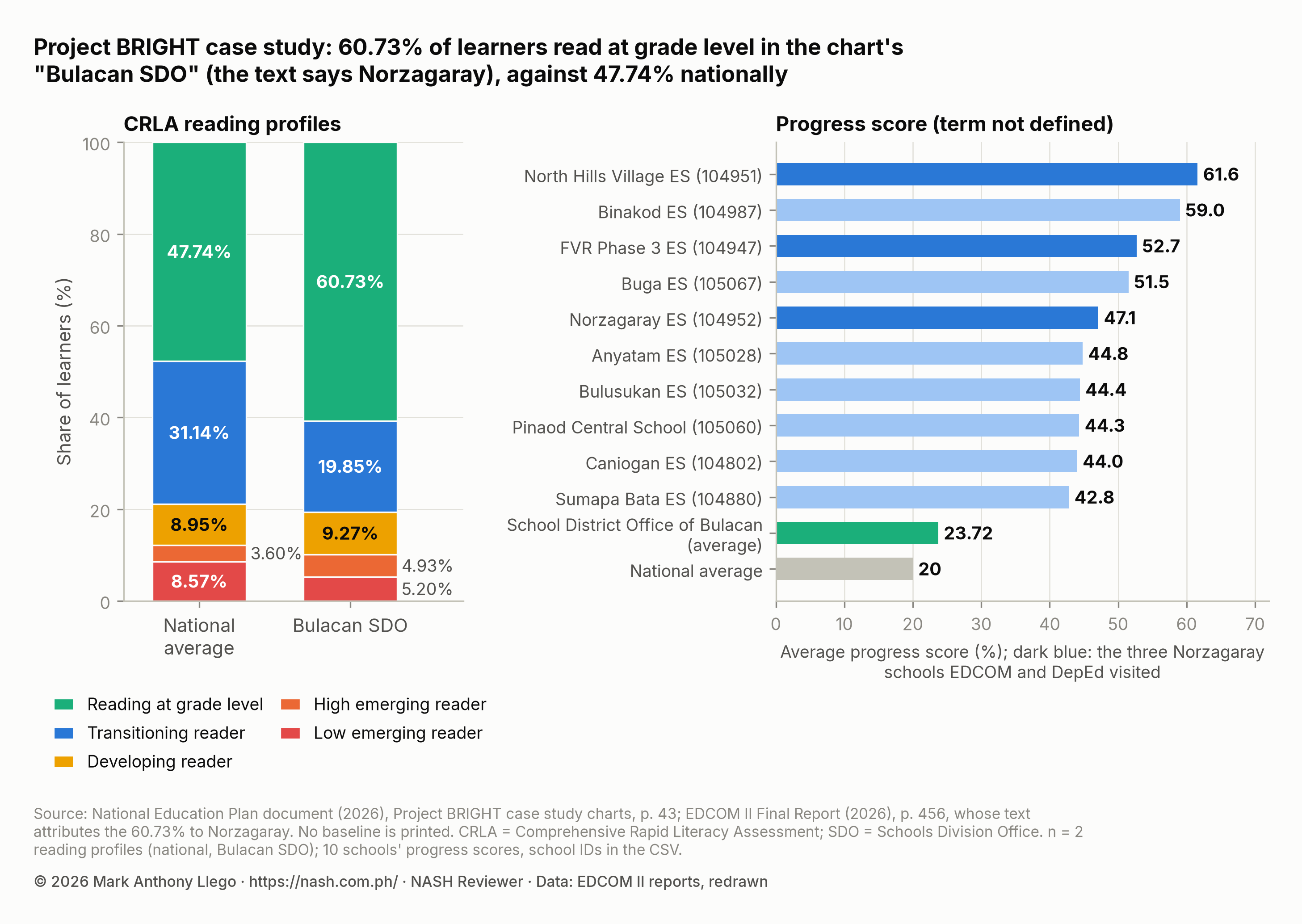
The national 47.74% matches the plan’s end-of-year CRLA baseline, 2,604,392 of 5,455,581 Key Stage 1 learners at grade level (Final Report, p. 445). Whichever unit it belongs to, 60.73% is above the plan’s 2026 target of 57% and below its 2028 target of 75%.
How strong the evidence is
The reports set CRLA results beside a national average and print no earlier figure for Norzagaray or the division, so they show a level, not a gain, and nothing shows the project caused it. They do not define “progress score” or “eliminating illiteracy”; the second cannot mean every learner reads at grade level, since the same box puts 60.73% at grade level. Compare such figures only with ones taken at the same point in the year; our comparison of the CRLA at the start and end of SY 2025-26 shows the share at grade level rising from 15.6% to 51.3% within one year.
What made it work, according to the report
The box names “targeted interventions, smaller class sizes, and outstanding support from the local government” and concludes that “This combination of school-led innovation and robust local government partnership allowed educators to focus on teaching, not on resource shortages” (p. 456). DepEd Assistant Secretary Jerome Buenviaje “noted that this model provides a concrete framework for the nationwide Academic Recovery and Accessible Learning (ARAL) Program”. EDCOM’s July 2025 release adds that teachers credited “a 1:31 teacher-pupil ratio at Norzagaray Elementary” and “a 1:1 book-to-pupil ratio” (EDCOM 2, July 15, 2025).
The Final Report pairs Norzagaray with Navotas City, where “programs such as Basa, Navoteño, NavoReads, and the Joyful Reading Treasures mobile library produced a 65% increase in the number of children identified as ‘grade-ready’ in reading by the end of School Year 2024–2025” (p. 608). That is a relative change with no counts printed, so it cannot be set beside the 60.73% share.
Iloilo: Local School Boards and the proof of concept
What it did, and who ran it
The Synergeia Foundation, “in partnership with” EDCOM II, ran “a Proof of Concept (POC) Education Reform program in 11 pilot areas in the province of Iloilo” in 2024–2025 (Final Report, p. 502). EDCOM’s March 2026 release says the initiative was led by Iloilo Governor Arthur Defensor Jr. and the foundation’s president, Dr. Milwida Guevara, as a partnership with the foundation and DepEd across 11 municipalities (EDCOM 2, March 14, 2026). The Year One Report had announced that the “decentralization proof of concept in Iloilo province will commence through planning sessions with the concerned local governments” (Year One Report, p. 317).
The program tested “how strengthening Local School Boards (LSBs), enhancing community participation, and decentralizing certain education delivery functions can directly improve learning outcomes” (Final Report, p. 502), through “capacity building, participatory planning, and performance-based budgeting”. The boards and school communities took on “needs assessment, development of reading materials, teacher and parent training, and creation of incentive and disincentive schemes to promote accountability”. The box does not say who paid; EDCOM’s March 2026 release says “The local government stepped up to fund the program” (EDCOM 2, March 14, 2026). No cost is printed.
What the report prints as results
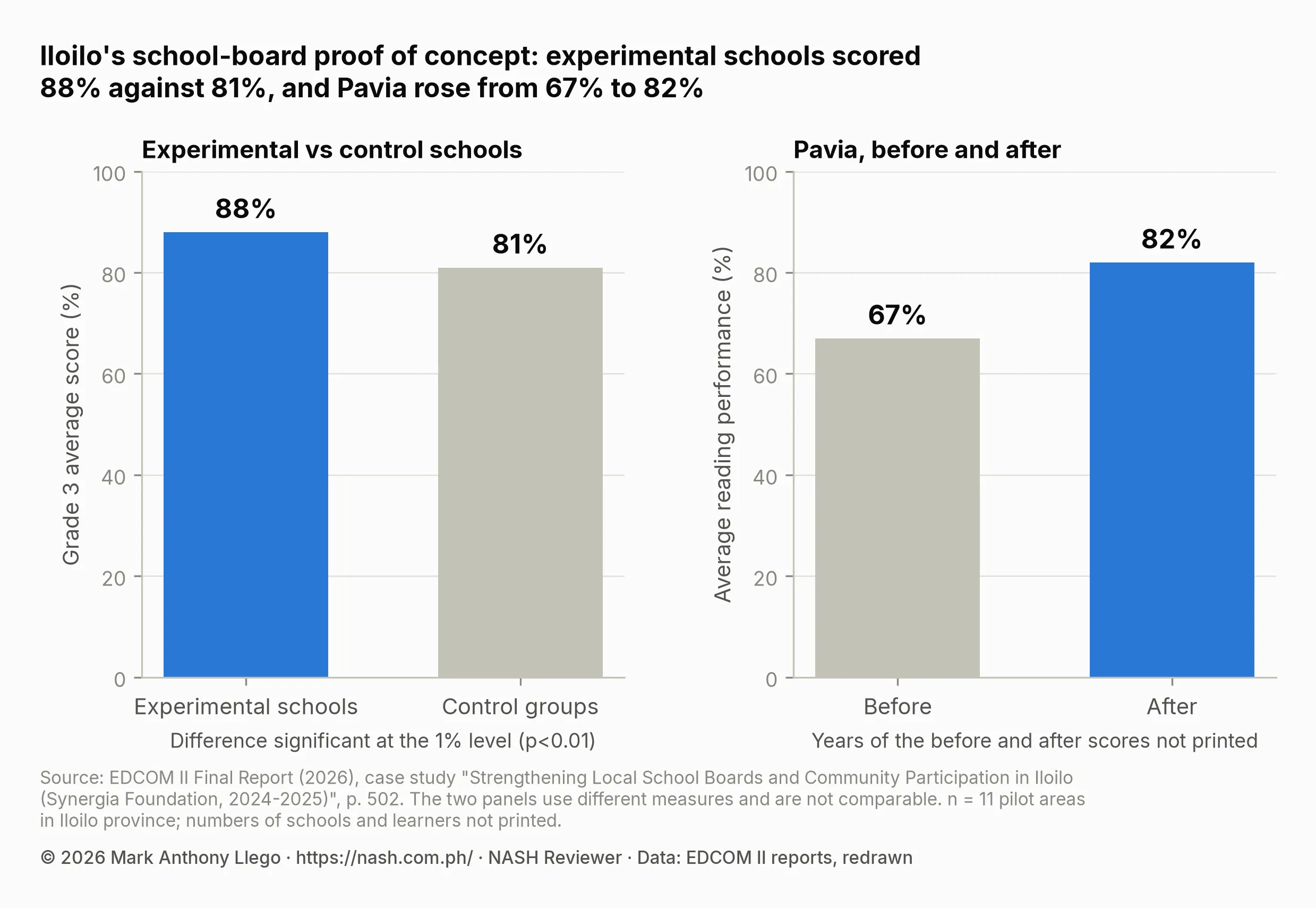
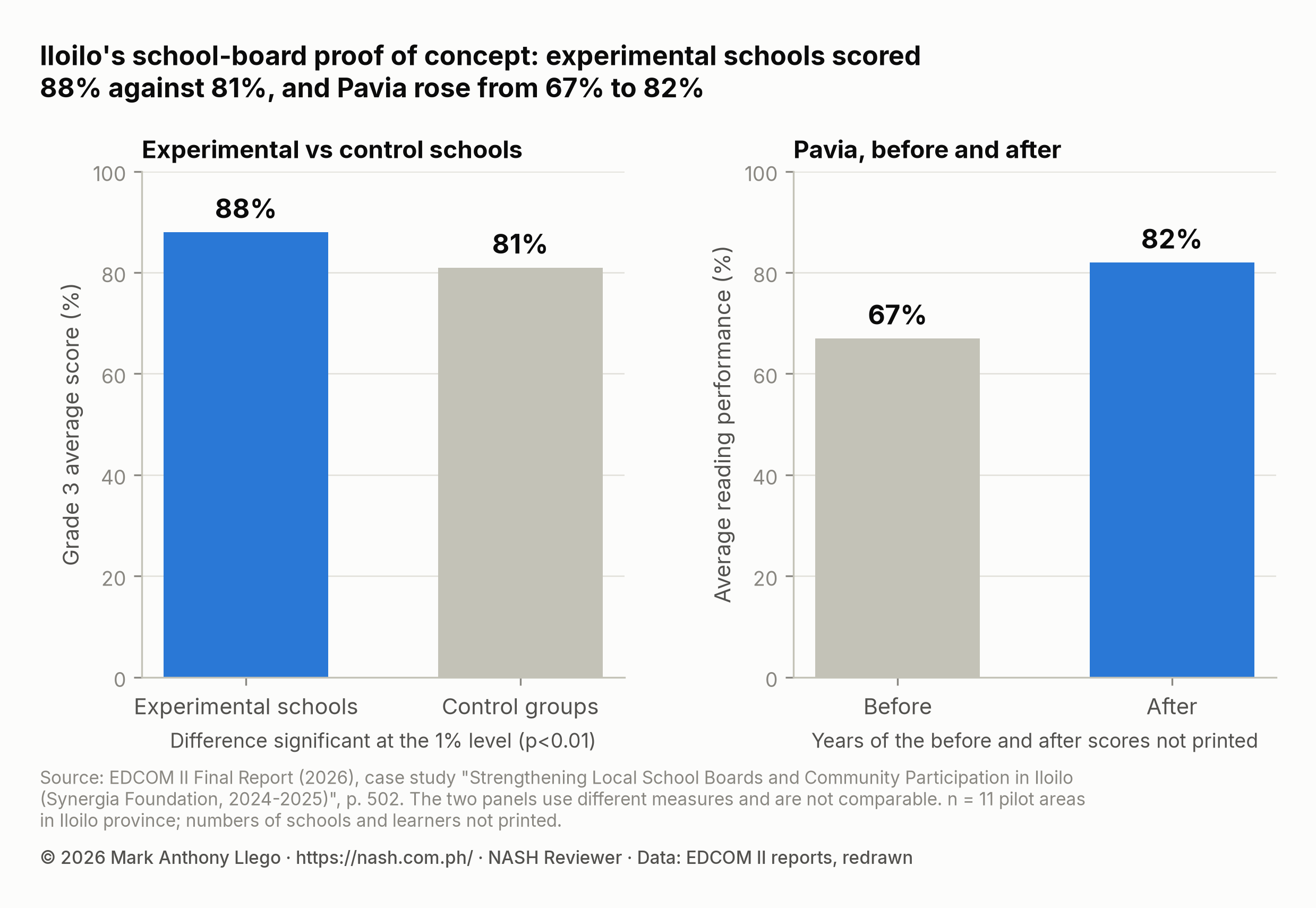
“Grade 3 learners scored 88% on average, compared to 81% in control groups, with statistically significant differences at the 1% level (p<0.01)” (p. 502). The experimental group did better in “English comprehension, story understanding, and critical thinking tasks”. In Pavia, “average reading performance … increased from 67% to 82%”, and “results were consistent across LGUs regardless of income classification”. Central schools showed “significantly higher outcomes compared to non-central and integrated schools”.
How strong the evidence is
This is the only local model in the reports with control groups and a significance test. The box credits the program to the foundation and EDCOM II and does not say who conducted the assessment, how schools were assigned, how many learners were tested, or with what test. The Pavia figures have no comparison group or dates. The March 2026 release reports a different measure, Grade 3 reading proficiency raised “from 30% to an impressive 90% in just one year” (EDCOM 2, March 14, 2026); a share of proficient readers is not an average score, so it is not combined with the 88%.
What made it work, according to the reports
“The Iloilo case illustrates the importance of devolved, accountable, and participatory education governance, which can lead to greater learning outcomes” (p. 502). Dr. Guevara, of the Synergeia Foundation (p. 599), whom the March 2026 release names as a leader of the Iloilo initiative, sets out a general approach in her essay “Moving Communities to Action” (pp. 122–125); the essay does not mention Iloilo. It describes denial, “When Mayor Rex Gatchalian of Valenzuela City presented the reading problem, principals replied, ‘Mayor, wala namang problema!’” (“Mayor, there is no problem!”) (p. 123), and its remedies are to embed “equal access to quality education” in local development and investment plans (p. 123), to present data simply (“The 5 x 5 rule is a good start: 5 slides, 5 lines per slide, 5 words per line”, p. 124), to judge outcomes rather than outputs such as “Feeding programs, teacher training, and computer distribution” (pp. 124–125), and to make School Boards and Governing Councils “co-owners of the education problem and its solution” (p. 125).
The guide to Local School Boards and the Special Education Fund explains how these boards work.
Valenzuela City: Education 360° and the special education center
Education 360°
The Year Two Report says the program was “Launched in 2014” by “then-mayor, now secretary of Social Welfare and Development, Rex Gatchalian, legislated through a city ordinance to ensure continuity” (Year Two Report, p. 377). It invests in “infrastructure, school supplies, curriculum enhancement, teacher competency, parental involvement, and nutrition”, with parenting camps, teaching camps for teachers, literacy and numeracy remediation, and sports drawn up with partners such as the Synergeia Foundation and the Laos Football Club. The Final Report stresses “massive infrastructure investments in classrooms, with multi-year plans mapped out to guide its construction priorities”, and records that the program was named one of the “Ten Outstanding Programs in Local Governance by the Galing Pook Foundation in 2015” (Final Report, p. 455).
Neither report prints a learning result, a classroom count or a cost for Education 360°. What the Year Two Report singles out is “its bottom-up budgeting approach. Governing councils of local schools actively participate, proposing programs during the budgeting and planning process” (p. 377).
The Valenzuela City Special Education Center (ValSpEd)
The city and DepEd opened the center on January 22, 2016; the Final Report calls it “the first locally-funded Special Education institution in the country” (p. 478). The city “provides facilities, personnel augmentation, and logistical support”, DepEd “allocates teaching positions, instructional resources, and curriculum supervision”, and corporate programs and donations add more (p. 479). “For the years 2024 and 2025, the Valenzuela City LGU has allocated PhP62.71 million”. A Center Director holding a Public Schools District Supervisor position leads 11 special education teachers, with therapists and para-teachers paid by the city.
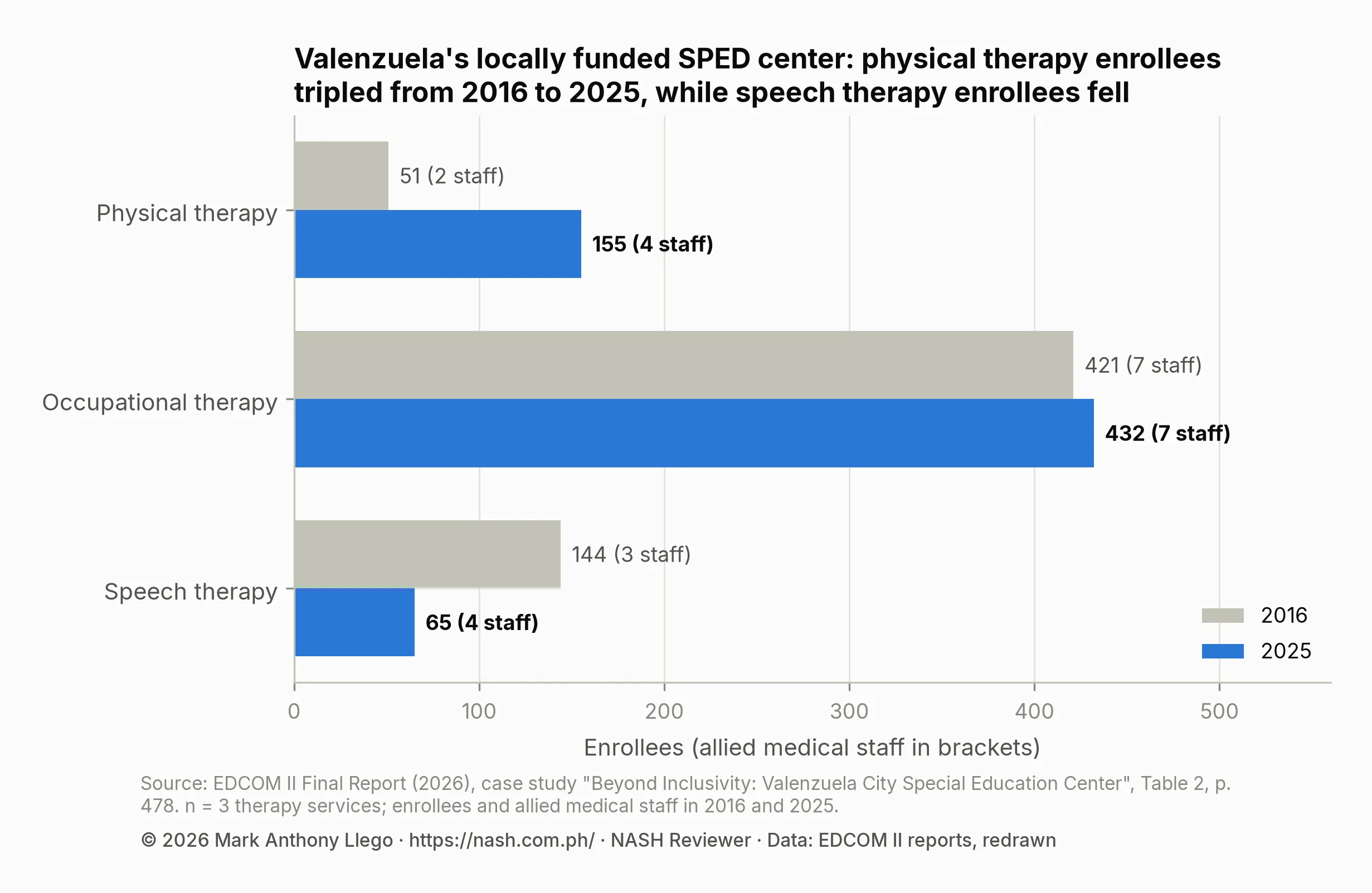
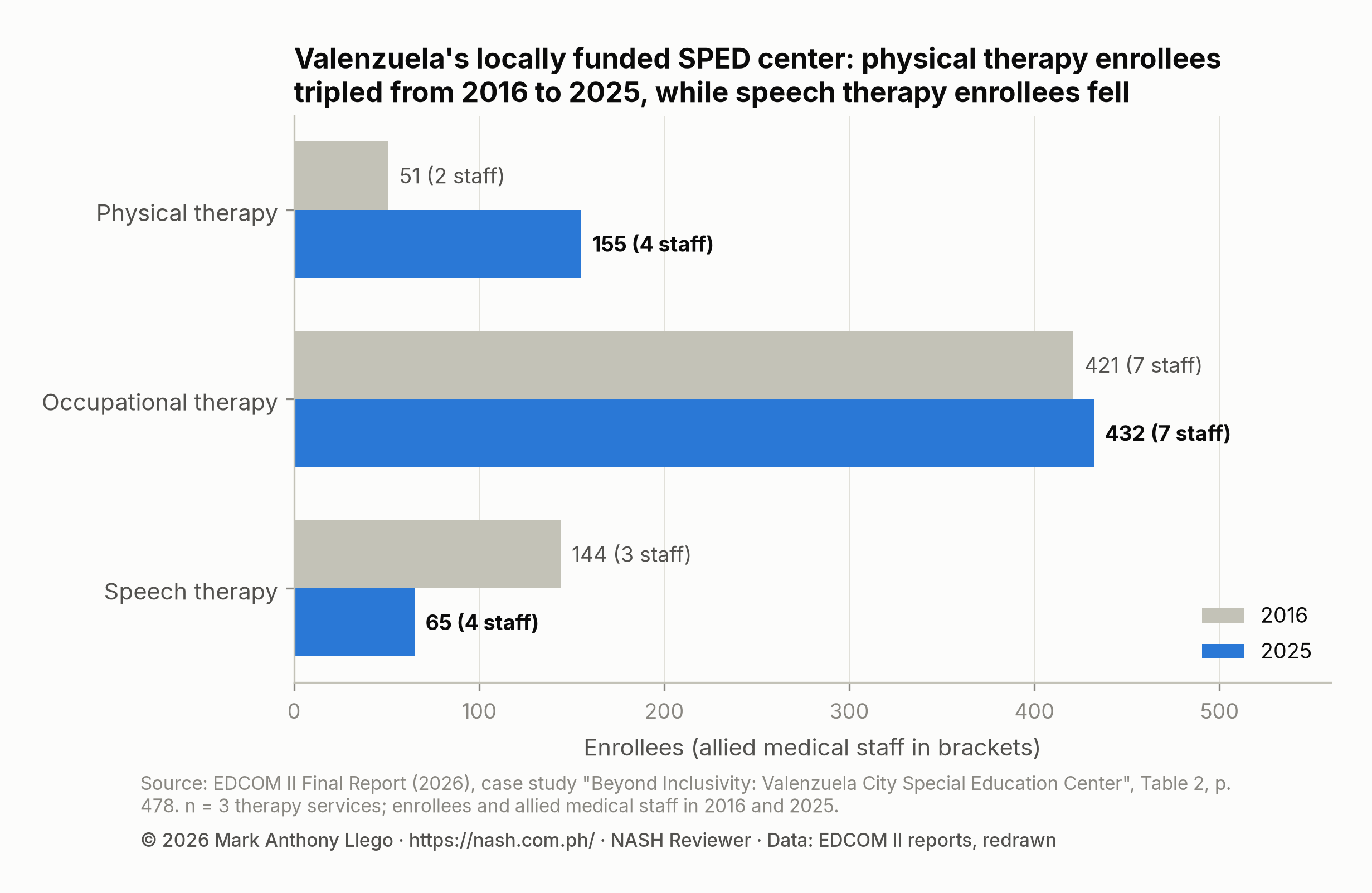
The box’s Table 1 shows the Special Needs Program growing from 58 learners in January to March 2016 to 325 in 2025–2026 (National Education Plan document, p. 69; Final Report, p. 478). These are counts of learners and staff, not learning results. The guide to learners with disabilities and RA 11650 covers the national policy.
Nutrition and early childhood: what local governments did
Nutrition belongs in a guide for school heads because the same children reach school: our stunting and early reading analysis links more stunting with slightly more struggling readers across 1,639 municipalities.
- Manolo Fortich, Bukidnon (Final Report, p. 441) created two plantilla posts, Nutrition Officer II and III, has 32 Barangay Nutrition Scholars across 22 barangays, hosts a milk hub, and paid for a complementary food facility from its Local Development Fund. Stunting fell “From a stunting prevalence of 4% in 2022 … to 2% in 2024”; the box gives the local government as its source.
- Bacnotan, La Union (p. 442), through its SIBOL-Bacnotan program and a full-time Municipal Nutrition Action Officer, raised its nutrition budget “from PHP 50,000 in 2020 to over 5 million for the Nutrition Office alone in 2024, and over PHP 50 million for total nutrition-related programs—representing more than 20% of its total LGU budget”, and pays monthly incentives to Barangay Nutrition Scholars. From 2021 to 2024, combined stunting and severe stunting fell from 5.66% to 3.2%, wasting from 2.37% to 0.8%, and underweight from 2.88% to 2.14%.
- A Western Visayas municipality (Year One Report, p. 36). An EDCOM II–IDInsight policy brief excerpt credits Green Banner awardees’ “allotment of approximately 1% of the municipality’s general fund”, “active child finding, and an effective municipal nutrition committee”, then describes an unnamed town’s locally funded programs. “From 2015 to 2022, stunting among children in the community decreased from 5.45% to 0.2%. A part of this drop may be attributed to these local initiatives.” The box first gives the 5.45% as the prevalence of wasting and does not resolve the difference.
- Pasig City (Final Report, p. 443), whose 107 public child development centers served “only about 19% of children aged 3–4” in 2024, pays “PHP 3,000 in financial assistance per child” for children the public centers cannot take, under agreements with 95 accredited private centers. No result is printed.
- Four more in the Year Two Report (p. 97), which calls them “exemplary programs”:
- Muntinlupa City’s Early Childhood Education Division, “Created through Ordinance No. 04-139”, has its own Annual Investment Plan and “a robust Php 72.9 million budget by 2023, serving over 8,000 children annually through 90 child development centers”.
- The Naga Early Education and Development Program set up Montessori-type day care centers in each sitio under a “counterpart” policy in which barangays and parents share operating costs, “doubling day care centers from 30 to 54 and reaching one-fourth of potential beneficiaries in just 2 years”.
- Barangay Taloot in Argao, Cebu runs its “Kapurok Ko, Karamay Ko” program through puroks, linking its Food Available in the Home initiative with purok-based feeding. It “significantly reduced malnutrition rates from 7.03% to 1.78% and decreased nonreaders from 6.01% to 1.48% between 2013 and 2023”, before-and-after figures with no comparison group or source printed.
- Taguig City offers free day care with supplementary feeding, the AlagaNutri program for 6- to 9-year-old students and a 120-day dietary supplementation program in Barangay Lower Bicutan, which earned it “the Sixth Seal of Child-Friendly and Nutrition Honor Award in Metro Manila”.
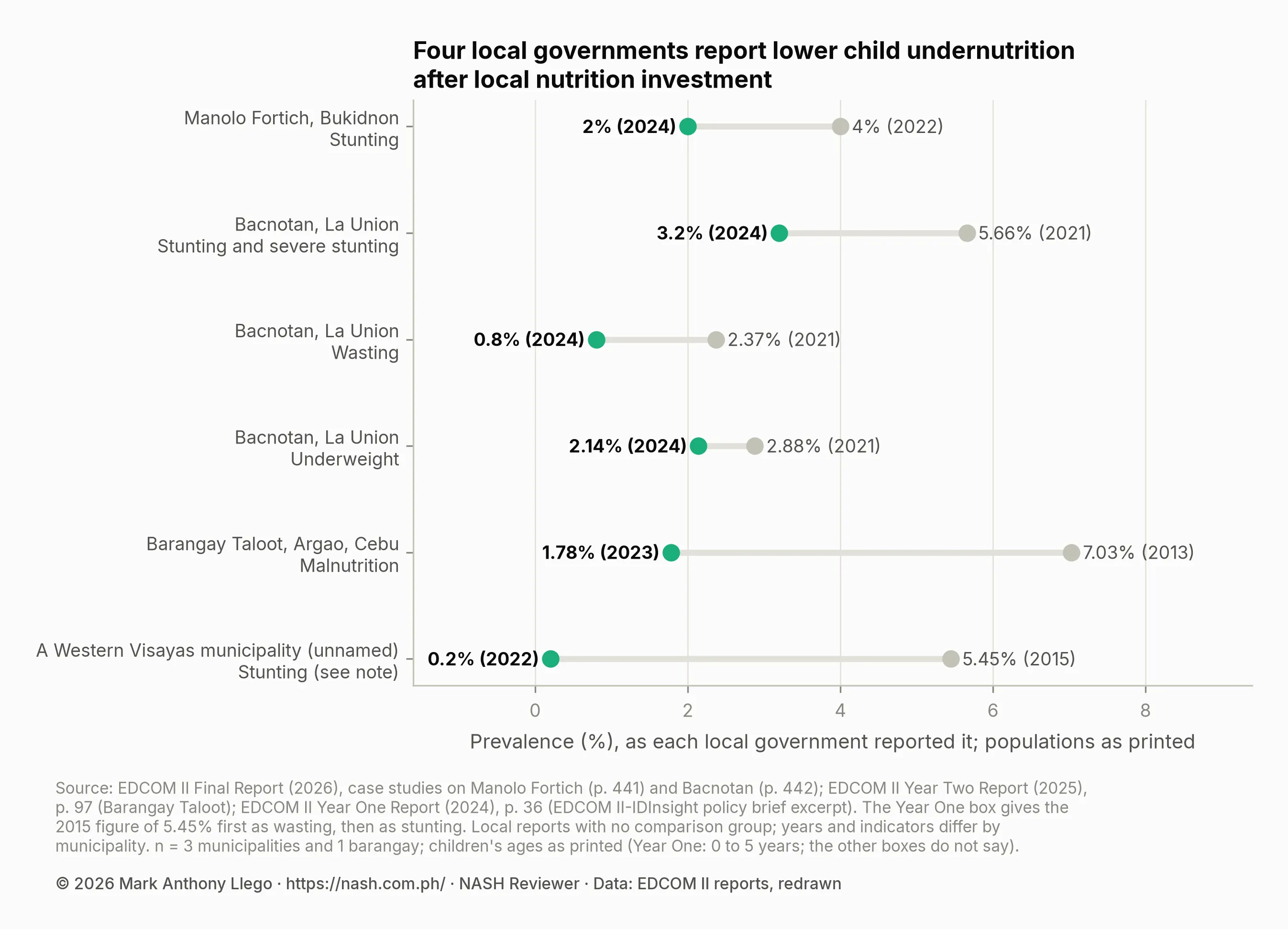
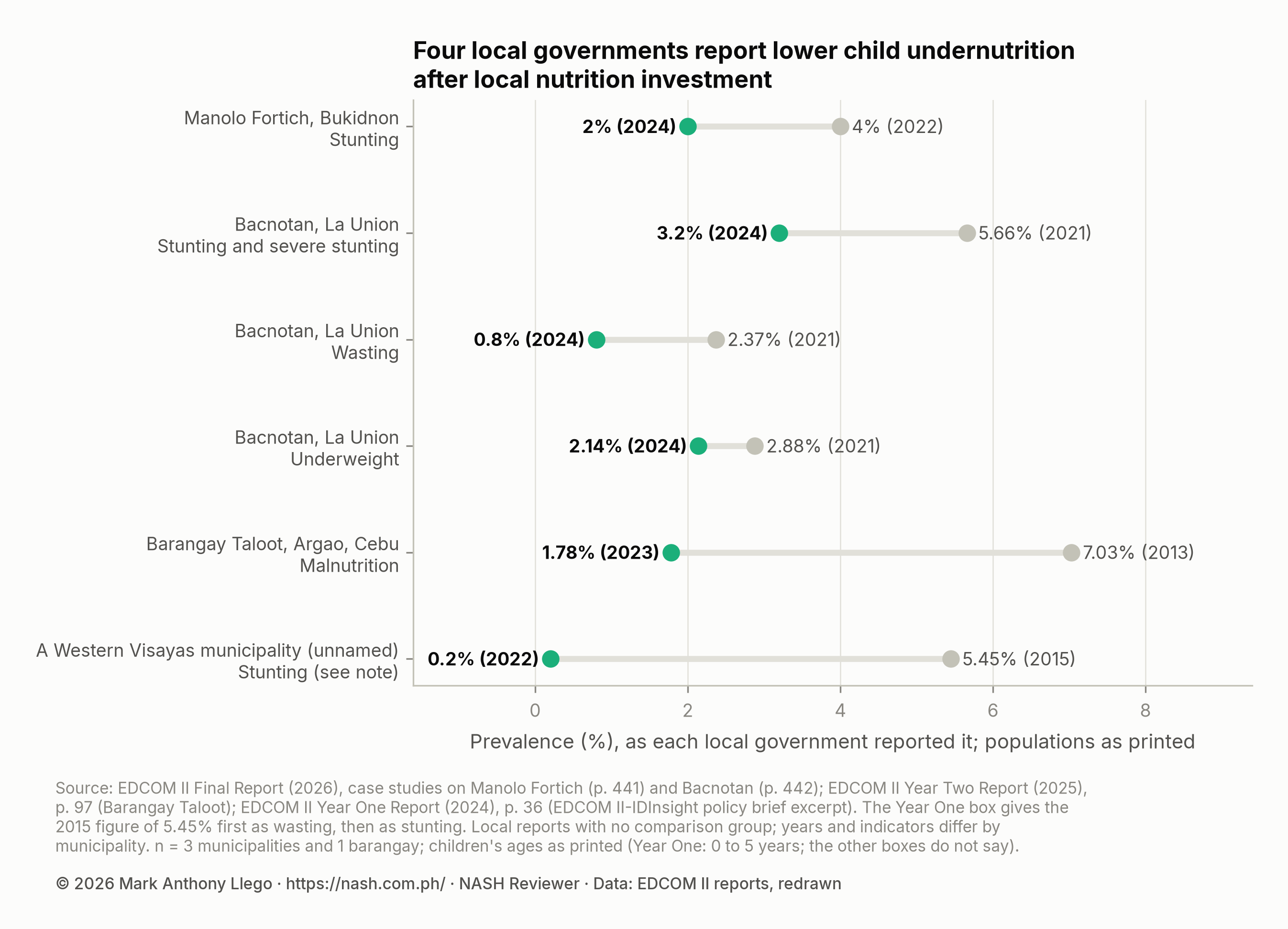
The boxes do not say how their figures were measured, so they are not comparable with the national baseline of 23.6% stunting among children under five in 2023 (Final Report, p. 434). The reports credit people and money: plantilla nutrition officers, trained and paid Barangay Nutrition Scholars, and nutrition budgets aligned with the local annual investment plan (Final Report, pp. 441–442; Year One Report, p. 35). The Year One Report found that these practices “lack institutionalization, with the most impactful initiatives for reducing undernutrition originating organically from grassroots efforts” (Year One Report, p. 35).
Schools that beat their budgets: Gapan and other positive deviants
The Year Two Report looked for “potential positive deviants”, public schools that perform better than expected “despite relatively low-resourced contexts” (Year Two Report, p. 358). A UNICEF (2024) analysis linking NAT results with school MOOE and SEF budgets found such schools, with Grade 10 scores above the national averages, which “ranged from 42 to 45 points” (p. 358); Table 10 lists seven (p. 359).
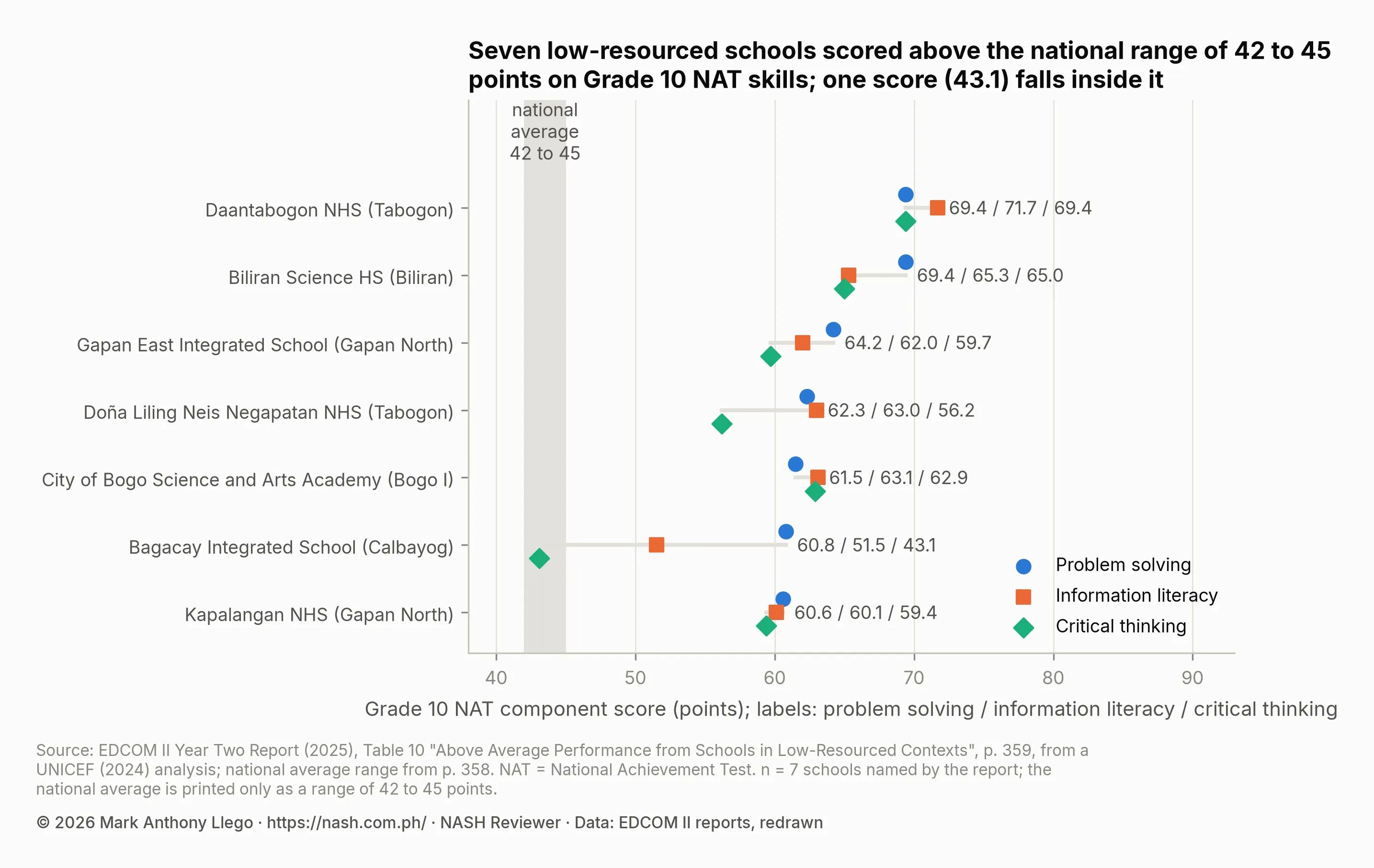
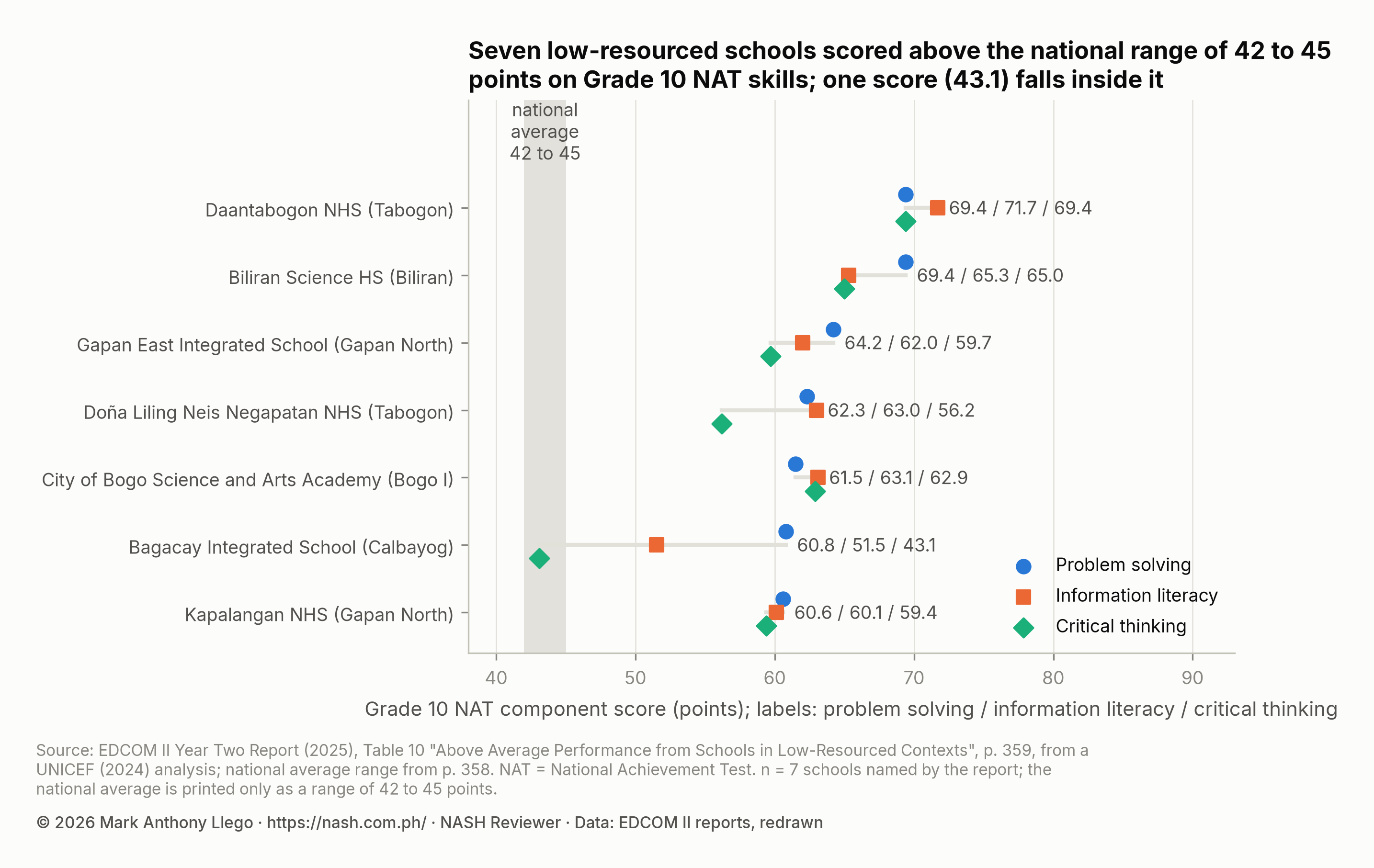
Two of the seven are in Gapan City, a fourth-income-class city whose FY 2022 SEF income of PHP 9.7 million was “less than half (40.03%) the average SEF income of other fourth-income-class cities” (p. 359). Set against “the more highly resourced schools in the National Capital Region”, Gapan East Integrated School and Kapalangan National High School “outperformed over 90% of the 342 public and private schools that had participated in the SY 2022–2023 NAT”. EDCOM reads this as showing that “quality of education is not solely determined by the amount of funding”, and emphasizes “effective resource utilization, strong leadership, and a conducive learning environment” (p. 359).
This one-time comparison identifies schools worth studying; it does not show what made them succeed. UNICEF’s wider finding was “weak detection of effects for school MOOE and SEF spending on learning outcomes”, which “could be indicative of ineffective spending, though further study is needed” (p. 355). The Final Report later calls positive deviance “One of the most striking lessons” of the Commission’s work (Final Report, p. 607).
Partnerships for Indigenous and out-of-school learners
Assisi Development Foundation (ADF) (Final Report, p. 480). The program “began in 2001 as a humanitarian response to the Ayta communities affected by the Mt. Pinatubo eruption” and has “supported over 48,000 Indigenous learners across early childhood, basic education, and tertiary levels”, with financial, technical and capacity-building support to local partners. In Himamaylan City, Negros Occidental, ADF partnered with the schools division in 2018: “Seven years later, three IP community schools have transitioned from extension to independent elementary schools.” In Malita, Davao Occidental, ADF works with the Malita Tagakaulo Mission (MATAMIS), which with ADF’s support maintains community-based schools set up after a child drowned on the way home from school in 2011; “Community members contribute food subsidies for teachers.”
Arnold Janssen Catholic Mission Foundation (Final Report, p. 477). Since 2019 it has been one of the few partners of DepEd and the Development Academy of the Philippines (DAP) in piloting the Alternative Learning System (ALS) Education and Skills Training program, for out-of-school youth and adults from Marawi to Palawan and Metro Manila. It “has produced 4,868 graduates between 2019-2025”, under a DAP monitoring system that “requires monthly reports from all Learning Facilitators”.
Both boxes print reach and status changes, not learning outcomes or costs. They credit “sustained collaboration between communities, civil society, and government” (p. 480). The guide to ALS, inclusive education and special programs explains the DepEd programs these partners work within.
Other cases with no printed result
The reports describe several more practices without a result:
- Opol National Secondary Technical School, Misamis Oriental, joined the Cagayan de Oro hotel and restaurant association for industry standards and work immersion, received equipment and a gas tank house from the Japan International Cooperation Agency (JICA), and became a TESDA-accredited training and assessment center (Final Report, pp. 463–464).
- Adventist University of the Philippines and Centro Escolar University describe mentoring, early-warning and counseling systems against college dropout (pp. 491–492).
- Region V aligned school heads’ performance reviews with the Philippine Professional Standards for School Heads (PPSSH) through a regional memorandum the report gives as “DepEd Memorandum No. 277, s. 2023”, and Region X built Project CELLS to train school heads; the Year Two Report calls both positive deviants (Year Two Report, pp. 261, 263).
- Smaller mentions: DSWD’s “Apo Ko” storytelling program (Final Report, p. 115), Angeles City’s referral system for redistributing learners (Year Two Report, p. 142), Tarlac’s electronic school forms (Year Two Report, p. 250), Iloilo province’s “Laswa sa Lamesa” household vegetable-farming ordinance (Year One Report, p. 35), and the education units created by Quezon City, General Santos City, Cagayan de Oro City, Muntinlupa City and Albay (Year One Report, p. 317).
What the models have in common, according to the reports
The Final Report draws the lesson itself: “These cases demonstrate that effective solutions often already exist within communities. Recognizing and scaling these homegrown practices allow policymakers to harness local ingenuity rather than rely solely on external models” (Final Report, p. 608).
Read together, the reports credit a few recurring things: a diagnosis first (CRLA and Phil-IRI profiles, Final Report, p. 167; active child finding, Year One Report, p. 36); grouping by level and protected time (Pasay’s daily pull-out sessions, p. 167; the LRP’s small groups, July 6, 2025 release); a local government that pays for people (Final Report, pp. 167, 441, 456, 479); councils and boards that plan and budget (Year Two Report, p. 377; Final Report, p. 502); continuity in law or habit (Year Two Report, p. 377; Final Report, pp. 167, 480); and outcomes, not outputs, as the measure of success (Final Report, pp. 124–125).
The National Education Plan wants these practices scaled. Its 2035 targets are that “Schools have functional SGCs, funded SIPs, and practice SBM” and that “Local Government Units fully utilize SEF aligned with SIPs” (Final Report, p. 496), and it asks the Department of the Interior and Local Government to create “peer-learning networks across LGUs” (p. 497). The money rules have changed too. Joint Circular No. 01, s. 2025 of DepEd, the Department of Budget and Management, the Department of the Interior and Local Government and the Department of Finance, the Omnibus Guidelines on the Use of the Special Education Fund (SEF), was signed on December 3, 2025 (Final Report, p. 368). Its Annex C lists “Remuneration of para-teachers who serve as tutors” under the ARAL Program and “Conduct of parent effectiveness sessions” (p. 31 of 43). DepEd Memorandum No. 061, s. 2026 confirms that Local School Boards “may allocate funding support for the engagement of external ARAL tutors and other learning support personnel through the SEF” (enclosure, item 34.b).
What this means for school heads
The models were built by mayors, foundations and divisions, but each ran through schools. Six practices follow.
- Start with your own data, and make it readable. Use your CRLA and Phil-IRI results to decide whom to help, and compare the same point in the year when you judge progress. The guide to reading a school’s CRLA results explains why small schools’ shares swing by chance; the Domain 1 guide covers monitoring and evaluation.
- Copy the design, not the brand. What p. 167 credits in BBMP, the LRP and Pasay is similar: diagnose, use scripted lessons, group by level, hold short daily sessions and check progress regularly. The BRIGHT box credits targeted interventions, smaller classes and local government support (p. 456). Do it within the ARAL rules set out in the mass promotion guide; the Domain 3 guide treats these as data-based interventions.
- Take a costed proposal to the Local School Board. Pasay’s reading teachers and Norzagaray’s camps were paid by local governments. Write a short proposal tied to your School Improvement Plan: learners below grade level, the tutors or materials needed, the cost, and the result you will report back. Joint Circular No. 01, s. 2025 lets the SEF pay para-teacher tutors and parent effectiveness sessions (Annex C), and DepEd Memorandum No. 061, s. 2026 confirms that the board may fund ARAL tutors. The SEF and Local School Board guide explains the process, and the LGU-funded teachers report shows which local governments already pay school staff.
- Let your School Governance Council propose, not only approve. Valenzuela’s councils propose programs at budget time, and Iloilo’s boards trained parents and set incentives (Year Two Report, p. 377; Final Report, p. 502). Bring your council the reading data before the budget is set and ask it to own one program. See the School Governance Council guide and the Domain 5 guide.
- Report results honestly, with a comparison. A before-and-after figure on the learners you helped is likely to rise even without the program. Compare with similar learners who did not attend, or with the same grade last year, and define your terms, which the reports often do not.
- Learn from the school next door. Gapan’s schools did more with less, and the Final Report calls positive deviance one of its “most striking lessons” (Year Two Report, p. 359; Final Report, p. 607). Visit a school in your district with similar learners and better results and write down what it does differently. The Domain 4 guide treats professional networks.
How the NASH may test this
Under DepEd Memorandum No. 069, s. 2025, the NASH covers “conceptual and situational critical thinking questions” aligned with the PPSSH, “using the SOLO (Structure of the Observed Learning Outcome) taxonomy as an underpinning framework” (para. 3). The two items below are original practice items, scored 3 (Relational), 2 (Multistructural), 1 (Unistructural) or 0 (Prestructural).
Question 1
Indicator 1.4.1, Research and innovation. Career Stage 1, Situational, Moderate.
You are a head teacher drafting your school’s reading plan. Your team brings three findings: a regional pilot whose impact evaluation found that learners gained up to 1.3 years of schooling in a 20-day remediation; a national program in which 96% of the lowest readers moved up at least one level on their own before-and-after tests; and a nearby division where 60.73% of learners read at grade level, against 47.74% nationally. Which response best uses this evidence?
- A. Adopt the nearby division’s program in full, since its learners already read well above the national level and its setting is closest to your school’s.
- B. Combine the activities of all three programs into one plan, since each has shown success and together they give learners the widest support.
- C. Weigh the impact evaluation most, adopt the features all three share, and compare your learners’ results with a similar group rather than rely on before-and-after scores alone.
- D. Weigh the impact evaluation most, adopt its design, and report the plan a success if most of your learners move up one level by the end of the summer.
Answer and explanation
Best answer: C. Points: A = 1, B = 0, C = 3, D = 2.
- A (1 point, Unistructural). Local relevance matters, but a division’s level of reading says nothing about what caused it, so this adopts the least tested model.
- B (0 points, Prestructural). Treating every finding as equal proof is the misconception the indicator guards against, and it produces a plan no one can evaluate.
- C (3 points, Relational). It ranks the evidence by design, draws on what the programs share (diagnosis, grouping by level, structured sessions, progress checks), and builds a comparison into the school’s own evaluation.
- D (2 points, Multistructural). It reads the evidence correctly but then judges its own program on a one-group before-and-after result, the weakest design of the three.
Why. EDCOM II reports the Region IX result from “an impact evaluation study”, the national 96% with no comparison group mentioned (p. 167), and the 60.73% against a national average with no baseline (Final Report, pp. 167, 456; National Education Plan document, p. 43). Indicator 1.4.1 asks the aspiring school head to identify relevant findings from reliable sources, which means reading what each design can show.
Indicator 1.4.1: Identify relevant research findings from reliable sources in facilitating data-driven and evidence-based innovations to improve school performance.
Sources: EDCOM II Final Report (2026), pp. 167, 456; National Education Plan document (2026), p. 43; DepEd Order No. 024, s. 2020.
Question 2
Indicator 5.5.2, Community engagement. Career Stage 2, Situational, Moderate.
You are the principal of an elementary school where the end-of-year CRLA shows that 40% of Grade 1 to 3 learners are not reading at grade level. Your MOOE cannot pay for tutors. The mayor has invited schools to submit proposals for next year’s Special Education Fund budget, and the division has told school heads that the revised SEF guidelines allow para-teacher tutors and parent sessions. What should you do?
- A. Submit a costed proposal through the division to the Local School Board for tutors and parent sessions, based on the CRLA results and the SIP, and report reading results to the board and the School Governance Council each term.
- B. Submit a request to the Local School Board for tutors and reading materials, attaching the list of learners who need help, and leave the reporting of results to the division.
- C. Recruit parent volunteers to tutor after class and wait for next year’s MOOE to buy materials, since requests for Special Education Fund support take too long.
- D. Ask the mayor to pay a private tutoring center that the school chooses directly from the Special Education Fund, bypassing the Local School Board to save time.
Answer and explanation
Best answer: A. Points: A = 3, B = 2, C = 1, D = 0.
- A (3 points, Relational). It ties the partnership to the school’s data and plan, uses the proper channel, and builds in reporting to the board and the council, as the Pasay and Iloilo models did.
- B (2 points, Multistructural). It uses the right channel and evidence, but without a cost, a link to the SIP or a report on results, the board cannot judge or sustain the program.
- C (1 point, Unistructural). Engaging parents is one sound element, but it leaves the funding unused and gives volunteers no structure or support.
- D (0 points, Prestructural). Bypassing the Local School Board and picking a provider for the mayor to pay ignores the rules on the use of public funds.
Why. EDCOM II credits Pasay’s reading gains to a two-decade partnership that deploys “dedicated reading teachers” with SEF support (Final Report, p. 167), and Iloilo’s to Local School Boards that assessed needs and held schools accountable (p. 502). Joint Circular No. 01, s. 2025 lets the fund pay para-teacher tutors and parent effectiveness sessions (Annex C), and DepEd Memorandum No. 061, s. 2026 confirms that Local School Boards may fund ARAL tutors from the SEF. Indicator 5.5.2 asks the school head to initiate partnerships that strengthen support for learners.
Indicator 5.5.2: Initiate partnerships with the community, such as parents, alumni, authorities, industries and other stakeholders, to strengthen support for learner development, as well as school and community improvement.
Sources: EDCOM II Final Report (2026), pp. 167, 368, 502; Joint Circular No. 01, s. 2025, Annex C; DepEd Memorandum No. 061, s. 2026; DepEd Order No. 024, s. 2020.
Nothing in this guide reproduces or predicts examination content.
Frequently asked questions
What is Project BRIGHT in Norzagaray, Bulacan?
Project BRIGHT (BRIdging Gaps through Helpful Tools) is a reading program begun in 2023 by Norzagaray’s DepEd schools, teachers, parents and local government (EDCOM II Final Report, p. 456). Teachers used reading games, lunch-break story reading and one-on-one tutorials, and the municipality paid a PHP 7,000 incentive for summer reading camps and supplied literacy materials every quarter. The Final Report’s text says 60.73% of Norzagaray’s students read at grade level against a national 47.74%, but the National Education Plan document’s chart labels that figure as the Bulacan Schools Division Office’s (p. 43), and neither prints an earlier figure.
What is Valenzuela City’s Education 360° program?
It is a city program launched in 2014 and set in a city ordinance, investing in classrooms, school supplies, curriculum, teachers, parents and nutrition, with school governing councils proposing programs during the city’s budgeting (EDCOM II Year Two Report, p. 377). It won a Galing Pook award in 2015 (Final Report, p. 455). Neither report prints a learning result for it.
Did the Bawat Bata Makababasa Program work?
According to EDCOM II, an impact evaluation by YouthImpact found that learners in the Region IX pilot gained “up to 1.3 years worth of schooling” during the 20-day remediation (Final Report, p. 167). It is one of only two results the reports attribute to an impact evaluation or a control-group comparison, but the report does not describe the evaluation’s design or sample. The program reached nearly 66,000 readers in the Zamboanga Peninsula (p. 204).
Can the Special Education Fund pay for reading tutors?
Yes. Joint Circular No. 01, s. 2025, the Omnibus Guidelines on the Use of the Special Education Fund signed on December 3, 2025, lists “Remuneration of para-teachers who serve as tutors” under the ARAL Program (Annex C), and DepEd Memorandum No. 061, s. 2026 confirms that Local School Boards may fund external ARAL tutors from the SEF. Pasay City’s long-running SEF-supported reading interventions rest on a two-decade partnership with the city that deploys dedicated reading teachers (EDCOM II Final Report, p. 167). Requests go to the Local School Board.
Download the data
- localmodels-bright-crla.csv: CRLA reading profiles of the national average and the Bulacan SDO, and the average progress scores of ten schools, the School District Office of Bulacan and the nation, from the Project BRIGHT case study (National Education Plan document, p. 43; Final Report, p. 456).
- localmodels-iloilo-reading.csv: Grade 3 average scores in experimental and control schools and Pavia’s reading performance in the Iloilo proof of concept (Final Report, p. 502).
- localmodels-valsped-services.csv: ValSpEd Center enrollees and allied medical staff by service, 2016 and 2025 (Final Report, Table 2, p. 478).
- localmodels-nutrition-lgus.csv: stunting, wasting, underweight and malnutrition before and after in Manolo Fortich, Bacnotan, Barangay Taloot and a Western Visayas municipality (Final Report, pp. 441–442; Year Two Report, p. 97; Year One Report, p. 36).
- localmodels-gapan-nat.csv: Grade 10 NAT problem-solving, information literacy and critical thinking scores of seven low-resourced schools, with the national average range (Year Two Report, Table 10, p. 359, and p. 358).
The CSVs and charts may be reused only with written permission: email support@nash.com.ph. The numbers themselves come from the EDCOM II reports, which you can cite directly.
How to cite this post
Llego, M. A. (2026, October 30). Local Education Models in EDCOM II: What the Evidence Shows. NASH Reviewer. https://nash.com.ph/blog/local-education-reform-models-edcom-ii
The EDCOM II reports:
- Second Congressional Commission on Education. (2024). Miseducation: The failed system of Philippine education (EDCOM II Year One Report). https://edcom2.gov.ph/media/2024/02/EDCOM-II-Year-One-Report-PDF-022924.pdf
- Second Congressional Commission on Education. (2025). Fixing the foundations: A matter of national survival (EDCOM II Year Two Report). https://edcom2.gov.ph/media/2025/01/EDCOM-2-Year-2-Report-Fixing-the-Foundations-2025.pdf
- Second Congressional Commission on Education. (2026). Turning point: A decade of necessary reform (2026–2035) (EDCOM II Final Report). https://edcom2.gov.ph/media/2026/01/EDCOM-II-Y03-for-web-012626_final.pdf
Sources
- EDCOM II, Final Report (2026), pp. 23, 68, 115, 122–125, 167–168, 202–205, 368, 431, 434, 441–443, 445, 455–456, 463–464, 477–480, 491–492, 496–497, 502, 599, 607–608.
- EDCOM II, Year Two Report (2025), pp. 82, 97, 142, 250, 261, 263, 355, 358–359, 377.
- EDCOM II, Year One Report (2024), pp. 35–36, 123, 317.
- Second Congressional Commission on Education. (2026). The National Education Plan (2026–2035) [Part of Turning point: A decade of necessary reform, EDCOM II Final Report]. https://edcom2.gov.ph/media/2026/01/EDCOM-II_Y03_National-Education-Plan.pdf (pp. 42–43, 69).
- EDCOM 2, Summer remediation program boosts literacy for 96% of struggling Grade 3 readers, July 6, 2025.
- EDCOM 2, Norzagaray, Bulacan: A model for the country in eliminating illiteracy in our schools, July 15, 2025.
- EDCOM 2, Iloilo proves effective education reform: Grade 3 reading proficiency soars to 90% in one year, March 14, 2026.
- Joint Circular No. 01, s. 2025 of DepEd, DBM, DILG and DOF, Omnibus Guidelines on the Use of the Special Education Fund (SEF), Annex C, p. 31 of 43 (certified copy, PDF).
- DepEd Memorandum No. 061, s. 2026, Amendments to DepEd Memorandum No. 001, s. 2026, enclosure item 34.b.
- DepEd Memorandum No. 069, s. 2025, Administration of the National Assessment for School Heads for Fiscal Year 2025, para. 3.
- DepEd Order No. 024, s. 2020, National Adoption and Implementation of the Philippine Professional Standards for School Heads (indicators 1.4.1 and 5.5.2).
The EDCOM II series
The reports:
- What EDCOM II Achieved, 2023-2025: Laws, Budgets, Policies
- EDCOM II’s Three Reports: How the Key Numbers Changed
- EDCOM II Final Report: Guide for Aspiring School Heads
- National Education Plan 2026-2035: Guide for School Heads
- 100 Years After the Monroe Report: Education Commissions
- Is the Philippines Spending Enough on Education?
- Education Data, Transparency and Research: EDCOM II
Learners and learning:
- Mass Promotion and Lost Instructional Time: EDCOM II
- PISA, TIMSS, SEA-PLM and the NAT: What EDCOM II Found
- Mother Tongue After RA 12027: Language of Instruction
- Why DepEd Bought Only 27 Textbook Titles in 2012-2023
- RA 12080, Bullying and School Mental Health: EDCOM II
- RA 11650 and Learners With Disabilities: EDCOM II Findings
- Senior High School and Jobs: EDCOM II Workforce Findings
Schools, teachers and governance:
- Teacher Workload and Accountability: EDCOM II Findings
- Local School Boards and the Special Education Fund
- Local Education Models in EDCOM II: What the Evidence Shows (this post)
- Education in the Bangsamoro: EDCOM II Findings for BARMM
Written by Mark Anthony Llego for NASH Reviewer. Sources: EDCOM II Year One (2024), Year Two (2025) and Final (2026) Reports; the National Education Plan document (2026); EDCOM II news releases, 2025–2026; Joint Circular No. 01, s. 2025; DepEd Memoranda No. 069, s. 2025 and 061, s. 2026; DepEd Order No. 024, s. 2020. Charts may be reused only with written permission from support@nash.com.ph.