The Special Education Fund (SEF) is the money that provinces and cities (and municipalities in Metro Manila) raise through an additional 1% yearly tax on the assessed value of real property, under Section 235 of Republic Act No. 7160, the Local Government Code of 1991. The proceeds go automatically to the Local School Board (LSB) of each province, city and municipality, which budgets them for public schools (Section 272). Joint Circular No. 01, s. 2025 of DepEd, the Department of Budget and Management (DBM), the Department of the Interior and Local Government (DILG) and the Department of Finance (DOF), signed on December 3, 2025, lists what the fund may pay for, now including the Alternative Learning System (ALS), learners with disabilities and ARAL tutors. It keeps a rule already in the 2017 circular, that every item be in the DepEd-approved School Improvement Plan (SIP) and Division Education Development Plan (DEDP).
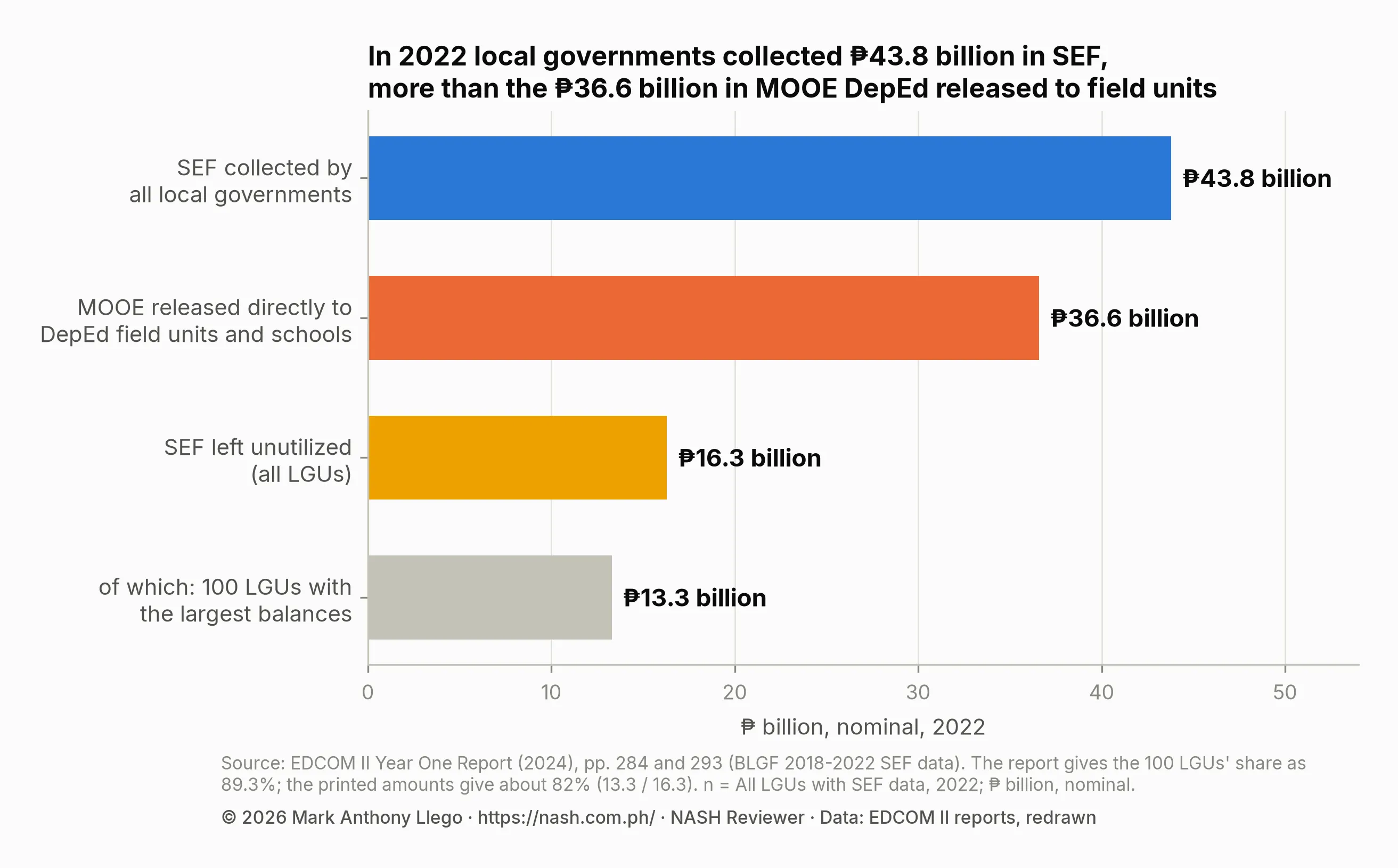
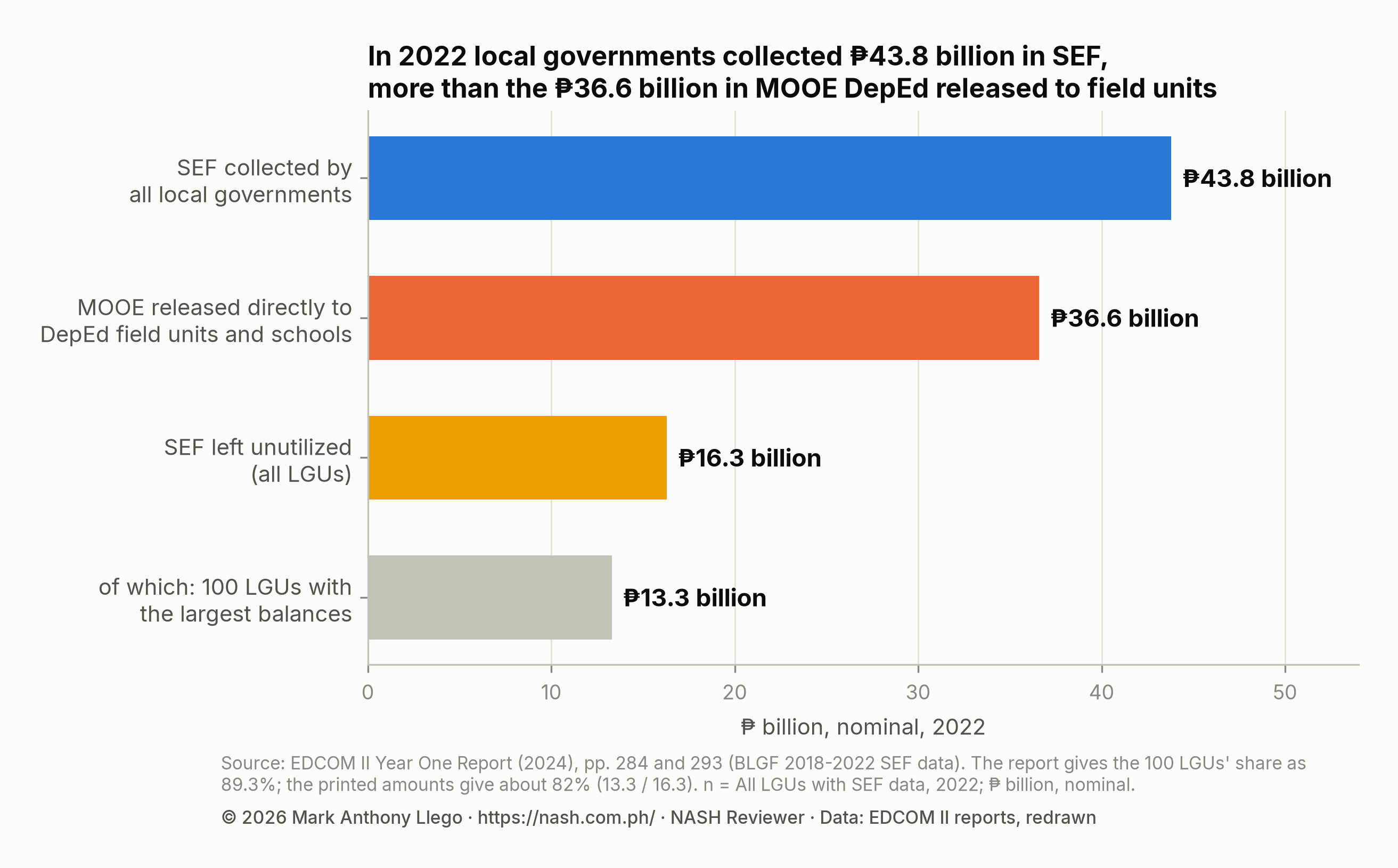
EDCOM II, the Second Congressional Commission on Education created by Republic Act No. 11899, found the fund large, unequal and underspent: local governments collected ₱43.8 billion in 2022, yet ₱16.3 billion went unused, and first-income-class municipalities had 68 times the SEF income of sixth-class ones (Year One Report, pp. 284, 287, 293). The figures below come from EDCOM II’s Year One Report (2024), Year Two Report (2025) and Final Report, Turning Point (2026), and a later section explains how a school head can ask for SEF support lawfully. The guide is written for teachers preparing for the National Assessment for School Heads (NASH) and for researchers who need the page behind each number.
Page numbers are the reports’ printed pages. Decentralization, school MOOE and national spending have their own guides: RA 9155 at 25, the school MOOE guide and Is the Philippines Spending Enough on Education?.
Key findings
- The fund is bigger than the MOOE DepEd releases to its field units and schools. In 2022 local governments collected ₱43.8 billion in SEF, “20% higher” than the ₱36.6 billion in MOOE released directly to DepEd field units and public schools (Year One Report, p. 284).
- It is very unequal. The median municipality’s SEF averaged ₱1.6 million, “a mere 4%” of the median city’s or province’s (Year One Report, p. 285). A forthcoming study cited in the Final Report finds SEF per learner ranging from ₱25,587 in Makati City to ₱65 in Guihulngan City, “a 394-fold difference” (p. 364).
- Much of it is not spent. ₱16.3 billion was unutilized in 2022, and average utilization fell from 66.7% in 2019 to 61.7% in 2021 (Year One Report, pp. 289, 293).
- Its link to learning is weak. About half of the SEF goes to maintenance and operating expenses, and a 1% increase in SEF is associated with only a 1.1 to 1.6 percentage point gain in Grade 10 National Achievement Test (NAT) scores (Final Report, p. 364).
- Boards are a weak channel for participation. Of at least 30 participation mechanisms that Comia et al. (2024) mapped, Local School Boards are among those with “significant challenges or dead ends” (Year Two Report, pp. 373, 375).
- The 2025 circular widens what the fund may buy, but it is only a circular. It keeps the 2017 rule that every item be in the approved SIP and DEDP and adds 11 ALS items, learners with disabilities, parent effectiveness and ARAL (Annex C). EDCOM II warns that joint circulars “can be rescinded or revised by succeeding administrations” and recommends amending the Local Government Code (Final Report, pp. 36–37).
What a Local School Board is and who sits on it
The Code creates “a provincial, city, or municipal school board” in every province, city and municipality (Sec. 98(a)), each with two co-chairs and six members (Sec. 98(b)).
| Board | Co-chairs | Members |
|---|---|---|
| Provincial | Governor; division superintendent of schools | Chair of the sanggunian’s education committee; provincial treasurer; representative of the pederasyon ng mga sangguniang kabataan; president of the provincial federation of parents-teachers associations; elected representative of the teachers’ organizations; elected representative of non-academic personnel |
| City | City mayor; city superintendent of schools | The same six, at city level |
| Municipal | Municipal mayor; district supervisor of schools | The same six, at municipal level |
Source: RA 7160, Sec. 98(b).
The board meets “at least once a month or as often as may be necessary”; the superintendent or district supervisor “shall prepare the budget of the school board”, which needs “the affirmative vote of the majority of all the members” (Sec. 100). Under Section 99, the board determines “the annual supplementary budgetary needs for the operation and maintenance of public schools”, authorizes the treasurer to disburse the SEF and advises the sanggunian. DepEd “shall consult the local school board on the appointment of division superintendents, district supervisors, school principals, and other school officials.”
A school head is not a member under the Code, and neither is anyone for early childhood care and development (ECCD): “It is unclear who among the members of the LSB could be the voice for ECCD concerns” (Year One Report, p. 295). The 2025 circular encourages wider membership, citing DILG Memorandum Circular No. 83, s. 2022 (§5.2), which EDCOM II “actively promotes” (Final Report, p. 77), and requires “a multistakeholder approach to planning and budgeting” that includes, among others, civil society organizations and the “School governance council” (§5.3). One fifth-income-class municipality added student representatives and elementary and secondary school heads to its board (Year One Report, p. 296).
How the Special Education Fund is raised
Section 235 of the Code reads: “A province or city, or a municipality within the Metropolitan Manila Area, may levy and collect an annual tax of one percent (1%) on the assessed value of real property which shall be in addition to the basic real property tax. The proceeds thereof shall exclusively accrue to the Special Education Fund (SEF).” Under Section 272 the proceeds “shall be automatically released to the local school boards”, and “in case of provinces, the proceeds shall be divided equally between the provincial and municipal school boards”. Cities keep their whole collection (Year One Report, p. 280). Section 309(a) keeps the SEF as a special fund in the local treasury.
The fund predates the Code: Republic Act No. 5447 of 1968 created it so that local governments would “contribute to the financial support of the goals of education” (Year One Report, p. 280). EDCOM II traces the gaps between local governments to property values, which favor urbanized cities, and to the rule that cities keep all of their SEF (Year One Report, p. 289; Final Report, p. 364).
What the SEF may pay for
Under the Local Government Code and later laws
Section 272 allocates the proceeds “for the operation and maintenance of public schools, construction and repair of school buildings, facilities and equipment, educational research, purchase of books and periodicals, and sports development as determined and approved by the local school board.” Section 100(c) puts three priorities first: school buildings and facilities, “extension classes where necessary”, and sports at the division, district, municipal and barangay levels. Later laws added uses, which the 2025 circular lists (§§3.5–3.11):
| Law | What it lets the SEF fund |
|---|---|
| RA 10665, Open High School System Act | Honoraria of community advisers, arranged by the LSB |
| RA 11037, Masustansyang Pagkain para sa Batang Pilipino Act | Part of the National Feeding Program |
| RA 11510, Alternative Learning System Act | ALS, including hiring Community ALS Implementors |
| RA 11650, Instituting a Policy of Inclusion and Services for Learners with Disabilities in Support of Inclusive Education Act | Support services for learners with disabilities |
| RA 11908, Parent Effectiveness Service Program Act | Parent effectiveness sessions |
| RA 12028, Academic Recovery and Accessible Learning (ARAL) Program Act | The ARAL Program |
| RA 12199, ECCD System Act | The ECCD Program, which LGUs “shall include” in SEF allocations |
Source: Joint Circular No. 01, s. 2025, §§3.5–3.11, pp. 4–5.
Under Joint Circular No. 01, s. 2025
The Final Report records that “ON DECEMBER 3, 2025, THE REVISED SEF GUIDELINES JOINT CIRCULAR WAS SIGNED BY DEPED, DBM, DILG, AND DOF” (p. 368; also p. 193). Joint Circular No. 01, s. 2025, the Omnibus Guidelines on the Use of the Special Education Fund (SEF), repeals Joint Circular No. 1, s. 2017 and Joint Circulars No. 1 and 2, s. 2020 (§15.0) and takes effect “immediately upon publication in the Official Gazette” (§16.0). EDCOM reported on March 4, 2026 that the agencies had published it (EDCOM 2, March 4, 2026), and DepEd’s 2026 memoranda apply it (DepEd Memorandum No. 042, s. 2026, para. 50; DepEd Memorandum No. 061, s. 2026, enclosure item 34.b).
Annex C is the list of allowable expenses:
| Heading in Annex C | Examples |
|---|---|
| ECCD Program | Locally hired Child Development Teachers and Day Care Workers; Child Development Centers |
| National Feeding Program | School-based and milk feeding, micronutrients, deworming, Gulayan sa Paaralan, WASH |
| Operation and maintenance of public schools | Locally hired teachers where there are shortages “per the teacher deployment analysis of DepEd”; utility workers and guards; school nurses and counselors; utilities; internet; learning materials |
| Construction and repair of school buildings | Classrooms where there is a shortage “per DepEd classroom deployment and learner support facility analysis”; learning centers, libraries and dormitories; school sites |
| Facilities and equipment | Computers, printers, CCTV, solar panels, furniture, service vehicles |
| ALS | Literacy mapping, Community Learning Centers, Community ALS Implementors, ALS materials |
| Learners with disabilities | Sites, assistive devices, instructional materials, teacher training |
| Research, books, sports | Research not funded by DepEd; library books, textbooks, software; school sports and facilities |
| Parent Effectiveness Service | Parent sessions and modules |
| ARAL Program | “Remuneration of para-teachers who serve as tutors”; data plans for para-teachers and pre-service teachers |
Source: Joint Circular No. 01, s. 2025, Annex C, pp. 27–31.
Three rules limit what a board may approve:
- National funds first. “Only those expenditure items that are not adequately funded by the DepEd, ECCD Council, DSWD, DOH, NNC, and other government agencies shall be charged against the SEF” (§7.1). Education projects not funded under the SEF may be considered for the General Fund (§7.2).
- Locally hired staff are paid at rates the LSB sets, “not to exceed the salary schedule being implemented by the LGU concerned” (Annex C). The pay of Child Development Teachers and Workers is exempt from the Code’s personal services limits (§6.7), the “45% or 55% cap” (Final Report, p. 368).
- Allowances for DepEd’s own staff may come from the SEF only if granted as of December 31, 1997; later ones go to the General Fund, except that fourth- and fifth-class municipalities may still charge them to the SEF “so long as the same does not exceed ten percent (10%) thereof” (Annex C).
Several of these rules are older than the circular. Joint Circular No. 1, s. 2017, issued with DepEd Order No. 10, s. 2017, already charged to the SEF only items “net of the budgetary provision” in DepEd’s budget (§4.1), paid locally hired teachers “per the teacher deployment analysis of DepEd” within the LGU’s salary schedule (§4.1.1.1), and listed ECCD expenses (§4.1.7). Against the list of SEF items in existing laws and the 2017 and 2020 circulars that the Year One Report reprints (pp. 354–355), Annex C adds learners with disabilities, parent effectiveness, ARAL, school counselors, libraries and dormitories, and nine ALS items beyond the two the Year One list draws from the ALS Act itself. DepEd Memorandum No. 042, s. 2026 points ALS pilot divisions to the SEF under the circular (para. 50). DepEd has begun to apply the circular: DepEd Memorandum No. 061, s. 2026 says LSBs “may allocate funding support for the engagement of external ARAL tutors and other learning support personnel through the SEF” and links a sample LSB resolution (enclosure, item 34.b).
How the SEF budget is prepared each year
The LSB writes a six-year SEF Investment Program (SEFIP) that must be “evidence-based, needs-driven” and focused on “foundational literacy, numeracy, and science competencies” (§6.1), “aligned and complementary” with the SIP and the DEDP (§6.2). Each annual budget is prepared “based on the DepEd-approved SIP and DEDP” (§6.3), and “All expenditure items to be included in the SEF Budget shall be among those provided under Annex C thereof and contained in the approved SIP and DEDP” (§6.3.1). The provincial SEF “shall, as much as possible, fill the funding gaps” of fourth- and fifth-income-class municipalities and of schools with many struggling learners (§6.3.3).
The board must consider the LGU’s education indicators with CRLA, Phil-IRI and Rapid Mathematics Assessment results (§6.4.1), the district supervisor’s and superintendent’s recommendations (§6.4.3), and “The report of the school heads on the state of education at the start of every school year”, which covers SIP progress and audited financial reports of the funds the school received from all sources (§6.4.2).
| Deadline | What happens | Who |
|---|---|---|
| March 31 | Report on the LGU’s education indicators and national resources per school; requests for the SEFIP | Division superintendent |
| April 1 to June 30 | Consultations with schools and stakeholders on the SEFIP | Division superintendent |
| July 15 | Certified statement of SEF collections and estimates | Treasurer and accountant |
| July 31 | Budget call with priorities and tentative ceilings | LSB |
| August 31 | Funding requests, from schools to the district supervisor (municipal boards) or the superintendent (city boards), and from ECCD offices, ALS focal persons, Inclusive Learning Resource Centers and health officers | Schools and other stakeholders |
| September 1 to 30 | Public consultation with schools and stakeholders | District supervisor and superintendent, with the LSB |
| October 31 | Approval of the municipal or city SEF budget by LSB resolution | Municipal or city LSB |
| Seven days after approval | Approved budgets and unfunded proposals sent to the provincial LSB | Division superintendent |
| November 30 | Review of unfunded proposals; approval of the provincial SEF budget | Provincial LSB |
| December 31 | Budgets submitted to DepEd’s Central Office and the DOF | Division superintendent |
Source: Joint Circular No. 01, s. 2025, §6.8, pp. 11–14.
The treasurer and budget officer report quarterly to the DOF’s Bureau of Local Government Finance (BLGF), the LSB posts “the detailed utilization monitoring report of the SEF Budget on the website of the LGU and/or in at least three (3) conspicuous public places” (§8.1), and purchases follow Republic Act No. 12009, the New Government Procurement Act (§8.4). LGUs are “encouraged” to create a Local Education Office or LSB secretariat by ordinance (§9.1), and high-SEF LGUs are “encouraged to share their resources” with neighbors (§10.2). DepEd is to issue guidelines on co-chairs and prepare “a data capturing tool for the LSB secretariat” (§§11.1.2, 12.0); as of October 2026, DepEd had issued neither.
Much of this process is not new. The 2017 circular already required budgets “based on the DepEd-approved SIP and DEDP”, items “contained in the approved SIP and DEDP”, the school heads’ state-of-education report, and the March 31, July 15, July 31, August 31, September, October 31, November 30 and December 31 deadlines, including the list of unfunded proposals sent to the provincial board (DO 10, s. 2017, enclosure §§5.2–5.5). What the 2025 circular adds is the six-year SEFIP (the 2017 program covered three years), CRLA, Phil-IRI and RMA data, the multistakeholder list, funding requests from ECCD, ALS, inclusive education and health offices, a provincial priority for fourth- and fifth-class municipalities (the 2017 text said “all the public schools covered by the province”), and reporting to the BLGF (the 2017 circular sent reports to DepEd’s Central Office).
How much SEF there is, and how unequal
The Year One Report analyzed BLGF data on SEF income and spending for 2018–2022 (p. 281). Because most of DepEd’s budget is centrally managed, it calls the SEF “a more accessible resource pool to schools” (p. 284).
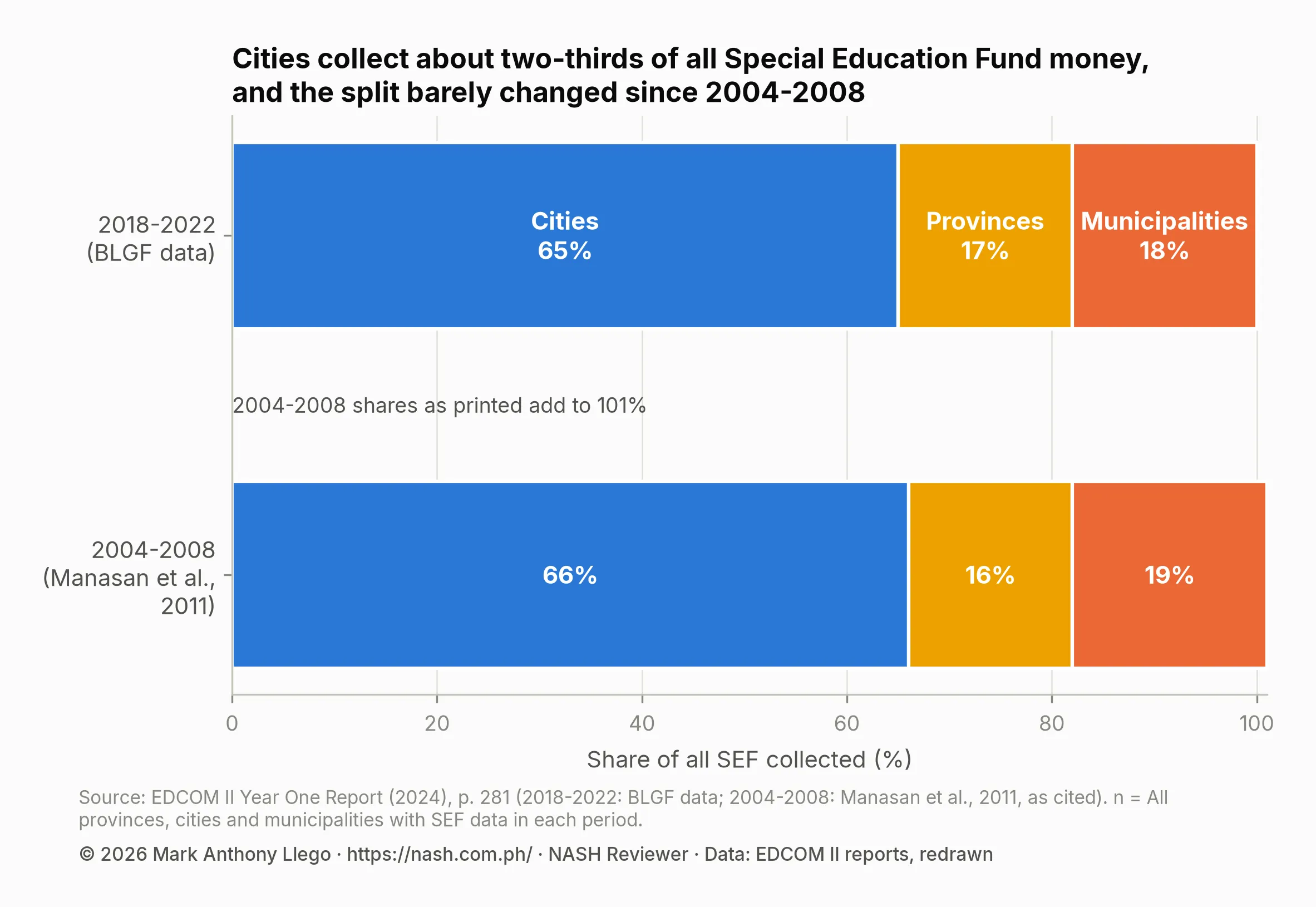
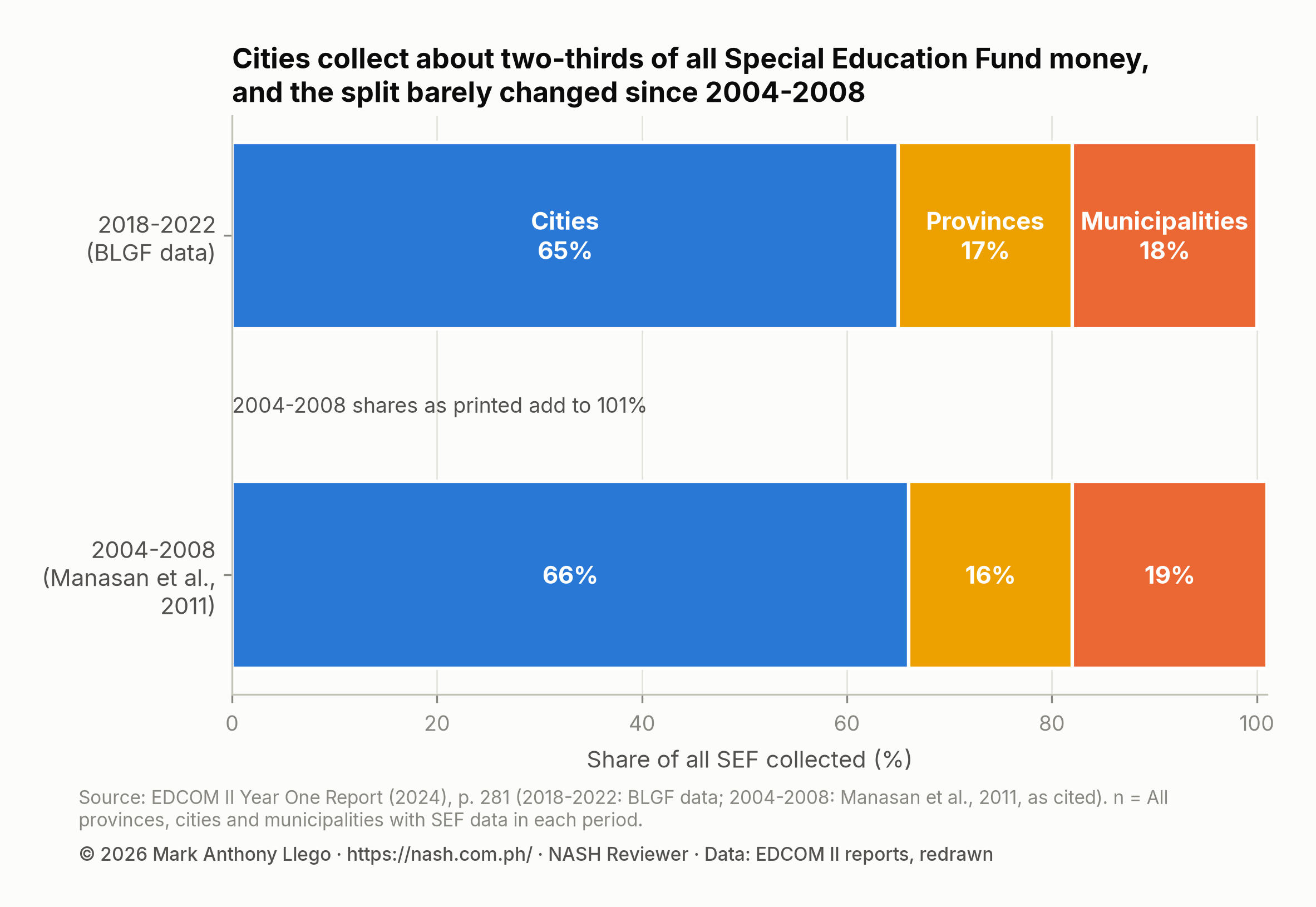
Cities collected 65% of all SEF in 2018–2022, against 17% for provinces and 18% for municipalities, almost the 2004–2008 split (Year One Report, p. 281). The Final Report, citing a 2025 study, gives “approximately 64%” for cities and “around 18%” each for the others, without stating the years (p. 364).
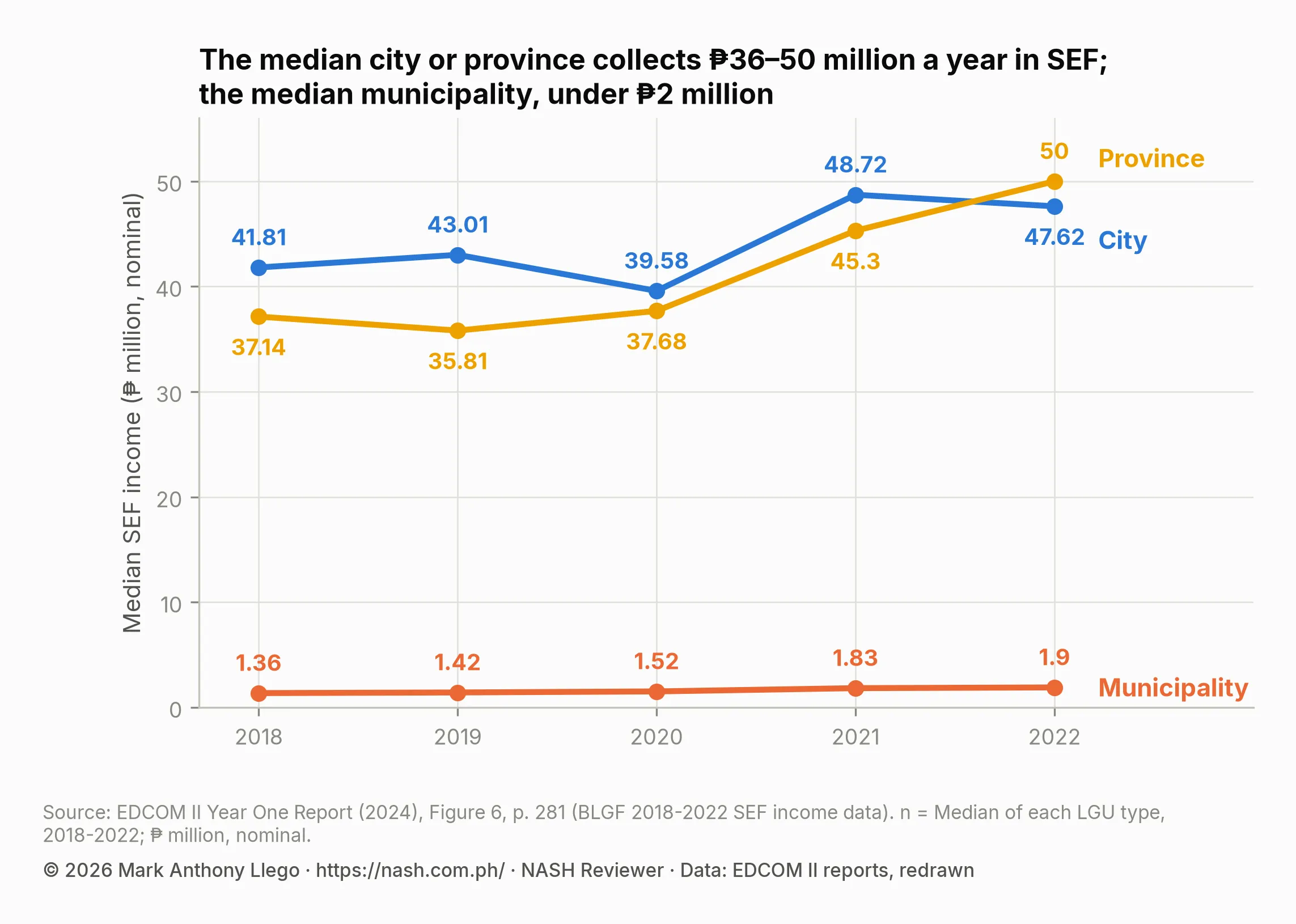
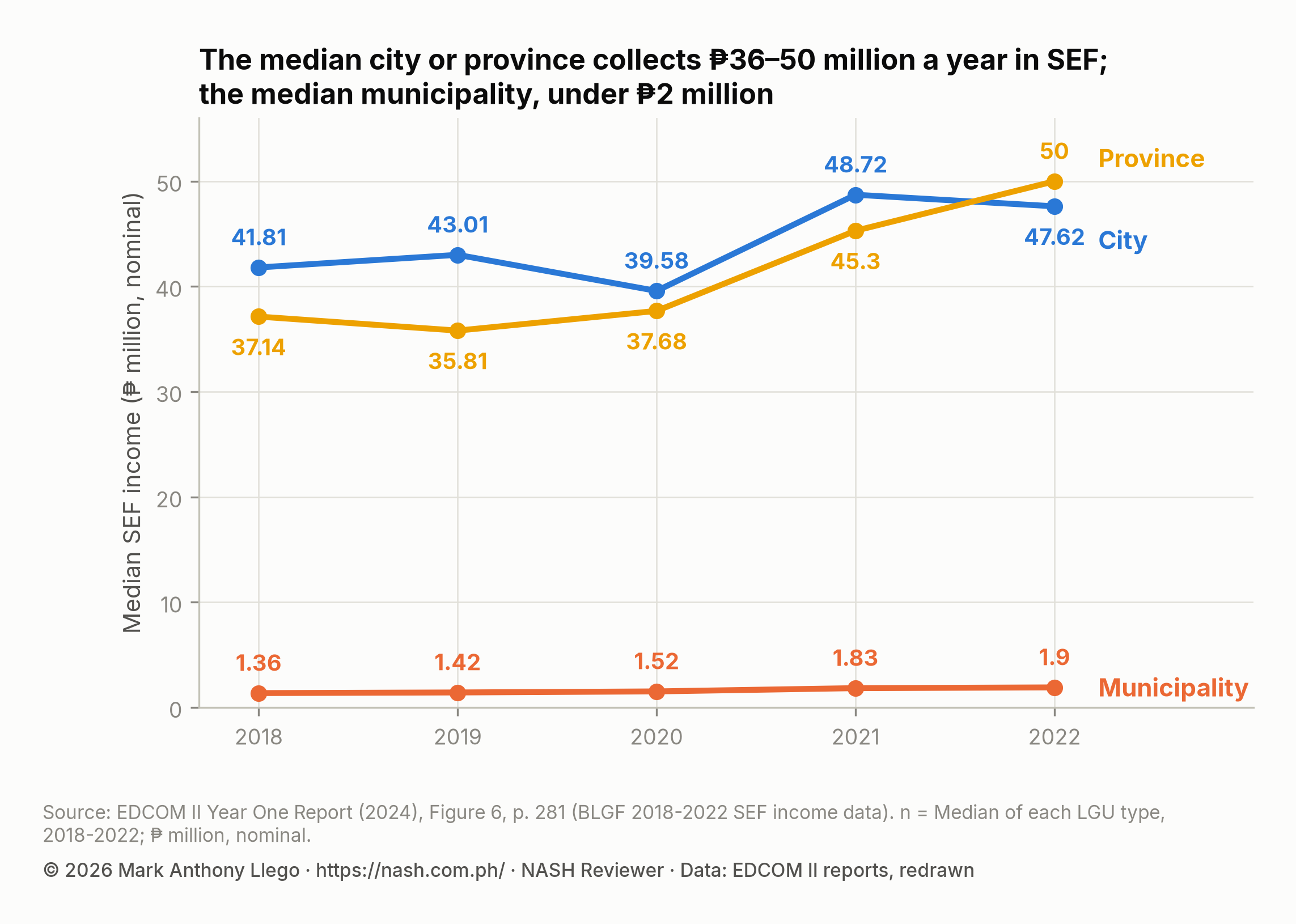
The median municipality’s SEF income stayed below ₱2 million every year, against about ₱36 million to ₱50 million for the median city or province. Averaged over the five years, it was ₱1.6 million, “a mere 4%” of the median city’s (₱44.1 million) or province’s (₱41.2 million) (Year One Report, pp. 281, 285).
| Local government | Middle half of LGUs (box in Figure 8, p. 285; text p. 287) | Median (figure label, p. 285) | Top of the plotted range (p. 285) |
|---|---|---|---|
| Cities (143) | ₱14.1 million to ₱180.3 million | ₱44.2 million | ₱429.4 million |
| Provinces (76) | ₱15.4 million to ₱88.1 million | ₱41.2 million | ₱197.2 million |
| Municipalities (1,369) | ₱709,000 to ₱3.9 million | ₱1.6 million | ₱8.6 million |
Source: EDCOM II Year One Report (2024), Figure 8, p. 285, and text, p. 287. Each LGU’s average SEF income for 2018–2022; BARMM and outliers excluded. The figure’s medians (₱44.2 million for cities) are medians of each LGU’s five-year average; the ₱44.1 million in the text is the average of the yearly medians in Figure 6.
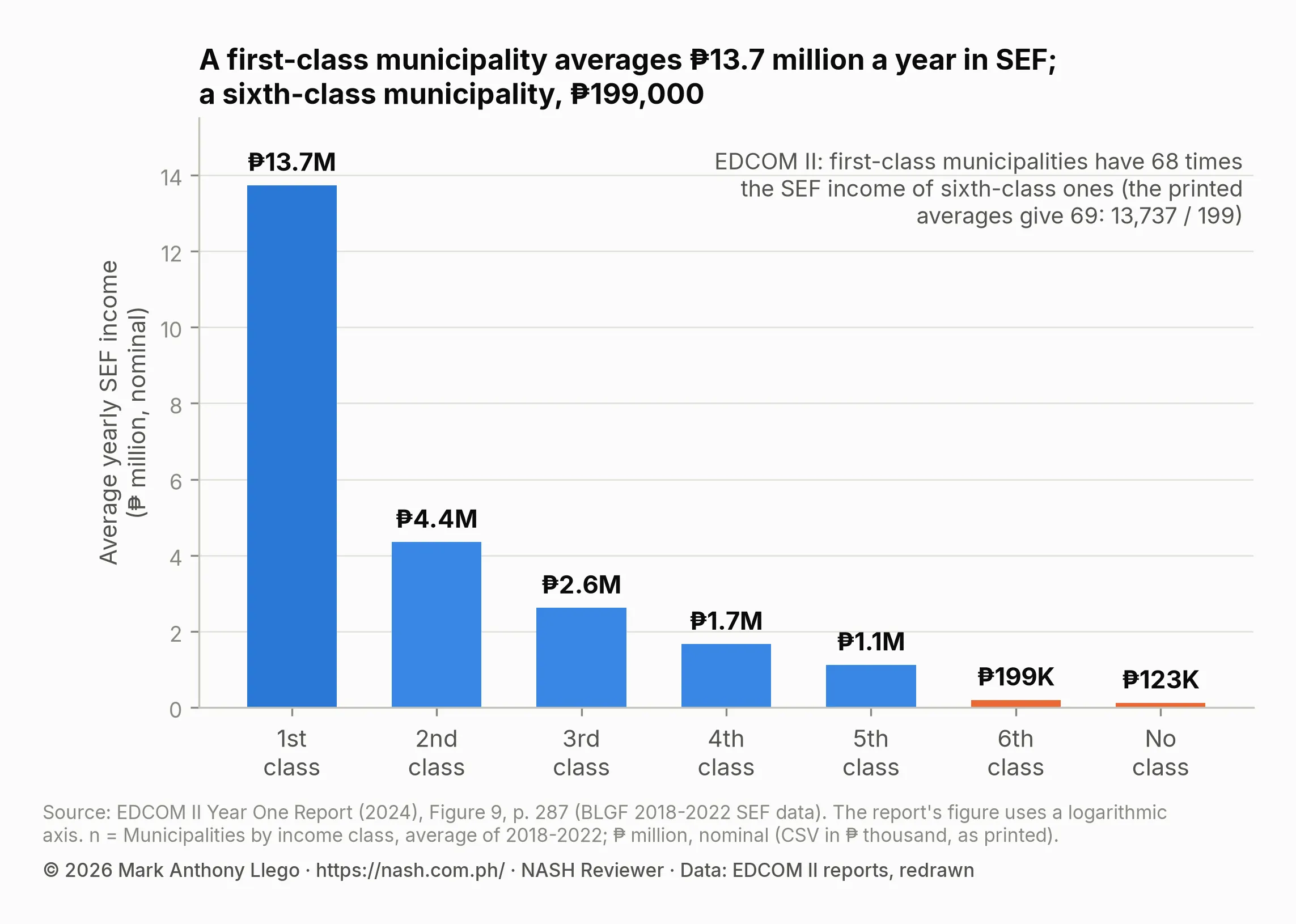
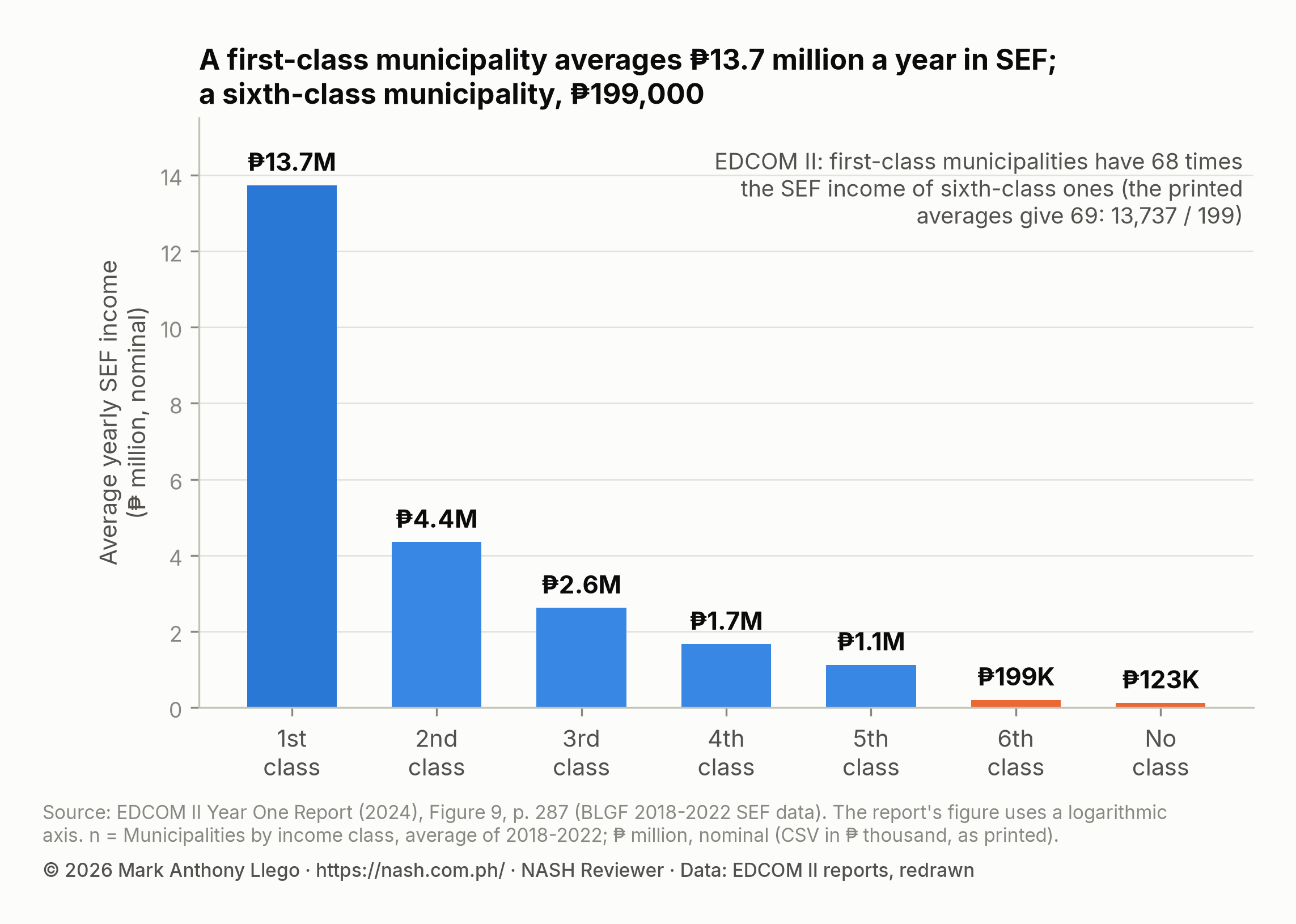
Municipalities also differ by income class.
| Income class | 1st | 2nd | 3rd | 4th | 5th | 6th | No class |
|---|---|---|---|---|---|---|---|
| Average SEF income (₱ thousand) | 13,737 | 4,351 | 2,620 | 1,666 | 1,123 | 199 | 123 |
“On average, first-income-class municipalities have 68 times more SEF income than sixth-income-class municipalities and 111 times more than municipalities with no classification” (Year One Report, p. 287). In one consultation, a fifth-class municipality with about ₱2.83 million in SEF could fund only classroom repairs and turned to its province, which collects an average of ₱209.3 million a year (p. 288). The classroom allocation by income class report shows how the same classes fare in DepEd’s classroom budget. DepEd has begun to respond: DepEd Memorandum No. 111, s. 2025 cites “the need to prioritize support for schools in low-Special Education Fund (SEF) localities” (para. 2) for its Needs-Based Program Support Funds under the Bayang Bumabasa Initiative, which go to schools whose CRLA results fell from the beginning to the end of SY 2024–2025, up to ₱1 million a school (enclosure, paras. 8–9). It notes that CRLA gains lagged, “a trend most evident in LGUs with below-average Special Education Fund allocations” (enclosure, para. 3), and defines counterpart funding as the support “that an LGU is expected to provide” to a school’s literacy plan (para. 6.2).
How the SEF is spent, and why money goes unspent
Average utilization fell from 66.7% in 2019 to 61.7% in 2021 and was 62.8% in 2022 (Year One Report, p. 289). Of the ₱16.3 billion unutilized in 2022, the 100 LGUs with the largest balances held ₱13.3 billion (p. 293). The report suggests three possible reasons, among them that “inflows into the SEF account are not likely to occur until March” and that some balances are obligated but not yet paid (p. 293). About 11% of LGUs used 10% or less of their SEF income in 2018–2022, while about 45% used 67% or more (pp. 293–294).
Spending goes first to general administration, “which includes the hiring of human resources and procurement”, then to subsidies for individual students, then to support for schools; DepEd and the Commission on Audit (COA) “do not maintain an information system on SEF” (p. 289). The Final Report, citing a forthcoming study by Bacate and Tenazas, says “approximately half of SEF” goes to maintenance and operating expenses “rather than targeted instructional improvements”, and that a 1% increase in SEF is associated with a 1.1 to 1.6 percentage point gain for Grade 10 on the NAT, with “no statistically significant effects for elementary or senior high school levels” (p. 364). These are associations, not proof of cause. The Year Two Report had cited UNICEF’s “weak detection of effects for school MOOE and SEF spending on learning outcomes”, which “could be indicative of ineffective spending, though further study is needed” (p. 355).
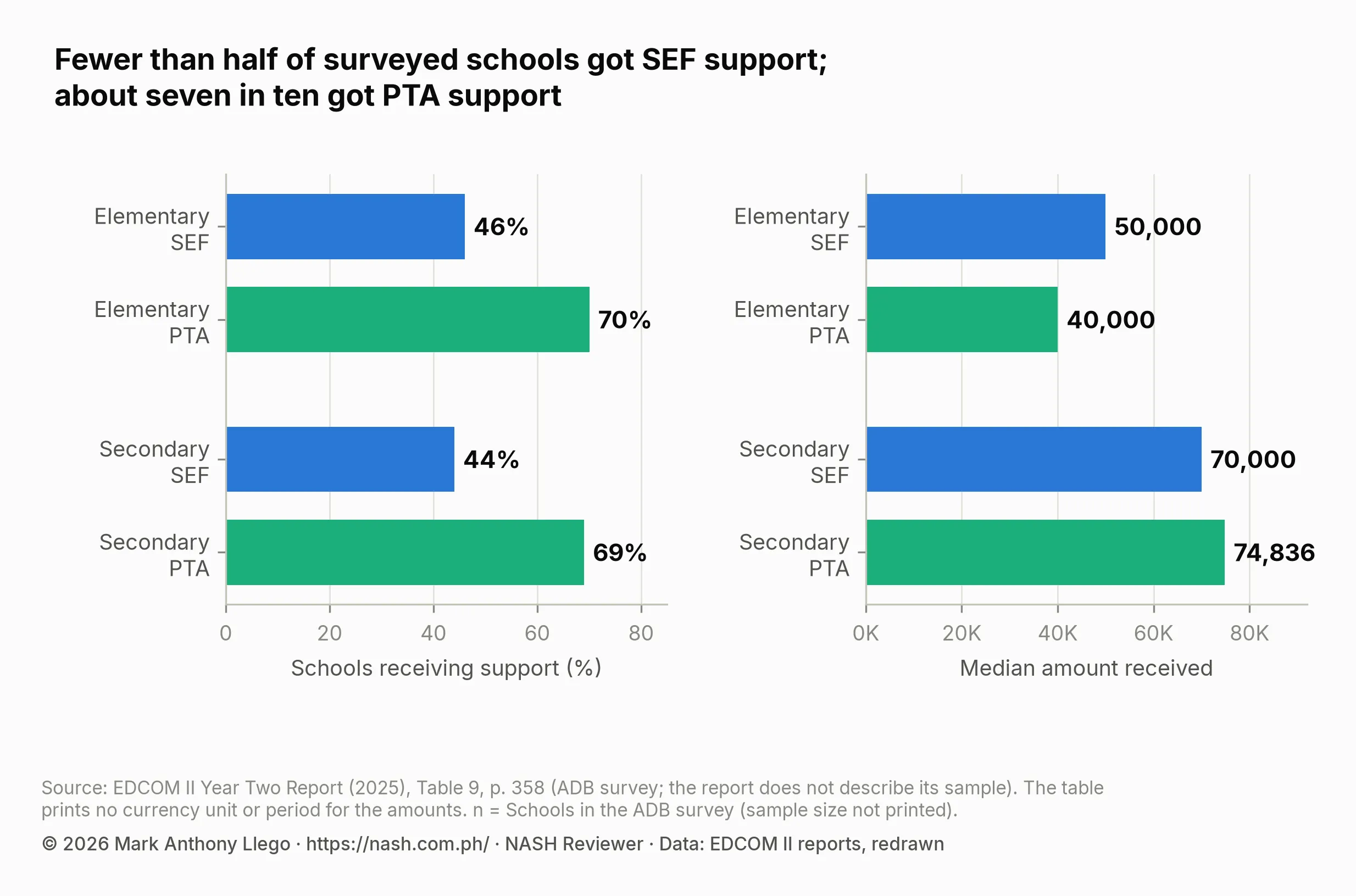
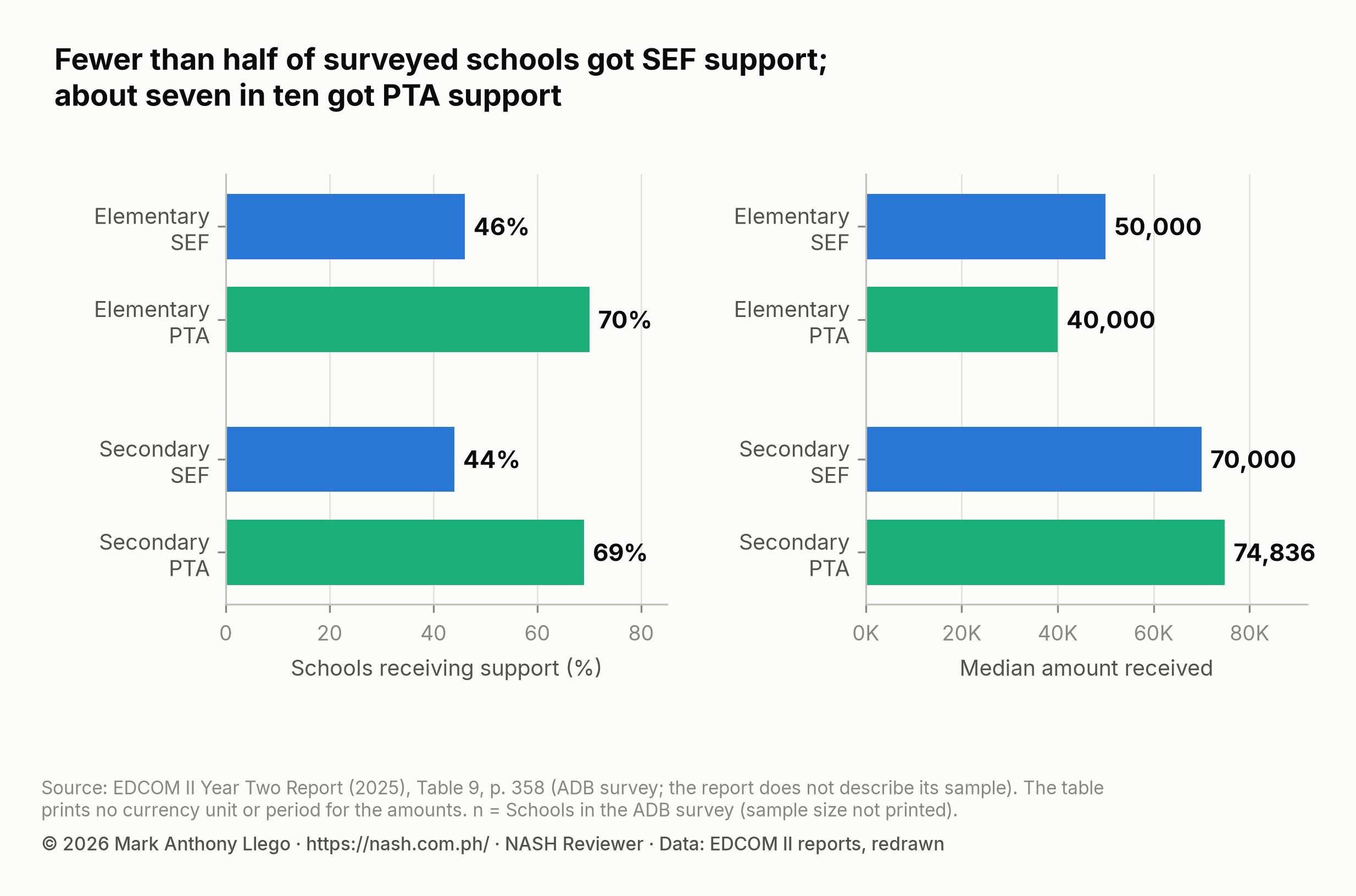
Schools see only part of the money. An Asian Development Bank (ADB) survey cited in the Year Two Report found that “close to half” of schools received SEF support, against “most” for the parent-teacher association (PTA) (p. 358).
| Level | Fund | Schools receiving | Median | Range |
|---|---|---|---|---|
| Elementary | SEF | 46% | 50,000 | 17,500–461,268 |
| Elementary | PTA | 70% | 40,000 | 20,000–311,529 |
| Secondary | SEF | 44% | 70,000 | 15,000–577,342 |
| Secondary | PTA | 69% | 74,836 | 30,000–159,093 |
Money is not the whole story: Local Education Models in EDCOM II describes two Gapan City schools that did well on a low SEF (Year Two Report, p. 359).
What EDCOM II found about how Local School Boards work
The rules were narrow and audits inconsistent. LGUs told EDCOM that “Existing SEF guidelines limit the menu of allowable expenditures” (Year One Report, p. 294). One LGU received an audit observation for charging education expenses to funds other than the SEF, and when it charged them to the SEF, “these were also disallowed” (p. 295). Some LGUs “refused to spend on ALS using their SEF” because they used outdated guidelines, such as the 2020 circular, that did not list ALS (Year Two Report, pp. 147–148). The Final Report still finds “restrictive interpretations of SEF rules, constraining their role as partners in system improvement” (p. 369).
Politics shapes allocation. Consultations raised “The influence of political alliances and rivalries in the allocation of SEF”; earlier research found the choice of schools for repair, and the hiring of teacher aides “based on preference rather than merit”, particularly exposed to such pressure (Year One Report, p. 295). Participants warned that reliance on the local chief executive’s “political will presents a risk to the continuity of any education reform agenda” and proposed a stronger LSB and “a permanent staffing complement focused on education in the LGU plantilla” (p. 315).
Boards are a weak channel for citizens. In the Comia et al. (2024) table, Local School Boards fall among mechanisms with “significant challenges or dead ends due to structural issues, political interference, or other barriers” (Year Two Report, pp. 374–375).
Responsibilities overlap. “The Unfulfilled Promise of Decentralized Education Governance”, the Final Report’s account of the DepEd charter hearing of October 28, 2025 (p. 385), finds that the Mandanas-Garcia ruling and Executive Order No. 138 (2021) created “confusion about funding responsibilities, project implementation, and maintenance obligations” (p. 391). With “Basic Education Facilities” slated by the DBM for phase-out to local funding, the report sees “a potential gap where neither level of government takes full responsibility for ensuring adequate school infrastructure”, and says the overlap led to the revised SEF guidelines (p. 391).
Some boards work well. A third-income-class municipality “uses the annual improvement plans drafted by schools as the basis for the budget proposal presented to the LSB” (Year One Report, p. 296). The Final Report adds Pasay City’s SEF-supported reading interventions (p. 167) and an Iloilo proof of concept with strengthened LSBs, whose experimental schools scored 88% in Grade 3 against 81% in control schools (p. 502); the local models guide assesses both.
What EDCOM II recommends, and what has happened since
| Recommendation | Report and page | Status on October 30, 2026 |
|---|---|---|
| A framework for how the provincial SEF “could complement the municipal SEF” | Year One, p. xlv | Partly addressed: §6.3.3 now asks the provincial SEF to fill, “as much as possible”, the gaps of fourth- and fifth-class municipalities (the 2017 circular said all public schools in the province); the review of unfunded municipal proposals dates from 2017 |
| An ECCD representative on the LSB | Year One, p. xxxvii | The Code is unchanged; the circular asks boards to involve the social welfare office and others (§5.3); the plan’s LSB amendment (below) would diversify membership |
| Amend the joint circular to include ALS | Year Two, p. 33 | Done: Annex C lists 11 ALS items (see also Final Report, p. 193) |
| Clarify provincial and municipal boards; equity mechanisms for low-income LGUs; harmonized reporting | Year Two, p. 34; pp. 361–362 | Partly done through the circular (§§6.3.3, 8.1, 12.0); the Year Two Report says a support fund for low-resourced LGUs needs legislation (p. 361) |
| “Amend the Local Government Code to institutionalize SEF reforms introduced by the recent JMC” | Final, pp. 36–37 | Bills filed and listed as LEDAC priorities (EDCOM 2, December 3, 2025); no law yet |
| Equalization and performance-based allocation; “weighted allocations or matching grants” for fourth- and fifth-class LGUs | Final, p. 367 | Recommendation; the circular only encourages voluntary sharing (§10.2) |
| Amend the law on Local School Boards by “diversifying LSB membership, broaden uses of the Special Education Fund (SEF), and enforce transparency in local government investments in education” | National Education Plan document, p. 102 | Bills filed and listed as LEDAC priorities (EDCOM 2, December 3, 2025); no law yet |
| “Conduct annual equity analysis of SEF and overall LGU education spending and publish results” (DOF and DBM, 2026) | National Education Plan document, p. 103 | Not yet reported |
| Engage LGUs through the DILG Local Government Academy and the Seal of Good Education Governance; track ALS spending as a separate SEF line; link assessment results to “school‑level dashboards” for “School Division Offices, Local School Boards, and teachers”; “DepEd and local school boards can anchor ARAL planning on classroom-based assessments” | Final, pp. 37, 147, 177, 194–195 | Recommendations |
| By 2035, “Local Government Units fully utilize SEF aligned with SIPs” | Final, p. 496 (Outcome 6.2.A) | National Education Plan target |
Since the Final Report, EDCOM has published template ordinances, among them one on “expanding the Local School Board” (EDCOM 2, March 11, 2026), and Region XII’s Regional Education Committee, through its Resolution No. 03, s. 2026, urged all LSBs in SOCCSKSARGEN to align their SEF spending “with updated national education policies” (EDCOM 2, August 3, 2026). The guide to the National Education Plan covers Outcome 6.2.A.
What this means for school heads
Under the Code a school head is not a member of the board (though some boards have added school heads, Year One Report, p. 296), and the LGU, not the school, holds and disburses the SEF: the board approves, the treasurer disburses (RA 7160, Sec. 99(b)) and the LGU procures under RA 12009 (circular, §8.4). The school head’s levers are the plan, the evidence and the calendar.
- Put the need in the SIP first. No item enters the SEF budget unless it is “contained in the approved SIP and DEDP” (§6.3.1). Cost it in the SIP and the Annual Implementation Plan (AIP), with the SEF as its source; see the SIP guide and the Domain 1 guide.
- Match each request to Annex C and show the gap. Name the Annex C heading and show that DepEd does not “adequately” fund the item (§7.1), citing the DepEd analyses the circular names (teacher deployment, classroom deployment) and what DepEd already provides (§§6.4.3–6.4.4, 6.5).
- Meet the deadlines. Submit requests by August 31 to the district supervisor (municipal board) or the division superintendent (city board), and prepare for the September consultation (§6.8). If the board does not fund a request, check that it appears on the list of unfunded proposals sent to the provincial board.
- Report every year. Prepare the state-of-education report the board must consider (§6.4.2), led by CRLA, Phil-IRI and RMA results and indicators such as struggling readers and schools on shifts (§5.4). The SIP communication plan helps.
- Document what you receive. Keep the records in the table below. The school MOOE guide explains how to record and report non-DepEd support, and the ethics and internal control guide covers conflicts of interest.
- Work through the board, not around it. A private request to the mayor bypasses the resolution, the consultation and the posted report; it can also feed the “political alliances and rivalries” EDCOM II found in SEF allocation (Year One Report, p. 295). Check the posted utilization report each year (§8.1).
| Record | Linked rule |
|---|---|
| SIP and AIP pages with the item, its cost and the SEF as source | §6.3.1 |
| Costed request naming the Annex C heading, with evidence of the gap | §7.1; Annex C |
| Assessment results and school indicators | §§5.4, 6.4.1 |
| State-of-education report with the audited financial report | §6.4.2 |
| The LSB resolution approving the school’s allocation | §6.6 |
| Delivery records of goods, works and personnel, matched to the budget | §8.1 |
See the Domain 2 and Domain 5 guides for the standards, school governance councils and PTA partnerships for the other bodies the circular brings into planning, and the locally funded teachers report for schools that already have SEF-paid staff.
How the NASH may test this
Under DepEd Memorandum No. 069, s. 2025, the NASH covers “conceptual and situational critical thinking questions” aligned with the PPSSH, “using the SOLO (Structure of the Observed Learning Outcome) taxonomy as an underpinning framework” (para. 3). The two items below are original practice items, scored 3 (Relational), 2 (Multistructural), 1 (Unistructural) or 0 (Prestructural).
Question 1
Indicator 2.2.1, Financial management. Career Stage 1, Situational, Moderate.
In early August, the head of a 900-learner elementary school in a fourth-class municipality learns that the Municipal School Board is taking funding requests until August 31. The approved SIP names Grade 1 to 3 reading as its first priority, and the beginning-of-year CRLA shows most Grade 2 learners at the emerging levels. DepEd’s ARAL funds will pay one tutor; the school needs three. What should the school head do?
- A. Ask the mayor in a private meeting to hire two tutors from the SEF this month, since the mayor co-chairs the board and can act faster.
- B. Submit a costed request for two tutors to the district supervisor by August 31, with the SIP page, the CRLA results and the tutor DepEd already funds.
- C. Submit a request for three tutors to the district supervisor by August 31, with the CRLA results, so that the board funds the full reading program.
- D. Add the tutors to next year’s SIP revision, since the Local Government Code limits the SEF to buildings, equipment, research, books and sports.
Answer and explanation
Best answer: B. Points: A = 0, B = 3, C = 2, D = 1.
- A (0 points, Prestructural). It skips the plan, the board’s resolution and the consultation that every SEF item requires.
- B (3 points, Relational). It connects the plan, the evidence, the rule that the SEF pays only what national funds do not adequately cover, and the board’s calendar.
- C (2 points, Multistructural). The channel, deadline and evidence are right, but asking for three tutors duplicates the one DepEd funds.
- D (1 point, Unistructural). It recalls the Code’s list but misses the later laws and the circular’s ARAL heading, so the school loses a year.
Why. Joint Circular No. 01, s. 2025 lets the SEF pay “para-teachers who serve as tutors” (Annex C), but only for items “not adequately funded” by DepEd and other agencies (§7.1) and “contained in the approved SIP and DEDP” (§6.3.1), with requests due to the district supervisor by August 31 (§6.8). EDCOM II found LGUs facing “restrictive interpretations of SEF rules” (Final Report, p. 369).
Indicator 2.2.1: Demonstrate knowledge and understanding of policies, guidelines and issuances in managing finances such as allocation, procurement, disbursement and liquidation aligned with the school plan.
Sources: Joint Circular No. 01, s. 2025, §§6.3.1, 6.8, 7.1 and Annex C; DepEd Memorandum No. 061, s. 2026; EDCOM II Final Report (2026), p. 369.
Question 2
Indicator 5.5.1, Community engagement. Career Stage 1, Situational, Moderate.
At the start of the school year, the City School Board asks each school head for a report before it reviews next year’s SEF budget. Last year the board paid for a utility worker and two locally hired teachers at your school, and the PTA and an Adopt-a-School partner also gave support. Which report best meets what the board is expected to consider?
- A. A list of next year’s requests, ranked from the most to the least expensive, with a short note on why each one matters.
- B. The SIP’s progress and performance indicators, with an audited financial report of the funds from DepEd, the SEF, the PTA and the partner and their use.
- C. The SIP’s progress and performance indicators, leaving out the SEF-funded staff, because the city reports its own SEF spending to the BLGF.
- D. Photographs of last year’s SEF-supported activities, with letters of thanks to the mayor from the school’s teachers and learners.
Answer and explanation
Best answer: B. Points: A = 1, B = 3, C = 2, D = 0.
- A (1 point, Unistructural). It speaks to next year’s budget, but the board asked for a report on the state of education, not a wish list.
- B (3 points, Relational). It links results, the plan and every source of money, so the board can see what its funds achieved and avoid overlaps.
- C (2 points, Multistructural). It reports progress but hides what the board’s money bought, breaking the link between funding and results.
- D (0 points, Prestructural). Thanks and photographs are not evidence of results or of how the funds were used.
Why. Joint Circular No. 01, s. 2025 tells the board to consider the school heads’ report on the state of education, covering the SIP’s progress, performance indicators and audited financial reports of funds “from national, local, and community-based sources, as well as the disposition of these funds” (§6.4.2). EDCOM II found no comprehensive mechanism that tracks what schools receive from the SEF, PTAs and partners (Year Two Report, p. 355).
Indicator 5.5.1: Involve the community, such as parents, alumni, authorities, industries and other stakeholders, in school programs, projects and activities to gain support for learner development, as well as school and community improvement.
Sources: Joint Circular No. 01, s. 2025, §6.4.2; EDCOM II Year Two Report (2025), p. 355.
Nothing in this guide reproduces or predicts examination content.
Frequently asked questions
Can the Special Education Fund pay teachers’ salaries?
Yes, for locally hired teachers in schools with shortages “per the teacher deployment analysis of DepEd”, at rates the LSB sets within the LGU’s salary schedule (Joint Circular No. 01, s. 2025, Annex C, pp. 28–29). Allowances granted after 1997 to DepEd’s own teachers come from the General Fund, except within a 10% limit in fourth- and fifth-class municipalities. The locally funded teachers report counts SEF-paid staff by region.
Can the SEF be used for ARAL tutors and the Alternative Learning System?
Yes. Annex C of the 2025 circular lists “Remuneration of para-teachers who serve as tutors” under the ARAL Program and 11 ALS items, from literacy mapping to hiring Community ALS Implementors (pp. 30–31), and DepEd Memorandum No. 061, s. 2026 confirms that LSBs may fund external ARAL tutors. Before it, some LGUs refused to spend SEF on ALS (Year Two Report, pp. 147–148).
How can a public school get SEF funding?
Put the item in the approved SIP, match it to an allowable expense in Annex C of Joint Circular No. 01, s. 2025, and show that DepEd does not adequately fund it (§§6.3.1, 7.1). Submit the request by August 31 to the district supervisor (municipal boards) or the division or city superintendent (city boards), and take part in the September consultation (§6.8).
Download the data
- lsb-sef-vs-mooe-2022.csv: SEF collected, MOOE released directly to DepEd field units and schools, SEF unutilized, and the part held by the 100 LGUs with the largest balances, 2022 (Year One Report, pp. 284, 293).
- lsb-sef-share-by-lgu-type.csv: share of SEF collections by cities, provinces and municipalities, 2004–2008 and 2018–2022 (Year One Report, p. 281).
- lsb-median-sef-by-lgu-type.csv: median SEF income by LGU type, 2018–2022 (Year One Report, Figure 6, p. 281).
- lsb-sef-by-municipal-income-class.csv: average SEF income of municipalities by income class, 2018–2022, in ₱ thousand as printed (Year One Report, Figure 9, p. 287).
- lsb-school-support-sef-pta.csv: schools receiving SEF and PTA support, with medians and ranges, from an ADB survey (Year Two Report, Table 9, p. 358).
The CSVs and charts may be reused only with written permission: email support@nash.com.ph. The numbers themselves come from the EDCOM II reports, which you can cite directly.
How to cite this post
Llego, M. A. (2026, October 30). Local School Boards and the Special Education Fund. NASH Reviewer. https://nash.com.ph/blog/local-school-board-special-education-fund
The EDCOM II reports:
- Second Congressional Commission on Education. (2024). Miseducation: The failed system of Philippine education (EDCOM II Year One Report). https://edcom2.gov.ph/media/2024/02/EDCOM-II-Year-One-Report-PDF-022924.pdf
- Second Congressional Commission on Education. (2025). Fixing the foundations: A matter of national survival (EDCOM II Year Two Report). https://edcom2.gov.ph/media/2025/01/EDCOM-2-Year-2-Report-Fixing-the-Foundations-2025.pdf
- Second Congressional Commission on Education. (2026). Turning point: A decade of necessary reform (2026–2035) (EDCOM II Final Report). https://edcom2.gov.ph/media/2026/01/EDCOM-II-Y03-for-web-012626_final.pdf
- Second Congressional Commission on Education. (2026). The National Education Plan (2026–2035) [Part of Turning point: A decade of necessary reform, EDCOM II Final Report]. https://edcom2.gov.ph/media/2026/01/EDCOM-II_Y03_National-Education-Plan.pdf
Sources
- EDCOM II, Final Report (2026), pp. 36–37, 77, 147, 167, 177, 193–195, 364, 367–369, 385, 391, 496, 502.
- EDCOM II, Year Two Report (2025), pp. 33–34, 147–148, 355, 358–359, 361–362, 373–375.
- EDCOM II, Year One Report (2024), pp. xxxvii, xlv, 280–281, 284–289, 293–296, 315, 354–355.
- EDCOM II, National Education Plan (2026–2035) (2026), stand-alone plan document, pp. 102–103.
- Republic Act No. 7160, An Act Providing for a Local Government Code of 1991, approved October 10, 1991 (Official Gazette), Secs. 98–100, 235, 272 and 309.
- Joint Circular No. 01, s. 2025 of DepEd, DBM, DILG and DOF, Omnibus Guidelines on the Use of the Special Education Fund (SEF), §§3.5–3.11, 5.2–5.4, 6.1–6.8, 7.1–7.2, 8.1, 8.4, 9.1, 10.2, 11.1.2, 12.0, 15.0–16.0 and Annex C (certified copy, PDF).
- DepEd Order No. 10, s. 2017, Revised Guidelines on the Use of the Special Education Fund, enclosing DepEd-DBM-DILG Joint Circular No. 1, s. 2017, enclosure §§4.1, 4.1.1.1, 4.1.7, 5.1–5.5 and 6.1 (repealed by Joint Circular No. 01, s. 2025, §15.0).
- DepEd Memorandum No. 111, s. 2025, Guidelines for the Implementation of the 2025 Needs-Based Program Support Funds under the Bayang Bumabasa Initiative, para. 2 and enclosure paras. 3 and 6.2.
- DepEd Memorandum No. 042, s. 2026, Guidelines on the Pilot Implementation of Mapping and Referral Mechanism for Learners with Disabilities in the Alternative Learning System in Select Schools Division Offices, para. 50.
- DepEd Memorandum No. 061, s. 2026, Amendments to DepEd Memorandum No. 001, s. 2026, enclosure item 34.b.
- DepEd Memorandum No. 069, s. 2025, Administration of the National Assessment for School Heads for Fiscal Year 2025, para. 3.
- DepEd Order No. 024, s. 2020, National Adoption and Implementation of the Philippine Professional Standards for School Heads (indicators 2.2.1 and 5.5.1).
- EDCOM 2, New guidelines expanding use of Special Education Fund signed, set to support literacy gaps, December 3, 2025.
- EDCOM 2, New Special Education Fund guidelines now allow funding for ECCD, nutrition, and literacy remediation, March 4, 2026.
- EDCOM 2, EDCOM 2 launches one-stop resource for local government initiatives in education, March 11, 2026.
- EDCOM 2, SOCCSKARGEN mobilizes Local School Boards to address learning crisis, align Special Education Funds, August 3, 2026.
The EDCOM II series
The reports:
- What EDCOM II Achieved, 2023-2025: Laws, Budgets, Policies
- EDCOM II’s Three Reports: How the Key Numbers Changed
- EDCOM II Final Report: Guide for Aspiring School Heads
- National Education Plan 2026-2035: Guide for School Heads
- 100 Years After the Monroe Report: Education Commissions
- Is the Philippines Spending Enough on Education?
- Education Data, Transparency and Research: EDCOM II
Learners and learning:
- Mass Promotion and Lost Instructional Time: EDCOM II
- PISA, TIMSS, SEA-PLM and the NAT: What EDCOM II Found
- Mother Tongue After RA 12027: Language of Instruction
- Why DepEd Bought Only 27 Textbook Titles in 2012-2023
- RA 12080, Bullying and School Mental Health: EDCOM II
- RA 11650 and Learners With Disabilities: EDCOM II Findings
- Senior High School and Jobs: EDCOM II Workforce Findings
Schools, teachers and governance:
- Teacher Workload and Accountability: EDCOM II Findings
- Local School Boards and the Special Education Fund (this post)
- Local Education Models in EDCOM II: What the Evidence Shows
- Education in the Bangsamoro: EDCOM II Findings for BARMM
Written by Mark Anthony Llego for NASH Reviewer. Sources: EDCOM II Year One (2024), Year Two (2025) and Final (2026) Reports and the National Education Plan (2026–2035) document; EDCOM II news releases, 2025–2026; Republic Act No. 7160 (Official Gazette); DepEd-DBM-DILG-DOF Joint Circular No. 01, s. 2025; DepEd Orders No. 10, s. 2017 and No. 024, s. 2020; DepEd Memoranda No. 069 and No. 111, s. 2025 and No. 042 and No. 061, s. 2026. Charts may be reused only with written permission from support@nash.com.ph.