What did EDCOM II and its partners in Congress and the executive branch actually get done between 2023 and January 2026, in laws, budgets and agency policies, and what was still pending when the Commission’s Final Report came out? The answer below is for aspiring school heads preparing for the National Assessment for School Heads (NASH), and for researchers who need a complete list they can cite page by page.
EDCOM II is the Second Congressional Commission on Education, created by Republic Act No. 11899 (Final Report, p. 597). It issued three reports: the Year One Report (2024), the Year Two Report (2025) and the Final Report (2026). The fullest list is the Final Report’s table “Collective Accomplishments and Reforms Across Priority Areas” (pp. 64-77); the Year Two Report’s “Accomplishments in Year Two” (pp. 34-39) and the Year One Report’s executive summary (pp. xxxvi-xliv) add to it. Laws’ titles and approval dates come from the Official Gazette. A final section, dated, covers what changed between the Final Report and October 30, 2026.
The Final Report frames this as shared work. It says that through “the hard work of the EDCOM Commissioners and champions in Congress”, the President, and the Secretaries of DepEd, CHED, TESDA and DBM, “many policy targets have been collectively achieved from 2023 to 2025” (p. 64). EDCOM II does not pass laws or approve budgets on its own; Congress, the President and the agencies do. Enacted laws, bills that were only filed, and recommendations are kept apart below.
Key findings
- EDCOM II’s own count is 118 bills and 10 laws. The Final Report says the Commission “put forward 61 policy recommendations and 118 bills, of which 10 have been passed into law (as of December 3, 2025)” (p. 45). In its second year alone it put forward 32 recommendations and 37 bills (Year Two Report, p. 17).
- The table names ten Republic Acts as passed. They are RA 11650 (whose implementing rules followed in December 2024), RA 12027, 12028, 12063, 12080, 12124, 12199, 12288, 12310 and 12313 (Final Report, pp. 65-74). The Year Two Report also lists RA 11984 (p. 35) and RA 12009 (p. 37), and the Final Report credits RA 12009 only for EDCOM’s “inputs” (p. 71).
- Seventeen measures were still bills. The table carries 59 bill mentions, 51 distinct bill numbers, for 17 separate measures, one of them listed only with 19th Congress bills. Counting 20th Congress bills, by mid-December 2025 three had passed third reading in the House and one had passed second reading in the Senate; none had become law (pp. 65-76).
- The largest budget change was for classrooms. DepEd’s basic education facilities budget rose from ₱39,028,800,000 to ₱65,931,205,000 in the 2026 General Appropriations Act (GAA) (p. 69). Support for the First 1,000 Days rose from ₱240 million in FY 2024 to ₱977 million in FY 2025 (p. 65), and the per-meal cost of DSWD’s Supplementary Feeding Program from ₱15 to ₱27 in the 2025 National Expenditure Program (Year Two Report, p. 34).
- Agency policies did much of the work. The report credits DepEd Memorandum No. 049, s. 2024 with raising textbook titles procured from 27 in 2013-2023 to 60 in 2024-2025 (p. 66), DepEd Order No. 006, s. 2025 with cutting teachers’ forms from 174 to 75 (p. 73), and Administrative Order No. 36 of August 13, 2025 with creating the Education and Workforce Development Group (p. 75). Elsewhere the report says DepEd procured over 100 new titles in 2024 alone (pp. 24, 131).
- For school leadership, the report lists 6,000 principal positions for 2026. It also records 10,000 more administrative officer (AO) items for 2025, for a total of 33,313, and RA 12288 on career progression for teachers and school leaders, approved September 12, 2025 (p. 73).
- Measures on three of the 17 subjects became law in 2026. RA 12321 (GIDA and last mile schools), RA 12322 (spiral progression) and RA 12325 (tertiary education subsidy) became law between July and September 2026, each through a Senate bill the Final Report does not list (SB 1937, SB 1899 and SB 1894), and RA 12315 extended EDCOM II’s term by two years on March 4, 2026 (Official Gazette).
How the reports count an accomplishment
Each report records accomplishments in its own way, so the three are not one running list.
The Year One Report (2024) has no accomplishments table. Its executive summary adds notes under some recommendations, saying what the Commission had already done: a bill filed, a budget provision proposed, a request to an agency (pp. xxxvi-xliv). It says the report shares “concrete policy recommendations that the Commission has already acted on in the past year—whether in the form of a bill, advocating for budget allocations in the 2024 budget, or by collaborating with the concerned agencies” (p. lvi). Its first-year findings rested on “19 hearings, 12 focused group discussions and 23 site visits” (p. lv).
The Year Two Report (2025) has a two-column table, “Accomplishments in Year Two”, listing “Policy Updates” by priority area (pp. 34-39). It mixes laws signed, bills filed or passed on third reading, budget lines, and agency actions.
The Final Report (2026) has the fullest list: a 13-page table under 27 numbered priority areas, grouped under six headings from Early Childhood Care and Development to Governance and Finance (pp. 65-77). A legend at the foot of each page marks entries as “Bills filed” or “Bills passed”. Twenty entries carry the “Bills passed” mark, printed in blue with a check. Fourteen of them concern 11 Republic Acts (RA 12199 appears four times). The other six are a budget increase, a joint circular, a DepEd memorandum, revenue regulations, an administrative order and a concurrent resolution. The many unmarked entries record budgets, agency commitments, studies and pilots.
| Report | What it counts | Page |
|---|---|---|
| Year One (2024) | 19 hearings, 12 focused group discussions, 23 site visits in year one | p. lv |
| Year Two (2025) | 32 policy recommendations and 37 bills “this year alone”; at least 97 studies by 60 research partners | p. 17 |
| Final (2026) | 61 policy recommendations and 118 bills, 10 passed into law as of December 3, 2025; at least 95 studies from 13 research partners | pp. 44-45 |
The report does not list the ten laws in its count. Its table credits the “Passage of” ten Republic Acts, but one of them, RA 11650, was signed in March 2022 (p. 68), before the Commission’s work began in January 2023 (p. 44). The table’s ten and the preface’s ten need not be the same laws; the counts below follow the table.
Laws enacted, 2024 to 2025
The Official Gazette dates show the laws clustered in two bursts: four from October to December 2024, and three from September to October 2025. RA 12027 did not get the President’s signature: the Official Gazette copy shows it lapsed into law on October 10, 2024, under Article VI, Section 27(1) of the Constitution, as the Year Two Report also says (p. 35).
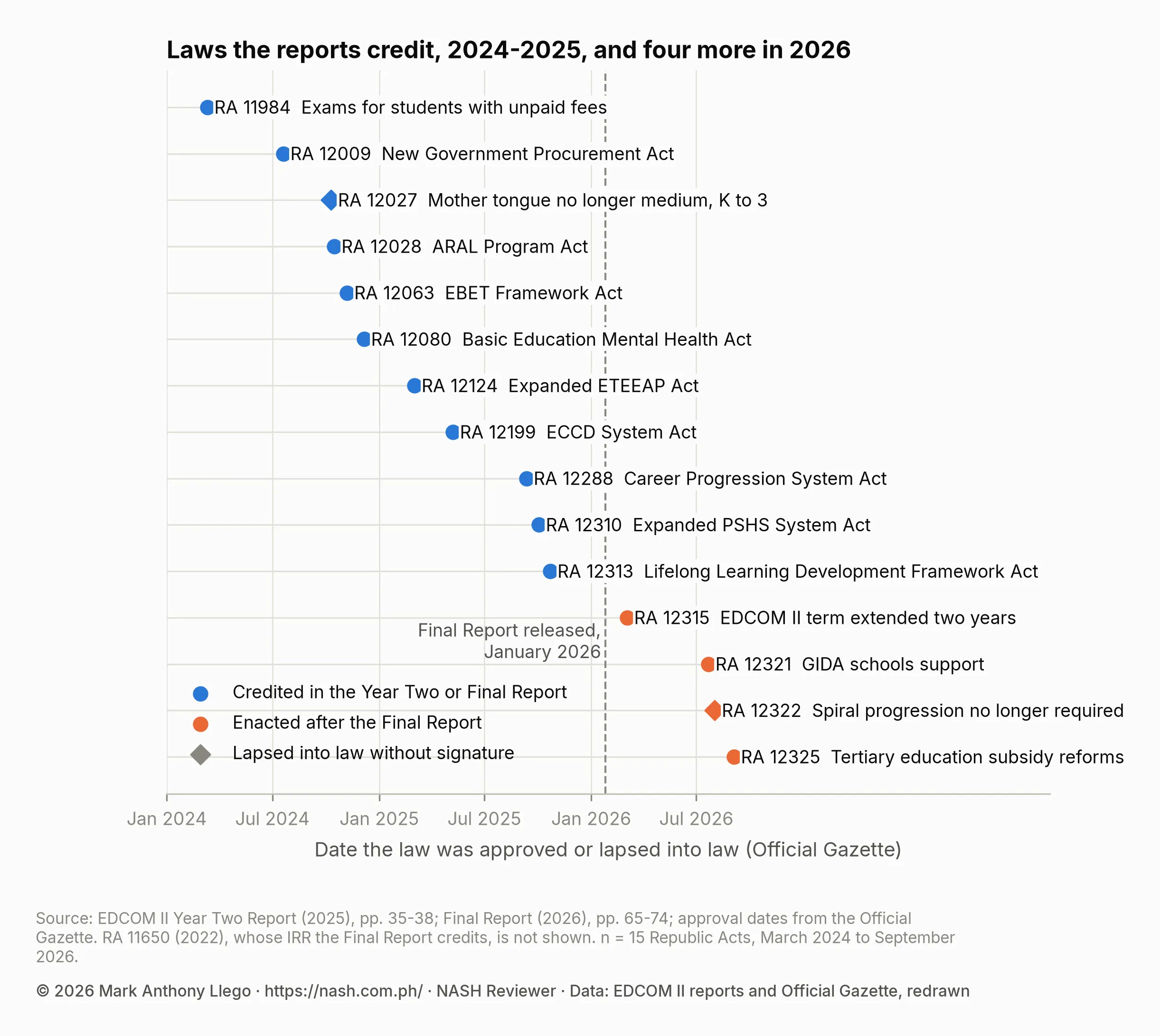
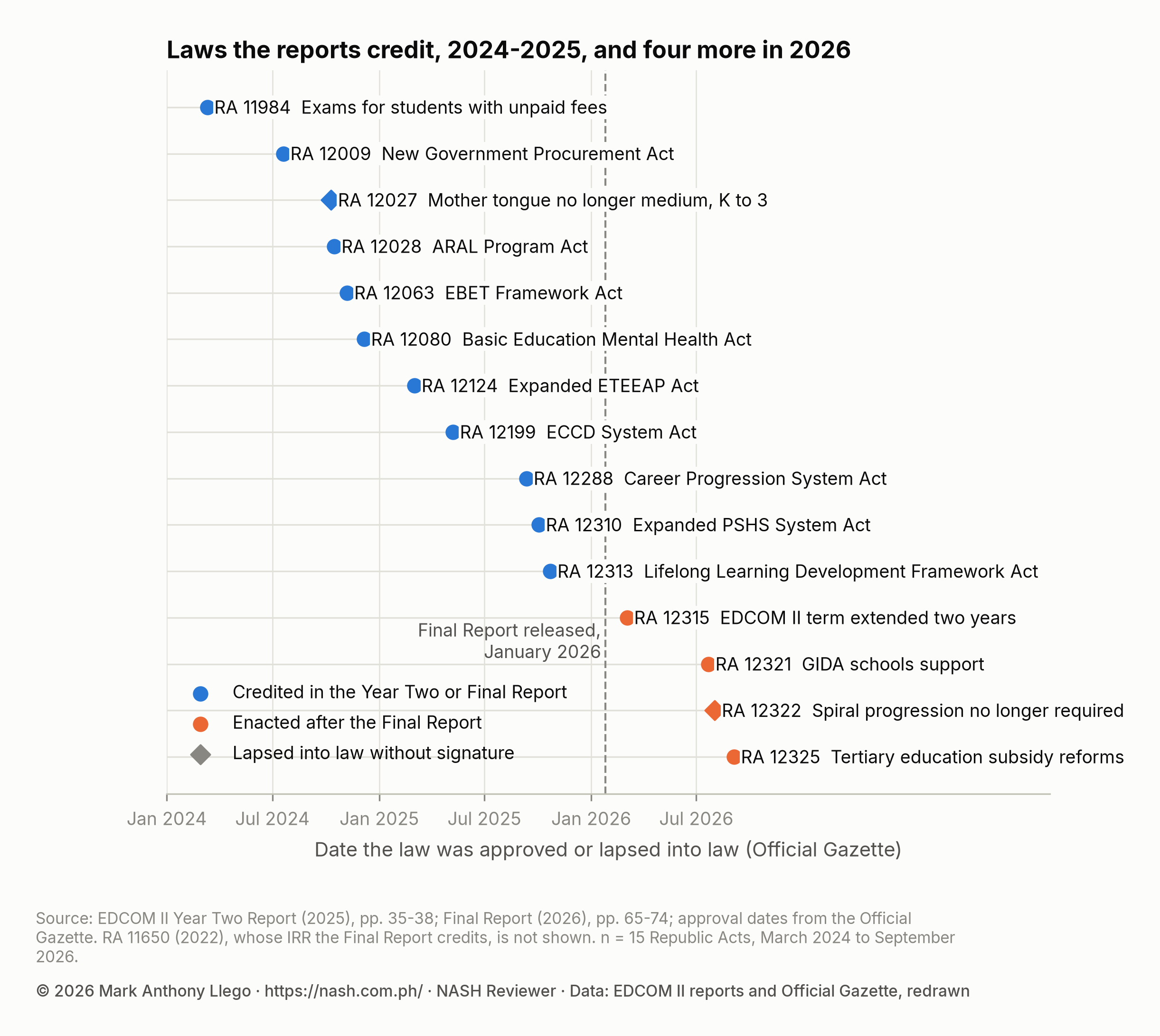
| Law | What it does (Official Gazette title, shortened) | Approved | Where the reports credit it |
|---|---|---|---|
| RA 11650 | Inclusion and services for learners with disabilities (Inclusive Education Act) | Mar 11, 2022 (before EDCOM II’s work began) | Final p. 68: rules published December 12, 2024; “fully implemented on January 11, 2025” |
| RA 11984 | Lets disadvantaged students with unpaid fees take periodic and final exams | Mar 11, 2024 | Year Two p. 35 |
| RA 12009 | Revises the Government Procurement Reform Act (New Government Procurement Act) | Jul 20, 2024 | Year Two p. 37; Final p. 71, as “Submitted inputs” |
| RA 12027 | Discontinues the mother tongue as medium of instruction in Kindergarten to Grade 3 | Oct 10, 2024 (lapsed) | Year Two p. 35; Final p. 67 |
| RA 12028 | Academic Recovery and Accessible Learning (ARAL) Program | Oct 16, 2024 | Year Two p. 35 (rules signed December 16, 2024); Final p. 67 |
| RA 12063 | Enterprise-Based Education and Training (EBET) Framework | Nov 7, 2024 | Year Two p. 38; Final p. 73 (rules November 2024, revenue regulations February 20, 2025) |
| RA 12080 | School-based mental health programs, counselors and counselor associates | Dec 6, 2024 | Year Two p. 36; Final p. 69 |
| RA 12124 | Expanded Tertiary Education Equivalency and Accreditation Program (ETEEAP) | Mar 3, 2025 | Final p. 74 |
| RA 12199 | Early Childhood Care and Development (ECCD) System Act; repeals RA 10410 | May 8, 2025 | Final pp. 65-66 |
| RA 12288 | Career Progression System for Public School Teachers and School Leaders | Sep 12, 2025 | Final p. 73 |
| RA 12310 | Expands the Philippine Science High School System | Oct 3, 2025 | Final p. 68 |
| RA 12313 | Lifelong Learning Development Framework; broadens the PQF-NCC mandate | Oct 23, 2025 | Final p. 74 |
The Final Report says what EDCOM wanted from several of these laws. RA 12199 provides plantilla positions for all child development workers and teachers (p. 65), makes the Department of the Interior and Local Government (DILG) co-chair of the ECCD Council, and adds CHED and TESDA as members (p. 66). It also requires a line item in the Local Government Support Fund for child development centers and their staff in fourth- and fifth-class municipalities (p. 66). RA 12063 brings apprenticeship, learnership and the dual training system under one EBET framework (p. 73).
How earlier bills became these laws
Several laws trace back to bills the Year One Report already named. The bill numbers of the enacted versions are printed on the Official Gazette copies.
| Reform | Bills in the earlier reports | Became |
|---|---|---|
| ECCD system | SB 2029 and HB 8393 (Year One, p. xxxvii); HB 10142 “filed in substitution of House Bill No. 8393”, passed on third reading March 18, 2024; SB 2575 passed on third reading December 16, 2024 (Year Two, p. 35) | RA 12199, from HB 10142 and SB 2575 |
| Mother tongue | HB 6717, passed on third reading February 6, 2023, and SB 2457 (Year One, p. xxxix) | RA 12027: the Senate passed SB 2457 on July 23, 2024 and the House adopted it as an amendment to HB 6717 on August 6, 2024 |
| ARAL Program | SB 1604 and HB 8210 (Year One, p. xl) | RA 12028, from SB 1604 and HB 8210 |
| Enterprise-based training | SB 363 and HB 7400 (Year One, p. xliii) | RA 12063, from SB 2587 and HB 7400 and 6523 |
| Lifelong learning | SB 364, “adopted” by EDCOM II (Year One, p. xliv) | RA 12313, from SB 2960 and HB 11543 |
| Career progression | HB 10270, passed on third reading September 4, 2024; SB 2827 and SB 2831 (Year Two, p. 38) | RA 12288, from HB 10270 and SB 3000 |
Rules and implementing steps the reports also credit
A law needs implementing rules before schools feel it. The reports credit these: the implementing rules and regulations (IRR) of RA 12028, signed December 16, 2024 (Year Two, p. 35); the IRR of RA 11650, published December 12, 2024 (Final, p. 68); the IRR of RA 12063, issued in November 2024, and revenue regulations on its incentives, promulgated February 20, 2025 (Final, p. 73); and the IRR of Executive Order No. 174, s. 2022 on teachers’ career progression (Year Two, p. 38; Final, p. 73).
Measures still pending at the end of 2025
The Final Report’s table lists far more bills than laws. Counting each bill number once, it names 51 bills: 20 in the House and 31 in the Senate, seven of them from the 19th Congress. They belong to 17 separate measures. One of them, the Adopt-a-School amendments, is listed only with 19th Congress bills that “Remained Pending”; the table names no 20th Congress bill for it (p. 76). A draft bill on digital tertiary education “shall be proposed” but had not been filed (p. 71), so it is not counted.
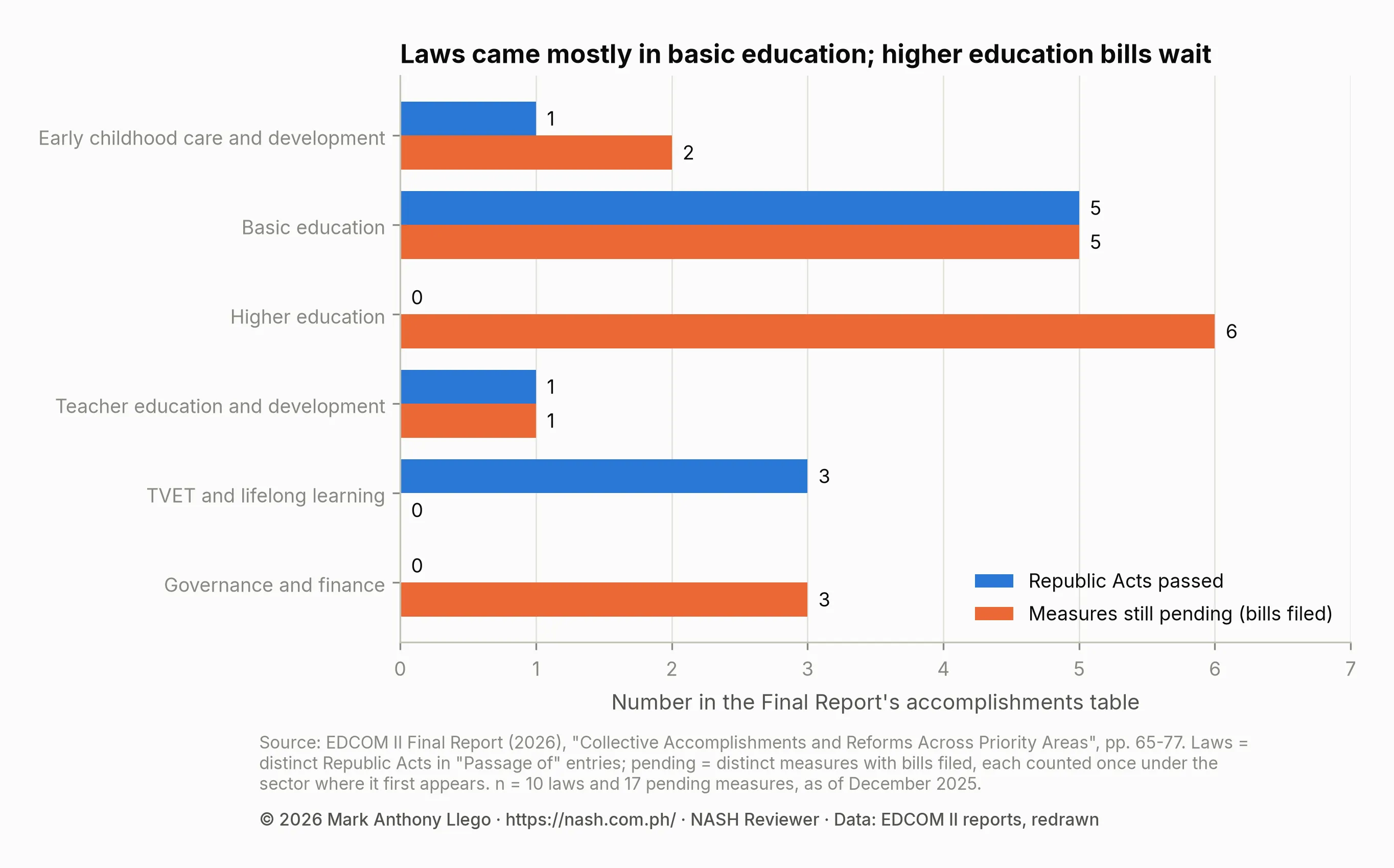
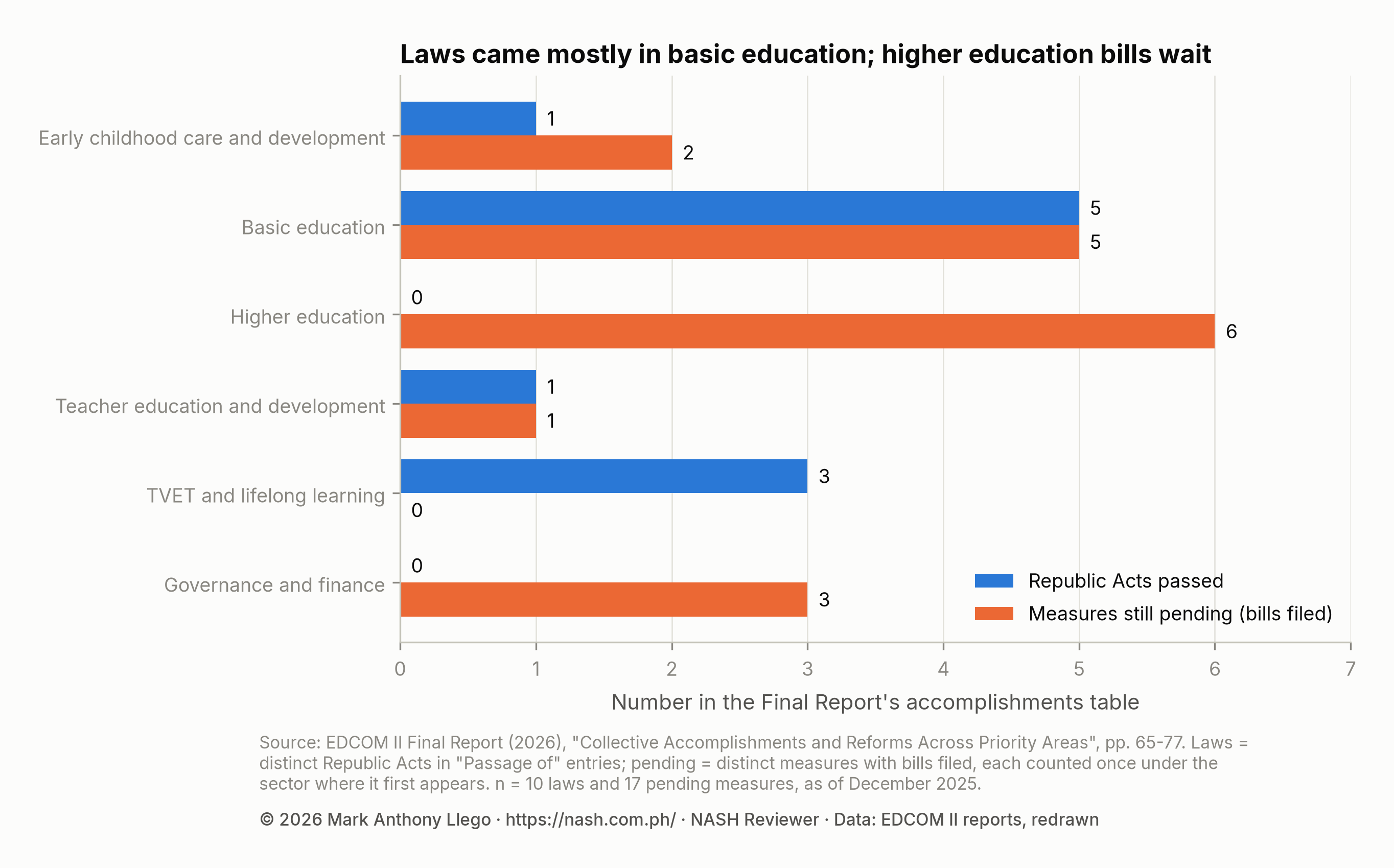
| Sector | Laws passed | Measures pending |
|---|---|---|
| Early childhood care and development | 1 | 2 |
| Basic education | 5 | 5 |
| Higher education | 0 | 6 |
| Teacher education and development | 1 | 1 |
| TVET and lifelong learning | 3 | 0 |
| Governance and finance | 0 | 3 |
| Total | 10 | 17 |
The pattern is plain: basic education and technical-vocational education got laws, while higher education’s six measures were all still bills. The table flags five measures as “LEDAC PRIORITY”, priorities of the Legislative-Executive Development Advisory Council: the amendment of RA 11037, the Classroom-Building Acceleration Program (CAP) Act, the private basic education vouchers, the amendment of RA 10931 on the Tertiary Education Subsidy (TES), and the amendment of RA 7836 (pp. 65, 68, 69, 72).
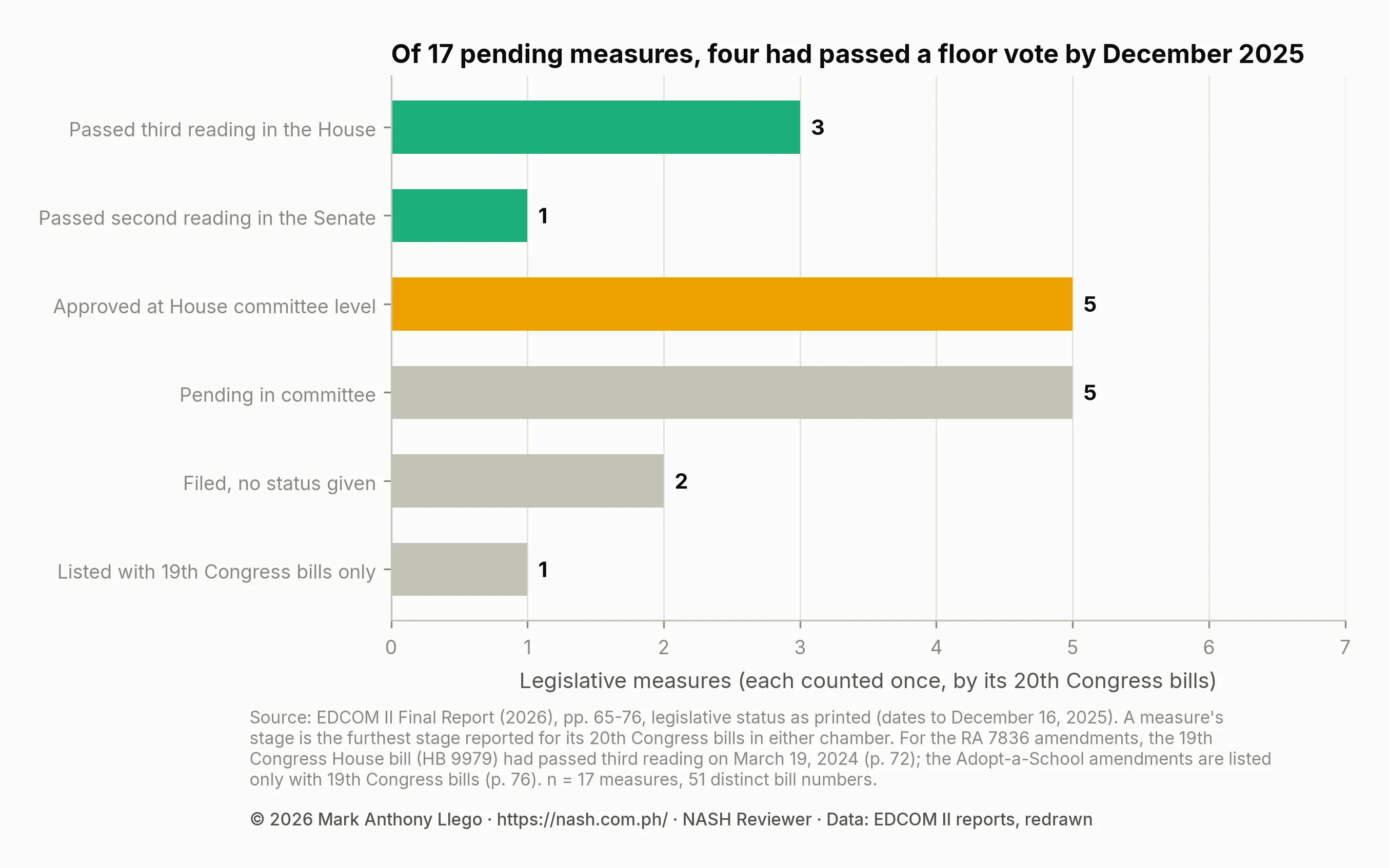
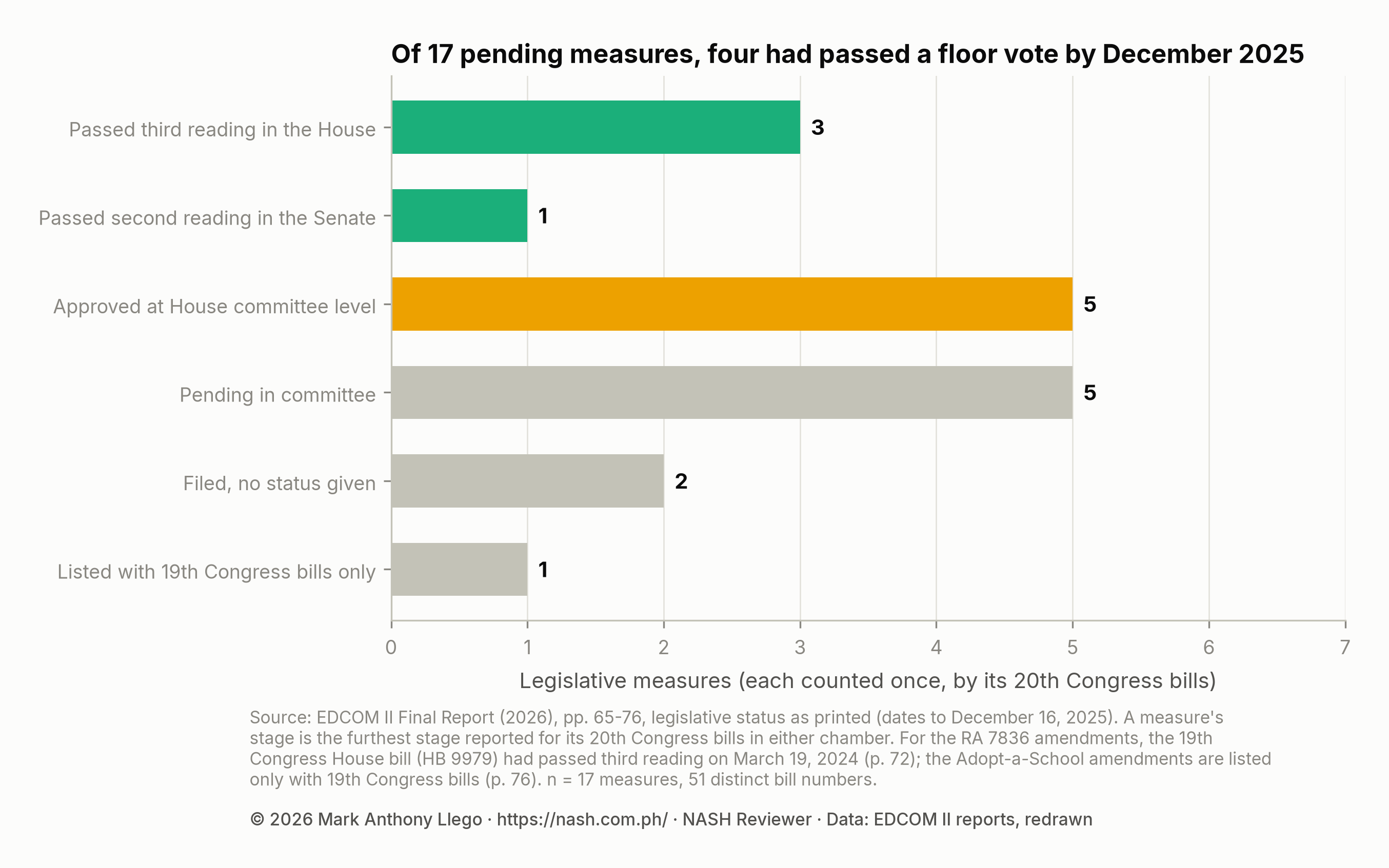
The full list follows. “Stage” is the furthest stage the Final Report prints. The last column records the next step found in the Official Gazette or in EDCOM’s own releases up to October 30, 2026; a dash means neither shows the measure enacted.
| # | Measure | Bills (20th Congress unless noted) | Stage in the Final Report | Page | By October 30, 2026 |
|---|---|---|---|---|---|
| 1 | Anti-Stunting Action Plan (ASAP) Council Act of 2025 | SB 416, filed July 10, 2025 | Filed; no status given | 65 | – |
| 2 | Amending RA 11037 to extend feeding to children aged 2-3 and nutritionally at-risk pregnant adolescents (LEDAC) | HB 5046; SB 1145, 1312 | Pending in committee | 65 | House counterpart passed third reading; SB 2272 sponsored (EDCOM, June 18, 2026) |
| 3 | Ending mandatory spiral progression | HB 5939; SB 530, 624 | House third reading, Dec 3, 2025 | 67 | RA 12322, lapsed into law Aug 2, 2026 (from HB 5939 and SB 1899) |
| 4 | Classroom-Building Acceleration Program Act (LEDAC) | HB 5577; SB 1482 | Senate second reading with amendments, Dec 16, 2025 | 68 | SB 1482 described as approved on third reading (EDCOM, April 23, 2026) |
| 5 | Emergency Classroom Building Act | HB 4904, 5103, 5302 | Pending in committee | 68 | – |
| 6 | Private Basic Education Vouchers Assistance Act (LEDAC) | HB 4744; SB 128, 309, 364, 422 | House third reading, Oct 13, 2025 | 68, 75-76 | Bicameral report ratified; to be submitted to the President (EDCOM, Sept 23, 2026) |
| 7 | Last Mile Schools Act | HB 4745; SB 1412 | House third reading, Oct 13, 2025 | 69 | RA 12321, Jul 22, 2026 (from SB 1937, a substitute bill, and HB 4745) |
| 8 | Amending RA 10931 on TES reforms (LEDAC) | HB 683, 4270; SB 130, 514, 1604 | House committee approval, Dec 2, 2025 | 69-70 | RA 12325, Sep 4, 2026 (from SB 1894, a substitute bill, and HB 8476) |
| 9 | Overlaps in the mandates and functions of the PRC boards | HB 4959; SB 1426, 1604 | House committee approval, Dec 9, 2025 | 70 | – |
| 10 | Higher Education Development and Innovation Act of 2025 (updating RA 7722, the CHED charter) | HB 4958; SB 1427 | House committee approval, Nov 18, 2025 | 70, 75 | – |
| 11 | Updating RA 8292, the Higher Education Modernization Act of 1997 | HB 4799, 5042; SB 1414 | Pending in committee | 71 | – |
| 12 | E-Textbook Para Sa Lahat | SB 122 | Filed; no status given | 71 | – |
| 13 | Dual citizens as faculty and researchers in public HEIs | HB 5019; SB 531, 626 | House committee approval, Nov 18, 2025 | 72 | – |
| 14 | Amending RA 7836, the Philippine Teachers Professionalization Act of 1994 (LEDAC) | 19th Congress: HB 9979 (third reading Mar 19, 2024), SB 2830, 2840; 20th: SB 52, 308, 547 | Pending in committee (20th Congress bills) | 72 | – |
| 15 | TESDA Modernization Act of 2025 (amending RA 7796) | HB 4798, 5043; SB 1413, 1449 | House committee approval, Nov 18, 2025 | 75 | – |
| 16 | Complementarity in Education Act | HB 4921; SB 167 | Pending in committee | 75 | – |
| 17 | Amending RA 8525, the Adopt-a-School Act of 1998 | 19th Congress only: HB 11179; SB 2731, 2809, 2852 | 19th Congress bills only, “Remained Pending” | 76 | – |
Many of these reforms had already passed the House once. In the 19th Congress the House passed on third reading a bill giving DepEd flexibility in pedagogical approaches (HB 9936, March 19, 2024; Year Two, p. 35), a last mile schools bill (HB 10823, September 19, 2024; Year Two, p. 36), a dual-citizen faculty bill (HB 10251, August 13, 2024; Year Two, p. 37) and the RA 7836 amendments (HB 9979, March 19, 2024; Year Two, p. 37). The Year One Report records HB 7922, a voucher system for private higher education under RA 10931, as passed on third reading and sent to the Senate on May 24, 2023 (p. xli). The same reforms return in the Final Report’s table as 20th Congress bills.
Budgets the reports credit
The reports credit EDCOM’s advocacy, with Congress and the agencies, for these budget changes. All amounts are nominal pesos.
| Item | From | To | Budget year or document | Source |
|---|---|---|---|---|
| DSWD Supplementary Feeding Program, cost per hot meal | ₱15 | ₱27 | 2025 National Expenditure Program | Year Two, p. 34 |
| DOH nutrition budget | ₱235 million | ₱977 million | 2025 GAA | Year Two, p. 34 |
| First 1,000 Days, non-PMNP sites | ₱240 million (FY 2024) | ₱977 million (FY 2025) | FY 2024 and FY 2025 | Final, p. 65 |
| Nutritionally at-risk pregnant mothers and children under 5 in fifth- and sixth-class municipalities with stunting of 15% or more, in non-food stamp sites (the Year One Report credits the proposal to “EDCOM I”) | ₱300 million | 2024 GAA | Year One, p. xxxvi | |
| New child development centers | ₱1 billion for 238 centers in low-income LGUs | 2025 | Final, p. 65 | |
| Child development centers in at least eight fifth-class municipalities | ₱24 million | 2025 GAA | Year Two, p. 34 | |
| Support to existing day care centers in low-income municipalities | ₱100,000 | ₱275,000 | not stated | Final, p. 65 |
| TESDA scholarships for child development workers (NC III in ECCD) | ₱80 million; ₱240 million since 2023 for 9,796 workers | 2025 GAA; TESDA programs | Year Two, p. 34; Final, p. 66 | |
| Local Government Support Fund line for centers and workers under RA 12199 | ₱2.46 billion | 2026 budget | Final, p. 66 | |
| DepEd basic education facilities | ₱39,028,800,000 | ₱65,931,205,000 | 2026 GAA | Final, p. 69 |
| School counselor associates | 10,000 (initial allocation) | 2026 | Final, p. 69 | |
| ARAL teachers, volunteers and materials | “8.9M budgeted for 2026” | 2026 | Final, p. 68 | |
| Administrative officer items | 10,000 more for 2025 (33,313 in all); 11,268 to fill by 2026 | 2025-2026 | Final, p. 73 | |
| School principal plantilla positions | 6,000 to be created | 2026 | Final, p. 73 | |
| Teacher Salary Subsidy | ₱18,000 | ₱24,000 | “for the first time in 8 years” | Final, p. 76 |
| Share of 4Ps grantees in the Tertiary Education Subsidy | 0.22% | 28% | special provisions in the 2024 and 2025 GAAs | Final, p. 70 |
| AI-powered labor market researcher; AI-powered TVET course builder | ₱10 million; ₱40 million | 2025 GAA | Year Two, p. 38 | |
| Revised school MOOE formula | 30% in 2025, 100% in 2026 | 2025-2026 | Final, p. 76 |
The Final Report also says that, with Senator Win Gatchalian as chair of the Senate Committee on Finance, “education has received the highest budget allocation in history, reaching 4.5% of GDP” (p. 76). Elsewhere it describes that figure as “the proposed 2026 education budget of 4.5% of GDP” (p. 366). Note what the table counts: an allocation or a target, not money spent.
Agency policies and issuances
Much of what the reports list never went through Congress. These are the agency and executive issuances they name, by issuer.
| Issuer | Issuance or action | What it did | Source |
|---|---|---|---|
| DepEd | DepEd Memorandum No. 049, s. 2024 (September 18, 2024) | Early procurement activities for FY 2025, including textbooks; the report credits it with raising textbook titles procured “from just 27 from 2013 to 2023, to 60 in 2024 to 2025 alone” (see below for pp. 24 and 131) | Final, p. 66; Year Two, p. 35 |
| DepEd | DepEd Order No. 006, s. 2025 | Cut forms filled out by teachers from 174 to 75 (5 regularly completed, 70 ancillary and teaching-related) | Final, p. 73 |
| DepEd | DepEd Memorandum No. 090, s. 2025 (October 9, 2025) | Disseminated the revised IRR of the Anti-Bullying Act of 2013 (RA 10627) | Final, p. 69 |
| DepEd | DepEd Order No. 035, s. 2025 (October 31, 2025) | Language mapping process for Key Stage 1 under RA 12027; its first cycle is in School Year 2026-2027 | Final, p. 67 |
| DepEd | DepEd Memorandum No. 073, s. 2025 (August 29, 2025) | One-time FY 2025 School Innovation and Improvement Fund for non-implementing public schools in fourth- and fifth-class municipalities | Final, p. 76 |
| DepEd | Funding formulas | Revised school MOOE formula; ALS resources moved from equal regional shares to a per-capita, demand-sensitive formula | Final, pp. 69, 76 |
| DepEd | Curriculum and assessment | Strengthened Senior High School curriculum piloted, with tracks cut from 4 to 2 and core courses from 15 to 5; CRLA and Phil-IRI fully implemented; Project Bukas publishes school-level results | Final, p. 67 |
| DepEd | Governance | Decentralization pilots in Regions I, III, VIII, IX and CAR, and a Decentralization Plan; 100% of schools as implementing units by 2031 | Final, p. 77 |
| DepEd | Learner Rights Protection Office | 9 plantilla items at the Central Office and 16 at the regional level | Year Two, p. 36 |
| DepEd, DBM, DOF, DILG | Joint Circular No. 1, s. 2025, Omnibus Guidelines on the Use of the Special Education Fund | Lists ECCD costs and includes the Alternative Learning System (ALS) among allowable SEF uses | Final, pp. 66, 69, 76 |
| DepEd, CHED, TESDA | Joint memorandum circular, October 3, 2025 | Interoperable data systems and a unified learner reference number | Final, p. 75 |
| DepEd and partners | Agreements | DepEd-TESDA agreement to quality-assure SHS TechPro programs; DepEd-DHSUD memorandum of understanding on housing and school congestion | Final, pp. 67, 69 |
| DepEd, DBM, CSC, PRC | IRR of Executive Order No. 174, s. 2022 | Expanded career progression for teachers | Year Two, p. 38; Final, p. 73 |
| CHED and PRC | Joint Memorandum Circular 1, s. 2025 | Separate licensure examinations by teacher education specialization, from the September 2025 board examination | Final, p. 72 |
| CHED, PRC, TESDA | Joint memorandum circular | Rationalizes professional and technical education and skills standards | Final, p. 74 |
| CHED | CHED Memorandum Order 10, s. 2024; technical panels | Lets CHED impose sanctions, up to program termination and institutional closure, based on a teacher education institution’s performance; technical panels reconstituted, from 15 in 2023 to an additional 72 in 2024 | Year Two, pp. 36-37 |
| CSC | Resolution No. 2500229, March 2025 | Grade 10 and Grade 12 graduates eligible for first-level government positions | Final, p. 67 |
| TESDA | Training regulations | NC III in ECCD Services, prioritized by the TESDA Board on November 13, 2024 | Year Two, p. 34; Final, p. 66 |
| President | Administrative Order No. 36, August 13, 2025 | Created the Education and Workforce Development Group | Final, p. 75 |
| President | Instruction of December 3, 2024 | Nutrition programs under DBM’s Program Convergence Budgeting | Final, p. 65 |
| Congress | Concurrent Resolution, June 16, 2025 | Urged the President to create a cabinet cluster for education | Final, p. 75 |
| Survey owners, at EDCOM’s urging | Survey changes | 2024 FLEMMS literacy questions revised to include comprehension; TVET rider questions added to the 2024 APIS-LFS | Final, pp. 67, 74 |
Several entries are commitments rather than completed acts. DepEd “has committed to providing 1 school principal per school” (p. 73), PRC “has committed to the review” of the licensure examination for teachers (p. 73), and CHED’s associate degree in early childhood education is marked “[ongoing proposal]” (p. 66). Read them as promises on record, not results.
Other entries in the tables
The tables list more that fits none of the categories above:
- A 2026 budget for converting day care centers to child development centers and hiring child development workers in fourth- and fifth-class municipalities, with pilots of alternative delivery through the ECCD Council (Final, p. 65).
- An interagency effort started by DepEd to amend Executive Order No. 66 so that class suspensions are science-based (Final, p. 67).
- DepEd’s Summer Literacy Remediation Program, recalibrated from the National Learning Camp; the report adds that “Results of the BBMP show outstanding gains in literacy, with the 20-day intervention equivalent to up to 1.3 years worth of schooling” (Final, p. 68).
- 105,000 classrooms projected under the PPP for School Infrastructure Project (PSIP) 1, 2 and 3, “expected to be completed by 2028” (Final, p. 69).
- A CHED-PRC commitment to quality-assure graduate teacher education programs from December 2025 to March 2027 (Final, p. 71), and PhilTER, launched by CHED, PRC, the Teacher Education Council and EDCOM (Final, p. 73).
- Eight additional National TESDA Industry Boards, and 155 Level III and IV courses with 110 competency standards as of January 7, 2026 (Final, p. 74).
- A push to revise DepEd’s Office Performance Commitment and Review form, and a letter to DepEd, DepDev and DBM to reconsider targets that “unitendedly reinforce mass promotion” (Final, p. 76).
- EDCOM’s promotion of DILG Memorandum Circular 2022-083 on wider membership of local school boards (Final, p. 77).
- House Resolution No. 260, adopted November 6, 2024 (Year Two, p. 36); the Teacher Education Council’s operationalization, beginning with its Executive Director’s appointment on September 6, 2024 (Year Two, p. 37); the PQF-NCC Permanent Secretariat, January 2025 (Year Two, p. 38); and DepEd’s agreement with the Delivery Unit on piloting decentralization (Year Two, p. 39).
Where the reports’ numbers differ
The reports do not always agree, and none of them explains the differences below. Each is given with both pages.
- Textbook titles after 2024. The accomplishments table credits DM 49, s. 2024 with raising titles procured “from just 27 from 2013 to 2023, to 60 in 2024 to 2025 alone” (p. 66). The executive summary says DepEd reports “procuring over 100 new titles in 2024 alone, compared with only 27 new titles procured in the preceding decade” (p. 24), and the basic education synthesis dates the 27 to “the entire preceding decade from 2012 to 2023” (p. 131). The report does not reconcile the two.
- Nutrition budget base. The Year Two Report gives DOH’s nutrition budget as rising “from Php 235 million to Php 977 million” in the 2025 GAA (p. 34). The Final Report gives First 1,000 Days support as ₱240 million in FY 2024 and ₱977 million in FY 2025 (p. 65). The labels differ as well as the base.
- Child development centers in 2025. The Year Two Report has ₱24 million for centers in at least eight fifth-class municipalities (p. 34). The Final Report has ₱1 billion for 238 centers in low-income LGUs (p. 65). Neither report says whether these are the same allocation.
- Executive Order No. 174 rules. Signed July 26, 2024 in the Year Two Report (p. 38) and August 1, 2024 in the Final Report (p. 73).
- Research base. “At least 97 studies contributed by 60 research partners” in the Year Two Report (p. 17); “at least 95 studies from 13 research partners” in the Final Report (p. 44).
- HB 4958. “Approved in the House at the Committee level on November 18, 2025” on p. 70, but “Pending with the Committee on Higher and Technical Education” on p. 75.
- Senate voucher bills. SB 128, 309, 364 and 422 are pending with the Committee on Basic Education on p. 68 and with the Committee on Higher, Technical and Vocational Education on p. 76.
- Special Education Fund circular. Checked as an amendment already made, “JC 1, s. 2025”, on p. 66, but marked “[for signing of final revised guidelines]” on p. 76. EDCOM reported on March 4, 2026 that the circular had been published.
- ARAL funding. The Final Report prints “8.9M budgeted for 2026” (p. 68). An EDCOM release of October 16, 2026 says ARAL received ₱8.9 billion in the FY 2026 GAA.
Since the Final Report: January to October 2026
This section is dated to October 30, 2026. Laws come from the Official Gazette; other events from EDCOM’s own press releases, which are a secondary source.
- March 4, 2026: EDCOM II extended. RA 12315 amends RA 11899. Upon completion of its initial three-year mandate, the Commission “shall continue to operate for an additional period of two (2) years” to oversee the National Education and Workforce Development Plans. It also adds objectives on global benchmarks, school infrastructure and teachers, and emerging technologies such as artificial intelligence. The Senate passed it as SB 1483 on December 2, 2025, and the House adopted it as an amendment to HB 6429 on December 22, 2025. The Final Report says the work began in January 2023 (p. 44); EDCOM described the extension as running “to the end of 2027” (EDCOM, December 3, 2025).
- February 3, 2026: the plan adopted by the Senate. The Senate adopted Senate Concurrent Resolution No. 8, adopting the National Education and Workforce Development Plan (2026-2035) (EDCOM).
- March 4, 2026: EDCOM reports the SEF circular published. EDCOM reported that Joint Circular No. 1, s. 2025 had been published, expanding allowable Special Education Fund expenses and requiring local school boards to prepare a six-year SEF Investment Program (EDCOM).
- April 2026: the coordinating group met. The Education and Workforce Development Group created by Administrative Order No. 36 held its inaugural meeting (EDCOM).
- July 22, 2026: GIDA schools. RA 12321 institutionalizes support for public basic education schools in geographically isolated and disadvantaged areas (GIDA) and underserved communities. It came from SB 1937 and HB 4745, the Last Mile Schools bill the Final Report recorded as passed by the House (p. 69). SB 1937 was approved “in substitution of several Senate Bills” (EDCOM, March 16, 2026); SB 1412, the Senate bill the Final Report lists, is not named in the law.
- August 2, 2026: spiral progression no longer required. RA 12322, from HB 5939 and SB 1899, lapsed into law without the President’s signature. It amends Section 5(g) of RA 10533 so that the curriculum “shall employ the approach deemed most effective by the DepEd”, with review “at least once every five (5) years”.
- August 5, 2026: ECCD rules signed. The IRR of RA 12199 was signed after what EDCOM called a one-year delay (EDCOM). EDCOM’s Legislative Tracker, launched July 31, 2026, had flagged the IRRs of RA 12199 and RA 12288 as overdue (EDCOM).
- September 4, 2026: tertiary education subsidy. RA 12325 amends RA 10931. It consolidates SB 1894 and HB 8476, passed by the Senate on June 17, 2026 and the House on June 3, 2026; neither bill is among those the Final Report lists for this subject (pp. 69-70). EDCOM describes SB 1894 as a bill that “substitutes several earlier measures” (EDCOM, February 24, 2026). EDCOM says it gives top TES priority to learners from 4Ps households and creates a Private Education Assistance program (EDCOM).
- August-September 2026: career progression rules. The IRR of RA 12288 was signed on August 17, 2026, and takes effect 30 days after its publication in a newspaper and its filing with the Office of the National Administrative Register (IRR, Sec. 20). As of October 31, 2026, the IRR had not been published in the Official Gazette or on deped.gov.ph, so its effective date is not yet known. By September 17, 2026 EDCOM had welcomed its issuance, and ₱12.09 billion was proposed for the Expanded Career Progression System in the 2027 budget (EDCOM).
- September 23 and October 8, 2026: two bills ratified by Congress. Congress ratified the bicameral reports on expanding vouchers to Kindergarten to Grade 6 (EDCOM) and on the Presidential Merit Scholarship Programs (EDCOM). Neither appears in the Official Gazette’s list of Republic Acts as of October 30, 2026.
Some things went the other way. EDCOM reported on July 3, 2026 that four of the ten operational guidelines needed for RA 11650 were still pending (EDCOM). The FY 2027 National Expenditure Program had no standalone allocation for ARAL (EDCOM, October 16, 2026).
What this means for school heads
Know which items bind your school and which do not. A law and its IRR bind you. A filed bill does not, and neither does an EDCOM recommendation until a law, a budget or a DepEd issuance adopts it. The laws above that reach a public school directly are RA 12027 on the medium of instruction, RA 12028 on ARAL, RA 12080 on mental health, RA 11650 on inclusive education, RA 12288 on career progression and, since August 2026, RA 12322. This is strand 1.3 of the Philippine Professional Standards for School Heads (PPSSH), policy implementation and review; see PPSSH Domain 1.
Plan for the reading programs the laws now require. ARAL started in School Year 2025-2026 with a focus on reading, supporting 6.7 million learners identified as struggling readers (p. 68). The language mapping of DepEd Order No. 035, s. 2025 runs its first cycle in School Year 2026-2027. Your school’s reading data decide who gets remediation; Literacy and Nutrition Programs Compared With Need shows how far the programs reach.
Use the support staff the reports count, and ask about it. The Final Report counts 33,313 AO items after 10,000 were added for 2025 (p. 73) and 10,000 school counselor associates for 2026 (p. 69), and DepEd Order No. 006, s. 2025 limits the forms teachers fill. See PPSSH Domain 2 and Human Resource Management for DepEd School Heads.
Watch the principal items. The 6,000 positions for 2026 (p. 73) are the jobs NASH passers fill. In the accomplishments table, 48% of all schools lack principal items and depend on teachers-in-charge, and another 12,057 schools have the wrong school-head items (p. 73). Principal, Head Teacher or Teacher-in-Charge in DepEd explains the item types, and PPSSH Domain 4 covers career progression.
Follow the money that reaches the school. The revised MOOE formula applies in full in 2026, after 30% in 2025 (p. 76); DepEd School MOOE explains its rules. The Special Education Fund circular lets your local school board fund ECCD and ALS, among other uses (pp. 66, 69). A school head who brings reading and nutrition data to the local school board is doing strand 5.5, community engagement; see PPSSH Domain 5 and RA 9155 at 25.
Read classroom plans against what passed. The 2026 facilities budget of about ₱65.9 billion is law; the CAP Act and the Emergency Classroom Building Act were still bills at the Final Report, and the 105,000 classrooms under the PSIP public-private partnerships are a projection to 2028 (p. 69). DepEd School Building Program 2026 in Numbers and Last Mile Schools: Classroom Need and 2026 Allocation look at where the 2026 classroom money went.
Apply the revised anti-bullying rules. DepEd Memorandum No. 090, s. 2025 directs every public and private school to implement the revised IRR. Since then, DepEd Order No. 006, s. 2026 (March 24, 2026) has consolidated DepEd’s rules on a safe learning environment, and DepEd Memorandum No. 055, s. 2026 (September 17, 2026) says the school head designates a Learner Formation Officer to handle bullying incidents. DepEd Child Protection and Anti-Bullying: School Head Duties sets out what that means for you.
How the NASH may test this
DepEd Memorandum No. 069, s. 2025 says the NASH covers “conceptual and situational critical thinking questions” aligned with the PPSSH. The two items below are original practice items in the format of NASH Practice Questions With Answers. Each option is scored 3-2-1-0 on the Structure of the Observed Learning Outcome (SOLO) taxonomy.
Practice item 1
Indicator 1.3.1, Policy implementation and review. Career Stage 1, Situational, Moderate.
In September 2026, a Grade 7 science teacher tells the school’s learning action cell that “spiral progression has been abolished” and proposes to reorder the quarter’s science topics by discipline starting next week. Which response by the school head best reflects sound policy implementation?
- A. Approve the reordering, since the EDCOM II Final Report recommended ending spiral progression and its recommendations took effect when Congress received the report.
- B. Explain that Republic Act No. 12322 removed the legal requirement and left the approach to DepEd, so the school keeps the current curriculum until DepEd issues guidance, and forward the teachers’ observations to the division.
- C. Ask the teacher to prepare an action research proposal on discipline-based sequencing, and decide on the reordering of topics after the study has been completed and reported.
- D. Explain that Republic Act No. 12322 now allows approaches other than spiral progression, and let the science department reorder the topics once the division supervisor agrees.
Answer and explanation
Best answer: B. Points: A = 0, B = 3, C = 1, D = 2.
- A (0 points, Prestructural). An EDCOM II report has no legal force of its own; a recommendation binds a school only when a law, a budget or a DepEd issuance adopts it.
- B (3 points, Relational). This states what the law changed, who decides under it, what the school does meanwhile, and how the teachers’ experience reaches the people who will decide.
- C (1 point, Unistructural). Gathering evidence is reasonable, but it leaves the policy question unanswered and leaves the change to be decided at the school.
- D (2 points, Multistructural). The reading of the law is correct and a supervisor is consulted, but the law gives the choice of approach to DepEd, not to a department or a division.
Why. This aligns with Career Stage 1 expectations because indicator 1.3.1 asks the aspiring school head to understand policy implementation so that school operations stay consistent with laws and issuances. RA 12322, which lapsed into law on August 2, 2026, amended Section 5(g) of RA 10533 so that the curriculum “shall employ the approach deemed most effective by the DepEd” and is reviewed at least once every five years. The EDCOM II Final Report had recorded the House bill’s approval on third reading on December 3, 2025 (p. 67). The option that waits for the division supervisor reads the law correctly but places a curriculum decision the law gives to DepEd at the level of a department.
Indicator 1.3.1: Demonstrate knowledge and understanding of policy implementation and review to ensure that school operations are consistent with national and local laws, regulations and issuances.
Sources: EDCOM II Final Report, Turning Point: A Decade of Necessary Reform (2026-2035), January 2026; Republic Act No. 12322 (Official Gazette); DepEd Order No. 024, s. 2020.
Practice item 2
Indicator 1.4.1, Research and innovation. Career Stage 1, Conceptual, Moderate.
A school planning team wants to cite EDCOM II in the situational analysis of its School Improvement Plan. One draft sentence reads: “EDCOM II passed 118 education laws from 2023 to 2025.” Which revision uses the source most accurately?
- A. “EDCOM II passed 118 laws, so the plan quotes the Commission’s report instead of the laws themselves, since the report already summarizes what each of them requires.”
- B. “EDCOM II reports that 10 of its 118 bills had become law by December 2025, so the plan lists all 118 bills as the reforms the school must prepare to implement.”
- C. “EDCOM II’s reports contain many recommendations, so the plan leaves out the numbers and names the Commission only as background to the school’s own priorities.”
- D. “EDCOM II reports putting forward 118 bills, 10 of which had become law as of December 3, 2025; the plan cites the laws that bind the school, such as RA 12028 on ARAL, directly.”
Answer and explanation
Best answer: D. Points: A = 0, B = 2, C = 1, D = 3.
- A (0 points, Prestructural). EDCOM II does not pass laws, and a report’s summary is not a substitute for the law it describes.
- B (2 points, Multistructural). The count is right, but treating pending bills as obligations confuses what was proposed with what is in force.
- C (1 point, Unistructural). Avoiding the error is something, but the plan loses evidence that a reliable source provides.
- D (3 points, Relational). This reports the source’s own count in its own terms, separates bills from laws, and sends the plan to the binding text for what the school must do.
Why. This aligns with Career Stage 1 expectations because indicator 1.4.1 asks the aspiring school head to identify relevant findings from reliable sources and use them correctly. The Final Report says the Commission “put forward 61 policy recommendations and 118 bills, of which 10 have been passed into law (as of December 3, 2025)” (p. 45), and it calls its list “Collective Accomplishments”, shared with Congress and the agencies (p. 64). The option that lists all 118 bills gets the count right but treats proposals as obligations.
Indicator 1.4.1: Identify relevant research findings from reliable sources in facilitating data-driven and evidence-based innovations to improve school performance.
Sources: EDCOM II Final Report, Turning Point: A Decade of Necessary Reform (2026-2035), January 2026; DepEd Order No. 024, s. 2020.
Nothing in this guide reproduces or predicts examination content.
Frequently asked questions
How many laws did EDCOM II pass?
None by itself: Congress passes laws and the President signs them or lets them lapse into law. The Final Report says the Commission put forward 118 bills, “of which 10 have been passed into law (as of December 3, 2025)” (p. 45). Its accomplishments table credits the passage of ten Republic Acts, from RA 11650 to RA 12313 (pp. 65-74), though the report does not say these are the ten in its count, and RA 11650 was signed in March 2022 (p. 68), before the Commission’s work began in January 2023 (p. 44). The table calls its entries collective accomplishments with Congress and the agencies (p. 64).
Was EDCOM II’s term extended?
Yes. Republic Act No. 12315, approved March 4, 2026, amends RA 11899 so that the Commission continues for two more years after its initial three-year mandate, to oversee the National Education and Workforce Development Plans. The Final Report says the Commission’s work began in January 2023 (p. 44).
Which EDCOM II accomplishments matter most to a public school head?
The ones that change staffing, money and daily work. They are RA 12288 on career progression (p. 73), the 6,000 principal positions for 2026 and 33,313 AO items (p. 73), DepEd Order No. 006, s. 2025 on teachers’ forms (p. 73), the revised MOOE formula (p. 76), and the ARAL Program under RA 12028 (pp. 67-68).
Is spiral progression abolished?
The legal requirement is. RA 12322 lapsed into law on August 2, 2026 and lets DepEd choose the approach “deemed most effective”, with a curriculum review at least every five years. When the Final Report went to print, the House bill (HB 5939) had passed third reading on December 3, 2025 and the Senate bills were in committee (p. 67).
Did DepEd really buy only 27 textbook titles in a decade?
That is the Final Report’s figure, though it dates the decade two ways. The accomplishments table says titles procured rose “from just 27 from 2013 to 2023, to 60 in 2024 to 2025 alone” and credits DepEd Memorandum No. 049, s. 2024 on early procurement (p. 66; Year Two Report, p. 35). The synthesis compares “over 100 new textbook titles in 2024 alone” with “the 27 titles procured in the entire preceding decade from 2012 to 2023” (p. 131; see also p. 24).
Download the data
- accomplishments-laws-timeline.csv: 15 Republic Acts with approval dates, group (credited in the reports or enacted after the Final Report), how each became law, and the report pages that credit it (Year Two Report, pp. 35-38; Final Report, pp. 65-74; Official Gazette).
- accomplishments-laws-and-pending-by-sector.csv: laws passed and pending measures by sector, with the laws and measures named (Final Report, pp. 65-77).
- accomplishments-pending-by-stage.csv: the 17 pending measures by the furthest stage of their 20th Congress bills, with the measures named (Final Report, pp. 65-76).
The CSVs and charts may be reused only with written permission: email support@nash.com.ph. The numbers themselves come from the EDCOM II reports, which you can cite directly.
How to cite this post
Llego, M. A. (2026, October 30). What EDCOM II achieved, 2023-2025: Laws, budgets, policies. NASH Reviewer. https://nash.com.ph/blog/edcom-ii-accomplishments-2023-2025
The EDCOM II reports:
Second Congressional Commission on Education. (2024). Miseducation: The failed system of Philippine education (EDCOM II Year One Report). https://edcom2.gov.ph/media/2024/02/EDCOM-II-Year-One-Report-PDF-022924.pdf
Second Congressional Commission on Education. (2025). Fixing the foundations: A matter of national survival (EDCOM II Year Two Report). https://edcom2.gov.ph/media/2025/01/EDCOM-2-Year-2-Report-Fixing-the-Foundations-2025.pdf
Second Congressional Commission on Education. (2026). Turning point: A decade of necessary reform (2026–2035) (EDCOM II Final Report). https://edcom2.gov.ph/media/2026/01/EDCOM-II-Y03-for-web-012626_final.pdf
Sources
- EDCOM II Year One Report (2024), Miseducation: The Failed System of Philippine Education, pp. xxxvi-xliv, lv-lvi. PDF
- EDCOM II Year Two Report (2025), Fixing the Foundations: A Matter of National Survival, pp. 17, 34-39. PDF
- EDCOM II Final Report (2026), Turning Point: A Decade of Necessary Reform (2026-2035), pp. 24, 44-45, 64-77, 131, 366, 597. PDF
- Official Gazette, Republic Acts Nos. 11650, 11984, 12009, 12027, 12028, 12063, 12080, 12124, 12199, 12288, 12310, 12313, 12315, 12321, 12322 and 12325 (titles, approval dates, bill numbers and approval notes), and the list of Republic Acts as of October 30, 2026.
- DepEd Memorandum No. 049, s. 2024; DepEd Order No. 006, s. 2025; DepEd Memorandum No. 069, s. 2025; DepEd Memorandum No. 073, s. 2025; DepEd Memorandum No. 090, s. 2025; DepEd Order No. 035, s. 2025; DepEd Order No. 006, s. 2026; DepEd Memorandum No. 055, s. 2026 (deped.gov.ph, linked above).
- EDCOM II press releases on edcom2.gov.ph, December 3, 2025 to October 16, 2026, linked above.
The EDCOM II series
The reports:
- What EDCOM II Achieved, 2023-2025: Laws, Budgets, Policies (this post)
- EDCOM II’s Three Reports: How the Key Numbers Changed
- EDCOM II Final Report: Guide for Aspiring School Heads
- National Education Plan 2026-2035: Guide for School Heads
- 100 Years After the Monroe Report: Education Commissions
- Is the Philippines Spending Enough on Education?
- Education Data, Transparency and Research: EDCOM II
Learners and learning:
- Mass Promotion and Lost Instructional Time: EDCOM II
- PISA, TIMSS, SEA-PLM and the NAT: What EDCOM II Found
- Mother Tongue After RA 12027: Language of Instruction
- Why DepEd Bought Only 27 Textbook Titles in 2012-2023
- RA 12080, Bullying and School Mental Health: EDCOM II
- RA 11650 and Learners With Disabilities: EDCOM II Findings
- Senior High School and Jobs: EDCOM II Workforce Findings
Schools, teachers and governance:
- Teacher Workload and Accountability: EDCOM II Findings
- Local School Boards and the Special Education Fund
- Local Education Models in EDCOM II: What the Evidence Shows
- Education in the Bangsamoro: EDCOM II Findings for BARMM
Written by Mark Anthony Llego for NASH Reviewer. Sources: EDCOM II Year One Report (2024), Year Two Report (2025) and Final Report (2026); Official Gazette; DepEd issuances; EDCOM II press releases. Charts may be reused only with written permission from support@nash.com.ph.