Republic Act No. 12288, the Career Progression System for Public School Teachers and School Leaders Act, was approved on September 12, 2025 (RA 12288, approval page). It writes DepEd’s career progression system into law and changes it in five ways: Teacher I to Master Teacher I become a “non-hierarchical” base; Master Teacher VI and School Principal V are added, at Salary Grade (SG) 23 under the implementing rules; incumbent head teachers may keep their positions; a Standards-Based Assessment becomes a prerequisite to promotion, with career stages affirmed by the Teacher Education Council (TEC); and a new three-year transition period begins. Its implementing rules and regulations (IRR) were signed on August 17, 2026. As of October 31, 2026, none of these changes is operational. DepEd has issued no order implementing the Act, there are no qualification standards for Master Teacher VI or School Principal V, the IRR has not been published, and no career progression document gives the Act’s effective date.
The rules that apply to applicants today are still those of Executive Order No. 174, s. 2022, DepEd Order No. 024, s. 2025, DepEd Order No. 034, s. 2025 and DBM-DepEd Joint Circular No. 01, s. 2025. DepEd’s FY 2026 memorandum opens reclassification only for “Teacher II–VII; Master Teacher I–V; School Principal I–IV” (DM-OUHRODI-2026-0802, Sec. III.1).
As of October 31, 2026, the IRR had not been published in the Official Gazette or on deped.gov.ph, so its effective date is not yet known. The DepEd-certified copy is in DepEd’s career progression toolkit folder, which DepEd shares through DM-OUHROD-2025-3003. DepEd’s orientation decks speak for DepEd on the dates they carry, but they are not issuances.
Key findings
- Law, but not yet operational. RA 12288 was approved on September 12, 2025, and its IRR is “Done this 17th day of August 2026” (IRR, signature page), but as of October 31, 2026, the IRR had not been published in the Official Gazette or on deped.gov.ph, so its effective date is not yet known (IRR, Sec. 20). No DepEd Order or Memorandum implements it, and DepEd’s August 24, 2026 deck targets “Q1 of 2027” for both the MT VI and SP V standards and a DepEd Order on “Full Implementation” (DepEd orientation deck on funding strategies, slide 34).
- The base grows from seven positions to eight. EO 174 made “Teacher I to Teacher VII” the base (Sec. 6). RA 12288 makes it Teacher I to Master Teacher I, and “Promotions within the base positions shall be non-hierarchical” (Sec. 5).
- Two new positions at SG 23. The Act adds Master Teacher VI and School Principal V, “equivalent in all salaries, benefits, and other privileges” (Secs. 5 and 7). The IRR, not the Act, sets both at SG 23 (IRR, Sec. 5).
- Two career stages move. Master Teacher III goes from PPST Stage IV under DO 024 to Stage III, and School Principal IV from PPSSH Stage IV to Stage III (DO 024, Encl. No. 1, Secs. 21.b and 22.b; IRR, Sec. 6).
- Head teachers may stay. “All incumbent head teachers may apply to retain their positions”, filing within three years from the Act’s effectivity (RA 12288, Sec. 6). DO 024 says Head Teacher VI and Assistant School Principal II–III “shall be retitled” (Encl. No. 1, Sec. 34.b).
- A second three-year clock. The new transition runs three years “reckoned from the effectivity of this IRR”, extendable by at most two years (IRR, Sec. 17). It starts only when the IRR takes effect, a date not yet known; a DepEd deck’s “reckoning date” of September 23, 2026 appears in no issuance. The EO 174 transition still ends February 24, 2028 (DO 024, Encl. No. 1, Sec. 31).
What RA 12288 does, in one paragraph
RA 12288 consolidates House Bill No. 10270 and Senate Bill No. 3000, passed on June 11, 2025 (approval page). It declares the career progression system “hereby institutionalized” (Sec. 4); sets the base and the new positions (Sec. 5), the head teachers’ options (Sec. 6) and the equivalence of the two lines (Sec. 7); and bars any “demotion in rank or diminution of salaries, benefits, and other privileges” (Sec. 8). Promotion is “through natural vacancy or reclassification of position based on merit, fitness, and competence anchored on the professional standards” (Sec. 9). “The funding for the promotion of teachers and school leaders shall be prioritized and made available” (Sec. 11). Inconsistent laws, executive orders and issuances are “repealed or amended accordingly” (Sec. 14), though EO 174 is not named. “School leaders” are “incumbent head teachers, assistant principals, and principals” (Sec. 3.h); the IRR adds that a designated Officer-in-Charge or Teacher-in-Charge “shall not be considered a school leader, without prejudice to the rights granted to them by law and the creditable relevant experience entitled to them” (Sec. 4.o).
| Feature | EO 174 and DO 024 (in force) | RA 12288 and its IRR (not yet operational) |
|---|---|---|
| Top of the ladder | Master Teacher V and School Principal IV, SG 22 (DO 024, Encl. No. 1, Sec. 12) | Adds Master Teacher VI and School Principal V (Act, Sec. 5), both SG 23 (IRR, Sec. 5) |
| Base | “Teacher I to Teacher VII” (EO 174, Sec. 6) | Teacher I to Master Teacher I (Act, Sec. 5) |
| Promotion within the base | “non-hierarchical”, but no jumping a career stage and at most three salary grades (DO 024, Encl. No. 1, Sec. 20) | “non-hierarchical”, with no stage or salary-grade proviso (Act, Sec. 5) |
| Entry from outside | Qualified individuals “internal or external to DepEd” may apply to vacant positions (DO 024, Encl. No. 1, Sec. 25) | Entry “to any position within the base” by recognition of prior learning, with CSC standards and TEC affirmation (Act, Sec. 5; IRR, Sec. 7) |
| Equivalence of lines | MT II–V = SP I–IV (EO 174, Sec. 4) | MT II–VI = SP I–V (Act, Sec. 7) |
| Switching lines | Allowed (EO 174, Sec. 6); “allowed once” (DO 024, Encl. No. 1, Sec. 24) | No switching rule; a Master Teacher I “may opt” for either line (Act, Sec. 5) |
| Head teachers | HT VI and ASP II–III “shall be retitled”; CTI tagging after the transition (DO 024, Encl. No. 1, Sec. 34) | All “may apply to retain”; no new head teacher items (Act, Sec. 6) |
| Transition | February 25, 2025 to February 24, 2028 (DO 024, Encl. No. 1, Sec. 31) | Three years from the IRR’s effectivity, plus at most two (IRR, Sec. 17) |
| Transition program | No mandatory program for every teacher; DO 024 orients all teachers and has NEAP prioritize professional development for on-stream ASPs and Head Teachers during the transition (Encl. No. 1, Sec. 37.a and 37.c) | Every teacher in the expanded system “shall undertake a mandatory transition program” developed by NEAP (Act, Sec. 6; IRR, Sec. 11) |
| Exclusions | Counselors, farming, vocational and library staff, non-DepEd-managed schools, BARMM (which “may adopt”) (DO 034, para. 7) | The same groups, plus part-time teachers and non-DepEd public schools; no BARMM item (IRR, Sec. 3) |
Is RA 12288 already in effect?
The Act is law. From what date it is in effect depends on publication, and no career progression document gives the publication date.
The Act. “Notwithstanding the non-issuance of the implementing rules and regulations, this Act shall take effect fifteen (15) days after its publication in the Official Gazette or in a newspaper of general circulation” (Sec. 15). It cannot have taken effect before September 27, 2025 (approval plus 15 days), but its actual effective date is not given. That date matters: the head teachers’ three-year filing window runs from it (Sec. 6).
The IRR. The Act gave DepEd, the CSC, the PRC and the DBM 90 days from its effectivity to issue the rules (Sec. 12). The IRR was signed on August 17, 2026, 339 days after the Act’s approval (computed), by DepEd’s Secretary, DBM’s Acting Secretary and the chairpersons of the CSC and PRC; DepEd certified its copy on August 24, 2026. Its Section 20 sets effectivity at “thirty (30) days from publication in a newspaper of general circulation and from filing of three (3) certified copies in the Office of the National Administrative Register”. As of October 31, 2026, the IRR had not been published in the Official Gazette or on deped.gov.ph, so its effective date is not yet known. It cannot have taken effect before September 16, 2026 (signing plus 30 days). A DepEd training deck gives the new transition’s “reckoning date” as September 23, 2026 (DepEd deck on RA 12288 and the 2025 ORAOHRA, undated, slide 6), but that date is not printed in the IRR, and a deck is not an issuance. EDCOM II reported on September 17, 2026 that Representative Jude Acidre “welcomed the issuance” of the IRR (EDCOM II); the release gives no effective date.
What is still missing on October 31, 2026
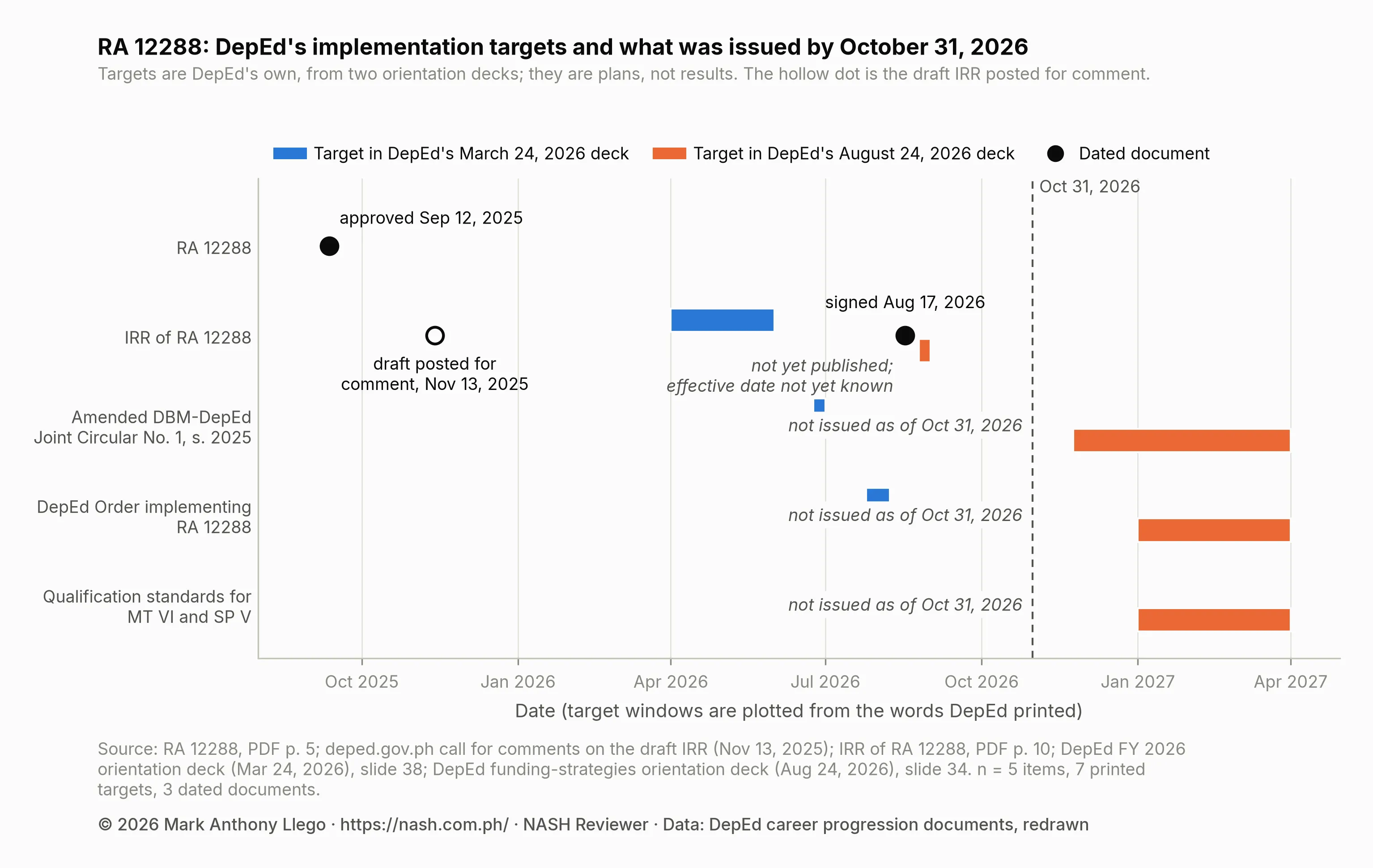
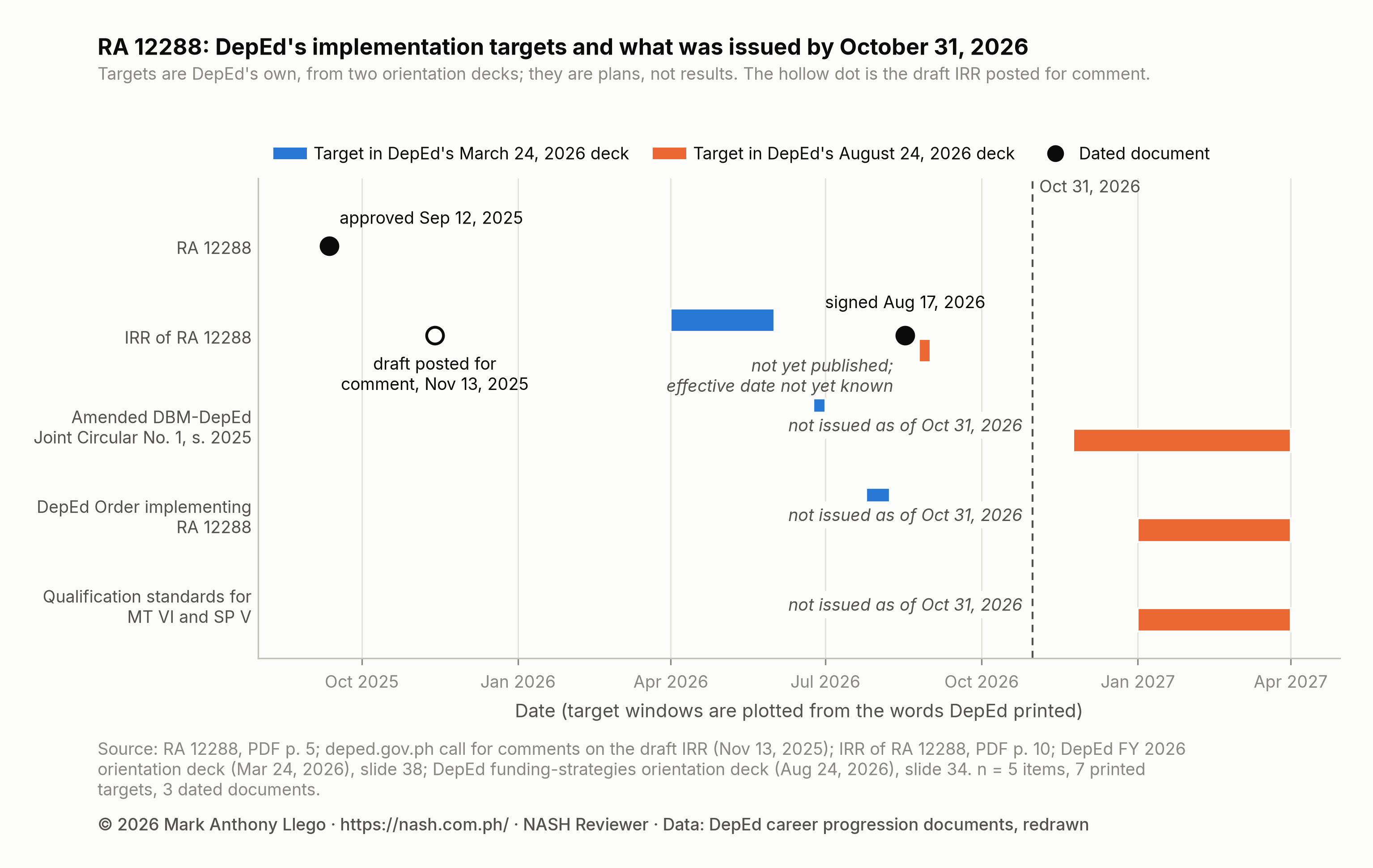
DepEd’s own decks list what must follow the IRR. Their targets are plans, not results.
| Deliverable | March 24, 2026 deck target | August 24, 2026 deck target | Status on October 31, 2026 |
|---|---|---|---|
| IRR of RA 12288 | “April or May 2026” | “Last Week of August 2026”, for “Issuance and Publication” | Signed August 17, 2026; not yet published; effective date not yet known |
| Amended DBM-DepEd Joint Circular No. 1, s. 2025 | “Last week of June 2026” | “Last Week of November 2026/Q1 of 2027” | Not issued |
| DepEd Order implementing RA 12288 | “Last week of July or first week of August 2026” | “Q1 of 2027” | Not issued |
| Qualification standards for School Principal V and Master Teacher VI | Not listed | “Q1 of 2027” | Not issued |
Sources: DepEd orientation deck on FY 2026 reclassification, March 24, 2026, slide 38; DepEd orientation deck on funding strategies, August 24, 2026, slide 34.
Two more points complete the picture:
- The IRR sets windows, not dates. “Within six (6) months from the issuance of this IRR, the DepEd may issue additional guidelines” on the head teachers’ options (Sec. 8); “may” is not “shall”. The agencies’ deliverables, including DBM’s creation of the new titles and CSC’s approval of standards, are due “within six (6) months from the effectivity of this IRR” (Sec. 16).
- DepEd has started a review, not an amendment. The August 2026 deck shows a July 24, 2026 memorandum asking for feedback on the review of DepEd’s hiring and promotion guidelines “In view of the enactment of Republic Act No. 12288”; a “Call for Responses” graphic beside it lists DO 024 and DO 034 among six orders under review (slide 34).
What “not yet operational” means. RA 12288 outranks DO 024, and Section 14 repeals inconsistent issuances. But no issuance yet says which parts of DO 024 are inconsistent. The IRR keeps DepEd’s guidelines and forms “insofar as they are not inconsistent with the provisions of R.A. 12288 and/or this IRR” (Sec. 14), and DepEd’s FY 2026 memorandum rests on the FY 2026 General Appropriations Act and EO 174, not RA 12288 (DM-OUHRODI-2026-0802, Sec. I). No court or CSC ruling has settled the question. In practice, every FY 2026 application is processed under DO 024 and DO 034.
A wider base: Teacher I to Master Teacher I
“The positions from Teacher I to Master Teacher I shall form the bases of the expanded career progression system. Promotions within the base positions shall be non-hierarchical”, based on merit, fitness, competence, qualifications and the professional standards. “Thereafter, a Master Teacher I may opt to pursue a career line in teaching or school administration” (Act, Sec. 5; repeated in IRR, Sec. 5).
Two things change. The base gains Master Teacher I. And “non-hierarchical” now comes from a law, without DO 024’s conditions. DO 024 already says “Promotion to higher positions shall be non-hierarchical; provided that the following conditions are met”, then bars jumping a career stage and promotions of more than three salary grades (Encl. No. 1, Sec. 20.a–b). The Act’s sentence covers only the base, and neither it nor the IRR mentions those two conditions.
Entry by prior learning. Entry “to any position within the base” is allowed in recognition of prior learning and experience, “Provided, That the qualification standards approved by the Civil Service Commission (CSC) are met and the indicators of the career stages of the professional standards are achieved as affirmed by the Teacher Education Council (TEC)” (Act, Sec. 5). The IRR lets such entrants apply “without any prohibition from applying to higher teaching or school administration positions” (Sec. 7). The standards still apply: under DO 019, s. 2025, Master Teacher I requires a master’s degree (qualification standards guide). And the TEC affirmation does not exist yet: DO 024 makes its Certificate of Competency route “Applicable only upon establishment of a system of recognition” by the TEC (Encl. No. 1, footnote 11).
The right-hand column below applies the Act’s text alone; DepEd’s guidelines will settle these questions.
| Question | Under DO 024 and DO 034 (FY 2026) | Under RA 12288’s text (pending DepEd’s guidelines) |
|---|---|---|
| Can a Teacher III (SG 13) go straight to Master Teacher I (SG 18)? | No: it skips Career Stage II and exceeds three salary grades (DO 024, Encl. No. 1, Sec. 20.a–b) | The Act does not bar it within the base; the standards and TEC affirmation still apply |
| What is the highest position a Teacher III can apply for this year? | Teacher VI (SG 16), if qualified | Not settled: neither the Act nor the IRR mentions a salary-grade limit |
| Can a Teacher II skip Teacher IV and apply for Teacher V? | Yes, if she meets the performance requirements of the stage’s entry position and of the position applied for (DepEd ECP FAQs, updated November 6, 2025, Q48) | Yes: both are base positions |
DepEd’s FAQ answers “No” to skipping a whole stage (Q11) and “Yes” to skipping the entry position of the next stage (Q48). Both answers follow DO 024. For the Teacher IV to VII process today, see how to be reclassified to Teacher IV to VII.
Master Teacher VI and School Principal V
The Act directs the DBM to “create the new teaching position titles of Teacher IV, Teacher V, Teacher VI, Teacher VII, Master Teacher V, Master Teacher VI, and School Principal V” (Sec. 5). Teacher IV to VII and Master Teacher V already exist under EO 174 (Sec. 5); Master Teacher VI and School Principal V are new, and Section 7 pairs them.
SG 23 is in the IRR, not the Act. The IRR’s table places both at SG 23, above Master Teacher V and School Principal IV at SG 22 (Sec. 5). A DepEd deck says “RA 12288 adds Master Teacher VI (SG 23) and School Principal V (SG 23)” (slide 3); the positions are in the Act, the grade in the IRR. No career progression document gives peso amounts for SG 23. The full ladder is in ECP salary grades for teachers, MTs and principals.
Nobody can apply for them yet. The CSC must approve qualification standards (IRR, Sec. 16), and DO 019, s. 2025 stops at Master Teacher V and School Principal IV; DepEd targets the new standards for “Q1 of 2027” (August 24, 2026 deck, slide 34). The DBM must create the titles (Act, Sec. 5), and no career progression document shows that it has. And the FY 2026 call stops at Master Teacher V and School Principal IV (DM-OUHRODI-2026-0802, Sec. III.1).
How RA 12288 remaps PPST and PPSSH career stages
Each position is tied to a career stage of the Philippine Professional Standards for Teachers (PPST) or for School Heads (PPSSH), and the stage decides which indicators an applicant must show. EO 174 itself maps only Master Teacher I, to “Career Stage III (Highly Proficient)” (Sec. 2). DO 024 maps the rest (Encl. No. 1, Secs. 21.b and 22.b, and Figure 1). The IRR prints a different map (Sec. 6).
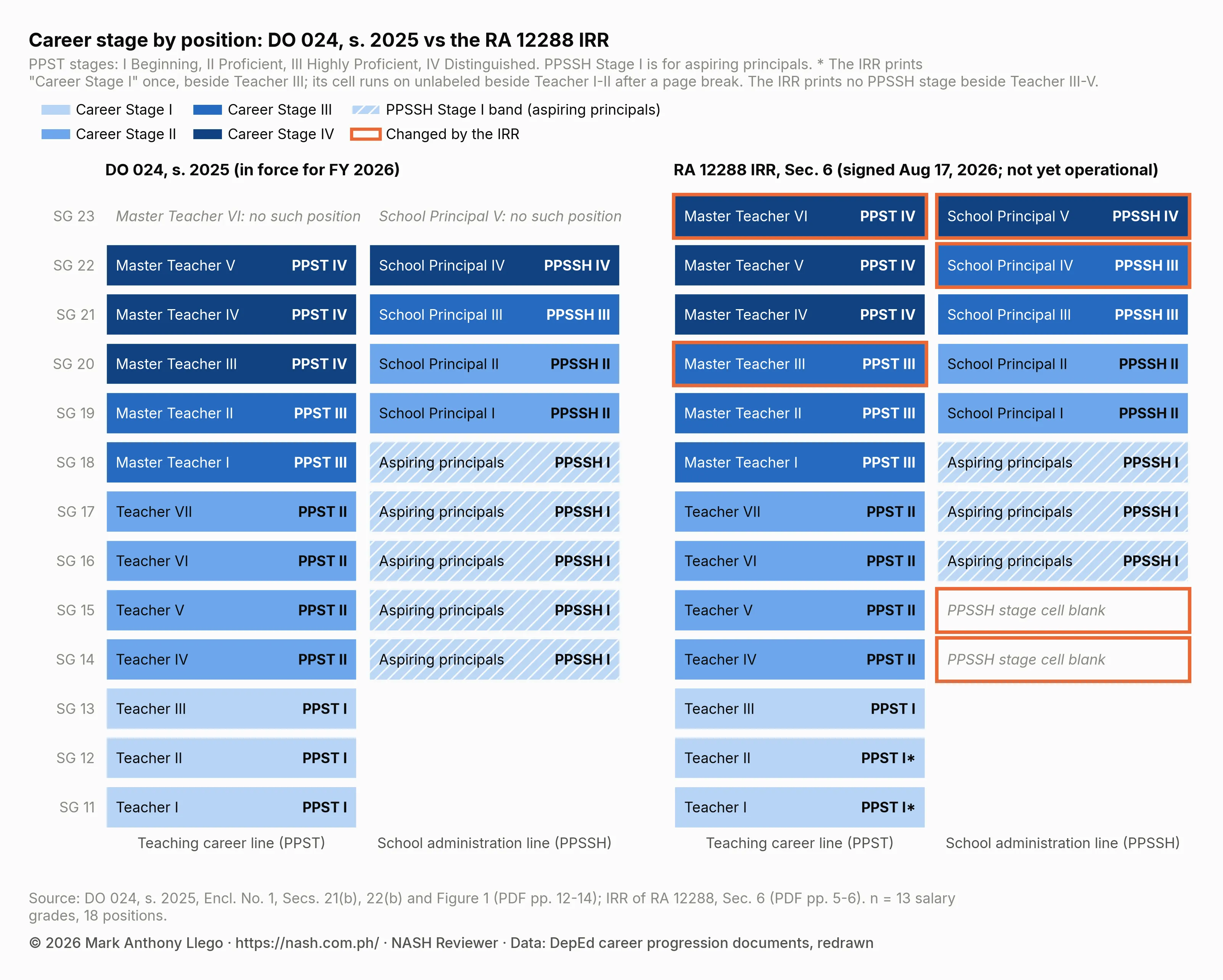
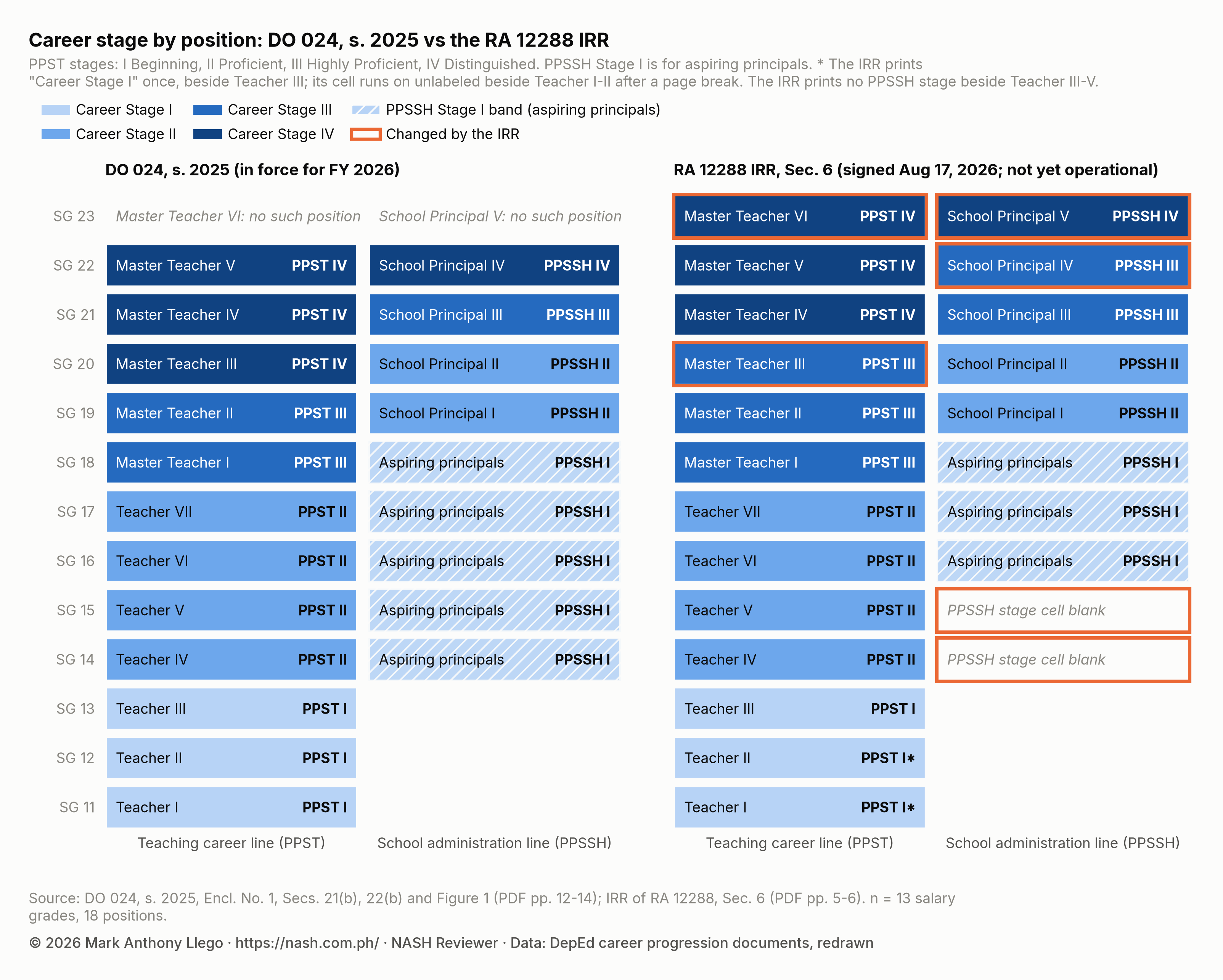
| Position or band | DO 024, s. 2025 | IRR of RA 12288, Sec. 6 |
|---|---|---|
| Master Teacher III | PPST Stage IV (Distinguished) | PPST Stage III (Highly Proficient) |
| Master Teacher VI | Does not exist | PPST Stage IV |
| School Principal IV | PPSSH Stage IV | PPSSH Stage III |
| School Principal V | Does not exist | PPSSH Stage IV |
| PPSSH Stage I (aspiring principals) | Teacher IV to Master Teacher I (Figure 1) | Teacher VI, Teacher VII and Master Teacher I |
Every other position keeps its stage. DepEd’s deck summarizes the change: “MT III moves to Career Stage III (Highly Proficient), while MT IV–VI are placed under Career Stage IV (Distinguished)” (slide 4).
Why it matters. The stage boundary moves. Under DO 024, Master Teacher II to III crosses into Stage IV and III to IV stays inside it. Under the IRR, II to III stays in Stage III and III to IV crosses into Stage IV. On the school administration line, School Principal III to IV becomes a move within PPSSH Stage III.
What applies now. DO 024’s map governs FY 2026 applications. DepEd’s multi-year performance memorandum is not consistent on Master Teacher III: its Table 2 (para. 11) classes “Master Teachers III-V” as Distinguished, and para. 15 lists Master Teacher III, IV and V there, but its classroom-observation rubric puts “Master Teachers I-III” at Highly Proficient and IV–V at Distinguished (Table 10, para. 44), and so does its transmutation table (Table 13, para. 76) (DepEd Memorandum No. 089, s. 2025, PDF pp. 7–8, 14–15 and 20). The rubric tables match the IRR’s map, not DO 024’s. Once the IRR takes effect, “All ongoing reclassification assessments prior to the effectivity of this IRR shall remain valid and effective and shall continue to be governed by prior laws, rules, and issuances” (IRR, Sec. 17). The 2026 special assessment for Master Teacher III applicants is in how to become a Master Teacher.
Head teachers may keep their positions
“All incumbent head teachers may apply to retain their positions and Career Progression Line under the Current Career Progression, or otherwise apply for reclassification or retitling of their current position” (Act, Sec. 6). They file “within three (3) years from the effectivity of this Act”. DepEd lists those who retain, “No new item or position under the Current Career Progression for incumbent head teachers shall be created hereafter”, and those reclassified or retitled “can no longer revert to the previous Career Progression Line.” The IRR extends the options to Assistant School Principals, Special School Principals and Assistant Special School Principals (Sec. 8) and lets those who retain request retitling “any time within the three (3) year transition period” (Sec. 12).
The conflict with DO 024. DO 024 says Assistant School Principal II–III and Head Teacher VI incumbents “shall be retitled to the appropriate position in the ECP System” (Encl. No. 1, Sec. 34.b), and tags other retained positions coterminous with the incumbent (CTI) after the EO 174 transition (Sec. 34.b–c). DepEd’s FAQ, issued after the Act, still says: “The position will be tagged as Coterminous with the Incumbent (CTI)” (DepEd ECP FAQs, updated November 6, 2025, Q31). The Act gives every head teacher the choice and says nothing of CTI tagging; neither does the IRR. The Act takes effect on its own terms, without waiting for the IRR (Sec. 15), and it outranks DO 024: its three-year filing window and its bar on new head teacher items run from the Act’s effectivity. What is missing is DepEd’s list of those who retain and the guidelines for exercising the choice (Act, Sec. 6; IRR, Secs. 8 and 16). Whether CTI tagging survives, no issuance says.
The IRR contradicts itself. Section 8.a says those who retain “shall follow their respective Career Progression Line under the current Career Progression system provided by Executive Order (E.O.) No. 174 series of 2022”. Section 10 says they “shall be covered by the ECP System.” The Act’s text points one way: the “Current Career Progression” is the set of lines “existing and implemented prior to the effectivity of this Act” (Sec. 3.d), and retaining head teachers are outside the expanded system (Sec. 6). As the Act outranks its IRR, its text should prevail, but no issuance has yet resolved the point.
Retitling continues in 2026, even in the 11 deficit regions, because DepEd’s August 2026 memorandum exempts “retitling actions, which do not involve salary adjustments” from the deferral (DM-OUHRODI-2026-2789, Sec. III.A). The options by group are in Head Teacher retitling: options under ECP and RA 12288.
The Standards-Based Assessment and the Teacher Education Council
The Standards-Based Assessment is “a competency-based assessment involving appropriate evaluation processes to assess the competencies of teachers and school leaders, which shall be required as a prerequisite to their promotion and increase in salary, as the case may be” (Act, Sec. 3.i). Section 9 sets its frame:
- The teaching line considers “subject area and pedagogical knowledge”, and “In no case shall promotion in the Teaching Career Line be based on arbitrary criteria such as the proportion of learners who achieve curricular expectations.”
- The school administration line considers “organizational and managerial effectiveness, in terms of productivity, performance, utility, efficiency”.
- “The DepEd shall formulate clear guidelines on assessing teachers and school leaders seeking promotion.”
- “The assessment process, criteria, and point system, as well as the Standards-Based Assessment of each teacher and school leader, shall be made available to the public”. DepEd “may” have a third party run it.
Those who fail “for two (2) successive assessments” must take a free NEAP support program (Act, Sec. 10; IRR, Sec. 15). And every teacher who follows the expanded system “shall undertake a mandatory transition program to be developed by the National Educators Academy of the Philippines (NEAP)” (Act, Sec. 6; IRR, Secs. 11 and 16).
The TEC. Under the Act, the TEC affirms career-stage indicators for entry into the base and helps harmonize qualification standards (Sec. 5). The IRR goes further: “Advancement in the teaching career or school administration line shall be subject to the necessary assessment and affirmation of career stages by the Teacher Education Council (TEC)” (Sec. 6). A DepEd deck notes that under EO 174 the TEC was “Not given the same explicit career-stage affirmation role” (slide 5).
None of this exists yet. As of October 31, 2026, there were no Standards-Based Assessment guidelines, no DepEd assessment guidelines under Section 9, no NEAP transition program and no TEC recognition system. For principals, DepEd’s FY 2026 memorandum says “career stage-based promotion through reclassification or natural vacancy, shall not yet be implemented” until a TEC system or PPSSH-based performance forms are issued (DM-OUHRODI-2026-0802, Sec. V.4). DepEd has not said whether the NASH or something new will serve as the Standards-Based Assessment. Until DepEd decides, applicants are scored under DO 024’s point systems (the ECP point system).
A new transition period, and three clocks
EO 174’s transition runs from “February 25, 2025, and shall end on February 24, 2028” (DO 024, Encl. No. 1, Sec. 31), and DO 034’s relaxed performance requirements are “strictly limited to the three-year transition period” (para. 33). The IRR starts a second period: “The transition period shall be three (3) years, reckoned from the effectivity of this IRR”, which DepEd may extend, but “the extended period shall in no case exceed two (2) years” (Sec. 17). The IRR’s effective date is not yet known, so this period cannot yet be dated, and it may not have started; it cannot have started before September 16, 2026 (signing plus 30 days). A DepEd deck gives a “reckoning date” of September 23, 2026 (slide 6), but that date is printed in no issuance.
The head teachers’ filing window runs on a third clock: three years from the Act’s effectivity (Act, Sec. 6; IRR, Sec. 9). It cannot close before late September 2028.
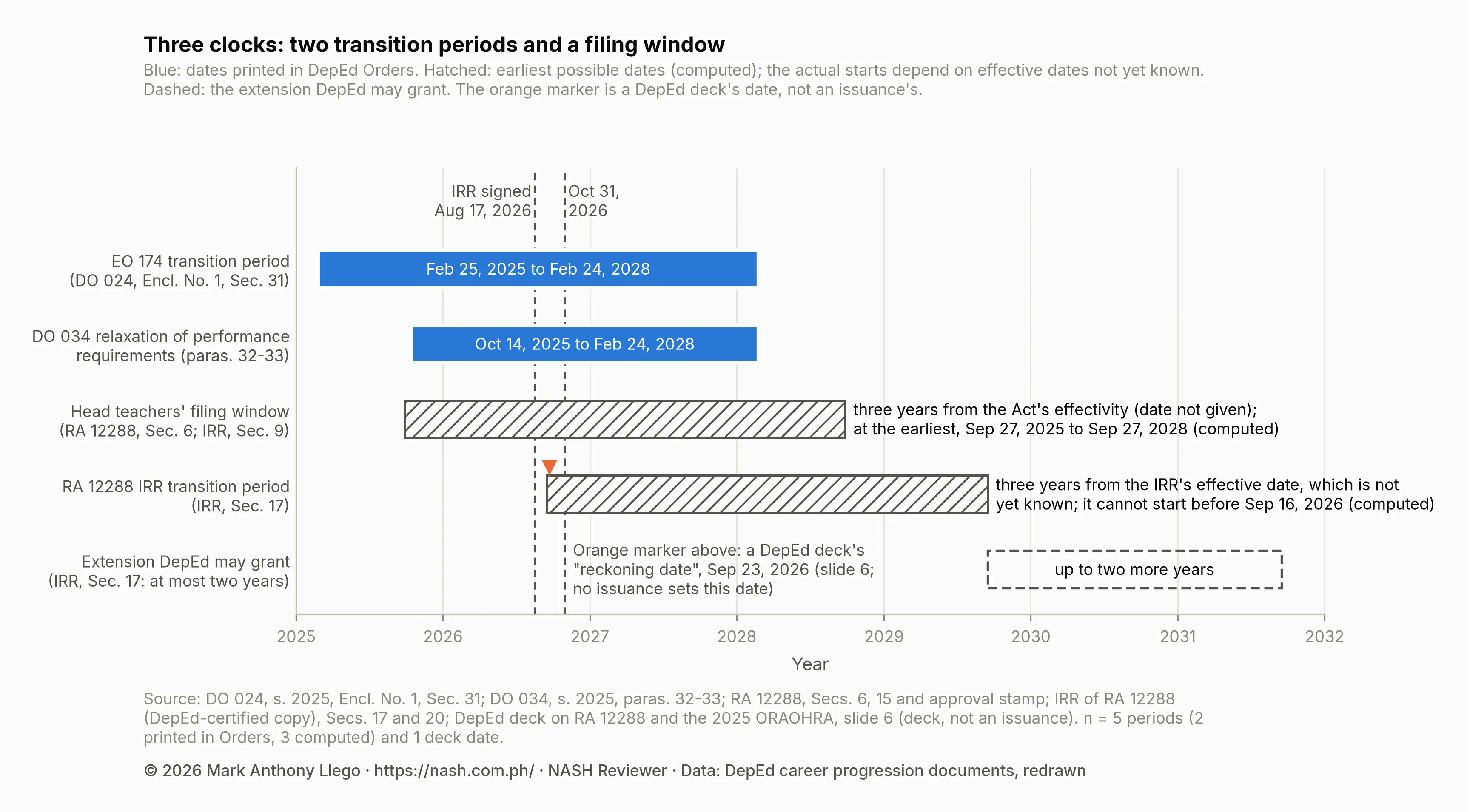
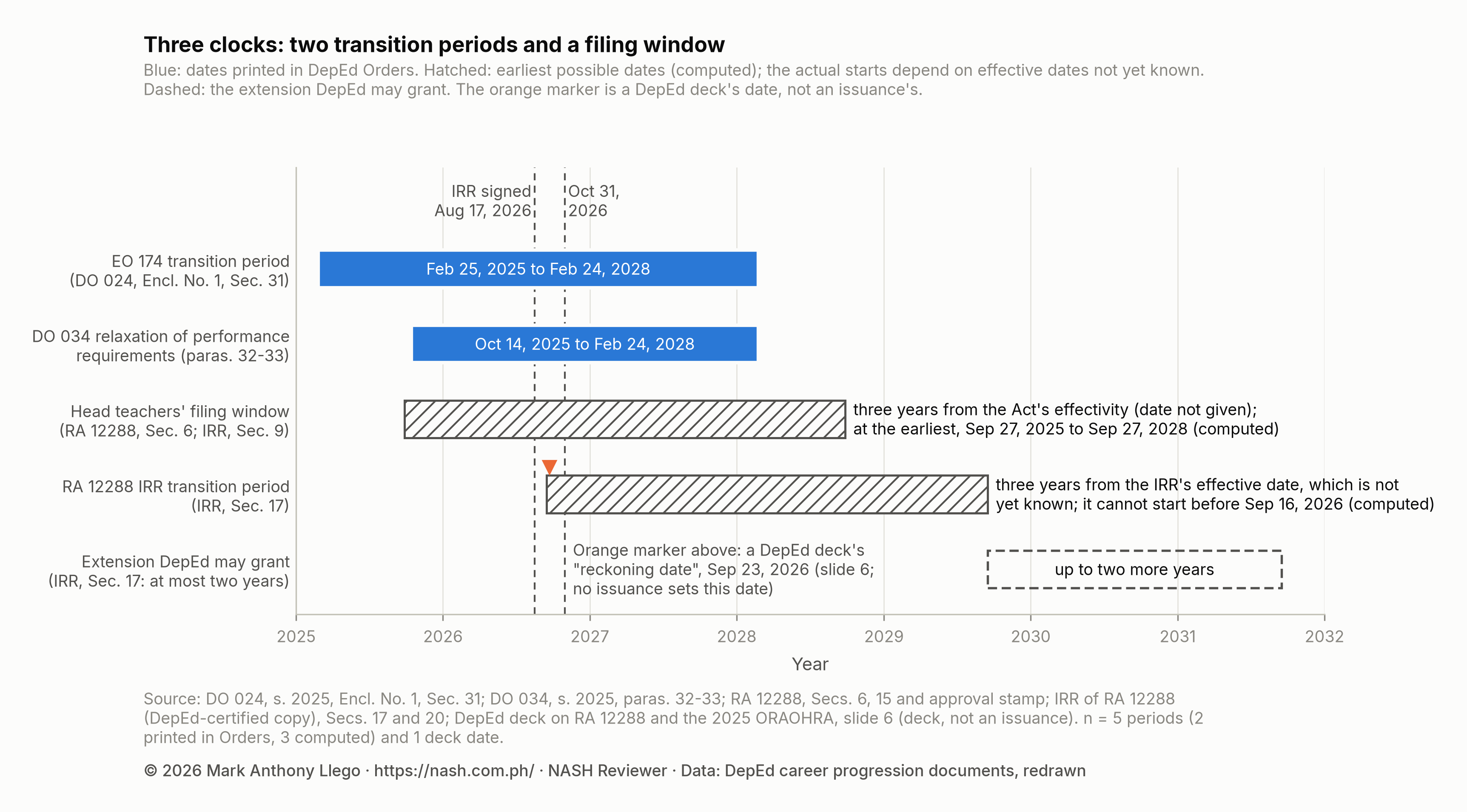
The deck says “The 3-year transition period in EO 174 has been reset” (slide 6). No issuance says so, and DO 034’s February 24, 2028 end date has not been amended. Until DepEd says otherwise, treat February 24, 2028 as the deadline for anything that depends on the EO 174 transition.
Where DO 024 and RA 12288 conflict, and which governs
A law outranks an executive order, which outranks its IRR and DepEd’s orders; decks and FAQs rank below all of them. The IRR implements the law and is later than DO 024. But DepEd has not yet said which provisions of DO 024 are inconsistent with the Act, so the table gives both texts and what applies on October 31, 2026.
| Point | DO 024, DO 034 and the FAQ | RA 12288 and its IRR | What applies on October 31, 2026 |
|---|---|---|---|
| Skipping career stages | “Under no circumstance shall an applicant be allowed to jump to higher career stage/s for promotion without progressing through each of the career stages” (DO 024, Encl. No. 1, Sec. 20.a); FAQ Q11: “No” | Promotion within the base “shall be non-hierarchical” (Act, Sec. 5) | DO 024’s rule for teachers. For principals, DepEd’s FY 2026 memorandum suspends stage-based promotion (DM-OUHRODI-2026-0802, Sec. V.4). Once the IRR takes effect, Sec. 20.a survives only insofar as consistent with the Act (IRR, Sec. 14) |
| Three-salary-grade limit | Promotion “shall not exceed three (3) salary grades higher than the applicant’s present position” (DO 024, Encl. No. 1, Sec. 20.b; DO 034, para. 28) | Not mentioned | DO 024’s limit, a DepEd rule that the Act neither adopts nor removes |
| Career-stage mapping | MT III Stage IV; SP IV PPSSH Stage IV (DO 024, Encl. No. 1, Secs. 21.b, 22.b) | MT III Stage III; SP IV PPSSH Stage III (IRR, Sec. 6) | DO 024’s map; once the IRR takes effect, assessments already under way stay under prior rules (IRR, Sec. 17) |
| Switching lines | “shall be allowed once” (DO 024, Encl. No. 1, Sec. 24); EO 174 sets no limit (Sec. 6) | No rule; a Master Teacher I “may opt” (Act, Sec. 5) | DO 024’s “once”, a DepEd limit no higher text states; it stands until DepEd amends it |
| Head teachers | HT VI and ASP II–III “shall be retitled”; CTI tagging (DO 024, Encl. No. 1, Sec. 34; FAQ Q31) | “may apply to retain”; no new items (Act, Sec. 6) | DO 024’s retitling is still processed; the Act’s right to retain stands, and its clock runs from the Act’s effectivity, but DepEd has issued no list or guidelines to exercise it |
| Incumbent principals | “shall no longer be required to pass the school head assessment” for higher SP posts (DO 034, para. 16) | The assessment is “a prerequisite to their promotion” (Act, Sec. 3.i) | DO 034’s exemption; the tension arises once a Standards-Based Assessment exists |
| Part-time teachers | DO 024 covers permanent appointments (Encl. No. 1, Sec. 12) | The Act’s “Teacher” includes those on “full- or part-time basis” (Sec. 3.j), but the IRR excludes “Part-Time Teachers” (Sec. 3.h) | The IRR narrows the Act’s definition, which an IRR should not do, but no ruling has settled it, and DO 024 covers permanent appointments only |
What stays the same for 2026 applicants
- The call covers Teacher II to VII, Master Teacher I to V and School Principal I to IV (DM-OUHRODI-2026-0802, Sec. III.1).
- The standards are those of DO 019, s. 2025, and the point systems those of DO 024.
- The limits stay: for teachers, no jumping a career stage (for principals, DM-OUHRODI-2026-0802 suspends stage-based promotion, Sec. V.4); at most three salary grades unless a CSC exemption applies; and one switch of line (DO 024, Encl. No. 1, Secs. 20 and 24).
- The queue stays. Qualified 50-point candidates not reclassified “due to budgetary constraints shall be automatically prioritized in the succeeding fiscal year”, without a new assessment, subject to funds (DO 034, para. 26).
- Ongoing assessments. When the IRR takes effect, assessments already under way “shall remain valid and effective and shall continue to be governed by prior laws, rules, and issuances, unless the concerned personnel opts to withdraw his/her existing application” (IRR, Sec. 17). DepEd gives no advice on withdrawing; doing so to wait for RA 12288’s rules would trade a place in the queue for rules not yet written.
FY 2026 deadlines are in the school head’s role in ECP reclassification, and the 2026 deferral in why ECP reclassification was deferred.
What this means for school heads
Teachers will ask about RA 12288, often after a social media post that treats it as already in force.
- Say which rules apply. FY 2026 runs under DO 024, DO 034 and DO 019, s. 2025, up to Master Teacher V and School Principal IV.
- Do not promise MT VI, SP V or SG 23. They need CSC-approved standards, position titles created by the DBM and DepEd guidelines; DepEd’s own target is the first quarter of 2027.
- Do not advise skipping a career stage this year. Help a teacher find the highest position she qualifies for within DO 024’s limits, and plan the PPST indicators for the next.
- Keep the records both systems use: IPCRFs with the indicators rated, classroom observation results, the Teacher’s Commitment Forms you noted under DO 034 (para. 29), and training and degree records.
- Let head teachers decide. Explain that the Act lets them retain or seek reclassification or retitling, that retitled head teachers “can no longer revert”, and that the deadline runs from the Act’s effectivity.
- Keep pass rates out of endorsements. The Act bars promotion in the teaching line “based on arbitrary criteria such as the proportion of learners who achieve curricular expectations” (Sec. 9).
| A school head may | A school head may not |
|---|---|
| Explain RA 12288’s changes and that they are not yet operational | Tell a teacher she can apply for MT VI or SP V, or skip a career stage, in the FY 2026 call |
| Help teachers plan PPST indicators for the next stage | Advise a teacher to withdraw an application under assessment to wait for new rules |
| Explain head teachers’ options under DO 024 and the Act | Require a head teacher to retitle, or say retention is no longer possible |
| Explain how the IRR defines school leaders | Present a teacher-in-charge as a “school leader” under the IRR, which says a designated TIC “shall not be considered a school leader” (Sec. 4.o) |
Indicator 4.4.2 of PPSSH Domain 4 asks school heads to “support the career advancement of school personnel”. See also human resource management for school heads, principal, head teacher or teacher-in-charge and, on how RA 12288 ties school leaders’ promotion to the professional standards, from NCBS-SH to the PPSSH.
How the NASH may test this
The two items below are original practice items, scored 3 (Relational), 2 (Multistructural), 1 (Unistructural) or 0 (Prestructural). An option that breaks a rule scores 0.
Question 1
Indicator 4.7.1, General welfare of human resources. Career Stage 1, Conceptual, Moderate.
In October 2026, a Master Teacher V asks whether she can apply for Master Teacher VI in the division’s FY 2026 reclassification call. She has read that Republic Act No. 12288 created the position and that its implementing rules, signed in August 2026, place it at Salary Grade 23. Which statement best reflects the rules that apply to her request?
- A. She cannot apply this cycle. The Act created the title and the IRR sets SG 23, but Master Teacher VI still needs CSC-approved standards, a title created by the DBM and DepEd guidelines, and the FY 2026 call stops at Master Teacher V.
- B. She cannot apply this cycle, because DepEd’s FY 2026 call covers positions only up to Master Teacher V and School Principal IV, so she should keep her IPCRFs and training records ready for a later call.
- C. Master Teacher VI is a new position under RA 12288, and the law makes it equivalent to School Principal V in all salaries, benefits and other privileges, so the two positions will be paid alike.
- D. She may apply now. RA 12288 is a law that outranks DepEd’s orders, and its IRR has already placed Master Teacher VI at Salary Grade 23, so the division must accept her application.
Answer and explanation
Best answer: A. Points: A = 3, B = 2, C = 1, D = 0.
- A (3 points, Relational). It connects the law, the IRR, the missing standards and titles, and the FY 2026 call into one accurate answer.
- B (2 points, Multistructural). The answer and the advice are right, but it does not explain why Master Teacher VI is closed.
- C (1 point, Unistructural). It states one true element of the law but does not answer whether she can apply.
- D (0 points, Prestructural). It treats a law DepEd has not implemented as the rule in schools and sends an application the FY 2026 call does not allow.
Why. This aligns with Career Stage 1 expectations because indicator 4.7.1 asks the aspiring school head to know the laws and issuances on personnel’s rights, privileges and benefits. RA 12288 adds Master Teacher VI and makes it equivalent to School Principal V (Secs. 5 and 7), and the IRR sets both at SG 23 (Sec. 5). The CSC must approve their standards and the DBM must create the titles (IRR, Sec. 16); DepEd targets the standards for “Q1 of 2027”. The FY 2026 memorandum covers “Teacher II–VII; Master Teacher I–V; School Principal I–IV” (DM-OUHRODI-2026-0802, Sec. III.1).
Indicator 4.7.1: Display knowledge of laws, policies, guidelines and issuances on the rights, privileges and benefits of school personnel to promote their general welfare.
Sources: Republic Act No. 12288, Secs. 5 and 7; IRR of RA 12288, Secs. 5 and 16; DM-OUHRODI-2026-0802, Sec. III.1; DepEd orientation deck on funding strategies, August 24, 2026, slide 34.
Question 2
Indicator 4.4.2, Performance management. Career Stage 2, Situational, Moderate.
You are the principal of an elementary school. A Teacher III with eight years of teaching, a master’s degree, the required training and Outstanding ratings in her last three IPCRFs asks you to support her application for Master Teacher I in the division’s FY 2026 reclassification call. She says RA 12288 made promotion from Teacher I to Master Teacher I “non-hierarchical”, so she need not pass through Teacher IV to VII. What is the most appropriate action?
- A. Explain that FY 2026 runs under DO 024 and DO 034, which bar skipping a career stage and promotion beyond three salary grades; help her apply for a Teacher IV to VI position she qualifies for and plan the indicators she needs next.
- B. Explain that FY 2026 runs under DO 024 and DO 034 and that Master Teacher I is beyond her reach this year, and advise her to wait for DepEd’s RA 12288 guidelines before applying for any position.
- C. Tell her that she cannot apply for Master Teacher I this year because DO 024 does not allow a teacher to skip a career stage, and leave the choice of another position to her and the division office.
- D. Support her Master Teacher I application in writing, since RA 12288 is a law that outranks DO 024 and makes promotion within the base from Teacher I to Master Teacher I non-hierarchical.
Answer and explanation
Best answer: A. Points: A = 3, B = 2, C = 1, D = 0.
- A (3 points, Relational). It applies the rules in force, finds the route open to her this year, and links her performance plan to the next promotion.
- B (2 points, Multistructural). The rules and the outcome are right, but waiting costs her a cycle in which she could apply for Teacher IV to VI.
- C (1 point, Unistructural). It states one correct rule but gives her no route and no support.
- D (0 points, Prestructural). It endorses an application that DO 024’s stage rule and salary-grade limit bar, on the strength of a law DepEd has not implemented.
Why. This aligns with Career Stage 2 expectations because indicator 4.4.2 asks the school head to use the performance management system to support the career advancement of school personnel. DO 024 bars jumping “to higher career stage/s”, and promotion “shall not exceed three (3) salary grades higher than the applicant’s present position” (Encl. No. 1, Sec. 20.a–b). Teacher III is SG 13, Teacher IV to VI are SG 14 to 16, and Master Teacher I is SG 18 (Sec. 12). RA 12288’s non-hierarchical base (Sec. 5) waits for DepEd’s guidelines, and FY 2026 applications run under DO 024 and DO 034 (DM-OUHRODI-2026-0802, Sec. III.1).
Indicator 4.4.2: Implement the performance management system with a team to support the career advancement of school personnel, and to improve office performance.
Sources: DepEd Order No. 024, s. 2025, Encl. No. 1, Secs. 12 and 20; DepEd Order No. 034, s. 2025, para. 28; Republic Act No. 12288, Sec. 5; DM-OUHRODI-2026-0802, Sec. III.1.
Nothing in this guide reproduces or predicts examination content.
Frequently asked questions
Is RA 12288 already in effect?
It is law: approved on September 12, 2025, and in effect 15 days after publication (Sec. 15), but no career progression document gives the publication date. Its IRR, signed August 17, 2026, takes effect 30 days after newspaper publication and filing with the Office of the National Administrative Register (IRR, Sec. 20); as of October 31, 2026, the IRR had not been published in the Official Gazette or on deped.gov.ph, so its effective date is not yet known. No DepEd order implements it, so FY 2026 reclassification runs under DO 024 and DO 034, s. 2025.
Can I apply for Master Teacher VI or School Principal V now?
No. The IRR places both at SG 23 (Sec. 5), but there are no CSC-approved qualification standards for them, and the FY 2026 call stops at Master Teacher V and School Principal IV (DM-OUHRODI-2026-0802, Sec. III.1). DepEd targets the standards for the first quarter of 2027 (August 24, 2026 deck, slide 34).
Can a Teacher I now be promoted directly to Master Teacher I?
Not in 2026. RA 12288 makes Teacher I to Master Teacher I a non-hierarchical base (Sec. 5), but DepEd has issued no guidelines under it. DO 024 still bars jumping a career stage and promotions of more than three salary grades (Encl. No. 1, Sec. 20), and Master Teacher I requires a master’s degree under DO 019, s. 2025.
Do head teachers have to give up their title under RA 12288?
No. “All incumbent head teachers may apply to retain their positions”, or apply for reclassification or retitling, within three years from the Act’s effectivity (Sec. 6). DO 024 still says Head Teacher VI and Assistant School Principal II–III “shall be retitled” (Encl. No. 1, Sec. 34.b). The Act prevails over DO 024, and the filing window runs from the Act’s effectivity, but DepEd has not yet issued the list or guidelines for exercising the choice.
When does the RA 12288 transition period end?
Three years after the IRR takes effect, plus at most two years if DepEd extends it (IRR, Sec. 17). Its effective date is not yet known, so no end date can be given. The EO 174 transition, and DO 034’s relaxed performance requirements, still end on February 24, 2028 (DO 024, Encl. No. 1, Sec. 31; DO 034, para. 33).
Download the data
- ra12288-career-stage-map.csv: the PPST and PPSSH career stage of each position from Teacher I to Master Teacher VI and School Principal I to V, under DO 024, s. 2025 and under the IRR of RA 12288, with blank PPSSH cells, the Teacher I–II cell carried over the page break, and non-existent positions marked (DO 024, Encl. No. 1, Secs. 21.b, 22.b and Figure 1; IRR of RA 12288, Sec. 6).
- ra12288-implementation-targets.csv: DepEd’s printed targets for the IRR, the amended Joint Circular, a DepEd Order and the MT VI and SP V standards, the three dated documents, each item’s status on October 31, 2026, and the plotted windows (DepEd orientation decks of March 24 and August 24, 2026; RA 12288; IRR of RA 12288).
- ra12288-transition-clocks.csv: start and end dates of the EO 174 transition and DO 034’s relaxation (printed), the earliest possible dates of the head teachers’ filing window and the RA 12288 transition (computed), and a deck’s “reckoning date” marked as the deck’s (DO 024, Encl. No. 1, Sec. 31; DO 034, paras. 32–33; RA 12288, Secs. 6 and 15; IRR of RA 12288, Secs. 17 and 20; DepEd deck on RA 12288, slide 6).
The CSVs and charts may be reused only with written permission: email support@nash.com.ph. The rules themselves come from DepEd’s issuances, which you can cite directly.
Sources
- Republic Act No. 12288, An Act Institutionalizing the Career Progression System for Public School Teachers and School Leaders and Appropriating Funds Therefor, approved September 12, 2025, Secs. 3.d, 3.h–j, 4–12, 14–15 and approval page. Also on Lawphil.
- Implementing Rules and Regulations of Republic Act No. 12288, “Done this 17th day of August 2026”; DepEd-certified copy (certified August 24, 2026) in DepEd’s career progression toolkit folder, shared through DM-OUHROD-2025-3003; not yet published as of October 31, 2026; Secs. 3–12, 14–17 and 20 (PDF pp. 1–10).
- DepEd, Call for Submission on Inputs and Comments on the Draft IRR of RA 12288, November 13, 2025 (a draft, not in force).
- Executive Order No. 174, s. 2022, Establishing the Expanded Career Progression System for Public School Teachers, June 23, 2022, Secs. 2 and 4–6.
- DepEd Order No. 024, s. 2025, Guidelines on the Implementation of the Expanded Career Progression System for Teachers and School Heads in the Department of Education, August 28, 2025, Encl. No. 1, Secs. 12, 20–25, 31 and 34, Figure 1 and footnote 11 (PDF pp. 5, 12–14, 17–21).
- DepEd Order No. 034, s. 2025, Amendments and Clarifications to DepEd Order No. 024, s. 2025, October 14, 2025, paras. 7, 16, 26, 28–29 and 32–33.
- DepEd Order No. 019, s. 2025, Amended Qualification Standards for Teacher I–III, Master Teacher I–IV and School Principal I–IV Positions, and the Qualification Standards for Newly Created Teacher IV–VII and Master Teacher V Positions, June 24, 2025.
- DepEd Memorandum No. 089, s. 2025, Guidelines on the Multi-Year Performance Management and Evaluation System for Teachers from School Years 2025–2026 to 2027–2028, October 1, 2025, paras. 11, 15, 44 and 76, Tables 2, 10 and 13 (PDF pp. 7–8, 14–15 and 20).
- DM-OUHRODI-2026-0802, Guidance on the Reclassification of Teaching and School Principal Positions for Fiscal Year 2026, March 13, 2026, Secs. I, III.1 and V.4 (pp. 1, 3 and 6), as posted by SDO Nueva Vizcaya.
- DM-OUHRODI-2026-2789, Funding Strategies and Interim Policy Directions for the Continuous Implementation of the Expanded Career Progression (ECP) System, August 5, 2026, Sec. III.A (p. 4), a memorandum DepEd circulated to the field.
- DepEd ECP FAQs, Annex A to DM-OUHROD-2025-3003 (October 24, 2025), updated November 6, 2025, Q11 (p. 4), Q31 (p. 8) and Q48 (p. 13).
- DepEd, Virtual Orientation: Guidance on the Reclassification of Teaching and School Principal Positions for FY 2026 (deck), March 24, 2026, slide 38, in DepEd’s career progression toolkit folder, shared through DM-OUHROD-2025-3003.
- DepEd, Virtual Orientation: Guidance on the Funding Strategies and Interim Policy Directions for the Continuous Implementation of the ECP System (deck), August 24, 2026, slide 34, in the same folder.
- DepEd, Session 2: Policy Updates and New Provisions under RA No. 12288 and the 2025 ORAOHRA (deck, undated), slides 3–6.
- EDCOM II, Acidre welcomes IRR of teacher career progression law, September 17, 2026.
The career progression series
- DepEd Expanded Career Progression (ECP): The Full Guide
- How to Be Reclassified to Teacher IV to VII in DepEd
- How to Become a Master Teacher Under DepEd’s ECP
- ECP Salary Grades for Teachers, MTs and Principals
- ECP Qualification Standards Under DO 019, s. 2025
- ECP Point System: How the HRMPSB Scores Applicants
- School Principal I to IV: Promotion Under the ECP
- The School Head’s Role in ECP Reclassification
- Head Teacher Retitling: Options Under ECP and RA 12288
- Why ECP Reclassification Was Deferred in 2026
- What RA 12288 Changes in Teacher Career Progression (this post)
- Department Head, Assistant School Head and MT Duties
Written by Mark Anthony Llego for NASH Reviewer. Sources: RA 12288 and its IRR; EO 174, s. 2022; DepEd Orders No. 019, 024 and 034, s. 2025; DepEd Memorandum No. 089, s. 2025; DM-OUHRODI-2026-0802 and -2789; DepEd’s ECP FAQs and orientation decks. Charts may be reused only with written permission from support@nash.com.ph.