A DepEd teacher becomes Teacher IV, V, VI or VII (Salary Grades 14 to 17) through reclassification of position under DepEd Order No. 024, s. 2025, as amended by DepEd Order No. 034, s. 2025. You apply when your Schools Division Superintendent (SDS) issues the call, which must come out “not later than June 30 of the current year” (DO 024, Encl. No. 2, Sec. 2). You must meet the qualification standards (QS) of DepEd Order No. 019, s. 2025, hold at least a Very Satisfactory rating for your last full year in your current position, show the PPST indicators the target position requires, score at least 50 of 100 points, and fall within the year’s funds (DO 024, Encl. No. 2, Secs. 14.a, 34, 42 and 50). You may not rise more than three salary grades at once, so a Teacher III can reach Teacher VI but not Teacher VII (Encl. No. 1, Sec. 20.b).
For fiscal year (FY) 2026, Memorandum DM-OUHRODI-2026-0802 (March 13, 2026) had schools division offices (SDOs) endorse applications to regional offices (ROs) “on or before August 15”, and ROs submit them to the DBM regional office “not later than November 30”, with appointments “only within the period of January to March of the succeeding fiscal year” (Sec. III.3). On August 5, 2026, DM-OUHRODI-2026-2789 deferred pending applications in 11 regions that ran short of funds and moved them to FY 2027 funding (Sec. III.A). DepEd’s August 2026 timeline puts the next call at SDOs in January to June 2027 (Annex A).
Republic Act No. 12288 (approved September 12, 2025) will make Teacher I to Master Teacher I a single “non-hierarchical” base (Sec. 5). Its implementing rules were signed on August 17, 2026, but as of October 31, 2026, they had not been published in the Official Gazette or on deped.gov.ph, so their effective date is not yet known. No DepEd order implements the law yet, so FY 2026 reclassification still runs under DO 024 and DO 034. Below, “the FAQ” is DepEd’s official FAQ on the two Orders (Annex A to DM-OUHROD-2025-3003), cited by the question numbers of the version updated November 6, 2025 in DepEd’s career progression toolkit folder; the copy attached to the memorandum on deped.gov.ph is an earlier version numbered differently in places (its Q45 is Q48 here). “The toolkit” is the ECP System Toolkit for Teachers (2025). Both are guidance, not issuances.
Key findings
- Teacher IV to VII are SG 14 to 17, and you may rise at most three grades. Promotion “shall not exceed three (3) salary grades higher than the applicant’s present position” (DO 024, s. 2025, Encl. No. 1, Secs. 12 and 20.b). Teacher I can reach Teacher IV; Teacher II, Teacher V; Teacher III, Teacher VI (DepEd-DBM JC No. 01, s. 2025, Form No. 1-A).
- The QS: 3 or 4 years of teaching and 16 to 32 hours of recent training. Teacher IV and V need 3 years, Teacher VI and VII 4; training is 16, 24, 24 and 32 hours “acquired within the last 5 years”, or a NEAP Career Stage II program (DO 019, s. 2025, PDF pp. 14–15).
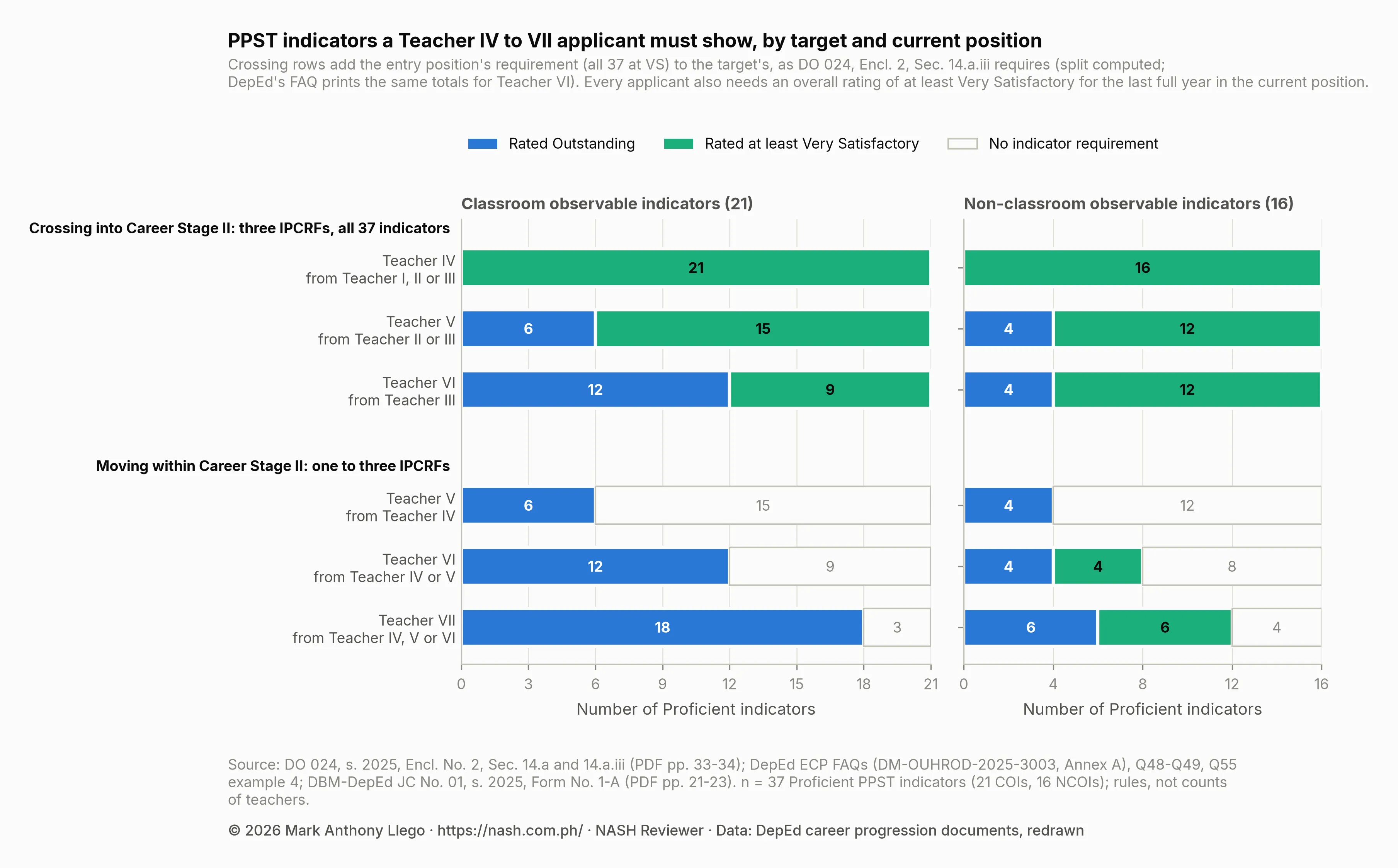
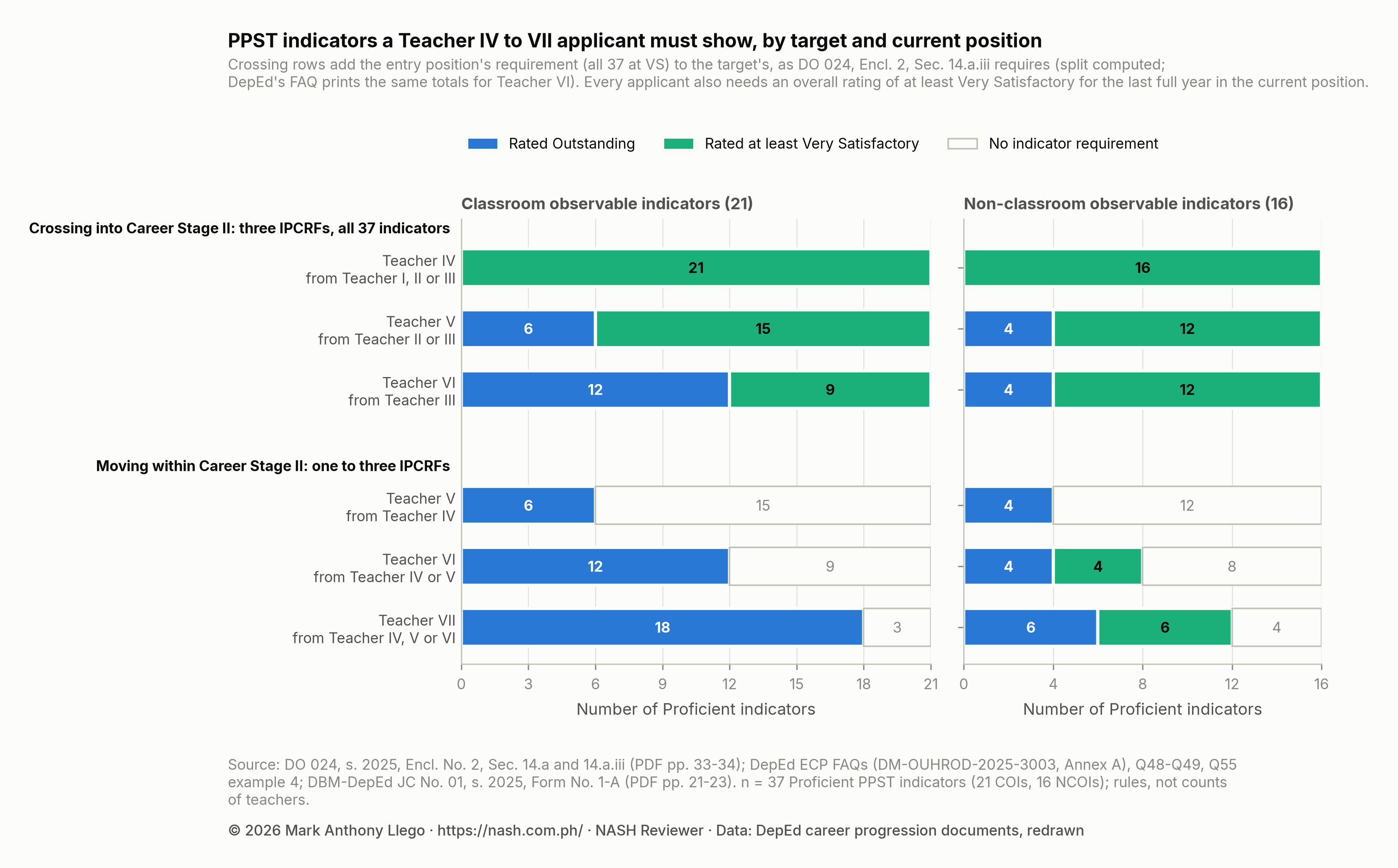
- Teacher IV needs all 37 Proficient indicators at Very Satisfactory, 21 classroom observable (COIs) and 16 non-classroom observable (NCOIs). Teacher V, VI and VII need at least 6, 12 and 18 COIs at Outstanding plus NCOIs (DO 024, Encl. No. 2, Sec. 14.a). A Teacher II or III aiming at Teacher V, or a Teacher III aiming at Teacher VI, must meet both sets, in three IPCRFs (Sec. 14.a.iii; FAQ, Q49).
- Until February 24, 2028, up to three indicators may be one level short, if you commit on a Teacher’s Commitment Form to improve them (DO 034, s. 2025, paras. 28–29 and 33; FAQ, Q56).
- The cut-off is 50 of 100 points. Funded slots go to those who reach it; unfunded qualifiers are “automatically prioritized in the succeeding fiscal year … without the need to undergo a new assessment” (DO 024, Encl. No. 2, Secs. 34 and 42; DO 034, para. 26).
- Applications without a NOSCA in 11 regions are deferred: CAR and Regions I, II, IV-B, V, VI, VII, IX, X, XI and XII, to be “prioritized for funding under the FY 2027 appropriations” (DM-OUHRODI-2026-2789, Sec. III.A).
- Pay starts at Step 1. Reclassified teachers “shall receive a salary rate equivalent to the 1st step of the new position” (JC No. 01, s. 2025, Sec. 7.6.1.1).
Teacher IV to VII: what the positions are
Executive Order No. 174, s. 2022 told DBM to “create the new position titles of Teacher IV, Teacher V, Teacher VI, Teacher VII, and Master Teacher V” (Sec. 5). DO 024 places them at SG 14 to 17 and in PPST Career Stage II, “Proficient” (Encl. No. 1, Secs. 12 and 21.b); the FAQ names Teacher IV the stage’s entry position (Q48). Teachers in these positions are rated at the Proficient stage, Classroom Observation Tool (COT) Levels 3 to 7 (DM-OSEC-OUHRODI-2026-0001, Sec. C).
DO 024 says teachers “shall be promoted primarily through reclassification of position; without precluding promotions through natural vacancy” (Encl. No. 1, Sec. 20). So there are three ways in: reclassification of your own item, the subject of this guide; a natural vacancy filled under DO 020, s. 2024 (Sec. 21.c.ii; FAQ, Q34); and retitling of Head Teacher I to IV to Teacher IV to VII at the same grade (Sec. 34), covered in Head Teacher Retitling: Options Under ECP and RA 12288.
Who can apply, and to which position
Reclassification “shall only apply to incumbents of teaching and school head positions” (DO 024, Encl. No. 2, Sec. 1): teachers “holding permanent appointments” from Kindergarten to Senior High School, including those handling ALS, Madrasah and Indigenous Peoples Education, and Special Science and Special Needs Education Teachers (Encl. No. 1, Sec. 12; DO 034, para. 6). It does not cover guidance coordinators and counselors, school farming coordinators, vocational instruction supervisors, school librarians, teachers in schools not managed by DepEd (such as PHSA, NAS, PSHS and SUC laboratory schools), or BARMM, which “may adopt” the Order (DO 034, para. 7). Your target depends on where you are now:
| Current position (SG) | You may apply for | Reason |
|---|---|---|
| Teacher I (11) | Teacher IV | SG 14 is the three-grade limit |
| Teacher II (12) | Teacher IV or V | SG 15 at most |
| Teacher III (13) | Teacher IV, V or VI | Teacher VII (SG 17) is four grades up |
| Teacher IV (14) | Teacher V, VI or VII | Within Career Stage II |
| Teacher V (15) | Teacher VI or VII | Within Career Stage II |
| Teacher VI (16) | Teacher VII | Within Career Stage II |
Sources: DO 024, s. 2025, Encl. No. 1, Secs. 12 and 20.b; DepEd-DBM JC No. 01, s. 2025, Form No. 1-A, “FROM” column (PDF pp. 21–23).
The three-grade limit comes from DepEd and DBM, not the Civil Service Commission. DO 024 sets it for promotion “whether through reclassification or natural vacancy”, except where “applicable exemptions granted by the CSC” apply (Encl. No. 1, Sec. 20.b), and the Joint Circular builds it into Form No. 1-A. DepEd’s FAQ also cites “Section 100 of 2025 ORAOHRA” (Q9). But the CSC’s 2025 Omnibus Rules on Appointments say the three-grade prohibition “shall not apply to” several actions, including “e. Reclassification of position” (CSC Resolution No. 2500358, Sec. 101, PDF p. 67). DO 024 and the Joint Circular are the sources of the limit for reclassification, and they bind you.
You cannot skip a career stage, but you can skip a stage’s entry position. “Under no circumstance shall an applicant be allowed to jump to higher career stage/s for promotion without progressing through each of the career stages” (DO 024, Encl. No. 1, Sec. 20.a). The FAQ answers “No” to skipping stages (Q11) and “Yes” to reaching any position in the next stage without the entry position, giving a Teacher II applying for Teacher V as its example (Q48). The two agree: Teacher I to III are Stage I, so Teacher V or VI is one stage up.
Applicants not rated on the teachers’ IPCRF may apply too. School Principals switching to the teaching line, Head Teachers and Assistant School Principals, and Teachers-in-Charge or Assistant School Head designates “who are not using the existing PPST-based IPCRF of teachers” are rated on “comparable performance requirements”: for Teacher IV to VII, “at least VS in the last three (3) immediately preceding rating periods, each covering one (1) year complete performance cycle” (DO 024, Encl. No. 2, Sec. 14.b), plus an assessment of both COIs and NCOIs (DO 034, para. 20).
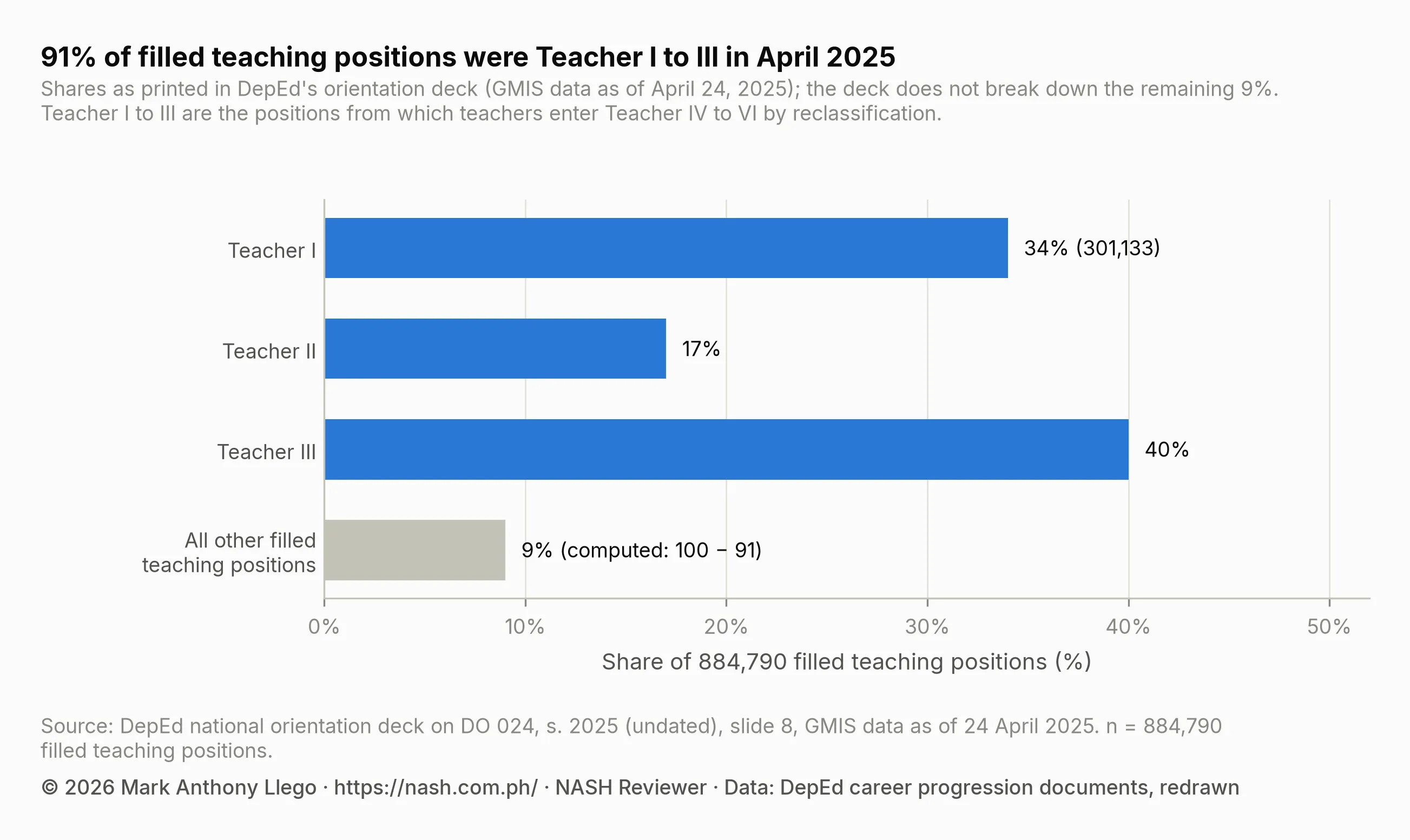
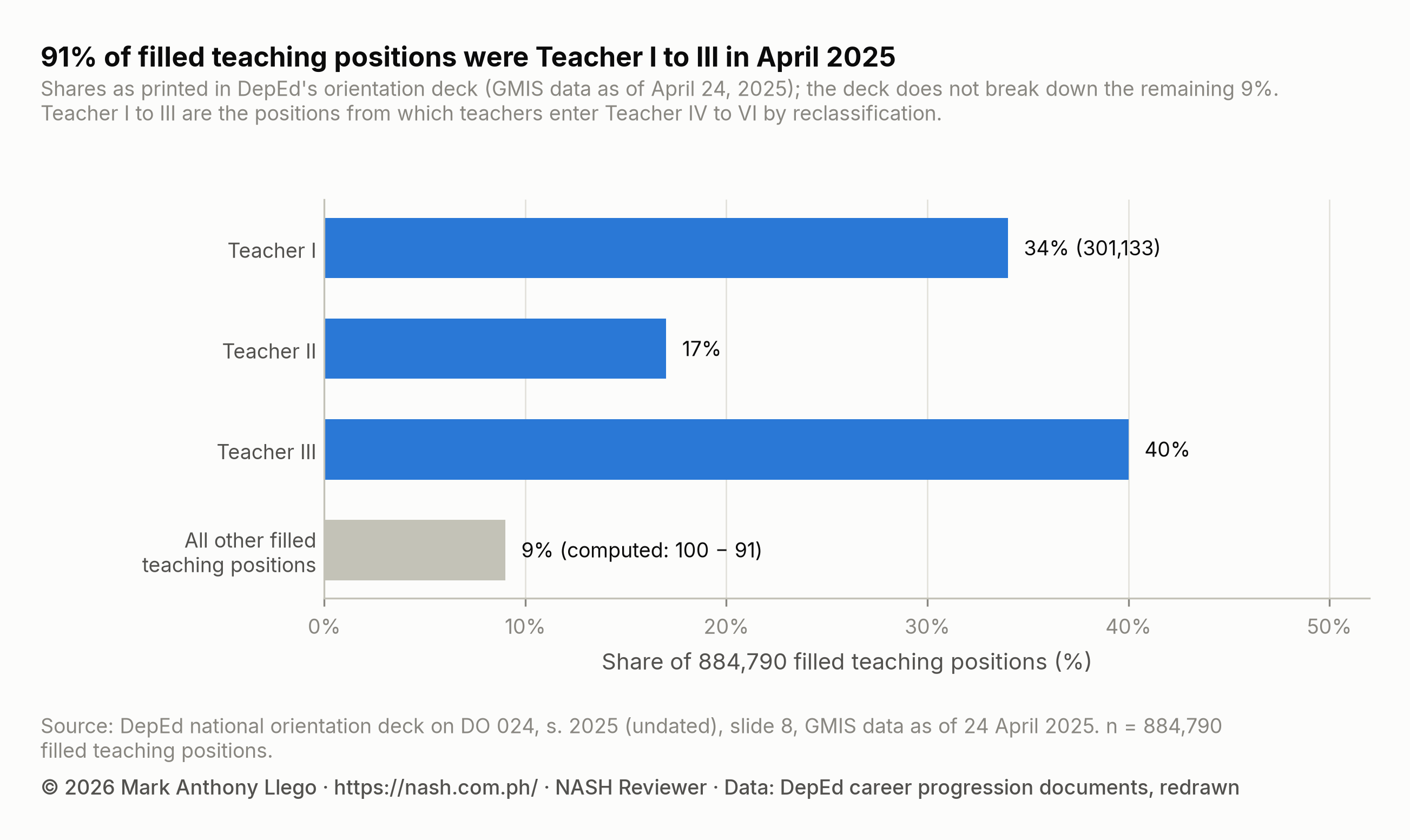
The pool is large: in April 2025, 91% of DepEd’s 884,790 filled teaching positions were Teacher I to III.
When to apply: the June 30 call and the FY 2026 dates
The SDS “shall issue an official memorandum calling for applications for reclassification of teaching positions not later than June 30 of the current year. Subsequent calls for applications may be done within the year subject to availability of funds” (DO 024, Encl. No. 2, Sec. 2). The call is posted in at least three conspicuous places in the SDO, schools and community learning centers, and online. It states the “Estimated number of slots for reclassification per position”, the QS, the documents and the deadline (Secs. 3–4).
DO 024 allows later calls within the year “subject to availability of funds” (Encl. No. 2, Sec. 2). The FAQ, which is guidance, adds “provided that the existing CAReER has already been exhausted” (Q33); the Order does not say this. For FY 2026, DM-OUHRODI-2026-0802 let SDOs “continue processing new reclassification applications for FY 2026, subject to the availability of funds”, with FY 2025 applications processed first (Sec. III.1).
The Joint Circular’s outer dates are the Plantilla Allocation List to DBM “not later than November 30 of each year” and appointments “not later than March 30 the succeeding year”, except “as may be determined by both DBM and DepEd in cases of emergency and unprecedented situations” (DepEd-DBM JC No. 01, s. 2025, Secs. 7.5.3.1 and 7.5.3.4; DO 024, Encl. No. 2, Secs. 56 and 58). For FY 2026, DM-OUHRODI-2026-0802 fixed three dates that “shall be strictly observed”:
| Step | FY 2026 deadline (DM-OUHRODI-2026-0802, Sec. III.3) |
|---|---|
| SDO completes the assessment and endorses to the RO | “on or before August 15 of the current fiscal year” |
| RO submits to the DBM regional office | “not later than November 30 of the current fiscal year” |
| SDO issues appointments | “only within the period of January to March of the succeeding fiscal year” |
The orientation deck on the memorandum adds “January – June of the Current Year” for the call and “April 28, 2026 – DBM’s cut-off for Tier 2” (DepEd orientation deck on FY 2026 reclassification, March 24, 2026, p. 15); neither is in the memorandum’s text. For FY 2025 qualifiers in the queue, the deck says April 28, 2026 (p. 10), the memorandum “on or before 30 April 2026” (Sec. II.2). The memorandum governs.
From FY 2027, a new calendar. DM-OUHRODI-2026-2789 orders ROs and SDOs to “strictly follow a forward-looking processing timeline prescribed in Annex A” (Sec. IV). Annex A sets the call and processing at the SDO in January to June; submission to the DepEd RO in July to August; submission to the DBM regional office in October to November; then, the following year, “Issuance of NOSCA and Appointment” in January to March and “Salary Adjustment” in April (Annex A, PDF p. 7). So an application processed in early 2027 would reach appointment in early 2028. The appointment dates agree: “not later than March 30” (Joint Circular, DO 024), “January to March” (DM-OUHRODI-2026-0802) and Annex A’s January to March; only the salary adjustment falls in April. Annex A is DepEd’s August 2026 plan, not an amendment of the Joint Circular.
Where FY 2026 applications stand
In the 11 deficit regions, “(CAR, Regions I, II, IV-B, V, VI, VII, IX, X, XI, and XII)”, DM-OUHRODI-2026-2789 provides (Sec. III.A):
- “All remaining reclassification applications that have not yet been issued NOSCA shall be temporarily deferred, pending the availability of funds, except for retitling actions, which do not involve salary adjustments.”
- New applications may be processed “up to the RO level”, but “such applications shall not be submitted to the DBM until funding becomes available.”
- “All deferred applications shall be prioritized for funding under the FY 2027 appropriations for the reclassification of positions.”
The six other regions, “(NCR, NIR, Regions III, IV-A, VIII, and CARAGA)”, continue “until their respective FY 2026 regional allocations are fully utilized”; leftovers go to FY 2027, and because “the DBM April 2026 processing cut-off has already lapsed”, later actions’ salary differentials are charged to the FY 2027 budget (Sec. III.B). For these six regions, Annex A shows processed FY 2026 applications going to the RO in July to August, to DBM in September to October, NOSCA and appointment in November and salary adjustment in December 2026. Annex A also shows pending applications, those “Under DBM’s Processing + Remaining in the CAReER”, submitted in July to August 2026 “to be charged against FY 2027 Budget”, and appears to place their NOSCA and appointment in January to March 2027 and salary adjustment in April 2027.
On August 12, 2026, DBM released ₱8,678,594,399 (SARO-BMB-F-26-0008170), charged to “New School Personnel Positions” and pooled from unreleased funds for new positions (DM-OUHRODI-2026-2789, pp. 3–4). The deficit it covers is salary differentials of personnel “appointed and issued NOSCA” from May 2025 onward (DM-OUHRODI-2026-2917, August 13, 2026, Annex A), so, by its terms, it does not cover applications still without a NOSCA. The August 24, 2026 orientation deck still presents those as deferred (DepEd orientation deck on funding strategies, p. 25). They are deferred, not cancelled; see Why ECP Reclassification Was Deferred in 2026.
Qualification standards for Teacher IV to VII
DO 019, s. 2025 “formally adopts CSC Resolution No. 2500471 dated May 28, 2025” (para. 2), and “all appointments, including promotion and reclassification of positions, shall strictly adhere to the amended and newly created QS” (para. 4). Under DO 019, Teacher IV and V need 3 years of teaching and Teacher VI and VII need 4. Training is 16, 24, 24 and 32 hours “acquired within the last 5 years”, or completion of the NEAP program for Career Stage II, on top of a bachelor’s degree in Education or a relevant bachelor’s degree with 18 professional units in Education (CSC Resolution No. 2500471, PDF pp. 14–15). Teacher VI and VII training may include Instructional Supervision.
Senior High School tracks differ. Academic Track Teacher IV to VII need a relevant major, or any bachelor’s degree with at least 18, 24, 30 or 36 units toward a master’s degree in the strand, plus 18 professional units in Education (PDF pp. 20–22). TVL Track teachers need a National Certificate II and a Trainer’s Methodology Certificate I (or the NEAP program), and Teacher V and VII need “3 years and 6 months” and “4 years and 6 months” of experience (PDF pp. 45–47). Full tables are in ECP Qualification Standards Under DO 019, s. 2025.
- The QS come first. An applicant who fails any element “shall not advance to the verification of Performance Requirements” (DO 024, Encl. No. 2, Sec. 13).
- Old training does not count. The toolkit’s Teacher IV applicant lost a 40-hour training from May 2015 “due to 5-year recency stipulated in QS” (toolkit, p. 14).
- Related experience outside DepEd counts. Government or private experience “may be credited provided that such experience is functionally related to the duties of the position applied for” (DO 034, para. 13); Head Teacher experience “shall be considered as teaching experience” (para. 14).
- Extra credentials earn points, not eligibility: master’s units, and training “after the last promotion but within the last five years” beyond the minimum (DO 034, paras. 12 and 15).
- SNET and SST. DO 019 excludes these positions and keeps their existing QS (para. 3), but DM-OUHRODI-2026-0802 tells SDOs, “pending the issuance of revised qualification standards (QS) for SNET”, to use “the regular QS for teaching and school principal positions under DO No. 19, s. 2025” (Sec. V.1), and SST incumbents “shall be evaluated using the regular QS under DO No. 19, s. 2025” (Sec. V.2). The Order outranks the memorandum; ask your SDO which it applies.
The performance requirement: PPST indicators by position
Every applicant needs “A rating of at least Very Satisfactory in the last rating period covering one (1) year complete performance cycle in the current position”, plus the target’s indicators “based on at most three (3) rating periods reckoned from the immediately preceding performance cycle completed” (DO 024, Encl. No. 2, Sec. 14.a):
| Position applied for | PPST career stage | Classroom observable indicators (COIs) | Non-classroom observable indicators (NCOIs) |
|---|---|---|---|
| Teacher II | Career Stage I (Beginning towards Proficient) | At least 6 Proficient COIs at Very Satisfactory | At least 4 Proficient NCOIs at Very Satisfactory |
| Teacher III | Career Stage I | At least 12 Proficient COIs at Very Satisfactory | At least 8 Proficient NCOIs at Very Satisfactory |
| Teacher IV | Career Stage II (Proficient) | 21 Proficient COIs at Very Satisfactory | 16 Proficient NCOIs at Very Satisfactory |
| Teacher V | Career Stage II | At least 6 Proficient COIs at Outstanding | At least 4 Proficient NCOIs at Outstanding |
| Teacher VI | Career Stage II | At least 12 Proficient COIs at Outstanding | At least 4 Proficient NCOIs at Very Satisfactory; and 4 Proficient NCOIs at Outstanding |
| Teacher VII | Career Stage II | At least 18 Proficient COIs at Outstanding | At least 6 Proficient NCOIs at Very Satisfactory; and 6 Proficient NCOIs at Outstanding |
Source: DO 024, s. 2025, Encl. No. 2, Sec. 14.a table (PDF p. 33); the same figures appear on the Reclassification Form for Teaching Positions (Annex B-1).
Crossing into Career Stage II adds the entry requirement. Advancement to the next stage needs “the performance requirements of the entry position of the Career Stage, in addition to the performance requirements of the position applied for”. The Order’s example: “a Teacher II applying for Teacher V shall be required to submit three (3) IPCRFs showing 6 Proficient COIs and 4 Proficient NCOIs at Outstanding with all the other 27 Proficient indicators at Very Satisfactory (VS)” (Sec. 14.a.iii). The FAQ requires three rating periods when crossing “since all 37 indicators must be met”, and one to three within a stage (Q49). Its Teacher III-to-Teacher VI case lists “12 COIs at Outstanding”, “9 COIs at least at Very Satisfactory”, “4 NCOIs at Outstanding” and “12 NCOIs at least at Very Satisfactory” (Q55, example #4).
How the HRMO counts:
- Higher ratings count (FAQ, Q46). Within a stage, Unsatisfactory or Poor ratings in other indicators do not disqualify you if the latest overall rating is “at least ‘Very Satisfactory’” (Q54).
- Repeated indicators: “the most recent rating shall be considered” (DO 024, Encl. No. 2, Sec. 14.a.ii), for example 1.1.2, 1.4.2 and 1.5.2 (FAQ, Q58). The Plus Factor is “not part of the 37 core PPST indicators” (Q57).
- Previous positions and leave. IPCRFs from a previous position count within the last three cycles (Q50), but you need “at least one (1) full school year in their current position” (Q53); by that rule, a teacher appointed Teacher IV in early 2027 would not qualify for the 2027 call. On CSC-authorized leave, the three periods are counted back from the last rating before the leave (Sec. 14.a.i).
- Submit every IPCRF you need. The form asks for the “IPCRF for the school year immediately preceeding [sic] the application” (Annex B-1, Part II), but you may submit “at most three (3) performance ratings depending on the performance requirements” (Sec. 6.j).
If you fall short: the DO 034 Teacher’s Commitment Form
“During the three-year transition period, teachers who do not fully meet the performance requirements for the position applied for may still be considered for promotion, whether through natural vacancy or reclassification, and appointment within or across career stages within the range of three salary grades, provided that they meet the QS for the position applied for” (DO 034, para. 28). Four groups qualify:
| Group (DO 034, para. 28) | Who | Example |
|---|---|---|
| a. Consistently High Performance | Overall Very Satisfactory or higher and Very Satisfactory in all indicators, but short where Outstanding is required | A Teacher IV aiming at Teacher V |
| b. Generally Satisfactory Performance | Overall Very Satisfactory or higher but Satisfactory in some indicators, “thereby rendering them ineligible to apply for positions such as Teacher IV” | A Teacher III with 2 NCOIs at Satisfactory, eligible for Teacher IV (FAQ, Q55, example #2) |
| c. Master Teachers Affected by Indicator Conversion | Master Teachers short after some NCOIs became COIs | Not relevant to Teacher IV to VII |
| d. Teachers with Approved Official Leave of Absence | IPCRFs from at most three periods before the leave show deficiencies | A Teacher III on maternity leave, eligible for Teacher VI “with two (2) COI PPST indicator deficiencies” (FAQ, Q55, example #4) |
The conditions:
- Three indicators at most: “a maximum of three PPST objectives shall be authorized for inclusion and explicitly reflected in the teacher’s IPCRF for the current school year” (DO 034, para. 28).
- One level below only. Where Outstanding is required, “a rating of Satisfactory or below is not considered”; where Very Satisfactory is required, “a rating of Unsatisfactory or below” is not (FAQ, Q56).
- The three-grade limit still applies (DO 034, para. 28; FAQ, Q55).
- Improve this school year. The indicators are evaluated at year’s end but “shall not carry any weight allocation and shall not affect the teacher’s final PMES rating” (DO 034, para. 28). The improvement “may be taken before or after the appointment” (para. 30).
The Teacher’s Commitment Form on PPST Indicators for Development lists each indicator, the school year, the previous rating and whether it is a COI or NCOI. It is “accomplished and signed by the concerned teacher, and noted by the School Principal”, and submitted to the HRMO (DO 034, para. 29); its last line is “Received by: [Name and Signature of the HRMPSB Chair]” (enclosure, p. 11). Improvement may be shown by classroom observation, a Learning Action Cell, a signed coaching form, or very satisfactory performance in a program such as ARAL (para. 30). Teachers record “their enhanced ratings in the e-IPCRF” as “a condition for promotion under DepEd Order No. 34, s. 2025” (DM-OSEC-OUHRODI-2026-0001, Sec. E.a).
The window closes on February 24, 2028. “It is hereby reiterated that relaxation of performance requirements shall be strictly limited to the three-year transition period. After the transition period (i.e., February 24, 2028), the performance requirements for the reclassification of teacher positions shall be governed by the provisions of Section 14 (a) of Enclosure No. 2 of DO No. 024, s. 2025” (DO 034, para. 33). DO 034 adds that teachers “may be allowed to address or rectify performance deficiencies reflected in their respective IPCRFs in the succeeding school years”, provided the “corrective action shall be undertaken prior to the submission of application documents for promotion” (para. 33). It does not say what happens to an application filed before February 24, 2028 and decided after it.
Documents to submit
File the Reclassification Form for Teaching Positions (RFTP, Annex B-1) with the HRMO through the SDO Records Unit by the deadline in the call, with (DO 024, Encl. No. 2, Sec. 6.a–l):
- a letter of intent to the SDS stating your purpose and the position applied for;
- a Personal Data Sheet (CS Form 212, Revised 2025) with the Work Experience Sheet;
- your PRC license or ID;
- a Certificate of Competency Level, if applicable;
- your special orders, transcript of records and diploma, including graduate units;
- your signed service record;
- your latest appointment;
- your training certificates;
- for Senior High School TVL applicants only, the TESDA NC II and Trainers Methodology Certificate;
- your performance ratings, at least Very Satisfactory: “at most three (3)”, the latest covering a full year in your current position;
- the Checklist of Requirements and Omnibus Sworn Statement with the Data Privacy Consent (Annex C-2);
- other documents the HRMPSB requires, such as a portfolio for the NCOIs.
Items 1 to 11 are mandatory: anyone missing them on the deadline “shall not be included in the pool of official applicants”, and “No additional documents shall be accepted after the set deadline” (Secs. 7–8). The SDO may allow online submission, “subject to submission of hard copies upon request” (Sec. 6). You need no new evidence: the MOVs “from the last three rating periods shall be utilized” (DO 034, para. 25; FAQ, Q43), and a missing MOV for one NCOI scores zero for that portfolio item but you still take the interview (Q47).
The sworn statement. The toolkit says it “shall no longer be required to be notarized”, citing Section 10 of DO 021, s. 2024 (toolkit, p. 12). That section was written for DO 007, s. 2023 applications, which exclude Teacher II to VII, and it requires the statement to “be sworn before any public officer authorized to administer oath” (DO 021, s. 2024, paras. 4 and 10). Annex C-2 itself ends with a line for the “Person Administering Oath”. Swear to it before an authorized officer.
Book your classroom observation early. An observation “within the immediately preceding school year”, separate from your PMES observation, may be used, and its certified rating sheet “shall only be valid for one year” (DO 034, paras. 22–23). You may request one this school year for next year’s call (FAQ, Q63). The forms are in DepEd’s Career Progression Toolkit folder.
What happens after you apply
- Initial evaluation. Each applicant gets a code “to protect the identity of the applicants when posting the results” (DO 024, Encl. No. 2, Sec. 10). The HRMO checks the QS, then performance, and posts the results with personal data concealed; each applicant gets a written notice (Secs. 12–18).
- Comparative assessment. The HRMPSB meets no earlier than 10 calendar days after the call is posted (Sec. 20) and scores 100 points: Education 10, Training 10, Experience 10, Performance 30, COIs by classroom observation 25, and NCOIs by portfolio and Behavioral Events Interview 15 (Sec. 34). DO 024 prints a BEI maximum of 12; the FAQ calls it “a clerical oversight and a typographical error in the policy” and uses 16 (Sec. 38.d; Q42). See ECP Point System: How the HRMPSB Scores Applicants.
- Open ranking. Scores are disclosed to those present (Sec. 25). Signing your RFTP “shall not, in any case, preclude the applicant from filing a protest” (Sec. 27).
- CAReER. The HRMPSB, chaired by the Assistant Schools Division Superintendent (Sec. 21), prepares the Comparative Assessment Results for Expanded Reclassification “within seven (7) calendar days after all the applicants have been assessed” (Sec. 40). They are posted “for a period of at least 10 calendar days”, “listed in no particular order using application codes”; the SDS’s copy ranks those “who meet the cut-off score of 50 points” (Secs. 40–42). Queries go to the HRMPSB within five calendar days and are answered in three to seven, while “the process of reclassification shall proceed without delay” (Sec. 48).
- SDS approval and endorsement within funds. The SDS reviews the CAReER and the Plantilla Allocation List, “ensuring equitable allocation of funding to all positions” (Sec. 43). For FY 2026, “the Schools Division Superintendent shall recommend to the Regional Director only those candidates who can be accommodated within the available funds” (DM-OUHRODI-2026-0802, Sec. IV; DO 024, Encl. No. 2, Sec. 50). The SDO sends the papers to the RO “on or before the set deadline stipulated in the Official Regional Memorandum” (for FY 2026, DM-OUHRODI-2026-0802 made August 15 the latest date for SDO endorsements, Sec. III.3.a): the endorsement letter, RFTPs, CAReER, PAL, ePSIPOP pages, the Certification of Availability of Funds and the Sub-ARO, among others (Sec. 51).
- RO, DBM and appointment. The RO evaluates and sends the papers to DBM by November 30 (Secs. 52–56). DBM issues the “Notices of Organization, Staffing and Classification Action (NOSCA)” (JC No. 01, s. 2025, Sec. 7.5.3.2). The RO endorses the approved PAL and NOSCA to the SDO (JC, Sec. 7.5.3.3), which issues the appointments and adjusts salaries (DO 024, Encl. No. 2, Secs. 58–59). The SDS, as appointing officer, “shall be accountable for the appointments” and answers complaints about them (Sec. 60).
If you are not reached, “The CAReER for a particular position shall be valid until exhausted”; 50-pointers are “in the queue” and processed “before all other new applicants” (Sec. 45; DO 034, para. 26). Below 50, you may carry your scores over for the same position (Sec. 46). The school head’s part is in The School Head’s Role in ECP Reclassification.
Pay after reclassification
Reclassified teachers “shall receive a salary rate equivalent to the 1st step of the new position”, and “step increments previously earned by a teacher shall no longer be credited in his new position” (JC No. 01, s. 2025, Sec. 7.6.1.1). A Head Teacher retitled to Teacher IV to VII keeps the “present salary rate, including step increment” (Sec. 7.6.1.2). See ECP Salary Grades for Teachers, MTs and Principals.
Priority groups, including retirable Teacher I
- The queue (by Order). Unfunded 50-pointers go “before all other new applicants” (DO 024, Encl. No. 2, Sec. 45; DO 034, para. 26).
- Transition incumbents (by Order). Qualified SSP I–II, ASP I–III, ASSP I, HT I–VI, SNET I–V and SST I–II incumbents “shall be given priority in the reclassification of positions” during the transition (DO 024, Encl. No. 1, Sec. 33). For FY 2026, DM-OUHRODI-2026-0802 also ranks qualified 50-pointers among Head Teachers and Assistant School Principals affected by the transition, and among SSP, ASSP, SNET and SST incumbents, ahead “regardless of their rank in the CAReER” (Sec. III.2.b–c).
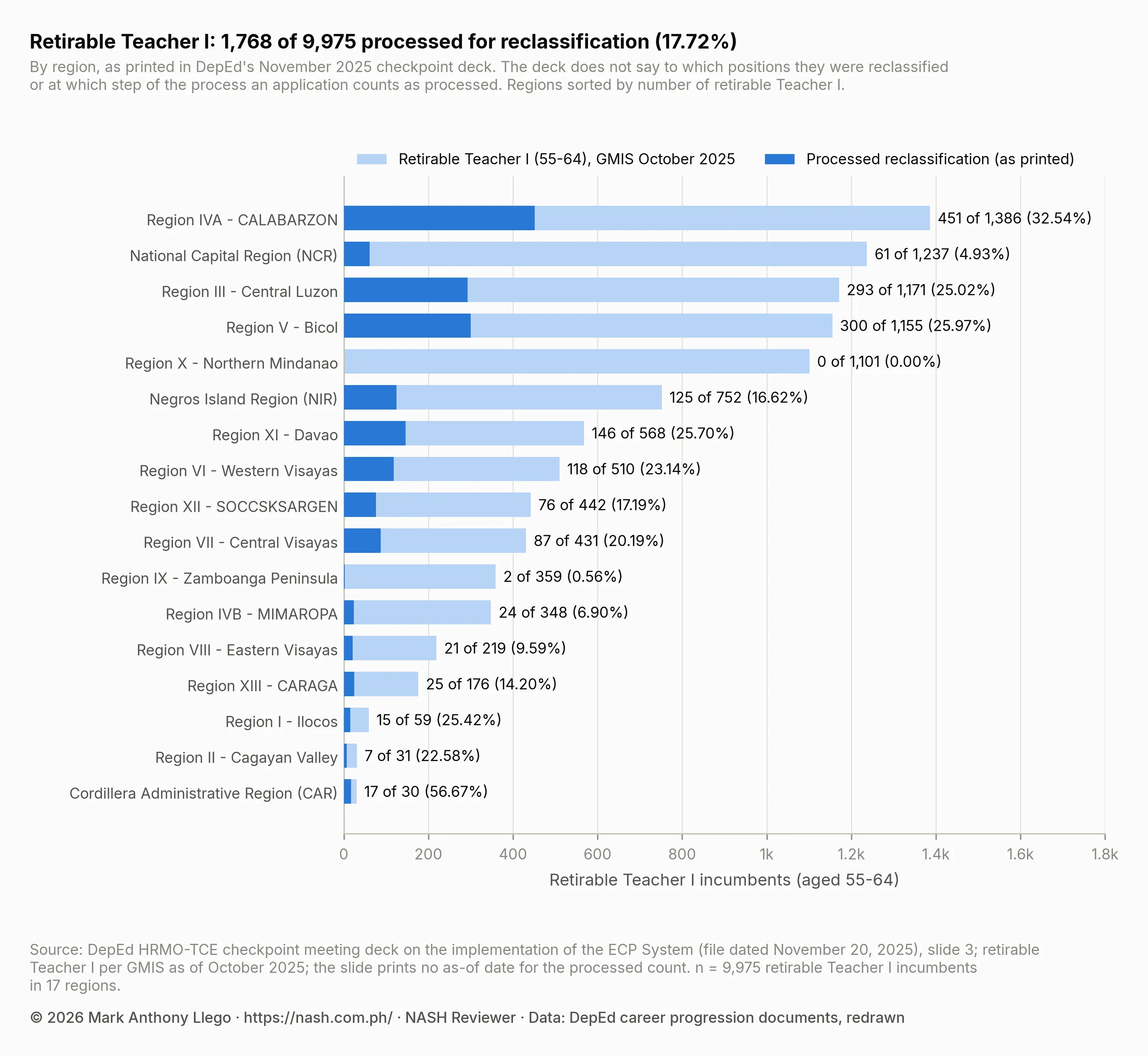
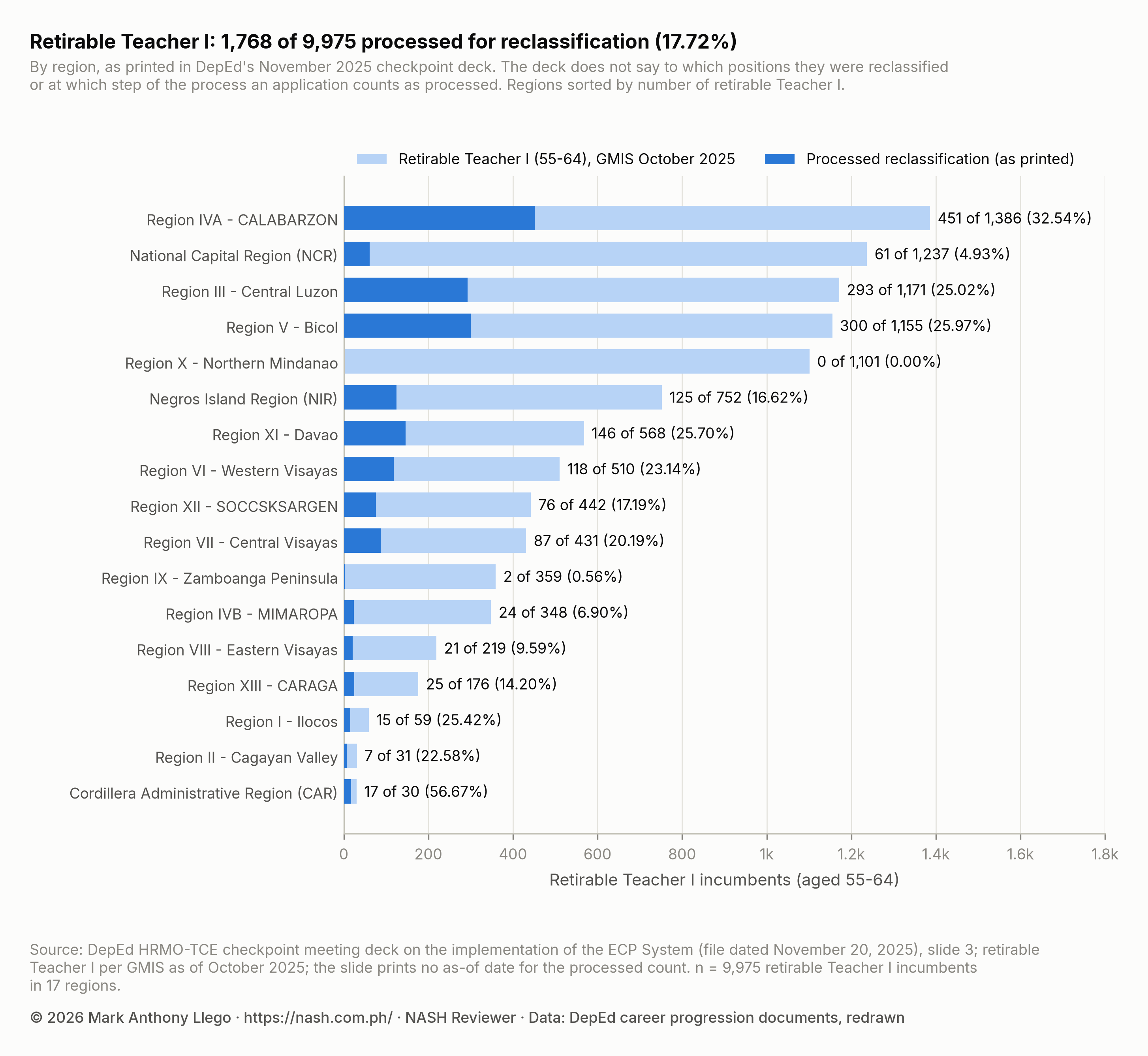
- Retirable Teacher I (by memorandum). DM-OUHROD-2025-2505 (September 8, 2025), citing the commitment that “no teacher should retire at Teacher I”, prioritized “Retirable Teacher I incumbents—both mandatory and optional in the next five (5) years”, while all applicants “shall be required to undergo assessment” (Secs. II–III). For FY 2026, DM-OUHRODI-2026-0802 prioritizes those “(55-64 years old)” who meet the 50-point cut-off “regardless of their rank in the CAReER” (Sec. III.2.a).
The retirable Teacher I priority has no basis in the Order. DO 024’s priority list (Encl. No. 1, Sec. 33) omits it, and the CAReER ranks candidates “from highest to lowest” (Encl. No. 2, Sec. 42). The memorandum cites “Sections 23-25 of the IRR of EO No. 174” and “Section 8.0 of DBM-DepEd Joint Circular No, 01, s. 2025”, which deal with retitling Head Teachers, Assistant School Principals and special teachers and with the transition; none gives Teacher I incumbents any priority, and they mention Teacher I only as the title to which vacant and non-conforming items convert. DO 024 outranks the memorandum, so this is a memorandum-level directive. A retirable Teacher I still needs the QS, the performance requirement and 50 points, and can reach no higher than Teacher IV.
What RA 12288 may change
RA 12288 takes effect 15 days after publication (Sec. 15); no career progression document gives its publication date. Its implementing rules (IRR) were signed on August 17, 2026, and under Sec. 20 take effect “thirty (30) days from publication in a newspaper of general circulation and from filing of three (3) certified copies” with the national register. As of October 31, 2026, the IRR had not been published in the Official Gazette or on deped.gov.ph, so its effective date is not yet known. The DepEd-certified copy is in DepEd’s career progression toolkit folder, which DepEd shares through DM-OUHROD-2025-3003. No DepEd order or memorandum implements the law; DepEd’s August 2026 deck targets “Last Week of November 2026/Q1 of 2027” for a new Joint Circular and “Q1 of 2027” for a DepEd Order on full implementation (DepEd orientation deck on funding strategies, August 24, 2026, p. 34). These are targets, not results. For Teacher IV to VII, the law and IRR would bring:
- A non-hierarchical base. “The positions from Teacher I to Master Teacher I shall form the bases of the expanded career progression system. Promotions within the base positions shall be non-hierarchical” (RA 12288, Sec. 5; IRR, Secs. 5–6). DO 024 also calls promotion “non-hierarchical”, but only “provided that” no career stage is skipped and no more than three salary grades are crossed (Encl. No. 1, Sec. 20). The law’s change is the base: it runs from Teacher I to Master Teacher I, across three PPST career stages. DO 024 still says “Under no circumstance shall an applicant be allowed to jump to higher career stage/s” (Encl. No. 1, Sec. 20.a). The law will govern once implemented; the IRR keeps DepEd’s guidelines “insofar as they are not inconsistent” with it (Sec. 14). No issuance has reconciled them yet, so the no-skipping rule and the three-grade limit still apply.
- A Standards-Based Assessment, “required as a prerequisite to their promotion and increase in salary” (Sec. 3.i). As of October 31, 2026, DepEd had issued no guidelines for it.
- The same career stage. The IRR keeps Teacher IV to VII at PPST Career Stage II and places Teacher VI, Teacher VII and Master Teacher I at PPSSH Career Stage I, the aspiring school head stage (IRR, Sec. 6).
- Protection for ongoing applications. “All ongoing reclassification assessments prior to the effectivity of this IRR shall remain valid and effective and shall continue to be governed by prior laws, rules, and issuances, unless the concerned personnel opts to withdraw his/her existing application” (IRR, Sec. 17).
- Two transition periods. The IRR starts a new three-year transition “reckoned from the effectivity of this IRR”, extendable by up to two years (Sec. 17). DO 034’s relaxation stays tied to February 24, 2028; no issuance has changed it.
The full comparison is in What RA 12288 Changes in Teacher Career Progression.
What this means for school heads
The school head rates the IPCRFs that decide eligibility, notes the Commitment Form and helps teachers get observed:
- Rate every indicator carefully. Eligibility turns on indicator-level ratings, not only the overall rating (DO 024, Encl. No. 2, Sec. 14.a), and a rating two levels short cannot be relaxed (FAQ, Q56). The PMES guide covers rating.
- Plan support for each Commitment Form: an observation, a LAC session or coaching on the listed indicators, with signed coaching forms on file (DO 034, paras. 29–30). This is PPSSH Domain 4 in practice; see Developing Self and Others.
- Request observation schedules from the SDO for teachers planning to apply, separate from PMES observations (DO 034, paras. 22–24; toolkit, p. 35).
- Post the SDO call in your school (DO 024, Encl. No. 2, Sec. 3) and warn teachers that incomplete applications are excluded (Sec. 7).
- Keep the records: IPCRFs for three rating periods, observation sheets, LAC documentation, coaching forms and noted Commitment Forms, the MOVs DepEd uses (DO 034, para. 25).
| May | May not |
|---|---|
| Note a teacher’s Commitment Form, as DO 034 asks the School Principal to do (para. 29) | Accept a form with more than three indicators, or one two levels short (para. 28; FAQ, Q56) |
| Serve as a classroom observer or assessor if designated from the SDO’s pool of trained assessors; Sec. 32 requires, among other things, five years as “a School Head or Master Teacher”, three years of Very Satisfactory ratings, and training under the Career Progression Assessors Program (DO 024, Encl. No. 2, Secs. 31–32; DO 034, para. 24) | Require new MOVs for the NCOIs (DO 034, para. 25; FAQ, Q43) |
| Tell a Teacher II that Teacher V, or a Teacher III that Teacher VI, is open if the entry requirement is met (FAQ, Q48) | Tell a Teacher III to apply for Teacher VII, or a Teacher I for Teacher V; both exceed three grades (DO 024, Encl. No. 1, Sec. 20.b) |
Related duties are in Human Resource Management for School Heads and Instructional Supervision for School Heads.
How the NASH may test this
The item below is an original practice item, scored 3 (Relational), 2 (Multistructural), 1 (Unistructural) or 0 (Prestructural). An option that breaks a rule scores 0.
Question 1
Indicator 4.4.2, Performance management. Career Stage 2, Situational, Moderate.
You are an elementary principal in October 2026. Teacher R, a Teacher III, is rated Outstanding overall. Across her last three IPCRFs, all 21 Proficient COIs are Outstanding, 13 NCOIs are Very Satisfactory or higher, and 3 NCOIs are Satisfactory. She wants to apply for Teacher IV in the 2027 call. What is the most appropriate action?
- A. Tell her she may apply under DO 034’s relaxation, note her Commitment Form listing the three NCOIs, and agree on coaching and evidence that will show them at Very Satisfactory this school year.
- B. Tell her she may apply under DO 034’s relaxation and note her Commitment Form listing the three NCOIs, leaving it to her to show the improvement during the school year.
- C. Advise her to wait until her IPCRFs show all 37 indicators at Very Satisfactory, since Teacher IV is the entry position of Career Stage II and requires every indicator.
- D. Review her SY 2025-2026 IPCRF with her and raise the three NCOI ratings to Very Satisfactory, since her overall rating is Outstanding and the change makes her eligible.
Answer and explanation
Best answer: A. Points: A = 3, B = 2, C = 1, D = 0.
- A (3 points, Relational). It applies the relaxation and links the form to the development the teacher must show this school year.
- B (2 points, Multistructural). Eligibility and the form are right, but the improvement the form commits to is left unsupported.
- C (1 point, Unistructural). It states the normal Teacher IV requirement but overlooks the transition relaxation that fits her case.
- D (0 points, Prestructural). Changing past ratings to create eligibility falsifies the IPCRF.
Why. DO 034, s. 2025 lets teachers rated Very Satisfactory or higher overall but with “Satisfactory ratings in certain PPST indicators” apply for “positions such as Teacher IV” during the transition, with “a maximum of three PPST objectives” for improvement (para. 28). The form is “noted by the School Principal”, and improvement may be shown through observation, a LAC or coaching (paras. 29–30). Her ratings are one level below the requirement, which the FAQ allows (Q56), and the window ends February 24, 2028 (para. 33).
Indicator 4.4.2: Implement the performance management system with a team to support the career advancement of school personnel, and to improve office performance.
Sources: DepEd Order No. 034, s. 2025, paras. 28–30 and 33; DepEd ECP FAQs, Q55–Q56; DepEd Order No. 024, s. 2025, Encl. No. 2, Sec. 14.a.
Nothing in this guide reproduces or predicts examination content.
Frequently asked questions
Can a Teacher III be reclassified directly to Teacher VI or Teacher VII?
To Teacher VI, yes; to Teacher VII, no, because Teacher III (SG 13) to Teacher VII (SG 17) exceeds the three-grade limit (DO 024, s. 2025, Encl. No. 1, Sec. 20.b; JC No. 01, s. 2025, Form No. 1-A). For Teacher VI you need all 37 Proficient indicators at Very Satisfactory, with 12 COIs and 4 NCOIs of them at Outstanding, in three IPCRFs (Encl. No. 2, Sec. 14.a.iii; FAQ, Q49 and Q55).
How many IPCRFs do I need to apply for Teacher IV?
Three. Teacher I, II or III to Teacher IV crosses a career stage, so “the three (3) performance rating periods are required since all 37 indicators must be met” (DepEd ECP FAQs, updated November 6, 2025, Q49). The latest must show at least Very Satisfactory for a full year in your current position (DO 024, s. 2025, Encl. No. 2, Sec. 14.a).
Can I apply for Teacher IV if some PPST indicators are rated Satisfactory?
Yes, until February 24, 2028, if no more than three indicators fall short and each is one level below the requirement. You submit a Teacher’s Commitment Form noted by your principal and improve those indicators during the school year (DO 034, s. 2025, paras. 28–29 and 33; FAQ, Q56).
When is the next call for Teacher IV to VII reclassification?
Each SDS must issue a call by June 30 every year (DO 024, Encl. No. 2, Sec. 2). DepEd’s August 2026 timeline schedules the next call and processing at SDOs in January to June 2027, with submission to the DBM regional office in October to November and appointments in January to March of the following year (DM-OUHRODI-2026-2789, Annex A). If you are already in the queue or your application is under DBM processing, Annex A appears to put NOSCA and appointment in January to March 2027. In the 11 deficit regions, applications without a NOSCA are deferred to FY 2027 funding (Sec. III.A).
Does RA 12288 let me skip positions now?
Not yet. The law makes promotions from Teacher I to Master Teacher I “non-hierarchical” (RA 12288, Sec. 5), but no DepEd order implements it, and as of October 31, 2026, its IRR, signed on August 17, 2026, had not been published in the Official Gazette or on deped.gov.ph, so its effective date is not yet known. Applications are assessed under DO 024 and DO 034, and ongoing assessments stay under them even after the IRR takes effect (IRR of RA 12288, DepEd-certified copy, Sec. 17).
Download the data
- t4-indicators-needed.csv: for each target position and the positions it may come from, the Proficient COIs and NCOIs required at Outstanding and at least Very Satisfactory, as printed for moves within Career Stage II and computed (entry position plus target) for moves into it (DO 024, s. 2025, Encl. No. 2, Sec. 14.a and 14.a.iii; DepEd ECP FAQs, Q48–Q49 and Q55; JC No. 01, s. 2025, Form No. 1-A).
- t4-teacher-i-iii-share.csv: shares of 884,790 filled teaching positions held by Teacher I, II and III as printed, and the remaining 9% (computed) (DepEd national orientation deck on DO 024, s. 2025, p. 8; GMIS data as of April 24, 2025).
- t4-retirable-teacher-i-by-region.csv: retirable Teacher I incumbents aged 55 to 64, processed reclassifications and the printed percentage, for 17 regions and in total (DepEd HRMO-TCE checkpoint meeting deck, file dated November 20, 2025, slide 3; retirable Teacher I per GMIS as of October 2025; no as-of date printed for the processed count).
The CSVs and charts may be reused only with written permission: email support@nash.com.ph. The rules themselves come from DepEd’s issuances, which you can cite directly.
Sources
- Executive Order No. 174, s. 2022, Establishing the Expanded Career Progression System for Public School Teachers, June 23, 2022, Sec. 5.
- Republic Act No. 12288, An Act Institutionalizing the Career Progression System for Public School Teachers and School Leaders, approved September 12, 2025, Secs. 3.i, 5 and 15.
- Implementing Rules and Regulations of Republic Act No. 12288, signed August 17, 2026 (not yet published as of October 31, 2026), Secs. 5–6, 14, 17 and 20 (PDF pp. 4–10); DepEd-certified copy (August 24, 2026) in DepEd’s career progression toolkit folder, shared through DM-OUHROD-2025-3003.
- DepEd-DBM Joint Circular No. 01, s. 2025, February 19, 2025, Secs. 7.5.3.1–7.5.3.4 and 7.6.1.1–7.6.1.2 (PDF pp. 11–12) and Sec. 8 (PDF pp. 12–16); Form No. 1-A (PDF pp. 21–23).
- Implementing Rules and Regulations of EO No. 174, s. 2022, registered August 1, 2024, Secs. 23–25 (PDF pp. 9–11).
- DepEd Order No. 019, s. 2025, Amended Qualification Standards for Teacher I–III, Master Teacher I–IV and School Principal I–IV Positions, and the Qualification Standards for Newly Created Teacher IV–VII and Master Teacher V Positions, June 24, 2025, paras. 2–4, and CSC Resolution No. 2500471 (PDF pp. 1, 14–15, 20–22 and 45–47).
- DepEd Order No. 024, s. 2025, Guidelines on the Implementation of the Expanded Career Progression System for Teachers and School Heads in the Department of Education, August 28, 2025, Encl. No. 1, Secs. 12, 20, 21, 33 and 34 (PDF pp. 5, 12–13 and 18); Encl. No. 2, Secs. 1–8, 10, 12–18, 20–21, 25, 27, 31–32, 34, 38.d, 40–43, 45–46, 48, 50–56 and 58–60 (PDF pp. 30–54); Annexes B-1 and C-2.
- DepEd Order No. 034, s. 2025, Amendments and Clarifications to DepEd Order No. 024, s. 2025, October 14, 2025, paras. 6–7, 12–15, 20, 22–26, 28–30 and 33, and the Teacher’s Commitment Form (PDF p. 11).
- DepEd Order No. 020, s. 2024, Guidelines on the Recruitment, Selection, and Appointment to Higher Teaching Positions, December 20, 2024.
- DepEd Order No. 021, s. 2024, Amendments to DepEd Order No. 007, s. 2023, December 23, 2024, paras. 4 and 10.
- CSC Resolution No. 2500358, 2025 Omnibus Rules on Appointments and Other Human Resource Actions, April 30, 2025, Sec. 101 (PDF p. 67), circularized by CSC Memorandum Circular No. 08, s. 2025.
- Memorandum DM-OUHROD-2025-2505, Commencement of Reclassification of Teaching and School Principal Positions Pursuant to DepEd Order No. 024, s. 2025, September 8, 2025, Secs. II–III, circulated by DepEd to the field.
- Memorandum DM-OUHROD-2025-3003, Frequently Asked Questions (FAQs) for DepEd Order No. 024, s. 2025 and DepEd Order No. 34, s. 2025, October 24, 2025, Annex A, cited from the version updated November 6, 2025 (posted on deped.gov.ph and in DepEd’s career progression toolkit folder) (DepEd ECP FAQs, updated November 6, 2025), Q9, Q11, Q33–Q34, Q42–Q43, Q46–Q50, Q53–Q58 and Q63. The copy attached to the memorandum on deped.gov.ph is an earlier version numbered differently in places.
- Memorandum DM-OSEC-OUHRODI-2026-0001, Guidance in the Implementation of the PMES for Teachers for SY 2025-2026, March 3, 2026, Secs. C and E.a (PDF pp. 4 and 6).
- Memorandum DM-OUHRODI-2026-0802, Guidance on the Reclassification of Teaching and School Principal Positions for Fiscal Year (FY) 2026, March 13, 2026, Secs. II.2, III.1–III.3, IV and V.1–V.2 (PDF pp. 1–5), as posted by SDO Nueva Vizcaya.
- Memorandum DM-OUHRODI-2026-2789, Funding Strategies and Interim Policy Directions for the Continuous Implementation of the Expanded Career Progression (ECP) System, August 5, 2026, Sec. II, Secs. III–IV and Annex A (PDF pp. 3–5 and 7), circulated by DepEd to the field.
- Memorandum DM-OUHRODI-2026-2917, Request for the Downloading of the Approved Additional Budget to Cover the Regional Funding Deficit under the ECP System, August 13, 2026, Annex A (p. 2), circulated by DepEd to the field.
- DBM, Special Allotment Release Order SARO-BMB-F-26-0008170, date of issue August 12, 2026, p. 1.
- ECP System Toolkit for Teachers (2025), DepEd BHROD, pp. 12, 14 and 35, in DepEd’s Career Progression Toolkit folder.
- DepEd, National Orientation on the Implementation of the Expanded Career Progression System for Teachers and School Heads (DO 024, s. 2025), session deck, 2025, p. 8.
- DepEd, HRMO-TCE Checkpoint Meeting on the Implementation of the ECP System, deck (file dated November 20, 2025), slide 3; retirable Teacher I per GMIS as of October 2025, with no as-of date printed for the processed count.
- DepEd, Virtual Orientation: Guidance on the Reclassification of Teaching and School Principal Positions for FY 2026, deck, March 24, 2026, pp. 10 and 15.
- DepEd, Virtual Orientation: Guidance on the Funding Strategies and Interim Policy Directions for the Continuous Implementation of the ECP System, deck, August 24, 2026, pp. 25 and 34.
The career progression series
- DepEd Expanded Career Progression (ECP): The Full Guide
- How to Be Reclassified to Teacher IV to VII in DepEd (this post)
- How to Become a Master Teacher Under DepEd’s ECP
- ECP Salary Grades for Teachers, MTs and Principals
- ECP Qualification Standards Under DO 019, s. 2025
- ECP Point System: How the HRMPSB Scores Applicants
- School Principal I to IV: Promotion Under the ECP
- The School Head’s Role in ECP Reclassification
- Head Teacher Retitling: Options Under ECP and RA 12288
- Why ECP Reclassification Was Deferred in 2026
- What RA 12288 Changes in Teacher Career Progression
- Department Head, Assistant School Head and MT Duties
Written by Mark Anthony Llego for NASH Reviewer. Sources: EO 174, s. 2022; RA 12288 and its IRR; DepEd-DBM JC No. 01, s. 2025; DepEd Orders No. 019, 024 and 034, s. 2025; DepEd memoranda DM-OUHROD-2025-2505, DM-OUHROD-2025-3003, DM-OSEC-OUHRODI-2026-0001, DM-OUHRODI-2026-0802, DM-OUHRODI-2026-2789 and DM-OUHRODI-2026-2917; DepEd’s ECP FAQs, toolkit and orientation decks. Charts may be reused only with written permission from support@nash.com.ph.