Under DepEd Order No. 024, s. 2025, the special Human Resource Merit Promotion and Selection Board (HRMPSB) of the Schools Division Office scores every qualified applicant for reclassification out of 100 points. Applicants for Teacher II–VII and Master Teacher I–V are scored on Education 10, Training 10, Experience 10, Performance 30, PPST classroom observable indicators (COIs) 25 and PPST non-classroom observable indicators (NCOIs) 15, and must reach a cut-off of 50 points (Encl. No. 2, Secs. 34 and 42). Applicants for School Principal I–IV are scored on Education 10, Training 10, Experience 10, Performance 25, Outstanding Accomplishments 10, Application of Education 10, Application of Learning and Development 10 and Potential 15, and no cut-off applies: they are ranked from highest to lowest (Encl. No. 3, Secs. 32 and 41).
Below are both systems as DO 024’s enclosures and forms print them, with the formulas, the sub-criteria and their ceilings, DepEd’s worked examples, and the conflict over the highest possible Behavioral Events Interview (BEI) rating. The rules are stated as of October 31, 2026. FY 2026 reclassification runs under DO 024 and its amendment, DepEd Order No. 034, s. 2025; RA 12288 is law, but no DepEd order implements it yet.
“The FAQ” below is DepEd’s Frequently Asked Questions on DO 024 and DO 034 (Annex A to Memorandum DM-OUHROD-2025-3003, October 24, 2025), “the toolkit” is the ECP System Toolkit for Teachers (2025), and “the orientation deck” is DepEd’s national orientation slides on DO 024. All three are guidance, not issuances. Section numbers refer to DO 024’s Enclosure No. 2 (teaching positions) or No. 3 (School Principal positions), as the context says.
Key findings
- Teaching positions: 100 points, 50 to pass. Education 10, Training 10, Experience 10, Performance 30, PPST COIs 25, PPST NCOIs 15, with a “cut-off score of 50 points” (DO 024, Encl. No. 2, Secs. 34 and 42). DO 020, s. 2024 uses the same weights for natural vacancies (Encl., para. 42).
- School Principal positions: 100 points, no cut-off. Performance is worth 25, and 45 points go to Outstanding Accomplishments, Application of Education, Application of Learning and Development and Potential (Encl. No. 3, Secs. 32 and 41; FAQ, Q35).
- Meeting the QS earns nothing. Education, Training and Experience score only increments above the qualification standards, from 2 points for 2–3 increments to 10 for 10 or more (Encl. No. 2, Sec. 35, Table 3). DO 024’s Master Teacher I example earns 12 of 30.
- Performance is the latest one-year rating, not an average. Points = rating ÷ 5 × 30 for teachers or × 25 for principals: 26.136 and 21.78 points for a 4.356 rating (Encl. No. 2, Sec. 36; Encl. No. 3, Sec. 34).
- The BEI divisor is in conflict. DO 024 prints “Highest Possible Total Rating = 12”, as does DO 020; DepEd’s FAQ calls that “a clerical oversight and a typographical error” and uses 16. No Order corrects the 12, so by rank it governs. The same applicant gets 12.83 NCOI points under the printed formula and 11.687 under the FAQ’s (Encl. No. 2, Sec. 38.d; FAQ, Q42).
- Passing does not mean funding, and rank is not the only order. Unfunded 50-pointers are prioritized the next fiscal year without reassessment, “subject to the availability of funds” (DO 034, para. 26). Transition groups get priority (DO 024, Encl. No. 1, Sec. 33), and for FY 2026 DepEd’s memorandum puts some groups ahead “regardless of their rank in the CAReER” (DM-OUHRODI-2026-0802, Sec. III(2)).
The 100-point system for teaching positions
Enclosure No. 2 of DO 024 governs reclassification to Teacher II–VII and Master Teacher I–V. Once the HRMO’s initial evaluation clears an applicant on the QS and the performance requirements, the HRMPSB assesses six criteria (Sec. 33), weighted in Table 1, “Point System for Comparative Assessment” (Sec. 34, PDF p. 39):
| Criterion | Maximum points | What earns points (Sec. 33) | How it is computed |
|---|---|---|---|
| a. Education | 10 | Units or degrees “that exceed the minimum qualification requirements” in the CSC-approved QS, relevant to the position | Increments Table and ETE rubric (Sec. 35) |
| b. Training (Learning and Development) | 10 | Hours above the QS, “acquired after the last promotion but within the last five (5) years”, in curriculum, pedagogy, or the relevant subject, learning area or strand | Same (Sec. 35) |
| c. Experience | 10 | Teaching experience above the QS; for SHS, “relevant industry and/or work experience may be considered” | Same (Sec. 35) |
| d. Performance | 30 | The rating “in the latest rating period covering one (1) year complete performance cycle in the current position”, at least Very Satisfactory | Rating ÷ 5 × 30 (Sec. 36) |
| e. PPST COIs (Classroom Observation) | 25 | Classroom observation | COT rating ÷ highest possible score × 25 (Sec. 37) |
| f. PPST NCOIs (Portfolio Annotations and BEI) | 15 | Portfolio annotations and a Behavioral Events Interview | Portfolio score (10) + BEI score (5) (Sec. 38) |
| Total | 100 |
The teaching CAReER form (Annex I-3) prints the same maxima in its column heads.
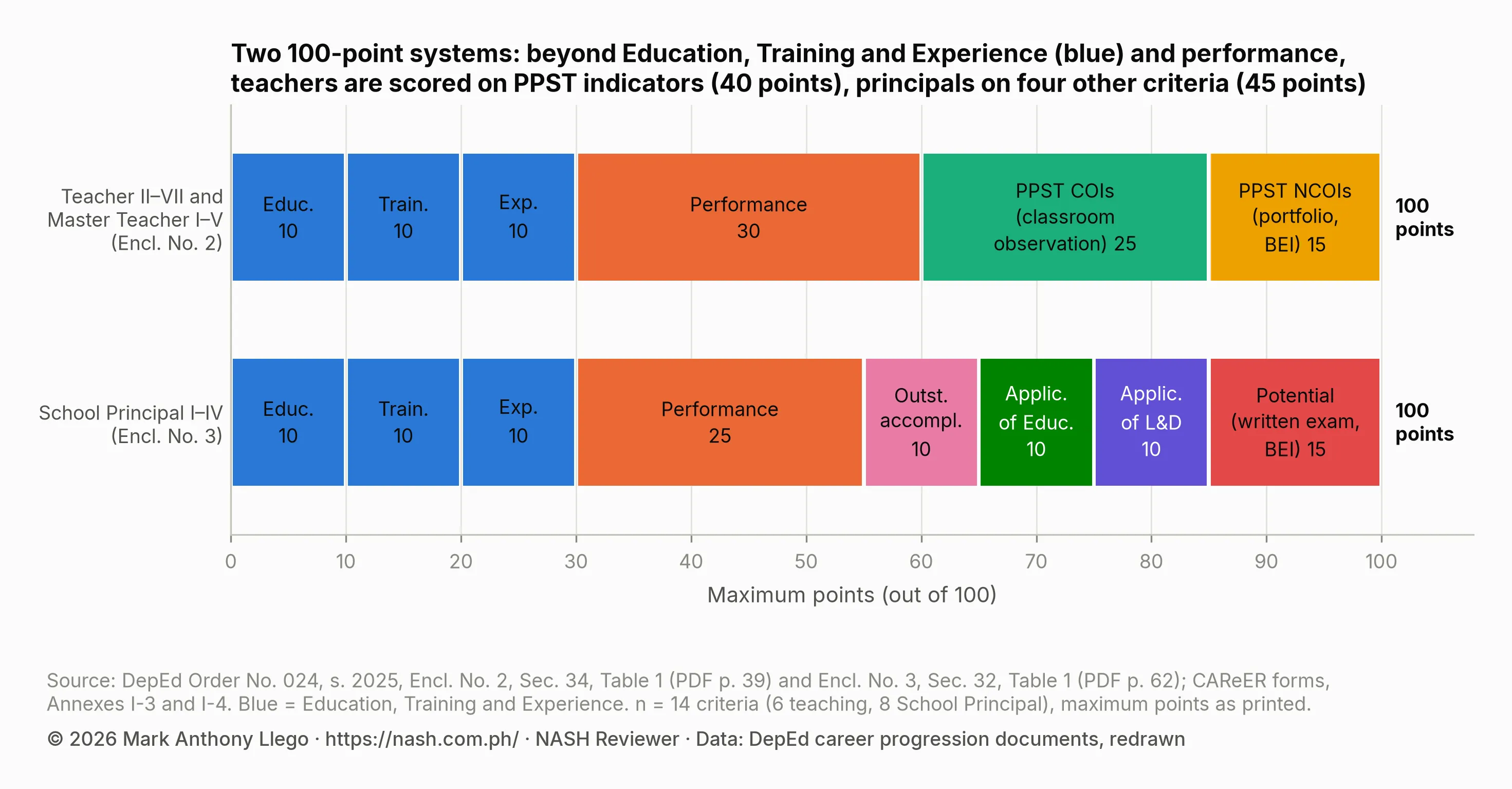
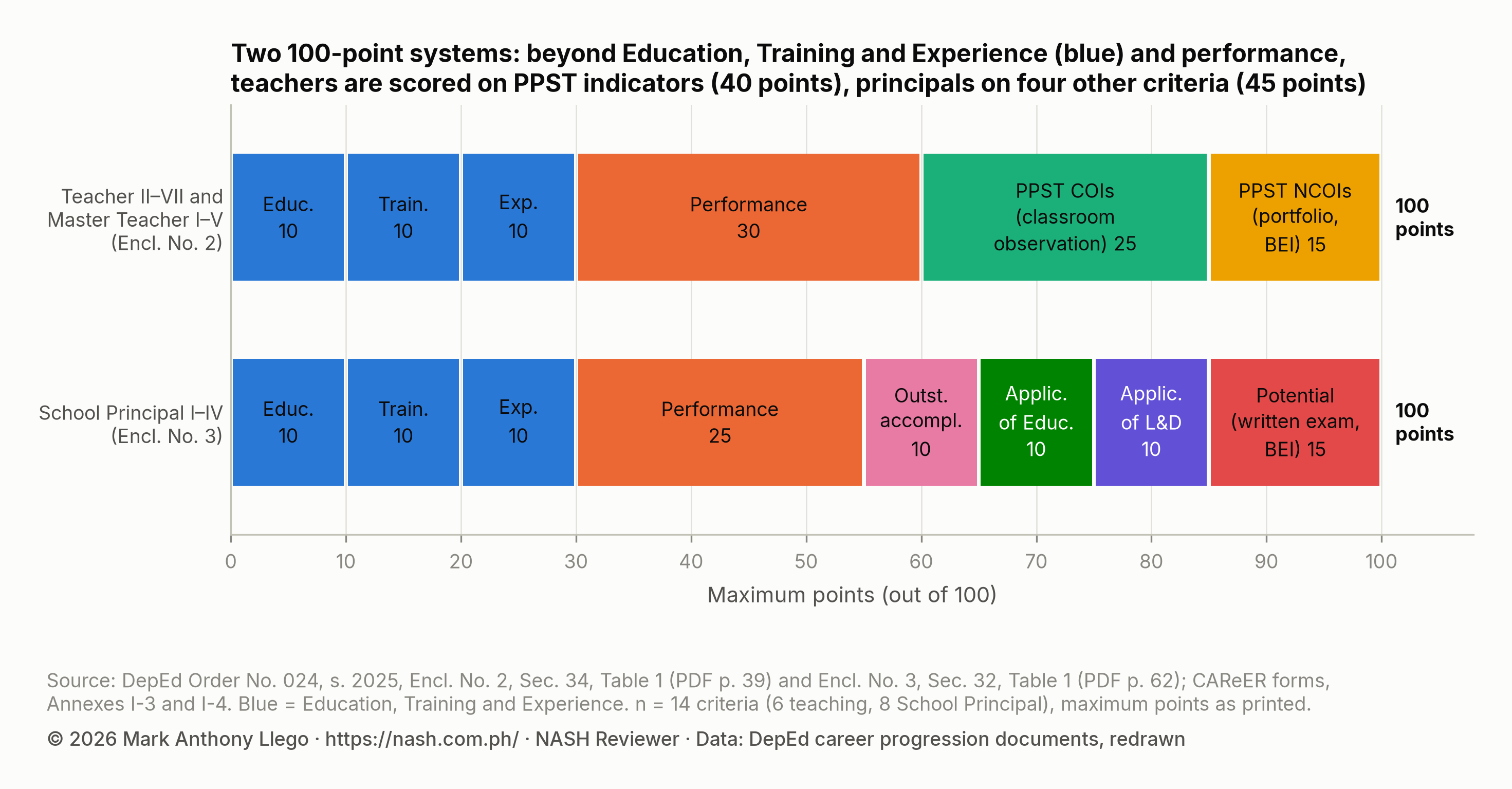
Two things earn no points. The HRMPSB “may” give a written examination or a skills or work sample test, but “Other evaluative assessments, however, do not have corresponding scores in the CAReER” (Sec. 39). And teachers’ awards are not credited: the FAQ answers “No”, because the assessment “is largely based on the demonstration of the required competencies under the Philippine Professional Standards for Teachers” (Q39).
Natural vacancies use the same weights. DO 020, s. 2024, which governs promotion to a vacant higher teaching position (FAQ, Q34), prints the same 10/10/10/30/25/15 split (Encl., para. 42, PDF p. 16), and its Comparative Assessment Result “shall contain only the candidates for appointment who meet the cut-off score of 50 points”, highlighting the top five (para. 48, PDF p. 29).
The 100-point system for School Principal positions
Enclosure No. 3 governs reclassification to School Principal I–IV. Its Table 1, “Point System for Evaluative Assessment: School Principal Positions” (Sec. 32, PDF p. 62), and the School Principal CAReER form (Annex I-4) print the weights; Secs. 35–38 set the sub-criteria:
| Criterion | Maximum points | Sub-criteria and ceilings as printed | Section |
|---|---|---|---|
| a. Education | 10 | Increments above the QS, ETE rubric | Sec. 33 |
| b. Training | 10 | Increments above the QS, after the last promotion and within the last five years | Sec. 33 |
| c. Experience | 10 | Increments above the QS | Sec. 33 |
| d. Performance | 25 | Rating ÷ 5 × 25 | Sec. 34 |
| e. Outstanding Accomplishments | 10 | Awards and Recognition 7; Research and Innovation 4; Subject Matter Expert or membership in national TWGs or committees 3; Resource Speakership or Learning Facilitation 2; NEAP Accredited Learning Facilitator 2. Points add up “but not to exceed” 10. National-level individual awards from a thorough search by bodies such as CSC, Metrobank, NEDA, DAP and DepEd get the full 10 | Sec. 35, Table 4 |
| f. Application of Education | 10 | Means of verification (MOVs) A–C. All MOVs: 10 if relevant, 5 if not; only A and B: 7 or 3; only A: 5 or 1 | Sec. 36 |
| g. Application of Learning and Development | 10 | MOVs A–D. All MOVs: 10 or 5; only A, B and C: 7 or 3; only A and B: 5 or 1 | Sec. 37 |
| h. Potential (Written Exam, BEI) | 15 | School Principal I: written examination 10, BEI 5. Higher School Principal positions: written examination 5, BEI 10 | Sec. 38 |
| Total | 100 |
Criteria e to g count only if “acquired after the last promotion” (Sec. 31.e–g). An intervention is “relevant” when it is “directly applicable to the functional unit where the position applied for is lodged” (Sec. 36).
The principal’s BEI is not the teacher’s BEI. For School Principal positions the BEI is part of Potential, and its points (“5 points for School Principal I and 10 points for higher positions”) “shall be the maximum or ceiling points”; the HRMPSB assigns points to the areas it assesses, “not exceeding the maximum or ceiling points for BEI” (Encl. No. 3, Sec. 38.b, PDF p. 75). There is no rating-over-12 formula, so the 12-or-16 conflict below concerns teaching positions only. The written examination, the MOV lists and DepEd’s worked examples for these criteria are in School Principal I to IV: Promotion Under the ECP.
A slide that misstates a rubric. The orientation deck’s slide on Application of Learning and Development prints “Only A & B” as 7 or 3 points and “Only A” as 5 or 1 (DepEd national orientation deck on DO 024, s. 2025, s. 112). Those are the Application of Education rows. For L&D, DO 024 prints “Only A, B, & C” as 7 or 3 and “Only A & B” as 5 or 1 (Encl. No. 3, Sec. 37, PDF p. 73). The Order governs: MOVs A and B alone earn 5 points, or 1 if not relevant.
Who does the scoring: the special HRMPSB
Both enclosures create a special HRMPSB at the division, chaired by the Assistant Schools Division Superintendent, “Consistent with the provision of Section 90 of DO 19, s. 2022” (Encl. No. 2, Sec. 21; Encl. No. 3, Sec. 20). The teaching board includes the “School Head where the vacancy exists”; the School Principal board does not. Its members, quorum and the school head’s seat are covered in The School Head’s Role in ECP Reclassification.
The SDS may designate sub-committees of assessors, but they “shall only serve as an assistorial body”; the HRMPSB keeps “full responsibility and accountability in the results of the comparative assessment” (Encl. No. 2, Sec. 31). Assessors for teaching positions are trained under the “Career Progression Assessors Program” and must have been “a School Head or Master Teacher for at least five (5) years”, or a supervisor such as a PSDS or EPS with three years of school management experience; a Master Teacher assessor “must be of higher ranks than the position applied for” (Sec. 32, PDF p. 38). For School Principal positions, an assessor must have been “a School Principal for at least five (5) years” or a supervisor with three years of school management experience, and a School Principal assessor “must be of higher ranks than the position applied for” (Encl. No. 3, PDF pp. 60–61).
Scoring is public. Under the Open Ranking System, “the scores of all applicants present thereat shall be disclosed to all attendees”, and each applicant may ask about their own results (Encl. No. 2, Sec. 25). The signed RFTP acknowledges the process but “shall not, in any case, preclude the applicant from filing a protest” (Sec. 27). On who may protest an appointment, on what ground and by when, see Promotion Protests and Nepotism: Cases on Principals.
ETE: points only above the QS
Education, Training and Experience (ETE) are scored the same way in both enclosures (Encl. No. 2, Sec. 35; Encl. No. 3, Sec. 33):
- Find the baseline. The HRMPSB converts the position’s minimum QS into a level on Increments Tables 2.a (education), 2.b (training) and 2.c (experience), each with 31 levels.
- Count increments. “Increment shall refer to the difference between the applicant’s actual qualification level and the corresponding level of the minimum (baseline) QS requirement” (Encl. No. 2, Sec. 35.b).
- Convert to points with Table 3.
| Table | What the levels measure (Encl. No. 2, PDF pp. 40–42) |
|---|---|
| 2.a Education | Level 6 bachelor’s degree; Levels 7–19 add 3 master’s units each, from 6 to 42 units; Level 20 complete academic requirements; Level 21 master’s degree; Levels 22–29 doctoral units, 3 to 24; Level 30 complete academic requirements; Level 31 doctorate |
| 2.b Training | 8-hour steps, from Level 1 (0 to less than 8 hours) to Level 31 (“240 hours” “or more”) |
| 2.c Experience | 6-month steps, from Level 1 (none to less than 6 months) to Level 31 (“15 years” “or more”) |
| 3 Points | 2–3 increments: 2 points; 4–5: 4; 6–7: 6; 8–9: 8; 10 or more: 10 (each of Education, Training and Experience) |
Table 3 prints no row for a single increment, and “Meeting the minimum (baseline) QS requirements for Education, Training, and Experience shall be given zero (0) points” (Encl. No. 2, Sec. 35.d; Encl. No. 3, Sec. 33.d). One level above the QS therefore earns nothing, and points start at two increments; this follows from Table 3, though no text says so.
Three worked examples
| DO 024, Master Teacher I (SHS Academic Track) | DO 024, School Principal I (Secondary) | Toolkit, Teacher Carina, Teacher IV | |
|---|---|---|---|
| Source | Encl. No. 2, Sec. 35.a–c (PDF pp. 42–43) | Encl. No. 3, Sec. 33.a–c (PDF pp. 65–67) | Toolkit, p. 29 |
| Education | Baseline Level 21 (master’s); applicant Level 25 (12 doctoral units): 4 increments, 4 points | Baseline Level 21; applicant Level 31 (PhD): 10 increments, 10 points | Baseline Level 6 (bachelor’s); applicant Level 13 (24 master’s units): 7 increments, 6 points |
| Training | Baseline Level 2 (12 hours); 64 hours, Level 9: 7 increments, 6 points | Baseline Level 5 (32 hours); 168 hours, printed as Level 21: 16 increments, 10 points | Baseline Level 3 (16 hours); 40 hours, Level 6: 3 increments, 2 points |
| Experience | Baseline Level 9 (4 years); 5 years 1 month, Level 11: 2 increments, 2 points | Baseline Level 13; 20 years 9 months: “31 – 13 = 18 increments”, 10 points | Baseline Level 7 (3 years); 17 years, Level 31: 24 increments, 10 points |
| ETE total (printed) | “12 points (out of 30)” | “30 points” | “18 pts/ 30 pts.” |
DO 024’s teaching example does not use the current QS. Its baseline is 12 hours of training and 4 years of experience, and its assessment is dated July 1, 2021. The example is carried over from DO 020, s. 2024 (Encl., para. 43, PDF p. 19). Under DO 019, s. 2025, Master Teacher I (SHS Academic Track and Core Subjects) needs 24 hours of training “and 8 hours of training in Instructional Supervision”, or the NEAP program for Career Stage III, and “5 years experience in teaching or industry work” (CSC Resolution No. 2500471, PDF p. 22). Use the example for the method and take the baseline from the current QS, set out in ECP Qualification Standards Under DO 019, s. 2025.
What counts
- Only qualifications “relevant to the position applied for” earn points (Encl. No. 2, Sec. 35); for teachers, only training in “curriculum, pedagogy, and/or in relevant subject, learning area specialization, or strand” (Sec. 33.b).
- Education units “relevant or related to education that exceed the minimum qualification requirements” earn points (DO 034, para. 12), even if “not strictly vertically aligned” with the bachelor’s degree (FAQ, Q40). Units taken to earn the equivalent of an education degree “shall not correspond to units towards the completion of a Master’s degree” (Encl. No. 2, Sec. 35.a).
- Government or private experience “may be credited” if “functionally related to the duties of the position applied for” and duly certified (DO 034, para. 13). Online training (CSC MC No. 3, s. 2021), TESDA NC II and Trainers Methodology certificates for non-TVL applicants, part-time work of “at least four (4) hours per day” and foreign experience may also count (Encl. No. 2, Sec. 35.e).
- Principals promoted before DO 019, s. 2025 “shall be considered meeting the required ‘five (5) years teaching experience’” when the baseline is set (Encl. No. 3, PDF p. 66). Enclosure No. 3 also lets Doctor of Medicine units count as master’s units, and LL.B. or J.D. units as professional doctorate units, “for purposes of giving points” (Sec. 33.e.ii–iii, PDF p. 67).
Performance: the latest rating, not an average
Points(Performance) = x ÷ 5 × WA, where x is the rating, 5 the highest possible rating, and WA 30 for teaching positions (Encl. No. 2, Sec. 36) or 25 for School Principal positions (Encl. No. 3, Sec. 34).
| Example | Rating (x) | Weight | Points | Source |
|---|---|---|---|---|
| DO 024, teaching | 4.356 | 30 | 26.136 (printed) | Encl. No. 2, Sec. 36, PDF p. 45 |
| DO 024, School Principal I | 4.356 | 25 | 21.78 (printed) | Encl. No. 3, Sec. 34, PDF p. 68 |
| Toolkit, Teacher Carina | 4.642 | 30 | 27.852 (printed); carried into her results as 27.85 | Toolkit, pp. 30 and 42 |
For teachers, the rating is “The PMES IPCRF rating of at least Very Satisfactory in the latest rating period covering one (1) year complete performance cycle”. Non-submission “shall warrant zero (0) points for Performance criterion. No alternate measure shall be considered” (Sec. 36). The toolkit’s HRMO tells an applicant with three IPCRFs that “only the most recent one-year complete performance rating (SY 2024–2025) shall be used” and “The scores in the three IPCRFs will not be averaged” (p. 27).
Eligibility and points use different periods. The performance requirements at initial evaluation are “based on at most three (3) rating periods” (Encl. No. 2, Sec. 14.a, PDF p. 32), and three are needed when crossing career stages (FAQ, Q49). Yet the RFTP form asks only for a “Copy of duly approved IPCRF for the school year immediately preceeding [sic] the application”. Submit every rating period the requirement needs; only the latest is scored. The indicator counts per position are in How to Be Reclassified to Teacher IV to VII in DepEd and How to Become a Master Teacher Under DepEd’s ECP.
Principals: current or previous position. Enclosure No. 3 defines the criterion as the rating “in the current position” (Sec. 31.d), then scores the rating “obtained in the current or previous position that is relevant to the position applied for”, from the IPCRF or OPCRF, with at least Very Satisfactory required in the last rating period (Sec. 34, PDF pp. 68–69). The Order does not reconcile the two; Sec. 34 is the scoring rule. See OPCRF for School Heads.
COI: the classroom observation (25 points)
Teachers demonstrate the five COIs listed for their target position (Encl. No. 2, Table 5) in a classroom observation scored with the Classroom Observation Tool for Recruitment, Selection, and Placement (COT-RSP). The rubric band and the highest possible score depend on the position (Sec. 37):
| Positions | COT rubric levels | Highest possible COI score |
|---|---|---|
| Teacher II–III; Teacher III (Special Science Teacher) | Levels 2 to 6 (Beginning towards Proficient) | 30 |
| Teacher IV–VII, including SNET | Levels 3 to 7 (Proficient) | 35 |
| Master Teacher I–II, including SNEMT | Levels 4 to 8 (Highly Proficient) | 40 |
| Master Teacher III–V, including SNEMT | Levels 5 to 9 (Distinguished) | 45 |
Each maximum is five COIs times the top level of the band (5 × 6 = 30 up to 5 × 9 = 45).
Points(COI) = COT rating ÷ highest possible COI score × 25. DO 024’s Master Teacher I applicant rated 36 gets 36/40 × 25 = 22.5 points (Sec. 37.d, PDF p. 47). The toolkit’s Teacher Carina, rated 34 of 35, gets “24.285” (pp. 35 and 42).
The protocols (Sec. 37.c, PDF pp. 46–47): “two (2) to three (3) observers”, who “must not be related to the applicant within the third degree of consanguinity or affinity”; “an actual classroom setting with learners”, for “the entire class period”; “Only the subject specialist/s shall rate Indicator 1”; and a final rating that “is NOT an average of their individual ratings, but a rating based on their reasoned and consensual judgment”. DO 024 allows an online observation where an in-person one “is not feasible” (Sec. 37.c).
DO 034 added three rules. An observation from “the immediately preceding school year” may be considered if “distinct and separate” from the PMES full-period observation (para. 22). Its certified rating sheet “shall only be valid for one year” and is the basis for “the PPST COI criterion, comprising 25% of the point system” (para. 23). Only trained assessors may observe for promotion (para. 24). Non-teacher applicants (School Principals switching lines, Head Teachers, Assistant School Principals, and teachers designated TIC or Assistant School Head) “shall be required to undergo assessment in both COI and NCOI” (para. 20).
NCOI: portfolio and BEI (12 or 16?)
The non-classroom observable indicators are assessed in two parts (Encl. No. 2, Sec. 38):
- Portfolio annotation, 10 points. On assessment day the applicant fills in the Portfolio Annotations Form (PAF) “on the spot”, in “at most two (2) hours”, annotating the MOVs in their PMES portfolio. No MOVs for an NCOI means “a rating of zero (0) for the Portfolio Assessment component for the particular NCOI”, but the applicant still takes the BEI (Sec. 38.c; FAQ, Q47).
- Behavioral Events Interview, 5 points. It follows the RSPI (Recruitment, Selection, Placement, and Induction) Handbook Vol. 1 and the STAR approach (situation, task, action, result) to validate the annotations (Sec. 38.c). For Master Teacher I and III, Table 6(a) assesses each indicator in the portfolio at one level and in the interview at the next.
The MOVs are documents teachers already have, drawn from the RPMS-PPST or PMES “from the last three rating periods” (DO 034, para. 25; FAQ, Q43).
The formula and the 12-or-16 conflict
Points(NCOI) = PA score + BEI score (Encl. No. 2, Sec. 38.d, PDF p. 50):
- PA score = total portfolio rating ÷ highest possible total rating × 10, the highest being 30, 35, 40 or 45 by career stage, as for the COI;
- BEI score = total BEI rating ÷ highest possible total rating × 5.
What the documents say about the BEI divisor:
- DO 024 prints 12. Sec. 38.d reads “Highest Possible Total Rating = 12”, with the example “11/12 x 5 = 4.583 points” and “Points(NCOI) = 8.250 + 4.58 = 12.83” (PDF p. 50).
- DepEd’s FAQ says 16. “No. That is a clerical oversight and a typographical error in the policy. The correct highest possible score for the Behavioral Events Interview (BEI) is 16 points, not 12” (FAQ, Q42, pp. 10–11). The toolkit also computes with 16 (p. 40).
- No DepEd Order corrects the 12. DO 034, which amends DO 024, has no BEI score provision, and as of October 31, 2026 no later Order or memorandum has amended it.
- DO 020, s. 2024 also prints 12, with the same example (Encl., para. 46.d, PDF p. 28). The FAQ’s answer speaks only of DO 024’s Section 38(d).
So: DO 024 printed 12, and DepEd’s FAQ calls that a typographical error and uses 16. By rank, the Order’s printed text governs until an Order amends it. The FAQ’s 16 is DepEd’s own reading, sent out as guidance by memorandum of its Undersecretary for Human Resource and Organizational Development; it is not an Order, does not amend DO 024, and nothing extends it to DO 020. DepEd’s own FAQ and toolkit nonetheless compute with 16, so ask your HRMPSB which divisor it used.
Neither DO 024 nor the FAQ explains where 16 comes from; the BEI rubric and rating sheets are DO 024’s Annexes O to Q (Sec. 38.b). One consequence is arithmetic. If a BEI rating can reach 16, as the FAQ says, the printed divisor would let a perfect interview earn 16/12 × 5 = 6.667 points, more than the 5 the BEI is worth. No document gives this as the reason for the FAQ’s correction.
The worked example, printed and computed
DO 024 and the FAQ use the same Master Teacher I applicant: a portfolio rating of 33 out of 40 and a BEI rating of 11.
| Step | DO 024 as printed (BEI ÷ 12) | DepEd FAQ, Q42 (BEI ÷ 16) |
|---|---|---|
| PA score | 33/40 × 10 = 8.250 (printed; exact) | 33/40 × 10 = 8.250 (printed; exact) |
| BEI score | 11/12 × 5 = 4.583 (printed); 4.58333 (computed) | 11/16 × 5 = 3.437 (printed); 3.4375, or 3.438 rounded (computed) |
| NCOI points | “8.250 + 4.58 = 12.83” (printed); 12.833 (computed) | “8.250 + 3.437” = 11.687 (printed); 11.6875 (computed) |
| Difference | 1.146 fewer points under the FAQ’s divisor (computed: 12.8333 − 11.6875) |
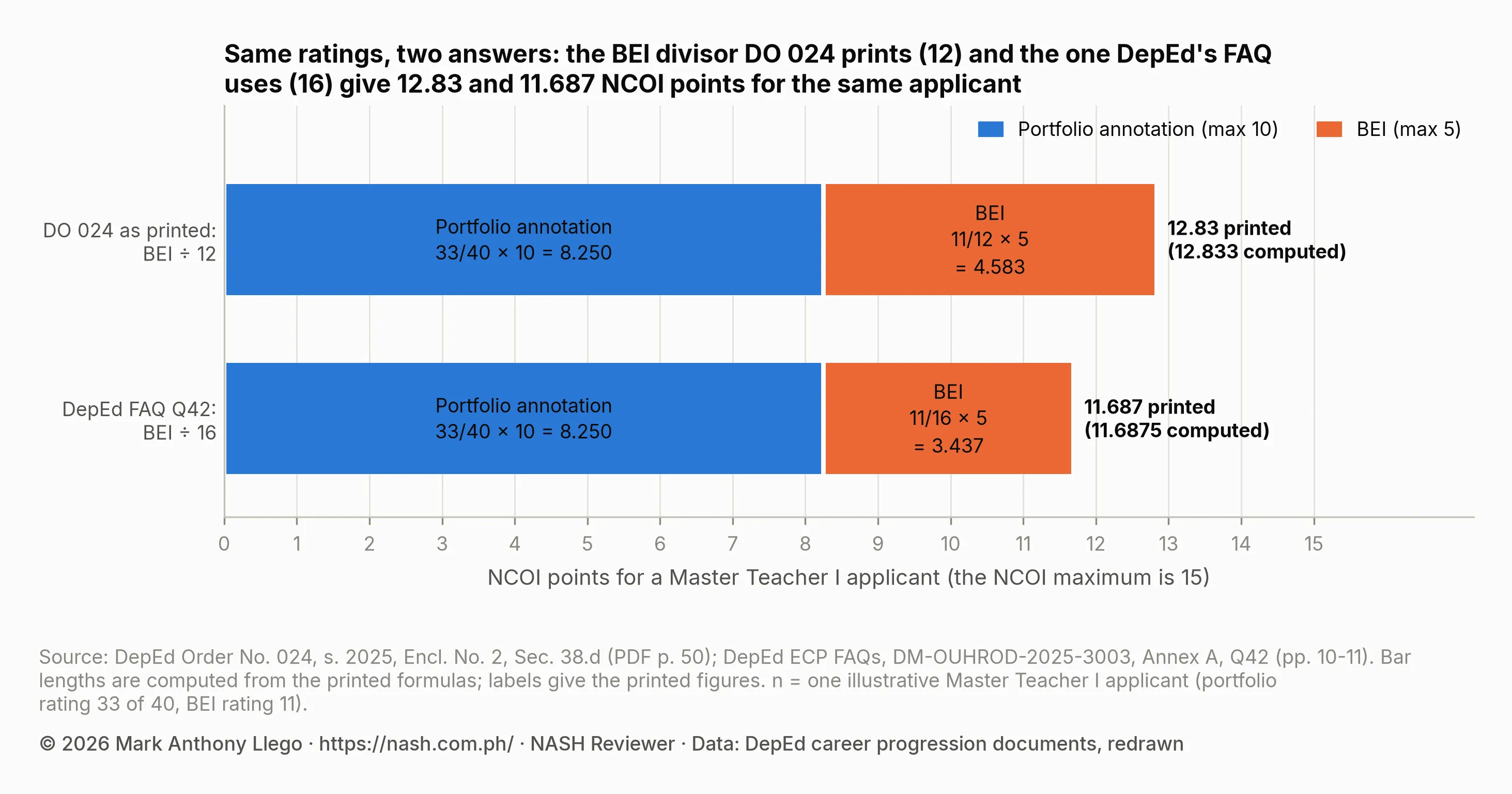
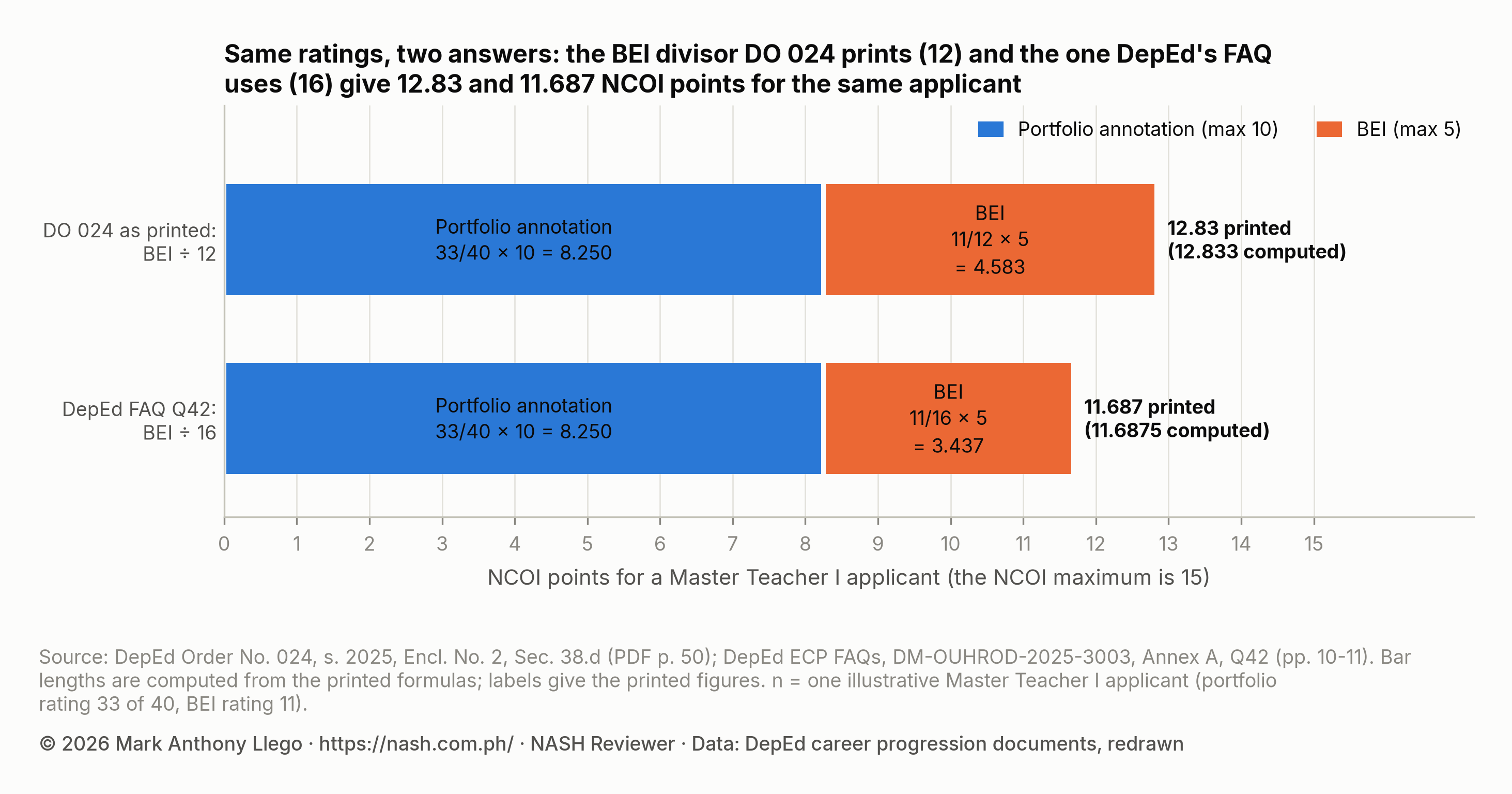
The toolkit’s Teacher Carina, with a portfolio rating of 32 of 35 and a BEI rating of 14 out of 16, gets 9.142 + 4.375 = 13.517 NCOI points (pp. 40 and 42). Enclosure No. 2 sets no rounding rule: DO 024 adds 4.58 after printing 4.583, while the FAQ and toolkit cut values at three decimals.
What to do about the divisor. An applicant can ask at the open ranking how the NCOI score on their RFTP was computed (Sec. 25) and query it within five calendar days of posting (Sec. 48); an HRMPSB should use one divisor for every applicant to a position and record it in its Minutes of Deliberation (Sec. 28).
The 50-point cut-off and the CAReER queue
Within “seven (7) calendar days” after all applicants are assessed, the HRMPSB prepares two copies of the Comparative Assessment Results for Expanded Reclassification (CAReER) for each position (Encl. No. 2, Sec. 40):
- The posted copy lists candidates “in no particular order using application codes”, in at least three conspicuous places “for a period of at least 10 calendar days” (Sec. 41). Only codes, criterion scores, totals and remarks are public (Sec. 30).
- The SDS copy highlights “the candidates for reclassification who meet the cut-off score of 50 points, ranked from highest to lowest based on the total scores”, with the Plantilla Allocation List (Sec. 42).
Rank is not the only order. DO 024 gives incumbents of SSP I–II, ASP I–III, ASSP I, HT I–VI, SNET I–V and SST I–II priority in reclassification during the transition (Encl. No. 1, Sec. 33). For FY 2026, DepEd’s memorandum DM-OUHRODI-2026-0802 (March 13, 2026, Sec. III(2); copy posted by SDO Nueva Vizcaya) goes further: qualified incumbents “who meet the 50-cut off score shall be prioritized for reclassification regardless of their rank in the CAReER”. They are retirable Teacher I incumbents aged 55–64, Head Teachers and Assistant School Principals affected by the transition, and SSP, ASSP, SNET and SST incumbents. The retirable Teacher I group rests on the memorandum alone; DO 024 does not list it. See How to Be Reclassified to Teacher IV to VII in DepEd.
Queries go to the HRMPSB “within five (5) calendar days from the date of posting”, answered in writing “within three (3) to seven (7) calendar days”; reclassification proceeds meanwhile (Sec. 48).
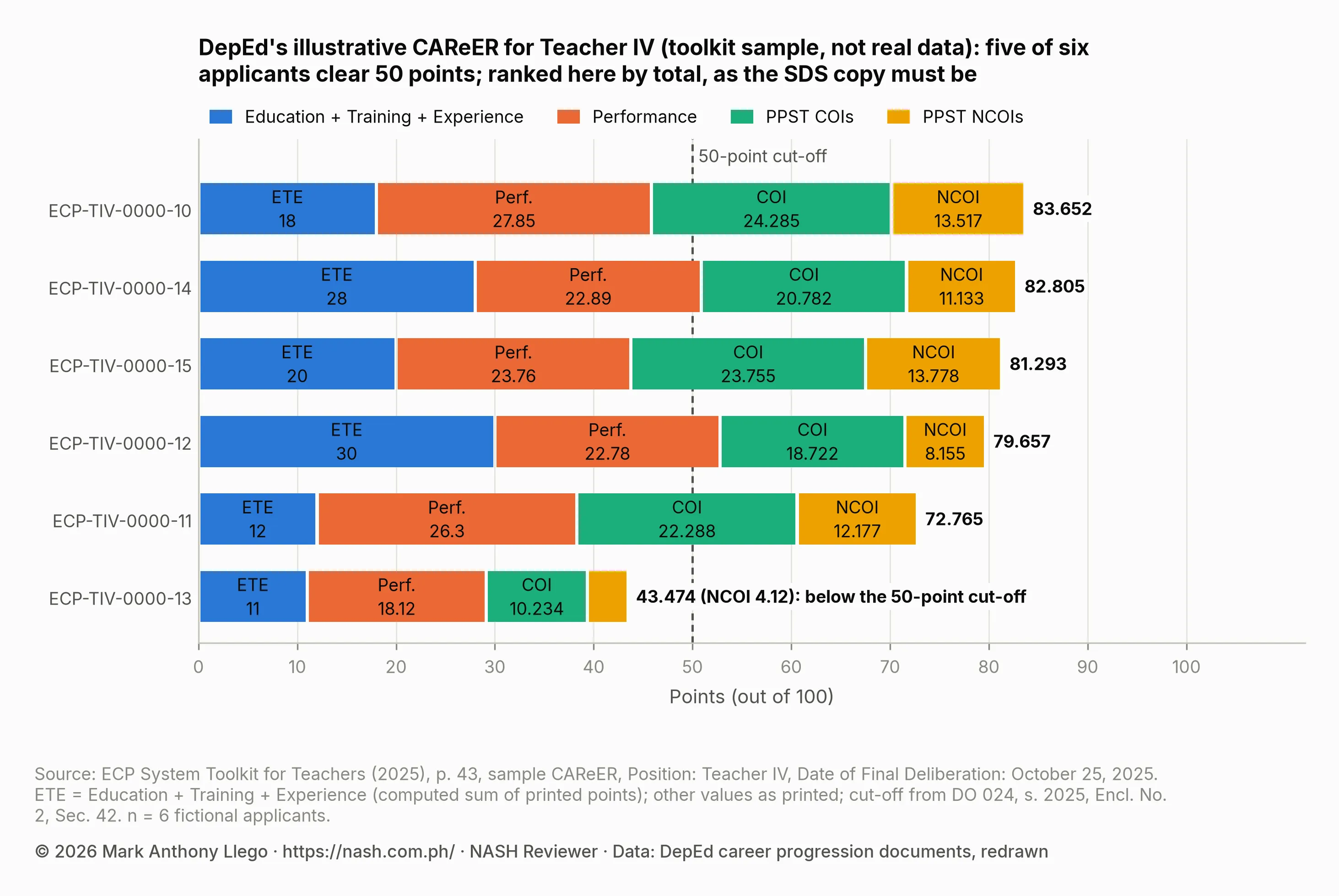
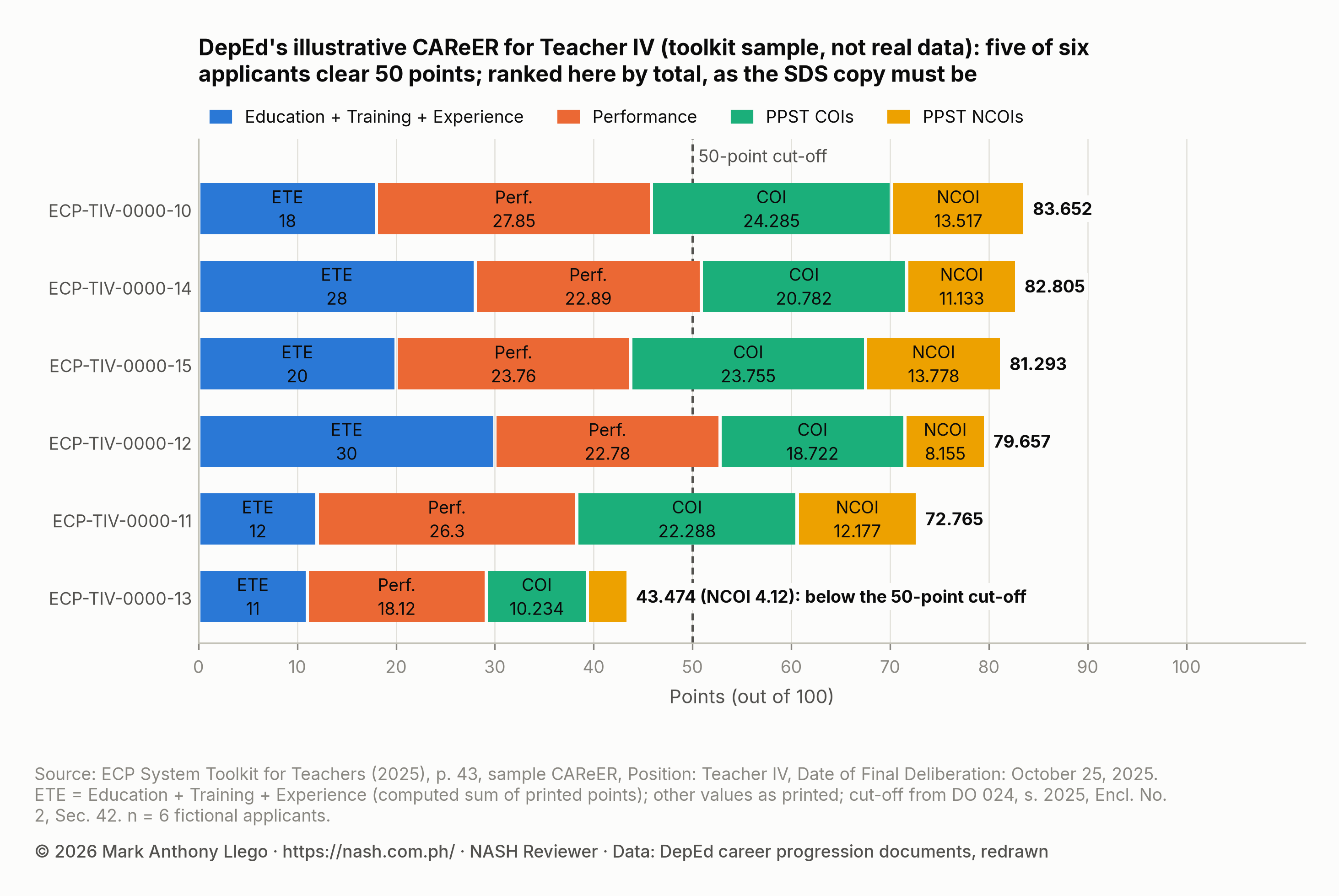
The toolkit’s sample (“Position: Teacher IV”, final deliberation October 25, 2025) lists six applicants (p. 43); -10’s scores are Teacher Carina’s (p. 42). Full ETE points did not put -12 (30 of 30) first: performance, COI and NCOI carry 70 of the 100 points.
After 50 points. “The CAReER for a particular position shall be valid until exhausted.” Candidates who clear the cut-off but are not funded are prioritized in the next fiscal year, “in the queue”, without a new assessment (Encl. No. 2, Sec. 45), “subject to the availability of funds” (DO 034, para. 26). Candidates below 50 may carry over their CAReER scores or update their credentials in the next round with a Letter of Intent and recent ratings (Sec. 46), and anyone not accommodated may still apply to a vacancy (Sec. 47). How the 2026 funding shortfall affected queued applications is covered in Why ECP Reclassification Was Deferred in 2026.
School Principals: no cut-off, and one stray sentence. Enclosure No. 3 ranks principal candidates “from highest to lowest based on the total scores” with no cut-off (Sec. 41) and queues all “remaining applicants in the CAReER who were not accommodated” (Sec. 44); the FAQ agrees (Q35; also orientation deck, s. 120). DO 034 speaks of “Qualified candidates who have obtained the minimum 50-point cut-off score” without naming a position type (para. 26). It is the later Order, but para. 26 neither mentions School Principal positions nor amends Encl. No. 3, Sec. 41, and the FAQ, issued ten days after DO 034, still says no cut-off applies. So para. 26 most likely describes the teaching CAReER, though DO 034 does not say so.
RA 12288. The Act requires that “The assessment process, criteria, and point system” “shall be made available to the public” (RA 12288, Sec. 9), but DepEd’s ECP issuances do not give its effective date. Its IRR was signed on August 17, 2026. As of October 31, 2026, the IRR had not been published in the Official Gazette or on deped.gov.ph, so its effective date is not yet known. Section 17 of the IRR keeps “All ongoing reclassification assessments prior to the effectivity of this IRR” under “prior laws, rules, and issuances”. No DepEd order implements the Act and no new point system has been issued; see What RA 12288 Changes in Teacher Career Progression.
What this means for school heads
Your school’s IPCRFs become the performance score and its PMES records the portfolio. These steps follow from the issuances:
- Know when you are a member. The teaching HRMPSB includes the “School Head where the vacancy exists” (Encl. No. 2, Sec. 21); DO 024 does not say which school head sits when a teacher’s own item is reclassified.
- Help teachers book an early observation. An observation from the preceding school year counts if separate from the PMES observation, and its certified rating sheet is valid for one year (DO 034, paras. 22–23). The toolkit tells teachers to “Coordinate with your School Head to request a classroom observation schedule from the SDO within the current school year” (p. 35).
- Keep PMES records complete, and ask for nothing new. A missing rating scores zero (Encl. No. 2, Sec. 36); the portfolio uses existing MOVs “from the last three rating periods” (DO 034, para. 25; FAQ, Q43). See DepEd’s PMES for teachers.
- Observe only if trained, and never a relative within the third degree (DO 034, para. 24; Encl. No. 2, Sec. 37.c).
- Explain the BEI conflict as it is: DO 024 prints 12 and, by rank, the Order’s 12 governs; DepEd’s FAQ calls it a typographical error and uses 16; no Order has settled it.
- Prepare your own principal application early. Accomplishments and applications of education and L&D count only after your last promotion and only with the listed MOVs (Encl. No. 3, Secs. 31 and 35–37).
| A school head may | A school head may not |
|---|---|
| Sit on the teaching HRMPSB for a vacancy in the school (Encl. No. 2, Sec. 21) | Observe a teacher for promotion without the assessors’ training (DO 034, para. 24) |
| Request an SDO observation schedule for teachers who plan to apply (DO 034, para. 24; toolkit, p. 35) | Use the PMES full-period observation as the promotion observation (DO 034, para. 22) |
| Help teachers organize the MOVs they already have (DO 034, para. 25) | Require new MOVs for the portfolio (DO 034, para. 25; FAQ, Q43) |
| Help a teacher file a query within five calendar days of the CAReER’s posting (Encl. No. 2, Sec. 48) | Post applicants’ names with their scores; only codes, scores and remarks are public (Encl. No. 2, Sec. 30) |
The wider duties are in Human Resource Management for School Heads and PPSSH Domain 4: Developing Self and Others, whose performance management strand covers the ratings that feed this point system.
How the NASH may test this
The two items below are original practice items, scored 3 (Relational), 2 (Multistructural), 1 (Unistructural) or 0 (Prestructural). An option that breaks a rule scores 0.
Question 1
Indicator 4.4.2, Performance management. Career Stage 2, Situational, Moderate.
You are the principal of an elementary school. Teacher R, a Teacher III whose latest IPCRF rating is Very Satisfactory, plans to apply for reclassification to Teacher IV in next year’s call for applications. She asks what she can do this school year to prepare for the HRMPSB’s comparative assessment. What is the most appropriate action?
- A. Help her organize the lesson plans, assessment materials and LAC documents from her last three rating periods, since the portfolio draws only on MOVs she already has.
- B. Request a classroom observation by the SDO’s trained assessors this school year, separate from her PMES observation, and tell her the certified rating sheet is valid for one year.
- C. Request a classroom observation by the SDO’s trained assessors this school year, separate from her PMES observation, and help her organize the MOVs from her last three rating periods.
- D. Observe her class yourself during her scheduled PMES full-period observation and certify your COT ratings as her classroom observation score for the reclassification.
Answer and explanation
Best answer: C. Points: A = 1, B = 2, C = 3, D = 0.
- A (1 point, Unistructural). It prepares only the 10-point portfolio and leaves the 25-point observation to chance.
- B (2 points, Multistructural). It gets the observation right, including its one-year validity, but does nothing for the NCOI portfolio.
- C (3 points, Relational). It prepares both PPST criteria as DO 034 allows: an early observation by trained assessors, separate from PMES, and a portfolio from existing MOVs.
- D (0 points, Prestructural). DO 034 counts only observations “distinct and separate” from the PMES full-period observation, certified by the sub-committee, and only trained assessors may observe for promotion.
Why. Under DO 034, s. 2025, an observation from the preceding school year counts only if “distinct and separate from the scheduled full-period classroom observation conducted for purposes of the Performance Management and Evaluation System (PMES)” (para. 22); its rating sheet is certified by the sub-committee and valid for one year (para. 23); and only trained assessors may observe for promotion (para. 24). The portfolio uses MOVs “from the last three rating periods” (para. 25).
Indicator 4.4.2: Implement the performance management system with a team to support the career advancement of school personnel, and to improve office performance.
Sources: DepEd Order No. 034, s. 2025, paras. 22–25; DepEd Order No. 024, s. 2025, Encl. No. 2, Secs. 34, 37 and 38.
Question 2
Indicator 2.4.1, Management of staff. Career Stage 1, Conceptual, Moderate.
A Teacher III and a Master Teacher I in the same division apply for reclassification, one to Teacher IV and the other to School Principal I. Which statement best describes how DepEd Order No. 024, s. 2025 scores the two applications?
- A. Both are scored out of 100, and only the teacher faces a cut-off of 50 points; School Principal I applicants are ranked from highest to lowest with no cut-off at all.
- B. Both are scored out of 100; the teacher is rated on PPST classroom and non-classroom indicators against a 50-point cut-off, the principal on accomplishments, application and potential, with no cut-off.
- C. Both are scored out of 100, and in both systems Education, Training and Experience are worth 30 points, earned only for qualifications above the QS.
- D. Both are scored out of 100, and both must reach a 50-point cut-off before the HRMPSB may include them in the Plantilla Allocation List.
Answer and explanation
Best answer: B. Points: A = 2, B = 3, C = 1, D = 0.
- A (2 points, Multistructural). The cut-off difference is right, but it says nothing about the different criteria the two systems score.
- B (3 points, Relational). It connects each system’s criteria with the rule that decides who is listed, which is how the two enclosures differ.
- C (1 point, Unistructural). True of both systems, but it describes only the 30 points they share.
- D (0 points, Prestructural). Enclosure No. 3 ranks School Principal candidates “from highest to lowest” with no cut-off, and DepEd says “no cut-off scores will be applied”.
Why. Enclosure No. 2 scores teachers on ETE, Performance, PPST COIs and PPST NCOIs and highlights those “who meet the cut-off score of 50 points” (Secs. 34 and 42). Enclosure No. 3 scores principals on ETE, Performance, Outstanding Accomplishments, Application of Education and of L&D, and Potential, ranked “from highest to lowest” (Secs. 32 and 41); the FAQ confirms there is no cut-off (Q35).
Indicator 2.4.1: Demonstrate knowledge and understanding of laws, policies, guidelines and issuances on managing school staff.
Sources: DepEd Order No. 024, s. 2025, Encl. No. 2, Secs. 34 and 42, and Encl. No. 3, Secs. 32 and 41; DepEd ECP FAQs, DM-OUHROD-2025-3003, Annex A, Q35.
Nothing in this guide reproduces or predicts examination content.
Frequently asked questions
What is the passing score for ECP reclassification?
For Teacher II–VII and Master Teacher I–V, 50 out of 100 points: the SDS copy of the CAReER highlights the candidates “who meet the cut-off score of 50 points” (DO 024, s. 2025, Encl. No. 2, Sec. 42). School Principal positions have no cut-off; candidates are ranked from highest to lowest (Encl. No. 3, Sec. 41; FAQ, Q35). Reaching 50 points puts a teacher in the queue but does not guarantee funding that year (DO 034, para. 26).
Is the BEI scored out of 12 or 16?
DO 024 prints 12 as the highest possible BEI rating (Encl. No. 2, Sec. 38.d), and by rank the Order’s 12 governs until an Order amends it. DepEd’s FAQ calls the 12 “a clerical oversight and a typographical error” and uses 16 (Q42), as does the toolkit, so ask your HRMPSB which divisor it used. DO 020, s. 2024 also prints 12.
Are teaching awards counted in teacher reclassification?
No. The FAQ says the teachers’ assessment “is largely based on the demonstration of the required competencies” under the PPST, plus performance and ETE (Q39). Awards do count for School Principal applicants, under Outstanding Accomplishments, if earned after the last promotion (DO 024, Encl. No. 3, Sec. 35).
Is my performance score the average of my three IPCRFs?
No. Only the latest rating period covering a one-year complete cycle is scored, as rating ÷ 5 × 30 for teachers (DO 024, Encl. No. 2, Secs. 33.d and 36). The toolkit says “The scores in the three IPCRFs will not be averaged” (p. 27). Up to three rating periods matter only for the performance requirements checked at initial evaluation (Sec. 14.a).
Download the data
- /blog/charts/career-progression/points-two-systems.csv: the maximum points for each of the 14 criteria in the two point systems, as printed (DO 024, s. 2025, Encl. No. 2, Sec. 34, Table 1 and Encl. No. 3, Sec. 32, Table 1; Annexes I-3 and I-4).
- /blog/charts/career-progression/points-ncoi-bei-example.csv: DO 024’s NCOI worked example under the printed BEI divisor (12) and the FAQ’s (16), each figure as printed and as computed (DO 024, Encl. No. 2, Sec. 38.d; FAQ, Q42).
- /blog/charts/career-progression/points-toolkit-career.csv: the toolkit’s illustrative CAReER for Teacher IV, six fictional applicants with every criterion score and total as printed, the ETE sum and recomputed totals (ECP System Toolkit for Teachers, 2025, p. 43).
The CSVs and charts may be reused only with written permission: email support@nash.com.ph. The rules themselves come from DepEd’s issuances, which you can cite directly.
Sources
- DepEd Order No. 024, s. 2025, Guidelines on the Implementation of the Expanded Career Progression System for Teachers and School Heads in the Department of Education, August 28, 2025. Encl. No. 1, Sec. 33 (PDF p. 18); Encl. No. 2 (teaching positions), Secs. 14.a, 20–25, 27–28, 30–48 (PDF pp. 32, 36–52); Encl. No. 3 (School Principal positions), Secs. 20–24, 31–38, 41 and 44 (PDF pp. 58–76); Annexes B-1 (RFTP), I-3 and I-4 (CAReER forms).
- DepEd Order No. 034, s. 2025, Amendments and Clarifications to DepEd Order No. 024, s. 2025, October 14, 2025, paras. 12–13 and 20–26 (PDF pp. 3, 5–7).
- DepEd Order No. 020, s. 2024, Guidelines on the Recruitment, Selection, and Appointment to Higher Teaching Positions, December 20, 2024, Encl., paras. 42 (Table 1), 43, 46.d and 48 (PDF pp. 16, 19, 28–29).
- DepEd Order No. 019, s. 2025, Amended Qualification Standards, June 24, 2025, enclosing CSC Resolution No. 2500471 (PDF p. 22).
- DepEd Memorandum DM-OUHRODI-2026-0802, Guidance on the Reclassification of Teaching and School Principal Positions for Fiscal Year (FY) 2026, March 13, 2026, Sec. III(2) (PDF p. 3), as posted by SDO Nueva Vizcaya.
- DepEd Order No. 019, s. 2022, The Department of Education Merit Selection Plan, cited by DO 024 for the special HRMPSB.
- Republic Act No. 12288, approved September 12, 2025, Sec. 9 (PDF p. 4). Implementing Rules and Regulations of RA 12288, signed August 17, 2026 (not yet published as of October 31, 2026), Sec. 17 (PDF p. 10), DepEd-certified copy in DepEd’s career progression toolkit folder (tinyurl.com/CareerProgToolKit).
- DepEd, Frequently Asked Questions (FAQs) for DepEd Order No. 024, s. 2025 and DepEd Order No. 34, s. 2025, Annex A to Memorandum DM-OUHROD-2025-3003, October 24, 2025 (copy updated November 6, 2025), Q34–Q35, Q39–Q40, Q42–Q43, Q47 and Q49 (pp. 9–13). Circulated to the field with the Career Progression Toolkit at tinyurl.com/CareerProgToolKit, the link the memorandum gives.
- DepEd, ECP Toolkit: An Implementation Guide for Teachers on the Expanded Career Progression System 2025 (ECP System Toolkit for Teachers), pp. 26–27, 29–30, 35, 40 and 42–43, in the same folder.
- DepEd, National Orientation on the Implementation of the Expanded Career Progression System for Teachers and School Heads (DO 024, s. 2025), session slides, undated (2025), s. 112 and 120, in the same folder.
The career progression series
- DepEd Expanded Career Progression (ECP): The Full Guide
- How to Be Reclassified to Teacher IV to VII in DepEd
- How to Become a Master Teacher Under DepEd’s ECP
- ECP Salary Grades for Teachers, MTs and Principals
- ECP Qualification Standards Under DO 019, s. 2025
- ECP Point System: How the HRMPSB Scores Applicants (this post)
- School Principal I to IV: Promotion Under the ECP
- The School Head’s Role in ECP Reclassification
- Head Teacher Retitling: Options Under ECP and RA 12288
- Why ECP Reclassification Was Deferred in 2026
- What RA 12288 Changes in Teacher Career Progression
- Department Head, Assistant School Head and MT Duties
Written by Mark Anthony Llego for NASH Reviewer. Sources: DepEd Orders No. 024 and No. 034, s. 2025; DO 020, s. 2024; DO 019, s. 2025; RA 12288 and its IRR; DepEd’s ECP FAQs (DM-OUHROD-2025-3003), ECP System Toolkit for Teachers and national orientation deck. Charts may be reused only with written permission from support@nash.com.ph.