Only a qualified next-in-rank employee may protest an appointment, and only on one ground: that the appointee “does not possess the minimum qualification requirements” (2025 RACCS, Sec. 116). In DepEd, a protest against an appointment to a school administration position goes in writing to the Head of Office within 15 days (DO 007 counts from issuance, the CSC rules from posting a day later), and an appeal goes to the Civil Service Commission (CSC) regional office, not to a higher DepEd office (DO 007, s. 2023, Encl. No. 1, item 67). On nepotism, the leading case is Civil Service Commission v. Dacoycoy, G.R. No. 135805, April 29, 1999 (En Banc). The Court revived the dismissal of a school administrator whose sons were appointed to non-teaching posts under his immediate supervision, though he had neither appointed nor recommended them, and held that the CSC may appeal when the Court of Appeals clears an employee the CSC found guilty.
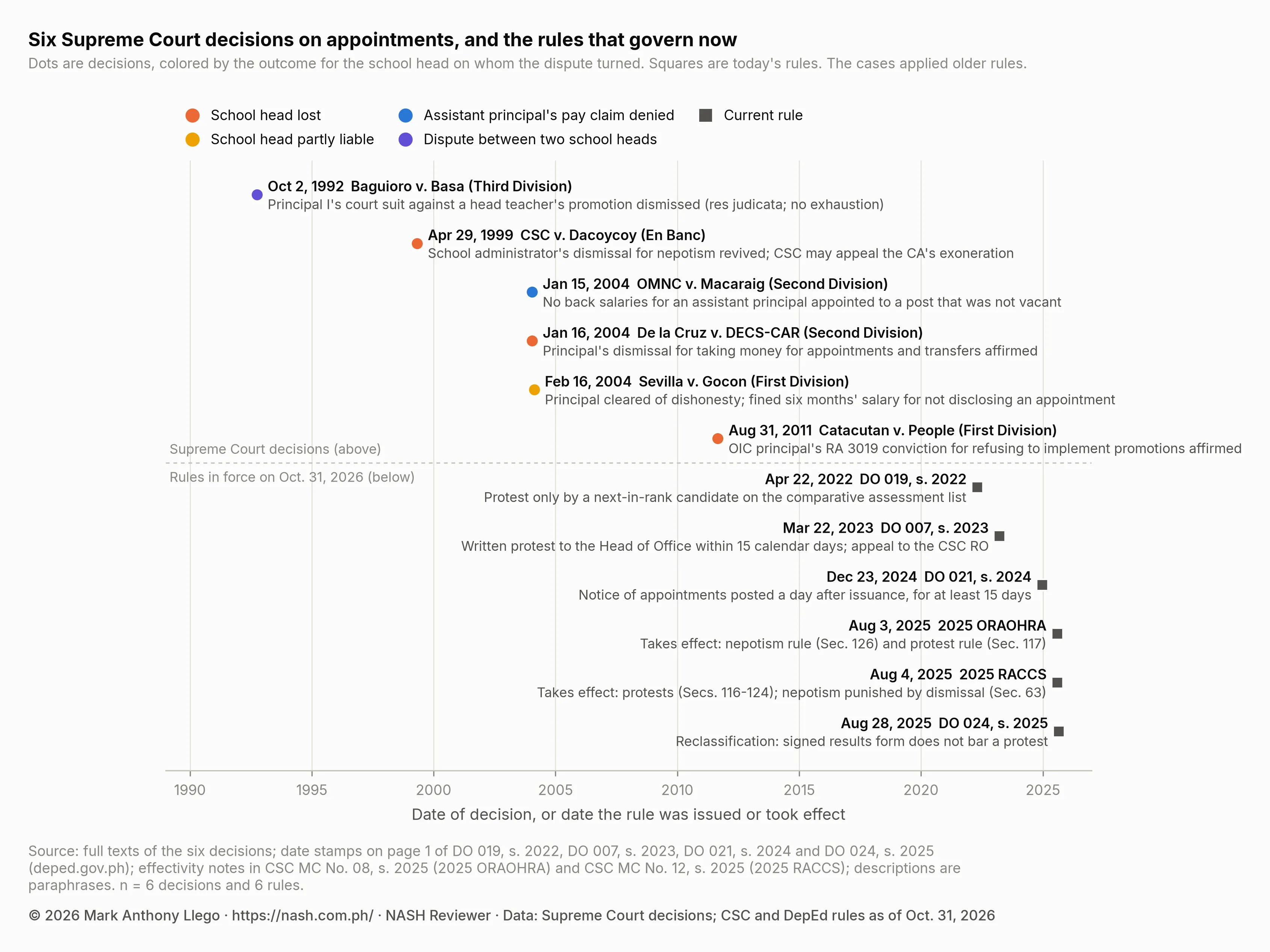
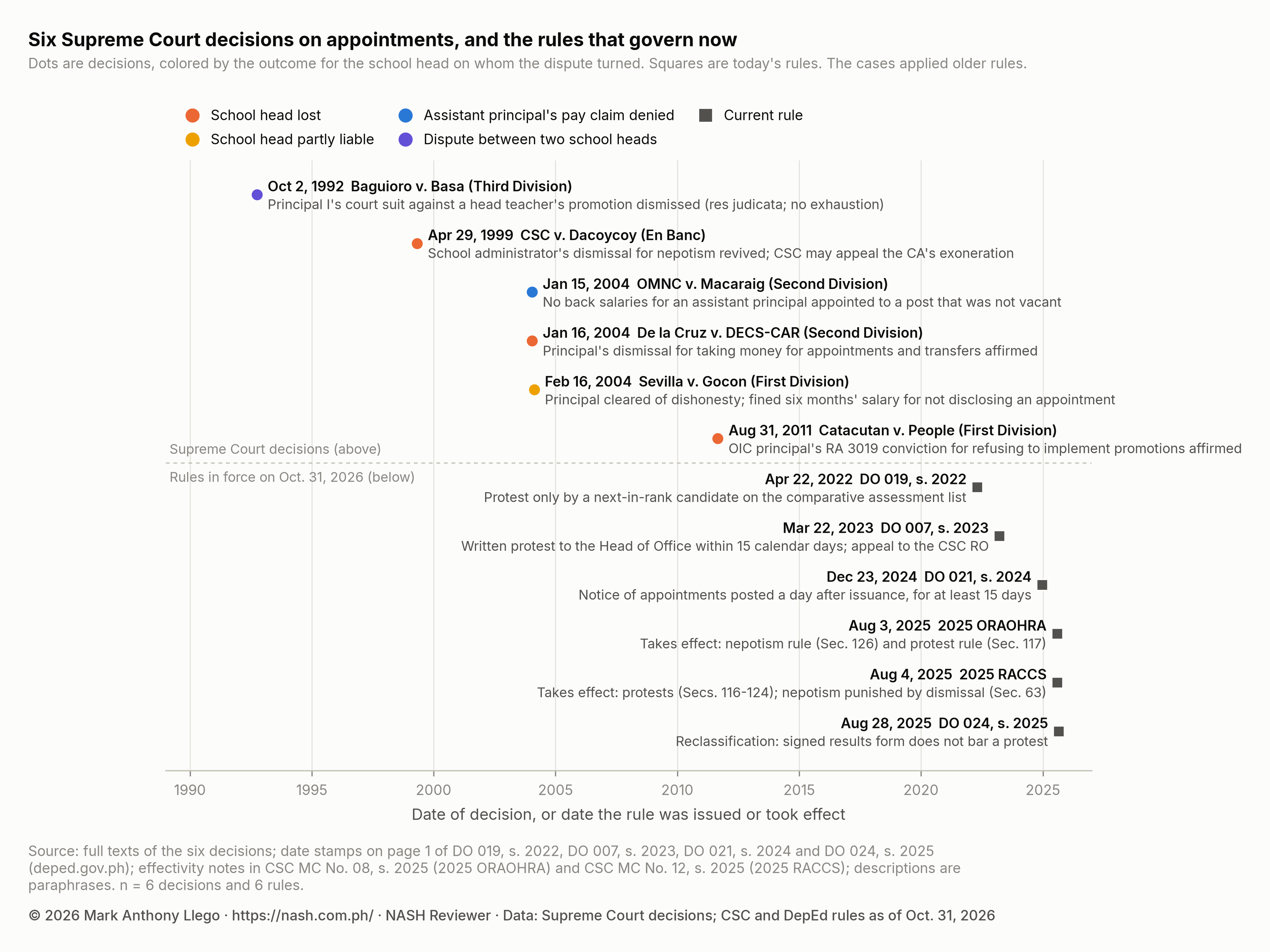
Five other decisions cover what happens around appointments: refusing to implement promotions (Catacutan v. People, 2011), taking money for them (De la Cruz v. DECS-CAR, 2004), failing to disclose one (Sevilla v. Gocon, 2004), an appointment to a post that was not vacant (Occidental Mindoro National College v. Macaraig, 2004), and a promotion contest between two school heads (Baguioro v. Basa, 1992).
The cases applied older procedures; the rules in force on October 31, 2026 are chiefly the 2025 Rules on Administrative Cases in the Civil Service (2025 RACCS) and the 2025 Omnibus Rules on Appointments and Other Human Resource Actions (2025 ORAOHRA).
Key findings
- Nepotism reaches the supervisor, not only the official who signs. In Dacoycoy (1999, En Banc), “it suffices that an appointment is extended or issued in favor of a relative within the third civil degree of consanguinity or affinity of the chief of the bureau or office, or the person exercising immediate supervision over the appointee.” Teaching posts are exempt: the 2025 ORAOHRA reads “teachers” through RA 4670, Sec. 2, which covers school supervisors and school heads but not “other school employees”.
- The CSC may appeal when the Court of Appeals clears an employee. Dacoycoy (1999) so held; the Court narrowed the ruling months later, and CSC v. Fuentes (2023, En Banc) settled that the CSC “generally” has standing. An agency’s decision exonerating a respondent still cannot be appealed to the CSC, except in sexual harassment cases (2025 RACCS, Sec. 98).
- “Better qualified” is not a protest ground today. Baguioro v. Basa (1992) arose from a “better qualified” contest under the old promotion boards. Today a protest lies only for lack of minimum qualifications, and filing it does not stop the appointment (2025 RACCS, Secs. 116 and 119).
- Refusing to implement a valid promotion can be a crime. In Catacutan v. People (2011), the Court affirmed an officer-in-charge principal’s conviction under RA 3019, Sec. 3(e): six years and one month in prison and perpetual disqualification from public office.
- Taking money for appointments means dismissal. In De la Cruz v. DECS-CAR (2004), twelve witnesses testified that a Principal I promised appointments, promotions and transfers for money, and the Court held that dismissal “is an indivisible penalty”.
- Failing to disclose an appointment is an offense, even without deceit. In Sevilla v. Gocon (2004), a principal was cleared of dishonesty because he made no false statement. He was fined six months’ salary for conduct grossly prejudicial to the service for failing to tell a teacher that someone else held the item for her work, and to fix it.
- An appointment to a filled post gives no right to back pay. In Macaraig (2004), an assistant principal appointed in 1977 to a post that was not vacant was ousted in 1984 when the rightful holder was restored. Her later suit for back salaries failed because that service was only de facto and the 1984 appointment her husband issued was unauthorized and never took effect.
Who can protest a principal’s appointment, and on what ground
- Who. “Only a qualified next-in-rank official or employee may file a protest against an appointment made in favor of another on the grounds that the latter does not possess the minimum qualification requirements” (2025 RACCS, Sec. 116; the 2025 ORAOHRA, Sec. 117, says the same). DepEd’s Merit Selection Plan (DO 019, s. 2022) adds that the protestant must be “included in the list of candidates in the CAR/CAR-RQA”, the comparative assessment results (DO 019, s. 2022, item 67).
- Ground. Only that the appointee lacks the minimum qualifications. Being next in rank gives no right to the post: the appointing authority “may appoint an applicant, who is ranked higher than those occupying positions deemed next-in-rank” (2025 ORAOHRA, Sec. 89).
- When. Within 15 days “from the announcement and/or posting of appointments” (2025 RACCS, Secs. 117 and 122(d); 2025 ORAOHRA, Sec. 117). DepEd’s Merit Selection Plan counts the same way (DO 019, s. 2022, item 67). DO 007 instead counts 15 calendar days “from the date of issuance of appointment” (Encl. No. 1, item 67), and the Notice of Appointments Issued is posted “a day after the issuance of the appointment” (DO 021, s. 2024, item 31), so DO 007’s period ends about a day earlier. No DepEd order or decision says which count prevails, though DO 007 itself says the CSC’s rules on protest apply. If the protest reaches the CSC regional office, the CSC applies the 2025 RACCS count, under which a protest is dismissed as late only if “filed beyond the fifteen (15)-day reglementary period” (Secs. 117 and 122(d)). A protestant who files within 15 calendar days of issuance meets every count, and a Head of Office who rejects as late a protest filed within 15 days of posting should expect the CSC regional office to count from posting on appeal.
- Where. In DepEd, the protest for “non-teaching, related-teaching, and school administration positions” is “a formal written communication addressed to the Head of Office”, who responds within seven calendar days, extendable to 20. “No appeal shall be filed to a higher governance level of DepEd”; appeals go to the CSC regional office (DO 007, Encl. No. 1, item 67). The 2025 RACCS route is “initially to the head of agency, then to the CSC RO, and finally to the Commission” (Sec. 117).
- Classroom teachers. Protests over a classroom teacher’s appointment follow RA 8190: filed at the Regional Office within 90 days (DO 007, Encl. No. 1, item 67).
DO 007 still says “The Rules on Protest under the 2017 RRACCS shall apply” (item 67), and DO 019’s item 67 still cites Rule 18 of the 2017 RACCS. The 2017 rules were repealed when the 2025 RACCS took effect on August 4, 2025 (Secs. 156 and 159), and the 2025 ORAOHRA now applies “the Rules on Protest under the 2025 RACCS” (Sec. 127). Read both references as references to the 2025 rules.
| Step | What the 2025 RACCS says | Section |
|---|---|---|
| Filing | “The filing of a protest shall not render an appointment ineffective”; CSC approval is “subject to the final outcome of the protest” | 119 |
| Protest granted by the appointing authority | The appointee may appeal; otherwise the CSC regional office reviews the grant automatically | 119 |
| Dismissal of the protest | Protestant not a qualified next-in-rank; not against one named appointee; “No appointment has been issued”; filed late; appeal not perfected | 122 |
| Protest finally upheld | Approval recalled; a promoted protestee reverts to the former position | 123 |
| Appointment accepted | It “cannot be withdrawn or revoked by the appointing authority and shall remain in force and effect until disapproved by the Commission” | 124 |
Reclassification under the Expanded Career Progression System. DO 007 does not cover the “Reclassification of Teaching and School Head positions” (DO 021, s. 2024, item 4(b)); DO 024, s. 2025, as amended by DO 034, s. 2025, does. For School Principal positions, the signed results form does not “preclude the applicant from filing a protest” (Encl. No. 3, item 26), issues on the comparative assessment are resolved by the HRMPSB “prior to the finalization of the results” (item 28), and the SDS answers “queries and complaints” on the appointments (item 59). DO 024 sets no separate protest procedure. See ECP Point System: How the HRMPSB Scores Applicants and School Principal I to IV: Promotion Under the ECP.
Why a protest no longer goes through the grievance machinery is in Grievance or Administrative Case? Where to File.
Can an OIC designation be protested?
No. In Tapispisan v. Court of Appeals, G.R. No. 157950, June 8, 2005 (En Banc), the Court upheld the dismissal of a Teacher III’s protest against two colleagues’ designations as OIC-Head Teacher and OIC-Principal: only appointments can be protested, and the designation “did not confer upon them security of tenure”. The digest is in Can a Principal Be Reassigned to Another School?. Today a protest is dismissed when “No appointment has been issued” (2025 RACCS, Sec. 122(c)). The nepotism rule, however, “shall also apply to designation” (2025 ORAOHRA, Sec. 126).
Baguioro v. Basa: a rival’s suit barred by res judicata
Baguioro v. Basa, G.R. No. 83369, October 2, 1992 (Third Division), ponente Justice Davide, Jr.
Facts. In 1982 Elementary Head Teacher Pacita Baguioro and Elementary School Principal I Romeo Espinosa were both considered for General Education Supervisor I (Music and Arts) in the San Carlos City division. The promotion boards favored Baguioro, but on Espinosa’s motion the Regional Director in 1983 “declared the private respondent better qualified” and appointed him. On Baguioro’s appeal, the Minister in 1985 found the 1983 decision irregular, and Baguioro was appointed. Espinosa’s petition to the Supreme Court (G.R. No. 73915) was dismissed “for lack of merit” by minute resolution in 1986. In 1988 he sued in the trial court over the same rulings, and the judge refused to dismiss the suit.
Issue. Was the new suit barred?
Ruling. Yes. The Court dismissed the suit.
- Res judicata. On the 1986 minute resolution, the Court said: “Although the former came in the form of a minute resolution, it is an adjudication on the merits of the petition because it was arrived at after a thorough evaluation of the facts alleged in the petition, an incisive determination of the issues involved and an exhaustive consideration of the arguments adduced therein.” It added that Espinosa and his counsel “are equally guilty of forum-shopping”.
- No exhaustion. Espinosa “had not exhausted the administrative remedies provided by law to set aside the promotion”; he should have appealed the Minister’s decision to the Merit Systems Board.
Why it matters. Losing in the Supreme Court on the merits, even by a one-line minute resolution dismissing the petition for lack of merit, ends a promotion dispute, and such disputes start in the administrative system, not in court.
Later history. The route is history. The promotion boards and the Merit Systems Board are gone, and the regional director’s “better qualified” ruling would not support a protest under today’s rule (2025 RACCS, Sec. 116).
What counts as nepotism in a school
The rule today. The Administrative Code of 1987, Book V, Sec. 59, still in force, prohibits appointments “made in favor of a relative of the appointing or recommending authority, or of the chief of the bureau or office, or of the persons exercising immediate supervision over him”, within “the third degree either of consanguinity or of affinity”. Sec. 59(2) exempts “(a) persons employed in a confidential capacity, (b) teachers, (c) physicians, and (d) members of the Armed Forces of the Philippines”, provided “That in each particular instance full report of such appointment shall be made to the Commission.” The 2025 ORAOHRA restates the ban (Sec. 126) and adds:
- It “covers all kinds of appointments whether original, promotion, transfer, and reemployment regardless of status, including casual, and contractual” and “shall also apply to designation”.
- A “common-law relationship shall be considered equivalent to a marital relationship”, and affinity survives a spouse’s death while there are children from the marriage.
- “Teacher” follows RA 4670, Sec. 2: “all persons engaged in classroom teaching … and all other persons performing supervisory and/or administrative functions in all schools”, but not “school nurses, school physicians, school dentists, and other school employees” (Sec. 126, note 124). The exemption turns on the appointee’s post, not the official’s: Dacoycoy was himself a school administrator, but his sons’ posts were non-teaching.
Under the 2025 RACCS, nepotism is a grave offense “punishable by dismissal from the service” (Sec. 63(A)(1)(i)).
| The appointee is a relative within the third degree of | Covered for a non-teaching post? | Source |
|---|---|---|
| The appointing authority | Yes | Admin. Code, Bk. V, Sec. 59(1) |
| The recommending authority | Yes | Sec. 59(1); Rubenecia (1995) |
| The chief of the bureau or office | Yes, whoever appoints or recommends | Dacoycoy (1999) |
| The person exercising immediate supervision over the appointee | Yes, whoever appoints or recommends | Dacoycoy (1999) |
| Any of the above, for a teaching, supervisory or school head (school administration) post | No, exempt, with a full report to the CSC | Sec. 59(2); 2025 ORAOHRA, note 124 |
CSC v. Dacoycoy (1999): the administrator who did not sign
Civil Service Commission v. Dacoycoy, G.R. No. 135805, April 29, 1999 (En Banc), ponente Justice Pardo.
Facts. Pedro O. Dacoycoy was the Vocational School Administrator of Balicuatro College of Arts and Trades in Allen, Northern Samar. In 1995 a citizens’ crime watch officer filed a complaint against him with the CSC for habitual drunkenness, misconduct and nepotism. The CSC found no substantial evidence of habitual drunkenness or misconduct. It found him guilty of nepotism on two counts and dismissed him, because his sons had been appointed driver and utility worker under his immediate supervision. He had neither appointed nor recommended them:
- At Dacoycoy’s recommendation, the DECS Regional Director gave Jaime Daclag, head of the school’s vocational department, authority to recommend first-level appointments such as drivers and utility workers.
- Daclag recommended one son, whom a DECS regional official appointed driver, and himself appointed the other as casual utility worker.
- Dacoycoy certified that “funds are available for the proposed appointment” of the first son and rated his performance “very satisfactory”. The second son wrote that his father was “his next higher supervisor”.
The Court of Appeals cleared Dacoycoy, reasoning that it is “the person who recommends or appoints who should be sanctioned, as it is he who performs the prohibited act.” The CSC appealed.
Issues. How far does the ban reach? And could the CSC appeal a decision clearing the employee?
Ruling on nepotism. The Court reversed the Court of Appeals and revived the CSC’s dismissal. Sec. 59 covers four situations: the appointing authority, the recommending authority, the chief of the bureau or office, and the immediate supervisor. “In the last two mentioned situations, it is immaterial who the appointing or recommending authority is. To constitute a violation of the law, it suffices that an appointment is extended or issued in favor of a relative within the third civil degree of consanguinity or affinity of the chief of the bureau or office, or the person exercising immediate supervision over the appointee.” On the facts, “The circumvention of the ban on nepotism is quite obvious”, and “the unseen but obvious hand of respondent Dacoycoy was behind the appointing or recommending authority in the appointment of his two sons.” Nepotism is “one pernicious evil impeding the civil service and the efficiency of its personnel.”
Why it matters. The ruling rests on two grounds. As a rule, a relative’s appointment to a non-teaching post under your immediate supervision is nepotism whoever signs; the rule the Court stated also reaches a relative of the chief of the bureau or office. On the facts, delegating the recommendation to a subordinate does not help; the Court looks at who was really behind it. Where a principal directly supervises the school’s non-teaching staff, a relative in a non-teaching post in that school is squarely within the rule.
Separate opinions. No separate opinion disputed the nepotism ruling. Justice Melo agreed “with the wisdom in which the issues relating to nepotism are threshed out in the majority opinion”. The Justices divided on the CSC’s right to appeal, discussed below.
Later history. The nepotism holding stands; the 2025 ORAOHRA restates the four relationships (Sec. 126).
Rubenecia: recommending a relative for a non-teaching post
In Rubenecia v. Civil Service Commission, G.R. No. 115942, May 31, 1995 (En Banc), the CSC found a high school principal guilty of nepotism for recommending his brother-in-law as utilityman, reasoning that the recommending authority is barred “from recommending the appointment to a non-teaching position of his relatives within the prohibited degree”, and the Court found “no basis for overturning” the CSC’s conclusions. Those words are the CSC’s and match the teacher exemption, so do not read the case as barring a principal from recommending a relative for any post; it is digested in Dishonesty and Grave Misconduct: Cases on Principals.
Can the CSC appeal when a principal is cleared?
This was Dacoycoy’s second ruling, and the one that divided the Court.
Ruling. Earlier cases held that the civil service law “does not contemplate a review of decisions exonerating officers or employees from administrative charges.” The Court asked who could appeal the Court of Appeals’ decision: “Certainly not the respondent, who was declared not guilty of the charge. Nor the complainant George P. Suan, who was merely a witness for the government. Consequently, the Civil Service Commission has become the party adversely affected by such ruling, which seriously prejudices the civil service system.” It “expressly” abandoned Paredes, Mendez, Magpale, Navarro and Del Castillo.
Separate opinions.
- Justice Melo, joined by Justices Vitug and Quisumbing, concurred in the result but wrote: “I do not agree with the majority opinion stating that the Civil Service Commission may appeal a judgment of exoneration in an administrative case involving nepotism.” He would have allowed the appeal because Dacoycoy never objected to it.
- Justice Romero dissented, reasoning that the CSC decides cases and is not a party to them.
- Justice Puno, joined by Justice Mendoza, concurred and argued that the bar on appeals from exonerations should be struck down altogether.
Later history. As Civil Service Commission v. Fuentes, G.R. No. 237322, January 10, 2023 (En Banc) recounts, the Court “modified” Dacoycoy seven months later in Mathay, Jr. v. Court of Appeals, and the cases went back and forth. Fuentes settled it: “Generally, the Commission has standing to bring an appeal before this Court as an aggrieved party affected by the reversal or modification of its decisions”, unless the other side clearly shows that the CSC has no standing, for example because the decision will not seriously prejudice the civil service. Fuentes is digested in Preventive Suspension, Appeals and Back Pay for Principals.
The rule today.
- The CSC may appeal a decision reversing or modifying its ruling, as the 2025 RACCS’s definition of the “party adversely affected” now also provides (Sec. 4(ee)).
- DepEd may ask the CSC to reconsider a principal’s exoneration, but only on time. In Department of Education v. Cuanan, G.R. No. 169013, December 16, 2008 (En Banc), the exoneration had already become final when DepEd moved; see Harassment, Child Abuse and Hazing: Cases on School Heads.
- A complainant cannot appeal to the CSC an agency decision that “exonerates the respondent”, “Except in cases involving sexual harassment” (2025 RACCS, Sec. 98(a)).
Dacoycoy does not mean anyone may appeal an exoneration. It means the CSC may defend its own ruling.
No back pay for an appointment to a filled post: Macaraig
Occidental Mindoro National College v. Macaraig, G.R. No. 152017, January 15, 2004 (Second Division), ponente Justice Quisumbing.
Facts. Virginia Sicat held a CSC-attested permanent appointment as Secondary Assistant Principal of San Jose National High School. The principal, Bernabe Macaraig, “refused to honor Sicat’s appointment” and sought its revocation. In 1977 the CSC canceled it on the Secretary’s recommendation, and the principal’s wife, Virginia Macaraig, whose own protest against Sicat had been dismissed, was appointed.
In 1981 the Office of the President declared Sicat’s appointment “valid and effective”. It found that “the appointment of Virginia Macaraig in 1977 was illegal as the subject position was no longer vacant”, and that in her data sheet she “made it appear that she was not related to the recommending authority when in truth she was the wife of the school principal, who recommended her.” In 1984 the Supreme Court, in Sicat’s petition (G.R. No. L-48781), concurred and ordered Sicat reinstated. Earlier in 1984 her husband, by then President of the school, now Occidental Mindoro National College (OMNC), had issued her a new appointment. In 1991 she sued OMNC for unpaid salaries, and the lower courts awarded her ₱692,189.73 plus attorney’s fees.
Issue. Was she entitled to back salaries and benefits?
Ruling. No. The Court dismissed her complaint, for four reasons:
- When she was appointed in 1977 “there was no vacant position to which said respondent could be validly appointed”; her service until 1984 “could be considered as de facto”.
- Her husband issued the 1984 appointment ten months before the Board of Trustees authorized it, so there “was no authority for its issuance.”
- It reached the CSC two years and 12 days after issuance, far beyond the 30 days allowed. “It died a natural death, so to speak, from sheer delay and neglect.”
- A pending administrative case disqualified her from promotion.
That last reason reflects the rules of the time. Today the pendency of an administrative case “shall not disqualify the respondent from promotion and other human resource actions … unless otherwise provided by law or other regulations” (2025 RACCS, Sec. 55; also DO 49, s. 2006, Sec. 39).
In a parenthetical remark the Court added that “the only person from whom she can demand accountability for or payment of all money claims is her husband who, as the President of OMNC, illegally appointed her.” No claim against him was before the Court, and none was decided.
What Macaraig did not decide. The case is often filed under nepotism, but the decision does not use the word, and no nepotism charge was before the Court. The 1977 appointment failed because the post “was no longer vacant”; the concealed marriage was a further finding of the Office of the President, with which the Court concurred in 1984. Describe it as an appointment to a filled post made with a concealed relationship, not as an appointment voided for nepotism.
Why it matters. A post held under a valid, attested appointment is not vacant. A second appointment to it gives no right to the post, and the second appointee cannot claim back salaries once the rightful holder is restored; service until then is de facto.
Later history. The 2025 ORAOHRA makes the appointing officer “personally liable for the payment of salaries” only after the CSC finally disapproves an appointment issued in violation of law, and only if bad faith “can be attributed” to that officer; an “Appointment in violation of the nepotism rule” is one such violation (Sec. 110). The rule Macaraig quoted had no bad-faith condition.
Can a principal refuse to implement a promotion? Catacutan v. People
Catacutan v. People, G.R. No. 175991, August 31, 2011 (First Division), ponente Justice Del Castillo.
Facts. Jose R. Catacutan was officer-in-charge principal of Surigao del Norte School of Arts and Trades. In June 1997 the Caraga regional office of the Commission on Higher Education (CHED), as appointing authority, promoted an instructor and an education program specialist of the school to Vocational Instruction Supervisor III, and the CSC attested the appointments the next day. Catacutan “made known that he strongly opposed their appointments and that he would not implement them”. He cited formal defects in the papers. CHED’s regional director answered each objection and directed him, more than once, to implement the appointments, and the CSC regional director wrote “clarifying with finality the validity of the appointment”. The two employees assumed only on November 19, 1997.
The trial court convicted him under RA 3019, Sec. 3(e), sentenced him to six years and one month of imprisonment and perpetual disqualification, and ordered ₱50,000 in moral damages to each complainant. The Sandiganbayan affirmed. Catacutan said the Court of Appeals had ruled for him in the related administrative case, but the trial court refused to admit that decision.
Issues. Was he denied due process? Were the elements of Sec. 3(e) proved?
Ruling. The Court affirmed the conviction.
- Due process. He was heard and cross-examined the witnesses. As the Sandiganbayan put it, in words the Court adopted, “The findings in administrative cases are not binding upon the court trying a criminal case, even if the criminal proceedings are based on the same facts and incidents which gave rise to the administrative matter.”
- Evident bad faith. The Court adopted the Sandiganbayan’s findings that the refusal “was no longer anchored on any law or civil service rule” once CHED answered his objections, and that it came from “a personal dislike or ill feelings” toward one complainant. It added: “While petitioner may have laudable objectives in refusing the implementation of private complainants’ valid appointments, the Court fails to see how he can still claim good faith when no less than the higher authorities have already sustained the validity of the subject appointments and have ordered him to proceed with the implementation.”
- Undue injury. The employees lost five months of higher salary and suffered anxiety that supported moral damages.
Why it matters. A school head may raise doubts about an appointment in writing, through channels. After the appointing authority and the CSC have ruled, continued refusal is evident bad faith, and a favorable administrative ruling does not bind the criminal court.
Later history. RA 3019, Sec. 3(e) has not changed in any way that affects the case. See also Oppression Cases: How Principals Must Treat Teachers.
Taking money for appointments: De la Cruz v. DECS-CAR
De la Cruz v. Department of Education, Culture and Sports-Cordillera Administrative Region, G.R. No. 146739, January 16, 2004 (Second Division), ponente Justice Quisumbing.
Facts. Luzviminda de la Cruz was Principal I of Bacsil Elementary School in Bangued, Abra. After complaints from some 20 teachers, the CSC regional office charged her with having “cooperated with” the district supervisor “in soliciting, accepting and receiving sums of money for their personal use ranging from P1,000.00 to [P]20,000.00” from teachers “as considerations for permanent appointments, promotions, transfers and similar favors”. She denied the charges and presented certifications of good character signed by 65 teachers. A criminal complaint over the same events had been dismissed by the Ombudsman for lack of merit. The CSC found her guilty of dishonesty and grave misconduct and dismissed her, and the Court of Appeals affirmed.
Issues. Was the investigation void? Were the charges proved? Was dismissal too harsh for a first offense after 25 years?
Ruling. The Court affirmed the dismissal.
- The forum. She “should have been investigated conformably with Section 9 of R.A. No. 4670”, but she raised it only in the Supreme Court and was barred by estoppel; see Can the Ombudsman Discipline a Principal?.
- The evidence. Her denial and certifications could not prevail over “the straightforward testimonies of twelve (12) prosecution witnesses who positively testified on petitioner’s participation in promising them permanent appointment, promotion, transfer, or other similar favors for a monetary consideration.” The criminal dismissal did not matter: “Dismissal of the criminal case does not foreclose administrative action involving the same facts.”
- The penalty. The Court held that “the penalty of dismissal is an indivisible penalty”, not susceptible to mitigation for length of service or a first offense.
Why it matters. Money in exchange for a personnel action is dishonesty and grave misconduct, even when a school head only collects it for a superior.
Later history. Under the 2025 RACCS, grave misconduct, serious dishonesty and “Soliciting or accepting, directly or indirectly, any gift, gratuity, favor … or anything of monetary value” in connection with one’s office are all punished by dismissal (Sec. 63(A)(1)(f), (l) and (m)), and mitigating circumstances apply “Except for offenses punishable by dismissal from the service” (Sec. 67).
Failing to disclose a subordinate’s appointment: Sevilla v. Gocon
Sevilla v. Gocon, G.R. No. 148445, February 16, 2004 (First Division), ponente Justice Panganiban.
Facts. Abelardo V. Sevilla was Principal IV of Quezon National High School in Lucena City. In 1993 he asked the Department of Budget and Management to reclassify the school’s eight Head Teacher III items to Head Teacher VI. Because the new curriculum had merged the Practical Arts Department and created a Values Education Department, the Practical Arts head teacher, Godofredo Limbo, altered Sevilla’s letter to read “Values Education” for his own item, and in 1994 he was appointed Head Teacher VI (Values Education). He kept doing the Practical Arts job. Lorma Gocon, a Guidance Counselor III designated chair of Values Education since 1989, kept doing the Values Education head’s work without the position. Sevilla had seen the appointment papers; Gocon learned of them only in 1997. The CSC found Sevilla and the head teacher guilty of dishonesty and dismissed them; the Court of Appeals affirmed. Sevilla retired while the case was pending.
Issue. Did his acts amount to dishonesty?
Ruling. No; the Court cleared Sevilla of dishonesty. “As found by the CA, it was Limbo who had made the alterations”, and Sevilla “never represented him to anyone as the head teacher of the Values Education Department.” But the core of Gocon’s complaint, in the Court’s words, was “the concealment from her and the entire school” of the appointment, and “Good faith demanded that petitioner should have revealed Limbo’s appointment to respondent.” As principal he could be faulted for failing to act promptly to change the unfair situation, an omission that made him liable but was not dishonesty, since he made no false statement. “On his part, no deliberate intent to mislead, deceive or defraud can be read from the circumstances of this case.” Relying on RA 6713, Sec. 4, the Court found him guilty of conduct grossly prejudicial to the best interest of the service, which “affected not only her but also all the other faculty members”. Because he had retired, it imposed a fine of six months’ salary, “to be deducted from his retirement benefits.”
Why it matters. Silence can be an offense. A principal who knows that someone else holds the item for work a teacher is doing must tell her and fix the arrangement.
Later history. The 2025 RACCS punishes “Conduct prejudicial to the best interest of the service” with suspension of six months and one day to one year for a first offense (Sec. 63(A)(2)(a)), and converts a retired respondent’s suspension to a fine of up to “six (6) months’ salary” (Sec. 66(a)(4)).
The six cases side by side
| Dispute | Rule from the case | Leading case | Current rule (October 31, 2026) |
|---|---|---|---|
| Protest against a promotion | A minute resolution after weighing the merits bars a new suit; exhaust administrative remedies | Baguioro (1992) | Next-in-rank, minimum qualifications only, 15 days, Head of Office then CSC RO (2025 RACCS, Secs. 116–117; DO 007, item 67) |
| Protest against a designation | Only appointments can be protested | Tapispisan (2005), see the reassignment guide | Dismissed if “No appointment has been issued” (2025 RACCS, Sec. 122(c)) |
| Nepotism | A relative of the chief of office or immediate supervisor is covered, whoever appoints | Dacoycoy (1999) | Admin. Code, Bk. V, Sec. 59; 2025 ORAOHRA, Sec. 126; dismissal (2025 RACCS, Sec. 63(A)(1)(i)) |
| Refusal to implement | Continued refusal after superiors uphold the appointment is evident bad faith | Catacutan (2011) | RA 3019, Sec. 3(e); appointment in force until the CSC disapproves it (2025 RACCS, Sec. 124) |
| Money for appointments | Dishonesty and grave misconduct; dismissal is indivisible | De la Cruz (2004) | Dismissal (2025 RACCS, Sec. 63(A)(1)); no mitigation (Sec. 67) |
| Failing to disclose an appointment | No false statement, no dishonesty; failing to fix the situation is conduct prejudicial | Sevilla (2004) | 6 months 1 day to 1 year (Sec. 63(A)(2)(a)); fine if retired (Sec. 66(a)(4)) |
| Appointment to a filled post | No vacancy, no back pay; service is de facto | Macaraig (2004) | Appointing officer liable for salaries only with bad faith (2025 ORAOHRA, Sec. 110) |
What this means for school heads
These practices fit PPSSH strand 2.4 on management of staff (PPSSH Domain 2) and strand 4.7 on the general welfare of human resources (PPSSH Domain 4); the wider duties are in Human Resource Management for School Heads.
On protests.
- Before protesting, check your standing, the ground and the date (see above). File in writing with the Head of Office within 15 calendar days of issuance to be safe, and appeal to the CSC regional office, not to the region or Central Office.
- Do not go to court while administrative remedies remain, and do not litigate the same dispute twice (Baguioro).
- In ECP reclassification, raise scoring issues with the HRMPSB before the rank list is final (DO 024, Encl. No. 3, item 28).
On relatives.
- List your relatives within the third degree of consanguinity or affinity, counting a common-law partner’s relatives, who work in or apply to your school.
- A relative cannot be appointed to a non-teaching post you supervise directly (administrative assistant, utility worker, watchman, driver), whoever appoints or recommends (Dacoycoy). Do not recommend, rate or certify funds for such an appointment.
- Teaching, supervisory and school head posts are exempt (Admin. Code, Bk. V, Sec. 59(2); 2025 ORAOHRA, Sec. 126, note 124), but each such appointment must be fully reported to the CSC (Sec. 59(2)). Administrative officers, administrative assistants and other non-teaching staff are not exempt.
- DepEd also keeps relatives off assessment panels. Classroom observers and Teacher Reflection Form evaluators for Teacher I applicants “must not be related to the applicant within the third degree of consanguinity or affinity” (DO 007, Encl. No. 2, items 6(c)(iii) and 7(c)(iii)), and so must observers and assessors in ECP reclassification to teaching positions (DO 024, s. 2025, Encl. No. 2, items 37(c)(ii) and 38(c)(ii)), where DO 034, s. 2025 places assessment sub-committees “preferably at the district and school levels” (item 24).
- If a relative applies, disclose it in writing to the HRMPSB chair and the HRMO and step aside from the assessment. The rule also covers designations.
On appointments you receive.
- Let an appointee assume once the appointment is signed (DO 021, s. 2024, item 29).
- Put any doubt about an appointment in writing to the appointing officer and the HRMO, and let them or the CSC act. Never hold the appointee back while you wait: the appointment is in force (DO 021, item 29; 2025 RACCS, Sec. 124), and continued refusal after superiors rule is a crime (Catacutan).
- Tell the people affected by an appointment, especially a colleague who has been doing the work of the post (Sevilla).
On money. Never take or pass on money, gifts or favors in connection with any appointment, promotion, transfer or assignment, even for a superior (De la Cruz). Document any report that a teacher was asked for money and refer it to the SDO.
For designations and teachers-in-charge, see Principal, Head Teacher or Teacher-in-Charge; for integrity rules, see Ethics and Internal Control for School Heads.
How the NASH may test this
The two items below are original practice items, scored 3 (Relational), 2 (Multistructural), 1 (Unistructural) or 0 (Prestructural). An option that breaks a rule scores 0.
Question 1
Indicator 2.4.1, Management of staff. Career Stage 1, Conceptual, Moderate.
Principal Santos heads a national high school. Her sister’s son applies for a vacant utility worker post in her school. The division’s selection board will assess him, the Schools Division Superintendent will appoint, and Principal Santos will not sit on the board. The utility worker reports directly to her. Which statement is most accurate?
- A. He may be appointed, because Principal Santos neither appoints nor recommends him and will not sit on the board, and the nepotism rule reaches only the officials who appoint or recommend.
- B. He cannot be appointed to that post, because a utility worker is not a teacher and the post is under Principal Santos’s direct supervision.
- C. He cannot be appointed to that post: the ban covers a third-degree relative of the appointee’s immediate supervisor, whoever appoints, and the teacher exemption does not reach a utility worker. She should disclose the relationship in writing.
- D. Principal Santos should ask the HRMO whether the nepotism rule applies to a post she supervises before deciding whether to let her nephew’s application go forward.
Answer and explanation
Best answer: C. Points: A = 0, B = 2, C = 3, D = 1.
- A (0 points, Prestructural). This is the Court of Appeals’ reasoning that the Supreme Court reversed in Dacoycoy; following it would produce a prohibited appointment.
- B (2 points, Multistructural). The conclusion and both key facts are right, but it does not connect them to the rule’s reach or say what she should do.
- C (3 points, Relational). It connects the degree of relationship (a nephew is third degree), the immediate-supervision situation and the teacher exemption, and adds the disclosure a school head should make.
- D (1 point, Unistructural). Asking is not wrong, but it shows no grasp of a rule a school head is expected to know.
Why. In Civil Service Commission v. Dacoycoy (1999), the Court held that in the chief-of-office and immediate-supervisor situations “it is immaterial who the appointing or recommending authority is.” The Administrative Code exempts teachers (Bk. V, Sec. 59(2)), and the 2025 ORAOHRA reads “teacher” through RA 4670, Sec. 2, which excludes “other school employees” (Sec. 126, note 124). Nepotism is punishable by dismissal (2025 RACCS, Sec. 63(A)(1)(i)).
Indicator 2.4.1: Demonstrate knowledge and understanding of laws, policies, guidelines and issuances on managing school staff.
Sources: Civil Service Commission v. Dacoycoy, G.R. No. 135805, April 29, 1999; Executive Order No. 292, Book V, Sec. 59; 2025 ORAOHRA (CSC MC No. 08, s. 2025), Sec. 126 and note 124; 2025 RACCS (CSC MC No. 12, s. 2025), Sec. 63(A)(1)(i).
Question 2
Indicator 4.7.2, General welfare of human resources. Career Stage 2, Situational, Moderate.
You are an elementary school principal. The Schools Division Superintendent has signed the promotion of your school’s Administrative Assistant I to Administrative Assistant III, and the notice of appointments was posted yesterday. The appointment form cites the wrong plantilla page. The staff member who ranked second says she is better qualified and asks you to hold the promotion. What should you do?
- A. Let the appointee assume at once, and send the plantilla error to the HRMO for correction.
- B. Keep the appointee in her current post until the SDS answers your written note on the plantilla error and the second-ranked staff member’s complaint, so that nobody is prejudiced.
- C. Let the appointee assume, and tell the second-ranked staff member that you will raise her concern with the SDS on her behalf.
- D. Let the appointee assume, report the plantilla error in writing to the SDS and the HRMO, and explain to the staff member who may protest, on what ground, where and by when.
Answer and explanation
Best answer: D. Points: A = 2, B = 0, C = 1, D = 3.
- A (2 points, Multistructural). It implements the appointment and routes the defect, but leaves the colleague uninformed.
- B (0 points, Prestructural). A school head has no power to hold a signed appointment: it takes effect on signing (DO 021, s. 2024, item 29) and stays in force until the CSC disapproves it (2025 RACCS, Sec. 124). In Catacutan, a refusal that continued after superiors had upheld the appointments was evident bad faith.
- C (1 point, Unistructural). The appointee assumes, but the colleague is not told that any protest is hers to file, and only as a qualified next-in-rank candidate, only for lack of a minimum qualification and only within 15 days; the plantilla error also goes unreported.
- D (3 points, Relational). It implements the appointment, routes the defect to those who can act on it, and gives the colleague the protest rules.
Why. In Catacutan v. People (2011), an officer-in-charge principal whose refusal continued after his objections were answered could not “claim good faith when no less than the higher authorities have already sustained the validity of the subject appointments and have ordered him to proceed with the implementation.” DepEd appointments “take effect immediately on the date it was signed” (DO 021, s. 2024, item 29), and an accepted appointment “shall remain in force and effect until disapproved by the Commission” (2025 RACCS, Sec. 124). A protest lies only for a qualified next-in-rank candidate on the assessment list and only for lack of minimum qualifications (Sec. 116; DO 019, s. 2022, item 67); filing within 15 days of issuance is safe (DO 007, s. 2023, Encl. No. 1, item 67).
Indicator 4.7.2: Implement laws, policies, guidelines and issuances on the rights, privileges and benefits of school personnel to ensure their general welfare.
Sources: Catacutan v. People, G.R. No. 175991, August 31, 2011; 2025 RACCS (CSC MC No. 12, s. 2025), Secs. 116 and 124; DepEd Order No. 007, s. 2023, Encl. No. 1, item 67; DepEd Order No. 019, s. 2022, item 67; DepEd Order No. 021, s. 2024, item 29.
Nothing in this guide reproduces or predicts examination content.
Frequently asked questions
Can a principal’s relative work in the same school?
As a teacher, yes: teachers are exempt from the nepotism rule, though each such appointment must be fully reported to the CSC (Admin. Code, Bk. V, Sec. 59(2)). In a non-teaching post the principal supervises, no. In CSC v. Dacoycoy (1999) a school administrator was dismissed when his sons became the school’s driver and utility worker under his supervision, even though a subordinate recommended them.
What happens to a principal who refuses to implement a promotion?
Possibly a criminal conviction. In Catacutan v. People (2011), an officer-in-charge principal who kept refusing to implement two CSC-attested promotions after his superiors had upheld them was convicted under RA 3019, Sec. 3(e). Raise doubts in writing and let the CSC decide; the appointment stays in force meanwhile (2025 RACCS, Sec. 124).
Can the government appeal when a principal is cleared of charges?
The CSC can when a court reverses or modifies its ruling (CSC v. Dacoycoy, 1999; CSC v. Fuentes, 2023), but a complainant cannot appeal an agency’s exoneration to the CSC except in sexual harassment cases (2025 RACCS, Sec. 98(a)).
Download the data
- promo-case-timeline.csv: the six decisions and six current rules in Figure 1, with citation, court or issuer, a one-line description, the outcome for the school head and the source location of each row.
The CSVs and charts may be reused only with written permission: email support@nash.com.ph. The decisions themselves are public records of the Supreme Court, which you can cite directly.
Sources
Supreme Court decisions
- Baguioro v. Basa, G.R. No. 83369, October 2, 1992 (Third Division).
- Rubenecia v. Civil Service Commission, G.R. No. 115942, May 31, 1995 (En Banc).
- Civil Service Commission v. Dacoycoy, G.R. No. 135805, April 29, 1999 (En Banc).
- Occidental Mindoro National College v. Macaraig, G.R. No. 152017, January 15, 2004 (Second Division).
- De la Cruz v. Department of Education, Culture and Sports-Cordillera Administrative Region, G.R. No. 146739, January 16, 2004 (Second Division).
- Sevilla v. Gocon, G.R. No. 148445, February 16, 2004 (First Division).
- Tapispisan v. Court of Appeals, G.R. No. 157950, June 8, 2005 (En Banc).
- Department of Education v. Cuanan, G.R. No. 169013, December 16, 2008 (En Banc).
- Catacutan v. People, G.R. No. 175991, August 31, 2011 (First Division).
- Civil Service Commission v. Fuentes, G.R. No. 237322, January 10, 2023 (En Banc).
Laws and rules
- Executive Order No. 292, Administrative Code of 1987, Book V, Title I, Subtitle A, Sec. 59 (nepotism).
- Republic Act No. 3019, Anti-Graft and Corrupt Practices Act, Sec. 3(e).
- Republic Act No. 4670, Magna Carta for Public School Teachers, Secs. 2 and 9.
- Republic Act No. 6713, Code of Conduct and Ethical Standards for Public Officials and Employees, Sec. 4.
- CSC Memorandum Circular No. 12, s. 2025, 2025 Rules on Administrative Cases in the Civil Service (CSC Res. No. 2500357, April 30, 2025; effective August 4, 2025), Secs. 2, 4(ee), 63, 66, 67, 98, 116–124, 156 and 159.
- CSC Memorandum Circular No. 08, s. 2025, 2025 Omnibus Rules on Appointments and Other Human Resource Actions (CSC Res. No. 2500358, April 30, 2025; effective August 3, 2025), Secs. 89, 110, 117, 126 (with note 124) and 127.
- DepEd Order No. 019, s. 2022, The Department of Education Merit Selection Plan (April 22, 2022), item 67.
- DepEd Order No. 007, s. 2023, Guidelines on Recruitment, Selection, and Appointment in the Department of Education (March 22, 2023), Encl. No. 1, item 67; Encl. No. 2, items 6(c)(iii) and 7(c)(iii).
- DepEd Order No. 021, s. 2024, Amendments to DepEd Order No. 007, s. 2023 (December 23, 2024), items 4(b), 29 and 31.
- DepEd Order No. 024, s. 2025, Guidelines on the Implementation of the Expanded Career Progression System for Teachers and School Heads (August 28, 2025), as amended by DO 034, s. 2025: Encl. No. 2, items 37(c)(ii) and 38(c)(ii); Encl. No. 3, items 26, 28 and 59.
- DepEd Order No. 034, s. 2025, Amendments and Clarifications to DepEd Order No. 024, s. 2025 (October 14, 2025), item 24.
- DepEd Order No. 024, s. 2020, Philippine Professional Standards for School Heads, indicators 2.4.1 and 4.7.2.
This guide explains Supreme Court decisions for study and professional awareness. It is not legal advice; for a specific case, consult a lawyer or your Schools Division Office’s legal unit.
The Supreme Court cases series
- Supreme Court Cases on School Heads: A Guide for Principals
- Can the Ombudsman Discipline a Principal? RA 4670 Cases
- Can a Principal Be Reassigned to Another School?
- Promotion Protests and Nepotism: Cases on Principals (this post)
- Unauthorized School Fees: What Happens to the Principal?
- Can a Principal Be Jailed Over School Funds?
- Dishonesty and Grave Misconduct: Cases on Principals
- Oppression Cases: How Principals Must Treat Teachers
- Harassment, Child Abuse and Hazing: Cases on School Heads
- Is a Principal Liable When a Pupil Is Injured?
- Can a Private School Remove Its Principal?
- Preventive Suspension, Appeals and Back Pay for Principals
Written by Mark Anthony Llego for NASH Reviewer. Sources: Supreme Court decisions (SC E-Library and Lawphil); the 2025 RACCS and 2025 ORAOHRA (CSC); DepEd Orders No. 019, s. 2022, No. 007, s. 2023, No. 021, s. 2024, No. 024, s. 2025 and No. 034, s. 2025; Executive Order No. 292 and RA 3019 (Lawphil). Charts may be reused only with written permission from support@nash.com.ph.