When a school head is accused of sexual harassment or child abuse, three cases can follow, and each runs on its own: an administrative case, a criminal case and a civil suit. The leading case is Department of Education v. Cuanan (2008, En Banc), in which the Civil Service Commission (CSC) exonerated a public elementary school principal of sexual harassment. The Supreme Court held that the exoneration had become final before DepEd asked the CSC to reconsider it, and that the CSC’s later order dismissing him was void because DepEd never served him its pleadings. Two other rules frame every such case. A complaint withdrawn by the complainant does not end the administrative case (Office of the Ombudsman v. Medrano, 2008). And a criminal court convicts only when every element of the crime is proved: in Briñas v. People (2021), the Court acquitted a school directress of child abuse because the prosecution did not prove the specific intent the charge required.
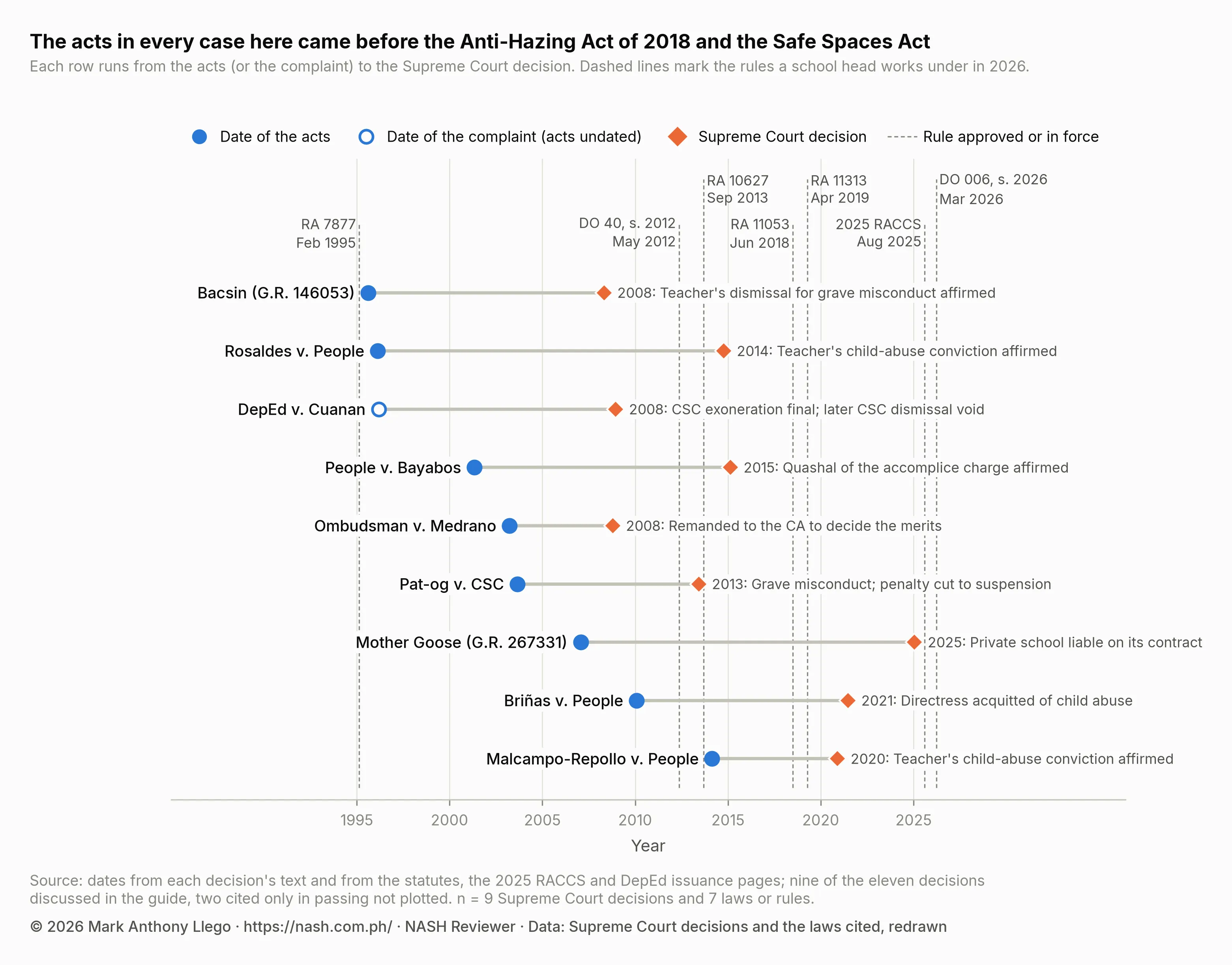
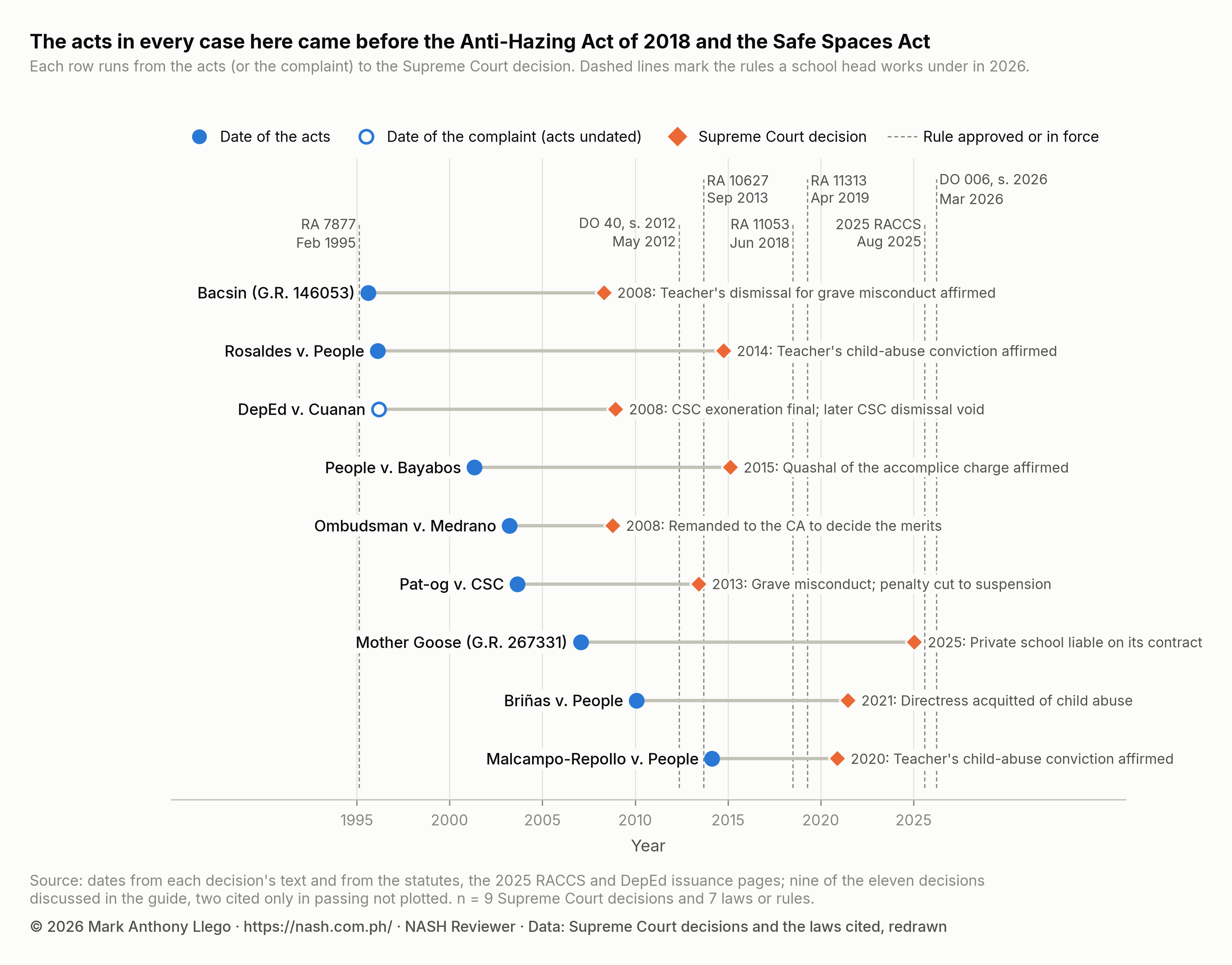
The school head also carries duties when someone else in the school is accused, under RA 7877, the Safe Spaces Act (RA 11313), DepEd’s Child Protection Policy and the Anti-Hazing Act of 2018 (RA 11053), and failing to act on them can make the head liable; People v. Bayabos (2015) shows how a hazing charge against school officials is built, and how it failed in that case.
The law is stated as of October 31, 2026.
Key findings
- A final exoneration stands, even against DepEd (Cuanan, 2008, En Banc). The CSC exonerated Principal Godofredo Cuanan of sexual harassment in January 2003. DepEd could seek reconsideration as disciplining authority, but it filed more than two months later and never served him. The Court held the exoneration “final and executory” and the later CSC dismissal void. It did not itself weigh the charge.
- A school directress was acquitted of child abuse (Briñas v. People, 2021). There is “no crime of grave oral defamation in relation to Section 10(a)” of RA 7610. Words said in the heat of anger did not prove the intent to debase, and the acts of her husband or the school could not be imputed to her without proof that she took part.
- Withdrawing a complaint does not end the administrative case (Medrano, 2008). An affidavit of desistance is “viewed with suspicion and reservation”. The Court sent the case back to the Court of Appeals on the merits; it did not decide whether the principal was guilty.
- School officials can be charged as accomplices to hazing (People v. Bayabos, 2015). The charge against officers of the Philippine Merchant Marine Academy failed because the information left out an element of hazing under the old law. RA 11053 (2018) has since widened hazing, keeps school authorities liable as accomplices, adds a duty to report hazing to law enforcement, and makes them “administratively accountable”.
- A teacher charged only with “misconduct” was dismissed for grave misconduct for harassing a pupil (Bacsin, 2008). What controls is the acts alleged, not the label, and the demand for a sexual favor “need not be explicit or stated”. Today the 2025 RACCS treats sexual harassment as its own offense, with the penalty one degree higher when the offended party is a minor.
- Teachers who hurt pupils were convicted (Rosaldes, 2014; Malcampo-Repollo, 2020). In Malcampo-Repollo the Court held that specific intent need not be proved when the charge is physical maltreatment and the information does not allege that intent.
The cases at a glance
| Case | Who was accused | Charge | Outcome in the Supreme Court |
|---|---|---|---|
| DepEd v. Cuanan (2008, En Banc) | Public elementary school principal | Sexual harassment (administrative) | CSC exoneration final; later CSC dismissal void |
| Briñas v. People (2021) | School directress and owner | Child abuse, RA 7610 Sec. 10(a) | Acquitted |
| Ombudsman v. Medrano (2008) | Public high school OIC and principal | Sexual harassment (administrative) | Not moot despite desistance; remanded to the CA on the merits |
| People v. Bayabos (2015) | Maritime academy president and officers | Accomplices to hazing, RA 8049 | Quashal affirmed; a new information not barred |
| Bacsin (2008) | Public school teacher | Grave misconduct for sexual harassment of a pupil | Dismissal affirmed |
| Rosaldes v. People (2014) | Public school teacher | Child abuse, RA 7610 Sec. 10(a) | Conviction affirmed; penalty and damages modified |
| Malcampo-Repollo v. People (2020) | Grade school teacher | Child abuse, RA 7610 Sec. 10(a) | Conviction affirmed; penalty and damages modified |
Only two of these decisions, Medrano and Cuanan, concern an administrative sexual-harassment charge against a school head, and none has a public school head accused under RA 7610 or party to an Anti-Bullying Act case. The teacher cases are here because the same rules reach a school head, and because a school head must act on complaints against teachers.
The laws that apply today
| Law or rule | What it covers | Where a complaint goes | The school head’s own exposure |
|---|---|---|---|
| RA 7877 (1995) | Sexual harassment by a person with “authority, influence or moral ascendancy” (Sec. 3) | The committee on decorum and investigation (Sec. 4(b)) | Solidary liability for damages if informed and “no immediate action is taken” (Sec. 5) |
| RA 11313, Safe Spaces Act (2019) | Gender-based sexual harassment, including in schools and online | The school’s complaints officer and its CODI (Secs. 21–22) | Fines on conviction for not carrying out the Sec. 22 duties or failing to act on reports (Sec. 23) |
| 2025 RACCS | Sexual harassment as an administrative offense (Sec. 64(A)) | The agency’s CODI (Sec. 16) | The head of agency (DepEd), not the school head, is charged with neglect of duty for failing to create a CODI (Sec. 16) |
| RA 7610, Sec. 10(a); DO 40, s. 2012 | Child abuse (a crime); child abuse and corporal punishment in school (prohibited acts) | The Disciplining Authority, within 48 hours (DO 40, Sec. 16(A)) | Neglect of duty for not reporting or deciding on time (DO 40, Sec. 16(G)) |
| RA 11053, Anti-Hazing Act of 2018 | Hazing for admission or continuing membership | Law enforcement; the school investigates on its own (Sec. 14(f), as amended) | Accomplice liability and administrative accountability (Sec. 14, as amended) |
| RA 10627, Anti-Bullying Act, and its 2025 revised IRR | Bullying among learners | The principal or a designated officer (Sec. 4) | Accountable for the school’s non-compliance (revised IRR, Sec. 24.1) |
RA 7877 and the Safe Spaces Act: two laws, both in force
RA 7877, approved February 14, 1995, has not been amended in its text. It covers a teacher or “any other person who, having authority, influence or moral ascendancy over another in a work or training or education environment, demands, requests or otherwise requires any sexual favor from the other” (Sec. 3). In a school this includes advances that “result in an intimidating, hostile or offensive environment for the student, trainee or apprentice” (Sec. 3(b)). The head of the institution must issue rules and create a committee on decorum and investigation (Sec. 4), and is personally exposed:
“The employer or head of office, educational or training institution shall be solidarily liable for damages arising from the acts of sexual harassment committed in the employment, education or training environment if the employer or head of office, educational or training institution is informed of such acts by the offended party and no immediate action is taken.” (RA 7877, Sec. 5)
A conviction under RA 7877 carries one to six months’ imprisonment, a fine of PHP 10,000 to 20,000, or both, and actions “shall prescribe in three (3) years” (Sec. 7). “Administrative sanctions shall not be a bar to prosecution in the proper courts” (Sec. 4(a)).
The Safe Spaces Act, RA 11313, approved April 17, 2019, is a separate and broader law. It does not amend RA 7877 by name; its repealing clause reaches only what is “contrary to or inconsistent with” it (Sec. 40). Its implementing rules require any school with “a CODI established under Republic Act No. 7877” to amend its policies “to conform to the law and these rules”. They also state that “The public sector shall comply with the standards set by the CSC”, and that school heads covered by DepEd, CHED and TESDA follow the standards those agencies set (IRR of RA 11313, Sec. 33). For schools the Act requires three things:
- Prompt action, even without a complaint. Every school designates an officer to receive complaints. If school authorities know or reasonably know of possible harassment, “the school should promptly investigate to determine the veracity of such information or knowledge” (Sec. 21).
- The school head’s duties (Sec. 22). Post the Act and run prevention measures. Create a CODI headed by a woman, at least half of whose members are women, whose members are “not connected or related to the alleged perpetrator”, and which decides “within ten (10) days or less upon receipt thereof”. Issue a code of conduct that sets penalties.
- The school head’s liability (Sec. 23). On conviction, a fine of PHP 5,000 to 10,000 for not carrying out the Sec. 22 duties, and PHP 10,000 to 15,000 for “(b) Failure to act on reported acts of gender-based sexual harassment committed in the educational institution.”
Where a complaint against public school personnel goes
A sexual-harassment complaint “shall be filed with the agency or department where the person complained of is employed” and goes to its Committee on Decorum and Investigation (2025 RACCS, Sec. 16). The CSC takes the case itself only in listed situations, among them that the agency has no CODI or that “the disciplining authority is the subject of the complaint” (Sec. 18). A legal guardian may file for a minor (Sec. 19).
DepEd Order No. 32, s. 2017 directs that “the DepEd in all levels of governance shall create or strengthen a Committee on Decorum and Investigation of cases on sexual harassment”. DO 40, s. 2012 requires the complaint to be “in writing, signed and sworn to by the complainant” and refers it to the CODI. If the respondent is a teacher, the formal investigating committee follows Section 9 of RA 4670 (Sec. 16(E)), and a principal counts as a “teacher” under that law (Medrano).
Two references in these orders are dated: DO 40 cites the CSC’s 2001 rules (Resolution No. 01-0940), and DO 32 cites CSC Memorandum Circular No. 19, s. 1994. The CSC’s current procedure is the 2025 RACCS, which integrates its 2021 Revised Administrative Disciplinary Rules on Sexual Harassment Cases (Resolution No. 2100064). The Ombudsman may also hear such a complaint, because its authority over public school teachers “is not an exclusive power but is concurrent with the proper committee of the DepEd” (Medrano). In the same case, though, the Court said the Ombudsman “should have desisted from hearing the administrative complaint against respondent and referred it to the proper DepEd committee”, and let the case go on only because the principal had taken part without objecting. See Can the Ombudsman Discipline a Principal?.
How serious it is. The 2025 RACCS classes sexual harassment as grave, less grave or light (Sec. 64(A)):
- Grave, punished by dismissal. Includes “malicious touching such as groping” and requesting a sexual favor in exchange for “a passing grade, the granting of honors or scholarship”.
- Less grave. Includes “verbal abuse with sexual overtones”; suspension of one month and one day to six months for a first offense.
- Light. Includes “unwelcome sexual flirtation, advances, or propositions”; a reprimand for a first offense.
The penalty next higher in degree applies “If the offended party is a minor” (Sec. 64(A)(5)).
Does a withdrawn complaint or a dismissed criminal case end the case?
No. In Office of the Ombudsman v. Medrano, G.R. No. 177580, October 17, 2008 (Second Division), the Court held that a teacher’s sexual-harassment case against the OIC and principal of two Laguna high schools did not become moot when she executed an affidavit of desistance and the criminal case was dismissed, because desistance “is, as a rule, viewed with suspicion and reservation because it can easily be secured from a poor and ignorant witness, usually through intimidation or for monetary consideration”. The Court then sent the case back to the Court of Appeals to decide the merits, so it did not decide whether the charge was true; the full digest is in the Ombudsman guide.
The CSC’s rules now say so directly: “The withdrawal of the complaint does not result in its outright dismissal or the discharge of the person complained of from any administrative liability” (2025 RACCS, Sec. 14). For child abuse, DO 40 adds that criminal and civil liability “shall not be a bar to the filing of an administrative case” (Sec. 19).
The criminal case runs on its own track too. The gravest criminal case in this series is People v. Ramos, G.R. No. 68209, December 21, 1993 (First Division), in which the Court affirmed the rape conviction of the principal of a Catholic high school, who also taught there, for an offense against one of his students.
DepEd v. Cuanan: a final exoneration stands
Department of Education v. Cuanan, G.R. No. 169013, December 16, 2008 (En Banc), ponente Austria-Martinez, J., with no separate opinion.
Facts. In March 1996, two mothers, on behalf of their minor daughters, filed administrative complaints for sexual harassment and conduct unbecoming a public officer against Godofredo G. Cuanan, then principal of Lawang Kupang Elementary School in San Antonio, Nueva Ecija. A DECS investigating committee found him guilty, the Regional Director imposed forced resignation in January 2000, and the Secretary affirmed.
- The exoneration. On appeal, the CSC, in Resolution No. 030069 of January 20, 2003, set aside the Secretary’s resolution and “exonerated Cuanan from the charge of sexual harassment”. Copies went to the parties, DepEd included, on January 23, 2003. Cuanan was reinstated effective April 30, 2003.
- DepEd’s late petition. DepEd filed a petition for review or reconsideration on April 11, 2003, and a supplement in July, but served neither on Cuanan. In Resolution No. 041147 of October 22, 2004, the CSC reversed itself and dismissed him. The Court of Appeals set that resolution aside.
Issues. Could DepEd seek reconsideration of an exoneration? Was Cuanan denied due process?
Ruling. The Court denied DepEd’s petition and affirmed the Court of Appeals.
- DepEd could ask, in principle. The exoneration “may be subject to a motion for reconsideration by the DepEd which, as the appointing and disciplining authority, is a real party in interest.”
- But it asked too late. The CSC was presumed to have served its resolution regularly, and DepEd did not prove otherwise. “Thus, the presumption stands that CSC Resolution No. 030069 dated January 20, 2003 had already become final and executory when the DepEd filed its Petition for Review/Reconsideration on April 11, 2003, more than two months later.” A final judgment “becomes immutable and can no longer be amended or modified.”
- And it never served him. “Cuanan undoubtedly was denied procedural due process.” DepEd’s pleadings “may be treated as mere scraps of paper which should not have merited the attention or consideration of the CSC.” Certiorari was proper against a void resolution.
What the Court did not decide. It did not weigh the evidence on the harassment charge. What stands is the CSC’s 2003 exoneration, which the Court held final, and it should be reported as an exoneration.
Why it matters. A school head who is a respondent is entitled to be served with every pleading and to rely on a decision that has become final. A school head who supports a complaint should know that DepEd’s remedies have deadlines, and that an unserved pleading may be disregarded.
Later history. Cuanan applied the Uniform Rules on Administrative Cases in the Civil Service, including a 2003 section requiring service on the other party. Those rules have been replaced; the 2025 RACCS, in force since August 4, 2025, repealed the 2017 RACCS (Sec. 156). The current rules keep both points:
- Pleadings must be served with proof of service, and “Non-compliance herewith shall be a ground to refuse a filing, or otherwise deem such pleading or submission not filed” (Sec. 54).
- A motion for reconsideration is due within 15 days (Sec. 84), and the “party adversely affected” includes “the authority whose decision or action has been reversed or modified on appeal” (Sec. 4(ee)).
One more rule matters here: an agency’s decision exonerating the respondent cannot be appealed to the CSC, “Except in cases involving sexual harassment” (Sec. 98), so a DepEd exoneration in a harassment case can be. On appeals generally, see Preventive Suspension, Appeals and Back Pay for Principals.
The charge’s facts, not its label, decide the offense: the Bacsin case
Bacsin v. (the pupil’s father), G.R. No. 146053, April 30, 2008 (Second Division).
Facts and issue. The CSC regional office charged a public elementary school teacher in Camiguin with “Misconduct” for touching a pupil in his office in 1995. He said the touching was accidental and lasted two or three seconds. The CSC found him guilty of “Grave Misconduct (Acts of Sexual Harassment)” under RA 7877 and dismissed him. He argued that he could not be found guilty of an offense different from the one charged.
Ruling. The Court dismissed his petition.
- The acts alleged control, not the label. Quoting an earlier case: “It is sufficient that he is apprised of the substance of the charge against him; what is controlling is the allegation of the acts complained of, not the designation of the offense.”
- No explicit demand is needed. Under RA 7877, “the demand of a sexual favor need not be explicit or stated”.
- Dismissal fits. “A teacher who perverts his position by sexually harassing a student should not be allowed, under any circumstance, to practice this noble profession.”
Why it matters. A complaint against a teacher must state the acts clearly enough for the respondent to answer; it need not name the statute. The same rule protects a school head who is the respondent.
Later history. The case applied the CSC’s Uniform Rules, under which grave misconduct carried dismissal. The 2025 RACCS now treats sexual harassment as its own offense in three classes, with a higher penalty when the offended party is a minor (Sec. 64(A)).
Child abuse under RA 7610: Briñas v. People and the teacher cases
Section 10(a) of RA 7610 punishes “other acts of child abuse, cruelty or exploitation” that are “not covered by the Revised Penal Code”. RA 11648 (2022) amended Sections 5(b), 7, 9 and 10(b) of RA 7610, but not Section 10(a). When the offender is a public officer or employee, the penalty “shall be imposed in its maximum period” (Sec. 31(e)).
Briñas v. People: a directress acquitted
Briñas v. People, G.R. No. 254005, June 23, 2021 (First Division), ponente Caguioa, J. The Court acquitted Asela Briñas.
Facts. In January 2010, Briñas, the directress and owner of a Montessori school in Iba, Zambales, called two 16-year-old fourth-year students and their classmates to the faculty room after learning that they had used her daughter’s name in a text message to another student. The prosecution’s witnesses said she shouted insults and curses at them in front of teachers and students, and that the two were later suspended, expelled and denied their records. Briñas denied the expulsion and said she had scolded them in anger. The trial court and the Court of Appeals convicted her of “grave oral defamation in relation to Section 10(a) of R.A. 7610”.
Issues. Is there such a crime, and was child abuse under Section 10(a) proved?
Ruling. The Court reversed both courts and acquitted her.
- No such crime. “There is no crime of grave oral defamation in relation to Section 10(a) of R.A. 7610.” The acts punished under Section 10(a) and those punished under the Revised Penal Code “are mutually exclusive.”
- Specific intent is required here. For abuse by “deeds or words which debases, degrades or demeans” a child (Sec. 3(b)(2)), “a specific intent to debase, degrade or demean the intrinsic worth of a child as a human being is required for conviction under Section 10(a) of R.A. 7610 in relation to Section 3(b)(2).” It may be refuted by showing emotional outrage in the moment or an intent to discipline, but a discipline defense fails when the measures are excessive.
- Only her own acts counted. The suspension, expulsion and withheld records “were not proven sufficiently”, and “the acts of Briñas’ husband or even those of Challenger’s, in which she serves as a school directress, cannot be imputed to Briñas without evidence of her participation in said acts, or conspiracy with the perpetrators.”
- Anger without more is not the intent. The Court found that “the only acts proven to have been committed by Briñas are the hurling of invectives, made in a spur of the moment and in the heat of anger”. These did not show the intent, so “Briñas cannot be held guilty of child abuse under R.A. 7610.”
The Court acquitted her “of the crime charged” and ordered: “Let entry of judgment be issued immediately.”
Why it matters. Briñas decides criminal liability under one section of one law. It does not hold that angry words to learners are proper, and it decided nothing about administrative discipline. Two points carry over:
- A school head answers for his or her own acts, not those of the school or a family member, unless he or she took part.
- DepEd’s rule is stricter than the crime. DO 40 defines corporal punishment to include “Verbal abuse or assaults, including intimidation or threat of bodily harm, swearing or cursing, ridiculing or denigrating the child” (Sec. 3(O)(9)), and penalizes it “in administrative proceedings as Grave or Simple Misconduct” (Sec. 15).
DO 40 reaches private schools through their own procedures (Secs. 20 and 23). DO 40, Sec. 19 suggests that an acquittal under RA 7610 would not by itself bar an administrative case over the same words; Briñas did not address that question.
The teacher cases: Rosaldes and Malcampo-Repollo
Rosaldes v. People, G.R. No. 173988, October 8, 2014 (First Division), ponente Bersamin, J. A public school teacher in Iloilo physically maltreated her seven-year-old Grade 1 pupil in 1996 after he accidentally bumped her knee; he lost consciousness and was injured. The Court affirmed her conviction: though she “could duly discipline” the pupil, “her infliction of the physical injuries on him was unnecessary, violent and excessive.” It cited the Family Code: “In no case shall the school administrator, teacher or individual engaged in child care exercising special parental authority inflict corporal punishment upon the child” (Art. 233). Because she was a public schoolteacher, it fixed the penalty in the maximum period (RA 7610, Sec. 31(e)).
Malcampo-Repollo v. People, G.R. No. 246017, November 25, 2020 (Third Division), ponente Leonen, J. A grade school teacher in Makati City was charged with hitting, pinching and slapping her ten-year-old student in 2014. She offered a certification from the school principal; the trial court gave it no credence because “it had no relation to the crime charged”. The Court affirmed her conviction, with modification: “A teacher’s physical maltreatment of her minor student constitutes child abuse. The specific intent of demeaning, degrading, and debasing the intrinsic worth and dignity of a child is not an essential element for all forms of child abuse under Section 10(a) of Republic Act No. 7610.” The intent must be proved only when the information alleges it or the law requires it; hers charged physical maltreatment.
Reading them together. All three are division rulings, and they fit their facts. Briñas concerned words charged as acts that debased the students, so intent had to be proved; Malcampo-Repollo concerned physical maltreatment charged as such; Rosaldes found the maltreatment did degrade the child. The divisions have not spoken with one voice, though. Malcampo-Repollo called an earlier division ruling that had required intent for physical maltreatment “a stray ruling”, and Briñas, decided seven months later by another division, cited that earlier ruling without mentioning Malcampo-Repollo. No En Banc decision has settled the point. For a school head the practical rule does not turn on it: corporal punishment is banned by the Family Code and by DO 40.
A related administrative case is Pat-og v. Civil Service Commission (2013), where a public high school teacher who punched a student was held guilty of grave misconduct but had his penalty reduced from dismissal to six months’ suspension. His separate criminal conviction for slight physical injuries had already become final; the digest is in the Ombudsman guide.
Hazing: when school officials become accomplices
People v. Bayabos
People v. Bayabos, G.R. Nos. 171222 and 174786, February 18, 2015 (First Division), ponente Sereno, C.J.
Facts. A probationary midshipman of the Philippine Merchant Marine Academy (PMMA), a government-owned school, died on May 3, 2001, during its indoctrination and orientation period. The trial court dismissed the case against the four persons charged as principals. The Special Prosecutor charged eight PMMA officers before the Sandiganbayan as accomplices under RA 8049, the old Anti-Hazing Law. They included the President of PMMA and the Commandant of Cadets, charged as “school authorities and/or faculty members” who consented to or knew of the hazing and failed to prevent it. The Sandiganbayan quashed the information before arraignment.
Issues. Could the accomplices be prosecuted after the principals’ case was dismissed? Did the information state every element?
Ruling. The Court affirmed the quashal, for a different reason from the Sandiganbayan’s.
- Accomplices can be tried on their own. The dismissal of the principals’ case did not by itself end the case against the accomplices.
- What a charge against school officials needs. “In the case of school authorities and faculty members who have had no direct participation in the act, they may nonetheless be charged as accomplices if it is shown that (1) hazing, as established by the above elements, occurred; (2) the accused are school authorities or faculty members; and (3) they consented to or failed to take preventive action against hazing in spite actual knowledge thereof.”
- The defect. Under RA 8049, hazing had to be a prerequisite for admission. “There is no allegation that the purported acts were employed as a prerequisite for admission or entry into the organization.” The information charged no offense, and the prosecutor had insisted it had no defect rather than amend it.
- Not an acquittal. “This does not mean, however, that the Special Prosecutor is now precluded from filing another information.”
What the Court did not decide. No officer was tried, and the Court made no finding that any of them consented to or knew of the hazing. Its opening remark that schools and their officers “cannot stand idly by in the face of patently criminal acts committed within their sphere of responsibility” states the law’s purpose, not a finding against them.
Why it matters. Bayabos concerned a tertiary academy, so its reasoning reaches basic education only by analogy. RA 11053 now covers basic education in terms: “Schools refer to colleges, universities, and all other educational institutions.”
RA 11053: what the law now requires
RA 11053, approved June 29, 2018, amended RA 8049 and widened the element the Bayabos information left out: hazing now covers suffering inflicted “as part of an initiation rite or practice made as a prerequisite for admission or a requirement for continuing membership”. A charge must still allege that purpose. Sections below are cited as RA 8049 now reads.
- School authorities as accomplices (Sec. 14). “The school authorities including faculty members … shall be liable as an accomplice and likewise be held administratively accountable for hazing conducted by fraternities, sororities and other organizations”. This applies if they “allowed or consented to the conduct of hazing”, or knew of it and “failed to take any action to prevent the same from occurring or failed to promptly report to the law enforcement authorities if the same can be done without peril to their person or their family”.
- Initiations and monitoring (Secs. 4–5). Only rites that are not hazing are allowed, on written application at least seven days ahead, and non-conforming applications must be disapproved with written reasons. “The head of the school or an authorized representative must assign at least two (2) representatives of the school to be present during the initiation.”
- Advisers (Sec. 7). Each organization names a faculty adviser who is not a member. If the Act is violated, “it is presumed that the faculty adviser has knowledge and consented to the commission of any of the unlawful acts stated therein.”
- The school’s own exposure (Sec. 14(f)). A PHP 1,000,000 fine on the school if hazing happens in an initiation it approved or when no school representatives were present. Where hazing circumvented the law, “it is incumbent upon school officials to investigate motu propio”.
In DepEd schools, fraternities are banned. DO 006, s. 2026 states: “All forms of hazing are strictly prohibited under RA No. 11053 (Anti-Hazing Act of 2018). Fraternities and sororities are prohibited; learners are encouraged to join school-registered organizations promoting safe space and camaraderie.” It repeals DO 6, s. 1954 on hazing and applies to all public schools and community learning centers. RA 11053’s initiation rules matter most for the clubs a public school does allow, and for private schools. A private school may discipline a student for joining a fraternity against its policy, and owes no damages when it observes due process and acts in good faith (Go v. Colegio de San Juan de Letran, 2012, digested in Is a Principal Liable When a Pupil Is Injured?).
Bullying: the principal answers for the school’s policy
Under RA 10627, approved September 12, 2013, “The school principal or any person who holds a comparable role shall be responsible for the implementation and oversight of policies intended to address bullying” (Sec. 4). The Secretary prescribes sanctions for administrators who fail to comply (Sec. 6). The revised implementing rules, published August 6, 2025 and disseminated by DM 090, s. 2025, state: “The school administrator shall be held accountable for the non-compliance with the anti-bullying policy of the school” (Sec. 24.1).
In the Mother Goose Special School System case (2025), as decided, the Court held a private school grossly negligent in handling a 2007 incident in which classmates punched a grade-school pupil, and liable on its contract to provide a safe learning environment. It read “bullying” in its ordinary sense because the Anti-Bullying Act “was not yet in force” at the time; the digest is in Is a Principal Liable When a Pupil Is Injured?. The bullying procedure itself is in DepEd Child Protection and Anti-Bullying: School Head Duties.
What the school head must do when a complaint comes in
These steps come from DO 40, s. 2012, DO 006, s. 2026 and the laws above. DO 40 remains in force: DO 006 “does not amend or repeal” it but supplements it, and DO 40’s bullying provisions now yield to the 2025 revised anti-bullying IRR. The child protection guide has the full procedure and time limits.
- Make the learner safe. Remove the learner from the place of the incident if he or she is at risk, have the Child Protection Committee fill in the intake sheet, and refer the learner to the local social welfare office (DO 40, Secs. 16(C) and 22).
- Document it. Use DO 006’s Incident Report and Intake Sheet, kept confidential by the guidance counselor or the designated committee member.
- Forward it within 48 hours. “The School Head or the Schools Division Superintendent, upon receipt of the Complaint, shall forward the same, within forty-eight (48) hours, to the Disciplining Authority” (DO 40, Sec. 16(A)).
- Flag harassment complaints for the CODI. A sexual-harassment complaint goes to the CODI (DO 40, Sec. 16(E.1)). Help the complainant put it in writing and under oath (Sec. 16(E)). Under RA 11313, act on what you know even if no one files (Sec. 21).
- Forward a desistance; do not act on it. It does not end the case (2025 RACCS, Sec. 14; Medrano).
- Do not settle. DO 40 complaints “shall not be brought for amicable settlement before the Barangay” (Sec. 17). Sexual-harassment cases “shall not be acted upon through the grievance machinery” (DO 35, s. 2004), and the 2025 RACCS states: “Complaints for sexual harassment shall not be subject to mediation and settlement” (Sec. 75).
- Keep identities confidential. Withhold information that may identify a learner, victim or offender (DO 40, Sec. 18). A teacher-respondent also has the Magna Carta’s protection: “no publicity shall be given to any disciplinary action against a teacher during the pendency of his or her case” (DO 40, Sec. 18, restating RA 4670, Sec. 8).
- Step aside if it involves you. CODI members must be “not connected or related to the alleged perpetrator” (RA 11313, Sec. 22(c)(4)), and the CSC may take a case in which “the disciplining authority is the subject of the complaint” (2025 RACCS, Sec. 18).
- Report on time. Submit investigation results to the Schools Division Superintendent and the Regional Director within 30 calendar days (DO 006, s. 2026). Unjustified delay is “a ground for administrative action for neglect of duty against the responsible official” (DO 40, Sec. 16(G)).
The investigation follows DepEd’s Revised Rules of Procedure in Administrative Cases, DO 49, s. 2006 (DO 40, Sec. 16(C)). How the CODI and the formal investigation run is in Sexual Harassment and Child Abuse Complaints in DepEd.
What this means for school heads
The PPSSH places these practices mainly in Domain 2 (management of staff), Domain 3 (learner discipline) and Domain 5 (school organizations).
What to do
- Set up the machinery before you need it. Post RA 7877 and RA 11313, name the officer who receives harassment complaints, confirm which CODI hears complaints against your personnel, and make sure the code of conduct prohibits gender-based sexual harassment and sets penalties (RA 11313, Sec. 22).
- Act on the first report. Under RA 7877, taking “no immediate action” after the offended party informs you makes you solidarily liable for damages; under RA 11313, failing to act is an offense of its own.
- Train your staff. RA 11648 requires schools to include in staff development sessions on “identifying, responding to and reporting rape and other sexual offenses” (Sec. 4).
- Serve every pleading. When you are a party, serve copies on the other side with proof of service. Cuanan turned on pleadings never served.
- Teach and model positive discipline. DO 40 counts cursing, ridicule and threats as corporal punishment. Rosaldes and Malcampo-Repollo show where physical discipline leads.
- Keep organizations within the rules. No fraternities or sororities in a public school (DO 006, s. 2026). For the clubs a school allows, keep each one’s registration, faculty adviser and member list, and act on any initiation only through a written application (RA 11053, Secs. 4, 6 and 7). Tell each adviser that the Act presumes an adviser knew of and consented to any violation (Sec. 7). Every school, public or private, runs the Act’s information campaign and orientation at the start of each term (Sec. 8), and assigns at least two representatives to any initiation it approves (Sec. 5).
What to document: the date you received each report and the date you forwarded it; the intake sheet, referral and safety measures; any desistance, forwarded with the complaint; and each organization’s registration, adviser, members and approved activities.
What not to do
- Do not discuss the facts of a pending case, or the people in it, at a faculty meeting or with other parents.
- Do not expect a certification from you to answer a charge against a teacher; in Malcampo-Repollo the trial court gave the principal’s certification no credence because it “had no relation to the crime charged”.
For complaints against staff generally, see Human Resource Management for School Heads.
How the NASH may test this
The two items below are original practice items, scored 3 (Relational), 2 (Multistructural), 1 (Unistructural) or 0 (Prestructural). An option that breaks a rule scores 0.
Question 1
Indicator 2.4.1, Management of staff. Career Stage 1, Conceptual, Moderate.
You are the principal of a public secondary school. A Grade 10 learner’s mother gives you a sworn written complaint that a male teacher sent her daughter messages with sexual remarks and asked to meet her alone after class. Two days later the mother returns with a signed affidavit of desistance and says the family has forgiven the teacher. The teacher asks you to file the affidavit and end the matter. What should you do?
- A. Accept the affidavit of desistance and close the matter at the school level, keeping both papers on file, since the complainant no longer wishes to pursue the complaint.
- B. Forward the complaint to the Disciplining Authority within 48 hours, and tell the mother that the division will handle the case from here.
- C. Forward the complaint and the affidavit to the Disciplining Authority within 48 hours for referral to the CODI, and explain to the mother and the teacher that a withdrawal does not end an administrative case.
- D. Forward the complaint and the affidavit within 48 hours for referral to the CODI, explaining that a withdrawal does not end the case. Have the Child Protection Committee assess and support the learner, arrange that she is not left alone with the teacher, keep the matter confidential, and record each step and date.
Answer and explanation
Best answer: D. Points: A = 0, B = 1, C = 2, D = 3.
- A (0 points, Prestructural). It breaks DO 40’s 48-hour rule and the CSC rule that a withdrawal does not by itself dismiss a complaint, and it risks liability under RA 7877, Sec. 5 and RA 11313, Sec. 23(b).
- B (1 point, Unistructural). Forwarding on time is the one step it gets right. It leaves out the affidavit, and it does nothing for the learner’s protection or the record.
- C (2 points, Multistructural). The forwarding, the CODI route and the effect of the desistance are right, but it does nothing for the learner’s safety, support or privacy.
- D (3 points, Relational). It meets the deadline, routes the complaint correctly, explains the desistance, and connects these with the protective, confidentiality and record duties.
Why. Medrano (2008) held that a desistance did not make the administrative case moot, and the 2025 RACCS now says so (Sec. 14). DO 40 sets the 48-hour period (Sec. 16(A)), sends harassment complaints to the CODI (Sec. 16(E.1)) and requires confidentiality (Sec. 18). RA 11313 requires the school to act on known harassment and address its effects (Sec. 21).
Indicator 2.4.1: Demonstrate knowledge and understanding of laws, policies, guidelines and issuances on managing school staff.
Sources: DepEd Order No. 40, s. 2012, Secs. 16 and 18; 2025 RACCS, Secs. 14 and 16; RA 7877, Sec. 5; RA 11313, Secs. 21 and 23; Office of the Ombudsman v. Medrano, G.R. No. 177580, October 17, 2008.
Question 2
Indicator 3.8.1, Learner discipline. Career Stage 1, Conceptual, Moderate.
A teacher in your public elementary school learned that some Grade 6 learners had posted a joke about her online. She called them to the faculty room and cursed at them in front of other teachers. The parents give you a written complaint and say they have also gone to the police. At a faculty meeting, a teacher argues that the Supreme Court acquitted a school directress in a similar case, so the school need not act. Which response is most consistent with the cases and DepEd policy?
- A. Agree that the school need not act, since Briñas v. People holds that words said in anger are not child abuse, and wait for the police to decide whether to file a case.
- B. Forward the parents’ complaint to the Disciplining Authority within 48 hours, and let the criminal case and the division decide what happened.
- C. Forward the complaint within 48 hours and, at the meeting, explain in general terms, without discussing the teacher’s case, that Briñas decided only criminal liability under RA 7610, while DO 40 treats cursing at learners as corporal punishment that is penalized administratively.
- D. Forward the complaint within 48 hours. At the meeting, explain the rule in general terms, without discussing the teacher’s case: Briñas turned on the specific intent the crime requires, while DO 40 separately treats cursing at learners as corporal punishment and keeps the administrative case apart from the criminal one. Have the Child Protection Committee attend to the learners, keep the learners’ identities and the case confidential, and schedule positive-discipline training.
Answer and explanation
Best answer: D. Points: A = 0, B = 1, C = 2, D = 3.
- A (0 points, Prestructural). It misreads Briñas and breaks DO 40, which requires the complaint to be forwarded within 48 hours and keeps the administrative case separate from the criminal one (Secs. 16(A) and 19).
- B (1 point, Unistructural). Forwarding on time is right, but it treats the criminal case as deciding the school’s question and leaves the learners and the faculty without guidance.
- C (2 points, Multistructural). It reads Briñas and DO 40 correctly and keeps the case out of the meeting, but does not attend to the learners or prevent a repeat.
- D (3 points, Relational). It distinguishes the criminal and administrative standards, follows the reporting rule, respects confidentiality, and links these to care for the learners and prevention.
Why. Briñas (2021) turned on the specific intent required by RA 7610, Sec. 10(a) in relation to Sec. 3(b)(2), and decided criminal liability only. DO 40 counts cursing at a child as corporal punishment (Sec. 3(O)(9)), penalizes it administratively (Sec. 15), keeps criminal liability from barring an administrative case (Sec. 19), and bars publicity about a teacher’s pending case (Sec. 18).
Indicator 3.8.1: Demonstrate knowledge and understanding of existing national and local policies related to learner discipline.
Sources: Briñas v. People, G.R. No. 254005, June 23, 2021; DepEd Order No. 40, s. 2012, Secs. 3(O), 15, 16(A), 18 and 19; RA 7610, Sec. 10(a).
Nothing in this guide reproduces or predicts examination content.
Frequently asked questions
Was Principal Cuanan found guilty?
No. The DECS committee and the Regional Director found him guilty, but the CSC set that aside and exonerated him in January 2003. In Department of Education v. Cuanan (2008, En Banc), the Supreme Court held that the exoneration had become final before DepEd sought reconsideration, and that the CSC’s 2004 dismissal order was void because DepEd never served him its pleadings. The Supreme Court did not itself weigh the evidence.
Must the school act if no one files a complaint?
Yes, for gender-based sexual harassment. Under RA 11313, if school authorities know or reasonably know of possible harassment, “the school should promptly investigate to determine the veracity of such information or knowledge”, even if no one files (Sec. 21). Failing to act on reported harassment can lead to a fine on conviction (Sec. 23), and under RA 7877 a head informed by the offended party who takes no immediate action is solidarily liable for damages (Sec. 5). Medrano (2008) shows that even a withdrawn complaint does not end the administrative case.
If a teacher is acquitted of child abuse, can DepEd still discipline the teacher?
Generally yes, because the cases are separate. In Briñas v. People (2021), the acquittal turned on the specific intent the crime requires, and DO 40’s definition of corporal punishment, which includes cursing and ridicule, does not require that intent. DO 40 also states that criminal and civil liability “shall not be a bar to the filing of an administrative case” (Sec. 19). How a particular acquittal bears on a particular case is for the disciplining authority and the SDO’s legal unit.
Can a school head be criminally liable for hazing he or she did not take part in?
Yes, if the elements are proved. Under RA 11053, school authorities who allowed or consented to hazing, or who knew of it and failed to prevent or report it, are liable as accomplices and administratively accountable (Sec. 14, as amended). In People v. Bayabos (2015), the Court recognized that school authorities “may nonetheless be charged as accomplices”, though the charge there failed because the information omitted an element of the old law.
Download the data
- harass-cases-timeline.csv: the nine decisions in Figure 1, with the date of the acts or complaint, the decision date and the outcome, and the seven laws and rules with their dates.
The CSVs and charts may be reused only with written permission: email support@nash.com.ph. The decisions themselves are public records of the Supreme Court, which you can cite directly.
Sources
Supreme Court decisions
- Department of Education v. Cuanan, G.R. No. 169013, December 16, 2008 (En Banc), Austria-Martinez, J.
- Office of the Ombudsman v. Medrano, G.R. No. 177580, October 17, 2008 (Second Division), Carpio Morales, J.
- Bacsin v. (the pupil’s father), G.R. No. 146053, April 30, 2008 (Second Division).
- Briñas v. People, G.R. No. 254005, June 23, 2021 (First Division), Caguioa, J.
- Rosaldes v. People, G.R. No. 173988, October 8, 2014 (First Division), Bersamin, J.
- Malcampo-Repollo v. People, G.R. No. 246017, November 25, 2020 (Third Division), Leonen, J.
- People v. Bayabos, G.R. Nos. 171222 and 174786, February 18, 2015 (First Division), Sereno, C.J.
- People v. Ramos, G.R. No. 68209, December 21, 1993 (First Division), Bellosillo, J.
- Pat-og v. Civil Service Commission, G.R. No. 198755, June 5, 2013 (Third Division), Mendoza, J.
- Mother Goose Special School System, Inc. v. (the pupil’s parents), G.R. No. 267331, January 20, 2025 (Second Division), M. Lopez, J.
- Go v. Colegio de San Juan de Letran, G.R. No. 169391, October 10, 2012 (Second Division), Brion, J.
Laws and rules
- Republic Act No. 7877, Anti-Sexual Harassment Act of 1995 (February 14, 1995), Secs. 3–7.
- Republic Act No. 11313, Safe Spaces Act (April 17, 2019), Secs. 21–23 and 40; its Implementing Rules and Regulations (October 28, 2019), Sec. 33.
- 2025 Rules on Administrative Cases in the Civil Service, CSC Memorandum Circular No. 12, s. 2025, under CSC Resolution No. 2500357 (in force August 4, 2025), Secs. 4(ee), 14, 16–19, 54, 64(A), 75, 84, 98 and 156.
- Republic Act No. 7610 (June 17, 1992), Secs. 3(b), 10(a) and 31(e); Republic Act No. 11648 (March 4, 2022), Secs. 3 and 4.
- Republic Act No. 11053, Anti-Hazing Act of 2018 (June 29, 2018), amending RA 8049.
- Republic Act No. 10627, Anti-Bullying Act of 2013 (September 12, 2013), Secs. 4 and 6; its revised IRR, disseminated by DepEd Memorandum No. 090, s. 2025, Sec. 24.1.
- DepEd Order No. 40, s. 2012, DepEd Child Protection Policy, Secs. 3(O), 15–20, 22 and 23.
- DepEd Order No. 006, s. 2026, Guidelines on Ensuring a Safe and Motivating Learning Environment (March 24, 2026).
- DepEd Order No. 32, s. 2017, Gender-Responsive Basic Education Policy, on the Committee on Decorum and Investigation.
- DepEd Order No. 35, s. 2004, Revision of the Grievance Machineries of the Department of Education, on cases excluded from the grievance machinery.
- Family Code, Art. 233, as quoted in Rosaldes v. People.
This guide explains Supreme Court decisions for study and professional awareness. It is not legal advice; for a specific case, consult a lawyer or your Schools Division Office’s legal unit.
The Supreme Court cases series
- Supreme Court Cases on School Heads: A Guide for Principals
- Can the Ombudsman Discipline a Principal? RA 4670 Cases
- Can a Principal Be Reassigned to Another School?
- Promotion Protests and Nepotism: Cases on Principals
- Unauthorized School Fees: What Happens to the Principal?
- Can a Principal Be Jailed Over School Funds?
- Dishonesty and Grave Misconduct: Cases on Principals
- Oppression Cases: How Principals Must Treat Teachers
- Harassment, Child Abuse and Hazing: Cases on School Heads (this post)
- Is a Principal Liable When a Pupil Is Injured?
- Can a Private School Remove Its Principal?
- Preventive Suspension, Appeals and Back Pay for Principals
Written by Mark Anthony Llego for NASH Reviewer. Sources: Supreme Court decisions in Cuanan, Medrano, Bacsin, Briñas, Rosaldes, Malcampo-Repollo, Bayabos and Ramos; RA 7877, RA 11313, RA 7610, RA 11053 and RA 10627; the 2025 RACCS; DO 40, s. 2012 and DO 006, s. 2026. Charts may be reused only with written permission from support@nash.com.ph.