It can be. Since August 3, 1988, the Family Code has given the school, its administrators and its teachers special parental authority over a minor under their supervision, instruction or custody, in all authorized activities inside or outside the school. It makes them “principally and solidarily liable” for damage the minor causes: each can be made to pay the whole amount, and the parents answer only after them. The leading decision for a public school head is Apolinario v. Heirs of De Los Santos, G.R. No. 219686, November 27, 2024 (First Division). The Supreme Court held an elementary school principal liable, as the pupil’s teacher-in-charge, for the death of a passing motorcyclist after a pupil, on the principal’s own instruction, cut down a banana plant beside the highway during a Saturday school work activity.
A principal can also be liable for his or her own negligence, as an elementary school principal was when a rotting tree on school grounds killed a pupil, and a private school can be liable on its contract to keep learners safe. The older rule, that the principal of an academic school is not liable, comes from Amadora and Ylarde. Both were decided in 1988 under Civil Code Article 2180, on incidents in 1972 and 1963. For incidents from August 3, 1988, that limit no longer shields administrators from liability for damage a minor causes in an authorized activity: Family Code Articles 218 and 219 make administrators, as well as teachers, principally and solidarily liable, and in USEP (2025) the Court held university administrators liable under them, while Article 2180 still applies alongside the Family Code.
The rules are stated as of October 31, 2026.
Key findings
- Under Article 2180, the head of an academic school is liable only as teacher-in-charge. Before August 3, 1988, that was the whole rule for minors (Amadora v. Court of Appeals, 1988; Ylarde v. Aquino, 1988). The head of a school of arts and trades was liable as head (Palisoc v. Brillantes, 1971, decided 6–4).
- From August 3, 1988, Family Code Articles 218 and 219 also apply to minors. The school, its administrators and teachers are principally and solidarily liable for damage a minor causes in any authorized activity unless they prove the proper diligence. So, on the articles’ text, the academic-school limit no longer shields administrators from liability for damage a minor causes; in University of Southeastern Philippines v. Sarate (USEP, 2025, En Banc) the Court held university administrators liable under them. The articles apply alongside Article 2180, not instead of it.
- A principal who directs an activity is its teacher-in-charge. In Apolinario (2024) the principal “closely supervised” a school work activity and told a pupil to cut a plant by the highway, with no warning devices and no adult assigned.
- Delegating a hazard does not end the principal’s duty. In Capili v. Spouses Cardaña (2006) an elementary school principal was personally liable for a dead tree that killed a pupil, because “she exercises supervision over her assignee”.
- Whether an activity was authorized can decide the case. In St. Francis High School v. Court of Appeals (1991, decided 3–2) the principal and the school were absolved because a class picnic held without the principal’s permit was a private affair, not a school activity, so Article 2180’s employer rule did not reach them, and because the teachers were found diligent.
- A private school answers on its contract. In Mother Goose Special School System, Inc. (2025) a school was liable for mishandling a punching incident, and its diligence in hiring teachers was no defense.
- The defenses are real. A school was absolved where its negligence was only a remote cause (St. Mary’s Academy v. Carpitanos, 2002) and where it had screened and supervised an outside teacher (Aquinas School, 2011). Discipline with due process earned no damages (Go v. Colegio de San Juan de Letran, 2012).
Four ways a school head can be held liable
| Legal basis | Who is liable | Main defense | Leading cases | Applies to |
|---|---|---|---|---|
| Civil Code Art. 2180, “teachers or heads of establishments of arts and trades” | For damage caused by pupils in custody: the teacher-in-charge in an academic school; the head alone in a school of arts and trades | “All the diligence of a good father of a family to prevent damage” | Palisoc (1971); Amadora (1988); Ylarde (1988); Apolinario (2024) | Every incident. For minors from August 3, 1988, the Court applies it alongside Family Code Arts. 218–219 (St. Joseph’s, 2010; Apolinario, 2024; USEP, 2025) |
| Family Code Arts. 218–219 | The school, its administrators and teachers, principally and solidarily; parents only subsidiarily | “The proper diligence required under the particular circumstances” | St. Joseph’s (2010); Apolinario (2024); USEP (2025) | Minors in authorized activities, from August 3, 1988 |
| Civil Code Art. 2176, one’s own negligence | The principal personally, for his or her own fault | No negligence, or no proximate cause | Capili (2006); Ylarde (1988, the teacher); Child Learning Center (2005, the school) | Everyone |
| The contract of enrollment | The school, for failing its “built-in” duty to keep students safe | The breach was not due to its negligence; diligence in hiring does not count | PSBA (1992); Mother Goose (2025) | Private schools in every case so far |
Whether the Family Code row is available depends on the date of the incident, not of the decision; it adds to Article 2180 and does not replace it. Apolinario, on a 1998 incident, rested on Articles 2176 and 2180 and added Articles 218 and 219. Ylarde was decided on July 29, 1988, five days before the Family Code took effect, on a 1963 incident, so the Family Code did not reach it.
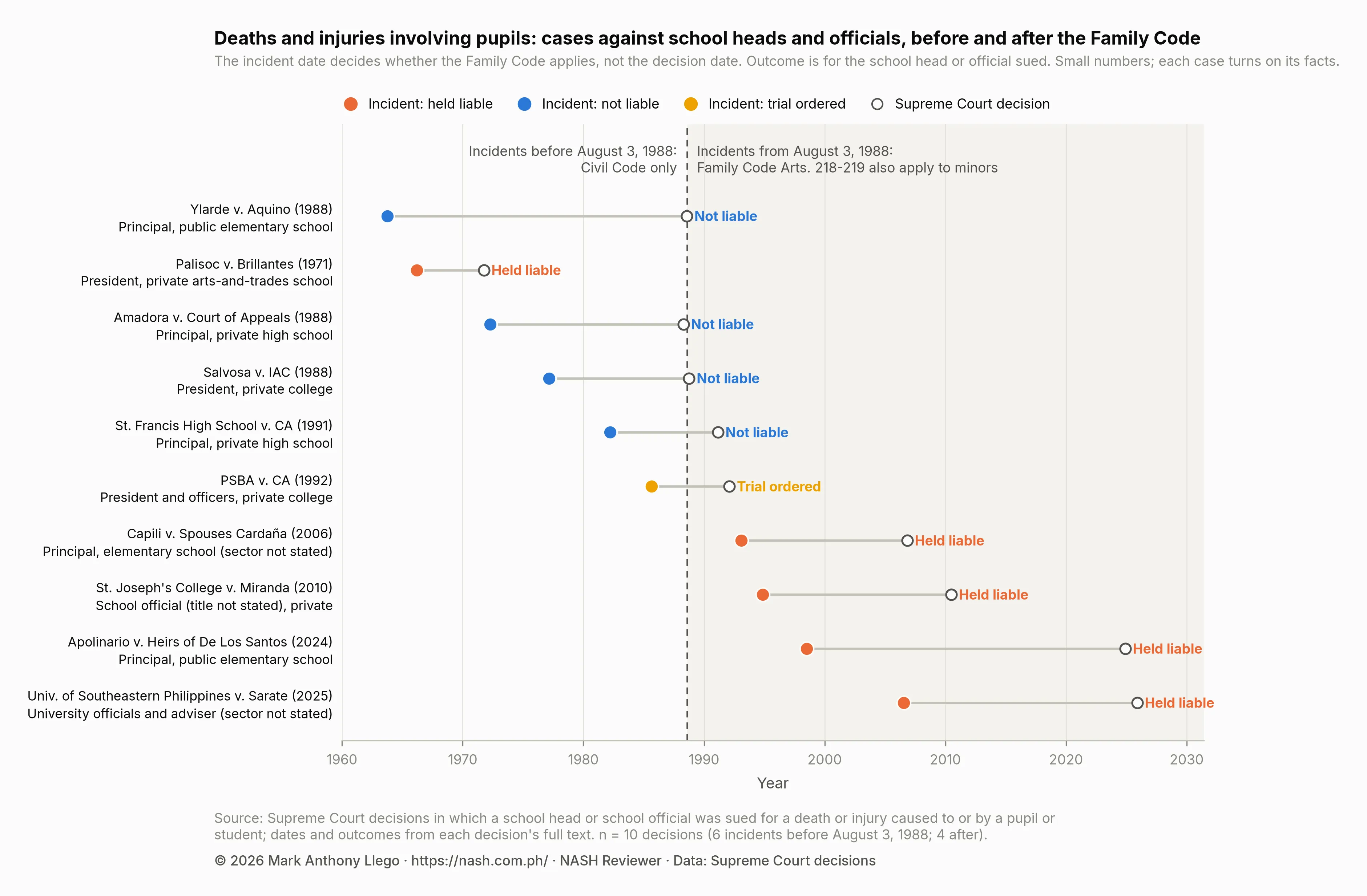
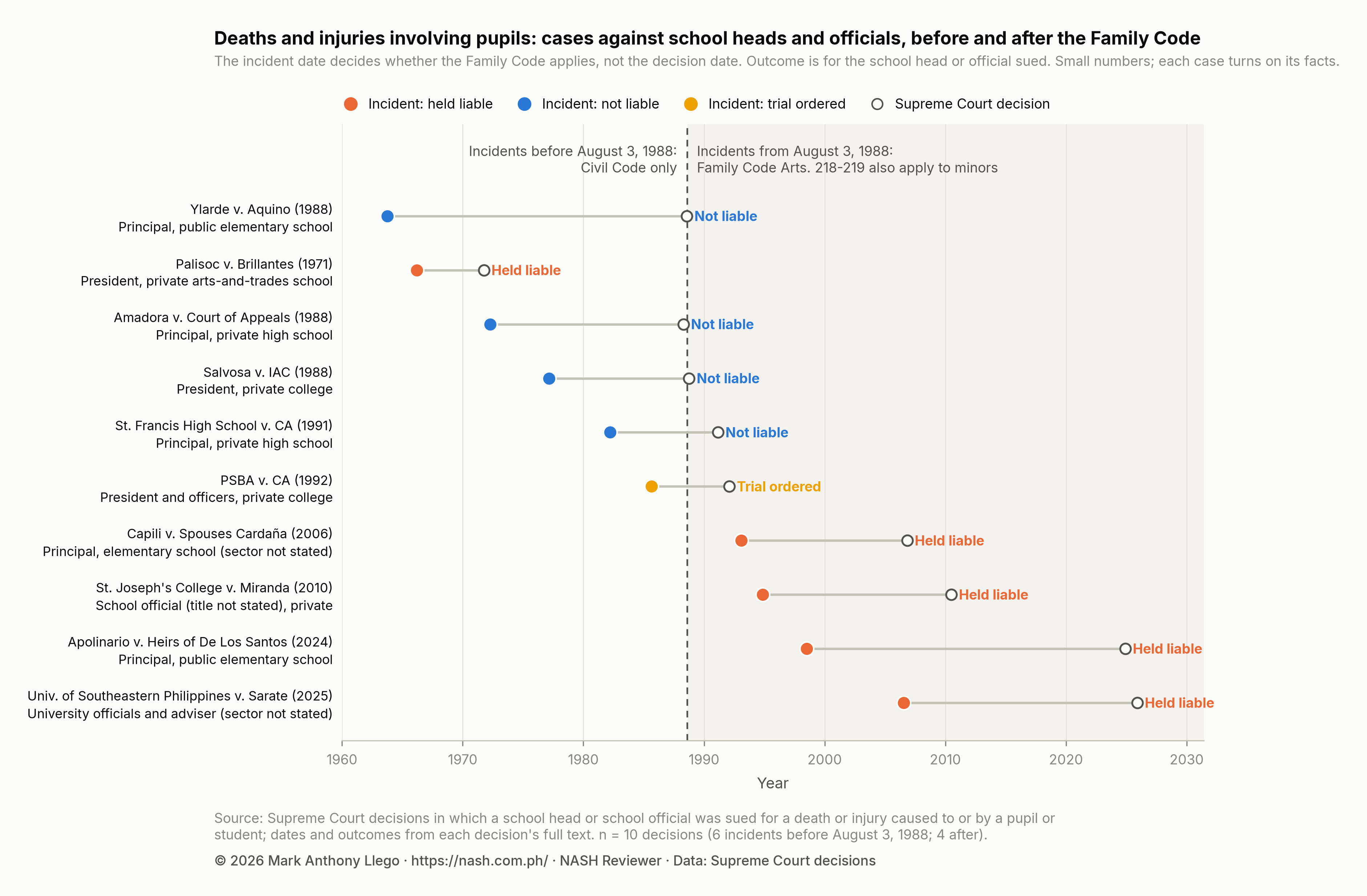
Of the six incidents before August 3, 1988, the head was held liable in one (Palisoc), not liable in four, and sent to trial in one (PSBA). The head or officials were held liable in all four later incidents counted, on four different grounds: the principal’s own negligence (Capili), the higher care the Family Code demands (St. Joseph’s), the principal’s direct supervision (Apolinario) and the university officials’ failures of oversight under Articles 218 and 219 (USEP). A decision outside the count points the other way: a principal sued in Mother Goose was not held liable.
Before August 3, 1988: Article 2180 and the teacher-in-charge
The school paragraph of Article 2180 of the Civil Code reads: “Lastly, teachers or heads of establishments of arts and trades shall be liable for damages caused by their pupils and students or apprentices, so long as they remain in their custody.” The liability ends when they prove “that they observed all the diligence of a good father of a family to prevent damage.”
Earlier dicta in Exconde v. Capuno, G.R. No. L-10134, June 29, 1957, and Mercado v. Court of Appeals, G.R. No. L-14342, May 30, 1960 (divisions not stated), had limited the article to schools of arts and trades and to pupils who live and board with the teacher.
Palisoc v. Brillantes (1971): the head of a school of arts and trades
Palisoc v. Brillantes, G.R. No. L-29025, October 4, 1971 (En Banc), Teehankee, J.
Facts. On March 10, 1966, during a recess, a 16-year-old automotive mechanics student at the Manila Technical Institute died after a classmate, already of age, hit him with fist blows in the laboratory. The parents sued the classmate, the president, the instructor and a board member who had once owned the school. Following Mercado, the trial court held only the classmate liable.
Issue. Are the head and teacher of a school of arts and trades liable when the student does not board at the school?
Ruling. Yes. Custody “means the protective and supervisory custody that the school and its heads and teachers exercise over the pupils and students for as long as they are at attendance in the school, including recess time.” The Mercado and Exconde dicta “must now be deemed to have been set aside”. The president and the instructor, “as president and teacher-in-charge of the school”, were held jointly and severally liable with the classmate, having failed to prove diligence. The board member was absolved “as a mere member of the school’s board of directors”.
The vote. It was 6–4. Justice J.B.L. Reyes, joined by Justice Barredo, concurred, adding that the liability is not limited to minors. Justice Makalintal, joined by Justices Zaldivar, Castro and Fernando, dissented: the majority’s reading “would demand responsibility without commensurate authority”. Justice Dizon took no part.
Why it matters and later history. Palisoc defined custody, which Apolinario still cites. The president was liable as head of a school of arts and trades, with no finding that he personally supervised the students. A footnote (fn. 9) left academic schools open, and Amadora settled that in 1988.
Amadora v. Court of Appeals (1988): the teacher-in-charge
Amadora v. Court of Appeals, G.R. No. L-47745, April 15, 1988 (En Banc), Cruz, J.
Facts. On April 13, 1972, a 17-year-old student was shot dead by a classmate in the auditorium of Colegio de San Jose-Recoletos, a private academic school. The school argued that the semester had already ended and that he had come only to submit his physics report; his parents said he was there to show a physics experiment required for graduation. Six days earlier the dean of boys had confiscated an unlicensed pistol from another student and returned it without reporting to the principal. The parents sued the school, the rector, the high school principal, the dean of boys and the physics teacher. The trial court held them liable; the Court of Appeals reversed.
Issues. Does Article 2180 cover academic schools? Was the student in custody? Who is liable?
Ruling. No respondent was liable, and the principal was exonerated. Article 2180 applies to all schools. In an academic school the teacher-in-charge answers; in a school of arts and trades “it is the head thereof, and only he, who shall be held liable as an exception to the general rule.” The student was in custody, being on campus for a legitimate purpose. “The teacher-in-charge is the one designated by the dean, principal, or other administrative superior to exercise supervision over the pupils in the specific classes or sections to which they are assigned.” The rector, the principal and the dean of boys were not liable because “none of them was the teacher-in-charge”; each was “exercising only a general authority over the student body”. No teacher-in-charge was identified, and even assuming the physics teacher was one, no negligence was shown. Returning the gun was “clearly negligence on his part, for which he deserves sanctions from the school”, but it was not shown to be the gun used.
Separate opinions. Justice Melencio-Herrera (concurring and dissenting) disagreed with limiting “teacher” to the teacher-in-charge, and Justice Gutierrez, Jr. (concurring) urged that the paragraph be amended.
Why it matters. Amadora is the source of the teacher-in-charge test that Apolinario reused. Its “teacher-in-charge” is the teacher supervising a class, not DepEd’s designation of a teacher-in-charge of a school (see Principal, Head Teacher or Teacher-in-Charge in DepEd).
Later history. The Family Code took effect less than four months later; see below. The Court still uses the teacher-in-charge test under Article 2180 (Apolinario, 2024).
Ylarde v. Aquino (1988): the principal absolved, the teacher liable
Ylarde v. Aquino, G.R. No. L-33722, July 29, 1988 (First Division), Gancayco, J.
Facts. In October 1963, at Gabaldon Primary School, a public school in Tayug, Pangasinan, a teacher had pupils aged ten to eleven dig, after class, a pit beside a one-ton concrete block so it could be buried. The next day he left four of them by the pit to borrow a key, allegedly telling them “not to touch the stone.” The block slid in and pinned a ten-year-old pupil, who died three days later. The trial court and the Court of Appeals dismissed the parents’ suit against the teacher and the principal.
Issue. Are the teacher and the principal liable?
Ruling. The principal was not liable, “he being the head of an academic school and not a school of arts and trades”, following Amadora; besides, he “did not give any instruction regarding the digging.” The teacher was liable for his own gross negligence under Article 2176. The digging was not Work Education, because “there were no instructions from the principal requiring what the pupils were told to do.”
Why it matters and later history. The principal was absolved because of the kind of school, and the teacher-in-charge paid. The case was decided five days before the Family Code took effect, on a 1963 incident. Its damages (₱30,000 indemnity) reflect 1988 values, as the figures in every case here reflect their year.
Two more 1988 decisions set limits. Salvosa v. Intermediate Appellate Court, G.R. No. 70458, October 5, 1988 (Second Division), absolved a college president because a student who shot someone on campus at 8:00 p.m. was not in custody: “Recess by its nature does not include dismissal”. Pasco v. Court of First Instance of Bulacan, G.R. No. 54357, April 25, 1988 (Second Division), held that Article 2180 binds the “teachers or heads”, not the school; the Family Code names the school itself.
Since August 3, 1988: special parental authority under the Family Code
“The Family Code took effect on August 3, 1988,” as the Court noted in Tayag v. Court of Appeals, G.R. No. 95229, June 9, 1992 (Second Division), fn. 14. Two articles of the Family Code changed school liability for minors:
- Article 218 gives the school, its administrators and teachers “special parental authority and responsibility over the minor child while under their supervision, instruction or custody.” It “shall apply to all authorized activities whether inside or outside the premises of the school, entity or institution.”
- Article 219 makes them “principally and solidarily liable for damages caused by the acts or omissions of the unemancipated minor.” Parents and guardians “shall be subsidiarily liable”. Neither is liable “if it is proved that they exercised the proper diligence required under the particular circumstances.” And “All other cases not covered by this and the preceding articles shall be governed by the provisions of the Civil Code on quasi-delicts.”
| Point | Civil Code Art. 2180 (school paragraph) | Family Code Arts. 218–219 |
|---|---|---|
| Who is liable | Teachers; heads only of schools of arts and trades | The school, its administrators and teachers |
| Kind of liability | Vicarious, for pupils in custody | Principal and solidary; parents only subsidiary |
| Where | While pupils are “at attendance in the school” (Palisoc) | “all authorized activities whether inside or outside the premises” |
| Learners covered | Students of any age (Amadora) | Minors |
Article 219 speaks of damage caused by the minor, as in Apolinario. When the pupil is the one hurt, the Court has used Article 218’s duty to measure the care owed, as in St. Joseph’s. Palisoc, Amadora and Ylarde did not apply these articles; all three applied Article 2180. The later cases apply the Family Code alongside Article 2180, not instead of it: St. Joseph’s read Article 218 “in relation to” Article 2180, Apolinario rested on Articles 2176 and 2180 and added Articles 218 and 219, and USEP applied Articles 218 and 219 and found Articles 2176 and 2180 “also applicable”.
St. Joseph’s College v. Miranda (2010): the higher degree of care
St. Joseph’s College v. Miranda, G.R. No. 182353, June 29, 2010 (Second Division), Nachura, J.
Facts. On November 17, 1994, a private school’s Grade 6 class of fifty was heating sulfur and iron filings in test tubes. As a pupil looked into a tube through a magnifying glass, a groupmate moved it toward his eye and the compound spurted out, burning his eyes. The pupils had been told not to look until the tube cooled. The trial court found the teacher was not in the room. It held the school, the teacher and Sr. Josephini Ambatali, SFIC, jointly and solidarily liable, finding that the others were under her “direct control and supervision”. The Court of Appeals affirmed.
Issue. Was the pupil’s own act the proximate cause?
Ruling. No. The proximate cause was “the concurrent failure of petitioners to prevent the foreseeable mishap.” “Petitioners were negligent by failing to exercise the higher degree of care, caution and foresight incumbent upon the school, its administrators and teachers.” The Court quoted Article 218 “in relation to” Article 2180 and listed the failures: no safety measures, no protective gear, “specifically goggles”, a teacher not in the room the whole time, and a class of fifty “difficult to monitor.” The pupil’s own carelessness only reduced the damages.
Why it matters. It is the clearest statement that the Family Code raises the care owed by administrators. The official’s title is not stated. “Command responsibility” is the trial court’s phrase, which the Supreme Court quoted; it is not the Court’s own ground.
University of Southeastern Philippines v. Sarate (2025): an event without a permit
University of Southeastern Philippines v. Sarate, G.R. No. 247617, November 25, 2025 (En Banc), Leonen, S.A.J.; Caguioa, J., separate concurring opinion.
Facts. In 2006 a recognized student organization held a beauty pageant in the university’s social hall, with a ramp lined by lit candles. A candidate’s costume caught fire and she died of her burns. No faculty member supervised except the judges. The university argued that the event had no permit and broke its weekends-only rule.
Issue. Are the university, its officials and the adviser liable?
Ruling. The petition was denied, with no dissent. Under Articles 218 and 219, the petitioners, “being the school, its administrators, and its teachers”, had special parental authority over the organization’s members: “They are principally and solidarily liable for damages caused by them, and this liability applies to all their authorized activities.” The Court also applied Articles 2176 and 2180: the adviser was negligent, and so was the university through the “collective negligence” of its officials. It tied each official’s liability to a failure of oversight: the vice president for administration, who was officer-in-charge of the university, the director of student services, the director who leased the hall and the officer-in-charge of the hall’s safety. On the permit, the Court relied on the finding below that the event “pushed through on campus grounds, inside the social hall, despite the alleged lack of permit and approval”; the organization was in the university’s plan of activities and had rented the hall, and the university had not shown the finding to be wrong. Diligence was not proved: no trained first aid, no alarm, no extinguisher used. The Court called the student the parents’ “minor child”. It raised the civil indemnity for death to ₱300,000, “pursuant to the Court’s established authority to modify and update the amounts of damages”, raised moral damages to ₱5,000,000 and exemplary damages to ₱1,000,000, and set attorney’s fees at ₱150,000.
Why it matters. An event a school knows of and lets happen on its premises is hard to call unauthorized.
When the principal personally directs an activity
Apolinario v. Heirs of De Los Santos, G.R. No. 219686, November 27, 2024 (First Division), Hernando, J.
Facts. On Saturday, July 4, 1998, Barangay Palale Elementary School in Sta. Margarita, Samar, held a pintakasi, a community work activity. A pupil, 16 by the Court’s statement of facts and 15 by his own testimony, was cutting a banana plant beside Maharlika Highway “upon the instruction and under the supervision of Apolinario, his school principal.” It fell on a passing motorcyclist, a Sangguniang Bayan member, who died four days later. His heirs sued the principal and the pupil’s mother. The principal said he was not there, that two teachers supervised the pupil, that it was not a school day, and that only a teacher-in-charge could be liable. The trial court held him liable, and the Court of Appeals affirmed with changes.
Issues. Is the principal, rather than the mother, principally liable? Was the ₱428,880 award for lost earnings proper?
Ruling. Partly granted. The Court applied Articles 2176 and 2180, adding that Articles 218 and 219 make the school, its administrators and teachers principally and solidarily liable for damage caused by a minor in their custody. It found all three requisites:
- A quasi-delict by the pupil: he cut the plant without warning devices or an adult to warn motorists.
- A teacher-in-charge with custody: the principal “closely supervised the pintakasi” and “directly instructed” the pupil “to cut down the plant immediately prior to the incident.”
- No proof of diligence: he was expected “to ensure not just the safety of the participants but likewise third persons in the immediate vicinity who may be affected by the pintakasi”, by installing warning devices, assigning an adult, or giving the task to an adult.
The mother could have been subsidiarily liable under Article 219, but she was no longer a party before the Court, so she could not be bound. The lost-earnings award was deleted for lack of proof, and the ₱25,000 temperate award was raised to ₱250,000 to cover the loss of earning capacity. Civil indemnity, moral damages and litigation expenses were left unchanged.
Why it matters. The principal was liable because of what he did, not merely because of his title: he directed the activity, gave a minor a dangerous task by a highway and took no precautions. The case does not hold that every principal is liable for every pupil. The Court of Appeals held that a Saturday activity with no classes still counts, and the Supreme Court affirmed the liability. The duty also reaches people outside the school.
Unsafe school grounds: the principal’s own negligence
Capili v. Spouses Cardaña, G.R. No. 157906, November 2, 2006 (Third Division), Quisumbing, J. The decision does not say whether the school was public.
Facts. On February 1, 1993, a branch of a dead caimito tree inside San Roque Elementary School fell on a 12-year-old Grade 6 pupil walking along the perimeter fence and killed her. The parents said a barangay resident had warned the principal about the tree on December 15, 1992. The principal said the resident had only offered to buy the tree, and that she had assigned a teacher to negotiate the sale. The trial court dismissed the suit; the Court of Appeals held the principal liable.
Issue. Was the principal negligent?
Ruling. Yes. “As the school principal, petitioner was tasked to see to the maintenance of the school grounds and safety of the children within the school and its premises.” Res ipsa loquitur applied, so her negligence was presumed and she had to explain. Her explanation failed: “As school principal, petitioner is expected to oversee the safety of the school’s premises.” And “even if petitioner had assigned disposal of the tree to another teacher, she exercises supervision over her assignee.” More than a month passed, and “she failed to check seasonably if the danger posed by the rotting tree had been removed.” The Court deleted the moral damages, finding no bad faith, and kept ₱50,000 for the death and ₱15,010 for burial.
Why it matters. Capili rests on the principal’s own negligence under Article 2176, so the Article 2180 exemption for academic schools could not help her. It is the clearest decision holding a principal personally liable because of the duties of the post. The incident came after the Family Code, but the Court did not mention it; the harm came from a tree, not a minor’s act.
A school answers for its premises in the same way. In Child Learning Center, Inc. v. Tagario, G.R. No. 150920, November 25, 2005 (First Division), Azcuna, J., a Grade 4 pupil locked in a third-floor comfort room of a private school fell from its window in 1991. The school’s “liability is under Article 2176 of the Civil Code, premised on the fact of its own negligence in not ensuring that all its doors are properly maintained”, so its diligence in selecting employees was not decisive. Two board members who managed the school were absolved, because there was “no basis to pierce CLC’s separate corporate personality”.
Field trips, picnics and events: was the activity authorized?
St. Francis High School v. Court of Appeals, G.R. No. 82465, February 25, 1991 (Second Division), Paras, J.; Padilla, J., dissenting, joined by Melencio-Herrera, J.
Facts. On March 20, 1982, two first-year sections of a private high school went on a beach picnic in Sariaya, Quezon, with their teachers. A 13-year-old student drowned while helping rescue a teacher who seemed to be drowning. The trial court held six teachers liable and absolved the school and the principal, who had not consented and did not join. The Court of Appeals held the school and the principal liable too, because he knew of the picnic from its planning, was invited, and neither forbade it nor set precautions.
Issue. Are the school, the principal and the teachers liable?
Ruling. The principal, the school and the teachers who appealed were all absolved, on two grounds. First, Article 2180’s paragraph on employers reaches only employees acting within their assigned tasks, and the teachers were not: the incident happened “not within the school premises, not on a school day and most importantly while the teachers and students were holding a purely private affair, a picnic.” “This picnic had no permit from the school head or its principal, Benjamin Illumin because this picnic is not a school sanctioned activity neither is it considered as an extra-curricular activity.” And “mere knowledge by petitioner/principal Illumin of the planning of the picnic by the students and their teachers does not in any way or in any manner show acquiescence or consent to the holding of the same.” Second, “no negligence could be attributable to the petitioners-teachers”: two physical education instructors trained in first aid and swimming were present, with life savers.
The dissent. The vote was 3–2. Justice Padilla, joined by Justice Melencio-Herrera, would have held the school and the principal liable, reading the principal’s “silence and negligence” as implied consent.
Why it matters today. The incident predates the Family Code, and the Court applied Article 2180’s paragraph on employers. Under Article 218 the question is whether the activity was authorized. In St. Mary’s (2002) the Court said this authority applies to “field trips, excursions and other affairs of the pupils and students outside the school premises whenever authorized by the school or its teachers.” That statement was not needed to decide St. Mary’s, and no later decision has applied it to a teacher-run outing. But it suggests that a picnic like this one could now count as authorized because teachers organized it.
What DepEd requires now
DepEd Order No. 66, s. 2017, Implementing Guidelines on the Conduct of Off-Campus Activities (September 27, 2017), is still in force: no later order replaces it, and DepEd Memorandum No. 015, s. 2026 still cites it (para. 4.b). It “covers the implementation and management of co-curricular and extra-curricular off-campus activities in all public and private schools” (Sec. II).
For public schools, “The conduct of off-campus activities will be a prerogative of the school heads and subject to the approval of the Schools Division Superintendents (SDS).” (Sec. V.C)
For all schools, public and private:
- Activities of a day or more need an approved Activity Proposal. “For all off-campus activities less than one day, concerned teachers shall seek the approval of the school head in writing.” (Sec. VII.A)
- Parents are convened and sign consent forms; learners get buddies, emergency cards and a medical kit; vehicles and drivers are checked; and “If inclement weather is expected, the school head shall immediately cancel the planned trip.” (Secs. VI.D.3, VII.B, VII.D and VII.F)
- Travel insurance is mandatory: “No one shall be allowed to join off-campus activities without travel insurance.” Participation is voluntary. (Secs. X.A and X.B)
Private schools use their own approving authorities but must also engage parents (Sec. VI.D).
A labor case shows the same lessons. In School of the Holy Spirit of Quezon City v. Taguiam, G.R. No. 165565, July 14, 2008 (Second Division), the grade school principal authorized a class party at the school pool. The adviser let a pupil join with an unsigned permit form, was the only adult present, and left the pool to follow two pupils who slipped away; the pupil drowned. The Court upheld the adviser’s dismissal for gross negligence: “The purpose of a permit form is precisely to ensure that the parents have allowed their child to join the school activity involved.”
The school’s contract to keep learners safe, including bullying
Enrollment creates a contract. In Philippine School of Business Administration v. Court of Appeals, G.R. No. 84698, February 4, 1992 (Second Division), outsiders stabbed a college student to death on campus, and the parents sued the school, its president and other officers. Article 2180 did not apply, because the assailants were not students. But “Institutions of learning must also meet the implicit or ‘built-in’ obligation of providing their students with an atmosphere that promotes or assists in attaining its primary undertaking of imparting knowledge.” The case went to trial on that contract. It was a ruling on a motion to dismiss, not a finding of liability. Soliman v. Tuazon, G.R. No. 66207, May 18, 1992 (Third Division, resolution), let a student shot by an agency guard prove “breach of an obligation ex contractu or ex lege”.
Mother Goose Special School System, Inc. (2025)
Mother Goose Special School System, Inc. v. (the pupil’s parents), G.R. No. 267331, January 20, 2025 (Second Division), M. Lopez, J.
Facts. On January 26, 2007, in a private grade school in Dagupan City, two classmates punched a pupil on the arm eleven times over a borrowed pencil while the teacher was out of the room. The pupil told another teacher, who did nothing. The parents learned of it only when one offender’s mother called to apologize. The father wrote the principal twice asking for an investigation; the school’s investigations called it teasing or rough play, and one offender was not disciplined. The parents sued the offenders’ fathers, the school, the principal and two teachers. The trial court held only the school and the class’s teacher liable; the Court of Appeals absolved the teacher.
Issue. Is the school liable for how it handled the incident?
Ruling. The school was liable “not on the basis of law or quasi-delict, but for the breach of its contractual obligation to provide and maintain a safe learning environment for its students”. The Court listed six failures, among them teachers ill-equipped to handle a complaint of harm, parents not informed, no protocol, an investigation only on the father’s prodding, and an inaccurate report with no discipline. Its defense of diligence in hiring under Article 2180, “which is applicable only for quasi-delicts, must fail.” The Court read “bullying” in its general sense, “and not the definition under the Anti-Bullying Act of 2013 which was not yet in force at the time the punching incident took place.” It affirmed ₱300,000 moral, ₱200,000 exemplary and ₱150,000 attorney’s fees.
Why it matters. The principal was not held liable, and only the school reached the Supreme Court. But many of the failures the Court listed fall within a school head’s duties. The contract cases so far all involve private schools.
The rules on bullying and safety now
- Republic Act No. 10627, the Anti-Bullying Act, Sec. 4: “The school principal or any person who holds a comparable role shall be responsible for the implementation and oversight of policies intended to address bullying.”
- Its revised implementing rules, disseminated by DepEd Memorandum No. 090, s. 2025, Sec. 24.1: “The school administrator shall be held accountable for the non-compliance with the anti-bullying policy of the school,” and “zero reporting of incidents of bullying shall not automatically be construed as a reflection of positive performance of the school.”
- DepEd Order No. 40, s. 2012, the Child Protection Policy, still in force, makes the school head ensure effective child-protection procedures and that every incident of abuse or bullying is addressed (Sec. 7).
- DepEd Order No. 006, s. 2026 supplements those rules without amending them; “It applies to all public schools and CLCs” (p. 5). “The School Head shall submit investigation results to the Schools Division Superintendent (SDS) and the Regional Director (RD) within 30 calendar days from the receipt of the report or complaint.” (Sec. VII.A.2.c, p. 13). Its code of conduct requires personnel to supervise learners in school, online and off-site activities (p. 9).
See also Child Protection and Anti-Bullying for School Heads and, for complaints of abuse, harassment and hazing, Harassment, Child Abuse and Hazing: Cases on School Heads.
Disciplining students without liability
In Go v. Colegio de San Juan de Letran, G.R. No. 169391, October 10, 2012 (Second Division), Brion, J., a private school suspended a fourth-year student for about a month for fraternity membership, after neophytes named him, with make-up classes so he could graduate. The parents sued the school, two priests, the assistant prefect for discipline and the high school principal, and the trial court awarded large damages. The Court of Appeals reversed, and the Supreme Court affirmed, exonerating the principal and the others. The school had given written notice, a chance to answer, notice of the evidence and a chance to present evidence, and cross-examination is not required. The respondents “did not act with bad faith, malice, fraud, or improper or willful motive or conduct”, so no damages were due.
The 1992 Manual of Regulations it applied has since been repealed or modified, where inconsistent, by the 2010 Revised Manual of Regulations for Private Schools in Basic Education (DO 88, s. 2010, para. 3). In public schools, DO 006, s. 2026 states that “Fraternities and sororities are prohibited” (p. 9), and discipline follows DO 40, s. 2012.
Defenses: diligence and proximate cause
Proximate cause. In St. Mary’s Academy v. Carpitanos, G.R. No. 143363, February 6, 2002 (First Division), Pardo, J., students on a 1995 enrollment drive rode a private jeep driven by a 15-year-old student; it overturned and a student died. The lower courts held the school liable under Articles 218 and 219. The Court reversed: for the school to be liable, “there must be a finding that the act or omission considered as negligent was the proximate cause of the injury”. The undisputed cause was a detached steering-wheel guide, nothing showed the school let the minor drive, and the school’s negligence was “only a remote cause of the accident.” It is the earliest of these decisions to apply the two articles.
Diligence, and no control. In Aquinas School v. (the pupil’s parents), G.R. No. 184202, January 26, 2011 (Second Division), Abad, J., a religion teacher sent by a congregation kicked a Grade 3 pupil in 1998. The school was not liable: it did not control her teaching methods, so it was not her employer, and it had screened and oriented her, pre-approved her course and relieved her at once. “Aquinas still had the responsibility of taking steps to ensure that only qualified outside catechists are allowed to teach its young students,” and it had taken them.
| Case | Defense | Result |
|---|---|---|
| St. Mary’s (2002) | The school’s negligence was not the proximate cause | School absolved |
| Aquinas (2011) | No control over an outside teacher; diligent screening | School absolved |
| St. Francis (1991) | Activity not authorized; teachers diligent | Principal, school and teachers absolved |
| St. Joseph’s (2010) | Pupil disobeyed instructions | Rejected: the school’s failure was the proximate cause |
| USEP (2025) | No permit; weekday event | Rejected: held on campus; no diligence shown |
| Mother Goose (2025) | Diligence in hiring | Rejected: no defense to a contract claim |
What this means for school heads
Treat every activity with learners as yours until you decide otherwise in writing.
- For an off-campus activity of less than a day, require the teacher’s written request and approve or refuse in writing (DO 66, s. 2017, Sec. VII.A); for a day or more, endorse an Activity Proposal to the SDO. Confirm that every participant has travel insurance (Sec. X.B).
- When you learn of an outing no one asked you to approve, do not stay silent. Approve it with conditions, or refuse it in writing and tell the parents it is not a school activity. St. Francis was a 3–2 decision on a 1982 picnic; USEP shows how a known event is treated now.
- Collect a signed consent form for every learner (School of the Holy Spirit, 2008). Consent does not lower the care you owe (St. Francis, 1991).
- The duty reaches the officials who approve the use of a hall and those in charge of safety: in USEP (2025) each was liable for failing to oversee an event.
When you direct the work, you are the teacher-in-charge. Do not give minors hazardous tasks such as cutting trees near roads, moving heavy objects or digging pits (Apolinario, 2024; Ylarde, 1988). For Brigada Eskwela and community work days, assign an adult to each risky task and set up warning devices where the public passes.
Inspect, delegate with a deadline, and check. Keep a hazard log for trees, walls, wiring and water. When you assign a hazard, set a date and verify it yourself (Capili, 2006). Your authority over school resources carries this duty; see RA 9155: The School Head’s Duties and PPSSH Domain 2: Managing School Operations and Resources. In science and TLE classes, provide protective gear, keep the teacher in the room and keep groups small enough to watch (St. Joseph’s, 2010).
Handle incidents the way Mother Goose requires. Inform both families promptly, investigate in writing, discipline when the facts warrant, and keep the parents updated. In a public school, send the results to the SDS and the Regional Director within 30 calendar days (DO 006, s. 2026). Discipline learners only through the written procedure, with notice and a chance to answer (Go v. Letran, 2012; DO 40, s. 2012); see PPSSH Domain 3: Focusing on Teaching and Learning on learner discipline.
Supervise the people you assign. Give duties in writing and check on them; see Human Resource Management for DepEd School Heads.
Records to keep: activity approvals and refusals, consent forms, manifests, safety plans, hazard logs with dates, incident reports, letters to parents and investigation results.
What not to do: call a known activity “private”; assume consent from an unsigned form; delegate a hazard and forget it; or describe a reported assault among learners as teasing.
How the NASH may test this
The two items below are original practice items, scored 3 (Relational), 2 (Multistructural), 1 (Unistructural) or 0 (Prestructural). An option that breaks a rule scores 0.
Question 1
Indicator 2.3.2, School facilities and equipment. Career Stage 2, Situational, Moderate.
You are the principal of a public elementary school. A parent reports a dead branch hanging over the walkway pupils use at dismissal. You assign the teacher in charge of school property to have it cut. Three weeks later the branch is still there; the barangay’s chainsaw is not yet available. What is the most appropriate action?
- A. Cordon off the walkway and reroute the pupils, and leave the removal to the teacher’s arrangement with the barangay, since the task is already assigned.
- B. Cordon off the walkway and the area under the branch today and reroute the pupils; arrange removal through whichever office or service can act first, with a date; record each action; and inspect the spot yourself once the branch is down.
- C. Cordon off the walkway, reroute the pupils, and give the teacher a written deadline to have the branch removed, asking the teacher to report back when it is done.
- D. Leave the matter with the teacher, since by assigning the task you discharged your duty and the teacher now answers for any accident.
Answer and explanation
Best answer: B. Points: A = 1, B = 3, C = 2, D = 0.
- A (1 point, Unistructural). The cordon protects the pupils for now, but the removal has no deadline and no one checks it.
- B (3 points, Relational). It removes the danger now, gets the hazard removed on a deadline, documents the action, and checks the result, which is what supervising an assignee means.
- C (2 points, Multistructural). Protection and a deadline are right, but you rely on the teacher’s report instead of checking the spot yourself.
- D (0 points, Prestructural). It misstates the law: delegating a hazard does not end the principal’s duty.
Why. In Capili v. Spouses Cardaña (2006) a principal assigned a dead tree’s disposal to a teacher and did not check for more than a month; a branch killed a pupil, and she was held personally liable. “As school principal, petitioner is expected to oversee the safety of the school’s premises”, and “even if petitioner had assigned disposal of the tree to another teacher, she exercises supervision over her assignee.”
Indicator 2.3.2: Manage school facilities and equipment in adherence to policies, guidelines and issuances on acquisition, recording, utilization, repair and maintenance, storage and disposal.
Sources: Capili v. Spouses Cardaña, G.R. No. 157906, November 2, 2006; DepEd Order No. 024, s. 2020.
Question 2
Indicator 1.3.2, Policy implementation and review. Career Stage 2, Situational, Difficult.
You are the principal of a public elementary school. Two Grade 6 advisers mention that their classes will spend a Saturday morning at a river park for a science lesson on water quality, followed by a swim. Parents are helping organize it, and the advisers call it “a class activity, not a school activity,” so they have not asked for your approval. What should you do?
- A. Leave it to the advisers and parents, since an activity the school has not approved is a private affair for which the school is not responsible.
- B. Forbid the activity at once and warn the advisers that they will face charges if it pushes through.
- C. Require the advisers’ written request and approve it in writing on condition that every parent signs a consent form and every learner has travel insurance, leaving the swimming arrangements to the advisers.
- D. Require the advisers’ written request for your approval, since the activity is shorter than a day; approve it in writing only if parents are convened and sign consent forms, every learner has travel insurance, enough adults are assigned to watch the swimmers, the site is checked and the weather is monitored; otherwise refuse it in writing and tell the parents it is not a school activity.
Answer and explanation
Best answer: D. Points: A = 0, B = 1, C = 2, D = 3.
- A (0 points, Prestructural). It ignores DepEd’s rule that an off-campus learning activity needs the school head’s written approval, and it leaves the learners unprotected.
- B (1 point, Unistructural). The principal may refuse, but a ban with threats skips the procedure and gives the advisers no way to comply.
- C (2 points, Multistructural). It follows the order’s rules on written approval, consent and insurance, but sets no water-safety supervision, site check or weather check.
- D (3 points, Relational). It applies the order, ties approval to the safeguards it requires, and keeps a written record whichever way you decide.
Why. DepEd Order No. 66, s. 2017 says “The conduct of off-campus activities will be a prerogative of the school heads and subject to the approval of the Schools Division Superintendents (SDS)” and “For all off-campus activities less than one day, concerned teachers shall seek the approval of the school head in writing” (Secs. V.C and VII.A). “Securing travel insurance is mandatory for all off-campus activities” (Sec. X.B). Since August 3, 1988, Family Code Article 218 has covered “all authorized activities whether inside or outside the premises of the school”. See St. Francis (1991) and St. Mary’s (2002) above.
Indicator 1.3.2: Undertake policy implementation and review in the school to ensure that operations are consistent with national and local laws, regulations and issuances.
Sources: DepEd Order No. 66, s. 2017; Family Code, Art. 218; St. Francis High School v. Court of Appeals, G.R. No. 82465, February 25, 1991; St. Mary’s Academy v. Carpitanos, G.R. No. 143363, February 6, 2002; DepEd Order No. 024, s. 2020.
Nothing in this guide reproduces or predicts examination content.
Frequently asked questions
Is a public school principal personally liable, or does DepEd pay?
In Apolinario (2024) the Court ordered a public school principal personally to pay, and in Capili (2006) it did the same to an elementary school principal; the Capili decision does not say whether her school was public. Neither decision says whether DepEd or anyone else reimburses a principal. In Ylarde (1988) the public school teacher was ordered to pay. A principal facing a claim should consult a lawyer or the SDO’s legal unit early.
Do the Family Code rules cover senior high school students who are 18 or older?
Articles 218 and 219 speak of the “minor child” and the “unemancipated minor”. Other cases go to the Civil Code (Art. 219, last paragraph), where Amadora’s teacher-in-charge rule covers students of any age and a principal’s own negligence still counts (Capili). No decision in this set involves an adult basic-education learner.
Can a school be liable for bullying even when the teacher was not negligent?
Yes, at least a private school. In Mother Goose (2025) the teacher, who was in the comfort room, was absolved, but the school was liable on its contract, and diligence in hiring was no defense. Public and private schools are bound by RA 10627. For public schools, its revised rules hold the school administrator “accountable for the non-compliance with the anti-bullying policy of the school” (Sec. 24.1); private-school personnel face the school’s own sanctions (Sec. 24.2).
Does a signed parent consent form protect the school?
It shows the parents agreed, and accepting an unsigned one cost an adviser her job (School of the Holy Spirit, 2008). But it does not lower the care owed: in St. Francis the parents’ consent did not mean the teachers “were already relieved of their duty to observe the required diligence of a good father of a family in ensuring the safety of the children”.
Download the data
- pupil-cases-family-code.csv: the ten decisions counted in Figure 1, with G.R. number, decision date and court, the incident date and how the decision describes the incident, the school head or official sued, school type and sector, the outcome for the head or official, and the legal basis the Court applied.
The CSVs and charts may be reused only with written permission: email support@nash.com.ph. The decisions themselves are public records of the Supreme Court, which you can cite directly.
Sources
Supreme Court decisions:
- Exconde v. Capuno, G.R. No. L-10134, June 29, 1957 (division not stated), Bautista Angelo, J.; J.B.L. Reyes, J., dissenting.
- Mercado v. Court of Appeals, G.R. No. L-14342, May 30, 1960 (division not stated), Labrador, J.
- Palisoc v. Brillantes, G.R. No. L-29025, October 4, 1971 (En Banc), Teehankee, J.; separate opinions of J.B.L. Reyes, J. (concurring) and Makalintal, J. (dissenting).
- Amadora v. Court of Appeals, G.R. No. L-47745, April 15, 1988 (En Banc), Cruz, J.; Melencio-Herrera, J., concurring and dissenting; Gutierrez, Jr., J., concurring.
- Pasco v. Court of First Instance of Bulacan, G.R. No. 54357, April 25, 1988 (Second Division), Paras, J.; Sarmiento, J., dissenting.
- Ylarde v. Aquino, G.R. No. L-33722, July 29, 1988 (First Division), Gancayco, J.
- Salvosa v. Intermediate Appellate Court, G.R. No. 70458, October 5, 1988 (Second Division), Padilla, J.
- St. Francis High School v. Court of Appeals, G.R. No. 82465, February 25, 1991 (Second Division), Paras, J.; Padilla, J., dissenting.
- Philippine School of Business Administration v. Court of Appeals, G.R. No. 84698, February 4, 1992 (Second Division), Padilla, J.
- Soliman v. Tuazon, G.R. No. 66207, May 18, 1992 (Third Division, resolution), Feliciano, J.
- Tayag v. Court of Appeals, G.R. No. 95229, June 9, 1992 (Second Division), Regalado, J., fn. 14 (Family Code effectivity).
- Child Learning Center, Inc. v. Tagario, G.R. No. 150920, November 25, 2005 (First Division), Azcuna, J.
- St. Mary’s Academy v. Carpitanos, G.R. No. 143363, February 6, 2002 (First Division), Pardo, J.
- Capili v. Spouses Cardaña, G.R. No. 157906, November 2, 2006 (Third Division), Quisumbing, J.
- School of the Holy Spirit of Quezon City v. Taguiam, G.R. No. 165565, July 14, 2008 (Second Division), Quisumbing, J.
- St. Joseph’s College v. Miranda, G.R. No. 182353, June 29, 2010 (Second Division), Nachura, J.
- Aquinas School v. (the pupil’s parents), G.R. No. 184202, January 26, 2011 (Second Division), Abad, J.
- Go v. Colegio de San Juan de Letran, G.R. No. 169391, October 10, 2012 (Second Division), Brion, J.
- Apolinario v. Heirs of De Los Santos, G.R. No. 219686, November 27, 2024 (First Division), Hernando, J.
- Mother Goose Special School System, Inc. v. (the pupil’s parents), G.R. No. 267331, January 20, 2025 (Second Division), M. Lopez, J.
- University of Southeastern Philippines v. Sarate, G.R. No. 247617, November 25, 2025 (En Banc), Leonen, S.A.J.; Caguioa, J., separate opinion.
Laws and rules:
- Civil Code of the Philippines (Republic Act No. 386), Arts. 2176 and 2180.
- Family Code of the Philippines (Executive Order No. 209, s. 1987), Arts. 218 and 219; in effect from August 3, 1988 (Tayag, fn. 14).
- Republic Act No. 10627, Anti-Bullying Act of 2013, Secs. 3 and 4.
- DepEd Memorandum No. 090, s. 2025, disseminating the Revised IRR of RA 10627, Secs. 24.1 and 24.2 (PDF p. 22).
- DepEd Order No. 40, s. 2012, DepEd Child Protection Policy, May 14, 2012, Sec. 7.
- DepEd Order No. 66, s. 2017, Implementing Guidelines on the Conduct of Off-Campus Activities, September 27, 2017, Secs. II, V.C, VI.D, VII.A, VII.B, VII.D, VII.F, X.A and X.B.
- DepEd Memorandum No. 015, s. 2026, Conduct of the K to 12 Basic Education Program End-of-School-Year Rites for the School Year 2025-2026, March 4, 2026, para. 4.b.
- DepEd Order No. 88, s. 2010, 2010 Revised Manual of Regulations for Private Schools in Basic Education, para. 3.
- DepEd Order No. 006, s. 2026, Guidelines on Ensuring a Safe and Motivating Learning Environment, March 24, 2026, pp. 5, 9 and 13.
- DepEd Order No. 024, s. 2020, Philippine Professional Standards for School Heads (indicators 1.3.2 and 2.3.2).
This guide explains Supreme Court decisions for study and professional awareness. It is not legal advice; for a specific case, consult a lawyer or your Schools Division Office’s legal unit.
The Supreme Court cases series
- Supreme Court Cases on School Heads: A Guide for Principals
- Can the Ombudsman Discipline a Principal? RA 4670 Cases
- Can a Principal Be Reassigned to Another School?
- Promotion Protests and Nepotism: Cases on Principals
- Unauthorized School Fees: What Happens to the Principal?
- Can a Principal Be Jailed Over School Funds?
- Dishonesty and Grave Misconduct: Cases on Principals
- Oppression Cases: How Principals Must Treat Teachers
- Harassment, Child Abuse and Hazing: Cases on School Heads
- Is a Principal Liable When a Pupil Is Injured? (this post)
- Can a Private School Remove Its Principal?
- Preventive Suspension, Appeals and Back Pay for Principals
Written by Mark Anthony Llego for NASH Reviewer. Sources: Supreme Court decisions (E-Library and Lawphil); Civil Code; Family Code; RA 10627 and its revised IRR; DepEd Orders No. 40, s. 2012, 66, s. 2017 and 006, s. 2026. Charts may be reused only with written permission from support@nash.com.ph.