Yes. The Office of the Ombudsman can investigate and discipline a public school principal, but it shares that power with DepEd, and the Supreme Court treats DepEd’s committee under Section 9 of the Magna Carta for Public School Teachers (RA 4670) as the proper forum. The leading case is Office of the Ombudsman v. Medrano, G.R. No. 177580, October 17, 2008 (Second Division). It held that a principal, including one serving as officer-in-charge, is a “teacher” under RA 4670, and that the Ombudsman’s disciplinary authority over a public school teacher “is not an exclusive power but is concurrent with the proper committee of the DepEd.” It also said the complaint “should have been referred” to that committee.
Who decides a given case turns on which body took it first and when the principal objected. In Office of the Ombudsman v. Estandarte, G.R. No. 168670, April 13, 2007 (Third Division), DECS had already taken a principal’s case and formed its Sec. 9 committee, and she objected from the start; the Ombudsman could not take the case over, and its dismissal of her was set aside. In Alcala v. Villar, G.R. No. 156063, November 18, 2003 (First Division), and in Medrano, the principals took part before the Ombudsman without a timely objection and lost the point by estoppel. In neither case did the Supreme Court decide whether the principal was guilty; both went back to the Court of Appeals on the merits.
Thirteen Supreme Court decisions, from 1997 to 2013, decided the point. The rules below are stated as of October 31, 2026.
Key findings
- A principal is a “teacher” under RA 4670. Medrano (2008) held that an OIC who was also a principal is “undoubtedly covered” by Sec. 2.
- DepEd’s authority is not exclusive. RA 4670 does not make it exclusive (Masing, 2008), and the Ombudsman’s authority is concurrent (Medrano, 2008), though Medrano said the complaint “should have been referred” to DepEd. The CSC and the PRC Board of Professional Teachers also have jurisdiction (Macud, 2009, En Banc; Puse, 2010; Pat-og, 2013), and the body that first takes cognizance keeps the case (Puse; Pat-og).
- The Court still expects referral to DepEd. “GENERALLY, the Ombudsman must yield to the Division School Superintendent” (Galicia, 2008, En Banc). Delijero (2010) called referral “more prudent”.
- Once DepEd has the case, the Ombudsman cannot take it over. In Estandarte (2007), DECS had acquired the case and formed its committee, and the principal objected from the start.
- A late objection is lost. Alcala (2003) and Medrano (2008) held principals estopped for taking part without objecting. Of the thirteen decisions, seven turned on estoppel.
- The 2016 statement is obiter. Desierto v. Epistola (2016) restated Medrano only after finding the petition moot.
- An Ombudsman penalty binds DepEd and takes effect at once. Madriaga (2006) held the Ombudsman’s authority “is not merely recommendatory”, and a motion for reconsideration or appeal does not stay execution (A.O. No. 1, s. 2026, Rule VIII, Sec. 8).
Short answer: yes, but DepEd’s committee is the proper forum
Four bodies can hear a complaint against a public school principal: DepEd, through its Regional Director and a Sec. 9 committee; the Ombudsman; the Civil Service Commission (CSC); and, for the license, the PRC Board. Two rules decide which one does:
- First cognizance. Among bodies with concurrent jurisdiction, the one that first takes the complaint keeps it (Puse, Pat-og). Once DepEd has acquired a case, the Ombudsman cannot take it over (Estandarte).
- Timely objection. A respondent who takes part before another body without objecting cannot raise RA 4670 after losing (Alcala, Medrano and others).
Figure 1 shows how the Court resolved each of the thirteen challenges.
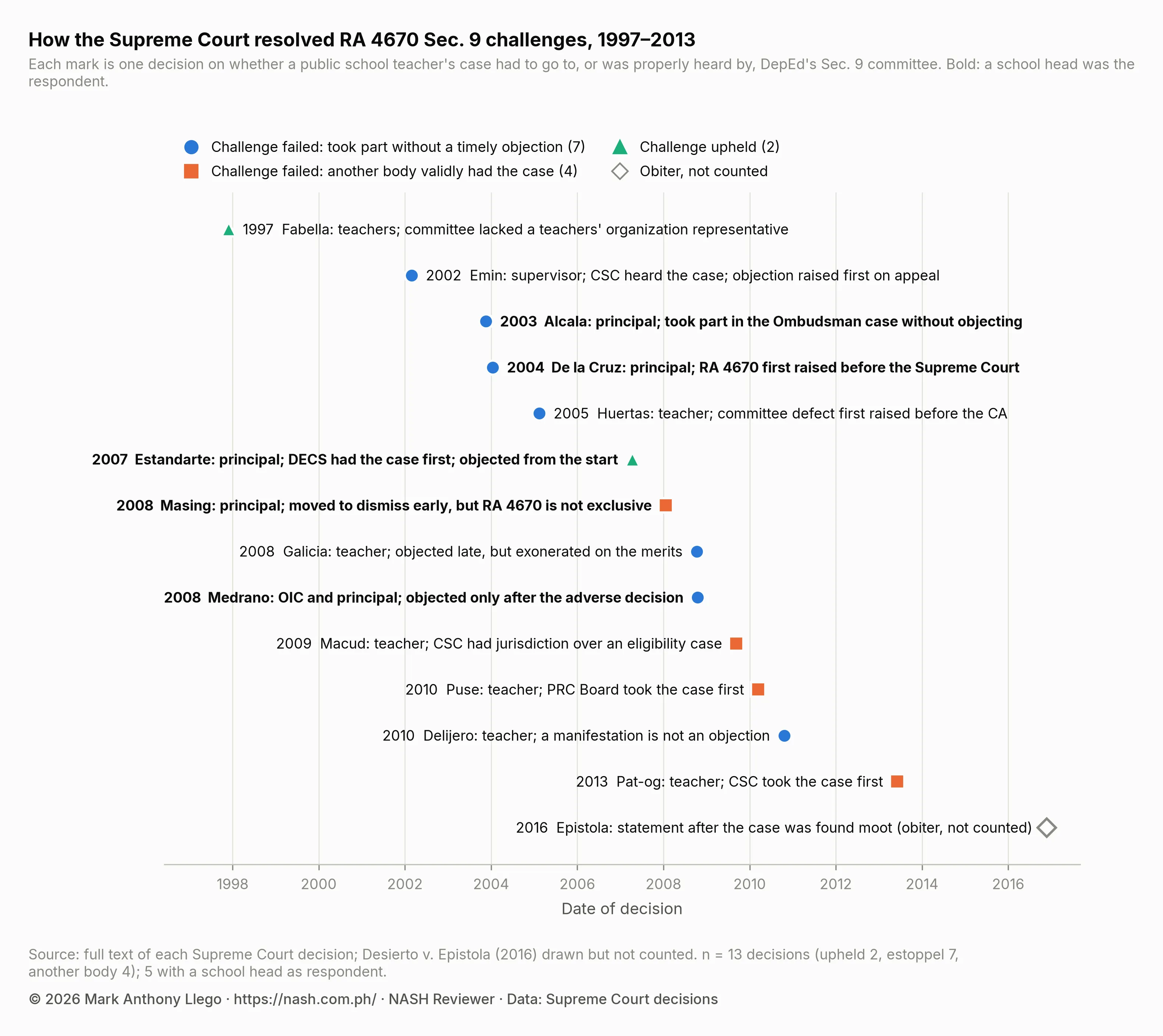
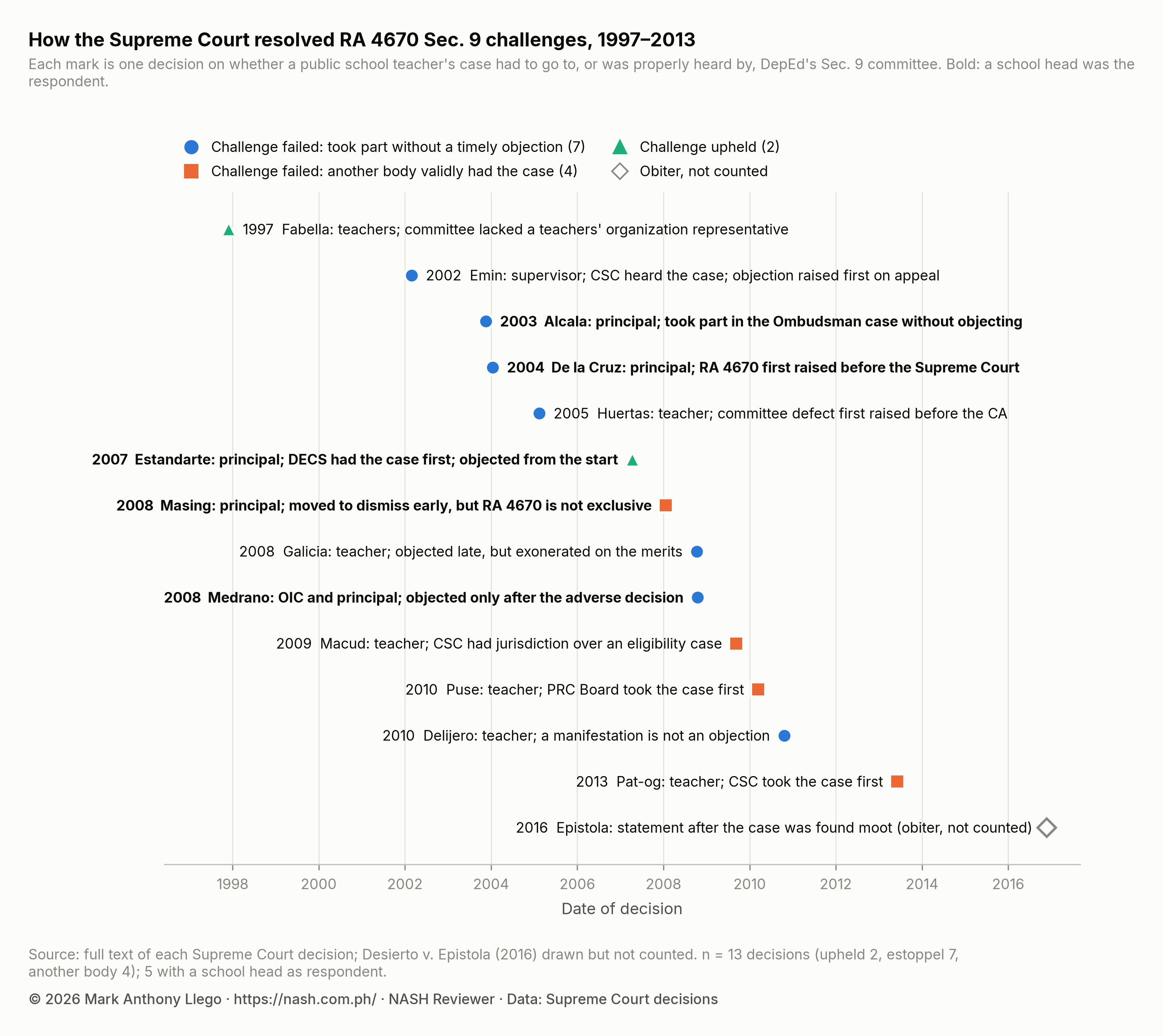
Five of the thirteen had a school head as respondent: Alcala, De la Cruz, Estandarte, Masing and Medrano. In Huertas and Galicia a principal was the complainant against a teacher. None of the thirteen has a dissent or separate opinion.
Is a principal a “teacher” under RA 4670?
Yes. RA 4670, Sec. 2 defines “teacher” to include “all other persons performing supervisory and/or administrative functions in all schools, colleges and universities operated by the Government or its political subdivisions”.
Office of the Ombudsman v. Medrano (2008)
Facts. In 2003 a teacher filed a sworn complaint with the Ombudsman for Luzon against Victorio N. Medrano, the OIC of her school and principal of another public high school in Laguna, for violating the Anti-Sexual Harassment Act (RA 7877) and for grave misconduct. He denied it and said it was meant to pressure him into giving her a regular teaching post. After a six-month preventive suspension order, later lifted, the Ombudsman dismissed him; on his motion for reconsideration, in which he first raised RA 4670, it found sexual harassment instead and imposed a one-year suspension. The Court of Appeals annulled the decision for lack of jurisdiction. While the case was in the Supreme Court, the complainant executed an affidavit of desistance and the trial court dismissed the criminal case.
Issues. Did the desistance moot the case? Did the Ombudsman have jurisdiction? Was Medrano estopped?
Ruling. The Court, through Justice Carpio Morales, ruled for the Ombudsman on all three issues, but on jurisdiction it said the complaint should have gone to DepEd. Medrano lost that point only by estoppel.
- Desistance did not end the case. Criminal and administrative cases are distinct, and “an affidavit of desistance (or recantation) is, as a rule, viewed with suspicion and reservation”.
- Jurisdiction. Medrano is “undoubtedly covered by the definition” of teacher, and “the administrative disciplinary authority of the Ombudsman over a public school teacher is not an exclusive power but is concurrent with the proper committee of the DepEd.” Still, the complaint “should have been referred by petitioner to the proper committee of the DepEd”, in light of RA 6770, Sec. 23.
- Estoppel. The Ombudsman “should have desisted from hearing the administrative complaint against respondent and referred it to the proper DepEd committee”, but “He had actively participated in the administrative proceedings before petitioner.” He had sought dismissal on the merits and contested his preventive suspension, and “It was only after petitioner had rendered an adverse Decision” that he questioned jurisdiction.
The case went back to the Court of Appeals “to decide the case on the merits”. The Supreme Court did not decide whether Medrano committed the acts charged.
Why it matters. Medrano states all three parts of the rule: coverage, concurrent power, and DepEd as the proper forum. A complainant’s withdrawal does not end the case (also DO 49, s. 2006, Sec. 7).
Later history. Delijero (2010) quoted and followed it.
Emin v. De Leon (2002): supervisors are covered too
In Emin v. De Leon, G.R. No. 139794, February 27, 2002 (En Banc), the CSC had dismissed a DECS Non-Formal Education Supervisor for grave misconduct, on testimony that he helped teachers obtain fake civil service eligibility certificates for a fee. The Court held that “R.A. 4670 is good law”, that a supervisor is covered, and that “it is the Investigating Committee that should have investigated his case”. But he had taken part in the CSC hearings and raised jurisdiction “for the first time in his amended petition for review” in the Court of Appeals, so estoppel by laches applied and his dismissal was affirmed. It cautioned that “nothing herein should be deemed as overriding the provision in the Magna Carta for Teachers on the jurisdiction of the Committee to investigate public school teachers as such”. Seven years later, in Macud (2009, below), the En Banc Court upheld the CSC’s jurisdiction over a teacher’s case; it did not mention Emin.
The Sec. 9 committee and why its make-up matters
RA 4670, Sec. 9 provides that “Administrative charges against a teacher shall be heard initially by a committee” of three: the Schools Division Superintendent or an authorized representative of at least division supervisor rank, as chair; a representative of the local teachers’ organization or, if none, a provincial or national one; and a division supervisor. When “the school superintendent is the complainant or an interested party, all the members of the committee shall be appointed by the Secretary of Education.” DepEd’s rules apply this to any respondent who is “a teacher as defined in Section 2 of Republic Act No. 4670” (DO 49, s. 2006, Sec. 21(a)).
Fabella v. Court of Appeals (1997)
Facts and issue. In 1990 the DECS Secretary charged teachers of a Metro Manila public high school who had joined mass actions. The committees that heard them had no teachers’ organization representative; DECS argued that the members belonged to teachers’ federations. Were the teachers denied due process?
Ruling. Yes. In Fabella v. Court of Appeals, G.R. No. 110379, November 28, 1997 (Third Division), the Court, through Justice Panganiban, held that “these committees were deemed to have no competent jurisdiction. Thus, all proceedings undertaken by them were necessarily void.” “The inclusion of a representative of a teachers’ organization in these committees was indispensable to ensure an impartial tribunal.” And “Mere membership of said teachers in their respective teachers’ organizations does not ipso facto make them authorized representatives”; the organization chooses its representative.
Why it matters. Fabella decided due process, not the mass action. In a DepEd case, check who sits on the committee and who designated them.
Later history. Masing (2008) confined Fabella to investigations conducted by DECS. In Huertas v. Gonzalez, G.R. No. 152443, February 14, 2005 (Second Division), the committee “was not the competent tribunal required by the law”, but the teacher lost because he first raised the defect in the Court of Appeals; see Oppression Cases: How Principals Must Treat Teachers.
Can the CSC or the PRC hear the case instead of DepEd?
Yes, and so can the Ombudsman. RA 4670 does not make DepEd’s authority exclusive.
Office of the Ombudsman v. Masing (2008)
Facts. In 1997 parents filed complaints with the Ombudsman for Mindanao against Florita A. Masing, former principal of the Davao City Integrated Special School, for collecting unauthorized fees, failing to remit authorized fees and failing to account for public funds. Another complainant filed a separate case for oppression and other charges. Before any decision, Masing moved to dismiss both, arguing that DECS had jurisdiction through a Sec. 9 committee. The Ombudsman denied the motions, dismissed her in the first case and suspended her for six months in the second. The Court of Appeals set both aside.
Issues. Could the Ombudsman intervene in the Court of Appeals, and could it directly discipline public school teachers?
Ruling. In Office of the Ombudsman v. Masing, G.R. Nos. 165416, 165584 and 165731, January 22, 2008 (First Division), the Court, through Chief Justice Puno, reinstated both Ombudsman decisions. “It is erroneous, therefore, for respondents to contend that R.A. No. 4670 confers an exclusive disciplinary authority on the DECS over public school teachers and prescribes an exclusive procedure in administrative investigations involving them.” Fabella’s statement “should be construed as referring only to the specific procedure to be followed in administrative investigations conducted by the DECS.” The Ombudsman’s penalties are not merely recommendatory.
Why it matters. Masing objected early and still lost. The complaints against her had been filed with the Ombudsman, and the Court held that RA 4670 does not make DECS’s authority exclusive. It distinguished Fabella, where the teachers were charged “in administrative proceedings initiated by the DECS Secretary”. The decision mentions no DECS case against her and no committee formed to hear her, and the word “concurrent” is not in its holding.
Later history. The En Banc Court quoted its holding in Macud (2009), and Pat-og (2013) repeated its reading of Fabella through Macud. Delijero (2010) followed it on the Ombudsman’s penalties.
Puse v. Santos-Puse (2010) and Pat-og v. CSC (2013)
In Puse v. Santos-Puse, G.R. No. 183678, March 15, 2010 (First Division), a Teacher I was charged by the respondent, Ligaya Delos Santos-Puse, before the PRC Board of Professional Teachers with immorality and dishonorable conduct over his marriages, and the Board revoked his license. He argued that only the CSC or DepEd’s committee could hear it. The Court, through Justice Villarama, Jr., affirmed: “An administrative case against a public school teacher may be filed before the Board of Professional Teachers-PRC, the DepEd or the CSC, which have concurrent jurisdiction over administrative cases such as for immoral, unprofessional or dishonorable conduct.” And “where concurrent jurisdiction exists in several tribunals, the body or agency that first takes cognizance of the complaint shall exercise jurisdiction to the exclusion of the others.” The Board had the case first.
In Pat-og v. Civil Service Commission, G.R. No. 198755, June 5, 2013 (Third Division), a teacher was charged before the CSC’s regional office with hitting a student. On appeal the CSC found grave misconduct and dismissed him, and only then did he raise RA 4670. The Court, through Justice Mendoza, rejected the objection: “it was CSC which first acquired jurisdiction over the case because the complaint was filed before it”, and “By no means, then, did R.A. No. 4670 confer an exclusive disciplinary authority over public school teachers on the DepEd.” He was also estopped. The finding stood, but the penalty was reduced to six months’ suspension.
Civil Service Commission v. Macud (2009, En Banc)
Emin (2002) had said the Sec. 9 committee should have heard a supervisor’s case. In Civil Service Commission v. Macud, G.R. No. 177531, September 10, 2009 (En Banc), the Court, through Justice Leonardo-De Castro, upheld the CSC’s jurisdiction over a teacher’s case. A Teacher I in Marawi City was charged by a CSC regional office with dishonesty, grave misconduct and conduct prejudicial to the best interest of the service over her claimed passing of the teachers’ board examination, and dismissed; she denied the charge. The Court of Appeals voided the proceedings under RA 4670, a theory it raised itself, since she had objected only to which CSC regional office should hear her. The Supreme Court reversed. It read CSC v. Alfonso as holding that “special laws such as R.A. 4670 did not divest the CSC of its inherent power to supervise and discipline all members of the civil service, including public school teachers”, and held that “where an administrative case involves the alleged fraudulent procurement of an eligibility or qualification for employment in the civil service, it is but proper that the CSC would have jurisdiction over the case”. Fabella was “misplaced”, and the Court quoted Masing’s holding. She was also “effectively barred by estoppel”, and the Court found substantial evidence of all three. Macud does not mention Emin; Pat-og relied on Macud.
Who may hear a complaint against a public school head
| Body | Legal basis | What it can do | Where a decision goes next |
|---|---|---|---|
| DepEd: Regional Director, with a Sec. 9 committee | RA 4670, Sec. 9; DO 49, s. 2006, Secs. 1, 6, 21(a) | Decide charges; removal needs the Secretary’s confirmation (Sec. 45) | Reconsideration in 15 days, which stays execution (Secs. 47, 50); the Secretary, then the CSC (Sec. 51), or directly to the CSC (2025 RACCS, Sec. 91); then the Court of Appeals, Rule 43 (Sec. 56) |
| Office of the Ombudsman | Constitution, Art. XI, Secs. 12–13; RA 6770, Secs. 19, 21; A.O. No. 1, s. 2026 | Penalties “ranging from reprimand to dismissal” (Rule VI, Sec. 5); preventive suspension up to six months (Sec. 3) | Reconsideration in 10 days under the rules (5 under RA 6770, Sec. 27), required before appeal (Rule VIII, Secs. 7–8); Rule 43 petition in 15 days; neither stays execution; light penalties are final (Sec. 8) |
| Civil Service Commission | 2025 RACCS, Sec. 9; Macud; Pat-og | Hear complaints filed with it, concurrently with the agency | Regional office decisions to the Commission in 15 days (Sec. 97); Commission decisions to the Court of Appeals, Rule 43 (Sec. 99) |
| PRC Board of Professional Teachers | RA 7836, Sec. 23, as quoted in Puse | Suspend or revoke a teacher’s certificate of registration for causes including “Immoral, unprofessional or dishonorable conduct” | In Puse, a petition for review to the Court of Appeals |
The 2025 RACCS (CSC Resolution No. 2500357) took effect August 4, 2025. Under it, too, a timely motion for reconsideration of an agency decision stays execution (Sec. 87).
Should the Ombudsman refer a teacher’s case to DepEd?
Three decisions say so; a fourth is often misread.
Office of the Ombudsman v. Galicia (2008, En Banc)
Facts. Ramon C. Galicia taught at a public high school in Caloocan City. His principal could not get a college to confirm his transcript and filed a complaint with the Ombudsman for falsification, dishonesty and grave misconduct. Galicia said the transcript was authentic and the complaint came from his disputes with the principal. The Ombudsman dismissed him for dishonesty. He first raised RA 4670 in his motion for reconsideration. The Court of Appeals reversed on jurisdiction and the merits and ordered him reinstated with back wages.
Issues. Did the Court of Appeals err in nullifying the Ombudsman’s decision for lack of jurisdiction, and in reversing its findings of fact?
Ruling. Galicia was exonerated. In Office of the Ombudsman v. Galicia, G.R. No. 167711, October 10, 2008 (En Banc), the Court, through Justice R.T. Reyes, denied the Ombudsman’s petition. It opened: “GENERALLY, the Ombudsman must yield to the Division School Superintendent in the investigation of administrative charges against public school teachers.” It held: “In sum, We reiterate that it is the School Superintendent and not the Ombudsman that has jurisdiction over administrative cases against public school teachers. Yet, Galicia is estopped from belatedly assailing the jurisdiction of the Ombudsman.” On the merits, the registrar’s certification was only negative evidence, and “We are constrained to uphold his innocence of the charges of falsification.”
Why it matters. Galicia is the only En Banc decision of the thirteen on the Ombudsman, and its words are the strongest for DepEd. Galicia lost the jurisdiction point but not the case. For principals who file complaints: “In administrative proceedings, the complainant has the burden of proving the allegations in the complaint.”
Later history. Delijero (2010) quoted its estoppel and due process passages.
Reading Galicia with Medrano. Galicia (En Banc, October 10, 2008) says “must yield”; Medrano (Second Division, a week later) says “concurrent” but “should have been referred”. Both treat DepEd’s committee as the right forum and both held the respondent estopped. A Division cannot overrule the Court En Banc (Constitution, Art. VIII, Sec. 4(3)), so Medrano did not overrule Galicia.
Office of the Ombudsman v. Delijero (2010)
Facts. Pedro Delijero, Jr., a public high school mathematics teacher in Leyte, was charged before the Ombudsman with grave misconduct over his conduct toward a student who was a minor. He filed a counter-affidavit contesting the charge. Asked for a position paper, he filed a manifestation that the same charge was pending before DepEd’s Regional Director, that he was “being charged and made to answer twice”, and that he “submits the same for the resolution of this Office.” The Ombudsman dismissed him; the Court of Appeals, raising jurisdiction on its own, set that aside.
Issues. Is the Ombudsman’s authority over public school teachers concurrent with DepEd’s, and are its penalties only recommendatory?
Ruling. In Office of the Ombudsman v. Delijero, G.R. No. 172635, October 20, 2010 (Second Division), the Court, through Justice Peralta, reversed. Jurisdiction is concurrent, but “it would have been more prudent for petitioner to have referred the complaint to the DECS”. That did not void the proceedings, “as estoppel has already set in.” The manifestation “cannot by any stretch be considered as a direct attack on the proceedings before the Ombudsman.” Instead: “If respondent wanted to assail the jurisdiction of the Ombudsman, he should have clearly prayed for the same through a motion to dismiss, a manifestation ad cautelam, or any other document of similar import.” The case went back to the Court of Appeals on the merits. The Supreme Court did not decide whether the charge was true.
Why it matters. Telling the Ombudsman that DepEd has the same case is not an objection. Note that the Ombudsman’s rules treat a “Motion to dismiss” as a prohibited pleading: the amended 1990 rules (A.O. No. 07) did, allowing the grounds to be argued in the counter-affidavit instead, and A.O. No. 1, s. 2026 does (Rule VIII, Sec. 4(a)). The objection belongs in the counter-affidavit and every later pleading.
Desierto v. Epistola (2016) is obiter on this point
Desierto v. Epistola, G.R. No. 161425, November 23, 2016 (Third Division, Resolution), arose from a pupil’s drowning and a charge that a teacher and a barangay captain pressured a child witness. The teacher had since died (the petition against her was dismissed in 2009) and the captain’s term had ended. The Court, through Justice Perez, began: “We deny the Petition for being moot and academic.” Near the end it said that Medrano settled the point and that “The fact that a referral to the proper committee would have been the prudent thing to do does not operate to divest the Ombudsman of its constitutional power to investigate government employees including public school teachers.” It closed by reiterating “that there is no justiciable controversy”.
A statement not needed to dispose of a moot petition is obiter. Epistola restates Medrano; it adds no holding. As of October 31, 2026, it is also the Court’s latest statement on the point.
Object early: Estandarte against Alcala
These two decisions reach opposite results. The difference is timing.
Office of the Ombudsman v. Estandarte (2007)
Facts. In 1998 the faculty club and department heads of Ramon Torres National High School in Bago City sent the Ombudsman (Visayas) an unsworn complaint of 33 alleged irregularities by the principal, Heidi M. Estandarte; the Ombudsman referred it to DECS-Region VI. In February 1999 they filed a sworn formal complaint with DECS-Region VI, which required her answer and formed a Special Investigating Committee, approved on July 26, 1999. The Ombudsman also referred its own administrative case to DECS under RA 6770, Sec. 23(2). In 2002 the faculty club asked the Ombudsman “to take over the case for speedier disposition”, and DECS turned over the records. Estandarte moved to remand the case to DECS, sought suspension of the proceedings, and did not attend the preliminary conference. In March 2004 the Ombudsman dismissed her for grave misconduct; the Court of Appeals set that aside and returned the records to the DECS committee.
Issue. Could the Ombudsman take over a case DECS had acquired?
Ruling. No. The Court, through Justice Callejo, Sr., affirmed the Court of Appeals on two grounds.
- Jurisdiction stayed with DECS. “Jurisdiction once acquired is not lost upon the instance of the parties but continues until the case is terminated.” Jurisdiction vested in DECS-Region VI when the formal complaint was filed there, and “It cannot now be transferred to petitioner upon the instance of the complainants, even with the acquiescence of the DECS and petitioner.”
- Even if jurisdiction were concurrent, the Court “would still sustain the DECS’ authority to decide the administrative case”, because DECS “is in a better position to decide the matter. Moreover, the DECS has already commenced proceedings over the administrative case by constituting the Special Investigating Committee pursuant to Section 9 of Rep. Act No. 4670.”
Alcala and Emin did not apply: “From the very start, respondent consistently protested the referral of the case back to the Ombudsman, and demanded that the same be remanded to the DECS.” By contrast, “what was striking in the Emin and Alcala cases was that the respondent therein actively participated in the proceedings before the other tribunal.”
What it did not decide. The Court did not rule on the charges against Estandarte; they went back to the DECS committee. The Court did not rule on the Court of Appeals’ further views that she was denied due process and that the Ombudsman could only recommend penalties; Masing and Delijero later rejected the second.
Why it matters. It is the only decision of the thirteen in which a school head’s objection succeeded, and it took two facts: DECS had the case and its committee first, and she objected at every stage. Her refusal to take part before the Ombudsman was a risk the Court did not endorse. The only other school head of the thirteen who objected before the decision, Masing, lost.
Later history. The En Banc Court in Galicia read Estandarte as holding that “by virtue of the Magna Carta for Public School Teachers, original jurisdiction belongs to the school superintendent”. Puse distinguished it as a contest between the Ombudsman and DepEd. Her criminal cases under RA 3019 went separately to the Court in Estandarte v. People, G.R. Nos. 156851-55, February 18, 2008 (Third Division); see Unauthorized School Fees: What Happens to the Principal?
Alcala v. Villar (2003)
Facts. In 1998 teachers of two high schools in Pilar, Cebu filed a dishonesty complaint with the Ombudsman against Jovencio D. Villar, principal of Lanao National High School. They alleged that he took their seminar reimbursement checks by forging their signatures and paid them less, and shortchanged four of them on loyalty benefits. Villar said they had authorized him to encash the checks at a lending firm that deducted their loan payments, and that the complaint aimed to force him out. The Ombudsman dismissed him. The Court of Appeals nullified the decision because RA 4670 governs public school teachers.
Issue. Was the Ombudsman’s decision void because RA 4670 governs public school teachers?
Ruling. The Court, through Justice Ynares-Santiago, reversed. RA 4670 “specifically covers and governs administrative proceedings involving public school teachers”, but Villar had filed a counter-affidavit and a motion for reconsideration, attended the hearings and was given the opportunity to cross-examine the witnesses. “Verily, participation in the administrative proceedings without raising any objection thereto amounts to a waiver of jurisdictional infirmities.” He was “barred under the principle of estoppel by laches from assailing the jurisdiction of the Ombudsman”, and the case was remanded “for determination of the appeal on its merits.”
Why it matters. The Supreme Court did not find Villar guilty; it decided only that he could no longer use RA 4670. The same rule cost a Principal I her objection in De la Cruz v. Department of Education, Culture and Sports-Cordillera Administrative Region, G.R. No. 146739, January 16, 2004 (Second Division), where she raised RA 4670 for the first time in the Supreme Court; see Promotion Protests and Nepotism: Cases on Principals.
Later history. Medrano (2008) quoted and applied it, Galicia (2008) explained it, and Estandarte (2007) distinguished it because Villar took part without objecting.
What timing did in each case
| Case | Where the case was | The objection | Result on the RA 4670 point |
|---|---|---|---|
| Estandarte (2007) | DECS (formal complaint), with a Sec. 9 committee formed | From the start, at every stage | Upheld: Ombudsman decision set aside |
| Masing (2008) | Ombudsman (complaints filed there) | Before the decision, by motion to dismiss | Rejected: RA 4670 is not exclusive |
| Alcala (2003) | Ombudsman (complaint filed there) | None while the Ombudsman heard the case | Estopped |
| Medrano (2008) | Ombudsman (complaint filed there) | First in a motion for reconsideration after the decision | Estopped |
Ombudsman penalties are binding and carried out at once
In Office of the Ombudsman v. Madriaga, G.R. No. 164316, September 27, 2006 (Third Division), the Court held that the Ombudsman’s authority “is not merely recommendatory. It is mandatory within the bounds of the law”, with implementation “coursed through the proper officer”; see Unauthorized School Fees. Masing, Delijero and Balbastro v. Junio, G.R. No. 154678, July 17, 2007 (Third Division), agree; see Dishonesty and Grave Misconduct: Cases on Principals.
Under A.O. No. 1, s. 2026 (Rule VIII, Secs. 7 and 8):
- “The filing of a motion for reconsideration or an appeal shall not stay the immediate execution of the decision.”
- A motion for reconsideration must be filed within a non-extendible ten days and is “a condition sine qua non” for a Rule 43 petition to the Court of Appeals, due within 15 days from the order resolving it.
- RA 6770, Sec. 27 itself says a motion for reconsideration “must be filed within five (5) days after receipt of written notice”. The statute’s period is shorter than the rules’, and neither text says how the two are reconciled, so file within five days if you can.
- An absolution, a censure or reprimand, or a suspension or fine of up to one month is “final, executory and unappealable”.
- The agency head must implement the decision and report compliance “within a period not exceeding ten (10) days from receipt thereof”, on pain of contempt and discipline.
DepEd Order No. 38, s. 2006, addressed among others to the heads of public and private schools, directs DepEd offices to implement Ombudsman decisions “immediately upon receipt thereof by their respective Offices”, and states that “Only a Temporary Restraining Order (TRO) or a Writ of Preliminary Injunction, duly issued by a court of competent jurisdiction, stays the immediate implementation” (paras. 1 and 3). It predates A.O. No. 1, s. 2026; the duty is unchanged.
Inside DepEd, by contrast, a motion for reconsideration filed within 15 days “shall stay the execution of the decision sought to be reconsidered” (DO 49, s. 2006, Sec. 50; 2025 RACCS, Sec. 87), one practical reason the forum matters. The Ombudsman may also preventively suspend a respondent for up to six months (Rule VI, Sec. 3); see Preventive Suspension, Appeals and Back Pay for Principals.
What DepEd’s rules say today
The cases applied older rules. As of October 31, 2026:
- RA 4670 is unamended. House Bill No. 8759 (filed March 24, 2026) would amend it but is only a bill, and DepEd Memorandum No. 057, s. 2026 only creates a working group to review it.
- DepEd Order No. 49, s. 2006 still governs DepEd’s procedure. “The disciplining authorities in the Department of Education shall be the Secretary and the Regional Directors in their respective regions” (Sec. 1), and complaints against teachers, school heads included, go to the Regional Director (Sec. 6). “A Grievance Committee is not allowed to hear and decide administrative disciplinary cases” (Sec. 2). Withdrawal of a complaint does not dismiss it (Sec. 7). “No publicity shall be given to any administrative case against a teacher during the pendency of his case” (Sec. 40; also RA 4670, Sec. 8).
- The 2025 RACCS (effective August 4, 2025) replaced the 2017 RACCS: “The disciplining authorities of agencies shall have original concurrent jurisdiction with the Commission and CSC ROs over their respective officials and employees” (Sec. 9).
- RA 6770, Sec. 23(2) grounds the preference for referral: “At its option, the Office of the Ombudsman may refer certain complaints to the proper disciplinary authority”.
- A.O. No. 1, s. 2026, signed January 19, 2026, takes effect by its terms 15 days after publication and filing with the Office of the National Administrative Register (that date is not yet known), and applies to pending cases “insofar as practicable” (Rule X, Sec. 8). Evaluators may recommend referral to “other agencies/offices that have concurrent jurisdiction with the Office of the Ombudsman” (Rule II, Sec. 3(a)(iii)), and a complaint may be dismissed outright if “the complainant has an adequate remedy in another judicial or quasi-judicial body” (Rule II, Sec. 4(a)). Both are discretionary.
- Administrative and criminal cases run separately. “Dismissal of the criminal case does not foreclose administrative action involving the same facts” (De la Cruz, 2004).
Why the Regional Director, not the superintendent, decides a teacher’s case is explained in Who Disciplines DepEd Teachers and School Heads?.
What this means for school heads
This is general guidance from the cases. If you are a respondent, get advice early from your Schools Division Office’s legal unit or a lawyer.
If a complaint is filed against you:
- Find out where each complaint was filed, and when, and get any order forming a DepEd committee. Those dates decided Estandarte. What a sworn complaint must contain is in How to File an Administrative Complaint in DepEd.
- If the Ombudsman or the CSC has the case, object in your first pleading. State plainly in your counter-affidavit that RA 4670 makes DepEd’s committee the proper forum, ask the Ombudsman to refer the complaint under RA 6770, Sec. 23(2), attach proof of any DepEd case, and repeat the objection in every later pleading. Under Medrano, taking part and objecting only after an adverse decision is what estops you.
- Do not file a motion to dismiss before the Ombudsman. It is a prohibited pleading (A.O. No. 1, s. 2026, Rule VIII, Sec. 4(a)); put the objection in the counter-affidavit.
- A notice is not an objection. Telling the Ombudsman that DepEd has the case, then submitting for resolution, is submission (Delijero).
- Answer the charge while you object. Without a counter-affidavit, the complaint is “deemed submitted for resolution on the basis of the evidence on record” (Rule VIII, Sec. 3(c)).
- Know what the objection can do. If DepEd had the case first, Estandarte supports keeping it there. If the complaint was filed with the Ombudsman, the Court has said it “should have been referred” (Medrano), but the Ombudsman may keep it: Masing objected early and its decisions stood. Prepare your full defense either way.
- In a DepEd case, check the committee for a teachers’ organization representative the organization chose (Fabella), and raise any defect at once, unlike Huertas.
- Expect an Ombudsman penalty to take effect at once. File any motion for reconsideration as early as you can: A.O. No. 1 allows ten days, but RA 6770, Sec. 27 says five. Then count 15 days for a Rule 43 petition. Only a court’s TRO or injunction stops execution (DO 38, s. 2006).
- Keep a case file of every pleading, order and date of receipt.
If you are the complainant against a teacher:
- File with the Regional Director (DO 49, s. 2006, Secs. 1 and 6), not a grievance committee, which may not decide charges (Sec. 2). See Human Resource Management for DepEd School Heads.
- Verify before you file. The complainant carries the burden of proof, and in Galicia the teacher was exonerated.
- Respect the teacher’s RA 4670 rights, which are also yours. Knowing them is PPSSH indicator 4.7.1 (PPSSH Domain 4: Developing Self and Others With DepEd Data); keeping school action within the law is indicator 1.3.1 (PPSSH Domain 1: Leading Strategically With DepEd Data).
The rules cover an officer-in-charge too (Medrano); see Principal, Head Teacher or Teacher-in-Charge in DepEd and, on preventing complaints, RA 6713 for DepEd School Heads: Ethics and Internal Control.
How the NASH may test this
The two items below are original practice items, scored 3 (Relational), 2 (Multistructural), 1 (Unistructural) or 0 (Prestructural). An option that breaks a rule scores 0.
Question 1
Indicator 4.7.1, General welfare of human resources. Career Stage 1, Conceptual, Moderate.
A Teacher III in your school is charged with grave misconduct. The complainant first filed a sworn complaint with the Regional Director, who required an answer and formed a committee under RA 4670, Sec. 9; it has held a pre-hearing conference. Two months later the same complainant files the same charge with the Office of the Ombudsman, which orders the teacher to file a counter-affidavit within 15 days. The teacher asks what the law and the Supreme Court’s decisions say. Which explanation is most accurate?
- A. The Ombudsman has no authority over public school teachers because RA 4670 makes DepEd’s committee exclusive, so the teacher may disregard the order and answer only the committee.
- B. The Ombudsman and DepEd share jurisdiction, so the teacher should answer the charge fully before both and let whichever body finishes first decide the case.
- C. DepEd took the case first, so the Ombudsman cannot take it over; the teacher should file a counter-affidavit that objects and asks for referral, and leave the charge unanswered until the objection is resolved.
- D. Jurisdiction is shared, but DepEd took the case first, so it keeps it; the teacher should file the counter-affidavit on time, object in it with proof of the DepEd case, answer the charge as a precaution, and consult the SDO legal unit.
Answer and explanation
Best answer: D. Points: A = 0, B = 1, C = 2, D = 3.
- A (0 points, Prestructural). RA 4670 is not exclusive (Masing; Medrano), and disregarding the order leaves the complaint to be decided on the record (A.O. No. 1, s. 2026, Rule VIII, Sec. 3(c)).
- B (1 point, Unistructural). Shared jurisdiction is right, but it misses first cognizance, and answering without objecting is how Alcala and Medrano lost the point.
- C (2 points, Multistructural). First cognizance and a timely objection are right, but leaving the charge unanswered risks a decision on the complainant’s evidence alone.
- D (3 points, Relational). It connects first cognizance, a timely objection, a defense on the merits and proper advice.
Why. Estandarte (2007) held that “Jurisdiction once acquired is not lost upon the instance of the parties but continues until the case is terminated.” Alcala (2003) and Medrano (2008) treat participation without objection as a waiver, and a motion to dismiss is a prohibited pleading (A.O. No. 1, s. 2026, Rule VIII, Sec. 4(a)).
Indicator 4.7.1: Display knowledge of laws, policies, guidelines and issuances on the rights, privileges and benefits of school personnel to promote their general welfare.
Sources: RA 4670, Sec. 9; Office of the Ombudsman v. Estandarte, G.R. No. 168670, April 13, 2007; Alcala v. Villar, G.R. No. 156063, November 18, 2003; Ombudsman A.O. No. 1, s. 2026, Rule VIII, Secs. 3 and 4.
Question 2
Indicator 1.3.1, Policy implementation and review. Career Stage 1, Conceptual, Moderate.
The Office of the Ombudsman finds the principal of a public elementary school guilty of grave misconduct and dismisses her. Five days after receiving the decision she files a motion for reconsideration and says she will appeal to the Court of Appeals. The decision directs the head of the agency to implement it. Which statement best describes how the decision is carried out?
- A. The decision is a recommendation to DepEd, so the Regional Director must first have a Sec. 9 committee review the case and then decide whether to dismiss her.
- B. The decision binds DepEd, and the head of the agency implements it through the proper officer, since the Ombudsman does not remove her from the service by itself.
- C. The decision binds DepEd and is carried out at once, because her motion for reconsideration does not stay it, and only a court’s restraining order or injunction can stop it.
- D. The decision binds DepEd and is carried out at once, with compliance reported within ten days unless a court enjoins it; her motion, required before an appeal, opens a 15-day Rule 43 petition to the Court of Appeals.
Answer and explanation
Best answer: D. Points: A = 0, B = 1, C = 2, D = 3.
- A (0 points, Prestructural). The Court rejected the recommendatory view (Madriaga, 2006; Masing, 2008), and holding the decision for review defies the directive.
- B (1 point, Unistructural). Binding effect and implementation through the proper officer are right, but it says nothing about timing or her remedies.
- C (2 points, Multistructural). Binding effect, immediate execution and the court-order exception are right, but it omits the compliance report and her route to contest the decision.
- D (3 points, Relational). It links the binding penalty, immediate execution, the report, the only way to stop execution, and her remedy.
Why. Madriaga (2006) held that the Ombudsman’s authority “is not merely recommendatory. It is mandatory within the bounds of the law.” A.O. No. 1, s. 2026, Rule VIII, Sec. 8 and DepEd Order No. 38, s. 2006 supply the rest.
Indicator 1.3.1: Demonstrate knowledge and understanding of policy implementation and review to ensure that school operations are consistent with national and local laws, regulations and issuances.
Sources: Office of the Ombudsman v. Madriaga, G.R. No. 164316, September 27, 2006; Office of the Ombudsman v. Masing, G.R. Nos. 165416, 165584 and 165731, January 22, 2008; Ombudsman A.O. No. 1, s. 2026, Rule VIII, Secs. 7 and 8; DepEd Order No. 38, s. 2006.
Nothing in this guide reproduces or predicts examination content.
Frequently asked questions
Can the Ombudsman dismiss a public school principal?
Yes. In Office of the Ombudsman v. Masing (2008), the Court reinstated the Ombudsman’s dismissal of a former principal, and Ombudsman penalties bind DepEd (Madriaga, 2006). But the Court treats DepEd’s committee as the proper forum (Galicia, 2008; Medrano, 2008), and in Estandarte (2007) it upheld the setting aside of an Ombudsman dismissal because DECS had the case first and the principal objected throughout.
Does RA 4670 mean only DepEd can discipline teachers and principals?
No. Medrano (2008) held that the Ombudsman’s authority over a public school teacher, principals included, is concurrent with DepEd’s committee, and Macud (2009, En Banc), Puse (2010) and Pat-og (2013) add the CSC and the PRC Board. RA 4670 makes DepEd’s committee the forum the Court prefers: the Ombudsman “must yield” generally (Galicia, 2008).
What happens if I answer an Ombudsman complaint without objecting to its jurisdiction?
You will likely lose the objection. In Alcala v. Villar (2003) and Medrano (2008), principals who took part without a timely objection were held estopped. Object in your counter-affidavit and keep objecting at every stage. The principal in Estandarte (2007), whose case DECS had first, objected from the start, though by refusing to take part, a risk the Court did not endorse.
Does a complainant’s affidavit of desistance end the administrative case?
No. In Medrano (2008), neither the desistance nor the dismissal of the criminal case ended the administrative case. DepEd’s rules agree: withdrawal of a complaint “does not result in its outright dismissal” (DO 49, s. 2006, Sec. 7).
Does a motion for reconsideration stop an Ombudsman decision from taking effect?
No. Under A.O. No. 1, s. 2026, a motion for reconsideration or an appeal “shall not stay the immediate execution of the decision” (Rule VIII, Sec. 8); only a court’s TRO or writ of preliminary injunction does (DO 38, s. 2006). Inside DepEd, a timely motion does stay execution (DO 49, s. 2006, Sec. 50).
Download the data
- omb-sec9-challenges.csv: the 13 decisions, 1997–2013, that resolved a challenge under RA 4670, Sec. 9 to the body or committee that heard a public school teacher’s case, plus Desierto v. Epistola (2016) marked as not counted. Each row gives the date, G.R. number, court, respondent, body challenged, when the challenge was raised, how the Court resolved it, and the result for the respondent.
The CSVs and charts may be reused only with written permission: email support@nash.com.ph. The decisions themselves are public records of the Supreme Court, which you can cite directly.
Sources
Supreme Court decisions
- Fabella v. Court of Appeals, G.R. No. 110379, November 28, 1997 (Third Division), Panganiban, J.
- Emin v. De Leon, G.R. No. 139794, February 27, 2002 (En Banc), Quisumbing, J.
- Alcala v. Villar, G.R. No. 156063, November 18, 2003 (First Division), Ynares-Santiago, J.
- De la Cruz v. Department of Education, Culture and Sports-Cordillera Administrative Region, G.R. No. 146739, January 16, 2004 (Second Division), Quisumbing, J.
- Huertas v. Gonzalez, G.R. No. 152443, February 14, 2005 (Second Division), Callejo, Sr., J.
- Office of the Ombudsman v. Madriaga, G.R. No. 164316, September 27, 2006 (Third Division), Carpio Morales, J.
- Office of the Ombudsman v. Estandarte, G.R. No. 168670, April 13, 2007 (Third Division), Callejo, Sr., J.
- Balbastro v. Junio, G.R. No. 154678, July 17, 2007 (Third Division), Austria-Martinez, J.
- Office of the Ombudsman v. Masing, G.R. Nos. 165416, 165584 and 165731, January 22, 2008 (First Division), Puno, C.J.
- Estandarte v. People, G.R. Nos. 156851-55, February 18, 2008 (Third Division), Austria-Martinez, J.
- Office of the Ombudsman v. Galicia, G.R. No. 167711, October 10, 2008 (En Banc), Reyes, R.T., J.
- Office of the Ombudsman v. Medrano, G.R. No. 177580, October 17, 2008 (Second Division), Carpio Morales, J.
- Civil Service Commission v. Macud, G.R. No. 177531, September 10, 2009 (En Banc), Leonardo-De Castro, J.
- Puse v. Santos-Puse, G.R. No. 183678, March 15, 2010 (First Division), Villarama, Jr., J.
- Office of the Ombudsman v. Delijero, G.R. No. 172635, October 20, 2010 (Second Division), Peralta, J.
- Pat-og v. Civil Service Commission, G.R. No. 198755, June 5, 2013 (Third Division), Mendoza, J.
- Desierto v. Epistola, G.R. No. 161425, November 23, 2016 (Third Division, Resolution), Perez, J.
Laws and rules
- 1987 Constitution, Art. VIII, Sec. 4(3), and Art. XI, Secs. 12–13.
- Republic Act No. 4670, the Magna Carta for Public School Teachers, approved June 18, 1966, Secs. 2, 8 and 9.
- Republic Act No. 6770, the Ombudsman Act of 1989, November 17, 1989, Secs. 19, 21, 23(2) and 27.
- Office of the Ombudsman, Administrative Order No. 1, s. 2026, Revised Rules of Procedure of the Office of the Ombudsman, signed January 19, 2026: Rule II, Secs. 3 and 4; Rule VI, Secs. 3 and 5; Rule VIII, Secs. 3, 4, 7 and 8; Rule X, Secs. 8, 10 and 11.
- Office of the Ombudsman, Administrative Order No. 07, Rules of Procedure of the Office of the Ombudsman, April 10, 1990, Rule III, Sec. 5(g)(1), as amended by Administrative Order No. 17.
- Republic Act No. 7836, the Philippine Teachers Professionalization Act of 1994, Sec. 23.
- DepEd Order No. 38, s. 2006, Immediate Implementation of Decisions, Orders or Resolutions Issued by the Office of the Ombudsman in Administrative Disciplinary Cases, August 29, 2006, paras. 1–3.
- DepEd Order No. 49, s. 2006, Revised Rules of Procedure of the Department of Education in Administrative Cases, December 12, 2006, Secs. 1, 2, 6, 7, 21(a), 40, 45, 47, 50, 51 and 56.
- DepEd Memorandum No. 057, s. 2026, Creation of a National Technical Working Group for the Development of a Roadmap for the Magna Carta for Public School Teachers, September 21, 2026, paras. 1–2.
- 2025 Rules on Administrative Cases in the Civil Service (2025 RACCS), CSC Resolution No. 2500357, promulgated April 30, 2025, effective August 4, 2025, Secs. 9, 87, 97 and 99.
- House Bill No. 8759, 20th Congress, filed March 24, 2026 (a bill to amend RA 4670; not law).
This guide explains Supreme Court decisions for study and professional awareness. It is not legal advice; for a specific case, consult a lawyer or your Schools Division Office’s legal unit.
The Supreme Court cases series
- Supreme Court Cases on School Heads: A Guide for Principals
- Can the Ombudsman Discipline a Principal? RA 4670 Cases (this post)
- Can a Principal Be Reassigned to Another School?
- Promotion Protests and Nepotism: Cases on Principals
- Unauthorized School Fees: What Happens to the Principal?
- Can a Principal Be Jailed Over School Funds?
- Dishonesty and Grave Misconduct: Cases on Principals
- Oppression Cases: How Principals Must Treat Teachers
- Harassment, Child Abuse and Hazing: Cases on School Heads
- Is a Principal Liable When a Pupil Is Injured?
- Can a Private School Remove Its Principal?
- Preventive Suspension, Appeals and Back Pay for Principals
Written by Mark Anthony Llego for NASH Reviewer. Sources: Supreme Court decisions in Medrano, Estandarte, Alcala, Masing, Galicia, Delijero, Macud, Puse, Pat-og, Emin, Fabella and Epistola; RA 4670; RA 6770; Ombudsman A.O. No. 1, s. 2026; DepEd Orders No. 38 and 49, s. 2006; DepEd Memorandum No. 057, s. 2026; the 2025 RACCS. Charts may be reused only with written permission from support@nash.com.ph.