A public school principal facing an administrative charge in DepEd may be preventively suspended for at most 90 days, and is automatically reinstated if the case is not decided in that time (2025 Rules on Administrative Cases in the Civil Service, Sec. 37; DepEd Order No. 49, s. 2006, Sec. 18). The Ombudsman may suspend for up to six months (RA 6770, Sec. 24). In the leading case on court-ordered suspension, Gonzaga v. Sandiganbayan, G.R. No. 96131, September 6, 1991 (En Banc), the Supreme Court set aside the open-ended suspension of a Malabon principal charged with malversation and held that it may not exceed 90 days.
Back pay is due in set situations: when a dismissed or suspended principal is exonerated or let off with a reprimand on appeal; when a dismissal is carried out before it may lawfully be; when the preventive suspension order is invalid, or for any part of it beyond the limit that the principal did not cause; when the CSC dismisses the case for a violation of due process; and, after a court suspension under RA 3019, Sec. 13, on acquittal. Preventive suspension pending investigation is not paid if the order was valid, even if the principal is later cleared (Civil Service Commission v. Cruz, G.R. No. 187858, August 9, 2011, En Banc; 2025 RACCS, Sec. 39(b)). The time out of work after a suspension or dismissal is carried out during an appeal is different: the law treats it as preventive suspension pending appeal, and it is paid if the principal is exonerated or only reprimanded (Cruz; Administrative Code of 1987, Book V, Sec. 47(4); DO 49, Sec. 54).
Each section states the rule as of October 31, 2026. “The 2025 RACCS” is CSC Resolution No. 2500357, in force since August 4, 2025; DO 49, s. 2006 remains in force; and “A.O. No. 1, s. 2026” is the Ombudsman’s Revised Rules of Procedure, signed January 19, 2026. Who may hear a case is covered in Can the Ombudsman Discipline a Principal?.
Key findings
- Suspension is capped at 90 days. Gonzaga (1991) held that a mandatory suspension under RA 3019, Sec. 13 may not exceed 90 days, and stated the same limit, for guidance, for administrative suspension.
- An investigation cannot drag on forever: Macabuhay v. Manuel (1980) gave DepEd 60 days to decide a principal teacher’s stalled case.
- Two kinds of preventive suspension, two pay rules. CSC v. Cruz (2011) held that suspension pending investigation is not paid but time out of work pending a successful appeal is; Austria v. Auditor General (1967) denied back salaries where demotion was the penalty.
- A dismissal carried out too early is paid for, even without full exoneration (Republic (DepEd) v. Maneja, 2021).
- Ombudsman penalties bind DepEd (Ombudsman v. Madriaga, 2006); the remedy is a Rule 43 appeal in 15 days, not certiorari (Gonzales v. Rosas, 2004; Balbastro v. Junio, 2007).
- Exonerations and retirements. The CSC may appeal a Court of Appeals reversal, including an exoneration (CSC v. Dacoycoy, 1999; CSC v. Fuentes, 2023); a final exoneration stays final (DepEd v. Cuanan, 2008); a retired principal is fined instead (Sevilla v. Gocon, 2004).
How long can a principal be preventively suspended?
Preventive suspension is not a punishment. The 2025 RACCS calls it “a measure of precaution so that the respondent may be removed from the scene of the alleged misfeasance/malfeasance/nonfeasance while the case is being investigated” (Sec. 32). Four kinds can reach a principal.
| Kind | Who orders it | Grounds, in short | Maximum |
|---|---|---|---|
| DepEd or CSC administrative case | The disciplining authority; for teachers and school heads, the Regional Director or the Secretary (DO 49, Sec. 1) | A formal charge for a grave offense, and a stated risk of pressure on witnesses or tampering (2025 RACCS, Sec. 34) | 90 days for national agencies such as DepEd; then automatic reinstatement (Administrative Code, Book V, Sec. 52; 2025 RACCS, Sec. 37; DO 49, Sec. 18) |
| Pending appeal (DepEd or CSC case) | Arises by law when a suspension or dismissal is carried out while the appeal is pending | The respondent appeals and wins | Until the appeal is decided; paid if exonerated or reprimanded (Administrative Code, Book V, Sec. 47(4); DO 49, Sec. 54; Cruz) |
| Ombudsman administrative case | The Ombudsman or a Deputy | Strong evidence of guilt, plus a grave charge or a risk to the case (RA 6770, Sec. 24; A.O. No. 1, s. 2026, Rule VI, Sec. 3) | Six months, without pay |
| Criminal case | The court trying the case | A valid information under RA 3019, Title 7, Book II of the Revised Penal Code (which includes malversation), or for fraud on public funds (RA 3019, Sec. 13) | 90 days (Gonzaga) |
For suspension pending investigation, in DepEd and in the Ombudsman, delay caused by the respondent is not counted (2025 RACCS, Sec. 37; RA 6770, Sec. 24).
Gonzaga v. Sandiganbayan (1991): the 90-day cap
Gonzaga v. Sandiganbayan, G.R. No. 96131, September 6, 1991 (En Banc; Padilla, J.).
Facts. Corazon C. Gonzaga, principal of Malabon Municipal High School, was charged in the Sandiganbayan with malversation over a ₱15,188.37 audit shortage. After she pleaded not guilty, the court suspended her pendente lite under RA 3019, Sec. 13, “effective immediately upon notice”, with no end date.
Issue. Was Sec. 13 unconstitutional, and could the suspension run indefinitely?
Ruling. The Court upheld Sec. 13: suspension “upon the filing of a valid information is mandatory”, and “preventive suspension is not a penalty”, so the accused keeps the presumption of innocence. But “What the Constitution abhors is an indefinite preventive suspension as it violates the due process and equal protection clauses”. It laid down the rule:
“Preventive suspension under Section 13, Rep. Act 3019 as amended shall be limited to a maximum period of ninety (90) days, from issuance thereof, and this applies to all public officers, (as defined in Section 2(b) of Rep. Act 3019) who are validly charged under said Act.”
It stated the same 90-day limit for administrative preventive suspension under the Civil Service Decree, except for delay due to “the fault, negligence or petition of the respondent”. The Court set aside the suspension and allowed her to “re-assume the position of school principal” without prejudice to the trial. The Justices who took part all concurred.
Why it matters. A principal charged in court with malversation or graft will be suspended, but for no more than 90 days, and returns to school while the trial continues. The decision does not say how her trial ended.
Later history. The administrative 90-day rule is now in the Administrative Code of 1987, Book V, Sec. 52, which repeats the text of P.D. 807, Sec. 42, and in 2025 RACCS, Sec. 37. Sec. 13, as amended by B.P. Blg. 195, also pays an accused who is acquitted for the suspension (see the back-pay table).
Delay counts against the respondent too. In Layug v. Quisumbing, G.R. No. 82272, February 7, 1990 (First Division), a teacher whose suspension ran past 90 days was not paid for the excess because his own postponements and absences caused it; see Oppression Cases: How Principals Must Treat Teachers.
What makes a preventive suspension order valid, and how to challenge it
Under the 2025 RACCS, an order may issue upon or right after a valid formal charge, and:
“Thus, in order for a preventive suspension order to be valid, the following must concur: (1) the formal charge or notice of charge must specify any of the offenses in Item (a); and (2) the appropriate circumstance or justification in Item (b) must be stated and substantiated in the preventive suspension order.” (Sec. 34)
Item (a) lists grave offenses such as serious dishonesty, oppression and grave misconduct. Item (b) lists ways to exert undue influence, such as having “employees under his or her direct supervision whom he or she could influence”, which often fits a principal, but the order must still say so. DO 49 (Secs. 15–16) does not require the order to state the ground; on appeal, the CSC applies its own rule (Sec. 39(a)).
Delay “caused by motions filed by the respondent” is added to the period, and no salary is paid during it (Sec. 37). Instead of suspending, the authority may reassign the respondent to another unit for the same period (Sec. 36; DO 49, Sec. 17); see Can a Principal Be Reassigned to Another School?
Challenging the order. The rules differ:
- 2025 RACCS, Sec. 38: appeal to the CSC within 15 days from receipt of the order, or of the decision in the main case. “A motion for reconsideration from the preventive suspension order shall not be allowed”, and one filed anyway does not stop the 15 days. Only the Court of Appeals or the Supreme Court can restrain the order.
- DO 49, Sec. 19: a motion for reconsideration with the disciplining authority, or an appeal to the CSC, within 15 days.
So a principal who wants the order reviewed should not rely on a motion alone. An Ombudsman preventive suspension order is different: it is interlocutory, and the Court has described the remedy as a Rule 65 petition for certiorari in the Court of Appeals (Gatchalian v. Office of the Ombudsman, G.R. No. 229288, August 1, 2018, Second Division, describing an earlier 2015 ruling).
An invalid order. An order signed by someone without authority, issued without a valid formal charge, or not based on Sec. 34 is invalid. A CSC finding of invalidity “entitles the respondent to immediate reinstatement and payment of back wages” for that period, without waiting for the main case. A valid order that runs too long earns “back wages corresponding to the excess period only” (Sec. 39(a)).
Who orders a preventive suspension, and when, is in DepEd Preliminary Investigation, Formal Charge and Answer.
When an investigation drags on: Macabuhay v. Manuel
Macabuhay v. Manuel, G.R. No. L-40872, Resolution, December 29, 1980 (En Banc; Concepcion, Jr., J.), with the decision of December 5, 1978 (En Banc) and G.R. No. L-38568, Resolution, July 31, 1974 (Second Division).
Facts. In December 1973 a resident filed a sworn complaint against Melecia M. Macabuhay, Division Superintendent of Schools for Batangas I, and Adela A. Pesigan, “Principal Teacher of Balisong Elementary School” in Taal; the decisions do not describe the charges. After both were removed in 1974, the parties agreed before the Supreme Court that the investigation would continue, with both “on official leave with pay”. In 1975 the Secretary instead put both on a list of officials facing charges that he submitted to the President, and both were purged from the service in September 1975. In 1978 the Court declared Macabuhay’s summary dismissal “null and void” and, because she had reached compulsory retirement undecided, dismissed her case and declared her innocent.
Issue. In a motion filed in December 1978, Pesigan asked for the same outright absolution.
Ruling. In its 1980 resolution, the Court held that its 1978 rulings voiding Macabuhay’s summary dismissal are “wholly applicable to movant Pesigan”, so her dismissal through the list could not stand either. But it refused to absolve her outright: Macabuhay’s case ended because she retired undecided, and for Pesigan “There still is a need for the ascertainment of decisive facts and this is best done in the administrative level.” It ordered the investigation finished within 60 days, and:
“if, for any reason other than that caused by movant Pesigan herself, no administrative decision is reached within sixty days, then movant Pesigan should be allowed to reassume, in the meantime, her post as Principal Teacher of Balisong Elementary School”
Justice Teehankee, in a separate opinion that Chief Justice Fernando joined as concurring and dissenting, would have ended the case, since “failure to resume and terminate the investigation of the case against Pesigan for almost seven years” divested the authorities of jurisdiction. That view did not carry.
Why it matters. The 60-day order was a remedy for that case, not a general rule. Today the law sets its own limits. The Administrative Code requires the investigation to be “finished within thirty days from the filing of the charges, unless the period is extended by the Commission in meritorious cases” (Book V, Sec. 48(4)); the 2025 RACCS says it “shall be concluded within thirty (30) days from the issuance of the Formal Charge or Notice of Charge” unless extended (Sec. 40), while DO 49 counts its 30 days from the order forming the committee (Sec. 22). The decision is due within 30 days of the report (Administrative Code, Book V, Sec. 48(4); 2025 RACCS, Sec. 57; DO 49, Sec. 42).
What due process means in a principal’s administrative case
Gaoiran v. Alcala, G.R. No. 150178, November 26, 2004 (Second Division; Callejo, Sr., J.).
Facts. Florian R. Gaoiran, Head Teacher III in the high school department of a state-supervised college in Isabela, was accused of mauling the school’s administrative officer in an unsworn letter. After fact-finding, the Commission on Higher Education (CHED) formally charged and preventively suspended him. He filed no answer, and the CHED Chairman dismissed him from the service.
Issue. Was the case void because the letter was unsworn, and was he denied due process?
Ruling. No. The letter “merely triggered a fact-finding investigation”; the complaint that counted was the formal charge, and because the disciplining authority itself initiated it, “the same need not be subscribed and sworn to”. On due process: “What is repugnant to due process is the denial of the opportunity to be heard.” He had been told to answer and chose not to. His dismissal was affirmed.
Why it matters. Answer a formal charge on time and on the merits; objections to how the complaint began will not replace an answer. Gaoiran applied the rules of its time; today, if the CSC finds a violation of due process “at any stage”, it dismisses the case, without prejudice to refiling, and orders reinstatement with back wages (2025 RACCS, Sec. 96).
Two other decisions fit here. In Rubenecia v. Civil Service Commission, G.R. No. 115942, May 31, 1995 (En Banc), a principal’s motion for reconsideration cured his complaint of not being heard; see Dishonesty and Grave Misconduct: Cases on Principals. In Balbastro v. Commission on Audit, Regional Office No. VI, G.R. No. 171481, June 30, 2008 (En Banc), a principal who missed two preliminary conferences lost her due-process complaint; see Can a Principal Be Jailed Over School Funds?.
Appeals: DepEd, the CSC, the Court of Appeals and the Supreme Court
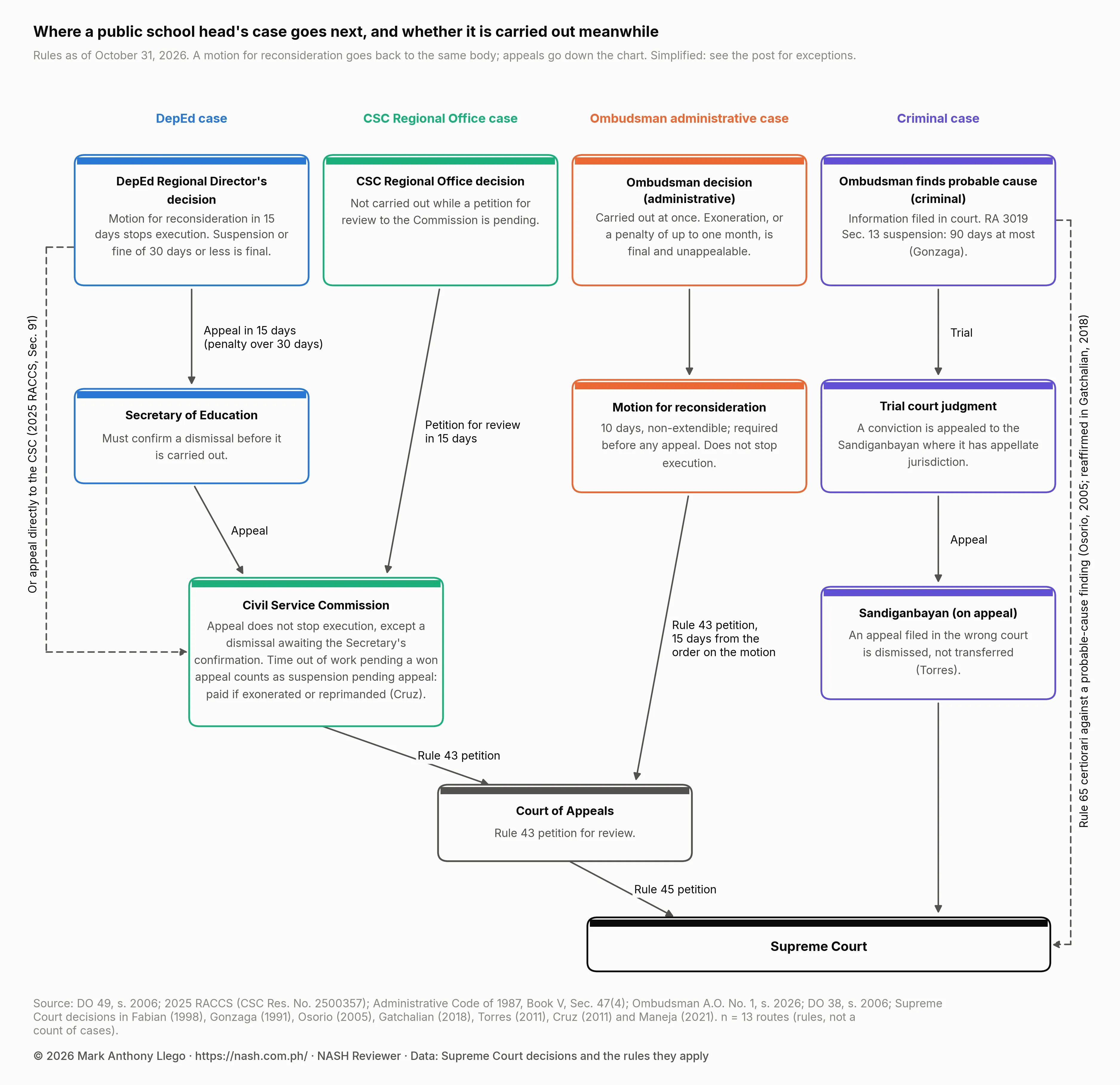
Inside DepEd (Figure 1):
- A motion for reconsideration within 15 days “shall stay the execution of the decision” (DO 49, Secs. 47 and 50; 2025 RACCS, Secs. 84 and 87).
- A suspension or fine of 30 days or less is final (DO 49, Sec. 46), though the 2025 RACCS allows an appeal on a due-process issue (Sec. 58).
- A larger penalty may be appealed to the Secretary within 15 days, then to the CSC. It is carried out pending appeal, except a dismissal, which waits for the Secretary’s confirmation (DO 49, Secs. 45 and 51; Administrative Code, Book V, Sec. 47(2); 2025 RACCS, Sec. 95). The 2025 RACCS, Sec. 91(a), adds that when a bureau or office head attached to a Department is appealed to the Secretary, “the decision will not be executory”; whether that covers a Regional Director’s decision has not been settled.
- The 2025 RACCS reads differently. Sec. 91 lets decisions of disciplining authorities be appealed “to the Commission” within 15 days, and for decisions of a bureau or office head attached to a department it offers either an appeal to the Department Head, during which the decision “will not be executory”, or a direct appeal to the CSC. Ask the division’s legal unit which route and which rule on execution apply.
- If the penalty is suspension or removal and the principal wins, “the respondent shall be considered as having been under preventive suspension during the pendency of the appeal” (DO 49, Sec. 54; Administrative Code, Book V, Sec. 47(4)). That period is paid if the principal is exonerated or only reprimanded (Cruz, applying Hon. Gloria v. CA).
- From the CSC, the route is a Rule 43 petition to the Court of Appeals (2025 RACCS, Sec. 99), then a Rule 45 petition to the Supreme Court, as in Cruz and Fuentes.
CSC Regional Office cases. A CSC Regional Office shares jurisdiction with DepEd (2025 RACCS, Sec. 9). Its decision goes to the Commission by petition for review within 15 days (Sec. 97) and, unlike an agency decision, is not carried out meanwhile (Sec. 95).
Criminal cases. In Torres v. People, G.R. No. 175074, August 31, 2011 (Third Division), a principal’s appeal from a malversation conviction, filed in the Court of Appeals instead of the Sandiganbayan, was dismissed, not transferred; see Can a Principal Be Jailed Over School Funds?. In Osorio v. Desierto, G.R. No. 156652, October 13, 2005 (Second Division), the Court said an Ombudsman finding of probable cause is challenged by certiorari in the Supreme Court; see Unauthorized School Fees: What Happens to the Principal? The Court reaffirmed that route in Gatchalian (2018), holding that it rests on the Court’s own rulings and upholding “the abovementioned established rules on appellate procedure”.
Gonzales v. Rosas (2004): the wrong remedy, filed too late
Gonzales v. Rosas, G.R. No. 145363, February 23, 2004 (Second Division; Quisumbing, J.).
Facts. Mercedes B. Gonzales, assistant principal of Caloocan Elementary School, Unit II, was charged in 1993 over the mortgage of another person’s land; the Court of Appeals acquitted her of estafa in 1997. Her administrative case was heard by one officer alone, “contrary to the provisions of Section 9” of RA 4670, and she was dismissed, later treated as resigned. Almost five years later she filed an Ombudsman complaint against the officials; it was dismissed, and she went to the Court of Appeals by certiorari.
Issue. Was certiorari the right remedy?
Ruling. No. Appeals from the Ombudsman in administrative cases go to the Court of Appeals under Rule 43, so certiorari “will not lie”, and she had missed the 15-day period. The Ombudsman properly dismissed a complaint filed years late (RA 6770, Sec. 20(5) lets it decline complaints filed more than a year after the act). Her remedy had been a court action to declare the administrative proceeding void.
Why it matters. The remedy and the deadline decide whether a case is heard at all, and a defect in how one’s own case was heard is raised in that case, or in court.
Later history. A.O. No. 1, s. 2026 keeps the Rule 43 route for a respondent who is suspended for more than a month or fined more than a month’s salary (Rule VIII, Sec. 8). Gonzales, though, was a complainant whose complaint had been dismissed, and like the 2003 rules, the 2026 rules call a decision that absolves the respondent “final, executory and unappealable” (Rule VIII, Sec. 8). A complainant in her position should ask a lawyer which remedy applies. The decision does not discuss whether her acquittal affected her separation; she never went to court to have the administrative proceeding declared void.
The hearing, the decision and the appeal steps inside DepEd are in Formal Investigation and Decision in DepEd Cases.
Ombudsman decisions: binding, carried out at once, appealed to the Court of Appeals
The power to penalize. In Office of the Ombudsman v. Madriaga, G.R. No. 164316, September 27, 2006 (Third Division), the Court held that the Ombudsman’s suspension of a San Juan principal and a teacher-canteen manager was not merely recommendatory but mandatory within the bounds of law, implemented through the proper officer; it did not rule on the charge; see Unauthorized School Fees. In Balbastro v. Junio, G.R. No. 154678, July 17, 2007 (Third Division), the Court held that the Ombudsman may impose removal directly and that a dismissed principal’s remedy was a Rule 43 appeal within 15 days, not certiorari filed 52 days after her motion was denied; see Dishonesty and Grave Misconduct.
Why the Court of Appeals. In Fabian v. Desierto, G.R. No. 129742, September 16, 1998 (En Banc; Regalado, J.), not a school case, the Court declared Sec. 27 invalid insofar as it sent these appeals to the Supreme Court, because it increased the Court’s appellate jurisdiction contrary to Article VI, Sec. 30 of the Constitution, and held that the appeals “should be taken to the Court of Appeals under the provisions of Rule 43.”
The rule now (A.O. No. 1, s. 2026, Rule VIII):
- A motion for reconsideration is due within a “non-extendible period of ten (10) days” (Sec. 7) and is “a condition sine qua non for availing of appellate remedies”; a Rule 43 petition follows within 15 days of the order resolving it (Sec. 8). RA 6770, Sec. 27 still says five days, so file early.
- “Where the respondent is absolved of the charge or where the penalty imposed is public censure or reprimand, suspension of not more than one month, or a fine equivalent to one month salary, the decision shall be final, executory and unappealable.” (Sec. 8)
- “The filing of a motion for reconsideration or an appeal shall not stay the immediate execution of the decision.” The agency head must implement it and report within 10 days (Sec. 8).
DepEd directs its offices, including school heads, to implement Ombudsman decisions “immediately upon receipt” (DO 38, s. 2006, para. 1): “Only a Temporary Restraining Order (TRO) or a Writ of Preliminary Injunction, duly issued by a court of competent jurisdiction, stays the immediate implementation” (para. 3).
A change in the text. The earlier rules (A.O. No. 07 as amended by A.O. No. 17, Rule III, Sec. 7) said a respondent who wins the appeal “shall be considered as having been under preventive suspension and shall be paid the salary and such other emoluments that he did not receive by reason of the suspension or removal.” A.O. No. 1, s. 2026 does not repeat that sentence in its section on implementing decisions (Rule VIII, Sec. 8). It does not name the earlier orders; it repeals “All other rules and regulations inconsistent herewith” (Rule X, Sec. 10) and applies to pending cases “insofar as practicable” (Rule X, Sec. 8). A principal who wins such an appeal should ask a lawyer how to claim pay. A.O. No. 1’s effective date is not yet known.
Who may appeal when a principal is exonerated
In Civil Service Commission v. Dacoycoy, G.R. No. 135805, April 29, 1999 (En Banc), the Court held that the CSC, as the party adversely affected, may appeal a Court of Appeals ruling that cleared a vocational school administrator of nepotism, abandoning earlier cases that barred such appeals. Justice Melo, joined by Justices Vitug and Quisumbing, dissented on that point, and Justice Romero dissented; see Promotion Protests and Nepotism: Cases on Principals.
Civil Service Commission v. Fuentes (2023): the rule as it stands
Civil Service Commission v. Fuentes, G.R. No. 237322, January 10, 2023 (En Banc; J. Lopez, J.).
Facts. The National Police Commission dismissed a police officer for grave misconduct over a fatal shooting; the CSC affirmed; the Court of Appeals reversed and dismissed the complaint. The CSC appealed.
Issue. May the CSC appeal a reversal of its own decision?
Ruling. To settle the issue “once and for all”, the Court held that “the Commission, generally has standing to bring an appeal before this Court as an aggrieved party in cases involving the reversal or modification of its decisions or resolutions.” The petition may be dismissed only if the other party clearly shows the CSC lacks standing, “such as when the decision will not seriously prejudice the civil service system”. The Court reinstated the dismissal. Chief Justice Gesmundo, concurring, would have made the CSC’s standing unqualified; Justice Singh also concurred.
Why it matters. A Court of Appeals exoneration in a case the CSC decided may still go to the Supreme Court.
A final exoneration stays final. In Department of Education v. Cuanan, G.R. No. 169013, December 16, 2008 (En Banc), the Court held that DepEd, as disciplining authority, may seek reconsideration of a principal’s exoneration, but that this one had already become final when DepEd sought reconsideration more than two months later, and that its pleadings, never served on him, should not have been considered; the CSC’s later dismissal could not stand; see Harassment, Child Abuse and Hazing: Cases on School Heads.
The rules now. Except in sexual harassment cases, an agency decision “which exonerates the respondent” cannot be appealed to the CSC (2025 RACCS, Sec. 98(a)), though the party adversely affected may move for reconsideration within 15 days (Sec. 84). An Ombudsman exoneration is “final, executory and unappealable” (A.O. No. 1, s. 2026, Rule VIII, Sec. 8). When the Court of Appeals reverses the CSC, Fuentes governs.
When is a principal entitled to back pay?
The starting point is “no work-no pay”, with an exception for employees “illegally dismissed or unjustly suspended” (Cruz).
Tan v. Gimenez (1960): exonerated on appeal
Tan v. Gimenez, G.R. No. L-12525, February 19, 1960 (Padilla, J.; division not stated).
Facts. Francisco A. Tan, head teacher of a barrio school in Caibiran, Leyte, was required to resign in 1949; in 1954 the Civil Service Board of Appeals reversed and acquitted him. Meanwhile he had worked as a provincial clerk.
Issue. Was he entitled to back salaries?
Ruling. Yes. His appeal had kept the removal from becoming final, so “his reinstatement became a ministerial duty of the proper authority; and the payment of back salary was merely incidental to reinstatement.” Under the Revised Administrative Code then in force, his clerk’s pay was deducted, and he was paid only up to the date he was offered reinstatement.
Why it matters. Pay runs to the offer of reinstatement. Today’s list of deductions (2025 RACCS, Sec. 103) does not mention earnings from other work.
Demotion is not reinstatement. In Austria v. Auditor General, G.R. No. L-21918, January 24, 1967 (no division stated), a principal demoted to classroom teacher for abuse of authority and vindictiveness claimed the principal’s salary for the years before his new appointment. The Court denied it: reinstatement meant return to the same position, and the lower post was his penalty; see Oppression Cases.
Cleared, so paid for forced leave. The 1980 Macabuhay resolution ordered Macabuhay paid for her forced leave without pay from October 1974 to August 1976, because once her case was dismissed she was “considered, for all legal purposes, not to have left her office”.
Civil Service Commission v. Cruz (2011): the two conditions
Civil Service Commission v. Cruz, G.R. No. 187858, August 9, 2011 (En Banc; Brion, J.).
Facts. Richard G. Cruz, a water district storekeeper, was charged with grave misconduct and dishonesty, preventively suspended for 15 days, and dismissed. The CSC cleared him of both charges, reprimanded him for failing to log in and out, and reinstated him without back salaries; the Court of Appeals awarded them.
Issue. Is an employee reprimanded for a different, lesser violation entitled to back salaries?
Ruling. Yes. The Court said that “the Court crafted two conditions before an employee may be entitled to back salaries: a) the employee must be found innocent of the charges and b) his suspension must be unjustified.” With complete exoneration, the second is subsumed in the first. With a lesser finding, the facts matter: “The employee found guilty of a lesser offense may only be entitled to back salaries when the offense actually committed does not carry the penalty of more than one month suspension or dismissal.” Cruz’s lapse was a different act and merited only a reprimand, so he was paid from dismissal to reinstatement, but “For the period of his preventive suspension pending investigation, the respondent is not entitled to any back salaries per our ruling in Hon. Gloria.”
Why it matters. Cruz separates the two kinds of preventive suspension: under E.O. 292, “compensation is due only for the period of preventive suspension pending appeal should the employee be ultimately exonerated”, and Cruz was paid for exactly that period. Read with the cases of teachers in the 1990 mass actions that it reviews: cleared of the act charged, or guilty only of a different lapse that merits no more than a reprimand, you are paid after dismissal; guilty of the same act and still suspended for more than a month, you are not; and preventive suspension pending investigation is not paid. The 2025 RACCS now pays anyone whose penalty is reduced to reprimand on appeal (Secs. 72(d) and 100(a)), and it does not pay a valid preventive suspension pending investigation (Sec. 39(b)).
Republic (DepEd) v. Maneja (2021): a dismissal carried out too early
Republic of the Philippines (Department of Education) v. Maneja, G.R. No. 209052, June 23, 2021 (Second Division; M. Lopez, J.).
Facts. Eulalia T. Maneja, a secondary school teacher in Cagayan de Oro City, was found guilty of dishonesty and dismissed by CSC Regional Office No. X. She appealed on time, but DepEd implemented her dismissal in December 2003. The CSC later found her liable only for simple dishonesty, imposed three months’ suspension, and awarded her salaries from December 2003 to her reinstatement, less the three months. DepEd challenged the award.
Issue. Is a teacher who was not fully exonerated entitled to backwages?
Ruling. Yes: “Premature execution of the decision ordering the employee’s dismissal from the service entitles the employee to the payment of backwages even though the employee is not fully exonerated on appeal.” The Court distinguished Cruz: there, heads of agencies decided and the dismissals were properly executed, whereas “decisions of the CSCROs imposing dismissal from the service are executory only when no motion for reconsideration or appeal is filed.” Maneja’s separation was “unjustified and without basis”.
Why it matters. DepEd lost. Before implementing a dismissal, confirm that it is executory; the 2025 RACCS now pays an employee whose dismissal is prematurely executed (Sec. 100(b)).
The back-pay rules as of October 31, 2026
Back wages are computed at the salary when separated, with later increases, “from the time of illegal termination up to actual reinstatement” (2025 RACCS, Sec. 102).
| Situation | Back pay? | Authority |
|---|---|---|
| Valid preventive suspension pending investigation, later cleared | No | Cruz; 2025 RACCS, Sec. 39(b) |
| Preventive suspension order declared invalid | Yes, for that period | 2025 RACCS, Secs. 39(a) and 100(c) |
| Preventive suspension past the limit, delay not the respondent’s | Yes, for the excess | 2025 RACCS, Sec. 39(a); Cruz (no pay where the delay is the respondent’s: Layug) |
| Suspension or dismissal carried out pending appeal, then exonerated or reprimanded (suspension pending appeal) | Yes, to actual reinstatement | Tan; Cruz; Administrative Code, Book V, Sec. 47(4); Secs. 72(d), 74 and 100(a) |
| CSC dismisses the case for a violation of due process | Yes, with reinstatement | 2025 RACCS, Sec. 96 |
| Guilty of a lesser offense on the same facts, suspension over one month | No | Cruz |
| Demoted as the penalty | No | Austria |
| Dismissal carried out before it was executory | Yes, even if not fully exonerated | Maneja; Sec. 100(b) |
| Convicted, pardoned and re-employed | No | Sabello (below) |
| Suspended under RA 3019, Sec. 13, then acquitted | Yes, unless administrative proceedings were filed meanwhile | RA 3019, Sec. 13 |
Penalties after retirement, resignation or a pardon
Retirement does not end the case. In Sevilla v. Gocon, G.R. No. 148445, February 16, 2004 (First Division), the Court found a Lucena principal liable for conduct grossly prejudicial to the best interest of the service, not dishonesty, and, because he had reached compulsory retirement while the case was pending, fined him six months’ salary instead of suspending him, deducted from his retirement benefits; see Promotion Protests and Nepotism. In Corpuz v. Cardoza, G.R. No. 253422, June 2, 2026 (Second Division; it may not yet be final), the Court likewise converted a principal’s six-month suspension into a fine if he had left the service; see Dishonesty and Grave Misconduct.
The rules now agree. For a respondent who “has already retired or otherwise separated from government service”, the disciplining authority “shall convert the suspension, regardless of its duration, to a fine, which in no case shall exceed an amount equivalent to six (6) months’ salary” (2025 RACCS, Sec. 66(a)(4)); the Ombudsman likewise converts such a suspension into a fine equal to the salary for the months of suspension, which may be deducted from retirement benefits, leave credits or other receivables (A.O. No. 1, s. 2026, Rule VI, Sec. 5).
Accessory penalties. Dismissal carries cancellation of eligibility, perpetual disqualification and forfeiture of retirement benefits, but not of terminal leave or personal GSIS contributions (2025 RACCS, Sec. 73(a)).
Pardon. In Sabello v. Department of Education, Culture and Sports, G.R. No. 87687, December 26, 1989 (First Division), an elementary school principal convicted under RA 3019 and later given an absolute pardon was re-employed only as a classroom teacher. The Court directed DECS to appoint him Elementary School Principal I or its equivalent but denied back wages, because a pardon restores eligibility, not automatic reinstatement, and his separation upon conviction was lawful; see Can a Principal Be Jailed Over School Funds?.
Administrative and criminal cases run separately
The outcome of one case does not settle the other: RA 3019, Sec. 13 pays an acquitted accused for the suspension only “unless in the meantime administrative proceedings have been filed against him”, and Cruz distinguishes an employee acquitted on a finding of innocence and then pardoned in the administrative case, who was paid back salaries, from one convicted and later pardoned, who was not. The broader rule is discussed in Promotion Protests and Nepotism.
What this means for school heads
If you are the respondent:
- Answer every formal charge on time and on the merits (Gaoiran), and attend every conference and hearing; staying away may waive the hearing (Balbastro v. COA; Balbastro v. Junio).
- Read the preventive suspension order: who signed it, the formal charge, and the stated risk to witnesses or evidence (2025 RACCS, Secs. 34 and 39(a)).
- Count the days, noting every postponement and who asked for it. On the 91st day without a decision, unless the delay is yours, you are reinstated (Sec. 37).
- Keep a deadline sheet of the 15-day and 10-day periods above; certiorari will not replace a missed appeal (Gonzales v. Rosas).
- Keep pay records, including the dates you were separated, offered reinstatement and reported back; after a won appeal, the time out of work is what is paid (Tan; Cruz).
If you supervise someone who is charged:
- You are not the disciplining authority. For teachers it is the Regional Director or the Secretary (DO 49, Sec. 1). Forward complaints; do not suspend anyone yourself.
- Implement orders as written, and an Ombudsman decision on receipt; only a court order stops it (DO 38, s. 2006).
- Before implementing a dismissal, confirm it is executory: a Regional Director’s dismissal needs the Secretary’s confirmation, and a CSC Regional Office dismissal waits for a timely appeal (DO 49, Sec. 51; 2025 RACCS, Sec. 95; Maneja).
- Keep records accurate and the case confidential; a pending case is not a finding of guilt.
Related guides: Human Resource Management for DepEd School Heads, PPSSH Domain 2: Managing School Operations and PPSSH Domain 4: Developing Self and Others.
How the NASH may test this
The two items below are original practice items, scored 3 (Relational), 2 (Multistructural), 1 (Unistructural) or 0 (Prestructural). An option that breaks a rule scores 0.
Question 1
Indicator 2.4.1, Management of staff. Career Stage 1, Situational, Moderate.
You are the principal of a national high school. The Regional Director formally charged Teacher R with grave misconduct and, in an order stating that she keeps the grade records the complainants will rely on, placed her under preventive suspension for 90 days. The 90 days have passed and the case has not been decided. The record sent to the school shows two hearings postponed at the complainants’ request and none at hers. Teacher R reports to school and asks to resume teaching. What is the most appropriate action?
- A. Tell her to stay home until the Regional Director issues a written order lifting the suspension, because only the authority that suspended her may end it.
- B. Let her resume teaching, because the 90-day period stated in the order has ended, and assign her back to her classes.
- C. Let her resume teaching, because DepEd’s rules reinstate a respondent automatically after 90 days, and report her return to the Schools Division Office.
- D. Let her resume teaching, because the 90 days have run and none of the delay is hers, so reinstatement is automatic; report her return in writing to the division and regional offices; and tell her the investigation continues.
Answer and explanation
Best answer: D. Points: A = 0, B = 1, C = 2, D = 3.
- A (0 points, Prestructural). Keeping her out breaks the rule: reinstatement after 90 days is automatic, and no lifting order is needed.
- B (1 point, Unistructural). Letting her return is right, but it rests only on the date and documents nothing.
- C (2 points, Multistructural). It applies the rule and reports the return, but does not check whether any delay was hers or tell her the case goes on.
- D (3 points, Relational). It links the limit, the delay rule and the record, acts, documents, and makes clear reinstatement is not exoneration.
Why. This aligns with Career Stage 1 expectations because indicator 2.4.1 asks the aspiring school head to know the rules on managing school staff. Reinstatement after 90 days of preventive suspension pending investigation is automatic, but delay due to the respondent’s “fault, negligence or petition” is not counted (2025 RACCS, Sec. 37; DO 49, s. 2006, Sec. 18; Administrative Code, Book V, Sec. 52). Reinstatement ends the suspension, not the case.
Indicator 2.4.1: Demonstrate knowledge and understanding of laws, policies, guidelines and issuances on managing school staff.
Sources: 2025 RACCS (CSC Resolution No. 2500357), Sec. 37; DepEd Order No. 49, s. 2006, Sec. 18; Administrative Code of 1987, Book V, Sec. 52.
Question 2
Indicator 4.7.1, General welfare of human resources. Career Stage 1, Conceptual, Moderate.
Teacher M was charged with grave misconduct for joining a walkout, preventively suspended for 90 days under a valid order, and then dismissed; the dismissal was carried out after the Secretary confirmed it. On appeal, the CSC found that she had not joined the walkout but had been absent that day without filing a leave application, imposed a reprimand, and ordered her reinstated. She asks you what pay she may claim. Which statement is most accurate?
- A. She may claim some back pay, because the penalty imposed on appeal is only a reprimand, and the regional office will compute the amount.
- B. She may claim nothing, because the CSC still found her guilty of an offense, and only a complete exoneration earns back pay.
- C. She may claim back pay from her dismissal to her reinstatement, because the offense found against her carries only a reprimand.
- D. She may claim back pay from her dismissal to her reinstatement, because the act charged was not proved and the offense found carries only a reprimand; the 90 days of suspension pending investigation are not paid unless the order is found invalid.
Answer and explanation
Best answer: D. Points: A = 1, B = 0, C = 2, D = 3.
- A (1 point, Unistructural). It names the reprimand as the reason but not the period covered.
- B (0 points, Prestructural). It contradicts the rule: a penalty downgraded to reprimand earns back wages.
- C (2 points, Multistructural). The period and basis are right, but it leaves out the 90 days of suspension pending investigation, which she would likely expect to be paid.
- D (3 points, Relational). It separates the unpaid suspension pending investigation from the time after her dismissal, which counts as suspension pending appeal and is paid because she ended with only a reprimand.
Why. This aligns with Career Stage 1 expectations because indicator 4.7.1 asks the aspiring school head to know the rules on the rights and benefits of school personnel. The time after a dismissal carried out during an appeal counts as preventive suspension pending appeal (Administrative Code, Book V, Sec. 47(4); DO 49, Sec. 54), and Civil Service Commission v. Cruz (2011) pays it when the employee is cleared of the act charged. The 2025 RACCS pays an employee “whose penalty is downgraded to reprimand” (Sec. 100(a)), but not a valid suspension pending investigation (Sec. 39(b)).
Indicator 4.7.1: Display knowledge of laws, policies, guidelines and issuances on the rights, privileges and benefits of school personnel to promote their general welfare.
Sources: Civil Service Commission v. Cruz, G.R. No. 187858, August 9, 2011; Administrative Code of 1987, Book V, Sec. 47(4); DepEd Order No. 49, s. 2006, Sec. 54; 2025 RACCS (CSC Resolution No. 2500357), Secs. 39, 72 and 100.
Nothing in this guide reproduces or predicts examination content.
Frequently asked questions
Can DepEd suspend a principal for more than 90 days before deciding the case?
No. Preventive suspension pending investigation lasts at most 90 days, not counting delay the principal causes, and then reinstatement is automatic (Administrative Code, Book V, Sec. 52; 2025 RACCS, Sec. 37). The Ombudsman may suspend for six months (RA 6770, Sec. 24), and a court for 90 days (Gonzaga, 1991).
Will I be paid for my preventive suspension if I am cleared?
Not for preventive suspension pending investigation, if the order was valid (Civil Service Commission v. Cruz, 2011; 2025 RACCS, Sec. 39(b)). You are paid if the CSC declares the order invalid, or for any excess beyond the limit that you did not cause (Sec. 39(a)). The time after a dismissal or suspension carried out during your appeal is different: it counts as preventive suspension pending appeal and is paid if you are exonerated or only reprimanded (Cruz; Administrative Code, Book V, Sec. 47(4)).
Does an appeal stop a DepEd decision from being carried out?
Usually not. A motion for reconsideration filed within 15 days stops execution (DO 49, Sec. 50), but an appeal does not, except that a dismissal waits for the Secretary’s confirmation (DO 49, Sec. 51; Administrative Code, Book V, Sec. 47(2); 2025 RACCS, Sec. 95). One point is open: the 2025 RACCS, Sec. 91(a), says an appeal to the Secretary from a bureau or office head attached to a Department means “the decision will not be executory”, and no rule or decision says whether a Regional Director’s decision falls under it. If you are then exonerated or only reprimanded, you are paid from separation to reinstatement (DO 49, Sec. 54; Tan v. Gimenez, 1960; CSC v. Cruz, 2011).
Can I stop an Ombudsman decision by moving for reconsideration?
No. A motion or appeal “shall not stay the immediate execution of the decision” (A.O. No. 1, s. 2026, Rule VIII, Sec. 8), DepEd implements it on receipt unless a court restrains it (DO 38, s. 2006), and the penalty binds DepEd (Office of the Ombudsman v. Madriaga, 2006). Your remedy is the motion within 10 days, then a Rule 43 petition within 15 days (Balbastro v. Junio, 2007).
What happens to my case if I retire before it is decided?
It continues. A suspension is converted into a fine of up to six months’ salary, which may come out of your retirement benefits (Sevilla v. Gocon, 2004; 2025 RACCS, Sec. 66(a)(4)). Dismissal would carry forfeiture of retirement benefits, though terminal leave and your personal GSIS contributions are kept (Sec. 73(a)).
Download the data
- suspension-appeal-routes.csv: the 13 routes in Figure 1, from a DepEd, CSC Regional Office, Ombudsman or criminal decision to the next body, with the remedy, deadline, effect on execution, pay if an appeal is won, and the rule or case for each.
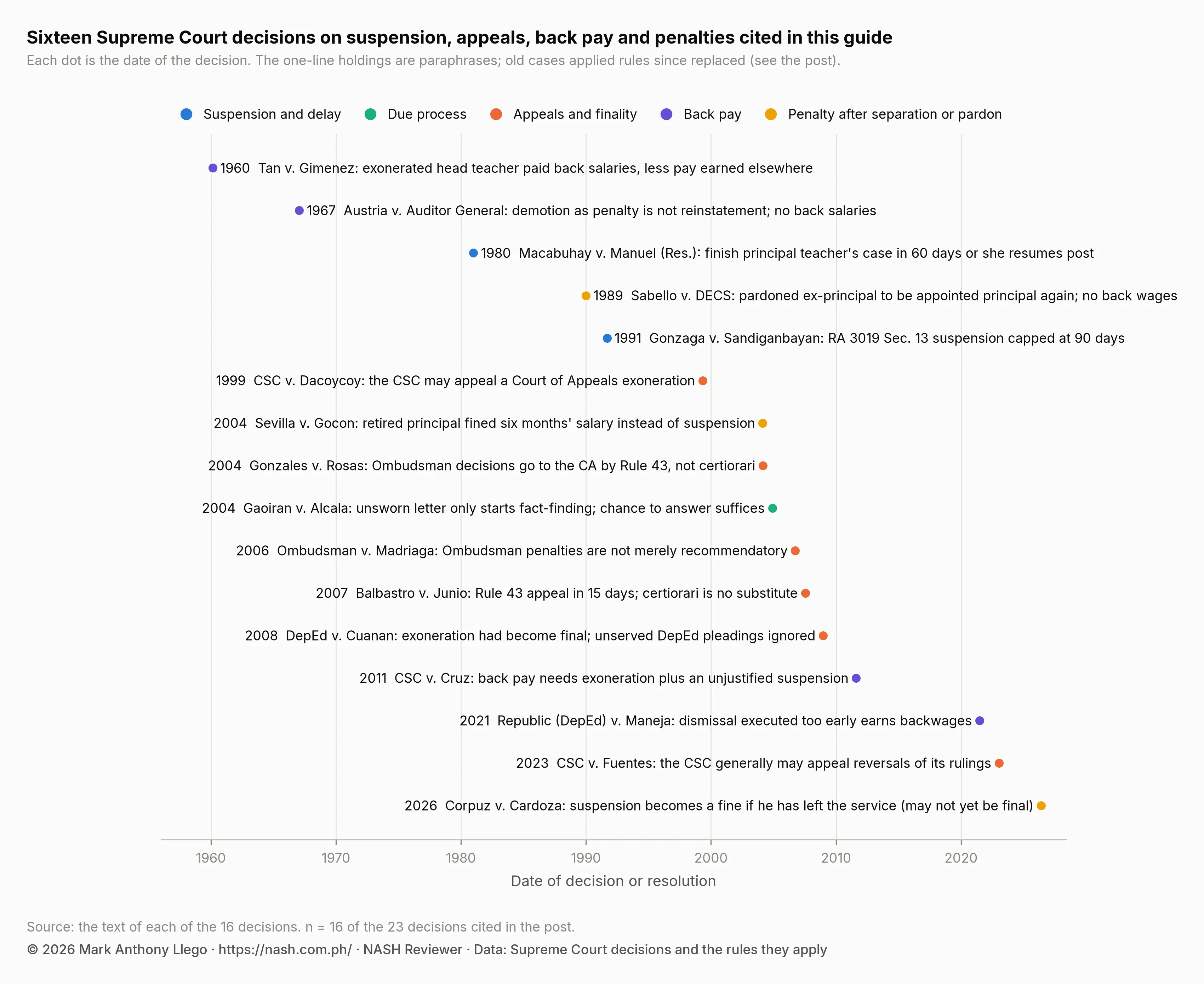
- suspension-case-timeline.csv: the 16 decisions in Figure 2, with date, G.R. number, court or ponente, a one-line paraphrase of the holding, topic and case-map code.
The CSVs and charts may be reused only with written permission: email support@nash.com.ph. The decisions themselves are public records of the Supreme Court, which you can cite directly.
Sources
Supreme Court decisions digested here
- Gonzaga v. Sandiganbayan, G.R. No. 96131, September 6, 1991 (En Banc).
- Macabuhay v. Manuel, G.R. No. L-40872, Resolution, December 29, 1980 (En Banc); with the decision in G.R. No. L-40872, December 5, 1978 (En Banc), and Macabuhay v. Manuel, G.R. No. L-38568, Resolution, July 31, 1974 (Second Division).
- Tan v. Gimenez, G.R. No. L-12525, February 19, 1960.
- Civil Service Commission v. Cruz, G.R. No. 187858, August 9, 2011 (En Banc).
- Republic of the Philippines (Department of Education) v. Maneja, G.R. No. 209052, June 23, 2021 (Second Division).
- Civil Service Commission v. Fuentes, G.R. No. 237322, January 10, 2023 (En Banc).
- Gonzales v. Rosas, G.R. No. 145363, February 23, 2004 (Second Division).
- Gaoiran v. Alcala, G.R. No. 150178, November 26, 2004 (Second Division).
- Fabian v. Desierto, G.R. No. 129742, September 16, 1998 (En Banc).
Supreme Court decisions cited, digested in other posts of the series
- Austria v. Auditor General, G.R. No. L-21918, January 24, 1967.
- Layug v. Quisumbing, G.R. No. 82272, February 7, 1990 (First Division).
- Sabello v. Department of Education, Culture and Sports, G.R. No. 87687, December 26, 1989 (First Division).
- Rubenecia v. Civil Service Commission, G.R. No. 115942, May 31, 1995 (En Banc).
- Civil Service Commission v. Dacoycoy, G.R. No. 135805, April 29, 1999 (En Banc).
- Sevilla v. Gocon, G.R. No. 148445, February 16, 2004 (First Division).
- Osorio v. Desierto, G.R. No. 156652, October 13, 2005 (Second Division).
- Office of the Ombudsman v. Madriaga, G.R. No. 164316, September 27, 2006 (Third Division).
- Balbastro v. Junio, G.R. No. 154678, July 17, 2007 (Third Division).
- Balbastro v. Commission on Audit, Regional Office No. VI, G.R. No. 171481, June 30, 2008 (En Banc).
- Department of Education v. Cuanan, G.R. No. 169013, December 16, 2008 (En Banc).
- Torres v. People, G.R. No. 175074, August 31, 2011 (Third Division).
- Corpuz v. Cardoza, G.R. No. 253422, June 2, 2026 (Second Division).
Other Supreme Court decisions cited
- Gatchalian v. Office of the Ombudsman, G.R. No. 229288, August 1, 2018 (Second Division).
Laws and rules
- Executive Order No. 292, Administrative Code of 1987, Book V, Title I, Subtitle A, Secs. 47(4), 51 and 52.
- Republic Act No. 3019, Anti-Graft and Corrupt Practices Act, Sec. 13, as amended by Batas Pambansa Blg. 195, Sec. 5.
- Republic Act No. 6770, The Ombudsman Act of 1989, Secs. 20, 24 and 27.
- 2025 Rules on Administrative Cases in the Civil Service, CSC Resolution No. 2500357, promulgated April 30, 2025, in force August 4, 2025, Secs. 9, 32, 34, 36–40, 57, 58, 66, 72–74, 84, 87, 91, 95–100, 102 and 103.
- DepEd Order No. 49, s. 2006, Revised Rules of Procedure of the Department of Education in Administrative Cases, December 12, 2006, Secs. 1, 15–19, 42, 45–47, 50, 51 and 54–57.
- DepEd Order No. 38, s. 2006, Immediate Implementation of Decisions, Orders or Resolutions Issued by the Office of the Ombudsman in Administrative Disciplinary Cases, August 29, 2006, paras. 1–3.
- Office of the Ombudsman, Administrative Order No. 1, s. 2026, Revised Rules of Procedure of the Office of the Ombudsman, signed January 19, 2026, Rule VI, Secs. 3 and 5; Rule VIII, Secs. 7–8; Rule X, Secs. 8, 10 and 11.
- Office of the Ombudsman, Administrative Order No. 07 (Rules of Procedure), as amended by Administrative Order No. 17 (September 7, 2003), Rule III, Sec. 7, revised by A.O. No. 1, s. 2026.
This guide explains Supreme Court decisions for study and professional awareness. It is not legal advice; for a specific case, consult a lawyer or your Schools Division Office’s legal unit.
The Supreme Court cases series
- Supreme Court Cases on School Heads: A Guide for Principals
- Can the Ombudsman Discipline a Principal? RA 4670 Cases
- Can a Principal Be Reassigned to Another School?
- Promotion Protests and Nepotism: Cases on Principals
- Unauthorized School Fees: What Happens to the Principal?
- Can a Principal Be Jailed Over School Funds?
- Dishonesty and Grave Misconduct: Cases on Principals
- Oppression Cases: How Principals Must Treat Teachers
- Harassment, Child Abuse and Hazing: Cases on School Heads
- Is a Principal Liable When a Pupil Is Injured?
- Can a Private School Remove Its Principal?
- Preventive Suspension, Appeals and Back Pay for Principals (this post)
Written by Mark Anthony Llego for NASH Reviewer. Sources: Supreme Court decisions (E-Library and Lawphil); RA 3019; RA 6770; 2025 RACCS; DepEd Orders No. 38 and 49, s. 2006; Ombudsman A.O. No. 1, s. 2026. Charts may be reused only with written permission from support@nash.com.ph.