Yes. A public school principal whose appointment paper names no particular school may be reassigned to another school in the exigency of the service, even without consent. The leading case is Yangson v. Department of Education, G.R. No. 200170, June 3, 2019 (Third Division). There the Supreme Court held that the consent rule in Section 6 of the Magna Carta for Public School Teachers, Republic Act No. 4670, “applies to transfers, not reassignments”. A transfer needs a new appointment; a reassignment does not.
The rule has limits. A reassignment must be made in the interest of the service, with no cut in rank, status or salary, and it must not amount to constructive dismissal. If the appointment does name the school, the reassignment may last no more than one year. Officer-in-charge (OIC), teacher-in-charge and acting designations are a different matter: they give no security of tenure at all (Tapispisan v. Court of Appeals, G.R. No. 157950, June 8, 2005 (En Banc); Arquero v. Court of Appeals, G.R. No. 168053, September 21, 2011 (Third Division)).
The rules below are stated as of October 31, 2026. Since August 3, 2025, reassignment has been governed by the Civil Service Commission’s 2025 Omnibus Rules on Appointments and Other Human Resource Actions (the 2025 ORAOHRA). Your own appointment paper decides, not DepEd Order No. 42, s. 2007, which is no longer safe to cite.
Key findings
- Tenure is in the position, not the school. Brillantes v. Guevarra (1969, En Banc), and DECS v. Court of Appeals (Navarro) (1990) after it, held that a principal whose appointment named no school could be moved “even without her consent”.
- RA 4670’s consent rule covers transfers only. Yangson v. DepEd (2019) held that Section 6 reaches only transfers, which involve another appointment; a reassignment does not.
- The appointment paper decides. Under Yangson (2019), an appointment is station-specific only if the paper names the station on its face or the position title specifies it. The 2025 ORAOHRA uses the same test.
- Constructive dismissal must be proved. Yangson (2019) held that it is “never presumed”; a smaller school at the same rank and pay was not a demotion there or in Brillantes (1969).
- Appeal within 15 days, not to court first. In Navarro (1990), a principal who sued without first appealing to the Civil Service Commission (CSC) was “without cause of action”. Republic v. Pacheo (2012, En Banc) held that a reassignment “does not become immediately effective” pending appeal; no case has yet applied it to a school head.
- Designations give no tenure. Tapispisan (2005, En Banc): OIC designations cannot be protested and confer no security of tenure. Arquero (2011): a principal whose OIC designation was withdrawn kept her principalship, not the OIC post.
Reassignment, transfer, detail and designation: the differences
The first question is whether a new appointment is issued, because that decides whether RA 4670’s consent rule applies. A transfer is a movement to another position “involving the issuance of a new appointment” (2025 ORAOHRA, Sec. 11(c)); a reassignment, a detail and a designation need only an Office Order (Sec. 13).
| Action | New appointment? | Your consent needed? | How long | Appeal, and effect while it is pending | Sources |
|---|---|---|---|---|---|
| Transfer to another position | Yes | Yes, for a teacher, “Except for cause” | Not time-limited; you take a new position | Appeal; the transfer “shall be held in abeyance” meanwhile | RA 4670, Sec. 6; 2025 ORAOHRA, Sec. 11(c) |
| Reassignment to another school or unit in DepEd | No; an Office Order | No, if the appointment names no station; undecided if it names one | One year at most if station-specific; otherwise no limit | 15 days, through DepEd’s grievance mechanism, then the CSC Regional Office; not executory pending appeal under item 4 and Pacheo (2012), though no case has applied this to a school head | 2025 ORAOHRA, Sec. 13(a); Brillantes; Navarro; Yangson; Pacheo |
| Detail to another department or agency | No; an Office Order | No; but without consent it may last one year only | One year without consent, not renewable; up to three years with consent | 15 days, to the CSC; executory unless the CSC orders otherwise | 2025 ORAOHRA, Sec. 13(b) |
| Designation as OIC, teacher-in-charge or acting head | No; an Office Order | Not addressed; no tenure, and no protest | Ends at the pleasure of the appointing authority; for a vacant position, one year at most, renewable twice (rule 5) | 15 days, to the CSC Regional Office; “Pending appeal, the designation order shall be executory” | 2025 ORAOHRA, Sec. 13(c); Tapispisan; Arquero |
| Reassignment in lieu of preventive suspension | No | Not required | The suspension period: 90 days for national agencies | 15 days, to the Commission; “Pending appeal, the order shall be executory” | 2025 RACCS, Secs. 36 to 38; DO 49, s. 2006, Sec. 17 |
A principal is a “teacher” under RA 4670. Section 2 includes “all other persons performing supervisory and/or administrative functions” in public schools, which is why the principals in Navarro and Yangson invoked Section 6.
The 2025 ORAOHRA sends teachers to their own laws first. Item 5 of Sec. 13(a) says the reassignment of “public school teachers” is “governed by their respective laws”, with the CSC’s rules “applied suppletorily”. Since RA 4670’s Section 6 covers only transfers, not reassignments (Yangson), it follows that the CSC’s rules fill the gap for school heads, including item 4’s rule that a reassignment is not executory pending appeal, though no case has yet decided this (see Remedies).
What the Court has decided when a principal fought to keep a post
In the five decisions below in which a principal sought to keep a school or an OIC post, the Court never ruled on the merits that the principal could keep it.
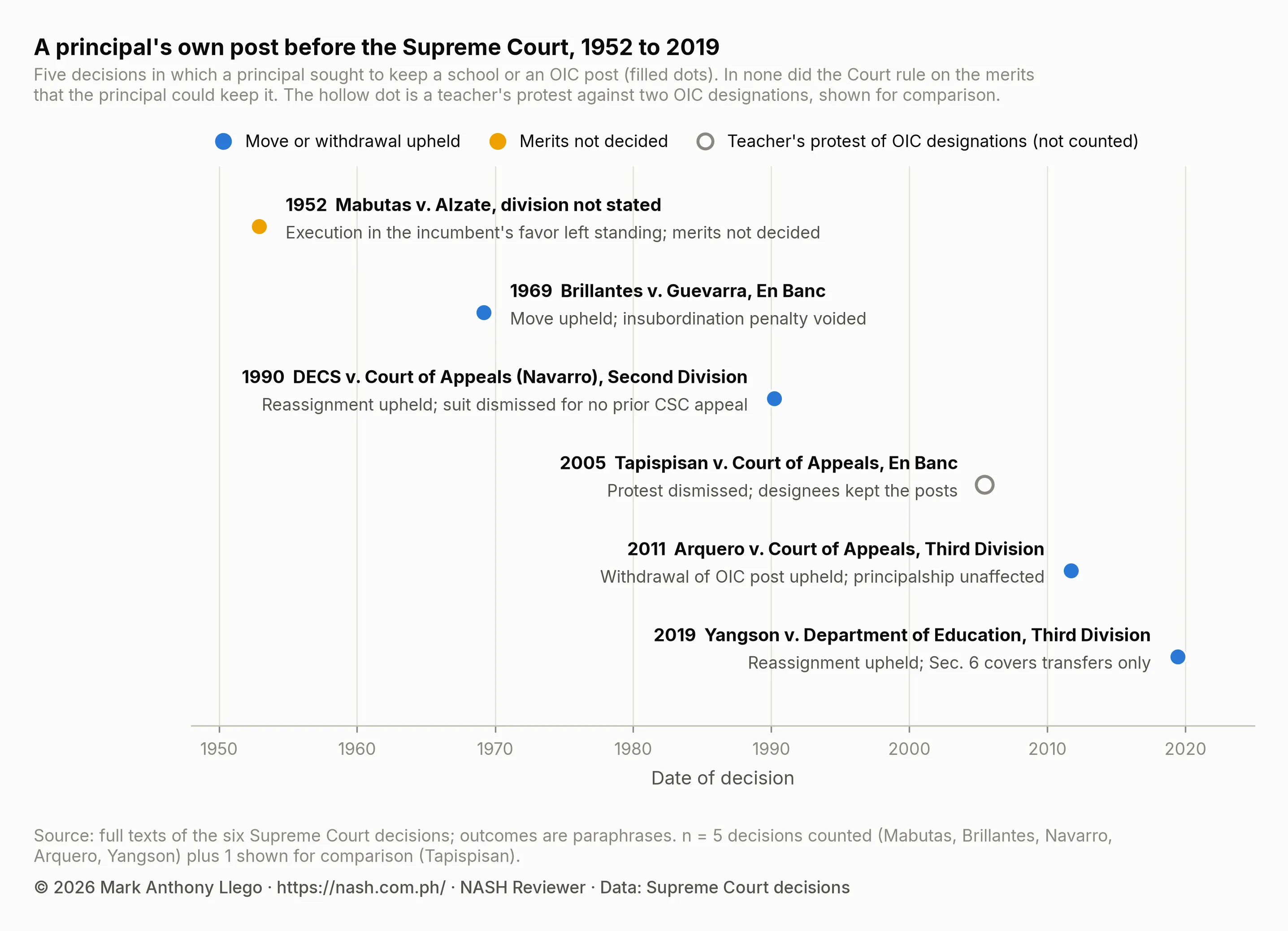
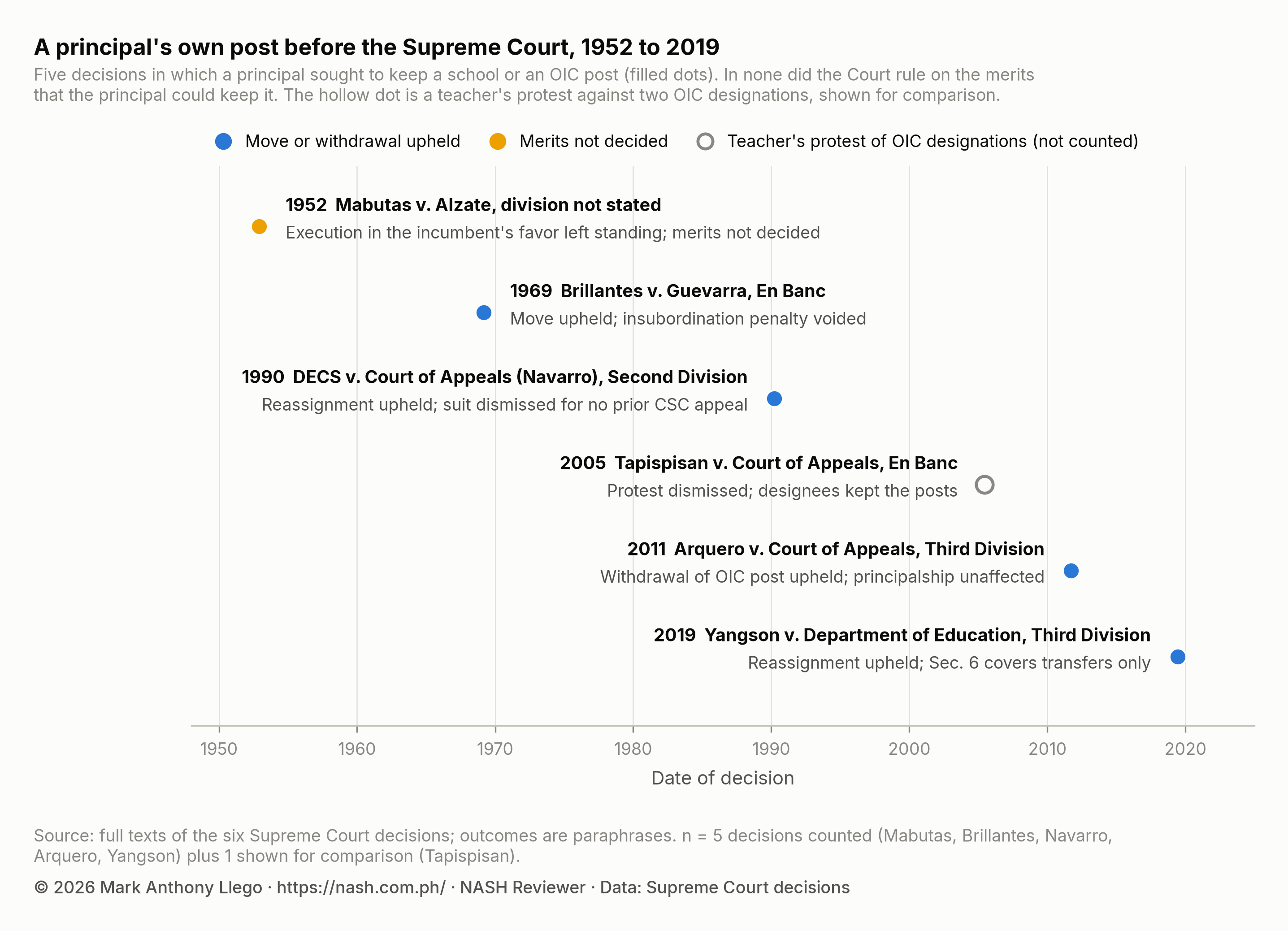
Mabutas (1952) settled only who held the school during the appeal, and Brillantes (1969) voided only a penalty; both are explained below.
Tenure in the position, not the station: Brillantes and Navarro
Brillantes v. Guevarra (1969)
Brillantes v. Guevarra, G.R. No. L-22586, February 27, 1969 (En Banc), written by Justice Sanchez for a unanimous Court.
Facts. Juliana Brillantes held a permanent appointment, effective July 1, 1952, as “Principal (Elementary School) in the Bureau of Public Schools, Department of Education”. It named no school. She had headed Sinalang Elementary School in Bangued, Abra, since 1951; it later became a division pilot school. In 1963, under a 1962 Department directive to move principals after five years in one station, the Division Superintendent gave all of Abra’s elementary principals new stations. She was sent to Peñarrubia Elementary School (13 teachers to Sinalang’s 23), sued, and did not report. While her appeal was pending, the Commissioner of Civil Service dismissed her for insubordination, then reduced the penalty to 10 months’ suspension.
Issues. Was the move a removal or a demotion? Could the penalty stand?
Ruling. Her tenure attached to the position, not to Sinalang: “She cannot therefore claim security of tenure as Principal of Sinalang Elementary School or any particular station. She may be assigned to any station as exigency of public service requires, even without her consent.” There was no demotion: she remained a Principal I, and the smaller school belonged to the same classification. The reason given, that “her efficiency and her experience as Principal in a pilot school would spur the improvement of small schools”, met the exigency of the service.
The Court nonetheless voided the suspension: with her case pending in court and no injunction, “school authorities should be cautious in charging” insubordination, and she acted in good faith. Of her belief that obeying would jeopardize her appeal, it said: “This is, of course, a mistake. But again, it is quite understandable.”
Why it matters. Brillantes applied to principals the rule, already stated in Miclat (1960), that tenure protects the position, not a school. It did not make refusing to report a right.
Later history. The 1963 move predates RA 4670, approved June 18, 1966, which the Court noted now requires notice, reasons and abeyance pending appeal for transfers. Do not read Brillantes as holding that Section 6 lets DepEd transfer principals without consent. Its rule survives: Navarro (1990) held Section 6 inapplicable to a principal not appointed to a particular station, and Yangson (2019) added that Section 6 covers only transfers, which need a new appointment.
DECS v. Court of Appeals (Navarro) (1990)
Department of Education, Culture and Sports v. Court of Appeals, G.R. No. 81032, March 22, 1990 (Second Division), written by Justice Paras, with Justice Melencio-Herrera taking no part. It is called Navarro here, after the principal.
Facts. Gloria Navarro was appointed on January 1, 1981 as “Secondary School Principal II in the Division of City Schools, District II, Quezon City”. It named no school. After ten years as principal of Carlos Albert High School, she was caught in a 1982 reshuffle of all Quezon City high school principals, who had stayed in one station for more than five years. She was reassigned to Manuel Roxas High School with no cut in rank or salary and refused, invoking RA 4670. The Regional Director and the Minister upheld the move. Without appealing to the CSC, she went to the Regional Trial Court; the Court of Appeals later ruled for her.
Issue. Was the reassignment valid?
Ruling. Section 6 “finds no application in the case at bar as this is predicated upon the theory that the teacher concerned is appointed — not merely assigned — to a particular station.” The Court continued: “The appointment of Navarro as principal does not refer to any particular station or school. As such, she could be assigned to any station and she is not entitled to stay permanently at any specific school.” Had she been meant to stay at Carlos Albert, “her appointment would have so stated.” After ten years, “She was ripe for reassignment”. Finally: “By not appealing her case to the Civil Service Commission before filing Special Civil Action No. Q-37025, respondent Navarro is indubitably without cause of action.” The Court set aside the Court of Appeals’ decision and dismissed her case.
Why it matters. Your appointment paper, not your years in one school, decides whether you can be moved, and a challenge goes through the civil service before the courts. Later history. Yangson (2019) quoted and followed Navarro.
Where the old removal rule came from: Mabutas, Miclat and Sta. Maria
Earlier cases treated an unconsented transfer of a public officer as a removal; Miclat (1960) confined that rule, and three decisions show how far it reaches.
Mabutas v. Alzate (1952)
Mabutas v. Alzate, G.R. No. L-5556, November 26, 1952 (division not stated), written by Justice Labrador.
Facts. Anacleto Alzate was appointed regular principal of Agoo South Provincial High School, La Union, in 1948. In 1951 the Director of Public Schools sent Ramon Mabutas to head it and transferred Alzate to Tagudin High School. Alzate refused to leave, calling it a demotion, and sued in quo warranto. The trial court upheld Alzate’s permanent appointment to that school and ordered execution pending appeal. Issue. Was immediate execution a grave abuse of discretion? Ruling. No: “the spectacle presented by two officials holding only one position, each claiming to be the rightful principal as against the other” justified it. It ruled “Without going into the merits of the case”, leaving those to “the appeal in the main case”. Why it matters. Mabutas decided only who ran the school during the appeal, not whether a principal can be moved. Later history. In Miclat (1960), the trial court cited a Court of Appeals decision titled “Alzate vs. Mabutas” for the view that moving a principal without consent is a removal. Alzate v. Aldana, G.R. No. L-14407, February 29, 1960, a salary case, still describes Alzate as “Principal of the South Provincial High School in Agoo”. As the trial court found, his appointment named that school: the situation the station-specific rule protects.
Miclat v. Ganaden (1960)
Miclat v. Ganaden, G.R. No. L-14459, May 30, 1960 (division not stated), written by Justice Bautista Angelo. It is not a school case.
Facts. Agrinelda Miclat, a welfare officer assigned to Mountain Province, was relieved; the trial court restored her, likening her to a school principal who could not be moved without consent. Issue. Was her relief a removal? Ruling. The Court reversed. The removal rule “is predicated upon the theory that said officers are appointed to particular stations and as such cannot be transferred without their consent.” Her appointment named no station, so “she may be reassigned to another place or station if such is necessary in the interest of the service.” Why it matters. Brillantes cites Miclat; since 1960 the protection against unconsented moves depends on an appointment to a particular station.
Sta. Maria v. Lopez (1970)
Sta. Maria v. Lopez, G.R. No. L-30773, February 18, 1970 (division not stated), also written by Justice Sanchez. Justices Castro and Fernando concurred in separate opinions. Justice Barredo, joined by Justice Villamor, concurred and dissented: he agreed the transfer was void but had reservations about returning the dean to the college at once.
Facts. Felixberto Sta. Maria was appointed “Dean, College of Education, University of the Philippines” for a five-year term; in 1969, amid student demands, he was moved to the President’s office. Issue. Was the move a removal? Ruling. Yes; the Court set it aside and ordered him restored. “His appointment is to a specific position; and, more importantly, to a specific station.” It added: “But a college dean holding an appointment with a fixed term stands on a different plane. He cannot, without his consent, be transferred before the end of his term.” The transfer was “in fact a removal”, made without due process. The opinion drew the contrast with Brillantes: “Thus, one who is appointed ‘principal in the Bureau of Public Schools’ and is designated to head a pilot school may be transferred to the post of principal of another school.” Why it matters. Station-specific protection needs an appointment to a named post at a named unit, which a principal’s appointment naming only a division does not give.
RA 4670 Section 6 covers transfers only: Yangson v. DepEd (2019)
Yangson v. Department of Education, G.R. No. 200170, June 3, 2019 (Third Division), written by Justice Leonen, with Justices Peralta (Chairperson), Hernando and Inting concurring. There were no separate opinions.
Facts. Marilyn Yangson was Principal III of Surigao Norte National High School. A memorandum served on April 30, 2008 reassigned her, “In the exigency of the service”, to the smaller Toledo S. Pantilo Memorial National High School. DepEd said it was part of a reshuffle of all school heads in the division under DECS Order No. 7, s. 1999. She alleged that only three principals were shuffled, after earlier attempts to remove her. She would supervise 31 personnel instead of 165, and she cited her record, including a Most Outstanding Principal award. DepEd’s regional and central offices upheld the move; the CSC voided it, finding that the new school was in another division, so her consent was needed; the Court of Appeals reinstated it.
Issues and ruling. The Court took six issues and denied her petition on every one.
- Not station-specific. “An appointment is station-specific if the employee’s appointment paper specifically indicates on its face the particular office or station the position is located.” Alternatively, “the station should already be specified in the position title, even if the place of assignment is not indicated on the face of the appointment.” DepEd alleged, and she did not deny, that she was appointed “Principal III of [the Department of Education] Division of Surigao del Norte”. That her papers named the retiring principal she replaced did not help her; the argument was “untenable”.
- Section 6 does not apply. “The text of the law is clear and unequivocal: Section 6 applies to transfers, not reassignments.” The difference: “a transfer involves the issuance of another appointment, while a reassignment does not.”
- No violation of tenure. Following Brillantes and Navarro: “Because she holds no vested right to remain as Principal III of Surigao National, her security of tenure was not violated.”
- Exigency shown. Reassignments are presumed “regular and made in the interest of public service”, and “The party questioning its regularity or asserting bad faith carries the burden to prove his or her allegations.” The Court could not conclude “that petitioner was reassigned by whim, fancy, or spite”.
- No demotion or constructive dismissal. The Court held that “demotion and constructive dismissal are never presumed and must be sufficiently proven.” She stayed a Principal III with the same rank, status, salary and duties, at a school “within her area of appointment”. The Court called the smaller-school argument “specious”; Brillantes had rejected the same argument.
- No time limit. “When an employee’s appointment is station-specific, his or her reassignment may not exceed a maximum period of one (1) year. This is not the case for appointments that are not station-specific.” Hers “may be indefinite and exceed one (1) year”.
In obiter, the Court said it was “aghast that grammatical errors pervade the Memorandum” that reassigned her.
Why it matters. Yangson is the modern rule: Section 6 protects against transfers only, the paper decides, and the principal must prove bad faith or constructive dismissal. It did not address her argument that the move should not be implemented pending appeal.
Later history. The 2025 ORAOHRA cites Yangson for the rule that “A claim of constructive dismissal must be sufficiently established” (Sec. 13(a), item 3, footnote 74). The 2017 Omnibus Rules (revised 2018) that Yangson cited were repealed by the 2025 ORAOHRA (Sec. 145), which carries the same tests forward. House Bill No. 8759 (20th Congress, filed March 24, 2026) would amend Section 6 to require consent “IN WRITING” and notice “AT LEAST 60 DAYS BEFORE SAID TRANSFER”; as filed, it still speaks of transfers, and it is a bill, not law.
A note on Azarcon (2008)
Superintendent of City Schools for Manila v. Azarcon, G.R. No. 166435, February 11, 2008 (First Division), written by Justice Corona, is a teachers’ case with two principals among the petitioners. Facts. Two Manila teachers, whose dismissal the CSC had reduced to a six-month suspension, sought reinstatement at their old school, which had no vacancy; the Superintendent placed them in two schools that lacked teachers. Issue. Was that valid? Ruling. Yes; it was “correct, commonsensical, valid and constitutional”, because “The accessibility of quality education determines the exigencies of the service.” The Court decided the case by applying four requisites it drew from Section 6: “For a transfer or reassignment of a public school teacher to be valid”, the move must be for the exigency of the service, the superintendent must notify the teacher beforehand and give the reasons, and it must not be made three months before an election.
How it fits with Yangson. The Court of Appeals in Yangson cited Azarcon for the view that Section 6 covers reassignments too. The Supreme Court held that Section 6 covers transfers only, and mentioned Azarcon only in a footnote describing the Court of Appeals’ ruling. Both are Division decisions, both upheld the move, and no En Banc decision has reconciled them. Yangson decides the transfer-or-reassignment question directly; Azarcon applied Section 6’s requisites to teachers’ reinstatement without analyzing it. A safe order meets both: it states the exigency and the reasons, is served in advance, is not issued within three months before an election, keeps your rank, status and salary, stays within your area of appointment, and is not a constructive dismissal.
Is your appointment station-specific? How to check
Get a copy of your appointment from your 201 file and apply the two tests that Yangson and the 2025 ORAOHRA share.
- Does the paper name a particular school or office? An appointment is station-specific when “the particular office or station where the position is located is specifically indicated on the appointment paper” (2025 ORAOHRA, Sec. 13(a), item 1).
- Does the position title name the station? The ORAOHRA’s examples include Human Resource Management Officer, Accountant and Budget Officer, titles “considered station-specific even if the place of assignment is not indicated on the appointment paper”. A title such as School Principal II names no school.
The appointment form should show it: “For station-specific appointments, the name of office or department or unit shall be indicated” (2025 ORAOHRA, Sec. 7(a), item 4).
If your appointment does name the school, no Supreme Court case has decided whether Section 6’s consent rule applies to a reassignment. Navarro tied Section 6 to appointment to a particular station; Yangson tied it to a new appointment. The ORAOHRA allows such a reassignment for one year at most.
What does not make an appointment station-specific:
- Naming the person you replaced (Yangson).
- Long service in one school. Navarro had ten years at Carlos Albert; if she was meant to stay, “her appointment would have so stated.”
- A designation to head a special school. Brillantes had been designated principal of the pilot school; the appointment that counted named only the Bureau.
- Informative entries on the form. In Orcino v. Civil Service Commission, G.R. No. 92869, October 18, 1990 (En Banc), a teacher’s case digested in Oppression Cases, entries recording where she would be assigned were “merely informative”.
Why DO 42, s. 2007 is no longer safe to cite. DepEd Order No. 42, s. 2007 said: “The appointment of a school principal shall be non-station specific.” DepEd Order No. 007, s. 2023 lists DO 42 among issuances that, where “inconsistent with this Order and its provisions, are repealed, rescinded, or amended accordingly” (para. 4(g)), and DO 007, as amended by DO 021, s. 2024, says nothing about stations. Whether DO 42’s sentence survives is uncertain, so do not cite it; the Court looks at the appointment paper itself.
When a reassignment is constructive dismissal
A reassignment that keeps rank and pay can still be a disguised dismissal. Yangson said constructive dismissal occurs “whether or not there is diminution in rank, status, or salary if the employee’s environment has rendered it impossible for him or her to stay in his or her work.” Its signs include:
- a move to “a more servile or menial job”;
- a move “to an office not in the existing organizational structure”, or without “a definite set of duties and responsibilities”;
- a move meant “to harass or oppress the employee on the pretext of promoting public interest”, which “may be inferred from reassignments done twice within a year, or during a change of administration of elective and appointive officials.”
The 2025 ORAOHRA, Sec. 13(a), item 3 lists the same kinds, including a reassignment causing “significant financial dislocation” or hardship “because of geographic location” (also named in Yangson’s definition), and closes with “Other analogous instances or situations.” A reassignment not made in the interest or exigency of public service, or one that constitutes constructive dismissal, “shall be invalid”.
The burden is on you. Constructive dismissal is “never presumed and must be sufficiently proven” (Yangson), and a smaller school alone was not a demotion in Brillantes or a constructive dismissal in Yangson.
What “exigency” means now. The cases accepted routine reshuffles as an exigency; the 2025 ORAOHRA defines it as “a situation where service is urgently needed and where any delay in its execution and delivery will adversely affect the outcome of the service to clients” (Sec. 13(a), footnote 72), so it is reasonable to ask that an order state the exigency it relies on.
How long a reassignment may last
- Station-specific: one year at most. The reassignment “shall be allowed only for a maximum period of one (1) year”, after which the employee “must automatically return to his or her original post/assignment” (2025 ORAOHRA, Sec. 13(a), item 1).
- Not station-specific: no fixed limit. The one-year maximum “shall not apply”, but you “may request for a recall of the reassignment citing reasons for his or her return to his or her original station” (item 2). Yangson agrees: such a reassignment “may be indefinite”.
- Not just before an election. “No detail or reassignment shall be made within three (3) months before any election unless with the permission of the COMELEC” (2025 ORAOHRA, Sec. 124). For transfers, RA 4670, Sec. 6 says “no transfers whatever shall be made three months before any local or national election.”
- Reassignment in lieu of preventive suspension is a disciplinary measure bounded by the suspension period (table above); see Preventive Suspension, Appeals and Back Pay for Principals.
OIC and teacher-in-charge designations give no tenure
A designation adds duties to a person who keeps his or her own position and “can be terminated anytime at the pleasure of the appointing officer or authority” (2025 ORAOHRA, Sec. 13(c)); see also Principal, Head Teacher and Teacher-in-Charge.
Tapispisan v. Court of Appeals (2005)
Tapispisan v. Court of Appeals, G.R. No. 157950, June 8, 2005 (En Banc), written by Justice Callejo, Sr.; Justice Puno was on leave and Justice Garcia took no part.
Facts. In 1995 the Pasay City Schools Division Superintendent designated Aida Rumbaoa, a Head Teacher III, as OIC-Head Teacher of one school and Myrna Teves, a Master Teacher II, as OIC-Principal of another. Librada Tapispisan, a Teacher III, protested that she was better qualified and that the designations broke the election-period ban on transfers; DECS, the CSC and the Court of Appeals dismissed her protest.
Issues. Can a designation be protested? Was it a prohibited transfer?
Ruling. No on both. The Court gave “great weight and respect” to the CSC’s ruling that “only appointments/promotions and not designation can be the subject of a protest”. The designations “merely imposed on them additional duties on top of those corresponding to their incumbent positions”. The Court held: “Such designation did not confer upon them security of tenure in the positions which they occupy in ‘acting’ capacity.” Nor was it a transfer: “The designation of respondents Rumbaoa and Teves did not involve a movement from one position to another.” Even if a protest could lie, the designations were within the officials’ prerogative.
Why it matters. A designation can be neither defended nor challenged by protest. For appointment protests, see Promotion Protests and Nepotism.
Later history. Today only a “qualified next-in-rank” employee may protest an appointment, and only for lack of minimum qualifications (2025 RACCS, Sec. 116).
Arquero v. Court of Appeals (2011)
Arquero v. Court of Appeals, G.R. No. 168053, September 21, 2011 (Third Division), written by Justice Peralta.
Facts. RA 6765 integrated several Palawan high schools with Palawan National School (PNS), under a superintendent who was never appointed. Rebecca Arquero, the permanent PNS principal, was designated OIC of the integrated schools in 1993; the designation was withdrawn in 2002 and given to an Assistant Schools Division Superintendent in 2003. The Regional Office also formally charged Arquero, alleging that she continued to defy its orders on the OIC post. She sued in quo warranto and won a default judgment; the Court of Appeals reversed.
Issues. Could the defaulted respondents appeal? Did Arquero have a clear right to the OIC post?
Ruling. A defaulted party may appeal. Arquero lacked the qualifications for the superintendent post and held it only by designation. “The essence of an acting appointment is its temporariness and its consequent revocability at any time by the appointing authority.” The Court held: “Thus, under RA 6765, petitioner can only insist on her security of tenure as principal of the PNS but not as OIC of the integrated school.” The ruling “does not in any way affect her position as principal of the PNS which she holds in a permanent capacity.” The Court did not rule on the administrative charge, which the Court of Appeals had left to DepEd because it was pending there.
Why it matters. A principal who also serves as OIC holds a permanent post protected by tenure and a designation that can be withdrawn at any time; quo warranto will not keep the designation.
Private schools
In La Salette of Santiago, Inc. v. NLRC, G.R. No. 82918, March 11, 1991 (First Division), the Court said that “teachers appointed to serve as administrative officials do not normally, and should not expect to, acquire a second or additional tenure.” In Magis Young Achievers’ Learning Center v. Manalo, G.R. No. 178835, February 13, 2009 (Third Division), it called an acting principalship “essentially a temporary appointment, revocable at will”, though it found the teacher illegally dismissed from her probationary teaching post. Both are digested in Can a Private School Remove Its Principal?.
Remedies: appeal within 15 days, not to court first
The current route. The 2025 ORAOHRA, Sec. 13(a), item 4: “The employee may file an appeal on the reassignment order within fifteen (15) days upon receipt thereof through a formal grievance mechanism to be established by the agency. If unresolved at the agency level, the employee may elevate the appeal to the CSC RO with jurisdiction.” DepEd’s grievance machinery is DepEd Order No. 35, s. 2004; it covers the non-implementation of policies affecting employees “from recruitment to promotion, detail, transfer, retirement” (Part V, item 2). From the Regional Office, the case may go to the Commission “by way of an appeal or petition for review” within 15 days (2025 RACCS, Secs. 141 and 142); if the reassignment is finally set aside, the result is “restoration to the employee’s former position” (Sec. 145(d)). The grievance steps themselves are in DepEd Grievance Machinery: Steps and Time Limits; the 15-day appeal period comes from the 2025 ORAOHRA, not from DO 35.
Why not court first. In Navarro, a principal who went to court without first appealing to the CSC was “indubitably without cause of action”. Brillantes is no counterexample: her pure questions of law excused exhaustion, and she lost anyway.
Do you report while the appeal is pending? Item 4 ends: “Pending appeal, the reassignment shall not be executory”, except for peace-and-order personnel. The ORAOHRA cites for it Republic v. Pacheo, G.R. No. 178021, January 25, 2012 (En Banc), written by Justice Mendoza for a unanimous Court (Sec. 13(a), item 4, footnote 75). A revenue attorney there did not report to a new post in Pampanga, and the CSC argued that she should have reported first and appealed after. The Court disagreed: under the Administrative Code (Book V, Sec. 26(7), the provision Yangson applied to a principal’s reassignment), “pending appeal with the CSC, an order to detail is immediately executory, whereas a reassignment order does not become immediately effective.” It held that “there is no such duty to first report to the new place of assignment prior to questioning an alleged invalid reassignment”, and that she “was well within her right not to report immediately”.
Still, be careful. Pacheo involved a reassignment the government had already accepted as invalid, and no decision has applied it to a teacher or school head. Item 5 sends teachers’ reassignments to “their respective laws” first. In Yangson’s case DepEd’s Regional Director held that the reassignment “could not be held in abeyance while her appeal was pending resolution”, a point the Supreme Court did not reach. A principal who stays away and loses still risks a charge, as Brillantes did. So file the appeal within 15 days, state in writing that you invoke item 4 and Pacheo, and ask the Schools Division Office and the CSC Regional Office to confirm in writing whether the order is stayed. Keep their answers.
What this means for school heads
Before any reshuffle
- Get a copy of your appointment from your 201 file and apply the two tests above. Navarro’s named only a division and district, and Yangson’s only a division.
When a reassignment order arrives
- Check the order: a written Office Order from the appointing authority? Does it state the exigency and keep your position, rank, status and salary? Is it your second reassignment within a year? Was it issued within three months before an election?
- Note the date you received it; the 15 days run from receipt. If you have grounds, appeal through DepEd’s grievance machinery under DO 35, s. 2004, then to the CSC Regional Office, not to court.
- In the appeal, invoke item 4 and Pacheo, and ask the Schools Division Office and the CSC Regional Office in writing whether the order is stayed while your appeal is pending.
- If you claim constructive dismissal, gather proof: distance and travel costs, duties that do not match your position, no definite assignment, or a pattern of moves. The burden is yours.
- Settle your accountabilities. Yangson’s order asked for “your clearance as to money and property accountability before reporting to your new station”. Turn over records, funds and property properly.
When you hold or lose a designation
- Treat an OIC or teacher-in-charge designation as a trust, not a title, and keep the order. Experience from a designation “compliant with Section 13 (c)” of the ORAOHRA “may be considered for meeting the experience requirement” (Sec. 61); experience from an invalid one is not credited (Sec. 13(c), rule 11). See School Principal I to IV: Promotion Under the ECP and PPSSH Domain 4.
- When the designation is withdrawn, turn over the office. Do not file a protest or quo warranto to keep it (Tapispisan; Arquero).
When you manage your own staff
- When you recommend that a teacher be reassigned, record the reasons and data. The Superintendent decides; Orcino (1990) called the principal “a purely recommendatory authority”. See School Head Human Resource Management and PPSSH Domain 2.
- Write orders with care. The Court’s remark on the grammar of Yangson’s reassignment memorandum was obiter, but it appears in a Supreme Court decision.
How the NASH may test this
The two items below are original practice items, scored 3 (Relational), 2 (Multistructural), 1 (Unistructural) or 0 (Prestructural). An option that breaks a rule scores 0.
Question 1
Indicator 4.7.1, General welfare of human resources. Career Stage 1, Conceptual, Moderate.
Principal Cruz holds a permanent appointment as “School Principal II, Schools Division of Bayani City”, naming no school. In a division-wide reshuffle, the Superintendent’s office order reassigns her, in the exigency of the service, to another school in the division at the same position and salary. She did not consent. Which statement best describes her position?
- A. She may refuse the reassignment outright, because RA 4670, Sec. 6 bars moving any teacher, principals included, from one station to another without consent.
- B. Her consent is not required, because her appointment names no school and the order states the exigency of the service.
- C. Her consent is not required, since Sec. 6 covers transfers; but the order must serve the service, keep her rank, status and salary, and not be constructive dismissal, and she may appeal within 15 days through DepEd’s grievance machinery, then the CSC.
- D. Her consent is not required, because her appointment names no school, and she may appeal within 15 days if she believes the order was not made in the interest of the service.
Answer and explanation
Best answer: C. Points: A = 0, B = 1, C = 3, D = 2.
- A (0 points, Prestructural). It applies Sec. 6’s consent rule to a reassignment, which Yangson rejected; lack of consent is no ground to refuse.
- B (1 point, Unistructural). The consent point is right, but stating the exigency does not settle the order’s validity, and it leaves out the other limits and her right to appeal.
- C (3 points, Relational). It explains why consent is not needed, states the limits on the order, and gives the remedy in the right sequence.
- D (2 points, Multistructural). The consent point, the 15-day period and one ground are right, but it leaves out the other limits on the order and the route, which starts with DepEd’s grievance machinery.
Why. Yangson v. DepEd (2019) held that “Section 6 applies to transfers, not reassignments”. The 2025 ORAOHRA requires a reassignment “made in the interest or exigency of public service” with no reduction in rank, status or salary, voids constructive dismissal, and sets the appeal: 15 days, “through a formal grievance mechanism to be established by the agency”, then the CSC Regional Office (Sec. 13(a), items 3 and 4).
Indicator 4.7.1: Display knowledge of laws, policies, guidelines and issuances on the rights, privileges and benefits of school personnel to promote their general welfare.
Sources: Yangson v. Department of Education, G.R. No. 200170, June 3, 2019; Brillantes v. Guevarra, G.R. No. L-22586, February 27, 1969; DECS v. Court of Appeals, G.R. No. 81032, March 22, 1990; 2025 ORAOHRA, Sec. 13(a); DepEd Order No. 35, s. 2004.
Question 2
Indicator 4.7.2, General welfare of human resources. Career Stage 2, Situational, Moderate.
You are the principal of a large elementary school. Ms. Reyes, a Master Teacher II on your staff, was designated by the Schools Division Superintendent as officer-in-charge of a nearby school that has no principal. Last week the Superintendent withdrew the designation and designated another teacher. Upset, Ms. Reyes asks you to help her file a protest, since she believes she is better qualified, and to let her keep running the other school until it is resolved. What do you do?
- A. Explain that the designation gave her no tenure and that her Master Teacher II position and salary are unaffected, and suggest she ask the Superintendent to consider her for the next such designation.
- B. Help her draft a protest to the CSC and advise her to keep acting as officer-in-charge until it is decided, since her service in the post gave her a right to it.
- C. Tell her that a designation can be withdrawn at any time, and ask her to turn over the other school’s records to the new officer-in-charge promptly.
- D. Explain that the designation gave no tenure and cannot be protested, while her Master Teacher II post is unaffected; help her turn over records and accountabilities; have the HRMO file the designation order, since the experience may count later; and plan her next leadership role.
Answer and explanation
Best answer: D. Points: A = 2, B = 0, C = 1, D = 3.
- A (2 points, Multistructural). The tenure point and the reassurance are right, but it leaves out the turnover and the record that protect her and the school.
- B (0 points, Prestructural). A designation cannot be protested and gives no right to the post, and acting after the withdrawal defies a lawful order.
- C (1 point, Unistructural). It states one rule and one task but does nothing for her welfare or career.
- D (3 points, Relational). It applies the rule, protects her permanent position, completes the turnover, preserves her experience and keeps her development going.
Why. Tapispisan v. Court of Appeals (2005, En Banc) held that only appointments may be protested and that designations confer no security of tenure. Arquero v. Court of Appeals (2011) held that a principal could insist on tenure as principal “but not as OIC of the integrated school”. The 2025 ORAOHRA makes a designation terminable “anytime at the pleasure of the appointing officer or authority” (Sec. 13(c)) and lets experience from a valid designation count (Sec. 61).
Indicator 4.7.2: Implement laws, policies, guidelines and issuances on the rights, privileges and benefits of school personnel to ensure their general welfare.
Sources: Tapispisan v. Court of Appeals, G.R. No. 157950, June 8, 2005; Arquero v. Court of Appeals, G.R. No. 168053, September 21, 2011; 2025 ORAOHRA, Secs. 13(c) and 61.
Nothing in this guide reproduces or predicts examination content.
Frequently asked questions
Can a principal refuse to be reassigned to another school?
Not for lack of consent, if the appointment names no school. Yangson v. DepEd (2019) held that RA 4670’s consent rule reaches only transfers, and Brillantes (1969) and Navarro (1990) allowed such moves “even without her consent”. A principal who thinks the order unjustified should appeal within 15 days. Republic v. Pacheo (2012, En Banc) held that a reassignment is not immediately effective pending appeal, but no case has applied it to a school head, so ask the SDO and the CSC Regional Office in writing whether the order is stayed.
Is a reassignment to a smaller school a demotion?
Not by itself. In Brillantes (1969) and Yangson (2019), moves to much smaller schools kept the principals’ rank, status and salary. A reassignment is invalid if it is not made in the interest of the service or amounts to constructive dismissal, which the principal must prove.
How long can a principal be reassigned?
If the appointment names the school, one year at most, after which the principal returns automatically (2025 ORAOHRA, Sec. 13(a), item 1; Yangson, 2019). If it names no school, the reassignment “may be indefinite”, though the principal may ask for a recall.
Does a teacher-in-charge or OIC have security of tenure?
No. Tapispisan v. Court of Appeals (2005, En Banc) held that a designation confers no security of tenure and cannot be protested, and in Arquero v. Court of Appeals (2011) a principal could not use quo warranto to keep a withdrawn OIC post. Her permanent position was unaffected.
Is DO 42, s. 2007 still the rule that principals’ appointments are non-station-specific?
It is not safe to cite. DepEd Order No. 007, s. 2023 lists DO 42, s. 2007 among the orders it repeals or amends to the extent inconsistent, and DO 007 says nothing about stations. Under Yangson (2019), what matters is whether your own appointment paper names a station.
Download the data
- reassign-principal-post-timeline.csv: the six decisions in Figure 1, with date, G.R. number, court, what was sought, the outcome, and whether the decision is one of the five counted.
The CSVs and charts may be reused only with written permission: email support@nash.com.ph. The decisions themselves are public records of the Supreme Court, which you can cite directly.
Sources
Supreme Court decisions
- Mabutas v. Alzate, G.R. No. L-5556, November 26, 1952 (division not stated; Labrador, J.).
- Alzate v. Aldana, G.R. No. L-14407, February 29, 1960 (division not stated; Barrera, J.).
- Miclat v. Ganaden, G.R. No. L-14459, May 30, 1960 (division not stated; Bautista Angelo, J.).
- Brillantes v. Guevarra, G.R. No. L-22586, February 27, 1969 (En Banc; Sanchez, J.).
- Sta. Maria v. Lopez, G.R. No. L-30773, February 18, 1970 (division not stated; Sanchez, J.; Castro and Fernando, JJ., concurring; Barredo, J., joined by Villamor, J., concurring and dissenting).
- Department of Education, Culture and Sports v. Court of Appeals (Navarro), G.R. No. 81032, March 22, 1990 (Second Division; Paras, J.).
- Orcino v. Civil Service Commission, G.R. No. 92869, October 18, 1990 (En Banc; Gutierrez, Jr., J.).
- La Salette of Santiago, Inc. v. NLRC, G.R. No. 82918, March 11, 1991 (First Division; Narvasa, J.).
- Tapispisan v. Court of Appeals, G.R. No. 157950, June 8, 2005 (En Banc; Callejo, Sr., J.).
- Superintendent of City Schools for Manila v. Azarcon, G.R. No. 166435, February 11, 2008 (First Division; Corona, J.).
- Magis Young Achievers’ Learning Center v. Manalo, G.R. No. 178835, February 13, 2009 (Third Division; Nachura, J.).
- Arquero v. Court of Appeals, G.R. No. 168053, September 21, 2011 (Third Division; Peralta, J.).
- Republic v. Pacheo, G.R. No. 178021, January 25, 2012 (En Banc; Mendoza, J.).
- Yangson v. Department of Education, G.R. No. 200170, June 3, 2019 (Third Division; Leonen, J.).
Laws, rules and issuances
- Republic Act No. 4670, Magna Carta for Public School Teachers (approved June 18, 1966), Secs. 2 and 6.
- 2025 Omnibus Rules on Appointments and Other Human Resource Actions, CSC Memorandum Circular No. 08, s. 2025 (CSC Resolution No. 2500358; effective August 3, 2025), Secs. 7(a), 11(c), 13(a) to 13(c) (with footnotes 72, 74 and 75), 61, 124 and 145.
- 2025 Rules on Administrative Cases in the Civil Service (2025 RACCS), CSC Resolution No. 2500357 (effective August 4, 2025), Secs. 36 to 38, 116, 141, 142 and 145.
- DepEd Order No. 49, s. 2006, Revised Rules of Procedure of the Department of Education in Administrative Cases, Sec. 17.
- DepEd Order No. 35, s. 2004, Revision of the Grievance Machinery of the Department of Education, Part V.
- DepEd Order No. 42, s. 2007, The Revised Guidelines on Selection, Promotion and Designation of School Heads, Part II, item 2 (cited for history only).
- DepEd Order No. 007, s. 2023, Guidelines on Recruitment, Selection, and Appointment in the Department of Education, para. 4(g), as amended by DepEd Order No. 021, s. 2024.
- House Bill No. 8759, 20th Congress, filed March 24, 2026, Sec. 4 (a bill, not law).
This guide explains Supreme Court decisions for study and professional awareness. It is not legal advice; for a specific case, consult a lawyer or your Schools Division Office’s legal unit.
The Supreme Court cases series
- Supreme Court Cases on School Heads: A Guide for Principals
- Can the Ombudsman Discipline a Principal? RA 4670 Cases
- Can a Principal Be Reassigned to Another School? (this post)
- Promotion Protests and Nepotism: Cases on Principals
- Unauthorized School Fees: What Happens to the Principal?
- Can a Principal Be Jailed Over School Funds?
- Dishonesty and Grave Misconduct: Cases on Principals
- Oppression Cases: How Principals Must Treat Teachers
- Harassment, Child Abuse and Hazing: Cases on School Heads
- Is a Principal Liable When a Pupil Is Injured?
- Can a Private School Remove Its Principal?
- Preventive Suspension, Appeals and Back Pay for Principals
Written by Mark Anthony Llego for NASH Reviewer. Sources: Supreme Court decisions in Brillantes, Navarro, Yangson, Pacheo, Tapispisan, Arquero, Mabutas, Miclat, Sta. Maria and Azarcon; RA 4670; the 2025 ORAOHRA and 2025 RACCS; DepEd Orders No. 35, s. 2004, No. 49, s. 2006, No. 42, s. 2007 and No. 007, s. 2023. Charts may be reused only with written permission from support@nash.com.ph.