A DepEd employee with a work-related complaint, such as unprocessed overtime pay, a workload dispute or a strained working relationship, uses the grievance machinery of DepEd Order No. 35, s. 2004, the Revision of the Grievance Machinery of the Department of Education. It has five steps. The immediate supervisor hears the grievance first and gives a decision orally “within three (3) days from the date of presentation”. An employee who is not satisfied goes in writing to the next higher supervisor, then to a grievance committee, then to the Office of the Secretary, and finally to the Civil Service Commission (CSC) Regional Office “within fifteen (15) working days from the receipt of such decision” (Part VI).
DO 35 is still DepEd’s grievance order as of October 31, 2026: no later order has replaced it, and 2024 and 2025 orders on workload, flexible work, vacation service credits and overtime still send complaints to it. It carries out the CSC’s grievance policy, CSC Resolution No. 010113 of January 10, 2001, issued through CSC Memorandum Circular No. 2, s. 2001, which the CSC still names in its 2025 Rules on Administrative Cases in the Civil Service (2025 RACCS). One item no longer applies: since 2010, a protest against an appointment does not go through the grievance machinery.
A grievance is not a charge: a grievance committee may not decide an administrative offense (DO 49, s. 2006, Sec. 2). Where each kind of complaint goes is in Grievance or Administrative Case? Where to File.
Key findings
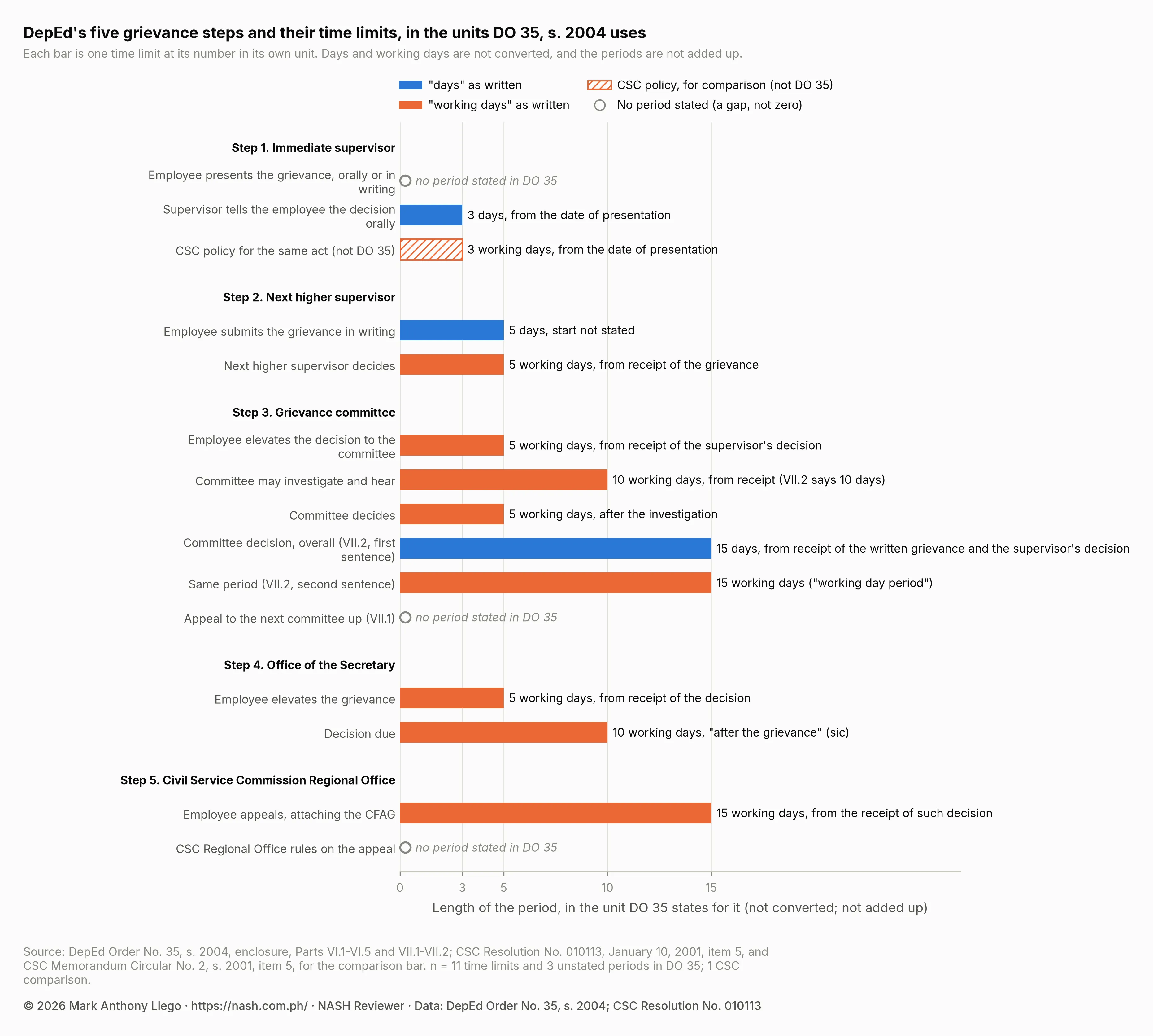
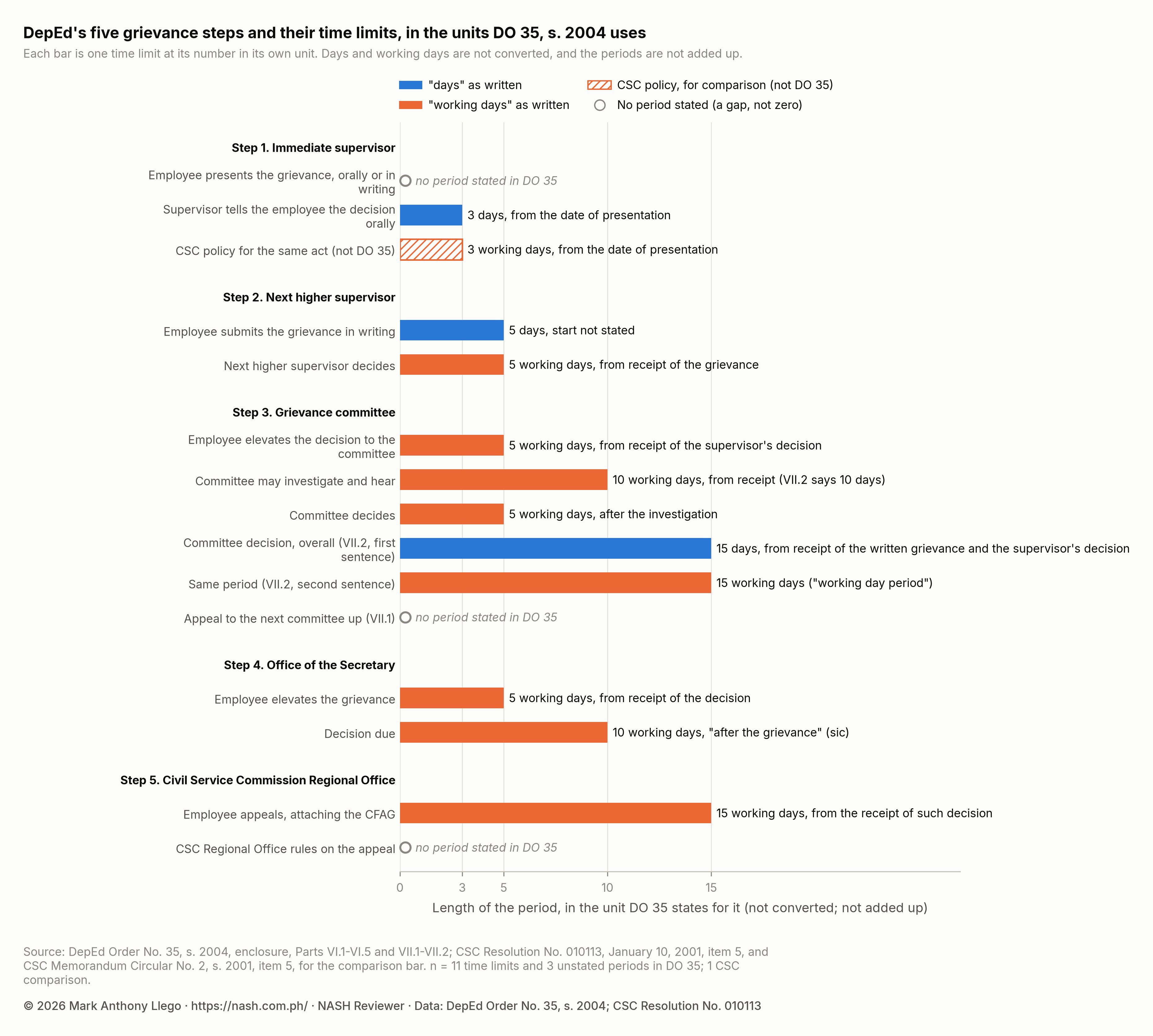
- Five steps, two units. The periods run from 3 days at step 1 to 15 working days to appeal to the CSC, and DO 35 calls the committee’s period both “fifteen (15) days” and a “fifteen (15) working day period” (Parts VI and VII.2).
- The CSC counts working days at step 1. CSC Resolution No. 010113, item 5, gives the supervisor “three (3) working days”; DO 35, Part VI.1 says “three (3) days”.
- The school committee is the principal or head teacher, the Faculty Club president, and a teacher acceptable to both sides whom the principal or head teacher appoints (DO 35, Part VII.3(a)). DO 32, s. 2017 adds at least one woman, and DO 030, s. 2025 requires an inclusion specialist to be present when a member of a marginalized group complains of discrimination, oppression or violence.
- Gaps. DO 35 names no chair, sets no period for an appeal from one committee to the next, and has no rule for a principal who is both committee member and object of the grievance (Parts VI–VII).
- Protests left in 2010 (CSC MC No. 4, s. 2010, item 1). Charges, sexual harassment and union matters are excluded (DO 35, Part V; DO 49, s. 2006, Sec. 2).
- Two DepEd orders disagree on lawyers (DO 35, Part I.3; DO 32, s. 2017), and no text settles which governs.
What counts as a grievance under DO 35?
A grievance is “a work-related discontentment or dissatisfaction which had been expressed verbally or in writing and which, in the aggrieved employee’s opinion, has been ignored or dropped without due consideration” (Part IV.5). DO 35 applies “to all levels of officials and employees in the Department of Education (DepEd), including non-career employees whenever applicable” (Part III).
Its basic policies (Part I): resolve a grievance “at the lowest level possible”; protect the employee from “coercion, discrimination, reprisal, and biased action”; act on “Even verbal grievance” expeditiously, free of “legal rules and technicalities”; and give men and women equal opportunity to sit on the committee.
| Item | Grievable matter (DO 35, Part V) | DO 35’s examples | Status on October 31, 2026 |
|---|---|---|---|
| 1 | Non-implementation of policies on pay and other terms of employment “fixed by law including salaries, incentives, working hours, leave benefits” | “delay in the processing of overtime pay, unreasonable withholding of salaries and inaction on application for leave” | Applies |
| 2 | Non-implementation of policies affecting employees “from recruitment to promotion, detail, transfer, retirement, termination, lay-offs” | “failure to observe selection process in appointment and undue delay in the processing of retirement papers” | Applies |
| 3 | “Inadequate physical working conditions” | poor ventilation; missing safety equipment in hazardous work | Applies |
| 4 | “Poor interpersonal relationships and linkages” | none | Applies |
| 5 | “Protest on appointments” | none | Superseded since 2010 |
| 6 | “All other matters giving rise to employee dissatisfaction and discontentment” | none | Applies |
What is not a grievance
Three kinds of case “shall not be acted upon through the grievance machinery” (Part V):
- Disciplinary cases. DO 35’s pointer, “DECS Order No. 33, s. 1999”, is outdated; the rules are now DO 49, s. 2006 and the 2025 RACCS. DO 49 restates the rule: “A Grievance Committee is not allowed to hear and decide administrative disciplinary cases” (Sec. 2, last paragraph).
- Sexual harassment cases. DO 35 names RA 7877; the 2025 RACCS treats sexual harassment under RA 7877 and RA 11313 (Safe Spaces Act) alike (Sec. 7) and sends complaints to the Committee on Decorum and Investigation (CODI) (Sec. 16); see Sexual Harassment and Child Abuse Complaints in DepEd.
- “Union-related issues and concerns.” See Grievance or Administrative Case?
Protests (item 5). Since February 10, 2010, “A protest on appointment shall no longer be acted upon through the grievance machinery” (CSC MC No. 4, s. 2010, item 1), and DepEd’s DO 32, s. 2016 applies the rule. Protests now follow the 2025 RACCS and DepEd’s recruitment orders, which name different offices and periods; see Grievance or Administrative Case? Where to File.
The five steps and their time limits
| Step | Who receives it | Employee’s period to bring it | Period to decide | DO 35 |
|---|---|---|---|---|
| 1. Immediate supervisor | The immediate supervisor, or the next higher supervisor if the immediate supervisor is the object | None stated; “orally or in writing” | “within three (3) days from the date of presentation”, given orally | Part VI.1; VI.1(e) |
| 2. Next higher supervisor | The next higher supervisor | In writing, “within five (5) days”; start not stated | “within five (5) working days from receipt of the grievance” | Part VI.2 |
| 3. Grievance committee | The committee, or the Office of the Secretary if the committee is the object | “within five (5) working days from receipt of the decision of the next higher supervisor” | Hearing “within ten (10) working days from receipt of the grievance”; decision “within five (5) working days after the investigation”; overall “within fifteen (15) days from receipt of the grievance in writing and the decision of the next higher supervisor” | Part VI.3; VII.2 |
| 4. Office of the Secretary | “through the Undersecretary for Legal Affairs” (DO 35’s 2004 title; see the note on step 4), or the CSC Regional Office directly if the Secretary is the object | “within five (5) working days from receipt of the decision” | “within ten (10) working days after the grievance” | Part VI.4 |
| 5. CSC Regional Office | The CSC Regional Office concerned, with a CFAG | “within fifteen (15) working days from the receipt of such decision” | None stated in DO 35 | Part VI.5 |
Notes on each step.
- Step 1. The supervisor “need not immediately give a definite decision, but the decision shall be rendered within three (3) days from the presentation of the grievance” (Part VI.1(e)). DO 35 sets no deadline for raising a grievance in the first place.
- Step 2. The five days to file have no stated starting point; the CSC’s model machinery uses the same words (CSC MC No. 2, s. 2001, model, Part VI.2). The safe course is to file within five days of the supervisor’s oral decision.
- Step 3. A hearing is allowed (“may”), not required. The decision “shall be in writing and shall contain all relevant facts and circumstances as well as the law or rule that was applied, if any” (Part VII.2).
- Step 4. The phrase “after the grievance” is DO 35’s; the CSC model reads “after the receipt of the grievance” (model, Part VI.4). DepEd’s designation order gives Central Office administrative complaints to an “Undersecretary for Legal and Legislative Affairs” (DO 001, s. 2023; the strand is kept in DO 015, s. 2024, which partly amends it) but does not mention grievances. No issuance says who now receives a step-4 grievance; ask the division’s personnel unit.
- Step 5. The employee “shall submit a Certification on the Final Action on the Grievance (CFAG) together with the appeal”. DO 35’s phrase “the decision of top management” is left over from the CSC model, where step 4 is “Appeal to Top Management”; in DO 35 it means the Office of the Secretary.
- When no decision comes. DO 35 does not say whether silence counts as a denial. It does say that “Officials who refuse to take action on a grievance brought to their attention shall be liable for neglect of duty” (Part VII).
Days or working days?
DO 35 says “three (3) days” at step 1 and “five (5) days” to file at step 2, “working days” elsewhere, and two units for the same committee periods:
- The committee’s overall period: “within fifteen (15) days from receipt of the grievance in writing and the decision of the next higher supervisor” in the first sentence of Part VII.2, then “Within the fifteen (15) working day period” in the next.
- The committee’s hearing: “ten (10) working days” in Part VI.3, but “ten (10) days” in Part VII.2.
The CSC’s policy uses working days at step 1: the supervisor acts “within three (3) working days from the date of presentation” (CSC Res. No. 010113, item 5; CSC MC No. 2, s. 2001, item 5). The CSC model itself says “five (5) days” for filing at step 2, so that mix did not start with DepEd.
Neither DO 35 nor the CSC texts define “days”, and no text says which count governs DO 35’s periods. The Administrative Code of 1987 defines a “day” as “a day of twenty-four hours” (Book I, Sec. 31) and lets an act whose last day falls on a regular holiday or special day be done “on the next succeeding business day” (Sec. 28). That points to calendar days for DO 35’s “days”, but not to which count governs where DO 35 uses both units. One practice satisfies every reading: decide or file within the shorter count, counting weekends.
The grievance committees, school to Central Office
DepEd “shall establish separate grievance committees in the central, regional and division and district offices and in schools”. “Only permanent officials and employees” may be members, chosen for “their integrity, probity, sincerity and credibility” (Part VII).
| Committee | Original jurisdiction (Part VII.1) | Appeals from (Part VII.1) | Members (Part VII.3) |
|---|---|---|---|
| School | “grievances of teachers and non-teaching personnel in the school that were not orally resolved” | None | (1) “Principal or Head Teacher”; (2) “President of the Faculty Club”; (3) “A teacher who is acceptable to both the aggrieved party and the object of the grievance to be appointed by the Principal or Head Teacher” |
| District | Grievances of employees in the district not orally resolved | The School committee | (1) District Supervisor/Coordinator or representative; (2) “Principal of the school where the grievance originated”; (3) President of the District Teachers’ Association or representative |
| Schools Division | Grievances of employees in the division not orally resolved | The District committee | (1) Schools Division Superintendent or representative; (2) District Supervisor/Chair/Coordinator of the district where the grievance originated; (3) President of the Schools Division Teachers Association or representative |
| Regional | Grievances of employees in the region not orally resolved | The Schools Division committee | (1) Regional Director or representative; (2) Chief of the Administrative Division; (3) two division chiefs; (4) two rank-and-file members; (5) “Designated Bilis Aksyon Partner” (see below) |
| Department | Grievances of Central Office employees not orally resolved | The Regional committee | (1) “Highest official responsible for Human Resource Management”; (2) two division chiefs, one from the OSEC proper and one from the bureaus; (3) two rank-and-file members; (4) “Designated Bilis Aksyon Partner” (see below) |
The regional and Department rank-and-file members, one first level and one second level, each sit only on grievances from their own level, for “a term of two (2) years”. At the regional committee they are chosen “through a general election or any other mode of the like”, or designated by the accredited or recognized employees union where there is one; at the Department committee the union nominates them (Part VII.3(d)–(e)).
Additions since 2004. DO 32, s. 2017 requires “at least one member of the GC shall be female, if all the above are men” (Grievance, item 4), adds “gender-related complaints or grievances” (item 1; sexual harassment still goes to the CODI), and says “All GC members shall be capacitated on GRBE”, its gender-responsive education policy (item 3). “An inclusion specialist is required to be present in the grievance committee” when a complaint by a member of a marginalized group is perceived to result from discrimination, oppression or violence (DO 030, s. 2025, Employee Relations, item c).
Each committee writes “its own rules of procedure”, the personnel unit serves as secretariat (Part VII.3), and membership is “part of the members’ regular duties” (Part VII.4(a)).
What DO 35 does not say
- Who chairs, and quorum and voting. DO 35 names no chair and no quorum or voting rule. The CSC policy names chairs at the central office (the highest HRM official) and regional offices (“the Chief or Head of Administrative Division”) (CSC Res. No. 010113, item 9(a)), and DO 54, s. 2004 named an Assistant Secretary “Chairman” of the Department committee; no text names a chair for the school, district or division committees, and no DepEd text names one for the regional committee.
- Which route after a committee decides. Part VI sends the employee from the committee to the Office of the Secretary; Part VII.1 gives each higher committee “appellate jurisdiction” over grievances not resolved below. DO 35 does not reconcile the two and sets no period for an appeal from one committee to the next. Until a rule does, filing within the five working days Part VI allows keeps an employee within every stated period.
- Whether the Bilis Aksyon Partner still exists. DO 35 defines it as the CSC’s counterpart action officer “under the Mamamayan Muna Program pursuant to CSC Memorandum Circular No. 3, s. 1994” (Part IV.10). No later issuance says whether the designation is still in use.
The school head’s three roles
1. The supervisor who hears it first. For your staff, you are the immediate supervisor at step 1, and you may be the next higher supervisor at step 2 when a teacher reports to a head teacher or department head under you. DO 35 sets five rules for the oral discussion (Part VI.1(a)–(e)):
| Rule, as DO 35 titles it | What it requires |
|---|---|
| a. “The employee/aggrieved party shall be put at ease” | Every effort to make the employee feel at ease |
| b. “The employee/aggrieved party shall be encouraged to talk” | The employee is “allowed to tell or explain his/her side” |
| c. “Privacy in discussion” | “held in private in a quiet and secluded spot where the conversation cannot be interrupted or overheard” |
| d. “The case shall be heard fully” | The supervisor “shall seek to keep his/her views and opinions entirely to himself/herself until after the employee has explained his/her side” |
| e. “A definite decision shall be reached” | “At the end of the discussion, the supervisor must be prepared to state his/her position clearly and accurately based on the merits of the grievance”; the decision is due “within three (3) days from the presentation of the grievance” |
Officials who refuse to act on a grievance “shall be liable for neglect of duty in accordance with civil service laws, rules and regulations” (Part VII), and DO 35’s commitment clause pledges action against them (Part IX).
2. A member of the School Grievance Committee. The principal or head teacher sits on it and appoints its third member for each grievance: a teacher “acceptable to both the aggrieved party and the object of the grievance”, not only to you (Part VII.3(a)).
3. A member of the District Grievance Committee when a grievance from your school reaches it, as “Principal of the school where the grievance originated” (Part VII.3(b)).
Not the disciplining authority. A grievance that turns out to be a charge goes to the disciplining authority (DO 49, s. 2006, Sec. 2); see Who Disciplines DepEd Teachers and School Heads?
When the school head is the object of the grievance
At step 1 the rule is clear. DO 35 provides that “where the object of the grievance is the immediate supervisor, the aggrieved party may bring the grievances to the next higher supervisor” (Part VI.1).
At the committee DO 35 is silent. It does not say whether a principal who is the object still sits on the School Grievance Committee, and it has no inhibition or substitute rule. Yet the principal appoints the third member, who must be acceptable to “the object of the grievance”, the principal. The same gap reaches the district committee, where the principal of the originating school sits, and DO 35 does not say when a grievance may start at the district instead, although that committee also has original jurisdiction (Part VII.1(b)).
The other texts do not close the gap:
- The CSC’s alternate rule fits elected members. “In cases where the grievance is against one of the members of the committee, the person who garnered the second highest votes shall sit as alternate of the member being complained of” (CSC Res. No. 010113, item 9). School committee members sit by position or by the principal’s appointment, not by a vote for committee seats, so there is no runner-up to sit as alternate.
- Committee as object. The route to the Office of the Secretary applies where “the object of the grievance is the grievance committee” (Part VI.3); DO 35 does not say whether one member counts.
In practice, a principal who is the object can step aside from the committee voluntarily, in writing, and ask the division’s personnel unit how to proceed. That is a choice, not a DO 35 rule, though it fits the policy against “biased action on the grievance” (Part I.2).
Can a lawyer take part in a DepEd grievance?
Two DepEd orders conflict, and no text resolves it.
- DO 35: “Grievance proceedings shall not be bound by legal rules and technicalities. Even verbal grievance must be acted upon expeditiously. The services of a legal counsel shall not be allowed” (Part I.3). The CSC policy says the same: “The services of a legal counsel shall not be allowed” (CSC Res. No. 010113, item 4).
- DO 32, s. 2017, on the same committees: “Inclusion of legal counsel will help guide the complainants on legal actions to be taken” (Grievance, item 2). DO 32 rescinds “All issuances inconsistent with this Order” (para. 4) without naming DO 35; DO 35 says “Subsequent amendments shall be subject to CSC approval” (Part VIII).
- Status. DepEd’s recent orders treat both as in force: DO 030, s. 2025 calls DO 32, s. 2017 an existing order it supports, and the 2024 and 2025 orders below still send complaints to DO 35. No DepEd issuance, CSC ruling or court decision says which prevails. At step 5 the CSC Regional Office applies “existing civil service law, rules and regulations” (Part VI.5), which include the CSC policy quoted in item 1.
- One act that satisfies both. The employee gets a lawyer’s advice on “legal actions to be taken” outside the meeting and speaks for himself or herself before the supervisor or committee. Whether a lawyer may take part in the proceedings themselves is the unsettled part; a committee facing that request should record it and ask the division’s legal unit before proceeding.
Prevention and paperwork: quarterly assembly, CFAG and reports
Every committee also has these duties (Part VII.4):
| Part VII.4 | Duty | Keep |
|---|---|---|
| a | “Establish its own procedures and strategies” | Written rules of procedure |
| b | Prevent grievances through “an employee assembly which shall be conducted at least once every quarter, ‘talakayan’, counseling and other HRD interventions” | “Minutes of the proceedings of these activities shall be documented for audit purposes” |
| c–e | Information drive, dialogues, and documenting each grievance and “written agreements” | Notices, notes, the file and signed agreements |
| f | Issue the CFAG, with “the history and final action taken by the agency on the grievance” | A copy of each CFAG |
| g | “Submit a quarterly report of its accomplishments and status of unresolved grievances to the Civil Service Commission Regional Office concerned” | Each report and proof of submission |
The quarterly assembly is a committee duty. DepEd’s earlier version, DO 3, s. 2004, required one “at least once every semester”; DO 35 changed it to “at least once every quarter”, the CSC’s rule (CSC Res. No. 010113, item 11). In a school, the School Grievance Committee, on which the principal or head teacher sits, holds it.
The CFAG opens step 5. A grievance may go to the CSC Regional Office “only upon submission of a Certification on the Final Action on Grievance (CFAG) issued by the grievance committee” (CSC Res. No. 010113, item 14). A committee that issues none stalls the appeal.
Access. Machineries for employees from marginalized groups “shall be known and readily accessible”, with accessible documents, interpreters and meeting places (DO 030, s. 2025, Employee Relations, items d.i–iii).
The CSC checks compliance. Under PRIME-HRM, the grievance machinery is “assessed to determine agency compliance with the CS Law, rules and regulations” (CSC MC No. 30, s. 2014, Part A.1); minutes, CFAGs and reports are the evidence.
Orders that send complaints to DO 35
| Order | Subject | Clause |
|---|---|---|
| DO 002, s. 2024 (January 26, 2024) | Removal of teachers’ administrative tasks | “Concerns, complaints, and/or violations” go to the grievance machinery under DO 35 “or pertinent rules on administrative cases in the civil service” |
| DO 005, s. 2024 (April 29, 2024) | Teachers’ workload and overload | Same as DO 002 |
| DO 004, s. 2025 (March 5, 2025) | Flexible work arrangements | Same as DO 002 |
| DO 013, s. 2024 (September 18, 2024) | Vacation service credits | “Objection, disapproval, and/or infringement” goes to DO 35 “or other pertinent rules on administrative cases in the civil service” |
| DO 026, s. 2025 (September 6, 2025) | Teachers’ overtime | Same as DO 013 |
| DO 022, s. 2025 (August 7, 2025) | School sports clubs | “Grievances may be settled with the school’s Grievance Committee in accordance with DepEd Order No. 35 s. 2004, as may be applicable.” |
| DO 030, s. 2025 (September 29, 2025) | Inclusive employment | “Applicants may present grievance with the office grievance machinery” on the selection process and discrimination (does not name DO 35) |
- Students and applicants. DO 022, s. 2025 covers complaints by “students and faculty members”, and DO 030, s. 2025 lets “Applicants” use the “office grievance machinery”; but DO 35’s scope is “officials and employees” (Part III), so it covers the faculty members only and does not say how students or outside applicants are heard.
- Outdated pointer. DO 030, s. 2025 cites the 2017 RACCS, replaced by the 2025 RACCS on August 4, 2025.
The orders themselves are explained in DepEd Teacher Workload Policies: A Complete Guide, Admin Tasks Off Teachers: DO 2 and School Support Staff and Vacation Service Credits and Overtime Pay for Teachers.
Reassignment appeals go through the grievance mechanism
The CSC’s 2025 Omnibus Rules on Appointments and Other Human Resource Actions (2025 ORAOHRA), in force since August 3, 2025, let an employee appeal a reassignment order “within fifteen (15) days upon receipt thereof through a formal grievance mechanism to be established by the agency”, then to the CSC Regional Office, and “Pending appeal, the reassignment shall not be executory”, except for peace-and-order personnel (Sec. 13(a), item 4). DO 35 has neither the 15 days nor the stay. The ORAOHRA also says the reassignment of “public school teachers” is “governed by their respective laws”, its rules “applied suppletorily” (item 5). How this applies to school heads is in Can a Principal Be Reassigned to Another School?
DO 35 in 2026
History. DO 3, s. 2004 (January 22, 2004) set up the Department’s machinery under the CSC’s 2001 policy. DO 35 (June 3, 2004) sent out “a revised copy of the Department’s Grievance Machinery approved by the Civil Service Commission” (para. 1) without expressly repealing DO 3, and DO 54, s. 2004 reconstituted the Department committee under DO 35, “as approved by the Civil Service Commission (CSC)”.
Still in force. No later DepEd order revises or replaces DO 35. The CSC policy is current too: the 2025 RACCS keeps grievance-machinery cases out of the CSC’s original jurisdiction, citing “CSC Memorandum Circular No. 2, s. 2001” (Sec. 7). Underneath is the Administrative Code of 1987, Book V, Sec. 37: “Each department or agency shall promulgate rules and regulations governing expeditious, fair and equitable adjustment of employees’ complaints or grievances in accordance with the policies enunciated by the Commission.”
What the CSC policy adds
| Point | DO 35, s. 2004 | CSC Res. No. 010113 and MC No. 2, s. 2001 |
|---|---|---|
| Step-1 period | “three (3) days” | “three (3) working days” (item 5) |
| Chair | None named | HRM head at the central office; Chief of the Administrative Division at regional offices (item 9(a)) |
| Grievance against a member | No rule | The person with “the second highest votes” sits as alternate (Res., item 9) |
| CFAG | Submitted “together with the appeal” | Appeal allowed “only upon submission” of a CFAG (item 14) |
What this means for school heads
Do:
- Hear every grievance in private, let the employee finish before you give a view, and decide orally within three days of presentation, counting weekends (Part VI.1).
- Tell the employee the next step: a written grievance to the next higher supervisor “within five (5) days” (Part VI.2).
- Keep the School Grievance Committee constituted, with a woman member, members trained on gender-responsive basic education, an inclusion specialist present when DO 030, s. 2025 requires one, a quarterly assembly and a quarterly report to the CSC Regional Office.
Document: the date, substance and decision on each grievance; minutes of assemblies and dialogues; signed agreements; written committee decisions with facts and the rule applied (Part VII.2); each CFAG.
Do not:
- Sit on a grievance or tell an employee to wait for the next assembly.
- Let the committee decide a charge, a sexual harassment complaint, a union issue or a protest (DO 35, Part V; DO 49, Sec. 2; CSC MC No. 4, s. 2010).
- Retaliate against an employee who files (Part I.2), or discuss a grievance where others can hear (Part VI.1(c)).
Refer a charge to the disciplining authority, as What a School Head Does When a Complaint Arrives explains. When a grievance is against you, tell the employee it may go to your own supervisor (Part VI.1). Take questions on lawyers, step 4 or the committee route to the division’s legal or personnel unit.
Related guides: Human Resource Management for DepEd School Heads, PPSSH Domain 2: Managing School Operations, PPSSH Domain 4: Developing Self and Others and Oppression Cases: How Principals Must Treat Teachers.
How the NASH may test this
The two items below are original practice items, scored 3 (Relational), 2 (Multistructural), 1 (Unistructural) or 0 (Prestructural). An option that breaks a rule scores 0.
Question 1
Indicator 2.4.1, Management of staff. Career Stage 1, Situational, Moderate.
You are the principal of an elementary school and the immediate supervisor of its teachers. On Monday morning, at the faculty room door with other teachers nearby, Teacher A tells you that her overtime pay for two Saturday sessions has not been processed, although she submitted her accomplishment report a month ago. She is visibly upset. What is the most appropriate action?
- A. Ask her to put the complaint in a letter so that the School Grievance Committee can take it up at its next quarterly employee assembly, and assure her it will be discussed there.
- B. Hear her out in your office with the door closed, let her explain fully before you comment, check the status of her claim, and tell her your decision within three days.
- C. Take her to a private room, note her concern about the unprocessed claim, and tell her your decision on the claim within three days.
- D. Hear her out in private, let her explain fully before you comment, check her claim, tell her your decision within three days, record it, and tell her she may write to the next higher supervisor within five days.
Answer and explanation
Best answer: D. Points: A = 0, B = 2, C = 1, D = 3.
- A (0 points, Prestructural). It breaks the rule that the immediate supervisor decides within three days of presentation; the quarterly assembly is a prevention activity, not step 1.
- B (2 points, Multistructural). It follows the oral-discussion rules and the three-day limit, but keeps no record and does not tell her the next step.
- C (1 point, Unistructural). It meets the privacy and three-day rules, but shows none of the other discussion rules, no check of the claim, no record and no next step.
- D (3 points, Relational). It links the discussion rules, the time limit, the record and the next step, so the grievance can be settled at the lowest level or move on properly.
Why. This aligns with Career Stage 1 expectations because indicator 2.4.1 asks the aspiring school head to know the issuances on managing school staff. Delay in processing overtime pay is a grievance (DO 35, s. 2004, Part V, item 1). The supervisor hears it in private, lets the employee explain first, and informs her orally “within three (3) days from the date of presentation” (Part VI.1; the CSC says three working days, Res. No. 010113, item 5). If not satisfied, she may go in writing to the next higher supervisor “within five (5) days” (Part VI.2).
Indicator 2.4.1: Demonstrate knowledge and understanding of laws, policies, guidelines and issuances on managing school staff.
Sources: DepEd Order No. 35, s. 2004, Parts V, VI.1, VI.2 and VII; CSC Resolution No. 010113, January 10, 2001, item 5.
Question 2
Indicator 4.7.1, General welfare of human resources. Career Stage 1, Conceptual, Moderate.
At a faculty meeting, three teachers raise concerns. Teacher B, who was next in rank and applied, says the new Master Teacher I lacks the required experience and her appointment should be set aside. Teacher C says a co-teacher collected money from learners for a field trip and kept it. Teacher D says her application for leave has gone unanswered for three weeks. Which statement best reflects which of these go through the grievance machinery of DO 35, s. 2004?
- A. All three go to the School Grievance Committee, because DO 35 covers protests on appointments, interpersonal relationships and all other matters giving rise to employee dissatisfaction.
- B. Only Teacher D’s is a grievance; Teacher B’s is a protest on an appointment, which no longer goes through the grievance machinery and follows the protest rules; Teacher C’s is a charge for the disciplining authority.
- C. Teacher D’s is a grievance, and Teacher C’s is a charge for the disciplining authority, not the committee; Teacher B should ask the division office how a protest is filed.
- D. Teacher D’s is a grievance she should first raise with her immediate supervisor; the other two concerns need more facts before they can be sorted.
Answer and explanation
Best answer: B. Points: A = 0, B = 3, C = 2, D = 1.
- A (0 points, Prestructural). It breaks two rules: a grievance committee may not decide a charge, and protests left the grievance machinery in 2010.
- B (3 points, Relational). It sorts all three and says why two of them leave the grievance machinery, connecting DO 35’s list to the rules that have changed it.
- C (2 points, Multistructural). The grievance and the charge are sorted correctly, but it does not know where a protest goes.
- D (1 point, Unistructural). It identifies the one grievance and its first step, but does not sort the other two.
Why. This aligns with Career Stage 1 expectations because indicator 4.7.1 asks the aspiring school head to know the issuances on school personnel’s rights and benefits, including how they are enforced. DO 35 lists “inaction on application for leave” as a grievance (Part V, item 1). Its protest item no longer applies: “A protest on appointment shall no longer be acted upon through the grievance machinery” (CSC MC No. 4, s. 2010, item 1). For a Master Teacher appointment, DepEd’s own rule is a written protest “addressed to the SDS, within 15 calendar days from the date of issuance of appointment” (DO 020, s. 2024, item 69). A charge goes to the disciplining authority, because “A Grievance Committee is not allowed to hear and decide administrative disciplinary cases” (DO 49, s. 2006, Sec. 2).
Indicator 4.7.1: Display knowledge of laws, policies, guidelines and issuances on the rights, privileges and benefits of school personnel to promote their general welfare.
Sources: DepEd Order No. 35, s. 2004, Part V; CSC Memorandum Circular No. 4, s. 2010, item 1; DepEd Order No. 020, s. 2024, item 69; DepEd Order No. 49, s. 2006, Sec. 2.
Nothing in this guide reproduces or predicts examination content.
Frequently asked questions
How many days does a principal have to act on a teacher’s grievance?
DO 35 gives the immediate supervisor “three (3) days from the date of presentation” to inform the employee orally of the decision (Part VI.1). The CSC’s policy says “three (3) working days” (CSC Res. No. 010113, item 5), and no text says which count governs DO 35. Deciding within three days, counting weekends, satisfies both.
Is DO 35, s. 2004 still in force in 2026?
Yes, with changes. Its protest item no longer applies (CSC MC No. 4, s. 2010, item 1), its pointer to DECS Order No. 33, s. 1999 is outdated, and later orders add members and conflict with it on counsel. No later order has replaced it, 2024 and 2025 orders such as DO 002, s. 2024 still send complaints to it, and the 2025 RACCS still names its CSC policy (Sec. 7).
What can a teacher do if the grievance is against the principal?
Take it to the principal’s own supervisor: “where the object of the grievance is the immediate supervisor, the aggrieved party may bring the grievances to the next higher supervisor” (DO 35, Part VI.1). DO 35 does not say whether the principal still sits on the School Grievance Committee then; a principal can step aside voluntarily, but no rule requires it.
Can a teacher bring a lawyer to a grievance meeting?
DepEd’s orders disagree: DO 35 says “The services of a legal counsel shall not be allowed” (Part I.3), and DO 32, s. 2017 says “Inclusion of legal counsel will help guide the complainants on legal actions to be taken.” No text settles it; advice outside the meeting and speaking for oneself in it fits both.
Download the data
- grievance-steps-time-limits.csv: the 15 rows in Figure 1, one per time limit or unstated period in DO 35 plus the CSC’s step-1 rule, with the step, who acts, the number, the unit and starting point as written, the verbatim text, the provision and the page of the order.
The CSVs and charts may be reused only with written permission: email support@nash.com.ph. The rules themselves come from DepEd’s and the Civil Service Commission’s issuances, which you can cite directly.
Sources
DepEd issuances
- DepEd Order No. 35, s. 2004, Revision of the Grievance Machinery of the Department of Education, June 3, 2004, cover memorandum and enclosure, Parts I–IX.
- DepEd Order No. 3, s. 2004, Establishing a Complaint/Grievance Committee at the Department of Education, January 22, 2004, paras. 1–2 and enclosure, Parts VII–IX.
- DepEd Order No. 54, s. 2004, Re-constituting the Department’s Grievance Committee, September 29, 2004, para. 1.
- DepEd Order No. 49, s. 2006, Revised Rules of Procedure of the Department of Education in Administrative Cases, December 12, 2006, Sec. 2 (last paragraph).
- DepEd Order No. 32, s. 2016, Addendum to DepEd Order No. 3, s. 2016 (Hiring Guidelines for Senior High School Teaching Positions), May 23, 2016, on protests.
- DepEd Order No. 32, s. 2017, Gender-Responsive Basic Education Policy, June 29, 2017, para. 4 and enclosure, “Grievance”, items 1–4.
- DepEd Order No. 001, s. 2023, Revised Designation of Undersecretaries and Assistant Secretaries to Their Strands and Functional Areas of Responsibilities and Revised Signing Authorities, January 9, 2023, signing authority on Central Office administrative complaints.
- DepEd Order No. 002, s. 2024, Immediate Removal of Administrative Tasks of Public School Teachers, January 26, 2024, grievance clause.
- DepEd Order No. 005, s. 2024, Rationalization of Teachers’ Workload in Public Schools and Payment of Teaching Overload, April 29, 2024, grievance clause.
- DepEd Order No. 013, s. 2024, Revised Guidelines on the Grant of Vacation Service Credits for Teachers, September 18, 2024, grievance clause.
- DepEd Order No. 015, s. 2024, Revised Designation of Undersecretaries and Assistant Secretaries to the Strands and Functional Areas of Responsibilities and Revised Signing Authorities on Human Resource Actions, October 18, 2024, para. 1 and the Legal and Legislative Affairs strand.
- DepEd Order No. 020, s. 2024, Guidelines on the Recruitment, Selection, and Appointment to Higher Teaching Positions, December 20, 2024, item 69.
- DepEd Order No. 004, s. 2025, Guidelines on the Adoption of the Flexible Work Arrangement in the Department of Education, March 5, 2025, grievance clause.
- DepEd Order No. 022, s. 2025, Policy Guidelines on the Institutionalization of the School Sports Club in Public Schools, August 7, 2025, on resolving conflicts and grievances.
- DepEd Order No. 026, s. 2025, Guidelines on the Payment of Overtime Services of Teachers, September 6, 2025, grievance clause.
- DepEd Order No. 030, s. 2025, Inclusive Employment Policy in the Department of Education, September 29, 2025, para. 6 and enclosure, recruitment item v and Employee Relations, items c–d.iii.
Civil Service Commission issuances
- CSC Resolution No. 010113, Revised Policies on Grievance Machinery, January 10, 2001, items 4, 5, 9, 11 and 14.
- CSC Memorandum Circular No. 2, s. 2001, Revised Policies on the Settlement of Grievances in the Public Sector, January 26, 2001, items 4, 5, 11 and 14, and model Agency Grievance Machinery, Part VI.
- CSC Memorandum Circular No. 4, s. 2010, Revised Policies in the Resolution of Protest Cases, February 8, 2010, issuing CSC Resolution No. 091718 (December 11, 2009; effective February 10, 2010), item 1.
- CSC Memorandum Circular No. 30, s. 2014, Adoption of HR Maturity Level Indicators for the Human Resource Management Systems in the Public Sector, Part A.1.
- 2025 Rules on Administrative Cases in the Civil Service (2025 RACCS), CSC Resolution No. 2500357, promulgated April 30, 2025, in force August 4, 2025, Secs. 7 and 16.
- 2025 Omnibus Rules on Appointments and Other Human Resource Actions (2025 ORAOHRA), CSC MC No. 08, s. 2025, CSC Resolution No. 2500358, in force August 3, 2025, Sec. 13(a), items 4 and 5.
Laws
- Executive Order No. 292, Administrative Code of 1987, Book I, Secs. 28 and 31; Book V, Title I, Subtitle A, Chapter 5, Sec. 37.
- Republic Act No. 7877, Anti-Sexual Harassment Act of 1995, as excluded by DO 35, Part V.
- Republic Act No. 11313, Safe Spaces Act, as named in the 2025 RACCS, Sec. 7.
This guide explains DepEd and Civil Service Commission rules for study and professional awareness. It is not legal advice; for a specific case, consult a lawyer or your Schools Division Office’s legal unit.
The administrative cases and grievances series
- DepEd Administrative Cases and Grievances: DO 49 and DO 35
- Who Disciplines DepEd Teachers and School Heads?
- How to File an Administrative Complaint in DepEd
- DepEd Preliminary Investigation, Formal Charge and Answer
- Formal Investigation and Decision in DepEd Cases
- DepEd Administrative Offenses and Penalties in 2026
- Can a Teacher Be Charged for Unpaid Loans in DepEd?
- DepEd Grievance Machinery: Steps and Time Limits (this post)
- Grievance or Administrative Case? Where to File
- Sexual Harassment and Child Abuse Complaints in DepEd
- What a School Head Does When a Complaint Arrives
Written by Mark Anthony Llego for NASH Reviewer. Sources: DepEd Orders No. 3, 35 and 54, s. 2004, No. 49, s. 2006, No. 32, s. 2016, No. 32, s. 2017, No. 001, s. 2023, No. 002, 005, 013, 015 and 020, s. 2024, and No. 004, 022, 026 and 030, s. 2025; CSC Resolution No. 010113 and MC No. 2, s. 2001; CSC MC No. 4, s. 2010 and No. 30, s. 2014; the 2025 RACCS and 2025 ORAOHRA; the Administrative Code of 1987; RA 7877 and RA 11313. Charts may be reused only with written permission from support@nash.com.ph.