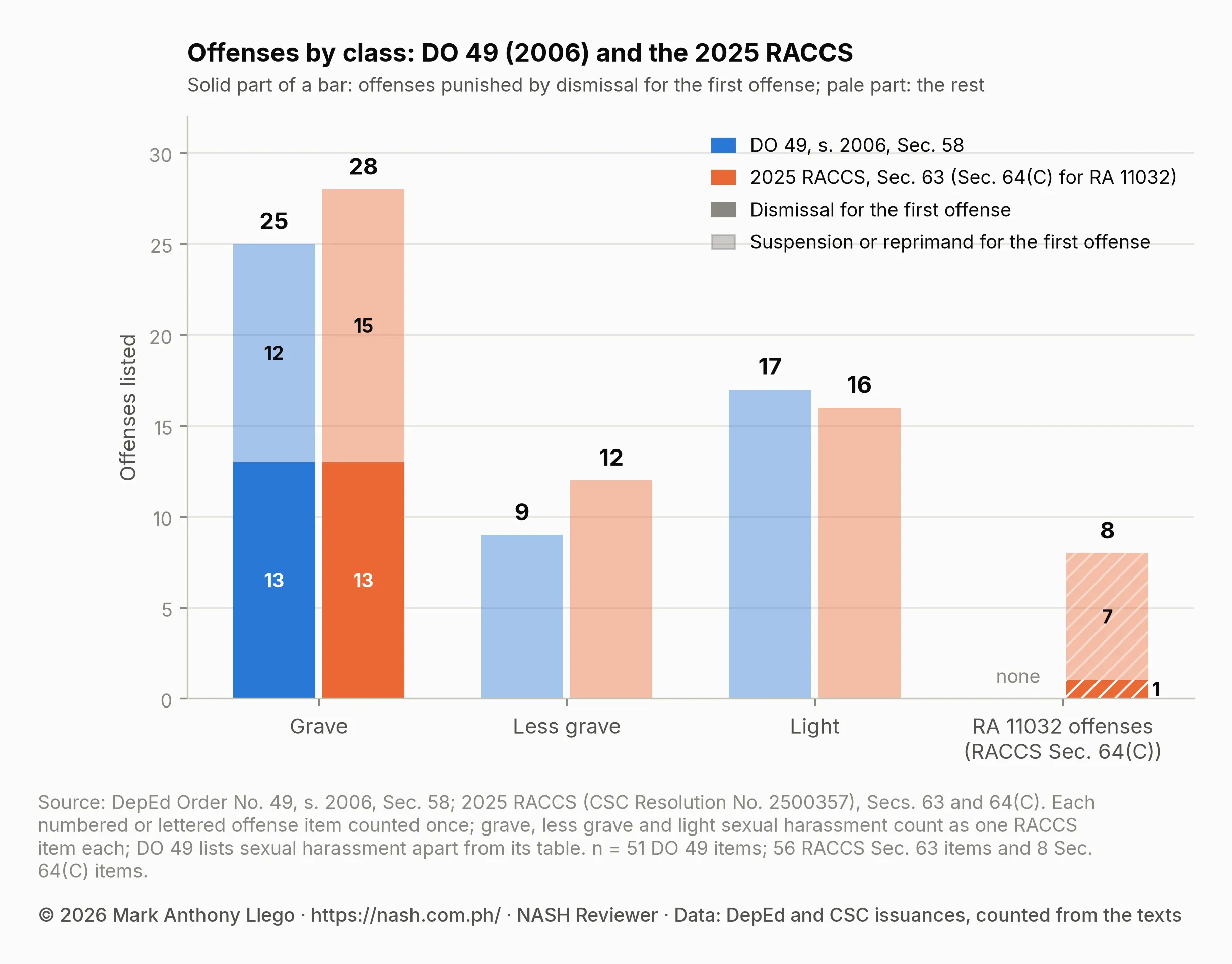
A DepEd teacher or school head who commits an administrative offense faces a penalty set by its class: grave offenses can mean dismissal for the first offense, less grave offenses a suspension, and light offenses a reprimand, with heavier penalties for repeat offenses. Two tables classify the offenses: DepEd Order No. 49, s. 2006, Sec. 58, with 25 grave, 9 less grave and 17 light offenses, and the Civil Service Commission’s 2025 Rules on Administrative Cases in the Civil Service (2025 RACCS), Sec. 63, with 28 grave, 12 less grave and 16 light offenses. The 2025 RACCS adds eight offenses under the Ease of Doing Business Act in Sec. 64(C).
The tables agree on most offenses. Where they differ, as on partisan political activity (grave in DO 49, less grave in the 2025 RACCS), DepEd’s 2026 orders cite both texts and no rule or decision says which prevails; a case that reaches the CSC on appeal is decided under the 2025 RACCS.
Below are both tables in full, and the rules on circumstances, repeat offenses and what each penalty carries, as of October 31, 2026. “The 2025 RACCS” is CSC Resolution No. 2500357, in force since August 4, 2025. Filing, investigation and decision are covered in this series.
Key findings
- Three classes, each with its own penalty ladder: grave offenses are punished by dismissal or by suspension then dismissal; less grave by suspension then dismissal; light by reprimand, suspension, then dismissal. The 2025 RACCS lists 28 grave, 12 less grave and 16 light offenses, plus 8 RA 11032 offenses in Sec. 64(C); DO 49 lists 25, 9 and 17 (2025 RACCS, Secs. 63–64; DO 49, Sec. 58; Figure 1).
- Some offenses moved. Partisan political activity dropped from grave to less grave, dishonesty split into three tiers, and sexual harassment entered the table (2025 RACCS, Secs. 63–64; DO 49, Sec. 58).
- Both texts are cited, and the conflict is open. DepEd’s 2026 orders cite DO 49 and the 2025 RACCS together (DO 007, s. 2026, Sec. VI.2, for social-media cases; DO 018, s. 2026, Sec. VII); on appeal, the CSC applies the 2025 RACCS.
- One offense names teachers. Improper or unauthorized solicitation of contributions “in the case of teachers or school officials from school children” is a light offense (2025 RACCS, Sec. 63(C)(7)). Child abuse and corporal punishment are punished as grave or simple misconduct (DO 40, s. 2012, Sec. 15).
- Circumstances move a penalty within its range, and the texts differ. Under the 2025 RACCS, dismissal “may neither be mitigated nor aggravated, unless allowed by law”, circumstances must be pleaded and proved, and several counts of one offense get the maximum (Secs. 67, 68 and 71); DO 49 requires only pleading and treats extra counts as aggravating (Secs. 59 and 61). No rule or decision says which prevails.
- A suspension of six months or less may be converted into a fine in offices whose functions are impressed with national interest, such as education, at the disciplining authority’s discretion; a conversion granted at the respondent’s request ends the right to appeal (2025 RACCS, Sec. 66(a)–(c)).
Which penalty table applies: DO 49 or the 2025 RACCS?
The grounds come from the law. The Administrative Code of 1987 lists 30 grounds for disciplinary action (Executive Order No. 292, Book V, Sec. 46(b)). DO 49, Sec. 2(a) to (dd) repeats them, and item (ee) adds “Sexual Harassment as defined and penalized under CSC Resolution No. 01-0940.” The Code also caps the penalties: “removal from the service, demotion in rank, suspension for not more than one year without pay, fine in an amount not exceeding six months’ salary, or reprimand” (Sec. 46(d)).
The two tables. Both sort offenses by “their gravity or depravity and effects on the government service” (DO 49, Sec. 58; 2025 RACCS, Sec. 63).
Partisan political activity shows where the tables part. DO 49 lists “Engaging directly or indirectly in partisan political activities by one holding non-political office” as a grave offense with “1st offense – Dismissal” (Sec. 58(A)(8)). The 2025 RACCS lists “Engaging directly or indirectly in partisan political activities” among the less grave offenses, which, “Unless otherwise stated”, “are punishable by suspension of one (1) month and one (1) day to six (6) months for the first offense; and dismissal from the service for the second offense” (Sec. 63(B), item 2).
DepEd’s 2026 orders treat both as in force, and no rule or decision says which prevails. If the case reaches the CSC on appeal, the CSC applies the 2025 RACCS.
What DepEd’s orders say:
- DO 007, s. 2026 (Media Management Guidelines), Sec. VI.1, says that breaking that order “shall constitute misconduct and shall subject the offending civil servant to appropriate administrative sanctions under the 2025 Rules on Administrative Cases in the Civil Service (RACCS)”. Sec. VI.2 adds that DO 49 “and the 2025 RACCS also apply in the institution, investigation, prosecution, and adjudication of cases involving the use of social media”. Both sentences are about that order and social-media cases.
- DO 018, s. 2026, Sec. VII(4.0), says violators “shall be dealt with in accordance with DepEd Order No. 49 s. 2006” and “the 2025 Rules on Administrative Case in the Civil Service”.
The open question is whether a DepEd disciplining authority may still impose a DO 49 penalty that the 2025 RACCS lowered, such as dismissal for a first offense of partisan political activity. No text settles it.
The tables below follow the 2025 RACCS, with DO 49’s item beside each offense. An item number alone means DO 49 gives the same class and penalties; differences are noted, and the main ones are explained below. The full wording of every offense in both texts is in the crosswalk CSV.
Grave offenses and their penalties
The 2025 RACCS has 28 grave offenses in two groups.
Group 1: dismissal for the first offense (2025 RACCS, Sec. 63(A)(1)). Thirteen offenses.
| RACCS item | Offense | DO 49, Sec. 58 |
|---|---|---|
| (a) | Being notoriously undesirable | A.4 |
| (b) | Contracting loans of money or other property from persons with whom the office of the employee has business relations | A.10 |
| (c) | Conviction of a crime involving moral turpitude | A.5 |
| (d) | Disloyalty to the Republic of the Philippines and to the Filipino people | A.13 |
| (e) | Falsification of official document | A.6 |
| (f) | Grave misconduct | A.3 |
| (g) | Grave sexual harassment | Not in the table; prosecuted apart (see below) |
| (h) | Gross neglect of duty | A.2 |
| (i) | Nepotism | A.12 |
| (j) | Physical or mental disorder or disability due to immoral or vicious habits | A.7 (“incapacity”) |
| (k) | Receiving for personal use a fee, gift or other valuable thing given in the hope of a favor, or committing acts punishable under the anti-graft laws | A.9 |
| (l) | Serious dishonesty | A.1 “Dishonesty”, dismissal |
| (m) | Soliciting or accepting any gift, gratuity, favor, entertainment, loan or anything of monetary value in the course of official duties or in connection with any operation or transaction regulated or affected by one’s office | A.11 |
Group 2: suspension, then dismissal (2025 RACCS, Sec. 63(A)(2)). Fifteen offenses, each punished by suspension of six months and one day to one year for the first offense and dismissal for the second.
| RACCS item | Offense | DO 49, Sec. 58 |
|---|---|---|
| (a) | Conduct prejudicial to the best interest of the service | A.20 |
| (b) | Directly or indirectly having financial and material interest in any transaction requiring the approval of one’s office | A.21 |
| (c) | Disclosing or misusing confidential or classified information known by reason of one’s office | A.23 |
| (d) | Disgraceful and immoral conduct | A.15 |
| (e) | Frequent unauthorized absences (habitual absenteeism) | Part of A.17 |
| (f) | Gross insubordination | A.19 |
| (g) | Habitual tardiness in reporting for duty causing prejudice to the operations of the office | Part of A.17 |
| (h) | Inefficiency and incompetence in the performance of official duties, which may instead be punished by demotion | A.16; no demotion option |
| (i) | Less serious dishonesty | A.1 “Dishonesty”, dismissal |
| (j) | Loafing from duty during regular office hours | Part of A.17 |
| (k) | Obtaining or using statements filed under RA 6713 for purposes contrary to morals or public policy, or commercial purposes | A.24 |
| (l) | Oppression | A.14 |
| (m) | Owning, controlling, managing or accepting employment in any private enterprise regulated, supervised or licensed by one’s office, unless allowed by law | A.22 |
| (n) | Recommending anyone to a position in a private enterprise with a pending or regular transaction with one’s office, unless mandated | A.25 |
| (o) | Refusal to perform official duty | A.18 |
Absences, tardiness and loafing, defined. DO 49 put all three in one grave offense (Sec. 58(A)(17)). The 2025 RACCS splits them and defines each:
- An employee is habitually absent “after incurring unauthorized absences exceeding the allowable 2.5 days monthly leave credit under the Leave Law for at least three (3) months in a semester or at least three (3) consecutive months during the year” (Sec. 63(A)(2)(e)).
- An employee is habitually tardy “after incurring tardiness, regardless of the number of minutes, ten (10) times a month for at least (2) months in a semester or at least two (2) consecutive months during the year” (Sec. 63(A)(2)(g)). The grave offense requires “prejudice to the operations of the office”; the light offense of habitual tardiness (Sec. 63(C)(6)) does not.
- “loafing refers to frequent unauthorized absences from duty during regular hours despite entering attendance in the office” (Sec. 63(A)(2)(j)).
Three tiers of dishonesty. The circumstances of the act set the tier (2025 RACCS, Sec. 64(B)):
- Serious (dismissal): for example, serious damage and grave prejudice to the government, grave abuse of authority, moral depravity, or fake credentials used to qualify for a position.
- Less serious (grave): for example, damage that is not serious, or taking advantage of one’s position without personal gain.
- Simple (less grave): for example, an act unrelated to one’s duties, or one that caused no damage, without moral depravity.
When a falsified official document “facilitated or was a necessary means for the commission of the dishonest act”, the charge is dishonesty alone, “as the act of falsification is already subsumed in the offense of Dishonesty” (Sec. 64(B)(5)). The full lists and the cases are in Dishonesty and Grave Misconduct: Cases on Principals.
Less grave offenses and their penalties
The 2025 RACCS has 12 less grave offenses. “Unless otherwise stated”, each is punished by suspension of one month and one day to six months for the first offense and dismissal for the second (Sec. 63(B)). The exception is simple dishonesty: suspension of one month and one day to six months, then six months and one day to one year, then dismissal (Sec. 63(B)(8)).
| RACCS item | Offense | DO 49, Sec. 58 |
|---|---|---|
| (1) | Discourtesy in the course of official duties | B.3 “Gross Discourtesy” |
| (2) | Engaging directly or indirectly in partisan political activities by one holding a non-political office | A.8, grave: dismissal |
| (3) | Failure to file sworn statements of assets, liabilities and net worth (SALN) in accordance with the guidelines on filing SALN | B.8 |
| (4) | Failure to resign from a private business within 30 days, or to divest one’s shareholdings within 60 days, when a conflict of interest arises | B.9 |
| (5) | Habitual drunkenness | B.6 |
| (6) | Insubordination | B.5 |
| (7) | Less grave sexual harassment | Not in the table; prosecuted apart |
| (8) | Simple dishonesty (three-step penalty above) | A.1 “Dishonesty”, dismissal |
| (9) | Simple misconduct | B.2 |
| (10) | Simple neglect of duty | B.1 |
| (11) | Unfair discrimination in rendering public service due to party affiliation or preference | B.7 |
| (12) | Violation of existing civil service laws and rules of serious nature | B.4 |
Grave or simple misconduct. The line matters, because grave misconduct means dismissal and simple misconduct a suspension. In Office of the Deputy Ombudsman for Luzon v. Dionisio, G.R. No. 220700, July 10, 2017 (First Division), the Court restated the test: “In order to differentiate gross misconduct from simple misconduct, the elements of corruption, clear intent to violate the law, or flagrant disregard of established rule, must be manifest in the former.” It dismissed a principal for grave misconduct; see Dishonesty and Grave Misconduct: Cases on Principals.
Light offenses and their penalties
The 2025 RACCS has 16 light offenses. Each is punished by a reprimand for the first offense, suspension of one to 30 days for the second and dismissal for the third (Sec. 63(C)). DO 49 uses the same ladder for its 17 light offenses (Sec. 58(C)).
| RACCS item | Offense | DO 49, Sec. 58 |
|---|---|---|
| (1) | Borrowing money by superior officers from subordinates | C.8 |
| (2) | Disgraceful, immoral or dishonest conduct prior to entering the service | C.7 |
| (3) | Engaging in private practice of one’s profession unless authorized by the Constitution, law, regulation or the head of office, and provided it does not conflict with one’s official functions | C.16; no head-of-office authority |
| (4) | Failure to act promptly on letters and request within 15 working days from receipt | C.13; “fifteen (15) days” |
| (5) | Gambling prohibited by law | C.5 |
| (6) | Habitual tardiness | C.4 |
| (7) | Improper or unauthorized solicitation of contributions from subordinate employees and, in the case of teachers or school officials, from school children | C.2 |
| (8) | Lending money at usurious rate of interest | C.9 |
| (9) | Light sexual harassment | Not in the table; prosecuted apart |
| (10) | Lobbying for personal interest or gain in legislative halls and offices without authority | C.11 |
| (11) | Promoting the sale of tickets for private enterprises not intended for charitable or public welfare purposes, and even for those that are, without prior authority | C.12 |
| (12) | Pursuit of private business, vocation or profession without the permission required by civil service rules and regulations | C.17 |
| (13) | Refusal to render overtime service | C.6 |
| (14) | Simple discourtesy in the course of official duties | C.1 “Discourtesy” |
| (15) | Violation of reasonable office rules and regulations | C.3 |
| (16) | Willful failure to pay just debts or willful failure to pay taxes due to the government | C.10 |
Two DO 49 light offenses have no item in Sec. 63: failure to complete action on documents “within a reasonable time” (C.14), and failure to attend to anyone who wants the office’s services (C.15). Some of the same conduct can fall under the RA 11032 offenses in the next section, which carry heavier penalties but apply only to applications and requests for government services (Sec. 64(C)(2)(e)–(f)). DepEd’s 2026 orders treat both as in force, and no rule or decision says which prevails. If the case reaches the CSC on appeal, the CSC applies the 2025 RACCS.
Just debts are, in both texts, claims adjudicated by a court or admitted by the debtor (2025 RACCS, Sec. 63(C); DO 49, Sec. 58(C)(10)). The 2025 RACCS allows settlement in only two light offenses, borrowing by superiors from subordinates and willful failure to pay just debts (Sec. 75); DepEd’s own mediation rules are in Can a Teacher Be Charged for Unpaid Loans in DepEd?
Letters and requests: 15 days or 15 working days. DO 49 makes it an offense to fail to act on letters and requests “within fifteen (15) days from receipt, except as otherwise provided in the rules implementing the Code of Conduct and Ethical Standards for Public Officials and Employees” (Sec. 58(C)(13)). The Code itself, RA 6713, Sec. 5(a), requires a response “within fifteen (15) working days from receipt”, and the 2025 RACCS uses the same period (Sec. 63(C)(4)). Acting within 15 days of receipt meets every version.
Ease of Doing Business offenses (RA 11032)
The 2025 RACCS adds eight offenses for violations of RA 9485, as amended by RA 11032, the Ease of Doing Business and Efficient Government Service Delivery Act of 2018 (Sec. 64(C)). DO 49, written in 2006, has none of them.
| RACCS item | Offense | 1st offense | 2nd offense |
|---|---|---|---|
| 64(C)(1) | Fixing and/or collusion with fixers in consideration of economic and/or other gain or advantage | Dismissal | — |
| 64(C)(2)(a) | Refusal to accept an application or request with complete requirements, without due cause | Suspension, 6 months | Dismissal |
| 64(C)(2)(b) | Imposition of additional requirements other than those listed in the Citizen’s Charter | Suspension, 6 months | Dismissal |
| 64(C)(2)(c) | Imposition of additional costs not reflected in the Citizen’s Charter | Suspension, 6 months | Dismissal |
| 64(C)(2)(d) | Failure to give the applicant or requesting party a written notice of the disapproval of an application or request | Suspension, 6 months | Dismissal |
| 64(C)(2)(e) | Failure to render government services within the prescribed processing time, without due cause | Suspension, 6 months | Dismissal |
| 64(C)(2)(f) | Failure to attend to applicants or requesting parties within the premises before the end of official working hours and during lunch break | Suspension, 6 months | Dismissal |
| 64(C)(2)(g) | Failure or refusal to issue official receipts | Suspension, 6 months | Dismissal |
The suspension here is a fixed six months. Schools are covered too: DepEd Memorandum No. 040, s. 2025 reminds “Field offices and schools” to have a DepEd Sub-CART, part of DepEd’s Committee on Anti-Red Tape, with the school head as chairperson at the school level (item 2, Table 2).
Offenses teachers and school heads face, with examples
Only one offense in either table names teachers: improper or unauthorized solicitation of contributions by teachers or school officials from school children (2025 RACCS, Sec. 63(C)(7); DO 49, Sec. 58(C)(2)). DepEd adds its own rule for acts against learners. DO 40, s. 2012, the DepEd Child Protection Policy, lists child abuse, discrimination against children, child exploitation, violence against children in school, corporal punishment and analogous acts, which “shall be penalized in administrative proceedings as Grave or Simple Misconduct depending on the gravity of the act and its consequences” (Sec. 15).
The fictional examples below show which offense a set of facts may fit. The disciplining authority frames and decides the charge; see Who Disciplines DepEd Teachers and School Heads?
| Fictional facts | Offense the facts may fit (2025 RACCS) | Class and 1st-offense penalty |
|---|---|---|
| Teacher A collects ₱50 from each pupil for a class party without authority | Improper or unauthorized solicitation from school children, Sec. 63(C)(7) | Light: reprimand |
| Teacher B hits a learner with a ruler as punishment | Corporal punishment, penalized as grave or simple misconduct (DO 40, Sec. 15) | Grave: dismissal; or less grave: suspension, 1 month and 1 day to 6 months |
| Principal C borrows ₱5,000 from a teacher in the school | Borrowing money by superior officers from subordinates, Sec. 63(C)(1) | Light: reprimand; may be settled (Sec. 75) |
| Teacher D campaigns for a mayoral candidate | Partisan political activity, Sec. 63(B)(2) | Less grave: suspension, 1 month and 1 day to 6 months (DO 49: grave, dismissal) |
| Teacher E is late 10 times a month for two straight months, and her first-period classes start late | Habitual tardiness causing prejudice to the operations of the office, Sec. 63(A)(2)(g) | Grave: suspension, 6 months and 1 day to 1 year |
| Principal F signs a daily time record showing a full day at school while he was elsewhere | Dishonesty, in the tier its circumstances fit, Sec. 64(B) | From less grave (suspension) to grave (dismissal) (DO 49: grave, dismissal) |
| Principal G withholds a teacher’s pay to punish her | Oppression, Sec. 63(A)(2)(l), if done in bad faith | Grave: suspension, 6 months and 1 day to 1 year |
Solicitation is the lowest charge such facts can bring; when collections went unremitted or unaccounted for, the Supreme Court cases show charges of misconduct and dishonesty; see Unauthorized School Fees: What Happens to the Principal?
What the Supreme Court cases add
- Oppression needs bad faith. In Office of the Ombudsman v. Caberoy, G.R. No. 188066, October 22, 2014 (Third Division), the Court cleared a principal accused of withholding a teacher’s pay: “like other grave offenses classified under the Civil Service laws, bad faith must attend the act complained of.” See Oppression Cases: How Principals Must Treat Teachers.
- Dismissal is not reduced for long service. In De la Cruz v. DECS-CAR, G.R. No. 146739, January 16, 2004 (Second Division), a Principal I dismissed for dishonesty and grave misconduct cited her 25 years of service; the Court held that “the penalty of dismissal is an indivisible penalty” (Dishonesty and Grave Misconduct).
Sexual harassment
DO 49 kept sexual harassment out of its table, saying it “may be prosecuted apart” under CSC Resolution No. 01-0940. That pointer is outdated. The current CSC rules are in the 2025 RACCS, which puts the three classes in its table (Sec. 63) and describes the acts at work, in public spaces and online (Sec. 64(A)), drawing on CSC Resolution No. 2100064, dated January 20, 2021.
Two rules matter in schools. “The penalty next higher in degree will be applied” when, among other cases, “the offended party is a minor, a senior citizen, a person with disability (PWD), or a breastfeeding mother nursing her child” (Sec. 64(A)(5)). And “a third conviction for sexual harassment, regardless of the nature and the imposable penalty, shall be punished by dismissal from the service.” Such complaints may not be settled (Sec. 75); the procedure is in Sexual Harassment and Child Abuse Complaints in DepEd.
What changed between DO 49 (2006) and the 2025 RACCS
Figure 1 counts each numbered or lettered offense item once. DO 49’s two sub-items under “just debts” are a definition, and RACCS Sec. 64(A) and (B) add rules for listed offenses, not new ones.
The main changes are below. The class tables above note smaller ones, such as the demotion option for inefficiency (Sec. 63(A)(2)(h)) and the head of office’s authority over private practice (Sec. 63(C)(3)); the other offenses kept their class and penalties.
| Offense | DO 49, Sec. 58 | 2025 RACCS | What changed |
|---|---|---|---|
| Dishonesty | Grave: dismissal (A.1) | Serious, less serious (both grave) and simple (less grave) (Sec. 64(B)) | Circumstances set the penalty |
| Partisan political activity | Grave: dismissal (A.8) | Less grave: suspension, then dismissal (B.2) | Moved down one class |
| Discourtesy | “Gross Discourtesy” less grave (B.3); “Discourtesy” light (C.1) | “Discourtesy” less grave (B.1); “Simple discourtesy” light (C.14) | Plain “Discourtesy” now names the less grave offense |
| Absences, tardiness, loafing | One grave offense (A.17) | Three grave offenses, each defined (A.2(e), (g), (j)) | Split and defined |
| Falsification of official document | Grave: dismissal (A.6) | Same, but subsumed in dishonesty when it was the means (Sec. 64(B)(5)) | New charging rule |
| Sexual harassment | Outside the table (CSC Res. No. 01-0940) | Three classes in the table (Secs. 63, 64(A)) | Brought into the table |
| Failure to act on letters and requests | Within “fifteen (15) days” (C.13) | Within “fifteen (15) working days” (C.4) | Unit of the period; DO 49 defers to the RA 6713 rules |
| Failure to act on documents in a reasonable time; failure to attend to anyone seeking service | Light (C.14, C.15) | Not in Sec. 63 | No RACCS item; some conduct may fall under RA 11032 |
| RA 11032 offenses | None | Fixing (dismissal); seven others (6 months, then dismissal) (Sec. 64(C)) | New |
Mitigating, aggravating and alternative circumstances
The two texts list circumstances differently.
| DO 49, Sec. 59 | 2025 RACCS, Sec. 67 | |
|---|---|---|
| Which offenses | All | “Except for offenses punishable by dismissal from the service” |
| Mitigating | One mixed list of 12, not sorted into kinds: physical fitness; good faith; taking undue advantage of official position; taking undue advantage of subordinate; undue disclosure of confidential information; use of government property in the offense; habituality; offense during office hours and within the premises; fraudulent means; length of service; education; other analogous circumstances | Awards and commendations; first offense; good faith; lack of malice; physical illness; other analogous circumstances |
| Aggravating | (same mixed list) | Fraudulent means to commit or conceal the offense; habituality; office hours and/or premises; malice; undue advantage of official position; undue advantage of a subordinate; undue disclosure of confidential information; use of government property; other analogous circumstances |
| Alternative (either way) | (same mixed list) | Education; intoxication; length of service; time and place of offense; other analogous circumstances |
| Must be raised by the parties? | “must be invoked or pleaded by the proper party” | “must be invoked or pleaded and proved by the concerned parties” |
| May the disciplining authority consider them on its own? | Yes: it “may take and consider these circumstances” | Only mitigating ones, motu proprio |
The 2025 RACCS defines habituality: it “is present if the respondent has been previously penalized for an administrative offense with an equal or greater penalty or for two (2) or more offenses punishable by a lighter penalty.”
DepEd’s 2026 orders treat both as in force, and no rule or decision says which prevails. If the case reaches the CSC on appeal, the CSC applies the 2025 RACCS. One act satisfies both texts: a respondent who relies on a circumstance should plead it in the answer and prove it with evidence.
Where in the range. Both texts use the same three steps (DO 49, Sec. 60; 2025 RACCS, Sec. 68):
| Circumstances present | Penalty imposed |
|---|---|
| Only mitigating, no aggravating | The minimum of the penalty |
| Neither | The medium |
| Only aggravating, no mitigating | The maximum |
| Both | The minimum if mitigating ones are more; the medium if they offset each other; the maximum if aggravating ones are more |
The 2025 RACCS sets the medium periods: three months for suspension of one month and one day to six months, and nine months for suspension of six months and one day to one year (Sec. 69). It adds: “Dismissal, being an indivisible penalty, may neither be mitigated nor aggravated, unless allowed by law.” (Sec. 68).
Repeat offenses and multiple charges
When an offense is a second or third offense. The 2025 RACCS, Sec. 65, has the only rule; DO 49 has none.
- “If the respondent is formally charged and found guilty of the same offense (i.e., offense of the same nomenclature) in separate instances, the first instance shall constitute the first offense, the second instance shall be deemed the second offense, and so forth.” (Sec. 65(a))
- Several counts of the same offense under one formal charge “shall constitute only one offense”, punished under Sec. 71.
- Different offenses in separate instances: “each instance shall be considered as the first offense or violation of the respective offenses” (Sec. 65(b)).
So a teacher once reprimanded for simple discourtesy gets another reprimand for a first habitual tardiness, but a suspension of one to 30 days for a second simple discourtesy.
Two or more offenses or counts. DO 49, Sec. 61 says: “If the respondent is found guilty of two or more charges or counts, the penalty to be imposed should be that corresponding to the most serious charge or count and the rest shall be considered as aggravating circumstances.” The 2025 RACCS keeps that rule for different offenses (Sec. 70) and adds one for counts of one offense: “In case the respondent is found guilty of two or more counts of the same offense, the penalty shall be imposed in the maximum regardless of the presence of any mitigating circumstance.” (Sec. 71)
The texts differ on counts: DO 49 treats the extra counts as aggravating circumstances, which mitigating ones can offset, while the 2025 RACCS goes straight to the maximum. DepEd’s 2026 orders treat both as in force, and no rule or decision says which prevails. If the case reaches the CSC on appeal, the CSC applies the 2025 RACCS.
Penalties and what comes with them
The penalties themselves.
| Penalty | DO 49, Sec. 62 | 2025 RACCS, Sec. 72 |
|---|---|---|
| Dismissal | Permanent separation from the service | Same |
| Transfer | Listed: failing to seek a transfer within “not less than ninety (90) days” means being “considered resigned” | Not listed |
| Demotion | “reduction in rank, or salary, or both” | “diminution of salary corresponding to the next lower salary grade with the same salary step” |
| Suspension | Up to one year; breaks the continuity of service; no money benefits, including leave credits | Same, except when converted into a fine |
| Fine | Up to six months’ salary | Only in place of suspension (Sec. 66) |
| Reprimand | No accessory penalty; no cessation of work | Same |
Preventive suspension is not a penalty (DO 49, Sec. 62; see DepEd Preliminary Investigation, Formal Charge and Answer), nor is a warning or admonition (DO 49, Sec. 64(i); 2025 RACCS, Sec. 73(f)).
A fine in place of suspension (2025 RACCS, Sec. 66). The disciplining authority, on its own or at the respondent’s written request, may allow a fine instead of suspension in four cases. The first fits DepEd: “When the functions or nature of the office is impressed with national interest such as those involved in maintenance of peace and order, health and safety, and education”. The others are understaffed frontline work, an offense not involving the powers of the position, and a respondent who has left the service.
- It applies “where the penalty imposed is for six (6) months or less at the ratio of one (1) day of suspension from the service to one (1) day salary fine” (Sec. 66(b)). If a mitigated grave-offense suspension is six months and one day, only the six months convert.
- “Where conversion to fine is granted upon request of the respondent, the conversion shall render the decision final and executory and, therefore, not subject to appeal or any other similar relief.” (Sec. 66(c)). Ask for a fine only if you do not mean to appeal.
- An unpaid fine reverts to suspension for the unpaid part (Sec. 66(d)). Payment is due within one year, in installments up to six months’ salary within twelve months (Sec. 66(g)–(h)). DO 49, Sec. 64(g) has the same schedule, but under DO 49 an unpaid fine keeps the promotion bar in place until it is paid (Sec. 64(g)(3)).
- A retired respondent’s suspension becomes a fine of no more than six months’ salary (Sec. 66(a)(4)); see Preventive Suspension, Appeals and Back Pay for Principals.
Accessory and inherent disabilities (DO 49, Secs. 63–64; 2025 RACCS, Sec. 73):
| Penalty | DO 49, Sec. 64 | 2025 RACCS, Sec. 73 |
|---|---|---|
| Dismissal | Cancellation of eligibility, forfeiture of retirement benefits, perpetual disqualification for reemployment, “unless otherwise provided in the decision” | Cancellation of eligibility, perpetual disqualification from public office, bar from civil service examinations, forfeiture of retirement benefits, but not of terminal leave benefits or personal GSIS contributions |
| Demotion | No promotion for six months (Sec. 64(b)), and also two months per step or one month per salary range (Sec. 64(c)), from reporting to the new post | No promotion for one year from the demotion’s effectivity |
| Suspension | No promotion for the period of suspension | Same |
| Fine | No promotion for “twice the number of days that the fine will be paid”, from finality | No promotion “for the period of suspension corresponding to the fine” |
| Reprimand | No accessory penalty | Same |
DO 49 also contradicts itself on demotion (Sec. 64(b) and (c)). Where DO 49 and the 2025 RACCS differ in the two tables above, such as on transfer, fines and the disqualification periods, DepEd’s 2026 orders treat both as in force, and no rule or decision says which prevails. If the case reaches the CSC on appeal, the CSC applies the 2025 RACCS.
On exoneration, a fine is refunded and a demoted, suspended or dismissed respondent is restored with back pay or salary differentials (DO 49, Sec. 65; 2025 RACCS, Sec. 74). Finality and appeals are in Formal Investigation and Decision in DepEd Cases.
What this means for school heads
Your role. You do not classify offenses or impose penalties. For teachers, including school heads, the disciplining authority is the Regional Director or the Secretary; the Schools Division Superintendent disciplines non-teaching personnel (DO 49, Sec. 1).
- Prevent the offenses that come up in schools. Stop unauthorized collections from learners (2025 RACCS, Sec. 63(C)(7)). Act on every letter and request within 15 days of receipt, which meets every version of the rule. Do not borrow money from your teachers (Sec. 63(C)(1)). Sign only accurate daily time records.
- Know the learner rule (DO 40, s. 2012, Sec. 15). The steps when a learner complains are in DepEd Child Protection and Anti-Bullying: School Head Duties.
- Describe facts, not labels. When you forward a complaint, give dates, amounts, documents and witnesses; do not tell a teacher what offense or penalty she faces.
- Do not impose a reprimand or suspension yourself, even for a light offense. The steps when a complaint arrives are in What a School Head Does When a Complaint Arrives.
- If you are the respondent: plead and prove any mitigating circumstance in your answer (Sec. 67), and ask for a fine in place of suspension only if you will not appeal (Sec. 66(c)).
- Keep records of attendance, collections and letters acted on.
Related guides: Human Resource Management for DepEd School Heads, RA 6713 for DepEd School Heads: Ethics and Internal Control, PPSSH Domain 2: Managing School Operations With DepEd Data and PPSSH Domain 4: Developing Self and Others With DepEd Data.
How the NASH may test this
The two items below are original practice items, scored 3 (Relational), 2 (Multistructural), 1 (Unistructural) or 0 (Prestructural). An option that breaks a rule scores 0.
Question 1
Indicator 2.4.1, Management of staff. Career Stage 1, Conceptual, Difficult.
Teacher M is formally charged with partisan political activity, her first offense. Her representative notes that DO 49, s. 2006 lists it as grave and the 2025 RACCS as less grave. Which statement best describes the penalty question?
- A. DO 49 is DepEd’s own order, so its classification controls in DepEd and on appeal, and the first-offense penalty is dismissal.
- B. DepEd’s 2026 orders cite both DO 49 and the 2025 RACCS, and the CSC would apply the 2025 RACCS if the case reached it on appeal.
- C. DepEd’s 2026 orders treat both texts as in force and no rule says which prevails; on appeal the CSC applies the 2025 RACCS, under which a first offense brings suspension of 1 month and 1 day to 6 months, not dismissal.
- D. The two texts classify the offense differently: grave with dismissal in DO 49, and less grave in the 2025 RACCS.
Answer and explanation
Best answer: C. Points: A = 0, B = 2, C = 3, D = 1.
- A (0 points, Prestructural). It states an unsettled question as settled, and wrongly: on appeal the CSC applies the 2025 RACCS.
- B (2 points, Multistructural). Both facts are right, but it does not say what they mean for Teacher M’s penalty.
- C (3 points, Relational). It links the open conflict, the rule on appeal and the actual difference in penalty.
- D (1 point, Unistructural). It notes the difference and stops.
Why. This aligns with Career Stage 1 expectations because indicator 2.4.1 asks the aspiring school head to know the laws and issuances on managing school staff, including where they conflict: DO 49, Sec. 58(A)(8) against the 2025 RACCS, Sec. 63(B)(2).
Indicator 2.4.1: Demonstrate knowledge and understanding of laws, policies, guidelines and issuances on managing school staff.
Sources: DepEd Order No. 49, s. 2006, Sec. 58; 2025 RACCS (CSC Resolution No. 2500357), Sec. 63; DepEd Orders No. 007 and 018, s. 2026.
Question 2
Indicator 2.4.1, Management of staff. Career Stage 1, Situational, Moderate.
You are an elementary school principal. A parent writes that Teacher N collected ₱100 from each pupil for an activity no one authorized. Teacher N admits it and offers to return the money. What is the most appropriate action?
- A. Issue Teacher N a written reprimand, the first-offense penalty for this light offense.
- B. Stop the collection, see that the money is returned to the parents against signed receipts, and forward the parent’s letter and copies of the receipts to the disciplining authority without deciding what offense it is.
- C. Stop the collection, see that the money is returned to the parents against signed receipts, and keep copies of the receipts and the parent’s letter in the school file.
- D. Ask Teacher N to return the money to the pupils right away.
Answer and explanation
Best answer: B. Points: A = 0, B = 3, C = 2, D = 1.
- A (0 points, Prestructural). A principal is not a disciplining authority and may not penalize a teacher.
- B (3 points, Relational). It ends the harm, documents the refund, keeps the evidence and sends the complaint to the authority that decides it, without prejudging the charge.
- C (2 points, Multistructural). It ends the harm and documents the refund, but the complaint never reaches the disciplining authority.
- D (1 point, Unistructural). It fixes the immediate problem only, with no record and no action on the complaint.
Why. This aligns with Career Stage 1 expectations because indicator 2.4.1 asks the aspiring school head to know the laws and issuances on managing school staff. Solicitation from school children is a light offense (2025 RACCS, Sec. 63(C)(7); DO 49, Sec. 58(C)(2)), but only the disciplining authority imposes the penalty (DO 49, Sec. 1).
Indicator 2.4.1: Demonstrate knowledge and understanding of laws, policies, guidelines and issuances on managing school staff.
Sources: DepEd Order No. 49, s. 2006, Secs. 1 and 58; 2025 RACCS (CSC Resolution No. 2500357), Sec. 63.
Nothing in this guide reproduces or predicts examination content.
Frequently asked questions
What is the penalty for a teacher’s first grave offense?
It depends on the group. Under the 2025 RACCS, thirteen grave offenses, including grave misconduct, serious dishonesty, gross neglect of duty and falsification of an official document, are punished by dismissal for the first offense (Sec. 63(A)(1)), and fifteen others, including oppression and less serious dishonesty, by suspension of six months and one day to one year, then dismissal (Sec. 63(A)(2)). DO 49’s first-offense dismissals also include partisan political activity and all dishonesty (Sec. 58(A)(1) and (8)). DepEd’s 2026 orders treat both as in force, and no rule or decision says which prevails; if the case reaches the CSC on appeal, the CSC applies the 2025 RACCS.
Does a reprimand count against a teacher later?
A reprimand carries no accessory penalty, so it does not disqualify a teacher from promotion (2025 RACCS, Sec. 73(e); DO 49, Sec. 64(h)). It does count as a first offense: a later finding of the same offense in a separate case is a second offense, punished by suspension of one to 30 days (Sec. 65(a)). Prior penalties also count toward habituality, an aggravating circumstance (Sec. 67(B)).
Is corporal punishment an administrative offense?
Yes. DO 40, s. 2012 punishes it, with the other prohibited acts listed above, as grave or simple misconduct, depending on the gravity of the act and its consequences (Sec. 15). Grave misconduct carries dismissal; simple misconduct, suspension of one month and one day to six months, then dismissal (2025 RACCS, Sec. 63; DO 49, Sec. 58).
Download the data
- penalties-offense-counts.csv: the counts in Figure 1, by text, section and class, with how many offenses in each class are punished by dismissal, suspension or reprimand for the first offense, and the provision cited.
- penalties-offense-crosswalk.csv: all 66 rows of the match between the two tables (56 offenses in 2025 RACCS Sec. 63, 8 in Sec. 64(C), and the 2 DO 49 offenses with no RACCS item), with each offense’s full wording, its penalty for the first, second and third offense in each text, and what changed.
The CSVs and charts may be reused only with written permission: email support@nash.com.ph. The rules themselves come from DepEd’s and the Civil Service Commission’s issuances, which you can cite directly.
Sources
Laws and rules
- Executive Order No. 292, Administrative Code of 1987, Book V, Title I, Subtitle A, Chapter 7, Sec. 46(b) and (d).
- Republic Act No. 6713, Code of Conduct and Ethical Standards for Public Officials and Employees, approved February 20, 1989, Sec. 5(a).
- Republic Act No. 11032, Ease of Doing Business and Efficient Government Service Delivery Act of 2018, approved May 28, 2018 (as cited in the 2025 RACCS, Sec. 64(C)).
- 2025 Rules on Administrative Cases in the Civil Service, CSC Resolution No. 2500357, dated April 30, 2025, in force August 4, 2025, Secs. 63–75.
DepEd issuances
- DepEd Order No. 49, s. 2006, Revised Rules of Procedure of the Department of Education in Administrative Cases, December 12, 2006, Secs. 1, 2 and 58–65.
- DepEd Order No. 40, s. 2012, DepEd Child Protection Policy, May 14, 2012, Sec. 15.
- DepEd Order No. 007, s. 2026, Media Management Guidelines, March 25, 2026, Sec. VI.1–2.
- DepEd Order No. 018, s. 2026, Guidelines on the Accreditation of Civil Society Organizations or Nongovernment Organizations for School Building Construction Projects, July 21, 2026, Sec. VII(4.0).
- DepEd Memorandum No. 040, s. 2025, Updated Composition of the Department of Education Committee on Anti-Red Tape in the Central Office and Sub-CART in Field Offices and Schools, April 28, 2025, item 2 and Table 2.
Supreme Court decisions
- Office of the Ombudsman v. Caberoy, G.R. No. 188066, October 22, 2014 (Third Division).
- De la Cruz v. DECS-CAR, G.R. No. 146739, January 16, 2004 (Second Division).
- Office of the Deputy Ombudsman for Luzon v. Dionisio, G.R. No. 220700, July 10, 2017 (First Division).
This guide explains DepEd and Civil Service Commission rules for study and professional awareness. It is not legal advice; for a specific case, consult a lawyer or your Schools Division Office’s legal unit.
The administrative cases and grievances series
- DepEd Administrative Cases and Grievances: DO 49 and DO 35
- Who Disciplines DepEd Teachers and School Heads?
- How to File an Administrative Complaint in DepEd
- DepEd Preliminary Investigation, Formal Charge and Answer
- Formal Investigation and Decision in DepEd Cases
- DepEd Administrative Offenses and Penalties in 2026 (this post)
- Can a Teacher Be Charged for Unpaid Loans in DepEd?
- DepEd Grievance Machinery: Steps and Time Limits
- Grievance or Administrative Case? Where to File
- Sexual Harassment and Child Abuse Complaints in DepEd
- What a School Head Does When a Complaint Arrives
Written by Mark Anthony Llego for NASH Reviewer. Sources: DepEd Orders No. 49, s. 2006, No. 40, s. 2012, and No. 007 and 018, s. 2026; DepEd Memorandum No. 040, s. 2025; 2025 RACCS; Administrative Code of 1987; RA 6713; RA 11032; Supreme Court decisions. Charts may be reused only with written permission from support@nash.com.ph.