When a complaint, report or grievance reaches a public school head, the head’s job is to make any learner at risk safe, receive and record the complaint, send it to the body that decides it within the time limit that applies, and keep it confidential. The head does not investigate a charge unless appointed investigator, and never decides one. In DepEd, “The disciplining authorities in the Department of Education shall be the Secretary and the Regional Directors in their respective regions”, and Schools Division Superintendents discipline non-teaching personnel (DepEd Order No. 49, s. 2006, Sec. 1). The tightest clock is 48 hours: a complaint of child abuse, exploitation, violence or discrimination against school personnel goes to the disciplining authority “within forty-eight (48) hours” of its receipt (DO 40, s. 2012, Sec. 16(A)).
The steps below are in order, as of October 31, 2026, each with a link to the series post that explains its rule. “The 2025 RACCS” is the CSC’s 2025 Rules on Administrative Cases in the Civil Service (CSC Resolution No. 2500357), in force since August 4, 2025. The examples are fictional: Principal B, Teacher A, Parent C, Learner D and the others are not real people.
Key findings
- You forward; you do not decide. The Regional Director (or the Secretary) disciplines teachers and school heads; the superintendent, non-teaching personnel (DO 49, s. 2006, Sec. 1).
- Abuse complaints against personnel start a 48-hour clock from receipt, then 72 hours “from submission” for the disciplining authority’s fact-finding order (DO 40, s. 2012, Sec. 16(A)), and 30 calendar days from receipt for your report on the results (DO 006, s. 2026, Sec. VII.A.2(c)).
- Sexual harassment complaints go to the CODI “within forty-eight (48) hours from receipt” (IRR of RA 11313, Sec. 25(1)(a)) and can never be settled (2025 RACCS, Sec. 75).
- A staff grievance you hear as immediate supervisor is answered “within three (3) days from the date of presentation” (DO 35, s. 2004, Part VI.1); the CSC says three working days (CSC MC No. 2, s. 2001, item 5).
- Letters and referrals have clocks too: 15 working days from receipt to reply to the public (RA 6713, Sec. 5(a)); an Ombudsman tracer if there is no response within 30 days from notice, then possible indorsement for a case (A.O. No. 1, s. 2026, Rule III, Sec. 3(B)(1)).
- No publicity, no suspension, no reassignment on your own initiative, no settlement at school (RA 4670, Sec. 8; DO 49, Secs. 15–17; 2025 RACCS, Secs. 33–36 and 75).
- If the complaint is about you, an objection to the Ombudsman’s forum raised only after an adverse decision is lost (Office of the Ombudsman v. Medrano, G.R. No. 177580, October 17, 2008, Second Division).
First: is a learner at risk?
DO 40, s. 2012, the DepEd Child Protection Policy, gives the school head this duty: “The School Head, with the aid of the assigned Guidance Counselor/Teacher, and in coordination with the LSWDO, shall immediately remove the victim, or in appropriate cases the offender, from the place of the incident, if the victim is determined to be at risk. The child’s family shall be informed of any action taken.” (Sec. 22). DO 006, s. 2026 adds a risk assessment, and a formal incident report even after a hotline call (Secs. VII.A.1 and VIII); that routine is in DepEd Child Protection and Anti-Bullying: School Head Duties. For sexual harassment, whoever receives the complaint checks whether the offended party “needs immediate assistance, such as counseling, and/or medical services” (IRR of RA 11313, Sec. 25(1)(a)).
Moving the learner is not a suspension. DO 40 does not define “offender” or say that it covers a teacher who has only been complained of, and it ties “reassignment of the offending party” to a formal charge by the disciplining authority (Sec. 16(C)). Move the learner. If you believe the teacher must be kept away from the learner, tell the disciplining authority at once, in writing, and follow its direction.
Preventive suspension is ordered by the disciplining authority (DO 49, Sec. 15) or its authorized representative (2025 RACCS, Sec. 33), upon or after a formal charge. Reassignment in lieu of it also comes only after a formal charge. DO 49, Sec. 17 gives it to “the proper disciplining authority or head of office”, and does not define “head of office”; the 2025 RACCS, Sec. 36 gives it to “the proper disciplining authority or its authorized representative”. DepEd’s 2026 orders treat both as in force, and no rule or decision says which prevails. If the case reaches the CSC on appeal, the CSC applies the 2025 RACCS. One act satisfies both texts: an order from the disciplining authority itself. Do not reassign a respondent on your own initiative; if you think one should be moved, write to the disciplining authority.
Receive, record and acknowledge the complaint
Receive whatever arrives. A grievance may be presented “orally or in writing” (DO 35, s. 2004, Part VI.1), and an incident report is referred “whether verbally or in writing” (DO 006, Sec. VII.A.2(a)). Do not turn away an oral or unsworn complaint; complainants may in any case go to the Regional Director (DO 49, Sec. 6), the CSC “anytime” (2025 RACCS, Sec. 13), or the Ombudsman (A.O. No. 1, s. 2026, Rule I, Sec. 3).
Record it at once. For a learner-related incident, “All incidents shall be documented using an Incident Report and Intake Sheet”, kept confidential by the guidance counselor or the designated committee member (DO 006, Sec. VII.A.2). For other complaints, no rule sets a format; keep a log of the date and time of receipt, the form, the parties, a one-line statement of the allegation without your opinion, and each forward.
If it is not in proper form, say so at once. “If a complaint is not sufficient in form, the concerned School Head, Schools Division Superintendent, or Disciplining Authority shall immediately inform the complainant of the requirements of a formal complaint.” DO 40 continues: “Upon the filing of the formal complaint, the same shall be acted upon pursuant to the preceding paragraphs.” (Sec. 16(B)). So the 48 hours for forwarding the complaint run from the filing of the formal complaint, which is written and sworn (DO 49, Sec. 4; 2025 RACCS, Sec. 11; checklist in How to File an Administrative Complaint in DepEd). The incident report does not wait: it still goes to the disciplining authority within 48 hours (DO 006, Sec. VII.A.2(a)).
Anonymous complaints are forwarded too; the disciplining authority decides whether to act (DO 49, Sec. 8(d); 2025 RACCS, Sec. 12), and the complaint-filing guide compares the two tests.
Acknowledge it with a dated received copy. A parent’s written complaint is arguably also a letter from the public, so the safe course is to follow the 15-working-day reply rule.
Sort the complaint: grievance, charge or something else
The route depends on what the complaint is, not what it is called. The full table is in Grievance or Administrative Case? Where to File.
| What arrives | Where it goes | Rule | Detail |
|---|---|---|---|
| A staff member’s work-related dissatisfaction | You as immediate supervisor, then the grievance steps | DO 35, s. 2004, Parts V–VI | Grievance machinery |
| A charge that a teacher or school head committed an offense | The Regional Director | DO 49, Secs. 1 and 6 | Who disciplines |
| A charge against non-teaching personnel | The Schools Division Superintendent | DO 49, Secs. 1 and 6 | Who disciplines |
| A complaint of child abuse, exploitation, violence or discrimination against personnel | The disciplining authority, within 48 hours | DO 40, Sec. 16(A); DO 006, Sec. VII.A.2 | Special complaints |
| Sexual harassment | The CODI, within 48 hours | 2025 RACCS, Sec. 16; IRR of RA 11313, Sec. 25(1)(a) | Special complaints |
| Bullying by one learner of another | The school’s anti-bullying process | RA 10627, Sec. 2 | Child protection guide |
| A protest against an appointment | Not a grievance; head of agency, then the CSC | CSC MC No. 4, s. 2010, Item 1; 2025 RACCS, Rule 18 | Promotion protests |
| A union-related issue | Not the grievance machinery | DO 35, Part V | Where to file |
| A letter or request from the public | A reply within 15 working days from receipt | RA 6713, Sec. 5(a) | Below |
| An Ombudsman or CSC referral | Action within its period | RA 6770, Sec. 23(2); A.O. No. 1, s. 2026 | Below |
Two clocks at once. A learner’s sexual harassment complaint against personnel starts both: the incident report to the disciplining authority and the complaint to the CODI, each within 48 hours (DO 006, Secs. VII.A.1–2, which cover “gender-based sexual harassment”; IRR of RA 11313, Sec. 25(1)(a); DO 40, Sec. 16(E.1)).
A grievance and a charge. Teacher E says Teacher F shouted at her in front of a class. As “Poor interpersonal relationships and linkages” it is grievable (DO 35, Part V.4). If Teacher E charges an offense, “the same shall be disposed of accordingly by the Disciplining Authority” (DO 49, Sec. 2).
The deadlines that start when you receive it
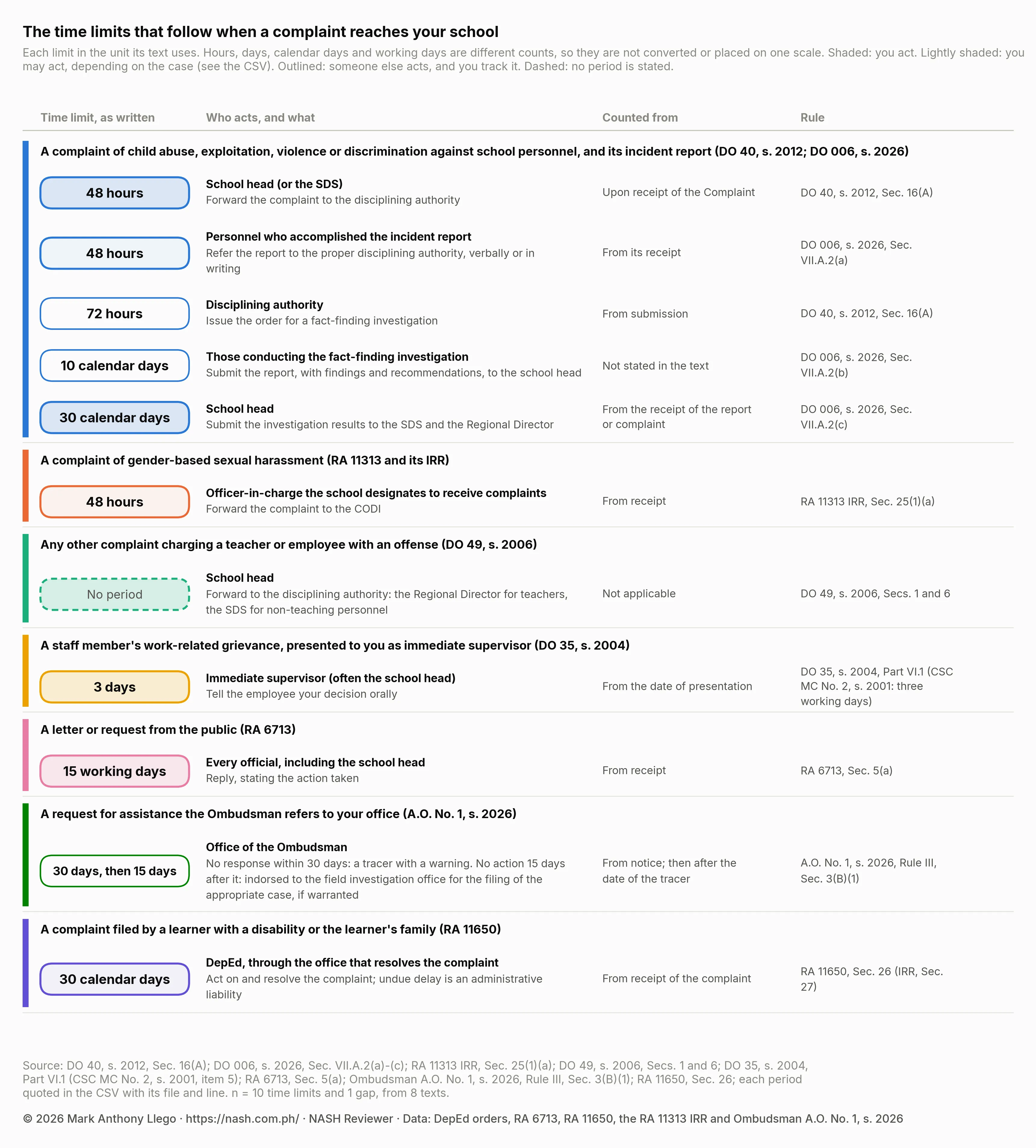
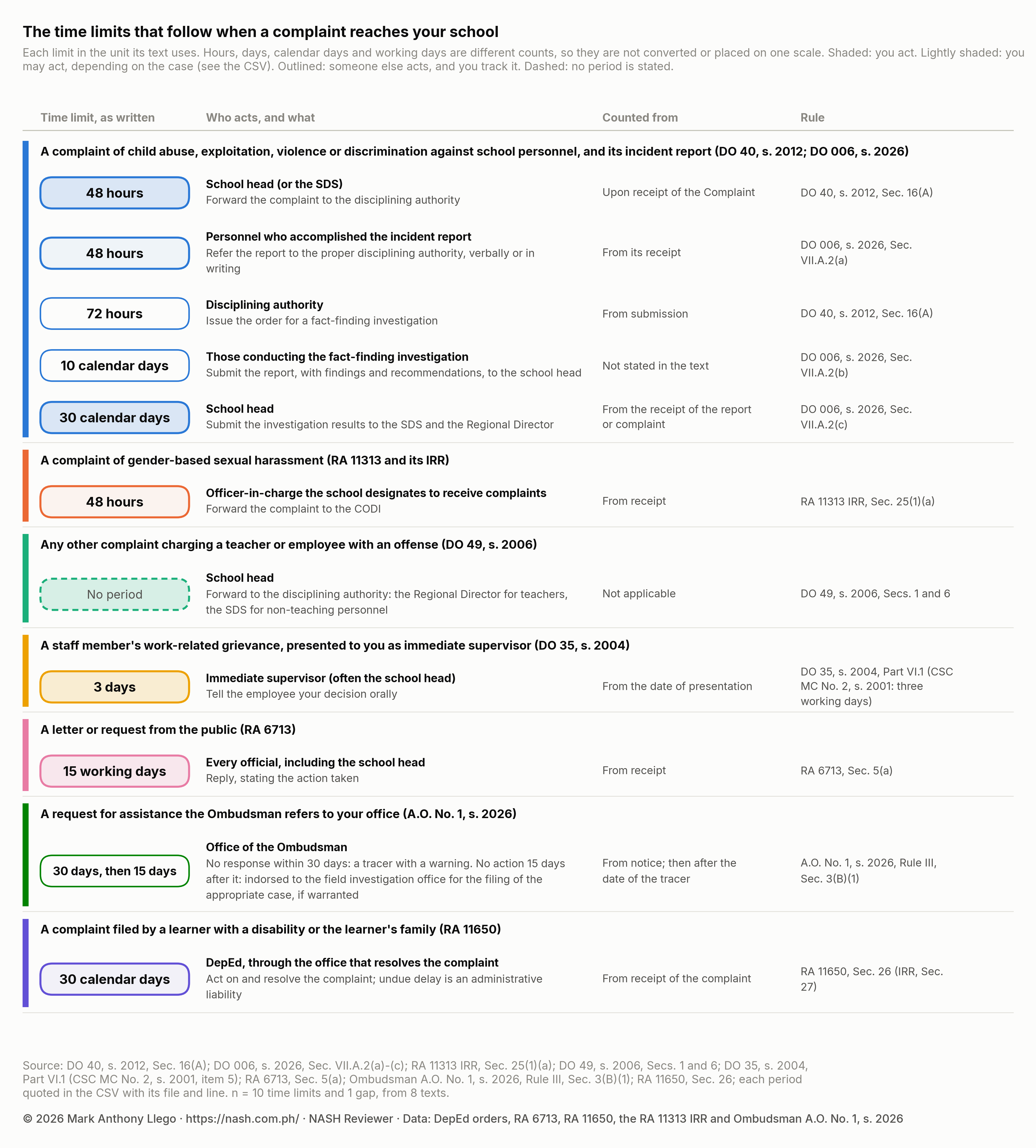
Complaints by learners with disabilities. RA 11650 has DepEd ensure that complaints “filed by learners with disabilities, their parents, guardians, care providers, or other immediate family members” are “promptly acted upon and resolved not later than thirty (30) calendar days from receipt of the complaint”; anyone causing “any undue delay” is “held administratively liable” (Sec. 26; IRR, Sec. 27, in effect since January 11, 2025 under DM 043, s. 2025). It sits among procedural safeguards for rights under the Act, and neither text says how it fits the DO 49 and RACCS periods in a disciplinary case. If the complaint charges personnel with an offense, forward it at once and note the 30-day period in the transmittal; if it concerns the learner’s services or rights at your school, act on it or send it at once to the office that can resolve it, within the 30 calendar days. Both the Act and its IRR give schools up to five years to comply with their provisions (RA 11650, Sec. 29; IRR, Sec. 29); neither says whether that delays the 30-day rule, so treat it as applying now.
Three points about counting:
- Hours are hours. Neither DO 40 nor DO 006 excludes weekends, and DO 40’s periods “shall be strictly observed, except when justified by circumstances beyond their control”; write any such reason down.
- Do not convert units. DO 006 counts “calendar days”, which include weekends; RA 6713 counts “working days”, which do not; DO 35 says “days”.
- A missed clock can itself be a ground for a charge. A late incident report, “without justifiable cause, shall be a ground for administrative action for neglect of duty against the responsible official” (DO 40, Sec. 16(G)). Bullying timelines are in the child protection guide’s table of time limits.
Forwarding to the disciplining authority
Know who decides. The Magna Carta’s “teacher” includes “all other persons performing supervisory and/or administrative functions in all schools” (RA 4670, Sec. 2), so complaints against school heads also go to the Regional Director (DO 49, Secs. 1 and 6; Who Disciplines DepEd Teachers and School Heads?).
Use your division’s channel, within the clock. The superintendent must “Facilitate investigations and disciplinary actions via SDO Legal Unit” (DO 006, Sec. IX.C), so complaints may go through that unit; an abuse complaint is still forwarded within 48 hours (DO 40, Sec. 16(A)).
What to send (no rule prescribes it): the complaint as received, with its attachments; a transmittal stating when and how it was received, with no opinion on guilt; for a learner’s case, the incident report and intake sheet, sent as your division handles confidential records. Keep a copy and proof of the date it left.
Ordinary complaints have no forwarding period. DO 49 sets none for a school head, for example for a teacher’s complaint that a colleague falsified a time record. That is a gap, not permission to wait: the disciplining authority’s periods start only when it receives the complaint (DepEd Preliminary Investigation, Formal Charge and Answer).
Telling the person complained of is not your step. The investigator serves the order to submit a counter-affidavit or comment, “together with a copy of the complaint and the supporting documents thereof” (DO 49, Sec. 9(a); see also 2025 RACCS, Secs. 15 and 22). If asked, say only that a complaint was received and forwarded.
The 10 and 30 calendar days. DO 006 has the fact-finding report “submitted to the School Head within 10 calendar days”, and “The School Head shall submit investigation results to the Schools Division Superintendent (SDS) and the Regional Director (RD) within 30 calendar days from the receipt of the report or complaint.” (Sec. VII.A.2(b)–(c)). It does not settle who conducts the fact-finding in a case against personnel; do not appoint yourself. If you have no results within the 30 calendar days because the case is with the disciplining authority, the safe course is to report that in writing within the period.
Example. Parent C hands Principal B a sworn complaint that Teacher A pulled her son’s ear, at 3:00 p.m. on a Tuesday. The 48 hours end at 3:00 p.m. on Thursday; Principal B forwards it on Wednesday and files the receiving copy.
Grievances you decide as immediate supervisor
Here the rules give you the decision: alone at step 1, and as a member of the School Grievance Committee later.
Step 1 is yours. The employee presents the grievance to the immediate supervisor, “who shall, within three (3) days from the date of presentation, inform the employee orally of his or her decision.” (DO 35, s. 2004, Part VI.1). The CSC’s rule says “within three (3) working days from the date of presentation” (CSC MC No. 2, s. 2001, item 5). A decision within three days meets both. Do not sit on it: “Officials who refuse to take action on a grievance brought to their attention shall be liable for neglect of duty in accordance with civil service laws, rules and regulations.” (Part VII).
The oral discussion, later steps and committee are in DepEd Grievance Machinery: Steps and Time Limits. A grievance that alleges an offense goes to the disciplining authority.
Ombudsman and CSC referrals
The Ombudsman refers, and expects action. “At its option, the Office of the Ombudsman may refer certain complaints to the proper disciplinary authority for the institution of appropriate administrative proceedings” (RA 6770, Sec. 23(2)); for a teacher, that is the Regional Director. The same section warns: “Any delay without just cause in acting on any referral made by the Office of the Ombudsman shall be a ground for administrative action against the officers or employees to whom such referrals are addressed and shall constitute a graft offense punishable by a fine of not exceeding Five thousand pesos (P5,000.00).”
Requests for assistance can come to the school. Under the Ombudsman’s Revised Rules of Procedure, A.O. No. 1, s. 2026 (signed January 19, 2026), a “Request for Assistance” is a concern “which does not necessarily amount to a criminal, administrative or forfeiture charge” (Rule III, Sec. 2(a)). When one is referred to an agency:
“If no response is received within thirty (30) days from notice, a tracer shall be sent with a warning under Section 7 of this Rule. If still no action is taken within fifteen (15) days after the date of the tracer, the action officer shall indorse the RAS folder to the field investigation office/bureau for the filing of the appropriate case against the concerned officer/s, if warranted.” (Rule III, Sec. 3(B)(1))
“Any delay or refusal to comply with the referral or directive of the Office of the Ombudsman shall constitute a ground for administrative disciplinary action against the officer or employee to whom it was addressed” (Rule III, Sec. 7). Act and reply in writing well inside the 30 days. A referral that concerns a charge against your staff goes to the disciplining authority; tell the referring office where it went.
The CSC “may also refer an administrative case or matter to any other agency” (2025 RACCS, Sec. 6); route such a referral the same way. Which body keeps a case is covered in Can the Ombudsman Discipline a Principal?.
Letters and requests: reply within 15 working days
RA 6713, the Code of Conduct and Ethical Standards for Public Officials and Employees, says: “All public officials and employees shall, within fifteen (15) working days from receipt thereof, respond to letters, telegrams or other means of communications sent by the public. The reply must contain the action taken on the request.” (Sec. 5(a)). Failing to do so is a light offense: “Failure to act promptly on letters and request within fifteen (15) working days from receipt” (2025 RACCS, Sec. 63(C)(4)). DO 49’s older list says “within fifteen (15) days from receipt” (Sec. 58(C)(13)). A reply within 15 days meets both.
For a complaint letter, the “action taken” is the routing: when it was received and where it went, not the evidence or any expected outcome.
Protect the complainant and preserve the evidence
No reprisal. In grievances, “The aggrieved party shall be assured freedom from coercion, discrimination, reprisal, and biased action on the grievance.” (DO 35, Part I.2). In sexual harassment cases, the CODI must “Ensure the protection of the complainant from retaliation and guarantee confidentiality to the greatest extent possible” (2025 RACCS, Sec. 17(C)(4); see also RA 11313, Sec. 22(c)(7)). Make no change in a complainant’s load, schedule or rating that you cannot explain on other grounds.
Act on harassment reports at once. A head of office who “is informed of such acts by the offended party and no immediate action is taken” is solidarily liable for damages (RA 7877, Sec. 5), and under RA 11313 school heads may be held responsible for “Failure to act on reported acts of gender-based sexual harassment committed in the educational institution” (Sec. 23(b)). See Harassment, Child Abuse and Hazing: Cases on School Heads.
Keep the evidence as it is. No rule tells a school head how to preserve evidence, but a respondent who “either has access to and control over the evidence, or authority over the custodian of said evidence that will be presented against him or her” may be preventively suspended (2025 RACCS, Sec. 34(b)(3); see also DO 49, Sec. 16). The safe course is to keep records that may matter (class records, attendance logs, CCTV recordings) unaltered, give the investigator certified true copies on request, and not ask the person complained of for a written explanation, since requiring a counter-affidavit or comment is the investigator’s step (DO 49, Sec. 9(a)).
Keeping it confidential: no publicity
“No publicity shall be given to any disciplinary action being taken against a teacher during the pendency of his case.” (RA 4670, Sec. 8, last paragraph; DO 49, Sec. 40 repeats it).
For learners, “the identity or other information that may reasonably identify the pupil, student or learner, whether victim or offender, shall be withheld from the public to protect his or her privacy” (DO 40, Sec. 18). DO 006 requires “the utmost confidentiality” about all parties from those who collected the data, naming “the school head or school principal”, and “Any personnel who commit a breach of confidentiality shall be subject to appropriate administrative action” (Sec. XII). RA 6713 bars using or divulging “confidential or classified information officially known to them by reason of their office and not made available to the public” to further private interests, give undue advantage to anyone, or prejudice the public interest (Sec. 7(c)), and the 2025 RACCS prohibits any unauthorized “posting in social media platforms or public domains of any copy of the official record” (Sec. 53).
The media. Under DO 007, s. 2026, the Media Management Guidelines, a teacher invited by the press or a content creator must “first inform their School Head” (Sec. V.A.5(b)(i)). For sensitive topics such as “ongoing investigations”, you may endorse a request to the superintendent, who “shall elevate the request to the RD for review and appropriate endorsement” (Sec. V.A.5(a)(ii), (b)(iii) and (v)); you do not clear such an interview yourself.
In practice: no names or facts at meetings or in group chats, complaint files locked, and one line for anyone who asks: the complaint went to the proper office. Public hearings under the RACCS are discussed in Formal Investigation and Decision in DepEd Cases.
What not to do
| Do not | Why | Rule |
|---|---|---|
| Investigate a charge unless the disciplining authority appoints you as investigator, or decide one at all | The disciplining authority decides and appoints the investigator | DO 49, Secs. 1 and 8(c); 2025 RACCS, Sec. 15 |
| Send a charge to the grievance committee | “A Grievance Committee is not allowed to hear and decide administrative disciplinary cases.” | DO 49, Sec. 2 |
| Preventively suspend anyone, or tell a teacher to stay home | Only “the proper Disciplining Authority” (DO 49, Sec. 15) or, under the 2025 RACCS, its authorized representative named in a signed delegation (Secs. 33–34) may, upon or after a formal charge | DO 49, Sec. 15; 2025 RACCS, Secs. 33–34 |
| Reassign the person complained of on your own initiative | Reassignment in lieu of suspension comes only after a formal charge, and DO 49 names “the proper disciplining authority or head of office” without defining the latter. Write to the disciplining authority instead | DO 49, Sec. 17; 2025 RACCS, Sec. 36 |
| Press the complainant to withdraw, or treat a withdrawal as the end | “The withdrawal of the complaint does not result in its outright dismissal nor in the discharge of the person complained of from any administrative liability.” (DO 49, Sec. 7) | DO 49, Sec. 7; 2025 RACCS, Sec. 14 |
| Broker a settlement, or send a child protection complaint to the barangay | Sexual harassment complaints “shall not be subject to mediation and settlement”; DO 40 complaints “shall not be brought for amicable settlement before the Barangay” | 2025 RACCS, Sec. 75; DO 40, Sec. 17 |
| Publicize the case or the people in it | No publicity while a teacher’s case is pending | RA 4670, Sec. 8; DO 49, Sec. 40 |
| Hold a complaint past its clock | Neglect of duty; for Ombudsman referrals, also a graft offense | DO 40, Sec. 16(G); DO 35, Part VII; RA 6770, Sec. 23(2) |
Reassignment. DO 49, Sec. 17 places it “during the formal hearings”; the 2025 RACCS, Sec. 36, “after the issuance of the formal charge”. So moving a teacher out of a post when a complaint first arrives fits neither text (see First: is a learner at risk?). If you think a respondent should be moved, at intake or after a charge, say why in writing to the disciplining authority; do not move the teacher yourself. See Preventive Suspension, Appeals and Back Pay for Principals and Can a Principal Be Reassigned to Another School?
Settlement. Settlement, where allowed, runs through a mediation officer the disciplining authority assigns, or DepEd’s mediation units, and never through the school; sexual harassment and child abuse complaints cannot be settled (2025 RACCS, Secs. 75–76; DO 15, s. 2012; DO 40, Sec. 17). Forward a lender’s complaint like any other, and do not press the teacher to pay (Can a Teacher Be Charged for Unpaid Loans in DepEd?).
When the complaint is against you
A complaint about you that reaches your office. Forward it, unaltered, to the Regional Director (DO 49, Secs. 1 and 6). DO 40’s 48-hour duty makes no exception for a complaint that names the head (Sec. 16(A)).
A grievance about you. “where the object of the grievance is the immediate supervisor, the aggrieved party may bring the grievances to the next higher supervisor” (DO 35, Part VI.1). DO 35 has no rule on whether you still sit on the School Grievance Committee; the safe course is to step aside, say why in writing, and ask your district or division office who will sit instead.
A harassment complaint about you. “When a member of the CODI is either the complainant or the person complained of, such member shall inhibit from the investigation, or the complaint may be filed directly with the CSC.” (2025 RACCS, Sec. 17). If you are the officer designated to receive harassment complaints and one names you, forward it unaltered to the CODI at once and take no other part in it: the offended party “may directly file a complaint with the CODI” (IRR of RA 11313, Sec. 25(1)), and CODI members must be “impartial and not connected or related to the alleged perpetrator” (RA 11313, Sec. 22(c)(4)).
Do not approach the complainant or the witnesses. Having employees “under his or her direct supervision whom he or she could influence” is one of the listed circumstances that, with a grave charge, can support preventive suspension (2025 RACCS, Sec. 34(b)(4)); DO 49 allows it “to preclude the possibility of exerting undue influence or pressure on the witnesses” (Sec. 16).
If the Ombudsman or the CSC has the case, object to the forum at the start. In Medrano (2008), a school officer-in-charge who objected only in a motion for reconsideration after losing was held “barred from assailing petitioner’s acts under the principle of estoppel”. An early objection does not always succeed, so answer the charge as well (Can the Ombudsman Discipline a Principal?).
Answer on time. The texts set different periods for answering a formal charge:
- DO 49 requires the formal charge to direct an answer “in not less than seventy-two (72) hours from receipt thereof” (Sec. 10), and a respondent who does not answer “within five (5) days from receipt thereof” “shall be considered to have waived his right thereto” (Sec. 14).
- The 2025 RACCS requires a “Directive to answer the charge in writing, under oath, in not less than three (3) days but not more than ten (10) days from receipt thereof” (Sec. 26(b)), and a motion for more time is not entertained (Sec. 28).
DepEd’s 2026 orders treat both as in force, and no rule or decision says which prevails. If the case reaches the CSC on appeal, the CSC applies the 2025 RACCS. Both respect the statutory floor: the respondent “shall be allowed not less than seventy-two hours after receipt of the complaint to answer” (Administrative Code of 1987, Book V, Sec. 48(2)). One act satisfies both: answer within the period the formal charge states and, in any case, within five days of receipt. Earlier, DO 49 gives “three (3) days from receipt of the said Order” for the counter-affidavit (Sec. 9(a)), and the 2025 RACCS “five (5) days from receipt of the complaint which is sufficient in form and substance” (Sec. 22(a)); filing within three days of receiving the order, which comes with the complaint, meets both. The details are in DepEd Preliminary Investigation, Formal Charge and Answer.
Get help, and keep working. You may “be defended by a representative of his choice and/or by his organization” (RA 4670, Sec. 8(c)); whether a non-lawyer may appear is unsettled (see the formal investigation guide). A pending case does not by itself disqualify you from promotion unless a law or regulation provides otherwise, and under the 2025 RACCS a case is “pending” only once a formal charge or notice of charge is issued (DO 49, Sec. 39; 2025 RACCS, Sec. 55). Do not post any case record online (2025 RACCS, Sec. 53).
Records to keep
| Record | What it proves | Rule |
|---|---|---|
| Receipt log with date and time | When each clock started | DO 40, Sec. 16(A); DO 006, Sec. VII.A.2; RA 6713, Sec. 5(a) |
| Incident report, intake sheet and risk assessment (kept by the guidance counselor or designated CPC member); protective steps | That the learner’s case was documented and the learner protected | DO 006, Secs. VII.A.1–2; DO 40, Sec. 22 |
| Notice of the formal requirements; date the formal complaint was filed | When the 48 hours began | DO 40, Sec. 16(B) |
| Transmittal and receiving copy for each forward | That you forwarded on time | DO 40, Sec. 16(A) and (G) |
| Grievance notes; replies to letters and referrals; the 30-calendar-day reports | That you acted on time | DO 35, Part VI.1; RA 6713, Sec. 5(a); A.O. No. 1, Rule III; DO 006, Sec. VII.A.2(c) |
Personnel records generally are covered in Human Resource Management for DepEd School Heads.
What this means for school heads
Set up before you need it. Write the complaint routine into the school’s child protection procedures, which DO 006 says must “define roles, timelines, reporting channels, protective measures, and investigation protocols” (Sec. VII.A). Name the officer who receives sexual harassment complaints (RA 11313, Sec. 21). RA 11313 also makes it your duty to post the Act, take prevention measures, and “Create an independent internal mechanism or a CODI” (Sec. 22(a)–(c)); non-implementation is punishable (Sec. 23(a)). How DepEd’s CODIs are set up is in Sexual Harassment and Child Abuse Complaints in DepEd. Ask your division’s legal unit how it wants complaints sent.
When something arrives: safety first; receive and record; sort; forward within the clock; reply to the sender; keep it confidential; report within 30 calendar days from receipt of the report or complaint where DO 006 applies. Do not investigate unless designated, decide, suspend, settle or publicize, and do not reassign anyone on your own initiative; write to the disciplining authority if you think a move is needed. Refer to the Regional Director for teachers and school heads, the superintendent for non-teaching personnel, the CODI for harassment, the local social welfare office for a learner’s needs (DO 40, Sec. 16(C)), and your division’s legal unit when unsure.
See also PPSSH Domain 2, Domain 4 and Domain 5, RA 6713 for DepEd School Heads: Ethics and Internal Control, and, for officers-in-charge, Principal, Head Teacher or Teacher-in-Charge in DepEd.
How the NASH may test this
The two items below are original practice items, scored 3 (Relational), 2 (Multistructural), 1 (Unistructural) or 0 (Prestructural). An option that breaks a rule scores 0.
Question 1
Indicator 2.4.1, Management of staff. Career Stage 1, Situational, Moderate.
You are the principal of an elementary school. On a Monday morning, Parent C hands you an unsigned handwritten letter saying that Teacher A slapped her son, Learner D, in class on Friday. Learner D is in school today and is afraid to return to Teacher A’s class. What is the most appropriate course of action?
- A. Have the incident report and intake sheet done, refer the report to the disciplining authority within 48 hours, and tell Parent C what a sworn complaint must contain.
- B. Receive the letter, give Parent C a received copy, and tell her what a sworn complaint must contain so that it can be forwarded to the disciplining authority.
- C. Keep Learner D away from Teacher A’s class for now and tell his family, have the incident report done and referred within 48 hours, and tell Parent C what a sworn complaint must contain.
- D. Keep Learner D safe and away from Teacher A’s class for now, tell his family, have the incident report done and referred within 48 hours, explain the formal requirements, and keep it confidential.
Answer and explanation
Best answer: D. Points: A = 1, B = 0, C = 2, D = 3.
- A (1 point, Unistructural). It documents, refers on time and explains the requirements, but does nothing for an afraid learner or his family and says nothing of confidentiality.
- B (0 points, Prestructural). It holds the learner’s report until a sworn complaint arrives, which DO 006, Sec. VII.A.2 does not allow, and does nothing for the learner.
- C (2 points, Multistructural). It protects the learner, informs the family, documents, refers and explains, but says nothing of confidentiality.
- D (3 points, Relational). It puts the learner’s safety first, documents and refers within the clock, answers the parent, and protects privacy.
Why. This aligns with Career Stage 1 expectations because indicator 2.4.1 asks the aspiring school head to know the rules on managing school staff. DO 40, s. 2012 requires the school head to remove a child at risk from the place of the incident and inform the family (Sec. 22), tell a complainant at once what a formal complaint needs, and act on the formal complaint once it is filed (Sec. 16(B)); DO 006, s. 2026 has the incident report referred to the disciplining authority “within 48 hours from its receipt”, “whether verbally or in writing” (Sec. VII.A.2(a)). The disciplining authority decides the case (DO 49, s. 2006, Sec. 1).
Indicator 2.4.1: Demonstrate knowledge and understanding of laws, policies, guidelines and issuances on managing school staff.
Sources: DepEd Order No. 40, s. 2012, Secs. 16 and 22; DepEd Order No. 006, s. 2026, Sec. VII.A.2; DepEd Order No. 49, s. 2006, Sec. 1.
Question 2
Indicator 5.1.1, Management of diverse relationships. Career Stage 1, Situational, Moderate.
A complaint against Teacher G has been forwarded to the Regional Director and is pending. Parents are discussing it in a group chat, and the PTA president asks you to explain the case at Saturday’s general assembly “so the rumors stop.” What should you do?
- A. Explain the complaint and Teacher G’s side at the assembly, without naming the learner, so that parents hear accurate facts from the school.
- B. Decline to discuss the case, and tell the PTA president that the matter is with the proper office.
- C. Decline to discuss the case at the assembly, tell the PTA president it is with the proper office, and remind your staff not to discuss it.
- D. Decline to discuss the case or anyone in it; say only that complaints are referred to the proper office and handled confidentially; remind staff in writing not to discuss or post it; and route any media request through the division.
Answer and explanation
Best answer: D. Points: A = 0, B = 1, C = 2, D = 3.
- A (0 points, Prestructural). Explaining a pending case to an assembly is publicity, which the Magna Carta forbids while a teacher’s case is pending.
- B (1 point, Unistructural). Declining is right, but nothing addresses the rumors or the staff who may be feeding them.
- C (2 points, Multistructural). It declines and reminds staff, but gives parents no assurance about how complaints are handled and makes no provision for the media.
- D (3 points, Relational). It keeps the case confidential, reassures parents about the process, closes staff and social media channels, and follows the media clearance route.
Why. This aligns with Career Stage 1 expectations because indicator 5.1.1 asks the aspiring school head to demonstrate skill in dealing with parents and other stakeholders. “No publicity shall be given to any disciplinary action being taken against a teacher during the pendency of his case” (RA 4670, Sec. 8). DO 006, s. 2026 binds the school head to confidentiality (Sec. XII), and DO 007, s. 2026 sends media requests on “ongoing investigations” up to the Regional Director (Sec. V.A.5).
Indicator 5.1.1: Demonstrate skills in dealing with authorities, colleagues, parents and other stakeholders to encourage an enabling and supportive environment for learners.
Sources: Republic Act No. 4670, Sec. 8; DepEd Order No. 49, s. 2006, Sec. 40; DepEd Order No. 006, s. 2026, Sec. XII; DepEd Order No. 007, s. 2026, Sec. V.A.5.
Nothing in this guide reproduces or predicts examination content.
Frequently asked questions
Can a principal investigate a complaint against a teacher?
Only if the disciplining authority appoints the principal as investigator, and a principal never decides the charge. The Regional Director is the disciplining authority for teachers and appoints the investigator (DO 49, s. 2006, Secs. 1 and 8(c); 2025 RACCS, Sec. 15).
How many hours does a school head have to forward a child abuse complaint?
Forty-eight, from receipt of the complaint (DO 40, s. 2012, Sec. 16(A)). If the complaint is not in proper form, the 48 hours run from the filing of the formal complaint (Sec. 16(B)); the incident report still goes to the disciplining authority “within 48 hours from its receipt” (DO 006, s. 2026, Sec. VII.A.2(a)). The school head reports the results within 30 calendar days from the receipt of the report or complaint (Sec. VII.A.2(c)).
Can a principal suspend or reassign a teacher while a complaint is pending?
Not on the principal’s own initiative. Preventive suspension is for the disciplining authority or, under the 2025 RACCS, its authorized representative, upon or after a formal charge (DO 49, s. 2006, Sec. 15; 2025 RACCS, Secs. 33–34). Reassignment in lieu of it also comes after a formal charge. DO 49, Sec. 17 names “the proper disciplining authority or head of office” without defining “head of office”, and the 2025 RACCS, Sec. 36 names the disciplining authority “or its authorized representative”. If you think a teacher should be moved, write to the disciplining authority. Moving a learner at risk away from the place of the incident (DO 40, Sec. 22) is a protective step, not a suspension.
What should a principal do if the complaint is against the principal?
Forward it to the Regional Director like any other, and do not contact the complainant or witnesses about it (DO 49, Secs. 1 and 6; 2025 RACCS, Sec. 34(b)). A grievance against you may go to your own supervisor (DO 35, s. 2004, Part VI.1). If the Ombudsman has the case, object to its forum at the start and answer the charge as well (Medrano, 2008).
Download the data
- steps-complaint-deadlines.csv: the ten time limits and one gap in Figure 1, with the kind of complaint, the period as written, its unit, what it is counted from, who acts and what, whether the school head acts, and the rule.
The CSVs and charts may be reused only with written permission: email support@nash.com.ph. The rules themselves come from DepEd’s and the Civil Service Commission’s issuances, which you can cite directly.
Sources
DepEd issuances
- DepEd Order No. 49, s. 2006, Revised Rules of Procedure of the Department of Education in Administrative Cases, December 12, 2006, Secs. 1, 2 (last paragraph), 4, 6, 7, 8(c)–(d), 9(a), 10, 14–17, 39, 40 and 58(C)(13).
- DepEd Order No. 35, s. 2004, Revision of the Grievance Machinery of the Department of Education, June 3, 2004, Parts I.2, V, VI.1 and VII (introduction).
- DepEd Order No. 40, s. 2012, DepEd Child Protection Policy, May 14, 2012, Secs. 16(A)–(C), 16(E.1), 16(G), 17, 18 and 22.
- DepEd Order No. 15, s. 2012, DepEd Policy Framework for the Implementation of the Alternative Dispute Resolution (ADR) System-Mediation, February 17, 2012, para. 2 and the enclosure’s exclusions.
- DepEd Order No. 006, s. 2026, Guidelines on Ensuring a Safe and Motivating Learning Environment, March 24, 2026, Secs. VII.A, VII.A.1–2, VIII, IX.C and XII.
- DepEd Order No. 007, s. 2026, Media Management Guidelines, March 25, 2026, Sec. V.A.5.
- DepEd Memorandum No. 043, s. 2025, Dissemination of the Implementing Rules and Regulations (IRR) of Republic Act No. 11650, May 9, 2025, para. 3 and the IRR’s Secs. 27 and 29.
Laws and rules
- Executive Order No. 292, Administrative Code of 1987, Book V, Title I, Subtitle A, Sec. 48(2).
- Republic Act No. 4670, Magna Carta for Public School Teachers, June 18, 1966, Secs. 2 and 8.
- Republic Act No. 6713, Code of Conduct and Ethical Standards for Public Officials and Employees, February 20, 1989, Secs. 5(a) and 7(c).
- Republic Act No. 6770, The Ombudsman Act of 1989, November 17, 1989, Sec. 23(2).
- Republic Act No. 7877, Anti-Sexual Harassment Act of 1995, February 14, 1995, Sec. 5.
- Republic Act No. 10627, Anti-Bullying Act of 2013, September 12, 2013, Sec. 2.
- Republic Act No. 11313, Safe Spaces Act, April 17, 2019, Secs. 21, 22 and 23.
- Implementing Rules and Regulations of Republic Act No. 11313, October 28, 2019, Sec. 25(1)(a).
- Republic Act No. 11650, Instituting a Policy of Inclusion and Services for Learners with Disabilities in Support of Inclusive Education Act, March 11, 2022, Secs. 26 and 29.
- 2025 Rules on Administrative Cases in the Civil Service, CSC Resolution No. 2500357, promulgated April 30, 2025, in force August 4, 2025, Secs. 6, 11–17, 22, 26(b), 28, 33, 34, 36, 53, 55, 63(C)(4), 75 and 76, and Rule 18.
- CSC Memorandum Circular No. 2, s. 2001, Revised Policies on the Settlement of Grievances in the Public Sector (CSC Resolution No. 010113, January 10, 2001), item 5.
- CSC Memorandum Circular No. 4, s. 2010, Revised Policies in the Resolution of Protest Cases, Item 1.
- Office of the Ombudsman, Administrative Order No. 1, s. 2026, Revised Rules of Procedure of the Office of the Ombudsman, signed January 19, 2026, Rule I, Sec. 3; Rule III, Secs. 2(a), 3(B)(1) and 7.
Supreme Court decision
- Office of the Ombudsman v. Medrano, G.R. No. 177580, October 17, 2008 (Second Division).
This guide explains DepEd and Civil Service Commission rules for study and professional awareness. It is not legal advice; for a specific case, consult a lawyer or your Schools Division Office’s legal unit.
The administrative cases and grievances series
- DepEd Administrative Cases and Grievances: DO 49 and DO 35
- Who Disciplines DepEd Teachers and School Heads?
- How to File an Administrative Complaint in DepEd
- DepEd Preliminary Investigation, Formal Charge and Answer
- Formal Investigation and Decision in DepEd Cases
- DepEd Administrative Offenses and Penalties in 2026
- Can a Teacher Be Charged for Unpaid Loans in DepEd?
- DepEd Grievance Machinery: Steps and Time Limits
- Grievance or Administrative Case? Where to File
- Sexual Harassment and Child Abuse Complaints in DepEd
- What a School Head Does When a Complaint Arrives (this post)
Written by Mark Anthony Llego for NASH Reviewer. Sources: DepEd Orders No. 49, s. 2006, No. 35, s. 2004, No. 40, s. 2012, No. 15, s. 2012, and No. 006 and No. 007, s. 2026; DepEd Memorandum No. 043, s. 2025; 2025 RACCS; CSC MCs No. 2, s. 2001 and No. 4, s. 2010; Administrative Code of 1987; RA 4670, RA 6713, RA 6770, RA 7877, RA 10627, RA 11313 with its IRR, and RA 11650; Ombudsman A.O. No. 1, s. 2026; Office of the Ombudsman v. Medrano (2008). Charts may be reused only with written permission from support@nash.com.ph.