Both orders are still in force as of October 31, 2026. DepEd Order No. 49, s. 2006, the Revised Rules of Procedure of the Department of Education in Administrative Cases, governs how DepEd disciplines its people: who decides, how a complaint is filed and investigated, and how a case is decided and appealed. DepEd Order No. 35, s. 2004, the Revision of the Grievance Machinery of the Department of Education, governs work-related complaints that charge no offense. No DepEd order has amended or replaced either one.
Neither order stands alone. The Civil Service Commission’s 2025 Rules on Administrative Cases in the Civil Service (2025 RACCS), in force since August 4, 2025, cover the same ground as DO 49, and DepEd’s 2026 orders cite both texts. Where they differ, no rule or decision says which prevails. Where the Administrative Code of 1987, a statute, speaks, it governs both. And one part of DO 35 is gone: since 2010, a protest against an appointment no longer goes through the grievance machinery.
Below are the status of each instrument, a case’s time limits under both texts, five rules for school heads, common misreadings, and the questions the other nine posts in this series answer.
Key findings
- Both orders are in force. DO 49 (December 12, 2006) superseded DO 43, s. 2006 and has not been amended or replaced; DepEd’s 2024 orders still send complaints to DO 35 (June 3, 2004) (DO 49, para. 2; DO 002, s. 2024, Sec. V.D).
- DepEd’s 2026 orders treat DO 49 and the 2025 RACCS as both in force, and no rule or decision says which prevails. DO 007, s. 2026 says both “also apply” in cases “involving the use of social media” (Sec. VI.2), and DO 018, s. 2026 names both (Sec. VII, item 4.0). A case that reaches the CSC on appeal is decided under the 2025 RACCS.
- The Administrative Code settles several points by statute: at least 72 hours to answer, a hearing 5 to 10 days from receipt of the answer, cross-examination, and 15 days to decide a motion for reconsideration (EO 292, Book V, Secs. 48(2), (4), (5) and 49(1)).
- The Regional Director or the Secretary decides charges against teachers, including school heads. The superintendent disciplines non-teaching personnel only, and the school head is not a disciplining authority for personnel (DO 49, Sec. 1; Public Schools District Supervisors Association v. De Jesus, 2006).
- A grievance committee may not decide a charge (DO 49, Sec. 2, last paragraph), and protests left the grievance machinery in 2010 (CSC Memorandum Circular No. 4, s. 2010, Item 1).
- The 2021 proposal to drop “willful failure to pay just debts” was never adopted; the ground is in the Administrative Code itself (OUA Memo 00-0921-0125, September 8, 2021; EO 292, Book V, Sec. 46(b)(22)).
Are DO 49 and DO 35 still in force? The status table
| Instrument | What it is | Status on October 31, 2026 |
|---|---|---|
| DO 49, s. 2006 | DepEd’s rules of procedure in administrative cases; order dated December 12, 2006, rules dated December 4, 2006 | In force; not amended or replaced. Where it differs from the 2025 RACCS, unsettled (next section); where the Administrative Code speaks, the statute governs (for example, clemency: EO 292, Book V, Sec. 53, not DO 49, Sec. 57) |
| DO 43, s. 2006 | The October 19, 2006 version of the same rules | Superseded by DO 49 (para. 2) |
| DO 35, s. 2004 | DepEd’s grievance machinery, “approved by the Civil Service Commission” (para. 1) | In force, except item V.5, protests on appointments (superseded since 2010). Modified by DO 32, s. 2017 (a woman on each committee; its line on legal counsel conflicts with Part I.3, unsettled) and by the 2025 ORAOHRA (reassignment appeals); its pointer to DECS Order No. 33, s. 1999 is outdated; the rules today are DO 49 and the 2025 RACCS |
| CSC Resolution No. 010113 and CSC MC No. 2, s. 2001 | The CSC grievance policy that DO 35 carries out | In force; the 2025 RACCS still names MC No. 2, s. 2001 (Sec. 7) |
| 2025 RACCS | CSC Resolution No. 2500357, April 30, 2025 | In force since August 4, 2025; repealed the 2017 RACCS (Sec. 156) |
| RA 4670, Secs. 8 and 9 | The Magna Carta’s no-publicity rule and the committee that hears a teacher’s case | In force; not amended |
| Administrative Code of 1987, Book V, Secs. 46–53 | Grounds, procedure, appeals and preventive suspension for civil servants | In force; governs where it speaks |
DO 49 and the 2025 RACCS: both in force, and where they conflict
What DepEd says. DO 007, s. 2026, the Media Management Guidelines, provides that DO 49 “and the 2025 RACCS also apply in the institution, investigation, prosecution, and adjudication of cases involving the use of social media” (Sec. VI.2). The sentence is about social-media cases, not every case, but it is DepEd’s clearest statement that both texts are live. DO 018, s. 2026 names both (Sec. VII, item 4.0), and DO 006, s. 2026 points investigations of school personnel in learner-protection cases to DO 49 (Annex A).
What the CSC says. Agency rules of procedure “shall not be in conflict with these Rules, unless otherwise allowed by law” (2025 RACCS, Sec. 2). Its repealing clause reaches “all other memorandum circulars, resolutions, rules, and regulations, inconsistent with these Rules” (Sec. 156). Neither section names a DepEd order.
What remains unsettled. No DepEd order and no Supreme Court decision says which text prevails where they differ. If a case reaches the CSC on appeal, the CSC applies the 2025 RACCS. Until then, the safe course is an act that satisfies both texts; where no such act exists, the question is open.
Where a statute speaks, it governs both. RA 4670 sets the committee that hears a teacher’s case (Sec. 9) and the bar on publicity (Sec. 8). The Administrative Code, Book V, settles these points for cases against non-presidential appointees, teachers among them:
| Point | The statute | Effect |
|---|---|---|
| Time to answer | “not less than seventy-two hours after receipt of the complaint to answer” (Sec. 48(2)) | Both texts respect this floor |
| Hearing schedule | “not earlier than five days nor later than ten days from the date of receipt of respondent’s answer”, finished “within thirty days from the filing of the charges” (Sec. 48(4)) | The RACCS follows it; DO 49 counts from the order creating the committee |
| Testing witnesses | Cross-examination, then “redirect and recross-examination” (Sec. 48(5)) | DO 49 lists written interrogatories, but its order of hearing applies “Unless the Committee directs otherwise” (Sec. 33), so a respondent may ask for cross-examination |
| Motion for reconsideration | “shall be decided within fifteen days” (Sec. 49(1)) | The statute’s 15 days, not the RACCS’s 30 (Sec. 88) |
| Clemency | The President acts “upon recommendation of the Commission” (Sec. 53) | Not “upon recommendation of the Secretary of Education” (DO 49, Sec. 57) |
The differences that remain open, with the act that meets both texts where one exists:
| Point | DepEd’s text | 2025 RACCS | One act that meets both |
|---|---|---|---|
| Anonymous complaint | Acted on only if the disciplining authority adopts it (DO 49, Sec. 8(d)) | Not entertained unless the acts are of public knowledge, verifiable, shown by sufficient evidence, or investigated and referred by an agency (Sec. 12) | Adopt one only when the RACCS test is met |
| Counter-affidavit | 3 days from receipt of the investigator’s order (DO 49, Sec. 9(a)) | 5 days from receipt of the complaint (Sec. 22(a)) | File within 3 days of receiving the order, which comes with the complaint |
| Answer | “not less than seventy-two (72) hours” (Sec. 10); waiver after “five (5) days from receipt” (Sec. 14) | 3 to 10 days from receipt (Sec. 26) | Answer within the period the charge states and, in any case, within five days of receipt |
| Preventive suspension grounds | A listed charge (Sec. 15) or undue influence (Sec. 16) | Both, “stated and substantiated in the preventive suspension order” (Sec. 34) | An order on a Sec. 34(a) charge that states and substantiates undue influence |
| Remedy from preventive suspension | Motion for reconsideration or CSC appeal, 15 days from receipt (Sec. 19) | CSC appeal only (Sec. 38) | A CSC appeal within 15 days of receipt |
| Partisan political activity | Grave: dismissal (Sec. 58(A)(8)) | Less grave: suspension, then dismissal (Sec. 63(B)) | None; the question is open |
| Settlement | DO 15, s. 2012 mediates all 17 DO 49 light offenses | Two light offenses only (Sec. 75) | Settle one of the two the RACCS names |
| Preliminary investigation length | “within thirty (30) days thereafter” (DO 49, Sec. 9(e)) | “within twenty (20) days thereafter”, extendible (Sec. 23) | An investigation that starts within five days of the disciplining authority’s receipt of the complaint and ends within 20 days of that receipt; the disciplining authority must appoint the investigator in time |
| Regional Director’s decision appealed to the Secretary | “Pending appeal, the same shall be executory, except where the penalty is removal” (DO 49, Sec. 51) | An appeal to the Secretary from “a bureau or office head” means “the decision will not be executory” (Sec. 91(a)) | None; whether a Regional Director is such a head is open |
The posts on each stage cover the other open points, such as whether a non-lawyer may represent the respondent at the hearing (formal investigation).
A case from complaint to decision
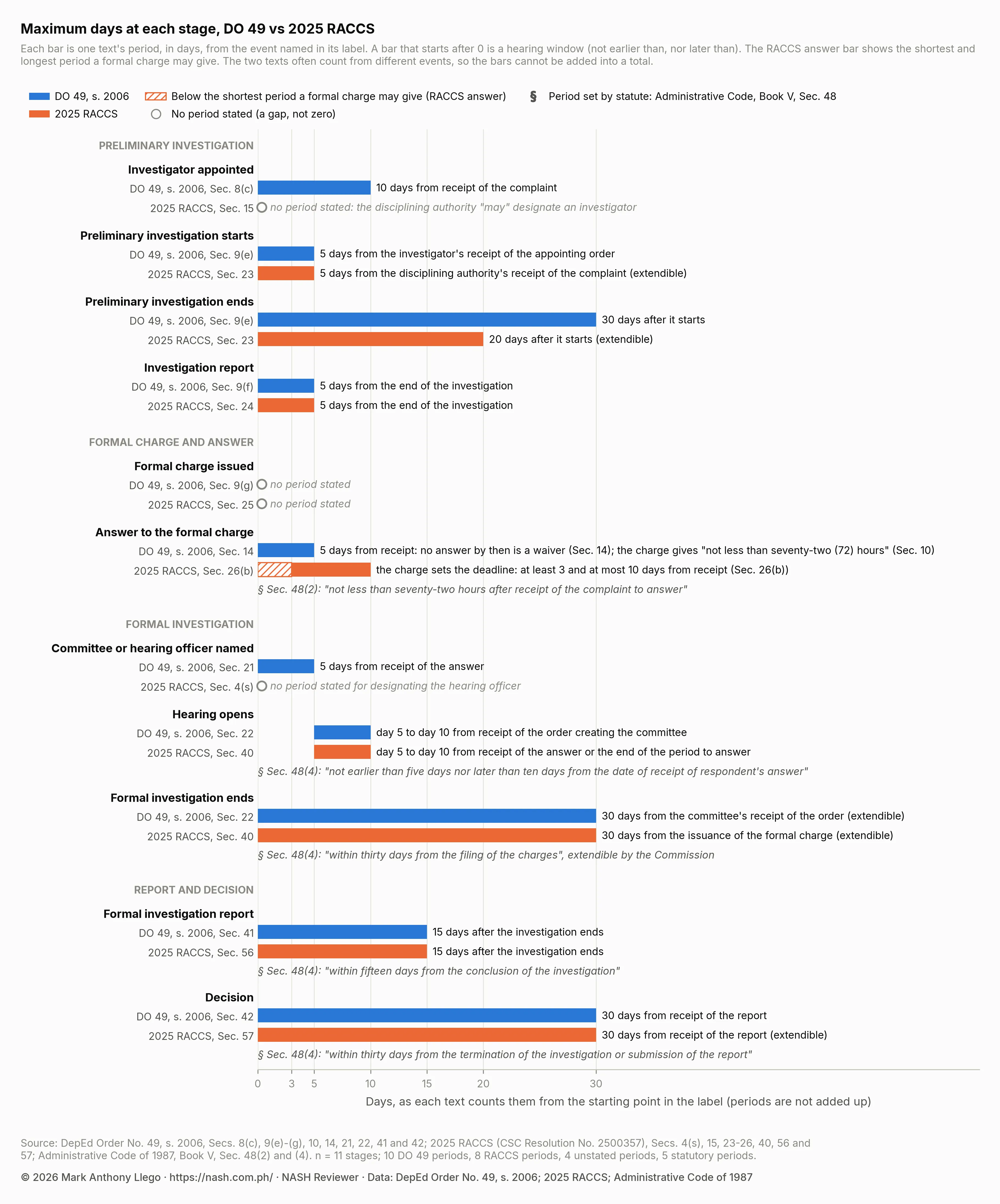
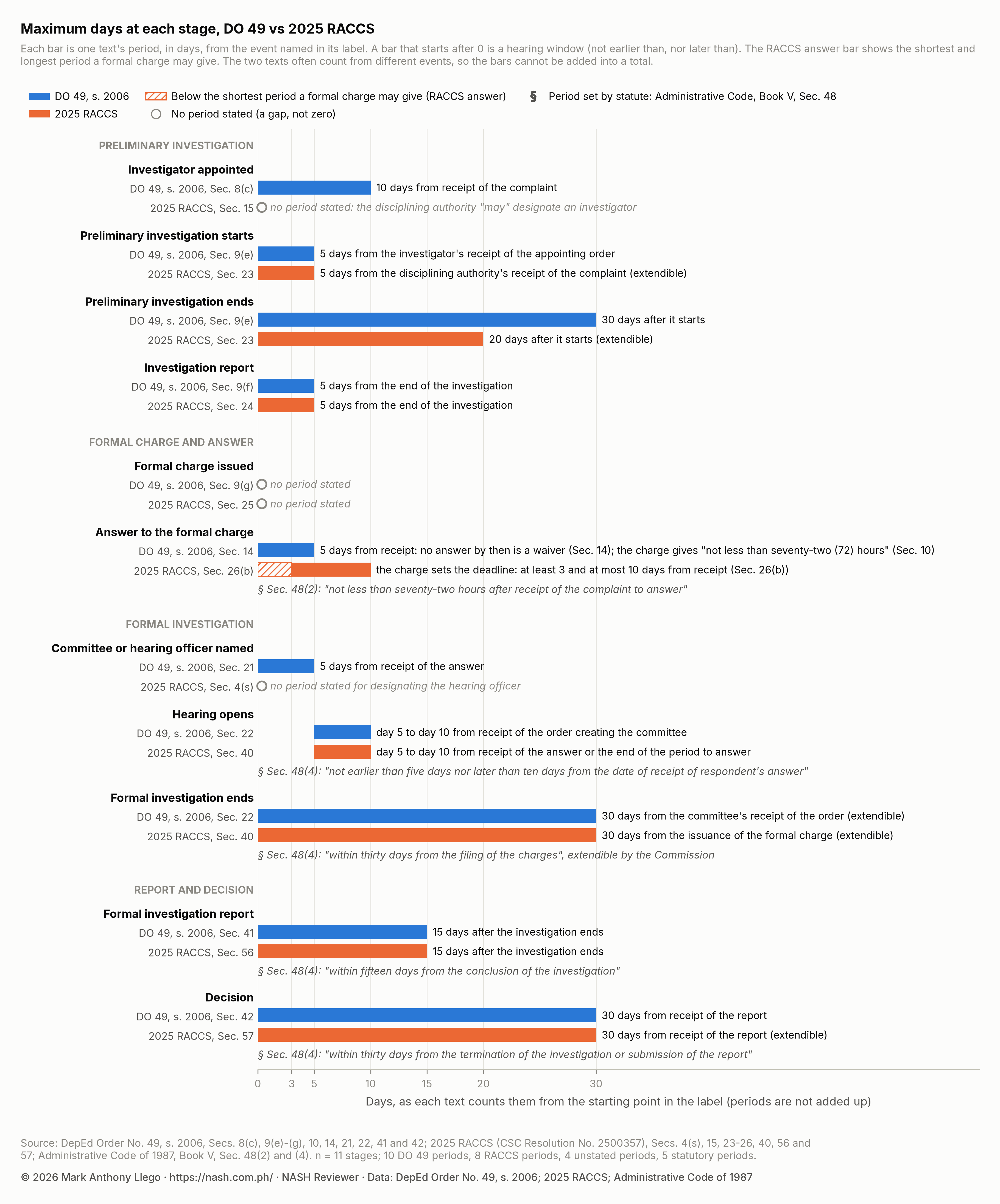
The bars cannot be added up, because the texts often count from different events: DO 49 starts the preliminary investigation’s five days at the investigator’s receipt of the appointing order (Sec. 9(e)), the RACCS at the disciplining authority’s receipt of the complaint (Sec. 23). Neither text sets a period for issuing the formal charge (DO 49, Sec. 9(g); 2025 RACCS, Sec. 25), and several RACCS periods can be extended in meritorious cases (Secs. 23, 40 and 57), as can DO 49’s formal-investigation period (Sec. 22).
Grievance, case or something else?
A grievance is “a work-related discontentment or dissatisfaction” (DO 35, Part IV.5): something to fix. A charge says someone committed an offense: someone to penalize. The short version:
| The complaint is about | Where it goes | Rule |
|---|---|---|
| Pay, leave, working conditions, relationships, other work-related dissatisfaction | The immediate supervisor, then the grievance steps | DO 35, Parts V–VI |
| An offense by a teacher or school head | The Regional Director | DO 49, Secs. 1 and 6 |
| An offense by non-teaching personnel in a division | The Schools Division Superintendent | DO 49, Secs. 1 and 6 |
| Sexual harassment | The Committee on Decorum and Investigation (CODI) | 2025 RACCS, Sec. 16 |
| Harm to a learner by school personnel | The disciplining authority, within 48 hours | DO 40, s. 2012, Sec. 16(A) |
| An appointee’s lack of qualifications (protest) | Not a grievance; the head of office (the superintendent, for higher teaching positions), then the CSC | CSC MC No. 4, s. 2010, Item 1; DO 007, s. 2023, item 67; DO 020, s. 2024, item 69; 2025 RACCS, Sec. 117 |
| Union-related issues | Not the grievance machinery | DO 35, Part V |
Reassignments, ratings, the Performance-Based Bonus, PTA disputes, canteens and the rest are in Grievance or Administrative Case? Where to File.
The 10 questions this series answers
Who disciplines DepEd teachers and school heads? The Regional Director or the Secretary (rule 1 below). If the superintendent is the complainant or an interested party, the Secretary appoints the whole hearing committee (RA 4670, Sec. 9), a proviso DO 49 leaves out.
How do I file an administrative complaint? In writing, under oath, with the five items DO 49, Sec. 5 and the RACCS, Sec. 11 list, filed with the Regional Director for a teacher or school head.
What happens after a complaint is filed, and how long do I have to answer? The preliminary investigation, the formal charge, the answer, and preventive suspension: who orders it and how to challenge it.
How is a formal investigation run, and what can I do after the decision? The RA 4670 committee, the statutory schedule, the decision, reconsideration and appeals, with the PHP 300 fee, plus PHP 10 for the Legal Research Fund, for an appeal to the Secretary (DO 49, Sec. 52; DO 14, s. 2015).
What are the offenses and penalties in 2026? DO 49, Sec. 58 lists 25 grave, 9 less grave and 17 light offenses; the 2025 RACCS, Sec. 63 lists 28, 12 and 16, and Sec. 64(C) adds 8 offenses under the Ease of Doing Business Act.
Can a teacher be charged for an unpaid loan? Yes, but only for a “willful failure to pay just debts”, and only if the debt is “just”: a claim “adjudicated by a court of law” or admitted by the debtor (EO 292, Book V, Sec. 46(b)(22); DO 49, Sec. 58(C)(10); 2025 RACCS, Sec. 63(C)).
What is DepEd’s grievance procedure? Five steps under DO 35, from the immediate supervisor’s decision “within three (3) days from the date of presentation” to an appeal to the CSC Regional Office “within fifteen (15) working days from the receipt of such decision” (Part VI).
Is my complaint a grievance or an administrative case? The routing table the other posts link to.
How are sexual harassment and child abuse complaints investigated? Sexual harassment goes to the CODI, which reports to the disciplining authority; child abuse complaints against personnel follow DO 40. Neither may be settled.
What does a school head do when a complaint arrives? Every deadline, and what to do when the complaint is against you.
Five rules every school head should know
1. The Regional Director or the Secretary, not the superintendent and not the principal, decides charges against teachers and school heads. “The disciplining authorities in the Department of Education shall be the Secretary and the Regional Directors in their respective regions”, and superintendents discipline non-teaching personnel (DO 49, Sec. 1). A school head is a “teacher” under RA 4670, Sec. 2, and is not a disciplining authority at all: the school head forwards complaints and recommends, but does not decide a charge or order a preventive suspension. Upholding the RA 9155 Implementing Rules, Rule IV, Sec. 4.3, the Supreme Court said that “A division superintendent of schools is not a disciplining authority over teachers” (Public Schools District Supervisors Association v. De Jesus, G.R. No. 157286, June 16, 2006, En Banc). See Who Disciplines DepEd Teachers and School Heads?
2. A grievance committee may not decide a charge. “A Grievance Committee is not allowed to hear and decide administrative disciplinary cases. If a complainant charges the respondent with the commission of administrative offenses, the same shall be disposed of accordingly by the Disciplining Authority.” (DO 49, Sec. 2, last paragraph) See Grievance or Administrative Case? Where to File.
3. Only the disciplining authority, or under the RACCS its authorized representative, orders a preventive suspension, and a CSC appeal within 15 days from receipt of the order is the remedy both texts allow (DO 49, Secs. 15 and 19; 2025 RACCS, Secs. 33 and 38). An order that rests on a charge listed in RACCS Sec. 34(a), and that states and substantiates an undue-influence circumstance, satisfies both texts. Reassignment in place of suspension goes to “the proper disciplining authority or head of office” under DO 49, which does not define “head of office” (Sec. 17), and to “the proper disciplining authority or its authorized representative” under the RACCS (Sec. 36). An order from the disciplining authority meets both, so a school head who thinks a charged teacher should be moved writes to it instead of acting alone. Pay and reinstatement are in Preventive Suspension, Appeals and Back Pay for Principals.
4. Forward an abuse, violence, exploitation or discrimination complaint against personnel within 48 hours, and a sexual harassment complaint to the CODI within 48 hours. “The School Head or the Schools Division Superintendent, upon receipt of the Complaint, shall forward the same, within forty-eight (48) hours, to the Disciplining Authority”, who orders a fact-finding investigation “not later than seventy-two (72) hours from submission” (DO 40, s. 2012, Sec. 16(A)). If the complaint is not in proper form, the 48 hours run from the filing of the formal complaint (Sec. 16(B)), but the school personnel who accomplished the incident report refer it to the disciplining authority “within 48 hours from its receipt” (DO 006, s. 2026, Sec. VII.A.2(a)). A gender-based sexual harassment complaint goes to the CODI “within forty-eight (48) hours from receipt” (RA 11313 IRR, Sec. 25(1)(a)). Other complaints have no set forwarding period; forward them promptly (What a School Head Does When a Complaint Arrives).
5. No publicity while a teacher’s case is pending. “No publicity shall be given to any disciplinary action being taken against a teacher during the pendency of his case.” The rule is the last paragraph of RA 4670, Sec. 8, and DO 49 repeats it (Sec. 40).
Common misreadings
| A common misreading | What the texts say |
|---|---|
| The 2025 RACCS repealed DO 49, or DepEd now follows only the RACCS. | DepEd’s 2026 orders cite both, and no rule or decision says which prevails; the CSC applies the RACCS on appeal. |
| DO 007, s. 2026 makes both texts apply to every case. | Its sentence covers “cases involving the use of social media” (Sec. VI.2). |
| The superintendent decides a teacher’s case. | The superintendent chairs the committee; the Regional Director or the Secretary decides. Office of the Ombudsman v. Galicia, G.R. No. 167711, October 10, 2008 (En Banc), says that, generally, the Ombudsman “must yield to the Division School Superintendent”. It means the DepEd committee the superintendent chairs, and the Court still upheld the Ombudsman’s investigation because the teacher objected too late (who disciplines). |
| The principal may reassign a charged teacher, or the principal can have no part in it. | DO 49, Sec. 17 names an undefined “head of office”; RACCS Sec. 36 names the disciplining authority or its authorized representative. Write to the disciplining authority. |
| A promotion protest goes to the grievance committee. | Not since February 10, 2010 (CSC MC No. 4, s. 2010, Item 1). DO 007, s. 2023 and DO 020, s. 2024 count 15 calendar days from issuance of the appointment; DO 019, s. 2022 and the 2025 RACCS count from announcement or posting. Filing within 15 calendar days of issuance meets every count, and on appeal the CSC applies its own (where to file). All three orders point to the 2017 RACCS’s protest rules, a pointer now outdated: the current rules are the 2025 RACCS, Rule 18 (Secs. 116–123). |
| Days means working days, or the reverse. | Each unit stands as written: DO 35 mixes “days” and “working days”, and the CSC gives the supervisor “three (3) working days”. |
| Under the RACCS, a fact-finding investigation comes first. | The RACCS has no fact-finding stage; its preliminary investigation “is a mandatory proceeding” (Sec. 21). |
| DepEd removed willful failure to pay just debts in 2021. | The 2021 proposal was never adopted, and the ground is statutory. Its papers listed 335 entries from field offices (some cases appear more than once), 160 of them labeled with the just-debts ground (unpaid loans). |
| DepEd’s sexual harassment order is DO 31, s. 2001. | That order is about voluntary contributions; DepEd has no standalone sexual harassment order (special complaints). |
| A teacher’s act against a learner is bullying. | Bullying is an act “by one or more students” against “another student” (RA 10627, Sec. 2); a teacher’s act falls under DO 40 and DO 49. |
What changed since 2004 and 2006
The two orders have not changed. The rules around them have.
| When | What changed |
|---|---|
| 2010 | CSC MC No. 4, s. 2010, effective February 10: “A protest on appointment shall no longer be acted upon through the grievance machinery.” DO 35’s item V.5 is superseded. |
| 2012 | DO 40, s. 2012: complaints of child abuse, exploitation, violence or discrimination against personnel forwarded within 48 hours of receipt, and fact-finding ordered within 72 hours of submission. DO 15, s. 2012: mediation of DO 49’s light offenses. |
| 2015 | DO 52, s. 2015: the Central Office Legal Division, where DO 49 sends some complaints, became the Legal Service. DO 14, s. 2015: PHP 10 for the Legal Research Fund on each appeal to the Secretary from a Regional Director’s decision. |
| 2017 | DO 32, s. 2017: CODIs “in all levels of governance”, at least one woman on each grievance committee, and “Inclusion of legal counsel will help guide the complainants”, against DO 35’s “The services of a legal counsel shall not be allowed” (unsettled). |
| 2023 | DO 001, s. 2023: the Undersecretary for Legal and Legislative Affairs signs Central Office decisions, committee orders, formal charges and preventive suspensions for the Secretary. |
| 2024 | OM-OUOPS-2024-05-01115: a school’s Child Protection Committee also handles gender-based sexual harassment cases. |
| 2025 | The 2025 RACCS, in force August 4, replaced the 2017 RACCS (Sec. 156). Its foreword lists what it integrates, among them the CSC’s revised rules on dishonesty and on sexual harassment, and virtual hearings. It provides for show-cause orders, notices of charge, a 3-to-10-day answer and two conditions for preventive suspension (Secs. 10, 25, 26 and 34). The 2025 ORAOHRA, in force August 3, lets an employee appeal a reassignment order “within fifteen (15) days upon receipt thereof through a formal grievance mechanism” (Sec. 13(a), item 4); for public school teachers these rules apply only “suppletorily” (item 5). |
| 2026 | DO 006, s. 2026: incident reports to the disciplining authority “within 48 hours from its receipt”, and the school head submits the results to the superintendent and the Regional Director “within 30 calendar days from the receipt of the report or complaint” (Sec. VII.A.2(a) and (c)). DO 007 and DO 018, s. 2026 cite DO 49 and the 2025 RACCS together. |
Unchanged throughout: DO 49 and DO 35 themselves, RA 4670, Secs. 8 and 9, and the Administrative Code’s Book V.
What this means for school heads
Know which hat you wear. For a grievance from your staff, you are usually the immediate supervisor and decide within three days of presentation (DO 35, Part VI.1), and you sit on the School Grievance Committee (Part VII.3(a)); see DepEd Grievance Machinery. For a charge, you are not the disciplining authority: you receive, record and forward (DO 49, Secs. 1 and 6). See Human Resource Management for DepEd School Heads.
Document every step: when a complaint arrived, where it went and when, and your replies. A missed clock can itself be a ground for a charge: failing to submit an incident report on time, “without justifiable cause, shall be a ground for administrative action for neglect of duty” (DO 40, Sec. 16(G)).
Do not hear a charge in the School Grievance Committee, suspend or move a teacher on your own initiative, settle a sexual harassment or child abuse complaint, or discuss a pending case at meetings or online (DO 49, Secs. 2, 15, 17 and 40; 2025 RACCS, Sec. 75; DO 40, Sec. 17).
Refer procedural questions to your Schools Division Office’s legal unit, and learner cases to the routine in DepEd Child Protection and Anti-Bullying: School Head Duties. These rules belong to PPSSH indicators 2.4.1 (Domain 2) and 1.3.1 (Domain 1). The court decisions behind them are in Supreme Court Cases on School Heads: A Guide for Principals; why an objection to the forum must come in the first pleading is in Can the Ombudsman Discipline a Principal? RA 4670 Cases.
How the NASH may test this
The item below is an original practice item, scored 3 (Relational), 2 (Multistructural), 1 (Unistructural) or 0 (Prestructural). An option that breaks a rule scores 0.
Question 1
Indicator 1.3.1, Policy implementation and review. Career Stage 1, Conceptual, Moderate.
A newly designated school head reads that the Civil Service Commission’s 2025 RACCS took effect on August 4, 2025, and asks whether DepEd Order No. 49, s. 2006 still governs a teacher’s administrative case in 2026. Which statement is most accurate?
- A. DO 49 no longer applies, because the 2025 RACCS repealed every agency rule inconsistent with it, so DepEd now follows only the RACCS.
- B. DO 49 still applies, because DepEd’s 2026 orders continue to cite it and no DepEd order has replaced it.
- C. DO 49 and the 2025 RACCS both apply, as DepEd’s 2026 orders treat them, and the CSC applies the 2025 RACCS if the case reaches it on appeal.
- D. Both apply and no rule says which prevails where they differ; the CSC applies the RACCS on appeal, the Administrative Code governs where it speaks, and the safe course, where one exists, is an act that meets both.
Answer and explanation
Best answer: D. Points: A = 0, B = 1, C = 2, D = 3.
- A (0 points, Prestructural). It states an open question as settled, and wrongly: DepEd’s 2026 orders cite DO 49 together with the 2025 RACCS.
- B (1 point, Unistructural). DO 49 is in force, but the answer ignores the RACCS, which DepEd’s orders also apply.
- C (2 points, Multistructural). Both facts are right, but it does not say what to do where the texts differ or where the statute governs.
- D (3 points, Relational). It links the status of both texts, the rule on appeal, the statute’s place above both, and the practical course that follows.
Why. This aligns with Career Stage 1 expectations because indicator 1.3.1 asks the aspiring school head to understand how school operations stay consistent with laws, regulations and issuances. DO 007, s. 2026 says DO 49 “and the 2025 RACCS also apply” in cases involving the use of social media (Sec. VI.2), DO 018, s. 2026 names both (Sec. VII, item 4.0), and no rule or decision says which prevails. The Administrative Code sets some points by statute, such as the hearing schedule (Book V, Sec. 48(4)).
Indicator 1.3.1: Demonstrate knowledge and understanding of policy implementation and review to ensure that school operations are consistent with national and local laws, regulations and issuances.
Sources: DepEd Orders No. 007 and 018, s. 2026; 2025 RACCS (CSC Resolution No. 2500357), Sec. 2; Administrative Code of 1987, Book V, Sec. 48(4).
Nothing in this guide reproduces or predicts examination content.
Frequently asked questions
Is DO 49, s. 2006 still in force in 2026?
Yes. No DepEd order has amended or replaced it, and DepEd’s 2026 orders still cite it: DO 007, s. 2026 says it “and the 2025 RACCS also apply” in social-media cases (Sec. VI.2), and DO 006, s. 2026 points investigations of school personnel in learner-protection cases to it (Annex A).
Did the 2025 RACCS replace DO 49?
No DepEd order or decision says so. The RACCS repealed the 2017 RACCS and “all other memorandum circulars, resolutions, rules, and regulations, inconsistent with these Rules” (Sec. 156), and says agency rules “shall not be in conflict with these Rules, unless otherwise allowed by law” (Sec. 2). It names no DepEd order, and DepEd’s 2026 orders treat both as in force; no rule or decision says which prevails. If the case reaches the CSC on appeal, the CSC applies the 2025 RACCS.
Is DO 35, s. 2004 still DepEd’s grievance machinery?
Yes, except for protests on appointments, which left the grievance machinery in 2010 (CSC MC No. 4, s. 2010, Item 1). DepEd’s 2024 orders still send complaints to it (for example, DO 002, s. 2024, Sec. V.D), and the 2025 RACCS still names the CSC policy behind it (Sec. 7).
Can a principal decide a complaint against a teacher?
No. The Regional Director or the Secretary decides charges against teachers, including school heads (DO 49, Sec. 1), and “A Grievance Committee is not allowed to hear and decide administrative disciplinary cases” (Sec. 2). The principal forwards the complaint. In the grievance machinery, the principal decides as the immediate supervisor (DO 35, Part VI.1), sometimes as the next higher supervisor (Part VI.2), and sits on the School Grievance Committee (Part VII.3(a)). None of these roles extends to a charge (DO 49, Sec. 2).
Download the data
- hub-case-time-limits.csv: the 28 rows behind Figure 1, one or two per text and stage, with the period, its unit and starting point as written, whether the text lets it be extended, how it is drawn, the verbatim text and its citation.
The CSVs and charts may be reused only with written permission: email support@nash.com.ph. The rules themselves come from DepEd’s and the Civil Service Commission’s issuances, which you can cite directly.
Sources
DepEd issuances
- DepEd Order No. 49, s. 2006, Revised Rules of Procedure of the Department of Education in Administrative Cases, December 12, 2006 (rules dated December 4, 2006), paras. 1–2 and Secs. 1, 2, 4–6, 8–10, 14–17, 19, 21, 22, 33, 40–42, 51, 52, 57 and 58.
- DepEd Order No. 43, s. 2006, Revised Rules of Procedure of the Department of Education in Administrative Cases, October 19, 2006 (superseded).
- DepEd Order No. 35, s. 2004, Revision of the Grievance Machinery of the Department of Education, June 3, 2004, para. 1 and enclosure, Parts I.3, IV.5, V and VI.
- DepEd Order No. 54, s. 2004, Re-constituting the Department’s Grievance Committee, September 29, 2004, para. 1.
- DepEd Order No. 1, s. 2003, Implementing Rules and Regulations of RA 9155, January 6, 2003, Rule IV, Sec. 4.3.
- DepEd Order No. 15, s. 2012, DepEd Policy Framework for the Implementation of the Alternative Dispute Resolution (ADR) System-Mediation, February 17, 2012, Sec. 4.
- DepEd Order No. 40, s. 2012, DepEd Child Protection Policy, May 14, 2012, Secs. 16(A), (B) and (G), and 17.
- DepEd Order No. 14, s. 2015, Authorizing the Collection of Fees for the Legal Research Fund (LRF), April 23, 2015, para. 4.
- DepEd Order No. 52, s. 2015, New Organizational Structures of the Central, Regional, and Schools Division Offices of the Department of Education, October 30, 2015 (changes to the Central Office).
- DepEd Order No. 32, s. 2017, Gender-Responsive Basic Education Policy, June 29, 2017, enclosure, “Grievance”, items 2 and 4, and the Committee on Decorum and Investigation, item 1.
- DepEd Order No. 019, s. 2022, The Department of Education Merit Selection Plan, April 22, 2022, item 67.
- DepEd Order No. 007, s. 2023, Guidelines on Recruitment, Selection, and Appointment in the Department of Education, March 22, 2023, Encl. No. 1, item 67.
- DepEd Order No. 001, s. 2023, Revised Designation of Undersecretaries and Assistant Secretaries to their Strands and Functional Areas of Responsibilities and Revised Signing Authorities, January 9, 2023, Annex C, Part III(c).
- DepEd Order No. 002, s. 2024, Immediate Removal of Administrative Tasks of Public School Teachers, January 26, 2024, Sec. V.D.
- DepEd Order No. 020, s. 2024, Guidelines on the Recruitment, Selection, and Appointment to Higher Teaching Positions, December 20, 2024, Encl., item 69.
- Memorandum OM-OUOPS-2024-05-01115, Guidelines on the Implementation of the Safe Spaces Act in Basic Education, Office of the Undersecretary for Operations, February 7, 2024, Sec. 20; attached to DepEd Region VIII Regional Memorandum No. 210, s. 2024.
- DepEd Order No. 006, s. 2026, Guidelines on Ensuring a Safe and Motivating Learning Environment, March 24, 2026, Sec. VII.A.2(a) and (c), and Annex A.
- DepEd Order No. 007, s. 2026, Media Management Guidelines, March 25, 2026, Sec. VI.2.
- DepEd Order No. 018, s. 2026, Guidelines on the Accreditation of Civil Society Organizations or Nongovernment Organizations for School Building Construction Projects, July 21, 2026, Sec. VII, item 4.0.
Civil Service Commission issuances
- 2025 Rules on Administrative Cases in the Civil Service, CSC Resolution No. 2500357, April 30, 2025, in force August 4, 2025, Foreword; Secs. 2, 4(s), 7, 10–12, 15–17, 21–26, 33, 34, 36, 38, 40, 56, 57, 63, 64(C), 75, 88, 91, 116–123 and 156.
- 2025 Omnibus Rules on Appointments and Other Human Resource Actions, CSC Memorandum Circular No. 08, s. 2025 (CSC Resolution No. 2500358, April 30, 2025), in force August 3, 2025, Sec. 13(a), items 4 and 5.
- CSC Resolution No. 010113, Revised Policies on Grievance Machinery, January 10, 2001.
- CSC Memorandum Circular No. 2, s. 2001, Revised Policies on the Settlement of Grievances in the Public Sector, January 26, 2001, item 5.
- CSC Memorandum Circular No. 4, s. 2010, Revised Policies in the Resolution of Protest Cases, February 8, 2010, effective February 10, 2010, Item 1.
Laws
- Executive Order No. 292, Administrative Code of 1987, Book V, Title I, Subtitle A, Secs. 46(b)(22), 48(2), (4) and (5), 49(1) and 53.
- Republic Act No. 4670, Magna Carta for Public School Teachers, June 18, 1966, Secs. 2, 8 and 9.
- Republic Act No. 10627, Anti-Bullying Act of 2013, Sec. 2.
- Implementing Rules and Regulations of Republic Act No. 11313 (Safe Spaces Act), October 28, 2019, Sec. 25(1)(a).
Supreme Court decisions
- Public Schools District Supervisors Association v. De Jesus, G.R. No. 157286, June 16, 2006 (En Banc).
- Office of the Ombudsman v. Galicia, G.R. No. 167711, October 10, 2008 (En Banc).
Internal DepEd papers
- OUA Memo 00-0921-0125, “Action on the Proposed Amendment to DepEd Order No. 49, Series of 2006”, Office of the Undersecretary for Administration, September 8, 2021 (not adopted).
This guide explains DepEd and Civil Service Commission rules for study and professional awareness. It is not legal advice; for a specific case, consult a lawyer or your Schools Division Office’s legal unit.
The administrative cases and grievances series
- DepEd Administrative Cases and Grievances: DO 49 and DO 35 (this post)
- Who Disciplines DepEd Teachers and School Heads?
- How to File an Administrative Complaint in DepEd
- DepEd Preliminary Investigation, Formal Charge and Answer
- Formal Investigation and Decision in DepEd Cases
- DepEd Administrative Offenses and Penalties in 2026
- Can a Teacher Be Charged for Unpaid Loans in DepEd?
- DepEd Grievance Machinery: Steps and Time Limits
- Grievance or Administrative Case? Where to File
- Sexual Harassment and Child Abuse Complaints in DepEd
- What a School Head Does When a Complaint Arrives
Written by Mark Anthony Llego for NASH Reviewer. Sources: DepEd Orders No. 35, s. 2004, No. 49, s. 2006, No. 40, s. 2012 and No. 006, 007 and 018, s. 2026; 2025 RACCS and 2025 ORAOHRA; CSC Resolution No. 010113 and MCs No. 2, s. 2001 and No. 4, s. 2010; Administrative Code of 1987; RA 4670; Supreme Court decisions. Charts may be reused only with written permission from support@nash.com.ph.