A principal who sets or collects fees that DepEd has not authorized can face an administrative case that ends in dismissal, a criminal case under the Anti-Graft and Corrupt Practices Act, and a demand to account for every peso. The leading case is Osorio v. Desierto, G.R. No. 156652, October 13, 2005 (Second Division). The Supreme Court let graft charges go to trial against a Bohol principal whose enrollment memoranda, the Ombudsman found, set Boy Scout and Girl Scout fees above the rates in a DECS order. It also let malversation charges proceed over the proceeds of old newspapers that were never receipted. It did not convict her; it held that her defenses were for the trial court. In Office of the Ombudsman v. Masing, G.R. Nos. 165416, 165584 and 165731, January 22, 2008 (First Division), the Court reinstated the Ombudsman’s dismissal of a principal whom parents had charged with collecting unauthorized fees and failing to remit authorized ones.
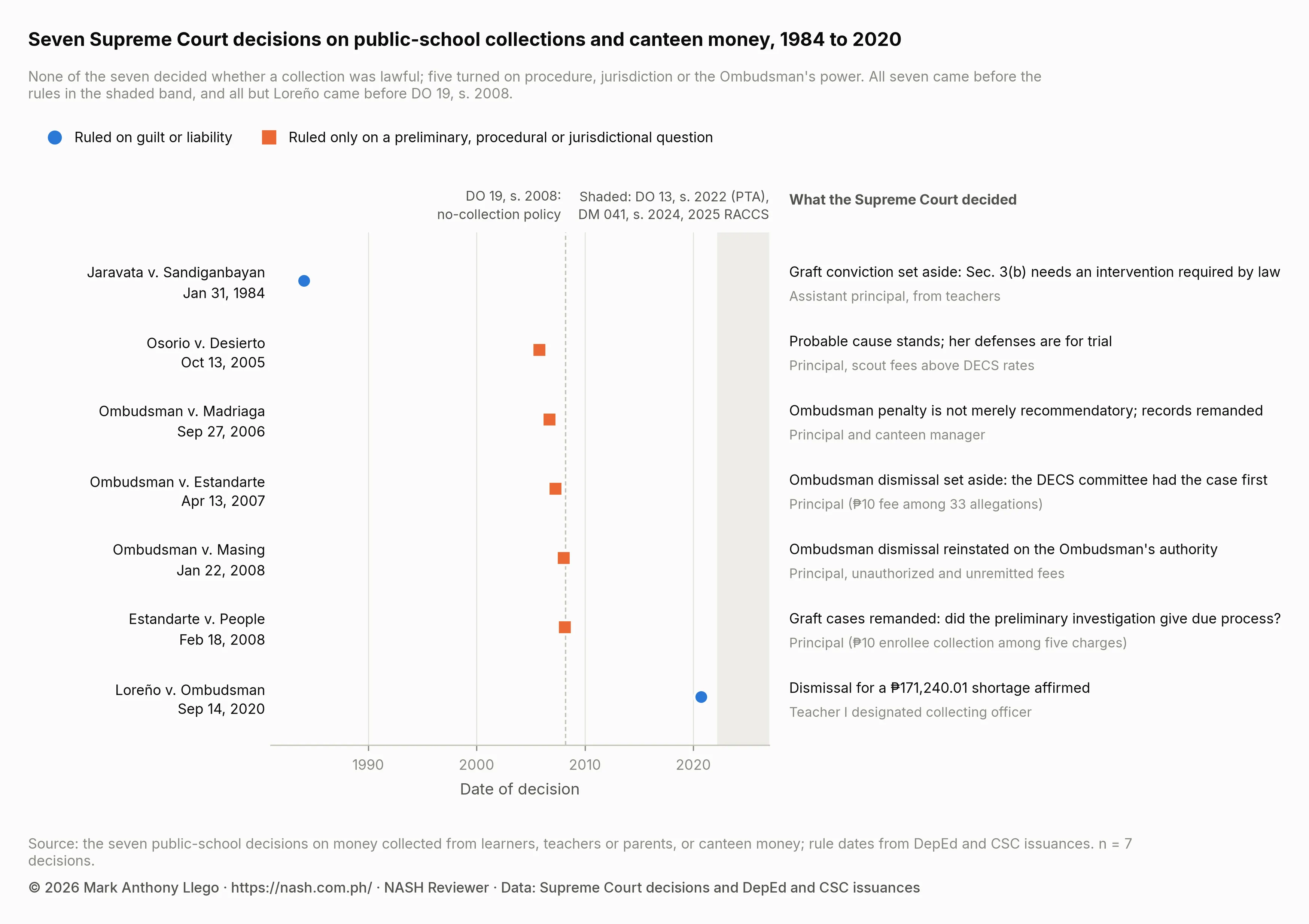
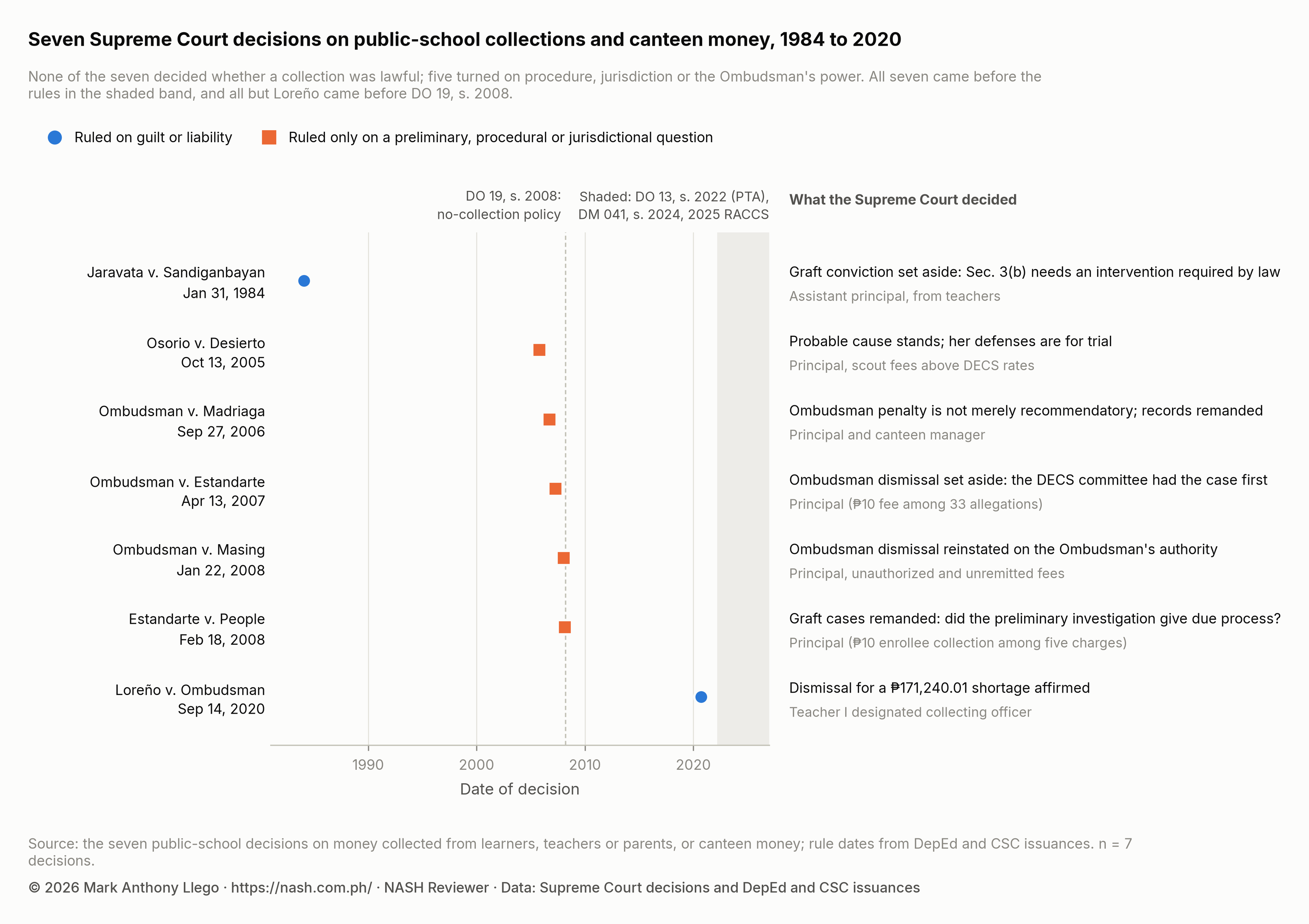
The cases are fewer and narrower than their reputation. Of the seven public-school decisions in this series on money collected from learners, teachers or parents, or on canteen money, none decided whether a collection was lawful. Five turned on procedure, jurisdiction or the Ombudsman’s power. Jaravata decided only the reach of Section 3(b) of RA 3019, setting aside an assistant principal’s conviction, and Loreño a collecting officer’s shortage in authorized collections. No decision in the series holds a principal liable for canteen money. And all seven came before the 2022 PTA rules, the 2024 reiteration of the No Collection Policy and the 2025 RACCS.
The rules in force on October 31, 2026 are RA 4206 as amended, DepEd’s no-collection and PTA rules, the canteen guidelines, MOOE, and the 2025 Rules on Administrative Cases in the Civil Service (2025 RACCS). Convictions for malversation and graft are covered in Can a Principal Be Jailed Over School Funds?.
Key findings
- Osorio v. Desierto (2005) upheld the Ombudsman’s finding of probable cause against a principal on three graft counts over scout fees set above DECS rates, two graft counts over purchases ordered after delivery, and five malversation counts over unreceipted newspaper proceeds. It decided only that she must stand trial.
- Estandarte v. People (2008) sent five graft cases against a principal back to the trial court, one of them charging her with collecting or allowing a ₱10 contribution from enrollees “without authority of law”. The trial court was to decide whether her preliminary investigation had given her due process.
- Office of the Ombudsman v. Masing (2008) reinstated an Ombudsman dismissal for unauthorized and unremitted fees, ruling on the Ombudsman’s authority, while Office of the Ombudsman v. Estandarte (2007) set aside a dismissal because the DECS committee under RA 4670 had the case first. Both are digested in the post on the Ombudsman and RA 4670.
- Jaravata v. Sandiganbayan (1984, En Banc) set aside an assistant principal’s graft conviction for taking more than his agreed expenses from teachers, because Section 3(b) of RA 3019 needs an official intervention required by law. The Court decided the reach of that section only. It did not approve the collection.
- Office of the Ombudsman v. Madriaga (2006) began with a request for a school canteen’s financial statements that, the Ombudsman found, the principal did not promptly answer. The Court ruled only that the Ombudsman’s six-month suspension was not “merely recommendatory”, and it remanded the records.
- Loreño v. Office of the Ombudsman (2020) affirmed the dismissal of a Teacher I designated as the school’s collecting officer for a ₱171,240.01 shortage. The nature of the duties, not the job title, made her accountable.
- The scout fees in Osorio (2005) were measured against DECS Order No. 27, s. 1995. Today, DepEd Order No. 13, s. 2022 lets only the PTA collect, with the school head as adviser. The 2025 RACCS makes unauthorized solicitation from school children a light offense, but cases with unremitted or missing money drew dismissal: the Ombudsman’s dismissal in Masing, which the Court reinstated without weighing the evidence, and the dismissal affirmed in Loreño for a shortage in authorized collections.
The no-collection rule in 2026: what the law and DepEd allow
The law: RA 4206, as amended
Republic Act No. 4206, approved June 19, 1965, first barred contributions from pupils of public primary and intermediate schools. Republic Act No. 5546, approved June 21, 1969, further amended it, rewriting Section 1, the penalty in Section 2, and the title. As amended, the law prohibits the sale of tickets and the collection of contributions “in any form whatsoever, by any person for any project or purpose, whether voluntary or otherwise”, from school children, students and teachers of public and private schools.
The amended section has two exceptions. It does not cover membership fees of school children and students in the Red Cross, the Girl Scouts of the Philippines and the Boy Scouts of the Philippines. It also does not cover contributions of parents and other donors for the support of barrio high schools. A violation is punishable by a fine or by imprisonment of up to one month, or both, as DepEd summarizes Section 2 of the law.
The law names teachers as well as learners. A collection from teachers for a school project is within its terms, not only a collection from learners.
DepEd’s rules on collections
DepEd’s No Collection Policy dates from DepEd Order No. 19, s. 2008 (March 19, 2008), which DepEd still cites in its 2025 and 2026 issuances. It ends: “Any violation should be subject to administrative action.” DepEd Order No. 41, s. 2012 added a rule aimed at school staff: “No teacher, school official nor school personnel shall collect fees or contributions, nor shall they be entrusted with the safekeeping and disbursement of collections made by the PTA” (item 2(e)). It also made learners’ ID cards free and charged them to MOOE (item 4(b)), and it sends violations to administrative proceedings under DepEd Order No. 49, s. 2006 (item 8).
The PTA guidelines in DepEd Order No. 13, s. 2022 (March 18, 2022) repeal inconsistent issuances, so they govern where the older orders differ. The collection of voluntary school contributions (VSCs) “shall only be allowed through the PTAs”, only for programs in the School Improvement Plan (SIP), and only from the third month of classes (Secs. 26.1 and 26.2). For Kindergarten to Grade 4, only PTA dues may be collected (Sec. 26.2.1). The PTA treasurer issues pre-numbered receipts and deposits each day’s collections (Sec. 26.2.3.5), and “No other school personnel… shall collect fees from learners, nor shall they safekeep and/or disburse such funds” (Sec. 26.2.3.6). The school head concurs in the amounts agreed at the General Assembly (Sec. 26.2.3.2) but “shall only serve as adviser to the SPTA” (Sec. 8.3), and holds PTA money only at the year-end turnover (Sec. 29.1). Non-payment may never cost a learner admission, promotion, a report card, a good moral certificate or a clearance (Sec. 26.2.3.8). The PTA may not run the canteen (Sec. 25.1.2).
Recent issuances apply the policy to particular events:
- Enrollment. “No voluntary fees shall be collected during the early registration and enrollment period as a prerequisite for registration and enrollment in basic education in public schools” (DepEd Order No. 017, s. 2025, Sec. C). DepEd Order No. 009, s. 2026 later amended that order’s transfer and enrollment provisions; it says nothing about fees.
- Graduation and moving-up rites. DepEd Order No. 009, s. 2023, the standing order on end-of-school-year rites, states: “No DepEd personnel shall be allowed to collect any kind of contribution or graduation/moving up fee.” Expenses are charged to MOOE (Encl., items 5(f) and 6). DepEd Memorandum No. 015, s. 2026 reiterated the rule for the 2025-2026 rites: “No individual shall be allowed to collect any kind of contribution or fee from learners and teachers for the graduation or moving-up ceremonies” (para. 4(c)).
- Brigada Eskwela. “School heads, teachers, and other school personnel are strictly prohibited from soliciting or collecting any form of contribution”, including Brigada Eskwela fees (DepEd Memorandum No. 027, s. 2026).
DepEd Memorandum No. 041, s. 2024 (August 2, 2024) reiterated the policy in the law’s terms: “sales of tickets and/or all forms of contributions, voluntary or otherwise, are prohibited except for the instances provided under RA 4206, as amended.” It cites DepEd Order No. 49, s. 2022 to remind personnel to “refrain from unwarranted solicitations and collection of contributions”, and it directs regional and division offices to monitor compliance. On its face it is stricter than DO 13. It allows only the law’s exceptions, the Red Cross and scouting memberships, while DO 13’s Table 2 also lists school publications (₱60 or ₱90), the Anti-TB Fund Drive (₱5) and learner organization fees. The memorandum’s references name DO 19, s. 2008, DO 41, s. 2012 and DO 49, s. 2022, not DO 13, and no later issuance reconciles the two. DM 041 has its own clause repealing or modifying earlier inconsistent issuances (para. 6), and DO 13 makes its amounts subject to later DepEd issuances (Sec. 26.3). Both point to the stricter reading, though no issuance says expressly that DM 041 narrows DO 13’s table. The guide to the School Governance Council and the PTA gives a careful reading: collect nothing from learners or teachers beyond what the law exempts, keep PTA dues voluntary and in the PTA’s hands, and ask the division before the PTA collects any other item in the table.
Who may collect what, as of October 31, 2026
| Collection | Allowed? | Who handles the money | Source |
|---|---|---|---|
| Any fee as a condition of early registration or enrollment | No | No one | DO 017, s. 2025, Sec. C |
| Contributions from learners or teachers for any project | No, except the law’s exceptions | No one | RA 4206, Sec. 1, as amended by RA 5546; DM 041, s. 2024, para. 5 |
| Red Cross, Boy Scout and Girl Scout memberships, Grades 5 to 12 | Yes, voluntary, ₱50 each, from the third month | PTA treasurer, with pre-numbered receipts | RA 4206 as amended; DO 13, s. 2022, Table 2 |
| PTA membership dues | Yes, voluntary, once a year per parent, from the third month | PTA treasurer | DO 13, s. 2022, Secs. 26.2.1 and 26.2.3.4 |
| School publication, Anti-TB Fund Drive, learner organization fees | Listed in DO 13’s table; not among the law’s exceptions | PTA treasurer; ask the division first | DO 13, s. 2022, Table 2; DM 041, s. 2024 |
| Graduation and moving-up rites | No contribution or fee from learners or teachers; MOOE pays | No one | DO 009, s. 2023, Encl., items 5(f) and 6, as reiterated by DM 015, s. 2026, para. 4(c) |
| Brigada Eskwela | No solicitation or collection by school personnel | No one | DM 027, s. 2026 |
| Learner ID cards | Free to learners; MOOE pays | No one | DO 41, s. 2012, item 4(b) |
| Year-end, undeposited PTA collections | Turned over to the school head | School head, receipted in writing, deposited the next banking day | DO 13, s. 2022, Sec. 29.1 |
The seven public-school collection cases at a glance
The seven public-school decisions below involve money collected from learners, teachers or parents, or canteen money, and are listed in order of decision. A private-school case on a teacher’s collection from students, Salavarria, is summarized below with Loreño. “Stage” means the point the case had reached when the Supreme Court ruled.
| Case | Who, and what money | What the Court decided | Stage |
|---|---|---|---|
| Jaravata v. Sandiganbayan (1984) | Assistant principal; ₱194 above agreed expenses from four teachers | Conviction under RA 3019 Sec. 3(b) set aside | Criminal, after trial |
| Osorio v. Desierto (2005) | Principal; scout fees above DECS rates, unreceipted newspaper proceeds | Probable cause stands; defenses are for trial | Criminal, preliminary |
| Office of the Ombudsman v. Madriaga (2006) | Principal and teacher-canteen manager; a request for canteen statements not promptly answered | Ombudsman’s penalty not merely recommendatory; records remanded | Administrative, on the Ombudsman’s power |
| Office of the Ombudsman v. Estandarte (2007) | Principal; ₱10 fee among 33 allegations | Ombudsman dismissal set aside; DECS committee had the case first | Administrative, on jurisdiction |
| Office of the Ombudsman v. Masing (2008) | Principal; unauthorized fees, unremitted fees, unaccounted funds | Ombudsman dismissal reinstated | Administrative, on the Ombudsman’s authority |
| Estandarte v. People (2008) | Principal; ₱10 enrollee collection among five graft charges | Remanded to decide whether the preliminary investigation gave due process | Criminal, preliminary |
| Loreño v. Office of the Ombudsman (2020) | Teacher I designated collecting officer; ₱171,240.01 shortage | Dismissal affirmed | Administrative, on the merits |
Two of the seven are preliminary rulings (Osorio and Estandarte v. People), and one is a remand to the Ombudsman (Madriaga). Neither Osorio nor Estandarte v. People decided guilt.
Fees above DepEd rates and unreceipted money: Osorio v. Desierto (2005)
Facts. In January 1998, a letter-complaint to the Ombudsman accused Dr. Benita Osorio, principal of Dr. Cecilio Putong National High School in Bohol, of several irregularities. The National Bureau of Investigation (NBI) and a Commission on Audit (COA) team examined the school. The Office of the Ombudsman-Visayas found the first four allegations substantiated. Three of them were charged against her:
- Newspaper proceeds. She had authorized a utility worker to sell the school’s old newspapers. COA found that proceeds of ₱2,621.75 “were not receipted, recorded and accounted for in the books of the agency.”
- “Ready-made” purchases. Purchase orders dated July 9 and July 16, 1997 were issued for supplies already delivered in June.
- Scout fees. According to the Ombudsman’s resolution, quoted by the Court, DECS Order No. 27, s. 1995 set the Boy Scout and Girl Scout contributions at ₱20 and ₱25. Her enrollment memoranda set ₱26 and ₱31 for school year 1996-1997, and ₱30 and ₱31 for 1997-1998. COA found that students were assessed “in excess of the rates authorized by DECS Order No. 27 and regardless of gender”, for a total of ₱202,282.00. COA also flagged an extra ₱1 fee, ₱698 in all, collected from fourth-year students “without a stated purpose and authority from the DECS”.
The first allegation, unreceipted rentals of school facilities, was charged against the supply officer. The Ombudsman found probable cause against Osorio for five counts of malversation, one for each newspaper sale, and five counts of violating Section 3(e) of RA 3019: two on the purchases and three on the scout fees. On the fees, it reasoned that her memoranda, issued “in absolute defiance of the specific directive of the DECS Order mentioned”, showed “evident bad faith or gross inexcusable negligence” that injured the students. She had also been placed under preventive suspension. The Court of Appeals dismissed her certiorari petition.
Issues. Did the Ombudsman abuse its discretion by refusing a clarificatory hearing? And were her defenses, that she never held the funds and that the elements of Section 3(e) were absent, questions of law that could defeat the charges at once?
Ruling. The Court, through Justice Chico-Nazario, dismissed the petition.
- Wrong remedy, but heard anyway. The remedy against an Ombudsman resolution finding probable cause in a criminal case is certiorari in the Supreme Court, not an appeal. The Court treated her petition as one for certiorari.
- No hearing needed. “It is the call of the investigating prosecutor, in the exercise of his sound discretion, whether to conduct a clarificatory hearing or not.”
- Defenses go to trial. Her claims that she did not receive or control the funds, and that the elements of Section 3(e) were missing, “are undoubtedly evidentiary matters that are to be ventilated in a full-blown trial and not during the preliminary investigation.”
On the newspapers, the Ombudsman found her denials “simply unbelievable”, because she was “the school principal who is naturally expected to have asked about the proceeds from the newspapers the sale of which she had authorized.” The Court found no grave abuse of discretion in the Ombudsman’s finding of probable cause. The inference is not a finding of guilt.
Why it matters. Osorio shows how a fee problem becomes a criminal case. Scout membership fees are among the few contributions the law allows; what made them a graft charge was a principal setting amounts above DepEd’s rates in her own memoranda. Unreceipted cash produced malversation charges against both the principal and the supply officer. And the Court would not stop the cases at the preliminary stage on a defense that depended on facts.
Later history. The outcome of the trials is not known. A parallel administrative case is mentioned, but its outcome is not stated. The rates have since changed: DO 13, s. 2022 lists ₱50 for each scouting membership.
Graft charges and a ₱10 enrollment collection: Estandarte v. People (2008)
Facts. Estandarte v. People, G.R. Nos. 156851-55, February 18, 2008 (Third Division), involved Heide Estandarte, principal of Ramon Torres National High School in Bago City. In 1998, teachers listed 15 irregularities against her. A city prosecutor deputized by the Ombudsman-Visayas granted her motion for a bill of particulars, which limited the charge to Sections 68 and 69 of PD 1445. The Ombudsman-Visayas then filed five informations under RA 3019 Section 3(e). They concerned:
- cash donations of ₱163,400;
- collecting, or allowing the collection of, ₱10 “from the enrollees of the school without authority of law”;
- guns bought with the students’ trust fund and registered in her name;
- double charging of ₱1,500 for video coverage of a coronation night; and
- double charging of ₱45,000 for repairs of the Home Economics building.
She moved in the trial court for a reinvestigation and, on reconsideration, argued that the informations went beyond the bill of particulars. The court denied both motions.
Issue. Was she denied due process in the preliminary investigation?
Ruling. The Court, through Justice Austria-Martinez, partly granted the petition. The Ombudsman’s rules then in force, Administrative Order No. 7, did not allow a bill of particulars, and the Ombudsman controls deputized prosecutors, so it could disregard the one granted. But after examining the records, “the Court does not find the subpoenas and the alleged documents served on her.” The Court restated that “the complaint should specifically allege the criminal acts complained of, so as to enable the accused to prepare his answer or counter-affidavit accurately and intelligently.” Whether the subpoenas and attachments did so was a question of fact. The Court set aside the trial court’s orders, and “The case is remanded to the trial court for determination whether petitioner was denied due process in the conduct of the preliminary investigation.”
Why it matters. The issue, the Court stressed, “is not whether the Ombudsman-Visayas had correctly found a probable cause”. So the case says nothing about whether the ₱10 collection was a crime. It shows that a principal’s protection at the preliminary stage is the right to know the acts charged, and that the record of what was served matters.
Later history. The outcome of the remand is not known. Administrative Order No. 7 has been replaced by the Ombudsman’s Revised Rules of Procedure, Administrative Order No. 1, s. 2026. The new rules still list a motion for a bill of particulars among the prohibited pleadings (Rule VIII, Sec. 4(b)).
The administrative cases: Ombudsman v. Estandarte (2007) and Masing (2008)
Two administrative cases on fees belong to the post on the Ombudsman and RA 4670, which digests them. In brief:
- In Office of the Ombudsman v. Estandarte, G.R. No. 168670, April 13, 2007 (Third Division), the same principal’s administrative case listed 33 allegations. A provincial auditor found that a ₱10 miscellaneous fee per student was “in violation of DECS Order No. 27 s. 1995”. The principal had explained that “this practice had been going on when she assumed thereat and the same has the implied permission of the PTA”. The Ombudsman dismissed her for grave misconduct on other findings. The Court upheld the Court of Appeals in setting that dismissal aside, because a DECS committee under RA 4670 had taken the case first and she had objected from the start. The case was sent back to that committee. Neither court ruled on the fee.
- In Masing, parents charged a former principal of the Davao City Integrated Special School “for allegedly collecting unauthorized fees, failing to remit authorized fees, and to account for public funds”. The Ombudsman dismissed her; the Court of Appeals reversed. The Supreme Court chose to “resolve the legal issues involved in the interest of speedy justice”, held that RA 4670 gives DepEd no exclusive authority, and reinstated the Ombudsman’s decisions.
Read together, the two decisions show that in fees cases the first contest is often over who hears the case, before anyone weighs the fee.
Collections from teachers: the limits of RA 3019 Section 3(b) (Jaravata)
Facts. In Jaravata v. Sandiganbayan, G.R. No. 56170, January 31, 1984 (En Banc), Hilario Jaravata was assistant principal of a barangay high school in Tubao, La Union. In January 1979, he told six classroom teachers that their 1978 salary differentials had been approved. They agreed that he would follow up the papers in Manila and that they would reimburse his expenses. He spent ₱220, which he divided at ₱36 per teacher. After the teachers were paid, four of them gave him ₱194 more than their shares. The school administrator did not approve and had him return the money. The Sandiganbayan convicted him under Section 3(b) of RA 3019 and sentenced him to one to four years in prison, with perpetual special disqualification.
Issue. Does Section 3(b) cover an assistant principal who had no legal role in paying the differentials? Section 3(b) punishes requesting or receiving a benefit in connection with a government transaction “wherein the public officer in his official capacity has to intervene under the law.”
Ruling. The Court, through Justice Abad Santos and with all participating Justices concurring, set the conviction aside. It said it would “deal with the legal issue only.”
- The rule. “In Our opinion, Sec. 3 (b) of R.A. No. 3019, refers to a public officer whose official intervention is required by law in a contract or transaction.”
- Applied. “In his official capacity as assistant principal, he is not required by law to intervene in the payment of the salary differentials.” Instead, he “played the humble role of a supplicant whose mission was to expedite payment”.
Why it matters. Jaravata is about the reach of one section of the anti-graft law. It is not a license to collect money from teachers. The Court did not decide whether the collection was proper under any administrative rule, and it did not discuss RA 4206, which names teachers. The administrator’s order to return the money is the part a school head should copy.
What applies today. Whatever the reach of Section 3(b) of RA 3019, collecting from subordinates is an administrative offense of its own. The 2025 RACCS lists “Improper or unauthorized solicitation of contributions from subordinate employees” as a light offense (Sec. 63(C), item 7). A school head who collects money from teachers, even for their own claims, risks that charge, apart from RA 4206.
Canteen money: what the cases do and do not say
Office of the Ombudsman v. Madriaga (2006)
Facts. In Office of the Ombudsman v. Madriaga, G.R. No. 164316, September 27, 2006 (Third Division), the San Juan School Club complained to the Ombudsman against two people at San Juan Elementary School in Metro Manila. They were the principal, Gertrudes Madriaga, and Ana Marie Bernardo, a classroom teacher designated as canteen manager. A graft investigation officer first found them liable under Section 5(a) of RA 6713, the duty to act promptly on letters and requests, and reprimanded them. A second officer set that decision aside and found Madriaga liable “for not promptly responding to the letter request of the complainant for copies of the school canteen’s financial statements for the period from February to August 2000”. The same order found both liable for conduct grossly prejudicial to the best interest of the service, and suspended both for six months. The Court of Appeals held that the Ombudsman’s penalty was merely a recommendation to DepEd.
Issue. Is a penalty imposed by the Ombudsman only recommendatory?
Ruling. No. The Court, through Justice Carpio Morales, read the Constitution and RA 6770, following Ledesma v. Court of Appeals: “In fine, petitioner’s authority to impose administrative penalty and enforce compliance therewith is not merely recommendatory. It is mandatory within the bounds of the law.” Implementation goes through the proper officer; the Ombudsman’s order had been sent to the DECS Secretary for implementation. The Court reversed the Court of Appeals and remanded the records to the Ombudsman “for appropriate action consistent with the ruling in this case.”
Why it matters. The Court did not decide whether Madriaga or Bernardo had done wrong. It decided only the weight of the Ombudsman’s penalty. Madriaga never mentions RA 4670, so it is not a case on who may hear charges against teachers. For a school head, its facts carry the lesson: a request for the canteen’s financial statements was not promptly answered, the Ombudsman found, and the case that followed reached the Supreme Court.
What applies today. RA 6713 still requires officials to respond to letters and requests “within fifteen (15) working days from receipt thereof”, as quoted in Madriaga. The 2025 RACCS makes failure to do so a light offense (Sec. 63(C), item 4). Conduct prejudicial to the best interest of the service is now a grave offense, punishable by suspension of six months and one day to one year for the first offense (Sec. 63(A)(2)(a)). Ombudsman decisions are now executed immediately; a motion for reconsideration or an appeal “shall not stay the immediate execution of the decision” (A.O. No. 1, s. 2026, Rule VIII, Sec. 8).
Osorio and the canteen allegation
The complaint in Osorio also accused the principal of treating canteen money as her own, but the Ombudsman found that allegation, the fifth, not substantiated: “allegations no. 1 to no. 4 were duly substantiated while the rest of the allegations were not.” It was never charged, and the Supreme Court did not rule on it. The COA findings behind it still show what auditors look for: canteen collections “were not remitted intact, instead, daily expenses/purchases were deducted therefrom”, ₱269,890.92 in canteen expenses were not recorded, and no cash book was kept.
So canteen funds were part of the complaints in Madriaga and Osorio, but no Supreme Court decision in this series finds a principal liable for canteen money.
The canteen rules in force
DepEd Order No. 8, s. 2007 still governs school canteens. DepEd Order No. 13, s. 2017 modified only its Policy Statements 4.4 to 4.6, on food, and no later order has replaced it. For a school-managed canteen, DO 8 requires the following:
| Requirement | DO 8, s. 2007 |
|---|---|
| The school head designates a Home Economics teacher as Canteen Teacher in writing | Item 6.1 |
| A book of accounts and a statement of sales and disbursements record daily transactions, with receipts kept | Item 5.4.1 |
| Earnings are deposited daily in a government depository bank, in an account “in trust for” the school, with the school head and the Canteen Teacher as joint signatories. “In no case shall the deposits be made in the personal account of any school official.” | Item 6.6 |
| The school head prepares an annual canteen budget for the Schools Division Superintendent’s approval, and disbursements follow it | Items 6.7 and 6.8 |
| A school-level auditing committee checks the books at least monthly and audits quarterly; the division’s COA auditor audits twice a year | Items 5.4.2 and 5.4.3 |
| “Audited financial statements shall be posted on bulletin boards for the information of everybody.” | Item 5.4.3 |
| Net income goes 35% to supplementary feeding, 5% to the clinic, 15% to faculty and student development, 10% to Home Economics instruction, 25% to school operations and 10% to revolving capital | Item 6.5 |
| Teachers and canteen personnel need clearance from money and property accountabilities before they retire, resign or transfer | Item 6.9 |
A request like the one in Madriaga is easy to meet when these rules are kept. The statements already exist, and the audited ones are already posted.
Teachers who collect: accountability passes down (Loreño)
Facts. In Loreño v. Office of the Ombudsman, G.R. No. 242901, September 14, 2020 (Second Division), Ma. Luisa Loreño was a Teacher I at Andres Bonifacio Integrated School in Mandaluyong City. A COA audit of the school’s cash accounts for March 2006 to June 2008 found a shortage. A demand was sent to her and to the former principal, who was not a party to the case. A fuller cash examination fixed Loreño’s shortage at ₱171,240.01, “representing the balance of collections from authorized school contributions/fees and school operating funds”. She did not produce it. The Ombudsman found her guilty of serious dishonesty, grave misconduct and conduct prejudicial to the best interest of the service and dismissed her. The Court of Appeals affirmed.
Issues. Was she an accountable officer? Was the evidence enough?
Ruling. The Court, through Justice Delos Santos, denied her petition. It noted that her issues were “substantially factual”, but it reviewed the record and found the offenses substantially proven.
- The test is the duties, not the title. “It is the nature of the duties of, not the nomenclature used for, or the relative significance of the title to, the position, which controls in that determination.”
- She was accountable. She had been designated Acting Collecting Officer and was bonded for ₱45,000. She admitted that “the school principal tasked her to collect payments for the costs of school IDs from the students.” Her claim that she only counted the money and handed it to the principal was contradicted by the records.
- The shortage. From April 16, 2007 to May 30, 2008 she collected ₱9,803,353.80. After her credits and the cash in bank, ₱171,240.01 was missing. “Her failure to account the discrepancy in her collections and her inability to return the said amount upon demand from the COA auditors, constitute a prima facie evidence that she appropriated the money to herself.”
She was dismissed with cancellation of eligibility, forfeiture of retirement benefits except accrued leave credits, perpetual disqualification from re-employment and a bar from civil service examinations.
Why it matters. The principal is not the only person at risk. A teacher whom the principal designates to collect becomes an accountable officer. PD 1445, as quoted in Loreño, requires that “Every accountable officer shall be properly bonded in accordance with law.” The money in Loreño came from authorized contributions and school operating funds, and the shortage still cost the teacher her career. The case says nothing about the former principal’s liability; she was not a party.
What applies today. The ID collections in Loreño came before DO 41, s. 2012, which makes ID cards free, and before DO 13, s. 2022, which leaves fees from learners to the PTA alone. A school head should not assign a teacher to collect from learners at all. Anyone who collects the school’s own income, such as facility rentals, should be designated in writing, bonded and audited.
A private-school parallel. In Salavarria v. Letran College, G.R. No. 110396, September 25, 1998 (Third Division), a private high school dismissed a teacher who had approved her students’ collection for religious articles in place of term papers. The Court upheld the dismissal, noting that she had been suspended in 1988 for soliciting contributions without school approval and given a final warning. It said her approval made her “in effect the author of the project”. It also found that “she never took physical custody of the funds, nor was she charged with misappropriating the same for personal gain,” and it affirmed her separation pay. The case is digested in Can a Private School Remove Its Principal?. In Reside v. People, G.R. No. 210318, July 28, 2020 (First Division), a private-school principal who collected tuition and did not remit it was held guilty “not of estafa, but of qualified theft”; see Can a Principal Be Jailed Over School Funds?.
What MOOE now pays for instead of collections
Many collections in these cases paid for things DepEd now funds. School MOOE is covered in full in the guide to school MOOE. The points that bear on collections are these:
- Graduation, moving-up and recognition. DepEd Order No. 8, s. 2019 allows MOOE “To finance expenses pertaining to graduation rites, moving up or closing ceremonies and recognition activities” (Sec. V.D.2). DO 009, s. 2023, as reiterated by DM 015, s. 2026, charges those rites to MOOE and bars collections for them.
- ID cards. DO 41, s. 2012 makes them free and funds them from MOOE (item 4(b)).
- Activities in the SIP. MOOE funds activities in the approved SIP and Annual Implementation Plan (Sec. V.D.1).
- Every fund is declared. The school head must declare all sources of school funds, including PTA support and “revenue from school canteen operations”, and post their sources and uses on a transparency board that “must be updated every three (3) months” (Sec. VI.A.1 and VI.A.4).
- The MOOE account takes DepEd money only. For schools that receive MOOE as cash advances (non-implementing units), DepEd Order No. 29, s. 2019 allows only funds from DepEd offices in the school’s MOOE bank account. “Deposits from personal funds and funds from other sources shall not be allowed” (item 21). PTA and canteen money stay in their own accounts.
Administrative penalties today under the 2025 RACCS
The cases above applied older rules. The Ombudsman’s order in Madriaga applied the Omnibus Rules implementing Book V of the Administrative Code, and Loreño applied the Revised Rules on Administrative Cases in the Civil Service then in force (Sec. 46). The 2025 RACCS, promulgated by CSC Resolution No. 2500357 on April 30, 2025, took effect on August 4, 2025. It repealed the 2017 RACCS (Sec. 156). It governs cases filed after that date and further proceedings in pending cases, unless the CSC finds that unfeasible or unjust (Sec. 158).
| Offense in the 2025 RACCS | Class | Penalty | Cases with comparable charges |
|---|---|---|---|
| Improper or unauthorized solicitation of contributions from subordinate employees, and by teachers or school officials from school children (Sec. 63(C)(7)) | Light | Reprimand; then suspension of 1 to 30 days; then dismissal | An unauthorized collection with no money missing; compare Jaravata |
| Failure to act promptly on letters and requests within 15 working days (Sec. 63(C)(4)) | Light | Same | Madriaga (first charge) |
| Conduct prejudicial to the best interest of the service (Sec. 63(A)(2)(a)) | Grave | Suspension of 6 months and 1 day to 1 year; dismissal for the second offense | Madriaga, Loreño |
| Grave misconduct (Sec. 63(A)(1)(f)) | Grave | Dismissal | Loreño; the Ombudsman’s charge in Ombudsman v. Estandarte |
| Serious dishonesty (Sec. 63(A)(1)(l)) | Grave | Dismissal | Loreño |
The light offense is the floor, not the ceiling. When unauthorized fees come with unremitted or unaccounted-for money, the charge becomes misconduct: gross misconduct and neglect of duty in Masing. A shortage in authorized collections drew serious dishonesty and grave misconduct in Loreño. Under the 2025 RACCS, a respondent found guilty of several offenses receives the penalty for the most serious one, with the others counted as aggravating circumstances (Sec. 70).
Who hears the case is a separate question. DepEd, the Civil Service Commission and the Ombudsman can each act on a complaint against a principal; Can the Ombudsman Discipline a Principal? explains when a timely objection matters. Preventive suspension and appeals are in Preventive Suspension, Appeals and Back Pay for Principals. On the criminal side, a violation of RA 4206 is punishable by a fine or imprisonment for not more than one month, or both, in the discretion of the court (as DM 041, s. 2024 states Section 2), while graft under Section 3(e) of RA 3019 and malversation carry far heavier penalties; see Can a Principal Be Jailed Over School Funds?.
The full table of offenses and penalties is in DepEd Administrative Offenses and Penalties in 2026.
What this means for school heads
The cases and the current rules point to concrete habits. Managing school operations and resources covers the PPSSH strand on financial management, and Building connections covers the strand on school organizations such as the PTA.
Do:
- Audit every fee in your first week. List what is being collected, by whom, for what, and under which issuance. In Ombudsman v. Estandarte, the auditor flagged a ₱10 fee that, she explained, predated her and had the PTA’s implied permission. No court ruled on it, but the lesson stands: an inherited practice is still your practice.
- Send every voluntary contribution through the PTA. Check that it funds an SIP activity, starts no earlier than the third month of classes, is truly voluntary and is not exorbitant before you concur in the amount (DO 13, s. 2022, Secs. 26.1, 26.2 and 26.2.3.2). From learners and teachers, collect nothing beyond the Red Cross and scouting memberships (DM 041, s. 2024, para. 5), and ask the division before the PTA collects any other item in DO 13’s Table 2. Keep the General Assembly minutes.
- Pay from MOOE what MOOE covers. ID cards, graduation and moving-up rites, and SIP activities should not depend on collections.
- Receipt every peso of school income. In Osorio, unreceipted newspaper proceeds and facility rentals led to malversation charges against both the principal and the supply officer. In Office of the Deputy Ombudsman for Luzon v. Dionisio, G.R. No. 220700, July 10, 2017 (First Division), a principal was dismissed for grave misconduct after part of the school grounds, owned by the province, was leased without authority and they could not show with official receipts how the money received from the lessees was spent; see Dishonesty and Grave Misconduct.
- Run the canteen by the book. Designate the Canteen Teacher in writing, deposit daily in the school’s trust account, convene the auditing committee monthly, post the audited statements, and get the annual budget approved (DO 8, s. 2007).
- Answer written requests within 15 working days. That includes requests for the canteen’s financial statements (Madriaga; RA 6713, Sec. 5(a)).
- Designate, bond and audit anyone who handles school money. A designation in writing creates accountability (Loreño), so give it only where a rule allows it, and check the books yourself.
- Keep everything served on you. Subpoenas, attachments, orders and your counter-affidavits decide whether you can later show a denial of due process (Estandarte v. People). Consult your Schools Division Office’s Legal Unit at once.
Document: the General Assembly resolutions you concur in, the PTA’s semestral financial reports, the canteen’s monthly statements and audit reports, the transparency board postings, written designations of collecting officers, and every turnover receipt.
Do not:
- set or approve any fee in an enrollment memo, or collect anything as a condition of enrollment (DO 017, s. 2025);
- collect, keep or spend PTA money yourself, except at the year-end turnover (DO 13, s. 2022, Secs. 26.2.3.6 and 29.1; DO 41, s. 2012, item 2(e));
- collect money from teachers, even to follow up their own claims (Jaravata; 2025 RACCS, Sec. 63(C));
- deposit canteen income in a personal account, or PTA or canteen money in the MOOE account (DO 8, s. 2007, item 6.6; DO 29, s. 2019, item 21);
- withhold a report card, certificate or clearance for non-payment (DO 13, s. 2022, Sec. 26.2.3.8).
For more on internal controls over cash, see School Head Ethics and Internal Control. For the staffing side of designations, see Human Resource Management for School Heads.
How the NASH may test this
The two items below are original practice items, scored 3 (Relational), 2 (Multistructural), 1 (Unistructural) or 0 (Prestructural). An option that breaks a rule scores 0.
Question 1
Indicator 2.2.2, Financial management. Career Stage 2, Situational, Moderate.
You have just been designated principal of a public secondary school. On the first day of enrollment, you find that advisers are collecting a ₱10 “miscellaneous fee” from each learner, as your predecessor’s enrollment memo directed. The advisers hand the money to the school clerk at the end of each week, and no official receipts are issued. The PTA president tells you the fee has been collected for years with the PTA’s approval and pays for learners’ ID cards and the moving-up rites. What is the most appropriate action?
- A. Let the collection continue for this enrollment period, since the PTA approved it and the learners expect it, but require the clerk to issue official receipts for every payment from now on.
- B. Stop the collection at once and have the advisers return the money they are holding to the learners who paid it, so that no one at the school keeps money collected without authority.
- C. Stop the collection at once, have the advisers and the clerk account in writing for every peso collected, and refer the earlier collections to the Schools Division Office for guidance on what to do with them.
- D. Stop the collection at once, have the advisers and the clerk account in writing and report the earlier collections to the Schools Division Office, charge the ID cards and the moving-up rites to MOOE, and refer any other support to the PTA’s General Assembly under DO 13, s. 2022.
Answer and explanation
Best answer: D. Points: A = 0, B = 1, C = 2, D = 3.
- A (0 points, Prestructural). No fee may be collected as a condition of enrollment, and no school personnel may collect fees from learners. Receipts do not make an unauthorized collection lawful.
- B (1 point, Unistructural). Stopping the collection is right, but refunding without a written accounting leaves no record of what was collected and spent, and the ID cards and rites are left without a lawful source.
- C (2 points, Multistructural). It stops the collection and documents it, but it leaves the ID cards and the moving-up rites unfunded and does not route future support through the PTA.
- D (3 points, Relational). It ends the violation, creates the record that protects everyone, funds the two purposes from the source DepEd designates, and channels any further support through the only body allowed to collect.
Why. DO 017, s. 2025 bars any voluntary fee as a prerequisite for enrollment (Sec. C). Under DO 13, s. 2022, the collection of contributions “shall only be allowed through the PTAs”, from the third month of classes, and no other school personnel may collect fees from learners (Secs. 26.1, 26.2 and 26.2.3.6). DO 41, s. 2012 funds ID cards from MOOE, and DO 8, s. 2019 lets MOOE pay for moving-up ceremonies. In Office of the Ombudsman v. Estandarte (2007), an auditor found a ₱10 fee unauthorized although the principal said it predated her and had the PTA’s implied permission; in Osorio v. Desierto (2005), unreceipted proceeds from the sale of old newspapers led to malversation charges, and scout fees set above DECS rates led to graft charges.
Indicator 2.2.2: Manage finances adhering to policies, guidelines and issuances in allocation, procurement, disbursement and liquidation aligned with the school plan.
Sources: DepEd Order No. 017, s. 2025, Sec. C; DepEd Order No. 13, s. 2022, Secs. 26.1, 26.2 and 26.2.3.6; DepEd Order No. 41, s. 2012, item 4(b); DepEd Order No. 8, s. 2019, Sec. V.D.2; Office of the Ombudsman v. Estandarte, G.R. No. 168670, April 13, 2007; Osorio v. Desierto, G.R. No. 156652, October 13, 2005.
Question 2
Indicator 2.2.1, Financial management. Career Stage 1, Conceptual, Moderate.
A faculty club writes to the principal asking for copies of the school-managed canteen’s financial statements for the past six months. Which statement best describes the principal’s duties?
- A. The principal should reply within fifteen working days that the letter has been referred to the Canteen Teacher, who prepares the canteen’s reports, and that the statements will follow once they are ready.
- B. The principal may decline, because canteen accounts are examined by the school-level auditing committee and the division’s COA auditor, not by the faculty club.
- C. The principal should reply within fifteen working days with copies of the statements the Canteen Teacher has prepared, and tell the club that the COA auditor examines canteen funds twice a year.
- D. The principal should reply within fifteen working days with the statements, after confirming that the auditing committee has reviewed the books, and should keep the audited statements posted on the bulletin board as the canteen rules require.
Answer and explanation
Best answer: D. Points: A = 1, B = 0, C = 2, D = 3.
- A (1 point, Unistructural). A timely reply that states the action taken meets RA 6713, but the club gets no statements and no date, and the school head, who organizes the auditing committee and co-signs the canteen account, steps back from the canteen’s books.
- B (0 points, Prestructural). DO 8, s. 2007 requires audited canteen statements to be posted “for the information of everybody”, and RA 6713 requires a reply within fifteen working days. Declining contradicts both.
- C (2 points, Multistructural). The timely reply and the statements are right, but it skips the school head’s own controls: the monthly review by the auditing committee and the posting of audited statements.
- D (3 points, Relational). It meets the reply deadline, checks the books before releasing them, and connects the request to the standing duty to post, so that the next request is already answered.
Why. Office of the Ombudsman v. Madriaga (2006) began with a request for canteen statements that, the Ombudsman found, the principal had not promptly answered; the Ombudsman suspended her and the canteen manager, and the Supreme Court held the penalty not merely recommendatory. RA 6713, Section 5(a) requires a response “within fifteen (15) working days from receipt thereof”. DO 8, s. 2007 requires monthly review by a school-level auditing committee and the posting of audited statements (items 5.4.2 and 5.4.3).
Indicator 2.2.1: Demonstrate knowledge and understanding of policies, guidelines and issuances in managing finances such as allocation, procurement, disbursement and liquidation aligned with the school plan.
Sources: Office of the Ombudsman v. Madriaga, G.R. No. 164316, September 27, 2006; RA 6713, Sec. 5(a); DepEd Order No. 8, s. 2007, items 5.4.2 and 5.4.3; 2025 RACCS, Sec. 63(C)(4).
Nothing in this guide reproduces or predicts examination content.
Frequently asked questions
Can a principal be dismissed for collecting unauthorized fees?
Yes, when the fees come with money that is unremitted or unaccounted for. In Office of the Ombudsman v. Masing (2008), the Supreme Court reinstated the Ombudsman’s dismissal of a principal charged with collecting unauthorized fees, failing to remit authorized fees and failing to account for public funds; it ruled on the Ombudsman’s authority, not on the evidence. Under the 2025 RACCS, unauthorized solicitation from school children alone is a light offense, but grave misconduct and serious dishonesty carry dismissal.
Is it a crime for a principal to collect money from teachers?
Not necessarily under Section 3(b) of RA 3019. In Jaravata v. Sandiganbayan (1984), the Court set aside an assistant principal’s conviction because he had no legal role in the salary differentials he followed up. But RA 4206, as amended, bars contributions from teachers as well as learners, and the 2025 RACCS makes unauthorized solicitation from subordinates an administrative offense.
Who may collect contributions in a public school?
Only the PTA, under DepEd Order No. 13, s. 2022: from the third month of classes, for SIP activities, on a voluntary basis, through the PTA treasurer with pre-numbered receipts, with the school head concurring in amounts but serving only as adviser. What the PTA may collect from learners is not settled: DM 041, s. 2024 allows only the law’s exceptions (Red Cross and scouting memberships), while DO 13’s table lists more, so ask the division before collecting anything else from learners. As Osorio v. Desierto (2005) shows, a principal who sets fee amounts in her own memoranda can face graft charges.
Is a teacher who collects on the principal’s instructions liable?
Yes, if the duties make the teacher an accountable officer. In Loreño v. Office of the Ombudsman (2020), a Teacher I designated as collecting officer, whom the principal had tasked to collect ID payments, was dismissed for a ₱171,240.01 shortage. The Court held that the nature of the duties, not the title, decides accountability.
Has the Supreme Court held a principal liable for canteen money?
Not in the decisions discussed here. Office of the Ombudsman v. Madriaga (2006) began with a request for canteen financial statements, but the Court ruled only on the Ombudsman’s penalty power and remanded. In Osorio v. Desierto (2005), the Ombudsman found the canteen allegation unsubstantiated. DepEd Order No. 8, s. 2007 still sets the deposit, audit and posting rules.
Download the data
- fees-collection-cases-timeline.csv: the seven public-school decisions in Figure 1, with date, G.R. number, who was involved and what money, what the Court decided and the category.
The CSVs and charts may be reused only with written permission: email support@nash.com.ph. The decisions themselves are public records of the Supreme Court, which you can cite directly.
Sources
Supreme Court decisions
- Jaravata v. Sandiganbayan, G.R. No. 56170, January 31, 1984 (En Banc), Abad Santos, J.
- Salavarria v. Letran College, G.R. No. 110396, September 25, 1998 (Third Division), Romero, J.
- Osorio v. Desierto, G.R. No. 156652, October 13, 2005 (Second Division), Chico-Nazario, J.
- Office of the Ombudsman v. Madriaga, G.R. No. 164316, September 27, 2006 (Third Division), Carpio Morales, J.
- Office of the Ombudsman v. Estandarte, G.R. No. 168670, April 13, 2007 (Third Division), Callejo, Sr., J.
- Office of the Ombudsman v. Masing, G.R. Nos. 165416, 165584 and 165731, January 22, 2008 (First Division), Puno, C.J.
- Estandarte v. People, G.R. Nos. 156851-55, February 18, 2008 (Third Division), Austria-Martinez, J.
- Office of the Deputy Ombudsman for Luzon v. Dionisio, G.R. No. 220700, July 10, 2017 (First Division), Perlas-Bernabe, J.
- Reside v. People, G.R. No. 210318, July 28, 2020 (First Division), Reyes, J., Jr., J.
- Loreño v. Office of the Ombudsman, G.R. No. 242901, September 14, 2020 (Second Division), Delos Santos, J.
Laws and rules
- Republic Act No. 4206 (1965), as amended by Republic Act No. 5546 (1969).
- Republic Act No. 3019, Anti-Graft and Corrupt Practices Act, Secs. 3(b) and 3(e).
- Republic Act No. 6713, Code of Conduct and Ethical Standards for Public Officials and Employees, Sec. 5(a).
- Republic Act No. 6770, Ombudsman Act of 1989.
- Presidential Decree No. 1445, Government Auditing Code, Sec. 101.
- 2025 Rules on Administrative Cases in the Civil Service, CSC Resolution No. 2500357, Secs. 1, 63, 70, 156 and 158.
- Office of the Ombudsman, Administrative Order No. 1, s. 2026, Revised Rules of Procedure, Rule VIII, Secs. 4 and 8.
DepEd issuances
- DepEd Order No. 8, s. 2007, Revised Implementing Guidelines on the Operation and Management of School Canteens in Public Elementary and Secondary Schools.
- DepEd Order No. 19, s. 2008, Implementation of No Collection Policy in All Public Elementary and Secondary Schools.
- DepEd Order No. 41, s. 2012, Revised Guidelines on the Opening of Classes.
- DepEd Order No. 13, s. 2017, Policy and Guidelines on Healthy Food and Beverage Choices in Schools and in DepEd Offices.
- DepEd Order No. 8, s. 2019, Revised Implementing Guidelines on the Direct Release, Use, Monitoring and Reporting of MOOE Allocation of Schools.
- DepEd Order No. 29, s. 2019, Procedural Guidelines on the Management of Cash Advances for School MOOE and Program Funds of Non-Implementing Units.
- DepEd Order No. 13, s. 2022, Omnibus Guidelines on the Regulation of Operations of Parent-Teacher Associations.
- DepEd Order No. 49, s. 2022, Amendments to DepEd Order No. 047, s. 2022.
- DepEd Order No. 009, s. 2023, An Order Updating the Multi-Year Implementing Guidelines on the Conduct of the K to 12 Basic Education Program End-of-School-Year Rites, Encl., items 5(f) and 6.
- DepEd Memorandum No. 041, s. 2024, Reiteration of the “No Collection Policy” in Schools.
- DepEd Order No. 017, s. 2025, Revised Basic Education Enrollment Policy, Sec. C.
- DepEd Memorandum No. 015, s. 2026, Conduct of the K to 12 Basic Education Program End-of-School-Year Rites for the School Year 2025-2026, para. 4(c).
- DepEd Order No. 009, s. 2026, Guidelines on the Implementation of the Three-Term School Calendar in Basic Education, para. 5.
- DepEd Memorandum No. 027, s. 2026, 2026 Brigada Eskwela Implementing Guidelines.
This guide explains Supreme Court decisions for study and professional awareness. It is not legal advice; for a specific case, consult a lawyer or your Schools Division Office’s legal unit.
The Supreme Court cases series
- Supreme Court Cases on School Heads: A Guide for Principals
- Can the Ombudsman Discipline a Principal? RA 4670 Cases
- Can a Principal Be Reassigned to Another School?
- Promotion Protests and Nepotism: Cases on Principals
- Unauthorized School Fees: What Happens to the Principal? (this post)
- Can a Principal Be Jailed Over School Funds?
- Dishonesty and Grave Misconduct: Cases on Principals
- Oppression Cases: How Principals Must Treat Teachers
- Harassment, Child Abuse and Hazing: Cases on School Heads
- Is a Principal Liable When a Pupil Is Injured?
- Can a Private School Remove Its Principal?
- Preventive Suspension, Appeals and Back Pay for Principals
Written by Mark Anthony Llego for NASH Reviewer. Sources: Supreme Court decisions in Jaravata, Osorio, Madriaga, Ombudsman v. Estandarte, Masing, Estandarte v. People, Salavarria, Dionisio, Loreño and Reside; RA 4206 as amended by RA 5546; RA 3019; RA 6713; PD 1445; the 2025 RACCS; DepEd Orders No. 8, s. 2007, No. 19, s. 2008, No. 41, s. 2012, No. 13, s. 2022, No. 009, s. 2023 and No. 017, s. 2025; DepEd Memoranda No. 041, s. 2024, No. 015, s. 2026 and No. 027, s. 2026. Charts may be reused only with written permission from support@nash.com.ph.