Yes. A public school principal who has custody or control of public funds because of the post is an accountable officer and can be convicted of malversation under Article 217 of the Revised Penal Code. In Torres v. People, G.R. No. 175074, August 31, 2011 (Third Division), a high school principal who encashed ₱196,654.54 in salary checks and never brought the cash back to school lost his appeal, so the trial court’s sentence of 12 years and 1 day to 18 years, 8 months and 1 day stood. In Oani v. People, G.R. No. 139984, March 31, 2005 (Second Division), the Court affirmed a principal’s two convictions under Section 3(e) of the Anti-Graft and Corrupt Practices Act, Republic Act No. 3019, for buying fire extinguishers, a sound system and supplies without genuine bidding at inflated prices.
The cases also mark limits. In 1984 the Court set aside an assistant principal’s conviction for receiving more than his share of expense money from teachers, because Section 3(b) of RA 3019 did not reach what he did. In 2025 it acquitted a school disbursing officer who was robbed at gunpoint while carrying teachers’ salaries. Several other rulings decided procedural questions, such as suspension or probable cause, not whether anyone was guilty. Tuition collected for a private school is the school’s own money, and malversation reaches only public funds, so keeping it is not malversation: in 2020 the Court found a private school principal guilty of qualified theft.
Below are who was convicted and who was cleared, and what has changed since: malversation’s peso brackets under RA 10951 (2017) and procurement under RA 12009 (2024). Cases that another post in this series digests get a sentence or two here and a link.
Key findings
- A principal can be an accountable officer: Torres v. People (2011). A public high school principal “may be held guilty of malversation if he or she is entrusted with public funds and misappropriates the same.” Torres lost because his appeal went to the Court of Appeals, not the Sandiganbayan. Justice Velasco concurred in the result and voted to dismiss, though he wrote that the Court “should have remanded” the case to the Sandiganbayan because of the PAO lawyer’s error.
- Buying without real bidding is graft: Oani v. People (2005). The principal’s two convictions (6 years and 1 month to 8 years each) were affirmed; the resident auditor had been acquitted. RA 12009 now governs procurement.
- Unremitted tuition is qualified theft: Reside v. People (2020). A private school principal held the money only as a temporary cash custodian, so the crime was qualified theft, not the estafa charged.
- Section 3(b) of RA 3019 has limits: Jaravata v. Sandiganbayan (1984). An assistant principal’s conviction for receiving more than his share of expense money from teachers was set aside: no law required him to intervene in their salary differentials.
- A forced surrender at gunpoint is not “permitting” the taking: Ragodon v. People (2025). A school disbursing officer was acquitted of malversation. The principal, who had chosen her unarmed escort, was not a party.
- A COA audit was enough to dismiss: Balbastro v. COA (2008, En Banc). A principal who skipped two Ombudsman conferences was dismissed for grave misconduct on the audit; the disbursing officer was exonerated.
- Suspension pending trial has a ceiling: Gonzaga v. Sandiganbayan (1991, En Banc). A principal charged with malversation could be suspended under RA 3019 Section 13 for no more than 90 days.
Who was convicted and who was acquitted
The table lists every decision this post discusses, in date order. Before trial means the Court ruled on a procedural question and decided nothing about guilt.
| Case (year) | Who was charged | Charge | What the Supreme Court decided | Stage |
|---|---|---|---|---|
| Jaravata (1984) | Assistant principal, public barangay high school | RA 3019 Sec. 3(b) | Sandiganbayan conviction set aside | After trial |
| Sabello (1989) | Elementary principal, with the barrio captain | RA 3019 | After a pardon, DECS ordered to reappoint him principal; no back wages | After a pardon |
| Gonzaga (1991) | Principal, public municipal high school | Malversation | Indefinite suspension set aside; trial to continue | Before verdict |
| Cinco (1991) | School administrator and staff of a state agro-industrial school | RA 3019 Sec. 3(e) | Motion to quash denied; trial to proceed | Before trial |
| Tirol (2000) | DECS regional director; a Principal I and a bookkeeper were co-accused | RA 3019 Sec. 3(g) | Ombudsman’s finding against the regional director upheld | Before trial |
| Oani (2005) | Principal and the school’s resident auditor | RA 3019 Sec. 3(e), two cases | Principal’s conviction affirmed; the auditor had been acquitted by the Sandiganbayan | After trial |
| Osorio (2005) | Principal; the supply officer, a co-respondent, faced four separate malversation counts | Malversation (5 counts) and RA 3019 Sec. 3(e) (5 counts) | Probable cause upheld | Before trial |
| Estandarte v. People (2008) | Principal | RA 3019 Sec. 3(e) (5 counts) | Remanded on the preliminary investigation | Before trial |
| Balbastro v. COA (2008) | Principal and disbursing officer | Grave misconduct (administrative) | Principal’s dismissal stands; the disbursing officer had been exonerated by the Ombudsman | Administrative |
| Torres (2011) | Principal | Malversation | Appeal dismissed; trial court’s conviction stands | After trial |
| Catacutan (2011) | OIC principal | RA 3019 Sec. 3(e) | Conviction affirmed | After trial |
| Reside (2020) | Principal, private school | Estafa | Convicted of qualified theft instead | After trial |
| Ragodon (2025) | School disbursing officer; the principal was not a party | Malversation through negligence | Acquitted | After trial |
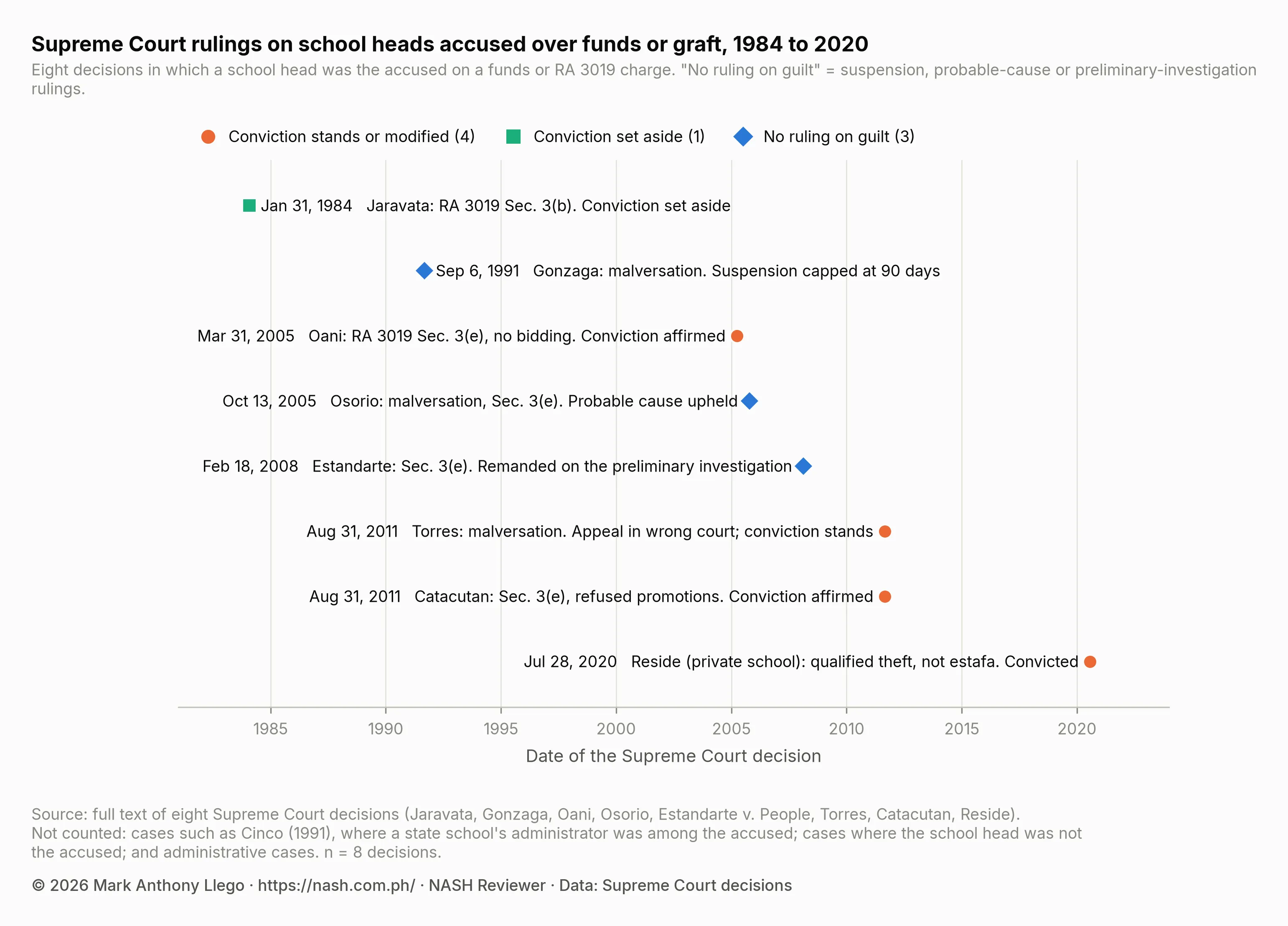
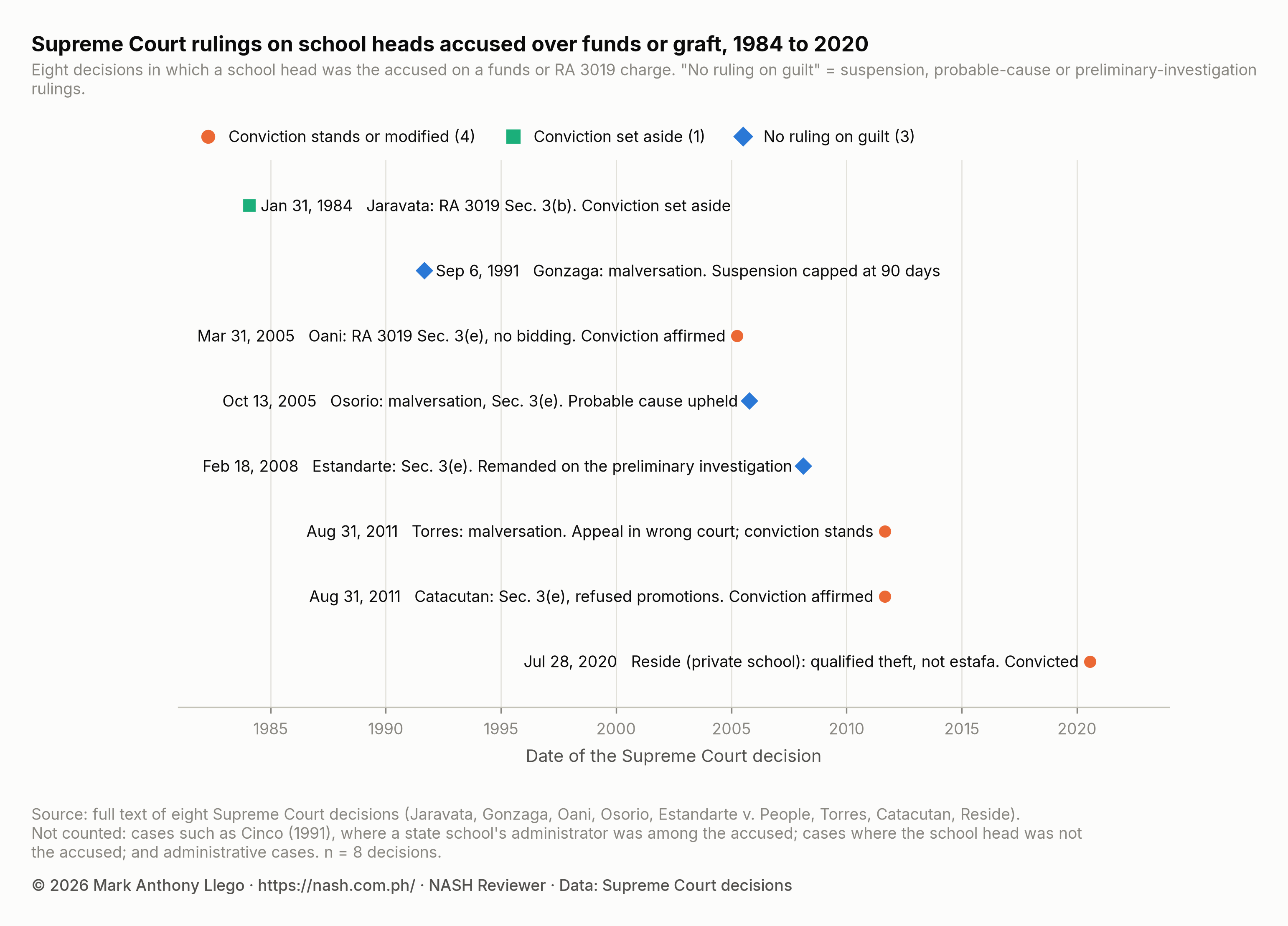
Figure 1 shows eight of these decisions, those in which a school head was the accused on a funds or RA 3019 charge. It leaves out Cinco (1991), where a state school’s administrator was among the accused, and Tirol (2000), where a principal was a co-accused below.
Is a principal an accountable officer? Torres v. People (2011)
Torres v. People, G.R. No. 175074, August 31, 2011 (Third Division), Peralta, J.; Velasco, Jr., J., separate concurring opinion.
Facts. Jesus Torres was principal of Viga Rural Development High School in Catanduanes. In April 1994 three checks totaling ₱196,654.54 were prepared for the staff’s salaries and allowances. By the school’s custom, the principal encashed salary checks and delivered the cash to the disbursing officer. Torres encashed these on April 27 but never returned to the school. His defense was that he flew to Manila for chest pains and was held up there two days later. The Regional Trial Court of Virac convicted him of malversation on August 31, 2005.
Issue. His lawyer from the Public Attorney’s Office filed the notice of appeal with the Court of Appeals. Torres acknowledged the error only on February 10, 2006, five months later, and asked that the case be sent to the Sandiganbayan; the Court of Appeals dismissed the appeal outright. His petition assigned one error, that dismissal, and also argued the merits.
Ruling. The petition was denied, and the conviction stands. The holding is procedural. Under RA 8249, the Sandiganbayan has exclusive appellate jurisdiction over final judgments of regional trial courts in these cases, and the Rules of Court say that “An appeal erroneously taken to the Court of Appeals shall not be transferred to the appropriate court, but shall be dismissed outright.” A wrong court may be corrected only within the 15-day period to appeal, and Torres was months late.
The Court added that his arguments would fail on the merits anyway. It said: “An accountable public officer, within the purview of Article 217 of the Revised Penal Code, is one who has custody or control of public funds or property by reason of the duties of his office.” It then said that “a school principal of a public high school, such as petitioner, may be held guilty of malversation if he or she is entrusted with public funds and misappropriates the same.” Torres also argued that he was charged with intentional malversation but convicted of malversation through negligence. The Court answered that the two are one crime: “Even when the Information charges willful malversation, conviction for malversation through negligence may still be adjudged if the evidence ultimately proves the mode of commission of the offense.”
Separate opinion. Justice Velasco agreed that Torres was an accountable officer and that the dismissal followed the rules. He found “gross mistake or irresponsibility on the part of the PAO lawyer” and wrote that “the Court should have remanded the instant case to the Sandiganbayan and ordered petitioner’s appeal to be given due course.” He still concluded: “I vote to dismiss the petition.”
Why it matters. Because of where and when his appeal was filed, no appellate court reweighed his robbery account. The merits passage is the clearest statement in the cases that a principal who handles school money can be an accountable officer.
Later history. The penalty was fixed under the brackets in force in 1994 (Article 217 as amended by RA 1060), which RA 10951 has since replaced (next section). The appellate rule still applies (see the appeals section below).
Malversation, including through negligence: what Article 217 says now
Ragodon (2025) lists the four elements of malversation: “(1) that the offender is a public officer; (2) that he/she had the custody or control of funds or property by reason of the duties of his office; (3) that those funds or property were public funds or property for which he/she was accountable; and (4) that he [or] she appropriated, took, misappropriated or consented or, through abandonment or negligence, permitted another person to take them.” Article 217 thus reaches an officer who “shall consent, through abandonment or negligence, shall permit any other person to take such public funds or property”. Its last paragraph creates a presumption: “The failure of a public officer to have duly forthcoming any public funds or property with which he is chargeable, upon demand by any duly authorized officer, shall be prima facie evidence that he has put such missing funds or property to personal uses.” The presumption arises from a failure to produce the funds on demand, and it can be rebutted. As the Court put it in Ragodon, “The mere absence of funds does not constitute sufficient evidence of malversation.” But it added that “an accountable officer may face conviction for malversation even in the absence of direct evidence of misappropriation, provided there exists evidence of a deficiency in their account that they cannot adequately explain.”
A related crime, not applied in any of these cases, is Article 220, illegal use of public funds: it punishes “Any public officer who shall apply any public fund or property under his administration to any public use other than that for which such fund or property were appropriated by law or ordinance”. That is the kind of wrong-fund spending the audit reported in the administrative case Balbastro v. COA, below; the decision does not say how the related criminal complaint ended.
RA 10951, which took effect on September 16, 2017 (as Reside records), rewrote the peso brackets in Section 40:
| Amount malversed | Penalty under RA 10951, Sec. 40 | Bracket under the old text quoted in Torres |
|---|---|---|
| Up to ₱40,000 | Prisión correccional, medium and maximum | Up to ₱200 |
| Over ₱40,000 to ₱1,200,000 | Prisión mayor, minimum and medium | Over ₱200 to ₱6,000 |
| Over ₱1,200,000 to ₱2,400,000 | Prisión mayor maximum to reclusion temporal minimum | Over ₱6,000 to under ₱12,000 |
| Over ₱2,400,000 to ₱4,400,000 | Reclusion temporal, medium and maximum | Over ₱12,000 to under ₱22,000 |
| Over ₱4,400,000 to ₱8,800,000 | Reclusion temporal, maximum | Over ₱22,000: reclusion temporal maximum to reclusion perpetua |
| Over ₱8,800,000 | Reclusion perpetua | (included in the row above) |
Source: RA 10951, Sec. 40; old text as quoted in Torres, footnote 20. In every bracket the offender also suffers perpetual special disqualification and a fine equal to the amount malversed.
Under the old text, the ₱196,654.54 in Torres fell in the top bracket. Under RA 10951 the same amount falls in the second. RA 10951, Sec. 100 gives the new brackets “retroactive effect to the extent that it is favorable to the accused or person serving sentence by final judgment.”
Who is accountable at school level today. Most public schools receive MOOE as a cash advance in the school head’s name, and DepEd Order No. 029, s. 2019 treats that head as accountable: on leaving, “the accountability for the funds and the unused checks should be transferred from the outgoing to the incoming School Head” (item 20; mechanics in DepEd School MOOE). No decision has ruled on a school head’s cash advance, but read with Torres, the head should assume Article 217 applies.
Buying without real bidding: Oani v. People (2005) and RA 3019 Section 3(e)
Oani v. People, G.R. No. 139984, March 31, 2005 (Second Division), Callejo, Sr., J.
Facts. Panabo High School in Davao del Norte received ₱648,532 in MOOE from November 1988 to December 1989 under the free secondary school program. In March 1990 the school’s Parents Teachers Association wrote to the DECS Secretary about principal Leopoldo Oani and the resident auditor, Bonifacio Roa. A COA audit team found that:
- Oani bought nine fire extinguishers for ₱54,747 without public bidding; a re-canvass showed an overprice of ₱23,040.
- The sound system and supplies cost ₱227,857.45, against ₱144,621.51 on re-canvass. The Sandiganbayan, as trial court, found the canvasses simulated: forms came back from favored suppliers “filled up with inflated quotations”, and only Oani’s signature, of the committee he chaired, appeared on them. The Supreme Court agreed.
Oani defended the fire extinguisher purchase with a supplier’s certification of exclusive distributorship dated “January 1988”. The Court found that it cited a COA circular issued only on December 19, 1991: “In fine, Cunanan could not possibly have issued a certification pursuant to an administrative circular which did not as yet exist.”
Issue. Was his guilt under Section 3(e) proved beyond reasonable doubt?
Ruling. Yes; the petition was denied. Under COA Circular No. 78-84 (1978), a negotiated purchase was allowed only in listed cases, including an exclusive distributor with no sub-dealers selling lower and no suitable substitute on better terms. “None of the foregoing conditions existed when the petitioner purchased the fire extinguishers on a negotiated basis from Powerline.” The Court concluded: “In the present case, the petitioner purchased the fire extinguishers and office and school supplies without the benefit of a public bidding, in gross and evident bad faith, resulting in the considerable overpricing of the fire extinguishers and the supplies, to the gross prejudice of the government.”
Who was convicted and who was acquitted. The Sandiganbayan convicted Oani in both cases, each with 6 years and 1 month to 8 years and perpetual disqualification, and ordered restitution of ₱23,040 and ₱73,878.79. It acquitted Roa, the resident auditor, in both cases, with no civil liability; the Supreme Court decision does not give its reasons.
Why it matters. Delivery was no defense: the Sandiganbayan, in a passage the Court quoted, said it “would have been a potent defense” had the purchases not been overpriced. An exception to bidding must exist, and be documented, before the purchase.
Later history. Procurement later came under RA 9184 (applied in Dionisio, 2017), which RA 12009 has repealed (next section). Since RA 10910 (2016), “All offenses punishable under this Act shall prescribe in twenty years.”
Section 3(e) beyond purchases. As Catacutan lists its elements, the accused “must be a public officer discharging administrative, judicial or official functions”; he must have acted, in the statute’s words, through “manifest partiality, evident bad faith or gross inexcusable negligence”; and his act must have caused undue injury to any party, including the government, or given a private party unwarranted benefits. Two cases digested in other posts show its range:
- In Osorio v. Desierto, G.R. No. 156652, October 13, 2005 (Second Division), the Ombudsman found probable cause against a Bohol principal for purchase orders issued after delivery, for Scout fees set above DECS rates, and for malversation of the proceeds of the school’s old newspapers. The Court let the case go to trial and decided nothing about guilt. See Unauthorized School Fees.
- In Catacutan v. People, G.R. No. 175991, August 31, 2011 (First Division), an OIC principal’s conviction under Section 3(e) was affirmed for refusing, from June to November 1997, to implement the promotions of two of the school’s personnel. No money was taken; the injury was their lost pay differentials. See Promotion Protests and Nepotism.
Procurement today: RA 12009 replaced RA 9184
RA 12009, the New Government Procurement Act, was approved on July 20, 2024. The Government Procurement Policy Board (GPPB) says it “will take effect on 13 August 2024.” Section 115 provides: “Republic Act No. 9184 otherwise known as the ‘Government Procurement Reform Act’ and Commonwealth Act No. 138 are hereby repealed.” But “Prior to the effectivity of the IRR of this Act, the provisions of Republic Act No. 9184 and its IRR shall remain in force and effect” (Sec. 113), and liability for acts committed before RA 12009 took effect “shall not be diminished, modified, or affected in any way by its enactment” (Sec. 93). Its list of resolutions shows the implementing rules approved on February 4, 2025 (Resolution No. 02-2025, published February 10, 2025) and the standard forms on May 14, 2025 (Resolution No. 03-2025). It follows from Secs. 93 and 113, though neither says so outright, that RA 9184 and its IRR governed purchases until the new IRR took effect in 2025, and that an earlier purchase is judged under them. Procuring entities then have three years from the standard forms’ approval “to fully comply with the requirements of this Act” (Sec. 113).
| Point in the cases | Rule then | Rule now (RA 12009) |
|---|---|---|
| Buying from a sole distributor (Oani) | COA Circular No. 78-84 (1978): negotiated purchase from an exclusive distributor with no sub-dealers selling lower and no suitable substitute | Sec. 31(c): direct contracting “When it is sold by an exclusive dealer or manufacturer which does not have sub-dealers selling at lower prices and for which no suitable substitute can be obtained at more advantageous terms to the government” |
| Purchases above a threshold without bidding (Tirol) | COA Circular No. 85-55A: public bidding for purchases above ₱50,000, as the decision describes it | Modes and thresholds in Secs. 26 to 37 and the IRR; see DepEd School MOOE for the small-purchase modes |
| Breaking up purchases | Not in issue in the cases | Sec. 39 prohibits splitting contracts “for the purpose of evading or circumventing the requirements of this Act and its IRR” |
| Liability | RA 3019 and administrative rules | Sec. 92 makes listed acts administrative offenses “Without prejudice to the criminal and civil liabilities under Republic Act No. 3019”; they include “Simulating procurement eligibility requirements or strategic procurement planning activities” |
RA 12009 has no penal article of its own. Criminal liability for a rigged or overpriced purchase still runs through RA 3019 and other penal laws, as in Oani and Tirol. Ask the Schools Division Office which official is the head of the procuring entity and which Bids and Awards Committee acts for your school’s purchases.
Money from teachers: the limits of Section 3(b) (Jaravata, 1984)
In Jaravata v. Sandiganbayan, G.R. No. 56170, January 31, 1984 (En Banc), the Court set aside an assistant principal’s Section 3(b) conviction for receiving more than his share of expense money from teachers, because no law required him to intervene in their salary differentials. It decided only the reach of Section 3(b), not whether such collections are proper; see Unauthorized School Fees.
When a COA audit is enough to dismiss: Balbastro v. COA (2008)
Balbastro v. Commission on Audit, Regional Office No. VI, G.R. No. 171481, June 30, 2008 (En Banc), Carpio Morales, J. This is an administrative case, not a criminal one.
Facts. On a 1999 letter from the teachers’ association of Iloilo City National High School, the Ombudsman had COA audit the school. The audit reported, among other things, ₱184,536.76 in city funds for students’ miscellaneous expenses kept off the books and spent on other purposes such as the Ati-Atihan and landscaping, ₱161,150 for repairs not implemented, and ₱467,254.55 for Ati-Atihan costumes taken from Personal Services funds without appropriation.
The principal, Corazon Balbastro, answered in writing but missed two preliminary conferences, so the Ombudsman deemed her to have waived a formal hearing. In 2002 it dismissed her for grave misconduct, exonerated the disbursing officer, Lydia Ocate, for lack of evidence, and gave the principal the benefit of the doubt on late remittances. The Court of Appeals, in an amended decision, affirmed.
Issue. Was she denied due process, and was the evidence enough?
Ruling. The petition was denied. “Petitioner deprived herself of standing to raise these issues, however, for failing to show up for two consecutive times at the preliminary conference”. The teachers did not need to testify: “The letter-complaint merely served the purpose of initiating the investigation, not to establish the culpability of petitioner.” The audit report was substantial evidence. Her argument that the disbursing officer was the one liable failed: “it would not follow that petitioner is thereby exonerated, for petitioner may still be just as liable as Ocate for the acts charged.”
Why it matters. Spending on real school activities can still be misconduct when the money comes from the wrong fund, stays off the books or lacks appropriation. Generalities and missed conferences lost the case.
Later history. A separate dismissal, for dishonesty over payrolls showing former students as paid, stands after Balbastro v. Junio (2007). The decision mentions a criminal case docketed from the same audit but not its outcome. Today the 2025 RACCS lists grave misconduct, serious dishonesty and “committing acts punishable under the anti-graft laws” among the grave offenses punishable by dismissal (Sec. 63(A)(1)). The Ombudsman rules that governed her conferences (A.O. No. 7, 1990) have been replaced by A.O. No. 1, s. 2026; see Preventive Suspension, Appeals and Back Pay.
Two school-property cases are digested in Dishonesty and Grave Misconduct: Office of the Deputy Ombudsman for Luzon v. Dionisio (2017), where a principal who leased provincial school land without authority, could not show receipts for the lease money she said went to school projects, and skipped bidding was dismissed for grave misconduct, and Corpuz v. Cardoza (June 2, 2026; it may not yet be final), where grave misconduct was not proved and a principal drew six months’ suspension for simple misconduct and simple neglect.
Private schools: unremitted tuition is qualified theft (Reside v. People, 2020)
Reside v. People, G.R. No. 210318, July 28, 2020 (First Division), Reyes, J., Jr., J.
Facts. From 2001 to 2005, Janice Reside was pre-school and grade school principal of Treasury of the Golden Word School, Inc. in Las Piñas, authorized to collect tuition, issue official receipts and remit the money. After she stopped reporting for work, the school found unremitted fees and “temporary receipts which was against the policy of TGWSI.” She signed a promissory note at the barangay, did not pay, and was charged with estafa. She denied failing to remit and said she signed the note under duress; the courts did not accept her defense. The trial court convicted her for ₱1,721,010.82; the Court of Appeals affirmed but found only ₱134,462.90 proved unremitted.
Issue. Was the crime estafa?
Ruling. No. “The Court finds that petitioner is guilty, not of estafa, but of qualified theft.” Estafa by misappropriation requires juridical possession. Money an employee receives for the employer is held only in material possession: “Consequently, petitioner, as principal and temporary cash custodian of TGWSI, acquires only physical or material possession over the unremitted funds.” Because the information’s facts included the elements of qualified theft, with grave abuse of confidence, she could be convicted of that crime. Applying RA 10951, the Court imposed 5 years, 5 months and 11 days to 9 years, 4 months and 1 day, and ₱134,462.90 in actual damages with 6% interest from finality. The Court of Appeals’ estafa sentence had a maximum of 17 years, 4 months and 1 day.
Why it matters. Reside did not discuss malversation, but Article 217 does not reach the school’s own funds. The trust placed in a principal who collects fees is what makes the theft “qualified”. Temporary receipts, against school policy, were part of the evidence.
On private school heads more broadly, see Can a Private School Remove Its Principal?
Subordinates, instructions and cash handling: Ragodon (2025) and Tirol (2000)
No principal was a party to either petition, but both show how a principal’s instructions and approvals shape the exposure of those who handle school money.
Ragodon v. People (2025): robbed while carrying salaries
Ragodon v. People, G.R. No. 254652, August 27, 2025 (Third Division), Inting, J.
Facts. On October 14, 2002, Alice Ragodon, disbursing officer of Romblon National High School, withdrew ₱802,224.19 in salaries at a bank in Odiongan. A school employee testified that the principal had told her to convert the cash into a demand draft. She did not: her escort said they went to a relative’s house until late evening, and she said the bank had closed. On the way to the pier, armed men robbed her and the unarmed utility worker the principal had chosen as escort. The trial court convicted her of malversation through negligence, and the Sandiganbayan affirmed.
Issue. Did she, “through abandonment or negligence”, permit another to take the funds?
Ruling. No; she was acquitted. “The law cannot be stretched to criminalize a forced or compelled surrender of funds under the compulsion of armed robbery.” The Court explained: “The term ‘permit’ suggests consent or tolerance, not an involuntary surrender under threat or force.” Carrying cash when drafts could not be cashed was common at the school, the departures from procedure did not amount to criminal negligence, and “petitioner cannot be faulted for assigning Mazo, a utility worker, to accompany her, as it was the school principal who appointed escorts.” Entry of judgment was ordered immediately.
Why it matters for principals. The principal was not an accused in this case, and the decision is not a ruling on his conduct. But the record turned on his instructions, his choice of escort and the cash practice at his school. Compare Torres: there the principal himself carried the cash, and no appellate court reviewed his robbery account because his appeal was dismissed.
Tirol v. COA (2000): signing on a subordinate’s word
Tirol v. Commission on Audit, G.R. No. 133954, August 3, 2000 (En Banc), Davide, Jr., C.J.
Facts. On a complaint by the Teachers and Employees Union of Lalawigan National High School in Eastern Samar, COA found that ₱80,000 of equipment had been bought by negotiated contract, not public bidding, and was overpriced by ₱35,100. The DECS regional director, Victoriano Tirol, Jr., who had approved the requisition and signed the check, was charged under RA 3019 Section 3(g) with the principal and the bookkeeper. He argued that he signed on his subordinates’ review, relying on Arias v. Sandiganbayan and Magsuci v. Sandiganbayan.
Issue. Did reliance on subordinates defeat the Ombudsman’s finding of probable cause?
Ruling. No; the petition was denied, with double costs, and his counsel was warned against dilatory tactics. Good faith and conspiracy “involve questions of fact” for the Sandiganbayan. Arias and Magsuci did not apply because “the petitioners therein were indicted and submitted themselves to trial before the Sandiganbayan, which convicted them of the offenses charged”. In other words, reliance on subordinates is a defense to be proved at trial, not a reason to stop the case. The petition also failed on procedure: no appeal lay from the Ombudsman’s finding in a criminal case, and, read as a certiorari petition, it named COA instead of the Ombudsman.
Why it matters. The principal, a co-accused below, was not a party here, and the decision says nothing about her guilt or the trial’s outcome. The lesson is about signatures: approving a requisition or a check is an act you may have to defend in court.
Suspension while the criminal case is pending (Gonzaga, 1991)
RA 3019 Section 13 requires the suspension of an incumbent officer facing a valid information under that Act, under Title 7, Book II of the Revised Penal Code (which includes malversation), or “for any offense involving fraud upon government or public funds or property”. In Gonzaga v. Sandiganbayan, G.R. No. 96131, September 6, 1991 (En Banc), the Court capped at 90 days the Section 13 suspension of a principal charged with malversation over an alleged ₱15,188.37 audit shortage, and let her return to her post while the trial continued; see Preventive Suspension, Appeals and Back Pay. As of October 2026, no later law has amended Section 13.
Which court hears the appeal, and why the deadline matters
Under the Sandiganbayan law as last amended by RA 10660 (2015), where no accused holds a position at “Salary Grade ‘27’ or higher”, the regular trial courts try the case. School Principals I to IV are Salary Grades 19 to 22 (ECP salary grades); Catacutan’s information described him as “with salary grade below 27”. Jaravata, Gonzaga and Oani were filed in the Sandiganbayan under the rules of their time.
The appeal from a trial court conviction goes to the Sandiganbayan, not the Court of Appeals. RA 10660 keeps the sentence Torres applied: “The Sandiganbayan shall exercise exclusive appellate jurisdiction over final judgments, resolutions or orders of regional trial courts whether in the exercise of their own original jurisdiction or of their appellate jurisdiction as herein provided.” Catacutan followed that route; Torres did not, and lost. An error in the court named can be cured only within the 15-day appeal period.
Objections to the preliminary investigation settle procedure, not guilt. In Cinco v. Sandiganbayan, G.R. Nos. 92362-67, October 15, 1991 (En Banc), Medialdea, J., the accused included the school administrator and the collecting and disbursing officer of Sumoroy Agro-Industrial School, a state college, charged under Section 3(e). When refiled cases were attacked for lack of a proper preliminary investigation, the Court held that the earlier investigation stayed valid: “A new preliminary investigation will be useless and repetitious because the same facts and evidence will be elicited.” The accused had been given time to submit evidence and submitted nothing. In Estandarte v. People (2008), digested in Unauthorized School Fees, a principal instead won a remand for the trial court to decide whether her preliminary investigation denied her due process.
After a conviction: pardon and reinstatement (Sabello, 1989)
Sabello v. Department of Education, Culture and Sports, G.R. No. 87687, December 26, 1989 (First Division), Gancayco, J.
Facts. Isabelo Sabello, an elementary school principal in Gingoog City, withdrew ₱840 of barrio aid allotted for a barangay high school’s teachers and deposited it with the City Treasurer in the school’s name. He and the barrio captain were convicted under RA 3019 and sentenced to one year and disqualification from public office. After an absolute pardon, DECS rehired him only as a classroom teacher.
Issue. Must he be restored as principal, with back wages and continuous service?
Ruling. In part. DECS was directed to appoint him Elementary School Principal I, since nothing warranted “the diminution in his rank”. A pardon gives no automatic reinstatement, and there were no back wages: “Such right is afforded only to those who have been illegally dismissed and were thus ordered reinstated or to those otherwise acquitted of the charge against them.” His service was not continuous, but he would retire as an Elementary School Principal I.
Why it matters. A conviction follows a principal long after: separation, years out of service and no back pay even after a pardon. The case says nothing about what conduct is criminal.
What this means for school heads
Treat school money as your personal accountability.
- If the MOOE cash advance is in your name, treat yourself as its accountable officer, as Torres and DO 29 indicate. Know where every peso is, and liquidate before you transfer or retire.
- Do not make a habit of carrying payroll cash yourself (Torres). Put the cash procedure in writing: bank, instrument, route and escort, chosen for the amount at risk; in Ragodon, the principal appointed escorts.
- Report any loss or theft to the police and the division at once; in Ragodon the prompt police report counted.
Buy by the rules, before the purchase.
- Never let a supplier fill in canvass or quotation forms, and never issue a purchase order after delivery (Oani; Osorio).
- If you rely on an exception, such as a sole distributor, get the proof and check for substitutes first, and file it before buying (Oani; RA 12009, Sec. 31(c)).
- Do not split purchases to stay under a threshold (RA 12009, Sec. 39). Ask the division who your head of procuring entity and BAC are.
- Before signing a requisition, voucher or check, read it. Reliance on staff is a defense for trial, not a shield from prosecution (Tirol).
Answer audits and complaints fully.
- Attend audit and Ombudsman conferences and answer each finding with documents. Spend each fund only for its purpose; a good cause does not cure the wrong fund (Balbastro v. COA).
Do not collect from teachers or learners on your own authority (Unauthorized School Fees; Jaravata turned only on Section 3(b)), and do not lease or give away school property (Dishonesty and Grave Misconduct).
If you are charged.
- Get a lawyer at once and submit your counter-affidavit and evidence when asked (Cinco).
- If convicted, check that the appeal goes to the right court within 15 days (Torres).
- Count the days of any suspension under Section 13 (Gonzaga), and remember that winning the administrative case does not end the criminal case (Catacutan).
In a private school, issue only the school’s official receipts and remit on schedule (Reside).
These habits are the financial-management strand of the PPSSH; see PPSSH Domain 2: Managing School Operations, and, for controls and red flags, School Head Ethics and Internal Control.
How the NASH may test this
The two items below are original practice items, scored 3 (Relational), 2 (Multistructural), 1 (Unistructural) or 0 (Prestructural). An option that breaks a rule scores 0.
Question 1
Indicator 2.2.1, Financial management. Career Stage 1, Conceptual, Moderate.
A teacher preparing for the NASH asks which statement best describes a public school principal’s criminal exposure in handling school funds and purchases. Which answer is most accurate?
- A. Only the disbursing officer and the bookkeeper can be charged with malversation, because a principal merely approves documents and never holds the money personally.
- B. A principal who holds public funds by reason of the post is an accountable officer, and malversation may be committed by taking the funds or by negligently letting another take them.
- C. RA 12009, Sec. 92 makes simulating procurement eligibility requirements, and other deliberate violations of the Act, administrative offenses, so a principal who rigs a canvass faces an administrative case even if no criminal case is filed.
- D. A principal with custody of public funds is an accountable officer liable for intentional or negligent malversation, while a rigged or overpriced purchase made in evident bad faith can be graft under RA 3019 Sec. 3(e), which RA 12009 expressly preserves; guilt must still be proved.
Answer and explanation
Best answer: D. Points: A = 0, B = 2, C = 1, D = 3.
- A (0 points, Prestructural). It is a misconception. Torres v. People (2011) says a public high school principal “may be held guilty of malversation if he or she is entrusted with public funds and misappropriates the same.”
- B (2 points, Multistructural). Both elements are right, but it treats funds alone and misses the graft exposure in purchasing.
- C (1 point, Unistructural). It is true, since Sec. 92 applies “even if no criminal prosecution is instituted”, but it stops at administrative liability and misses that Sec. 92 is “Without prejudice to the criminal and civil liabilities under Republic Act No. 3019”.
- D (3 points, Relational). It connects accountability for funds, the two modes of malversation, Section 3(e) for procurement and the current procurement law, and keeps the burden of proof in view.
Why. This aligns with Career Stage 1 expectations because indicator 2.2.1 asks the aspiring school head to understand the rules on procurement and disbursement. Torres treats a principal entrusted with public funds as an accountable officer under Article 217; Oani v. People (2005) affirmed a Section 3(e) conviction for rigged, overpriced purchases; RA 12009 keeps RA 3019 liability; and Ragodon v. People (2025) shows each element must be proved.
Indicator 2.2.1: Demonstrate knowledge and understanding of policies, guidelines and issuances in managing finances such as allocation, procurement, disbursement and liquidation aligned with the school plan.
Sources: Torres v. People, G.R. No. 175074, August 31, 2011; Oani v. People, G.R. No. 139984, March 31, 2005; Ragodon v. People, G.R. No. 254652, August 27, 2025; RA 10951, Sec. 40; RA 12009, Secs. 92 and 115.
Question 2
Indicator 2.2.2, Financial management. Career Stage 2, Situational, Moderate.
You are the principal of a national high school. The fire safety inspection is in three weeks, and the school’s plan includes ten new fire extinguishers. A supplier says it is the exclusive distributor of its brand and offers to prepare the quotation and canvass forms to save time. A hardware store has quoted a lower price for an extinguisher of similar rating. What is the most appropriate action?
- A. Accept the supplier’s offer, since an exclusive distributor may be engaged directly, and let it prepare the forms so that the file is complete before the inspection.
- B. Send the specifications, the supplier’s offer and the hardware store’s quotation to the division BAC, and ask it to complete the purchase before the inspection.
- C. Defer the purchase to the next fiscal year, so that no procurement question can arise while the inspection is pending.
- D. Confirm with the division’s BAC the proper mode and that the item is in the procurement plan; obtain quotations yourself; use the distributor only if it proves exclusivity and no suitable substitute exists at better terms; and keep every document.
Answer and explanation
Best answer: D. Points: A = 0, B = 2, C = 1, D = 3.
- A (0 points, Prestructural). Letting the supplier fill in the canvass is the simulated canvass condemned in Oani v. People (2005), and the cheaper substitute defeats the exclusive-distributor exception. It breaks the procurement rules.
- B (2 points, Multistructural). Routing the purchase through the BAC is right, but it leaves the exclusivity claim untested, does not check that the item is in the procurement plan, and keeps no school record of the choice.
- C (1 point, Unistructural). It avoids a bad purchase but leaves a safety need in the school plan unmet.
- D (3 points, Relational). It ties the safety need to the plan, the proper mode under RA 12009 and the documents that show the purchase was lawful.
Why. This aligns with Career Stage 2 expectations because indicator 2.2.2 asks the school head to manage finances, including procurement, within the rules. RA 12009 allows direct contracting from an exclusive dealer only when it “does not have sub-dealers selling at lower prices and for which no suitable substitute can be obtained at more advantageous terms to the government” (Sec. 31(c)). In Oani, the sole-distributor defense failed: a cheaper equivalent existed, and the certification post-dated the purchase.
Indicator 2.2.2: Manage finances adhering to policies, guidelines and issuances in allocation, procurement, disbursement and liquidation aligned with the school plan.
Sources: Oani v. People, G.R. No. 139984, March 31, 2005; RA 12009, Secs. 31, 39 and 92.
Nothing in this guide reproduces or predicts examination content.
Frequently asked questions
Can a principal go to jail for misusing MOOE?
Yes, if the crime is proved. A principal entrusted with public funds is an accountable officer under Article 217 (Torres v. People, 2011), with penalties set by amount under RA 10951. Purchases made in evident bad faith that cause undue injury can also be graft under RA 3019 Section 3(e) (Oani v. People, 2005).
Is the principal liable if the disbursing officer loses the money?
No decision has settled a principal’s criminal liability for a subordinate’s loss. In Ragodon v. People (2025), the disbursing officer robbed at gunpoint was acquitted, and the principal who instructed her was not a party to the case. In Balbastro v. COA (2008), an administrative case, the principal was dismissed and the disbursing officer exonerated, and the Court rejected the principal’s argument that only the disbursing officer was liable.
Can a private school principal be charged with malversation?
Not over the school’s own money: Article 217 punishes public officers, and tuition collected for a private school is the school’s property. In Reside v. People (2020), such a principal was convicted of qualified theft, not the estafa charged, because she had only material possession of the money. Article 222 extends malversation to private individuals who “have charge of any Insular, provincial or municipal funds, revenues or property”, a different situation.
How long can a principal be suspended while a graft or malversation case is pending?
Under RA 3019 Section 13, suspension is mandatory once a valid information is filed, but Gonzaga v. Sandiganbayan (1991, En Banc) limited it to 90 days. Administrative preventive suspension has separate limits, explained in Preventive Suspension, Appeals and Back Pay.
Does winning the administrative case end the criminal case?
No. In Catacutan v. People (2011), the trial court refused to admit a Court of Appeals decision that, by his account, had dismissed the related administrative case against him and found no malice, and the Supreme Court agreed with the Sandiganbayan that “The findings in administrative cases are not binding upon the court trying a criminal case”. The ruling it relied on also says that “an absolution from a criminal charge is not a bar to an administrative prosecution, or vice versa.”
Download the data
The CSVs and charts may be reused only with written permission: email support@nash.com.ph. The decisions themselves are public records of the Supreme Court, which you can cite directly.
Sources
Decisions of the Supreme Court
- Jaravata v. Sandiganbayan, G.R. No. 56170, January 31, 1984 (En Banc), Abad Santos, J.
- Sabello v. Department of Education, Culture and Sports, G.R. No. 87687, December 26, 1989 (First Division), Gancayco, J.
- Gonzaga v. Sandiganbayan, G.R. No. 96131, September 6, 1991 (En Banc), Padilla, J.
- Cinco v. Sandiganbayan, G.R. Nos. 92362-67, October 15, 1991 (En Banc), Medialdea, J.
- Tirol v. Commission on Audit, G.R. No. 133954, August 3, 2000 (En Banc), Davide, Jr., C.J.
- Oani v. People, G.R. No. 139984, March 31, 2005 (Second Division), Callejo, Sr., J.
- Osorio v. Desierto, G.R. No. 156652, October 13, 2005 (Second Division), Chico-Nazario, J.
- Estandarte v. People, G.R. Nos. 156851-55, February 18, 2008 (Third Division), Austria-Martinez, J.
- Balbastro v. Commission on Audit, Regional Office No. VI, G.R. No. 171481, June 30, 2008 (En Banc), Carpio Morales, J.
- Torres v. People, G.R. No. 175074, August 31, 2011 (Third Division), Peralta, J.; Velasco, Jr., J., separate concurring opinion.
- Catacutan v. People, G.R. No. 175991, August 31, 2011 (First Division), Del Castillo, J.
- Office of the Deputy Ombudsman for Luzon v. Dionisio, G.R. No. 220700, July 10, 2017 (First Division), Perlas-Bernabe, J.
- Reside v. People, G.R. No. 210318, July 28, 2020 (First Division), Reyes, J., Jr., J.
- Ragodon v. People, G.R. No. 254652, August 27, 2025 (Third Division), Inting, J.
- Corpuz v. Cardoza, G.R. No. 253422, June 2, 2026 (Second Division), Kho, Jr., J.
Laws and rules
- Republic Act No. 3019, Anti-Graft and Corrupt Practices Act (1960; Section 13 as amended by Batas Pambansa Blg. 195 is quoted in Gonzaga, footnote 6).
- Revised Penal Code (Act No. 3815), Arts. 217, 220, 222, 308, 310 and 315.
- Republic Act No. 10951 (approved August 29, 2017), Sec. 40, amending Art. 217.
- Republic Act No. 10910 (approved July 21, 2016), amending RA 3019, Sec. 11.
- Republic Act No. 10660 (approved April 16, 2015), Sec. 2, amending Sec. 4 of P.D. No. 1606 on the Sandiganbayan’s jurisdiction.
- Republic Act No. 12009, New Government Procurement Act (approved July 20, 2024), Secs. 26, 31, 39, 92, 93, 113 and 115.
- GPPB, Important Update: Effectivity and Transistory Periods under RA 12009 (July 30, 2024); GPPB Resolutions (Resolution Nos. 02-2025 and 03-2025); NGPA Implementing Rules and Regulations.
- DepEd Order No. 029, s. 2019, Procedural Guidelines on the Management of Cash Advances for School MOOE and Program Funds of Non-Implementing Units, item 20.
- 2025 Rules on Administrative Cases in the Civil Service (CSC Resolution No. 2500357), Sec. 63(A)(1).
- Office of the Ombudsman, Administrative Order No. 1, s. 2026, Revised Rules of Procedure (January 19, 2026), replacing A.O. No. 7 (1990).
This guide explains Supreme Court decisions for study and professional awareness. It is not legal advice; for a specific case, consult a lawyer or your Schools Division Office’s legal unit.
The Supreme Court cases series
- Supreme Court Cases on School Heads: A Guide for Principals
- Can the Ombudsman Discipline a Principal? RA 4670 Cases
- Can a Principal Be Reassigned to Another School?
- Promotion Protests and Nepotism: Cases on Principals
- Unauthorized School Fees: What Happens to the Principal?
- Can a Principal Be Jailed Over School Funds? (this post)
- Dishonesty and Grave Misconduct: Cases on Principals
- Oppression Cases: How Principals Must Treat Teachers
- Harassment, Child Abuse and Hazing: Cases on School Heads
- Is a Principal Liable When a Pupil Is Injured?
- Can a Private School Remove Its Principal?
- Preventive Suspension, Appeals and Back Pay for Principals
Written by Mark Anthony Llego for NASH Reviewer. Sources: Supreme Court decisions (E-Library and Lawphil), RA 3019, the Revised Penal Code as amended by RA 10951, RA 10660, RA 12009, DepEd Order No. 029, s. 2019 and the 2025 RACCS. Charts may be reused only with written permission from support@nash.com.ph.