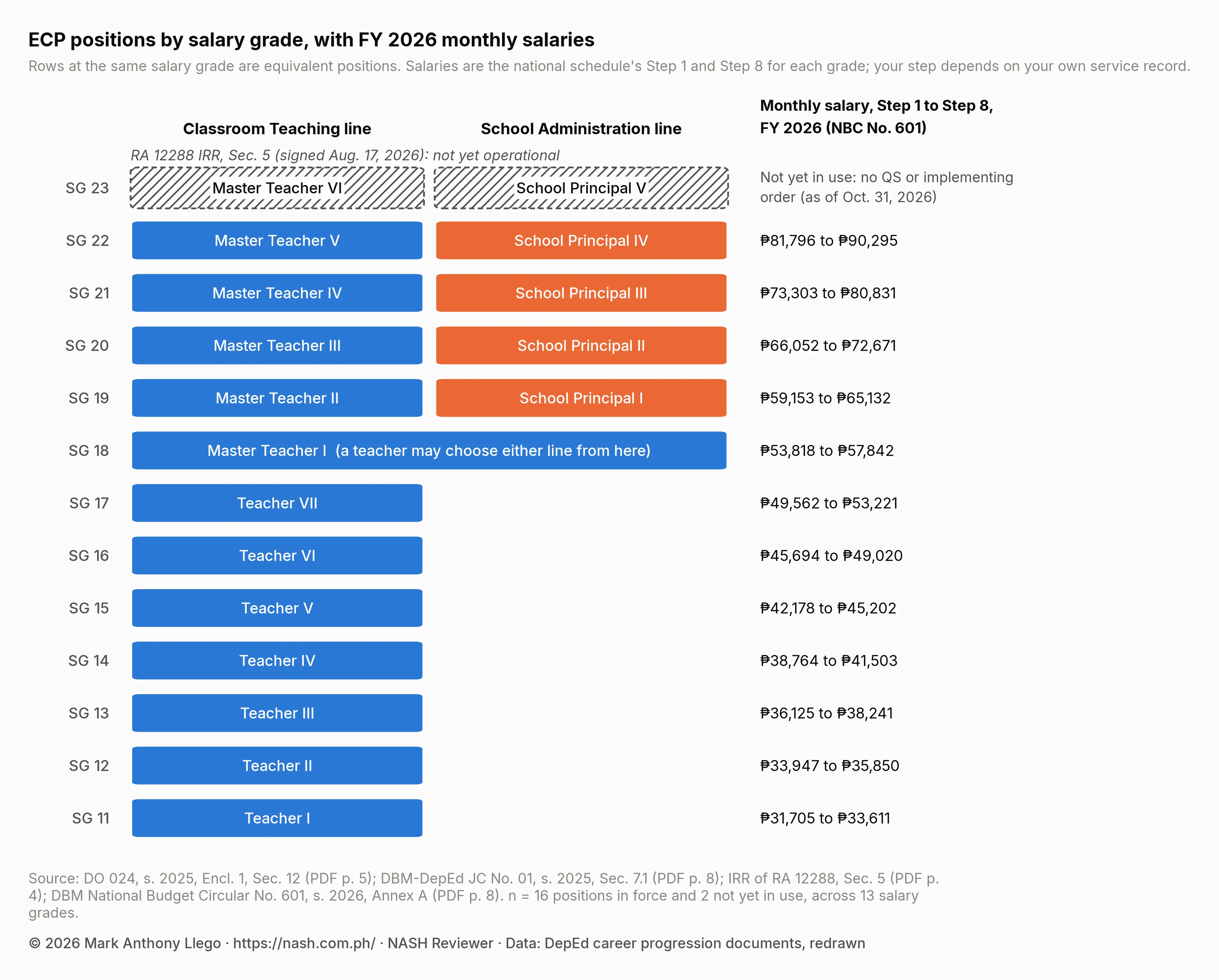
Under DepEd Order No. 024, s. 2025, DepEd’s guidelines for the Expanded Career Progression (ECP) System created by Executive Order No. 174, s. 2022, Teacher I to Teacher VII are Salary Grade (SG) 11 to 17, Master Teacher I to V are SG 18 to 22, and School Principal I to IV are SG 19 to 22 (Encl. 1, Sec. 12). So Teacher IV is SG 14, Teacher VII is SG 17, and Master Teacher V and School Principal IV are both SG 22. In pesos, the salary schedule for 2026, DBM’s National Budget Circular No. 601, s. 2026 (the third tranche under EO No. 64, s. 2024), pays SG 11 ₱31,705 a month at Step 1 and SG 22 ₱81,796 at Step 1, rising to ₱90,295 at Step 8 (Annex A).
Republic Act No. 12288 adds Master Teacher VI and School Principal V, and its implementing rules, signed on August 17, 2026, place both at SG 23 (IRR of RA 12288, Sec. 5). As of October 31, 2026, neither position is in use. No DepEd order implements the law, the two positions have no qualification standards, and the rules’ effective date is not yet known. FY 2026 reclassification still stops at Master Teacher V and School Principal IV.
Below are the grades and what they pay, the equivalence of the two lines, your salary step on reclassification or retitling, the three-salary-grade cap, and the last 5,335 applications under the old system. Qualification standards are in the QS post, the School Principal line in the principal post, retitling in the head teacher post, and the 2026 funding deferral in the deferral post.
Key findings
- The ladder in force has 16 positions on 12 salary grades. Teacher I–VII are SG 11–17, Master Teacher I–V SG 18–22 and School Principal I–IV SG 19–22 (DO 024, s. 2025, Encl. 1, Sec. 12; DO 034, s. 2025, para. 6). Positions with a Special Science Teacher or Special Needs Education Teacher title in parentheses carry the grade of the main title (DO 024, s. 2025, Annex A.2).
- FY 2026 monthly salaries run from ₱31,705 to ₱90,295. That is Teacher I at Step 1 up to Master Teacher V or School Principal IV at Step 8, under the third-tranche schedule effective January 1, 2026 (DBM NBC No. 601, s. 2026, Sec. 5.0 and Annex A). The circular covers “all civilian government personnel” in the Executive Branch (Sec. 3.0), and DepEd’s DM 061, s. 2026 cites it (para. 31.b).
- The two lines pay alike. Master Teacher II–V and School Principal I–IV are equivalent at SG 19–22 (EO 174, Sec. 4; DepEd-DBM JC No. 01, s. 2025, Sec. 7.1). RA 12288 provides that the lines “shall be equivalent in all salaries, benefits, and other privileges” (Sec. 7).
- SG 23 is in the IRR, not the Act, and is not yet in use. RA 12288 names Master Teacher VI and School Principal V but no grade (Sec. 5); the IRR puts both at SG 23 (Sec. 5). Their qualification standards are targeted for “Q1 of 2027” (DepEd deck, August 24, 2026, slide 34).
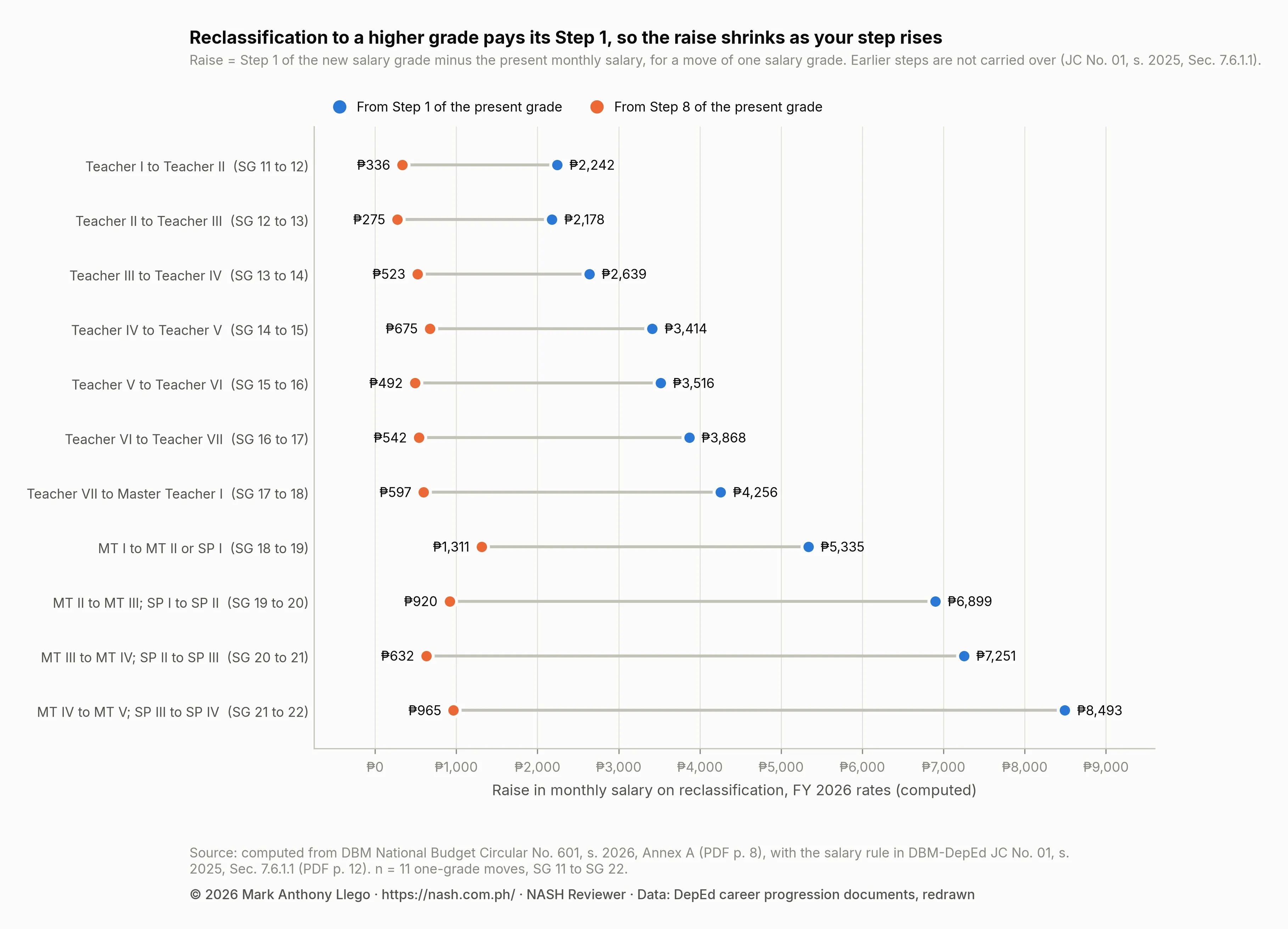
- Reclassification to a higher grade restarts your step. Reclassified teachers “shall receive a salary rate equivalent to the 1st step of the new position”, and step increments earned before “shall no longer be credited” (JC No. 01, s. 2025, Sec. 7.6.1.1). Retitled incumbents keep their “present salary rate, including step increment” (Sec. 7.6.1.2); no issuance states the pay rule for a same-grade move between the lines. At FY 2026 rates, a one-grade move pays ₱2,178 to ₱8,493 more a month from Step 1, but only ₱275 to ₱1,311 more from Step 8 (computed).
- The three-grade cap on reclassification comes from DepEd and the JC, not the CSC. DO 024 caps promotion “whether through reclassification or natural vacancy” at three salary grades (Encl. 1, Sec. 20.b). JC Form 1-A, issued earlier, lists no source position more than three grades below. The CSC’s 2025 rules exempt “Reclassification of position” from their own limit (2025 ORAOHRA, Sec. 101.e).
- The old system’s last batch was 5,335 positions, 79.93% of them Teacher I–III items. DBM allowed DepEd to process them under the old Equivalents Record Form (ERF) guidelines (DBM letter, March 2, 2026). Regional offices had to submit them “on or before April 2, 2026 only” (DM-OUHRODI-2026-0802, Sec. II.1).
ECP salary grades from Teacher I to School Principal IV
EO 174, s. 2022 created the Classroom Teaching and School Administration career lines, and it directed DBM to create the new titles Teacher IV to VII and Master Teacher V (Secs. 2, 3 and 5). The order itself prints no salary grades. The grades come from three places:
- the IRR of EO 174 (Sec. 9);
- the DepEd-DBM Joint Circular No. 01, s. 2025 of February 19, 2025 (Secs. 6.1.1, 6.1.2 and 7.1);
- DepEd’s guidelines, DO 024, s. 2025 of August 28, 2025 (Encl. 1, Sec. 12), repeated in DO 034, s. 2025 of October 14, 2025 (para. 6).
All of them give the same grades for SG 11 to 22. The table adds the two SG 23 positions of the RA 12288 IRR:
| SG | Classroom Teaching line | School Administration line | FY 2026 monthly salary, Step 1 | FY 2026 monthly salary, Step 8 |
|---|---|---|---|---|
| 23 | Master Teacher VI (RA 12288 IRR; not yet operational) | School Principal V (RA 12288 IRR; not yet operational) | Not yet in use | Not yet in use |
| 22 | Master Teacher V | School Principal IV | ₱81,796 | ₱90,295 |
| 21 | Master Teacher IV | School Principal III | ₱73,303 | ₱80,831 |
| 20 | Master Teacher III | School Principal II | ₱66,052 | ₱72,671 |
| 19 | Master Teacher II | School Principal I | ₱59,153 | ₱65,132 |
| 18 | Master Teacher I (a teacher may choose either line from here) | ₱53,818 | ₱57,842 | |
| 17 | Teacher VII | ₱49,562 | ₱53,221 | |
| 16 | Teacher VI | ₱45,694 | ₱49,020 | |
| 15 | Teacher V | ₱42,178 | ₱45,202 | |
| 14 | Teacher IV | ₱38,764 | ₱41,503 | |
| 13 | Teacher III | ₱36,125 | ₱38,241 | |
| 12 | Teacher II | ₱33,947 | ₱35,850 | |
| 11 | Teacher I | ₱31,705 | ₱33,611 |
Salary grades: DO 024, s. 2025, Encl. 1, Sec. 12; JC No. 01, s. 2025, Sec. 7.1; IRR of RA 12288, Sec. 5 (SG 23). Monthly salaries: DBM NBC No. 601, s. 2026, Annex A, third tranche, effective January 1, 2026.
Three points about the table:
- Parenthetical titles share the grade. DO 024’s list of authorized positions gives “Teacher IV (Special Needs Education Teacher I)” SG 14 and “Teacher III (Special Science Teacher I)” SG 13; every parenthetical title has the grade of its main title (Annex A.2).
- The pesos follow the national schedule. The grades “and their rates” are “deemed updated, adjusted, or modified whenever necessary to reflect such current levels and rates as may be fixed by relevant laws and executive issuances” (DO 024, Encl. 1, Sec. 19; similarly IRR of EO 174, Sec. 9 and JC, Sec. 7.2). The ECP documents fix the grade; the national schedule fixes what it pays.
- The same classroom work earns different grades on purpose. The JC holds that “there is no distinction between the duties and responsibilities of one teaching position and those of other teaching positions”, a deviation from grading by work assignment made “to encourage and reward initiatives for professional growth” (Sec. 7.0). A Teacher VII and a Teacher I can teach the same classes; the higher grade rewards qualifications and demonstrated professional standards, not a different job (Sec. 7.0).
How much each salary grade pays in FY 2026
The ECP documents give grades, not pesos. The pesos are in DBM’s National Budget Circular No. 601, dated January 22, 2026 and signed by Acting Secretary Rolando U. Toledo. “The new salary rates shall take effect beginning January 1, 2026” under its Annex A (Sec. 5.0), the third of the four tranches EO No. 64, s. 2024 sets “from Fiscal Year (FY) 2024 to FY 2027” (Sec. 1.0).
The schedule covers DepEd’s teachers. NBC 601 “applies to all civilian government personnel, now existing or hereafter created in the Executive, Legislative, and Judicial Branches”, “regardless of the appointment status” (Sec. 3.0). Its exclusions, such as military and uniformed personnel and agencies exempt from RA No. 6758, do not include teachers (Sec. 4.0), and the amounts “are already incorporated in the respective agency budgets under RA No. 12314 or the FY 2026 General Appropriations Act (GAA)” (Sec. 8.1). DepEd cites it in DepEd Memorandum No. 061, s. 2026, which computes the pay of external ARAL tutors from a Teacher I annual salary of ₱380,460: “The annual salary rate of Teacher I used in the computation is based on Executive Order No. 64, s. 2024, as implemented by National Budget Circular No. 601, s. 2026” (Encl., para. 31.b). ₱380,460 is 12 × ₱31,705, the SG 11 Step 1 rate (computed). The same Teacher I salary drives the 2026 hourly rate in our teaching overload pay guide.
Steps. Each grade from SG 11 to SG 23 has eight steps (Annex A). A step increment is “the increase in salary from step to step within the salary grade allocation”, given for meritorious performance “and/or through length of service” (2025 ORAOHRA, Sec. 12.c). Two rules in NBC 601 matter here:
- A new hire is paid “the rate corresponding to Step 1 of the salary grade allocation of the position” (Sec. 5.1.4).
- Incumbents moved to the 2026 rates “corresponding to the designated steps of the salary grade allocations of their positions as of December 31, 2025” (Sec. 5.1.1). A new tranche raises the rate but keeps your grade and step.
At FY 2026 rates, the spread from Step 1 to Step 8 within a grade is ₱1,906 a month for SG 11 and ₱8,499 for SG 22 (computed).
A figure to avoid copying. The ECP toolkit’s sample Initial Evaluation Result shows “Teacher IV” at “SG 14 - 37,024” (ECP System Toolkit for Teachers, 2025, p. 24). That is a sample, not the FY 2026 rate (₱38,764 at Step 1; NBC 601, Annex A), and the toolkit does not name its schedule.
FY 2026 only. The rates here are from the schedule in force for 2026; rates for 2027 or later are not given. The amounts are monthly salary rates, not take-home pay.
The two career lines pay alike
EO 174 sets out “equivalence in duties, recognition, and compensation for teachers choosing a career line” (Sec. 1). Its Section 4 pairs the lines: Master Teacher II with School Principal I, Master Teacher III with School Principal II, Master Teacher IV with School Principal III, and Master Teacher V with School Principal IV. The JC’s table puts each pair on one grade, SG 19 to 22, with Master Teacher I alone at SG 18 across both columns (Sec. 7.1). “Upon reaching the Master Teacher I position, a teacher may choose to continue the CT Career Line or pursue the SA Career Line”, subject to qualifications, performance, assessments and staffing parameters (JC, Sec. 6.2).
Because each pair shares a grade, each pair shares a salary. A Master Teacher II and a School Principal I at Step 1 are both paid ₱59,153 a month in FY 2026, and a Master Teacher V and a School Principal IV at Step 1 are both paid ₱81,796 (NBC 601, Annex A). JC Form 1-B also lists same-grade moves between the lines as reclassifications, such as Master Teacher II (SG-19) to School Principal I (SG-19) (PDF p. 48). What happens to the step in such a move is discussed below.
RA 12288, approved September 12, 2025, puts the pay equivalence in the law, once the Act is in effect. “The positions in the Teaching Career Line and the School Administration Career Line shall be equivalent in all salaries, benefits, and other privileges” (Sec. 7). The Act also protects incumbents: “In no case shall there be a demotion in rank or diminution of salaries, benefits, and other privileges, or both, of incumbent teachers and school leaders” upon its implementation (Sec. 8).
How a teacher chooses a line and moves between them is covered in the Master Teacher post and the principal post.
Master Teacher VI and School Principal V at SG 23: in the IRR, not yet in use
What the law says. RA 12288 says DBM “shall create the new teaching position titles of Teacher IV, Teacher V, Teacher VI, Teacher VII, Master Teacher V, Master Teacher VI, and School Principal V” and include them in the Index of Occupational Services, Occupational Groups, Classes, and Salary Grades (Sec. 5). EO 174 had already ordered five of the seven created (Sec. 5), and the JC grades them (Sec. 6.1.1). The new ones are Master Teacher VI and School Principal V, and the Act gives them no salary grade.
What the IRR says. The IRR of RA 12288, “Done this 17th day of August 2026”, was signed by DepEd, the DBM Acting Secretary, the CSC and the PRC. Its Section 5 table puts “MASTER TEACHER VI” and “SCHOOL PRINCIPAL V” at “Salary Grade Level” 23, above Master Teacher V and School Principal IV at 22. The DepEd-certified copy (stamped August 24, 2026) is in DepEd’s career progression toolkit folder, the folder DepEd shares through DM-OUHROD-2025-3003. As of October 31, 2026, the IRR had not been published in the Official Gazette or on deped.gov.ph, so its effective date is not yet known.
A DepEd training deck says “RA 12288 adds Master Teacher VI (SG 23) and School Principal V (SG 23)” (DepEd deck, Session 2: Policy Updates and New Provisions under RA No. 12288 and the 2025 ORAOHRA, undated, slide 3). The grade is in the IRR, not the Act, so cite the IRR, Sec. 5, for SG 23.
Why it is not yet operational (as of October 31, 2026):
| Step needed | Status | Source |
|---|---|---|
| The law takes effect | 15 days after publication in the Official Gazette or a newspaper of general circulation. DepEd’s ECP issuances do not give the publication date. | RA 12288, Sec. 15 |
| The IRR takes effect | 30 days “from publication in a newspaper of general circulation and from filing of three (3) certified copies” with the Office of the National Administrative Register. As of October 31, 2026, the IRR had not been published in the Official Gazette or on deped.gov.ph, so its effective date is not yet known. | IRR of RA 12288, Sec. 20 |
| A DepEd order implements the law | None as of October 31, 2026. DepEd’s deck targets “Issuance of DepEd Order on the Full Implementation of RA 12288” for “Q1 of 2027”. | DepEd orientation deck on funding strategies, August 24, 2026, slide 34 |
| Qualification standards for MT VI and SP V | None. Target “Q1 of 2027”. | Same deck, slide 34 |
| An amended DepEd-DBM Joint Circular | None. Target “Last Week of November 2026/Q1 of 2027”. | Same deck, slide 34 |
Meanwhile, the FY 2026 call covers “Teacher II–VII; Master Teacher I–V; School Principal I–IV” (DM-OUHRODI-2026-0802, March 13, 2026, Sec. III.1). Applications already being assessed are protected: “All ongoing reclassification assessments prior to the effectivity of this IRR shall remain valid and effective and shall continue to be governed by prior laws, rules, and issuances, unless the concerned personnel opts to withdraw his/her existing application” (IRR of RA 12288, Sec. 17).
What SG 23 pays. NBC 601 prints SG 23 rates for 2026, ₱91,306 at Step 1 to ₱101,318 at Step 8 (Annex A), because the national schedule covers every grade. No one is paid them as a Master Teacher VI or School Principal V: no document shows that DBM has created either position in the Index (RA 12288, Sec. 5), and the amended Joint Circular is only targeted for “Last Week of November 2026/Q1 of 2027” (slide 34). The rate that will apply depends on the schedule in force when the positions are created. What the rest of RA 12288 changes is in the RA 12288 post.
What happens to your step when you are reclassified or retitled
Three rules, and one open case, decide what happens to your pay:
| Action | What happens to pay | Source |
|---|---|---|
| Reclassification to a higher position | Paid “a salary rate equivalent to the 1st step of the new position”. Step increments for length of service are reckoned from the new appointment, and earlier ones “shall no longer be credited”. | JC No. 01, s. 2025, Sec. 7.6.1.1 |
| Retitling to a position at the same grade | “shall continue to be paid at their present salary rate, including step increment” | JC No. 01, s. 2025, Sec. 7.6.1.2; DepEd ECP FAQs, updated November 6, 2025, Q24 |
| Reclassification between the lines at the same grade (e.g., Master Teacher II to School Principal I) | No issuance states the rule. DepEd’s orientation deck answers “No” to a step reset for a teacher “reclassified to an equivalent position”. | JC Form 1-B (PDF p. 48); DepEd national orientation deck on DO 024, s. 2025, slide 54 |
| A new salary tranche | Same grade and step, at the new rate | NBC 601, Sec. 5.1.1 |
Reclassification to a higher grade. JC Sec. 7.6.1.1 adopts the promotion rules of DBM Budget Circular No. 2019-1, Sec. 5.2 for teachers “who are appointed to higher level positions through reclassification”. Step increments for length of service run “from the date of appointment to the latest position of the incumbent”, and service “not credited in the RFTP and MPRF evaluation” cannot be used for them.
Retitling. The JC defines retitling as “a form of reclassification that does not involve change in salary grade of the position” (Sec. 5.1.7), as when a Head Teacher III (SG 16) is retitled Teacher VI (SG 16) (Sec. 8.5 table). Pay and step stay (Sec. 7.6.1.2), and DepEd’s FAQ answers “No” to whether a retitled teacher’s step resets (DepEd ECP FAQs, updated November 6, 2025, Q24). Its national orientation deck gives the same answer for a teacher “reclassified to an equivalent position” (DepEd national orientation deck on DO 024, s. 2025, slide 54). The deck does not define “equivalent position”. It covers retitling, and it may also cover a same-grade move between the lines, such as Master Teacher II to School Principal I, which JC Form 1-B lists as a reclassification (PDF p. 48). Sec. 7.6.1.1 speaks only of “higher level positions”, and no issuance states the pay rule for a same-grade move. A deck is not an issuance, so confirm with your division’s HRMO before relying on it. In August 2026, DepEd deferred reclassification applications without a Notice of Organization, Staffing and Classification Action (NOSCA) (JC, Sec. 7.5.3.2) in 11 deficit regions, “except for retitling actions, which do not involve salary adjustments” (DM-OUHRODI-2026-2789, August 5, 2026, Sec. III.A.1).
What the step reset costs, in pesos. At FY 2026 rates, Step 8 of every grade from SG 11 to SG 22 is lower than Step 1 of the next grade (NBC 601, Annex A; comparison computed). So a reclassification to a higher grade never lowers the monthly salary. The higher your present step, though, the smaller the raise. For a Teacher III:
| Teacher III (SG 13) now at | Present monthly salary | To Teacher IV (SG 14), Step 1: ₱38,764 | To Teacher V (SG 15), Step 1: ₱42,178 | To Teacher VI (SG 16), Step 1: ₱45,694 |
|---|---|---|---|---|
| Step 1 | ₱36,125 | +₱2,639 | +₱6,053 | +₱9,569 |
| Step 4 | ₱36,919 | +₱1,845 | +₱5,259 | +₱8,775 |
| Step 8 | ₱38,241 | +₱523 | +₱3,937 | +₱7,453 |
Monthly rates: DBM NBC No. 601, s. 2026, Annex A (FY 2026, third tranche). Raises: new Step 1 rate minus present rate (computed). Teacher VI is the highest position a Teacher III can reach in one reclassification (see the three-grade cap below).
Across all one-grade moves, the raise from Step 1 runs from ₱2,178 (Teacher II to III) to ₱8,493 (Master Teacher IV to V, or School Principal III to IV). From Step 8 it runs from ₱275 to ₱1,311 (all computed). Over time the higher grade is worth more: Step 8 of SG 14 is ₱41,503 against ₱38,241 for SG 13 (NBC 601, Annex A).
When the new salary starts. Upon receipt of the NOSCA, the SDO “shall prepare and process the appointment papers and the necessary adjustment to the salaries” (JC, Sec. 7.5.3.4). The annual cycle, with its deadlines, is in the school head’s role post. Whether your region’s 2026 applications were deferred is in the deferral post.
The three-salary-grade cap and its reclassification exemption
DepEd’s rule. DO 024 sets a “Three (3) Salary Grade Limitation”: “Promotion, whether through reclassification or natural vacancy, shall not exceed three (3) salary grades higher than the applicant’s present position, except when the promotional appointment falls within the purview of any applicable exemptions granted by the CSC as stipulated in the ORAOHRA.” In such cases, “appropriate justification shall be submitted to the oversight agencies (i.e., DBM and CSC)” (Encl. 1, Sec. 20.b).
The JC’s forms. JC Form 1-A, “Basis and Pre-requisites for Classification of Teaching Positions”, lists for each position the positions it may be reclassified from. None is more than three grades below. For elementary and junior high school positions:
| Reclassified to (SG) | From (SG) |
|---|---|
| Teacher II (12) | Teacher I (11) |
| Teacher III (13) | Teacher I–II (11–12) |
| Teacher IV (14) | Teacher I–III (11–13) |
| Teacher V (15) | Teacher II–IV (12–14) |
| Teacher VI (16) | Teacher III–V (13–15) |
| Teacher VII (17) | Teacher IV–VI (14–16) |
| Master Teacher I (18) | Teacher V–VII (15–17) |
| Master Teacher II (19) | Master Teacher I (18) |
| Master Teacher III (20) | Master Teacher I–II (18–19) |
| Master Teacher IV (21) | Master Teacher III (20) |
| Master Teacher V (22) | Master Teacher III–IV (20–21) |
Source: DepEd-DBM JC No. 01, s. 2025, Form No. 1-A, Elementary and Junior High School (PDF pp. 21–26). The four Senior High School tables of Form 1-A (Academic, Arts and Design, Sports, and TVL tracks) list the same “From” positions (PDF pp. 27–47).
At the Master Teacher level the form is narrower than the cap: Master Teacher IV may be reclassified only from Master Teacher III, though Master Teacher II is two grades below. The form does not explain this. The career-stage rule also limits moves: an applicant may not “jump to higher career stage/s for promotion without progressing through each of the career stages” (DO 024, Encl. 1, Sec. 20.a). How the Teacher IV–VII and Master Teacher moves work is in the Teacher IV to VII post and the Master Teacher post. School Principal positions use Form 1-B, covered in the principal post. That form has one listed route wider than three grades: Head Teacher I to VI and Assistant School Principal I and II may be reclassified to School Principal I (SG 19), from as low as SG 14; Head Teacher I (SG 14) and Head Teacher II (SG 15) are more than three grades below. This is under the footnote “Reclassification of Head Teacher and Assistant School Principal positions to School Principal positions shall only be allowed within the 3-year transition period (Sec. 24 of EO 174 IRR)” (JC, Form 1-B, PDF pp. 48–49). The form does not say how this squares with DO 024’s cap.
The CSC’s rule, and its exemption. The CSC’s 2025 Omnibus Rules on Appointments and Other Human Resource Actions (ORAOHRA; CSC Resolution No. 2500358, promulgated April 30, 2025) say: “An employee may be promoted to a position that is within three (3) salary grades, pay, or job grades higher than the employee’s present position” (Sec. 100). Section 101 adds: “The three-salary grade limitation shall apply only to promotion within the agency. This prohibition shall not apply to the following human resource actions which involve issuance of an appointment”, and its item (e) is “Reclassification of position”.
A citation to correct. DepEd’s FAQ answers that reclassification “shall not go beyond the three-salary grade limitation, pursuant to Section 20 b of DO 24 s. 2025, Form 1-A of DepEd-DBM Joint Circular No. 01, s. 2025 and Section 100 of 2025 ORAOHRA” (DepEd ECP FAQs, updated November 6, 2025, Q9). The first two hold; the third does not, since Section 101(e) takes reclassification out of the ORAOHRA’s limit.
Which governs. For a DepEd teacher, the cap on reclassification is settled. It comes from DO 024, Sec. 20.b and the JC’s Form 1-A, a joint DBM-DepEd issuance, not from the CSC. The ORAOHRA does not require the cap for reclassification. DO 024 imposes it, and the JC’s Form 1-A lists no source position more than three grades down; Form 1-B’s transition route for Head Teacher I and II is the one exception. DO 024’s exception clause refers to exemptions “granted by the CSC”. Reading Section 101(e) as such an exemption would empty the rule of its words “whether through reclassification”. DO 024’s wording, “falls within the purview of any applicable exemptions” with “appropriate justification”, tracks ORAOHRA Sec. 100’s “falls within the purview of any of the following instances” and its “written justification”, which suggests the exemptions meant are Sec. 100’s instances, not Sec. 101’s list. DepEd’s FAQ, too, does not read Sec. 101(e) as lifting the cap. So a Teacher III can reach Teacher VI in one reclassification, not Teacher VII.
The cap survives the transition relief. DO 034 lets four groups of teachers who fall short of the performance requirements be promoted “within or across career stages within the range of three salary grades”, provided they meet the qualification standards (para. 28). DepEd’s FAQ repeats “up to a range of three (3) salary grades” (DepEd ECP FAQs, updated November 6, 2025, Q55).
The last applications under the old system
Before the ECP, DepEd reclassified teaching positions under three older rules (DBM letter, March 2, 2026, p. 2 of 5):
- Teacher I to III: DBM Budget Circular No. 2004-1, the ERF scheme;
- Master Teacher I to IV: MEC Order No. 10, s. 1979;
- school head positions (Head Teacher I–VI, Principal I–IV): DO 97, s. 2011.
DBM’s letter says the ERF “shall no longer be recognized or used as basis for the processing of the reclassification/conversion/retitling of teaching positions starting June 4, 2025”, the date the JC took effect (pp. 1–2 of 5).
DepEd asked DBM to reconsider a backlog that its regional offices had already processed. On March 2, 2026, DBM gave “favorable consideration” to processing “5,335 teaching/school head positions” under the old guidelines. It added that “only the identified 5,335 pending applications by the DepEd ROs” would be processed that way. Any further request “will now be considered following the ECP System” (p. 4 of 5). DepEd then told regional offices to submit the backlog “on or before April 2, 2026 only”; after that, “applicants shall be required to undergo the regular assessment process under the ECP system”. Applicants “who have already been promoted, whether through reclassification or natural vacancy, shall be excluded” (DM-OUHRODI-2026-0802, Sec. II.1, as posted by SDO Nueva Vizcaya).
DBM’s letter lists the positions by title and grade. The list is the one DepEd submitted to DBM “as of 2 October 2025” (DM-OUHRODI-2026-0802, Annex A, PDF p. 9). “79.93% or 4,264 positions” were “lower-level teaching items, i.e., Teacher I, SG-11 (34.51%), Teacher II, SG-12 (18.33%), and Teacher III, SG-13 (27.09%)” (p. 3 of 5). Master Teacher I was next with 388 (7.27%), then School Principal I with 185 (3.47%).
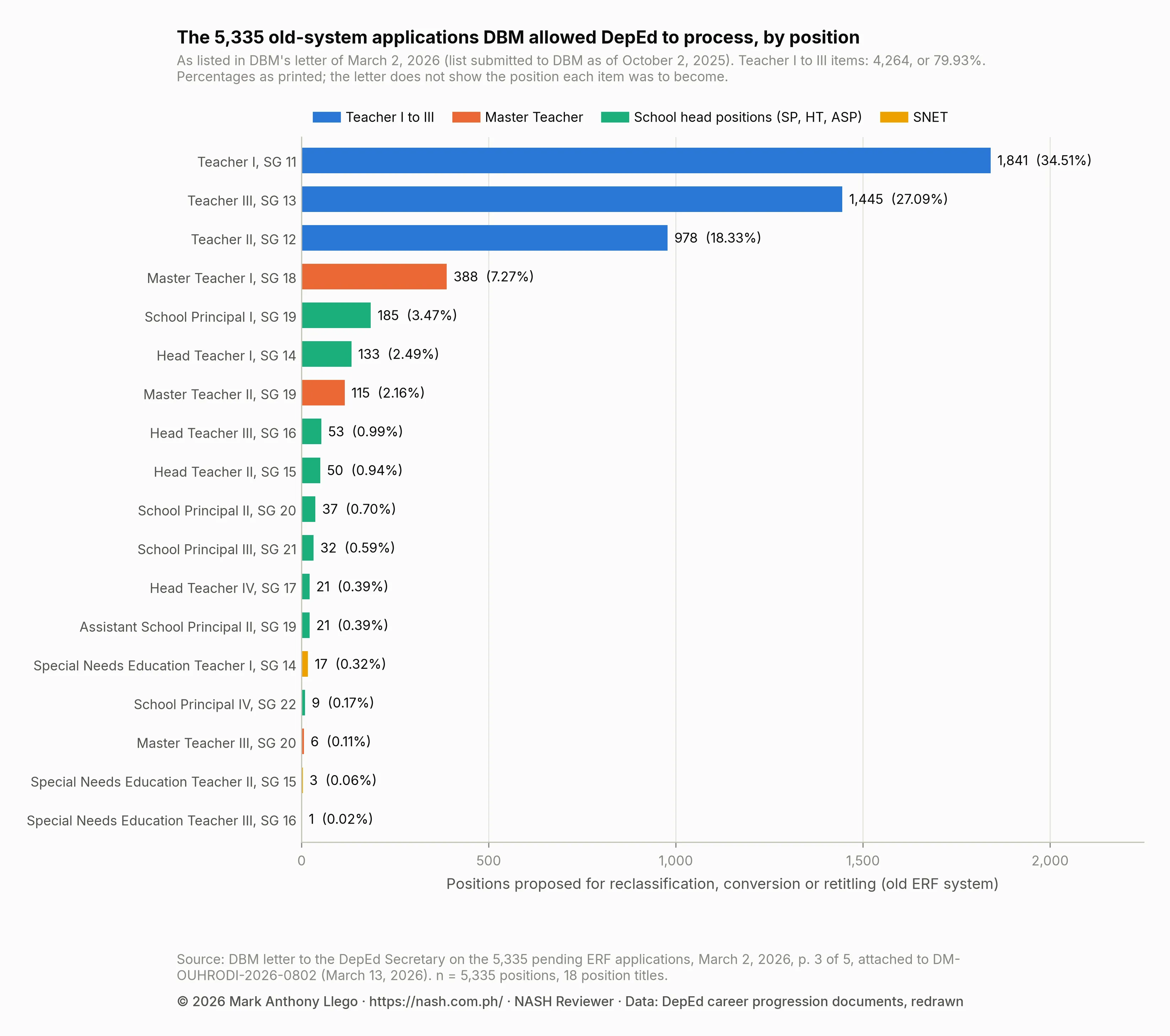
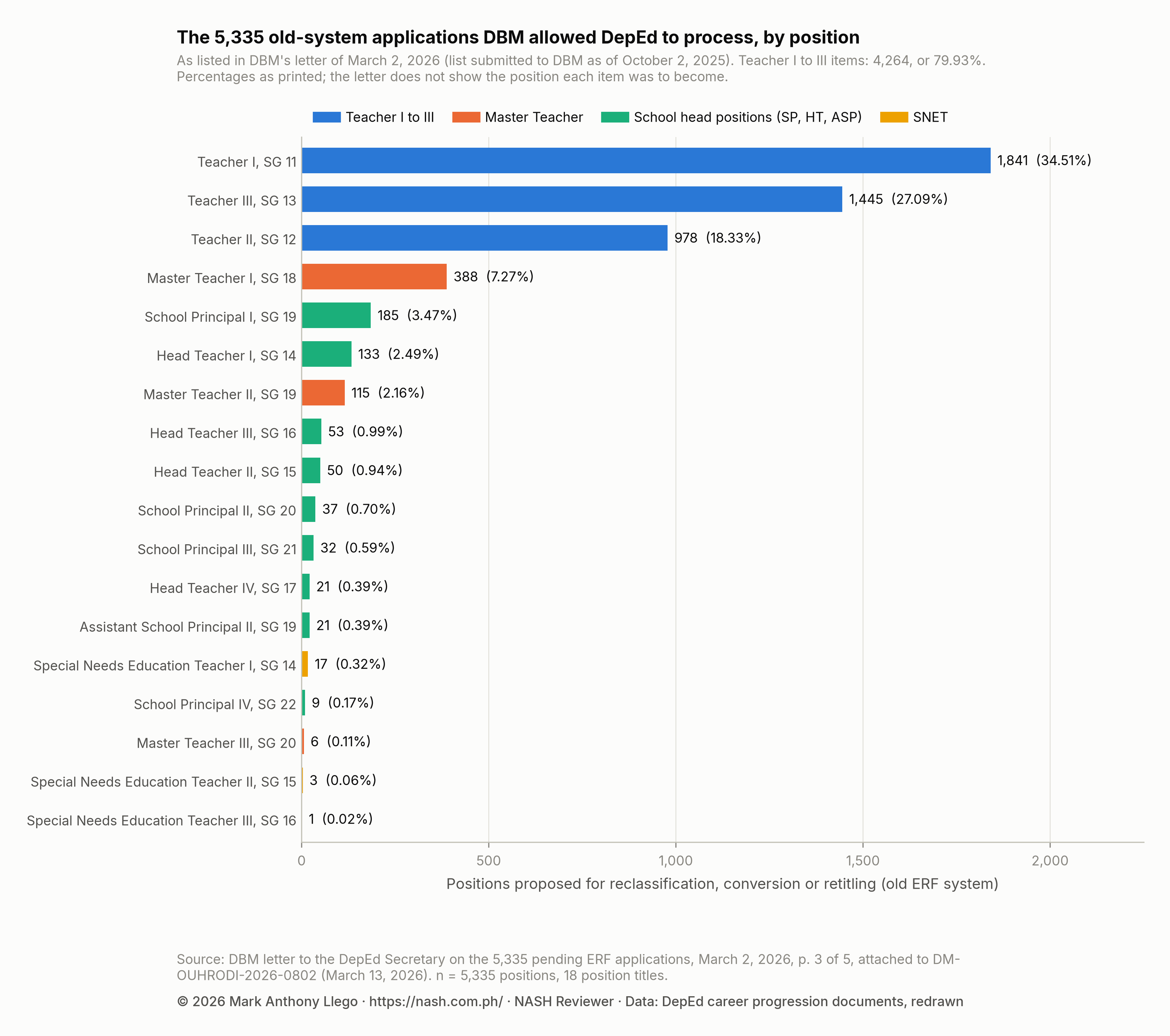
The 18 counts add up to 5,335. The letter calls the titles “proposed positions for reclassification/conversion/retitling”. It does not show what each position was to become. No DepEd issuance says how many of the 5,335 were approved; the pipeline figures are in the deferral post.
What this means for school heads
These steps follow from the issuances:
- Give the grade, then the rate for the teacher’s step. The grade is in DO 024, Encl. 1, Sec. 12; the FY 2026 rate is in NBC 601, Annex A. Read the teacher’s present step from her latest Notice of Salary Adjustment (NBC 601, Sec. 7.1) or Notice of Step Increment (ORAOHRA, Sec. 12.c).
- Check the source positions before an application goes up. A teacher may be reclassified only from the positions in JC Form 1-A, all within three grades (DO 024, Encl. 1, Sec. 20.b). A Teacher III’s ceiling in one reclassification is Teacher VI.
- Explain the step reset before a teacher applies. A teacher reclassified to a higher grade starts at Step 1 of the new position, and her length-of-service clock restarts (JC, Sec. 7.6.1.1). For a Teacher III at Step 8, a move to Teacher IV adds ₱523 a month at FY 2026 rates (computed). That is still a raise, and the new grade’s later steps are higher.
- Tell retitled incumbents their salary and step stay (JC, Sec. 7.6.1.2). In the 11 deficit regions, the August 2026 deferral excepts retitling (DM-OUHRODI-2026-2789, Sec. III.A.1).
- Keep the records an application draws on, such as service records, appointment papers and IPCRFs. The full list is in the Teacher IV to VII post, and your part in the process in the school head’s role post.
| A school head may | A school head may not |
|---|---|
| Explain the grade, the FY 2026 rate and the step rule, citing DO 024, NBC 601 and the JC | Endorse a reclassification more than three grades up on the strength of ORAOHRA Sec. 101(e); DO 024 and Form 1-A cap it at three |
| Help a teacher find her allowed target positions in Form 1-A | Tell a teacher reclassified to a higher grade that she keeps her step; the JC says earlier steps “shall no longer be credited” |
| Tell a retitled head teacher that his rate and step stay | Tell anyone that Master Teacher VI or School Principal V is open for application; as of October 31, 2026 neither has qualification standards or an implementing order, and no document shows DBM has created them |
These rules sit within PPSSH strand 4.7, General welfare of human resources (indicators 4.7.1 and 4.7.2; PPSSH Domain 4). The wider duties are in human resource management for school heads, and the head teacher and teacher-in-charge positions in principal, head teacher and teacher-in-charge.
How the NASH may test this
The two items below are original practice items, scored 3 (Relational), 2 (Multistructural), 1 (Unistructural) or 0 (Prestructural). An option that breaks a rule scores 0.
Question 1
Indicator 4.7.1, General welfare of human resources. Career Stage 1, Conceptual, Moderate.
Teacher L is a Teacher III (SG 13) at Step 8, paid ₱38,241 a month under the FY 2026 salary schedule. She is reclassified to Teacher IV (SG 14), with her appointment issued in 2026. She asks her principal what happens to her salary. Which answer best reflects the rules?
- A. Her salary becomes Step 1 of SG 14, ₱38,764 a month, a raise of ₱523; her earlier steps are not carried over, and her length-of-service step increments count again from the new appointment.
- B. Her salary becomes Step 1 of SG 14 under the FY 2026 schedule, ₱38,764 a month, which is higher than her present salary.
- C. Her salary grade rises from SG 13 to SG 14, because Teacher IV is a higher position than Teacher III.
- D. She keeps Step 8 in her new grade, ₱41,503 a month, because DBM rules keep a teacher’s step increments when her position is reclassified.
Answer and explanation
Best answer: A. Points: A = 3, B = 2, C = 1, D = 0.
- A (3 points, Relational). It links the new grade, the Step 1 rule, the FY 2026 rate and what happens to her earned steps.
- B (2 points, Multistructural). The rate is right, but it leaves out that her earned steps are not carried over and her step clock restarts.
- C (1 point, Unistructural). The grade is right, but it says nothing of her pay.
- D (0 points, Prestructural). It applies the retitling rule to a reclassification. The JC says earlier step increments “shall no longer be credited”.
Why. This aligns with Career Stage 1 expectations because indicator 4.7.1 asks the aspiring school head to know the rules on personnel’s pay and benefits. DepEd-DBM JC No. 01, s. 2025, Sec. 7.6.1.1 says teachers “appointed to higher level positions through reclassification” “shall receive a salary rate equivalent to the 1st step of the new position”, with step increments reckoned “from the date of appointment to the latest position”. Under DBM NBC No. 601, s. 2026, Annex A, SG 14 Step 1 is ₱38,764 and SG 13 Step 8 is ₱38,241; the raise is ₱523 (computed).
Indicator 4.7.1: Display knowledge of laws, policies, guidelines and issuances on the rights, privileges and benefits of school personnel to promote their general welfare.
Sources: DepEd-DBM Joint Circular No. 01, s. 2025, Secs. 7.6.1.1–7.6.1.2; DBM National Budget Circular No. 601, s. 2026, Annex A.
Question 2
Indicator 4.7.2, General welfare of human resources. Career Stage 2, Situational, Difficult.
You are the principal of a large secondary school. During the FY 2026 call for reclassification, Teacher R, a Teacher III (SG 13) with Outstanding ratings, asks you to endorse her application for Teacher VII (SG 17). A colleague told her that the CSC’s 2025 rules exempt reclassification from the three-salary-grade limit. What is the most appropriate action?
- A. Explain that DO 024 and the JC’s Form 1-A cap reclassification at three grades above her present position, so Teacher VI is the highest she can reach this cycle; help her check the requirements for Teacher IV to VI; and tell her that a teacher reclassified to a higher grade starts at Step 1.
- B. Explain that DO 024 and the JC’s Form 1-A cap reclassification at three grades above her present position, and advise her that Teacher VI is the highest position she can apply for in this cycle.
- C. Advise her to wait for the DepEd order implementing RA 12288 before applying, since the new law makes promotions within the base positions non-hierarchical.
- D. Endorse her application for Teacher VII, citing Section 101(e) of the 2025 ORAOHRA, which says the three-salary-grade limitation does not apply to reclassification.
Answer and explanation
Best answer: A. Points: A = 3, B = 2, C = 1, D = 0.
- A (3 points, Relational). It applies the cap, turns it into her real options, and adds the pay rule she needs.
- B (2 points, Multistructural). The cap and the ceiling are right, but it gives her no help with the requirements or the pay rule.
- C (1 point, Unistructural). It knows one feature of RA 12288, but the law is not yet operational, and waiting costs her a cycle she can use now under DO 024.
- D (0 points, Prestructural). It breaks DO 024, Encl. 1, Sec. 20.b and Form 1-A, which lists only Teacher IV to VI as sources for Teacher VII.
Why. This aligns with Career Stage 2 expectations because indicator 4.7.2 asks the school head to apply the rules on personnel’s rights and benefits. DO 024, s. 2025 says promotion “whether through reclassification or natural vacancy, shall not exceed three (3) salary grades higher than the applicant’s present position” (Encl. 1, Sec. 20.b). JC Form 1-A allows Teacher VI from Teacher III to V, and Teacher VII only from Teacher IV to VI. The 2025 ORAOHRA, Sec. 101(e) exempts reclassification only from the CSC’s own limit. FY 2026 reclassification runs under DO 024 and DO 034 (DM-OUHRODI-2026-0802, Secs. II.2 and III).
Indicator 4.7.2: Implement laws, policies, guidelines and issuances on the rights, privileges and benefits of school personnel to ensure their general welfare.
Sources: DepEd Order No. 024, s. 2025, Encl. 1, Sec. 20.b; DepEd-DBM Joint Circular No. 01, s. 2025, Form No. 1-A and Sec. 7.6.1.1; CSC Resolution No. 2500358 (2025 ORAOHRA), Secs. 100–101; DM-OUHRODI-2026-0802, Secs. II.2 and III.
Nothing in this guide reproduces or predicts examination content.
Frequently asked questions
What is the salary grade of Teacher IV, Teacher V, Teacher VI and Teacher VII?
Teacher IV is SG 14, Teacher V SG 15, Teacher VI SG 16 and Teacher VII SG 17 (DO 024, s. 2025, Encl. 1, Sec. 12). In FY 2026, Step 1 pays ₱38,764, ₱42,178, ₱45,694 and ₱49,562 a month respectively (DBM NBC No. 601, s. 2026, Annex A). Teacher I to III remain SG 11 to 13.
What is the salary grade of Master Teacher V and School Principal IV?
Both are SG 22, the top of the ladder in force (DO 024, s. 2025, Encl. 1, Sec. 12). In FY 2026 they are paid ₱81,796 a month at Step 1 to ₱90,295 at Step 8 (NBC 601, Annex A). The two positions are equivalent (EO 174, Sec. 4), and RA 12288 provides that the lines “shall be equivalent in all salaries, benefits, and other privileges” (Sec. 7).
What salary grade are Master Teacher VI and School Principal V?
SG 23, under the IRR of RA 12288 signed on August 17, 2026 (Sec. 5). The Act itself names the positions but no grade (Sec. 5). As of October 31, 2026 neither position is in use: they have no qualification standards and no implementing DepEd order, and DepEd’s deck targets the standards and the implementing order for “Q1 of 2027” (August 24, 2026 deck, slide 34).
Will my step increment reset if I am reclassified to a higher position?
Yes. A reclassified teacher is paid “the 1st step of the new position”, and earlier step increments “shall no longer be credited” (DepEd-DBM JC No. 01, s. 2025, Sec. 7.6.1.1). If you are retitled to a position at the same grade instead, you keep your “present salary rate, including step increment” (Sec. 7.6.1.2; DepEd ECP FAQs, updated November 6, 2025, Q24).
Can I be reclassified more than three salary grades higher?
Not as a teacher or Master Teacher: DO 024 caps promotion “whether through reclassification or natural vacancy” at three grades (Encl. 1, Sec. 20.b), and the ORAOHRA’s exemption for reclassification (Sec. 101.e) does not lift it. The one wider route in the JC is Form 1-B’s transition route from Head Teacher I and II to School Principal I; see the section on the cap above.
Download the data
- sg-ecp-ladder.csv: the ECP positions by salary grade, 16 in force and 2 in the RA 12288 IRR and not yet operational, with the FY 2026 monthly salary at Step 1 and Step 8 for each grade (DO 024, s. 2025, Encl. 1, Sec. 12; JC No. 01, s. 2025, Sec. 7.1; IRR of RA 12288, Sec. 5; DBM NBC No. 601, s. 2026, Annex A).
- sg-step-reset-gain.csv: the 11 one-grade moves from SG 11 to SG 22, with the present Step 1 and Step 8 rates, the new Step 1 rate, and the raise from each (computed) (NBC 601, Annex A; JC No. 01, s. 2025, Sec. 7.6.1.1).
- sg-erf-5335-by-position.csv: the 5,335 old-system positions by title and salary grade, with the printed and computed percentages (DBM letter of March 2, 2026, p. 3 of 5, attached to DM-OUHRODI-2026-0802).
The CSVs and charts may be reused only with written permission: email support@nash.com.ph. The rules themselves come from DepEd’s issuances, which you can cite directly.
Sources
- Executive Order No. 174, s. 2022, Establishing the Expanded Career Progression System for Public School Teachers, June 23, 2022, Secs. 1–5.
- Implementing Rules and Regulations of EO No. 174, s. 2022, Sec. 9 (PDF p. 6).
- DepEd-DBM Joint Circular No. 01, s. 2025, Modified Position Classification and Compensation Scheme and System of Career Progression of Teachers and School Heads in the Public Basic Education System, February 19, 2025, Secs. 5.1.7, 6.1.1–6.2, 7.0–7.2, 7.5.3.2, 7.5.3.4, 7.6.1.1–7.6.1.2 and 8.5 (PDF pp. 6–8, 11–12, 14); Form No. 1-A (PDF pp. 21–47); Form No. 1-B (PDF pp. 48–50).
- DepEd Order No. 024, s. 2025, Guidelines on the Implementation of the Expanded Career Progression System for Teachers and School Heads in the Department of Education, August 28, 2025, Encl. 1, Secs. 12, 19 and 20.a–b (PDF pp. 5, 12); Annex A.2, List of DepEd Authorized Positions.
- DepEd Order No. 034, s. 2025, Amendments and Clarifications to DepEd Order No. 024, s. 2025, October 14, 2025, paras. 6 and 28 (PDF pp. 2, 7).
- Republic Act No. 12288, An Act Institutionalizing the Career Progression System for Public School Teachers and School Leaders and Appropriating Funds Therefor, approved September 12, 2025, Secs. 5, 7, 8 and 15.
- Implementing Rules and Regulations of RA No. 12288, done August 17, 2026, Secs. 5, 17 and 20 (PDF pp. 4, 10): the DepEd-certified copy (stamped August 24, 2026) in DepEd’s career progression toolkit folder. As of October 31, 2026, the IRR had not been published in the Official Gazette or on deped.gov.ph, so its effective date is not yet known.
- CSC Resolution No. 2500358, 2025 Omnibus Rules on Appointments and Other Human Resource Actions, promulgated April 30, 2025, Secs. 12.c, 100 and 101 (PDF pp. 30, 66–67), in DepEd’s ECP toolkit folder.
- DBM National Budget Circular No. 601, s. 2026, Implementation of the Third Tranche of the Updated Salary Schedule for the Civilian Government Personnel Under Executive Order (EO) No. 64, s. 2024, January 22, 2026, Secs. 1.0, 3.0, 4.0, 5.0, 5.1.1, 5.1.4, 7.1 and 8.1, and Annex A (pp. 1–5, 8).
- DepEd Memorandum No. 061, s. 2026, Amendments to DepEd Memorandum No. 001, s. 2026, September 29, 2026, Encl., para. 31.b (PDF p. 11).
- Memorandum DM-OUHRODI-2026-0802, Guidance on the Reclassification of Teaching and School Principal Positions for Fiscal Year (FY) 2026, March 13, 2026, Secs. II.1, II.2 and III.1 and Annex A (PDF p. 9), with the attached DBM letter to Secretary Angara of March 2, 2026 (pp. 1–5 of 5), as posted by SDO Nueva Vizcaya.
- Memorandum DM-OUHRODI-2026-2789, Funding Strategies and Interim Policy Directions for the Continuous Implementation of the Expanded Career Progression (ECP) System, August 5, 2026, Sec. III.A.1 (p. 4), in DepEd’s ECP toolkit folder.
- DepEd, Frequently Asked Questions on the Expanded Career Progression System (Annex A to DM-OUHROD-2025-3003, October 24, 2025), the copy updated November 6, 2025, Q9, Q24 and Q55, in DepEd’s career progression toolkit folder.
- ECP Toolkit: An Implementation Guide for Teachers on the Expanded Career Progression System, 2025, p. 24, in DepEd’s ECP toolkit folder.
- DepEd, National Orientation on the Implementation of the Expanded Career Progression System (DO 024, s. 2025), session slides, 2025, slide 54, in DepEd’s ECP toolkit folder.
- DepEd, Session 2: Policy Updates and New Provisions under RA No. 12288 and the 2025 ORAOHRA (deck, undated), slide 3, in DepEd’s ECP toolkit folder.
- DepEd, Virtual Orientation: Guidance on the Funding Strategies and Interim Policy Directions for the Continuous Implementation of the ECP System (deck), August 24, 2026, slide 34, in DepEd’s ECP toolkit folder.
The career progression series
- DepEd Expanded Career Progression (ECP): The Full Guide
- How to Be Reclassified to Teacher IV to VII in DepEd
- How to Become a Master Teacher Under DepEd’s ECP
- ECP Salary Grades for Teachers, MTs and Principals (this post)
- ECP Qualification Standards Under DO 019, s. 2025
- ECP Point System: How the HRMPSB Scores Applicants
- School Principal I to IV: Promotion Under the ECP
- The School Head’s Role in ECP Reclassification
- Head Teacher Retitling: Options Under ECP and RA 12288
- Why ECP Reclassification Was Deferred in 2026
- What RA 12288 Changes in Teacher Career Progression
- Department Head, Assistant School Head and MT Duties
Written by Mark Anthony Llego for NASH Reviewer. Sources: EO 174, s. 2022 and its IRR; DepEd-DBM JC No. 01, s. 2025; DO 024 and DO 034, s. 2025; RA 12288 and its IRR; the 2025 ORAOHRA; DBM NBC No. 601, s. 2026; DM 061, s. 2026; DM-OUHRODI-2026-0802 and -2789; DepEd’s ECP FAQs, toolkit and decks. Charts may be reused only with written permission from support@nash.com.ph.