Teaching overload pay is DepEd’s payment for actual classroom teaching beyond six hours in a day, up to two extra hours a day and ten a week (DepEd Order No. 005, s. 2024, Sec. III.j). Each overload hour is paid at the Prime Hourly Teaching Rate (PHTR): annual salary ÷ 1,600 × 1.25, which DepEd Memorandum No. 053, s. 2024 rounds to 0.000781 × annual salary (Encl. 1, Computation item 3). In DM 53’s own example, a teacher earning ₱27,000 a month who taught 22.75 overload hours in a month is paid ₱5,756.75. For FY 2026, DM 061, s. 2026 computes a Teacher I PHTR of ₱297.14 from an annual salary of ₱380,460, to pay external ARAL tutors (para. 31.b). The exact formula gives ₱297.23, and a teacher at a higher salary grade or step has a higher rate.
As a general rule, DO 5 pays overload only to teachers in schools with a teacher shortage, and it also counts relieving duties (Sec. V.A.2, item 3). Later issuances add ARAL tutors and relievers of teachers on wellness leave, always for time beyond six hours a day, and DepEd’s answers add teachers who receive the Special Hardship Allowance. Teachers in positions funded by the Local School Board are excluded. The sections below set out who qualifies, work through the computation step by step, and cover the 50% annual cap and tax.
Claims, papers and funds are covered in Why So Few Teachers Get Paid for Teaching Overload. Overtime pay and vacation service credits are covered in Vacation Service Credits and Overtime Pay for Teachers, and the six-hour load in How Many Hours Must DepEd Teachers Teach a Day? In what follows, “DM 53 orientation Q&A” is DepEd’s consolidated Q&A from the online orientation on DM 53 (updated November 13, 2024), “2026 Q&A” is its consolidated Q&A from the May–June 2026 meetings on implementation status, and “the toolkit” is the Teacher Workload Policy Toolkit of June 2025.
Key findings
- Overload is time past six hours of teaching in a day. It may not exceed “two (2) hours a day or ten (10) hours a week” (DO 5, s. 2024, Sec. III.j). DepEd tests it day by day: “The point of analysis on whether a teacher is granted overload pay or not is on a daily basis” (DepEd consolidated Q&A, DM 53 orientation, No. 6).
- Each overload hour pays 125% of an hourly rate. PHTR = annual salary ÷ 1,600 × 1.25, rounded by DM 53 to 0.000781 × annual salary. In DM 53’s example, ₱27,000 a month gives a PHTR of ₱253.04, and 22.75 hours give ₱5,756.75 (DM 53, s. 2024, Encl. 1, Computation items 3 and 5).
- FY 2026 Teacher I: ₱297.14 or ₱297.23 an hour. DM 061, s. 2026 computes ₱297.14 from a Teacher I annual salary of ₱380,460 to pay external ARAL tutors (para. 31.b); it is what the rounded factor 0.000781 gives. The formula it writes out, ₱380,460 ÷ 1,600 × 1.25, gives ₱297.23 (computed), about nine centavos more an hour, or ₱3.78 over 40 overload hours (computed). A Teacher I at a higher step has a higher PHTR, which “will depend on the salary grade and step level” (DM 53, Encl. 1, Computation item 4).
- The shortage rule is applied loosely. DO 5 makes teacher shortage the “general rule” (Sec. V.A.2, item 3). DepEd’s 2026 answers pay a teacher over six hours even in a school with excess teachers, “subject for justification” at the SDO (DepEd consolidated Q&A, 2026 implementation-status meetings, No. 16).
- Later issuances add cases; DO 5 excludes one. ARAL tutors (DO 018, s. 2025, para. 83) and relievers of teachers on wellness leave (DO 002, s. 2026, Sec. VI.1.h) are eligible for overload pay for time beyond six hours a day; LSB-funded contractual teachers “are not eligible” (DO 5, Sec. V.A.2, item 5).
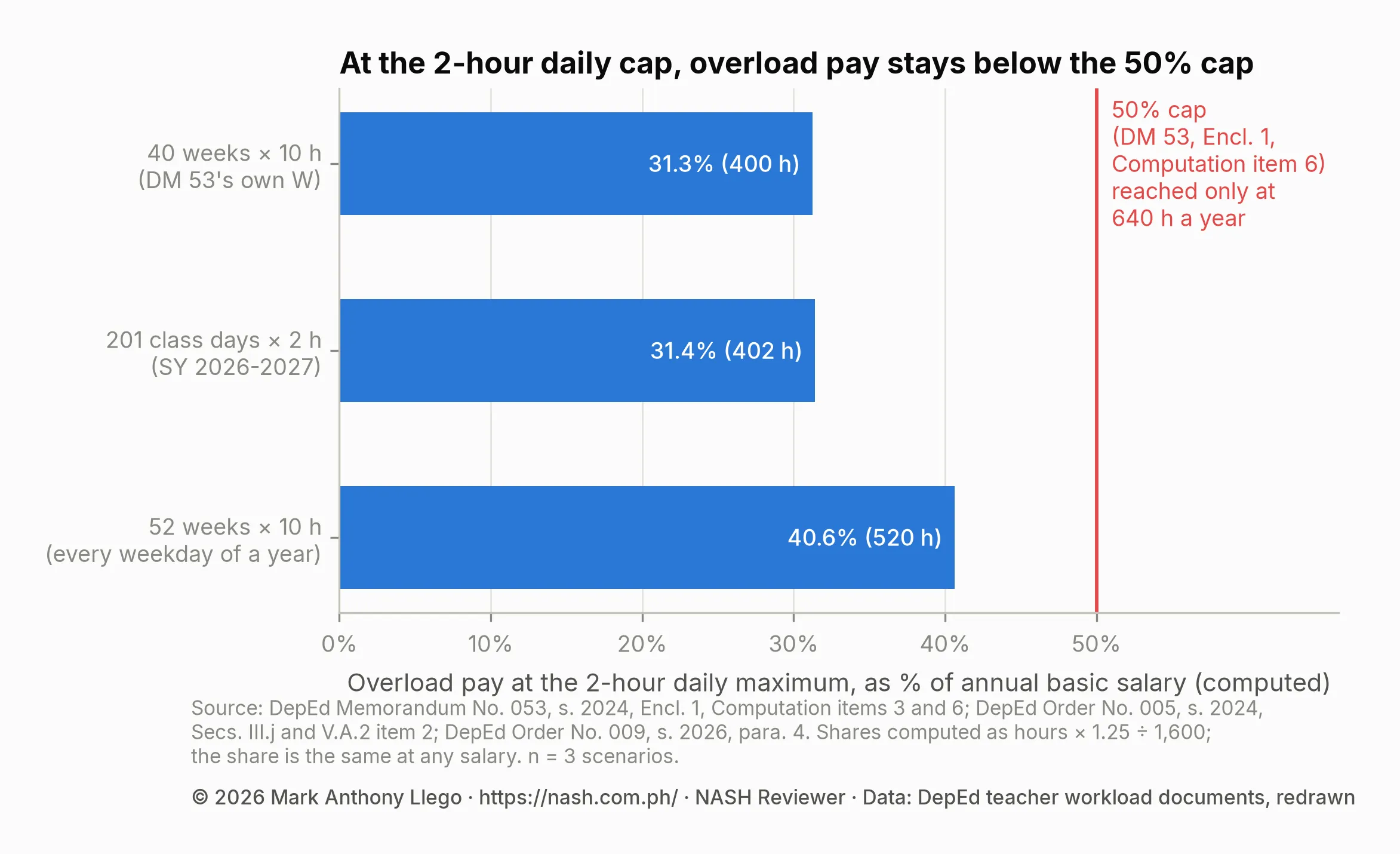
- The 50% cap cannot bind at two hours a day. Total overload pay may not exceed “50% of his/her basic salary for the year” (DM 53, Encl. 1, Computation item 6). In any year the ten-hour weekly cap limits overload to about 520 hours, 40.6% of annual basic salary; a full SY 2026-2027 at two hours a day is 31.4% (both computed).
- Overload pay is taxable. It “is included in the teacher’s taxable income”, and the SDO personnel unit makes the deductions (DM 53, Encl. 1, Computation item 7).
What counts as teaching overload
DO 5 defines it in one sentence: “Teaching Overload refers to the actual classroom teaching in excess of the prescribed six (6) hours of actual classroom teaching in a day. The teaching overload shall not exceed two (2) hours a day or ten (10) hours a week” (Sec. III.j). The two-hour daily limit comes from Republic Act No. 4670, the Magna Carta for Public School Teachers. Its Section 13 allows a teacher to be required to teach more than six hours “but not exceeding eight hours of actual classroom teaching a day upon payment of additional compensation at the same rate as his regular remuneration plus at least twenty-five per cent of his basic pay.” DO 5 cites that section for its cap (Sec. V.A.2, item 2).
| Rule | What it says | Source |
|---|---|---|
| What counts | Actual classroom teaching “whether in-person, distance, or blended”, including relieving duties for other teachers | DO 5, Sec. V.A.2, item 3 |
| Caps | Two hours a day, “To ensure the general welfare of teaching personnel”; ten hours a week | DO 5, Secs. V.A.2, item 2 and III.j |
| Load first | “All teachers shall render the prescribed number of actual classroom teaching hours before they may be assigned a teaching overload”; specialization is “a prime consideration” | DO 5, Sec. V.A.2, item 4 |
| Counting | Minutes are accumulated weekly and converted into hours | DO 5, Sec. V.A.2, item 1; DM 53, Encl. 1, Computation item 2 |
| Class advising | One hour of teaching load a day, part of the six; overload only if the total passes six | DO 5, Sec. V.A.1, item 2; 2026 Q&A, No. 9 |
Teaching-related assignments and ancillary tasks are not overload. Teaching-related assignments, parent conferences and home visits, and Master Teachers’ coaching and mentoring earn vacation service credits when done beyond regular hours (DO 5, Sec. V.B.2, item 1), and teaching-related assignments inside the school can earn overtime pay under DO 026, s. 2025 (Sec. V.2). Large classes do not count either: a teacher with 360 minutes a day of classes of more than 50 and no vacant period is “not eligible for teaching overload pay” (DM 53 orientation Q&A, No. 48).
By the day or by the week?
DO 5 uses both measures. Its definition of overload is daily, “in excess of the prescribed six (6) hours … in a day” (Sec. III.j). Its definition of overload pay is weekly, pay for teaching “beyond the required thirty (30) hours a week” (Sec. III.k), and the school head’s record aggregates hours beyond six “on a weekly basis” (Sec. V.B.1, item 2).
DepEd reads it as a daily test: “The point of analysis on whether a teacher is granted overload pay or not is on a daily basis” (DM 53 orientation Q&A, No. 6). The toolkit’s teacher with eight hours every Monday and four every Wednesday is paid: “The two (2) hours of Teaching Overload during Monday shall still be compensated” (Teacher Workload Policy Toolkit, June 2025, p. 33). The 2026 SDO deck pays overload “regardless if they have less than six (6) hours of teaching load on certain days” (DepEd SDO meeting deck on implementation status, 2026, p. 38; also 2026 Q&A, No. 15).
The daily reading is also how the issuances count overload for pay: hours “in excess of the prescribed six (6) hours in a day for teachers shall be counted as teaching overload” (DO 5, Sec. V.A.2, item 1; also DM 53, Encl. 1, Computation item 1). Only Sec. III.k’s definition of overload pay is worded by the week. The counting rule and DM 53 govern the computation; DepEd’s answers apply them and are not an amendment. In practice, count each day’s minutes over 360, add them up for the week, and convert to hours. The same answer warns that such an uneven program “must be rectified since it does not exemplify a sound distribution of teaching load” (DM 53 orientation Q&A, No. 6).
What happens past two hours a day
No issuance pays for a third hour. The toolkit’s quiz has a teacher at 510 minutes: “The 2 hours of teaching overload will be compensated, but the remaining 30 minutes will not” (toolkit, p. 39). One 2026 answer says “there is no maximum number of hours allowable for relieving duties” (2026 Q&A, No. 5). That answer conflicts with DO 5, which counts relieving duties as overload only if they meet items A.2.1 and A.2.2, and A.2.2 is the two-hour cap (Sec. V.A.2, items 2–3). The Order and RA 4670 govern: no teacher should be programmed for more than eight hours of actual teaching in a day.
Who qualifies for teaching overload pay
DO 5 covers “all DepEd-employed teachers engaged in classroom teaching, on a full-time basis, under permanent, provisional, or substitute status in all public elementary and secondary schools” (Sec. II). Within that group:
| Case | Paid overload? | Source |
|---|---|---|
| Teacher over six hours in a school with a teacher shortage | Yes: the “general rule” | DO 5, Sec. V.A.2, item 3 |
| Teacher over six hours in a school with no recorded shortage | Yes in DepEd’s answers; the SDO may ask for a justification | Toolkit, p. 30; DM 53 orientation Q&A, No. 42; 2026 Q&A, Nos. 7, 15–17 |
| Reliever for an absent teacher | Yes, for the time beyond six hours a day | DO 5, Sec. V.A.2, item 3; DM 53 orientation Q&A, No. 52; 2026 Q&A, No. 8 |
| Reliever for a teacher on wellness leave | Yes, for time beyond six hours a day: “shall be eligible to teaching overload pay, in accordance with DO 005, s. 2024” | DO 002, s. 2026, Sec. VI.1.h; DO 5, Sec. V.A.2, items 1–3 |
| ARAL tutor beyond six hours on a regular school day | Yes, for at most two hours a day; weekend, holiday and vacation tutoring earns VSC instead | DO 018, s. 2025, paras. 81 and 83; DM 061, s. 2026, para. 31.a |
| Teacher conducting Hinga check-ins or makeup classes after an emergency | Check-ins count as teaching load, so they are paid as overload only beyond six hours a day; makeup classes are paid under DO 5 and DO 026 | DO 014, s. 2026, para. 69 |
| Class adviser | Only if advising plus teaching passes six hours | DO 5, Sec. V.A.1, item 2; 2026 Q&A, No. 9 |
| Teacher receiving the Special Hardship Allowance | Yes, in DepEd’s answers; no issuance addresses it | DM 53 orientation Q&A, No. 49; 2026 Q&A, No. 13 |
| Teacher in an ALS-Senior High School pilot school | Yes, as a temporary arrangement | DO 5, Sec. IX |
| Teacher in a contractual position funded by the Local School Board | No | DO 5, Sec. V.A.2, item 5 |
| Teacher-in-charge | Not addressed. A TIC is relieved of teaching and may be given a load only when every teacher carries the two-hour maximum overload; that load “shall form part of their regular work hours”, and work beyond regular hours is “compensated accordingly” | DO 5, Sec. V.A.1, item 5 |
Three other positions have their own load rules. Head Teachers’ workload “is not covered by DO 05, s. 2024” (DM 53 orientation Q&A, No. 2). Under DO 024, s. 2025, “A Department Head Designate shall have three (3) hours of teaching load” (Encl. 1, Sec. 36.c.iv). An Assistant School Principal is treated like a TIC: “Pursuant to DepEd Order No. 005, s. 2024, a designated ASP shall be relieved of teaching load”, and “may be assigned a teaching load on the condition that all teachers in the school have been assigned the maximum teaching overload of two (2) hours” (Sec. 36.d.iv). None of the documents says whether teaching beyond these positions’ loads is paid as overload.
The teacher-shortage “general rule”
DO 5 says: “As a general rule, only teachers in schools with teacher shortage based on the enhanced planning parameters are eligible for teaching overload pay” (Sec. V.A.2, item 3). A shortage is “the deficiency in the number of teachers in a school”, derived from enrollment and teacher inventory data in the Basic Education Information System (Sec. III.g). The same item covers actual teaching “including relieving duties for other teachers, which are beyond the normal teaching hours and affecting vacant periods”.
DepEd’s later guidance treats shortage as the usual case, not a condition:
- Overload “can happen even if the school doesn’t really show a record of teacher shortage — like when a teacher goes on a leave, or other valid reasons” (toolkit, p. 30).
- A teacher can claim while colleagues teach less than six hours: “Technically, yes”, with shortage called “a general rule” and the matter left to the school head’s discretion (DM 53 orientation Q&A, No. 42).
- In 2026, DepEd answered that every teaching position is eligible once the load passes six hours a day (2026 Q&A, No. 7).
- In a school with excess teachers: “Yes, but subject for justification”, and “a justification may be required at the SDO level before the release of the payment” (No. 16).
- A shortage in one learning area is enough: schools “may assign teaching overload to ensure the continuity of instruction” when no specialized teacher is available (No. 17).
DM 53 itself lists four reasons a school head may enter in the overload certification: “Additional teaching load due to teacher shortage”, “Relieving duties of teachers”, “Conduct of remediation/enhancement classes” and “Class Advising Duties” (Encl. 1, Submission of Requirements). Only the first depends on a shortage.
Which governs. DO 5’s general rule stands; the answers and the toolkit are guidance on how DepEd applies it, not amendments. A teacher in a school without a recorded shortage may be paid, but the school head should record why the overload was needed and expect the SDO to check.
Relievers, ARAL tutors and other cases
Relievers. DepEd pays relieving duties “provided that these additional load are in excess of 6 hours of actual classroom teaching” (DM 53 orientation Q&A, No. 52; also 2026 Q&A, No. 8). DepEd Order No. 002, s. 2026 (February 13, 2026) makes it a rule for wellness leave. The school head “shall specifically assign relievers to fill in for the classes of those on wellness leave”, and “the teachers with relieving duties shall be eligible to teaching overload pay, in accordance with DO 005, s. 2024” (Sec. VI.1.h). As with any relieving duty, only the reliever’s time beyond six hours a day, up to two hours, counts (DO 5, Sec. V.A.2, items 1–3).
ARAL tutors. Under DepEd Order No. 018, s. 2025 (June 13, 2025), tutorial sessions “shall be treated as a teaching load” (para. 81). Tutors are paid overload on regular school days once they have taught six hours, but not beyond “the compensation for two (2) hours based on the Prime Hourly Teaching Rate”. Weekend, holiday and long-vacation tutoring earns vacation service credits “excluded from the thirty (30) day limitation” (para. 83). DepEd Memorandum No. 001, s. 2026 (January 8, 2026) repeated the entitlement (para. 32) and said teachers under six hours “shall be prioritized” as tutors (para. 31). DepEd Memorandum No. 061, s. 2026 (September 29, 2026) amended DM 001. Tutoring by DepEd teachers “shall not be mandatory”, and the school head now “may prioritize” teachers under six hours, “provided that they are not assigned as tutors to their own learners” (para. 6.d). Weekend, holiday and vacation tutoring earns VSC that does not count toward the 30-day or 45-day annual limit (para. 31.a.ii). Pay “shall not exceed two (2) hours of teaching overload per day, computed based on the Prime Hourly Teaching Rate (PHTR)” (para. 31.a.i). DepEd’s July 2026 reminder on overload claims confirms that the claims include “payments to DepEd teachers serving as ARAL tutors who exceed six (6) hours of teaching load due to ARAL tutorial sessions” (Memorandum DM-OUHRODI-2026-2538, July 29, 2026, p. 2).
LSB-funded teachers. Teachers “holding contractual positions funded by the Local School Board (LSB) are not eligible to receive teaching overload pay”, though “the protection of their statutory rights shall be properly observed” through a fair distribution of load (DO 5, Sec. V.A.2, item 5). The toolkit leaves out the second half (p. 30).
Special Hardship Allowance. DepEd’s answers say SHA recipients may claim, because “Teaching overload compensation and SHA are granted on different legal and policy bases” (2026 Q&A, No. 13; DM 53 orientation Q&A, No. 49). No issuance addresses the point.
Emergencies. Under DO 014, s. 2026, Hinga check-ins “shall be considered as part of teaching load” and are compensated under DO 5; read with DO 5, that means overload pay only for time beyond six hours a day, though DO 014 does not say so. Makeup classes are compensated “under DO No. 005, s. 2024 and DO No. 026 s. 2025” (para. 69). See the El Niño guide for school heads.
How teaching overload pay is computed
DM 53’s Enclosure No. 1 sets the formula:
Teaching Overload Pay = Total Teaching Overload Hours × Prime Hourly Teaching Rate (PHTR) (Computation item 1)
PHTR = AR ÷ W × T = AR ÷ 1,600 × 1.25 = 0.000781 × AR (Computation item 3)
- AR is the “Annual Salary rate of each Teacher proposed to be paid”.
- W is total teaching hours, “computed at 40 Hours/Week multiplies by 40 weeks or 1,600 hours”.
- T is “1.25 or 125% of the teacher’s remuneration for services in excess of 6 hours actual teaching per day but not more than 2 hours”.
DM 53 says the PHTR is “provided in Chapter 6.4.1 of the DBM Position Classification and Compensation Manual” (item 3) and “will depend on the salary grade and step level of the teacher to be paid” (item 4). The monthly hours are the sum of the weekly hours, and minutes under an hour are “first divided by 60 minutes” (item 2). DM 53 does not explain why W is 40 hours for 40 weeks.
“At least 25%” does not mean 25% of pay
DO 5 defines overload pay as compensation of “at least twenty-five percent (25%) of a teacher’s regular remuneration” (Sec. III.k), and the toolkit repeats that wording (p. 33). Read alone, that sounds like a quarter of salary. It is not. RA 4670 Sec. 13 pays the extra hours “at the same rate as his regular remuneration plus at least twenty-five per cent”. DM 53’s T = 1.25 matches the statute: it multiplies the hourly rate (AR ÷ 1,600) by 1.25, so an overload hour pays the hourly rate plus a 25% premium.
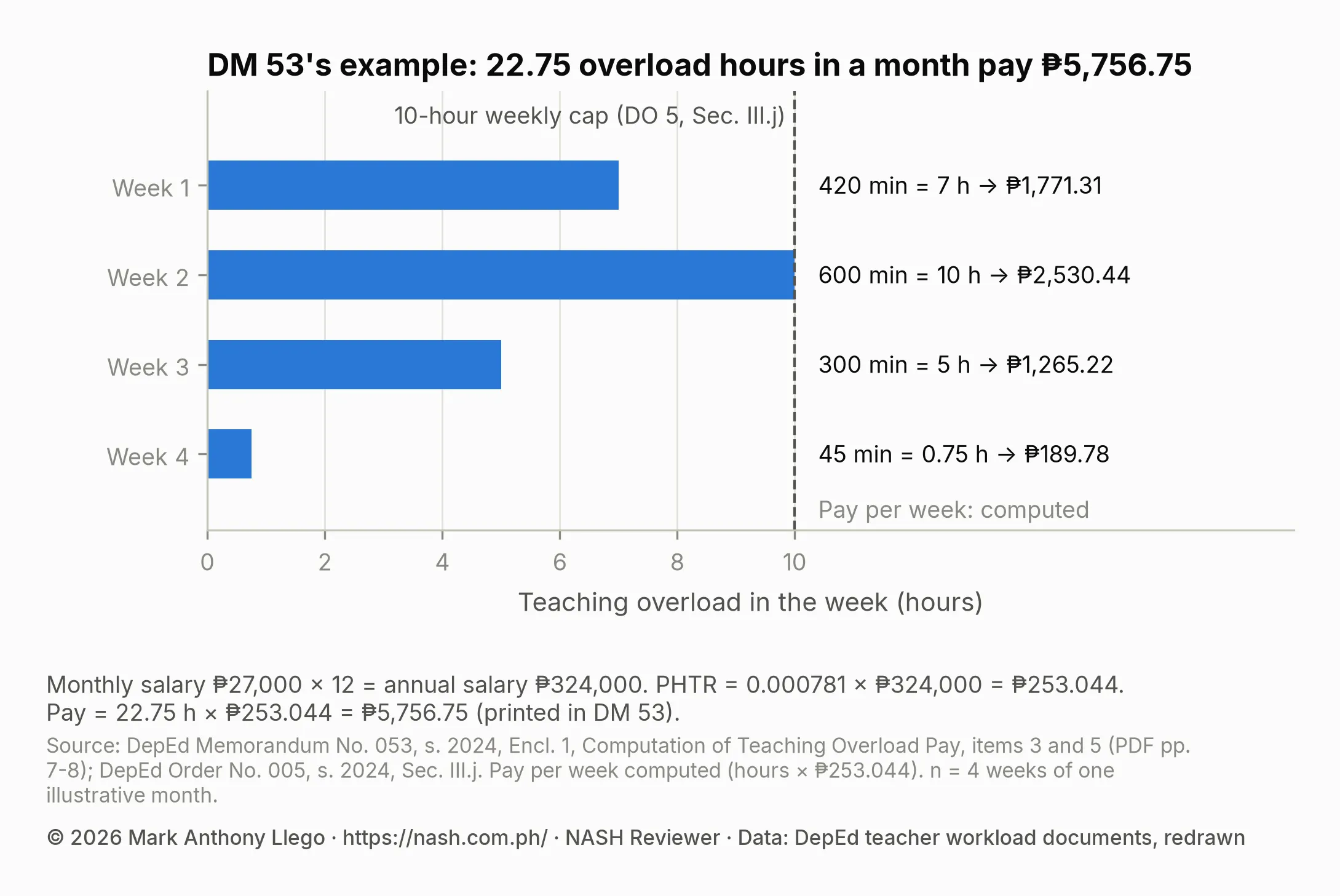
DM 53’s worked example, step by step
DM 53 gives one example (Encl. 1, Computation item 5, PDF p. 8; repeated in the DM 53 orientation deck, pp. 45–49):
| Step | What DM 53 does | Result |
|---|---|---|
| Given | Monthly basic salary | ₱27,000.00 |
| Given | Overload minutes by week: 420, 600, 300, 45 | 7, 10, 5 and 0.75 hours |
| i | Add the weekly hours: 7 + 10 + 5 + 0.75 | 22.75 hours |
| ii | AR = monthly basic salary × 12 months = ₱27,000.00 × 12 | ₱324,000.00 |
| iii | PHTR = 0.000781 × AR = 0.000781 × ₱324,000.00 | ₱253.04 (₱253.044 unrounded) |
| iv | Pay = 22.75 hours × ₱253.044 | ₱5,756.75 |
Week 2 sits exactly at the ten-hour weekly cap. At 0.000781 × 324,000 = 253.044, the month’s pay is 22.75 × 253.044 = 5,756.751, which rounds to ₱5,756.75 (computed). DM 53 multiplies by the unrounded ₱253.044. With the rounded ₱253.04, the product is ₱5,756.66 (computed).
The rounding. 1.25 ÷ 1,600 is exactly 0.00078125; DM 53 prints 0.000781. With the exact factor, the same example gives a PHTR of ₱253.125 and pay of ₱5,758.59 (computed), ₱1.84 more. DM 53 prints both forms of the formula as equal and uses the rounded one in its example. It does not say which one SDO payroll should use.
Teaching overload pay in FY 2026: a Teacher I example
DepEd’s overload issuances and guidance print only one FY 2026 salary, Teacher I’s. DM 061, s. 2026 uses it to set the pay of external ARAL tutors, who are paid at the PHTR of a Teacher I (para. 31.b). Its table reads “PHTR = [PhP 380,460.00 / 1,600] x 1.25” and “PHTR = PhP 297.14”. It bases the annual salary on “Executive Order No. 64, s. 2024, as implemented by National Budget Circular No. 601, s. 2026” (para. 31.b, PDF p. 11). DepEd’s 2026 SDO deck uses the same salary in its example: ₱31,705.00 a month, AR ₱380,460.00 and PHTR ₱297.14 (DepEd SDO meeting deck on implementation status, 2026, p. 30).
| Step | Computation | Result |
|---|---|---|
| AR | ₱380,460 (DM 061, s. 2026, para. 31.b); ÷ 12 = ₱31,705 a month | ₱380,460.00 |
| PHTR, with DM 53’s rounded factor | 0.000781 × ₱380,460 = 297.139 | ₱297.14 (printed in DM 061 and the 2026 deck) |
| PHTR, with the formula DM 061 writes out | ₱380,460 ÷ 1,600 × 1.25 = 297.234 | ₱297.23 (computed) |
| Gap | ₱297.234375 − ₱297.14 = ₱0.094 per hour | ₱3.78 over 40 hours; ₱37.94 over 402 hours (computed) |
| DM 53’s 22.75 hours at FY 2026 Teacher I rates | 22.75 × ₱297.14; 22.75 × ₱297.234375 | ₱6,759.94 or ₱6,762.08 (computed) |
| Four-week month at the cap: 40 hours (10 a week) | 40 × ₱297.14; 40 × ₱297.234375 | ₱11,885.60 or ₱11,889.38 (computed) |
Why the two figures differ. DM 061’s ₱297.14 is what DM 53’s rounded factor gives (0.000781 × ₱380,460), the computation the 2026 deck shows (p. 30). The expression DM 061 writes on the same page, ₱380,460 ÷ 1,600 × 1.25, equals ₱297.23. Both trace to DM 53, which presents 0.000781 × AR as equal to AR ÷ 1,600 × 1.25. The difference is about nine centavos an hour. For external ARAL tutors DM 061 settles it: “Final Remuneration of External Tutors = PhP 297.14 x actual no. of tutoring hours rendered” (para. 31.b). For DepEd teachers’ overload, DM 53 prints the two forms as equal and applies the rounded factor in its only example; it does not say which prevails when they differ. Note also that ₱297.14 is the rate for the Teacher I salary DM 061 uses. A teacher at a higher step or grade has a higher PHTR (DM 53, Encl. 1, Computation item 4).
A slip to avoid copying. The 2026 SDO deck multiplies the same 22.75 hours by ₱297.14 and prints “Php 5,942.80” (p. 31). The product is ₱6,759.94 (computed); ₱5,942.80 is 20 hours × ₱297.14.
DM 061 adds that “The PHTR of a Teacher I position shall be adjusted accordingly based on the DBM Budget Circular of the updated salary schedule in effect for the subsequent fiscal years of the program” (para. 31.b). No DepEd issuance or guidance prints other positions’ FY 2026 rates. To compute your own, use your monthly basic salary from your appointment or payslip: × 12 × 1.25 ÷ 1,600.
PHTR by position and step (2023 salary rates)
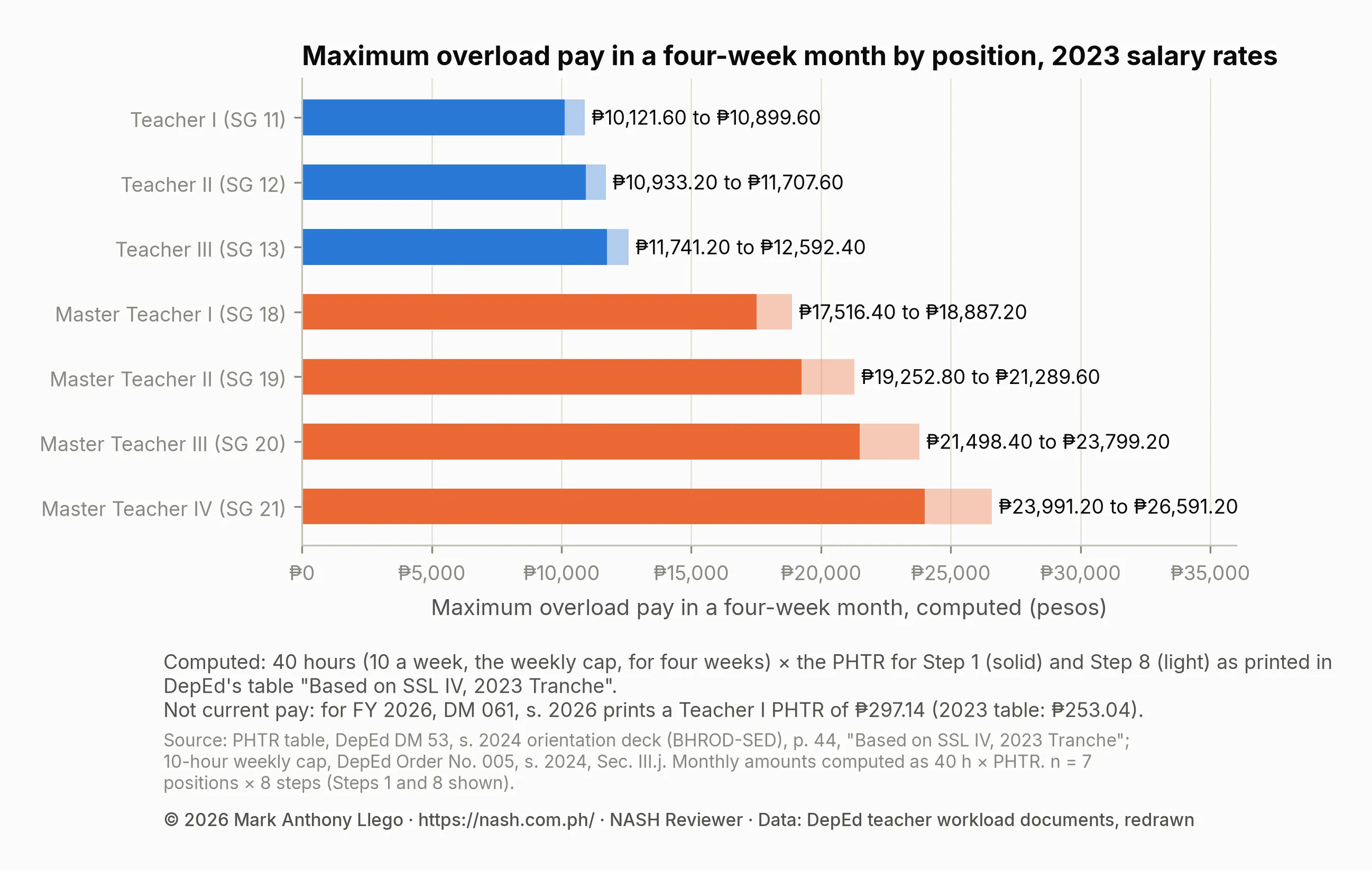
DepEd’s orientation deck on DM 53 prints a PHTR table by salary grade and step, footnoted “Based on SSL IV, 2023 Tranche” (DM 53 online orientation deck, undated, p. 44). It is the only table of PHTRs by position and step in DepEd’s workload drive. It covers seven positions, Teacher I–III and Master Teacher I–IV, and has no rows for the newer Teacher IV–VII and Master Teacher V positions (DO 020, s. 2024, Encl., para. 4). Its rates are 2023 salary rates. For Teacher I, Step 1 it gives ₱253.04; DM 061, s. 2026 prints ₱297.14 for a Teacher I position in FY 2026.
| Position | SG | Step 1 | Step 2 | Step 3 | Step 4 | Step 5 | Step 6 | Step 7 | Step 8 |
|---|---|---|---|---|---|---|---|---|---|
| Teacher I | 11 | 253.04 | 255.71 | 258.41 | 261.15 | 263.92 | 266.75 | 269.59 | 272.49 |
| Teacher II | 12 | 273.33 | 276.00 | 278.70 | 281.42 | 284.19 | 286.99 | 289.82 | 292.69 |
| Teacher III | 13 | 293.53 | 296.46 | 299.43 | 302.43 | 305.47 | 308.54 | 311.66 | 314.81 |
| Master Teacher I | 18 | 437.91 | 442.62 | 447.40 | 452.23 | 457.13 | 462.09 | 467.10 | 472.18 |
| Master Teacher II | 19 | 481.32 | 488.24 | 495.28 | 502.43 | 509.71 | 517.09 | 524.61 | 532.24 |
| Master Teacher III | 20 | 537.46 | 545.27 | 553.23 | 561.31 | 569.53 | 577.88 | 586.36 | 594.98 |
| Master Teacher IV | 21 | 599.78 | 608.62 | 617.61 | 626.73 | 636.02 | 645.45 | 655.04 | 664.78 |
PHTR in pesos per hour, 2023 salary rates, as printed. Source: DM 53 online orientation deck (BHROD-SED), p. 44, “Based on SSL IV, 2023 Tranche”.
The Teacher I, Step 1 rate, ₱253.04, is the PHTR in DM 53’s ₱27,000 example. The most a teacher can earn from overload in a four-week month is 40 hours (ten a week, the weekly cap) × PHTR. At 2023 rates, that ranges from ₱10,121.60 for a Teacher I at Step 1 to ₱26,591.20 for a Master Teacher IV at Step 8 (computed).
The 50% annual cap
DM 53 adds a cap that DO 5 does not have: “The total teaching overload pay of teachers shall not exceed 50% of his/her basic salary for the year” (Encl. 1, Computation item 6). The DM 53 orientation deck (p. 51), the toolkit (p. 37) and the 2026 SDO deck (p. 31) repeat it. None of them explains the figure.
Under the two-hour daily cap, the 50% ceiling cannot be reached. Because overload pay is hours × AR × 1.25 ÷ 1,600, its share of annual salary is the same at any salary. In any year, the ten-hour weekly cap limits overload to about 520 hours (52 weeks × 10), 40.63% of annual basic salary. A full school year at two hours a day is less: 402 hours over the 201 class days of SY 2026-2027 (DO 009, s. 2026, para. 4), or 31.41%, though that school year (June 8, 2026 to April 8, 2027) spans two calendar years. Reaching 50% would take 640 hours, two a day on 320 days (all computed). For the FY 2026 Teacher I, the cap is ₱190,230, half of ₱380,460, and 402 hours pay ₱119,488.22 at ₱297.234375 (computed).
Is teaching overload pay taxable?
Yes. “The Teaching Overload Pay is included in the teacher’s taxable income. The SDO-Admin Unit (Personnel) shall include the necessary deductions in the computation and preparation of payroll” (DM 53, Encl. 1, Computation item 7). The 2026 SDO deck repeats it (p. 38). The computation template that SDO personnel use (Template No. 6) works out gross pay only: “No, the template does not include tax deductions in the computation” (DepEd consolidated Q&A, DM 53 orientation, No. 59; also the DM 53 orientation deck, p. 50). What a teacher receives is the computed pay less any deductions payroll applies; none of the documents gives a tax rate.
Overload pay, overtime pay and service credits
Overload pay covers classroom teaching beyond six hours a day. Overtime pay under DO 026, s. 2025 covers work on a designated teaching-related assignment inside the school, by a teacher who has taught six hours a day and 30 a week (Secs. V.2 and VII.5). Vacation service credits cover other authorized work beyond regular hours and overload that funds cannot pay. The full comparison is in Vacation Service Credits and Overtime Pay for Teachers.
An overload hour is worth about 1.32 workday overtime hours. The two rates use different divisors. Overload divides the annual salary by 1,600 hours (40 a week for 40 weeks; DM 53, Encl. 1, Computation item 3). Overtime divides the monthly salary by 22 working days and 8 hours (DO 026, s. 2025, Sec. VI.B.1), that is, the annual salary by 12 × 22 × 8 = 2,112 hours. Both then multiply by 1.25 on a workday (DO 026, Sec. VI.B.2). For the same salary:
- overload hour ÷ workday overtime hour = (1.25 ÷ 1,600) ÷ (1.25 ÷ 2,112) = 2,112 ÷ 1,600 = 1.32 (computed);
- for the FY 2026 Teacher I: ₱297.23 against ₱31,705 ÷ 22 ÷ 8 × 1.25 = ₱225.18 (computed); with DM 061’s ₱297.14 the ratio still rounds to 1.32;
- against Saturday or holiday overtime at 150% (₱270.21), the ratio is 1.10 (computed).
This assumes the same monthly basic salary and DO 026’s 22-day, 8-hour month. Neither issuance compares the two rates, and they do not compete: overtime pays only for teaching-related assignments inside the school, in blocks of at least two hours, and never for ancillary tasks done in school (DO 026, Secs. V.2, V.6 and VII.3).
When funds run short, overload hours “shall be converted to earned VSC” (DO 5, Sec. V.B.1, item 3), on the SDO budget unit’s certification (DM 53, Encl. 1, Source of Funds item 2). Under DO 013, s. 2024, “One (1) hour of teaching overload shall be equivalent to 1.25 hours of Vacation Service Credit” (Sec. V.A.1.c). These credits are “exclusive of the thirty (30) days limitation” (Sec. V.A.7).
How and when overload is paid
Payment is quarterly, “subject to the extent of allotment for the purpose” (DO 5, Sec. V.B.1, item 3), on the school head’s certification of the teachers with overload (DM 53, Encl. 1, Submission of Requirements). For FY 2026 the money sits in the Regional Offices’ Administration of Personnel Benefits line item (Memorandum DM-OUHRODI-2026-2538, July 29, 2026, p. 2). The papers, deadlines and funds are in Why So Few Teachers Get Paid for Teaching Overload.
What this means for school heads
Under DM 53 the school head identifies the teachers with overload and prepares the list that starts every claim (Encl. 1, Submission of Requirements). These steps follow from the issuances:
- Load first, then overload. Give every teacher the prescribed teaching hours before anyone gets overload, with specialization as “a prime consideration” (DO 5, Sec. V.A.2, item 4). Teachers under six hours “are given priority” for teaching-related assignments (DM 53, para. 3.b), and the school head “may prioritize” them as ARAL tutors, “provided that they are not assigned as tutors to their own learners” (DM 061, s. 2026, para. 6.d). The teacher-loading guide covers the planning.
- Never program more than two hours of overload a day or ten a week (DO 5, Secs. III.j and V.A.2, item 2). Under RA 4670 Sec. 13, eight hours of actual teaching is the legal maximum.
- Write down the reason for each teacher’s overload, using DM 53’s list: teacher shortage, relieving duties, remediation or enhancement classes, or class advising. In a school with excess teachers or no recorded shortage, add a short justification; DepEd says the SDO may require one where a school has excess teachers (2026 Q&A, No. 16).
- Keep the records: the daily programs, the weekly record of hours beyond six (DO 5, Sec. V.B.1, item 2), the DTRs, the updated eSF7 and the posted Certification/List. Ask teachers for nothing else: “There shall be strictly no additional documentary requirements aside from the templates provided in each Enclosure” (DM 53, para. 10).
- Start the claim yourself, every quarter. DepEd encourages school heads “to facilitate and initiate the processing of teaching overload pay”, since the certification comes from them (2026 Q&A, No. 18). Its 2026 answers say past fiscal years cannot be claimed (No. 12); the funds post explains that answer and its limits.
- Name relievers for wellness leave and record the time they teach beyond six hours a day, up to two hours a day and ten a week, as overload (DO 002, s. 2026, Sec. VI.1.h; DO 5, Sec. V.A.2, items 1–3). Spread loads evenly: an eight-hour Monday and a four-hour Wednesday are paid under the daily test, but DepEd says such a program “must be rectified” (DM 53 orientation Q&A, No. 6).
What a school head may and may not do:
| May | May not |
|---|---|
| Assign overload when the service requires it. DM 53 says “In the exigency of service, teachers may render additional teaching loads” (para. 3.b), and DepEd’s 2024 answer is that “teachers may be required to render more than 6 hours of teaching”, as part of a discussion with the school head (DM 53 orientation Q&A, No. 50) | Require a DepEd teacher to serve as an ARAL tutor: the engagement “shall not be mandatory” (DM 061, s. 2026, para. 6.d) |
| Assign overload in a school with excess teachers when a learning area lacks a specialist (2026 Q&A, No. 17) | Certify an LSB-funded contractual teacher for overload pay (DO 5, Sec. V.A.2, item 5) |
| Certify relievers’ time beyond six hours a day as overload (DO 5, Sec. V.A.2, item 3) | Program or certify more than two hours of overload in a day (DO 5, Sec. V.A.2, item 2; toolkit, p. 39) |
For the wider duties of managing staff, see the guides to human resource management for school heads and PPSSH Domain 2, managing school operations and resources. The EDCOM II evidence on teachers’ hours is in Teacher Workload and Accountability: EDCOM II Findings.
How the NASH may test this
The two items below are original practice items, scored 3 (Relational), 2 (Multistructural), 1 (Unistructural) or 0 (Prestructural). An option that breaks a rule scores 0.
Question 1
Indicator 2.4.2, Management of staff. Career Stage 2, Situational, Moderate.
You are the principal of a junior high school with a shortage of Mathematics teachers in the latest BEIS data. Teacher M’s program gives her 450 minutes of Mathematics classes on Monday, Tuesday and Thursday, and 300 minutes on Wednesday and Friday, or 32.5 hours a week. At the end of the month, the SDO payroll clerk tells you she is owed overload only for the 2.5 hours a week above 30. What is the most appropriate action?
- A. Certify 4.5 hours of overload for each such week, 1.5 hours on each of the three long days, citing DepEd’s daily test, and revise the class program so that her load is spread evenly across the week.
- B. Certify 4.5 hours of overload for each such week, 1.5 hours on each of the three long days, citing DepEd’s daily test, and keep the class program as it is because the extra hours are paid.
- C. Revise the class program so that she teaches six and a half hours every day from next week, and ask the SDO how to count the weeks already taught before certifying anything.
- D. Certify 2.5 hours of overload for each such week, the hours above 30, as the clerk suggests, since DO 5 defines overload pay as pay for teaching beyond 30 hours a week.
Answer and explanation
Best answer: A. Points: A = 3, B = 2, C = 1, D = 0.
- A (3 points, Relational). It applies DepEd’s daily test, certifies only the hours actually taught beyond six on each day, and fixes the uneven program, which DepEd says must be rectified.
- B (2 points, Multistructural). The hours are right, but it leaves in place a program DepEd calls unsound distribution of teaching load.
- C (1 point, Unistructural). It fixes the program but leaves the hours already taught uncertified while it waits for advice the issuances already give.
- D (0 points, Prestructural). It leaves uncounted two of the 4.5 hours that DO 5, Sec. V.A.2, item 1 says “shall be counted as teaching overload”.
Why. DO 5, s. 2024 defines overload as teaching “in excess of the prescribed six (6) hours … in a day” (Sec. III.j), and hours beyond six in a day “shall be counted as teaching overload” (Sec. V.A.2, item 1; also DM 53, s. 2024, Encl. 1, Computation item 1). DepEd’s answer on DM 53 says “The point of analysis on whether a teacher is granted overload pay or not is on a daily basis”, and that such a program “must be rectified since it does not exemplify a sound distribution of teaching load” (DM 53 orientation Q&A, No. 6). Three days × 90 minutes over 360 = 270 minutes = 4.5 hours.
Indicator 2.4.2: Manage staffing such as teaching load distribution and grade level and subject area assignment in adherence to laws, policies, guidelines and issuances based on the needs of the school.
Sources: DepEd Order No. 005, s. 2024, Secs. III.j–k, V.A.2 item 1 and V.B.1; DepEd Memorandum No. 053, s. 2024, Encl. 1, Computation item 1; DepEd consolidated Q&A, DM 53 orientation, No. 6.
Question 2
Indicator 2.4.1, Management of staff. Career Stage 1, Conceptual, Moderate.
A Teacher I with a monthly basic salary of ₱31,705 taught 30 hours of teaching overload in a month of FY 2026, never more than two hours in a day. Her SDO uses a PHTR of ₱297.14, DM 53’s factor rounded to the centavo (0.000781 × ₱380,460 = ₱297.139), the rate DepEd Memorandum No. 061, s. 2026 also prints for that salary. Which statement best describes her overload pay?
- A. She is paid 30 × ₱297.14 = ₱8,914.20, gross of tax. The SDO personnel unit deducts tax in payroll, and her overload pay for the year may not exceed 50% of her annual basic salary.
- B. She is paid 30 × ₱297.14 = ₱8,914.20 for the month, released with the other overload claims of the quarter.
- C. She is paid 125% of an hourly rate for each overload hour.
- D. She is paid 25% of her monthly salary, ₱7,926.25, because DO 5 sets overload pay at 25% of a teacher’s regular remuneration.
Answer and explanation
Best answer: A. Points: A = 3, B = 2, C = 1, D = 0.
- A (3 points, Relational). It connects the formula, the FY 2026 rate, the tax rule and the annual cap into one account of what she receives.
- B (2 points, Multistructural). The amount and the quarterly payment are right, but it says nothing of tax or the cap.
- C (1 point, Unistructural). It states the 125% principle correctly but does not compute the pay.
- D (0 points, Prestructural). It misreads “at least twenty-five percent” as a quarter of salary; DM 53 pays 125% of an hourly rate for each hour.
Why. DM 53, s. 2024 sets pay as total overload hours × PHTR, with PHTR = annual salary ÷ 1,600 × 1.25 (Encl. 1, Computation items 1 and 3). Pay “is included in the teacher’s taxable income” and may “not exceed 50% of his/her basic salary for the year” (items 6–7). 0.000781 × ₱380,460 = ₱297.14, the figure DM 061, s. 2026 prints for a Teacher I annual salary of ₱380,460 (para. 31.b).
Indicator 2.4.1: Demonstrate knowledge and understanding of laws, policies, guidelines and issuances on managing school staff.
Sources: DepEd Memorandum No. 053, s. 2024, Encl. 1; DepEd Memorandum No. 061, s. 2026, para. 31.b; DepEd Order No. 005, s. 2024, Secs. III.k and V.B.1.
Nothing in this guide reproduces or predicts examination content.
Frequently asked questions
How much is teaching overload pay per hour in 2026?
DepEd Memorandum No. 061, s. 2026 computes ₱297.14 from a Teacher I annual salary of ₱380,460, to pay external ARAL tutors (para. 31.b); computed exactly as ₱380,460 ÷ 1,600 × 1.25, it is ₱297.23. A teacher at a higher step or grade has a higher rate. For your own rate, multiply your monthly basic salary by 12, then by 1.25, and divide by 1,600 (DM 53, s. 2024, Encl. 1, Computation item 3).
Can a teacher get overload pay if she teaches less than six hours on some days?
Yes. DepEd tests overload day by day, so hours beyond six on one day are paid even if another day is shorter (DepEd consolidated Q&A, DM 53 orientation, No. 6; Teacher Workload Policy Toolkit, June 2025, p. 33). Its 2026 answers say the same (2026 Q&A, No. 15). DepEd also says such an uneven program should be corrected.
Do ARAL tutors get teaching overload pay?
Yes, when tutoring takes their teaching load past six hours on a regular school day, for at most two hours a day at the PHTR (DO 018, s. 2025, para. 83; DM 061, s. 2026, para. 31.a.i). Tutoring on weekends, holidays and vacations earns vacation service credits that do not count toward the 30-day (or, for late appointees, 45-day) annual limit (DM 061, s. 2026, para. 31.a.ii; DO 013, s. 2024, Sec. V.A.2.c). Tutoring by DepEd teachers is voluntary (DM 061, s. 2026, para. 6.d).
Is teaching overload pay taxable?
Yes. DM 53, s. 2024 says it “is included in the teacher’s taxable income”, and the SDO personnel unit makes the deductions in payroll (Encl. 1, Computation item 7). The SDO’s computation template gives gross pay only (DM 53 orientation Q&A, No. 59).
Can teachers who receive the Special Hardship Allowance claim overload pay?
Yes, according to DepEd’s answers in 2024 and 2026: “Teaching overload compensation and SHA are granted on different legal and policy bases” (2026 Q&A, No. 13; DM 53 orientation Q&A, No. 49). No issuance addresses the question directly.
Download the data
- overload-pay-dm53-example.csv: DM 53’s illustrative month, with weekly overload minutes and hours as printed, the PHTR of ₱253.044 and pay per week (computed) (DM 53, s. 2024, Encl. 1, Computation items 3 and 5).
- overload-pay-max-monthly-by-position.csv: PHTR for seven positions and eight steps at 2023 salary rates, as printed, and maximum overload pay in a four-week month, 40 hours × PHTR (computed) (DM 53 online orientation deck, p. 44).
- overload-pay-annual-cap.csv: overload hours a year at the two-hour daily maximum under three scenarios and the resulting share of annual basic salary (computed), with the hours needed to reach the 50% cap (DM 53, s. 2024, Encl. 1, Computation items 3 and 6; DO 009, s. 2026, para. 4).
The CSVs and charts may be reused only with written permission: email support@nash.com.ph. The rules themselves come from DepEd’s issuances, which you can cite directly.
Sources
- Republic Act No. 4670, the Magna Carta for Public School Teachers, approved June 18, 1966, Sec. 13.
- DepEd Order No. 005, s. 2024, Rationalization of Teachers’ Workload in Public Schools and Payment of Teaching Overload, April 29, 2024, para. 2.d and Secs. II, III.g, III.j–k, V.A.1 items 2 and 5, V.A.2 items 1–5, V.B.1, V.B.2 item 1 and IX.
- DepEd Memorandum No. 053, s. 2024, Implementation Guidelines for DepEd Order No. 005, s. 2024, September 27, 2024, paras. 3.b and 10; Encl. 1, Submission of Requirements, Computation of Teaching Overload Pay items 1–7, and Source of Funds item 2 (PDF pp. 6–9).
- DepEd Order No. 020, s. 2024, Guidelines on the Recruitment, Selection, and Appointment to Higher Teaching Positions, December 20, 2024, Encl., para. 4.
- DepEd Order No. 013, s. 2024, Revised Guidelines on the Grant of Vacation Service Credits for Teachers, September 18, 2024, Secs. V.A.1.c, V.A.2.c and V.A.7.
- DepEd Order No. 018, s. 2025, Implementing Guidelines of the Academic Recovery and Accessible Learning Program, June 13, 2025, paras. 81 and 83.
- DepEd Order No. 024, s. 2025, Guidelines on the Implementation of the Expanded Career Progression System for Teachers and School Heads in the Department of Education, August 28, 2025, Encl. 1, Secs. 36.c.iv and 36.d.iv.
- DepEd Order No. 026, s. 2025, Guidelines on the Payment of Overtime Services of Teachers, September 6, 2025, Secs. V.2, V.6, VI.B.1–2, VII.3 and VII.5.
- DepEd Memorandum No. 001, s. 2026, Guidelines on the Engagement of ARAL Tutors and Support Aides, January 8, 2026, paras. 30–32.
- DepEd Order No. 002, s. 2026, Guidelines on the Grant of Wellness Leave for the Department of Education Personnel, February 13, 2026, Sec. VI.1.c and h.
- DepEd Order No. 009, s. 2026, Guidelines on the Implementation of the Three-Term School Calendar in Basic Education, April 16, 2026, para. 4.
- DepEd Order No. 014, s. 2026, Guidelines on Learning Continuity in Emergencies, June 4, 2026, para. 69.
- DepEd Memorandum No. 061, s. 2026, Amendments to DepEd Memorandum No. 001, s. 2026, September 29, 2026, paras. 6.d, 31.a.i–ii and 31.b (PDF pp. 4, 10–12).
- Memorandum DM-OUHRODI-2026-2538, Reminder on the Processing of Payment and Submission of Utilization Reports for the Honoraria for Teaching Overload for the Second Quarter of FY 2026, July 29, 2026, p. 2, in DepEd’s Teacher Workload Public Drive.
- Teacher Workload Policy Toolkit, version 2025-v1, released June 25, 2025, pp. 30, 33, 37 and 39, in DepEd’s Teacher Workload Public Drive.
- DepEd Memorandum No. 053, s. 2024 Online Orientation (orientation deck, School Effectiveness Division, BHROD), undated, pp. 44–51, in DepEd’s Teacher Workload Public Drive.
- DepEd, Consolidated Questions and Answers, DM 53, s. 2024 online orientation (October 22 and November 6–8, 2024; updated November 13, 2024), Nos. 2, 6, 42, 48–50, 52 and 59, in DepEd’s Teacher Workload Public Drive.
- DepEd, Online Meeting on the Implementation Status of Teacher Workload Policies, Schools Division Office deck (undated; used at the May–June 2026 meetings), pp. 30–31 and 38, in DepEd’s Teacher Workload Public Drive.
- DepEd, Consolidated Question and Answer from the Online Meeting with Regional and Schools Division Offices on the Implementation Status of Teacher Workload Policies (May 25–26 and June 2, 2026), Nos. 5, 7–9, 12, 13 and 15–18, in DepEd’s Teacher Workload Public Drive.
The teacher workload series
- DepEd Teacher Workload Policies: A Complete Guide
- How Many Hours Must DepEd Teachers Teach a Day?
- Can Teachers Leave School After Six Hours of Teaching?
- DepEd Teaching Overload Pay: Who Qualifies, How Much (this post)
- Why So Few Teachers Get Paid for Teaching Overload
- Teaching-Related Assignments: The 11 Roles DepEd Allows
- Vacation Service Credits and Overtime Pay for Teachers
- Admin Tasks Off Teachers: DO 2 and School Support Staff
- DepEd 2026 Teacher Workload Survey: What Teachers Said
- How School Heads Plan Teaching Loads Under DO 5
- Teacher Workload and Accountability: EDCOM II Findings
Written by Mark Anthony Llego for NASH Reviewer. Sources: RA 4670; DepEd Order No. 005, s. 2024 and DepEd Memorandum No. 053, s. 2024; DO 013, s. 2024; DO 018 and DO 026, s. 2025; DM 001, DO 002, DO 009, DO 014 and DM 061, s. 2026; DepEd’s Teacher Workload Policy Toolkit, orientation decks and Q&A. Charts may be reused only with written permission from support@nash.com.ph.