DepEd’s own review of its teacher workload policies, built on a “May 2026 Teacher Survey”, found that most respondents believe they understand the rules but many still sort tasks into the wrong category, that about six in ten respondents attended an orientation on them, and that 62.65% said they could focus adequately on teaching. The policies are DepEd Order No. 002, s. 2024 (removal of administrative tasks), DepEd Order No. 005, s. 2024 (teachers’ workload and overload pay) and DepEd Memorandum No. 053, s. 2024 (its implementing guidelines). The results were shown to DepEd’s regional and division offices at online meetings in May and June 2026. The survey was an open, anonymous call that DepEd itself calls “a sensing tool”, and its two decks report different respondent counts: 163,351 and 145,000.
The results, and what DepEd asked divisions to do next, are in four documents in DepEd’s Teacher Workload Public Drive: the deck for the Central and Regional Offices, dated June 2, 2026 (the CO and RO deck); the undated deck for Schools Division Offices (the SDO deck); the undated FY 2026 / SY 2026-2027 SDO Teacher Workload Implementation Plan – Guide for SDOs (the SDO plan guide); and the consolidated answers from the meetings (the 2026 Q&A). None of them is a DepEd order or memorandum.
This is a different study from the 2024 EDCOM II–IDinsight survey behind the 52-hour week; that one is covered in Teacher Workload and Accountability: EDCOM II Findings, and its charts are not repeated here.
Key findings
- Two counts, one survey. The CO and RO deck reports 163,351 respondents in 17 regions (CO and RO deck, June 2, 2026, p. 18); the SDO deck’s orientation table totals 145,000 (SDO deck, 2026, p. 50). Neither has a BARMM row, and both call the survey “a sensing tool for what may be happening on the ground”.
- Respondents rate teaching load best understood, administrative tasks least. Their self-ratings average 2.56 for teaching load (“Well Understood”) and 2.19 for administrative tasks (“Moderately Understood”); the deck does not print the scale (CO and RO deck, p. 21).
- The check questions show the confusion. 130,812 responses named class advisorship a teaching-related assignment, although DepEd Order No. 005 counts advising as teaching load, and 72,063 named lesson planning as teaching load (CO and RO deck, pp. 23, 29).
- 60.95% attended an orientation on the three issuances after their release: 99,563 of 163,351 respondents, from 49.67% in Region I to 69.37% in Caraga (CO and RO deck, p. 32). The factor most often cited for weak understanding was “Limited orientation or briefing on the policies by RO/SDO” (101,698 responses; p. 31).
- 62.65% said they could focus adequately on teaching, 31.31% said partially and 6.05% said no (CO and RO deck, p. 41). The factors named most often were reports unrelated to teaching (83,763 responses), trainings or events on class days (69,426) and meetings (58,262) (p. 42).
- Divisions were told to plan. The decks set June 8 for the plan template and July 6 for submission (CO and RO deck, p. 75; SDO deck, p. 91). The SDO plan guide that carries the template prints no deadline.
What DepEd’s 2026 teacher workload survey is
Who ran it, and when
The survey is DepEd’s own. The SDO deck closes with the contact details of the School Effectiveness Division of the Bureau of Human Resource and Organizational Development (BHROD) (SDO deck, p. 100), and the meetings were to present “key concerns identified during the November 2025 Consultation Workshop and May 2026 Teacher Survey” (CO and RO deck, p. 5).
The CO and RO deck is dated “June 2, 2026” (p. 1); the SDO deck is undated. The 2026 Q&A is headed “May 25-26, 2026” and “June 2, 2026”, which suggests the SDO meetings were held in May.
Two decks, two respondent counts
The two decks present the same questions on different bases and do not say why. Read every figure against its own deck.
| Item | CO and RO deck (June 2, 2026) | SDO deck (undated) |
|---|---|---|
| Respondents | 163,351 (p. 18) | 145,000 (orientation table, p. 50) |
| Attended an orientation | 99,563, or 60.95% (p. 32) | 88,756, or 61.21% (p. 50) |
| Lowest and highest region, orientation | Region I 49.67%; Caraga 69.37% (p. 32) | Region I 49.45%; Caraga 69.45% (p. 50) |
| Focus on teaching, pie chart | Yes 63%, Partially 31%, No 6% (p. 40) | Yes 62%, Partially 32%, No 6% (p. 58) |
| Self-rated understanding | Weighted means and labels (p. 21) | Labels only (p. 44) |
| “Not sure” in the teaching-load question | 9,310 (p. 23) | Not shown (p. 45) |
| “Requests to assist in administrative tasks” as a factor | Not shown (p. 42) | 32,496 (p. 59) |
Figures below are from the CO and RO deck, the larger base, unless noted.
Why the results are a “sensing tool”, not a sample
Both decks and the plan guide carry the same note: “The survey does not represent all teachers or all schools as it was issued through an open call and responses were completely anonymous. It should be read as a sensing tool for what may be happening on the ground” (CO and RO deck, p. 18; SDO deck, p. 42; SDO plan guide, 2026, p. 42). The CO and RO deck adds that the results are “an early sensing point, not a final representation of all schools”, and that the next round will “Seek representation from all schools, teachers, school heads, and field offices” (p. 17).
Three things follow for anyone using the numbers:
- Responses are uneven across regions. Region I gave 23,581 of the 163,351 responses; Region XII gave 1,606 and Caraga 2,259 (CO and RO deck, p. 18). Region I alone outnumbers NCR, Regions VI, XI and XII and Caraga combined (19,535).
- National figures pool all responses. The national 60.95% is total “Yes” over total responses (99,563 ÷ 163,351), so regions with many respondents weigh more (CO and RO deck, p. 32).
- There is no BARMM row in any regional table, and the decks do not explain it (CO and RO deck, pp. 18, 32, 41).
Because the survey was an open call, its figures describe the people who answered; our guide to survey research with Google Forms explains when a survey needs a sample.
How it differs from the 2024 EDCOM II–IDinsight survey
The EDCOM II–IDinsight survey drew on “a nationally representative sample of 2,283 schools”, ran from July 16 to August 16, 2024, and was answered by 14,892 teachers (IDinsight policy brief, p. 6). It measured weekly working hours. DepEd’s 2026 survey asked about understanding, orientation and focus; its only hours question in the decks covers teaching-related assignments (CO and RO deck, p. 67). Do not combine the two or read them as a trend.
How well teachers understand the workload policies
Self-rated understanding by policy area
Teachers were asked: “How would you rate your understanding of the different policy areas of teacher workload policies?” (CO and RO deck, p. 21).
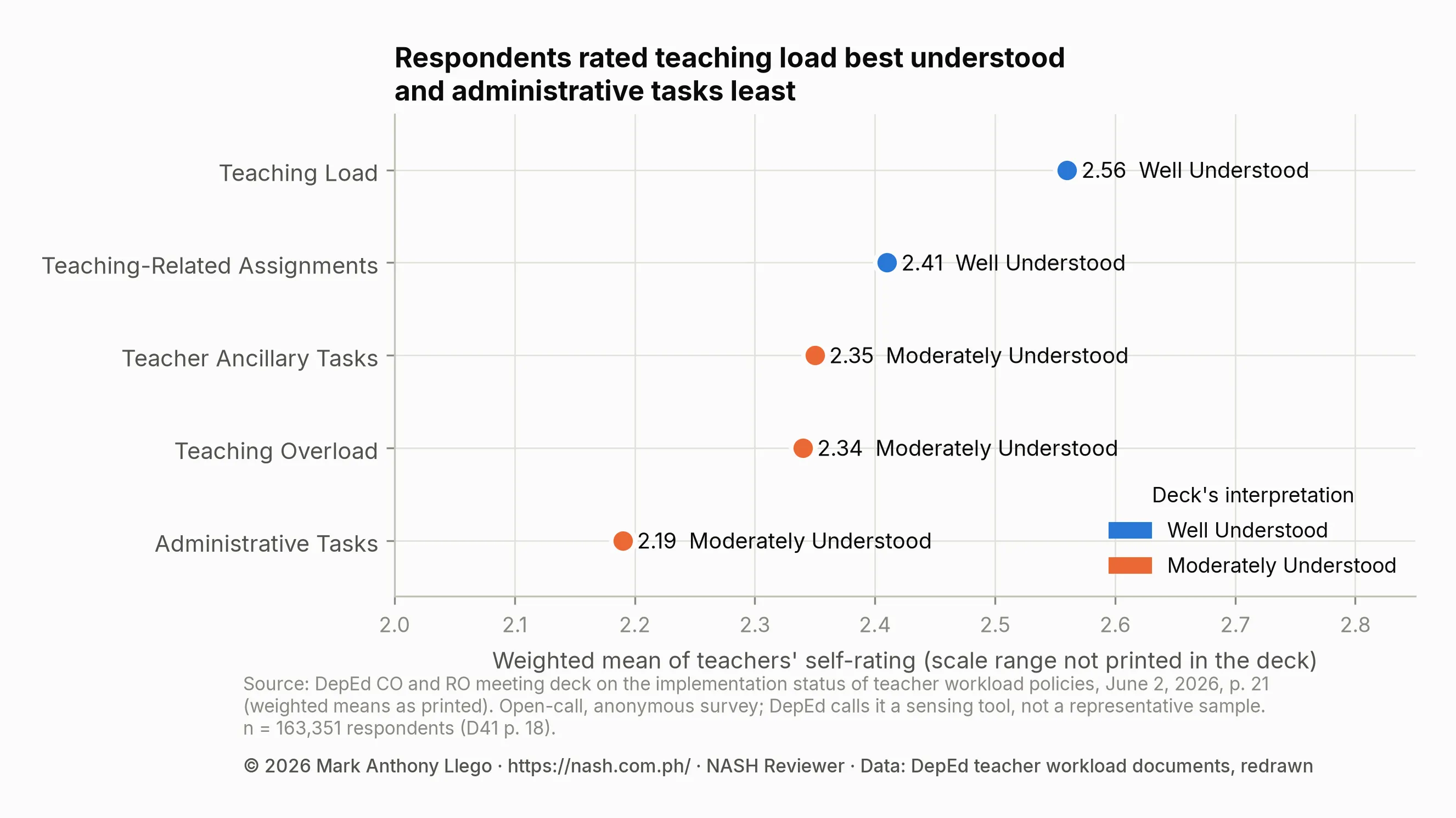
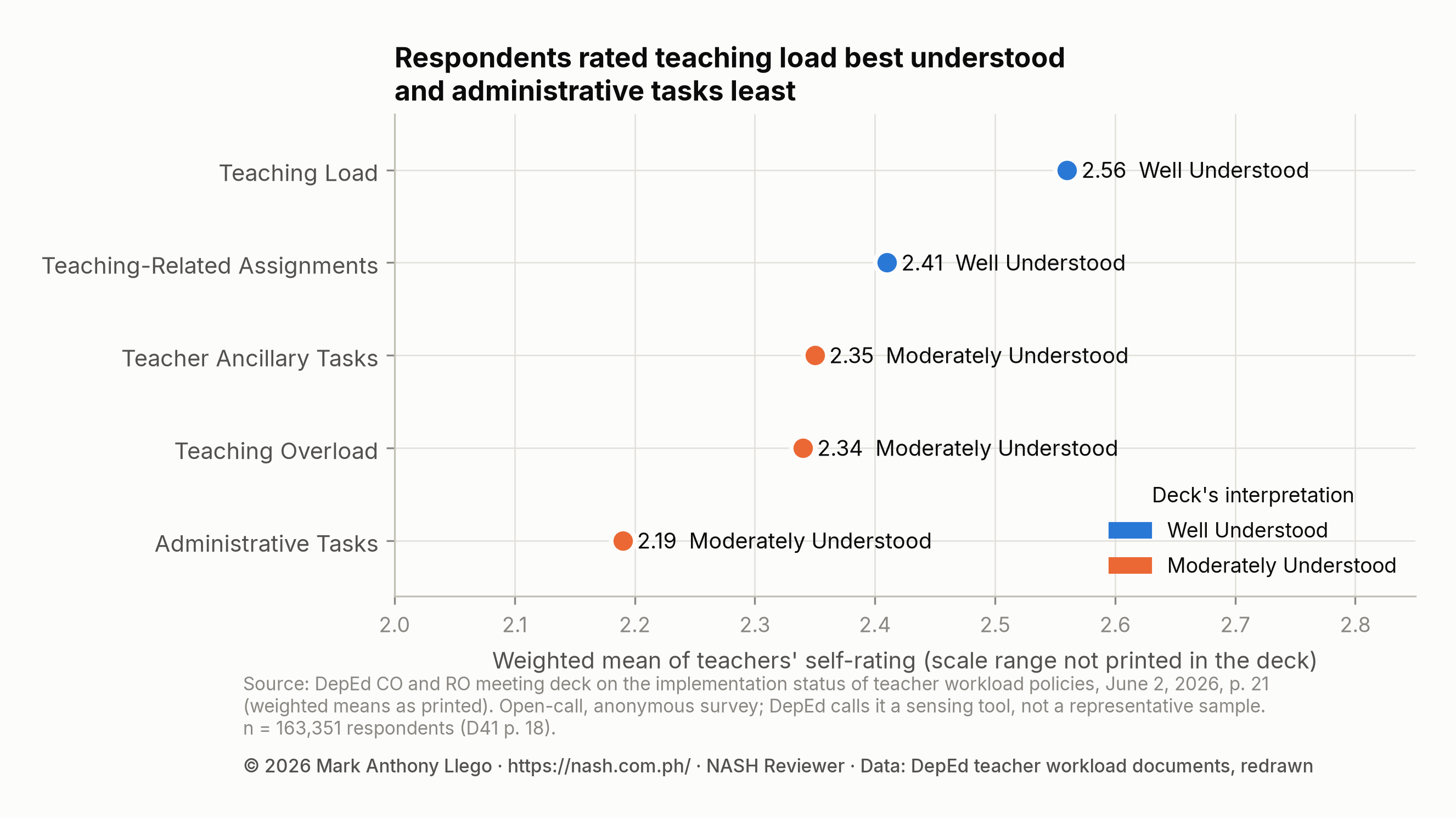
By region, teaching load is “Well Understood” and administrative tasks “Moderately Understood” in all 17 regions (p. 22). The SDO deck gives the same five labels without the means (p. 44).
Without the scale, the means cannot be read as a share of teachers; the labels change somewhere between 2.35 and 2.41. Our guide to weighted means and Likert scale interpretation shows how the interpretation bands for a weighted mean are built from the scale.
The four check questions
DepEd then tested understanding with four multiple-answer questions, each asking what counts “based on DepEd Order No. 005, s. 2024”. The decks mark the correct choices with green boxes (CO and RO deck, pp. 23, 25, 27, 29; SDO deck, pp. 45–48).
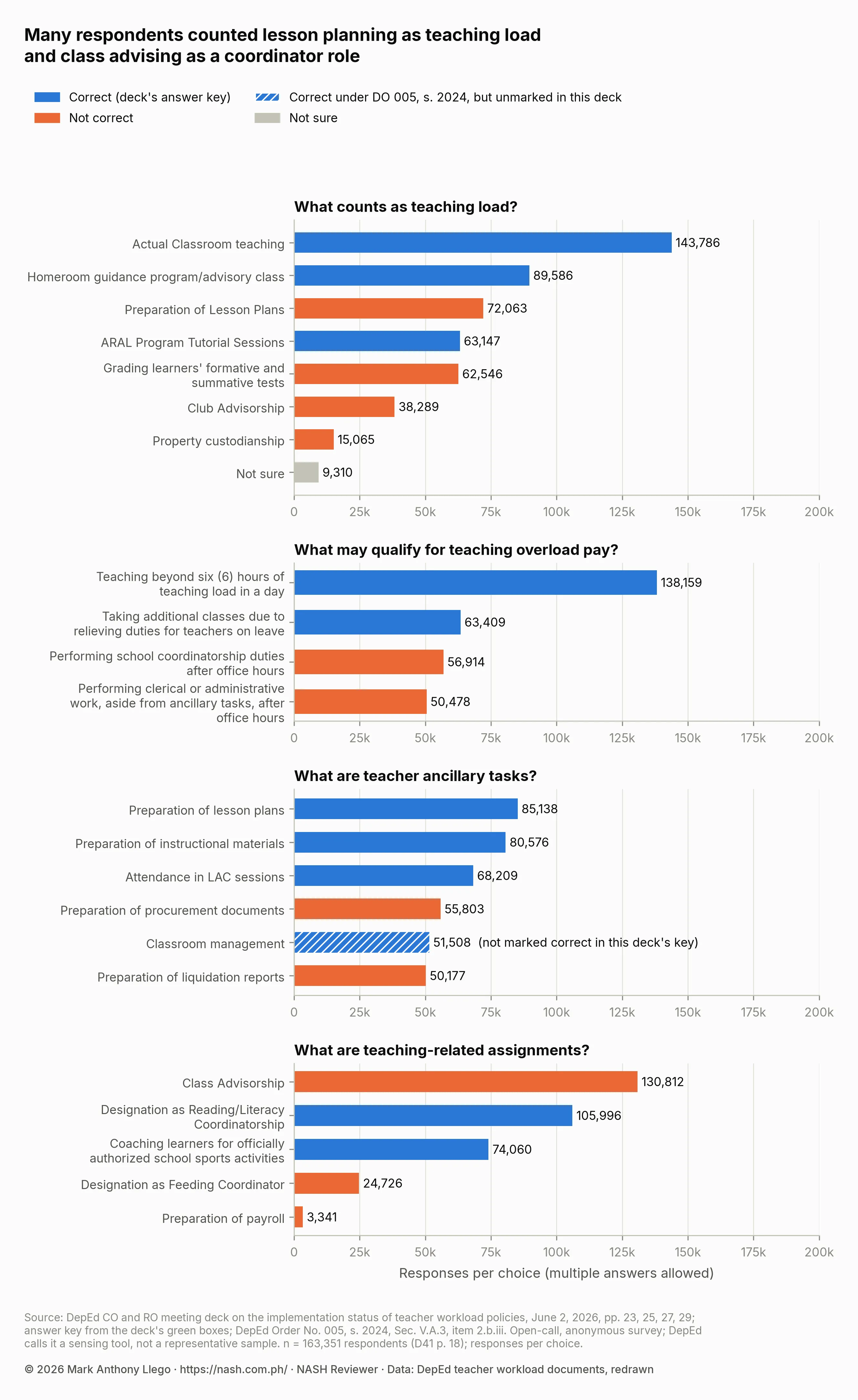
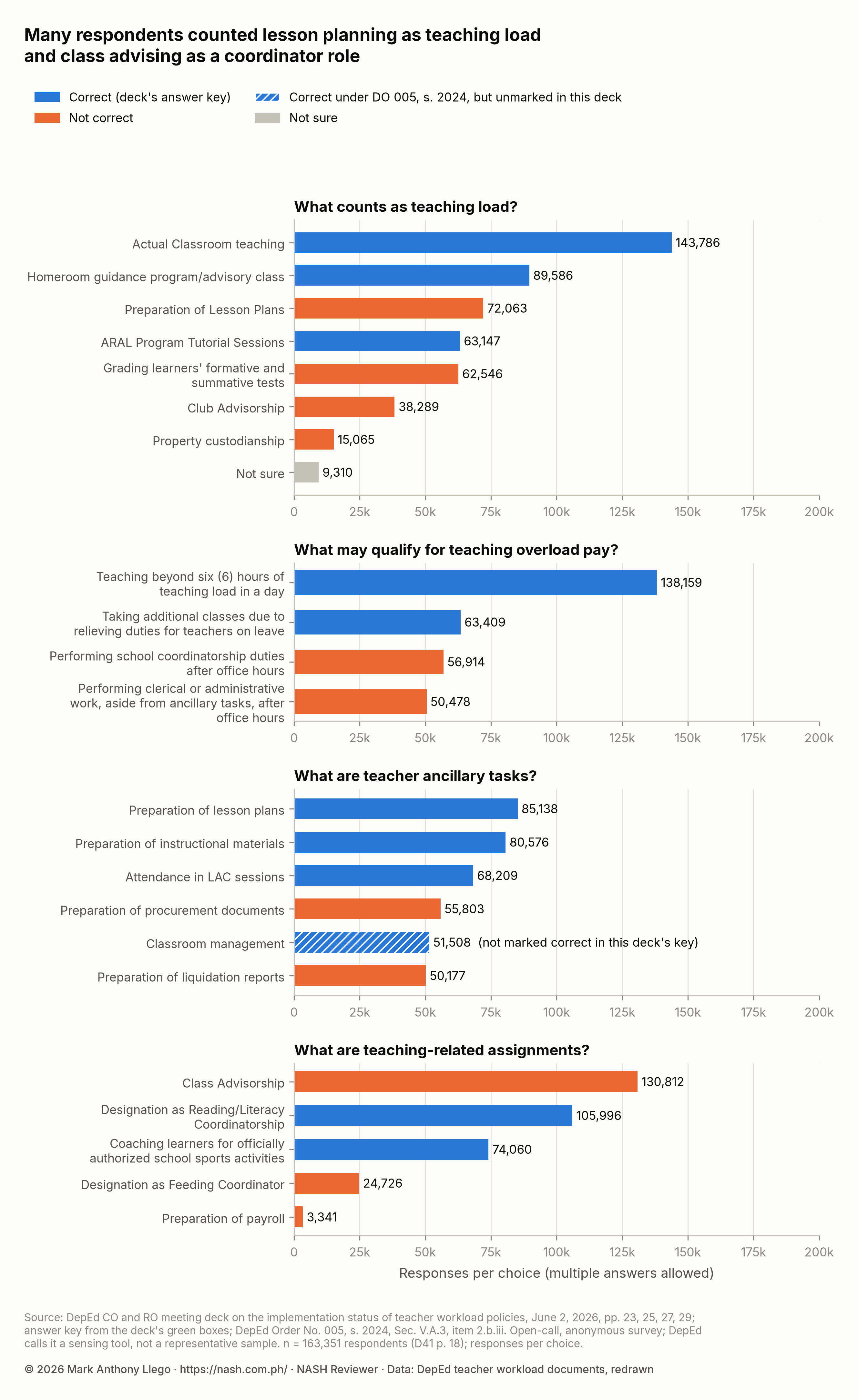
Four results stand out:
- Class advising is not a teaching-related assignment. It drew 130,812 responses, more than either correct answer. Under DepEd Order No. 005, s. 2024, class advising “shall be treated as a teaching load equivalent to one (1) hour per day or five (5) hours a week”, including the Homeroom Guidance Program (Sec. V.A.1, item 2). DO 005 also lists “Class advising duties” among ancillary tasks (Sec. V.A.3, item 2.d.i), which may explain the confusion. The specific rule in Sec. V.A.1, item 2 governs: advising is an ancillary task that counts as one hour of teaching load, and DM 053, s. 2024 says class advising duties “are treated as teaching load and shall form part of the six hours of teaching” (para. 3.c).
- Lesson planning is not teaching load. It drew 72,063 responses, more than the correct ARAL answer (63,147). DO 005 lists “Preparation of lesson plans/daily lesson logs” among ancillary tasks (Sec. V.A.3, item 2.a.i).
- Coordinator duties after hours are not overload. 56,914 responses said they qualify; the deck reads this as “continuing confusion regarding the distinction between teaching overload, overtime, and administrative tasks” (p. 25).
- The ancillary answers were spread out, a sign of “possible ambiguity” (p. 27): 55,803 responses picked procurement documents and 50,177 liquidation reports, neither of which DO 005 lists as an ancillary task.
A flaw in one answer key. The CO and RO deck boxes three ancillary tasks and leaves “Classroom management” unboxed (p. 27); the SDO deck boxes it (p. 47). DO 005 lists “Classroom management” as an ancillary task (Sec. V.A.3, item 2.b.iii), and the Order governs any deck, so the SDO deck’s key is right. The question also asks what counts “based on DepEd Order No. 005”, but ARAL tutoring was made teaching load later, by DepEd Order No. 018, s. 2025.
What the rules say about each choice:
| Choice in the survey | Where it falls | Rule |
|---|---|---|
| Actual classroom teaching | Teaching load | DO 005, Sec. V.A.1 |
| Homeroom guidance program/advisory class | Teaching load, one hour a day including HGP | DO 005, Sec. V.A.1, item 2 |
| ARAL Program tutorial sessions | Teaching load (“shall be treated as a teaching load”) | DO 018, s. 2025, para. 81 |
| Preparation of lesson plans; LAC sessions | Ancillary task (Curriculum Planning) | DO 005, Sec. V.A.3, item 2.a.i and iii |
| Instructional materials; classroom management | Ancillary task (Curriculum Delivery and Pedagogy) | DO 005, Sec. V.A.3, item 2.b.i and iii |
| Grading learners’ tests | Ancillary task (Assessment of Learner’s Progress) | DO 005, Sec. V.A.3, item 2.c |
| Reading/literacy coordinator; sports coaching | Teaching-related assignment | DO 005, Sec. V.A.4, item 1 |
| Property custodianship; feeding | Administrative task for school heads and non-teaching personnel | DO 002, s. 2024, Sec. V.A.1, items b and f.i |
| Teaching beyond six hours a day; relieving classes | Teaching overload, up to two hours a day | DO 005, Sec. V.A.2, items 1–3 |
| Coordinator work beyond regular hours | Not overload: vacation service credits, or overtime pay for work “within school premises” under the conditions of DO 026, s. 2025 (details) | DO 005, Sec. V.A.4, item 4; DO 013, s. 2024; DO 026, Sec. V.2 |
What affected understanding
Asked, from their experience, what affects teachers’ understanding of the policies, respondents most often chose “Limited orientation or briefing on the policies by RO/SDO” (101,698), “Limited opportunities to seek clarifications” (69,947) and “Greater focus on compliance than understanding” (56,513), the three the decks mark (CO and RO deck, p. 31; SDO deck, p. 49). “Policies are difficult to understand” came last of eight (32,922). The decks conclude that a major factor “is limited direct access to policy dissemination and clarification from higher governance levels” (CO and RO deck, p. 34; SDO deck, p. 52).
How many teachers attended a policy orientation
The question was: “Have you attended any orientation or information dissemination activity related to DepEd Order No. 002, s. 2024, DepEd Order No. 005, s. 2024, and DepEd Memorandum No. 053, s. 2024 AFTER THEIR RELEASE?” (CO and RO deck, p. 32).
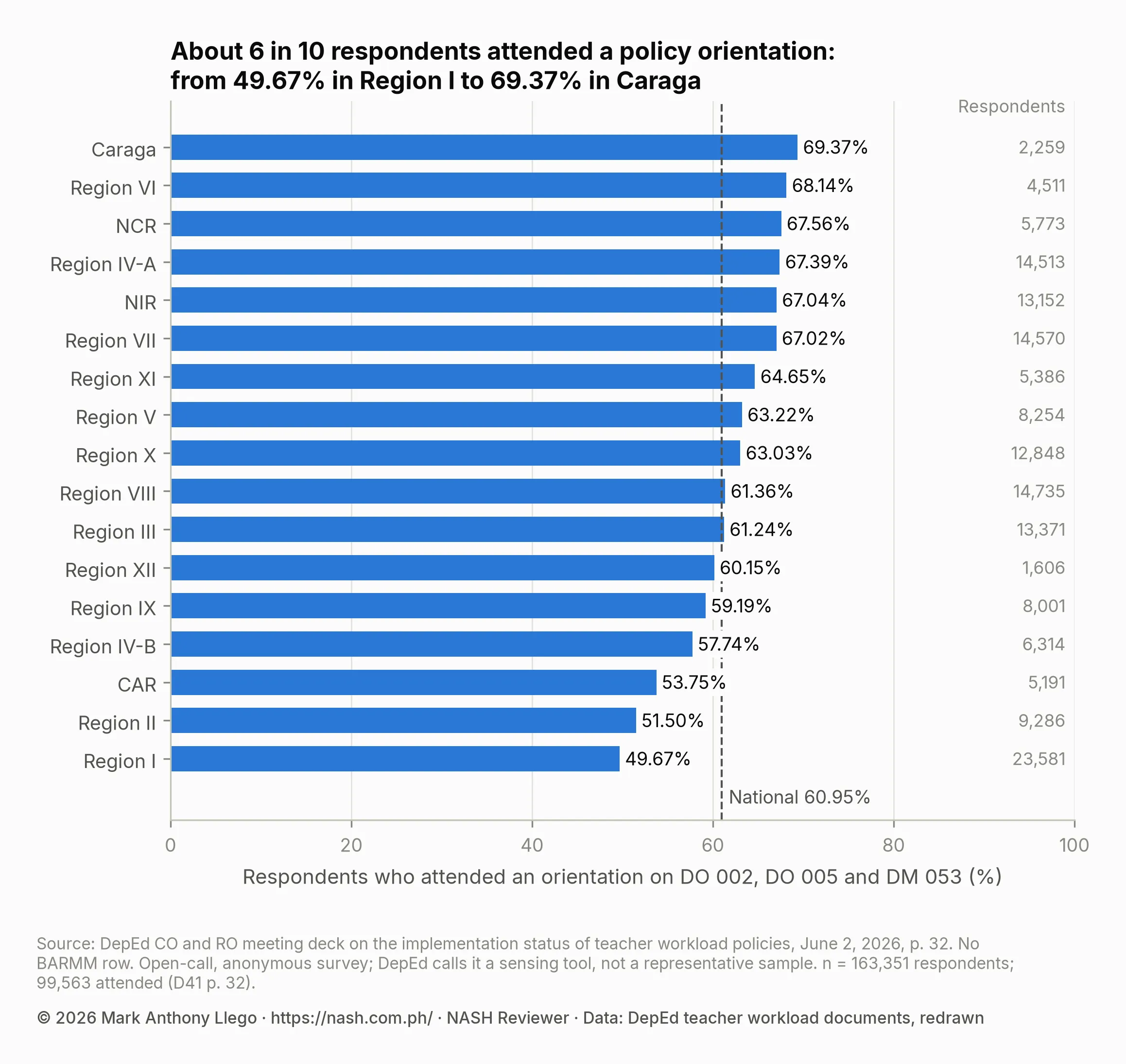
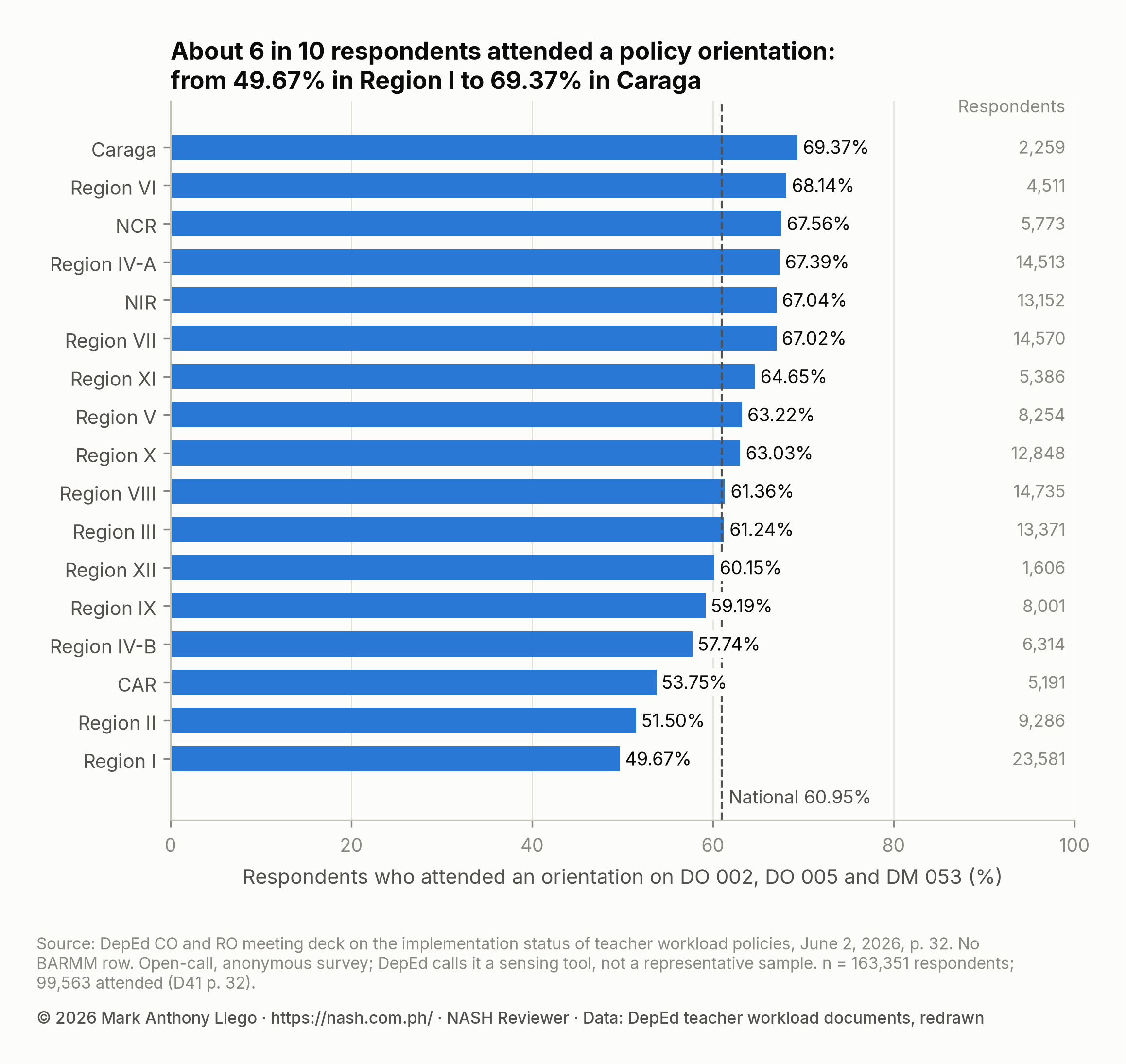
Nationally, 99,563 of 163,351 respondents said yes (60.95%) and 63,788 said no (CO and RO deck, p. 32). Region I is the only region where most respondents had not attended: 11,868 no against 11,713 yes. Six regions are above 67%: Caraga, Region VI, NCR, Region IV-A, NIR and Region VII. The deck’s reading: “coverage remains incomplete nationwide” (p. 32).
Orientations by the Central, Regional and Division Offices and districts were each rated “Seldom (once a year BOSY or EOSY)”, and by the school “Sometimes (twice a year)” (CO and RO deck, p. 33; SDO deck, p. 51).
Could teachers focus on teaching?
The question was: “Based on your experience during the previous school year, were you able to focus adequately on your core mandate of teaching?” (CO and RO deck, p. 40).
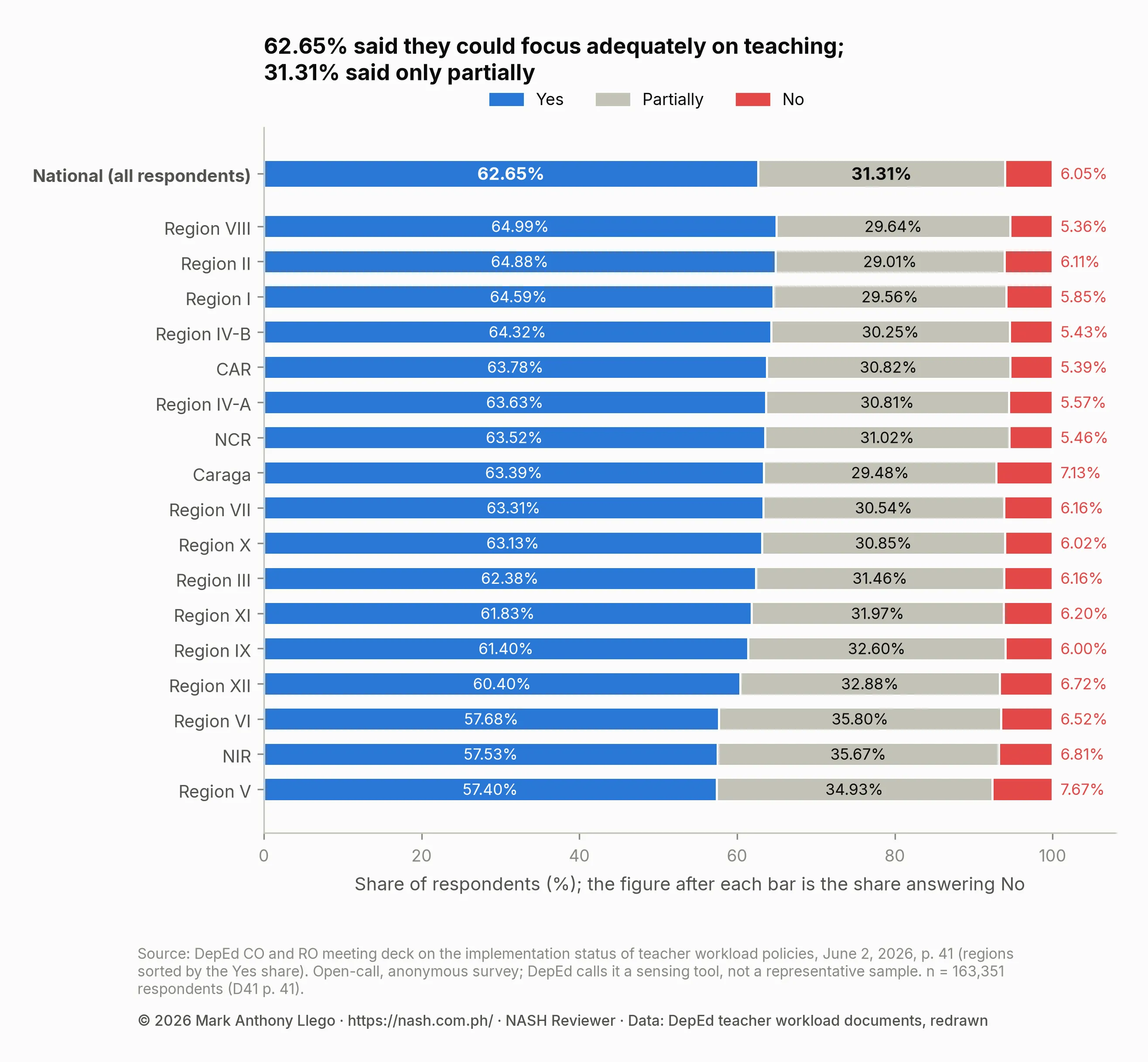
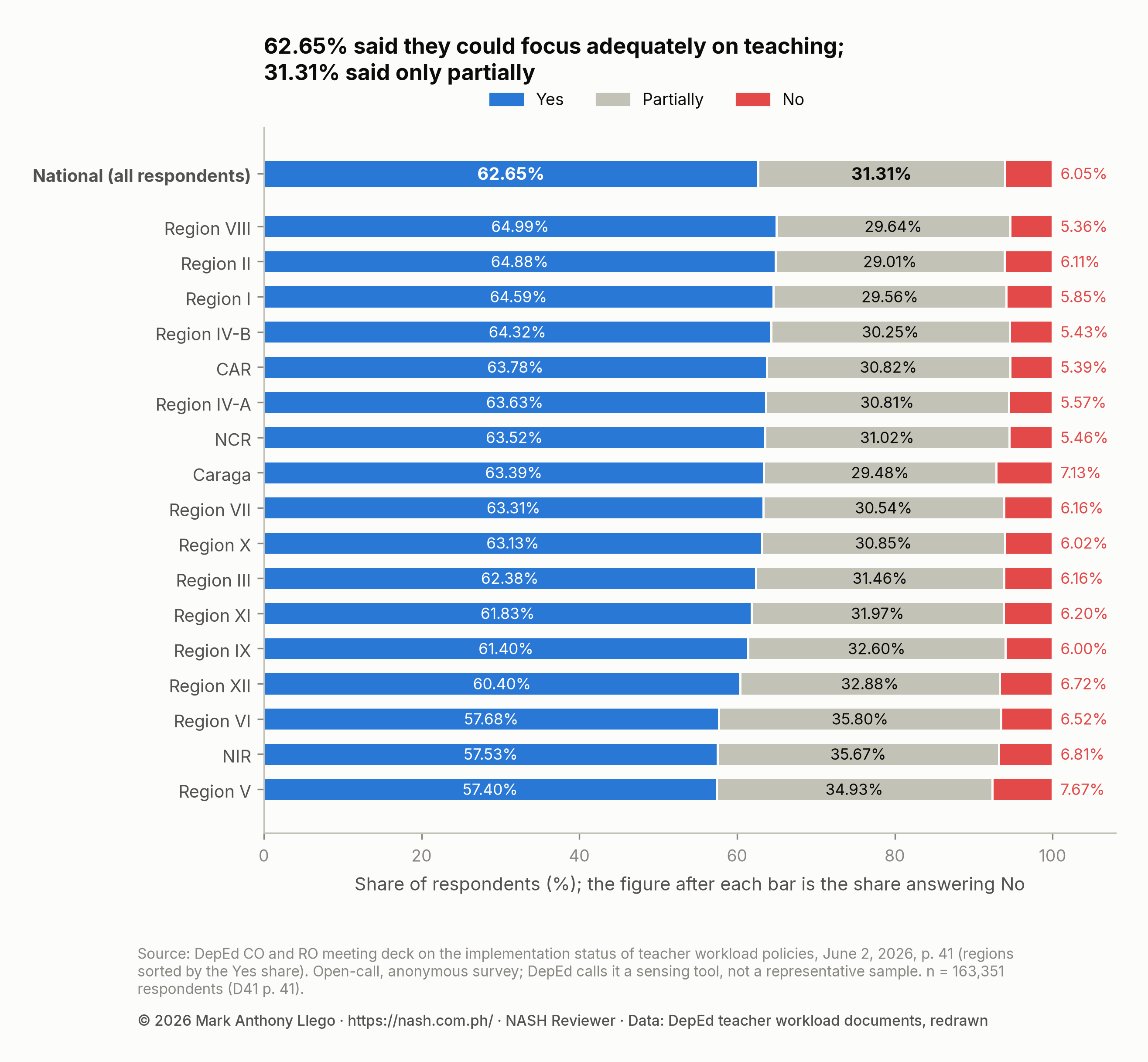
Of 163,351 respondents, 102,333 said yes (62.65%), 51,138 partially (31.31%) and 9,880 no (6.05%) (CO and RO deck, p. 41). “Yes” ranges from 57.40% in Region V to 64.99% in Region VIII; Regions V and VI and NIR are the only three below 60%. The deck calls this “encouraging progress, but our aspiration remains clear: every teacher should be fully enabled to focus on teaching” (p. 40).
What kept teachers from focusing on teaching
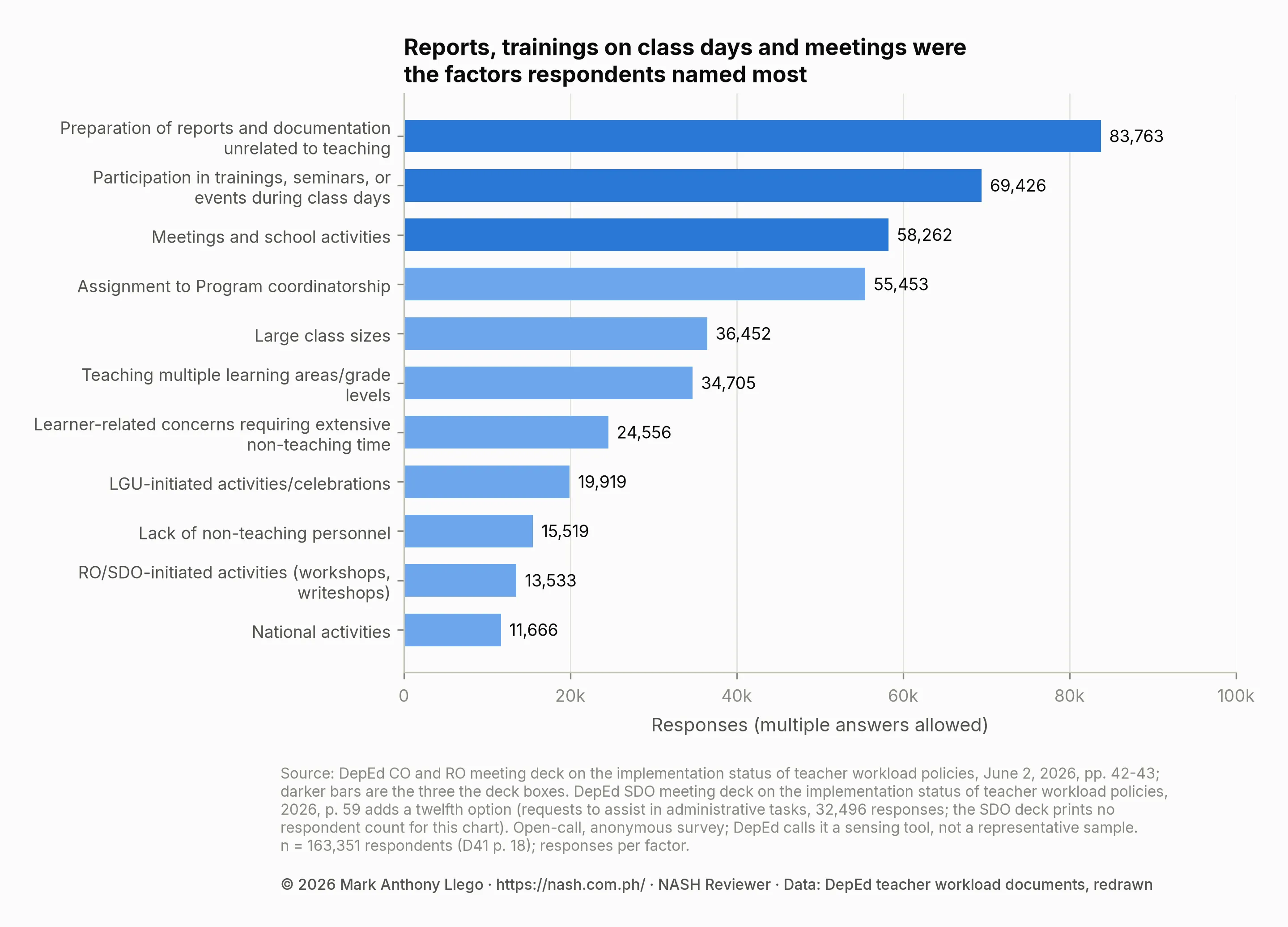
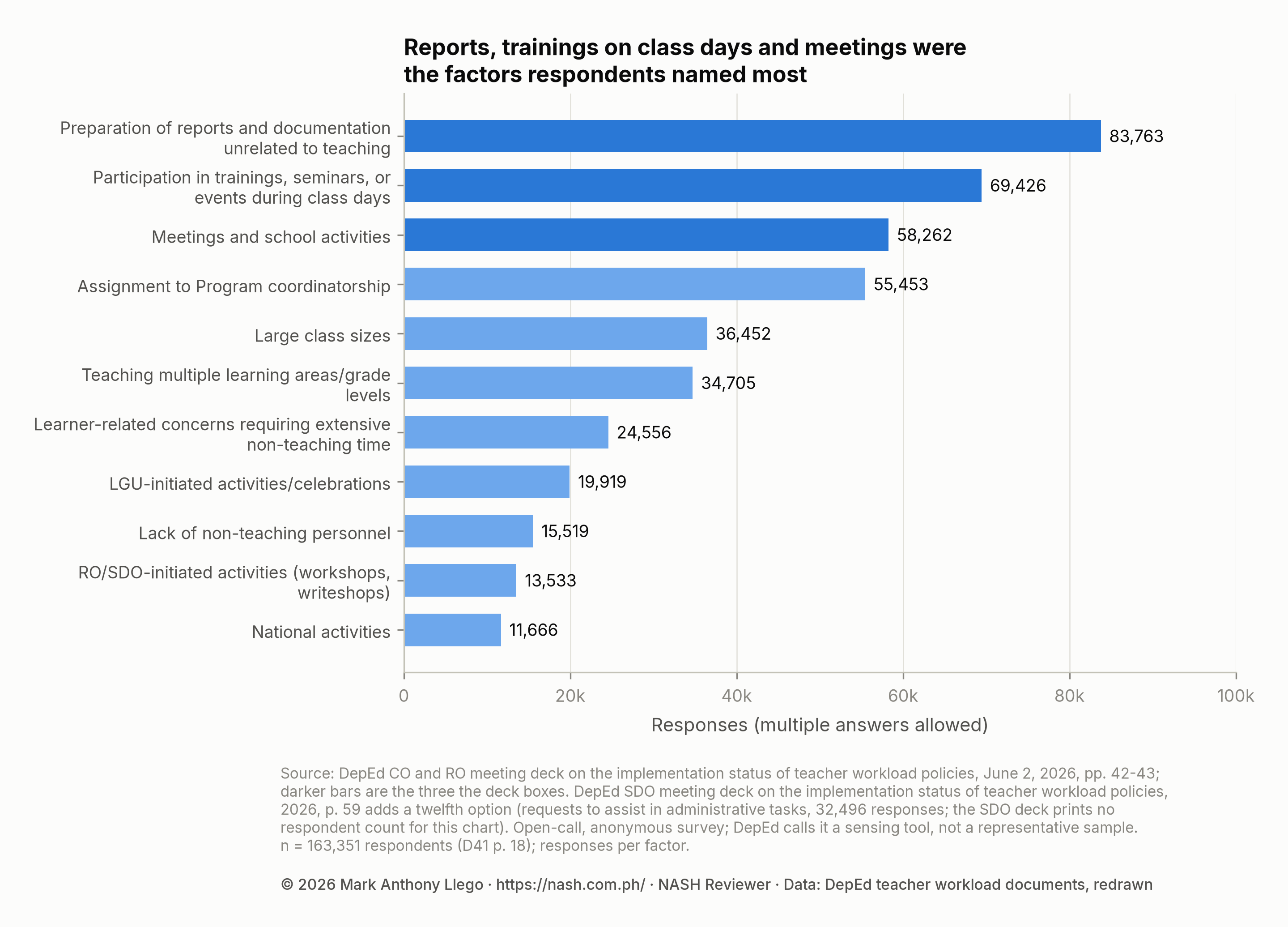
The top three are “Preparation of reports and documentation unrelated to teaching” (83,763), “Participation in trainings, seminars, or events during class days” (69,426) and “Meetings and school activities” (58,262) (CO and RO deck, pp. 42–43). DepEd’s consultations with school heads describe the first two in more detail:
- Reports. Teachers face “Rushed submission timelines; Repeated requests for reports already submitted; Lengthy narrative documentation requirements; and Limited knowledge on how submitted reports and documentation are utilized” (CO and RO deck, p. 44; SDO deck, p. 60).
- Pull-outs. Causes include “Delayed rollout of activities that overlap with instructional days” and “The need to assign teachers with specialized expertise to participate in capacity-building activities, workshops, and writeshops” (CO and RO deck, p. 45).
On LGU activities (19,919 responses), the 2026 Q&A says the issue is being discussed among Central Office bureaus and that SDOs “are encouraged to properly document and identify specific instances of disruption due to LGU-led activities” as a basis for dialogue with LGUs and the DILG (2026 Q&A, No. 35). On non-teaching staff (15,519), BHROD says school-based positions “should remain assigned to schools to help reduce the administrative burden of teachers” (No. 38); see Admin Tasks Off Teachers.
DepEd Order No. 009, s. 2026 adopts three terms in part to “reduce ancillary and non-teaching-related tasks of teachers, and ensure more manageable teaching workloads” (para. 2), and the decks add that “we need to ensure the protection of instructional block and uninterrupted teaching time” (CO and RO deck, p. 39; SDO deck, p. 57).
What teachers said would help
- Ancillary tasks. Asked “What mechanisms would help you manage your teacher ancillary tasks?”, respondents most often chose standardized and simplified templates for lesson plans, reports and school forms (131,992), ready-to-use or shared instructional materials (120,051) and digitized systems for attendance, learner performance and grades (97,676) (CO and RO deck, p. 59).
- Curriculum planning. The concerns named most often were “Preparation of lesson plans is too time-consuming” (108,724) and “Frequent changes or unclear guidelines in the curriculum and competencies” (106,364) (CO and RO deck, p. 58).
- Workload in general (SDO deck only). Asked which support mechanisms “would help improve teacher workload in your school”, respondents most often chose “Assignment of learning areas aligned with teacher specialization” (87,742), “Manageable class sizes” (83,407) and “Reduced administrative responsibilities for teachers” (72,381) (SDO deck, p. 62).
On lesson plans, DO 016, s. 2026 now asks school heads and instructional leaders to “support the gradual simplification of lesson planning practices and reduce unnecessary documentation requirements” (para. 37.c); see our guide to lesson planning under DO 016, s. 2026.
Loads, ancillary work, overload pay and TRA hours: covered in other posts
The decks also report eSF7 and finance data and more survey items, each with its own post in this series.
- Teaching loads. eSF7 data for SY 2024-2025, “covering 45,328 public schools with a 98% submission rate”, put the average daily teaching load at 5.28 hours: 5.88 in elementary, 5.04 in junior high and 4.92 in senior high (CO and RO deck, p. 37). The deck says the national average “remains within the six (6)-hour limit” (p. 46). See How Many Hours Must DepEd Teachers Teach a Day?
- Ancillary work outside school. Asked “Are teachers in your school allowed to accomplish teacher ancillary tasks outside school premises?”, 78.57% of respondents (128,352 of 163,351) answered Yes. The question asks about practice in the respondent’s school, not about the respondent (CO and RO deck, pp. 60–61). Asked why teachers are not allowed, respondents most often cited the 8-hour DTR (20,791 responses) and school heads requiring work on campus (19,041) (p. 62). The decks also rank curriculum planning as the most time-consuming ancillary task (p. 57). See Can Teachers Leave School After Six Hours of Teaching?
- Overload pay. eSF7 shows 348,678 teachers with overload in SY 2024-2025 (CO and RO deck, p. 48), while FY 2025 disbursements were ₱27,431,781.46 against an original allotment of ₱482,772,000.00 (p. 50). On the question about “the major challenges encountered in processing payment for teaching overload”, the decks show different options: the SDO deck adds “Unclear or inconsistent guidelines/parameters”, its top answer (57,384; SDO deck, p. 70), which the CO and RO deck does not show; there, “Lack of orientation or guidance on requirements/processes” leads (50,518; p. 53). See Why So Few Teachers Get Paid for Teaching Overload.
- Hours on teaching-related assignments. Respondents reported 4.26 hours a week as ICT coordinator, the highest, down to 3.11 as research coordinator (CO and RO deck, p. 67). See Teaching-Related Assignments: The 11 Roles DepEd Allows.
What DepEd asked SDOs to do next
Three priority areas
After the results, the CO and RO deck lists “Priority Areas for SDO-level Interventions” and states that “SDOs were directed to submit implementation plans that clearly identify teacher workload issues, corresponding interventions, timelines, and accountable offices” (CO and RO deck, p. 73):
- “Strengthen policy understanding of all school heads and teachers”: orientation and cascading, “Policy feedback mechanisms”, and “Onboarding of newly-hired teachers and school heads”.
- “Protect teachers’ time”: “Protect instructional blocks”, “Support curriculum planning”, “Streamline reporting and documentation”, “Simplify teaching-related assignments”.
- “Improve policy compliance”: “Processing of Teaching Overload Pay”, “Teacher loading monitoring”, “Address staffing gaps and deployment”.
Six proposed SDO-level interventions
The SDO deck sets out six proposed interventions, the first five each with a guide question for the division (SDO deck, pp. 83–86).
| No. | Intervention (as printed) | What it includes | Page |
|---|---|---|---|
| 1 | “Clarify and cascade the policy to all school heads and teachers” | Advocacy materials; orientations and feedback sessions with school heads; “accessible mechanisms” for clarification; orientation for “newly hired teachers, school heads, and TICs” | p. 83 |
| 2 | “Protect Instructional Time” | “Minimize teacher pull-outs especially during instructional blocks”; participation “without requiring physical reporting to the SDO whenever feasible”; align activities with the three-term calendar | p. 84 |
| 3 | “Support curriculum planning and teaching processes” | Technical assistance; “ready-to-use or shared instructional materials”; digitized records | p. 84 |
| 4 | “Make overload pay process easier to implement” | Identify teachers with overload “early upon submission of eSF7”; “Ensure quarterly payment”; “Clarify payment parameters and processes” | p. 85 |
| 5 | “Streamline reporting and documentation” | “Reduce redundant reports”; “Limit or do not require lengthy narrative or documentation reports”; “Maintain a repository of data requirements”; “Digitize submissions where possible” | p. 85 |
| 6 | “Strengthen workload and staffing in schools” | “Monitor teacher loading through eSF7”; deploy teachers by specialization; “Avoid prolonged vacancies both for teaching and non-teaching positions” | p. 86 |
The SDO plan guide later lists “21 CO-recommended SDO-level interventions”, which it says were “discussed during the SDO Interface Meetings” and developed “based on the national results of the Teacher Survey” (SDO plan guide, pp. 19–20). The guide itself shows only the first seven; the full list is in the plan template.
The CARE steps in the SDO plan guide
The guide organizes the work as CARE, “caring for and supporting our teachers” (SDO plan guide, p. 5).
| Step | What the guide asks | Pages |
|---|---|---|
| C: “Convene your SDO Implem Team” | Minimum team “Per DM 53, s. 2024”: the ASDS as head; the Chiefs of SGOD and CID and the SDO HRMO as members; Finance, Planning or Legal may be added | p. 6 |
| A: “Assess your SDO’s current situation” | Use “the Teacher Workload survey, available SDO data, and stakeholder feedback”, and “Focus on identifying the root causes of implementation issues, not just their symptoms” | pp. 7–10 |
| R: “Respond by identifying and prioritizing interventions” | Responsible offices, “realistic implementation timelines”, “measurable expected outputs and Means of Verification (MOVs)”, and support needed from the RO or CO | pp. 11–14 |
| E: “Encode using the Template and Execute the Plan” | Fill in the template’s three sheets (Info Sheet, Part I, Part II), have it recommended by the ASDS and approved by the SDS, submit “Signed copy of the Implem Plan in PDF File; and Excel version of the Implem Plan”, then carry it out with “continuous monitoring and regular feedback” | pp. 15–39 |
One instruction in the Assess step protects teachers directly: “We highly discourage teacher pull-outs, particularly during the instructional block. If teacher interviews are not feasible, you may instead gather insights from School Heads or explore other appropriate methods” (p. 8). The guide’s root-cause approach is the same one used in school planning; see our guide to root cause analysis for the School Improvement Plan.
The dates: which document says what
| Step | CO and RO deck (June 2, 2026) | SDO deck (undated) | SDO plan guide (undated) |
|---|---|---|---|
| Template and submission form | “June 8: Release of Implementation Plan Template and Submission Form”, by “A separate memorandum” (p. 75) | Same (p. 91) | Gives the template link, tinyurl.com/TW-ImplemPlan (pp. 4, 16); no date |
| Submission | “July 6: Deadline of Submission of Implementation Plans” (p. 75) | Same (p. 91) | Gives the submission link, tinyurl.com/TW-2026ImplemPlan-Submission (p. 38); no deadline printed |
| After submission | Plans “consolidated and provided to Operations Strand and Regional Directors for monitoring” (p. 75); CO to give results to Operations and Regional Offices “for technical assistance and progress monitoring” (p. 81) | Same consolidation (p. 91); “CO to conduct a progress check after the first term of SY 2026-2027” (p. 95) | Execute the plan with “continuous monitoring and regular feedback” (p. 39) |
June 8, 2026 was also the opening day of SY 2026-2027, and Term 1 ran to September 15, 2026 (DO 009, s. 2026, para. 4 and Annex B). None of the three documents is an issuance; the decks say “A separate memorandum shall be issued” for the template and process (CO and RO deck, p. 75). As of October 2026, no numbered DepEd memorandum had set it, and DepEd had posted no result of the post-Term 1 progress check. If your division received that memorandum, its dates govern.
The guide says the plan “is not intended to be another reporting requirement” (SDO plan guide, p. 2), yet it asks for a signed PDF and an Excel file (p. 38). Either way it is the division’s document; school heads appear in it as people the division may consult (p. 8).
What this means for school heads
Teachers “may rely heavily on school-based communication for policy interpretation and guidance” (CO and RO deck, p. 33), so many of the gaps the survey found can be closed at school. Concrete steps:
- Teach the four categories with the Order in hand. Use the table above, starting with class advising (teaching load, not a coordinator role) and lesson planning (an ancillary task). A learning action cell session outside class hours can go through DO 005, Sec. V.A.1 to V.A.4 line by line.
- Orient every teacher, especially new teachers and teachers-in-charge, whom the SDO deck names (p. 83), and keep the attendance sheet.
- Give teachers a way to ask. “Limited opportunities to seek clarifications” was the second most-cited factor (69,947; CO and RO deck, p. 31). Name a contact person, and elevate what you cannot answer to the division’s implementation team.
- Protect the instructional block. Schedule meetings and activities outside class time where you can, and log pull-outs and LGU requests; divisions are asked to document LGU disruptions (2026 Q&A, No. 35).
- Filter reports. Answer requests from records the school already holds, and do not ask teachers again for data already submitted (CO and RO deck, p. 44).
- Read your division’s results as a signal, and check them against your own eSF7, orientation records and teachers before acting.
What a school head may not do under the Orders:
- Require “documentary evidence or accomplishment reports on how the two (2) hours of ancillary tasks are spent outside school premises” (DO 005, Sec. V.A, item 1).
- Designate a teaching-related assignment that does not fall under the categories in DO 005, Sec. V.A.4, item 1 (new program roles are “subsumed” under them, item 5; for example, Learner Formation Officers under Guidance and Advocacy, DM 055, s. 2026, Sec. II.c), or without “a designation order from the school head duly concurred by the teacher concerned” (Sec. V.A.4, item 3).
- Give teachers the administrative tasks that DO 002 assigns to “School Heads and non-teaching personnel”, such as property custodianship and feeding (DO 002, Sec. V.A.1).
Records to keep: orientation attendance; designation orders and the SDS-approved list of teachers with teaching-related assignments (DO 005, Sec. V.A.4, item 3); the eSF7; and a log of pull-outs and outside requests. The PPSSH Domain 1 guide covers policy implementation and review, and the PPSSH Domain 2 guide covers the management of staff and loads.
How the NASH may test this
The two items below are original practice items, scored 3 (Relational), 2 (Multistructural), 1 (Unistructural) or 0 (Prestructural).
Question 1
Indicator 1.4.1, Research and innovation. Career Stage 1, Situational, Moderate.
Your division shares its results from DepEd’s May 2026 teacher workload survey: in your region, fewer respondents than the national 60.95% attended an orientation on the workload policies. The division asks each school head to propose school-level actions for its implementation plan. What is the most appropriate first step?
- A. Treat the regional rate as your school’s own and require every teacher to submit a written account of how the two ancillary hours are spent outside school, as proof of compliance.
- B. Check the finding against the school’s own records, such as orientation attendance and teachers’ questions, and ask teachers briefly outside class hours before proposing actions for the gaps you confirm.
- C. Treat the regional rate as your school’s own and schedule a re-orientation on the workload policies for every teacher, then report the session to the division as the school’s action.
- D. Set the regional results aside, since the survey was an open call that DepEd itself says does not represent all teachers or all schools.
Answer and explanation
Best answer: B. Points: A = 0, B = 3, C = 2, D = 1.
- A (0 points, Prestructural). DO 005, s. 2024 bars requiring documentary evidence of how the two ancillary hours are spent outside school premises.
- B (3 points, Relational). It connects the survey’s limits to the school’s own evidence and to teachers’ time, which is how DepEd’s plan guide asks divisions to validate the findings.
- C (2 points, Multistructural). A re-orientation responds to a real gap, but it treats a regional figure from an open-call survey as a fact about one school without checking it.
- D (1 point, Unistructural). It knows the survey’s limits but discards the signal, so no gap is checked.
Why. Indicator 1.4.1 asks the aspiring school head to identify relevant findings from reliable sources and judge what they can support. DepEd calls the survey “a sensing tool for what may be happening on the ground” (CO and RO deck, June 2, 2026, p. 18), and its plan guide asks divisions to validate the findings with their own data and consultations while it discourages teacher pull-outs (SDO plan guide, pp. 8–9).
Indicator 1.4.1: Identify relevant research findings from reliable sources in facilitating data-driven and evidence-based innovations to improve school performance.
Sources: DepEd CO and RO meeting deck on the implementation status of teacher workload policies, June 2, 2026; FY 2026 / SY 2026-2027 SDO Teacher Workload Implementation Plan – Guide for SDOs; DepEd Order No. 005, s. 2024, Sec. V.A, item 1.
Question 2
Indicator 2.4.2, Management of staff. Career Stage 2, Situational, Difficult.
While you finalize the class program, Teacher C asks how her day is counted. She teaches five hours of Grade 5 classes a day, advises a Grade 5 class and is the school’s reading coordinator under a designation order she concurred with. She prepares her lesson plans at school. Which answer should you give her and record in eSF7?
- A. Her five hours of classes and one hour of lesson planning make six hours of teaching load, and class advising and the reading coordinatorship are her teaching-related assignments.
- B. Her five hours of classes and one hour of class advising make six hours of teaching load, and the reading coordinatorship is a teaching-related assignment recorded in eSF7.
- C. Her five hours of classes and one hour of class advising make six hours of teaching load; lesson planning belongs to her two ancillary hours; the reading coordinatorship is a teaching-related assignment that adds no teaching load, recorded in eSF7.
- D. Lesson planning is one of the teacher ancillary tasks under DO 005, s. 2024, so it belongs to her two ancillary hours rather than to her teaching load.
Answer and explanation
Best answer: C. Points: A = 0, B = 2, C = 3, D = 1.
- A (0 points, Prestructural). It counts an ancillary task as teaching load and takes class advising out of it, two errors common in the 2026 survey, and it would misstate her load in eSF7.
- B (2 points, Multistructural). The load and the designation are counted correctly, but it leaves her question about lesson planning unanswered.
- C (3 points, Relational). It places each duty in its category under DO 005 and ties it to the school’s record.
- D (1 point, Unistructural). It is correct about lesson planning but says nothing about her load or her designation.
Why. Indicator 2.4.2 asks the school head to manage teaching load distribution in adherence to issuances. DO 005, s. 2024 treats class advising as teaching load of one hour a day (Sec. V.A.1, item 2), lists lesson planning among ancillary tasks (Sec. V.A.3, item 2.a.i), and allows reading coordinators as teaching-related assignments “on top of the teacher ancillary tasks” (Sec. V.A.4, item 1), reflected in eSF7 (item 3). In DepEd’s 2026 survey, 130,812 responses called class advisorship a teaching-related assignment and 72,063 called lesson planning teaching load (CO and RO deck, June 2, 2026, pp. 23, 29).
Indicator 2.4.2: Manage staffing such as teaching load distribution and grade level and subject area assignment in adherence to laws, policies, guidelines and issuances based on the needs of the school.
Sources: DepEd Order No. 005, s. 2024, Secs. V.A.1, V.A.3 and V.A.4; DepEd CO and RO meeting deck on the implementation status of teacher workload policies, June 2, 2026.
Nothing in this guide reproduces or predicts examination content.
Frequently asked questions
What is DepEd’s 2026 teacher workload survey?
It is the “May 2026 Teacher Survey” that DepEd’s Central Office used to check how its 2024 workload policies are being implemented, presented to regional and division offices in May and June 2026 (CO and RO deck, June 2, 2026, pp. 1, 5; 2026 Q&A, header). It was an open, anonymous call, and DepEd says it “should be read as a sensing tool”, not as a representative sample (p. 18). It is separate from the 2024 EDCOM II–IDinsight survey.
How many teachers answered DepEd’s 2026 workload survey?
The deck for the Central and Regional Offices reports 163,351 respondents in 17 regions, with no BARMM row (CO and RO deck, June 2, 2026, p. 18). The deck for Schools Division Offices prints 145,000 as the total of its orientation table (SDO deck, 2026, p. 50) and gives no other respondent count. The decks do not explain the difference, so each figure should be cited with its own deck.
Is lesson planning part of a teacher’s six-hour teaching load?
No. DepEd Order No. 005, s. 2024 lists “Preparation of lesson plans/daily lesson logs” among the teacher ancillary tasks done in the two remaining hours of the 8-hour day (Sec. V.A.3, items 1 and 2.a.i), and DO 016, s. 2026 asks school heads to give teachers “ample time for ancillary tasks, including the preparation of lesson plans” (para. 37.c). Teaching load is actual classroom teaching, class advising at one hour a day, and remediation and enhancement classes (DO 005, Sec. V.A.1), plus ARAL tutorial sessions (DO 018, s. 2025, para. 81). Two 2026 Orders add check-ins at the Hinga level of learning continuity during emergencies (DO 014, s. 2026, para. 69) and, in senior high, asynchronous sessions shown in the teacher’s schedule. DO 017, s. 2026 requires this for schools still on the 2016 K to 12 curriculum whose shifting or similar schedules limit in-person classes (para. 21); notes in its Grade 12 sample schedules for the Strengthened SHS curriculum say that “The asynchronous class schedule should be reflected in the teacher’s schedule as part of their teaching load” (Annex D1, p. 61).
When were SDO teacher workload implementation plans due?
Both 2026 decks give “July 6” as the deadline, after a template release on “June 8” (CO and RO deck, June 2, 2026, p. 75; SDO deck, p. 91). The SDO plan guide that carries the template prints no deadline (pp. 4, 38), and the decks say a separate memorandum would set the process. Where a division received that memorandum, its dates govern.
Download the data
- survey-understanding.csv: weighted means and interpretation labels of teachers’ self-rated understanding for five policy areas, with the SDO deck’s labels (CO and RO deck, June 2, 2026, p. 21; SDO deck, p. 44).
- survey-quiz.csv: responses per choice to the four check questions in both decks, with each deck’s answer key (CO and RO deck, pp. 23, 25, 27, 29; SDO deck, pp. 45–48).
- survey-orientation-by-region.csv: respondents who attended a policy orientation, by region, in both decks (CO and RO deck, p. 32; SDO deck, p. 50).
- survey-focus-on-teaching.csv: Yes, No and Partially counts and shares on focusing on teaching, by region and nationally (CO and RO deck, p. 41).
- survey-focus-factors.csv: responses per factor that affected focus on teaching, in both decks (CO and RO deck, pp. 42–43; SDO deck, p. 59).
The CSVs and charts may be reused only with written permission: email support@nash.com.ph. The rules themselves come from DepEd’s issuances, which you can cite directly.
Sources
DepEd’s Teacher Workload Public Drive, linked from the Teacher Workload Policy Toolkit, June 2025, p. 101: bit.ly/TeacherWorkload_ToolsandProcedure.
- DepEd, [MAIN DECK] CO & RO Online Meeting on the Implementation Status of Teacher Workload Policies, Central and Regional Offices, June 2, 2026, pp. 1, 5, 17–18, 21–34, 37, 39–46, 48, 50, 53, 57–62, 67, 73, 75, 81.
- DepEd, [MAIN DECK] Online Meeting on the Implementation Status of Teacher Workload Policies, Schools Division Office orientation material, undated (2026), pp. 1, 42, 44–52, 57–60, 62, 70, 83–86, 91, 95, 100.
- DepEd, FY 2026 / SY 2026-2027 SDO Teacher Workload Implementation Plan – Guide for SDOs, undated, pp. 2, 4–17, 19–20, 23, 38–39, 42.
- DepEd, [Q&A] Consolidated Question and Answer from the Online Meeting with Regional and Schools Division Offices on the Implementation Status of Teacher Workload Policies, May 25–26 and June 2, 2026, Nos. 35 and 38.
- DepEd Order No. 002, s. 2024, Immediate Removal of Administrative Tasks of Public School Teachers, Sec. V.A.1.
- DepEd Order No. 005, s. 2024, Rationalization of Teachers’ Workload in Public Schools and Payment of Teaching Overload, Secs. V.A, V.A.1–V.A.4 (including V.A.3, item 2.d.i and V.A.4, item 5).
- DepEd Memorandum No. 053, s. 2024, Implementation Guidelines for DepEd Order No. 005, s. 2024, para. 3.c.
- DepEd Order No. 013, s. 2024, Revised Guidelines on the Grant of Vacation Service Credits for Teachers.
- DepEd Order No. 018, s. 2025, Implementing Guidelines of the Academic Recovery and Accessible Learning Program, para. 81.
- DepEd Order No. 026, s. 2025, Guidelines on the Payment of Overtime Services of Teachers, Sec. V.2.
- DepEd Order No. 009, s. 2026, Guidelines on the Implementation of the Three-Term School Calendar in Basic Education, paras. 2 and 4 and Annex B.
- DepEd Order No. 014, s. 2026, Guidelines on Learning Continuity in Emergencies, para. 69.
- DepEd Order No. 016, s. 2026, Guidelines on Lesson Planning and Learning Design, para. 37.c.
- DepEd Order No. 017, s. 2026, Strengthened Senior High School Curriculum, para. 21.
- DepEd Memorandum No. 055, s. 2026, Clarificatory Guidelines on the Designation of Learner Formation Officers in Schools, Sec. II.c.
- IDinsight, Removing the Burden of Administration from Teachers, EDCOM II Policy Brief, p. 6.
- DepEd Order No. 024, s. 2020, National Adoption and Implementation of the Philippine Professional Standards for School Heads (indicators 1.4.1 and 2.4.2).
The teacher workload series
- DepEd Teacher Workload Policies: A Complete Guide
- How Many Hours Must DepEd Teachers Teach a Day?
- Can Teachers Leave School After Six Hours of Teaching?
- DepEd Teaching Overload Pay: Who Qualifies, How Much
- Why So Few Teachers Get Paid for Teaching Overload
- Teaching-Related Assignments: The 11 Roles DepEd Allows
- Vacation Service Credits and Overtime Pay for Teachers
- Admin Tasks Off Teachers: DO 2 and School Support Staff
- DepEd 2026 Teacher Workload Survey: What Teachers Said (this post)
- How School Heads Plan Teaching Loads Under DO 5
- Teacher Workload and Accountability: EDCOM II Findings
Written by Mark Anthony Llego for NASH Reviewer. Sources: DepEd’s 2026 implementation-status decks for Central, Regional and Schools Division Offices, the SDO implementation plan guide and the 2026 consolidated Q&A; DepEd Orders No. 002, 005 and 013, s. 2024, No. 018 and 026, s. 2025, and No. 009, 014, 016 and 017, s. 2026; DepEd Memoranda No. 053, s. 2024 and No. 055, s. 2026; the EDCOM II–IDinsight policy brief. Charts may be reused only with written permission from support@nash.com.ph.