A DepEd teacher claims teaching overload pay by handing the monthly daily time record (DTR) to the school head. Under DepEd Memorandum No. 053, s. 2024, which implements DepEd Order No. 005, s. 2024, the school head does the rest each quarter: certifies the list of teachers with overload, writes an endorsement memorandum to the Schools Division Superintendent (SDS), attaches the DTRs and the eSF7, posts the list and sends it all to the Schools Division Office (SDO). Little of the money reaches teachers. Of the ₱482,772,000 allotted for FY 2025, ₱27,431,781.46 was disbursed, 5.68% (computed). Field reports for FY 2025 add up to 2,148 paid, with no unit printed; that figure cannot be read against the 348,678 teachers with overload in the SY 2024-2025 eSF7, because the periods and sources differ (DepEd CO-RO meeting deck on implementation status, June 2, 2026, pp. 48, 50–51). The deck says the low use “suggests possible gaps not necessarily in the availability of funds, but in the processing, validation, documentation, and mechanisms related to teaching overload pay” (p. 54).
The sections below follow a claim from the classroom to the payroll, then cover the money, the obstacles and what a school head can do. Who qualifies and how the pay is computed are in DepEd Teaching Overload Pay: Who Qualifies, How Much; EDCOM II’s evidence is in Teacher Workload and Accountability: EDCOM II Findings.
Key findings
- Teachers submit only their DTR, with its locator slips or certificates of undertaking. The school head prepares the certification of teachers with overload, the endorsement memorandum and the eSF7 within 3–4 working days and submits them within 1–2 more (DM 053, s. 2024, Encl. No. 1; DepEd overload process-flow cards, p. 2).
- Processing takes about two to three working weeks if every step is on time. From the school’s start to payment, DM 053’s tables add up to 10–15 working days and its flowchart to 9–15 (Encl. No. 1; computed).
- FY 2025: ₱27,431,781.46 disbursed of ₱482,772,000. The adjusted allotment was ₱100,236,830.30 and obligations ₱77,397,429.30. Disbursements were 5.68% of the original allotment (computed; CO-RO deck, p. 50).
- 2,148 paid (no unit printed) and 348,678 with overload, from different periods. The first adds four quarterly FY 2025 field reports; the second is SY 2024-2025 eSF7 data. They are not a payment rate (CO-RO deck, pp. 48, 51).
- FY 2026 has ₱1,738,683,000, 3.6 times FY 2025’s original allotment (computed). ₱579,532,000 reached the regional offices by April 20, 2026 and a SARO for ₱1,159,151,000 the Central Office by July 29. Ten regional offices reported 183 teachers paid in the first quarter (DM-OUHRODI-2026-1235, p. 1; DM-OUHRODI-2026-2538, p. 1).
- Orientation and clarity top the obstacles in DepEd’s 2026 sensing survey. The SDO deck puts “Unclear or inconsistent guidelines/parameters” (57,384 responses) and lack of orientation (44,871) first; the CO-RO deck, with 163,351 respondents and no unclear-guidelines option, puts lack of orientation (50,518) and insufficient budget (33,264) first (SDO meeting deck on implementation status, 2026, p. 70; CO-RO deck, pp. 18, 53).
- DepEd says past-year overload cannot be paid. Its 2026 answer is that compensation “cannot be granted retroactively” because a fiscal year’s budget lapses (consolidated Q&A, 2026 implementation-status meetings, No. 12). No Drive issuance states this, and DO 005 and DO 013, s. 2024 convert unpaid overload to service credits, so file quarterly.
How teachers claim teaching overload pay
Teaching overload is actual classroom teaching beyond six hours a day, at most two hours a day and ten a week, paid per hour at the Prime Hourly Teaching Rate of annual salary ÷ 1,600 × 1.25 (DO 005, Sec. III.j; DM 053, Encl. No. 1, Computation, item 3); Post 3 of this series covers eligibility and worked examples.
DO 005 requires the school head to “prepare a record of teachers who rendered services beyond six (6) hours aggregated on a weekly basis”, and payment “shall be made on a quarterly basis, subject to the extent of allotment” (Sec. V.B.1, items 2–3). DM 053 sets the steps:
| Who | What they do | Time allowed |
|---|---|---|
| Teacher | Submits the DTR “and all other attachments” (locator slips, certificates of undertaking); a copy stays with the school head “to be used as attachment in the quarterly processing of teaching overload pay” | “Immediately after end of the month” |
| School head | Identifies teachers with overload; prepares the Certification/List of Teachers with Teaching Overload Pay, the Endorsement Memorandum to the SDS through the SDO-Admin Unit (Personnel), the DTRs and the eSF7 | 3–4 working days |
| School head or non-teaching staff | Submits everything to the SDO-Admin Unit (Personnel) and posts the Certification/List “on the transparency board/s of schools” | 1–2 working days |
| SDO-Admin Unit (Personnel) | Validates the papers, computes the pay, prepares the payroll with the ORS and DV | 3–5 working days |
| SDO Finance (Budget, Accounting) and Admin Unit (Cash) | Obligates, pre-audits, recomputes and pays “thru LDDAP-ADA” | 3–4 working days |
| SDO, then regional office (RO) | Budget utilization reports, approved by the SDS and then the Regional Director | “Every quarter after disbursement of teaching overload pay”; RO “Upon receipt of reports from SDOs” |
Source: DM 053, s. 2024, Enclosure No. 1 tables.
The certification gives each teacher’s reason and hours: “Additional teaching load due to teacher shortage”, “Relieving duties of teachers”, “Conduct of remediation/enhancement classes” or “Class Advising Duties” (Encl. No. 1). The templates (Encl. No. 2, Nos. 4–8, all “Quarterly”) are in Folder III of the Teacher Workload Public Drive, bit.ly/TeacherWorkload_ToolsandProcedure.
Three rules govern the papers:
- Nothing beyond the templates. “There shall be strictly no additional documentary requirements aside from the templates provided in each Enclosure” (DM 053, para. 10). “Teachers only need to submit their Daily Time Record (DTR) for the processing of teaching overload pay” (process-flow cards, p. 2). For ARAL tutoring, the later DM 061, s. 2026 makes pay conditional on the tutor’s DTR and Accomplishment Report (Annexes F and G of DM 001, s. 2026), submitted as “Duly wet-signed hard copies” (paras. 30–31); for that case DM 061, the later and more specific memorandum, governs.
- Incomplete papers come back. “Documents found not in order shall be returned without action” (DM 053, Encl. No. 1).
- Attach the eSF7. The Toolkit says “eSF7 if necessary” (Teacher Workload Policy Toolkit, June 2025, p. 34), but DM 053, which governs, lists it without condition, and DepEd’s 2024 answer is that “the updated SF7 should be attached” (DepEd consolidated Q&A, DM 53 orientation, No. 45).
Later issuances add cases a certification may include:
- ARAL tutoring. DepEd Order No. 018, s. 2025 treats ARAL tutorial sessions “as a teaching load”, reflected in School Form 7, and pays tutors over six hours under DO 005 and DM 053 (paras. 81–83). DepEd Memorandum No. 001, s. 2026 repeats that a tutor who “renders more than six hours of total teaching load shall be entitled to teaching overload pay” (paras. 30, 32). DepEd Memorandum No. 061, s. 2026 makes tutoring by DepEd teachers voluntary (“shall not be mandatory”, para. 6.d), caps the pay at “two (2) hours of teaching overload per day, computed based on the Prime Hourly Teaching Rate (PHTR)” (para. 31.a.i), and requires a DTR and an accomplishment report, with “Duly wet-signed hard copies” for processing (para. 30).
- Relievers. DepEd Order No. 002, s. 2026 makes relievers of teachers on wellness leave “eligible to teaching overload pay” (Sec. VI.1.h). The Office of the Secretary’s Memorandum of August 10, 2026 repeats that they “shall be eligible for overload pay, subject to the applicable guidelines and conditions under DO 005, s. 2024” (para. 4), and tells school heads to ensure that “additional teaching or relieving duties are properly documented” (para. 6).
- Emergencies. DepEd Order No. 014, s. 2026 counts Hinga check-ins “as part of teaching load”, compensated under DO 005, and pays teachers who hold makeup classes “subject to existing guidelines under DO No. 005, s. 2024 and DO No. 026 s. 2025” (para. 69).
How long an overload claim takes to process
DM 053 gives two sets of times. Its flowchart (Encl. No. 1, first page) gives the school and SDO Finance 3 to 5 working days each; its tables on the next page give the school 3 to 4 days plus 1 to 2, and Finance 3 to 4.
| Step | DM 053 tables | DM 053 flowchart | 2026 SDO deck |
|---|---|---|---|
| Teacher submits the DTR | “Immediately after end of the month” | not shown | “Immediately after end of the month” (p. 35) |
| School head prepares the papers | 3–4 working days | 3–5 working days for the whole school stage | 3–4 days (p. 35); 3–5 for the school stage (p. 34) |
| School head or staff submits and posts the list | 1–2 working days | included above | 1–2 days (p. 35) |
| SDO-Admin Unit (Personnel) | 3–5 working days | 3–5 working days | 3–5 days (pp. 34, 36) |
| SDO Finance and Cash | 3–4 working days | 3–5 working days | 3–5 days (pp. 34, 36) |
| Total, school start to payment (computed) | 10–15 working days | 9–15 working days | 10–16 days |
Sources: DM 053, s. 2024, Encl. No. 1; DepEd SDO meeting deck on implementation status, 2026, pp. 34–36.
DM 053 says only that its general flow “shall be broken down per Major Process” in the tables, not which times prevail. The Toolkit follows the tables for the school (p. 34); the SDO deck follows the flowchart for Finance (p. 36), but a deck cannot change an issuance. Plan to the longer time.
Nor does DM 053 say when the school head’s days begin. DTRs come in monthly, but DepEd’s process-flow cards place the school head’s steps “Immediately after the end of the quarter” (pp. 5–6). Its quick-facts cards go further and tell teachers to “Submit all required documents to your School Head and SDO for processing at the end of every quarter” (p. 5); DM 053, which governs, has teachers hand in DTRs monthly to the school head only. For the regional step, DM 053 says only “Upon receipt of reports from SDOs”; DepEd’s DM 53 orientation deck gives “3-4 working days” (p. 52).
Overload pay report deadlines, FY 2024 to FY 2026
Since January 2025, memoranda from DepEd’s Office of the Undersecretary for Human Resource and Organizational Development (OUHROD, later OUHRODI) have set each regional report date and, from March 2025, reminded offices quarterly to pay overload. Each regional office sends BHROD’s School Effectiveness Division (BHROD-SED) a scanned report signed by the Regional Director and an Excel file. These memoranda are not posted on deped.gov.ph; they are in the Teacher Workload Public Drive.
| Period paid | RO report due | Memorandum and date |
|---|---|---|
| FY 2024, whole year | February 14, 2025 (Friday) | DM-OUHROD-2025-0204, January 20, 2025 |
| Q1 FY 2025 (January to March 2025) | May 30, 2025 | DM-OUHROD-2025-0850, March 28, 2025 |
| Q2 FY 2025 (April to June 2025) | August 31, 2025 | DM-OUHROD-2025-1878, July 10, 2025 |
| Q3 FY 2025 (July to September 2025) | November 28, 2025 | DM-OUHROD-2025-2859, October 6, 2025 (released October 14) |
| Q4 FY 2025 | February 20, 2026 | DM-OUHROD-2026-0278, January 28, 2026, following DM-OUHROD-2025-3402 of November 28, 2025 |
| Q1 FY 2026 | May 22, 2026 | DM-OUHRODI-2026-1235, April 20, 2026 |
| Q2 FY 2026 | August 14, 2026 | DM-OUHRODI-2026-2538, July 29, 2026 |
Sources: the memoranda named, pp. 1–2 of each.
- Schools face earlier dates. SDO Finance and Personnel units “should establish and communicate clear deadlines” for schools (DM-OUHROD-2025-0850, p. 1). The memo of November 28, 2025 set no report date but asked that schools file “in time for the deadline of obligation of funds” (DM-OUHROD-2025-3402, p. 1).
- No third-quarter FY 2026 memo was in the Public Drive as of October 31, 2026. Ask the SDO for its current deadline.
- Quarterly, not semiannual, in practice. DO 005 has the SDO Finance Unit prepare, and the RO Personnel Section consolidate, the report “on a semiannual basis” (Sec. V.D.2–3). DM 053 marks the reports “Quarterly” (Encl. No. 2, Nos. 7–8), and from March 2025 the reminder memos ask for a report for each quarter (DM-OUHROD-2025-3402 set no report date). No document reconciles the two. In practice the quarterly schedule applies, and a quarterly report also meets a semiannual one, though no document says so. Payment is quarterly under both (DO 005, Sec. V.B.1, item 3).
The three-term calendar for SY 2026-2027 (DO 009, s. 2026) does not mention overload pay; claims still follow fiscal quarters.
Where the overload money sits
| Fiscal year | Where the money is | Source |
|---|---|---|
| FY 2024 | “lodged to SDOs” and “sourced from the Personnel Services (PS) allotment under the line item Operations of Schools” for elementary, junior high and senior high school | DM 053, Encl. No. 1, Source of Funds, item 1 |
| FY 2025 | “released to the Regional Offices (ROs) under the Administration of Personnel Benefits” | DM-OUHROD-2025-0850, p. 1 |
| FY 2026 | ₱1,738,683,000.00 “lodged under the Administration of Personnel Benefits (APB) budget line item”, charged to the ROs’ APB line under the object code “Honoraria - Civilian” | DM-OUHRODI-2026-1235, p. 1 |
DepEd’s 2026 answer says the fund “is annually lodged” with the regional offices’ APB line (consolidated Q&A, 2026, No. 10). That holds from FY 2025; for FY 2024, DM 053 governs and put the money with the SDOs.
The reminder memos tell regional offices to “ensure the availability and release of funds to the SDOs within their jurisdiction” (DM-OUHROD-2025-2859, p. 2; similar wording in DM-OUHROD-2025-0850, p. 1). DepEd’s 2026 answer adds that ROs download the money “upon request of the concerned SDO”, once the SDO has validated its teachers and computed “the exact funding needed” (consolidated Q&A, 2026, No. 19); the CO-RO deck says “on a quarterly basis” (p. 10).
When money does not reach a teacher, two rules apply:
- Insufficient funds. “In the event of insufficiency of funds, teaching overload hours shall be converted to earned VSC” (DO 005, Sec. V.B.1, item 3), on a certification from the SDO-Finance Unit (Budget) (DM 053, Encl. No. 1, Source of Funds, item 2). DepEd Order No. 013, s. 2024 sets the rate, “One (1) hour of teaching overload shall be equivalent to 1.25 hours of Vacation Service Credit”, and keeps these credits “exclusive of the thirty (30) days limitation” (Sec. V.A.1.c, V.A.7). The school submits quarterly the DTR, School Form 7, the “Certification on Teaching Overload” and the “Certification of insufficiency of funds for Teaching Overload” (Sec. VI.B.1). See Vacation Service Credits and Overtime Pay for Teachers.
- One fiscal year only. DepEd’s 2026 answer: “Compensation for teaching overload cannot be granted retroactively for the School Years before the current”, because “Once a fiscal year has lapsed, the budget allocated for that year can no longer be accessed or utilized for the processing of claims” (consolidated Q&A, 2026, No. 12). No issuance in the Public Drive states this; the answer mixes school and fiscal years and does not mention the conversion to service credits under DO 005 and DO 013, s. 2024. Those Orders govern, but the documents do not settle whether past-year overload can still be converted, so ask the SDO in writing.
How much of the FY 2025 overload money was used
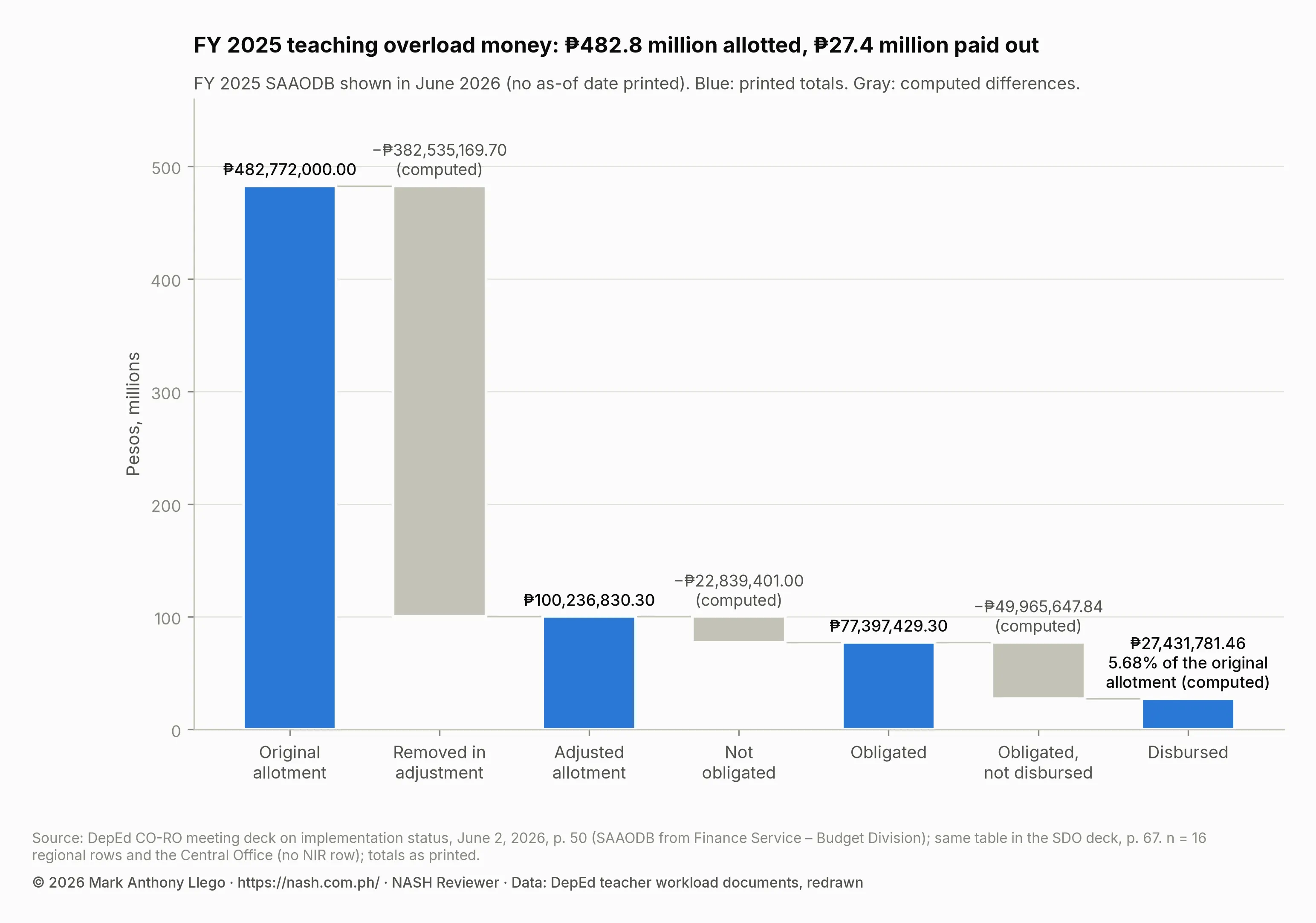
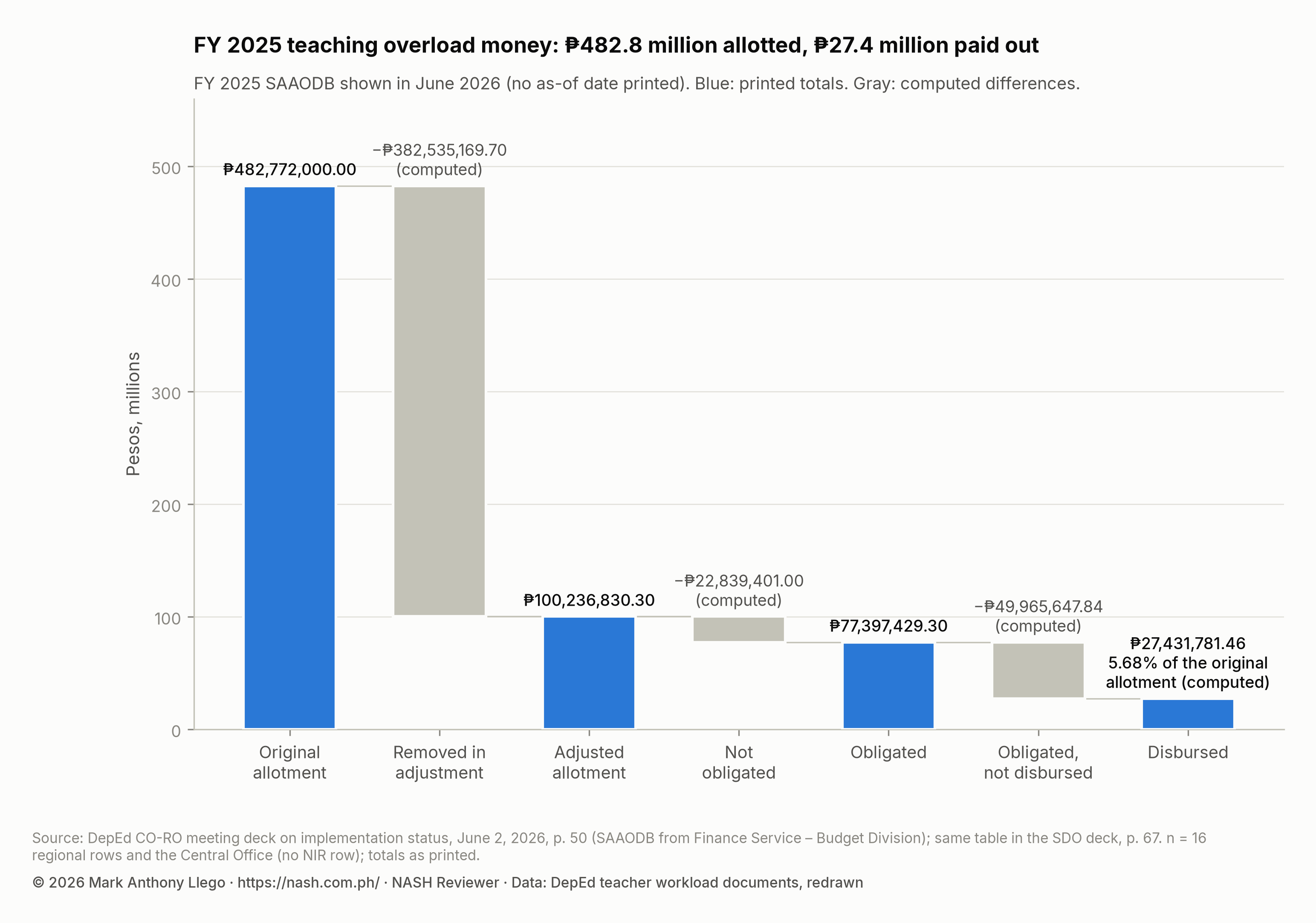
Figure 1’s table is the FY 2025 Statement of Appropriations, Allotments, Obligations, Disbursements and Balances (SAAODB) “from Finance Service – Budget Division” shown at the 2026 meetings (CO-RO deck, p. 50; SDO deck, p. 67). It prints no as-of date; it is treated here as the full year. The adjusted allotment was 20.76% of the original and obligations 16.03% (computed); the printed “Obligation Rate” of 77.21% is obligations divided by the adjusted allotment.
- Regions IV-A, IX and XII had original allotments of ₱64,420,000.00, ₱30,612,000.00 and ₱24,595,000.00 and no adjusted allotment, obligation or disbursement.
- NCR’s allotment was adjusted from ₱22,044,000.00 to ₱21,968,388.29, but it obligated only ₱924,000.00, a rate of 4.21%.
- Region VIII obligated its full adjusted allotment of ₱36,709,271.23 but disbursed ₱348,326.80.
- Region X disbursed the most, ₱5,935,629.66, then Region VII, ₱5,757,001.04. NIR has no FY 2025 row.
Two reminder memos print earlier snapshots, which cannot be read as a series with the June 2026 table:
| As of | Adjusted allotment | Obligation | Disbursement | Source |
|---|---|---|---|---|
| End of Q1 FY 2025 | ₱483,434,311.95 | ₱9,582,441.33 | ₱9,567,886.93 | DM-OUHROD-2025-1878, Annex A |
| End of Q3 FY 2025 | ₱451,908,748.68 | ₱5,223,300.76 | ₱4,984,295.00 | DM-OUHROD-2025-3402, Annex A |
| FY 2025, as shown in June 2026 | ₱100,236,830.30 | ₱77,397,429.30 | ₱27,431,781.46 | CO-RO deck, p. 50 |
Caveats: the Q3 table is labeled “as of 3rd Quarter”, yet its obligations are lower than Q1’s; Region VII’s falls from ₱9,120,558.21 to ₱68,935.84, and neither memo explains why. Region IX had ₱70,146.82 obligated and disbursed by the third quarter but none in the June 2026 table, and CAR’s disbursement falls from ₱333,697.58 to ₱330,197.58; the documents do not explain either. Between Q3 and the June 2026 table, the adjusted allotment fell by about ₱351.7 million (computed).
How many overload payments the field reports count
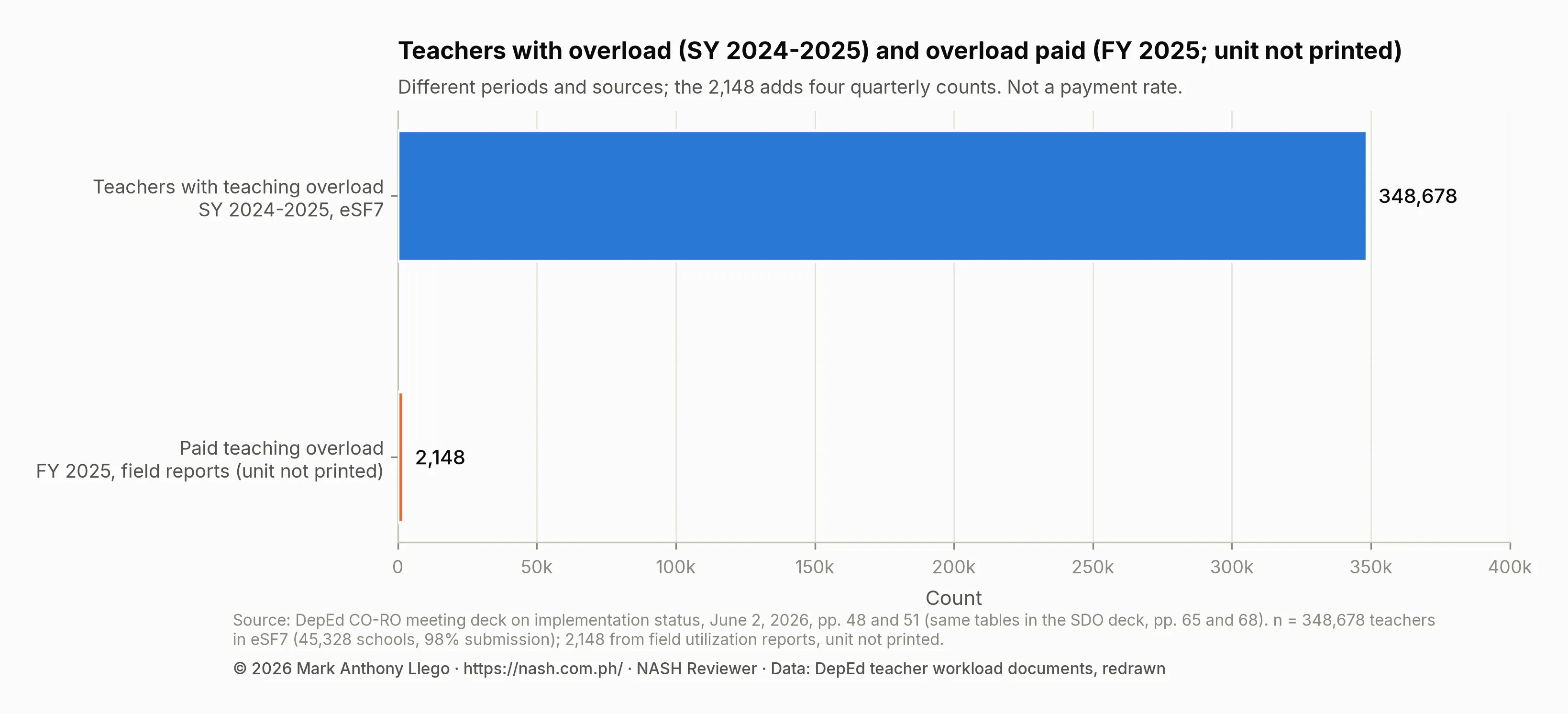
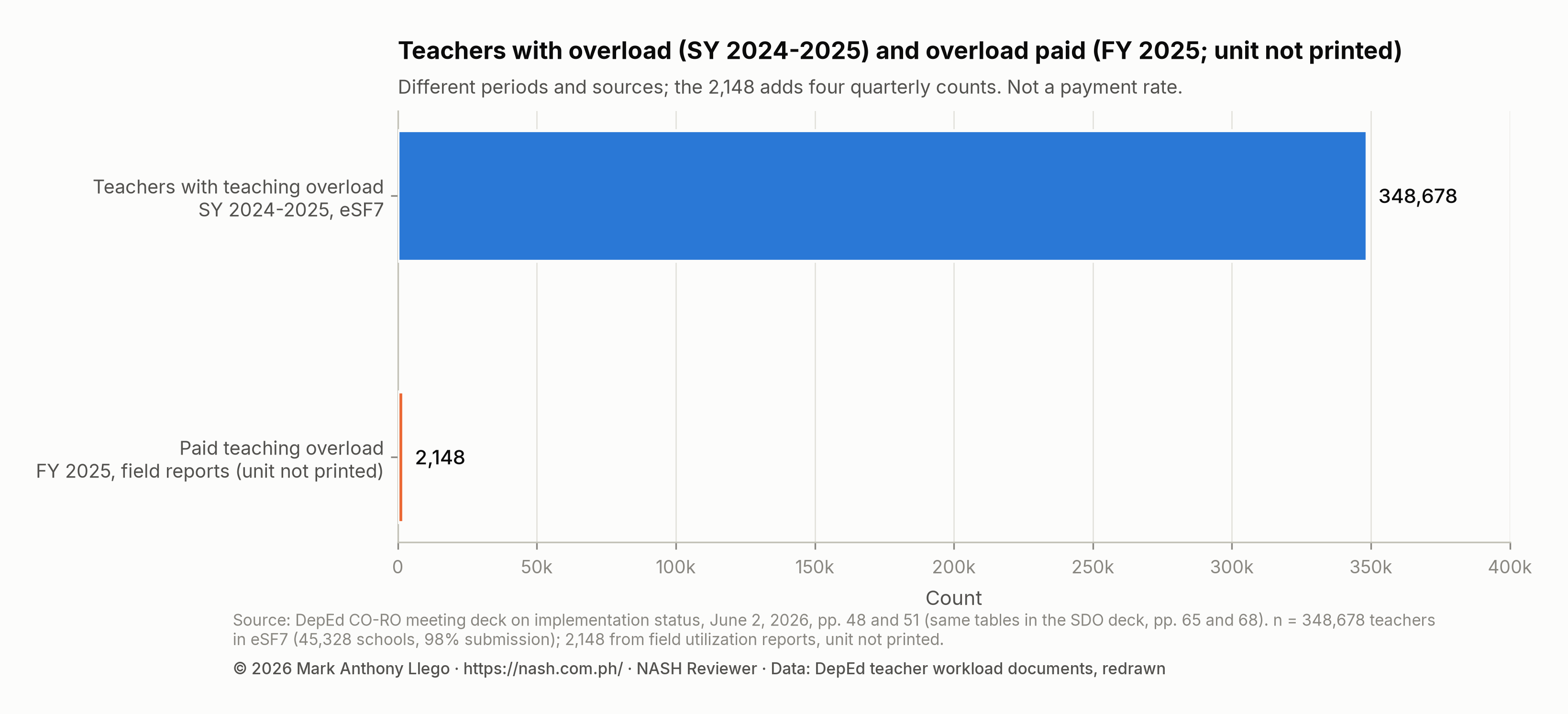
The 348,678 is from SY 2024-2025 eSF7 data “covering 45,328 public schools with a 98% submission rate”: 271,648 elementary, 58,840 junior high and 18,190 senior high school teachers (CO-RO deck, p. 48). The 2,148 is from the “consolidated utilization reports submitted by the Field Offices” for FY 2025, with no unit printed (p. 51): 167, 412, 1,030 and 539 by quarter. Region VI alone reports 795, 37% of the total (computed); NCR, Region IX and Region XII report none.
The two figures are not a payment rate:
- Different periods. A school year straddles two fiscal years; the fiscal year’s first quarter is “January to March” (DM-OUHROD-2025-0850, p. 1).
- Different measures. The eSF7 counts teachers whose load exceeds six hours, not eligible claims; the deck does not say the field reports are complete.
- Quarterly counts added up. The 2,148 sums four quarterly counts, so a teacher paid in more than one quarter may be counted more than once; the deck does not say.
- The 2025 tables disagree. Region IV-A has 117 in the physical table but no money obligated or disbursed; NCR shows ₱924,000.00 disbursed but none in the physical table; the Central Office disbursed ₱134,000.00 but has no row in it. The documents do not explain these.
DepEd’s summary is that “both financial and physical utilization reports indicate relatively low utilization rates” (CO-RO deck, p. 54). Newer figures are incomplete: the SY 2025-2026 eSF7 count, 162,713, rests on “partial submissions” (52%) without Regions III, IV-A and V (p. 49). For the first quarter of FY 2026, “only ten (10) Regional Offices have submitted their utilization reports, indicating a total of one hundred eighty-three (183) teachers compensated”; NCR, NIR, Regions VIII, IX, X and XI, and Caraga had not reported (DM-OUHRODI-2026-2538, p. 1).
FY 2026 overload pay funds by region
For FY 2026 the honoraria for teaching overload have “a total appropriation of PhP1,738,683,000.00”. “Php579,532,000.00 has been comprehensively released to the Regional Offices (ROs)”; the other ₱1,159,151,000.00 was “For Issuance of a Special Allotment Release Order” (FISARO), pending the Department of Budget and Management’s SARO (DM-OUHRODI-2026-1235, April 20, 2026, p. 1). By July 29, 2026, the SARO “was recently released to the Central Office and shall likewise be sub-allotted to the field offices”, with “A separate Memorandum” to follow (DM-OUHRODI-2026-2538, p. 1). As of October 31, 2026, the Public Drive did not include it.
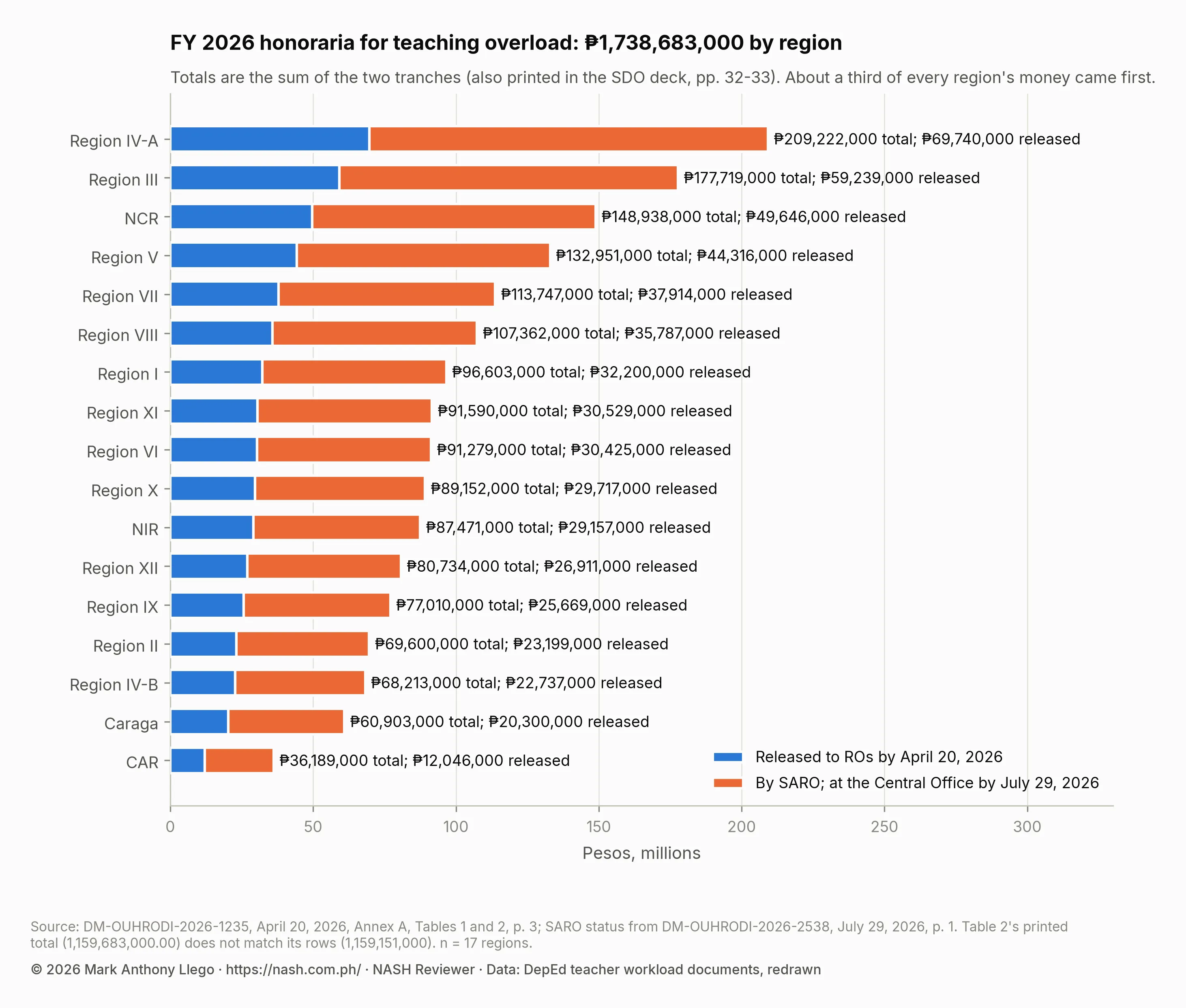
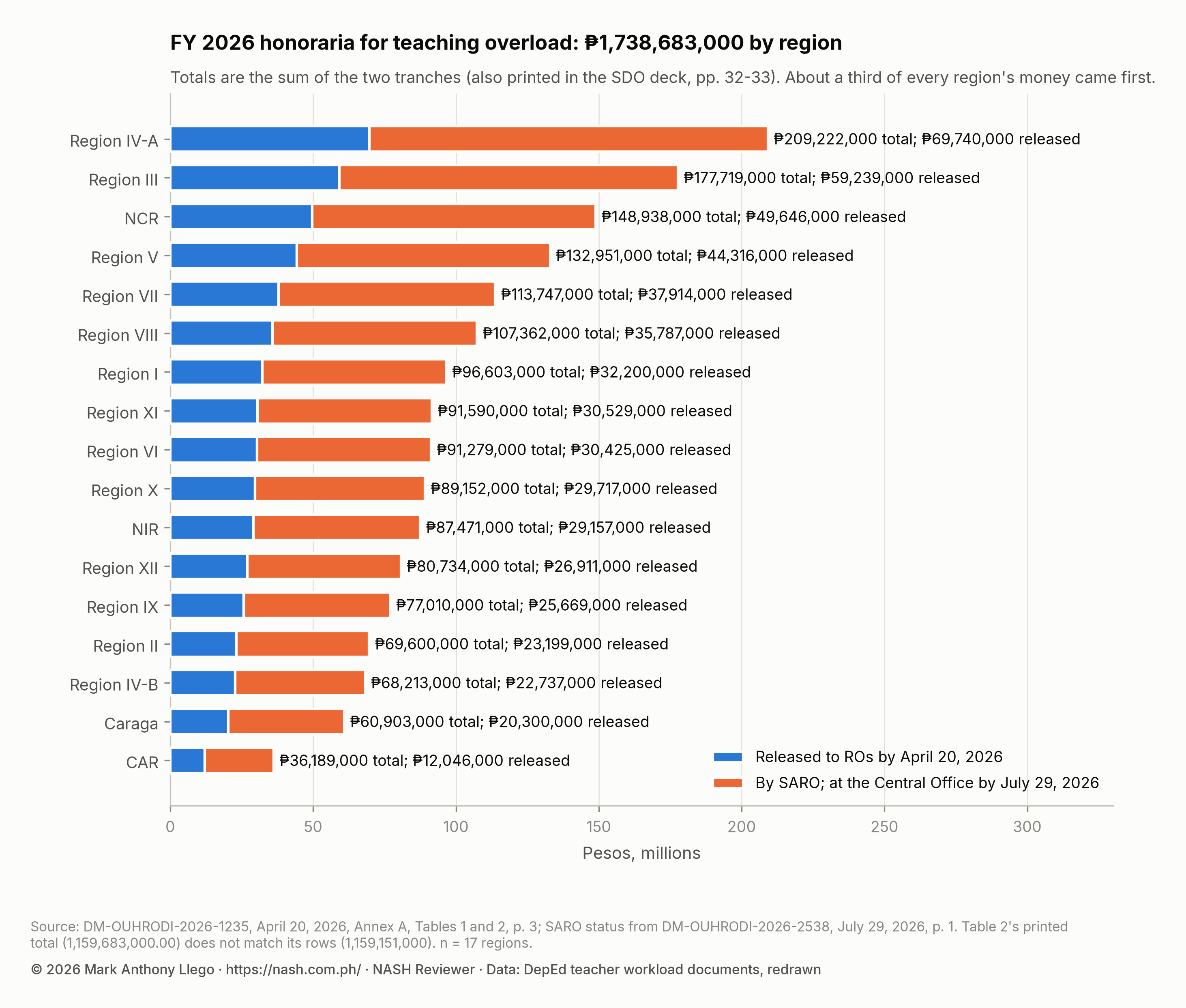
A printed total that does not add up. Annex A’s Table 2 prints a grand total of “1,159,683,000.00”, but its 17 rows add to ₱1,159,151,000, the figure in the memo’s text, and ₱579,532,000 + ₱1,159,151,000 = ₱1,738,683,000, the appropriation. The printed total is ₱532,000 too high, an error in the original that the 2026 decks repeat (CO-RO deck, p. 52; SDO deck, p. 69). Use the rows.
Region IV-A has the largest share, ₱209,222,000, then Region III (₱177,719,000) and NCR (₱148,938,000); CAR has the smallest, ₱36,189,000. In every region the first release was about a third of the total, from 33.29% in CAR to 33.33% elsewhere (computed). The line now also “shall include payments to DepEd teachers serving as ARAL tutors who exceed six (6) hours of teaching load due to ARAL tutorial sessions” (DM-OUHRODI-2026-2538, p. 2). DM 061, s. 2026 instead charges ARAL compensation to “the directly released/downloaded funds” “and/or other available funding sources” (para. 43) without naming the APB line; the documents do not reconcile the two.
What blocks overload claims
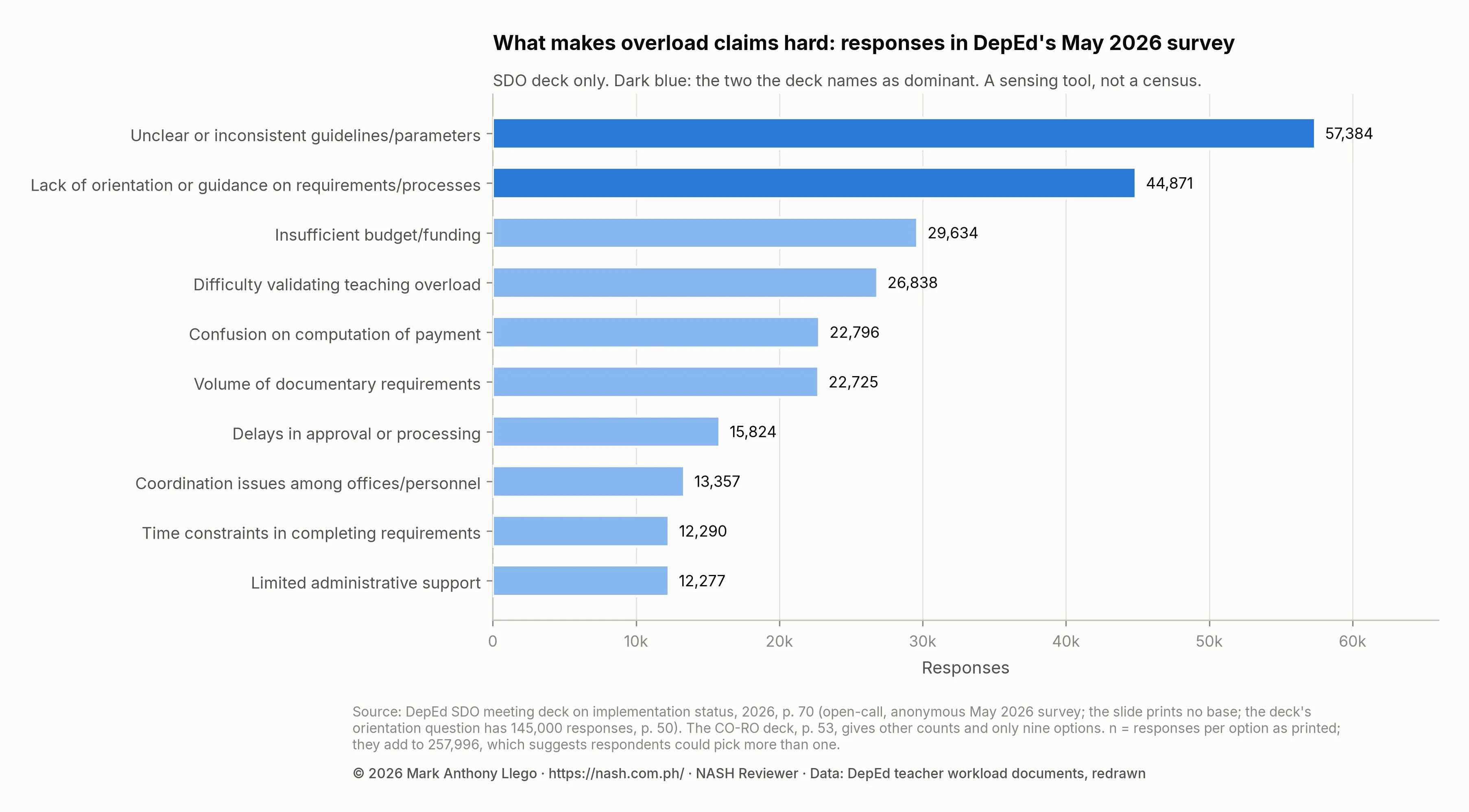
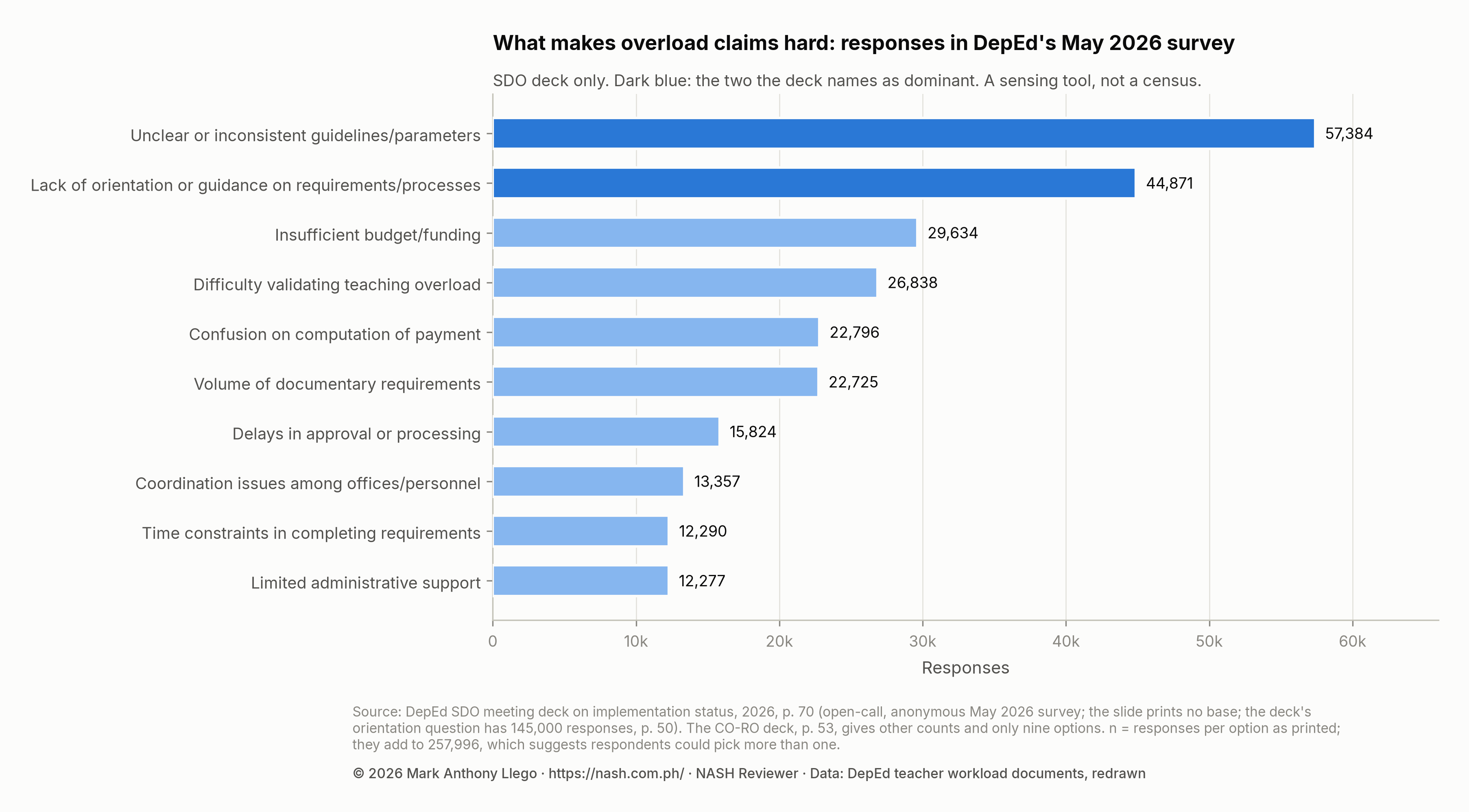
Figure 4 uses one deck because the two 2026 decks differ. The SDO deck shows ten options and names “Unclear or inconsistent Guidelines/parameters” and “Lack of orientation or guidance on requirements/processes” as dominant (p. 70). The CO-RO deck of June 2, 2026 shows nine options, without the unclear-guidelines option, and names lack of orientation (50,518 responses) and “Insufficient budget/funding” (33,264) as dominant (p. 53). The documents do not explain the difference. The bases differ too: 163,351 respondents (CO-RO deck, p. 18) against 145,000 responses to the orientation question (SDO deck, p. 50). Both decks call the open-call survey “a sensing tool for what may be happening on the ground” (CO-RO deck, p. 18; SDO deck, p. 42).
“Insufficient budget” probably does not mean the national money ran out, since most of FY 2025’s went unspent; it may mean a division had nothing on hand because it had not requested a download. The decks do not say.
The “underload” misconception
Both decks report “the perception that the presence of underload teachers in the school, or having underload schedules on certain days, automatically disqualifies them from claiming overload pay” (CO-RO deck, p. 53; SDO deck, p. 70). DepEd’s SDO deck notes that teachers with overload, “regardless if they have less than six (6) hours of teaching load on certain days or if the school has other teachers with less than six (6) hours of teaching load, shall be compensated with teaching overload pay” (p. 38), and its 2026 answer is that “Eligibility for teaching ovverload [sic] pay is determined by exceeding the prescribed at most six (6) hours of teaching load per day” (consolidated Q&A, 2026, No. 15).
The perception may come from DO 005: “As a general rule, only teachers in schools with teacher shortage based on the enhanced planning parameters are eligible for teaching overload pay”, with an exception for relieving duties (Sec. V.A.2, item 3), and “All teachers shall render the prescribed number of actual classroom teaching hours before they may be assigned a teaching overload” (item 4). DO 005 governs, and DepEd’s answers treat the shortage rule as the “general rule” it says it is, not a bar: in a school with excess teachers, a teacher may still claim, “but subject for justification … a justification may be required at the SDO level before the release of the payment” (consolidated Q&A, 2026, No. 16). So the school head must be able to show why the overload was assigned. Post 3 covers eligibility.
What this means for school heads
DepEd’s 2026 answer encourages school heads “to facilitate and initiate the processing of teaching overload pay … since the primary documentary requirement which is the certification of overload is issued by school heads” (consolidated Q&A, 2026, No. 18), and the third-quarter memo of FY 2025 directs them “to review their respective School Form 7 (SF7) to identify teachers with teaching overload” (DM-OUHROD-2025-2859, p. 1). In practice:
- Find overload when loads are set. DepEd’s proposed SDO interventions include “Identify teachers with teaching overload early upon submission of eSF7” and “Ensure quarterly payment of identified teachers and those who will incur overload along the SY” (SDO deck, p. 85).
- File every quarter, for every teacher with overload, without waiting to be asked, and before the SDO’s internal deadline.
- Use the templates and nothing more, check that the set is complete, and post the list on the transparency board.
- Prepare a justification if your school has excess teachers.
- Follow up. Teachers are told to “Coordinate with your SDO on the status of your Teaching Overload Pay” (DepEd overload quick-facts cards, p. 5). If the SDO certifies that funds are short, see that the hours become service credits.
| Record to keep | Why | Rule |
|---|---|---|
| Weekly record of hours beyond six | Basis of the quarterly claim | DO 005, Sec. V.B.1, item 2 |
| Copy of each teacher’s monthly DTR, with locator slips or certificates of undertaking | Attached to the claim | DM 053, Encl. No. 1 |
| Updated eSF7 | “the official basis to determine teachers with more than 6 hours of teaching load” | consolidated Q&A, DM 53 orientation, Nos. 43, 45 |
| Certification/List and Endorsement Memorandum, as submitted | Template Nos. 4 and 5, quarterly | DM 053, Encl. No. 2 |
| Justification for overload in a school with excess teachers | May be required before payment | consolidated Q&A, 2026, No. 16 |
| SDO-Finance certification of insufficient funds, if any | Basis for converting hours to service credits | DO 005, Sec. V.B.1, item 3; DM 053, Encl. No. 1; DO 013, s. 2024, Sec. VI.B.1 |
A school head may not:
- ask for more papers than the templates (DM 053, para. 10), except the DTR and Accomplishment Report that DM 061, s. 2026 requires of ARAL tutors (paras. 30–31);
- hold back a claim only because other teachers carry fewer than six hours, which DepEd’s 2026 reading says does not disqualify the teacher (SDO deck, p. 38; consolidated Q&A, 2026, No. 15), though assigning overload must still follow DO 005, Sec. V.A.2, items 3–4;
- count LAC sessions, INSET or trainings as overload: “This duty has no equivalent teaching load” (consolidated Q&A, 2026, No. 14);
- leave relieving duties undocumented (Memorandum of August 10, 2026, para. 6);
- deny or delay approved wellness leave because a reliever is needed: the designation of relievers “shall not be used as a basis for denying, delaying, or unduly restricting the approved availment of WL” (para. 5).
See also the guides to human resource management for school heads, PPSSH Domain 2, managing school operations and How School Heads Plan Teaching Loads Under DO 5.
How the NASH may test this
Under DepEd Memorandum No. 069, s. 2025, the NASH covers “conceptual and situational critical thinking questions” aligned with the PPSSH, “using the SOLO (Structure of the Observed Learning Outcome) taxonomy as an underpinning framework” (para. 3). The two items below are original practice items, scored 3 (Relational), 2 (Multistructural), 1 (Unistructural) or 0 (Prestructural).
Question 1
Indicator 2.2.1, Financial management. Career Stage 1, Conceptual, Moderate.
In FY 2025, DepEd allotted ₱482,772,000 for teaching overload pay and disbursed ₱27,431,781.46. Which statement best explains why so little of the allotment was used, and what a school head can do about it?
- A. The appropriation was too small for so many teachers, so school heads should record overload hours as vacation service credits instead of filing claims.
- B. The money sits with the regional offices and reaches a division when the SDO requests it from validated claims, so payment depends on schools filing complete papers every quarter; the school head should identify overload from the eSF7 early, prepare the certification and endorsement, and submit them by the SDO’s deadline.
- C. Teachers misread the rules, and the survey also names unclear guidelines and missing orientation, so the school head should hold a faculty orientation on the overload rules.
- D. Overload is meant only for exigencies of service, so the low spending shows that schools are keeping teachers within six hours of teaching.
Answer and explanation
Best answer: B. Points: A = 0, B = 3, C = 2, D = 1.
- A (0 points, Prestructural). Most of the money went unspent, and it breaks the rule: overload “shall be compensated through teaching overload pay”, with service credits only when the SDO certifies that funds are insufficient.
- B (3 points, Relational). It connects where the money sits, how it is released and the school head’s part in the claim.
- C (2 points, Multistructural). It names real causes from DepEd’s survey and a useful action, but leaves out the claim process that releases the money.
- D (1 point, Unistructural). Overload is an exception, but legitimate overload must still be paid, and DepEd itself calls the utilization low.
Why. DO 005, s. 2024 converts overload hours to service credits only “In the event of insufficiency of funds” (Sec. V.B.1). From FY 2025 the money sits with the regional offices, released “upon request of the concerned SDO” (consolidated Q&A, 2026, No. 19), and DepEd’s deck says low use “suggests possible gaps” in “processing, validation, documentation, and mechanisms” (CO-RO deck, p. 54).
Indicator 2.2.1: Demonstrate knowledge and understanding of policies, guidelines and issuances in managing finances such as allocation, procurement, disbursement and liquidation aligned with the school plan.
Sources: DepEd Order No. 005, s. 2024; DepEd Memorandum No. 053, s. 2024; DepEd CO-RO meeting deck on implementation status (June 2, 2026), pp. 50, 54.
Question 2
Indicator 2.4.1, Management of staff. Career Stage 1, Situational, Moderate.
In August 2026, a Grade 4 teacher with a six-hour load relieved a colleague on wellness leave for three days and taught seven hours on each of those days. Your school is not listed as having a teacher shortage. At the end of the quarter, she asks whether she can claim overload pay. What should you do?
- A. Tell her overload pay is only for schools with a teacher shortage, and have her extra hours converted to vacation service credits.
- B. Include her in the quarter’s Certification/List with “relieving duties of teachers” as the reason and three overload hours, attach her DTRs and the eSF7, send the set with the Endorsement Memorandum to the SDS through the SDO-Admin Unit (Personnel), and post the list on the transparency board.
- C. Tell her she is eligible because relievers of teachers on wellness leave may be paid overload, and ask her to submit her DTRs so that the claim can be prepared.
- D. Advise her to check with the SDO whether her relieving hours can be paid.
Answer and explanation
Best answer: B. Points: A = 0, B = 3, C = 2, D = 1.
- A (0 points, Prestructural). It breaks the rule: relieving duties are DO 005’s own exception to the shortage rule, and DO 002, s. 2026 makes wellness-leave relievers eligible for overload pay.
- B (3 points, Relational). It applies the eligibility rule and every step DM 053 gives the school head, with the right reason and hours.
- C (2 points, Multistructural). It gets eligibility and the teacher’s part right but stops before the school head’s own papers, which start the claim.
- D (1 point, Unistructural). It names the paying office but passes to the teacher a question the school head can answer, and leaves undone the certification and endorsement that start the claim.
Why. DO 005, s. 2024 counts “relieving duties for other teachers” as overload (Sec. V.A.2, item 3), and DO 002, s. 2026 states that “the teachers with relieving duties shall be eligible to teaching overload pay” (Sec. VI.1.h). DM 053, s. 2024 lists “Relieving duties of teachers” as a reason in the certification (Encl. No. 1). Seven hours on three days is one overload hour a day, three in all.
Indicator 2.4.1: Demonstrate knowledge and understanding of laws, policies, guidelines and issuances on managing school staff.
Sources: DepEd Orders No. 005, s. 2024 and No. 002, s. 2026; DepEd Memorandum No. 053, s. 2024.
Nothing in this guide reproduces or predicts examination content.
Frequently asked questions
How do I claim teaching overload pay in DepEd?
Submit your daily time record, with any locator slips or certificates of undertaking, to your school head right after each month ends; DepEd’s cards say teachers “only need to submit their Daily Time Record (DTR)” (process-flow cards, p. 2). Each quarter the school head prepares the certification, the endorsement memorandum and the eSF7 for the SDO, which computes and pays (DM 053, s. 2024, Encl. No. 1).
How long does it take to receive teaching overload pay?
Payment is quarterly, “subject to the extent of allotment” (DO 005, s. 2024, Sec. V.B.1, item 3). Once a quarter’s claim starts, DM 053 gives the school 3–4 plus 1–2 working days, SDO Personnel 3–5 and SDO Finance 3–4 (3–5 in its flowchart), about two to three working weeks if every step is on time (computed).
Who holds the teaching overload pay funds?
Since FY 2025, the regional offices, under the Administration of Personnel Benefits line. They must “ensure the availability of funds for SDOs under their jurisdiction” (DM-OUHROD-2025-0850, p. 1), and download them on the SDO’s request once it has validated its teachers and computed the amount (consolidated Q&A, 2026, No. 19). FY 2024 money was with the SDOs (DM 053, Encl. No. 1).
Can I still claim overload pay for last school year?
DepEd’s 2026 answer is no: once a fiscal year lapses, its budget “can no longer be accessed or utilized” for claims (consolidated Q&A, 2026, No. 12). No issuance in the Public Drive states this, and DO 005 and DO 013, s. 2024 convert overload hours to service credits when funds are insufficient (DO 005, Sec. V.B.1, item 3; DO 013, Sec. V.A.7), so ask your SDO in writing what can still be done.
Why is so little of the overload budget used?
In FY 2025, ₱27,431,781.46 of ₱482,772,000 was disbursed, 5.68% (computed; CO-RO deck, p. 50). DepEd’s deck says the low use “suggests possible gaps not necessarily in the availability of funds, but in the processing, validation, documentation, and mechanisms related to teaching overload pay” (p. 54). Survey respondents in the SDO deck most often named unclear guidelines and a lack of orientation (p. 70); the CO-RO deck puts lack of orientation and insufficient budget first (p. 53).
Download the data
- overload-funds-fy2025-waterfall.csv: FY 2025 original allotment, adjusted allotment, obligation and disbursement as printed, the differences between them, and each step’s share of the original allotment, computed (DepEd CO-RO meeting deck on implementation status, June 2, 2026, p. 50).
- overload-funds-teachers-vs-paid.csv: teachers with overload in SY 2024-2025 (eSF7) and overload paid in FY 2025 (field reports), with each count’s period, basis and printed unit (CO-RO deck, pp. 48 and 51).
- overload-funds-fy2026-by-region.csv: FY 2026 honoraria for teaching overload by region, released to the RO and for issuance of a SARO, with computed totals and shares (DM-OUHRODI-2026-1235, Annex A, p. 3).
- overload-funds-claim-challenges.csv: survey responses on ten challenges in processing overload pay, with the two the deck names as dominant (DepEd SDO meeting deck on implementation status, 2026, p. 70).
The CSVs and charts may be reused only with written permission: email support@nash.com.ph. The rules themselves come from DepEd’s issuances, which you can cite directly.
Sources
- DepEd Order No. 005, s. 2024, Rationalization of Teachers’ Workload in Public Schools and Payment of Teaching Overload, April 29, 2024, Secs. III.j, V.A.2 (items 3–4), V.B.1 and V.D.2–3.
- DepEd Memorandum No. 053, s. 2024, Implementation Guidelines for DepEd Order No. 005, s. 2024, September 27, 2024, paras. 2 and 10, Enclosure No. 1 (PDF pp. 5–9: process flow, submission, processing and reporting tables, computation, Source of Funds) and Enclosure No. 2 (Nos. 4–8).
- Memoranda of the Office of the Undersecretary for Human Resource and Organizational Development (and Infrastructure), in DepEd’s Teacher Workload Public Drive: DM-OUHROD-2025-0204 (January 20, 2025), pp. 1–2; DM-OUHROD-2025-0850 (March 28, 2025), p. 1; DM-OUHROD-2025-1878 (July 10, 2025), pp. 1, 3 (Annex A); DM-OUHROD-2025-2859 (October 6, 2025), pp. 1–2; DM-OUHROD-2025-3402 (November 28, 2025), pp. 1, 3 (Annex A); DM-OUHROD-2026-0278 (January 28, 2026), p. 1; DM-OUHRODI-2026-1235 (April 20, 2026), pp. 1–3 (Annex A); DM-OUHRODI-2026-2538 (July 29, 2026), pp. 1–2.
- DepEd, CO-RO online meeting deck, “Implementation Status of Teacher Workload Policies”, June 2, 2026, pp. 10, 18, 48–54 (Teacher Workload Public Drive).
- DepEd, SDO online meeting deck, “Implementation Status of Teacher Workload Policies”, 2026, pp. 32–38, 42, 50, 65–71, 85 (Teacher Workload Public Drive).
- DepEd, Consolidated Question and Answer from the Online Meeting with Regional and Schools Division Offices on the Implementation Status of Teacher Workload Policies (May 25–26 and June 2, 2026), Nos. 10, 12, 14–16, 18–19.
- DepEd, Consolidated Questions and Answers, Online Orientation on DM 53, s. 2024 (updated as of November 13, 2024), Nos. 43–45.
- DepEd, Teacher Workload Policy Toolkit, version 2025-v1, June 25, 2025, p. 34 (Teacher Workload Public Drive).
- DepEd, “Teaching Overload Pay: Requirements and Process Flow” cards, undated, pp. 2, 5–6; “What you need to know about Teaching Overload Pay” cards, undated, p. 5 (Teacher Workload Public Drive).
- DepEd, DM 53, s. 2024 online orientation deck, p. 52 (Teacher Workload Public Drive).
- DepEd Order No. 013, s. 2024, Revised Guidelines on the Grant of Vacation Service Credits for Teachers, September 18, 2024, Secs. V.A.1.c, V.A.7 and VI.B.1.
- DepEd Order No. 018, s. 2025, Implementing Guidelines of the Academic Recovery and Accessible Learning Program, June 13, 2025, paras. 81–83.
- DepEd Order No. 002, s. 2026, Guidelines on the Grant of Wellness Leave for the Department of Education Personnel, February 13, 2026, Sec. VI.1.h.
- DepEd Memorandum No. 001, s. 2026, Guidelines on the Engagement of Academic Recovery and Accessible Learning Program Tutors and Support Aides, January 8, 2026, paras. 30 and 32.
- DepEd Memorandum No. 061, s. 2026, Amendments to DepEd Memorandum No. 001, s. 2026, September 29, 2026, paras. 6.d, 30, 31 (31.a.i) and 43.
- Office of the Secretary, Memorandum of August 10, 2026 (unnumbered; signed by the Undersecretary and Chief of Staff), Clarification on the Availment of Wellness Leave by Teachers During Class Days, paras. 4–6.
- DepEd Order No. 014, s. 2026, Guidelines on Learning Continuity in Emergencies, June 4, 2026, para. 69.
- DepEd Order No. 009, s. 2026, Guidelines on the Implementation of the Three-Term School Calendar in Basic Education, April 16, 2026.
- DepEd Memorandum No. 069, s. 2025, Administration of the National Assessment for School Heads for Fiscal Year 2025, para. 3.
- DepEd Order No. 024, s. 2020, National Adoption and Implementation of the Philippine Professional Standards for School Heads (indicators 2.2.1 and 2.4.1).
The teacher workload series
- DepEd Teacher Workload Policies: A Complete Guide
- How Many Hours Must DepEd Teachers Teach a Day?
- Can Teachers Leave School After Six Hours of Teaching?
- DepEd Teaching Overload Pay: Who Qualifies, How Much
- Why So Few Teachers Get Paid for Teaching Overload (this post)
- Teaching-Related Assignments: The 11 Roles DepEd Allows
- Vacation Service Credits and Overtime Pay for Teachers
- Admin Tasks Off Teachers: DO 2 and School Support Staff
- DepEd 2026 Teacher Workload Survey: What Teachers Said
- How School Heads Plan Teaching Loads Under DO 5
- Teacher Workload and Accountability: EDCOM II Findings
Written by Mark Anthony Llego for NASH Reviewer. Sources: DepEd Order No. 005, s. 2024 and DepEd Memorandum No. 053, s. 2024; OUHROD and OUHRODI memoranda on teaching overload pay, 2025–2026; DepEd’s 2026 implementation-status decks and consolidated Q&A; the Teacher Workload Policy Toolkit (2025); DepEd Orders No. 013, s. 2024, No. 018, s. 2025 and No. 002, 009 and 014, s. 2026; DepEd Memoranda No. 001 and 061, s. 2026; DepEd’s Memorandum of August 10, 2026 on wellness leave. Charts may be reused only with written permission from support@nash.com.ph.