Public school teachers earn vacation service credits (VSC) for authorized work beyond their regular hours under DepEd Order No. 013, s. 2024. Each hour earns 1.25 hours of credit on a school day and 1.5 hours on a weekend, a holiday or a vacation, up to 30 days in a calendar year, or 45 in a late appointee’s first year (Sec. V.A.1–2). Since DepEd Order No. 026, s. 2025, some of that work is paid in money instead. A teacher designated to a teaching-related assignment who has taught six hours that day and 30 that week is paid 125% of the actual hourly rate on workdays and 150% on Saturdays, holidays and non-working days, for approved work of at least two hours inside the school (Secs. V.2, V.6, VI.B.2, VII.5).
The sections below cover what earns VSC, the rates, caps and papers, overtime pay with a worked example, a comparison of overload pay, overtime pay and VSC, and the answers that are now outdated.
The overload formula has its own guide, DepEd Teaching Overload Pay: Who Qualifies, How Much, and the assignments that can earn overtime are in Teaching-Related Assignments: The 11 Roles DepEd Allows.
Key findings
- An hour of extra work earns 1.25 or 1.5 hours of VSC: 1.25 beyond regular hours on school days and for unpaid overload, 1.5 on weekends, holidays and vacations (DO 013, s. 2024, Sec. V.A.1; Annexes A–C).
- VSC is capped at 30 days a calendar year, or 45 in the first year of a new hire appointed four months after classes open. Unpaid overload is outside the cap (DO 013, Secs. V.A.2, V.A.7), and so are weekend and vacation ARAL tutoring (DM 061, s. 2026, para. 31.a.ii) and the 2026 Summer Remediation Programs (DO 010, s. 2026, para. 57).
- Overtime pay is the actual hourly rate times 1.25 or 1.5, the rate being the monthly salary divided by 22 × 8 (DO 026, s. 2025, Sec. VI.B). For a Teacher I on ₱380,460 a year in FY 2026 (DM 061, para. 31.b), that is ₱225.18 an hour on workdays and ₱270.21 on Saturdays and holidays (computed).
- Overtime pay has six conditions: a designated teaching-related assignment, work inside the school, at least two hours, a six-hour teaching day and 30-hour week, an “extremely necessary” task, and the school head’s approval before the work (DO 026, Secs. V.2–8, VII.2, VII.5). Without funds, the hours become VSC (Sec. V.9), and weekend and holiday overtime is paid for four hours a day at most (Sec. VII.6).
- Ancillary tasks never earn overtime pay (DO 026, Sec. VII.3), though a 2026 DepEd deck says it is “Granted for ancillary tasks (home visitations and coaching & mentoring)” (DepEd SDO meeting deck on implementation status, 2026, p. 26). The Order governs; the two kinds of ancillary task it names earn VSC (DO 013, Sec. V.A.8.j–k).
- Two official answers are outdated, and a 2026 memorandum conflicts. “As of today, there is no provision for overtime pay” (DepEd consolidated Q&A, DM 53 orientation, No. 33, November 2024) was overtaken by DO 026, and the “15-day cap” of DO 53, s. 2003 (DepEd consolidated Q&A, RO orientation on DO 5, May 2024, item 3) ended with DO 013 (Sec. XI). DM 040, s. 2026 still credits “one vacation service credit for every eight accumulated hours” under DO 53 (para. 2); DO 013 governs.
- VSC starts beyond the eight-hour day, not beyond six hours of teaching. DO 5, s. 2024 says “beyond regular work hours” (Sec. V.A.4 item 4); DM 53, s. 2024, para. 7 says “beyond the six hours of teaching load”. The Order governs.
What are vacation service credits?
Teachers do not earn the usual vacation and sick leave. They receive Proportional Vacation Pay (PVP) during the Christmas and summer or long vacations, in proportion to the days they served (DO 013, s. 2024, Secs. III.1, V.B.1). VSC are their leave credits, “earned by public school teachers for services rendered during activities authorized by proper authorities during summer/long and Christmas vacation, weekends and holidays, and teaching overload” and used “to offset absences due to illness or to offset proportional deduction in vacation salary due to absences for personal reasons or late appointments” (Sec. III.5).
DO 013 covers all public school teachers, “including Mobile Teachers”, on permanent, substitute or provisional appointment (Sec. II). Teachers reassigned to non-teaching functions, including Teachers-in-Charge with a teaching load, “shall earn vacation and sick leave credits only” (Sec. V.A.3); see Principal, Head Teacher or Teacher-in-Charge in DepEd.
DO 013, dated September 18, 2024, defines VSC by the periods and work that earn it (Sec. III.5). DO 5, s. 2024 had defined them by activities “during long periods with no classes”, adding that VSC “can be granted for teaching overload and activities during the regular school year as authorized by this Order” (Sec. III.m). It repealed DO 53, s. 2003 and its addendum, DO 84, s. 2003, and took effect 15 days after approval and publication (paras. 3–4; Secs. X–XI).
What work earns vacation service credits?
DO 013 lists 12 kinds of work that earn VSC (Sec. V.A.8) and five that do not, “considering it is already compensated during regular working hours” (Sec. V.A.9).
| Item | Earns VSC (DO 013, s. 2024, Sec. V.A.8) |
|---|---|
| a | Remedial or enhancement classes on weekends, in vacations or outside regular school days |
| b | The early opening of the school year: Brigada Eskwela, Oplan Balik Eskwela, enrollment |
| c | Sports competitions, youth formation and scouting held outside regular school days |
| d | Teaching overload not paid as overload pay (outside the 30-day cap) |
| e | DepEd testing and assessment held outside school days |
| f | Fully funded, short-term trainings, seminars and special projects partnered with DepEd, on weekends, holidays or vacations |
| g | Teaching-related and learning-and-development activities, school to national level, on weekends, holidays and vacations |
| h | Work before, during and after a calamity when schools serve as evacuation centers |
| i | Registration and election days mandated by law |
| j | Parent conferences and home visits beyond regular work hours |
| k | Coaching, mentoring and technical assistance by “Master Teachers assigned as class advisers” outside regular working hours |
| l | Teaching-related assignments beyond regular working hours “as defined by other applicable DepEd issuances” |
| Item | Does not earn VSC (DO 013, s. 2024, Sec. V.A.9) |
|---|---|
| a | Government-funded in-service training, exhibits at a fair, and counseling, mentoring and coaching of students on weekdays within official time |
| b | Forms and reports for the opening and closing of classes, such as year-end reports and School Form 7 |
| c | Teachers “performing tasks other than teaching as a result of designation or reassignment” |
| d | Travel time for official travel such as trainings and seminars |
| e | Research, personal or government-funded |
Item 9.c appears to cover teachers moved to non-teaching work, not teachers on a teaching-related assignment, whose extra hours item 8.l credits; its footnote cites the civil-service rules on appointments and other human-resource actions, which govern designation and reassignment. A teacher who does not complete an eligible activity earns VSC for “the actual hours/days of rendered service” (Sec. V.A.6).
Beyond six hours of teaching, or beyond regular work hours?
DM 53, s. 2024, para. 7 says “Any authorized work in relation to their teaching-related assignments conducted beyond the six hours of teaching load shall be compensated by vacation service credits (VSC)”, and DepEd’s orientation deck repeats it (DepEd DM 53 orientation deck, 2024, p. 34). DO 5, s. 2024 says such work “beyond regular work hours, whether within or outside the school premises, shall be granted with VSC” (Sec. V.A.4 item 4; also Sec. V.B.2 item 1), and DM 53’s own enclosure agrees: “performed outside the regular work hours of teachers” (Encl. 1, Sec. II.1).
Regular work hours are the eight-hour day of six teaching hours and two ancillary hours (DO 5, Sec. V.A item 1), so para. 7 would credit the ancillary hours and the Order would not. “Beyond regular work hours” governs. DM 53 implements the Order rather than amending it, para. 7 itself sends readers to Enclosure No. 1, and DO 013, the later Order, uses the same test (Secs. V.A.1.a, V.A.8.l). Overtime pay is measured differently, as explained below.
How DO 013 changed what earns VSC
DO 5 and DM 53 credited parent conferences and home visits, Master Teachers’ coaching and teaching-related assignments beyond regular hours (DO 5, Sec. V.B.2 item 1; DM 53, Encl. 1, Sec. II.1), plus unpaid overload (DO 5, Sec. V.B.1 item 3). DO 013 keeps these, lists the other work that earns VSC, most of it on weekends, holidays and vacations (items 8.a–8.i), and changes three things:
- A second rate. DO 5 had one: “Eight (8) hours of services rendered shall be equivalent to at least 1.25 VSC” (Sec. V.B.2 item 2). DO 013 keeps it for school days and adds 1.5 for weekends, holidays and vacations (Sec. V.A.1).
- A cap with exceptions, below.
- A narrower Master Teacher item. DO 013 credits coaching by “Master Teachers assigned as class advisers” (Sec. V.A.8.k). DO 5 has no adviser condition (Sec. V.A.3 item 6), nor does DM 53 (Encl. 1, Sec. II.1.b), issued nine days after DO 013. The documents do not reconcile the two. DO 013 does not say its list is exclusive, and it provides a route for activities “not among those listed under Section V.A.8” (Sec. VI.A.1.c). Until DepEd clarifies, a Master Teacher who is not an adviser can cite DO 5 and DM 53, and a school head should confirm with the SDO’s Personnel Unit before approving.
How many hours of work make one day of VSC?
| Work | VSC per hour | Eight hours earn | Source |
|---|---|---|---|
| Eligible work beyond regular hours on school days | 1.25 hours | 1.25 days | DO 013, s. 2024, Sec. V.A.1.a; Annex A |
| Eligible work in Christmas, summer or long vacation, weekends and holidays | 1.5 hours | 1.5 days | DO 013, Sec. V.A.1.b; Annex B |
| Teaching overload not paid for lack of funds | 1.25 hours | 1.25 days | DO 013, Sec. V.A.1.c; Annex C |
| Training for, or tutoring in, the 2026 Summer Remediation Programs (for ARAL tutors, see below) | One day per six hours (1.333 hours, computed) | 1.333 days (computed) | DO 010, s. 2026, para. 56 |
DO 013 writes the conversion as (Hours/8) × 1.25 and (Hours/8) × 1.5, giving days (Annexes A–B).
| Hours of work | School day, beyond regular hours (× 1.25) | Weekend, holiday or vacation (× 1.5) |
|---|---|---|
| 1 | 0.156 | 0.188 |
| 2 | 0.313 | 0.375 |
| 3 | 0.469 | 0.563 |
| 4 | 0.625 | 0.750 |
| 5 | 0.781 | 0.938 |
| 6 | 0.938 | 1.125 |
| 7 | 1.094 | 1.313 |
| 8 | 1.250 | 1.500 |
| 16 | 2.500 | 3.000 |
| 40 | 6.250 | 7.500 |
| Hours that fill the 30-day cap | 192 | 160 |
| Hours that fill the 45-day cap | 288 | 240 |
Computed as (hours ÷ 8) × 1.25 or × 1.5, rounded half-up to three decimals. The rows for 1 to 8 hours match DO 013’s printed Annexes A and B (PDF pp. 12–13).
Two Saturdays of eight hours at a fully funded division workshop thus earn 3 days.
A 2026 memorandum still uses the repealed rate
DepEd’s memorandum on Proportional Vacation Pay for SY 2025–2026, DM 040, s. 2026, dated June 24, 2026, says that “pursuant to DO 53, s. 2003”, teachers authorized to work during the long school break “may be granted one vacation service credit for every eight accumulated hours of service rendered” (para. 2). That is one day per eight hours; DO 013 gives 1.5 days for eight hours in vacations (Sec. V.A.1.b; Annex B). DO 53, s. 2003 was repealed by DO 013 (para. 4; Sec. XI). DO 013 governs: it is the Order in force on VSC, DM 040 does not claim to amend it, and DM 040 itself applies DO 013 elsewhere (para. 8). A teacher credited at one day per eight hours can ask the HRMO to apply DO 013’s Annex B.
The 30-day cap and what sits outside it
DO 013 caps a year’s VSC (Sec. V.A.2):
- Incumbents with a year or more of service: “not more than thirty (30) days” in a calendar year.
- New hires appointed less than four months after the first day of classes: also 30.
- New hires with late appointments, “issued four (4) months after the first day of classes”: “not more than forty-five (45) days” that year, then 30 from the next.
The cap is counted “exclusive of the number of days of converted teaching overload due to insufficiency of funds” (Sec. V.A.2), and VSC for unpaid overload “shall be exclusive of the thirty (30) days limitation under this DepEd Order” (Sec. V.A.7). Later issuances add two more exceptions: ARAL tutoring on weekends, holidays and long vacations, and the 2026 Summer Remediation Programs (both below).
VSC that DO 026 gives for overtime sessions under two hours, weekend hours beyond four or unfunded overtime has no such exclusion. DO 013 exempts only converted teaching overload (Secs. V.A.2, V.A.7), so these credits should count within the 30- or 45-day limit; DO 026 is silent on the point.
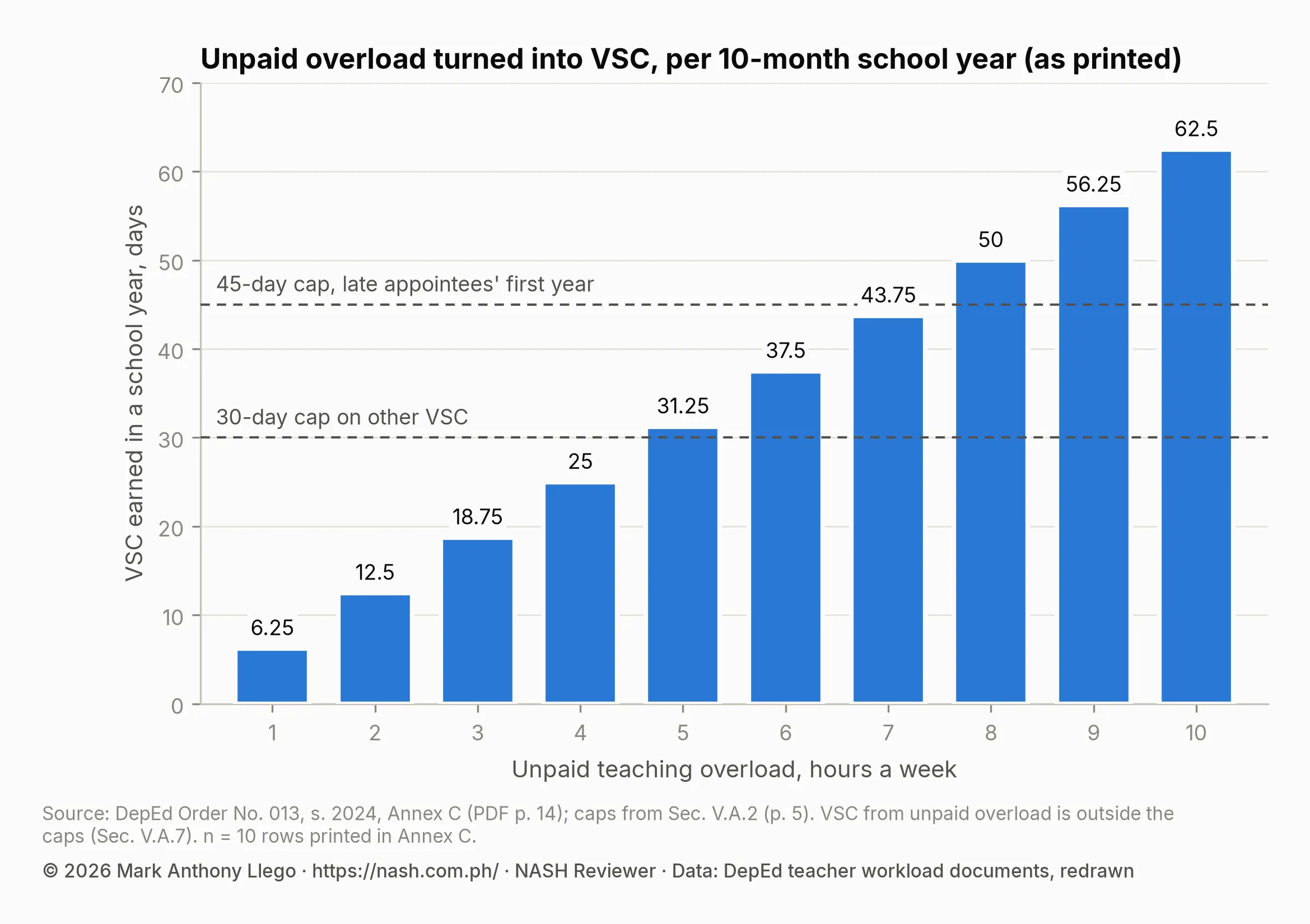
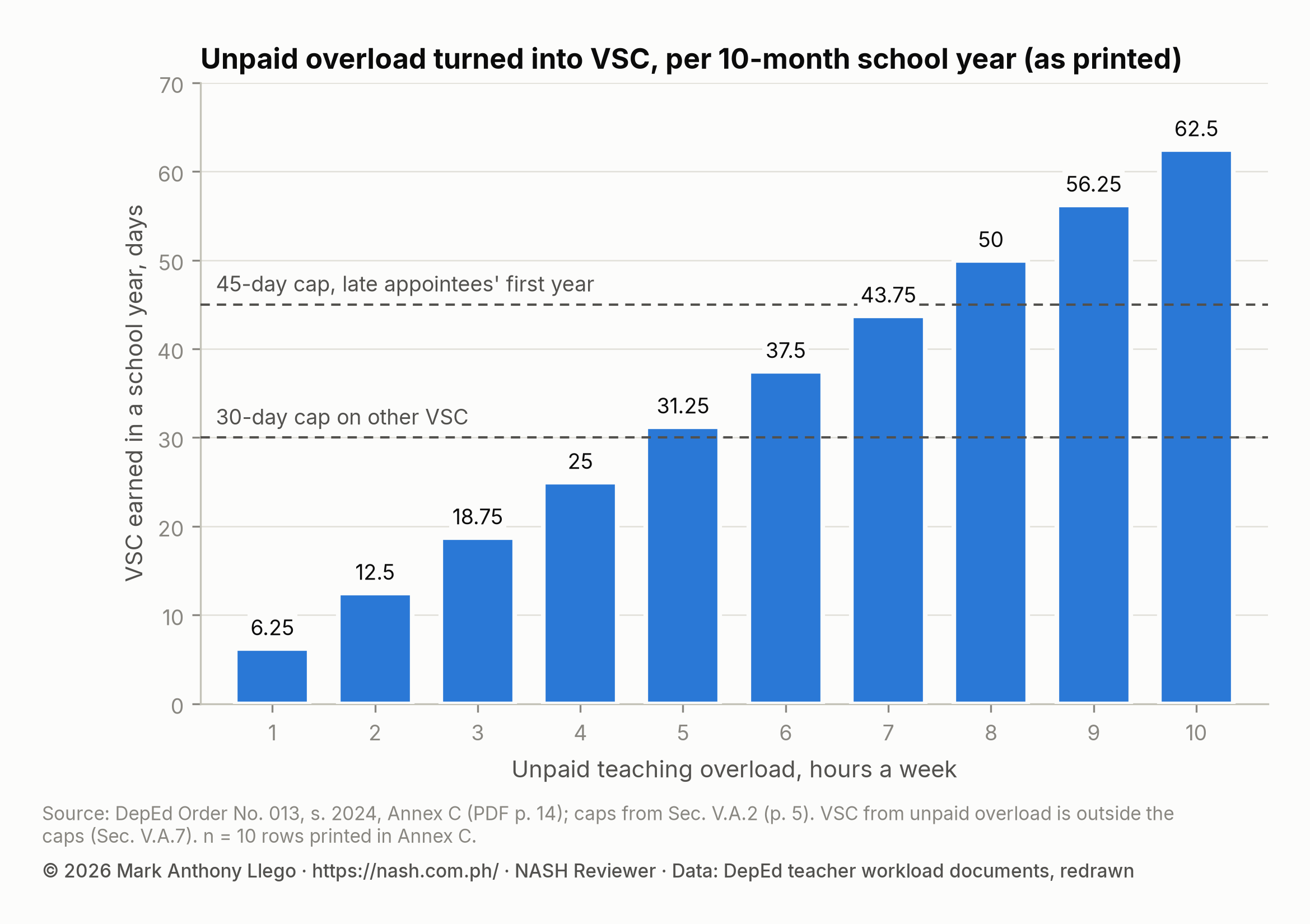
Annex C counts a month as four weeks and a school year as ten months, while the caps run by calendar year. In its table, five hours a week of unpaid overload earn 31.25 days in a school year, more than the 30-day cap on other VSC; ten hours a week earn 62.5, more than the 45-day cap.
ARAL tutoring and the 2026 summer programs
DO 018, s. 2025 grants VSC under DO 013 for ARAL tutoring on weekends, holidays and long vacations, “excluded from the thirty (30) day limitation” (para. 83). DM 061, s. 2026, dated September 29, 2026, now sets three rules for DepEd teachers who tutor:
- Voluntary. Their engagement “shall be subject to existing teacher workload policies and shall not be mandatory” (para. 6.d).
- School days: overload pay. Tutoring forms part of the teaching load; beyond six hours it is paid as overload, at most two hours a day at the Prime Hourly Teaching Rate (para. 31.a.i).
- Weekends, holidays and long vacations: VSC at 1.5, which “shall not be counted within the thirty (30)-day or forty-five (45)-day annual limitation for allowable VSCs” (para. 31.a.ii).
DM 061 is later than DO 018 and names both caps. Neither memo says what happens when overload funds run short for school-day tutoring, but DO 018 makes the payment follow “the parameters and procedures provided in DO 005, s. 2024” and DM 53 (para. 83), and DO 5 converts unpaid overload to VSC (Sec. V.B.1 item 3), at 1.25 hours per hour and outside the cap (DO 013, Secs. V.A.1.c, V.A.7).
The 2026 summer programs. DO 010, s. 2026, dated April 28, 2026, set the 2026 Summer Remediation Programs (SRP) for May 6 to June 2, 2026: the ARAL Summer Programs, the Senior High School Remediation Program and the Summer Academic Remedial Program (paras. 1–2). Teachers “who attend training related to the SRP or handle tutorial sessions totaling six hours of actual service shall earn one day of vacation service credit” (para. 56), “in addition to the annual limit of 30 days, or 45 days for newly hired teachers” (para. 57). That rate differs from DO 013’s, which gives a day for about 5.3 hours of vacation work (Sec. V.A.1.b). DO 010 modifies inconsistent parts of DO 018 (para. 4), but for ARAL tutors it points to DM 001, s. 2026 for “Remuneration and incentives” (para. 55). DM 001 applies DO 013 (para. 38.b), and DM 061, the latest, keeps DO 013’s 1.5 rate “including summer periods” (para. 31.a.ii). The documents do not reconcile the two rates. Since DO 010 defers to them, DM 001 and DM 061 are the safer guide for ARAL tutoring, and DO 010’s six-hour rule for SRP training and the other two programs. Either way, these credits sit outside the cap. A 2025 memorandum went the other way: DM-OUHROD-2025-2949, dated October 23, 2025, granted teachers who voluntarily joined pre-approved professional development during the October 27–30, 2025 midyear wellness break “1.5 days VSC per eight (8) hours of rendered services, inclusive of the maximum limitation under DepEd Order 13, s. 2024”. Those credits use DO 013’s vacation rate and count inside the 30- or 45-day cap, unlike DO 010’s summer credits.
How to claim VSC: from authority to leave card
The papers depend on the kind of work.
1. Parent conferences and home visits, Master Teachers’ coaching, and teaching-related assignments that earn VSC rather than overtime pay follow the seven steps of DO 5 and DM 53 (Figure 2). Overtime has its own papers, set out in the overtime section.
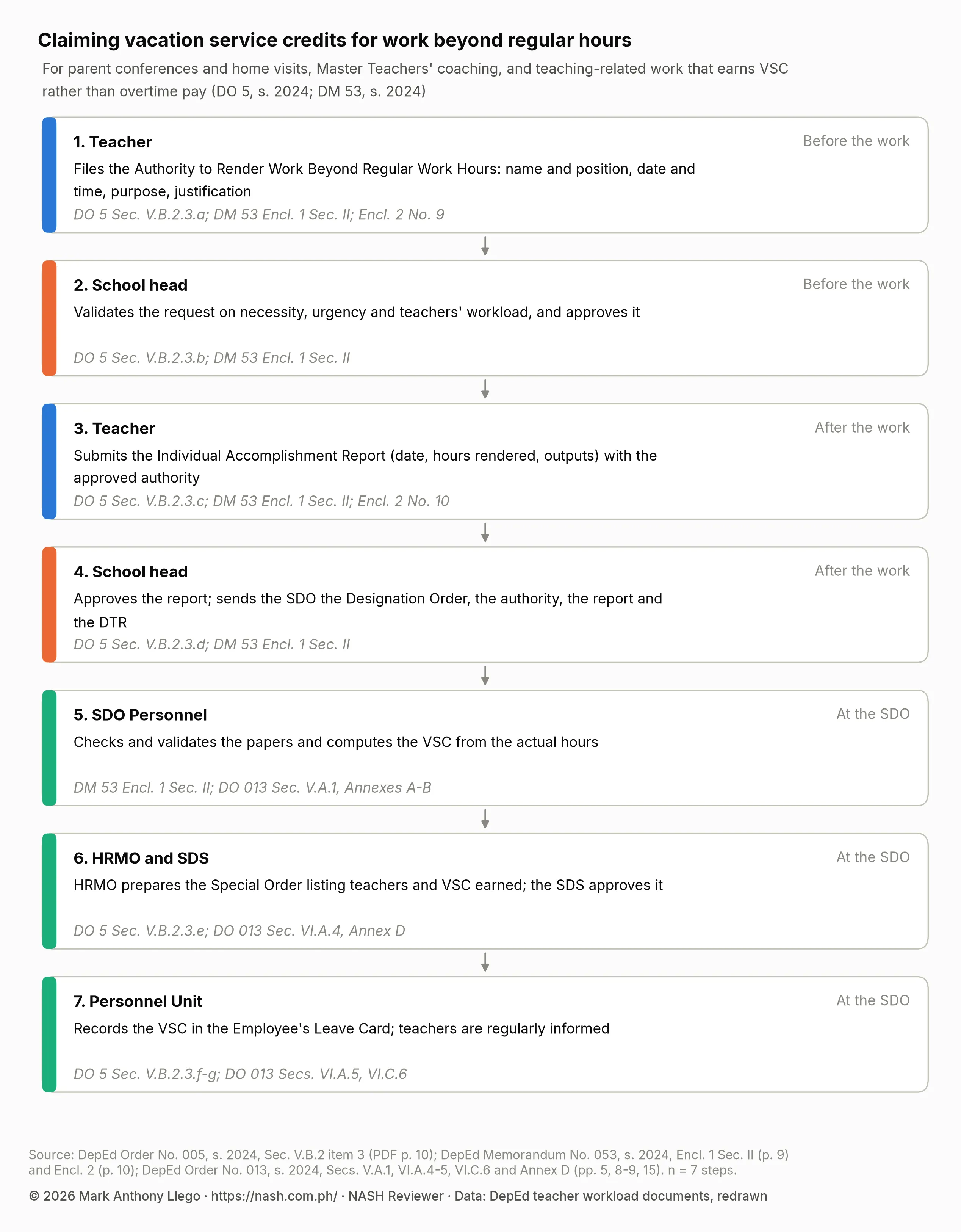
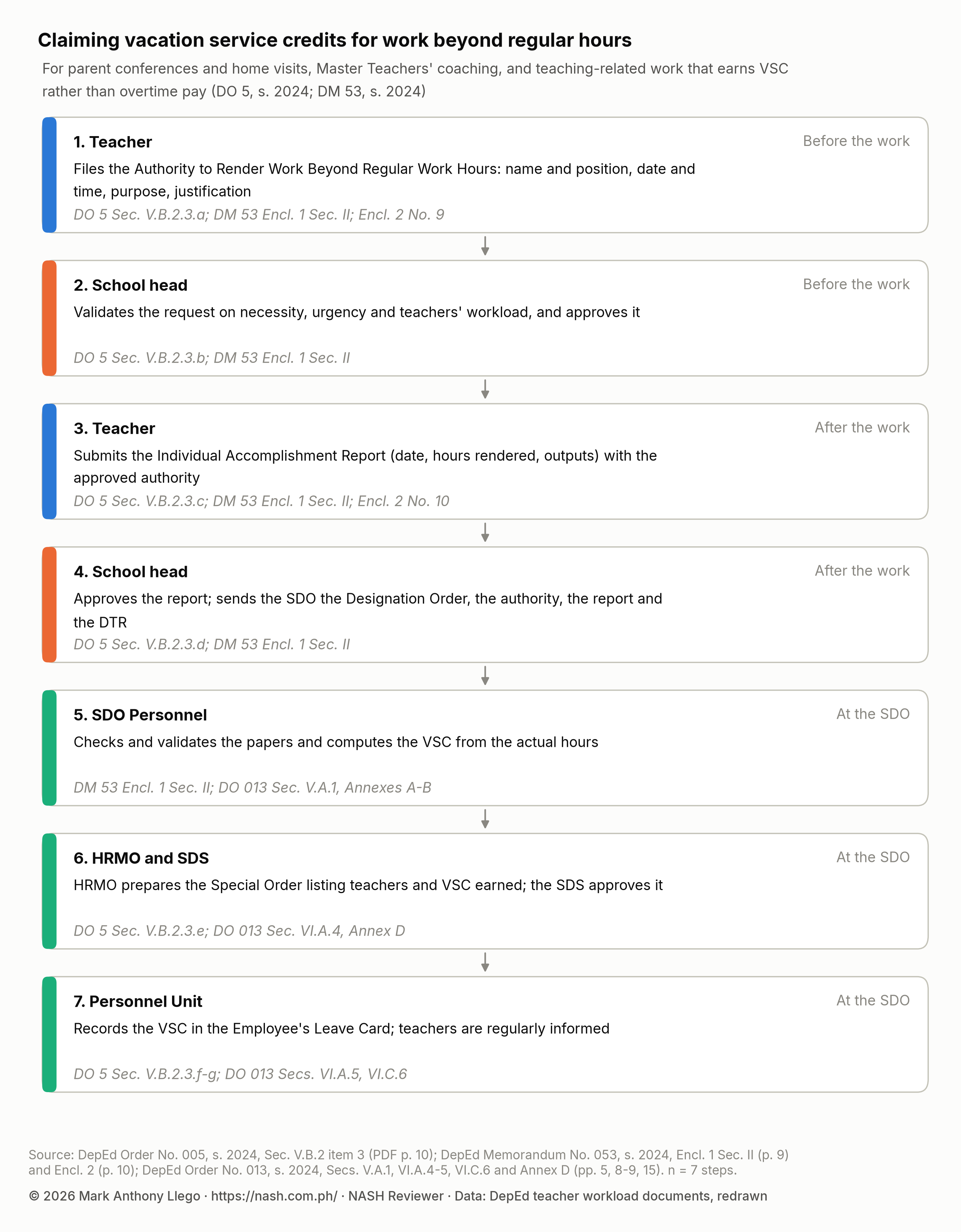
The forms are DM 53’s Template No. 9, “Authority to Render Work Beyond Regular Work Hours”, and No. 10, “Individual Accomplishment Report for Work Rendered Beyond Regular Work Hours”, filed “As necessary” (DM 53, Encl. 2). Copies are in DepEd’s Teacher Workload Public Drive (bit.ly/TeacherWorkload_ToolsandProcedure, the link printed in the Teacher Workload Policy Toolkit, June 2025, p. 101) as “[02] Authority to Render Work Beyond Regular Work Hours” and “[03] Individual Accomplishment Report”. DepEd’s answers add:
- Home visits need “Authority and Accomplishment Report only. No limit as to the number”, with the school head’s approval (DepEd consolidated Q&A, DM 53 orientation, No. 18).
- VSC is based on “the actual number of hours/minutes rendered for TRAs beyond the regular work hours” (No. 37).
- The authority need not bear the SDS’s signature, “since the designation order signed by the SDS already provides for authority to the designated teachers to render work beyond regular work hours” (No. 60). Read with DO 013’s rule that VSC needs “the approved authority by the Schools Division Superintendent (SDS) or the authorized approving authority” (Sec. V.A.4), the answer appears to treat the SDS-signed designation order as that authority, though it does not cite DO 013. It cannot help with home visits, which have no designation order, and DO 013 does not say who the “authorized approving authority” is for them.
- Weekend distribution of report cards is “compensated through VSC” (No. 28). That fits DO 013’s item for parent conferences beyond regular hours (Sec. V.A.8.j), though preparing the cards is not credited (Sec. V.A.9.b). The answer goes further than DO 5’s list (Sec. V.B.2 item 1), but DO 013, the later Order, governs.
2. Activities DO 013 lists, such as Brigada Eskwela or a weekend training. The Division Chief or the school head, through the program focal person, asks the SDS (or the Regional Director for regional activities) beforehand, and the memorandum on the activity states the VSC to be granted (DO 013, Sec. VI.A.1). Afterward, the school head submits the DTR (CS Form 48), an accomplishment report, a mode of verification such as a certificate of attendance, and the memorandum or letter of authority “within one (1) month” (Secs. VI.A.2–3). The HRMO’s Special Order (Annex D), based on days attended, goes to the SDS, and the Personnel Unit records the VSC (Secs. VI.A.4–5).
3. Unpaid overload. Each quarter the school submits the DTR, School Form 7, a Certification on Teaching Overload and a Certification of insufficiency of funds (DO 013, Sec. VI.B.1). The SDO Finance Unit (Budget) certifies the shortfall, which is the HRMO’s basis for converting the hours (DM 53, Encl. 1, Sec. I, Source of Funds, item 2); the Special Order then follows the same path (DO 013, Secs. VI.B.2–3).
How teachers use and cash in VSC
VSC may be used only for “absences related to illness or to offset proportional deduction in vacation pay due to absences for personal reasons or late appointment” (DO 013, s. 2024, Sec. V.A.5). The Toolkit’s line that VSC can “offset approved leaves or absences” (Teacher Workload Policy Toolkit, June 2025, p. 33) is broader than the Order, which governs. Under Sec. VI.C:
- The teacher files CS Form No. 6, the Application for Leave, in two original copies (item 1).
- The school head recommends, and the Assistant Schools Division Superintendent approves (item 2).
- The HRMO fills in item 7A: VSC accrued, VSC used and the balance (item 3).
- Illness of more than five consecutive days needs a medical certificate, or a notarized affidavit if no doctor was seen (item 4).
- The DTR is marked “VSCA (Vacation Service Credits Applied)” for illness and “VSC to offset PVP deduction” for personal reasons (item 5).
When a teacher will not receive full PVP, the HRMO advises the teacher “to signify his/her intent to offset a proportional deduction from his/her earned vacation service credits (VSC)”. If the VSC is not enough, the shortfall is reported to GSIS as leave of absence without pay (DM 040, s. 2026, para. 5).
Cashing in. Unused VSC is converted into vacation and sick leave credits for monetization, “subject to availability of funds”, and what remains is converted back (Sec. VI.C.7). The formula is vacation and sick leave = 30Y ÷ 69, where Y is the VSC and 69 is “58 days of summer vacation plus 11 days of Christmas vacation”, split equally between vacation and sick leave (Sec. VI.C.8). So 23 days of VSC become 10 days of leave credits, and 30 days become 13.04 (computed). The same conversion applies when a teacher moves to a non-teaching post, and the reverse, Y = (VL + SL) ÷ 30 × 69, when a non-teaching employee becomes a teacher (Secs. VI.C.8–9). On resignation, retirement or separation, the converted credits are paid as terminal leave (Sec. VI.C.10).
Overtime pay under DO 026, s. 2025: who qualifies
DO 026, dated September 6, 2025, took effect “immediately” on approval and publication (para. 4). It is issued under RA 4670, the Magna Carta for Public School Teachers, and CSC-DBM Joint Circular No. 02, s. 2015 (para. 1), and is “implemented in conjunction with” DO 5 and DO 013 (Sec. IV). Its rationale notes that teachers’ work beyond regular hours is otherwise compensated through VSC “where payment of honorarium or overtime pay is not possible” (Sec. I.5).
| Condition | The rule | DO 026, s. 2025 |
|---|---|---|
| Who | Full-time DepEd teachers, ALS included, on permanent, substitute or provisional appointment | Sec. II |
| Designation | Only teachers “officially designated to perform teaching-related assignments” | Sec. V.5 |
| Full load | At least six hours of actual classroom teaching a day and 30 a week | Sec. VII.5 |
| Work | Teaching-related assignments only, the list in DO 5, Sec. V.A.4.1 (DM 055, s. 2026 adds the Learner Formation Officer; see below) | Sec. V.2 |
| Place | Only “within the official school premises (the teacher’s official station)” or the CLC | Secs. V.2, VII.2 |
| Need | Only when “extremely necessary”: the work cannot be finished in regular hours, and not finishing it would cause financial loss to the government, embarrass it, or defeat the work’s purpose | Sec. V.3 |
| When | Beyond six hours of teaching and advising on a school day; weekends, after 30 teaching hours; holidays and special non-working holidays within the school year; lunch and breaks excluded | Sec. V.4 |
| Approval first | A request (Annex A) approved by the school head before the work; school heads may also initiate requests | Secs. V.8, VI.A.1.a–b |
| Minimum | Money only for two hours or more; under two hours, VSC | Sec. V.6 |
| Weekend and holiday cap | Four paid hours a day; the excess becomes VSC | Sec. VII.6 |
| No funds | Converted to VSC and recorded in the leave card | Secs. V.9, VI.A.1.c.iv |
| Not covered | Teachers-in-Charge and teachers reassigned to non-teaching functions fall under CSC-DBM JC No. 02, s. 2015 and DO 30, s. 2016 instead | Sec. V.7 |
| Never | Ancillary tasks in school; offsetting undertime; travel status; LSB-funded teachers, from DepEd funds | Secs. VII.1, VII.3, VII.4, VII.7 |
So teaching-related work outside the school still earns VSC, which DO 5 grants “whether within or outside the school premises” (Sec. V.A.4 item 4). A designated teacher with less than six hours of teaching can still earn VSC for work beyond regular hours (DepEd consolidated Q&A, DM 53 orientation, No. 29) but cannot be paid overtime (DO 026, Sec. VII.5).
Two 2026 issuances apply DO 026. DM 055, s. 2026, dated September 17, 2026, makes the Learner Formation Officer (LFO) a teaching-related assignment under Guidance and Advocacy. LFO work beyond regular hours “shall be compensated through overtime pay in accordance with DO 026, s. 2025” (Sec. II.c.ii), and schools had to designate an LFO “by October 9, 2026” (Sec. II.i). The memorandum also gives priority to teachers “who have less than six hours of teaching load” (Sec. II.c.i), while DO 026 pays overtime only to teachers with six hours a day and 30 a week (Sec. VII.5). DepEd has not reconciled the two; until it does, the safer course is to credit an under-loaded LFO’s extra hours as VSC, not overtime pay. DO 014, s. 2026 pays teachers who conduct makeup classes “subject to existing guidelines under DO No. 005, s. 2024 and DO No. 026 s. 2025” (para. 69), without saying which applies when. A makeup class is classroom teaching, which DO 5 pays as overload beyond six hours, while DO 026 covers only teaching-related assignments (Sec. V.2).
When does school-day overtime start? DO 026 counts it from the end of “six (6) hours of actual classroom teaching and class advising duties combined per school day” (Sec. V.4.a). Its definitions agree: overtime pay is for work “beyond the regular teaching load” (Sec. III.1), which is “six (6) hours a day” (Sec. III.3). Yet the Order keeps the two ancillary hours in the eight-hour day (Sec. V.1) and excludes ancillary tasks (Sec. VII.3). DO 5 puts teaching-related assignments “on top of the teacher ancillary tasks” (Sec. V.A.4 item 1), and so do DepEd’s 2026 deck and Q&A (DepEd SDO meeting deck on implementation status, 2026, p. 23; DepEd consolidated Q&A, 2026 meetings, No. 26) and DM 055 (“beyond the prescribed regular working hours”, Sec. II.c.ii). DO 026 is the later and more specific rule on overtime, so its Sec. V.4.a governs. A school head who approves only hours beyond the eight-hour day is on the safe side for audit but may leave unpaid hours the Order would pay. Either way, the authority should say which hours are ancillary and which are the assignment. Sec. VII.5’s 30-hour week also applies to workday overtime, and DO 026 does not say how it works in a week shortened by a holiday or a class suspension, when 30 teaching hours are impossible.
The papers. The approved Annex A, “Request for Authority to Render Work Beyond Regular Hours, Weekends and Holidays”, is the authority (Sec. VI.A.1.b.iii). Each month the school head sends the SDO a Report on Authorized Overtime Services Rendered (Annex B) with Annex A, the Individual Accomplishment Report (Annex C), the DTR and the designation order (Sec. VI.A.1.c.i). SDO Personnel prepares the payroll quarterly, and Finance pays “subject to the availability of funds” (Secs. VI.A.1.c.ii–iii). Overtime pay is taxable (Sec. VI.B.4).
How overtime pay is computed: a worked example
The actual hourly rate (AHR) is the “Actual Basic Salary per month” divided by 22 × 8, for 22 working days of 8 hours. Overtime pays AHR + 25% on ordinary workdays and AHR + 50% on Saturdays, holidays and non-working days, and a month’s pay adds the two (DO 026, s. 2025, Sec. VI.B.1–3). For the salary, DM 061, s. 2026 uses ₱380,460.00 a year for a Teacher I in FY 2026, “based on Executive Order No. 64, s. 2024, as implemented by National Budget Circular No. 601, s. 2026” (para. 31.b).
| Step | Computation (computed) | Result |
|---|---|---|
| Monthly salary | ₱380,460 ÷ 12 | ₱31,705.00 |
| Actual hourly rate | ₱31,705 ÷ (22 × 8) = ₱31,705 ÷ 176 | ₱180.14 |
| Workday overtime rate | ₱180.14 × 1.25 | ₱225.18 |
| Saturday, holiday and non-working-day rate | ₱180.14 × 1.5 | ₱270.21 |
The month. A Teacher I is the designated school paper adviser and teaches six hours every school day. With approved authorities, she works on the paper inside the school after her eight-hour day for 2 hours on Tuesday, 1.5 on Wednesday and 3 on Thursday, then 6 hours on Saturday to meet a press deadline.
| Day | Hours | Rule applied | Overtime pay | VSC |
|---|---|---|---|---|
| Tuesday | 2.0 | Two hours or more on a workday: 125% | 2 × ₱225.18 = ₱450.36 | – |
| Wednesday | 1.5 | Under two hours: VSC at DO 013’s school-day rate | – | 1.5 ÷ 8 × 1.25 = 0.234 day |
| Thursday | 3.0 | Workday: 125% | 3 × ₱225.18 = ₱675.54 | – |
| Saturday | 6.0 | Four hours at 150%; two hours to VSC at the weekend rate | 4 × ₱270.21 = ₱1,080.84 | 2 ÷ 8 × 1.5 = 0.375 day |
| Month | 12.5 | (₱225.18 × 5) + (₱270.21 × 4) | ₱2,206.74 | 0.609 day |
All values computed. Rates rounded to the centavo; VSC rounded half-up to three decimals.
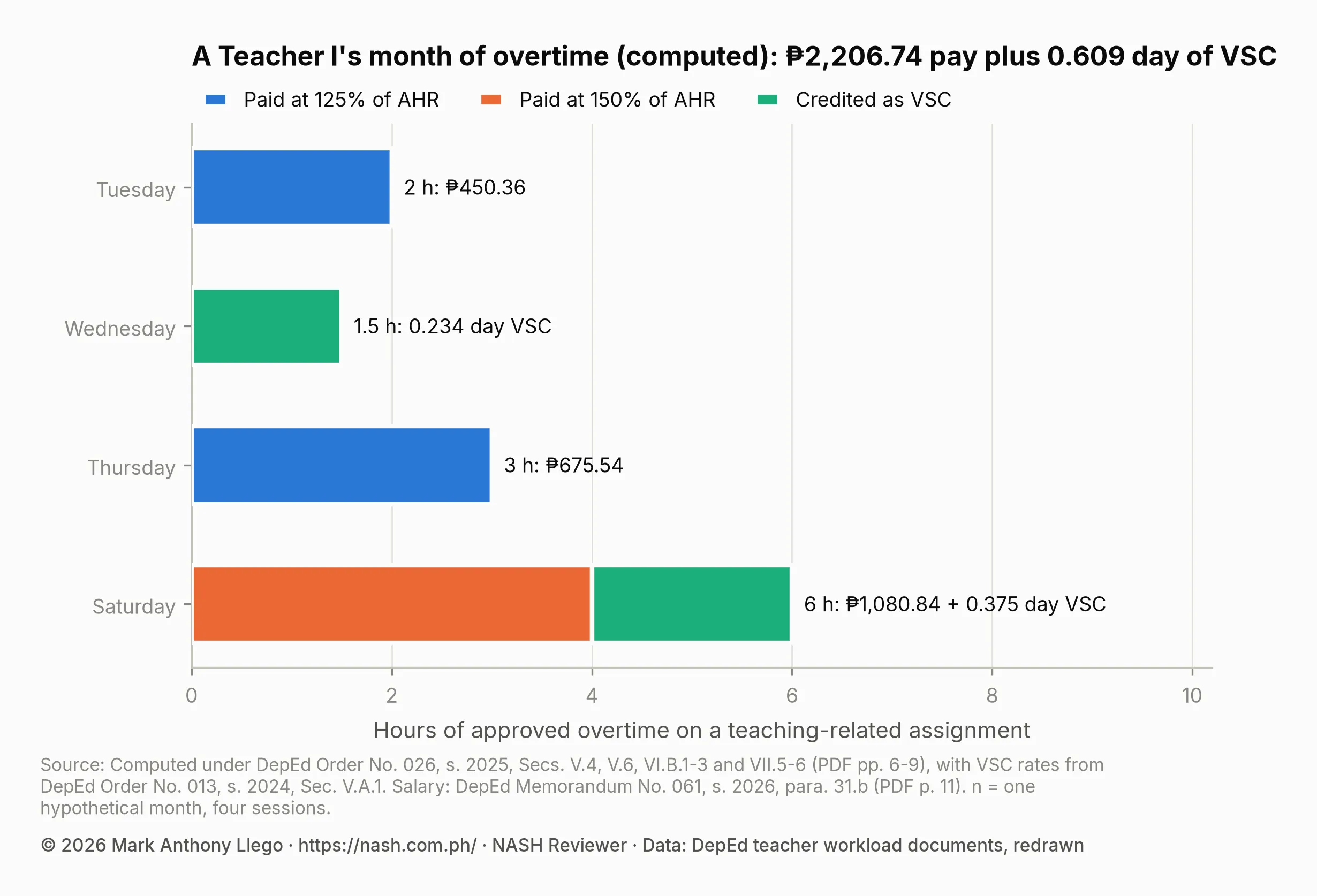
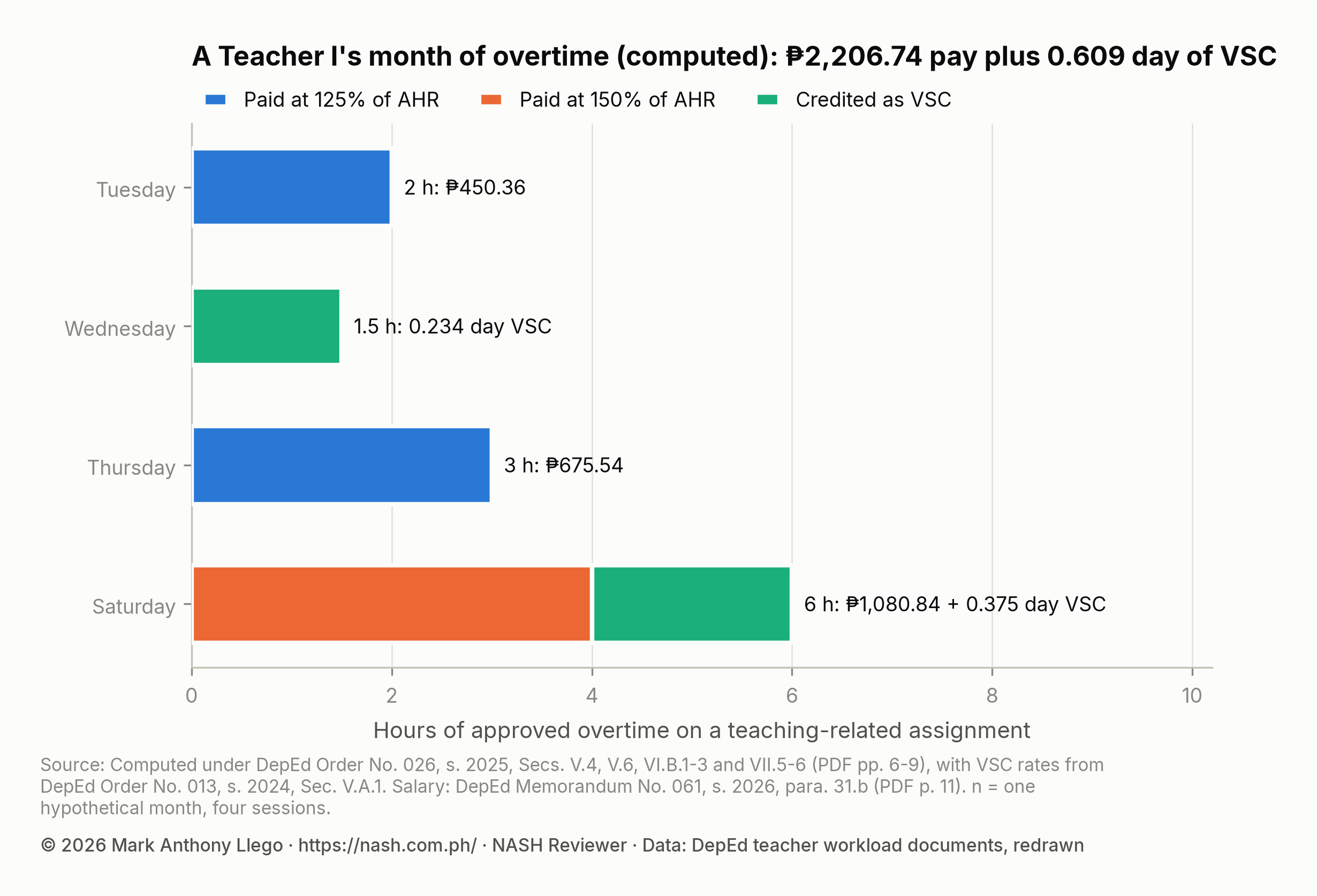
The example makes four assumptions. DO 026 does not say over what period the two-hour minimum is counted, so it is counted per day, like the single 4:00 to 6:00 p.m. entry in the Order’s Annex C sample. DO 026 sends short and excess hours to VSC “subject to existing DepEd and Civil Service Commission (CSC) guidelines” without a rate (Secs. V.6, VII.6), so DO 013’s rates are used. The Saturday counts only because she taught 30 hours that week (Sec. V.4.b). And the ₱2,206.74 is before tax (Sec. VI.B.4).
Overload pay, overtime pay and VSC compared
| Teaching overload pay | Overtime pay | Vacation service credits | |
|---|---|---|---|
| Pays for | Actual classroom teaching beyond six hours a day | Teaching-related assignments beyond the teaching day, inside the school | Authorized work beyond regular hours, on weekends, holidays and vacations, and unpaid overload |
| Who | Teachers teaching over six hours; “As a general rule”, only in schools with a teacher shortage, though relieving duties also count; not LSB-funded contractual teachers (DO 5, s. 2024, Sec. V.A.2 items 3–5) | Designated teachers with six teaching hours a day and 30 a week; TICs and teachers in non-teaching functions fall under the general overtime rules instead; LSB-funded teachers are not paid from DepEd funds (DO 026, s. 2025, Secs. V.5, V.7, VII.5, VII.7) | All public school teachers, including Mobile Teachers; not TICs or teachers reassigned to non-teaching functions (DO 013, s. 2024, Secs. II, V.A.3) |
| When | Any school day with over six hours of teaching (DO 5, Sec. V.A.2 item 1) | School days beyond six hours of teaching and advising; weekends after a 30-hour week; holidays within the school year; only when “extremely necessary” (DO 026, Secs. V.3–4) | The 12 items of DO 013, Sec. V.A.8 |
| Rate | PHTR = annual salary ÷ 1,600 × 1.25 per hour (DM 53, s. 2024, Encl. 1); Teacher I, FY 2026: ₱297.23 by the formula, ₱297.14 as DM 061 prints it | AHR = monthly salary ÷ (22 × 8); 125% on workdays, 150% on Saturdays, holidays and non-working days (DO 026, Sec. VI.B); Teacher I, FY 2026: ₱225.18 and ₱270.21 (computed) | 1.25 hours of VSC per hour on school days and for overload; 1.5 on weekends, holidays and vacations (DO 013, Sec. V.A.1); one day per six hours in the 2026 summer programs (DO 010, s. 2026, para. 56) |
| Papers | Monthly DTR; quarterly Certification/List of Teachers with Teaching Overload Pay, Endorsement Memorandum and eSF7; the list posted on the transparency board (DM 53, Encl. 1; Encl. 2 Nos. 4–5) | Annex A authority first; Annex C report, DTR and designation order; the monthly Annex B report; quarterly payroll at the SDO (DO 026, Sec. VI.A) | Authority first; accomplishment report and DTR; designation order for assignments; Special Order approved by the SDS; entry in the leave card (DO 5, Sec. V.B.2 item 3; DM 53, Encl. 1, Sec. II; DO 013, Sec. VI) |
| Cap | Two hours a day, ten a week (DO 5, Secs. III.j, V.A.2 item 2); total “shall not exceed 50% of his/her basic salary for the year” (DM 53, Encl. 1) | Money only for two hours or more; four paid hours a day on weekends and holidays (DO 026, Secs. V.6, VII.6) | 30 days a calendar year, 45 in a late appointee’s first year; unpaid overload, ARAL tutoring and the 2026 summer programs outside (DO 013, Sec. V.A.2; DM 061, s. 2026, para. 31.a.ii; DO 010, s. 2026, para. 57) |
| If funds run short | Converted to VSC at 1.25, outside the cap (DO 5, Sec. V.B.1 item 3; DO 013, Sec. V.A.7) | Converted to VSC (DO 026, Secs. V.9, VI.A.1.c.iv) | Monetization is “subject to availability of funds” (DO 013, Sec. VI.C.7) |
| Taxable | Yes (DM 53, Encl. 1) | Yes (DO 026, Sec. VI.B.4) | A leave credit, not pay, until monetized |
Which official answers are now outdated
DepEd’s orientation answers, decks and Toolkit came before DO 026 or do not cite it. An issuance outranks any of them.
| Answer | What it says | Status on October 31, 2026 |
|---|---|---|
| DepEd consolidated Q&A, DM 53 orientation, No. 33 (November 2024) | A school paper adviser gets VSC; “As of today, there is no provision for overtime pay.” | Outdated. DO 026 (September 6, 2025) pays overtime for teaching-related work in school; school paper adviser is a listed assignment (Sec. V.2.b.i) |
| DepEd consolidated Q&A, RO orientation on DO 5, item 3 (May 2024) | “Pending the release of the new guidelines of VSC”, converted overload is “exempted to the 15-day cap as provided in DO 53, s. 2003” | Outdated. DO 013 repealed DO 53, s. 2003 (Sec. XI) and set 30- and 45-day caps (Sec. V.A.2); the exemption survives (Sec. V.A.7) |
| DM 53, s. 2024, para. 7; DepEd General FAQs on DO 5, s. 2024, p. 33; Teacher Workload Policy Toolkit, June 2025, p. 54 | Teaching-related assignments beyond hours are compensated with VSC | Needs a caveat. Since DO 026, such work in school by a designated teacher with a full load, of two hours or more, approved in advance as extremely necessary, is paid in money if funds allow, and otherwise credited as VSC (DO 026, Secs. V.3–9) |
| DepEd SDO meeting deck on implementation status, 2026, p. 26 | Overtime pay and VSC are “Granted for ancillary tasks (home visitations and coaching & mentoring) and teaching-related assignments performed beyond the regular work hours” | Wrong on overtime for ancillary tasks (DO 026, Secs. VII.2–3). VSC for them is right (DO 013, Sec. V.A.8.j–k) |
| DepEd consolidated Q&A, 2026 implementation-status meetings, No. 28 | Such work “shall be compensated by Overtime Pay. In cases where there is no budget for overtime pay, this is the only time where teachers are going to receive VSC” | Partly wrong. VSC also covers sessions under two hours, weekend hours beyond four, work outside the school and teachers without a full load (DO 026, Secs. V.6, VII.2, VII.5–6) |
| DepEd consolidated Q&A, 2026 meetings, No. 26; DepEd CO–RO meeting deck, June 2, 2026, p. 12; SDO deck, p. 23 | Such work “shall be compensated by Overtime Pay and/or Vacation Service Credits” (No. 26: “may be compensated”) | Right in outline, but none cites DO 026 or its conditions |
What this means for school heads
The school head approves every claim before the work, so most errors start or stop at the school.
- Sort each request by the rule that pays it. Extra classroom teaching is overload. A designated assignment inside the school, by a teacher with a full load, for two hours or more, is overtime. Other work on DO 013’s list earns VSC: that includes the two kinds of ancillary task it names, parent conferences and home visits and Master Teachers’ coaching beyond regular hours, and eligible teaching-related work outside the school. Other ancillary tasks done after hours earn nothing (DO 5, Sec. V.B.2 item 1; DO 013, Sec. V.A.8–9).
- Approve before the work, in writing: Template No. 9 for VSC, weighing “Necessity”, “Urgency” and “Workload of Teachers” (DM 53, Encl. 1, Sec. II), and Annex A for overtime, applying the “extremely necessary” test (DO 026, Sec. V.3). A school head may initiate requests and may approve or disapprove “depending on the nature and urgency of the work involved” (DO 026, Sec. VI.A.1.a–b).
- Check the limits before signing: the designation order, a class program of six teaching hours a day and 30 a week (required for all paid overtime), the two-hour minimum and the four-hour weekend cap (DO 026, Secs. V.4–6, VII.5–6).
- Submit on time: the overtime report monthly (DO 026, Sec. VI.A.1.c.i), papers for DO 013 activities within a month (Sec. VI.A.3) and overload papers quarterly (DO 013, Sec. VI.B.1).
- Track each teacher’s VSC. The HRMO must update teachers regularly (DO 013, Sec. VI.C.6), and the Toolkit asks school heads to “Monitor the progress and status of your teachers’ VSC through constant communication with your respective SDO” (June 2025, p. 54).
| Record to keep | Rule |
|---|---|
| Designation orders approved by the SDS | DM 53, s. 2024, para. 6.c–d; DO 026, s. 2025, Sec. VI.A.1.c.i |
| Approved authorities and accomplishment reports (Templates No. 9–10; DO 026 Annexes A and C) | DO 5, s. 2024, Sec. V.B.2 item 3.a, c; DO 026, Secs. VI.A.1.b.iii, VI.A.1.c.i |
| DTRs (CS Form 48) and monthly overtime reports (Annex B) | DO 013, s. 2024, Secs. VI.A.2, VI.B.1; DO 026, Sec. VI.A.1.c.i |
| Memoranda granting VSC for activities, with modes of verification | DO 013, Secs. VI.A.1–2 |
| Overload certifications, certifications of insufficiency of funds, and copies of Special Orders | DO 013, Secs. VI.A.4, VI.B.1–2 |
What a school head may not do:
- authorize overtime for ancillary tasks, to offset undertime, for teachers on travel status, or outside the school (DO 026, Secs. VII.1–4);
- require “documentary evidence or accomplishment reports on how the two (2) hours of ancillary tasks are spent outside school premises” (DO 5, Sec. V.A item 1);
- add papers beyond the templates and annexes the issuances prescribe (DO 013, Sec. VI; DO 026, Sec. VI.A); DM 53 says there “shall be strictly no additional documentary requirements aside from the templates provided in each Enclosure” (para. 10);
- make ARAL tutoring mandatory for DepEd teachers (DM 061, s. 2026, para. 6.d);
- request or endorse VSC for the items DO 013 excludes, such as preparing School Form 7 (Sec. V.A.9.b).
For the wider duties, see Human Resource Management for DepEd School Heads and PPSSH Domain 2: Managing School Operations; makeup classes after suspensions are covered in Super El Niño 2026: A School Head’s Continuity Guide.
An “Objection, disapproval, and/or infringement” under DO 013, s. 2024 or DO 026, s. 2025 goes through the grievance machinery of DO 35, s. 2004 or the civil service rules on administrative cases; see DepEd Grievance Machinery: Steps and Time Limits.
How the NASH may test this
The two items below are original practice items in the format of the NASH practice questions, scored 3 (Relational), 2 (Multistructural), 1 (Unistructural) or 0 (Prestructural).
Question 1
Indicator 2.4.1, Management of staff. Career Stage 1, Situational, Moderate.
A Grade 10 teacher is the school paper adviser under a designation order approved by the SDS, and teaches six hours every school day. The paper must reach the division press conference in two weeks, and the layout cannot be finished within regular hours. She asks to work in the school for three hours after her eight-hour day on three weekdays, and for six hours on Saturday. The SDO has certified that funds for overtime are available. What should the school head do?
- A. Approve her request on the overtime form before the work, after confirming that her class program gives her six teaching hours a day and 30 a week; have the weekday hours paid at 125% of her actual hourly rate and four Saturday hours at 150%, with the other two credited as VSC; and send her accomplishment report, DTR and designation order with the monthly report to the SDO.
- B. Approve the request, but credit all 15 hours as vacation service credits, since DepEd Order No. 005, s. 2024 compensates teaching-related assignments beyond regular hours with VSC.
- C. Approve the three weekday sessions as paid overtime with the required papers, and ask her to finish the rest of the layout on weekdays instead of on Saturday.
- D. Approve all the hours and leave it to the SDO to decide how they will be paid once her papers come in.
Answer and explanation
Best answer: A. Points: A = 3, B = 0, C = 2, D = 1.
- A (3 points, Relational). This applies every condition of DO 026 in order: authority first, a designated assignment in school, a full teaching week, the two rates, the weekend cap with the excess as VSC, and the monthly report.
- B (0 points, Prestructural). This follows a rule DO 026 has overtaken. The Order turns qualifying overtime into VSC only when funds are insufficient (Secs. V.9, VI.A.1.c.iv), and the SDO has certified funds.
- C (2 points, Multistructural). The weekday approvals follow the rules, but the school head drops the Saturday work without weighing whether the deadline needs it.
- D (1 point, Unistructural). Approving in advance is right, but the pay rules, the weekend cap and the report are left undone.
Why. This aligns with Career Stage 1 expectations because indicator 2.4.1 asks the aspiring school head to know the issuances on managing school staff. DO 026, s. 2025 pays overtime only to designated teachers, in school, after approval, at 125% or 150% of the actual hourly rate, with “a maximum of four (4) hours per day” on weekends and the excess converted to VSC (Secs. V.2, V.5, V.8, VI.B.2, VII.6). The option that approves only the weekdays keeps to the rules but leaves the school’s problem unsolved.
Indicator 2.4.1: Demonstrate knowledge and understanding of laws, policies, guidelines and issuances on managing school staff.
Sources: DepEd Order No. 026, s. 2025; DepEd Order No. 005, s. 2024; DepEd Order No. 013, s. 2024; DepEd Order No. 024, s. 2020.
Question 2
Indicator 2.4.2, Management of staff. Career Stage 2, Situational, Moderate.
A teacher has earned 28 days of VSC this calendar year from Brigada Eskwela and weekend trainings. She volunteers to tutor ARAL learners on four Saturdays, four hours each. The HRMO tells her she can earn only two more days of VSC this year, and she asks the school head whether to cut her tutoring. What is the most appropriate action?
- A. Explain that VSC from ARAL tutoring is not counted within the 30-day cap, approve her tutoring schedule, and make sure her DTR and accomplishment report for each session reach the SDO so that the full credits are recorded.
- B. Approve her tutoring schedule and refer the question of the cap to the SDO’s Personnel Unit, making sure her DTR and accomplishment report for each session are submitted.
- C. Approve her tutoring schedule and advise her to keep a personal log of her tutoring hours in case the credits are questioned.
- D. Advise her to limit her tutoring to about 11 hours, since any VSC beyond 30 days this year would be forfeited.
Answer and explanation
Best answer: A. Points: A = 3, B = 2, C = 1, D = 0.
- A (3 points, Relational). This connects the rule (ARAL credits sit outside the cap), the papers that prove the hours, and the purpose of keeping a willing tutor with her learners. Sixteen weekend hours earn 3 days (16 ÷ 8 × 1.5).
- B (2 points, Multistructural). The approval and the papers are right, but a settled rule is left unanswered and the teacher uncertain.
- C (1 point, Unistructural). It supports the tutoring, but a personal log is not the DTR and accomplishment report the memorandum requires.
- D (0 points, Prestructural). A misconception: it cuts learners’ tutoring because of a cap that does not apply.
Why. This aligns with Career Stage 2 expectations because indicator 2.4.2 asks the school head to manage teaching load distribution within the issuances. ARAL tutoring is voluntary for DepEd teachers, and weekend VSC from it “shall not be counted within the thirty (30)-day or forty-five (45)-day annual limitation” (DM 061, s. 2026, paras. 6.d, 31.a.ii; DO 018, s. 2025, para. 83). Tutors must submit the DTR and accomplishment report (DM 061, para. 30). The option that refers the question to the SDO keeps the papers in order but does not use what the school head should already know.
Indicator 2.4.2: Manage staffing such as teaching load distribution and grade level and subject area assignment in adherence to laws, policies, guidelines and issuances based on the needs of the school.
Sources: DepEd Memorandum No. 061, s. 2026; DepEd Order No. 018, s. 2025; DepEd Order No. 013, s. 2024; DepEd Order No. 024, s. 2020.
Nothing in this guide reproduces or predicts examination content.
Frequently asked questions
How many hours of work equal one day of vacation service credit?
On a school day, eight hours of eligible work beyond regular hours earn 1.25 days, so 6.4 hours earn one day. On weekends, holidays and vacations, eight hours earn 1.5 days, so about 5.3 hours earn one (DO 013, s. 2024, Sec. V.A.1; Annexes A–B; computed).
Is there overtime pay for public school teachers in DepEd?
Yes, since DepEd Order No. 026, s. 2025, dated September 6, 2025. It pays 125% of the actual hourly rate on workdays and 150% on Saturdays, holidays and non-working days, but only to designated teachers who have taught six hours that day and 30 that week, for teaching-related work of two hours or more inside the school (Secs. V.2, V.5–6, VI.B.2, VII.5).
Do home visits and parent conferences earn overtime pay?
No. DO 026 excludes ancillary tasks done in school and allows overtime only inside the school (Secs. VII.2–3). Parent conferences and home visits beyond regular work hours earn VSC instead (DO 013, s. 2024, Sec. V.A.8.j; DO 5, s. 2024, Sec. V.A.3 item 5).
What is the maximum vacation service credit a teacher can earn in a year?
Thirty days in a calendar year, or 45 in the first year of a new hire appointed four months after the first day of classes (DO 013, s. 2024, Sec. V.A.2). VSC from unpaid overload, from weekend, holiday and vacation ARAL tutoring, and from the 2026 Summer Remediation Programs is not counted against the cap (DO 013, Sec. V.A.7; DM 061, s. 2026, para. 31.a.ii; DO 010, s. 2026, para. 57).
Can vacation service credits be converted to cash?
Yes, subject to available funds. Unused VSC is converted into vacation and sick leave credits at 30Y ÷ 69 and monetized, and what remains is converted back (DO 013, s. 2024, Sec. VI.C.7–8); 30 days of VSC become 13.04 days of leave credits (computed). On resignation, retirement or separation, unused VSC is converted the same way and paid as terminal leave (Sec. VI.C.10).
Download the data
- vsc-overload-per-school-year.csv: VSC from unpaid teaching overload, 1 to 10 hours a week, per week, month and 10-month school year, as printed (DepEd Order No. 013, s. 2024, Annex C, PDF p. 14).
- vsc-process-flow.csv: the seven steps from the authority to the leave card, with who acts and the source of each step (DepEd Order No. 005, s. 2024, Sec. V.B.2 item 3; DepEd Memorandum No. 053, s. 2024, Encl. 1, Sec. II and Encl. 2; DepEd Order No. 013, s. 2024, Sec. VI).
- vsc-overtime-example.csv: the worked overtime month, with hours paid at each rate, hours credited as VSC, pesos and days, all computed, and its assumptions (DepEd Order No. 026, s. 2025, Secs. V.4–6, VI.B, VII.5–6; DepEd Order No. 013, s. 2024, Sec. V.A.1; DepEd Memorandum No. 061, s. 2026, para. 31.b).
The CSVs and charts may be reused only with written permission: email support@nash.com.ph. The rules themselves come from DepEd’s issuances, which you can cite directly.
Sources
- DepEd Order No. 013, s. 2024, Revised Guidelines on the Grant of Vacation Service Credits for Teachers, September 18, 2024, paras. 3–4, Secs. II, III.1, III.5, V.A.1–9 (with footnote 1), V.B.1, VI.A–C, X–XI and Annexes A–D (PDF).
- DepEd Order No. 026, s. 2025, Guidelines on the Payment of Overtime Services of Teachers, September 6, 2025, paras. 1 and 4, Secs. I.5, II, III.1–3, IV, V.1–9, VI.A–B, VII.1–7 and Annexes A–C (PDF).
- DepEd Order No. 005, s. 2024, Rationalization of Teachers’ Workload in Public Schools and Payment of Teaching Overload, April 29, 2024, Secs. III.j, III.m, V.A item 1, V.A.1.b.iii, V.A.2 items 1–5, V.A.3 items 5–6, V.A.4 items 1 and 4, V.B.1 item 3 and V.B.2 items 1–6.
- DepEd Memorandum No. 053, s. 2024, Implementation Guidelines for DepEd Order No. 005, s. 2024, September 27, 2024, paras. 6–7 and 10, Encl. 1 (Secs. I and II) and Encl. 2.
- DepEd Order No. 018, s. 2025, Implementing Guidelines of the Academic Recovery and Accessible Learning Program, June 13, 2025, para. 83.
- DepEd Memorandum No. 061, s. 2026, Amendments to DepEd Memorandum No. 001, s. 2026, September 29, 2026, Encl., paras. 6.d, 30 and 31.a–b.
- DepEd Memorandum No. 001, s. 2026, Guidelines on the Engagement of Academic Recovery and Accessible Learning Program Tutors and Support Aides, January 8, 2026, Encl., para. 38.b.
- DepEd Order No. 010, s. 2026, Guidelines for the Implementation of the 2026 Summer Remediation Programs, April 28, 2026, paras. 1–2 and 4, and Encl., paras. 55–57.
- DepEd Memorandum No. 040, s. 2026, Guidelines on Public School Teachers’ Proportional Vacation Pay for School Year 2025–2026, June 24, 2026, paras. 2, 5 and 8.
- Memorandum DM-OUHROD-2025-2949, Vacation Service Credits for Voluntary Participation in Professional Development Activities During the Midyear Break, October 23, 2025, para. 2.
- DepEd Order No. 014, s. 2026, Guidelines on Learning Continuity in Emergencies, June 4, 2026, para. 69.
- DepEd Memorandum No. 055, s. 2026, Clarificatory Guidelines on the Designation of Learner Formation Officers in Schools, September 17, 2026, Encl., Secs. II.c and II.i.
- DepEd Order No. 53, s. 2003, Updated Guidelines on Grant of Vacation Service Credits to Teachers (repealed by DO 013, s. 2024), and DepEd Order No. 30, s. 2016, Policies and Guidelines on Overtime Services and Payment in the Department of Education.
- DepEd consolidated Q&A, online orientation on DM 53, s. 2024 (updated November 13, 2024), Nos. 18, 28, 29, 33, 37 and 60, in DepEd’s Teacher Workload Public Drive.
- DepEd consolidated Q&A from the online meetings with regional and schools division offices on the implementation status of teacher workload policies (May 25–26 and June 2, 2026), Nos. 26 and 28, in the Teacher Workload Public Drive.
- DepEd consolidated questions and answers, online orientation of regional offices on DO 5, s. 2024 (May 2024), item 3, in the Teacher Workload Public Drive.
- DepEd, “Understanding D.O. 005, s. 2024 … General FAQs”, p. 33, in the Teacher Workload Public Drive.
- DepEd, DM 53, s. 2024 orientation deck (2024), p. 34, in the Teacher Workload Public Drive.
- DepEd, Online Meeting on the Implementation Status of Teacher Workload Policies: SDO deck (2026), pp. 23 and 26, and CO–RO deck (June 2, 2026), p. 12, in the Teacher Workload Public Drive.
- DepEd, Teacher Workload Policy Toolkit, version 2025-v1 (June 2025), pp. 33, 54 and 101, in the Teacher Workload Public Drive.
- Teacher Workload Public Drive forms “[02] Authority to Render Work Beyond Regular Work Hours” and “[03] Individual Accomplishment Report”.
- DepEd Order No. 024, s. 2020, National Adoption and Implementation of the Philippine Professional Standards for School Heads (indicators 2.4.1 and 2.4.2).
The teacher workload series
- DepEd Teacher Workload Policies: A Complete Guide
- How Many Hours Must DepEd Teachers Teach a Day?
- Can Teachers Leave School After Six Hours of Teaching?
- DepEd Teaching Overload Pay: Who Qualifies, How Much
- Why So Few Teachers Get Paid for Teaching Overload
- Teaching-Related Assignments: The 11 Roles DepEd Allows
- Vacation Service Credits and Overtime Pay for Teachers (this post)
- Admin Tasks Off Teachers: DO 2 and School Support Staff
- DepEd 2026 Teacher Workload Survey: What Teachers Said
- How School Heads Plan Teaching Loads Under DO 5
- Teacher Workload and Accountability: EDCOM II Findings
Written by Mark Anthony Llego for NASH Reviewer. Sources: DepEd Orders No. 005 and 013, s. 2024, No. 018 and 026, s. 2025, No. 010 and 014, s. 2026, and No. 024, s. 2020; DepEd Memoranda No. 053, s. 2024 and No. 001, 040, 055 and 061, s. 2026; DepEd’s consolidated Q&A of 2024 and 2026, orientation decks, General FAQs and Teacher Workload Policy Toolkit (June 2025). Charts may be reused only with written permission from support@nash.com.ph.