This post gives fifty free practice questions with answers for the National Assessment for School Heads, the NASH (formerly NQESH), one for each of fifty indicators of the Philippine Professional Standards for School Heads (PPSSH). Each item has four options scored 3-2-1-0 on the Structure of the Observed Learning Outcome (SOLO) taxonomy, with feedback on every option and a full explanation.
Aspiring school heads search for free NASH reviewers every week, and most of what they find is recall drill. The NASH does not test recall. DepEd Memorandum No. 069, s. 2025 says it covers “conceptual and situational critical thinking questions aligned with” the PPSSH of DepEd Order No. 024, s. 2020, built on the SOLO taxonomy. DepEd’s results memoranda score each response from 0 to 3, so partial understanding earns partial credit. A reviewer that helps has to work the same way: one PPSSH indicator per item, four options at four levels of thinking, and feedback that says what each level gets right and what it misses.
The set holds ten items per PPSSH domain, written from three public sources. They are DepEd’s own school-level datasets as analyzed in the data reports in this series, the January 2026 Final Report of the Second Congressional Commission on Education (EDCOM II), and the PPSSH and NASH issuances. The numbers in the stems are real; the schools, officials and incidents are fictional.
Every item follows the item-writing rules of the NASH Reviewer question bank. The stem is situational, written in the second person, and contains every fact the answer needs. The options are matched in length and form, so that nothing but content shows which is best. Scoring follows a 3-2-1-0 pattern, and an integrity rule means that anything unlawful or harmful scores zero however reasonable it sounds.
These are original practice items. They are not actual, past or recalled NASH items, and no score here predicts a NASH rating. DepEd’s memorandum warns that it is not affiliated with anyone claiming access to the examination’s content. This set claims nothing of the kind.
Download this set as a PDF: NASH Reviewer PDF, Set A, A4, with the questions first and the answer key after them. Both sets are on the NASH reviewer PDF page.
How to use this set
- Answer each item before opening its explanation. Choose the single most appropriate action, not the most ambitious one.
- Score yourself with the explanation: 3 for the Relational option, 2 for Multistructural, 1 for Unistructural, 0 for Prestructural. The maximum is 30 per domain and 150 overall.
- Read the feedback for the option you chose, not only for the key. The feedback says what your choice shows about your practice and what fuller practice looks like. That is how the NASH’s Individual Development Report is written.
- Where an item rests on a number, follow the link to the data report that produced it. The guide to reading DepEd data explains every statistic used here.
How the four options are scored
| Score | SOLO level | In a school-head decision, the option… |
|---|---|---|
| 3 | Relational | integrates the relevant elements into one coherent course of action: it solves the core problem, follows the governing policy with the correct authority and sequence, and links the action to its purpose |
| 2 | Multistructural | gets several relevant elements right but does not connect them: one required element is missing, mis-sequenced or handled through the wrong channel |
| 1 | Unistructural | gets one relevant element right and leaves the rest: a single step, or a reactive fix that leaves the core problem standing |
| 0 | Prestructural | misses the point: irrelevant, a misconception, outside the school head’s authority, harmful, or contrary to policy. Anything unlawful or harmful scores 0 however many correct elements it contains |
The blueprint: PPSSH indicators covered per domain
| Domain | Indicators covered | Items | Career Stage 1 | Career Stage 2 |
|---|---|---|---|---|
| D1 Leading Strategically | 1.1.1, 1.2.1, 1.2.2, 1.3.1, 1.4.1, 1.4.2, 1.5.2, 1.6.1, 1.7.1, 1.7.2 | 10 | 6 | 4 |
| D2 Managing School Operations and Resources | 2.1.1, 2.1.2, 2.2.1, 2.2.2, 2.3.1, 2.3.2, 2.4.1, 2.4.2, 2.5.1, 2.6.1 | 10 | 6 | 4 |
| D3 Focusing on Teaching and Learning | 3.1.1, 3.1.2, 3.2.1, 3.2.2, 3.3.2, 3.4.1, 3.4.2, 3.5.1, 3.5.2, 3.6.1 | 10 | 5 | 5 |
| D4 Developing Self and Others | 4.1.1, 4.2.1, 4.3.1, 4.4.1, 4.4.2, 4.5.1, 4.5.2, 4.6.1, 4.7.1, 4.8.1 | 10 | 8 | 2 |
| D5 Building Connections | 5.1.1, 5.1.2, 5.2.1, 5.2.2, 5.3.1, 5.3.2, 5.4.1, 5.4.2, 5.5.1, 5.5.2 | 10 | 5 | 5 |
Career Stage 1 indicators describe aspiring school heads. They are tested with conceptual items, or with situational items where the indicator’s verb is an action. Career Stage 2 indicators describe serving School Principals I and II and are always situational. Difficulty is the writer’s estimate: 12 Easy, 29 Moderate and 9 Difficult.
Domain 1: Leading Strategically (Questions 1 to 10)
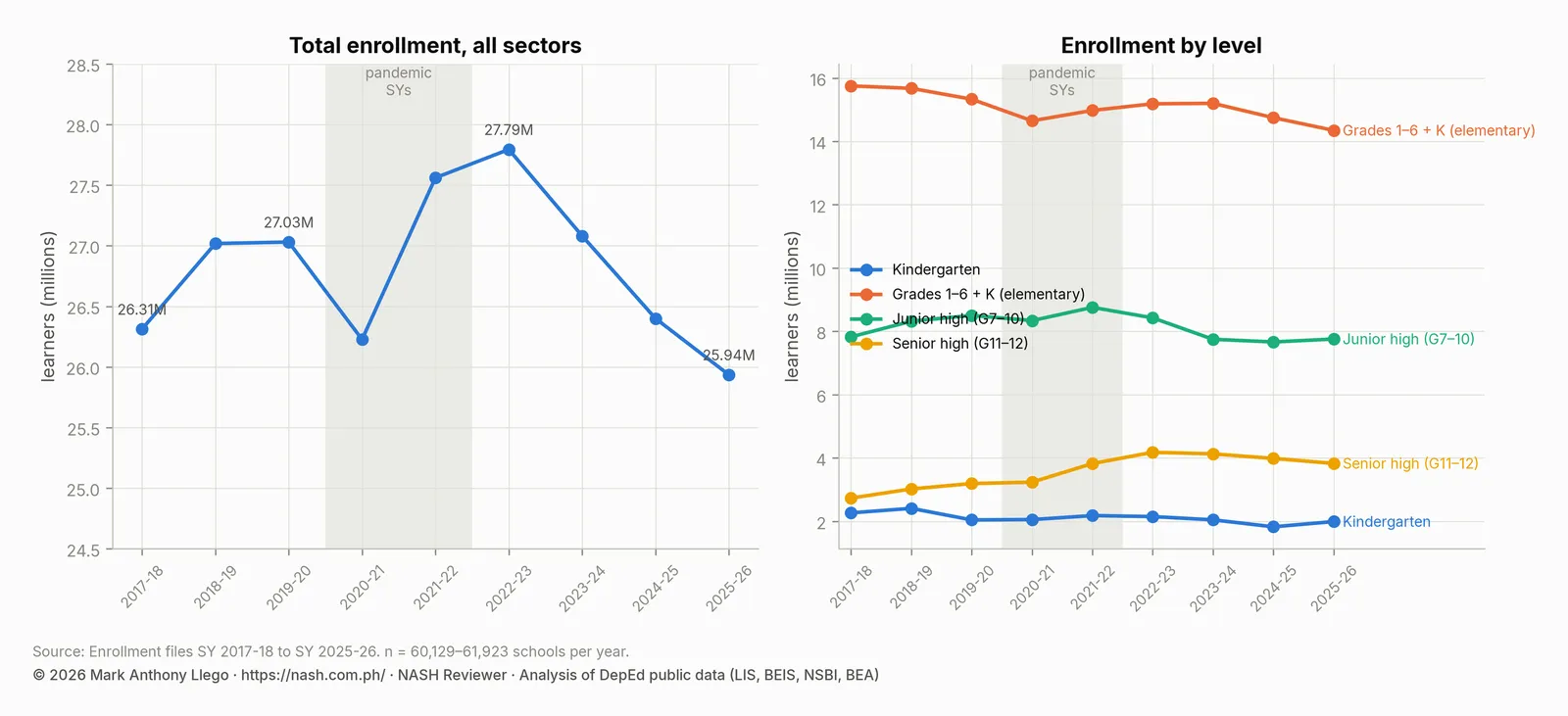
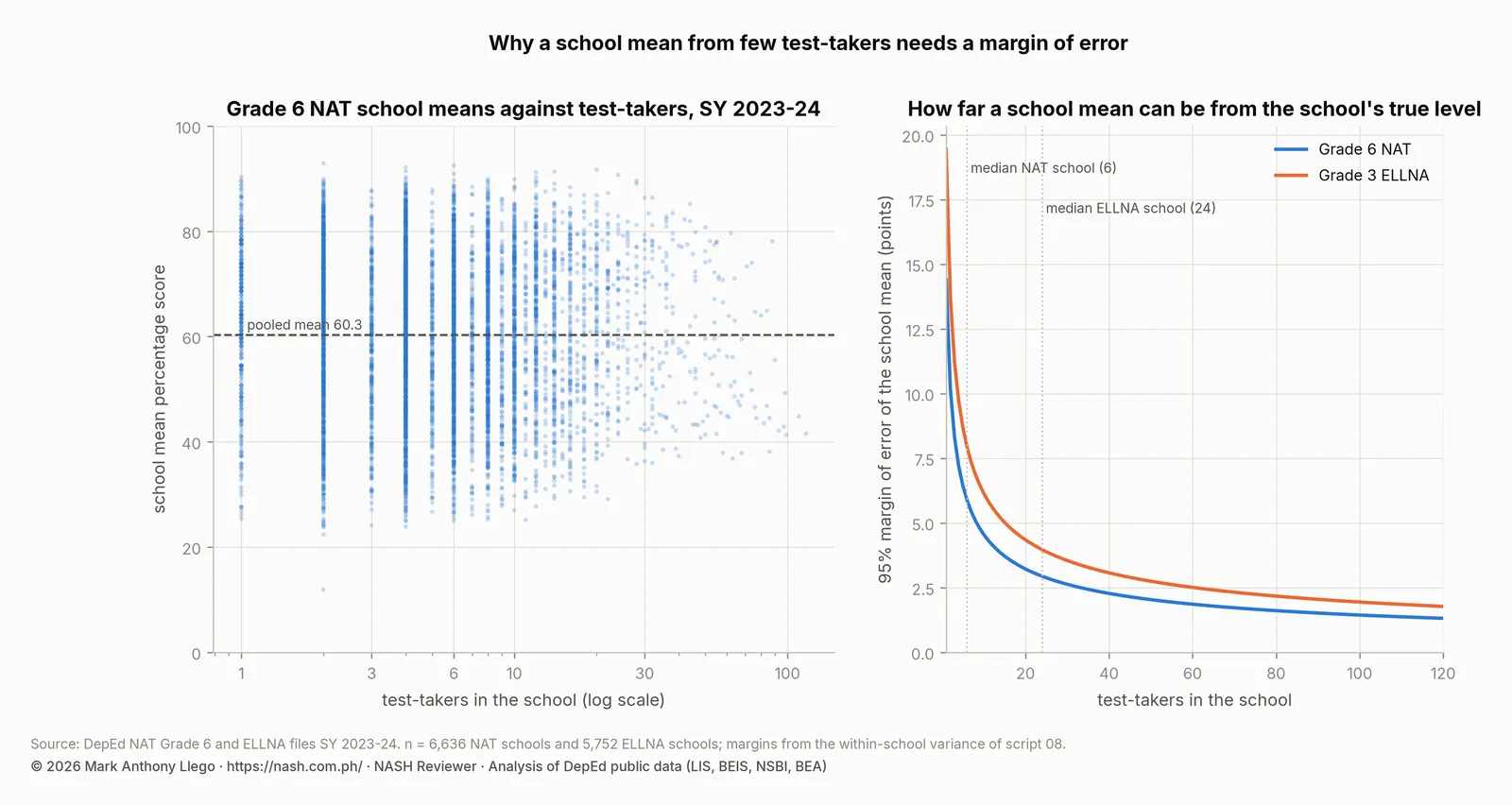
These items rest on the following findings. National enrollment peaked at 27.79 million in SY 2022-2023 and is 25.94 million in SY 2025-2026, and every region except BARMM has lost learners since the peak. Elementary internet access is associated with about 2.6 more Grade 6 National Achievement Test (NAT) points within a division, while computers per learner show no association. Multigrade schools average about four points lower. A Grade 6 NAT school mean rests on a median of six sampled learners. DepEd Order No. 009, s. 2005 prescribes 205 class days of engaged time on task, and EDCOM II counts about 191.
Question 1
Indicator 1.2.1, School planning and implementation. Career Stage 1, Conceptual, Easy.
A newly designated school head is told that the School Improvement Plan begins with a situational analysis before any target is set. Which statement best explains what that phase requires?
- A. Adopt last year’s plan with its growth targets unchanged, since a plan that the division already approved remains valid until the division itself revises it.
- B. Collect the division’s targets and the school’s latest enrollment, then write the division’s targets into the plan so that the school’s priorities match the division’s priorities.
- C. Assemble the school’s own data, such as five years of enrollment and the reading profile by grade, to describe its current state before the planning team sets targets.
- D. Hold a meeting of teachers and parents to list the problems they feel most strongly about, and adopt that list as the plan’s priorities for the year.
Answer and explanation
Best answer: C. Points: A = 0, B = 2, C = 3, D = 1.
- A (0 points, Prestructural). Carrying forward a plan built on assumptions that the data no longer support skips the phase entirely and leaves the targets disconnected from the school.
- B (2 points, Multistructural). Division targets belong in the plan’s alignment, but copying them replaces the analysis of the school’s own state with someone else’s conclusions.
- C (3 points, Relational). The situational analysis describes the school’s current state from its own evidence, which is what the planning team needs before it can set achievable targets.
- D (1 point, Unistructural). Stakeholder views are part of the analysis, but a list of felt problems without the school’s data cannot show where the school actually stands.
Why. This aligns with Career Stage 1 expectations because indicator 1.2.1 asks the aspiring school head to understand the phases of plan development, of which the situational analysis is the first. The PPSSH booklet says school heads in Domain 1 must have a complete understanding of the school’s current and desired states, and the data reports show why: national enrollment has fallen since SY 2022-23 in every region except BARMM, so inherited growth assumptions are often wrong. The option that copies the division’s targets gets alignment right but skips the description of the school’s own state that the targets must rest on.
Indicator 1.2.1: Demonstrate knowledge and understanding of the phases of development and implementation of school plans aligned with institutional goals and policies.
Sources: DepEd Order No. 024, s. 2020; NASH Reviewer, Philippine basic education in numbers (DepEd public datasets, SY 2017-18 to SY 2025-26).
Question 2
Indicator 1.2.2, School planning and implementation. Career Stage 2, Situational, Difficult.
You are the school head of an elementary school in a province where enrollment has fallen every year since SY 2022-23, as it has in every region except BARMM. The School Improvement Plan you inherited assumes three percent growth and requests two new classrooms. Your kindergarten intake is a third smaller than five years ago, and the planning team meets next week. What is the most appropriate action?
- A. Keep the growth assumption and the classroom request unchanged, since smaller cohorts are temporary and a plan that the division has already approved should stay as it is until review.
- B. Bring the five-year enrollment and grade profile to the planning team, revise the targets and classroom request on that evidence, and send the plan to the School Governing Council.
- C. Revise the enrollment targets yourself from the learner information system and submit the corrected plan to the division first, then brief the planning team on the changes at its next scheduled meeting.
- D. Keep the plan as it is but add a note that enrollment has declined for three years, so that the division can decide whether the classroom request should still be considered this year.
Answer and explanation
Best answer: B. Points: A = 0, B = 3, C = 2, D = 1.
- A (0 points, Prestructural). The data show a sustained decline, not a temporary dip, and keeping a request the evidence no longer supports misleads the division’s programming.
- B (3 points, Relational). This revises the plan with the planning team on the school’s own evidence and keeps the governance steps, which is what implementing a plan with the team means.
- C (2 points, Multistructural). The revision rests on the right data, but the school head makes it alone and bypasses the planning team and the council the plan belongs to.
- D (1 point, Unistructural). Flagging the decline is honest, but leaving the targets and the request unchanged passes the school’s planning decision to the division.
Why. This aligns with Career Stage 2 expectations because indicator 1.2.2 asks the school head to develop and implement school plans with the planning team, not alone. The PPSSH’s Domain 1 description expects school heads to execute collaborative strategies with stakeholders in response to the school’s changing needs, and the enrollment series shows kindergarten down from 2.27 million to 1.99 million nationally with smaller cohorts moving up. The option that corrects the targets alone gets the evidence right but drops the team and the council from a decision the standards assign to them.
Indicator 1.2.2: Develop and implement with the planning team school plans aligned with institutional goals and policies.
Sources: DepEd Order No. 024, s. 2020; NASH Reviewer, Philippine basic education in numbers (DepEd public datasets, SY 2017-18 to SY 2025-26).
Question 3
Indicator 1.4.1, Research and innovation. Career Stage 1, Situational, Moderate.
You are a head teacher asked to review a proposal for the school’s innovation fund. The proposal asks to buy forty tablets, citing a data report in which public schools with an internet connection average about 2.6 points higher on the Grade 6 assessment than unconnected schools in the same division. Your school has no connection and three working computers. What is the most appropriate action?
- A. Reject the proposal because a report on five regions says nothing about your school, and innovations should rest on the school’s own experience instead.
- B. Ask the proponent to cite the report properly in the proposal, since the planning team requires every innovation to be supported by a published study.
- C. Accept the finding as support for the purchase and add a request for a connection in the same proposal, so that the tablets and the internet service arrive together.
- D. Point out that the finding concerns connectivity and is an association, and redirect the proposal toward securing a connection first, with devices to follow once it is working.
Answer and explanation
Best answer: D. Points: A = 0, B = 1, C = 2, D = 3.
- A (0 points, Prestructural). Dismissing reliable evidence because it was gathered elsewhere abandons the data-driven practice the indicator describes.
- B (1 point, Unistructural). Citation is a formality here; the proposal’s problem is that the finding is about connectivity and association, not about devices.
- C (2 points, Multistructural). Adding the connection is right, but treating the finding as proof that tablets raise scores keeps a purchase the evidence does not support.
- D (3 points, Relational). This reads the finding for what it measures and what it can show, and uses it to redirect the innovation toward the input the evidence actually concerns.
Why. This aligns with Career Stage 1 expectations because indicator 1.4.1 asks the aspiring school head to identify relevant findings from reliable sources for data-driven innovation, which includes reading a finding correctly. The data reports find elementary internet access associated with about 2.6 more Grade 6 points within a division, while computers per learner show no association with any result, and they state that these are associations in observational data. The option that accepts the finding as support for tablets adds the right request but does not connect the finding to the input it actually measures.
Indicator 1.4.1: Identify relevant research findings from reliable sources in facilitating data-driven and evidence-based innovations to improve school performance.
Sources: NASH Reviewer, Philippine basic education in numbers (DepEd public datasets, SY 2017-18 to SY 2025-26); DepEd Order No. 024, s. 2020.
Question 4
Indicator 1.4.2, Research and innovation. Career Stage 2, Situational, Difficult.
You are the school head of a 160-learner elementary school where two of six classes are multigrade. A division data report finds that, within the same division and holding school size constant, fully multigrade schools average about four points lower on the Grade 3 and Grade 6 assessments than monograde schools. Your Grade 3 mean is five points below the division’s. Teachers propose splitting the multigrade classes. What is the most appropriate action?
- A. Treat the finding as a reason to strengthen multigrade teaching now, through coaching and division training, while raising the staffing question through the division’s class size and item rules.
- B. Set the report aside, since an association measured in other schools cannot apply to yours, and keep both the class organization and the current teaching approach.
- C. Request additional teacher items from the division citing the report, and regroup the multigrade learners by reading level across the two classes, without changing how the teachers are supported.
- D. Ask the division for a slot in its next multigrade training for the two teachers, and keep the class organization and the current teaching approach until then.
Answer and explanation
Best answer: A. Points: A = 3, B = 0, C = 2, D = 1.
- A (3 points, Relational). This uses the finding to act on what the school controls now and routes the structural question through the rules that govern it, linking both to learner outcomes.
- B (0 points, Prestructural). A within-division finding that holds in every region and specification is reliable evidence; dismissing it leaves the school without a basis for action.
- C (2 points, Multistructural). The item request and the regrouping are reasonable, but the teachers who deliver the multigrade lessons get no technical assistance, which the finding points to.
- D (1 point, Unistructural). Training is one relevant element, but waiting for a slot leaves the lessons unchanged for the learners who are behind now.
Why. This aligns with Career Stage 2 expectations because indicator 1.4.2 asks the school head to utilize relevant research findings in data-driven innovations, which means acting on what the finding supports. The data reports find the multigrade association to be the most consistent in the files, about four points within a division, while noting it is an association and that multigrade schools are small and remote. Class organization and items are governed by division rules, so the sound action is instructional support now and a proper staffing request. The regrouping option does several right things but never connects the finding to the teachers’ practice.
Indicator 1.4.2: Utilize relevant research findings from reliable sources in facilitating data-driven and evidence-based innovations to improve school performance.
Sources: NASH Reviewer, Philippine basic education in numbers (DepEd public datasets, SY 2017-18 to SY 2025-26); DepEd Order No. 024, s. 2020.
Question 5
Indicator 1.7.1, Monitoring and evaluation processes and tools. Career Stage 1, Conceptual, Moderate.
A school head wants a monthly measure of early-grade reading to track an intervention. The Grade 6 assessment mean rests on six sampled learners, the Grade 3 assessment is given once a year, and the classroom reading screen can be repeated by teachers. Which choice best reflects sound monitoring?
- A. Use the Grade 3 assessment mean as the main measure because it is a standardized test, and add the reading screens as supporting evidence when the results arrive.
- B. Use repeated reading screens by grade, since they cover every learner and can move within the year, and keep the two assessments for the division’s annual comparison.
- C. Use the Grade 6 assessment mean, since it is the national measure of achievement, and compare each month’s reading activities with last year’s score.
- D. Use the learners’ quarterly grades, since a passing grade shows mastery, and treat any learner with a grade of 75 or more as reading at grade level.
Answer and explanation
Best answer: B. Points: A = 2, B = 3, C = 1, D = 0.
- A (2 points, Multistructural). The standardized test is the right tool for comparison, but it arrives once a year and cannot monitor a monthly intervention.
- B (3 points, Relational). This matches each tool to its purpose: a screen of every learner for monthly monitoring, and the annual tests for comparison where their intervals are narrow.
- C (1 point, Unistructural). A mean from six sampled learners carries a margin of about six points and is given once a year, so it cannot track monthly change.
- D (0 points, Prestructural). A transmuted grade of 75 can rest on an initial grade of 60, so grades cannot stand in for a measure of reading level.
Why. This aligns with Career Stage 1 expectations because indicator 1.7.1 asks the aspiring school head to understand monitoring and evaluation tools and what each can show. The data reports show the Grade 6 assessment tested a median of six learners per school, giving a school mean a margin of about six points, while the reading screen counts every learner at one of five levels and can be repeated. The option that leads with the standardized test chooses a reliable instrument but misses that its timing and purpose do not fit monthly monitoring.
Indicator 1.7.1: Display knowledge and understanding of monitoring and evaluation processes and tools to promote learner achievement.
Sources: NASH Reviewer, Philippine basic education in numbers (DepEd public datasets, SY 2017-18 to SY 2025-26); DepEd Order No. 024, s. 2020; EDCOM II Final Report, Turning Point: A Decade of Necessary Reform (2026-2035), January 2026.
Question 6
Indicator 1.7.2, Monitoring and evaluation processes and tools. Career Stage 2, Situational, Moderate.
You are the school head of an elementary school. The division has asked each school to post a quarterly dashboard of learning outcomes for parents. A teacher drafts one built on last year’s Grade 6 assessment mean, which came from six sampled learners. Your reading screens and classroom assessment records cover every learner, and the division’s own estimates carry confidence intervals. What is the most appropriate action?
- A. Build the dashboard on measures that cover every learner, such as reading levels, classroom mastery and attendance, and show the assessment mean with its number of test-takers.
- B. Post the assessment mean alone, since it is the only standardized measure the school has, and add a note that other results will follow when the division releases the next set of figures.
- C. Delay the dashboard until the next assessment round is released, since parents would misread any result that does not come from a national test and the division can wait a quarter.
- D. Post the assessment mean as the headline with the reading screen results below it, and update the dashboard every quarter so that parents can see whether the school’s score has moved since last year.
Answer and explanation
Best answer: A. Points: A = 3, B = 1, C = 0, D = 2.
- A (3 points, Relational). This chooses the tools that can show quarterly change for every learner and presents the sampled mean honestly, which is what utilizing monitoring tools means.
- B (1 point, Unistructural). One sampled mean, given once a year, is neither a quarterly measure nor a picture of the school’s learners.
- C (0 points, Prestructural). Withholding the school’s own full-coverage data from parents misreads what the national test is for and leaves the division’s request unmet.
- D (2 points, Multistructural). The reading results belong on the dashboard, but a six-learner mean cannot move quarterly and headlining it invites parents to read noise as progress.
Why. This aligns with Career Stage 2 expectations because indicator 1.7.2 asks the school head to utilize available monitoring and evaluation tools to promote learner achievement, which includes choosing the right tool for the audience and the interval. The data reports advise building school-level monitoring on instruments with enough learners to be reliable and keeping the national assessments for division-level comparison, where intervals are about a point wide. The headline-mean option includes the reading results but still presents a six-learner mean as the measure of quarterly progress.
Indicator 1.7.2: Utilize available monitoring and evaluation processes and tools to promote learner achievement.
Sources: NASH Reviewer, Philippine basic education in numbers (DepEd public datasets, SY 2017-18 to SY 2025-26); DepEd Order No. 024, s. 2020.
Question 7
Indicator 1.3.1, Policy implementation and review. Career Stage 1, Conceptual, Moderate.
DepEd policy directs that the school days in the calendar be devoted to engaged time on task, that observances be integrated into relevant subjects rather than marked by suspending classes, and that athletic meets and competitions be held after class hours. Which statement best explains what this requires of a school head in a month with three division-level contests?
- A. Suspend classes for the practices and for the contests, since division-level competitions are official activities that count as school days in the calendar.
- B. Suspend classes on the contest days themselves, keep the practices within school hours so that coaches can supervise them, and integrate the observances into the relevant subjects.
- C. Remind teachers in a memorandum that instructional time must be protected, and leave the scheduling of practices and observances to the coaches and coordinators.
- D. Prepare the school calendar so that the contests’ practices sit outside class hours and the observances are taught within subjects, and report the actual class days held to the division.
Answer and explanation
Best answer: D. Points: A = 0, B = 2, C = 1, D = 3.
- A (0 points, Prestructural). A suspended class day is not engaged time on task, and the policy expressly bars suspensions for competitions and celebrations.
- B (2 points, Multistructural). Integrating observances is right, but practices within class hours and suspensions on contest days are the losses the policy was written to prevent.
- C (1 point, Unistructural). A reminder states the principle, but the calendar and the scheduling decisions that protect time are left to others.
- D (3 points, Relational). This applies each provision of the policy in the school calendar and keeps the reporting that lets the division check the class days actually held.
Why. This aligns with Career Stage 1 expectations because indicator 1.3.1 asks the aspiring school head to understand policy implementation so that school operations stay consistent with issuances. EDCOM II’s Final Report cites DepEd Order No. 009, s. 2005, which requires the prescribed school days to be devoted to engaged time on task, discourages suspensions for celebrations, directs that observances be integrated into subjects, and mandates that competitions be held after class hours; it finds schools average about 191 actual class days. The option that suspends classes on contest days integrates observances correctly but gives up the class days the policy protects.
Indicator 1.3.1: Demonstrate knowledge and understanding of policy implementation and review to ensure that school operations are consistent with national and local laws, regulations and issuances.
Sources: EDCOM II Final Report, Turning Point: A Decade of Necessary Reform (2026-2035), January 2026; DepEd Order No. 024, s. 2020.
Question 8
Indicator 1.5.2, Program design and implementation. Career Stage 2, Situational, Difficult.
You are the school head of an elementary school where the start-of-year reading screen placed 55 percent of Grade 1 learners and 16 percent of Grade 3 learners at the lowest level. The tutorial sessions for struggling learners are scheduled, but attendance in the first two weeks was below half, and teachers report that learners are kept home to help with farm work. What is the most appropriate action?
- A. Send a letter to the parents of the flagged learners explaining that the sessions are required, and continue the sessions as scheduled for those who attend.
- B. Group the sessions by reading level, set them at times families can keep, and work with the barangay and parents to bring the flagged learners in, tracking attendance weekly.
- C. Mark the absent learners as having completed the program, since the sessions were offered, and report full implementation to the division.
- D. Keep the schedule as planned and ask teachers to visit the homes of absent learners after class, recording the visits as evidence that the program was implemented.
Answer and explanation
Best answer: B. Points: A = 1, B = 3, C = 0, D = 2.
- A (1 point, Unistructural). A letter informs parents, but it does not remove the reason learners stay home or reach the learners who most need the sessions.
- B (3 points, Relational). This adjusts the program to the barrier that is actually keeping learners away and enlists the community, which is what implementing a learner program means.
- C (0 points, Prestructural). Reporting learners as served when they were not falsifies the program record and leaves the learners without the support the program exists to give.
- D (2 points, Multistructural). Home visits respond to absence, but they fall on teachers after class and leave the schedule that caused the absences unchanged.
Why. This aligns with Career Stage 2 expectations because indicator 1.5.2 asks the school head to implement programs that support learners, which includes making the program reach them. EDCOM II’s Final Report finds that the remaining constraints on the ARAL Program lie in time, workforce and family-level barriers, that teachers point to chronic attendance problems among flagged learners, and that parent support and barangay-level advocacy are needed to ensure children show up. The home-visit option responds to the absences but leaves the schedule and the community role unaddressed while adding to teachers’ load.
Indicator 1.5.2: Implement programs in the school that support the development of learners.
Sources: EDCOM II Final Report, Turning Point: A Decade of Necessary Reform (2026-2035), January 2026; NASH Reviewer, Philippine basic education in numbers (DepEd public datasets, SY 2017-18 to SY 2025-26); DepEd Order No. 024, s. 2020.
Question 9
Indicator 1.6.1, Learner voice. Career Stage 1, Conceptual, Easy.
A regional survey finds that half of Grade 5 learners report being bullied at least once a month, yet a school’s incident records show almost no cases. Which statement best explains why learner voice matters for the school’s decisions?
- A. The incident records are the official data on the school’s safety, so the survey’s figure should be treated as unreliable until learners file formal complaints that the records can count.
- B. Learners should be consulted because the policy on learner organizations requires a functioning student government in every school, and the government’s officers can speak for the learners.
- C. The survey shows that bullying is common across the region, so the school should adopt the division’s anti-bullying program in full and keep its incident records as the measure of the program’s progress.
- D. Learners’ own reports reveal needs that records of reported incidents miss, so their views, gathered through learner organizations and surveys, should inform the school’s safety measures.
Answer and explanation
Best answer: D. Points: A = 0, B = 1, C = 2, D = 3.
- A (0 points, Prestructural). Treating a low complaint count as proof of safety mistakes silence for absence of harm and discards the evidence learners offered.
- B (1 point, Unistructural). A student government is one channel, but the reason to listen is what learners know about their own safety, not the requirement to have the body.
- C (2 points, Multistructural). Adopting a program is a reasonable response, but measuring progress by incident records keeps the school blind to what learners experience.
- D (3 points, Relational). This connects what learner voice adds to what administrative data miss, and names the channels through which the school can gather it.
Why. This aligns with Career Stage 1 expectations because indicator 1.6.1 asks the aspiring school head to understand how learner voice informs policy and decision-making. EDCOM II’s Final Report cites PISA results in which 43 percent of girls and 53 percent of boys reported being bullied at least a few times a month, and SEA-PLM 2024 results in which the Philippine figure for head teachers reporting bullying among pupils at least monthly was 50 percent, down from 63 percent in 2019, alongside a shortage of guidance counselors. Administrative records capture only what is reported. The option that adopts a program but measures it by incident records uses learner voice once and then stops listening.
Indicator 1.6.1: Demonstrate knowledge and understanding of utilizing learner voice to inform policy development and decision-making towards school improvement.
Sources: EDCOM II Final Report, Turning Point: A Decade of Necessary Reform (2026-2035), January 2026; DepEd Order No. 024, s. 2020.
Question 10
Indicator 1.1.1, Vision, mission and core values. Career Stage 1, Conceptual, Easy.
Which statement best explains how a school head shows that the school’s programs, projects and activities are aligned with the DepEd vision, mission and core values?
- A. The programs can be traced to the learners the school actually serves, such as its Indigenous Peoples and multigrade learners, and each states how it moves them toward the vision.
- B. The vision, mission and core values are posted at the gate and recited at the flag ceremony, and the programs follow the division’s list of mandated activities for the year.
- C. The school has a written vision statement of its own that mentions learners, which the school head reads out at the opening of the school year.
- D. The programs follow whatever the parent-teacher association agrees to fund, since stakeholder support is the surest sign that a program reflects shared values.
Answer and explanation
Best answer: A. Points: A = 3, B = 2, C = 1, D = 0.
- A (3 points, Relational). Alignment is shown in what the programs do for the school’s own learners, which is the learner-centered purpose the vision and the standards describe.
- B (2 points, Multistructural). Displaying the vision builds awareness, but a program list drawn from mandated activities is not yet connected to the learners the vision is about.
- C (1 point, Unistructural). A statement of the school’s own is one element, but alignment is about programs, not wording.
- D (0 points, Prestructural). Funding availability is not a test of alignment; letting it decide the programs replaces the vision with convenience.
Why. This aligns with Career Stage 1 expectations because indicator 1.1.1 asks the aspiring school head to know the DepEd vision, mission and core values in order to foster alignment of school programs, projects and activities. The PPSSH’s first guiding principle is that the standards are learner-centered, and the learner data show whom a program must reach: Indigenous Peoples learners are 9.3 percent of public-school learners nationally and over 70 percent in CAR, and 15 percent of public schools offer multigrade classes. The option that posts and recites the vision raises awareness but does not connect the program list to the learners it should serve.
Indicator 1.1.1: Demonstrate knowledge of the DepEd vision, mission and core values to foster shared understanding and alignment of school policies, programs, projects and activities.
Sources: DepEd Order No. 024, s. 2020; NASH Reviewer, Philippine basic education in numbers (DepEd public datasets, SY 2017-18 to SY 2025-26).
Domain 2: Managing School Operations and Resources (Questions 11 to 20)
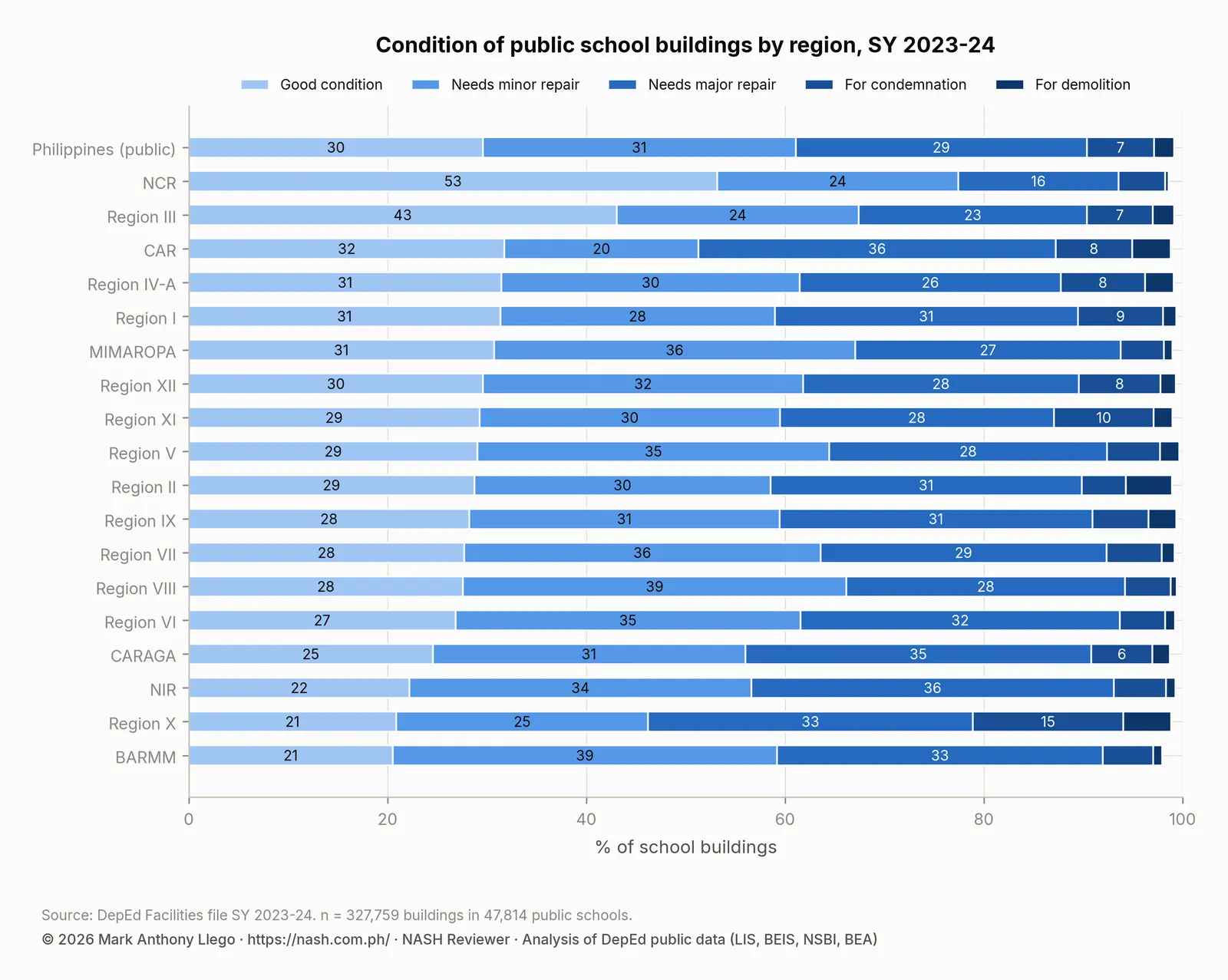
These items rest on the following findings. Nationally, 30% of public school buildings are in good condition and 9% are tagged for condemnation or demolition. A total of 316 schools report more academic computers than learners, and the SY 2025-2026 enrollment file wrote blanks where earlier years wrote zeros. Utilities take 30% to 70% of school Maintenance and Other Operating Expenses (MOOE), and only 2,661 of 45,225 public schools are implementing units. DepEd Order No. 002, s. 2024 moved administrative tasks from teachers to school heads and support staff. The pupil-teacher ratio is associated with early reading and not with Grade 3 or Grade 6 scores.
Question 11
Indicator 2.1.1, Records management. Career Stage 1, Situational, Easy.
You are a head teacher asked to sign the school’s ICT report before it goes to the division. The form lists 420 academic computers for a school of 180 learners. The property custodian says the figure was carried over from last year’s file and that the school actually has 12 working units. School-level reports from every public school are now published online. What is the most appropriate action?
- A. Have the count verified against the inventory, correct the entry before signing, and keep a note of the correction so that the published figure and the school’s records agree.
- B. Enter the 420 units as the official count, since the earlier file was accepted by the division and changing it now would raise questions about past reports.
- C. Ask the custodian to recount the units and report back to you, and hold the form until the recount is done, without checking the other entries on it.
- D. Sign the report as submitted to meet the deadline and send the division a separate letter with the correct count, asking that the published figure be amended later.
Answer and explanation
Best answer: A. Points: A = 3, B = 0, C = 1, D = 2.
- A (3 points, Relational). This verifies, corrects and documents before the data leave the school, which is the skill of managing school data the indicator describes.
- B (0 points, Prestructural). Certifying a figure known to be false is a false report, and the public files already show such entries: 316 schools report more computers than learners.
- C (1 point, Unistructural). A recount is a necessary step, but it leaves the rest of the form unchecked and the correction undocumented.
- D (2 points, Multistructural). Reporting the correct count is right, but a signed report with a known error enters the division’s data and the public release before any letter is read.
Why. This aligns with Career Stage 1 expectations because indicator 2.1.1 asks the aspiring school head to demonstrate skills in managing school data and information, which begins with the accuracy of what the school submits. The data quality audit of DepEd’s public files found 316 public schools reporting more academic computers than learners and one reporting 15,699 tablets. Since Project BUKAS, a school’s BEIS entries are public. The option that signs and writes separately gets the correct count to the division but lets a known error into the record first.
Indicator 2.1.1: Demonstrate skills in managing school data and information using technology, including ICT.
Sources: NASH Reviewer, Philippine basic education in numbers (DepEd public datasets, SY 2017-18 to SY 2025-26); DepEd Order No. 024, s. 2020; EDCOM II Final Report, Turning Point: A Decade of Necessary Reform (2026-2035), January 2026.
Question 12
Indicator 2.1.2, Records management. Career Stage 2, Situational, Moderate.
You are the school head of a senior high school. The enrollment file for the new school year asks for learners by grade. Your registrar left every kindergarten to Grade 10 cell blank because the school offers none of those grades, and also left two Grade 11 strand cells blank that should read zero. The division’s planning and the public release use the file exactly as submitted. What is the most appropriate action?
- A. Have the registrar apply the file’s conventions, entering zero where a strand is offered but empty and leaving blanks only where instructed, and review the file before it is submitted.
- B. Leave the file to the registrar as submitted, since the division’s data officers correct submission errors as a matter of course and the school head is not responsible for the encoding.
- C. Submit the file as it stands and send the division a separate note explaining which of the blank cells mean zero and which mean not offered, so that its planners can adjust the figures themselves.
- D. Fill every blank cell in the file with zero, including the kindergarten to Grade 10 cells for grades the school does not offer, so that no cell is left empty when the division checks the file.
Answer and explanation
Best answer: A. Points: A = 3, B = 0, C = 2, D = 1.
- A (3 points, Relational). This applies the file’s own rules for blanks and zeros and adds the school head’s review, which is how data management ensures the records serve operations.
- B (0 points, Prestructural). The school head is accountable for the school’s records; delegating that accountability leaves known ambiguities in data others will act on.
- C (2 points, Multistructural). Explaining the blanks helps the division, but the file itself still carries ambiguous cells into planning and the public release.
- D (1 point, Unistructural). Zeros where a grade is not offered contradict the file’s conventions and make the school appear to offer grades it does not.
Why. This aligns with Career Stage 2 expectations because indicator 2.1.2 asks the school head to manage school data and information so that operations are efficient and effective, and a blank that can mean zero, not offered or not reported is the commonest flaw in the files. The data quality audit found that the SY 2025-26 enrollment file wrote blanks where earlier years wrote zeros: 1,403 schools had every kindergarten to Grade 10 cell blank, 1,347 of them senior-high-only schools, and 128 schools left an offered level blank. The option that explains the blanks in a note leaves the file itself unfixed.
Indicator 2.1.2: Manage school data and information using technology, including ICT, to ensure efficient and effective school operations.
Sources: NASH Reviewer, Philippine basic education in numbers (DepEd public datasets, SY 2017-18 to SY 2025-26); DepEd Order No. 024, s. 2020.
Question 13
Indicator 2.2.1, Financial management. Career Stage 1, Conceptual, Moderate.
School MOOE is the main discretionary fund available to a school head, covering utilities, minor repairs, supplies and connectivity. Studies find that utility bills take 30 to 70 percent of it, and most schools are not implementing units, so their MOOE is processed through the division office. Which statement best explains what this means for planning the fund?
- A. The plan should list the school’s priorities in order and spend on them as the money arrives through the division, then record the utility bills as they come due and liquidate at year end.
- B. The plan should treat MOOE as the school head’s own allocation to spend as needs arise, since the fund is discretionary and the division’s role is limited to releasing it.
- C. The plan should set aside the utilities first, align the remaining amount with the school plan’s priorities, and follow the division’s schedule for cash advances and liquidation.
- D. The plan should keep a receipt for every purchase and file it with the division on time, since liquidation is the main requirement for a school that is not an implementing unit.
Answer and explanation
Best answer: C. Points: A = 2, B = 0, C = 3, D = 1.
- A (2 points, Multistructural). Prioritizing from the plan is right, but spending before the utilities are reserved leaves the largest fixed cost unfunded later in the year.
- B (0 points, Prestructural). Discretionary does not mean personal; the fund is public money governed by allocation, procurement and liquidation rules.
- C (3 points, Relational). This connects what the fund must cover, what the plan prioritizes and how a non-implementing unit’s money actually moves, which is the understanding the indicator asks for.
- D (1 point, Unistructural). Receipts matter for liquidation, but they are one requirement, not a plan for allocating the fund.
Why. This aligns with Career Stage 1 expectations because indicator 2.2.1 asks the aspiring school head to understand the policies on allocation, procurement, disbursement and liquidation aligned with the school plan. EDCOM II’s Final Report describes school MOOE as the primary discretionary operational fund of school heads, finds that 30 to 70 percent of it goes to utility bills, and notes that only 2,661 of 45,225 public schools are implementing units, the rest having their MOOE processed through the division. The option that spends by priority as money arrives aligns with the plan but does not connect the fund’s fixed costs to its sequence.
Indicator 2.2.1: Demonstrate knowledge and understanding of policies, guidelines and issuances in managing finances such as allocation, procurement, disbursement and liquidation aligned with the school plan.
Sources: EDCOM II Final Report, Turning Point: A Decade of Necessary Reform (2026-2035), January 2026; DepEd Order No. 024, s. 2020.
Question 14
Indicator 2.2.2, Financial management. Career Stage 2, Situational, Difficult.
You are the school head of an elementary school with no master teacher, where half of the Grade 1 learners are at the lowest reading level. The parent-teacher association offers to raise funds for a reading tutor’s honorarium. The local school board has unspent Special Education Fund, and your school plan lists early reading as its first priority. What is the most appropriate action?
- A. Thank the association and decline for now, and write to the division to request a reading teacher item for the school, since staffing the early grades is the division’s responsibility.
- B. Accept the association’s offer and have it pay the tutor directly each month from its own funds, while asking the division whether the Special Education Fund could cover the honorarium next year.
- C. Bring the reading data and the plan to the local school board to request a tutor funded from the Special Education Fund, and direct the association’s effort to materials and attendance.
- D. Pay the tutor from the school’s MOOE cash advance and record the amount under supplies in the liquidation, since the purpose serves learners and the fund is discretionary.
Answer and explanation
Best answer: C. Points: A = 1, B = 2, C = 3, D = 0.
- A (1 point, Unistructural). A teacher item is a legitimate request, but it leaves the learners without support while the local fund that could help goes unspent.
- B (2 points, Multistructural). Getting a tutor quickly serves learners, but a recurring honorarium paid privately sits outside the school’s financial controls, and the fund that exists for it is left unused.
- C (3 points, Relational). This matches the need to the fund designed for it, keeps the request aligned with the plan, and gives the association a role that fits it.
- D (0 points, Prestructural). Recording an honorarium as supplies falsifies the liquidation, which is a violation of disbursement and liquidation rules whatever the purpose.
Why. This aligns with Career Stage 2 expectations because indicator 2.2.2 asks the school head to manage finances within the rules on allocation, disbursement and liquidation while keeping them aligned with the school plan. EDCOM II’s Final Report finds Special Education Fund resources unevenly used, with Php 16.3 billion unspent in 2022, and cites Pasay City’s locally funded reading teachers as a model that produced documented gains. The option that lets the association pay the tutor serves the learners but takes a recurring payment outside the school’s controls and ignores the fund that exists for it.
Indicator 2.2.2: Manage finances adhering to policies, guidelines and issuances in allocation, procurement, disbursement and liquidation aligned with the school plan.
Sources: EDCOM II Final Report, Turning Point: A Decade of Necessary Reform (2026-2035), January 2026; NASH Reviewer, Philippine basic education in numbers (DepEd public datasets, SY 2017-18 to SY 2025-26); DepEd Order No. 024, s. 2020.
Question 15
Indicator 2.3.1, School facilities and equipment. Career Stage 1, Conceptual, Easy.
In the national school building inventory, each building is recorded by condition: good, needing minor repair, needing major repair, for condemnation, or for demolition. Nationally, 30 percent of public school buildings are in good condition and 9 percent are tagged for condemnation or demolition. Which statement best explains why accurate recording matters to a school head?
- A. The inventory drives the division’s repair programming as well as the school’s safety decisions, so each building’s condition must be recorded as it is, then updated when it changes.
- B. The inventory affects how the school is viewed by the division, so buildings should be recorded as in good condition until a repair is actually funded and the work has been completed.
- C. The inventory is where a school lists the buildings it wants repaired, so a building should be tagged for major repair whenever the school needs a new one and the division has funds.
- D. The inventory feeds the division’s reports to the central office, so it should be updated once a year and kept consistent with the previous year’s entries for each building on the site.
Answer and explanation
Best answer: A. Points: A = 3, B = 0, C = 1, D = 2.
- A (3 points, Relational). This links the record to its two uses, programming and safety, and to the duty to keep it current, which is what managing facilities under the policy means.
- B (0 points, Prestructural). Recording a false condition hides a safety risk and misdirects funds; it is a false entry in an official record.
- C (1 point, Unistructural). The inventory is a record of condition, not a request form; tagging to attract a repair corrupts the data the programming relies on.
- D (2 points, Multistructural). Annual updating is part of it, but consistency with last year is not the goal; the record must change when the building does.
Why. This aligns with Career Stage 1 expectations because indicator 2.3.1 asks the aspiring school head to understand the policies on recording and maintaining school facilities. The facilities data from the National School Building Inventory show 30 percent of public school buildings in good condition, 29 percent needing major repair and 9 percent for condemnation or demolition, and EDCOM II’s Final Report recommends modernizing the inventory into a regularly updated database that programming relies on. The option that updates once a year for consistency performs the task but does not connect the record to the decisions that depend on it.
Indicator 2.3.1: Demonstrate knowledge and understanding of policies, guidelines and issuances on acquisition, recording, utilization, repair and maintenance, storage, and disposal in managing school facilities and equipment.
Sources: NASH Reviewer, Philippine basic education in numbers (DepEd public datasets, SY 2017-18 to SY 2025-26); EDCOM II Final Report, Turning Point: A Decade of Necessary Reform (2026-2035), January 2026; DepEd Order No. 024, s. 2020.
Question 16
Indicator 2.3.2, School facilities and equipment. Career Stage 2, Situational, Moderate.
You are the school head of an elementary school with two buildings. The division engineer’s assessment tags one building for condemnation and the other for minor repair. Three classes still meet in the condemned building because there is nowhere else, and the parent-teacher association offers to patch its roof so the classes can stay. What is the most appropriate action?
- A. Keep the three classes where they are and use MOOE to repair the condemned building, since the fund covers repairs and moving the classes would disrupt instruction for the learners.
- B. Move the three classes out under the disaster plan, using temporary spaces if needed, record the building as condemned in the inventory, and request replacement through the division engineer.
- C. Record the building as condemned in the inventory and wait for the division to schedule its demolition before deciding where the three classes will meet for the rest of the year.
- D. Accept the association’s offer to patch the roof so that the three classes can stay for now, and submit the engineer’s report to the division together with a request for a new building.
Answer and explanation
Best answer: B. Points: A = 0, B = 3, C = 1, D = 2.
- A (0 points, Prestructural). Spending public funds to repair a condemned building and keeping classes in it is unsafe and contrary to the engineer’s assessment.
- B (3 points, Relational). This puts safety first, keeps the record accurate and routes the replacement through the office that programs it, connecting all three.
- C (1 point, Unistructural). Recording the condemnation is necessary, but waiting leaves three classes in the building the record says must be vacated.
- D (2 points, Multistructural). The request for a new building is right, but patching a condemned structure keeps learners in a building the engineer has declared unsafe.
Why. This aligns with Career Stage 2 expectations because indicator 2.3.2 asks the school head to manage facilities in adherence to the policies on repair, maintenance and disposal, which includes acting on an engineer’s assessment. EDCOM II’s Final Report notes DepEd Order No. 018, s. 2023 on division engineers’ role in assessment and monitoring, counts about 160,000 classrooms due for condemnation between 2025 and 2075, and records that 11,634 temporary learning spaces were in use in SY 2023-24. The option that accepts the roof repair makes the right request but leaves learners in a condemned building.
Indicator 2.3.2: Manage school facilities and equipment in adherence to policies, guidelines and issuances on acquisition, recording, utilization, repair and maintenance, storage and disposal.
Sources: EDCOM II Final Report, Turning Point: A Decade of Necessary Reform (2026-2035), January 2026; NASH Reviewer, Philippine basic education in numbers (DepEd public datasets, SY 2017-18 to SY 2025-26); DepEd Order No. 024, s. 2020.
Question 17
Indicator 2.4.1, Management of staff. Career Stage 1, Conceptual, Moderate.
A 2024 DepEd policy removed administrative tasks from public school teachers and transferred them to school heads and non-teaching personnel, while the proposed staffing standards still show gaps of more than 12,000 administrative officer items. Which statement best explains what the policy requires of a school head whose school has no administrative officer?
- A. The school head absorbs or redistributes the tasks among non-teaching staff and requests support items through the division, rather than returning the tasks to teachers.
- B. The school head designates a master teacher as the school’s administrative officer, since the position carries a higher salary and the role fits a senior teacher.
- C. The school head requests an administrative officer item from the division and continues the current arrangement until the item is filled.
- D. The school head lists the tasks and assigns them to the teachers with the lightest loads until an administrative officer is appointed, recording the assignments in the class program.
Answer and explanation
Best answer: A. Points: A = 3, B = 0, C = 1, D = 2.
- A (3 points, Relational). This states what the policy requires now, who carries the tasks meanwhile, and the proper route to the staffing the school lacks.
- B (0 points, Prestructural). A master teacher is a teaching position; using one as an administrative officer diverts instructional leadership and contradicts the policy’s purpose.
- C (1 point, Unistructural). Requesting the item is correct, but continuing the old arrangement keeps teachers on the tasks in the meantime.
- D (2 points, Multistructural). Documenting the assignments is orderly, but assigning the tasks back to teachers is what the policy removed.
Why. This aligns with Career Stage 1 expectations because indicator 2.4.1 asks the aspiring school head to know the laws and issuances on managing school staff. EDCOM II’s Final Report records that DepEd Order No. 002, s. 2024 mandated the removal of administrative tasks from public school teachers and transferred them to school heads and non-teaching personnel, that the 2025 budget funded 10,000 support positions, and that the proposed staffing standards still show gaps of 12,078 Administrative Officer II items. The option that assigns the tasks to lightly loaded teachers organizes the work but undoes the policy’s central rule.
Indicator 2.4.1: Demonstrate knowledge and understanding of laws, policies, guidelines and issuances on managing school staff.
Sources: EDCOM II Final Report, Turning Point: A Decade of Necessary Reform (2026-2035), January 2026; DepEd Order No. 024, s. 2020.
Question 18
Indicator 2.4.2, Management of staff. Career Stage 2, Situational, Difficult.
You are the school head of an elementary school with nine teachers and one Master Teacher I. The reading screen shows the widest gaps in Grades 1 and 2, and a division data report links a higher pupil-teacher ratio in the early grades with fewer readers at grade level. Two senior teachers prefer the upper grades, where they have taught for years. You are preparing the class program. What is the most appropriate action?
- A. Keep the senior teachers in the upper grades as they prefer and assign the newest teachers to Grades 1 and 2 with smaller classes, with the Master Teacher observing them once each quarter and reporting to you.
- B. Assign the Master Teacher a full Grade 1 class and the Grade 2 class as well, since the most skilled teacher in the school should take the grades where the reading gaps are widest.
- C. Assign the strongest early-grade teachers to Grades 1 and 2 with smaller classes, schedule the Master Teacher’s coaching time there, and explain the data behind the assignments to the faculty.
- D. Split the Grade 1 and 2 classes into smaller sections using the current teachers’ vacant periods, since the pupil-teacher ratio is what the report links with early reading at grade level.
Answer and explanation
Best answer: C. Points: A = 2, B = 0, C = 3, D = 1.
- A (2 points, Multistructural). A quarterly observation is some support, but the newest teachers are placed where the need is greatest with the least help.
- B (0 points, Prestructural). Two full classes for one teacher exceeds a lawful teaching load and removes the Master Teacher from the coaching role the position exists for.
- C (3 points, Relational). This uses the class program, which the school head controls, to put teaching strength and coaching where the data show the need, and explains the decision.
- D (1 point, Unistructural). Smaller early-grade classes address one factor, but vacant periods cannot carry sections and the placement of teachers is untouched.
Why. This aligns with Career Stage 2 expectations because indicator 2.4.2 asks the school head to manage teaching load distribution and grade level assignment based on the needs of the school. The data reports find the pupil-teacher ratio associated with early reading and not with Grade 3 or Grade 6 scores, about four points of readers at grade level between a school at 15 and one at 45 learners per teacher, and show master teachers are 7.6 percent of nationally funded positions. The option that honors preferences and observes quarterly keeps the faculty content but places the least experienced teachers where the gap is widest.
Indicator 2.4.2: Manage staffing such as teaching load distribution and grade level and subject area assignment in adherence to laws, policies, guidelines and issuances based on the needs of the school.
Sources: NASH Reviewer, Philippine basic education in numbers (DepEd public datasets, SY 2017-18 to SY 2025-26); DepEd Order No. 024, s. 2020.
Question 19
Indicator 2.5.1, School safety for disaster preparedness, mitigation and resiliency. Career Stage 1, Conceptual, Easy.
The law on children in emergencies allows schools to be used as evacuation centers only as a last resort and for a limited period, and temporary learning spaces are meant to serve for about six months. The barangay plans to designate a school as its permanent evacuation center. Which statement best reflects the school head’s understanding of the law?
- A. The school may shelter evacuees temporarily when no alternative exists, so the school head should work with the barangay on a separate center and on a plan to resume classes quickly.
- B. The school may serve as an evacuation center whenever the barangay needs it, so the school head should prepare classrooms for evacuees and shift the classes while they stay.
- C. The school head should post the law’s provisions and inform the barangay that the classrooms cannot be used, leaving the barangay to find another site on its own.
- D. The school head should accept the designation, since the barangay is the local authority on disaster response and the school must follow its decision.
Answer and explanation
Best answer: A. Points: A = 3, B = 2, C = 1, D = 0.
- A (3 points, Relational). This states the rule correctly, last resort and limited period, and turns it into cooperation with the barangay that protects instruction.
- B (2 points, Multistructural). Preparing for evacuees is prudent, but accepting routine use misreads a last-resort provision as a standing arrangement.
- C (1 point, Unistructural). Citing the law is one element, but refusing without helping the barangay find an alternative leaves the community and the school unprotected.
- D (0 points, Prestructural). A permanent designation contradicts the law’s last-resort and limited-period conditions, and the school head is accountable for continuity of instruction.
Why. This aligns with Career Stage 1 expectations because indicator 2.5.1 asks the aspiring school head to know the laws on school safety and continuity of instruction. EDCOM II’s Final Report cites Republic Act No. 10821’s mandate that schools serve as shelters only as a last resort and for a strictly limited period, finds thousands of classrooms still converted into evacuation centers with Region IV-A accounting for nearly half the SY 2023-24 cases, and notes schools operating in temporary spaces far beyond the recommended six-month limit. The option that prepares classrooms for routine use gets readiness right but misreads the law’s condition.
Indicator 2.5.1: Demonstrate knowledge and understanding of laws, policies, guidelines and issuances on managing school safety for disaster preparedness, mitigation and resiliency in ensuring continuous delivery of instruction.
Sources: EDCOM II Final Report, Turning Point: A Decade of Necessary Reform (2026-2035), January 2026; DepEd Order No. 024, s. 2020.
Question 20
Indicator 2.6.1, Emerging opportunities and challenges. Career Stage 1, Situational, Moderate.
You are a head teacher in a town where a government resettlement project of 2,000 housing units is being built two kilometers from the school, with no school site in its plan. The school’s enrollment has fallen for three years, and its two older buildings are past their 25-year design life. You are asked to brief the planning team on emerging challenges. What is the most appropriate action?
- A. Recommend no change to the plan, since the decline is confirmed by three years of data and the housing project lies outside the school’s catchment until the units are completed and occupied.
- B. Report the three-year enrollment decline and recommend consolidating sections for next year, and mention the housing project as something for the team to monitor once the families begin to move in.
- C. Report the condition of the two old buildings and recommend a repair request to the division, since the buildings are the school’s most visible problem at present and the team can act on them.
- D. Present the likely surge from the housing project alongside the aging buildings, estimate the classroom demand, and propose that the team flag both to the division and the local housing board.
Answer and explanation
Best answer: D. Points: A = 0, B = 2, C = 1, D = 3.
- A (0 points, Prestructural). A resettlement of 2,000 units will enroll children in the nearest public school; treating it as outside the catchment ignores a foreseeable need.
- B (2 points, Multistructural). The decline is real, but planning on it alone while a surge is being built nearby misses the emerging challenge the briefing was for.
- C (1 point, Unistructural). The buildings matter, but the briefing stops at today’s visible problem and never reaches the demand that is coming.
- D (3 points, Relational). This identifies the challenge the current data do not yet show, connects it to the facilities constraint, and points the team to the bodies that can act.
Why. This aligns with Career Stage 1 expectations because indicator 2.6.1 asks the aspiring school head to identify emerging opportunities and challenges in addressing learners’ needs. EDCOM II’s Final Report finds 58 government resettlement projects with 167,120 units built without planned school sites, implying about 8,000 classrooms of demand, and that about 123,000 school buildings are past the 25-year design life set by DepEd Order No. 064, s. 2017. The option that reports the decline and consolidates sections reads the past data correctly but does not connect them to the surge the project will bring.
Indicator 2.6.1: Identify emerging opportunities and challenges in addressing the needs of learners, school personnel and other stakeholders.
Sources: EDCOM II Final Report, Turning Point: A Decade of Necessary Reform (2026-2035), January 2026; NASH Reviewer, Philippine basic education in numbers (DepEd public datasets, SY 2017-18 to SY 2025-26); DepEd Order No. 024, s. 2020.
Domain 3: Focusing on Teaching and Learning (Questions 21 to 30)
These items rest on the following findings. A six-learner NAT school mean carries a margin of about six points. On the Comprehensive Rapid Literacy Assessment (CRLA), 5.3% of Grade 1 learners read at grade level and 55% are at the lowest level. Numeracy is the weakest component of the Early Language, Literacy, and Numeracy Assessment (ELLNA) in every region. The CRLA share at grade level and the ELLNA mean correlate at 0.06 in the same schools. Reading-screen shares differ by language of instruction, from 19.4% (Kapampangan) to 12.0% (Waray). An initial grade of 60 is transmuted to 75 under DepEd Order No. 008, s. 2015. The National Education Plan sets 75% of Key Stage 1 learners at grade level by 2028.
Question 21
Indicator 3.1.1, School-based review, contextualization and implementation of learning standards. Career Stage 1, Conceptual, Moderate.
A law ended compulsory mother-tongue instruction in the early grades and requires a review of its effects. In one region, schools teaching in Kapampangan have the highest share of learners reading at grade level and schools teaching in Waray the lowest, while the Grade 3 assessment shows nearly the reverse. Which statement best explains what contextualizing learning standards requires here?
- A. Use of English alone from Grade 1, since the national assessment is the standard that matters and the mother tongue is no longer required by the law.
- B. A school-level language plan built from its own learners’ languages and reading data, with bridging from the first language to Filipino and English, reviewed as the law requires.
- C. Adoption of the language with the best regional reading result for all early-grade classes, with the school’s own reading screen used to confirm the choice at the end of the year.
- D. A faculty vote on which language the teachers are most comfortable using, since teachers deliver the standards and their fluency decides how well learners understand.
Answer and explanation
Best answer: B. Points: A = 0, B = 3, C = 2, D = 1.
- A (0 points, Prestructural). The law ended compulsion, not first-language support; an English-only start ignores the evidence and the review the law requires.
- B (3 points, Relational). This grounds the language decision in the school’s learners and evidence and in the structured transition the law and the standards call for.
- C (2 points, Multistructural). Using the reading screen to check is right, but a regional result for one language says nothing about the languages a given school’s learners speak.
- D (1 point, Unistructural). Teacher fluency is one factor, but contextualization starts from the learners’ languages, not the teachers’ preference.
Why. This aligns with Career Stage 1 expectations because indicator 3.1.1 asks the aspiring school head to understand school-based review and contextualization of learning standards. EDCOM II’s Final Report asks that the transition under Republic Act No. 12027 be managed through language mapping, school-level language plans and bridging programs, with periodic reviews of effects on early reading. The data reports show reading-screen shares at grade level from 19.4 percent in Kapampangan schools to 12.0 percent in Waray schools, almost the reverse of the Grade 3 assessment. The option that adopts the best regional language checks results but ignores the school’s own learners.
Indicator 3.1.1: Demonstrate knowledge and understanding of school-based review, contextualization and implementation of learning standards.
Sources: EDCOM II Final Report, Turning Point: A Decade of Necessary Reform (2026-2035), January 2026; NASH Reviewer, Philippine basic education in numbers (DepEd public datasets, SY 2017-18 to SY 2025-26); DepEd Order No. 024, s. 2020.
Question 22
Indicator 3.1.2, School-based review, contextualization and implementation of learning standards. Career Stage 2, Situational, Moderate.
You are the school head of an elementary school serving three language communities. Since the mother tongue is no longer a required medium of instruction, your Grade 1 and 2 teachers want to teach in Filipino only. The reading screen shows that learners from the smallest language community have the lowest share reading at grade level. What is the most appropriate action?
- A. Lead the teachers in mapping the learners’ home languages and drafting a school language plan that bridges from each first language, and track the smallest community on the reading screen.
- B. Approve Filipino as the medium in all sections, since a uniform medium is easier to supervise and the law no longer requires the mother tongue in the early grades.
- C. Ask the division for its official guidance on the law before any change is made, and keep the current language arrangements in every section until the guidance arrives and is discussed.
- D. Allow Filipino as the sole medium in most sections and ask the teachers of the smallest community to translate lessons when needed, reviewing the arrangement with the faculty at the end of the year.
Answer and explanation
Best answer: A. Points: A = 3, B = 0, C = 1, D = 2.
- A (3 points, Relational). This assists the teachers to contextualize the standards for the learners actually enrolled and builds in the monitoring the decision needs.
- B (0 points, Prestructural). Choosing the medium for ease of supervision rather than the learners’ languages sets aside the evidence and the learner-centered principle.
- C (1 point, Unistructural). Seeking guidance is prudent, but waiting leaves the teachers without the assistance the indicator asks the school head to provide now.
- D (2 points, Multistructural). A review at year end is sensible, but ad hoc translation is not a bridging plan, and the learners already furthest behind get the least structure.
Why. This aligns with Career Stage 2 expectations because indicator 3.1.2 asks the school head to assist teachers in contextualizing learning standards so the curriculum is relevant for learners. EDCOM II’s Final Report recommends thorough language mapping, clear school-level language plans and bridging programs under Republic Act No. 12027, and monitoring of effects on linguistically minority learners. The reading data show large differences by language of instruction. The option that allows Filipino-only teaching with translation keeps a review step but leaves the smallest community without a structured bridge.
Indicator 3.1.2: Assist teachers in the review, contextualization and implementation of learning standards to make the curriculum relevant for learners.
Sources: EDCOM II Final Report, Turning Point: A Decade of Necessary Reform (2026-2035), January 2026; NASH Reviewer, Philippine basic education in numbers (DepEd public datasets, SY 2017-18 to SY 2025-26); DepEd Order No. 024, s. 2020.
Question 23
Indicator 3.2.1, Teaching standards and pedagogies. Career Stage 1, Conceptual, Moderate.
Within the same division, fully multigrade schools average about four points lower on the Grade 3 and Grade 6 assessments than monograde schools of the same size, and 15 percent of public schools offer multigrade classes. Which statement best explains what this implies for technical assistance to teachers?
- A. Multigrade classes should be observed more often by the school head during the year, since classroom observation is the main form of technical assistance available in a small school.
- B. Multigrade teachers need assistance specific to teaching several grades at once, such as differentiated planning and grouping, since the organization itself is linked with lower results.
- C. Multigrade classes should be converted to monograde by merging nearby schools into one, since the data show that the organization itself causes the lower results in those schools.
- D. Multigrade teachers need the same division trainings as other teachers, delivered more often and earlier in the year, since more exposure to general pedagogy will offset the organization’s disadvantage.
Answer and explanation
Best answer: B. Points: A = 1, B = 3, C = 0, D = 2.
- A (1 point, Unistructural). Observation is a tool, but observing more without knowing what multigrade practice should look like gives teachers nothing to improve toward.
- B (3 points, Relational). This reads the finding as a pedagogical need and names the practices that fit it, which is the understanding of pedagogies the indicator asks for.
- C (0 points, Prestructural). An association is not a cause, and merging schools is outside the school head’s authority and the question of teaching practice.
- D (2 points, Multistructural). More training is a reasonable instinct, but general pedagogy repeated does not address what is specific to teaching several grades together.
Why. This aligns with Career Stage 1 expectations because indicator 3.2.1 asks the aspiring school head to understand pedagogies within and across learning areas in order to assist teachers. The data reports find multigrade organization the most consistent correlate of lower results, about four points within a division, and note that multigrade schools are small and remote and that the finding is an association. The PPSSH strands on curriculum and teaching are where the school head acts on it. The option that repeats general trainings supports teachers but does not connect the assistance to the specific pedagogy the setting demands.
Indicator 3.2.1: Demonstrate knowledge and understanding of teaching standards and pedagogies within and across learning areas to provide technical assistance to teachers to improve their teaching practice.
Sources: NASH Reviewer, Philippine basic education in numbers (DepEd public datasets, SY 2017-18 to SY 2025-26); DepEd Order No. 024, s. 2020.
Question 24
Indicator 3.2.2, Teaching standards and pedagogies. Career Stage 2, Situational, Moderate.
You are the school head of an elementary school whose Grade 3 assessment shows Numeracy as the weakest component, eleven points below its Filipino component, as it is across the region. Your two early-grade teachers hold Teacher I positions and have no training in early numeracy, and the school has no master teacher. What is the most appropriate action?
- A. Reassign the two teachers to the upper grades and bring in the upper-grade mathematics teacher for Grades 1 to 3, since subject mastery is what the component measures.
- B. Send both teachers to the next division training on mathematics and ask them to echo it to the whole faculty, using the next assessment round to see whether the Numeracy component improves.
- C. Add a daily numeracy drill to the Grade 1 to 3 schedule from next week, and ask the two teachers to report the learners’ weekly drill scores to you for the rest of the quarter.
- D. Observe their numeracy lessons, coach them on the specific gaps, and arrange division or network training on early numeracy, checking progress with the classroom numeracy screen.
Answer and explanation
Best answer: D. Points: A = 0, B = 2, C = 1, D = 3.
- A (0 points, Prestructural). Early numeracy is a pedagogy, not only content; shuffling teachers without developing them leaves the gap and disrupts three grades.
- B (2 points, Multistructural). Training is part of the answer, but a general mathematics course with no coaching and a once-a-year check leaves the teachers’ daily practice unsupported.
- C (1 point, Unistructural). A drill adds practice time, but it is not assistance to the teachers and does not address how numeracy is taught.
- D (3 points, Relational). This provides technical assistance directly, adds the training that fits the gap, and monitors with a tool that can show change within the year.
Why. This aligns with Career Stage 2 expectations because indicator 3.2.2 asks the school head to provide technical assistance to teachers on pedagogies to improve their practice. The data reports find Numeracy the weakest Grade 3 component in every region, 53.6 overall against Filipino at 66.9, and the personnel data show master teachers scarce in small schools, so instructional coaching falls to the school head. EDCOM II’s Final Report asks that in-service training emphasize early-grade literacy and numeracy. The option that sends teachers to a general mathematics training provides development but no coaching and no within-year monitoring.
Indicator 3.2.2: Provide technical assistance to teachers on teaching standards and pedagogies within and across learning areas to improve their teaching practice.
Sources: NASH Reviewer, Philippine basic education in numbers (DepEd public datasets, SY 2017-18 to SY 2025-26); EDCOM II Final Report, Turning Point: A Decade of Necessary Reform (2026-2035), January 2026; DepEd Order No. 024, s. 2020.
Question 25
Indicator 3.3.2, Teacher performance feedback. Career Stage 2, Situational, Difficult.
You are the school head of an elementary school. Several parents complain that a Grade 4 teacher gave failing marks and ask you to have the grades raised. The teacher’s records show quarterly assessments, remediation sessions and two parent conferences, and the learners’ reading screen places them below grade level. Your school’s promotion rate is one of the highest in the division. What is the most appropriate action?
- A. Direct the teacher to adjust the grades to passing marks, since the complaint affects the school’s standing in the division and the promotion rate is a performance indicator for the school.
- B. Tell the parents that grading is the teacher’s professional judgment under the grading policy and that the school respects it, and close the matter without reviewing the records yourself.
- C. Review the records with the teacher and ask for additional make-up assessments so that the learners can earn a passing grade this quarter, then inform the parents of the new grades in writing.
- D. Validate the complaint against the records and a classroom observation, uphold the documented grades, and use the feedback to plan support for the learners and a conference with the parents.
Answer and explanation
Best answer: D. Points: A = 0, B = 1, C = 2, D = 3.
- A (0 points, Prestructural). Ordering grades changed to protect a promotion rate falsifies learner records and is the mass-promotion practice the grading policy does not sanction.
- B (1 point, Unistructural). Deferring to the teacher may be correct in the end, but feedback that is never checked cannot help the teacher or the learners.
- C (2 points, Multistructural). Reviewing the records is right, but arranging extra assessments to reach a passing grade manages the complaint rather than the learning gap.
- D (3 points, Relational). This validates the feedback before acting on it and turns it into support for learners and teacher, which is what using validated feedback means.
Why. This aligns with Career Stage 2 expectations because indicator 3.3.2 asks the school head to use validated feedback from parents and others to help teachers improve, and validation comes before action. EDCOM II’s Final Report finds that promotion rates used as headline metrics pressure principals to discourage failing marks and that teachers are confronted by parents when they assign them, and it calls for performance systems that reward truthful reporting and effective remediation. The option that arranges make-up assessments for a passing grade reviews the records but resolves the complaint instead of the learners’ reading gap.
Indicator 3.3.2: Use validated feedback obtained from learners, parents and other stakeholders to help teachers improve their performance.
Sources: EDCOM II Final Report, Turning Point: A Decade of Necessary Reform (2026-2035), January 2026; NASH Reviewer, Philippine basic education in numbers (DepEd public datasets, SY 2017-18 to SY 2025-26); DepEd Order No. 024, s. 2020.
Question 26
Indicator 3.4.1, Learner achievement and other performance indicators. Career Stage 1, Situational, Moderate.
You are a head teacher preparing the reading targets for the school plan. The start-of-year screen placed 60 percent of Grade 1 learners at the lowest reading level and 5 percent at grade level. The national plan sets 75 percent of Key Stage 1 learners reading at grade level by 2028, from a baseline near 48 percent. The school’s Grade 6 assessment mean came from six sampled learners. What is the most appropriate action?
- A. Set the target as reaching the national 75 percent at grade level this school year, since a plan should aim at the national milestone from the start, and screen the learners at the end of the year to check it.
- B. Set the target on the end-of-year reading screen with every Grade 1 learner screened, such as cutting the lowest level to 35 percent, and state the monitoring and the 2028 milestone it builds toward.
- C. Set no reading target for Grade 1 this year, since first graders are expected to be non-readers at the start of the year and the screen’s result is normal for the grade.
- D. Set the target as raising the Grade 6 assessment mean by five points next year, since it is the national measure of achievement, and report it among the plan’s performance indicators.
Answer and explanation
Best answer: B. Points: A = 2, B = 3, C = 0, D = 1.
- A (2 points, Multistructural). Aiming at the milestone is right, but a jump from 5 to 75 percent in one year is not achievable, and a target that cannot be met guides nothing.
- B (3 points, Relational). This sets a target that is achievable from the baseline, challenging against the milestone, and measurable with an instrument that covers every learner.
- C (0 points, Prestructural). Grade 1 reading is where the gap is widest; setting no target abandons the learners the plan should serve.
- D (1 point, Unistructural). A mean from six sampled learners moves by chance; a five-point target on it is neither achievable by design nor a measure of Grade 1 reading.
Why. This aligns with Career Stage 1 expectations because indicator 3.4.1 asks the aspiring school head to set achievable and challenging learning outcomes. The data reports show 5.3 percent of Grade 1 learners reading at grade level and 55 percent at the lowest level in the assessed schools, and EDCOM II’s National Education Plan 2035 sets the end-of-year share of Key Stage 1 learners at grade level at 75 percent by 2028 from 47.74 percent. The option that adopts the 2028 milestone as this year’s target is challenging but not achievable, and so cannot guide the year’s work.
Indicator 3.4.1: Set achievable and challenging learning outcomes to support learner achievement and the attainment of other performance indicators.
Sources: NASH Reviewer, Philippine basic education in numbers (DepEd public datasets, SY 2017-18 to SY 2025-26); EDCOM II Final Report, Turning Point: A Decade of Necessary Reform (2026-2035), January 2026; DepEd Order No. 024, s. 2020.
Question 27
Indicator 3.4.2, Learner achievement and other performance indicators. Career Stage 2, Situational, Moderate.
You are the school head of an elementary school whose Grade 6 assessment mean fell from 61 to 54 in a year. Six learners were sampled each year, and the test is not equated across years. The division office asks for an intervention plan within the week. Your reading screens and classroom assessments cover every learner. What is the most appropriate action?
- A. Report to the division that the drop was caused by the weakness of the learners who were sampled, and request that different learners be chosen for the sample next year.
- B. Submit a plan that adds review classes for the Grade 6 learners before the next test round, since the division asked for an intervention and the review can start next week.
- C. Submit a plan that targets the Grade 6 subjects with the largest drop between the two rounds, and add remediation sessions for the Grade 5 learners who will take the next round of the test.
- D. Explain that two six-learner means cannot show a real change, then base the plan on the reading screens and classroom assessments, naming the grades where learners are behind.
Answer and explanation
Best answer: D. Points: A = 0, B = 1, C = 2, D = 3.
- A (0 points, Prestructural). Blaming the sampled learners misreads sampling and asks to manipulate who is tested, which the school head has no authority to do.
- B (1 point, Unistructural). Review classes respond to the request, but they are aimed at the test rather than at the learners’ identified needs.
- C (2 points, Multistructural). Targeting subjects and the next cohort is organized, but it treats a chance-sized change in a sampled mean as the diagnosis.
- D (3 points, Relational). This reads the outcome data correctly and builds the intervention on the evidence that can actually locate the learning gaps.
Why. This aligns with Career Stage 2 expectations because indicator 3.4.2 asks the school head to utilize learning outcomes in developing data-based interventions, which requires knowing what the outcome data can show. The data reports estimate the 95 percent margin of error of a six-learner Grade 6 mean at about six points, and DepEd’s technical notes caution that difficulty differs by year, so a seven-point change between two such means is within noise. The option that targets the subjects with the largest drop is organized but treats a statistical artifact as the diagnosis.
Indicator 3.4.2: Utilize learning outcomes in developing data-based interventions to maintain learner achievement and attain other performance indicators.
Sources: NASH Reviewer, Philippine basic education in numbers (DepEd public datasets, SY 2017-18 to SY 2025-26); DepEd Order No. 024, s. 2020.
Question 28
Indicator 3.5.1, Learning assessment. Career Stage 1, Conceptual, Moderate.
Under the current grading policy, an initial grade of 60 is transmuted to 75 on the report card. Which statement best explains what a transmuted grade of 75 tells a school head about a learner’s mastery?
- A. It may rest on an initial grade as low as 60, so mastery of the competencies should be checked against classroom assessments and reading screens rather than inferred from the card.
- B. It shows the learner passed the quarter under the policy, so the school head should include the learner in the count of passers reported to the division at the end of the grading period.
- C. It shows the learner mastered the competencies for the quarter, since the transmutation table is designed to make report card grades reflect the learner’s actual learning.
- D. It shows the learner met the minimum for promotion in that quarter, so the school head should verify that the teacher applied the transmutation table correctly and file the grades for the record.
Answer and explanation
Best answer: A. Points: A = 3, B = 1, C = 0, D = 2.
- A (3 points, Relational). This reads the transmuted grade for what it is and points to the assessment tools that show mastery, which is the understanding the indicator asks for.
- B (1 point, Unistructural). Counting passers is reporting, not assessment; the grade’s meaning for the learner is left unexamined.
- C (0 points, Prestructural). The table converts low initial grades into passing marks; reading a 75 as mastery is the misconception that masks learning gaps.
- D (2 points, Multistructural). Verifying the table was applied is a records check; it does not tell the school head whether the learner has mastered anything.
Why. This aligns with Career Stage 1 expectations because indicator 3.5.1 asks the aspiring school head to understand assessment tools and the utilization of results. EDCOM II’s Final Report reproduces the transmutation table of DepEd Order No. 008, s. 2015, under which an initial grade of 60.00 to 61.59 becomes 75, and finds that it allows learners far below proficiency thresholds to appear to have met minimum requirements, masking learning gaps; it recommends phasing the table out. The option that verifies correct application of the table performs a legitimate check but does not connect the grade to what the learner can do.
Indicator 3.5.1: Demonstrate knowledge and understanding of learning assessment tools, strategies and utilization of results consistent with curriculum requirements.
Sources: EDCOM II Final Report, Turning Point: A Decade of Necessary Reform (2026-2035), January 2026; DepEd Order No. 024, s. 2020.
Question 29
Indicator 3.5.2, Learning assessment. Career Stage 2, Situational, Moderate.
You are the school head of an elementary school. Your Grade 3 teachers point out that the school’s reading screen places only 12 percent of Grade 3 learners at grade level, while the school’s Grade 3 assessment mean is above the division’s. They ask which result to believe and how to use them. What is the most appropriate action?
- A. Explain that the screen places each learner for instruction while the test gives a school mean for comparison, and have the teachers group and support learners from the screen’s levels.
- B. Ask the teachers to re-administer the screen to check its result against the test, and use whichever of the two results comes out closer to the division’s figure for planning the year.
- C. Tell the teachers to adjust the screen’s levels so that they agree with the assessment, since the two instruments should give the same picture of the school to the division.
- D. Tell the teachers that the assessment is the official result for the school, and ask them to continue their current reading program for the rest of the year without regrouping.
Answer and explanation
Best answer: A. Points: A = 3, B = 2, C = 0, D = 1.
- A (3 points, Relational). This provides the technical assistance the indicator describes: what each tool measures, and how to use the one that guides instruction.
- B (2 points, Multistructural). Re-screening can be useful, but choosing the result that matches the division confuses agreement with accuracy.
- C (0 points, Prestructural). Altering screen results to match a test falsifies the record that decides which learners get help.
- D (1 point, Unistructural). Declaring one result official leaves the teachers with no guidance on using either tool for their learners.
Why. This aligns with Career Stage 2 expectations because indicator 3.5.2 asks the school head to assist teachers in using assessment tools and results consistent with curriculum requirements. The data reports find that the reading screen and the Grade 3 assessment correlate at only 0.06 across the same schools, that they are different instruments given to different cohorts, and that the screen is a classroom tool for deciding which learners need what while the test is for division-level comparison. The option that re-screens and keeps the closer result adds a check but misunderstands why the instruments differ.
Indicator 3.5.2: Provide technical assistance to teachers in using learning assessment tools, strategies and results consistent with curriculum requirements to ensure accountability in achieving higher learning outcomes.
Sources: NASH Reviewer, Philippine basic education in numbers (DepEd public datasets, SY 2017-18 to SY 2025-26); EDCOM II Final Report, Turning Point: A Decade of Necessary Reform (2026-2035), January 2026; DepEd Order No. 024, s. 2020.
Question 30
Indicator 3.6.1, Learning environment. Career Stage 1, Conceptual, Easy.
A school reports 300 learners, ten toilet bowls of which four are non-functional, and no handwashing facility with soap. Nationally there are 27.5 learners per functional toilet bowl and 11 percent of bowls are non-functional. Which statement best explains the school head’s first responsibility for a healthy learning environment here?
- A. Post a cleaning schedule for the six working bowls and assign classes to each, so that the available facilities are used fairly by every section.
- B. Restore the four non-functional bowls and provide handwashing with soap, since repair and basic hygiene change the learners’ daily conditions before any new construction does.
- C. Record all ten bowls as functional in the inventory until the repairs are made, so that the school’s ratio is reported at the national level.
- D. Request a new toilet building from the division, since fifty learners per functional bowl is far above the national figure, and ask the parents’ association for soap in the meantime.
Answer and explanation
Best answer: B. Points: A = 1, B = 3, C = 0, D = 2.
- A (1 point, Unistructural). Fair use of six bowls is sensible, but it accepts a ratio the school could halve by repair.
- B (3 points, Relational). This acts on what the school controls now and addresses hygiene as well as access, which is what managing a healthy environment means.
- C (0 points, Prestructural). Reporting broken bowls as functional is a false record and hides a health risk from the division.
- D (2 points, Multistructural). A new building may be justified, but the quickest improvement, repairing four bowls, is left to the division’s timeline.
Why. This aligns with Career Stage 1 expectations because indicator 3.6.1 asks the aspiring school head to understand managing a learner-friendly, inclusive and healthy environment. The WASH data show 27.5 learners per functional toilet bowl nationally, 11.1 percent of bowls non-functional, and 3.3 functional handwashing facilities per 100 learners, and they note that a school’s ratio can be improved by repairing the bowls it has. The option that requests a new building reads the ratio correctly but leaves the fastest and cheapest remedy, repair, unused.
Indicator 3.6.1: Demonstrate understanding of managing a learner-friendly, inclusive and healthy learning environment.
Sources: NASH Reviewer, Philippine basic education in numbers (DepEd public datasets, SY 2017-18 to SY 2025-26); DepEd Order No. 024, s. 2020.
Domain 4: Developing Self and Others (Questions 31 to 40)
These items rest on the following findings. Of public schools, 43.4% report a School Principal position, 27.7% report head teachers only and 28.5% report none. Master teachers are 7.6% of nationally funded positions, and 91% of elementary positions are Teacher I to III. The NASH returns an Individual Development Report, and its memorandum warns against anyone claiming access to examination content. EDCOM II finds that promotion-rate targets in the Individual Performance Commitment and Review Form (IPCRF) and the Office Performance Commitment and Review Form (OPCRF) discourage honest grading, and it plans 22,124 new principal items from 2026 to 2028.
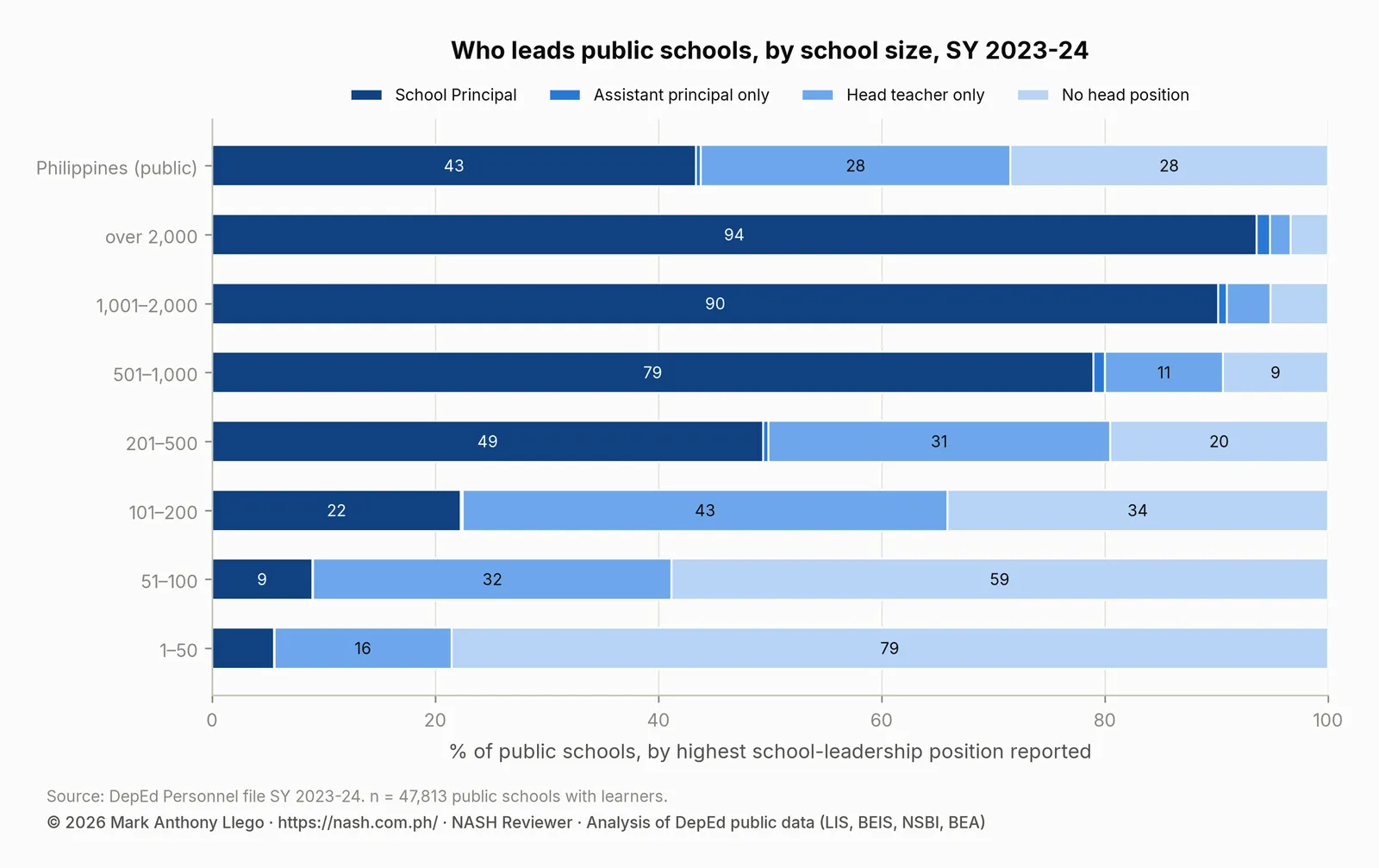
Question 31
Indicator 4.1.1, Personal and professional development. Career Stage 1, Situational, Easy.
You are a head teacher who took the NASH. Your Individual Development Report shows a score above 65 overall and in four domains, but below 65 in Managing School Operations and Resources. A colleague recommends a private review center that claims to know the examination’s content. What is the most appropriate action?
- A. Re-read the PPSSH booklet from the first domain to the last and attend every division training offered this year, so that all five domains are covered again before the next assessment.
- B. Keep the report in your application file, since a score above 65 overall and in four domains already makes you a prospective candidate for appointment as School Principal I.
- C. Enroll in the review center your colleague recommends, since access to the examination’s content is the surest way to raise the one domain that fell below the standard.
- D. Use the report to assess your practice against the Domain 2 indicators, set development goals, and seek coaching from an experienced principal on operations, as the memorandum encourages.
Answer and explanation
Best answer: D. Points: A = 2, B = 1, C = 0, D = 3.
- A (2 points, Multistructural). Study and training are useful, but covering every domain again ignores what the report identified and sets no goal.
- B (1 point, Unistructural). The level does make you a prospective candidate, but a developmental report that is filed rather than used is wasted.
- C (0 points, Prestructural). DepEd warns that it is not affiliated with anyone claiming access to examination content and that attempts to obtain it may bring administrative action.
- D (3 points, Relational). This is self-assessment against the standards, with goals and the coaching the NASH memorandum itself recommends.
Why. This aligns with Career Stage 1 expectations because indicator 4.1.1 asks the aspiring school head to conduct self-assessment of development needs using the PPSSH. DepEd Memorandum No. 069, s. 2025 describes the NASH as a developmental tool, provides an Individual Development Report, and strongly encourages coaching and mentoring with experienced principals; its item 14 warns against anyone claiming access to the examination’s content. The option that re-reads every domain and attends any training shows diligence but does not use the report to target the one domain that needs work.
Indicator 4.1.1: Conduct self-assessment of personal and professional development needs using the Philippine Professional Standards for School Heads.
Sources: DepEd Memorandum No. 069, s. 2025; DepEd Order No. 024, s. 2020.
Question 32
Indicator 4.2.1, Professional reflection and learning. Career Stage 1, Conceptual, Moderate.
A school head reflects on a year in which the school’s Grade 6 assessment mean rose by four points, from six sampled learners, while the reading screen showed no change in the share of Grade 1 to 3 learners at grade level. Which statement best shows professional reflection that improves practice?
- A. Record the four-point rise in the school report as the year’s main achievement, since the national assessment is the recognized measure of learning for the division’s purposes.
- B. Conclude that the reading screen is unreliable because it disagrees with the assessment result, and drop it from the school’s monitoring plan for the coming year.
- C. Treat the small-sample rise as inconclusive and ask why early reading did not move, since reflection should rest on the evidence that can actually show a change in practice.
- D. Credit the rise to the year’s reading program and plan to extend the program to more grades, while noting that the screen may have been administered differently by the teachers this year.
Answer and explanation
Best answer: C. Points: A = 1, B = 0, C = 3, D = 2.
- A (1 point, Unistructural). Recording the rise is reporting, not reflection; it asks nothing about what the year’s practice did for learners.
- B (0 points, Prestructural). Discarding the instrument that covers every learner because it disagrees with a six-learner mean removes the school’s best evidence.
- C (3 points, Relational). This reflects on the right evidence and turns the uncomfortable result into a question about practice, which is how reflection improves it.
- D (2 points, Multistructural). Looking for an explanation is reflective, but crediting a chance-sized rise and doubting the fuller measure reverses the weight of the evidence.
Why. This aligns with Career Stage 1 expectations because indicator 4.2.1 asks the aspiring school head to understand how professional reflection improves practice, and reflection needs evidence that can show change. The data reports give a six-learner Grade 6 mean a margin of error of about six points, so a four-point rise is within chance, while the reading screen covers every learner and is the measure the National Education Plan’s targets use. The option that credits the program and doubts the screen reflects, but on the weaker evidence.
Indicator 4.2.1: Demonstrate understanding of how professional reflection and learning can be used in improving practice.
Sources: NASH Reviewer, Philippine basic education in numbers (DepEd public datasets, SY 2017-18 to SY 2025-26); DepEd Order No. 024, s. 2020.
Question 33
Indicator 4.3.1, Professional networks. Career Stage 1, Situational, Easy.
You are a newly appointed School Principal I in a division where between-school differences in reading results are large and between-division differences explain about a quarter of the variation. The division has a learning community of school heads that shares reading-screen profiles each quarter. Your schedule is full. What is the most appropriate action?
- A. Decline for now and revisit the invitation next year, since a new school head should master the school’s own operations before comparing it with other schools in the division.
- B. Join the community and bring your school’s reading profile, since schools in the same division are the most useful comparison for your practice and the exchange is job-embedded learning.
- C. Attend the regional conference for school heads once a year instead of the division’s meetings, since a wider network offers more ideas than one division’s group can provide.
- D. Join the community’s online group and read the shared profiles when time allows, since the quarterly meetings would take you away from the school too often in your first year as its head.
Answer and explanation
Best answer: B. Points: A = 0, B = 3, C = 1, D = 2.
- A (0 points, Prestructural). Waiting to be ready misreads networks as a reward for competence rather than a means of acquiring it.
- B (3 points, Relational). This seeks the network most likely to improve practice and contributes to it, which is what the indicator asks of an aspiring or new school head.
- C (1 point, Unistructural). A conference is a network of a kind, but it cannot compare your school with the ones that resemble it.
- D (2 points, Multistructural). Reading the profiles has value, but a network improves practice through exchange, and the school’s own profile is never shared.
Why. This aligns with Career Stage 1 expectations because indicator 4.3.1 asks the school head to seek opportunities to improve practice through professional networks. The data reports find that between-division differences explain about a quarter of the variation in assessment means and advise benchmarking within the division because a regional comparison tells you less than the school next door; EDCOM II’s Final Report asks NEAP to expand professional learning communities for school heads. The option that joins online but never attends keeps a connection but forgoes the exchange that makes a network developmental.
Indicator 4.3.1: Seek opportunities to improve one’s practice as a school leader through professional networks.
Sources: NASH Reviewer, Philippine basic education in numbers (DepEd public datasets, SY 2017-18 to SY 2025-26); EDCOM II Final Report, Turning Point: A Decade of Necessary Reform (2026-2035), January 2026; DepEd Order No. 024, s. 2020.
Question 34
Indicator 4.4.1, Performance management. Career Stage 1, Conceptual, Moderate.
Under the performance management system, division offices contextualize the objectives in school heads’ performance commitment forms, and promotion and completion rates have been common headline targets. Teachers report that these targets discourage honest grading. Which statement best reflects a school head’s understanding of the system’s purpose?
- A. The system exists to improve performance, so objectives should be set on learning results the school can measure reliably and on the support delivered, within the division’s contextualized form.
- B. The system rewards the targets the division sets in its contextualized form, so the school head should meet the promotion and completion targets and add a reading target as a separate objective.
- C. The system measures compliance with the division’s targets, so the school head should keep the promotion rate high by discouraging failing marks, since a low rate lowers the rating.
- D. The system requires evidence for every objective in the form, so the school head should compile the means of verification for the targets already in it before the review.
Answer and explanation
Best answer: A. Points: A = 3, B = 2, C = 0, D = 1.
- A (3 points, Relational). This connects the system’s purpose, improvement, to objectives that can show it, within the division’s authority to contextualize the form.
- B (2 points, Multistructural). Adding a reading target is a step, but keeping promotion-rate targets as the headline preserves the incentive the teachers describe.
- C (0 points, Prestructural). Discouraging failing marks to protect a rate is the mass-promotion practice EDCOM II documents, and it falsifies what learners have learned.
- D (1 point, Unistructural). Means of verification are required, but compiling evidence for targets that do not measure improvement is compliance, not performance management.
Why. This aligns with Career Stage 1 expectations because indicator 4.4.1 asks the aspiring school head to understand how the performance management system improves personnel and office performance. EDCOM II’s Final Report finds that the OPCR for principals lacks standardization and that promotion, completion and dropout rates used as headline metrics pressure principals to maintain high promotion rates, and it calls for objectives that reward effective remediation and truthful reporting. The option that keeps the promotion targets and adds a reading target uses the form but leaves its purpose unconnected to learning.
Indicator 4.4.1: Demonstrate knowledge and understanding of the implementation of the performance management system in improving school personnel and office performance.
Sources: EDCOM II Final Report, Turning Point: A Decade of Necessary Reform (2026-2035), January 2026; DepEd Order No. 024, s. 2020.
Question 35
Indicator 4.4.2, Performance management. Career Stage 2, Situational, Moderate.
You are the school head of an elementary school. A Grade 2 teacher’s performance review shows a 100 percent promotion rate for three years, while the reading screen shows that half of their learners ended the year at the lowest level. The teacher’s self-rating is outstanding. The mid-year review is due. What is the most appropriate action?
- A. Lower the teacher’s rating to unsatisfactory because of the reading results, without discussion, since the record should reflect what the learners actually achieved during the year.
- B. Rate the teacher as proposed for the first half, since the agreed targets were met, and add a note to the form that reading outcomes will be included among next year’s objectives for the teacher and the grade.
- C. Ask the teacher to submit the reading screen results as an additional means of verification for the review, and complete the mid-year rating on that basis without further discussion.
- D. Discuss the gap between the promotion rate and the reading profile in the review, agree on learning-based objectives with coaching for the second half, and document the plan with the teacher.
Answer and explanation
Best answer: D. Points: A = 0, B = 2, C = 1, D = 3.
- A (0 points, Prestructural). A unilateral rating without discussion breaches the review’s process and treats a developmental tool as a punishment.
- B (2 points, Multistructural). Honoring the agreed targets is fair, but deferring the reading evidence for a year leaves the learners and the teacher’s practice unchanged now.
- C (1 point, Unistructural). Collecting the screen results is one step, but a review that stops at the file does not help the teacher improve.
- D (3 points, Relational). This implements the system as a development process with the teacher, grounded in evidence and ending in an agreed plan.
Why. This aligns with Career Stage 2 expectations because indicator 4.4.2 asks the school head to implement the performance management system with a team to support personnel and improve performance. EDCOM II’s Final Report finds that the current RPMS and OPCRF reward promotion statistics and asks that they be realigned so indicators reward effective remediation and truthful reporting, with the revised instruments scheduled for 2027 onward; a school head can already set the review conversation on learning evidence. The option that rates as proposed and defers reading outcomes keeps faith with the agreed targets but leaves the gap for another year.
Indicator 4.4.2: Implement the performance management system with a team to support the career advancement of school personnel, and to improve office performance.
Sources: EDCOM II Final Report, Turning Point: A Decade of Necessary Reform (2026-2035), January 2026; NASH Reviewer, Philippine basic education in numbers (DepEd public datasets, SY 2017-18 to SY 2025-26); DepEd Order No. 024, s. 2020.
Question 36
Indicator 4.5.1, Professional development of school personnel. Career Stage 1, Conceptual, Easy.
A school’s faculty is eight teachers at Teacher I to III and no master teacher, which is common in small elementary schools, and its Grade 1 reading screen shows 57 percent of learners at the lowest level. Which statement best explains how professional development should address the gap?
- A. Development should wait until a master teacher item is filled for the school, since professional development is the master teacher’s function under the staffing standards.
- B. Development should begin with a general training-needs survey of the whole faculty, since teachers know best what they want to learn and the survey is required for the training plan.
- C. Development should target the specific need, early-grade reading for the Grade 1 and 2 teachers, through coaching, learning action cells and division training tied to the screen’s results.
- D. Development should send every teacher to the division’s annual training program and the regional reading congress, since all of them will teach reading at some point in their careers at the school.
Answer and explanation
Best answer: C. Points: A = 0, B = 1, C = 3, D = 2.
- A (0 points, Prestructural). Development is the school head’s responsibility now; waiting for an item leaves the Grade 1 teachers and their learners without support.
- B (1 point, Unistructural). A needs survey is a tool, but the need is already visible in the screen; starting from preferences delays the response.
- C (3 points, Relational). This connects development to an identified performance gap and to the forms that address it in the school, which is the understanding the indicator asks for.
- D (2 points, Multistructural). Training everyone is inclusive, but a general program is not tied to the gap the data show or to the teachers who face it.
Why. This aligns with Career Stage 1 expectations because indicator 4.5.1 asks the aspiring school head to understand professional development that addresses performance gaps among personnel. The personnel data show 91 percent of elementary positions at Teacher I to III and master teachers at 7.6 percent of nationally funded positions, and the reading data put 55 percent of Grade 1 learners at the lowest level; EDCOM II’s Final Report asks that in-service training emphasize early-grade literacy and numeracy. The option that sends everyone to the annual program provides development but not the kind the gap requires.
Indicator 4.5.1: Demonstrate knowledge and understanding of professional development in enhancing strengths and in addressing performance gaps among school personnel.
Sources: NASH Reviewer, Philippine basic education in numbers (DepEd public datasets, SY 2017-18 to SY 2025-26); EDCOM II Final Report, Turning Point: A Decade of Necessary Reform (2026-2035), January 2026; DepEd Order No. 024, s. 2020.
Question 37
Indicator 4.5.2, Professional development of school personnel. Career Stage 2, Situational, Moderate.
You are the school head of an elementary school planning the mid-year in-service training. The division’s menu offers sessions on classroom management, ICT integration and early numeracy. Your Grade 3 assessment shows Numeracy as the weakest component and your reading screen shows the widest gaps in Grade 1. Teachers ask for ICT integration because the school recently received tablets. What is the most appropriate action?
- A. Cancel the in-service training and use the days for remedial classes with the learners, since the learners’ gaps are more urgent than the teachers’ training this year.
- B. Run all three sessions in equal time blocks so that every request is honored, and ask the teachers to submit written reflections on each session afterward for the training file and the division’s report.
- C. Choose early numeracy and early reading as the core sessions, pair them with learning action cells that apply them in Grades 1 to 3, and fit ICT integration in as a tool for those lessons.
- D. Choose ICT integration as the teachers requested, since the tablets are new and unused and teacher ownership of the topic improves the training’s uptake in the classrooms.
Answer and explanation
Best answer: C. Points: A = 0, B = 2, C = 3, D = 1.
- A (0 points, Prestructural). Canceling mandated in-service training removes the development the gaps call for and does not make the remedial classes better taught.
- B (2 points, Multistructural). Equal blocks feel fair, but the training is not prioritized by the gaps and reflections alone do not carry it into practice.
- C (3 points, Relational). This implements development that addresses the identified gaps, applies it in classrooms, and still honors the teachers’ request where it serves learning.
- D (1 point, Unistructural). Ownership matters, but choosing the session by the arrival of devices leaves the numeracy and reading gaps unaddressed.
Why. This aligns with Career Stage 2 expectations because indicator 4.5.2 asks the school head to implement professional development that addresses performance gaps. The data reports find Numeracy the weakest Grade 3 component in every region and Grade 1 the widest reading gap, and find computers per learner unassociated with results; EDCOM II’s Final Report asks that in-service training be responsive to grade-level and developmental needs, with emphasis on early-grade literacy and numeracy. The option that runs all three sessions equally honors requests but does not prioritize by the evidence or build in classroom application.
Indicator 4.5.2: Implement professional development initiatives to enhance strengths and address performance gaps among school personnel.
Sources: NASH Reviewer, Philippine basic education in numbers (DepEd public datasets, SY 2017-18 to SY 2025-26); EDCOM II Final Report, Turning Point: A Decade of Necessary Reform (2026-2035), January 2026; DepEd Order No. 024, s. 2020; Executive Order No. 174, s. 2022; Republic Act No. 12288.
Question 38
Indicator 4.6.1, Leadership development in individuals and teams. Career Stage 1, Situational, Difficult.
You are the school head of a large elementary school with more than 1,000 learners, a Head Teacher III, two master teachers and no Assistant School Head Designate yet. Nearly half of the division’s schools have no principal item, new principal items are being created each year, and first appointment to School Principal requires passing the school head assessment. You are asked to identify staff for leadership development. What is the most appropriate action?
- A. Designate the Head Teacher III as Assistant School Head now by school memorandum, since the school needs the help immediately for its operations.
- B. Map each candidate’s qualifications and demonstrated leadership against the PPSSH, then plan coaching with assignments that prepare them for the assessment as well as the designation.
- C. Post the division’s announcement of the next assessment batch on the faculty board, and let the interested teachers apply on their own through the division’s human resource office.
- D. Nominate the Head Teacher III for the next assessment batch on the basis of seniority, and ask the two master teachers whether they would consider administration later in their careers.
Answer and explanation
Best answer: B. Points: A = 0, B = 3, C = 1, D = 2.
- A (0 points, Prestructural). An Assistant School Head Designate needs an Official Designation Order signed by the schools division superintendent; the school head cannot make the designation by memorandum.
- B (3 points, Relational). This identifies potential against the standards the roles require and connects it to development, which is what the indicator asks.
- C (1 point, Unistructural). Posting the announcement informs, but it identifies no one and develops no one.
- D (2 points, Multistructural). Nominating and asking are steps, but seniority is not potential, and nothing prepares anyone for what the assessment measures.
Why. This aligns with Career Stage 1 expectations because indicator 4.6.1 asks the aspiring school head to identify strengths, capabilities and potentials of individuals for leadership roles. DepEd Memorandum No. 069, s. 2025 names head teachers, assistant school principals and teachers-in-charge who meet the qualification standards as NASH takers and ties first appointment to a pass, and EDCOM II’s Final Report plans 22,124 new principal items from 2026 to 2028 while asking for succession planning linked to the career progression system. The option that nominates by seniority acts but identifies potential by the wrong measure and prepares no one.
Indicator 4.6.1: Identify strengths, capabilities and potentials of individuals and teams in performing leadership roles and responsibilities.
Sources: DepEd Memorandum No. 069, s. 2025; EDCOM II Final Report, Turning Point: A Decade of Necessary Reform (2026-2035), January 2026; NASH Reviewer, Philippine basic education in numbers (DepEd public datasets, SY 2017-18 to SY 2025-26); DepEd Order No. 024, s. 2020; DepEd Order No. 024, s. 2025, Encl. No. 1, Sec. 36(d).
Question 39
Indicator 4.7.1, General welfare of human resources. Career Stage 1, Conceptual, Moderate.
A 2025 law institutionalized the career progression system that began under a 2022 executive order, with a Classroom Teaching line and a School Administration line, and a 2024 DepEd order removed administrative tasks from teachers. Which statement best reflects a school head’s knowledge of what these issuances mean for the welfare of the faculty?
- A. Teachers can advance in the Classroom Teaching line without the school head assessment, but administrative tasks may still be assigned to them whenever the school has no support staff and the reports are due.
- B. Teachers can advance within teaching without leaving the classroom, and their workload should exclude administrative tasks, so the school head protects both in load assignments and in career advice.
- C. Teachers may no longer be given administrative tasks of any kind, so the school head should take all of them on personally until support items for the school arrive from the division.
- D. The issuances do not change the school’s practice until the division issues its own guidelines on them, so the school head should continue assigning administrative tasks as before.
Answer and explanation
Best answer: B. Points: A = 2, B = 3, C = 1, D = 0.
- A (2 points, Multistructural). The career line point is right, but the workload order transferred the tasks to school heads and non-teaching staff, not back to teachers when staff are short.
- B (3 points, Relational). This states what each issuance gives teachers and what the school head must do to make it real, which is the knowledge of welfare provisions the indicator asks for.
- C (1 point, Unistructural). The removal is correctly understood, but the order shares the tasks with non-teaching personnel; absorbing everything personally is neither required nor sustainable.
- D (0 points, Prestructural). A DepEd order in force binds the school; waiting for division guidelines to apply it keeps teachers on tasks the policy removed.
Why. This aligns with Career Stage 1 expectations because indicator 4.7.1 asks the aspiring school head to know the laws and issuances on personnel’s rights, privileges and benefits. EDCOM II’s Final Report records the passage of Republic Act No. 12288 on September 12, 2025, institutionalizing the Expanded Career Progression System of Executive Order No. 174, s. 2022, with its two career lines, Classroom Teaching and School Administration (EO 174, Secs. 2 and 3; RA 12288, Sec. 7), and DepEd Order No. 002, s. 2024, which transferred administrative tasks from teachers to school heads and non-teaching personnel. The option that keeps assigning tasks when staff are short understands the career lines but misreads the workload order.
Indicator 4.7.1: Display knowledge of laws, policies, guidelines and issuances on the rights, privileges and benefits of school personnel to promote their general welfare.
Sources: EDCOM II Final Report, Turning Point: A Decade of Necessary Reform (2026-2035), January 2026; DepEd Order No. 024, s. 2020.
Question 40
Indicator 4.8.1, Rewards and recognition mechanism. Career Stage 1, Situational, Easy.
You are the school head of an elementary school. At the end of the year, the Grade 1 teacher’s class moved from 60 percent to 25 percent of learners at the lowest reading level, with every learner screened, while another teacher reports a 100 percent promotion rate with no reading data. You are planning the recognition program. What is the most appropriate action?
- A. Rank all teachers by their sections’ assessment means from the sampled learners and recognize the top three at the program, since the national test is the fairest basis for comparison.
- B. Recognize both teachers equally at the program, since each met a performance indicator, and announce that documented reading gains will become a criterion for next year’s recognition program and awards.
- C. Recognize the Grade 1 teacher for the documented reading gains, state the evidence publicly so that the criteria are clear, and recognize the parents and barangay partners who supported the sessions.
- D. Give the Grade 1 teacher a certificate at the faculty meeting for the reading gains, and keep the program’s other awards on the usual indicators of promotion and attendance.
Answer and explanation
Best answer: C. Points: A = 0, B = 2, C = 3, D = 1.
- A (0 points, Prestructural). Means from a handful of sampled learners cannot rank sections; recognition on that basis is arbitrary and teaches the faculty to chase noise.
- B (2 points, Multistructural). Announcing the new criterion is good, but equal recognition tells the faculty that a promotion rate without evidence counts the same as documented gains.
- C (3 points, Relational). This rewards exemplary performance on evidence, makes the criteria transparent, and recognizes the stakeholders who supported it.
- D (1 point, Unistructural). A certificate recognizes the teacher, but quietly, and the program’s criteria go on rewarding the wrong things.
Why. This aligns with Career Stage 1 expectations because indicator 4.8.1 asks the aspiring school head to reward and recognize learners, personnel and stakeholders for exemplary performance and support. EDCOM II’s Final Report finds that performance systems have historically rewarded high pass rates rather than accurate reporting of learning gaps and asks that they reward effective remediation and truthful reporting; the data reports show why sampled assessment means cannot rank sections. The option that recognizes both teachers equally adds a future criterion but rewards an undocumented rate now.
Indicator 4.8.1: Reward and recognize learners, school personnel and other stakeholders for exemplary performance and/ or support.
Sources: EDCOM II Final Report, Turning Point: A Decade of Necessary Reform (2026-2035), January 2026; NASH Reviewer, Philippine basic education in numbers (DepEd public datasets, SY 2017-18 to SY 2025-26); DepEd Order No. 024, s. 2020.
Domain 5: Building Connections (Questions 41 to 50)
These items rest on the following findings. Indigenous Peoples (IP) learners are 9.3% of public-school learners and 71.9% in CAR. Learners in Arabic Language and Islamic Values Education (ALIVE) classes are 18.2% of BARMM’s learners. Parent-teacher associations (PTAs) paid for 0.1% of academic computers, and local government units (LGUs) and the Special Education Fund paid for 32.7%. Internet reaches 78% of public schools and 90% of learners. EDCOM II reports that about 10% of Indigenous Peoples and 20% of Muslim learners lack birth registration, that 45 divisions have no engineer, and that Pasay City’s locally funded reading teachers produced documented gains.
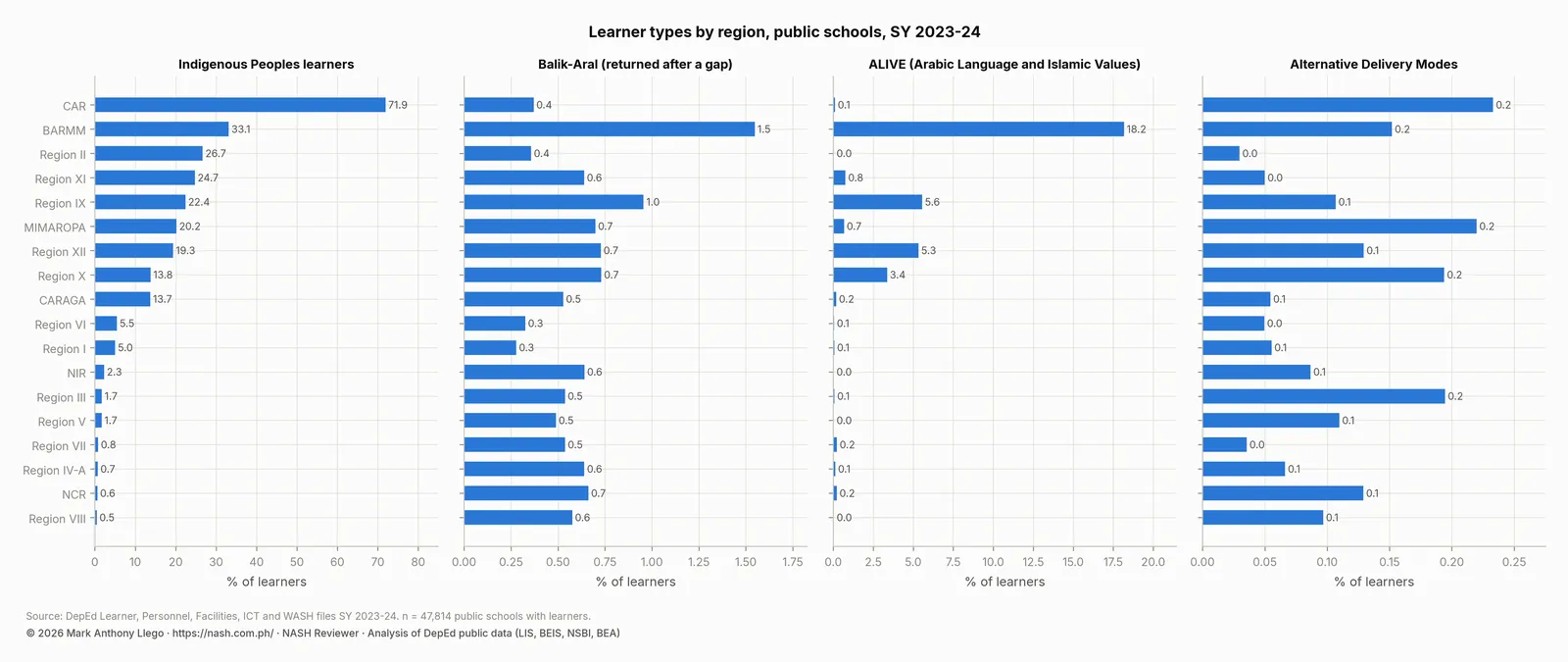
Question 41
Indicator 5.1.1, Management of diverse relationships. Career Stage 1, Situational, Moderate.
You are a head teacher serving as teacher-in-charge of a small school. The building tagged for major repair has not been scheduled, and the division has no engineer assigned to your district this year. The district supervisor visits monthly, the municipal engineer has offered to inspect, and the local school board meets next month. What is the most appropriate action?
- A. Ask the municipal engineer to inspect and repair the building through the municipality’s own funds, and inform the division afterward so that the inventory and its programming can be updated for next year.
- B. Wait for the division to assign an engineer to the district, since facilities are the division’s responsibility and the school should not involve other authorities in the repair.
- C. Raise the repair with the district supervisor for the division’s programming, use the municipal engineer’s inspection as evidence, and bring both to the local school board for counterpart support.
- D. Write to the division office requesting a schedule for the repair of the building, and wait for its reply before approaching anyone else about the matter, since facilities are its responsibility.
Answer and explanation
Best answer: C. Points: A = 2, B = 0, C = 3, D = 1.
- A (2 points, Multistructural). The municipality can help, but a repair done outside the division’s programming and before it is informed bypasses the office accountable for the building.
- B (0 points, Prestructural). Facilities involve the LGU by law; refusing to engage other authorities leaves learners in an unrepaired building.
- C (3 points, Relational). This deals with each authority in its proper role and connects them so that the repair moves, which is the skill the indicator describes.
- D (1 point, Unistructural). A written request is one correct step, but waiting on it alone leaves two willing partners unused.
Why. This aligns with Career Stage 1 expectations because indicator 5.1.1 asks the aspiring school head to demonstrate skills in dealing with authorities and stakeholders to support learners. EDCOM II’s Final Report finds that 45 divisions lack engineers, that division engineers’ roles are set by DepEd Order No. 018, s. 2023, that the Local Government Code assigns school buildings to LGUs while DepEd also mandates them, and it supports LGU counterpart construction. The option that has the municipality repair the building first gets help but sidesteps the division’s accountability and programming.
Indicator 5.1.1: Demonstrate skills in dealing with authorities, colleagues, parents and other stakeholders to encourage an enabling and supportive environment for learners.
Sources: EDCOM II Final Report, Turning Point: A Decade of Necessary Reform (2026-2035), January 2026; DepEd Order No. 024, s. 2020.
Question 42
Indicator 5.1.2, Management of diverse relationships. Career Stage 2, Situational, Difficult.
You are the school head of an elementary school. A parent arrives angry that a Grade 3 teacher gave their child a failing mark and required remediation, and threatens to file a child protection complaint. The teacher’s records show the assessments and two unanswered invitations to a conference. The child’s reading screen is at the lowest level. What is the most appropriate action?
- A. Meet the parent and explain the grading policy and the teacher’s records, then refer the complaint to the division’s legal unit so that the teacher is protected from the threat of a case.
- B. Promise the parent that the mark will be reviewed and raised if the child attends two remediation sessions, so that the complaint is withdrawn and the matter ends quietly.
- C. Ask the teacher to meet the parent and settle the matter directly with them, since grading and remediation are the teacher’s responsibility and you were not present in the class.
- D. Meet the parent calmly, review the records and the child’s reading level together, agree on the remediation plan and the parent’s part in it, and document the meeting for both parties.
Answer and explanation
Best answer: D. Points: A = 2, B = 0, C = 1, D = 3.
- A (2 points, Multistructural). Explaining the records is right, but escalating a threat to the legal unit before any conversation hardens the conflict and leaves the child’s reading unaddressed.
- B (0 points, Prestructural). Trading a grade for attendance to end a complaint falsifies the learner’s record and is the inducement no school head may offer.
- C (1 point, Unistructural). The teacher is a party to the conflict; sending the parent back to them abdicates the school head’s role in the relationship.
- D (3 points, Relational). This builds the relationship around the child’s actual need, with evidence and shared responsibility, and protects teacher and parent by documenting it.
Why. This aligns with Career Stage 2 expectations because indicator 5.1.2 asks the school head to build constructive relationships with parents to foster a supportive environment for learners. EDCOM II’s Final Report records teachers being confronted or threatened by parents when they assign failing marks, with the child protection policy sometimes used adversarially, and finds that parental engagement reduces the odds of low performance. The option that explains and refers to the legal unit protects the teacher but treats the parent as an adversary and leaves the remediation unplanned.
Indicator 5.1.2: Build constructive relationships with authorities, colleagues, parents and other stakeholders to foster an enabling and supportive environment for learners.
Sources: EDCOM II Final Report, Turning Point: A Decade of Necessary Reform (2026-2035), January 2026; DepEd Order No. 024, s. 2020.
Question 43
Indicator 5.2.1, Management of school organizations. Career Stage 1, Conceptual, Easy.
Parent-teacher associations paid for 0.1 percent of public schools’ academic computers, while local governments and the Special Education Fund paid for a third. A regional study links parents’ frequent engagement with their children’s schoolwork to lower odds of low performance. Which statement best explains the role of a parent-teacher association under the policies on school organizations?
- A. The association’s main role is fund-raising for the school’s needs during the year, so the school head should set its annual targets and account for the funds to the parents at the general assembly.
- B. The association supports institutional goals mainly through parents’ engagement with learning and attendance, managed transparently under its guidelines, not as the school’s equipment fund.
- C. The association exists to hold the general assembly each year and to elect its officers, at which the school head reports the school’s performance to the parents who attend.
- D. The association’s funds may be used at the school head’s discretion for urgent needs of the school, since the school head is accountable for the school’s operations under the law.
Answer and explanation
Best answer: B. Points: A = 2, B = 3, C = 1, D = 0.
- A (2 points, Multistructural). Accounting to the assembly is right, but defining the association by fund-raising ignores the engagement the evidence links to learning.
- B (3 points, Relational). This places the association where the evidence and the standards put it, on engagement, and keeps its management transparent.
- C (1 point, Unistructural). The assembly is one function, but reporting to parents is not the association’s purpose.
- D (0 points, Prestructural). An association’s funds are the association’s, managed by its officers under its guidelines; discretionary use by the school head breaches transparency and accountability.
Why. This aligns with Career Stage 1 expectations because indicator 5.2.1 asks the aspiring school head to understand the policies on managing school organizations such as parent-teacher associations in support of institutional goals. The ICT data show PTAs paid for 0.1 percent of academic computers against 32.7 percent from LGUs and the Special Education Fund, and EDCOM II’s Final Report cites SEA-PLM evidence that parental engagement independently reduces the risk of low performance. The option that casts the association as a fund-raiser gets accountability right but misplaces its contribution.
Indicator 5.2.1: Demonstrate knowledge and understanding of policies and guidelines on managing school organizations, such as learner organizations, faculty clubs and parent-teacher associations, in support of the attainment of institutional goals.
Sources: NASH Reviewer, Philippine basic education in numbers (DepEd public datasets, SY 2017-18 to SY 2025-26); EDCOM II Final Report, Turning Point: A Decade of Necessary Reform (2026-2035), January 2026; DepEd Order No. 024, s. 2020.
Question 44
Indicator 5.3.1, Inclusive practice. Career Stage 1, Conceptual, Moderate.
Indigenous Peoples learners are 9 percent of public-school learners nationally and more than 70 percent in one region. Studies report that about one in ten Indigenous Peoples and one in five Muslim learners lack birth registration, which restricts enrollment and access to social protection. Which statement best reflects inclusive practice for a school head?
- A. Refer the families to the civil registrar for the registration and ask them to return to enroll the learners when the registration has been completed and the certificate issued.
- B. Enroll the learners while working with the local civil registrar and the community to complete their registration, and plan materials and language support for the groups actually present.
- C. Enroll the learners and refer the parents to the civil registrar for the registration, and treat the language and materials of instruction as a matter for the division’s program office to handle.
- D. Require a birth certificate before enrollment, since the learner information system needs the document and the school cannot be faulted by the division for following the requirement.
Answer and explanation
Best answer: B. Points: A = 1, B = 3, C = 2, D = 0.
- A (1 point, Unistructural). A referral helps, but turning the family away until it is done keeps the child out of school.
- B (3 points, Relational). This removes the barrier, keeps the learner in school meanwhile, and makes the school’s practice responsive to the learners’ cultures and languages.
- C (2 points, Multistructural). Enrolling and referring are right, but culture-responsive materials and language support are the school’s practice, not only the division’s.
- D (0 points, Prestructural). Refusing enrollment for a missing document excludes the learners inclusion exists to protect, contrary to the standards’ inclusivity principle.
Why. This aligns with Career Stage 1 expectations because indicator 5.3.1 asks the aspiring school head to understand inclusive practices such as culture responsiveness. The learner data show Indigenous Peoples learners at 9.3 percent nationally and 71.9 percent in CAR, and EDCOM II’s Final Report reports that about 20 percent of Muslim ethnic groups and 10 percent of IPs lack birth registration, restricting enrollment, and recommends culturally responsive materials and coordination with the PSA and LGUs to resolve documentation barriers. The option that enrolls and refers but leaves language and materials to the division gets access right but not responsiveness.
Indicator 5.3.1: Demonstrate knowledge and understanding of inclusive practices, such as gender sensitivity, physical and mental health awareness and culture responsiveness, to foster awareness, acceptance and respect.
Sources: NASH Reviewer, Philippine basic education in numbers (DepEd public datasets, SY 2017-18 to SY 2025-26); EDCOM II Final Report, Turning Point: A Decade of Necessary Reform (2026-2035), January 2026; DepEd Order No. 024, s. 2020.
Question 45
Indicator 5.3.2, Inclusive practice. Career Stage 2, Situational, Difficult.
You are the school head of an elementary school in a region where 18 percent of public-school learners attend Arabic Language and Islamic Values Education classes. Your school has 40 such learners, two learners with hearing impairment, and no inclusive learning resource center nearby. A teacher proposes scheduling the Arabic classes during the reading period so that they do not disrupt the other subjects. What is the most appropriate action?
- A. Excuse the 40 learners from the reading period, since their program is separate from the curriculum, and advise the parents of the two learners to enroll them in a special school in the city.
- B. Approve the teacher’s schedule as a practical compromise for this year, and remind the faculty to treat the 40 learners and the two learners with hearing impairment with respect in every class.
- C. Schedule the Arabic classes outside the reading period, arrange screening and referral for the two learners through the division’s inclusive education unit, and brief the faculty on inclusion.
- D. Keep the Arabic classes outside the reading period and request a special education teacher for the two learners from the division, without screening or referral through the division’s inclusive education unit.
Answer and explanation
Best answer: C. Points: A = 0, B = 1, C = 3, D = 2.
- A (0 points, Prestructural). Excusing one group from reading and sending another away denies both the education the school exists to provide.
- B (1 point, Unistructural). Respect is necessary, but a schedule that removes 40 learners from reading is exclusion by timetable.
- C (3 points, Relational). This protects every learner’s access to reading, routes the two learners to the support system, and makes inclusion a faculty practice.
- D (2 points, Multistructural). Protecting reading and requesting a teacher are right, but without screening and referral the request rests on nothing and the learners wait.
Why. This aligns with Career Stage 2 expectations because indicator 5.3.2 asks the school head to exhibit inclusive practices such as culture responsiveness and health awareness. The learner data show ALIVE learners at 18.2 percent of BARMM’s learners, and EDCOM II’s Final Report finds inclusive learning resource centers under Republic Act No. 11650 unevenly staffed and calls for standardized screening, teacher training on identification and referral, and a multi-tiered system of support. The option that protects reading and requests a teacher without screening does several right things but skips the referral that the support depends on.
Indicator 5.3.2: Exhibit inclusive practices, such as gender sensitivity, physical and mental health awareness and culture responsiveness, to foster awareness, acceptance and respect.
Sources: NASH Reviewer, Philippine basic education in numbers (DepEd public datasets, SY 2017-18 to SY 2025-26); EDCOM II Final Report, Turning Point: A Decade of Necessary Reform (2026-2035), January 2026; DepEd Order No. 024, s. 2020.
Question 46
Indicator 5.4.1, Communication. Career Stage 1, Situational, Moderate.
You are a head teacher asked to write the school’s results summary for parents. The school’s Grade 6 assessment mean was 52 from six sampled learners, with a margin of error of about six points, against a division mean of 60. The Grade 3 mean was 58 from 22 learners. The reading screen, which covered every learner, shows 20 percent of Grade 1 to 3 learners at grade level. What is the most appropriate action?
- A. Report the Grade 6 mean as the school’s rank in the division, since parents understand rankings, and add that the school will aim for a higher rank next year.
- B. Report the Grade 3 and Grade 6 means against the division’s means with a short explanation of each test, and attach the reading screen’s table for the parents who want more detail.
- C. Report the reading screen’s result and leave the two assessment means out of the summary, so that parents are not confused by results from small samples.
- D. Report each result with its number of learners and what it can show, present the reading screen as the fullest picture, and state the school’s targets and next steps in plain language.
Answer and explanation
Best answer: D. Points: A = 0, B = 2, C = 1, D = 3.
- A (0 points, Prestructural). A rank built on six sampled learners is not a result; presenting it as one misinforms parents and sets a meaningless target.
- B (2 points, Multistructural). Explaining the tests helps, but leading with sampled means and relegating the full-coverage screen reverses the weight of the evidence.
- C (1 point, Unistructural). Avoiding confusion is a fair aim, but withholding results parents will hear about elsewhere is not communication.
- D (3 points, Relational). This communicates each number with its base and its limits and leads with the evidence that covers every learner, which is competent written communication of data.
Why. This aligns with Career Stage 1 expectations because indicator 5.4.1 asks the aspiring school head to demonstrate competent skills in writing for parents and stakeholders, and data communication is part of that competence. The data reports set three rules for honest communication of school data: state the base, state the uncertainty, and state what the number cannot show, and they estimate a six-learner Grade 6 mean’s margin at about six points. The option that reports the means with explanations and attaches the screen informs but orders the evidence by status rather than by what it shows.
Indicator 5.4.1: Demonstrate competent skills in speaking and writing, as well as in utilizing communication platforms, in communicating with teachers, learners, parents and other stakeholders.
Sources: NASH Reviewer, Philippine basic education in numbers (DepEd public datasets, SY 2017-18 to SY 2025-26); DepEd Order No. 024, s. 2020.
Question 47
Indicator 5.4.2, Communication. Career Stage 2, Situational, Moderate.
You are the school head of an elementary school. A local social media page posts a list ranking the division’s schools by their Grade 6 assessment means and places your school last. Your mean came from five sampled learners, and your reading screen shows gains in every grade this year. Parents are asking questions at the gate. What is the most appropriate action?
- A. Issue a clear statement through the school’s channels explaining what the mean rests on and sharing the reading gains, and invite the parents to a meeting on the school’s plan.
- B. Post a reply on the page disputing the division’s data, and name the five learners’ sections as the cause of the low mean so that parents know where the problem lies.
- C. Post the reading screen’s gains on the school’s page without addressing the ranking directly, and ask the teachers to reassure any parents who raise the issue with them at the gate.
- D. Ask the page’s administrator to take the post down, since the ranking misrepresents the school and its learners, and say nothing further to the parents until it is removed.
Answer and explanation
Best answer: A. Points: A = 3, B = 0, C = 2, D = 1.
- A (3 points, Relational). This communicates through the school’s own platforms, explains the data honestly, and turns the moment into engagement with parents.
- B (0 points, Prestructural). Identifying the tested learners’ sections exposes children to blame and breaches the confidentiality a school head owes them.
- C (2 points, Multistructural). Sharing the gains is right, but ignoring the ranking leaves the parents’ actual question unanswered and the teachers to carry it.
- D (1 point, Unistructural). Requesting removal is a reaction, not communication; parents at the gate learn nothing from it.
Why. This aligns with Career Stage 2 expectations because indicator 5.4.2 asks the school head to communicate effectively with parents and stakeholders through positive use of communication platforms. The data reports show that a Grade 6 mean from five sampled learners carries a margin of about seven points and that raw school means cannot rank schools, and they advise reporting a school’s reading profile rather than a rank. The option that posts the gains but ignores the ranking uses the platform well but avoids the question parents are asking.
Indicator 5.4.2: Communicate effectively in speaking and in writing to teachers, learners, parents and other stakeholders, through positive use of communication platforms, to facilitate information sharing, collaboration and support.
Sources: NASH Reviewer, Philippine basic education in numbers (DepEd public datasets, SY 2017-18 to SY 2025-26); DepEd Order No. 024, s. 2020.
Question 48
Indicator 5.5.1, Community engagement. Career Stage 1, Situational, Moderate.
You are a head teacher in a municipality whose local school board has unspent Special Education Fund. Half of your Grade 1 learners are at the lowest reading level, the school has no reading teacher, and a city in another region has run level-based reading sessions with locally funded reading teachers for twenty years with documented gains. The board meets in two weeks. What is the most appropriate action?
- A. Charge each parent a small monthly fee for a tutor’s honorarium, since parents are the stakeholders most directly concerned with their children’s reading progress.
- B. Ask the municipal mayor informally for a reading tutor and start the sessions as soon as one is assigned, submitting the proposal to the board afterward for its records and approval.
- C. Write to the board requesting books and reading materials for the Grade 1 classes, since materials are what the fund usually covers for schools in the municipality.
- D. Prepare a proposal with the reading profile and the documented model, present it to the board for a locally funded reading tutor, and involve the barangay in attendance support.
Answer and explanation
Best answer: D. Points: A = 0, B = 2, C = 1, D = 3.
- A (0 points, Prestructural). Charging households shifts a public cost to families and excludes the poorest learners, contrary to the inclusivity the standards require.
- B (2 points, Multistructural). An informal request may work, but it bypasses the board that governs the fund and leaves the arrangement undocumented.
- C (1 point, Unistructural). Materials help, but the need identified is a teacher, and the fund can cover one.
- D (3 points, Relational). This involves the community’s institutions with evidence and a proven model, and brings the barangay in where attendance is decided.
Why. This aligns with Career Stage 1 expectations because indicator 5.5.1 asks the aspiring school head to involve the community and authorities in school programs to gain support for learner development. EDCOM II’s Final Report describes Pasay City’s two-decade partnership with its local government to deploy dedicated reading teachers and run daily level-based sessions, with almost all flagged non-readers progressing at least one level, and finds Special Education Fund resources widely unspent. The option that asks the mayor informally gains a tutor but outside the board’s process and without the barangay’s role.
Indicator 5.5.1: Involve the community, such as parents, alumni, authorities, industries and other stakeholders, in school programs, projects and activities to gain support for learner development, as well as school and community improvement.
Sources: EDCOM II Final Report, Turning Point: A Decade of Necessary Reform (2026-2035), January 2026; NASH Reviewer, Philippine basic education in numbers (DepEd public datasets, SY 2017-18 to SY 2025-26); DepEd Order No. 024, s. 2020.
Question 49
Indicator 5.5.2, Community engagement. Career Stage 2, Situational, Moderate.
You are the school head of a rural elementary school with no internet connection, like about a fifth of public schools. A division data report links elementary internet access with better results. The municipality runs a free public Wi-Fi program, and a telecommunications vendor offers a connection in exchange for permission to sell data loads to learners on campus. What is the most appropriate action?
- A. Accept the vendor’s connection on condition that no sales to learners take place on campus, and ask the municipality for a public Wi-Fi site as a replacement in the future.
- B. Request a connection from the division’s connectivity program and wait for its schedule to reach the school, since connectivity is a national program rather than a local one.
- C. Initiate a partnership with the municipality for a free Wi-Fi site at the school, supported by the division’s connectivity program, and set rules for its instructional use.
- D. Accept the vendor’s offer and allow the sale of data loads to learners on campus during breaks, since the school gets a connection at no cost to its MOOE.
Answer and explanation
Best answer: C. Points: A = 2, B = 1, C = 3, D = 0.
- A (2 points, Multistructural). Removing the sales condition helps, but the arrangement still rests on a vendor’s goodwill and defers the partnership that would last.
- B (1 point, Unistructural). The national program is a legitimate route, but waiting alone leaves a willing local partner unused.
- C (3 points, Relational). This initiates a partnership that fits the need, uses both local and national programs, and ties the connection to instruction.
- D (0 points, Prestructural). Granting a vendor commercial access to learners on campus exploits children for a service; the harm outweighs the connection.
Why. This aligns with Career Stage 2 expectations because indicator 5.5.2 asks the school head to initiate partnerships with the community and authorities to strengthen support for learners. The data reports find internet access the one input with a measurable association with results, reaching 78 percent of public schools and 90 percent of learners, and name an LGU line, a DICT free Wi-Fi site or a DepEd connectivity program as the routes a school head can pursue; EDCOM II’s Top 20 priorities include equitable connectivity. The option that accepts the vendor without sales gets a connection but not a partnership.
Indicator 5.5.2: Initiate partnerships with the community, such as parents, alumni, authorities, industries and other stakeholders, to strengthen support for learner development, as well as school and community improvement.
Sources: NASH Reviewer, Philippine basic education in numbers (DepEd public datasets, SY 2017-18 to SY 2025-26); EDCOM II Final Report, Turning Point: A Decade of Necessary Reform (2026-2035), January 2026; DepEd Order No. 024, s. 2020.
Question 50
Indicator 5.2.2, Management of school organizations. Career Stage 2, Situational, Moderate.
You are the school head of a junior high school. The learner government’s survey found that half of learners reported being bullied at least monthly, while the school’s records show three incidents all year. The learner government asks to present the survey at the faculty meeting and to help revise the school’s anti-bullying measures. What is the most appropriate action?
- A. Thank the learner government and have the guidance designate revise the measures from the survey, then report the revisions to the learners at the next school assembly.
- B. Ask the learner government to submit the survey in writing for the child protection committee’s file, and remind the teachers to report incidents promptly.
- C. Have the learner government present the survey, convene the child protection committee to revise the measures with them, and schedule a follow-up survey to check the change.
- D. Decline the presentation, since the survey contradicts the official records and could expose the school to complaints from parents.
Answer and explanation
Best answer: C. Points: A = 2, B = 1, C = 3, D = 0.
- A (2 points, Multistructural). Using the survey is right, but handing the revision to one designate and reporting back later removes the learners from the decision they asked to join.
- B (1 point, Unistructural). Filing the survey and reminding teachers are steps, but the organization’s offer to help is left unused.
- C (3 points, Relational). This manages the learner organization as a partner in a school decision, through the body the policy assigns, with a way to know whether it worked.
- D (0 points, Prestructural). Suppressing learner evidence to avoid complaints puts the school’s image above learners’ safety.
Why. This aligns with Career Stage 2 expectations because indicator 5.2.2 asks the school head to manage learner organizations by applying the relevant policies to support institutional goals. EDCOM II’s Final Report cites PISA evidence that 43 percent of girls and 53 percent of boys report being bullied at least a few times a month and notes the revised rules of Republic Act No. 10627 that strengthen the anti-bullying framework, while the PPSSH’s learner voice strand expects learners’ views to inform decisions. The option that lets the guidance designate revise the measures uses the survey but excludes the learner organization from the work it offered to do.
Indicator 5.2.2: Manage school organizations, such as learner organizations, faculty clubs and parent-teacher associations, by applying relevant policies and guidelines to support the attainment of institutional goals.
Sources: EDCOM II Final Report, Turning Point: A Decade of Necessary Reform (2026-2035), January 2026; DepEd Order No. 024, s. 2020.
Score yourself
| Domain | Your points | Maximum |
|---|---|---|
| 1 Leading Strategically | 30 | |
| 2 Managing School Operations and Resources | 30 | |
| 3 Focusing on Teaching and Learning | 30 | |
| 4 Developing Self and Others | 30 | |
| 5 Building Connections | 30 | |
| Total | 150 |
DepEd’s fiscal year (FY) 2025 results use a standardized score of 65 on a 1 to 100 scale, overall and by domain, computed from an Ordinal Partial Credit Model. A raw points total on fifty practice items is not that scale and cannot be converted to it. The per-domain totals can show where your Multistructural and Unistructural choices cluster. A domain where you repeatedly chose the right action through the wrong channel, or a single step in place of a plan, is the domain to study with its PPSSH domain guide, starting from the PPSSH Domain 1 guide.
The item-writing rules used in this set
Every item meets the rules the NASH Reviewer question bank applies before it accepts an item:
- One Career Stage 1 or 2 indicator per item, with Career Stage 2 items always situational.
- Exactly one option at each SOLO level.
- The Relational option between 0.85 and 1.15 times the average length of the other three, the longest option at most 1.5 times the shortest, and the key the single longest option in no more than 30 percent of items.
- No “all of the above”, and no option letters in feedback.
- No absolute words that appear only in wrong options, and no policy vocabulary that appears only in the key.
- Positive question sentences, and no issuance numbers in situational stems.
- Feedback that explains what every option gets right and misses.
- A rationale that names the career stage, the governing provision and the element the two-point option fails to connect.
Frequently asked questions
Are these actual NASH questions?
No. They are original practice items written from public issuances and public data, following DepEd’s own description of the NASH. DepEd Memorandum No. 069, s. 2025 states that the Department is not affiliated with anyone claiming access to examination content. It adds that attempts to obtain such content may result in administrative action.
Why do all four options earn points in this NASH practice set?
Because DepEd scores each NASH response from 0 to 3 under the SOLO taxonomy, as its FY 2025 results memoranda state. An option that gets several elements right but fails to connect them earns 2; one that gets a single element right earns 1. Practicing with graded options trains the judgment the assessment measures.
Which PPSSH indicators does this set not cover?
The PPSSH has 68 Career Stage 1 and 2 indicators, and this set covers 50 of them once each. The NASH Reviewer app’s practice sets cover the rest, and the five PPSSH domain guides in this series explain every strand.
Can I use these NASH practice items in a review session?
Yes, with the credit line below. DepEd personnel who conduct review sessions must hold an approved permit to practice their profession outside official hours, as the memorandum’s item 15 requires.
Download the data
The cleaned, harmonized DepEd files behind this series are free to download in CSV and Parquet, with a codebook and checksums, under the terms of use set out in the release. Download Cleaned DepEd School Data, SY 2017-18 to 2025-26 documents every file and column. The files themselves are at data.nash.com.ph, starting with the README, the SY 2023-24 school master file (CSV, 8.0 MB) and the nine-year enrollment panel (Parquet, 17.2 MB).
Guides for aspiring school heads
- The other set: NASH Practice Test Set B: 50 PPSSH Items With Answer Keys
- DepEd Data for Aspiring School Heads: Where to Start
- How to Read DepEd Data: A Guide for Aspiring School Heads
- EDCOM II Final Report: Guide for Aspiring School Heads
- NASH Study Guide: DepEd Memorandum 069, s. 2025 and PPSSH
- PPSSH Domain 1: Leading Strategically With DepEd Data
- PPSSH Domain 2: Managing School Operations With DepEd Data
- PPSSH Domain 3: Teaching and Learning With DepEd Data
- PPSSH Domain 4: Developing Self and Others With DepEd Data
- PPSSH Domain 5: Building Connections With DepEd Data
- On the app: the NASH guide, the PPSSH guide, the practice sets and the full data report, Philippine basic education in numbers
The data reports
- DepEd Enrollment Trends SY 2017-2018 to SY 2025-2026
- DepEd Learner Data SY 2023-2024: IP, ALIVE and School Size
- DepEd Teachers and School Personnel Data, SY 2023-2024
- DepEd Classroom and School Building Data, SY 2023-2024
- DepEd WASH Data SY 2023-2024: Toilets, Water, Electricity
- DepEd ICT Data SY 2023-2024: Computers and Internet
- NAT Grade 6 Results SY 2023-2024: DepEd Division Scores
- ELLNA Grade 3 Results SY 2023-2024: DepEd Division Scores
- CRLA Results SY 2025-2026: Reading Levels in Grades 1 to 3
- DepEd School Inputs vs Test Results: Multigrade and Internet
- DepEd Open Data Quality: Errors, Blanks and Coverage Limits
- Download Cleaned DepEd School Data, SY 2017-18 to 2025-26
Practice items written by Mark Anthony Llego for NASH Reviewer. Sources: DepEd public datasets; EDCOM II Final Report, January 2026; DepEd Order No. 024, s. 2020; DepEd Memorandum No. 069, s. 2025. The items may be reused only with written permission: email support@nash.com.ph.