DepEd Memorandum No. 069, s. 2025 renamed the National Qualifying Examination for School Heads (NQESH) as the National Assessment for School Heads (NASH). Below is what the memorandum says about the NASH (formerly NQESH): who may take it, the qualification standards, the SOLO taxonomy, and the 65-point result, followed by a way to study the Philippine Professional Standards for School Heads (PPSSH) with DepEd’s public data.
Secretary Sonny Angara signed the memorandum on August 11, 2025. It redefines the assessment as “a developmental assessment tool to evaluate readiness and identify areas for improvement among aspiring school leaders”. The memorandum sets out what the assessment covers: the PPSSH, tested through conceptual and situational critical-thinking questions built on the Structure of the Observed Learning Outcome (SOLO) taxonomy. It says who may take the NASH, which laws make passing it a requirement, and what takers receive afterwards.
The PPSSH is a set of competencies that you can practice on real evidence. The evidence is DepEd’s public data, analyzed in the eleven data reports in this series, and the January 2026 Final Report of the Second Congressional Commission on Education (EDCOM II). None of this reproduces examination content. It covers the policy and the data that the examination says it is aligned with.
Key findings
- The NASH covers the PPSSH, nothing else. Items are “conceptual and situational critical thinking questions aligned with” DepEd Order No. 024, s. 2020. They use the SOLO taxonomy, which scores how well an answer connects ideas rather than how many facts it recalls.
- Three issuances require a pass. The Implementing Rules and Regulations (IRR) of Executive Order No. 174, s. 2022 (Section 17(c)), DepEd-DBM Joint Circular No. 01, s. 2025 (Section 7.4.3) and DepEd Order No. 021, s. 2024 (Item 27) all require the school head assessment for a first appointment to School Principal, by natural vacancy or reclassification.
- The qualification standards changed in 2025. DepEd Order No. 019, s. 2025 requires a master’s degree in Education, Educational Management or Educational Leadership, or in a learning area with 9 management units. It also requires 5 years of teaching plus 1 year of relevant experience, 32 hours of training in the last 5 years, and Republic Act (RA) 1080 eligibility.
- Results are reported as a score of 65 on a 1 to 100 scale, overall and by domain, with three competency levels. Takers receive a Certificate of Rating and an Individual Development Report by DepEd email.
- Five of the 34 strands at Career Stage 1 name data, evidence or assessment results explicitly, and most of the rest cannot be answered well without them. The data series supplies a worked example for every domain.
What DepEd Memorandum No. 069, s. 2025 says
Purpose (paragraphs 1 to 3). DepEd restates its commitment “to ensure that every school is led by a competent and qualified principal”. It renames the NQESH and defines the NASH as developmental: the assessment evaluates readiness and identifies areas for improvement “within the career progression framework”. The content is the PPSSH, and the method is conceptual and situational critical-thinking items. The “underpinning framework” is the SOLO taxonomy.
Legal basis (paragraph 4). Three provisions make a pass a requirement. Section 17(c) of the IRR of Executive Order No. 174, s. 2022 covers a Master Teacher I who aspires to school administration under the Expanded Career Progression system. That teacher may be promoted or reclassified into the School Administration career line only after passing the DepEd-administered school head assessment. Section 7.4.3 of DepEd-DBM Joint Circular No. 01, s. 2025 requires the assessment, or its equivalent, for School Principal positions in that line. Item 27 of DepEd Order No. 021, s. 2024 requires it for every first appointment to a School Principal position, and names NQESH and Principal’s Test passers as eligible.
Qualification standards (paragraph 5). DepEd Order No. 019, s. 2025 adopts Civil Service Commission (CSC) Resolution No. 2500471 of May 28, 2025. For School Principal I:
| Education | Experience | Training | Eligibility |
|---|---|---|---|
| Master’s degree in Education, Educational Management or Educational Leadership; or a master’s degree in a relevant learning area with at least 9 units in Management | 5 years of teaching experience and 1 year of relevant experience in learning area coordination, subject area supervision, school management and operations, or instructional supervision | 32 hours of training in Curriculum, Pedagogy, School Management and Operations or Instructional Leadership, acquired within the last 5 years | RA 1080, as amended (Teacher) |
Batches (paragraph 6). Fiscal year (FY) 2025 had two batches, each with a mock examination before the actual one. Batch 1 was for Head Teachers, Assistant School Principals and Teachers-in-Charge who met the amended qualification standards (QS); it was held in September 2025. Batch 2 was for Head Teachers and Assistant School Principals regardless of QS, FY 2021 NQESH Category C takers, FY 2023 NQESH Category B and C takers, and other personnel qualified under the new QS. Its schedule in the memorandum was moved twice by later memoranda (DM-OUHROD-2025-3318 and DM-OUHRODI-2026-0789), and it was held in May 2026. Head Teachers and Assistant School Principals rated With Developmental Areas in Batch 1 could also take Batch 2. Both batches were taken online, on the DepEd Learning Management System through the Safe Exam Browser; how the NASH online assessment works explains each step.
Prioritization (paragraphs 7 to 11). DepEd ran a nationwide profiling of Head Teachers, Assistant School Principals and school heads in February and March 2025 “in line with the efforts of DepEd to achieve the 1:1 Principal-to-School ratio”. Batch 1 takers held positions affected by the Expanded Career Progression system or served as Teacher-in-Charge. Head Teacher Retitling: Options Under ECP and RA 12288 explains what the system means for them. They met the revised QS and had not yet passed the NQESH or the Principal’s Test. The Schools Division Office’s Human Resource Management Officer evaluates each application against those parameters and disapproves any that fails them.
Results and support (paragraphs 12 and 13). DepEd releases official results through a DepEd Memorandum. A Certificate of Rating and an Individual Development Report then go to each taker’s DepEd email. Because the NASH is developmental, aspiring school heads “are strongly encouraged to actively participate in coaching and mentoring sessions with experienced and proficient school principals” to see “how the competencies outlined in the PPSSH are demonstrated in practice”.
Integrity (paragraphs 14 and 15). DepEd “is not affiliated with any individual or institution offering monetary value in exchange for review classes or claiming access to the content of the examination”. Attempts to obtain test content or to offer bribes are subject to administrative action under DepEd Order No. 49, s. 2006; how those cases run is explained in DepEd Administrative Cases and Grievances: DO 49 and DO 35. DepEd personnel who conduct review sessions must submit a copy of their approved permit to practice their profession outside official hours to the Bureau of Human Resource and Organizational Development’s Human Resource Development Division (BHROD-HRDD). CSC Memorandum Circular No. 15, s. 1999, RA 6713 and DepEd Order No. 001, s. 2023 require that permit.
How NASH results are reported
DepEd’s FY 2025 results memoranda (DepEd Memorandum No. 097, s. 2025 and No. 044, s. 2026) do not use the words pass and fail. They report a score of 65 on a scale of 1 to 100. A taker who scores 65 or higher overall and in at least four of the five domains meets the PPSSH standards in four domains. A taker who reaches 65 in at least three domains meets them in three and, if appointed, enters a Targeted Development Program within three months. Otherwise the level is With Developmental Areas.
Scores come from an Ordinal Partial Credit Model in which each response is scored 0 to 3. This is how a SOLO-based item is marked: a response earns more credit as its structure improves. The NASH guide on the app keeps these rules current.
Two consequences follow for study. First, a domain score below 65 counts against you even if your overall score is high, so you cannot skip any domain. Second, partial credit means an answer that uses several relevant ideas without connecting them earns some credit. The full mark goes to the answer that connects them.
The SOLO taxonomy with DepEd data examples
| SOLO level | What the response does | A response about a Grade 3 ELLNA mean of 54 |
|---|---|---|
| Prestructural | Misses the point of the task | “The school needs more computers.” |
| Unistructural | Uses one relevant idea | “54 is below the 75-point proficiency mark.” |
| Multistructural | Uses several relevant ideas without connecting them | “54 is below 75; Numeracy is the weakest component; the school is multigrade; the division mean is 63.” |
| Relational | Connects the ideas into a coherent whole | “The school is nine points below its division, and Numeracy explains most of the gap. It is a multigrade school, and in this division multigrade schools average about four points lower, so part of the gap is organizational. The remediation plan should start with numeracy in Grades 1 to 3, use the CRLA profile to group learners, and protect the time under DepEd Order No. 9, s. 2005.” |
| Extended abstract | Generalizes the whole to new situations | “…and because a school mean from 24 test-takers has an interval of several points, the plan is judged by next year’s CRLA profile and classroom assessments, not by a single ELLNA change; the same logic applies to any small school compared with its division.” |
The right-hand column shows five responses to a Grade 3 Early Language, Literacy, and Numeracy Assessment (ELLNA) mean of 54. The relational and extended-abstract responses are impossible without knowing what the numbers mean. That is why the PPSSH can examine data literacy.
PPSSH indicators that ask for data
The PPSSH booklet describes Career Stage 1 school heads as those who “have acquired the prerequisite qualifications for the school head position”. They also “demonstrate basic knowledge and understanding of the authority, responsibility, and accountability expected of school heads”. Among the 34 Career Stage 1 indicators, these name data or evidence directly:
| Indicator | Text | What to practice with |
|---|---|---|
| 1.4.1 | Identify relevant research findings from reliable sources in facilitating data-driven and evidence-based innovations to improve school performance | The inputs and outcomes analysis: which inputs are associated with results, and why association is not effect |
| 1.7.1 | Display knowledge and understanding of monitoring and evaluation processes and tools to promote learner achievement | The CRLA by grade and language; the difference between a screen and a test |
| 2.1.1 | Demonstrate skills in managing school data and information using technology, including ICT | The data quality audit: what BEIS entry errors look like once published |
| 3.4.1 | Set achievable and challenging learning outcomes to support learner achievement and the attainment of other performance indicators | Division estimates with confidence intervals; the National Education Plan targets |
| 3.5.1 | Demonstrate knowledge and understanding of learning assessment tools, strategies and utilization of results consistent with curriculum requirements | ELLNA, NAT and CRLA side by side; the transmutation table |
Most other indicators require data without naming it. Indicator 1.2.1 (phases of school planning) begins with a situational analysis. Indicator 2.3.1 (facilities) begins with the National School Building Inventory, 2.4.1 (staff) with the plantilla, and 5.3.1 (inclusive practice) with knowing who your learners are.
The principal shortage: why DepEd needs NASH passers
The EDCOM II Final Report counts 18,576 schools (48%) without a School Principal plantilla item in SY 2024-2025. It sets a target of one principal item for every school by 2028. The schedule starts from 23,661 schools with items in June 2025 and adds 6,000 items in 2026, 8,000 in 2027 and 8,124 in 2028. Each of those 22,124 new items needs a first-time principal, and every first appointment requires a pass.
The Year Two Report’s history of the NQESH shows that the supply of passers, not the number of items, is the constraint. Pass rates were 2.22% in 2016 and 24.75% in 2017. In 2018 about 0.7% passed (148 of about 23,000 examinees). The rate was 36% in 2021 and 26% in 2023, and no examination was held in 2019, 2020 or 2022. EDCOM traced the recent low rates to a gap in training aligned with the PPSSH.
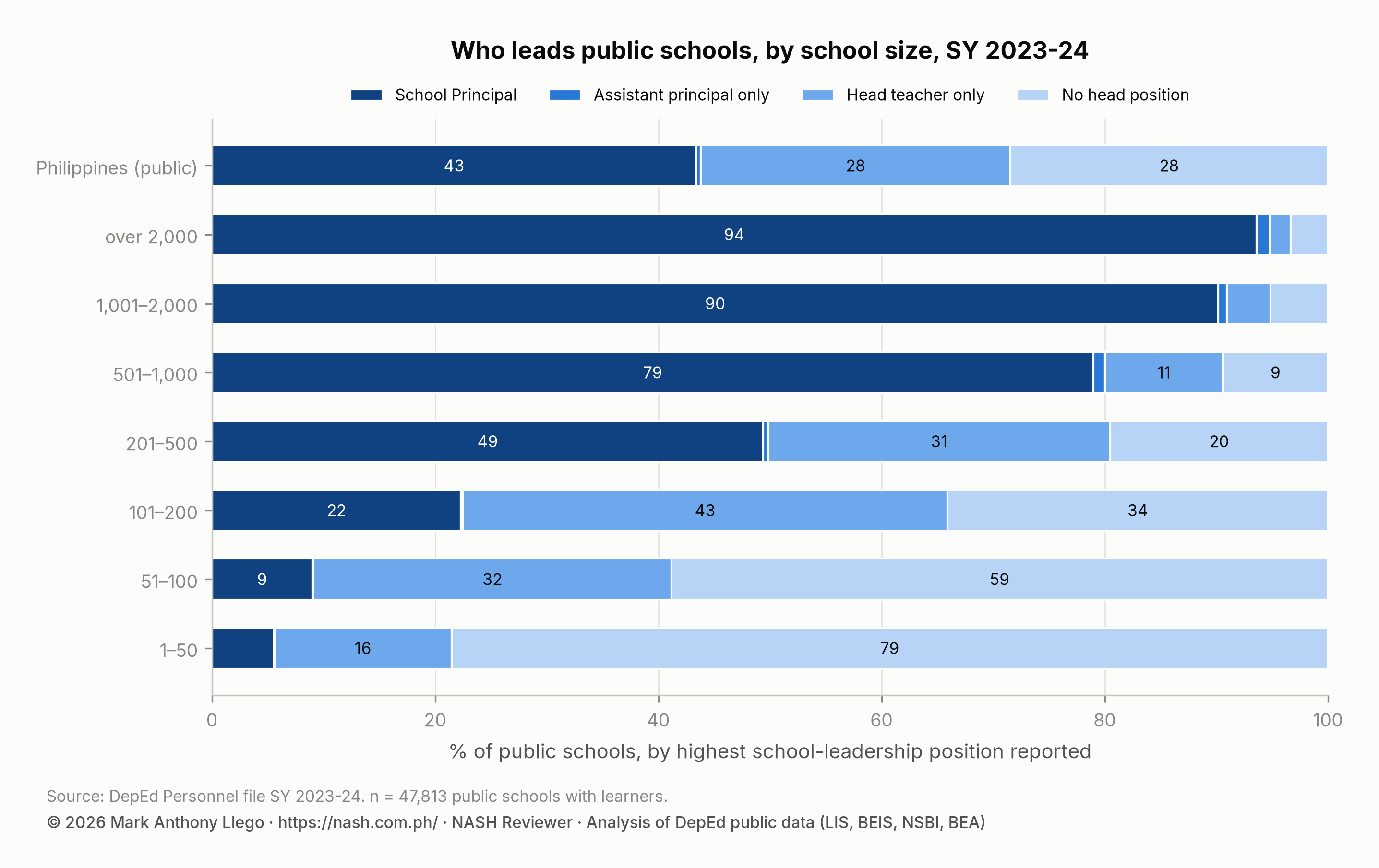
The SY 2023-2024 personnel file shows where the new principals will go. Of 47,813 public schools with learners, 43.4% report a School Principal position and 28.5% report no school-leadership position. The table below gives the full split by school size. Among the smallest schools, 1 to 50 learners, 79% report no head position.
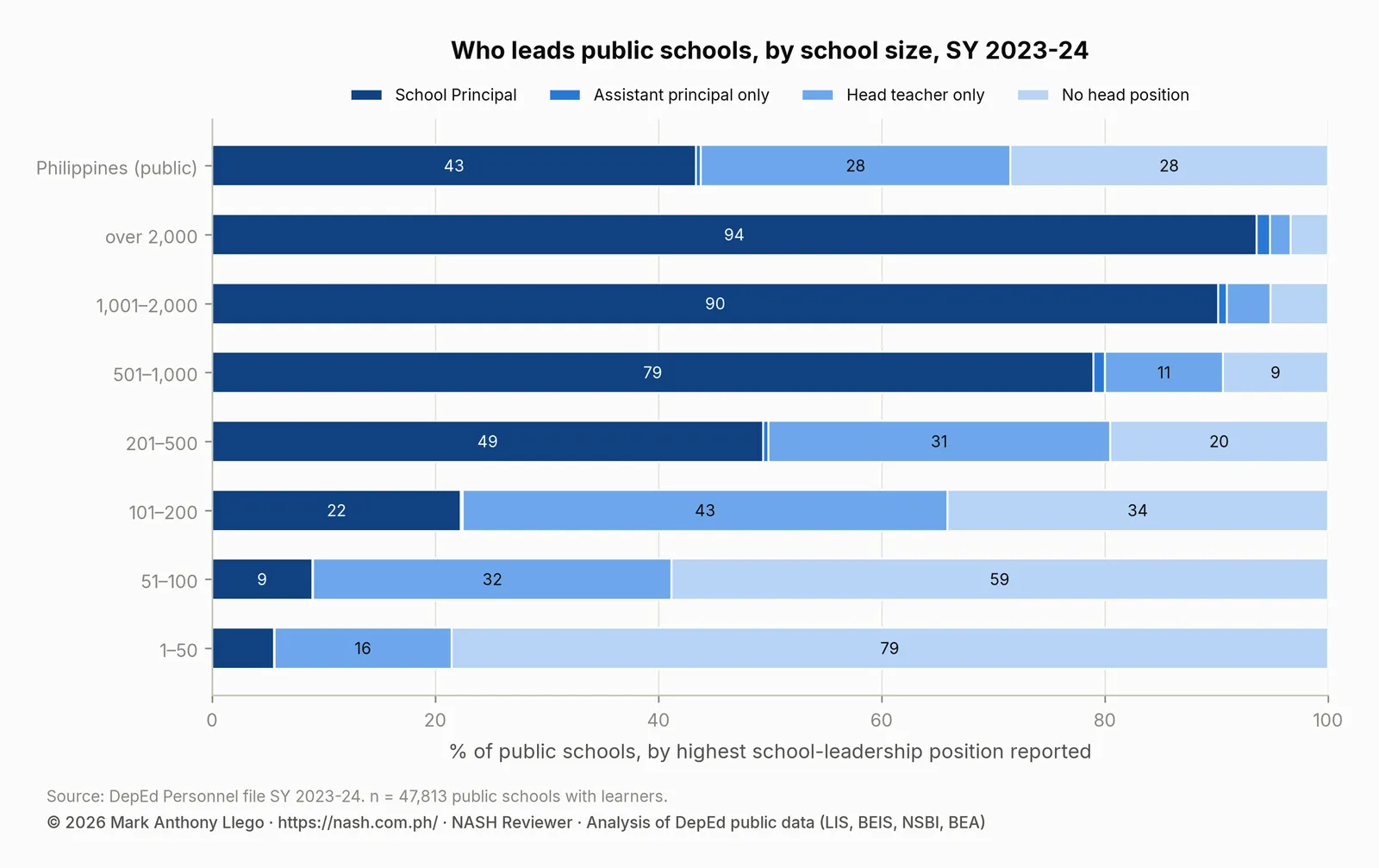
| Learners per school | School Principal | Assistant principal only | Head teacher only | No head position | Schools | Learners |
|---|---|---|---|---|---|---|
| 1–50 | 5.6% | 0.0% | 15.9% | 78.5% | 2,628 | 87,517 |
| 51–100 | 9.0% | 0.1% | 32.1% | 58.8% | 5,902 | 452,684 |
| 101–200 | 22.3% | 0.2% | 43.5% | 34.1% | 12,528 | 1,848,183 |
| 201–500 | 49.4% | 0.4% | 30.6% | 19.5% | 15,288 | 4,849,403 |
| 501–1,000 | 79.0% | 1.0% | 10.6% | 9.4% | 6,185 | 4,278,461 |
| 1,001–2,000 | 90.2% | 0.8% | 3.9% | 5.1% | 3,248 | 4,494,332 |
| over 2,000 | 93.6% | 1.2% | 1.9% | 3.3% | 2,034 | 7,214,545 |
| Philippines (public) | 43.4% | 0.4% | 27.7% | 28.5% | 47,813 | 23,225,125 |
Five NASH practice scenarios from DepEd data
Each scenario below is written from the public data. Work it at the relational level first, then ask what would change in a different school.
Domain 1, Leading Strategically. Your division’s enrollment has fallen every year since SY 2022-2023, as it has in every region except BARMM. Your school’s kindergarten intake is a third smaller than five years ago. The School Improvement Plan you inherit assumes growth. Indicator 1.2.1 asks you to know the phases of plan development. What does a situational analysis built on the enrollment trends report change in the plan’s targets, staffing requests and classroom requests, and which stakeholders must sign off?
Domain 2, Managing School Operations and Resources. The facilities file shows your school’s three buildings as one in good condition, one needing major repair and one for condemnation. That is close to the national split of 30%, 29% and 7%. Utilities take most of your Maintenance and Other Operating Expenses (MOOE); EDCOM found that utilities take 30% to 70% of schools’ MOOE. Indicators 2.2.1 and 2.3.1 ask you to know the rules on finance and on facilities. What can you fund from MOOE, what must go to the division engineer and the Basic Education Facilities Fund, and what can the local government unit’s (LGU’s) Special Education Fund legally cover?
Domain 3, Focusing on Teaching and Learning. The Comprehensive Rapid Literacy Assessment (CRLA) shows 55% of your Grade 1 learners at low emerging in the mother tongue, which is the pooled figure for the assessed schools. The ELLNA shows Numeracy as your weakest component, as it is in every region. EDCOM reports that a 20-day structured remediation produced gains of up to 1.3 years of schooling. Indicators 3.4.1 and 3.5.1 ask you to set outcomes and use assessment results. What targets do you set for the end-of-year CRLA, how do you use the Academic Recovery and Accessible Learning (ARAL) Program and the instructional time rules, and how do you avoid the mass-promotion incentives EDCOM describes?
Domain 4, Developing Self and Others. Your faculty of nine is eight Teacher I to III and one Master Teacher I, which is close to the national 7.6% master-teacher share. DepEd Order No. 002, s. 2024 has moved administrative tasks from teachers to you and to support staff you do not have. Indicators 4.4.1 and 4.5.1 ask you to know performance management and professional development. How do you run the Results-based Performance Management System (RPMS) cycle so that it rewards remediation and honest grading, and what does the one master teacher’s role become?
Domain 5, Building Connections. Nine percent of your learners are Indigenous Peoples (IP), which is the national share. One in six of your families has no birth registration; EDCOM reports missing registration for about 10% of IP groups and 20% of Muslim groups. Indicators 5.3.1 and 5.5.1 ask you to know inclusive practice and to involve the community. Which partners solve which problem: the barangay, the Local Civil Registrar, the LGU, the Parent-Teacher Association (PTA), or an Indigenous Peoples Education (IPEd) coordinator? How do you avoid making the teacher the “shock absorber” EDCOM describes?
A six-week NASH study plan
| Week | PPSSH | Read | Work with |
|---|---|---|---|
| 1 | Domain 1, strands 1.1 to 1.7 | EDCOM Priority Areas 6 and 25; DO 024, s. 2020 | Enrollment trends; division estimates |
| 2 | Domain 2, strands 2.1 to 2.6 | EDCOM Priority Areas 8, 26 and 27; DO 002, s. 2024 | Facilities, WASH, ICT and personnel reports |
| 3 | Domain 3, strands 3.1 to 3.8 | EDCOM Priority Area 7; DO 8, s. 2015; RA 12028 | NAT, ELLNA and CRLA reports; inputs analysis |
| 4 | Domain 4, strands 4.1 to 4.8 | EDCOM Priority Area 18; RA 12288; EO 174 and DO 24, s. 2025 | Personnel report; school-head tables |
| 5 | Domain 5, strands 5.1 to 5.5 | EDCOM Priority Area 7 on IP education and Priority Area 27 | Learner data report; funding sources |
| 6 | All domains | DM 069, s. 2025; your Individual Development Report if you have one | Rewrite each scenario at the extended-abstract level |
Pair the plan with what paragraph 13 of the memorandum recommends: coaching and mentoring by a serving principal, who can show how the indicators look in a real school.
Frequently asked questions
Who may take the NASH for FY 2025?
For FY 2025, Batch 1 was for Head Teachers, Assistant School Principals and Teachers-in-Charge who met the amended qualification standards for School Principal I. Batch 2 added Head Teachers and Assistant School Principals regardless of QS (including Batch 1 takers rated With Developmental Areas), FY 2021 NQESH Category C takers, FY 2023 Category B and C takers, and other personnel qualified under the new QS. DepEd announces later administrations by memorandum.
Is there a passing score for the NASH?
The FY 2025 results memoranda report a score of 65 on a 1 to 100 scale rather than a pass or fail. Reaching 65 overall and in at least four domains, or in at least three, makes you a prospective candidate for School Principal I. The three-domain level adds a Targeted Development Program.
Can a NASH review center have the actual questions?
No. The memorandum states that DepEd is not affiliated with anyone claiming access to examination content. It treats attempts to obtain that content as grounds for administrative action. Study the PPSSH, the policies it points to and the evidence about schools.
Does passing the NASH guarantee appointment as School Principal?
No. You still need the qualification standards, the performance requirement and the comparative assessment, and appointment depends on an available School Principal item, filled by reclassification or by natural vacancy, and on funds. The target of one principal item per school by 2028 is what creates those items.
Download the data
The cleaned, harmonized DepEd files behind this series are free to download in CSV and Parquet, with a codebook and checksums, under the terms of use set out in the release. Download Cleaned DepEd School Data, SY 2017-18 to 2025-26 documents every file and column. The files themselves are at data.nash.com.ph, starting with the README, the SY 2023-24 school master file (CSV, 8.0 MB) and the nine-year enrollment panel (Parquet, 17.2 MB).
Guides for aspiring school heads
- DepEd Data for Aspiring School Heads: Where to Start
- NASH Practice Questions With Answers: 50 Items on the PPSSH
- How to Read DepEd Data: A Guide for Aspiring School Heads
- EDCOM II Final Report: Guide for Aspiring School Heads
- National Education Plan 2026-2035: Guide for School Heads
- PPSSH Domain 1: Leading Strategically With DepEd Data
- PPSSH Domain 2: Managing School Operations With DepEd Data
- PPSSH Domain 3: Teaching and Learning With DepEd Data
- PPSSH Domain 4: Developing Self and Others With DepEd Data
- PPSSH Domain 5: Building Connections With DepEd Data
- On the app: the NASH guide, the PPSSH guide, the principal shortage and the full data report, Philippine basic education in numbers
The data reports
- DepEd Enrollment Trends SY 2017-2018 to SY 2025-2026
- Enrollment by school year: SY 2017-18, SY 2018-19, SY 2019-20, SY 2020-21, SY 2021-22, SY 2022-23, SY 2023-24, SY 2024-25, SY 2025-26
- DepEd Learner Data SY 2023-2024: IP, ALIVE and School Size
- DepEd Teachers and School Personnel Data, SY 2023-2024
- DepEd Classroom and School Building Data, SY 2023-2024
- DepEd WASH Data SY 2023-2024: Toilets, Water, Electricity
- DepEd ICT Data SY 2023-2024: Computers and Internet
- NAT Grade 6 Results SY 2023-2024: DepEd Division Scores
- ELLNA Grade 3 Results SY 2023-2024: DepEd Division Scores
- CRLA Results SY 2025-2026: Reading Levels in Grades 1 to 3
- DepEd School Inputs vs Test Results: Multigrade and Internet
- DepEd Open Data Quality: Errors, Blanks and Coverage Limits
- Download Cleaned DepEd School Data, SY 2017-18 to 2025-26
Written by Mark Anthony Llego for NASH Reviewer. Sources: DepEd Memorandum No. 069, s. 2025; DepEd Order No. 024, s. 2020; DepEd Order No. 019, s. 2025; DepEd Order No. 021, s. 2024; DepEd-DBM Joint Circular No. 01, s. 2025; EDCOM II Final Report (2026) and Year Two Report (2025); DepEd public datasets. Charts may be reused only with written permission from support@nash.com.ph.