This is the second set of fifty free practice items for the National Assessment for School Heads (NASH). The items are written from the newer data analyses in this series and from the Philippine Professional Standards for School Heads (PPSSH) of DepEd Order No. 024, s. 2020. Each item covers one PPSSH indicator, with four options scored 3-2-1-0 on the Structure of the Observed Learning Outcome (SOLO) taxonomy and a full explanation.
The first practice set in this series was written from the data reports that opened it: enrollment, learners, personnel, facilities, water, sanitation and hygiene (WASH), information and communications technology (ICT), and the three assessments. Since then the series has gone further into the same files and found things the first set could not use. A school low on the Grade 3 assessment tends to be low on the Grade 6 one three years later. Private schools scored below public schools on the Grade 6 National Achievement Test (NAT) in the same divisions. Girls are now the majority in Science, Technology, Engineering and Mathematics (STEM) and a shrinking minority in Technical-Vocational-Livelihood (TVL).
Fewer than half of public schools have a principal position, and fewer than a third have an administrative officer. A total of 178 schools are reached by foot or boat alone. The cohorts already enrolled imply a Grade 7 a quarter smaller by SY 2031-2032. This second set puts those findings in front of a school head and asks what to do.
The NASH is a developmental assessment under DepEd Memorandum No. 069, s. 2025. It is designed to evaluate whether an aspiring school head is ready for a leadership role and to identify what to work on. Its Individual Development Report tells the candidate where they stand by domain. A practice set that serves that purpose has to do more than drill recall. Each item here holds one PPSSH indicator, four options at four levels of thinking scored 3-2-1-0, and feedback that says what each level gets right and what it misses. A wrong answer therefore tells you something about your practice.
The set has ten items per domain, written to the same rules as the first set. Eighteen of the indicators here were not in Set A, including every Career Stage 2 indicator in Domain 4 and the discipline, career guidance and learning environment indicators of Domain 3. The rest revisit indicators from Set A with new situations. The numbers in the stems are real, and the schools, officials and incidents are invented. These are original practice items, not actual, past or recalled NASH items, and no score here predicts a NASH rating.
Download this set as a PDF: NASH Reviewer PDF, Set B, A4, with the questions first and the answer key after them. Both sets are on the NASH reviewer PDF page.
How to use this set
- Answer each item before opening its explanation. Choose the single most appropriate action, not the most ambitious one.
- Score yourself with the explanation: 3 for the Relational option, 2 for Multistructural, 1 for Unistructural, 0 for Prestructural. The maximum is 30 per domain and 150 overall.
- Read the feedback for the option you chose, not only for the key. The feedback says what your choice shows about your practice and what fuller practice looks like. That is how the NASH’s Individual Development Report is written.
- Where an item rests on a number, follow the link to the data report that produced it. The guide to reading DepEd data explains every statistic used here.
How the four options are scored
| Score | SOLO level | In a school-head decision, the option… |
|---|---|---|
| 3 | Relational | integrates the relevant elements into one coherent course of action: it solves the core problem, follows the governing policy with the correct authority and sequence, and links the action to its purpose |
| 2 | Multistructural | gets several relevant elements right but does not connect them: one required element is missing, mis-sequenced or handled through the wrong channel |
| 1 | Unistructural | gets one relevant element right and leaves the rest: a single step, or a reactive fix that leaves the core problem standing |
| 0 | Prestructural | misses the point: irrelevant, a misconception, outside the school head’s authority, harmful, or contrary to policy. Anything unlawful or harmful scores 0 however many correct elements it contains |
The blueprint: PPSSH indicators covered per domain
| Domain | Indicators covered | Items | Career Stage 1 | Career Stage 2 |
|---|---|---|---|---|
| D1 Leading Strategically | 1.1.2, 1.2.2, 1.3.1, 1.3.2, 1.4.1, 1.4.2, 1.5.1, 1.6.2, 1.7.1, 1.7.2 | 10 | 4 | 6 |
| D2 Managing School Operations and Resources | 2.1.1, 2.1.2, 2.2.1, 2.3.1, 2.3.2, 2.4.1, 2.4.2, 2.5.1, 2.5.2, 2.6.2 | 10 | 5 | 5 |
| D3 Focusing on Teaching and Learning | 3.1.1, 3.2.1, 3.3.1, 3.4.2, 3.5.2, 3.6.2, 3.7.1, 3.7.2, 3.8.1, 3.8.2 | 10 | 5 | 5 |
| D4 Developing Self and Others | 4.1.2, 4.2.2, 4.3.2, 4.4.1, 4.5.1, 4.6.1, 4.6.2, 4.7.1, 4.7.2, 4.8.2 | 10 | 4 | 6 |
| D5 Building Connections | 5.1.1, 5.1.2, 5.2.1, 5.2.2, 5.3.1, 5.3.2, 5.4.1, 5.4.2, 5.5.1, 5.5.2 | 10 | 5 | 5 |
Career Stage 1 indicators describe aspiring school heads. They are tested with conceptual items, or with situational items where the indicator’s verb is an action. Career Stage 2 indicators describe serving School Principals I and II and are always situational. Difficulty is the writer’s estimate: 11 Easy, 27 Moderate and 12 Difficult.
Domain 1: Leading Strategically (Questions 1 to 10)
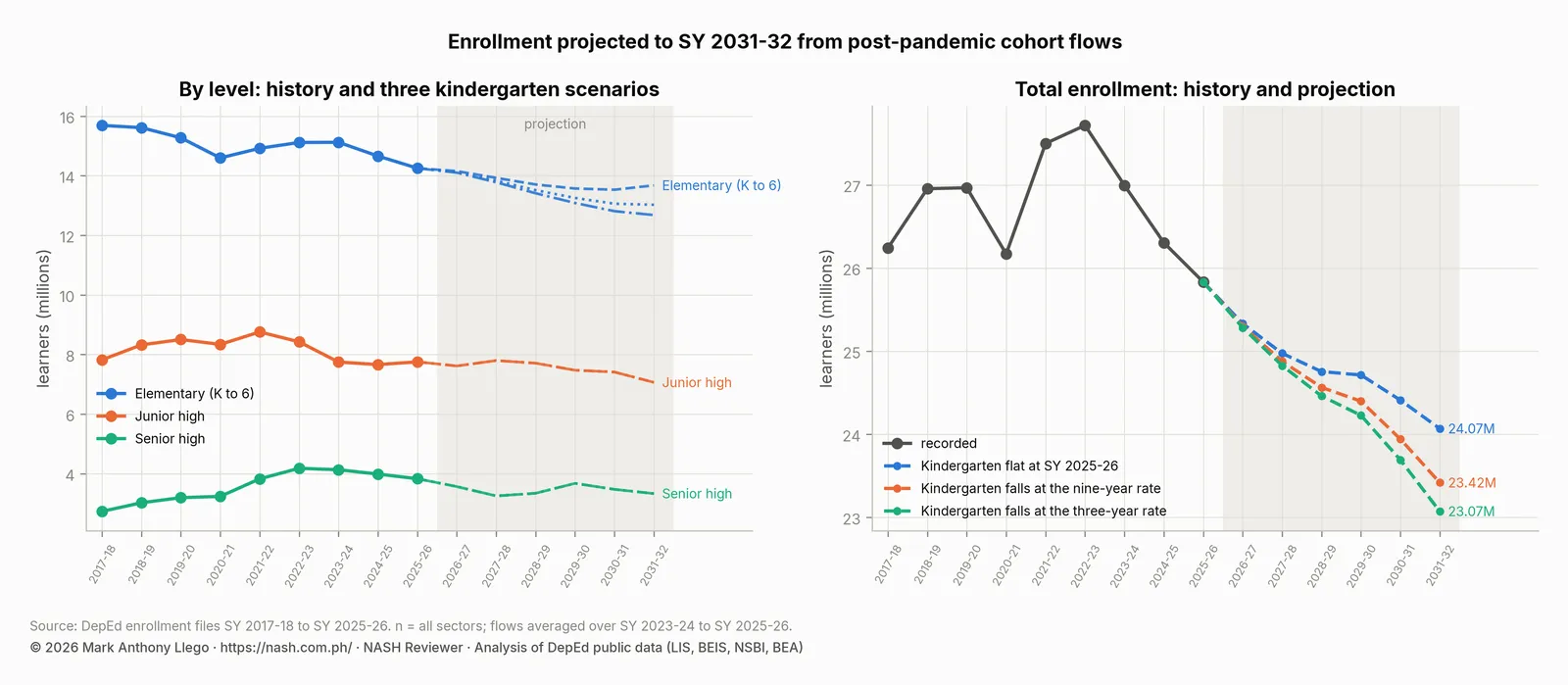
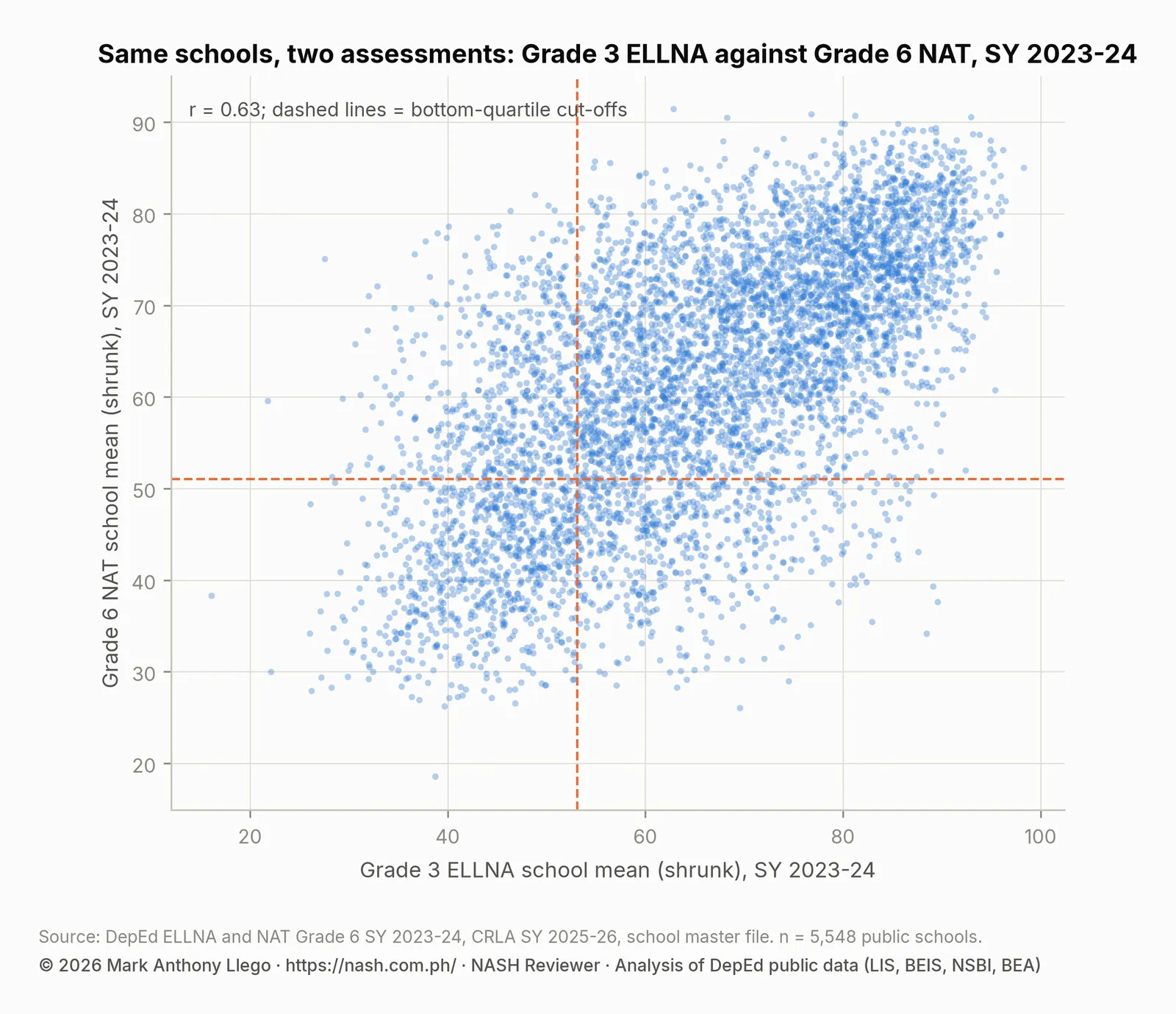
These items rest on the following findings. The cohorts already enrolled imply 23.1 to 24.1 million learners by SY 2031-2032, with Grade 7 about 24 percent smaller. A school’s Early Language, Literacy, and Numeracy Assessment (ELLNA) and Grade 6 NAT means correlate at 0.62, and 14.1 percent of schools sit in the bottom quarter on both. Private schools averaged 53.2 against 61.0 for public schools on the Grade 6 NAT, about 6.8 points lower within the same division. That comparison rests on a self-selected sample of 814 private schools. Balik-Aral learners are 1.19 percent of Grade 7. The Open High School Program reaches 13,060 learners in 586 schools.
Question 1
Indicator 1.1.2, Vision, mission and core values. Career Stage 2, Situational, Moderate.
You are the principal of an elementary school in a division where enrollment has fallen for three years. Parents at the general assembly ask why the school is starting a reading intervention and a bridging class for returning learners instead of asking the division for new classrooms. Several teachers also treat the two programs as extra work unconnected to the school’s direction. The School Governing Council meets after the assembly. What is the most appropriate action?
- A. Distribute copies of the DepEd vision, mission and core values to the parents and teachers present, so that each of them can read how the Department describes the learner it hopes every school will produce.
- B. Explain at the assembly and to the council how both programs serve the DepEd vision of learners who complete basic education, link each to the school plan, and ask teachers to carry the same message to parents.
- C. Tell the assembly that the division selected both programs for the school, and that classrooms will be requested once the division confirms the enrollment figures for the coming school year.
- D. Present the DepEd vision and mission at the assembly in Filipino and English and post them in every classroom, then ask the council to approve the two programs as separate items on its agenda for the quarter, with a short note on each.
Answer and explanation
Best answer: B. Points: A = 1, B = 3, C = 0, D = 2.
- A (1 point, Unistructural). Handing out the text is a start, but reading a statement does not show parents or teachers why these two programs follow from it.
- B (3 points, Relational). This communicates the vision as the reason for the programs and connects it to the plan and the council, which is how shared understanding and alignment are built.
- C (0 points, Prestructural). Attributing the programs to the division and promising classrooms avoids the question and leaves the school’s direction unexplained.
- D (2 points, Multistructural). Presenting and posting the vision spreads the words, but treating the programs as separate agenda items leaves their connection to the vision unexplained.
Why. This aligns with Career Stage 2 expectations because indicator 1.1.2 asks the school head to communicate the DepEd vision, mission and core values to the wider school community so that policies and programs are understood as aligned with them. The data reports show why the explanation is needed: enrollment has fallen since SY 2022-23 in most divisions, returning learners re-enter mainly at Grade 1 and Grade 7, and a school head who starts bridging and reading programs is responding to that evidence. The option that posts the vision gets the communication right but fails to connect it to the two programs, which is the element the indicator requires. Copying the text alone is one step; deferring to the division communicates nothing.
Indicator 1.1.2: Communicate the DepEd vision, mission and core values to the wider school community to ensure shared understanding and alignment of school policies, programs, projects and activities.
Sources: DepEd Order No. 024, s. 2020; NASH Reviewer, Philippine basic education in numbers (DepEd public datasets, SY 2017-18 to SY 2025-26).
Question 2
Indicator 1.3.2, Policy implementation and review. Career Stage 2, Situational, Difficult.
You are a junior high school principal. In October your registrar tells a parent that a sixteen-year-old who stopped schooling two years ago can enroll in Grade 7 next June, since the first grading period has ended. You learn that this has been the school’s practice for years, and the learner information system shows your school tagging far fewer returning learners than neighboring schools. The parent has gone to the district office. What is the most appropriate action?
- A. Review the school’s late-enrollment practice against the national policy on enrolling returning learners, enroll the learner with a bridging arrangement, and issue a written procedure for the registrar and advisers.
- B. Enroll the learner now and apologize to the parent, then remind the registrar verbally that returning learners may be admitted during the year, while keeping the rest of the enrollment process as it stands for the rest of the year.
- C. Keep the practice, since a learner who has missed a grading period will fail the year, and advise the parent to enroll the child in the Alternative Learning System until the next school year opens.
- D. Ask the registrar to prepare a written explanation of the school’s practice for the district office, so that the matter can be settled by the supervisor on the basis of a complete record of what was said.
Answer and explanation
Best answer: A. Points: A = 3, B = 2, C = 0, D = 1.
- A (3 points, Relational). This treats the incident as a policy review: it corrects the practice against the national policy, fixes the case in hand and writes the corrected procedure down.
- B (2 points, Multistructural). Admitting the learner fixes one case, but a verbal reminder leaves a years-old practice undocumented and liable to return.
- C (0 points, Prestructural). Refusing enrollment on the grading calendar contradicts the policy that no learner is turned away, and ALS is not a substitute for a seat the learner is entitled to.
- D (1 point, Unistructural). A written record for the supervisor is useful, but it hands the school’s own policy review to the district and leaves the learner waiting.
Why. This aligns with Career Stage 2 expectations because indicator 1.3.2 asks the school head to undertake policy implementation and review so that school operations stay consistent with national issuances. DepEd’s enrollment policy admits learners throughout the year and directs schools to bridge returning learners, and the data show the stakes: Balik-Aral learners are 1.19 percent of Grade 7 nationally, the highest share of any secondary grade, so a school that tags few of them is probably turning them away rather than lacking them. The option that enrolls the learner and reminds the registrar gets the case right but leaves the practice unreviewed and unwritten. Documenting the practice for the supervisor is a single step; refusing enrollment is contrary to policy.
Indicator 1.3.2: Undertake policy implementation and review in the school to ensure that operations are consistent with national and local laws, regulations and issuances.
Sources: DepEd Order No. 024, s. 2020; NASH Reviewer, Philippine basic education in numbers (DepEd public datasets, SY 2017-18 to SY 2025-26).
Question 3
Indicator 1.5.1, Program design and implementation. Career Stage 1, Conceptual, Easy.
An aspiring school head is asked how the Open High School Program supports learners in a public junior high school. Which statement best explains its implementation?
- A. It is the junior high school counterpart of the Alternative Learning System, run outside the school by community facilitators for out-of-school youth who have left the formal system for good.
- B. It is a program for learners who are too old for their grade, allowing them to take a placement test and move to a higher grade without attending the classes they have missed in the years away from school.
- C. It gives learners who have stopped schooling a set of self-learning modules to complete at home, with a teacher checking the outputs when the learner returns to the school at the end of each quarter to have the grade recorded.
- D. It enrolls learners who cannot attend daily classes, such as working or distant learners, in a school-based alternative delivery mode with modules, scheduled teacher contact and the same Grade 7 to 10 curriculum and assessment.
Answer and explanation
Best answer: D. Points: A = 0, B = 1, C = 2, D = 3.
- A (0 points, Prestructural). The Open High School Program is a school-based program within the formal system, not the Alternative Learning System.
- B (1 point, Unistructural). The program is not an acceleration or placement scheme; it delivers the same grades to learners who cannot attend daily.
- C (2 points, Multistructural). Modules are part of it, but the program keeps scheduled contact with a teacher and is not self-study checked once a quarter.
- D (3 points, Relational). This names the learners the program serves, how it is delivered and that it keeps the regular curriculum and assessment, which is what understanding its implementation requires.
Why. This aligns with Career Stage 1 expectations because indicator 1.5.1 asks the aspiring school head to understand how programs that support learners are implemented in the school. The Open High School Program is DepEd’s school-based alternative delivery mode for junior high learners who cannot attend daily classes; it keeps the regular curriculum and assessment while delivering them through modules and scheduled teacher contact. The learner data for SY 2023-24 show how small it is, 13,060 learners in 586 public schools, so a school head who understands its design can judge whether to offer it. The option describing home modules gets the materials right but drops the scheduled contact; the placement and ALS descriptions confuse it with other programs.
Indicator 1.5.1: Display understanding of the implementation of programs in the school that support the development of learners.
Sources: DepEd Order No. 024, s. 2020; NASH Reviewer, Philippine basic education in numbers (DepEd public datasets, SY 2017-18 to SY 2025-26).
Question 4
Indicator 1.6.2, Learner voice. Career Stage 2, Situational, Moderate.
You are the principal of a large junior high school with 1,900 learners. The learner government’s survey of all sections finds that girls avoid using the toilets during the day because the three functional female cubicles serve nearly 900 girls, and that absences on some days are linked to this. Your school plan for the year lists a covered court as the first priority. The planning team meets next week to finalize the annual implementation plan. What is the most appropriate action?
- A. Bring the survey to the planning team as evidence, verify the toilet count against the facilities inventory, and move sanitation ahead of the covered court in the annual plan with the learner representatives present.
- B. Explain to the learner government that the plan was approved by the division and cannot be changed in the middle of the year, and that facilities decisions rest with the school head and the planning team.
- C. Instruct the maintenance staff to repair any non-functional cubicles this month, and tell the learner government that the plan will be revisited when the covered court has been completed and paid for.
- D. Thank the learner government for the survey and ask the planning team to add toilet repairs to the plan under the covered court, so that both projects are funded in the order the team already approved and the survey is noted in the minutes.
Answer and explanation
Best answer: A. Points: A = 3, B = 0, C = 1, D = 2.
- A (3 points, Relational). This uses the learners’ evidence to change a decision, checks it against the school’s records and keeps the learners in the room where the plan is revised.
- B (0 points, Prestructural). Declaring the plan unchangeable and decisions reserved to adults is the opposite of using learner voice in decision-making.
- C (1 point, Unistructural). Repairs are a response, but they treat the survey as a maintenance request rather than as evidence for the plan.
- D (2 points, Multistructural). Adding the repairs acknowledges the survey, but keeping the court first means the learners’ evidence did not inform the priority it speaks to.
Why. This aligns with Career Stage 2 expectations because indicator 1.6.2 asks the school head to utilize learner voice, including learners’ views and feelings, to inform policy and decision-making for school improvement. The WASH data give the scale of the problem the survey describes: public schools average about 62 girls per functional female toilet bowl, and the sanitation report links this to absence among adolescent girls. The option that adds repairs below the covered court hears the learners but does not let their evidence change the priority, which is the element the indicator requires. Ordering repairs is a single step; refusing to revisit the plan dismisses the voice altogether.
Indicator 1.6.2: Utilize learner voice, such as feelings, views and/ or opinions to inform policy development and decision-making towards school improvement.
Sources: DepEd Order No. 024, s. 2020; NASH Reviewer, Philippine basic education in numbers (DepEd public datasets, SY 2017-18 to SY 2025-26).
Question 5
Indicator 1.2.2, School planning and implementation. Career Stage 2, Situational, Difficult.
You are the principal of a junior high school. The division has asked every school to submit a three-year plan with classroom requests. Your Grade 7 has 420 learners this year, but the feeder elementary schools report Grade 1 classes about a quarter smaller than their Grade 6 classes, and a national projection shows Grade 7 enrollment falling by about a fourth by SY 2031-32. Two teachers on the planning team want to request a new four-classroom building. What is the most appropriate action?
- A. Submit the request as the teachers propose, since the national projection describes the whole country and a school’s own crowding is better evidence of what it will need over the next three years.
- B. Accept the four-classroom request because the school is crowded today, and add the feeder data and the projection to the plan’s annex so that the division can decide whether to fund the building in full or in part over the three years.
- C. Ask the feeder schools to confirm their Grade 1 counts in writing before the planning team meets, and hold the plan until the division releases its own enrollment projection for the municipality.
- D. Put the feeder schools’ grade counts and the projection before the planning team, revise the three-year enrollment targets from them, and size any classroom request to the smaller Grade 7 the plan now expects.
Answer and explanation
Best answer: D. Points: A = 0, B = 2, C = 1, D = 3.
- A (0 points, Prestructural). Dismissing the projection and the feeder data ignores the evidence that the school’s crowding is about to ease.
- B (2 points, Multistructural). Attaching the evidence is right, but leaving the request unchanged and passing the decision to the division drops the school’s own planning step.
- C (1 point, Unistructural). Confirming counts is sensible, but holding the plan for a projection the division may never issue stalls the team’s work.
- D (3 points, Relational). This brings the evidence to the team, revises the targets with them and makes the request follow the revised targets, which is developing a plan with the planning team.
Why. This aligns with Career Stage 2 expectations because indicator 1.2.2 asks the school head to develop and implement school plans with the planning team on the basis of evidence. The enrollment series shows kindergarten intakes falling for three years and the cohort projection in this series puts Grade 7 about 24 percent smaller by SY 2031-32, because this year’s small Grade 1 class reaches it then. A classroom request sized to today’s Grade 7 would be built for learners who will not arrive. The option that attaches the evidence but keeps the request gets the documentation right and the decision wrong. Waiting for the division is a single step; ignoring the projection abandons the planning evidence altogether.
Indicator 1.2.2: Develop and implement with the planning team school plans aligned with institutional goals and policies.
Sources: DepEd Order No. 024, s. 2020; NASH Reviewer, Philippine basic education in numbers (DepEd public datasets, SY 2017-18 to SY 2025-26).
Question 6
Indicator 1.4.2, Research and innovation. Career Stage 2, Situational, Difficult.
You are a public elementary school principal. A teacher proposes that the school adopt a nearby private school’s textbooks and homework scheme, arguing that private schools teach better. You have read an analysis of the Grade 6 national assessment in which private schools in the same divisions averaged about seven points below public schools, with no gap in English, and in which the author warns that the private schools tested were a small, self-selected sample. What is the most appropriate action?
- A. Ask the teacher to request the private school’s Grade 6 results, so that the proposal can be judged on that school’s own performance rather than on an analysis of schools in other places.
- B. Share the finding and its limits with the teacher, decline to copy the scheme on the strength of a reputation, and ask the grade level to compare the two schools’ own Grade 6 results by subject before deciding.
- C. Share the finding with the teacher and the faculty, and reject the proposal on the grounds that the analysis shows private schools perform worse, so the school has nothing to learn from the neighbor’s scheme or from any other private school.
- D. Approve a pilot of the scheme in one section, since a published analysis of other schools cannot settle a question about teaching practices in this one and the teacher has seen the scheme work.
Answer and explanation
Best answer: B. Points: A = 1, B = 3, C = 2, D = 0.
- A (1 point, Unistructural). Asking for the neighbor’s results is one useful step, but it drops the national evidence and the caveat the teacher needs to see.
- B (3 points, Relational). This uses the finding to question the premise, respects its stated limits and turns the decision into a comparison of the two schools’ own evidence.
- C (2 points, Multistructural). Reading the finding as proof that private schools are worse overstates it; the author’s caveat about the sample is part of the finding.
- D (0 points, Prestructural). Piloting a scheme proposed on reputation, while dismissing evidence as inapplicable, is not research-informed innovation.
Why. This aligns with Career Stage 2 expectations because indicator 1.4.2 asks the school head to utilize research findings from reliable sources in facilitating data-driven innovation, which includes using a finding’s limits as well as its headline. The analysis of the SY 2023-24 Grade 6 assessment finds private schools averaging 53.2 against 61.0 for public schools and about 6.8 points lower within the same division, with no gap in English, while warning that the 814 private schools tested were not a representative sample. The option that rejects the proposal outright gets the direction right but turns an association into a verdict. Requesting the neighbor’s results is a single step; the pilot ignores the evidence.
Indicator 1.4.2: Utilize relevant research findings from reliable sources in facilitating data-driven and evidence-based innovations to improve school performance.
Sources: DepEd Order No. 024, s. 2020; NASH Reviewer, Philippine basic education in numbers (DepEd public datasets, SY 2017-18 to SY 2025-26).
Question 7
Indicator 1.7.1, Monitoring and evaluation processes and tools. Career Stage 1, Conceptual, Moderate.
A data analysis finds that public schools whose Grade 3 learners scored in the lowest quarter on the early language and numeracy assessment were more than twice as likely as expected to also score in the lowest quarter on the Grade 6 assessment. Which statement best explains what this implies for a school’s monitoring and evaluation?
- A. The two assessments measure different things, so a low Grade 3 result has no bearing on the Grade 6 result and each should be monitored on its own schedule by the teachers concerned.
- B. A low Grade 3 result is an early warning for the same school three years later, so monitoring should track the Grade 3 cohort’s progress each year rather than wait for the Grade 6 result to arrive.
- C. A low Grade 3 result predicts a low Grade 6 result, so the school should repeat the Grade 3 assessment every year to confirm that the weakness is real before planning any intervention for the learners.
- D. A low Grade 3 result means the school’s Grade 6 teachers will need extra training, so monitoring should focus on the Grade 6 classes where the second result is produced three years later.
Answer and explanation
Best answer: B. Points: A = 0, B = 3, C = 2, D = 1.
- A (0 points, Prestructural). The finding is that the results do rise and fall together, which is the opposite of treating them as unrelated.
- B (3 points, Relational). This reads persistence as a monitoring signal and places the monitoring where it can change the outcome, in the years between the two assessments.
- C (2 points, Multistructural). Repeating the Grade 3 test confirms what is already known; monitoring is meant to follow the cohort, not re-measure the starting point.
- D (1 point, Unistructural). Focusing on Grade 6 treats the warning as a Grade 6 problem when the gap was visible three years earlier.
Why. This aligns with Career Stage 1 expectations because indicator 1.7.1 asks the aspiring school head to understand monitoring and evaluation processes and tools that promote learner achievement. The persistence analysis in this series finds a correlation of 0.62 between a school’s ELLNA and Grade 6 NAT means and that 14.1 percent of schools sit in the bottom quarter on both, against 6.25 percent if the results were unrelated. The implication is that a Grade 3 result is a warning for the same school, and that monitoring the cohort through Grades 4 and 5 is where evaluation can still change the outcome. Repeating the test re-measures rather than monitors; focusing on Grade 6 arrives late; denying the link ignores the finding.
Indicator 1.7.1: Display knowledge and understanding of monitoring and evaluation processes and tools to promote learner achievement.
Sources: DepEd Order No. 024, s. 2020; NASH Reviewer, Philippine basic education in numbers (DepEd public datasets, SY 2017-18 to SY 2025-26).
Question 8
Indicator 1.7.2, Monitoring and evaluation processes and tools. Career Stage 2, Situational, Moderate.
You are the principal of an elementary school whose Grade 3 learners scored in the division’s lowest quarter on the early language and numeracy assessment two years ago, and whose Grade 6 learners have just done the same on the national assessment. The division wants a monitoring plan within the month. Your teachers keep quarterly grades in the learner information system but no one has compared them across grades. What is the most appropriate action?
- A. Ask each class adviser to list learners with failing quarterly grades and submit the list to the division as the school’s monitoring plan, pending the results of the next national assessment.
- B. Submit a monitoring plan that schedules a school-made reading and numeracy test for all grades at the end of the year, and compare the results with the two assessment scores when the division releases them.
- C. Build the monitoring plan around the cohort now in Grades 4 and 5, with quarterly reading and numeracy checks compared across grades in the system, and review the results with the teachers each quarter.
- D. Report to the division that the two results reflect the learners the school receives from its community, and request that the monitoring plan be prepared by the district supervisor instead.
Answer and explanation
Best answer: C. Points: A = 1, B = 2, C = 3, D = 0.
- A (1 point, Unistructural). A list of failing learners is one input, but it is not a plan and it waits on an assessment that will come after the cohort has moved on.
- B (2 points, Multistructural). An end-of-year test is monitoring of a kind, but once a year is too late to act, and it ignores the quarterly data already in the system.
- C (3 points, Relational). This uses the tools the school already has, points them at the cohort where the pattern will repeat and builds in a review cycle, which is utilizing monitoring to promote achievement.
- D (0 points, Prestructural). Attributing results to the community and passing the plan to the district uses no monitoring tool at all.
Why. This aligns with Career Stage 2 expectations because indicator 1.7.2 asks the school head to utilize available monitoring and evaluation processes and tools to promote learner achievement. The persistence finding, that schools low on ELLNA tend to be low on the Grade 6 NAT three years later, means the cohort between the two assessments is where monitoring matters, and the learner information system already holds quarterly grades that can be compared across grades. The option proposing an annual school-made test gets the idea of measurement but loses the quarterly cycle and the existing data. Listing failing learners is a single step; blaming the community and deferring to the supervisor abandons the task.
Indicator 1.7.2: Utilize available monitoring and evaluation processes and tools to promote learner achievement.
Sources: DepEd Order No. 024, s. 2020; NASH Reviewer, Philippine basic education in numbers (DepEd public datasets, SY 2017-18 to SY 2025-26).
Question 9
Indicator 1.3.1, Policy implementation and review. Career Stage 1, Conceptual, Easy.
DepEd’s revised senior high school program reduces the number of strands and lets schools offer electives in place of some tracks. Which statement best describes the school head’s role in implementing a curriculum policy of this kind?
- A. To keep the current strands until the first batch of learners under the old program has graduated, since a policy should not change the program a learner has already begun and been promised.
- B. To announce the new strands to the Grade 10 learners during career guidance so that they can choose among them when they enroll in Grade 11 at the start of the next school year.
- C. To study the issuance with its transition rules, decide the school’s offerings with the faculty within what the policy allows, inform learners as well as parents, and report implementation problems to the division.
- D. To wait for the division’s implementing memorandum and then apply it as written, since a national curriculum policy leaves the school head no decisions to make about the school’s offerings or electives, beyond scheduling the classes.
Answer and explanation
Best answer: C. Points: A = 0, B = 1, C = 3, D = 2.
- A (0 points, Prestructural). Delaying a national policy until a cohort graduates is outside the school head’s authority and ignores its transition rules.
- B (1 point, Unistructural). Informing learners is one step of implementation, not the role.
- C (3 points, Relational). This describes implementation as study, decision within the policy’s limits, communication and feedback, which is the school head’s part in it.
- D (2 points, Multistructural). Applying the division’s memorandum is part of it, but the policy leaves the choice of offerings and electives to schools.
Why. This aligns with Career Stage 1 expectations because indicator 1.3.1 asks the aspiring school head to understand policy implementation and review so that school operations stay consistent with national issuances. The strengthened senior high school program, implemented from SY 2025-26, reclassified strands and shifted some learners between tracks, which the SY 2025-26 enrollment file records; schools had to decide what to offer within the new structure. The option that waits for the division memorandum gets the chain of issuances right but misses that implementation includes decisions the school makes. Announcing strands to learners is one step; refusing to change until a cohort graduates misreads the school head’s authority.
Indicator 1.3.1: Demonstrate knowledge and understanding of policy implementation and review to ensure that school operations are consistent with national and local laws, regulations and issuances.
Sources: DepEd Order No. 024, s. 2020; NASH Reviewer, Philippine basic education in numbers (DepEd public datasets, SY 2017-18 to SY 2025-26).
Question 10
Indicator 1.4.1, Research and innovation. Career Stage 1, Situational, Moderate.
You are a head teacher. The school’s planning team has found a published projection that puts national enrollment between 23.1 and 24.1 million by SY 2031-32, with Grade 7 about a fourth smaller than today. One member wants to write the national percentages into the school plan as the school’s own targets. The projection’s author states that it uses national grade-to-grade ratios and three kindergarten assumptions. What is the most appropriate action?
- A. Leave the projection out of the plan, because a national figure built on assumptions says nothing reliable about one school’s enrollment next year or in any year after that.
- B. Adopt the projection’s percentages as the school’s targets, since it is the most recent published figure, and attach the author’s note on method so that the division can judge the source for itself and the targets with it.
- C. Treat the projection as a reliable signal of direction, note its stated method with its assumptions in the plan, and build the school’s own targets from its feeder schools’ grade counts plus its enrollment history.
- D. Ask the division planning office whether it endorses the projection before the team refers to it, since a school plan should cite sources that the division has accepted for its own planning.
Answer and explanation
Best answer: C. Points: A = 0, B = 2, C = 3, D = 1.
- A (0 points, Prestructural). A projection with a stated method is reliable evidence of direction; discarding it loses the warning it carries.
- B (2 points, Multistructural). Attaching the method note is good practice, but national ratios are not a school’s targets, whatever their date.
- C (3 points, Relational). This identifies what the finding can support, a direction, and what it cannot, a school target, and uses the school’s own data for the latter.
- D (1 point, Unistructural). Checking endorsement is one step; it does not address what the projection can and cannot say for the school.
Why. This aligns with Career Stage 1 expectations because indicator 1.4.1 asks the aspiring school head to identify relevant research findings from reliable sources, which includes judging what a finding can be used for. The projection in this series is built from national cohort flows and three kindergarten scenarios and is explicit that it describes the shape of the next six years, not any school’s enrollment. The option that adopts the national percentages as school targets gets the source right and the use wrong. Seeking the division’s endorsement is a single step that does not resolve the use; dismissing the projection discards a reliable signal that the school’s Grade 7 will shrink.
Indicator 1.4.1: Identify relevant research findings from reliable sources in facilitating data-driven and evidence-based innovations to improve school performance.
Sources: DepEd Order No. 024, s. 2020; NASH Reviewer, Philippine basic education in numbers (DepEd public datasets, SY 2017-18 to SY 2025-26).
Domain 2: Managing School Operations and Resources (Questions 11 to 20)
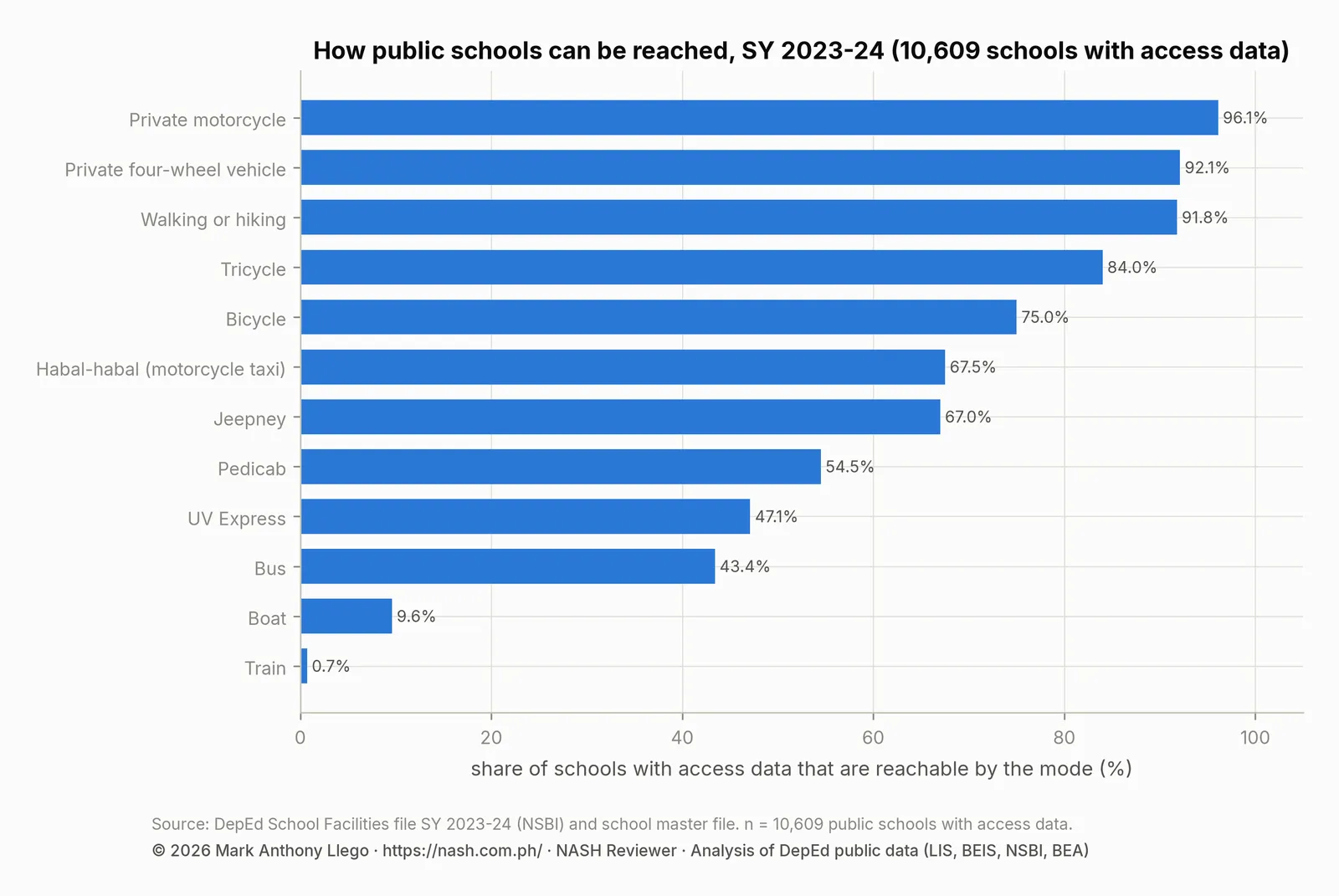
These items rest on the following findings. Of 10,609 reporting public schools, 178 are reached by foot or boat alone. Smart televisions are reported by 65.9 percent of public schools, and an Administrative Officer II position exists in 29.6 percent. Locally funded personnel number 29,938, and they are 12.6 percent of teachers in BARMM. Of all schools, 71 percent have no toilet usable by a learner with a disability. Learners per instructional room run from 12.1 to 82.3 across divisions. The SY 2025-2026 enrollment file writes blanks where earlier files wrote zeros.
Question 11
Indicator 2.5.2, School safety for disaster preparedness, mitigation and resiliency. Career Stage 2, Situational, Moderate.
You are the school head of an island elementary school that learners and teachers reach by boat. The school sits on the division’s list of schools accessible by boat alone. Typhoon season begins next month; last year classes were suspended for eleven days when crossings were unsafe, and no learning materials were sent home. The division has asked for the school’s contingency plan for continuous delivery of instruction. What is the most appropriate action?
- A. Ask the barangay to provide a larger boat for the school, so that crossings can continue in rougher weather and the number of suspended days falls below last year’s eleven during the coming season.
- B. Prepare the plan with the teachers and the barangay: suspension triggers tied to the coast guard’s advisories, home learning packets ready before the season, and a teacher duty roster for the days the crossing is closed.
- C. Submit last year’s suspension record as the plan, since the school cannot control the weather and the division’s guidelines already say when classes are suspended and when they resume.
- D. Prepare the plan around the division’s suspension guidelines and keep learning materials in the classrooms, so that lessons resume the day the crossing reopens without the school having to send anything home or to prepare materials in advance.
Answer and explanation
Best answer: B. Points: A = 1, B = 3, C = 0, D = 2.
- A (1 point, Unistructural). A larger boat may reduce closures, but it does not provide for instruction on the days the sea is unsafe.
- B (3 points, Relational). This plans for the hazard the school actually faces, with local partners and a way to keep instruction going when the crossing closes.
- C (0 points, Prestructural). A record of lost days is not a contingency plan, and the guidelines say when to suspend, not how to keep learning going.
- D (2 points, Multistructural). Following the guidelines is necessary, but keeping materials in school means instruction stops for every suspended day, which the plan was meant to avoid.
Why. This aligns with Career Stage 2 expectations because indicator 2.5.2 asks the school head to manage school safety for disaster preparedness, mitigation and resiliency so that instruction continues. The access data in this series count 178 public schools reachable by foot or boat alone among those reporting, and typhoon suspensions fall hardest on them. A contingency plan that works has local triggers, materials prepared ahead and staff assignments for closure days, built with the barangay that owns the boats. The option that keeps materials in classrooms follows the guidelines but drops continuity, the element the indicator names. A larger boat is a single mitigation; submitting last year’s record is not a plan.
Indicator 2.5.2: Manage school safety for disaster preparedness, mitigation and resiliency to ensure continuous delivery of instruction.
Sources: DepEd Order No. 024, s. 2020; NASH Reviewer, Philippine basic education in numbers (DepEd public datasets, SY 2017-18 to SY 2025-26).
Question 12
Indicator 2.6.2, Emerging opportunities and challenges. Career Stage 2, Situational, Difficult.
You are the principal of an elementary school with 24 classrooms, two of them multigrade classes for learners from a nearby indigenous community and one for learners with disabilities. The municipality donates ten smart televisions and the barangay captain asks that they go to the Grade 6 sections so that the school’s assessment results improve. Teachers of the multigrade and special classes say their learners have never used any device. What is the most appropriate action?
- A. Decline the donation until the municipality can provide a unit for every classroom, so that no section is favored over another and the school avoids complaints from the parents of the other sections.
- B. Accept the donor’s request for the Grade 6 sections, since results matter to the community, and list the multigrade and special classes first for the next donation so that they are covered within the year and the donor’s wish is respected now.
- C. Thank the donor and allocate the televisions by a written criterion agreed with the faculty that reaches the multigrade and special classes as well as the test grades, and show the barangay how each unit will be used.
- D. Place the ten televisions in the ten largest sections, because more learners benefit from each unit that way, and let the smaller classes borrow them whenever a teacher asks for one.
Answer and explanation
Best answer: C. Points: A = 0, B = 2, C = 3, D = 1.
- A (0 points, Prestructural). Refusing a usable donation until everyone can be served leaves every learner without, which is not equity.
- B (2 points, Multistructural). Accepting the donor’s terms secures the units, but deferring the learners who have never used a device leaves the inequity standing.
- C (3 points, Relational). This manages the opportunity for equity: a criterion, agreed openly, that includes the learners least likely to be served, while keeping the donor informed.
- D (1 point, Unistructural). Largest-first is a criterion, but it is not an equity criterion, and borrowing on request rarely reaches the classes that need it.
Why. This aligns with Career Stage 2 expectations because indicator 2.6.2 asks the school head to manage emerging opportunities and challenges so as to encourage equality and equity in addressing learners’ needs. The ICT data show that 65.9 percent of public schools report at least one smart television and that devices are concentrated in large urban schools, while the learner data show IP, multigrade and special-needs learners clustered in the classes least likely to have any. A donation is such an opportunity, and the equitable response is a criterion that reaches those classes. The option that accepts the donor’s terms gets the opportunity but defers equity; largest-first is a different criterion; refusing the donation serves no one.
Indicator 2.6.2: Manage emerging opportunities and challenges to encourage equality and equity in addressing the needs of learners, school personnel and other stakeholders.
Sources: DepEd Order No. 024, s. 2020; NASH Reviewer, Philippine basic education in numbers (DepEd public datasets, SY 2017-18 to SY 2025-26).
Question 13
Indicator 2.1.2, Records management. Career Stage 2, Situational, Moderate.
You are the principal of a junior high school. The division’s monitoring report says your school tagged four returning learners in the learner information system this year, while advisers tell you that at least thirty learners in Grade 7 came back after a year or more away. The enrollment forms are complete but the returning-learner field was left blank by most advisers. The division uses the tag to allocate bridging materials. What is the most appropriate action?
- A. Send the division a letter stating that the school has about thirty returning learners, so that bridging materials can be allocated while the records in the system are updated at a later date.
- B. Leave the records as they are, since the learners are enrolled and attending, and request bridging materials directly from the division on the basis of the advisers’ estimate of the number.
- C. Ask the advisers to correct the tags in the system for the thirty learners they know of, and inform the division that the school’s count will rise once the corrections appear in the next monitoring report, which is due at the end of the quarter.
- D. Have the advisers verify each Grade 7 learner’s prior enrollment, update the tag in the system before the division’s cut-off, and add the field to the school’s enrollment checklist so that it is captured at registration.
Answer and explanation
Best answer: D. Points: A = 1, B = 0, C = 2, D = 3.
- A (1 point, Unistructural). A letter may get materials once, but it leaves the system wrong and the division’s monitoring unreliable.
- B (0 points, Prestructural). Leaving the system wrong because learners are attending ignores what the data are used for.
- C (2 points, Multistructural). Correcting the known thirty is right, but an unverified list and no change to the process leave the next cohort unrecorded.
- D (3 points, Relational). This fixes the data, verifies it rather than taking an estimate, meets the deadline the allocation depends on and changes the process so the gap does not recur.
Why. This aligns with Career Stage 2 expectations because indicator 2.1.2 asks the school head to manage school data and information using technology so that school operations are efficient and effective. The learner data for SY 2023-24 show returning learners concentrated at Grade 7, 1.19 percent of the grade nationally, and divisions use the tag to allocate support; a school that under-tags loses the support and distorts the division’s picture. The option that corrects the thirty gets the immediate fix but skips verification and the process change that stops the gap recurring. A letter is a single workaround; leaving the records wrong fails the indicator entirely.
Indicator 2.1.2: Manage school data and information using technology, including ICT, to ensure efficient and effective school operations.
Sources: DepEd Order No. 024, s. 2020; NASH Reviewer, Philippine basic education in numbers (DepEd public datasets, SY 2017-18 to SY 2025-26).
Question 14
Indicator 2.2.1, Financial management. Career Stage 1, Conceptual, Difficult.
A municipality offers to pay the salary of a guidance designate for a public school from its Special Education Fund. Which statement best explains how the school head should understand that arrangement under DepEd’s financial policies?
- A. The offer should be declined, since guidance counselors are DepEd positions filled through the division and a municipality has no authority to fund a position in a school that the national government runs.
- B. The fund may pay for school personnel the local school board approves, the person is locally funded rather than a DepEd plantilla item, and the school head records the arrangement in the personnel inventory.
- C. The fund may pay for school personnel, so the school head signs a service contract with the person in the school’s name and pays the salary from the school’s operating funds while awaiting the municipality’s reimbursement.
- D. The fund is reserved for school buildings and sports, so the municipality must instead donate the amount to the parent-teacher association, which can then hire the designate on the school’s behalf.
Answer and explanation
Best answer: B. Points: A = 1, B = 3, C = 2, D = 0.
- A (1 point, Unistructural). Locally funded personnel are common and lawful; declining the offer misreads both the fund and the personnel data.
- B (3 points, Relational). This identifies the fund’s allowable use, the person’s status as locally funded and the school head’s recording duty, which is what the policies require.
- C (2 points, Multistructural). The fund may pay, but the school cannot advance salaries from its operating funds or contract in its own name for a locally funded person.
- D (0 points, Prestructural). The fund’s allowable uses include personnel services approved by the local school board; routing money through the PTA is not the mechanism.
Why. This aligns with Career Stage 1 expectations because indicator 2.2.1 asks the aspiring school head to understand the policies, guidelines and issuances on managing finances, including funds that reach the school from local government. The Special Education Fund, under the Local Government Code and the joint guidelines on its use, may support school personnel approved by the local school board, and the personnel data for SY 2023-24 count 29,938 locally funded personnel in public schools, 12.6 percent of teachers in BARMM. The option that signs a contract and advances salaries from operating funds gets the fund’s purpose right but the mechanism wrong. Declining misreads the policy; routing through the PTA invents one.
Indicator 2.2.1: Demonstrate knowledge and understanding of policies, guidelines and issuances in managing finances such as allocation, procurement, disbursement and liquidation aligned with the school plan.
Sources: DepEd Order No. 024, s. 2020; NASH Reviewer, Philippine basic education in numbers (DepEd public datasets, SY 2017-18 to SY 2025-26).
Question 15
Indicator 2.3.2, School facilities and equipment. Career Stage 2, Situational, Moderate.
You are the principal of an elementary school with 1,100 learners, twelve functional toilet bowls and no toilet that a learner in a wheelchair can use. A Grade 2 learner who uses a wheelchair enrolled this year, and her mother takes her home at noon each day. The facilities inventory you inherited still lists an accessible toilet that was converted to storage years ago. The division’s repair budget call closes in three weeks. What is the most appropriate action?
- A. Correct the inventory to show no accessible toilet, prepare a costed request to restore the converted unit with a ramp and grab bars for the division’s budget call, and arrange a usable interim facility for the learner now.
- B. Instruct the maintenance staff to clear the storage from the converted unit, so that the learner can use it in the meantime, and note the matter for correction in the next facilities inventory cycle.
- C. Advise the mother that the school will apply for a facility in the next budget cycle, and that until then the noon pick-up arrangement is the safest option for the learner and the one the school recommends.
- D. Submit a request for a new accessible toilet block under the division’s budget call, with the learner’s case as justification, and update the inventory once the new facility has been built and inspected by the division’s engineer.
Answer and explanation
Best answer: A. Points: A = 3, B = 1, C = 0, D = 2.
- A (3 points, Relational). This manages the facility under the policies: a corrected record, a costed request on time, and a usable arrangement for the learner while it is pending.
- B (1 point, Unistructural). Clearing the unit helps, but without the ramp and fittings it may not be usable, and the request and record remain undone.
- C (0 points, Prestructural). Accepting a half-day arrangement for a learner entitled to a full day leaves the facility problem unmanaged.
- D (2 points, Multistructural). A request is right, but it leaves a false inventory entry in place and the learner without a toilet until a new block is built.
Why. This aligns with Career Stage 2 expectations because indicator 2.3.2 asks the school head to manage school facilities in adherence to policies on acquisition, recording, utilization, repair and maintenance. The WASH data show that 71 percent of public schools have no toilet usable by a learner with a disability, and the quality audit found inventories that no longer match what actually stands on the site. Managing the facility means correcting the record, costing the repair for the funding window and providing for the learner meanwhile. The option that requests a new block gets acquisition right but leaves the record wrong and the learner waiting. Clearing the storage is a single step; deferring to the next cycle manages nothing.
Indicator 2.3.2: Manage school facilities and equipment in adherence to policies, guidelines and issuances on acquisition, recording, utilization, repair and maintenance, storage and disposal.
Sources: DepEd Order No. 024, s. 2020; NASH Reviewer, Philippine basic education in numbers (DepEd public datasets, SY 2017-18 to SY 2025-26).
Question 16
Indicator 2.4.2, Management of staff. Career Stage 2, Situational, Difficult.
You are the principal of a senior high school whose technical-vocational enrollment has fallen from six sections to three in five years while the humanities strand has grown from two sections to five. Three technical-vocational teachers now carry light loads and two humanities teachers carry overloads. One of the three holds a social science major; the other two do not. The division cannot create new items this year. What is the most appropriate action?
- A. Keep the loads as they are, since teachers are appointed to the specialization on their item and moving them to another subject area would expose the school to complaints from the teachers concerned.
- B. Request two humanities items from the division, with the enrollment figures as justification, and keep the current loads until the division decides on the request at the next staffing review.
- C. Reassign all three technical-vocational teachers to humanities subjects so that the overloads are removed this quarter, and ask the division to provide training in the social sciences for the two teachers without the major.
- D. Reassign the social science major to humanities subjects within her qualifications, use the other two teachers’ remaining load for applied subjects and work immersion, and document the new loads for the division’s review.
Answer and explanation
Best answer: D. Points: A = 0, B = 1, C = 2, D = 3.
- A (0 points, Prestructural). Teaching loads are the school head’s to manage within the guidelines; leaving mismatches in place is not fidelity to the items.
- B (1 point, Unistructural). Requesting items is reasonable, but it leaves overloads and idle loads in place for a decision the division has already said it cannot make.
- C (2 points, Multistructural). Moving all three removes overloads, but assigning teachers outside their qualifications and hoping for training later breaks the guideline the indicator rests on.
- D (3 points, Relational). This matches teachers to subjects within their qualifications, uses the remaining load within the track and records the change for the division, which is staffing under the guidelines.
Why. This aligns with Career Stage 2 expectations because indicator 2.4.2 asks the school head to manage staffing such as teaching load distribution and subject area assignment in adherence to laws and guidelines. The senior high strand series shows the technical-vocational track’s share of enrollment falling since SY 2019-20 while the humanities strand grew, so this mismatch is common. The guidelines allow assignment within a teacher’s qualifications and set load limits, and the school head holds the authority. The option that reassigns all three gets the load problem but ignores qualifications; requesting items is a single step; leaving the loads untouched misreads the school head’s authority.
Indicator 2.4.2: Manage staffing such as teaching load distribution and grade level and subject area assignment in adherence to laws, policies, guidelines and issuances based on the needs of the school.
Sources: DepEd Order No. 024, s. 2020; NASH Reviewer, Philippine basic education in numbers (DepEd public datasets, SY 2017-18 to SY 2025-26).
Question 17
Indicator 2.1.1, Records management. Career Stage 1, Conceptual, Easy.
In the SY 2025-26 enrollment file, DepEd left cells blank where earlier files wrote zero for grades a school does not offer. Which statement best explains what a school head managing data should take from this?
- A. A blank is not a zero in a dataset, so the school’s own records should state explicitly whether a count is zero, whether a value is unknown, or whether it does not apply to the school at all.
- B. A blank should be read as zero whenever the school does not offer the grade, so the school head can fill blanks with zeros before the file is used for any report or comparison with other schools in the division.
- C. A blank is an encoding error that the division should correct, so the school head should report blanks to the division’s planning office rather than use the file for the school’s own reports.
- D. A blank has no effect on totals, since a spreadsheet ignores empty cells when it sums a column, so the change makes no difference to how the file is used by the school or the division.
Answer and explanation
Best answer: A. Points: A = 3, B = 2, C = 1, D = 0.
- A (3 points, Relational). This takes the general lesson: the distinction between zero, unknown and not applicable must be explicit in any record the school keeps or reports.
- B (2 points, Multistructural). Filling blanks with zeros works for grades a school does not offer but would turn missing values elsewhere into false zeros.
- C (1 point, Unistructural). Treating the convention as an error to be reported misreads a documented change and leaves the school unable to use the file.
- D (0 points, Prestructural). Sums are unaffected, but averages, counts of schools and comparisons across years are, which is why the distinction matters.
Why. This aligns with Career Stage 1 expectations because indicator 2.1.1 asks the aspiring school head to demonstrate skills in managing school data and information using technology. The quality audit in this series found that the SY 2025-26 enrollment file writes blanks where earlier years wrote zeros, and that averages and school counts change depending on how the blanks are read. The skill the indicator names is knowing that a blank is not a zero and keeping that distinction explicit in the school’s own records. The option that fills blanks with zeros gets the special case right and the general rule wrong. Reporting blanks as errors is a single reaction; assuming no effect is a misconception about how data are summarized.
Indicator 2.1.1: Demonstrate skills in managing school data and information using technology, including ICT.
Sources: DepEd Order No. 024, s. 2020; NASH Reviewer, Philippine basic education in numbers (DepEd public datasets, SY 2017-18 to SY 2025-26).
Question 18
Indicator 2.3.1, School facilities and equipment. Career Stage 1, Conceptual, Moderate.
A school’s facilities inventory records three makeshift classrooms, built by parents from light materials, in which three Grade 1 sections are taught. Which statement best explains the school head’s responsibilities for these rooms under the policies on school facilities?
- A. To record them as instructional rooms, since classes are held in them, and to include the cost of improving them to the standard in the next maintenance request the school sends to the division for the coming fiscal year.
- B. To stop holding classes in them, since rooms not built by the government are not school facilities and the division cannot be held responsible for anything that happens inside them.
- C. To have the rooms inspected by the municipal engineer, and to keep them in use as long as the inspection finds no immediate danger to the learners and teachers who use them every day.
- D. To record them as makeshift rather than as instructional rooms, keep them safe for use while they are needed, and include their replacement in the school’s classroom request with the enrollment that justifies it.
Answer and explanation
Best answer: D. Points: A = 2, B = 0, C = 1, D = 3.
- A (2 points, Multistructural). Recording them as standard rooms misstates the inventory and hides the shortage the classroom request depends on.
- B (0 points, Prestructural). Rooms in use are the school head’s responsibility whoever built them, and closing them without alternative space harms the learners.
- C (1 point, Unistructural). Inspection is one duty, but it does not address recording or the replacement request.
- D (3 points, Relational). This covers recording, safe utilization and the replacement request, which are the three duties the policies assign for a non-standard room.
Why. This aligns with Career Stage 1 expectations because indicator 2.3.1 asks the aspiring school head to understand the policies on acquisition, recording, utilization, repair and maintenance of school facilities. The facilities data for SY 2023-24 show makeshift classrooms in more than half the schools of some divisions, Digos City and Canlaon City among them, and the inventory distinguishes them from instructional rooms precisely so that the shortage is visible. The option that records them as instructional rooms gets utilization right but corrupts the record the request depends on. Inspection alone is one duty; abandoning the rooms misreads responsibility for facilities in use.
Indicator 2.3.1: Demonstrate knowledge and understanding of policies, guidelines and issuances on acquisition, recording, utilization, repair and maintenance, storage, and disposal in managing school facilities and equipment.
Sources: DepEd Order No. 024, s. 2020; NASH Reviewer, Philippine basic education in numbers (DepEd public datasets, SY 2017-18 to SY 2025-26).
Question 19
Indicator 2.4.1, Management of staff. Career Stage 1, Conceptual, Easy.
DepEd has directed that administrative tasks be removed from teachers and assigned to school heads and non-teaching staff, yet fewer than a third of public schools report an administrative officer position. Which statement best explains what this means for a school head managing staff?
- A. The school head should request that the division suspend the issuance for the school, since a policy cannot be implemented where the positions it assumes do not exist and the division knows this.
- B. The school head must absorb all administrative work personally until an administrative officer is appointed, since the issuance removes it from teachers and the school has no one else to whom it can be assigned.
- C. The school head may continue assigning administrative work to teachers, since the issuance applies to schools that have non-teaching staff to receive it and makes no provision for schools that do not.
- D. The school head must keep administrative work off teachers, carry it with any non-teaching staff while asking the division for clustered non-teaching personnel or contract-of-service hires, and document the gap when requesting a non-teaching item.
Answer and explanation
Best answer: D. Points: A = 0, B = 2, C = 1, D = 3.
- A (0 points, Prestructural). A school head cannot ask for a policy to be suspended; the gap is managed and documented, not exempted.
- B (2 points, Multistructural). Absorbing the work is consistent with the order, which gives it to school heads and non-teaching personnel, but it ignores the clustering and contract-of-service or job-order hiring the order provides and leaves the gap undocumented.
- C (1 point, Unistructural). The removal of administrative tasks from teachers applies whether or not the school has non-teaching staff.
- D (3 points, Relational). This reads the issuance together with the school’s staffing: keep administrative tasks off teachers, use the clustering and contract-of-service measures the order provides, and document the gap for the request.
Why. This aligns with Career Stage 1 expectations because indicator 2.4.1 asks the aspiring school head to understand the laws, policies and issuances on managing school staff. DepEd Order No. 002, s. 2024 removed administrative tasks from teachers, and the personnel data for SY 2023-24 show an Administrative Officer II position in only 29.6 percent of public schools, so most school heads must implement the order with the staff they have. The option that absorbs everything personally gets the direction of the order but misses the clustering and contract-of-service hiring it allows (Section V.A.2). Continuing to assign teachers misreads the order’s scope; seeking suspension misreads the school head’s authority.
Indicator 2.4.1: Demonstrate knowledge and understanding of laws, policies, guidelines and issuances on managing school staff.
Sources: DepEd Order No. 024, s. 2020; NASH Reviewer, Philippine basic education in numbers (DepEd public datasets, SY 2017-18 to SY 2025-26).
Question 20
Indicator 2.5.1, School safety for disaster preparedness, mitigation and resiliency. Career Stage 1, Conceptual, Moderate.
The SY 2023-24 facilities file records whether each public school has a perimeter fence, a guard, an evacuation plan and other safety features, and many schools report none. Which statement best describes the school head’s duty on school safety under DepEd’s policies?
- A. To assess the school’s hazards and the features it lacks, put the assessment into the school’s disaster risk reduction plan with the budget and partners to close the gaps, and drill the plan with learners and staff.
- B. To request a perimeter fence and a security guard from the division, since those are the two features most often missing, and to keep the school’s existing evacuation plan on file for the division’s inspection when it comes.
- C. To post the emergency numbers and the evacuation route in every classroom, so that teachers and learners know what to do when an incident occurs during the school day.
- D. To refer safety to the barangay, since the police and the barangay tanod are responsible for security outside the classroom and the school head’s duty is the instruction that goes on inside it.
Answer and explanation
Best answer: A. Points: A = 3, B = 2, C = 1, D = 0.
- A (3 points, Relational). This describes safety as assessment, planning, resourcing and practice, which is the duty the policies assign the school head.
- B (2 points, Multistructural). Requesting the two common features addresses part of the gap, but it skips the assessment and leaves the plan untested.
- C (1 point, Unistructural). Posting routes and numbers is one measure of a plan, not the duty.
- D (0 points, Prestructural). The school head is accountable for safety on the school grounds; the barangay is a partner, not a substitute.
Why. This aligns with Career Stage 1 expectations because indicator 2.5.1 asks the aspiring school head to understand the laws, policies and issuances on managing school safety for disaster preparedness, mitigation and resiliency. The access and safety analysis in this series shows large shares of public schools reporting no fence, guard or other listed safety feature, which is why the policies make the school head responsible for a hazard assessment, a disaster risk reduction plan and regular drills. The option that requests a fence and guard gets two features but not the assessment and practice. Posting routes is a single measure; delegating safety to the barangay misreads accountability.
Indicator 2.5.1: Demonstrate knowledge and understanding of laws, policies, guidelines and issuances on managing school safety for disaster preparedness, mitigation and resiliency in ensuring continuous delivery of instruction.
Sources: DepEd Order No. 024, s. 2020; NASH Reviewer, Philippine basic education in numbers (DepEd public datasets, SY 2017-18 to SY 2025-26).
Domain 3: Focusing on Teaching and Learning (Questions 21 to 30)
These items rest on the following findings. The Comprehensive Rapid Literacy Assessment (CRLA) share at grade level and the ELLNA mean correlate at only 0.06 to 0.08 in the same schools. Numeracy is the weakest ELLNA component in every region. Public schools average 62 girls per functional female toilet bowl, and a nurse position exists in 0.8 percent of schools. Over nine years, the female share of STEM rose from 46.3 to 54.4 percent. The female share of TVL fell from 45.6 to 39.3 percent. Multigrade classes hold 280,087 learners in 5,974 schools. Indigenous Peoples (IP) learners are 9.3 percent of public enrollment and more than 70 percent in every grade in CAR.
Question 21
Indicator 3.3.1, Teacher performance feedback. Career Stage 1, Conceptual, Easy.
A school collects end-of-quarter feedback from learners and parents on each teacher’s classes. Which statement best explains how such feedback is meant to be used in helping teachers improve?
- A. Feedback is validated against other evidence, such as observation and learner results, and discussed with the teacher as a basis for specific development goals rather than used as a rating in itself.
- B. Feedback is shared with the faculty by name at the next meeting, so that teachers can see how they compare with their colleagues and adjust their teaching before the next quarter begins.
- C. Feedback is averaged for each teacher and reported to the division as part of the performance rating, so that teachers with low scores are prioritized for training in the next development cycle of the school and the division.
- D. Feedback is read by the school head and filed with the teacher’s records, so that patterns across the years are available when the teacher applies for promotion or transfer to another school.
Answer and explanation
Best answer: A. Points: A = 3, B = 0, C = 2, D = 1.
- A (3 points, Relational). This describes feedback as validated evidence used in a development conversation, which is what the indicator means by helping teachers improve.
- B (0 points, Prestructural). Public comparison by name is not development and discourages honest feedback.
- C (2 points, Multistructural). Using raw feedback as a rating component skips validation and turns a development tool into a sanction.
- D (1 point, Unistructural). Filing feedback preserves it but does not help the teacher improve.
Why. This aligns with Career Stage 1 expectations because indicator 3.3.1 asks the aspiring school head to understand the use of feedback from learners, parents and other stakeholders to help teachers improve. The PPSSH’s Domain 3 places feedback within technical assistance: it is validated against observation and results and discussed with the teacher as a basis for development goals, not used as a score. The data reports show why validation matters, since a school’s assessment mean on a handful of learners is itself uncertain. The option that averages feedback into the rating gets the collection right and the use wrong. Filing it is one step; public comparison by name is a misconception.
Indicator 3.3.1: Demonstrate understanding of the use of feedback obtained from learners, parents and other stakeholders to help teachers improve their performance.
Sources: DepEd Order No. 024, s. 2020; NASH Reviewer, Philippine basic education in numbers (DepEd public datasets, SY 2017-18 to SY 2025-26).
Question 22
Indicator 3.6.2, Learning environment. Career Stage 2, Situational, Moderate.
You are the principal of a junior high school with 1,400 learners. The handwashing stations have no water on most days, the three functional female toilets serve about 700 girls, and the school nurse post has been vacant for two years, as it is in most schools. The division has approved a small repair budget and the local water utility has offered a connection if the school pays the meter deposit. What is the most appropriate action?
- A. Use the repair budget to restore every non-functional toilet cubicle, since the ratio of girls to toilets is the most serious problem, and apply to the division for the water connection in the next budget cycle, when funds for utilities are released.
- B. Ask the parent-teacher association to donate alcohol and soap for every classroom, so that learners can clean their hands even while the handwashing stations have no water supply.
- C. Pay the deposit from the repair budget to get water to the stations as well as the toilets, prioritize restoring female cubicles with what remains, then set a cleaning schedule with the learner government plus the parents.
- D. Hold the repair budget until the nurse post is filled, since a health program needs a nurse to run it, and advise learners to bring their own water for washing until the position is filled.
Answer and explanation
Best answer: C. Points: A = 2, B = 1, C = 3, D = 0.
- A (2 points, Multistructural). Restoring cubicles is right, but toilets without water will not stay functional, and waiting a cycle for the connection delays the input everything else needs.
- B (1 point, Unistructural). Soap and alcohol are a stopgap for one part of the problem and leave the toilets and the water as they are.
- C (3 points, Relational). This secures water first, because toilets and handwashing both depend on it, then uses the rest where the ratio is worst and keeps the facilities usable through a schedule.
- D (0 points, Prestructural). A healthy environment does not wait for a nurse; the facilities are the school head’s to manage now.
Why. This aligns with Career Stage 2 expectations because indicator 3.6.2 asks the school head to manage a learner-friendly, inclusive and healthy learning environment. The WASH data for SY 2023-24 show about 62 girls per functional female toilet bowl in public schools, handwashing facilities without reliable water in many, and a nurse position in 0.8 percent of schools, so the environment is the school head’s to manage without a health professional on staff. The option that restores cubicles first gets the priority but not the dependency on water. Soap from the PTA is a single stopgap; waiting for a nurse leaves the environment unmanaged.
Indicator 3.6.2: Manage a learner-friendly, inclusive and healthy learning environment.
Sources: DepEd Order No. 024, s. 2020; NASH Reviewer, Philippine basic education in numbers (DepEd public datasets, SY 2017-18 to SY 2025-26).
Question 23
Indicator 3.7.1, Career awareness and opportunities. Career Stage 1, Conceptual, Moderate.
Over nine years the share of girls among senior high STEM learners rose from 46 to 54 percent while their share in the technical-vocational track fell from 46 to 39 percent. Which statement best explains what integrating career awareness into the curriculum asks of a junior high school?
- A. That the school leave strand choice to learners and parents, since career awareness is a senior high concern and junior high teachers have no role in it beyond teaching their own subjects well and recording grades.
- B. That the Grade 10 advisers hold a session on senior high strands before enrollment, so that learners and parents know which strands the nearest senior high schools offer and what each one requires of them in terms of grades and subjects.
- C. That career guidance in Grades 7 to 10 give every learner information on all tracks and the work they lead to, through the subjects and the guidance program, so that strand choice rests on interest and aptitude rather than on who usually takes it.
- D. That the school steer more girls into technical-vocational subjects and more boys into science subjects in Grade 10, so that the two tracks return to an even balance before learners choose a strand for senior high, using the guidance program to do so.
Answer and explanation
Best answer: C. Points: A = 0, B = 1, C = 3, D = 2.
- A (0 points, Prestructural). Career awareness is a junior high responsibility under the curriculum; the choice is made at the end of Grade 10.
- B (1 point, Unistructural). A single pre-enrollment session is one element of a career guidance program, not its integration into the curriculum.
- C (3 points, Relational). This describes integration across subjects and guidance, for every learner, aimed at informed choice, which is what the indicator means.
- D (2 points, Multistructural). Quotas by sex are not career awareness; the data are a reason to inform choice, not to engineer it.
Why. This aligns with Career Stage 1 expectations because indicator 3.7.1 asks the aspiring school head to understand how career awareness and opportunities are integrated into learning experiences aligned with the curriculum. The strand analysis in this series finds the female share of STEM rising from 46.3 to 54.4 percent and of TVL falling from 45.6 to 39.3 percent between SY 2017-18 and SY 2025-26, a shift that career guidance should help learners read as information about options, not as a rule about who belongs where. The option proposing quotas by sex misreads integration as steering. A single session is one element; leaving the matter to senior high misreads the curriculum.
Indicator 3.7.1: Demonstrate knowledge and understanding of the integration of career awareness and opportunities in the provision of learning experiences aligned with the curriculum.
Sources: DepEd Order No. 024, s. 2020; NASH Reviewer, Philippine basic education in numbers (DepEd public datasets, SY 2017-18 to SY 2025-26).
Question 24
Indicator 3.7.2, Career awareness and opportunities. Career Stage 2, Situational, Moderate.
You are the principal of a junior high school. Nearly all your Grade 10 learners who go on to senior high choose the humanities strand, because the nearest senior high school offers little else, and the few who choose a technical-vocational strand travel to a city school. Local employers tell you they cannot fill technician posts. Your career guidance program consists of one orientation in the fourth quarter. What is the most appropriate action?
- A. Invite the local employers to the fourth-quarter orientation to describe technician work and its pay, so that more Grade 10 learners consider the technical-vocational strand before they enroll in senior high, with a record kept.
- B. Ask the senior high school to send its strand coordinators to the Grade 10 classes, so that learners hear about every strand it offers from the people who teach it before they make their decision.
- C. Rebuild career guidance as a Grade 7 to 10 program with employer visits and strand information across subjects, and take the employers’ demand and the learners’ choices to the division as a case for new offerings nearby.
- D. Keep the orientation as it is, since learners choose the strand that is available to them and the school cannot change what the senior high schools in the area decide to offer.
Answer and explanation
Best answer: C. Points: A = 2, B = 1, C = 3, D = 0.
- A (2 points, Multistructural). Employers at the orientation add information, but one fourth-quarter event does not make career awareness part of the learning experience.
- B (1 point, Unistructural). Hearing about available strands is one element, and it describes what exists rather than what the learners’ futures need.
- C (3 points, Relational). This ensures integration through the grades and the subjects, uses the local labor information and acts on the supply problem through the division.
- D (0 points, Prestructural). Accepting the constraint as fixed abandons the indicator’s duty to ensure career awareness.
Why. This aligns with Career Stage 2 expectations because indicator 3.7.2 asks the school head to ensure the integration of career awareness and opportunities in learning experiences aligned with the curriculum. The strand data show the humanities strand growing fastest nationally and the technical-vocational track shrinking, and the National Education Plan links senior high offerings to local labor demand, which a junior high school can inform through the division. A program that integrates career awareness runs through Grades 7 to 10 and across subjects, not in one fourth-quarter orientation. The option that invites employers improves the one event but leaves integration undone. Coordinators’ visits are a single element; keeping the orientation accepts the gap.
Indicator 3.7.2: Ensure integration of career awareness and opportunities in the provision of learning experiences aligned with the curriculum.
Sources: DepEd Order No. 024, s. 2020; EDCOM II, National Education Plan 2026-2035 (2026); NASH Reviewer, Philippine basic education in numbers (DepEd public datasets, SY 2017-18 to SY 2025-26).
Question 25
Indicator 3.8.1, Learner discipline. Career Stage 1, Conceptual, Easy.
Which statement best explains how DepEd’s child protection policy shapes a public school’s rules on learner discipline?
- A. School rules must use positive and non-violent discipline, follow due process through the child protection committee for serious cases, and treat bullying and abuse as matters for the committee rather than for the classroom alone.
- B. School rules may allow a teacher to impose any sanction short of corporal punishment, since the policy prohibits physical punishment but leaves other forms of discipline to the teacher’s judgment.
- C. School rules must list the offenses and the corresponding penalties in the student handbook approved by the parents, so that every learner and parent knows the sanctions before the school year begins in June and can sign to acknowledge them.
- D. School rules must be posted in every classroom at the start of the year, so that no learner can claim ignorance of them when a sanction is imposed by a teacher or an adviser at any point during the year.
Answer and explanation
Best answer: A. Points: A = 3, B = 0, C = 2, D = 1.
- A (3 points, Relational). This names the three features the policy requires: positive discipline, due process through the committee and the committee’s role in bullying and abuse.
- B (0 points, Prestructural). The policy limits discipline to positive, non-violent measures with due process; it does not leave sanctions to individual judgment.
- C (2 points, Multistructural). A handbook of offenses and penalties is a usual instrument, but the policy constrains what the penalties may be and how cases are handled.
- D (1 point, Unistructural). Posting rules is a step toward fairness, not what the policy requires of the rules themselves.
Why. This aligns with Career Stage 1 expectations because indicator 3.8.1 asks the aspiring school head to understand national and local policies on learner discipline. DepEd Order No. 040, s. 2012, the child protection policy, requires positive and non-violent discipline, creates the child protection committee and sets due process for bullying and abuse, and the Anti-Bullying Act’s implementing rules add reporting duties; school rules must fit inside those. The learner data show returning learners and over-age learners concentrated at entry grades, where discipline rules are tested most. The option describing a handbook of penalties gets the instrument but not the constraints. Posting rules is one step; leaving sanctions to teacher judgment contradicts the policy.
Indicator 3.8.1: Demonstrate knowledge and understanding of existing national and local policies related to learner discipline.
Sources: DepEd Order No. 024, s. 2020; NASH Reviewer, Philippine basic education in numbers (DepEd public datasets, SY 2017-18 to SY 2025-26).
Question 26
Indicator 3.8.2, Learner discipline. Career Stage 2, Situational, Difficult.
You are the principal of a junior high school where thirty Grade 7 learners returned this year after a year or more away. Several are two or three years older than their classmates. After two fights in the first month, a group of parents asks the parent-teacher association to have the returnees placed in a separate section with stricter rules, and some teachers agree. The child protection committee has not met this year. What is the most appropriate action?
- A. Handle the two fights through the child protection committee as the policy requires, and agree to the separate section for the returnees as a temporary measure while the committee studies the parents’ request in detail and reports back to the association.
- B. Approve the separate section with its stricter rules, since the parents and teachers who asked for it are the stakeholders the discipline policy says should be involved in setting the rules of the school.
- C. Convene the child protection committee with parent and learner representatives to handle the two cases under the school’s discipline rules, and review those rules with the association rather than create a separate regime for the returnees.
- D. Meet the parents of the returnees and the learners involved in the fights, and ask each to sign an undertaking on conduct, so that the association’s request can be set aside for the rest of the school year.
Answer and explanation
Best answer: C. Points: A = 2, B = 0, C = 3, D = 1.
- A (2 points, Multistructural). Using the committee is right, but a separate stricter section for returnees, even temporarily, is discrimination the rules cannot carry.
- B (0 points, Prestructural). Stakeholder involvement does not license rules that single out a group; collaboration operates within the child protection policy.
- C (3 points, Relational). This applies the rules through the committee and the stakeholders, and refuses a discriminatory regime while still reviewing the rules collaboratively.
- D (1 point, Unistructural). Undertakings address the individuals, but they bypass the committee and the collaborative review the indicator asks for.
Why. This aligns with Career Stage 2 expectations because indicator 3.8.2 asks the school head to implement learner discipline policies developed collaboratively with parents, school personnel and the community, which means both using the committee and keeping the rules within the child protection policy. The learner data show Balik-Aral learners concentrated at Grade 7, 1.19 percent of the grade, often older than their classmates, so pressure to segregate them is foreseeable. The option that uses the committee but concedes the separate section gets the process right and the substance wrong. Undertakings are a single measure that bypasses the committee; approving the section misreads collaboration as majority rule.
Indicator 3.8.2: Implement learner discipline policies that are developed collaboratively with stakeholders including parents, school personnel and the community.
Sources: DepEd Order No. 024, s. 2020; NASH Reviewer, Philippine basic education in numbers (DepEd public datasets, SY 2017-18 to SY 2025-26).
Question 27
Indicator 3.4.2, Learner achievement and other performance indicators. Career Stage 2, Situational, Moderate.
You are the principal of an elementary school in a division where the Grade 3 and Grade 6 results of the same schools tend to rise and fall together. Your school’s Grade 3 learners scored in the division’s lowest quarter on the early literacy and numeracy assessment last year, with numeracy the weakest component, as it is in every region. The division has released a reading recovery package for Grades 1 to 3. What is the most appropriate action?
- A. Use the Grade 3 result to target the cohort now in Grade 4 with a numeracy intervention built from the item-level weaknesses, implement the reading package in the early grades, and set a Grade 4 numeracy target to check each quarter.
- B. Ask the Grade 3 teachers to review the numeracy items the learners missed and reteach them this quarter, and report the reteaching to the division as the school’s data-based intervention for the year.
- C. Implement the reading package and wait for the Grade 6 result, since one assessment on a small number of learners is too uncertain to justify changing the school’s program in any other grade until then.
- D. Implement the division’s reading recovery package in Grades 1 to 3 as released, and schedule a numeracy intervention for Grade 6 next year so that the learners are prepared before they sit the national assessment in the fourth quarter of that year.
Answer and explanation
Best answer: A. Points: A = 3, B = 1, C = 0, D = 2.
- A (3 points, Relational). This uses the result where it points, at the cohort and the component that were weak, and sets a target to check whether the intervention works.
- B (1 point, Unistructural). Reteaching the missed items is one step, but it treats a cohort weakness as last quarter’s lesson.
- C (0 points, Prestructural). Uncertainty in a school mean argues for monitoring, not for waiting three years to find out.
- D (2 points, Multistructural). The package is right for the early grades, but delaying numeracy to Grade 6 leaves the cohort’s weakest component unaddressed for two years.
Why. This aligns with Career Stage 2 expectations because indicator 3.4.2 asks the school head to utilize learning outcomes in developing data-based interventions to maintain learner achievement. The ELLNA report shows numeracy as the weakest component in every region, and the persistence analysis finds that schools low on ELLNA tend to be low on the Grade 6 NAT three years later, so the cohort between the two assessments is where an intervention can still change the outcome. The option that implements the package and defers numeracy to Grade 6 gets the package right and the timing wrong. Reteaching missed items is a single step; waiting for the next result wastes the warning.
Indicator 3.4.2: Utilize learning outcomes in developing data-based interventions to maintain learner achievement and attain other performance indicators.
Sources: DepEd Order No. 024, s. 2020; NASH Reviewer, Philippine basic education in numbers (DepEd public datasets, SY 2017-18 to SY 2025-26).
Question 28
Indicator 3.5.2, Learning assessment. Career Stage 2, Situational, Difficult.
You are the principal of an elementary school in a region covered by the early-grade reading screen. A teacher proposes using the Grade 3 reading screen results to predict which learners will do badly on the Grade 3 literacy and numeracy assessment, so that only those learners receive intervention. You have read that, across the same schools, the share of learners at grade level on the screen and the assessment mean are almost unrelated. What is the most appropriate action?
- A. Ask the division for the correlation between the two results in your own school before deciding, since the published finding may not hold for your learners and the division holds both sets of results.
- B. Explain that the two tools measure different things, keep the screen for its purpose of grouping readers for instruction, and use classroom assessment across the components to decide who needs intervention.
- C. Accept the proposal but widen it, so that learners flagged by the screen and learners with low quarterly grades both receive intervention, since two indicators together are more reliable than either one alone.
- D. Approve the proposal, since both tools assess Grade 3 learners and a learner who cannot read the screen’s passages will not be able to answer the assessment’s questions when the time comes.
Answer and explanation
Best answer: B. Points: A = 1, B = 3, C = 2, D = 0.
- A (1 point, Unistructural). A school-level correlation would rest on a few dozen learners and settles nothing; the question is what the tools are for.
- B (3 points, Relational). This gives technical assistance on what each tool measures and uses each for its design purpose, which is what the indicator asks of the school head.
- C (2 points, Multistructural). Adding quarterly grades is sounder, but it keeps the screen in a predictive role the evidence says it cannot play.
- D (0 points, Prestructural). The assumption that reading level predicts the assessment is the one the evidence contradicts.
Why. This aligns with Career Stage 2 expectations because indicator 3.5.2 asks the school head to provide technical assistance to teachers in using assessment tools and results consistent with policy. The persistence analysis in this series finds the CRLA share at grade level and the ELLNA mean correlating at only 0.06 to 0.08 across the same schools, so the reading screen does not predict the assessment; it is a classroom grouping tool and the assessment measures literacy and numeracy components. The option that combines the screen with grades is more cautious but keeps the wrong use. Asking for a school-level correlation is a single step on too few learners; approving the proposal rests on the assumption the evidence rejects.
Indicator 3.5.2: Provide technical assistance to teachers in using learning assessment tools, strategies and results consistent with curriculum requirements to ensure accountability in achieving higher learning outcomes.
Sources: DepEd Order No. 024, s. 2020; NASH Reviewer, Philippine basic education in numbers (DepEd public datasets, SY 2017-18 to SY 2025-26).
Question 29
Indicator 3.1.1, School-based review, contextualization and implementation of learning standards. Career Stage 1, Conceptual, Moderate.
In a public elementary school where seven learners in ten are from indigenous communities, as in most schools of the Cordillera, which statement best explains what school-based contextualization of the learning standards involves?
- A. Teachers deliver the national curriculum as written, since contextualization is the work of the central office that produces the indigenous peoples education framework and the materials that go with it.
- B. Teachers keep the competencies of the national curriculum while adapting the content, examples, materials, even the language of instruction, to the learners’ community, with elders consulted on what is included.
- C. Teachers replace the parts of the national curriculum that do not fit the community with locally developed competencies, so that the school’s curriculum reflects indigenous knowledge in place of the national standards.
- D. Teachers translate the learning materials into the learners’ mother tongue, so that the content of the national curriculum can be taught as written in a language the learners and their parents understand.
Answer and explanation
Best answer: B. Points: A = 0, B = 3, C = 2, D = 1.
- A (0 points, Prestructural). Contextualization is school-based by design; the framework is implemented in the school.
- B (3 points, Relational). This keeps the standards and adapts the delivery with the community, which is what contextualization means.
- C (2 points, Multistructural). Replacing competencies is not contextualization; the standards are national and the adaptation is in content and delivery.
- D (1 point, Unistructural). Translation is one element of contextualization, not the whole.
Why. This aligns with Career Stage 1 expectations because indicator 3.1.1 asks the aspiring school head to understand school-based review, contextualization and implementation of learning standards. The learner data for SY 2023-24 tag 9.3 percent of public-school learners as Indigenous Peoples and more than 70 percent in every grade in the Cordillera, so contextualization through the indigenous peoples education framework is daily work in those schools. It keeps the national competencies and adapts content, materials and language with the community. The option that replaces competencies misreads the standards as optional. Translation is one element; leaving the work to the central office misreads where contextualization happens.
Indicator 3.1.1: Demonstrate knowledge and understanding of school-based review, contextualization and implementation of learning standards.
Sources: DepEd Order No. 024, s. 2020; NASH Reviewer, Philippine basic education in numbers (DepEd public datasets, SY 2017-18 to SY 2025-26).
Question 30
Indicator 3.2.1, Teaching standards and pedagogies. Career Stage 1, Conceptual, Moderate.
About 280,000 public elementary learners in nearly 6,000 schools are taught in multigrade classes. Which statement best explains the pedagogy a school head should expect to see in a well-run multigrade class?
- A. The teacher plans a single lesson around a shared theme with differentiated tasks for each grade, rotates direct instruction among the grades while the others work independently or in peer groups, and assesses each grade against its own competencies.
- B. The teacher teaches each grade’s lesson in turn from the grade’s own learning materials, dividing the period equally among the grades present, so that every grade covers its competencies in the time allotted to it during the week, with the teacher’s attention divided equally.
- C. The teacher teaches the lowest grade’s lesson to the whole class, since learners in the higher grades will have met the content before and the lesson can serve as a review for them while the younger ones learn it.
- D. The teacher pairs older learners with younger ones for most of the period, so that the older learners tutor the younger ones in reading and numbers while the teacher moves around the room checking their work.
Answer and explanation
Best answer: A. Points: A = 3, B = 2, C = 0, D = 1.
- A (3 points, Relational). This describes the planning, rotation and grade-specific assessment that multigrade pedagogy requires.
- B (2 points, Multistructural). Teaching grades in turn is a common fallback, but it leaves each grade idle for most of the period and is not multigrade pedagogy.
- C (0 points, Prestructural). Teaching one grade’s lesson to all denies the higher grades their own competencies.
- D (1 point, Unistructural). Peer tutoring is one technique within a multigrade class, not the pedagogy.
Why. This aligns with Career Stage 1 expectations because indicator 3.2.1 asks the aspiring school head to understand teaching standards and pedagogies within and across learning areas, and multigrade teaching is a pedagogy a school head in a small school must be able to recognize and support. The learner data for SY 2023-24 count 280,087 public elementary learners in multigrade classes in 5,974 schools, one in eight public schools. DepEd’s multigrade program expects a themed lesson with differentiated tasks, rotation and grade-specific assessment. The option that teaches grades in turn is the fallback that the program exists to replace. Peer tutoring is one technique; teaching the lowest grade to all is a misconception.
Indicator 3.2.1: Demonstrate knowledge and understanding of teaching standards and pedagogies within and across learning areas to provide technical assistance to teachers to improve their teaching practice.
Sources: DepEd Order No. 024, s. 2020; NASH Reviewer, Philippine basic education in numbers (DepEd public datasets, SY 2017-18 to SY 2025-26).
Domain 4: Developing Self and Others (Questions 31 to 40)
These items rest on the following findings. A School Principal position exists in 43.4 percent of public schools, and head teachers only in 27.7 percent. The median district has 17 schools, and a third of districts have more than twenty. Teacher I to III positions are 91 percent of elementary positions. Locally funded teachers’ benefits depend on the local contract and the local school board. The Second Congressional Commission on Education (EDCOM II) finds that promotion-rate targets in the Individual Performance Commitment and Review Form (IPCRF) and the Office Performance Commitment and Review Form (OPCRF) discourage honest grading. DepEd Order No. 005, s. 2024 sets actual classroom teaching at six hours a day, a maximum rather than a quota, and DepEd Order No. 002, s. 2024 removes administrative tasks from teachers; the guide to DepEd teacher workload policies covers both. The NASH’s Individual Development Report shows the competency level by domain.
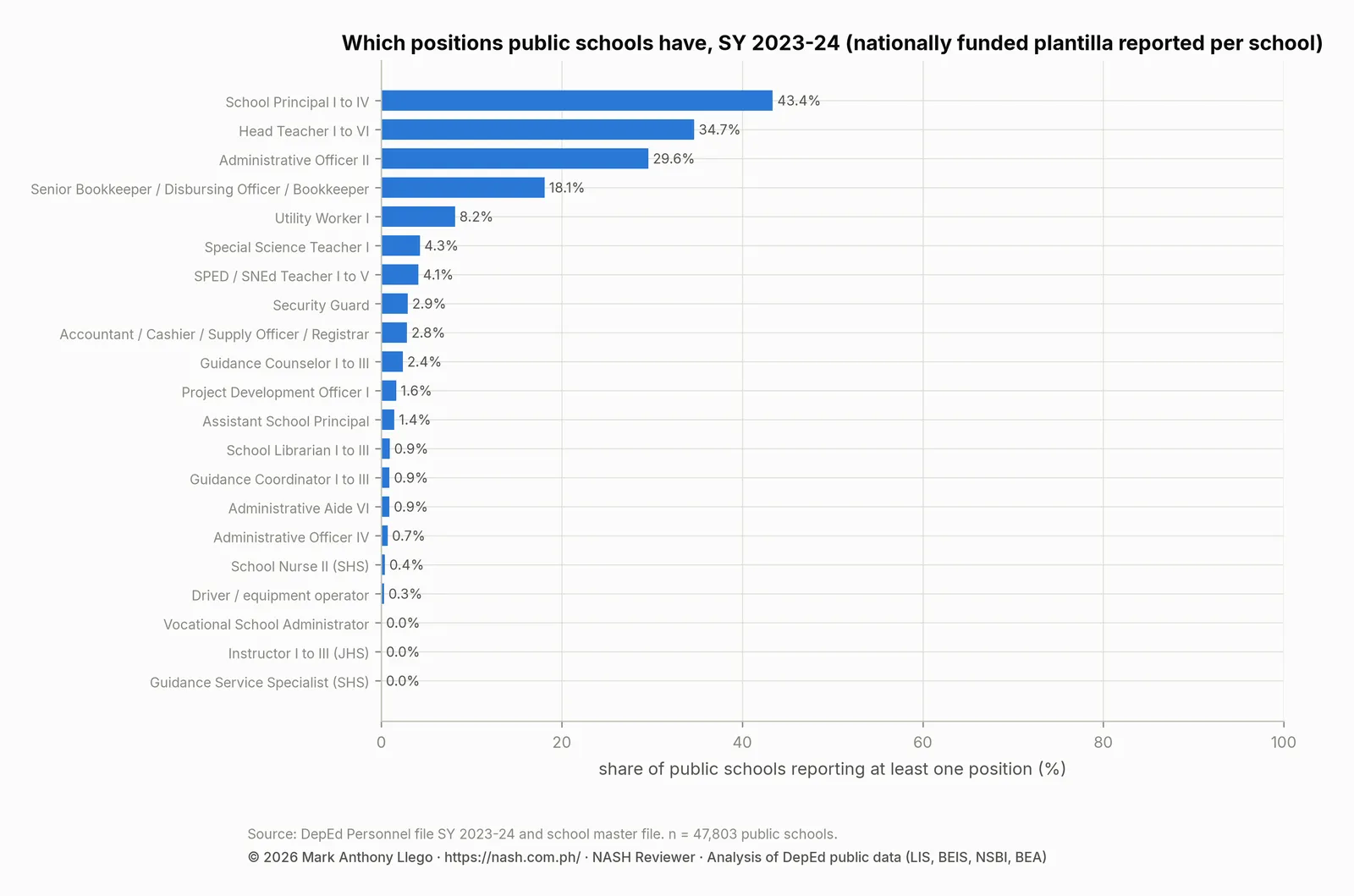
Question 31
Indicator 4.1.2, Personal and professional development. Career Stage 2, Situational, Moderate.
You are a newly appointed principal. Your assessment report for school heads rates you lowest in managing school operations and resources, and your own self-assessment against the professional standards agrees: you have never prepared a procurement plan or an inventory. The division offers a generic leadership course next quarter. Your school has an administrative officer with twelve years of experience. What is the most appropriate action?
- A. Ask the division for a course specifically on procurement and inventory, and defer setting development goals until the training schedule for the year is known and the course has been confirmed.
- B. Set development goals on the specific standards your self-assessment flagged, pair them with the administrative officer as a mentor on procurement and inventory this quarter, and take the division course for the gaps it covers.
- C. Enroll in the division’s leadership course and ask the administrative officer to take over procurement and inventory in the meantime, so that the school’s operations continue without interruption while you complete the course and the division’s follow-up sessions.
- D. Set a goal to raise your overall assessment rating in the next cycle, since the report scores all domains together and the operations domain will improve on its own with experience on the job.
Answer and explanation
Best answer: B. Points: A = 1, B = 3, C = 2, D = 0.
- A (1 point, Unistructural). Asking for a specific course is reasonable, but waiting for it postpones the goals that the self-assessment already supports.
- B (3 points, Relational). This sets goals from the self-assessment, matches each to a development means at hand and uses the course where it fits, which is what the indicator describes.
- C (2 points, Multistructural). The course helps, but delegating the work you need to learn to the officer leaves the gap unaddressed.
- D (0 points, Prestructural). An overall rating is not a development goal, and experience without a plan is not professional development.
Why. This aligns with Career Stage 2 expectations because indicator 4.1.2 asks the school head to set personal and professional development goals based on self-assessment aligned with the PPSSH. The assessment for school heads is developmental: its individual report shows the competency level by domain so that the candidate can target interventions, and the standards’ Domain 2 names procurement, inventory and records as the operations the school head manages. The personnel data show an administrative officer position in under a third of schools, so a principal who has one has a resource many lack. The option that delegates the work gets the course but not the goal. Waiting for a specific course is a single step; targeting a rating is not a goal.
Indicator 4.1.2: Set personal and professional development goals based on self-assessment aligned with the Philippine Professional Standards for School Heads.
Sources: DepEd Order No. 024, s. 2020; DepEd Memorandum No. 069, s. 2025; NASH Reviewer, Philippine basic education in numbers (DepEd public datasets, SY 2017-18 to SY 2025-26).
Question 32
Indicator 4.2.2, Professional reflection and learning. Career Stage 2, Situational, Moderate.
You are the principal of an elementary school. The reading intervention you introduced last year, modeled on a program you read about, has produced no change in the share of Grade 2 learners reading at grade level, which remains near the regional figure of one in twenty. The teachers who ran it say the materials were too hard and the sessions too short. The division wants your plan for the coming year. What is the most appropriate action?
- A. Continue the program unchanged, since one year is too short to judge a reading intervention and the learners’ starting level explains the lack of change better than anything in the program itself.
- B. Extend the sessions as the teachers suggest and keep the materials, so that the program has a fair trial over a second year before any further change is made to its design or its supervision.
- C. Replace the program with a different one recommended by the division, since the first did not work, and ask the teachers to document the new program’s sessions more carefully this year so that it can be evaluated properly at the end of the year.
- D. Review the year’s evidence with the teachers, identify what in the design and in your own decisions did not fit the learners, and revise the program and your supervision of it on that reflection before writing the plan.
Answer and explanation
Best answer: D. Points: A = 0, B = 1, C = 2, D = 3.
- A (0 points, Prestructural). Attributing no change to the learners and time avoids the reflection the evidence calls for.
- B (1 point, Unistructural). Adopting one of the teachers’ points is a partial response that skips the reflection on design and supervision.
- C (2 points, Multistructural). Changing programs without examining why the first failed repeats the original decision in a new form.
- D (3 points, Relational). This is professional reflection applied: the evidence is examined, the school head’s own part is included and the practice changes as a result.
Why. This aligns with Career Stage 2 expectations because indicator 4.2.2 asks the school head to apply professional reflection and learning to improve one’s own practice. The CRLA data show about one Grade 1 learner in twenty at grade level in the five regions covered, so a reading program that produces no change is a common experience, and the standards expect the school head to examine the evidence, including their own decisions, rather than swap programs. The option that replaces the program gets the need to change but skips the reflection. Extending sessions is a single adjustment; continuing unchanged is a refusal to reflect.
Indicator 4.2.2: Apply professional reflection and learning to improve one’s practice.
Sources: DepEd Order No. 024, s. 2020; NASH Reviewer, Philippine basic education in numbers (DepEd public datasets, SY 2017-18 to SY 2025-26).
Question 33
Indicator 4.3.2, Professional networks. Career Stage 2, Situational, Easy.
You are the principal of a school in a district with forty-one schools, twice the national median, where the district supervisor visits each school about once a year. Four nearby principals meet informally over coffee to swap problems. The division has launched an online community of practice for school heads, and the regional principals’ association invites members to a quarterly learning session. Your week is full. What is the most appropriate action?
- A. Ask the district supervisor to convene the district’s principals, since professional networking is the supervisor’s responsibility and the schools should wait for the district’s program to begin before meeting on their own.
- B. Keep meeting the four principals over coffee, since their problems are closest to yours, and read the online community’s posts when time allows during the quarter, since the posts are mostly about other divisions’ concerns.
- C. Join the division’s online community and the regional association, and let the coffee group lapse, since formal networks with a program and a membership are what the standards mean by professional networks for school heads at this career stage.
- D. Turn the informal group into a regular learning circle with an agenda drawn from shared problems, join the division’s online community for issues beyond the group, and attend the regional sessions that address your development goals.
Answer and explanation
Best answer: D. Points: A = 0, B = 1, C = 2, D = 3.
- A (0 points, Prestructural). Waiting for the supervisor to convene makes networking someone else’s duty.
- B (1 point, Unistructural). The coffee group is a network, but without structure or wider reach it will not upgrade practice much.
- C (2 points, Multistructural). Formal networks are valuable, but dropping the local group loses the network closest to the school’s problems.
- D (3 points, Relational). This participates in networks at three levels, with a purpose tied to development goals, which is what the indicator means by upgrading practice through networks.
Why. This aligns with Career Stage 2 expectations because indicator 4.3.2 asks the school head to participate in professional networks to upgrade knowledge and skills and enhance practice. The supervisor-load analysis in this series finds a median of 17 schools per district and a third of districts above twenty, so in a district of forty-one the supervisor’s visits are rare and peer networks carry much of the professional support. The option that joins the formal networks but drops the local group gets the structure and loses the nearest source of help. Keeping only the coffee group is a single network; waiting for the supervisor is not participation.
Indicator 4.3.2: Participate in professional networks to upgrade knowledge and skills and to enhance practice.
Sources: DepEd Order No. 024, s. 2020; NASH Reviewer, Philippine basic education in numbers (DepEd public datasets, SY 2017-18 to SY 2025-26).
Question 34
Indicator 4.6.2, Leadership development in individuals and teams. Career Stage 2, Situational, Moderate.
You are the principal of a large elementary school with no head teacher items and no assistant principal, as in most schools. Three master teachers and several Teacher IIIs have never led anything beyond their own classes. Next year’s school improvement plan has five programs, and you have been coordinating all of them yourself. The division has announced that head teacher items will be released to schools over three years. What is the most appropriate action?
- A. Keep coordinating the programs yourself, since accountability for the plan rests with the principal and teachers without a leadership item cannot be held responsible for a program’s results.
- B. Ask the teachers to nominate one of their number as assistant to the principal for the year, so that someone shares the coordination while the school waits for the items the division has announced.
- C. Designate a coordinator for each program from the master teachers or senior teachers, with a written role, a team, a schedule of your coaching, plus a record of their leadership work for the division’s head teacher selection.
- D. Designate the three master teachers as coordinators of the five programs, since their rank carries the responsibility, and continue to coordinate the remaining two programs yourself until the items are released to the school.
Answer and explanation
Best answer: C. Points: A = 0, B = 1, C = 3, D = 2.
- A (0 points, Prestructural). Accountability for the plan does not prevent delegation; refusing to delegate denies the opportunities.
- B (1 point, Unistructural). One nominated assistant shares the load but gives one person an opportunity, not the teams the indicator names.
- C (3 points, Relational). This creates real leadership roles with support and a record, for individuals and teams, which is what providing opportunities means.
- D (2 points, Multistructural). Using the master teachers is right, but limiting roles to rank and keeping two programs leaves opportunities on the table.
Why. This aligns with Career Stage 2 expectations because indicator 4.6.2 asks the school head to provide opportunities to individuals and teams in performing leadership roles and responsibilities. The personnel data for SY 2023-24 show a principal position in 43.4 percent of public schools and head teachers only in 27.7 percent, so middle leadership often has to be built by designation, and the National Education Plan’s pipeline of new principal and head teacher items will be filled from teachers who have led something. The option that designates the master teachers alone gets the delegation but limits it by rank. A single nominated assistant is one opportunity; refusing to delegate provides none.
Indicator 4.6.2: Provide opportunities to individuals and teams in performing leadership roles and responsibilities.
Sources: DepEd Order No. 024, s. 2020; EDCOM II, National Education Plan 2026-2035 (2026); NASH Reviewer, Philippine basic education in numbers (DepEd public datasets, SY 2017-18 to SY 2025-26).
Question 35
Indicator 4.7.2, General welfare of human resources. Career Stage 2, Situational, Difficult.
You are the principal of a public elementary school with thirty-two nationally funded teachers and six teachers paid by the municipality from its Special Education Fund. The six have been with the school for years, teach full loads, and this month learned that they have no leave credits, no hazard pay in the flood season and no contribution to any pension. Two have asked you whether they are entitled to the same benefits as their colleagues. What is the most appropriate action?
- A. Grant the six the same leave credits as the nationally funded teachers from the school’s records, since they do the same work, and inform the municipality of the arrangement after it has taken effect at the start of the next quarter.
- B. Advise the six that locally funded personnel are not DepEd employees and have no entitlements under the Department’s issuances, so the school has no role in the matter and cannot take it further on their behalf.
- C. Tell them that their contracts are the municipality’s responsibility and refer them to the municipal human resource office, while writing to the division to ask that the six be given national items in the next allocation of teaching positions.
- D. Tell them accurately which benefits attach to their local contracts and which do not, take their case to the local school board for the benefits the municipality can lawfully provide, and record their service for any future national item.
Answer and explanation
Best answer: D. Points: A = 1, B = 0, C = 2, D = 3.
- A (1 point, Unistructural). Granting benefits the contracts do not carry is outside the school head’s authority and creates a false record.
- B (0 points, Prestructural). The issuances on locally funded personnel assign the school head duties; disclaiming any role fails them.
- C (2 points, Multistructural). Referral and the request for items are both useful, but they leave the teachers without the accurate information and advocacy the school head owes them.
- D (3 points, Relational). This implements the issuances as they apply to each contract, pursues what the local board can give and keeps the record that future rights depend on.
Why. This aligns with Career Stage 2 expectations because indicator 4.7.2 asks the school head to implement laws, policies and issuances on the rights, privileges and benefits of school personnel to ensure their welfare. The personnel data for SY 2023-24 count 29,938 locally funded personnel in public schools, and the analysis in this series shows their benefits depend on the local contract and the local school board’s resolutions, not on the Department’s rules for plantilla staff. The school head’s duty is accurate information, advocacy with the board and a service record. The option that refers them elsewhere and requests items gets two steps without the duty. Granting benefits unilaterally exceeds authority; disclaiming any role fails the welfare duty.
Indicator 4.7.2: Implement laws, policies, guidelines and issuances on the rights, privileges and benefits of school personnel to ensure their general welfare.
Sources: DepEd Order No. 024, s. 2020; NASH Reviewer, Philippine basic education in numbers (DepEd public datasets, SY 2017-18 to SY 2025-26).
Question 36
Indicator 4.8.2, Rewards and recognition mechanism. Career Stage 2, Situational, Easy.
You are the principal of a junior high school. A team of three Grade 7 teachers ran a bridging class for thirty returning learners this year; all thirty are still enrolled in the fourth quarter, against a school history of losing half of such learners by then. The school’s recognition program consists of a certificate for the teacher with the highest performance rating at the end of the year. What is the most appropriate action?
- A. Keep the recognition program as it is, since rewarding one team for retention would discourage teachers whose subjects give them no comparable result to show at the end of the year.
- B. Recognize the team publicly for the outcome, with the data that show it, through a school rewards system that you now extend to teams and to specific results, and feed the practice into next year’s plan.
- C. Nominate the three teachers for the division’s outstanding teacher award, since the school’s own program recognizes only the top-rated individual and cannot be changed in the middle of the school year without the faculty’s agreement.
- D. Thank the three teachers at the next faculty meeting and note the result in their performance records, so that it counts toward the rating at the end of the year for each of them.
Answer and explanation
Best answer: B. Points: A = 0, B = 3, C = 2, D = 1.
- A (0 points, Prestructural). A system that cannot reward a documented gain in retention is not motivating performance.
- B (3 points, Relational). This rewards the result through the school’s own system, broadens the system to teams and outcomes and links recognition to improvement.
- C (2 points, Multistructural). A division nomination is recognition, but it leaves the school’s own system unable to reward what it most wants repeated.
- D (1 point, Unistructural). Thanks and a note in the record are a minimal acknowledgement, not a rewards system.
Why. This aligns with Career Stage 2 expectations because indicator 4.8.2 asks the school head to implement a school rewards system that recognizes and motivates learners, personnel and stakeholders for exemplary performance. The learner data show returning learners concentrated at Grade 7 and the cohort-flow analysis shows the junior high transitions leaking, so retaining thirty returnees is a result worth repeating; a rewards system that recognizes only the top individual rating cannot reward it. The option that nominates the team to the division gets recognition from elsewhere and leaves the system unchanged. Thanks and a note are a single gesture; keeping the system misreads motivation.
Indicator 4.8.2: Implement a school rewards system to recognize and motivate learners, school personnel and other stakeholders for exemplary performance and/or continued support.
Sources: DepEd Order No. 024, s. 2020; NASH Reviewer, Philippine basic education in numbers (DepEd public datasets, SY 2017-18 to SY 2025-26).
Question 37
Indicator 4.4.1, Performance management. Career Stage 1, Conceptual, Difficult.
EDCOM II reports that promotion-rate targets written into teachers’ and school heads’ performance commitments discourage honest grading. Which statement best explains how a school head should understand the performance management system in the light of this?
- A. The system rates personnel on the targets in their commitments, so the school head should keep the promotion-rate target but require teachers to attach their class records as evidence that the rate was genuinely achieved.
- B. The system is meant to improve performance through agreed objectives, coaching and evidence, so targets should be set on what the school can influence and measured with evidence that cannot be met by lowering standards.
- C. The system is a compliance requirement from the central office, so the school head should accept the targets it prescribes and focus on submitting the forms completely and on time each cycle.
- D. The system should exclude any target on learner outcomes, since results depend on the learners, and rate teachers instead on the activities they complete and document during the year.
Answer and explanation
Best answer: B. Points: A = 2, B = 3, C = 0, D = 1.
- A (2 points, Multistructural). Keeping the target with class records as evidence does not remove the incentive the report describes.
- B (3 points, Relational). This reads performance management as improvement through objectives and evidence, and draws the lesson about which targets and evidence to use.
- C (0 points, Prestructural). Treating the system as paperwork misunderstands its purpose.
- D (1 point, Unistructural). Excluding outcomes altogether overcorrects; the problem is the choice of target and evidence, not outcomes as such.
Why. This aligns with Career Stage 1 expectations because indicator 4.4.1 asks the aspiring school head to understand the implementation of the performance management system in improving performance. EDCOM II’s final report finds that promotion-rate targets in the IPCRF and OPCRF push teachers toward passing learners who have not met the standard, and the assessment data in this series show how small and uncertain the outcome measures available to a school are. The system’s purpose is improvement through agreed objectives, coaching and evidence, which means choosing targets within the school’s influence and evidence that cannot be gamed. The option keeping the target with records as evidence gets the evidence but not the incentive. Excluding outcomes overcorrects; treating the system as forms misreads it.
Indicator 4.4.1: Demonstrate knowledge and understanding of the implementation of the performance management system in improving school personnel and office performance.
Sources: DepEd Order No. 024, s. 2020; EDCOM II Final Report, Turning Point: A Decade of Necessary Reform (2026-2035), January 2026.
Question 38
Indicator 4.5.1, Professional development of school personnel. Career Stage 1, Conceptual, Easy.
A small school’s three teachers each handle a multigrade class, and their observation records show whole-class teaching of a single grade’s lesson. Which statement best explains how professional development should address this?
- A. Development should send the three teachers to the division’s next scheduled training, whatever its topic, since attendance at in-service training is the requirement the performance management system records for each teacher.
- B. Development should be targeted at the specific gap, multigrade planning and rotation, through training, coaching and observation of a practicing multigrade teacher, with follow-up to see the practice change in the classroom.
- C. Development is unnecessary, since teaching one grade’s lesson to the whole class is the practical way to run a multigrade class with the time available and the materials the school has been given.
- D. Development should provide the teachers with the multigrade teaching guides and lesson exemplars, so that they can study the approach on their own time and apply it when they are ready to do so.
Answer and explanation
Best answer: B. Points: A = 2, B = 3, C = 0, D = 1.
- A (2 points, Multistructural). Attendance at generic training does not address the gap the observations found.
- B (3 points, Relational). This targets the identified gap, uses more than one development mode and checks for change in practice, which is what the indicator describes.
- C (0 points, Prestructural). The observed practice is the gap multigrade pedagogy exists to close.
- D (1 point, Unistructural). Guides are one input, but reading them is not development of practice.
Why. This aligns with Career Stage 1 expectations because indicator 4.5.1 asks the aspiring school head to understand professional development in enhancing strengths and addressing performance gaps. The learner data for SY 2023-24 put 280,087 learners in multigrade classes in 5,974 public schools, and whole-class teaching of one grade’s lesson is the common fallback where teachers have not been trained in multigrade planning. Development that works is targeted at the observed gap, uses training with coaching and demonstration, and is followed up in the classroom. The option sending teachers to any scheduled training gets the mode but not the target. Guides alone are one input; denying the gap is a misconception.
Indicator 4.5.1: Demonstrate knowledge and understanding of professional development in enhancing strengths and in addressing performance gaps among school personnel.
Sources: DepEd Order No. 024, s. 2020; NASH Reviewer, Philippine basic education in numbers (DepEd public datasets, SY 2017-18 to SY 2025-26).
Question 39
Indicator 4.6.1, Leadership development in individuals and teams. Career Stage 1, Situational, Moderate.
You are a head teacher asked by your principal to propose coordinators for next year’s three new programs: a reading recovery class, a school research program and an ICT program for learners. The faculty has twenty teachers. The three most senior teachers expect the roles. A Teacher I built the school’s learning website on her own, a Teacher II has completed two action research studies, and a Teacher III ran a successful reading camp two years ago. What is the most appropriate action?
- A. Ask all twenty teachers to apply for the roles in writing, so that the principal can choose from the applications, and submit the list of applicants without a recommendation of your own.
- B. Match each program to the teacher whose demonstrated capability fits it, whatever their seniority, and propose a support role for the senior teachers that uses their strengths, with the reasons recorded for the principal.
- C. Propose the three senior teachers as coordinators, as they expect, and name the three teachers with relevant experience as their assistants so that their capabilities are used in the programs during the year under the senior teachers’ direction.
- D. Propose the three senior teachers, since coordination is a function of rank and experience, and the younger teachers’ projects were outside their assigned duties and should not count toward a role.
Answer and explanation
Best answer: B. Points: A = 1, B = 3, C = 2, D = 0.
- A (1 point, Unistructural). An open call is fair, but declining to recommend leaves the identification the task asked for undone.
- B (3 points, Relational). This identifies capability from evidence of what each teacher has done and matches it to the role, while finding a place for the senior teachers’ strengths too.
- C (2 points, Multistructural). Naming the capable teachers as assistants acknowledges them, but it puts the roles with the expectation rather than the strength.
- D (0 points, Prestructural). Rank is not evidence of capability for a specific role; this ignores the strengths in front of you.
Why. This aligns with Career Stage 1 expectations because indicator 4.6.1 asks the aspiring school head to identify the strengths, capabilities and potentials of individuals and teams in performing leadership roles. The evidence of capability in the scenario is what each teacher has already done, and the PPSSH’s Domain 4 treats leadership development as building on such strengths rather than on rank. The personnel data show 91 percent of elementary positions at Teacher I to III, so leadership for school programs must come from that pool. The option that keeps the senior teachers as coordinators and names the capable ones as assistants gets the capabilities noticed but not used. An open call without a recommendation is a single step; rank-based selection ignores the strengths.
Indicator 4.6.1: Identify strengths, capabilities and potentials of individuals and teams in performing leadership roles and responsibilities.
Sources: DepEd Order No. 024, s. 2020; NASH Reviewer, Philippine basic education in numbers (DepEd public datasets, SY 2017-18 to SY 2025-26).
Question 40
Indicator 4.7.1, General welfare of human resources. Career Stage 1, Conceptual, Moderate.
DepEd’s current rules set a teacher’s daily work at eight hours, of which six are for actual teaching and the rest for ancillary tasks, and remove administrative tasks from teachers. Which statement best describes how a school head applies these rules when assigning duties?
- A. Count each teacher’s actual teaching, ancillary tasks and any designation against the limits, assign administrative work to non-teaching staff or to the school head, and compensate or relieve where a teacher exceeds the limits.
- B. Assign duties so that each teacher’s timetable shows six hours of teaching, and treat tasks done outside the timetable, such as records and reports, as the teacher’s own time that the rules do not cover, to be arranged as each teacher sees fit.
- C. Post the rules in the faculty room so that teachers know their entitlements, and leave the assignment of duties to the department heads, who know their teachers’ loads better than the school head does from the office.
- D. Treat the rules as guidance, since a small school without non-teaching staff cannot operate within them, and assign duties according to the school’s needs as they arise during the school year, with the teachers’ consent.
Answer and explanation
Best answer: A. Points: A = 3, B = 2, C = 1, D = 0.
- A (3 points, Relational). This applies the rules to each teacher’s whole load, places administrative work where the rules put it and uses the remedies the rules provide.
- B (2 points, Multistructural). A six-hour timetable meets one limit, but tasks outside it are within the eight hours and the rules, not outside them.
- C (1 point, Unistructural). Informing teachers is one step; the school head assigns duties and is accountable for the limits.
- D (0 points, Prestructural). The rules are mandatory and include the small-school case; necessity does not suspend them.
Why. This aligns with Career Stage 1 expectations because indicator 4.7.1 asks the aspiring school head to know the laws, policies and issuances on the rights, privileges and benefits of school personnel, and the workload rules are among the most consequential. DepEd Order No. 005, s. 2024 sets six hours of actual teaching, at most, and two hours of ancillary tasks within the eight-hour day and DepEd Order No. 002, s. 2024 removes administrative tasks from teachers, while the personnel data show an administrative officer in under a third of schools, so the school head applies the limits with the staff available. The option that times only the timetable misses the tasks inside the eight hours. Posting the rules is a single step; treating them as guidance misreads them.
Indicator 4.7.1: Display knowledge of laws, policies, guidelines and issuances on the rights, privileges and benefits of school personnel to promote their general welfare.
Sources: DepEd Order No. 024, s. 2020; NASH Reviewer, Philippine basic education in numbers (DepEd public datasets, SY 2017-18 to SY 2025-26).
Domain 5: Building Connections (Questions 41 to 50)
These items rest on the following findings. Rizal, Cavite and the Metro Manila districts run 57 to 66 public learners per instructional room, and the local school board sets the Special Education Fund’s priorities. Internet connections exist in 78 percent of public schools, and connected schools average higher on the Grade 6 NAT within a division. The Indigenous Peoples share falls from 9.8 percent in Grade 7 to 8.4 percent in Grade 10. Many public schools report no fence or guard, and parent-teacher association contributions must be voluntary. Schools reached by foot or boat alone number 178, and thousands are tagged hard to reach.
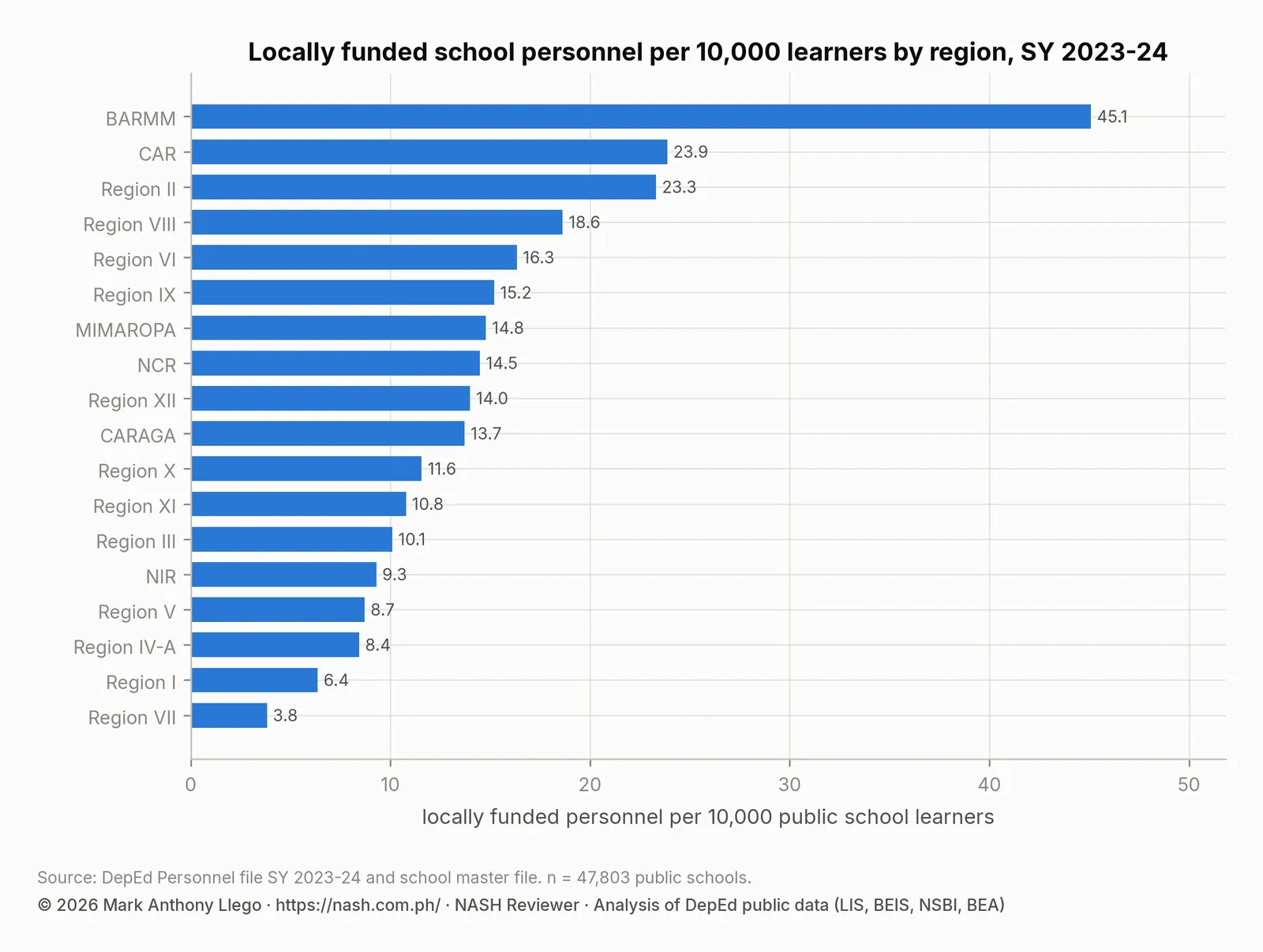
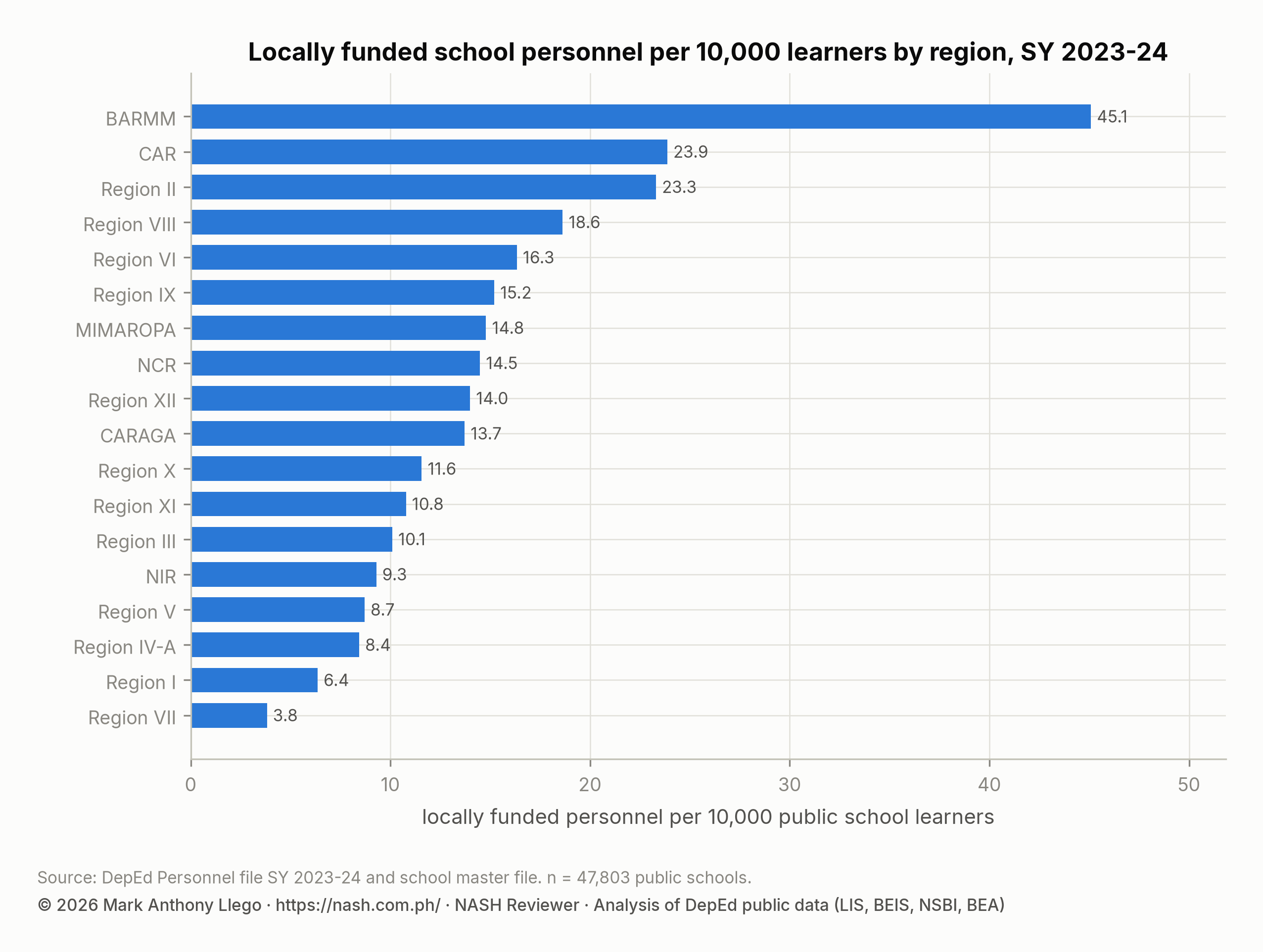
Question 41
Indicator 5.1.2, Management of diverse relationships. Career Stage 2, Situational, Moderate.
You are the principal of a public elementary school in a province whose classrooms hold about sixty learners each, among the most crowded in the country. The municipal mayor is new and has said the Special Education Fund will go to a sports complex. The local school board has not met in a year. Your two makeshift classrooms were built by parents. What is the most appropriate action?
- A. Ask the mayor, as the board’s chair, to convene the local school board, and bring to it the school’s enrollment, classroom ratio and a costed proposal so that the fund’s priorities are decided on the schools’ evidence.
- B. Invite the mayor to visit the school and see the makeshift classrooms, so that the shortage is seen first-hand before the fund’s budget for the year is finalized by the municipal council.
- C. Accept the mayor’s decision, since the fund belongs to the municipality and a school head who contests its use risks the relationship the school needs for its other requests during the mayor’s term.
- D. Write to the division superintendent asking that the division raise the classroom shortage with the mayor, since the superintendent sits on the board and has the standing to negotiate with the municipality on behalf of all schools.
Answer and explanation
Best answer: A. Points: A = 3, B = 1, C = 0, D = 2.
- A (3 points, Relational). This builds the relationship through the structure that exists for it, the board, and gives the authority the evidence on which to decide.
- B (1 point, Unistructural). A visit is a good step, but without the board and a proposal it leaves the decision where it was.
- C (0 points, Prestructural). Deference is not a relationship; the board exists so that schools’ needs are heard before the fund is spent.
- D (2 points, Multistructural). The superintendent is an ally, but asking the division to carry the request leaves the school head’s own relationship with the mayor unbuilt.
Why. This aligns with Career Stage 2 expectations because indicator 5.1.2 asks the school head to build constructive relationships with authorities and other stakeholders to foster an enabling environment. The province data in this series show Rizal, Cavite and the Metro Manila districts at 57 to 66 public learners per instructional room, and the local school board, chaired by the local chief executive with the superintendent as co-chair, is where the Special Education Fund’s priorities are set. The option that asks the superintendent to intervene uses a legitimate channel but not the school head’s own relationship. A visit is a single step; accepting the decision abandons the relationship the indicator describes.
Indicator 5.1.2: Build constructive relationships with authorities, colleagues, parents and other stakeholders to foster an enabling and supportive environment for learners.
Sources: DepEd Order No. 024, s. 2020; NASH Reviewer, Philippine basic education in numbers (DepEd public datasets, SY 2017-18 to SY 2025-26).
Question 42
Indicator 5.5.2, Community engagement. Career Stage 2, Situational, Difficult.
You are the principal of a junior high school with no internet connection, as a fifth of public schools report. A telecommunications company has offered a free connection for a year if the school signs a three-year contract at its commercial rate thereafter, and the parent-teacher association has offered to pay the first year’s electricity for the equipment. The division’s connectivity program has placed the school on a waiting list with no date. What is the most appropriate action?
- A. Accept the association’s electricity offer and ask the company for the free year without the contract, since a public school cannot be bound by a commercial agreement with a private firm of any kind.
- B. Decline the company’s offer and wait for the division’s program, since a commercial contract would commit school funds the school does not control, and ask the association to hold its offer until then.
- C. Sign the three-year contract and accept the association’s offer, since a year of free connection is worth having, and ask the division to take over the cost when its program reaches the school in a later year, which the division has said it will.
- D. Negotiate the offer into a partnership the school can sustain, with the association’s support written into a memorandum and the later years’ cost either reduced or covered by a partner, and keep the division’s program informed.
Answer and explanation
Best answer: D. Points: A = 0, B = 1, C = 2, D = 3.
- A (0 points, Prestructural). Schools may enter agreements with private partners under the rules; refusing any contract misreads them.
- B (1 point, Unistructural). Waiting avoids risk but leaves learners unconnected for an unknown period when partners are offering help.
- C (2 points, Multistructural). Taking the free year is attractive, but signing for costs the school cannot meet creates a liability, not a partnership.
- D (3 points, Relational). This initiates a partnership on sustainable terms, documents the stakeholders’ commitments and coordinates with the division’s own program.
Why. This aligns with Career Stage 2 expectations because indicator 5.5.2 asks the school head to initiate partnerships with the community and other stakeholders for the implementation of school programs. The ICT data for SY 2023-24 show about 78 percent of public schools with an internet connection and the connected schools averaging higher on the Grade 6 assessment within a division, so connectivity is worth pursuing, and the rules allow schools to enter documented partnerships with private firms. The option that signs the contract gets the opportunity and ignores the sustainability that a partnership needs. Declining and waiting is a single choice that gives up the offer; refusing any contract misreads the rules on partnerships.
Indicator 5.5.2: Initiate partnerships with the community, such as parents, alumni, authorities, industries and other stakeholders, to strengthen support for learner development, as well as school and community improvement.
Sources: DepEd Order No. 024, s. 2020; NASH Reviewer, Philippine basic education in numbers (DepEd public datasets, SY 2017-18 to SY 2025-26).
Question 43
Indicator 5.3.2, Inclusive practice. Career Stage 2, Situational, Moderate.
You are the principal of a junior high school that receives Grade 7 learners from two elementary schools serving an indigenous community. A fifth of your Grade 7 learners are indigenous, but by Grade 10 the share is a tenth, and the Grade 7 advisers report that the indigenous learners sit together at the back and rarely speak in class. The school has no indigenous teacher and no contact with the community’s elders. What is the most appropriate action?
- A. Treat all learners the same, since singling out the indigenous learners for different treatment would be discrimination and the school’s rules apply equally to every learner enrolled in it.
- B. Meet the community’s elders and the feeder schools to learn why learners leave, adopt practices in class and school life that reflect the learners’ culture and language, and track the cohort’s retention by group each quarter.
- C. Ask the Grade 7 advisers to move the indigenous learners to the front of the room and call on them in class, so that they take part in lessons from the start of the year rather than sitting at the back.
- D. Start a culture day each year and a club for the indigenous learners, so that they feel welcome, and ask the division for an indigenous teacher so that the learners have someone from their own community on the staff who can speak their language.
Answer and explanation
Best answer: B. Points: A = 0, B = 3, C = 1, D = 2.
- A (0 points, Prestructural). Treating everyone the same when the outcomes differ is not inclusion; inclusive practice responds to difference.
- B (3 points, Relational). This exhibits inclusive practice with the community’s knowledge, changes the school rather than the learners and measures whether it works.
- C (1 point, Unistructural). Seating and calling on learners is a classroom measure that treats the symptom.
- D (2 points, Multistructural). A culture day and a club are visible gestures, but they leave the daily practices and the community relationship untouched.
Why. This aligns with Career Stage 2 expectations because indicator 5.3.2 asks the school head to exhibit inclusive practices, including culture responsiveness, to foster awareness, acceptance and respect. The learner data for SY 2023-24 show the share of Indigenous Peoples learners rising through elementary and falling through junior high, from 9.8 percent in Grade 7 to 8.4 percent in Grade 10 nationally and more steeply in some regions, which is the pattern in the scenario. Inclusive practice starts from the community’s own account and changes the school’s practices, then checks retention. The option offering a culture day and a club gets visibility but not practice. Seating is a single classroom measure; sameness ignores the outcome gap.
Indicator 5.3.2: Exhibit inclusive practices, such as gender sensitivity, physical and mental health awareness and culture responsiveness, to foster awareness, acceptance and respect.
Sources: DepEd Order No. 024, s. 2020; NASH Reviewer, Philippine basic education in numbers (DepEd public datasets, SY 2017-18 to SY 2025-26).
Question 44
Indicator 5.4.2, Communication. Career Stage 2, Situational, Difficult.
You are the principal of a junior high school. The School Governing Council has read a news report that enrollment will fall by a fourth and wants the school to drop its request for two classrooms. Your own figures show Grade 7 falling by about a fifth over six years while the school stays above fifty learners per room until then. The council meets on Thursday and includes parents, a barangay official and a learner representative. What is the most appropriate action?
- A. Prepare a one-page brief with the school’s own grade counts and the projection side by side, present it in plain language to the council with the learner representative’s questions taken first, and record the decision and its reasons.
- B. Send the council members the school’s enrollment figures by message before Thursday, so that they can read them in advance and the meeting can proceed directly to a vote on the classroom request without a long discussion.
- C. Tell the council that the news report is wrong and that the classroom request stands, since the school’s figures are the school’s business and the council’s role is to endorse the plan it is given.
- D. Present the national projection and the school’s figures to the council in the form the division uses for its planning reports, so that the council sees the complete data behind the request before it votes on it at the same meeting on Thursday.
Answer and explanation
Best answer: A. Points: A = 3, B = 1, C = 0, D = 2.
- A (3 points, Relational). This communicates in writing and in speech, to every member including the learner, in a form they can use, and leaves a record.
- B (1 point, Unistructural). Sending figures is one channel; without the explanation and the discussion it does not communicate.
- C (0 points, Prestructural). Dismissing the council and withholding explanation is the opposite of effective communication with stakeholders.
- D (2 points, Multistructural). Complete data in the division’s format is accurate but not communication the council can use.
Why. This aligns with Career Stage 2 expectations because indicator 5.4.2 asks the school head to communicate effectively in speaking and in writing to teachers, learners, parents and other stakeholders through positive use of communication platforms. The projection in this series shows Grade 7 nationally falling about 24 percent by SY 2031-32 but describes a national shape, not a school, and a school above fifty learners per room can still need rooms while shrinking. Communicating that to a mixed council requires a plain brief, a spoken explanation and a record. The option presenting the division’s format gets completeness but not usability. A message before the meeting is a single channel; dismissing the council fails the indicator.
Indicator 5.4.2: Communicate effectively in speaking and in writing to teachers, learners, parents and other stakeholders, through positive use of communication platforms, to facilitate information sharing, collaboration and support.
Sources: DepEd Order No. 024, s. 2020; NASH Reviewer, Philippine basic education in numbers (DepEd public datasets, SY 2017-18 to SY 2025-26).
Question 45
Indicator 5.2.2, Management of school organizations. Career Stage 2, Situational, Moderate.
You are the principal of an elementary school with no perimeter fence and no guard, like many public schools. The parent-teacher association has voted to collect a monthly contribution from every family to hire a guard and has asked you to announce it at the flag ceremony. Some parents have complained to the barangay that the contribution is compulsory. The association’s officers say the guidelines allow it. What is the most appropriate action?
- A. Stop the association’s plan and ask the barangay to fund a guard instead, since security is the local government’s responsibility and parents should not be asked to pay for it from their own pockets every month.
- B. Allow the collection as voted, since the association is the body that decides its own contributions, and remind the officers in writing that no learner may be refused a service or a document for non-payment of the contribution by the family.
- C. Meet the officers to review what the guidelines allow, which is voluntary contributions decided in a general assembly with no learner disadvantaged, and help the association restructure the plan on that basis before any collection.
- D. Decline to announce the contribution at the flag ceremony, so that the school is not seen to endorse it, and let the association collect from the families who agree to pay on their own account and at their own risk.
Answer and explanation
Best answer: C. Points: A = 0, B = 2, C = 3, D = 1.
- A (0 points, Prestructural). Stopping the association and reassigning the problem misreads the school head’s role in managing it.
- B (2 points, Multistructural). A written reminder is right, but allowing a collection already seen as compulsory lets a non-compliant plan proceed.
- C (3 points, Relational). This manages the organization by the guidelines: the officers are helped to make the plan compliant before it is implemented.
- D (1 point, Unistructural). Keeping the school’s distance protects the school, not the families, and leaves the plan unmanaged.
Why. This aligns with Career Stage 2 expectations because indicator 5.2.2 asks the school head to manage school organizations such as parent-teacher associations by applying relevant policies and guidelines. The access and safety analysis in this series shows large shares of public schools without a fence or a guard, so associations often take security on themselves, and the guidelines on parent-teacher associations permit only voluntary contributions approved in a general assembly, with no learner disadvantaged. The option that allows the collection with a reminder gets one safeguard but lets the non-compliant plan go ahead. Declining to announce is a single distancing step; stopping the association misreads the school head’s role.
Indicator 5.2.2: Manage school organizations, such as learner organizations, faculty clubs and parent-teacher associations, by applying relevant policies and guidelines to support the attainment of institutional goals.
Sources: DepEd Order No. 024, s. 2020; NASH Reviewer, Philippine basic education in numbers (DepEd public datasets, SY 2017-18 to SY 2025-26).
Question 46
Indicator 5.1.1, Management of diverse relationships. Career Stage 1, Situational, Easy.
You are a head teacher of a small elementary school reached by boat. The barangay captain, whose council has just received its annual share of the disaster fund, mentions that the barangay could buy a boat for the school’s learners if the school asked. Your principal is on leave for a month, and the division’s planning cycle for the year closes in two weeks. What is the most appropriate action?
- A. Thank the captain but explain that the school cannot accept a boat from the barangay, since the division’s planning cycle is the proper channel for school needs and the request should go there first.
- B. Thank the captain and prepare a written request for your principal to sign on return, since a request to a local authority on behalf of the school is the principal’s to make and not the head teacher’s, whatever the timing.
- C. Thank the captain and mention the offer at the next parent assembly, so that the parents can follow it up with the barangay council themselves as the people whose children make the crossing.
- D. Thank the captain, confirm your principal’s agreement by phone, and send the barangay a short written request with the number of learners and the crossing schedule so that the council can act on it in its session.
Answer and explanation
Best answer: D. Points: A = 0, B = 2, C = 1, D = 3.
- A (0 points, Prestructural). A barangay may support a school; the planning cycle does not exclude local help.
- B (2 points, Multistructural). Waiting a month for a signature may miss the council’s session and the opportunity.
- C (1 point, Unistructural). Handing the follow-up to parents is one channel but leaves the school’s own request unmade.
- D (3 points, Relational). This deals with the authority promptly and properly, within your role, with the principal’s agreement and a written request the council can act on.
Why. This aligns with Career Stage 1 expectations because indicator 5.1.1 asks the aspiring school head to demonstrate skills in dealing with authorities, colleagues, parents and other stakeholders to encourage an enabling environment. The access data in this series count 178 public schools reachable by foot or boat alone among those reporting, and the barangay is the authority closest to such a school. Dealing with it well means acting promptly within one’s role, with the principal’s agreement and a written request the council can act on. The option that waits for the principal’s signature is correct about authority but risks the chance. Passing the follow-up to parents is a single step; refusing local help is a misconception.
Indicator 5.1.1: Demonstrate skills in dealing with authorities, colleagues, parents and other stakeholders to encourage an enabling and supportive environment for learners.
Sources: DepEd Order No. 024, s. 2020; NASH Reviewer, Philippine basic education in numbers (DepEd public datasets, SY 2017-18 to SY 2025-26).
Question 47
Indicator 5.2.1, Management of school organizations. Career Stage 1, Conceptual, Easy.
Which statement best describes the school head’s role toward the learner government under DepEd’s guidelines on learner organizations in public schools?
- A. To ensure that it is elected under the guidelines, has an adviser, meets, keeps records, is heard on matters that affect learners such as facilities or discipline, while leaving decisions within its mandate to the learners.
- B. To attend its assembly at the start of the year and let the adviser handle its affairs for the rest of the year, since the adviser is the teacher assigned to the organization by the school for that purpose.
- C. To treat it as a co-curricular club, since learners cannot take part in school decisions and the government’s function is to organize events and activities for the learners during the year.
- D. To approve its officers and its activities before they take effect, since the learner government acts in the school’s name and the school head is accountable for everything it does during the school year in the school’s name.
Answer and explanation
Best answer: A. Points: A = 3, B = 1, C = 0, D = 2.
- A (3 points, Relational). This describes supervision under the guidelines together with the learner government’s voice and autonomy.
- B (1 point, Unistructural). Attending once is a minimal form of supervision, not the role.
- C (0 points, Prestructural). The guidelines give learner organizations a voice in school decisions; treating them as a club misreads them.
- D (2 points, Multistructural). Approval of officers and activities overreaches; the guidelines provide for election and an adviser, not for the school head’s approval.
Why. This aligns with Career Stage 1 expectations because indicator 5.2.1 asks the aspiring school head to understand policies and guidelines on managing school organizations, including learner organizations. The guidelines on learner government provide for elections, an adviser and participation in school decisions, and the data in this series show matters, such as toilets and safety, on which learners’ evidence is often the first the school has. The option that approves officers and activities confuses supervision with control. Attending the assembly is a single act; treating the government as a club denies the voice the guidelines give it.
Indicator 5.2.1: Demonstrate knowledge and understanding of policies and guidelines on managing school organizations, such as learner organizations, faculty clubs and parent-teacher associations, in support of the attainment of institutional goals.
Sources: DepEd Order No. 024, s. 2020; NASH Reviewer, Philippine basic education in numbers (DepEd public datasets, SY 2017-18 to SY 2025-26).
Question 48
Indicator 5.3.1, Inclusive practice. Career Stage 1, Conceptual, Moderate.
A junior high school finds that girls make up more than half its science and mathematics honor roll but a third of those choosing the science strand for senior high, and that boys account for most of its discipline cases and early leavers. Which statement best explains what gender sensitivity asks of the school?
- A. To run a gender and development seminar for teachers and learners each year, as the program requires, and to report the number of participants in the school’s gender and development accomplishment report to the division at the end of the year.
- B. To encourage the girls on the honor roll to choose the science strand, since the data show that capable girls are choosing other strands and the school should correct that pattern before enrollment.
- C. To examine how the school’s practices, from strand guidance to discipline, treat girls and boys differently in their effects, and to adjust those practices so that neither sex is steered or lost, using the data by sex to check.
- D. To treat girls and boys identically in every policy and practice, since gender sensitivity means that sex plays no part in how the school treats a learner in class or in discipline.
Answer and explanation
Best answer: C. Points: A = 2, B = 1, C = 3, D = 0.
- A (2 points, Multistructural). A seminar and a report are activities the program counts, not the examination of practice the data call for.
- B (1 point, Unistructural). Encouraging the girls addresses one pattern and leaves the boys’ pattern and the practices behind both untouched.
- C (3 points, Relational). This describes gender sensitivity as attention to differential effects, adjustment of practice and monitoring by sex, which is what the indicator means.
- D (0 points, Prestructural). Identical treatment where effects differ is not sensitivity; the concept exists because effects differ.
Why. This aligns with Career Stage 1 expectations because indicator 5.3.1 asks the aspiring school head to understand inclusive practices such as gender sensitivity. The strand analysis in this series shows girls now a majority in STEM nationally and a shrinking minority in TVL, while the enrollment series shows the female share of each cohort rising with grade, which means boys leave earlier, so the patterns in the scenario are real and run in both directions. Gender sensitivity means examining the school’s own practices for their effects by sex and adjusting them, with the data as the check. The option proposing a seminar gets an activity but not the examination. Encouraging the girls is a single step; identical treatment is a misconception.
Indicator 5.3.1: Demonstrate knowledge and understanding of inclusive practices, such as gender sensitivity, physical and mental health awareness and culture responsiveness, to foster awareness, acceptance and respect.
Sources: DepEd Order No. 024, s. 2020; NASH Reviewer, Philippine basic education in numbers (DepEd public datasets, SY 2017-18 to SY 2025-26).
Question 49
Indicator 5.4.1, Communication. Career Stage 1, Situational, Moderate.
You are a head teacher asked to write the school’s section of the division report for parents. The division’s own figures place it in the bottom tenth of divisions nationally on classrooms and toilets per learner. Your school is below the division average on both. The principal wants the section to be honest, short and useful to parents who will read it on their phones. What is the most appropriate action?
- A. Write that the school faces a classroom and toilet shortage and that the division is aware of it, keeping the figures out so that parents are not alarmed by numbers they may misread without the context.
- B. Write that the school’s facilities meet the standard, since the figures are the division’s problem and a report to parents should maintain their confidence in the school and its teachers.
- C. Write the section as a summary of the division’s full table of indicators, reproduced for parents, so that the school’s position is shown accurately in the context of every other school in the division and the region as a whole.
- D. Write three short paragraphs in plain language that state the school’s two ratios against the division and the country, say what the school is doing about each, and end with how parents can help, with one simple chart.
Answer and explanation
Best answer: D. Points: A = 1, B = 0, C = 2, D = 3.
- A (1 point, Unistructural). Withholding the figures to avoid alarm treats parents as unable to read a number and leaves them without the facts.
- B (0 points, Prestructural). A false statement is not communication; it is the opposite of the honesty the principal asked for.
- C (2 points, Multistructural). Reproducing the division’s table is accurate but unreadable on a phone and unusable by parents.
- D (3 points, Relational). This is competent writing for the audience and platform: accurate, plain, brief and tied to action.
Why. This aligns with Career Stage 1 expectations because indicator 5.4.1 asks the aspiring school head to demonstrate competent skills in speaking and writing and in using communication platforms. The division league tables in this series show the spread across divisions, from 12 to 82 public learners per instructional room and from 15 to 136 per functional toilet bowl, and a parent report that places the school within that spread must be short, plain and tied to action if it is to be read on a phone. The option that reproduces the division’s table gets accuracy and loses the reader. Withholding figures is a single evasion; claiming the standard is met is a falsehood.
Indicator 5.4.1: Demonstrate competent skills in speaking and writing, as well as in utilizing communication platforms, in communicating with teachers, learners, parents and other stakeholders.
Sources: DepEd Order No. 024, s. 2020; NASH Reviewer, Philippine basic education in numbers (DepEd public datasets, SY 2017-18 to SY 2025-26).
Question 50
Indicator 5.5.1, Community engagement. Career Stage 1, Situational, Moderate.
You are a head teacher of an elementary school that the division lists as hard to reach: learners walk up to an hour on a trail that floods in the rainy season, and attendance in the first quarter falls by a fifth. The barangay has a youth council, a women’s association and a farmers’ cooperative, and two alumni run businesses in the town. The school has never asked any of them for anything. What is the most appropriate action?
- A. Ask the two alumni to fund a footbridge over the flooded section of the trail, since a single large contribution from people with means will solve the problem faster than many small ones from the community.
- B. Accept the attendance pattern as a feature of a hard-to-reach school, since the trail is outside the school’s grounds and the community’s roads are the local government’s responsibility and not the school’s to fix.
- C. Identify what each group can contribute to a footbridge, a walking escort and a rainy-season attendance plan, invite them to a meeting where the attendance data are shown, and agree written roles for the year.
- D. Request the barangay council to include the trail in its infrastructure plan for the coming year, and inform the parents that the school has raised the matter with the barangay on their behalf.
Answer and explanation
Best answer: C. Points: A = 2, B = 0, C = 3, D = 1.
- A (2 points, Multistructural). Alumni funding may help, but involving one donor leaves the community’s other capacities and the attendance plan unused.
- B (0 points, Prestructural). Accepting the loss of a fifth of attendance abandons the learners and the community’s willingness to help.
- C (3 points, Relational). This involves several community groups with specific contributions, on evidence, with roles agreed and written down.
- D (1 point, Unistructural). A request to the council is one step and leaves the rest of the community uninvolved.
Why. This aligns with Career Stage 1 expectations because indicator 5.5.1 asks the aspiring school head to involve the community, including parents, alumni, authorities and other stakeholders, in school programs and projects. The access data for SY 2023-24 record thousands of public schools tagged hard to reach and 178 reachable only on foot or by boat, where attendance depends on the route as much as on the school. Involving the community means matching each group to a contribution, showing the evidence and agreeing roles. The option that asks the alumni to fund a bridge gets a contribution but involves one group. Requesting the council is a single step; accepting the attendance loss involves no one.
Indicator 5.5.1: Involve the community, such as parents, alumni, authorities, industries and other stakeholders, in school programs, projects and activities to gain support for learner development, as well as school and community improvement.
Sources: DepEd Order No. 024, s. 2020; NASH Reviewer, Philippine basic education in numbers (DepEd public datasets, SY 2017-18 to SY 2025-26).
Score yourself
| Domain | Your points | Maximum |
|---|---|---|
| 1 Leading Strategically | 30 | |
| 2 Managing School Operations and Resources | 30 | |
| 3 Focusing on Teaching and Learning | 30 | |
| 4 Developing Self and Others | 30 | |
| 5 Building Connections | 30 | |
| Total | 150 |
DepEd’s fiscal year (FY) 2025 results use a standardized score of 65 on a 1 to 100 scale, overall and by domain, computed from an Ordinal Partial Credit Model. A raw points total on fifty practice items is not that scale and cannot be converted to it. The per-domain totals can show where your Multistructural and Unistructural choices cluster. A domain where you repeatedly chose the right action through the wrong channel, or a single step in place of a plan, is the domain to study with its PPSSH domain guide, starting from the PPSSH Domain 1 guide.
The item-writing rules used in this set
Every item meets the rules the NASH Reviewer question bank applies before it accepts an item:
- One Career Stage 1 or 2 indicator per item, with Career Stage 2 items always situational.
- Exactly one option at each SOLO level.
- The Relational option between 0.85 and 1.15 times the average length of the other three, the longest option at most 1.5 times the shortest, and the key the single longest option in no more than 30 percent of items.
- No “all of the above”, and no option letters in feedback.
- No absolute words that appear only in wrong options, and no policy vocabulary that appears only in the key.
- Positive question sentences, and no issuance numbers in situational stems.
- Feedback that explains what every option gets right and misses.
- A rationale that names the career stage, the governing provision and the element the two-point option fails to connect.
Frequently asked questions
How is NASH practice Set B different from Set A?
Set A was written from the first data reports in this series. Set B is written from the later analyses: the projection to SY 2031-2032, the division and province tables, the private and public assessment comparison, persistence across assessments, strands by sex, supervisor load, school leadership and support positions, locally funded personnel, access and safety, sanitation, classroom technology, learner groups by grade and the private-school closures of 2020. Eighteen of its fifty indicators do not appear in Set A.
Are these actual NASH questions?
No. They are original practice items written from public issuances and public data. They follow DepEd’s own description of the NASH as conceptual and situational items aligned with the PPSSH and scored on the SOLO taxonomy. DepEd Memorandum No. 069, s. 2025 states that the Department is not affiliated with anyone claiming access to examination content.
Which PPSSH indicators does Set B cover that Set A did not?
In Domain 1: 1.1.2, 1.3.2, 1.5.1 and 1.6.2. In Domain 2: 2.5.2 and 2.6.2. In Domain 3: 3.3.1, 3.6.2, 3.7.1, 3.7.2, 3.8.1 and 3.8.2. In Domain 4: 4.1.2, 4.2.2, 4.3.2, 4.6.2, 4.7.2 and 4.8.2. Between the two sets, every Career Stage 1 and 2 indicator the NASH targets is covered at least once.
Can I use these NASH practice items in a review session?
Yes, with the credit line below. DepEd personnel who conduct review sessions must hold an approved permit to practice their profession outside official hours, as the memorandum’s item 15 requires.
Download the data
The cleaned, harmonized DepEd files behind this series are free to download in CSV and Parquet, with a codebook and checksums, under the terms of use set out in the release. Download Cleaned DepEd School Data, SY 2017-18 to 2025-26 documents every file and column. The files themselves are at data.nash.com.ph, starting with the README, the SY 2023-24 school master file (CSV, 8.0 MB) and the nine-year enrollment panel (Parquet, 17.2 MB).
Guides for aspiring school heads
- The other set: NASH Practice Questions With Answers: 50 Items on the PPSSH
- DepEd Data for Aspiring School Heads: Where to Start
- How to Read DepEd Data: A Guide for Aspiring School Heads
- EDCOM II Final Report: Guide for Aspiring School Heads
- NASH Study Guide: DepEd Memorandum 069, s. 2025 and PPSSH
- PPSSH Domain 1: Leading Strategically With DepEd Data
- PPSSH Domain 2: Managing School Operations With DepEd Data
- PPSSH Domain 3: Teaching and Learning With DepEd Data
- PPSSH Domain 4: Developing Self and Others With DepEd Data
- PPSSH Domain 5: Building Connections With DepEd Data
- On the app: the NASH guide, the PPSSH guide, the practice sets and the full data report, Philippine basic education in numbers
The data reports
- DepEd Enrollment Trends SY 2017-2018 to SY 2025-2026
- DepEd Learner Data SY 2023-2024: IP, ALIVE and School Size
- DepEd Teachers and School Personnel Data, SY 2023-2024
- DepEd Classroom and School Building Data, SY 2023-2024
- DepEd WASH Data SY 2023-2024: Toilets, Water, Electricity
- DepEd ICT Data SY 2023-2024: Computers and Internet
- NAT Grade 6 Results SY 2023-2024: DepEd Division Scores
- ELLNA Grade 3 Results SY 2023-2024: DepEd Division Scores
- CRLA Results SY 2025-2026: Reading Levels in Grades 1 to 3
- DepEd School Inputs vs Test Results: Multigrade and Internet
- DepEd Open Data Quality: Errors, Blanks and Coverage Limits
- Download Cleaned DepEd School Data, SY 2017-18 to 2025-26
Practice items written by Mark Anthony Llego for NASH Reviewer. Sources: DepEd public datasets; EDCOM II Final Report, January 2026; DepEd Order No. 024, s. 2020; DepEd Memorandum No. 069, s. 2025. The items may be reused only with written permission: email support@nash.com.ph.