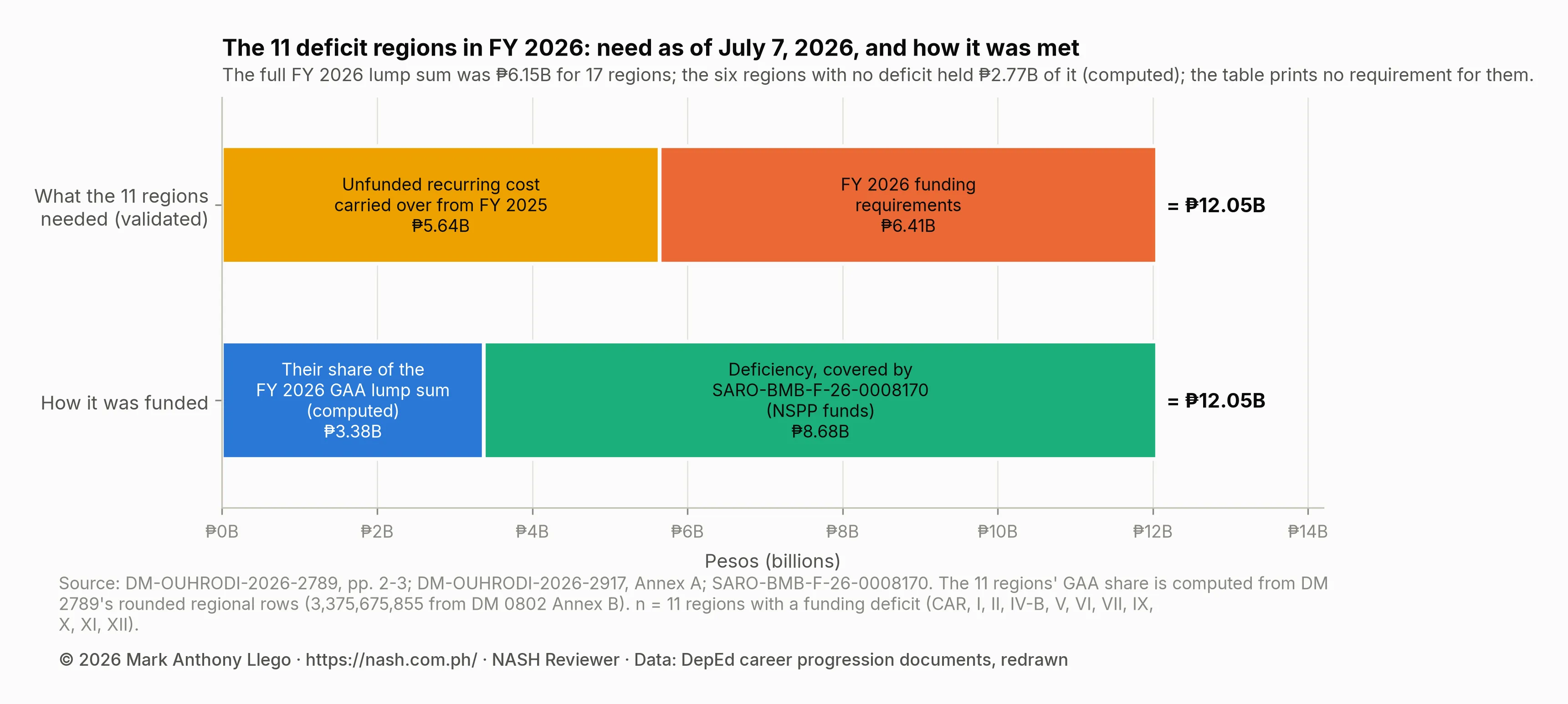
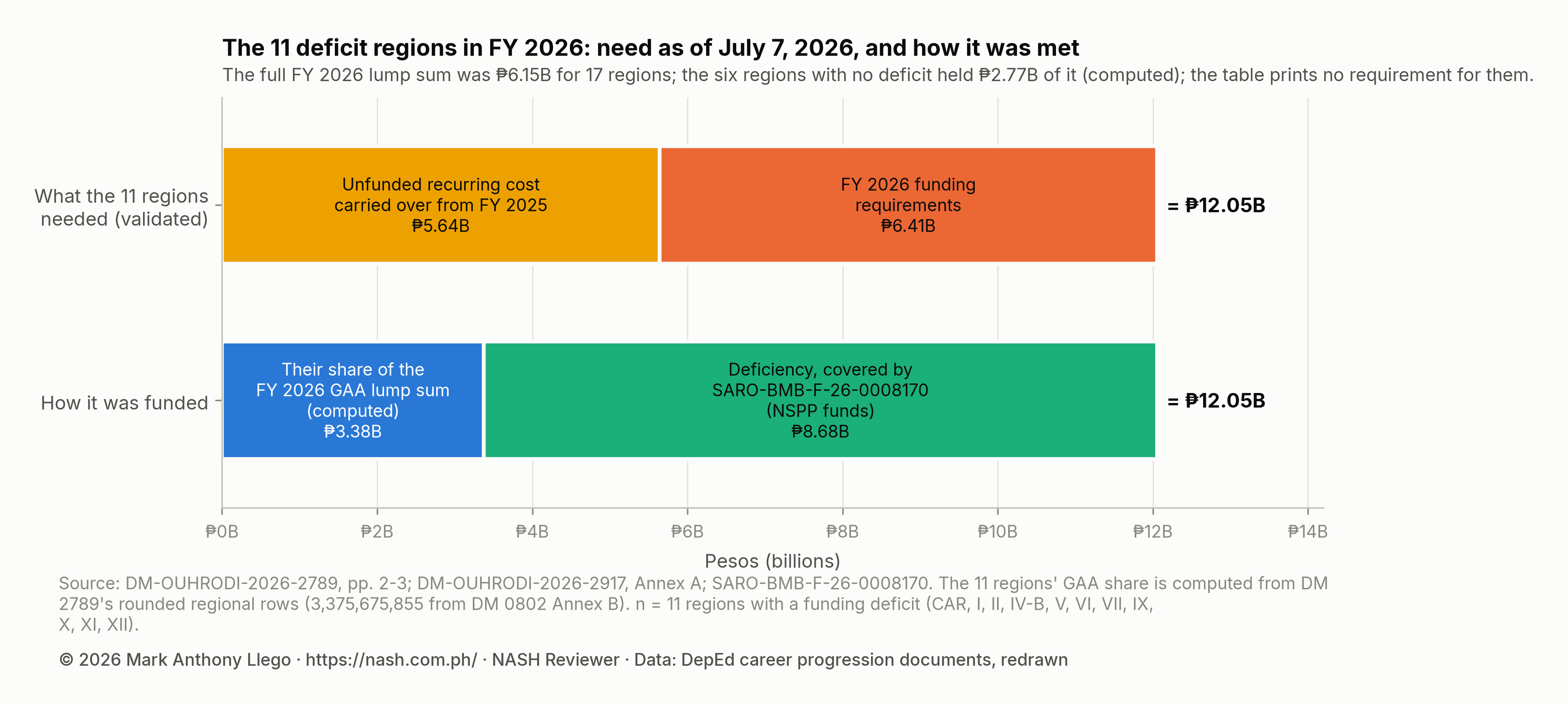
ECP reclassification was deferred in 2026 because 11 regions ran out of reclassification money. DepEd Memorandum DM-OUHRODI-2026-2789, dated August 5, 2026, covers CAR and Regions I, II, IV-B, V, VI, VII, IX, X, XI and XII. There, every application not yet issued a Notice of Organization, Staffing and Classification Action (NOSCA) “shall be temporarily deferred, pending the availability of funds, except for retitling actions, which do not involve salary adjustments”, and all deferred applications “shall be prioritized for funding under the FY 2027 appropriations for the reclassification of positions” (Sec. III.A, p. 4). As of July 7, 2026, the 11 regions needed ₱12,054,271,399 to pay the salary differentials of teachers and school heads already appointed or issued a NOSCA. Their share of the FY 2026 reclassification lump sum was ₱3,375,677,000 in DM 2789’s rounded figures (computed), leaving a deficiency of ₱8,678,594,399 (pp. 2–3).
The Department of Budget and Management (DBM) covered that deficiency with SARO-BMB-F-26-0008170 of August 12, 2026, using unreleased funds for New School Personnel Positions (NSPP) pooled from regions with filling-up rates below 10%. That money pays for reclassifications already made, not for the applications still waiting. DM 2789 deferred those “to ensure that approved salary differentials remain within available appropriations and prevent the accumulation of unfunded personnel obligations” (p. 4). Nothing was canceled: a qualified applicant not reclassified for lack of funds keeps a place in the Comparative Assessment Results for Expanded Reclassification (CAReER) without a new assessment (DO 034, s. 2025, para. 26).
This post is current as of October 31, 2026. “DM 2789” is DM-OUHRODI-2026-2789. “The SBR” is DepEd’s Special Budget Request to DBM of July 13, 2026, whose six-page letter is attached to DM 2789 (pp. 8–13). SBR page numbers below are those of the full 15-page SBR, with its Annexes A and B. A SARO is a Special Allotment Release Order, a sub-ARO is the allotment DepEd’s central office passes to a region, and an NCA is a Notice of Cash Allocation.
Key findings
- Deferred, not canceled, in 11 regions only. In CAR and Regions I, II, IV-B, V, VI, VII, IX, X, XI and XII, applications without a NOSCA are deferred, retitling excepted, and prioritized for FY 2027 appropriations (DM-OUHRODI-2026-2789, Sec. III.A, p. 4). NCR, NIR, Regions III, IV-A and VIII, and CARAGA may keep processing until their FY 2026 allocations are fully utilized (Sec. III.B, p. 5).
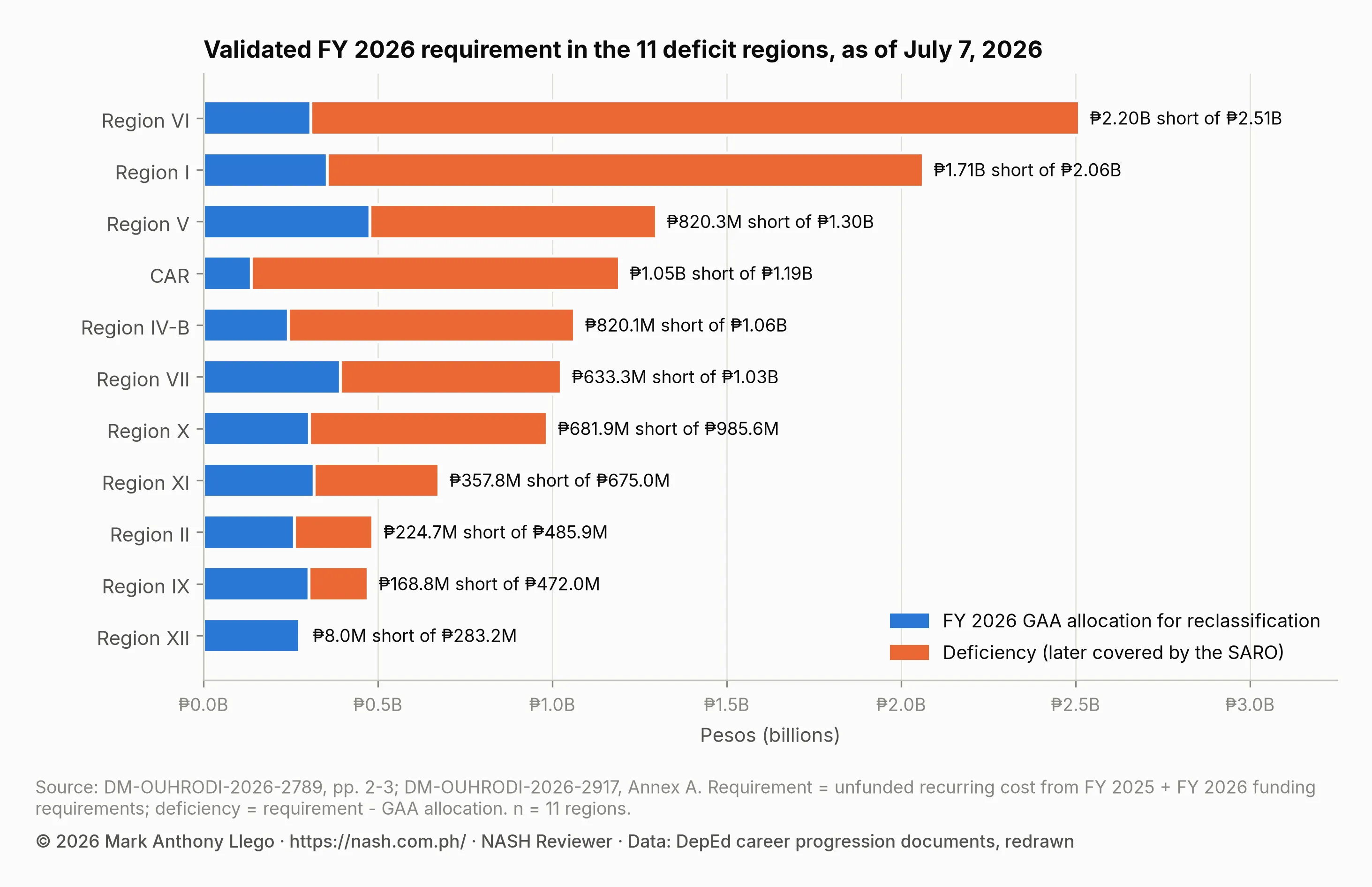
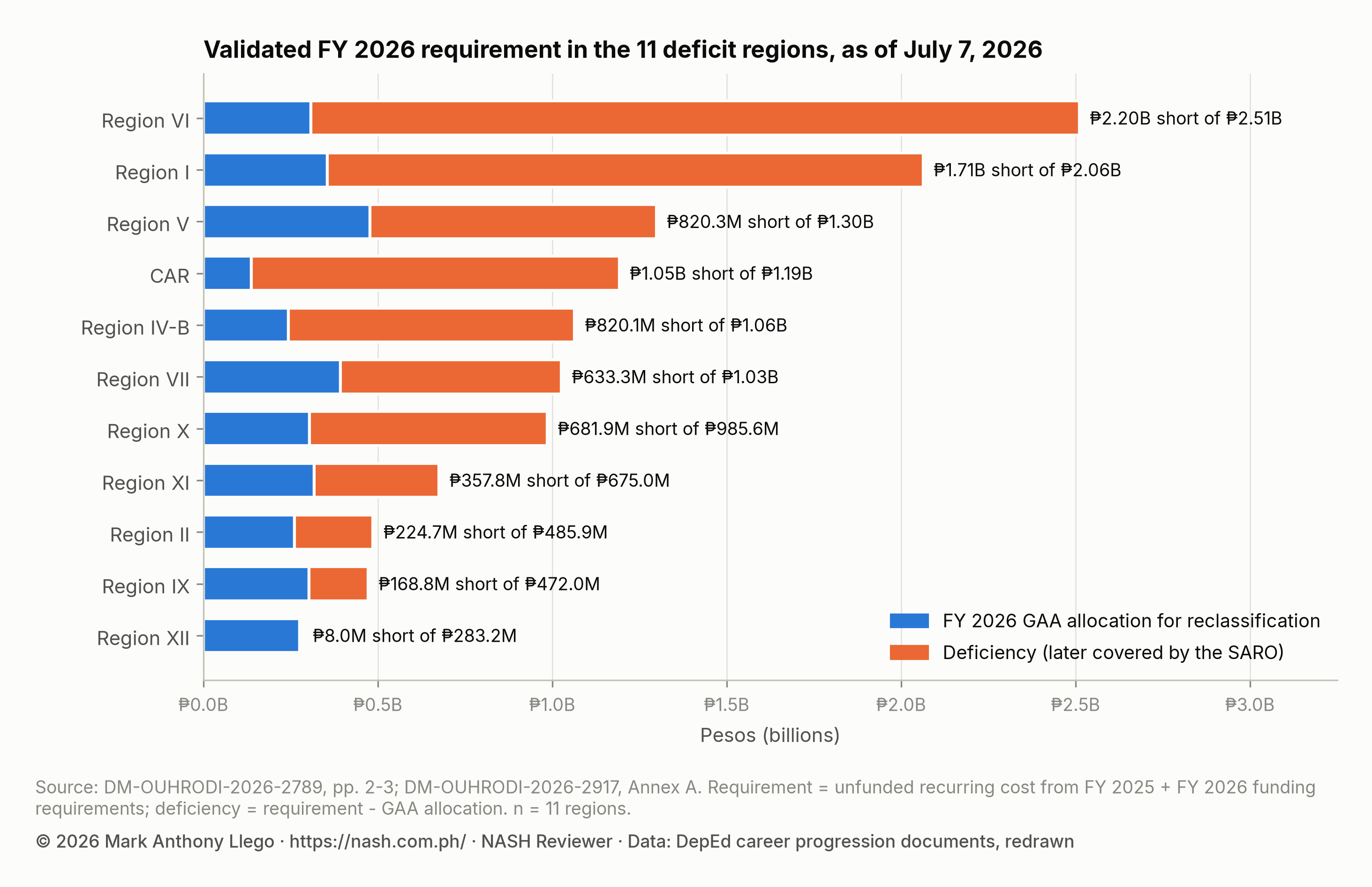
- The gap was ₱8,678,594,399 as of July 7, 2026. The 11 regions’ validated requirement was ₱12,054,271,399: ₱5,641,741,357 of unfunded recurring cost from FY 2025 and ₱6,412,530,042 of FY 2026 requirements. Their rows of the ₱6,148,433,000 lump sum add up to ₱3,375,677,000 as DM 2789 rounds them, or ₱3,375,675,855 from the exact figures in DM-OUHRODI-2026-0802; either way about 28.0% of the need (all computed) (DM 2789, pp. 2–3; DM 0802, Annex B). Region VI’s deficiency, ₱2,202,001,954, was the largest.
- DBM filled it with NSPP money. SARO-BMB-F-26-0008170, issued August 12, 2026, releases ₱8,678,594,399 under “New School Personnel Positions”, “valid for obligation until December 31, 2026” (SARO, p. 1). Twelve regions with filling-up rates below 10% gave up that amount (DM 2789, pp. 3–4).
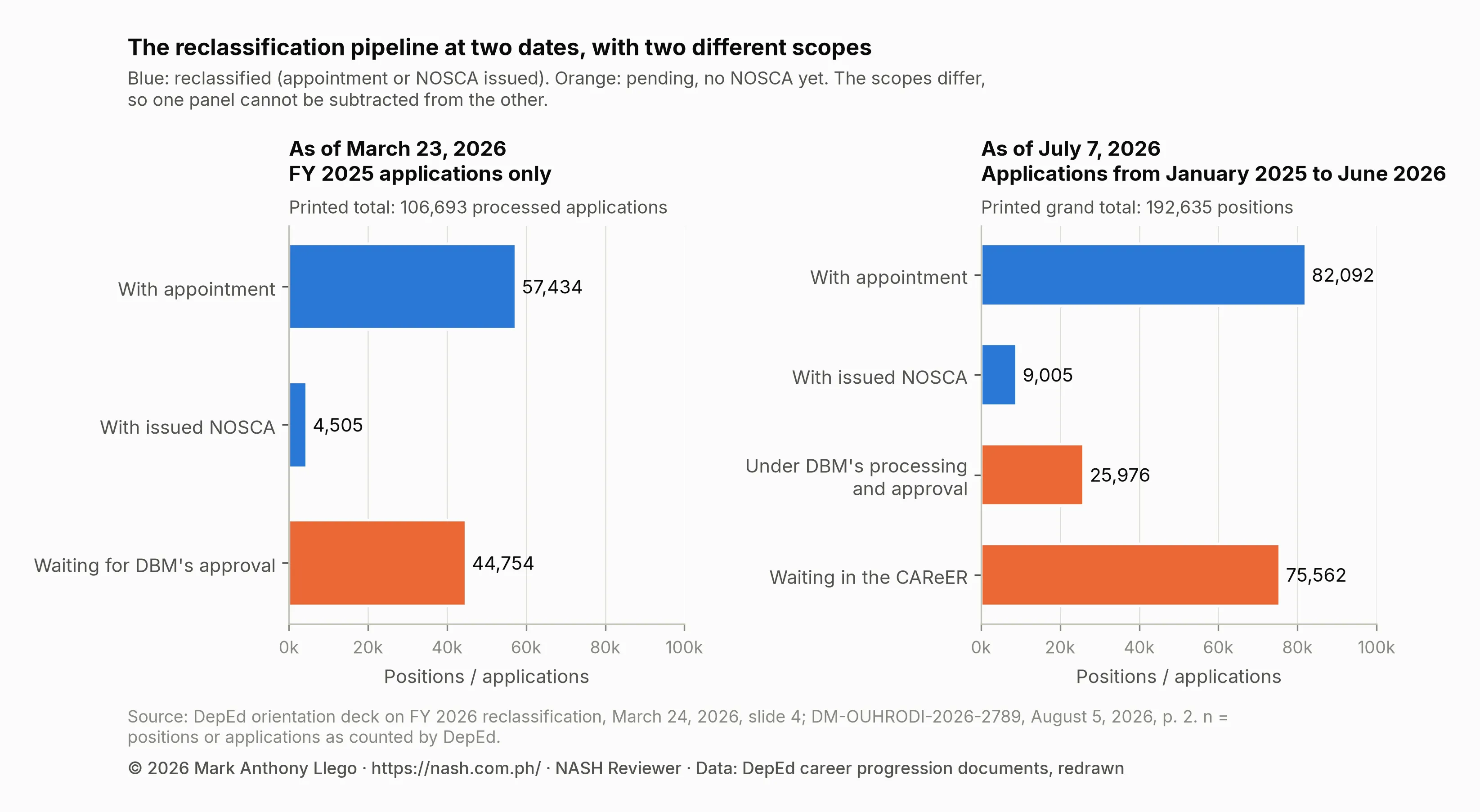
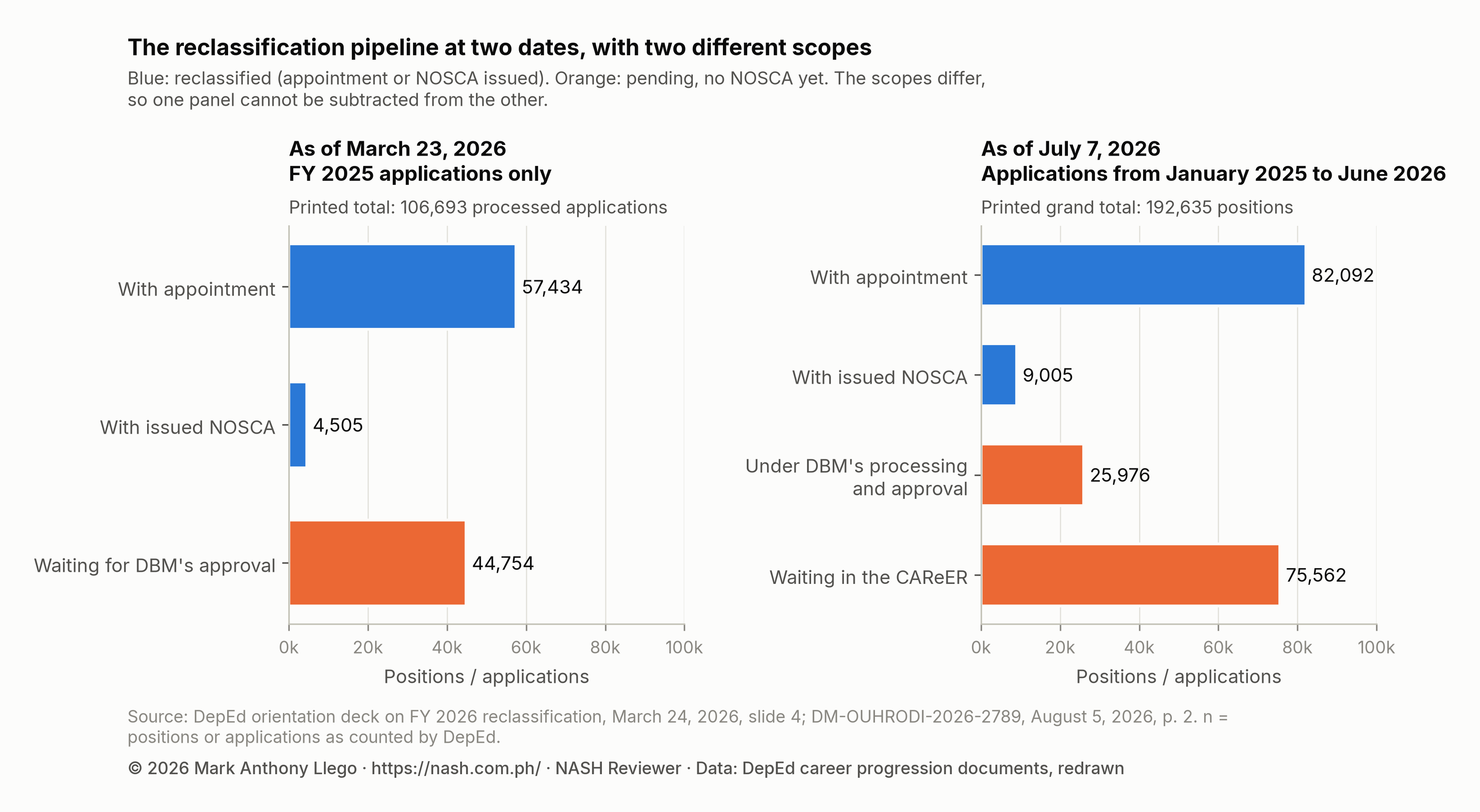
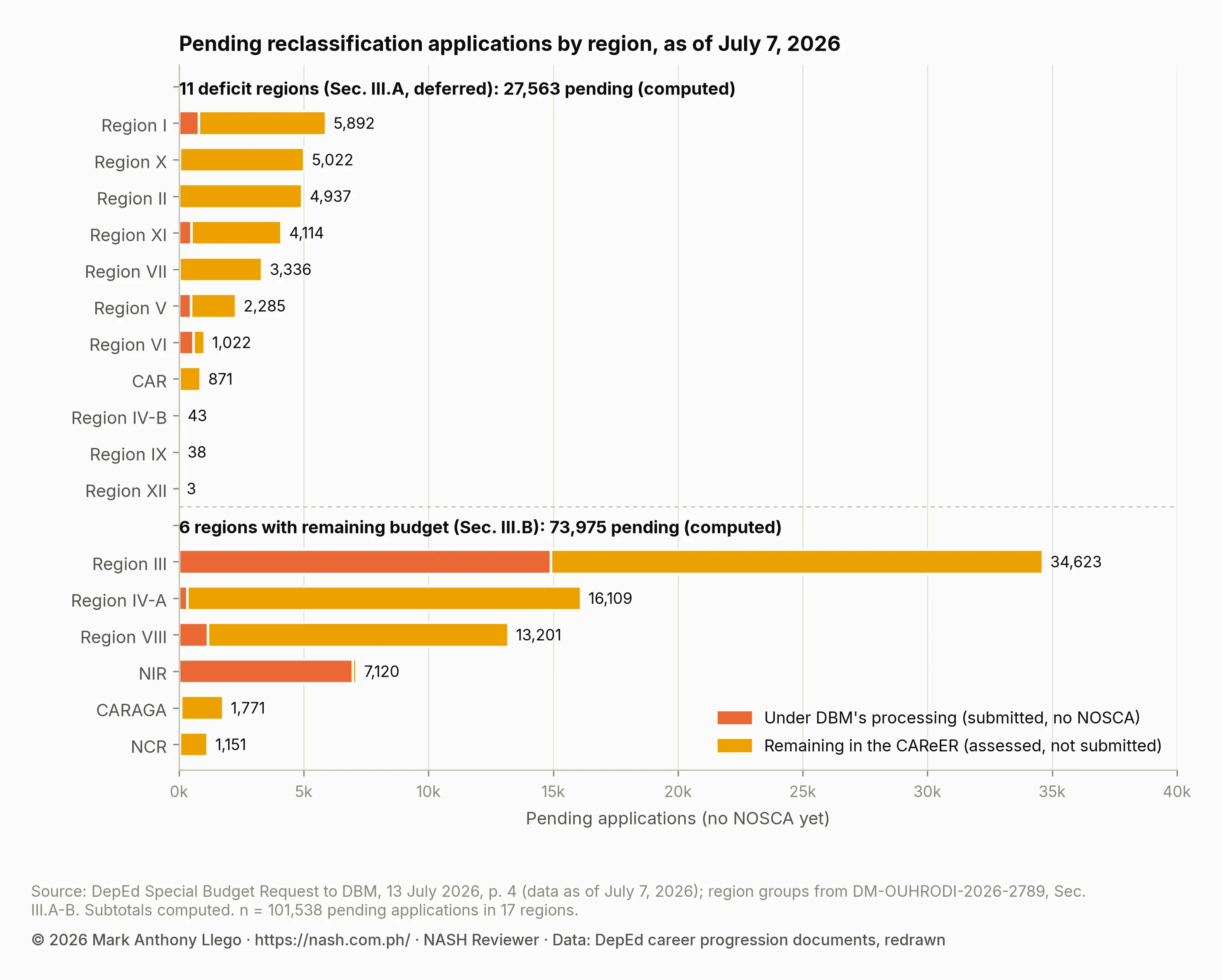
- The pipeline on July 7, 2026 held 192,635 positions: 82,092 with appointment, 9,005 with a NOSCA, 25,976 under DBM processing and 75,562 waiting in the CAReER (DM 2789, p. 2). Of the 101,538 pending, 27,563 were in the 11 deficit regions (computed from the SBR, p. 4).
- A new timeline from FY 2027. DM 2789’s Annex A has SDOs calling and processing applications from January to June, regional offices submitting to DBM in October–November, NOSCAs and appointments in January–March of the next year, and the salary adjustment in April (read from the chart; pp. 5, 7). The appointment window fits DO 024’s March 30 limit. The April salary adjustment does not fit the Joint Circular, which ties it to the appointment papers (JC No. 01, s. 2025, Sec. 7.5.3.4).
- FY 2027’s “₱12 billion” is a proposal. DepEd’s August 24, 2026 deck calls it the “proposed FY 2027 budget” at National Expenditure Program (NEP) level, and the deck’s table totals do not add up (DepEd orientation deck on funding strategies, August 24, 2026, p. 32). It is not an appropriation.
What DM-OUHRODI-2026-2789 says
DM-OUHRODI-2026-2789, “Funding Strategies and Interim Policy Directions for the Continuous Implementation of the Expanded Career Progression (ECP) System”, is dated August 5, 2026. It is signed by Undersecretary Wilfredo E. Cabral (Human Resource and Organizational Development and Infrastructure) and Undersecretary Atty. Edson Byron K. Sy (Finance). It is addressed to regional directors, schools division superintendents, regional and division HRMOs and budget officers (p. 1), and it ends “For information, guidance, and strict compliance” (p. 6). DepEd circulated it in its public Career Progression Materials folder, with an Annex A timeline and copies of the SBR and the SARO (pp. 7–15).
| Part | What it does | Pages |
|---|---|---|
| I. Background | The pipeline from January 2025 to June 2026 and the regional deficits, as of July 7, 2026 | 1–3 |
| II. Funding source | Pools unreleased NSPP funds from regions with filling-up rates below 10%, subject to a SARO and an NCA; the central office sub-allots to regions “based on their validated funding requirements” | 3–4 |
| III.A Regions with funding deficit | Defers applications without a NOSCA, except retitling; new applications go “up to the RO level” only; FY 2027 priority | 4 |
| III.B Regions with remaining budget | May continue until the FY 2026 allocation is used; remaining qualified applications carry over to FY 2027; actions approved after “the DBM April 2026 processing cut-off” are charged to FY 2027 | 5 |
| IV. New processing timeline for FY 2026 onwards | “all ROs and SDOs shall strictly follow a forward-looking processing timeline prescribed in Annex A” | 5, 7 |
The memo does not distinguish teaching from school principal positions; its directions cover “reclassification applications” in general (pp. 4–5). It does not mention RA 12288.
Two follow-up memoranda.
- DM-OUHRODI-2026-2917 (August 13, 2026), from Usec. Cabral to Usec. Sy, “respectfully requests the downloading of the corresponding allotments to the concerned Regional Offices, based on the validated funding gap requirements, as reflected in Annex A” (p. 1). Its Annex A repeats DM 2789’s deficit table.
- DM-OUHRODI-2026-2932 (August 19, 2026) called an orientation on DM 2789 “on August 24, 2026, from 1:30 p.m. to 3:30 p.m. via Microsoft Teams” for ASDSs, HRMOs, Teacher Credentials Evaluators and budget officers (pp. 1–2).
The ECP reclassification pipeline as of July 7, 2026
DM 2789 opens with DepEd’s count of “Reclassification from January 2025 to June 2026”. The peso amounts are projections: “Projected amount is based on reported number of reclassified positions as of July 7, 2026” (p. 2).
| Status | Positions | Projected funding requirement (₱) |
|---|---|---|
| Reclassified, with appointment | 82,092 | 7,403,491,536.78 |
| Reclassified, with issued NOSCA | 9,005 | 866,125,798.48 |
| Total reclassified | 91,097 | 8,269,617,335.26 |
| Pending, under DBM’s processing and approval | 25,976 | 2,447,320,347.86 |
| Pending, waiting in the CAReER | 75,562 | 7,155,385,269.40 |
| Total pending | 101,538 | 9,602,705,617.26 |
| Grand total | 192,635 | 17,872,322,952.52 |
Source: DM-OUHRODI-2026-2789, p. 2. The rows add up to the printed totals.
The SBR defines the pending groups: under DBM’s processing means “Submitted to DBM but no Issued NOSCA yet”, and the CAReER group is the “Pool of assessed reclassification applications ready for submission to DBM” (SBR, p. 4, notes 2–3).
Do not compare the March figures. DepEd’s March 24, 2026 orientation counted FY 2025 applications only, as of March 23, 2026: 106,693 processed, of which 57,434 had an appointment, 4,505 had a NOSCA and 44,754 were waiting for DBM’s approval (DepEd orientation deck on FY 2026 reclassification, March 24, 2026, p. 4). The July count covers January 2025 to June 2026 and includes the CAReER pool. The scopes differ, so subtracting one from the other measures nothing.
93,344 is a different count. It is the number of positions in the 11 deficit regions whose salary differentials fell on the FY 2026 budget: 51,886 for the FY 2025 unfunded recurring cost and 41,458 for FY 2026 expenses (SBR, Annex A, p. 14). DepEd’s press release of September 4, 2026 says “May kabuuang 93,344 reclassified positions ng mga guro at punong-guro sa buong bansa ang makikinabang sa pondo” (a total of 93,344 reclassified positions of teachers and principals nationwide will benefit from the fund). “Nationwide” is the press release’s word: the SBR’s Annex A puts all 93,344 in the 11 deficit regions (p. 14). The count is also larger than DM 2789’s 91,097 positions reclassified from January 2025 to June 2026 in all regions (p. 2). The documents do not reconcile the two counts.
Why there was an ₱8.68 billion deficit
The budget. Under RA 12314, the FY 2026 General Appropriations Act (GAA), DepEd “has been allocated Php 6,148,433,000.00 for the reclassification of teacher and school principal positions”, an allocation “intended to address the remaining applications from Fiscal Year (FY) 2025 and expand opportunities for all qualified teachers and school heads to advance through reclassification within the current FY” (DM-OUHRODI-2026-0802, March 13, 2026, Sec. I, p. 1, as posted by SDO Nueva Vizcaya). FY 2025’s lump sum was the same ₱6,148,433,000.00 (DM-OUHROD-2025-0541, March 3, 2025, p. 1). DM 0802’s Annex B splits the FY 2026 amount by region, from ₱137,836,658 for CAR to ₱725,931,825 for Region IV-A. Its rows are in pesos and sum to ₱6,148,433,000 (computed); its printed total, “6,148,433”, is in thousands (p. 17).
The rules meant to keep spending within it. Each region’s Plantilla Allocation List rests on “the available funding per budget allocation of the region for the specific fiscal year” (DepEd-DBM JC No. 01, s. 2025, Sec. 7.5.3.1). DM 0802 adds that the SDS “shall recommend to the Regional Director only those candidates who can be accommodated within the available funds” (Sec. IV, p. 4).
What the regions reported. By July 7, 2026, regions showed deficits “after accounting for (a) the Unfunded Recurring Cost carried over from FY 2025 and (b) the funding requirements for FY 2026 approved reclassifications” (DM 2789, p. 2). The first covers salary differentials “of personnel appointed and issued NOSCA from May to December 2025”, the second those “appointed and with issued NOSCA from January 2026 onwards” (pp. 2–3). Both pay for people already reclassified.
| Region | FY 2026 GAA allocation (₱) | Unfunded recurring cost from FY 2025 (₱) | FY 2026 funding requirements (₱) | Total requirement (₱) | Deficiency (₱) |
|---|---|---|---|---|---|
| CAR | 137,837,000 | 1,189,087,476 | 2,757,648 | 1,191,845,124 | 1,054,008,124 |
| Region I | 355,304,000 | 806,300,995 | 1,256,689,087 | 2,062,990,082 | 1,707,686,082 |
| Region II | 261,172,000 | 138,110,902 | 347,773,548 | 485,884,450 | 224,712,450 |
| Region IV-B | 243,271,000 | 965,000,602 | 98,336,356 | 1,063,336,958 | 820,065,958 |
| Region V | 477,704,000 | 567,652,697 | 730,360,990 | 1,298,013,687 | 820,309,687 |
| Region VI | 308,658,000 | 94,695,076 | 2,415,964,878 | 2,510,659,954 | 2,202,001,954 |
| Region VII | 392,518,000 | 233,250,331 | 792,524,119 | 1,025,774,450 | 633,256,450 |
| Region IX | 303,186,000 | 217,563,479 | 254,403,216 | 471,966,695 | 168,780,695 |
| Region X | 303,671,000 | 694,649,543 | 290,911,129 | 985,560,672 | 681,889,672 |
| Region XI | 317,181,000 | 463,534,533 | 211,481,839 | 675,016,372 | 357,835,372 |
| Region XII | 275,175,000 | 271,895,723 | 11,327,232 | 283,222,955 | 8,047,955 |
| 11 regions | 3,375,677,000 (computed) | 5,641,741,357 | 6,412,530,042 | 12,054,271,399 | 8,678,594,399 |
Source: DM-OUHRODI-2026-2789, pp. 2–3; the same values are in DM-OUHRODI-2026-2917, Annex A. As of July 7, 2026. Five of the other six regions print “With Certification of no Deficits”; Region III prints “No deficit based on report submitted”. None prints a requirement. Every row adds up. DM 2789’s GAA column prints DM 0802’s Annex B in round thousands. The ₱3,375,677,000 share is computed from DM 2789’s rounded rows; from Annex B it is ₱3,375,675,855 (computed), ₱1,145 less. The printed deficiency of ₱8,678,594,399 recomputes from the rounded rows; from Annex B the need less the share would be ₱8,678,595,544 (computed).
How to read the printed total row. DM 2789’s total row puts ₱6,148,433,000, the allocation for all 17 regions, beside ₱12,054,271,399 and ₱8,678,594,399, which are totals for the 11 deficit regions only. So the row does not add across: ₱12,054,271,399 − ₱6,148,433,000 is ₱5,905,838,399 (computed), not the deficiency. The deficiency is the 11 regions’ need less their own allocation: ₱12,054,271,399 − ₱3,375,677,000 = ₱8,678,594,399 (computed from the rounded rows). The six regions with no deficit held ₱2,772,756,000 of the lump sum in the rounded rows, or ₱2,772,757,145 in Annex B (both computed). The SBR names the 11 regions for the requirement, which “of eleven (11) regions amounts to Php 12,054,271,399.00”, but it sets that figure beside the full “Php 6,148,433,000.00” and says the appropriation “is insufficient to fully cover the same, resulting in a funding deficit of Php 8,678,594,399.00” (p. 2). Read the deficit as the 11 regions’ need less their own share.
How short each region was. The allocation covered 11.6% of CAR’s requirement, 12.3% of Region VI’s and 17.2% of Region I’s, but 97.2% of Region XII’s, whose deficiency was ₱8,047,955 (computed from DM 2789, pp. 2–3).
Why it happened, in DepEd’s words. DM 2789 says “the timing of reclassification activities prescribed under DepEd-DBM Joint Circular No. 1, s. 2025, and relative to budget preparation schedules has created challenges in ensuring the availability of appropriations to support the resulting salary differentials” (Sec. IV, p. 5). The documents point to timing. DepEd’s March deck lists last year’s “Misalignment of submission timeline to DBM’s budget preparation of PS-OPS and inclusion in the corresponding salary adjustments in the succeeding fiscal year” (p. 5). DM 2789 applies the same logic to 2026: actions approved after “the DBM April 2026 processing cut-off” “may result in unfunded Personnel Services (PS) requirements in the subsequent fiscal year” (Sec. III.B, p. 5). The FY 2025 recurring cost, for people appointed “from May to December 2025”, appears to be that kind of cost, approved too late for the FY 2026 budget, though no document says so in those words. It then fell on a lump sum the same size as FY 2025’s.
An earlier estimate. The SBR notes that its figures “differ from the initial estimates previously presented during the DepEd-DBM meeting last May 5, 2026”, which put the “Computed Reclass Deficit as of May 4, 2026” at 2,102,896,281.10 (p. 2 and note 1). Note 1 also gives “8,251,329,335.10 - FY 2025 Unfunded Recurring Cost and FY 2026 Expenses as of May 4, 2026”. The difference, ₱6,148,433,054.00 (computed), is within ₱54 of the whole lump sum. The May figure appears to net all 17 regions’ allocation against the need, though the SBR does not say how it was computed. DepEd calls the validated July figures “more reliable” (p. 2). Do not cite the May figure as the deficit.
Where the ₱8.68 billion came from: NSPP pooling and the SARO
The budget request. On July 13, 2026, DepEd sent DBM a Special Budget Request signed by Atty. Fatima Lipp D. Panontongan, Undersecretary and Chief of Staff (SBR, pp. 1, 6). It asked for “Pooling and centralization of unreleased appropriations amounting to Php 8,678,594,399.00 to DepEd Central Office”, a SARO to the Office of the Secretary, direct release of the NCA to DepEd operating units, and “Adoption and dissemination to DBM Regional Offices of the proposed reclassification directions and forward-looking timeline” (p. 5).
The source: unreleased NSPP funds. DM 2789 directs that “the Department shall utilize available unreleased appropriations for the New School Personnel Positions (NSPP) – Lumpsum for Filling-up of Positions, as authorized under Republic Act No. 12314”, subject to a SARO and an NCA from DBM. Portions “from Regional Offices with filling-up rates below ten percent (10%) shall be pooled and transferred to the DepEd-CO” (Sec. II, p. 3). The deck says this was “Based on the recommendation of DBM” (p. 10). Of ₱24,872,456,987 unreleased as of June 30, 2026, ₱8,678,594,399 was pooled from 12 regions, leaving ₱16,193,862,588; the national filling-up rate was 5.3% (DM 2789, pp. 3–4). The rates are “as of April 2026”. Four regions show negative rates, meaning “the number of unfilled items as of February 2026 has increased compared with the GMIS data on filling-up as of April 2026” (p. 4). DM 2789 still heads the column “Proposed Amount to be Pooled and Transferred to DepEd CO”, but the deck shows 12 regional SAROs, dated August 4 to 6, 2026, moving exactly those amounts (p. 14).
The SARO. SARO-BMB-F-26-0008170, “Date of Issue: August 12, 2026”, signed by Kim Robert C. De Leon, Acting Secretary, releases ₱8,678,594,399 to DepEd’s Office of the Secretary, Central Office, from the “FY 2026 General Appropriations Act, RA 12314”. It is charged to PAP 310200100002000, “New School Personnel Positions”, Personnel Services. Its purpose is “To cover the funding requirements for the continued implementation of the Expanded Career Progression (ECP) System of the DepEd”, and it is “valid for obligation until December 31, 2026” (pp. 1–2).
To the regions. On August 13, DM 2917 asked Finance to download the allotments (p. 1). The deck shows the first page of OUF-2026-1890, an “ADVISORY ON THE RELEASE OF FUNDS” from Usec. Sy dated August 19, 2026 (p. 17), then lists 11 sub-AROs, one per deficit region, each equal to that region’s deficiency, totaling ₱8,678,594,399 (p. 18).
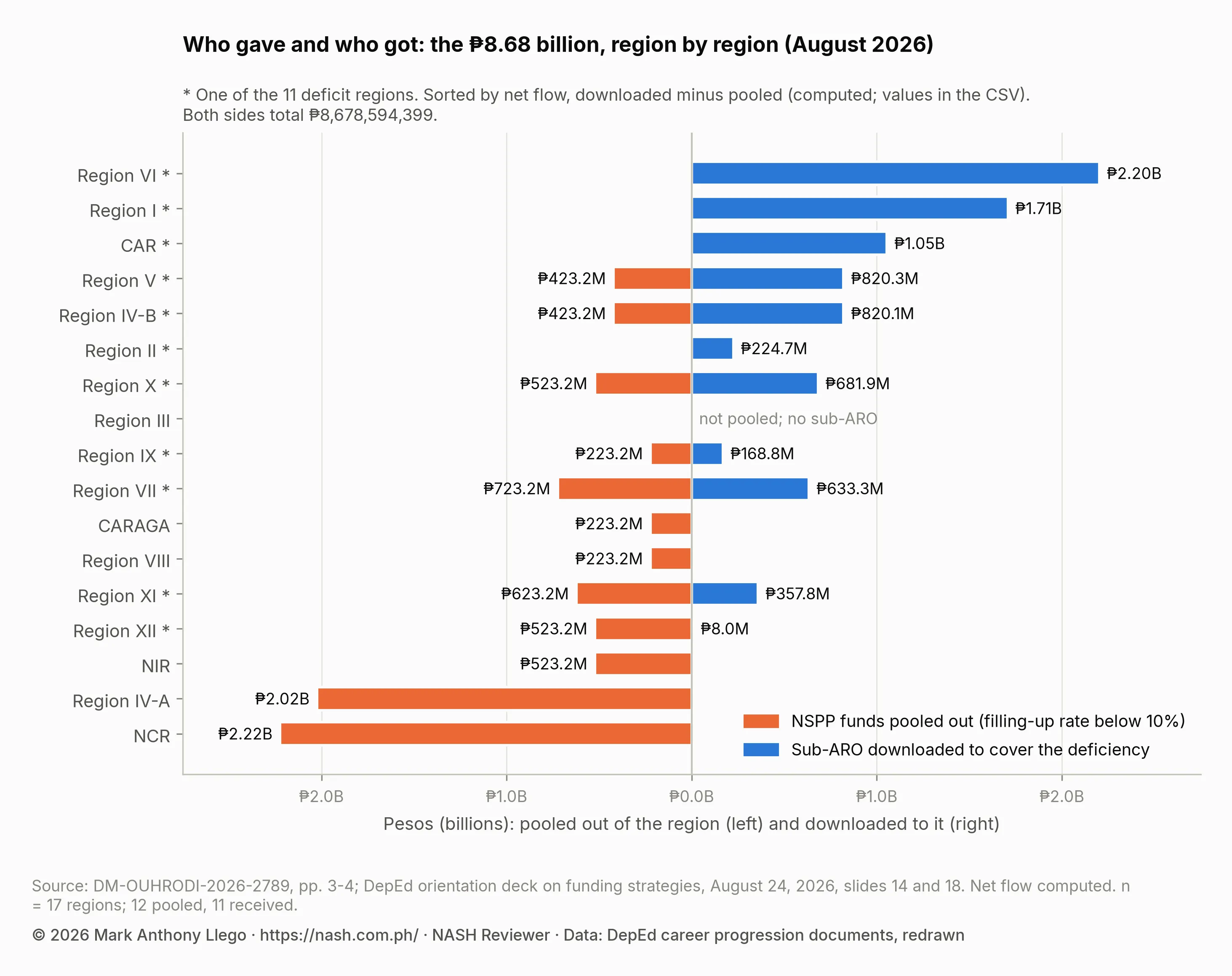
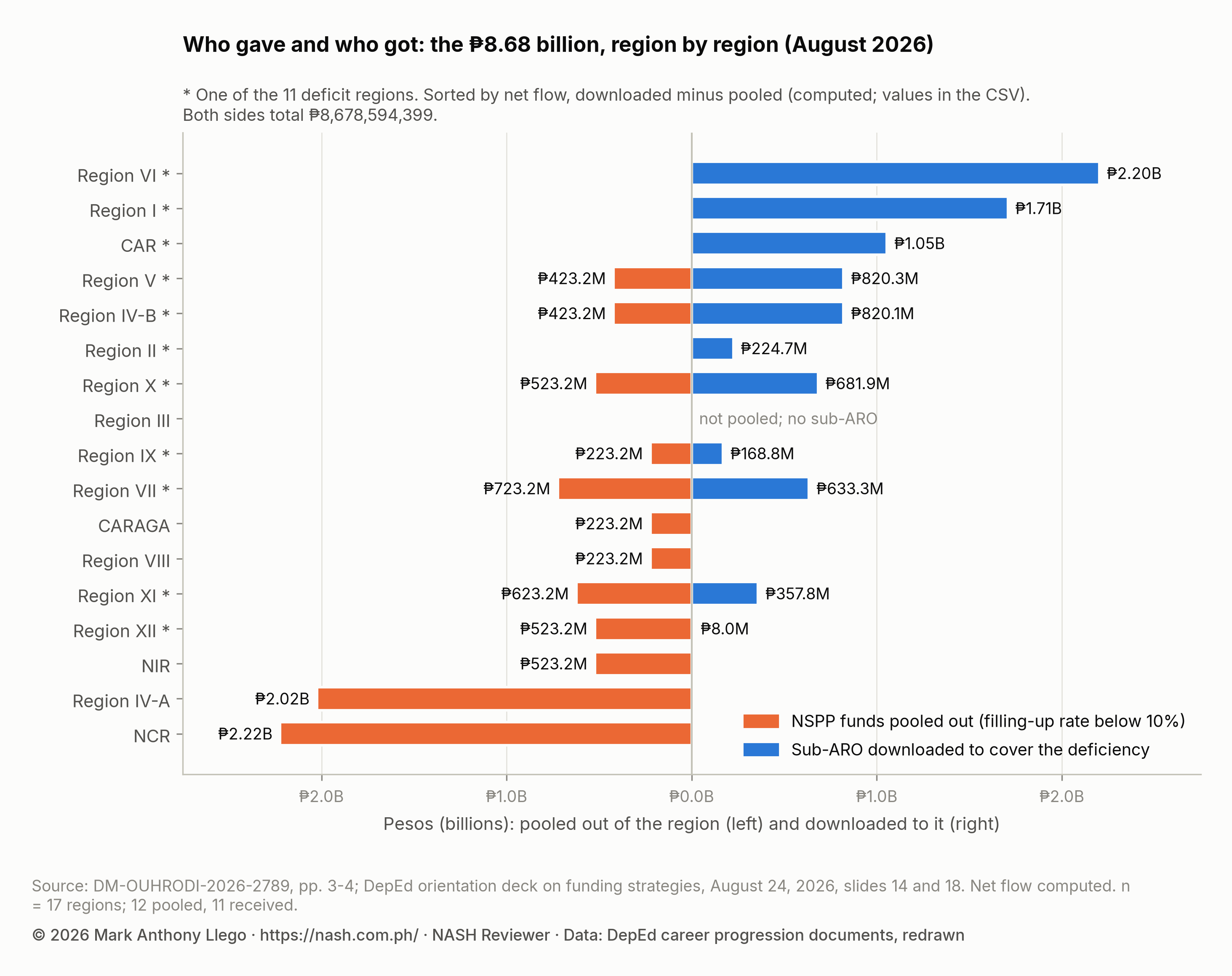
Who gave and who got. Pooling followed filling-up rates, not deficits (computed from DM 2789, pp. 2–4, and the deck, p. 18):
- Five regions with no deficit gave ₱5,216,080,334: NCR ₱2,223,215,154, Region IV-A ₱2,023,216,295, NIR ₱523,216,295, Region VIII and CARAGA ₱223,216,295 each.
- Seven deficit regions gave ₱3,462,514,065 and also received: Regions IV-B, V, VII, IX, X, XI and XII. Region XII gave ₱523,216,295 and received ₱8,047,955.
- Four deficit regions, with filling-up rates of 10% or more, gave nothing and received ₱5,188,408,610: Region VI, Region I, CAR and Region II.
- Region III neither gave to the ECP pooling nor received a sub-ARO (deck, pp. 14 and 18). DepEd’s NSPP table as of August 15, 2026 shows other adjustments that the deck does not explain, including (44,137,174) for Region III (p. 16).
None of the documents says what the pooling means for filling new positions in the regions that gave.
Which fund? The Joint Circular charges approved reclassifications “to the Lump-sum for the Reclassification of Positions appropriated under the GAA, with priority given to applicants who were not accommodated in previous years” (Sec. 10.1). The ₱8.68 billion came from the NSPP line through a SARO that DBM, a party to the Joint Circular, issued itself, so the documents raise no rule problem. But it is not the reclassification lump sum, and the allotment is “valid for obligation until December 31, 2026” (SARO, p. 1).
Which regions were deferred, and what still moves
| Regions with funding deficit (Sec. III.A) | Regions with remaining budget (Sec. III.B) | |
|---|---|---|
| Regions | CAR, Regions I, II, IV-B, V, VI, VII, IX, X, XI and XII | NCR, NIR, Regions III, IV-A and VIII, and CARAGA |
| Applications without a NOSCA | “Temporarily deferred, pending the availability of funds” | “May continue processing” and submitting to DBM “until their respective FY 2026 regional allocations are fully utilized” |
| Then | “All deferred applications shall be prioritized for funding under the FY 2027 appropriations” | Remaining qualified applications “shall be carried over and prioritized for funding under the FY 2027 appropriations” |
| New applications | Processed “up to the RO level”, but “shall not be submitted to the DBM until funding becomes available” | Not restricted beyond the allocation |
| Retitling | Continues: excepted as “retitling actions, which do not involve salary adjustments” | Continues |
| Late approvals | — | Because “the DBM April 2026 processing cut-off has already lapsed”, later actions’ salary differentials are charged to the FY 2027 budget, “subject to the availability of appropriations” |
Source: DM-OUHRODI-2026-2789, Sec. III, pp. 4–5.
How many applications the deferral touches. On July 7, 2026, 27,563 of the 101,538 pending applications were in the 11 deficit regions: 2,486 under DBM processing and 25,077 in the CAReER (computed from the SBR, p. 4). The other 73,975 were in the six regions with remaining budget, 34,623 of them in Region III. The documents do not give those regions’ remaining balances, so how many of their applications that money can carry is not known. These counts predate the memo by four weeks.
Retitling moves because it adds no salary. Under the Joint Circular, incumbents of retitled positions “shall continue to be paid at their present salary rate, including step increment” (Sec. 7.6.1.2). See Head Teacher Retitling: Options Under ECP and RA 12288.
The April cut-off. DM 2789 gives no day for “the DBM April 2026 processing cut-off” (p. 5). DM 0802 set DepEd’s own deadline for submitting FY 2025 CAReER applicants to the DBM-RO, “on or before 30 April 2026” (Sec. II.2, p. 2). The March deck gave that deadline as “April 28, 2026” (p. 10), and the memo governs the deadline. The deck also lists “April 28, 2026 – DBM’s cut-off for Tier 2” (p. 15), a DBM budget date that no memo restates. No document says which date DM 2789 means.
The new reclassification timeline from FY 2027
DM 2789’s Annex A is meant to ensure that applications “are processed, validated, and integrated into the budget cycle in a timely manner” (Sec. IV, p. 5). It is a bar chart, “ECP Reclassification Process Timeline” (p. 7). The months below are read from the bars, so they are approximate.
| Year on the chart | What happens, and when |
|---|---|
| FY 2026 (“Transition Years”), regions with remaining budget only | July–August: FY 2026 processed applications to the regional office, with “Submission of Pending Reclass Applications to be charged against FY 2027 Budget”. September–October: to the DBM regional office. November: NOSCA and appointment. December: salary adjustment |
| FY 2027 (“Transition Years”); FY 2028 and FY 2029 (“Clean Slate”) | January–March: NOSCA and appointment for the previous year’s applications. April: salary adjustment. January–June: call and processing at the SDO. July–August: to the regional office. October–November: to the DBM regional office |
The same chart is the SBR’s Annex B, marked “revised timeline as of 17 July 2026; Kindly disregard the previous timeline” (p. 15). The August deck adds, for the deficit regions, January–February 2027 “Submission of Pending Applications from previous years”, a box not on DM 2789’s Annex A (pp. 26, 28–29).
Applications processed in one year are appointed early in the next and paid from the next year’s budget. DM 0802 had already set that pattern for FY 2026, “To align with the DBM budget preparation and fund release cycle” (Sec. III.3, p. 4). The annual cycle, with who does what, is in The School Head’s Role in ECP Reclassification.
Does the new timeline break the March 30 rule?
| Step | JC No. 01, s. 2025 | DO 024, s. 2025, Encl. No. 2 (teaching) and Encl. No. 3 (SP) | DM 0802 (March 13, 2026) | DM 2789, Annex A (August 5, 2026), FY 2027–2029 |
|---|---|---|---|---|
| Regional office to DBM | PAL “not later than November 30 of each year”, or as DBM and DepEd decide in emergencies (Sec. 7.5.3.1) | — | “not later than November 30 of the current fiscal year” (Sec. III.3.b) | October–November |
| Appointment | Appointment papers “and the necessary adjustment to the salaries” “not later than March 30 the succeeding year”, or as DBM and DepEd decide in emergencies (Sec. 7.5.3.4) | “not later than March 30 of the succeeding year, or as may be determined by both DBM and DepEd in cases of emergency and unprecedented situations” (Encl. 2, Sec. 58; Encl. 3, Sec. 57) | “only within the period of January to March of the succeeding fiscal year” (Sec. III.3.c) | January–March |
| Salary adjustment | With the appointment papers, by March 30 (Sec. 7.5.3.4) | “Upon issuance of the appointment” (Encl. 2, Sec. 59; Encl. 3, Sec. 58); no date | — | April |
- The appointment window fits. For FY 2027 to FY 2029 the appointment bar ends with March, matching DM 0802 and DO 024’s March 30 limit as closely as a monthly chart can.
- The April salary adjustment does not fit the Joint Circular, which ties it to the appointment papers by March 30. DO 024 sets no date. The JC is a joint DBM-DepEd issuance, and a DepEd memo does not amend it.
- The FY 2025 cycle was already past March 30, 2026 before the deferral. DM 0802 set 30 April 2026 for submitting the remaining FY 2025 CAReER applicants to the DBM-RO (Sec. II.2, p. 2), and DM 2789 now sends those in deficit regions to FY 2027 funding. DO 024 and the JC allow another date “as may be determined by both DBM and DepEd in cases of emergency and unprecedented situations”, but neither memo invokes that clause. The SBR asked DBM to adopt the “forward-looking timeline” (p. 5); none of the documents shows that DBM did.
The FY 2026 row puts NOSCAs and appointments for the six regions with remaining budget in November 2026, not January–March 2027 as DM 0802 said. That is earlier, so it stays within DO 024’s “not later than”, and between the two memoranda the later one governs.
Which governs. The JC and DO 024 outrank both memoranda. Read Annex A as DepEd’s August 2026 plan, not as an amendment of the March 30 rule.
What happens to your application now
| Where your application stood | Deficit region (Sec. III.A) | Region with remaining budget (Sec. III.B) |
|---|---|---|
| Appointment issued | Not deferred; the deficit the SARO covers is the cost of people already appointed or issued a NOSCA | Not deferred |
| NOSCA issued | Not deferred: the deferral covers applications “that have not yet been issued NOSCA” | Not deferred |
| Submitted to DBM, no NOSCA | Deferred; prioritized for FY 2027 appropriations | May continue while the allocation lasts, then carries over to FY 2027 |
| In the CAReER, not yet submitted | Deferred; the CAReER result stays valid | May continue while the allocation lasts, then carries over |
| New application in a 2026 call | Processed up to the regional office; not sent to DBM until funds are available | Processed within the allocation |
| Retitling | Continues | Continues |
Sources: DM-OUHRODI-2026-2789, pp. 2–5.
You do not have to be assessed again. DO 034, s. 2025: “The results of the Comparative Assessment for Expanded Reclassification (CAReER) shall remain valid until fully exhausted. Qualified candidates who have obtained the minimum 50-point cut-off score but were not reclassified due to budgetary constraints shall be automatically prioritized in the succeeding fiscal year prior to the consideration of new applicants, without the need to undergo a new assessment, subject to the availability of funds” (para. 26). For School Principal applicants, who have no cut-off score, DO 024 provides that the CAReER “shall be valid until exhausted” and that applicants not accommodated “shall be prioritized in the reclassification for the following year” (Encl. No. 3, Sec. 44). The deferral is a delay in funding, not a new evaluation.
RA 12288 does not reset it. The IRR of RA 12288, signed on August 17, 2026, provides that “All ongoing reclassification assessments prior to the effectivity of this IRR shall remain valid and effective and shall continue to be governed by prior laws, rules, and issuances, unless the concerned personnel opts to withdraw his/her existing application” (Sec. 17, in the DepEd-certified copy in DepEd’s career progression toolkit folder, the Career Progression Materials folder linked above). As of October 31, 2026, the IRR had not been published in the Official Gazette or on deped.gov.ph, so its effective date is not yet known. No DepEd order implements RA 12288, and FY 2026 reclassification still runs under EO 174, DO 024 and DO 034, s. 2025, and the Joint Circular. See What RA 12288 Changes in Teacher Career Progression.
When? No document gives a date for any individual application. The plan points to early 2027: NOSCAs and appointments in January–March, and the deck’s speaker notes call the remaining CAReER applications “ready for submission to DBM on January 2027”. All of it depends on the FY 2027 appropriation.
What to keep. Copies of everything you submitted, the CAReER result showing your score, and the date your application reached the regional office. For FY 2025 applicants, DM 0802 gave priority “to applications first submitted to the RO” when funds could not cover the whole CAReER (Sec. II.2, p. 2). The documents do not say whether that order will apply to FY 2027 funding.
FY 2027: a ₱12 billion proposal, not a budget
The August deck’s table “FY 2027 RECLASS BUDGET (NEP LEVEL)” comes with this line: “To accommodate more qualified teachers and school heads and to address backlogs from previous years, DepEd-CO proposed FY 2027 budget is ₱12 billion, doubling the allocation in previous years” (p. 32). DepEd’s September 4, 2026 press release gives ₱12.09 billion under the FY 2027 National Expenditure Program, “mas mataas ng PHP5.94 bilyon o 96.6 porsyento kumpara sa FY 2026 allocation” (₱5.94 billion or 96.6 percent above the FY 2026 allocation). An NEP figure is a proposal; the appropriation is what the FY 2027 GAA provides, and that amount is not yet known.
The speaker notes describe Tier 1 as “Computed based on Remaining Applications in the Comparative Assessment Results for Expanded Reclassification (CAReER)” and Tier 2 as “Computed at 7% of the universe of teaching and school principal positions”. The table’s printed totals and rows disagree:
| Item | Printed | Computed from the rows |
|---|---|---|
| Tier 1 total | 6,148,433,000 | ₱6,148,433,000, matching (and equal to the FY 2026 lump sum) |
| Tier 2 total | “5,941,519” | ₱5,941,519,169: the total is in thousands, the rows in pesos |
| Grand total | “12,089,952” | Tier totals: ₱12,089,952,169. Total column’s rows: ₱12,089,904,861 |
| CAR row total | 134,159,928 | 79,866,885 + 131,046,226 = ₱210,913,111 |
| NCR row total | 548,163,103 | 3,113,703 + 468,296,218 = ₱471,409,921 |
| Region XII row total | 263,870,369 | 47,309 + 263,870,369 = ₱263,917,678 |
Source: DepEd orientation deck on funding strategies, August 24, 2026, p. 32.
CAR’s and NCR’s Tier 1 figures look swapped: exchanged, both rows match their printed totals to within ₱1 (computed). Cite “about ₱12 billion, proposed” and leave the regional rows alone.
What this means for school heads
Teachers will ask their school head first. As part of the school head’s human resource duties, give the right status, keep records, and keep the next round moving.
- Know your region’s group: Sec. III.A for CAR and Regions I, II, IV-B, V, VI, VII, IX, X, XI and XII; Sec. III.B for NCR, NIR, Regions III, IV-A and VIII, and CARAGA.
- Sort your teachers by status (appointment, NOSCA, at DBM, in the CAReER, new applicant, retitling) and use the table above.
- Say “deferred”. It is DM 2789’s word, and a CAReER result stays valid without reassessment (DO 034, s. 2025, para. 26).
- Keep retitling and the next call moving. Retitling is outside the deferral (Sec. III.A.1); incumbents file the Retitling Form with the Division HRMO (DO 024, s. 2025, Appendix 1, item 3). The SDO may process new applications up to the regional office (Sec. III.A.2). Performance counts for 30 of the 100 points on the teaching CAReER form (DO 024, s. 2025, Annex I-3), so keep the performance cycle on schedule; see PPSSH Domain 4: developing self and others.
- Keep a file: DM 2789, 2917 and 2932, the SDO’s advisories, and a list of teachers with their status and submission dates.
| A school head may | A school head may not |
|---|---|
| Tell an applicant in a deficit region that the application is deferred “pending the availability of funds” and prioritized for FY 2027 (DM 2789, Sec. III.A) | Tell an applicant it is canceled, or that they must reapply and be reassessed (DO 034, s. 2025, para. 26) |
| Help incumbents file retitling papers with the Division HRMO (DO 024, s. 2025, Appendix 1, item 3); retitling is outside the deferral (DM 2789, Sec. III.A.1) | Tell a Head Teacher that retitling is on hold because of the deferral |
| Help new applicants prepare for the SDO’s call (Sec. III.A.2) | Promise an appointment date: Annex A is a plan, and FY 2027 funding is a proposal |
| Share DepEd’s figures with their dates | Subtract the March 23 counts from the July 7 counts |
For managing staff more broadly, see PPSSH Domain 2: managing school operations and resources.
How the NASH may test this
The two items below are original practice items, scored 3 (Relational), 2 (Multistructural), 1 (Unistructural) or 0 (Prestructural). An option that breaks a rule scores 0.
Question 1
Indicator 2.4.1, Management of staff. Career Stage 1, Conceptual, Moderate.
A Teacher III in Region VI scored 62 points in her division’s CAReER for Teacher IV in early 2026. In September 2026 she still has no NOSCA and asks what DM-OUHRODI-2026-2789 means for her. Which answer is most accurate?
- A. Her application is deferred, not canceled, pending the availability of funds. Her CAReER result stays valid, and she is prioritized for FY 2027 appropriations without a new assessment.
- B. Her application waits for FY 2027 funding, so she should keep her documents ready.
- C. Region VI is one of the regions with a funding deficit, so applications there without a NOSCA wait for funds.
- D. Her application lapsed with the FY 2026 budget. She must apply again in the FY 2027 call and be reassessed.
Answer and explanation
Best answer: A. Points: A = 3, B = 2, C = 1, D = 0.
- A (3 points, Relational). It connects the deferral, her CAReER status, the rule against reassessment and the FY 2027 priority into one accurate answer.
- B (2 points, Multistructural). It says the application waits and points to FY 2027, but it omits that the wait is “pending the availability of funds”, that her result stays valid and that she has priority.
- C (1 point, Unistructural). It says why the deferral applies to her and nothing more.
- D (0 points, Prestructural). It contradicts DO 034, which keeps CAReER results valid “until fully exhausted” and prioritizes qualified candidates “without the need to undergo a new assessment”.
Why. DM 2789 defers applications in deficit regions “that have not yet been issued NOSCA”, “pending the availability of funds”, and prioritizes them “for funding under the FY 2027 appropriations” (Sec. III.A, p. 4). DO 034, s. 2025 keeps candidates who reached the 50-point cut-off first in line for the succeeding fiscal year without reassessment, “subject to the availability of funds” (para. 26).
Indicator 2.4.1: Demonstrate knowledge and understanding of laws, policies, guidelines and issuances on managing school staff.
Sources: DM-OUHRODI-2026-2789, Sec. III.A, p. 4; DepEd Order No. 034, s. 2025, para. 26.
Question 2
Indicator 4.4.2, Performance management. Career Stage 2, Situational, Moderate.
You are the principal of a school in Region XI. In September 2026 three teachers come to you. A Teacher V is in the CAReER for Master Teacher I but has no NOSCA. A Head Teacher III wants to be retitled to Teacher VI. A Teacher II wants to apply in the SDO’s next call. What is the most appropriate action?
- A. Tell the Teacher V that her application is deferred and prioritized for FY 2027 funding. Tell the Head Teacher that retitling is outside the deferral and help the Head Teacher file the Retitling Form (Annex T) and its documents with the Division HRMO. Help the Teacher II complete her application and performance evidence, explaining that the SDO may process it up to the regional office but will not send it to DBM until funds are available.
- B. Tell all three that reclassification in Region XI is deferred until FY 2027, and ask them to wait for the next call before doing anything.
- C. Explain the deferral to the Teacher V and help the Head Teacher file the retitling papers with the Division HRMO. Advise the Teacher II to wait until FY 2027 funds are released before preparing an application.
- D. Help the Head Teacher file the retitling papers with the Division HRMO, and refer the other two teachers to the SDO.
Answer and explanation
Best answer: A. Points: A = 3, B = 0, C = 2, D = 1.
- A (3 points, Relational). It applies each part of DM 2789’s Sec. III.A to the right case and keeps all three teachers’ advancement moving within the rules.
- B (0 points, Prestructural). It holds back a retitling that DM 2789 expressly excepts from the deferral.
- C (2 points, Multistructural). The first two cases are right, but it stalls the Teacher II, whose application the SDO may already process up to the regional office.
- D (1 point, Unistructural). It gets the retitling right and leaves the rest to others.
Why. Region XI is a deficit region. DM 2789 defers applications without a NOSCA “except for retitling actions, which do not involve salary adjustments”, lets offices keep “receiving, evaluating, validating, and processing new reclassification applications up to the RO level”, and prioritizes deferred applications for FY 2027 (Sec. III.A, p. 4). Incumbents file the Retitling Form with the Division HRMO, and the HRMO sends it to the Regional Office with an endorsement letter signed by the SDS (DO 024, s. 2025, Appendix 1, items 3 and 7). A Head Teacher III is retitled to Teacher VI at the same salary grade, and retitled incumbents keep their present salary rate (JC No. 01, s. 2025, Secs. 8.5 and 7.6.1.2).
Indicator 4.4.2: Implement the performance management system with a team to support the career advancement of school personnel, and to improve office performance.
Sources: DM-OUHRODI-2026-2789, Sec. III.A, p. 4; DepEd Order No. 024, s. 2025, Appendix 1, items 3 and 7; DepEd-DBM JC No. 01, s. 2025, Secs. 7.6.1.2 and 8.5.
Nothing in this guide reproduces or predicts examination content.
Frequently asked questions
Was my ECP reclassification canceled in 2026?
No. In 11 regions, DM-OUHRODI-2026-2789 of August 5, 2026 “temporarily deferred, pending the availability of funds” applications not yet issued a NOSCA and prioritized them for FY 2027 appropriations (Sec. III.A, p. 4). Qualified CAReER results stay valid without a new assessment (DO 034, s. 2025, para. 26). In the other six regions, applications may continue while each region’s FY 2026 allocation lasts (Sec. III.B, p. 5).
Which regions were affected by the reclassification deferral?
CAR and Regions I, II, IV-B, V, VI, VII, IX, X, XI and XII, the 11 regions with a funding deficit as of July 7, 2026 (DM 2789, pp. 2–4). NCR, NIR, Regions III, IV-A and VIII, and CARAGA had no deficit and may keep processing until their allocations are fully utilized (p. 5).
Is retitling affected by the deferral?
No. DM 2789 excepts “retitling actions, which do not involve salary adjustments” (Sec. III.A.1, p. 4). A retitled incumbent keeps the present salary rate, including step increment (JC No. 01, s. 2025, Sec. 7.6.1.2).
Where did the ₱8.68 billion for the ECP come from?
From unreleased FY 2026 funds for New School Personnel Positions, pooled from 12 regions with filling-up rates below 10% (DM 2789, pp. 3–4). DBM released them through SARO-BMB-F-26-0008170 on August 12, 2026, “valid for obligation until December 31, 2026” (SARO, p. 1), and DepEd downloaded each deficit region’s deficiency to it (DepEd orientation deck on funding strategies, August 24, 2026, p. 18). The money pays salary differentials of people already appointed or issued a NOSCA.
Will deferred applications be funded in 2027?
They are first in line for FY 2027 reclassification appropriations (DM 2789, Sec. III.A, p. 4), but the amount is not yet known. DepEd proposed about ₱12 billion at NEP level (DepEd orientation deck on funding strategies, p. 32), and its September 4, 2026 press release gives ₱12.09 billion. A proposal is not an appropriation.
Download the data
- deferral-pipeline-two-dates.csv: the reclassification pipeline as of March 23, 2026 (FY 2025 only) and as of July 7, 2026 (January 2025 to June 2026), by status, with printed totals (DepEd orientation deck on FY 2026 reclassification, March 24, 2026, p. 4; DM-OUHRODI-2026-2789, p. 2).
- deferral-money-equation.csv: the 11 deficit regions’ FY 2026 requirement and how it was funded, with their share of the lump sum computed from DM 2789’s rounded rows and, as a note, from DM 0802’s Annex B (DM-OUHRODI-2026-2789, pp. 2–3; DM-OUHRODI-2026-2917, Annex A; SARO-BMB-F-26-0008170; DM-OUHRODI-2026-0802, Annex B).
- deferral-deficiency-by-region.csv: each deficit region’s FY 2026 GAA allocation as DM 2789 prints it and as DM 0802’s Annex B prints it, unfunded recurring cost from FY 2025, FY 2026 requirement, total requirement and deficiency as of July 7, 2026, with the share covered (computed) (DM-OUHRODI-2026-2789, pp. 2–3; DM-OUHRODI-2026-0802, Annex B, p. 17).
- deferral-pooled-vs-downloaded.csv: for all 17 regions, the filling-up rate as of April 2026, NSPP funds pooled out, sub-ARO downloaded and net flow (computed) (DM-OUHRODI-2026-2789, pp. 3–4; DepEd orientation deck on funding strategies, August 24, 2026, pp. 14 and 18).
- deferral-pending-by-region.csv: pending applications as of July 7, 2026 by region, under DBM processing and in the CAReER, with group subtotals (computed) (DepEd Special Budget Request to DBM, July 13, 2026, p. 4).
The CSVs and charts may be reused only with written permission: email support@nash.com.ph. The rules themselves come from DepEd’s issuances, which you can cite directly.
Sources
- DepEd Memorandum DM-OUHRODI-2026-2789, Funding Strategies and Interim Policy Directions for the Continuous Implementation of the Expanded Career Progression (ECP) System, August 5, 2026, pp. 1–7 (Secs. I–IV and Annex A), with copies of the SBR and the SARO (pp. 8–15), in DepEd’s Career Progression Materials folder.
- DepEd Memorandum DM-OUHRODI-2026-2917, Request for the Downloading of the Approved Additional Budget to Cover the Regional Funding Deficit under the ECP System, August 13, 2026, p. 1 and Annex A.
- DepEd Memorandum DM-OUHRODI-2026-2932, Virtual Orientation on the Issued Guidelines Regarding Funding Strategies and Interim Policy Directions for FY 2026 Implementation of the ECP System, August 19, 2026, pp. 1–3.
- DepEd, Special Budget Request to DBM, letter of July 13, 2026, with Annexes A and B (15 pages), pp. 1–2, 4–6, 14–15; the letter alone is also at DM 2789, pp. 8–13; in DepEd’s Career Progression Materials folder.
- DBM, Special Allotment Release Order SARO-BMB-F-26-0008170, date of issue August 12, 2026, pp. 1–2, in the same folder.
- DepEd, Virtual Orientation: Guidance on the Funding Strategies and Interim Policy Directions for the Continuous Implementation of the ECP System (orientation deck), August 24, 2026, pp. 10, 14, 16–18, 26, 28–29 and 32, and its speaker notes, in the same folder.
- DepEd, Virtual Orientation: Guidance on the Reclassification of Teaching and School Principal Positions for Fiscal Year (FY) 2026 (orientation deck), March 24, 2026, pp. 4, 5, 10 and 15, in the same folder.
- DepEd Memorandum DM-OUHRODI-2026-0802, Guidance on the Reclassification of Teaching and School Principal Positions for Fiscal Year (FY) 2026, March 13, 2026, Secs. I, II.2, III.3 and IV and Annex B (pp. 1–4, 17), as posted by SDO Nueva Vizcaya.
- DepEd Memorandum DM-OUHROD-2025-0541, Guidelines on the Utilization of Lumpsum for the Reclassification of Positions for 1st Quarter of FY 2025, March 3, 2025, p. 1, in the same folder.
- DepEd-DBM Joint Circular No. 01, s. 2025, Modified Position Classification and Compensation Scheme and System of Career Progression of Teachers and School Heads in the Public Basic Education System, February 19, 2025, Secs. 7.5.3.1, 7.5.3.4, 7.6.1.2, 8.5 and 10.1.
- DepEd Order No. 024, s. 2025, Guidelines on the Implementation of the Expanded Career Progression System for Teachers and School Heads in the Department of Education, August 28, 2025, Encl. No. 2, Secs. 58–59; Encl. No. 3, Secs. 44 and 57–58; Annex I-3; and Appendix 1 (Retitling of Existing Filled Positions to Positions in the ECP System), items 3 and 7.
- DepEd Order No. 034, s. 2025, Amendments and Clarifications to DepEd Order No. 024, s. 2025, October 14, 2025, para. 26.
- Implementing Rules and Regulations of RA 12288, signed August 17, 2026, Sec. 17: the DepEd-certified copy in DepEd’s career progression toolkit folder. As of October 31, 2026, the IRR had not been published in the Official Gazette or on deped.gov.ph, so its effective date is not yet known.
- DepEd press release, “DepEd, palalawakin ang career progression sa 2027; DBM naglabas ng P8.68-B para sa higit 93,000 guro, punong-guro”, September 4, 2026 (a press release, not an issuance).
The career progression series
- DepEd Expanded Career Progression (ECP): The Full Guide
- How to Be Reclassified to Teacher IV to VII in DepEd
- How to Become a Master Teacher Under DepEd’s ECP
- ECP Salary Grades for Teachers, MTs and Principals
- ECP Qualification Standards Under DO 019, s. 2025
- ECP Point System: How the HRMPSB Scores Applicants
- School Principal I to IV: Promotion Under the ECP
- The School Head’s Role in ECP Reclassification
- Head Teacher Retitling: Options Under ECP and RA 12288
- Why ECP Reclassification Was Deferred in 2026 (this post)
- What RA 12288 Changes in Teacher Career Progression
- Department Head, Assistant School Head and MT Duties
Written by Mark Anthony Llego for NASH Reviewer. Sources: DepEd Memoranda DM-OUHRODI-2026-2789, -2917, -2932 and -0802 and DM-OUHROD-2025-0541; DepEd’s Special Budget Request of July 13, 2026; SARO-BMB-F-26-0008170; DepEd’s March and August 2026 orientation decks; DepEd-DBM JC No. 01, s. 2025; DO 024 and DO 034, s. 2025; the DepEd-certified copy of the IRR of RA 12288. Charts may be reused only with written permission from support@nash.com.ph.