Under DepEd Order No. 024, s. 2025, the school head’s formal place in teacher reclassification is a seat on the division’s special Human Resource Merit Promotion and Selection Board (HRMPSB) for teaching positions, as the “School Head where the vacancy exists” (Encl. No. 2, Sec. 21). Around that seat are four more duties. The school head may serve as a trained assessor when the Schools Division Superintendent (SDS) designates one (Encl. No. 2, Secs. 31–32). The school head notes the Teacher’s Commitment Form of a teacher who falls short of a performance requirement during the transition (DO 034, s. 2025, para. 29). The school head prepares the Report on the Number of Teachers and Master Teachers for Master Teacher applicants (DO 024, Annex S-1) and rates every Master Teacher (Encl. No. 1, Sec. 36.b.iv). Under DepEd Memorandum No. 089, s. 2025, the school head also approves the ratings of teachers whom a Master Teacher, Department Head or Assistant School Head rates (para. 91, Table 18). The board for School Principal positions has no seat for the school head where the vacancy exists (Encl. No. 3, Sec. 20), and the SDS, not the school head, sets the slots, recommends candidates and appoints (Encl. No. 2, Secs. 5, 50 and 60).
As of October 31, 2026, FY 2026 reclassification still runs under DO 024 and DO 034, for “Teacher II–VII; Master Teacher I–V; School Principal I–IV” (DM-OUHRODI-2026-0802, Sec. III(1)). In the 11 regions with a funding deficit, new applications go “up to the RO level” but “shall not be submitted to the DBM until funding becomes available” (DM-OUHRODI-2026-2789, Sec. III.A.2). Republic Act No. 12288 is law and its IRR was signed on August 17, 2026, but no DepEd order implements it yet, and the IRR keeps “All ongoing reclassification assessments prior to the effectivity of this IRR” under “prior laws, rules, and issuances” (Sec. 17). As of October 31, 2026, the IRR had not been published in the Official Gazette or on deped.gov.ph, so its effective date is not yet known. See What RA 12288 Changes in Teacher Career Progression.
The point systems are in ECP Point System: How the HRMPSB Scores Applicants, the qualification standards in ECP Qualification Standards Under DO 019, s. 2025, and the principal’s own route in School Principal I to IV: Promotion Under the ECP.
Key findings
- One seat on a six-person board. The special HRMPSB for teaching positions has the Assistant Schools Division Superintendent (ASDS) as chair and five members, one of them the “School Head where the vacancy exists”. A majority is a quorum, “provided that the Chairperson is present” (DO 024, s. 2025, Encl. No. 2, Secs. 21 and 24). The School Principal board has no such seat (Encl. No. 3, Sec. 20).
- 46 days in FY 2026. The SDS calls for applications “not later than June 30 of the current year” (Encl. No. 2, Sec. 2), and SDOs endorse to the Regional Office (RO) “on or before August 15” (DM-OUHRODI-2026-0802, Sec. III(3)(a)). A call issued on June 30 left 46 days (computed). ROs submit to the DBM RO by November 30, and appointments are issued “only within the period of January to March of the succeeding fiscal year” (Sec. III(3)(b)–(c)). DM-OUHRODI-2026-2789’s later timeline draws NOSCA and appointment in November 2026 for the six regions with remaining budget (Annex A).
- Five years to assess. An assessor of teacher competencies “Has been a School Head or Master Teacher for at least five (5) years” and has had at least a Very Satisfactory rating for the past three years (Encl. No. 2, Sec. 32). Observers “must not be related to the applicant within the third degree of consanguinity or affinity” (Sec. 37.c).
- 30 of 100 points rest on ratings the school head often approves. Performance is worth 30 points and needs at least Very Satisfactory in the latest one-year period (Encl. No. 2, Secs. 14.a, 33.d and 34). The school head rates Master Teachers and either rates or approves the rating of every other school-based teacher (DM 089, s. 2025, para. 91, Table 18).
- At most three indicators on a Commitment Form. Until February 24, 2028, a teacher short on performance may apply after committing to improve “a maximum of three PPST objectives”, on a form “noted by the School Principal” and submitted to the HRMO (DO 034, s. 2025, paras. 28, 29 and 33).
- 10 days posted, 5 days to query. The Comparative Assessment Results for Expanded Reclassification (CAReER) is posted by application code for at least 10 calendar days. Queries are lodged within 5 calendar days and answered within 3 to 7, and “the process of reclassification shall proceed without delay” (Encl. No. 2, Secs. 41 and 48).
- 41% said more than six months. In DepEd’s monitoring and evaluation (M&E) survey on DO 020, DO 024 and DO 034 (5,479 responses in all, 93% from schools; the deck does not say how many answered this question), 41% perceived the promotion process to take more than six months. Submission of documents (17%) and posting of the call (16%) led the processes needing improvement (DepEd M&E Results deck, slides 3, 4 and 6).
The reclassification cycle: who acts and by when
Enclosure No. 2 to DO 024 sets the steps for teaching positions. The DBM-DepEd Joint Circular fixes the ends: the RO submits the Plantilla Allocation List (PAL) to the DBM RO “not later than November 30 of each year”, and the SDO issues the appointments and salary adjustments “not later than March 30 the succeeding year”, unless DBM and DepEd decide otherwise “in cases of emergency and unprecedented situations” (DepEd-DBM JC No. 01, s. 2025, Secs. 7.5.3.1 and 7.5.3.4).
| Step | Who acts | Time limit | DO 024, Encl. No. 2 |
|---|---|---|---|
| Call, with estimated slots per position | SDS; slots “upon the recommendation of the HRMPSB” | “not later than June 30 of the current year” | Secs. 2, 5 |
| Posting of the call | “in the SDO, schools, and community learning centers”, and online | None stated | Sec. 3 |
| Application (RFTP and documents) | Teacher, to the HRMO “through the Records Unit” | SDO deadline; nothing accepted after it | Secs. 6, 8 |
| Initial evaluation; results (IER) posted | HRMO; sub-committees may assist | None stated | Secs. 12–19 |
| Comparative assessment | HRMPSB and trained sub-committees | Deliberation “not be made earlier than 10 calendar days” after the call | Secs. 20–32 |
| CAReER and PAL | HRMPSB | Within 7 calendar days after all are assessed; posted at least 10 calendar days | Secs. 40–42 |
| Queries | Applicant to HRMPSB | Within 5 calendar days; answered within 3 to 7 | Sec. 48 |
| Recommendation to the Regional Director | SDS | None stated | Secs. 43, 50 |
| Endorsement to the RO | SDO | Regional memorandum; FY 2026: August 15 | Sec. 51; DM-OUHRODI-2026-0802, Sec. III(3)(a) |
| Evaluation and approval | RO credentials evaluator, HRMO, Chief Administrative Officer, Regional Director | None stated | Secs. 52–55 |
| Submission to the DBM RO | RO | “not later than November 30 of the current year” | Sec. 56 |
| NOSCA, then appointment and salary adjustment | DBM RO; then the SDO, with the SDS as appointing officer | Appointments “not later than March 30 of the succeeding year”; FY 2026: January to March only (DM 0802), but November 2026 for the six regions with remaining budget (DM 2789, Annex A) | Secs. 58–60; DM-OUHRODI-2026-0802, Sec. III(3)(c); DM-OUHRODI-2026-2789, Annex A |
The dated deadlines move each year. For FY 2025, DM-OUHROD-2025-2505 of September 8, 2025 began reclassification under DO 024, set October 30, 2025 for SDOs and November 30, 2025 for ROs, and let offices “set earlier deadlines for the submission of applications, insofar as practicable” (Sec. III). For FY 2026, DM-OUHRODI-2026-0802 of March 13, 2026 (as posted by SDO Nueva Vizcaya) moved the SDO deadline to August 15 “To align with the DBM budget preparation and fund release cycle” (Sec. III(3)). It also directs that “the Schools Division Superintendent shall recommend to the Regional Director only those candidates who can be accommodated within the available funds” (Sec. IV).
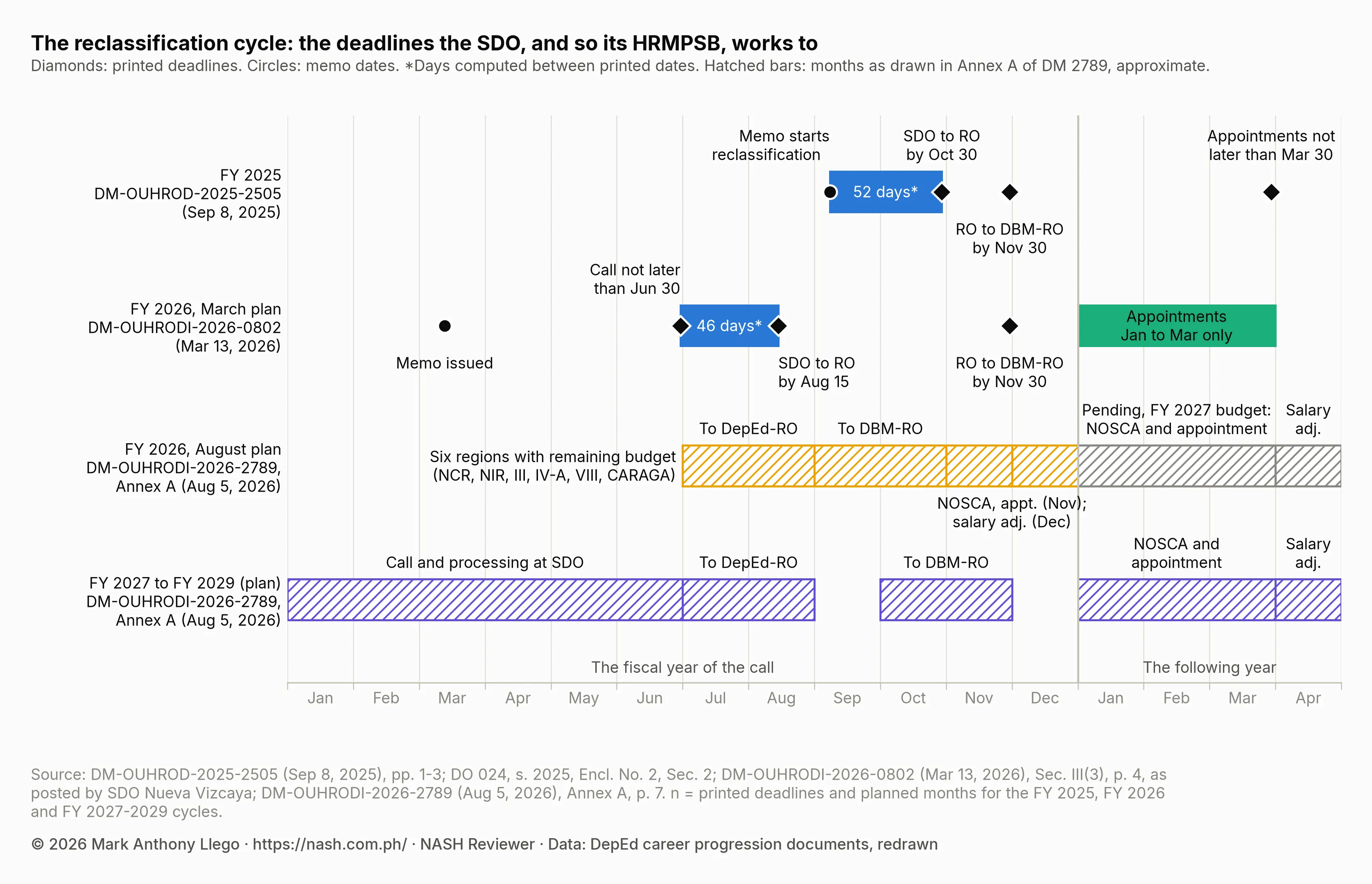
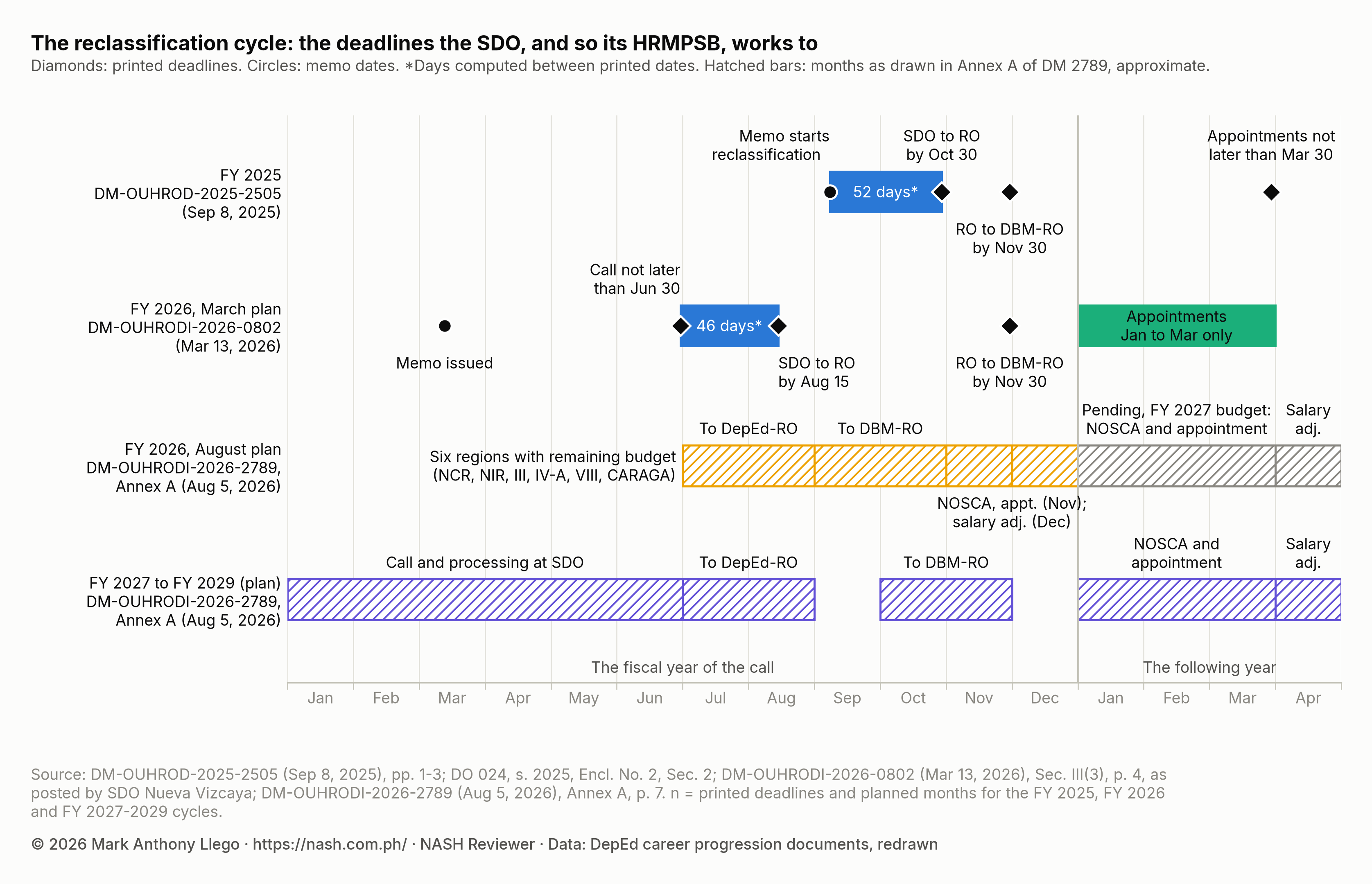
A division that issued its FY 2026 call on June 30, the latest date DO 024 sets for the call (later calls are allowed “subject to availability of funds”), had 46 days (computed) to receive papers, evaluate, deliberate no earlier than 10 days after the call, observe, interview, post the CAReER and endorse. FY 2025 had 52 days (computed) from the memorandum to the SDO deadline.
For “FY 2026 ONWARDS” (the heading of its Sec. IV), DM-OUHRODI-2026-2789 of August 5, 2026 tells ROs and SDOs to “strictly follow a forward-looking processing timeline prescribed in Annex A”. For FY 2026 itself, Annex A draws a path for the six regions with remaining budget (NCR, NIR, III, IV-A, VIII and CARAGA): submission to the RO in July and August, to the DBM RO in September and October, NOSCA and appointment in November 2026, and the salary adjustment in December 2026. Applications still pending, “Under DBM’s Processing + Remaining in the CAReER”, are “to be charged against FY 2027 Budget”, with NOSCA and appointment drawn in January to March 2027 and the salary adjustment in April 2027; the 11 deficit regions’ deferred applications are prioritized for FY 2027 funding (Sec. III.A). DM-OUHRODI-2026-0802 of March 2026 had limited FY 2026 appointments to January to March 2027. Where the two memoranda differ, the later one governs.
From FY 2027, the SDO’s call and processing run from January to June, and NOSCA and appointment from January to March of the next year, within DO 024’s March 30 limit; only the salary adjustment, drawn in April, falls after it. The Joint Circular sets March 30 for both the appointment papers and “the necessary adjustment to the salaries” (Sec. 7.5.3.4), unless DBM and DepEd jointly decide otherwise. A DepEd memorandum cannot amend it, so the April adjustment departs from the JC, and the documents do not reconcile the two. The months are read off a bar chart, and the annex is DepEd’s August 2026 plan. Why ECP Reclassification Was Deferred in 2026 covers the funding behind it.
What the school head does at each step
No single section lists the school head’s duties in reclassification. They are spread across DO 024, DO 034, the PMES memorandum and the annex forms. The last column gives the strand of the Philippine Professional Standards for School Heads (PPSSH, DO 024, s. 2020) each duty exercises; the strands are named in the PPSSH table below.
| When | What the school head does | Source | PPSSH strand |
|---|---|---|---|
| All year | Rates Master Teachers, Head Teachers with a teaching load, and teachers where no Master Teacher, Department Head or Assistant School Head rates them; approves the ratings those raters give | DM 089, s. 2025, para. 91, Table 18 | 4.4 |
| Before applying | Helps a teacher get a promotion observation, done by trained assessors and separate from the PMES one | DO 034, paras. 22–24; ECP Toolkit, p. 35 (guidance) | 3.2 |
| Before applying | Notes the Teacher’s Commitment Form | DO 034, para. 29 | 4.4; 4.5 |
| During the call | Lets the HRMO post the call and the CAReER at the school and keeps them up for the full period (inferred; DO 024 names schools among the places but assigns CAReER posting to the HRMO) | DO 024, Encl. No. 2, Secs. 3 and 30 | 5.4 |
| During the call | Prepares the Report on the Number of Teachers and Master Teachers for Master Teacher applicants | DO 024, Annex S-1 and Encl. No. 2, Sec. 51.l; JC Form No. 4 | 2.4 |
| When designated | Serves on a school or district sub-committee that receives documents or observes classes | DO 024, Encl. No. 2, Sec. 11; DO 034, para. 24 | 2.4 |
| Comparative assessment | Sits on the special HRMPSB for teaching positions; signs the CAReER | DO 024, Encl. No. 2, Sec. 21; Annex I-3 | 2.4; 1.3 |
| After appointment | Designs Master Teachers’ programs to leave time for coaching; rates them | DO 024, Encl. No. 1, Sec. 36.b.iii–iv | 2.4; 4.6 |
| After appointment | Rates, or approves the rating of, a promoted teacher on the new position’s tools once the teacher has served at least 90 days in it | DM 089, s. 2025, paras. 91 and 94 | 4.4 |
Two duties people expect are not in the issuances. DO 024 does not ask the school head to endorse an application: the letter of intent is “addressed to the SDS” (Encl. No. 2, Sec. 6.a), and at the SDO the RFTP is signed by the applicant, the HRMPSB chair, the HRMO, the Administrative Officer V and the SDS; the RO’s credentials evaluator, administrative chief and Regional Director sign after them. No line is for the school head (Annex B-1). DO 024 also does not say who prepares the “teacher needs analysis” the SDS weighs in setting slots and recommending candidates (Secs. 5 and 50).
The HRMPSB for teaching positions: membership and rules
DO 024 creates two special boards “Consistent with the provision of Section 90 of DO 19, s. 2022”, the DepEd Merit Selection Plan (Encl. No. 2, Sec. 21; Encl. No. 3, Sec. 20).
| Teaching positions (Encl. No. 2, Sec. 21) | School Principal positions (Encl. No. 3, Sec. 20) | |
|---|---|---|
| Chair | ASDS | ASDS |
| Members | Chief, Curriculum Implementation Division (CID); “School Head where the vacancy exists”; Administrative Officer V; Administrative Officer IV (HRMO); union or association representative “belonging to the teaching group” | Chief, School Governance and Operations Division; Chief, CID; Administrative Officer V; Administrative Officer IV (HRMO); union or association representative “belonging to the school heads group” |
| Quorum | “A majority of the HRMPSB shall constitute a quorum, provided that the Chairperson is present” (Sec. 24) | Same (Sec. 23) |
The seat comes from the Merit Selection Plan, DO 019, s. 2022, whose division boards include the “School Head or Chief of Division where the vacancy exists” (Encl., para. 83). The board is constituted by an Office Order, and “Each regular member, except for the Chairperson, shall have one (1) alternate whose name shall also be indicated in the Office Order/Designation” (para. 85). “Membership to the HRMPSB shall be considered a regular duty, and shall be treated with utmost priority” (para. 93), and the board must “Maintain fairness and impartiality in the assessment of applicants” (para. 84.g). The Civil Service Commission’s 2025 Omnibus Rules on Appointments and Other Human Resource Actions (ORAOHRA) make the same seat a minimum for national agencies: the “Head of organizational unit where vacancy exists, or his or her designated alternate”, and “the prescribed composition may not be reduced” (Secs. 90 and 92).
Two points the documents leave open.
- Quorum. DO 024 and the Merit Selection Plan (para. 94) require the chair’s presence. The ORAOHRA asks only that the board “be represented by at least the majority of its members” during deliberation (Sec. 95). They do not conflict: the ORAOHRA sets the CSC’s minimum, and DepEd’s chair-present rule is a stricter rule of its own.
- “Where the vacancy exists.” The phrase comes from hiring. In reclassification no position is vacant; the applicant’s own item is upgraded. DO 024 does not say which school head sits when a division’s applicants come from many schools. Your division’s Office Order names the members and alternates, so read it.
What the board does. It convenes the applicants “in a group to witness the paper evaluation”, scores education, training, experience and performance, rates classroom-observable indicators (COIs) by observation and non-classroom-observable indicators (NCOIs) by portfolio annotation and the Behavioral Events Interview (BEI), and prepares the rank list and PAL (Encl. No. 2, Sec. 23). Under open ranking, each applicant may “ask questions and seek clarifications on the results of their individual assessment” (Sec. 25), and “Any issue on the comparative assessment shall be resolved by the HRMPSB prior to the finalization of the results” (Sec. 29).
The board then prepares two CAReERs: one lists candidates “in no particular order using application codes” for posting, and one goes to the SDS, “highlighting the candidates for reclassification who meet the cut-off score of 50 points, ranked from highest to lowest” (Secs. 41–42). The template says “All members should affix signature” (Annex I-3). Its Remarks column records what the SDS should weigh beyond scores: specialization, qualifications for handling ALS, Special Needs Education, Madrasah or Indigenous Peoples’ Education learners, languages, skills such as Filipino Sign Language, and “Place of residence (RA No. 8190, Localization Law), if applicable” (Sec. 44). This is where the school head’s knowledge of the school belongs.
Queries, appeals and protests. The SDO HRMPSB “shall respond to queries and appeals” on the comparative assessment (Encl. No. 1, Sec. 44), and the SDS answers “queries and complaints pertaining appointments” (Encl. No. 2, Sec. 60). Signing the RFTP “shall not, in any case, preclude the applicant from filing a protest” (Sec. 27). DO 024 sets no protest procedure of its own, but Sec. 61 adopts the appointment rules in Part V(E) of the Merit Selection Plan. There, “a qualified next-in-rank official or employee included in the list of candidates in the CAR/CAR-RQA” may protest an appointee who lacks the minimum qualifications “within 15 calendar days from the announcement and/or posting of appointments” (DO 019, s. 2022, Encl., para. 67). Part V(G) of the same Plan makes the SDS the appointing officer for schools (para. 81) and has the appointing officer answer “queries and/or protests pertaining to the decision on the appointments” (para. 82.g). The 2025 ORAOHRA sets the same 15 days, with appeal “initially to the head of agency, then to the CSC RO, and then to the CSC CO” (Sec. 117). Neither says how “next-in-rank” applies when each applicant’s own item is upgraded.
Serving as an assessor or classroom observer
On the board’s recommendation, the SDS “may designate sub-committee/s in the districts, or offices”, but sub-committees “shall only serve as an assistorial body” and the HRMPSB keeps “full responsibility and accountability in the results” (Encl. No. 2, Sec. 31). DO 034 tells SDOs to form sub-committees of trained assessors “preferably at the district and school levels”, and “Only those assessors who have completed the prescribed training shall be authorized to conduct classroom observations for promotion purposes” (para. 24).
| Criterion | Teacher competencies (Encl. No. 2, Sec. 32) | School head competencies (Encl. No. 3, Sec. 32) |
|---|---|---|
| Experience | “Has been a School Head or Master Teacher for at least five (5) years”, or a supervisor (PSDS or EPS) with three years of school management; has observed, given feedback and rated or validated IPCRFs | “Has been a School Principal for at least five (5) years”, or a supervisor (EPS) with three years of school management; same observation and IPCRF experience |
| Rank | “If a Master Teacher is selected as assessor, he/she must be of higher ranks than the position applied for” | “If a School Principal is selected as assessor, he/she must be of higher ranks than the position applied for” |
| Performance and training | Very Satisfactory “for the past three (3) years”; trained in PPST, PPSSH or PPSS and RPMS/PMES | Same |
An observer follows Encl. No. 2, Sec. 37.c. There are two to three observers, none related to the applicant within the third degree. The class is “an actual classroom setting with learners”, observed “for the entire class period”. Only the teaching is rated. “Only the subject specialist/s shall rate Indicator 1”, and the final rating “is NOT an average of their individual ratings, but a rating based on their reasoned and consensual judgment”. The NCOI assessment has the same two-to-three rule and relationship bar, and the applicant gets “at most two (2) hours” for the Portfolio Annotations Form (Sec. 38.c). These rules also apply when the applicant is the school’s teacher-in-charge or Assistant School Head Designate, who “shall be required to undergo assessment in both COI and NCOI” (DO 034, para. 20).
Endorsements and documents that pass through the school head
The endorsement in reclassification is the SDS’s. The SDO’s package to the RO starts with the “Endorsement Letter duly signed by the SDS” (Encl. No. 2, Sec. 51.a). The school head’s papers enter it in other ways.
| Document | The school head’s part | Source |
|---|---|---|
| IPCRFs, at most three, the latest covering a full year in the current position | Rater or approving authority for every school-based teacher; the RFTP asks for a “Copy of duly approved IPCRF” | DO 024, Encl. No. 2, Sec. 6.j; Annex B-1; DM 089, Table 18 |
| Teacher’s Commitment Form | Notes it | DO 034, para. 29 |
| Report on the Number of Teachers and Master Teachers | “Prepared by: School Head”; reviewed by the AO V, recommended by the SDS, verified by the CAO, approved by the RD | DO 024, Annex S-1; JC Form No. 4 |
| COI rating sheet from an observation before applying | Certified by the sub-committee members; “valid for one year” | DO 034, para. 23 |
| Class programs | Master Teacher applicants teaching outside their major need at least five years in the subject “as evidenced by duly approved Class Programs” | DepEd ECP FAQs, updated November 6, 2025, Q44 |
| Work experience | “must be certified by the HRMO, immediate supervisor, or another authorized official” | DepEd ECP FAQs, updated November 6, 2025, Q65 |
The Commitment Form. During the transition, DO 034 lets four groups of teachers who do not fully meet a performance requirement apply “within or across career stages within the range of three salary grades” (para. 28); How to Be Reclassified to Teacher IV to VII in DepEd explains the groups. The teacher commits to “a maximum of three PPST objectives”, which go into “the teacher’s IPCRF for the current school year” and “shall not carry any weight allocation” (para. 28). DepEd’s FAQ says the IPCRF “for the succeeding school year” (Q55); DO 034, an Order, governs, so use the current year’s. The form is “accomplished and signed by the concerned teacher, and noted by the School Principal” (para. 29). DepEd’s FAQ allows only ratings one level below the requirement: “If the required PPST Indicator rating is Outstanding, a rating of Satisfactory or below is not considered for reclassification” (Q56). The relaxation ends on February 24, 2028 (para. 33).
Two details are unsettled. Paragraph 29 sends the form to the HRMO, but the printed form ends with “Received by: [Name and Signature of the HRMPSB Chair]”; submit it to the HRMO and ask whether your division also wants the chair’s signature. And neither DO 034 nor the FAQ says who notes it in a school run by a teacher-in-charge. Under DM-OSEC-OUHRODI-2026-0001 of March 3, 2026, “As a condition for promotion under DepEd Order No. 34, s. 2025, teachers with PPST Indicators for improvement reflected in the Teacher’s Commitment Form shall record their enhanced ratings in the e-IPCRF”, which the rater and approving authority verify (Sec. E.a). The school head receives each teacher’s finalized e-IPCRF and, directly or through designated non-teaching staff, uploads it (Secs. E.a–E.b). The same memorandum promised “A separate issuance” on the PMES “beginning SY 2026-2027”; as of October 31, 2026, none had been issued. Improvement may be shown through observation, learning action cells, a coaching and mentoring form “duly signed by the Rater and school heads”, or very satisfactory participation in DepEd programs that improve learning outcomes, such as ARAL (DO 034, para. 30).
Observations before the call. An observation from “the immediately preceding school year prior to the submission of the application may be considered for purposes of promotion”, provided it “is distinct and separate from the scheduled full-period classroom observation” for the PMES (DO 034, para. 22); the certified sheet counts for the COI criterion, “comprising 25%” of the points (para. 23). DepEd’s toolkit tells teachers to “Coordinate with your School Head to request a classroom observation schedule from the SDO” (ECP System Toolkit for Teachers, 2025, p. 35), guidance that makes the school head the first contact.
The Master Teacher report. Annex S-1 counts the school’s teachers and Master Teachers by position and learning area, applies the Master Teacher ratio (“Refer to Section 27 Part V (B) of this Order”), and shows the “Remaining Balance/Available Master Teacher Slots After this Request”. It warns: “There should be no double counting of teachers with other learning area/subject area/track/specialization”, and item numbers follow “the order in the latest PSIPOP”. The RO approves the report and sends it to the DBM RO (Encl. No. 2, Secs. 55–56). The ratios are in How to Become a Master Teacher Under DepEd’s ECP.
After reclassification: deploying, designating and rating Master Teachers
- Pay. A reclassified teacher receives “a salary rate equivalent to the 1st step of the new position” (JC No. 01, s. 2025, Sec. 7.6.1.1); see ECP Salary Grades for Teachers, MTs and Principals.
- Program. “The teaching load of Master Teachers shall be at most six (6) hours per day”, and “school heads shall design the teachers’ program in a way that they have time to conduct coaching and mentoring” (DO 024, Encl. No. 1, Sec. 36.b.iii). The Joint Circular’s six hours of teaching plus two of ancillary services (Sec. 9.2.4) is compared in Department Head, Assistant School Head and MT Duties; see also How Many Hours Must DepEd Teachers Teach a Day?.
- Rating. “All Master Teachers shall be administratively under the School Head, who shall be the Rater of all Master Teachers, notwithstanding their rank or salary level” (Sec. 36.b.iv; JC Sec. 9.2.1 says the same of administrative supervision, but not of rating). The ASDS approves those ratings (DM 089, Table 18), and Master Teachers in turn “shall serve as raters of teacher performance” (Sec. 36.b.ii).
- Designations. A Department Head Designate “shall come from the ranks of Master Teachers”, by SDS order, on a one-year rotation, with three hours of teaching (Sec. 36.c). Assistant School Head Designates, in schools with “more than 1,000 learners”, come from Teacher VI, Teacher VII and Master Teacher I “As part of the professional development of prospective or aspiring principals” (Sec. 36.d.i); the Joint Circular prefers Master Teachers for these designations (Sec. 9.2.3).
- The first rating in the new post. For a teacher promoted across career stages within the year, “the performance evaluation shall be based on the new position and career stage, provided that the teacher has rendered at least 90 days of service in the new position”; earlier ratings “shall be honored and carried over” (DM 089, s. 2025, para. 94).
Data privacy and posting rules
Each applicant gets an application code “to protect the identity of the applicants when posting the results” (Encl. No. 2, Sec. 10). The IER is posted “in at least three (3) conspicuous physical places, concealing the applicants’ personal information”; only codes, qualifications, performance and the Qualified or Disqualified remark are public (Sec. 17). For the CAReER, “The only information that shall be made public are the assigned application codes, corresponding scores obtained by the applicant in each criterion, total scores, and remarks” (Sec. 30). Notices use channels “that can be verified, recorded, and preserved”; “Telephone calls and short messaging services may be used only to accompany” them (Sec. 18).
What a school head may and may not do
| A school head may | A school head may not |
|---|---|
| Sit and vote on the teaching HRMPSB and sign the CAReER (DO 024, Encl. No. 2, Sec. 21; Annex I-3) | Appoint, promise a reclassification or set slots; the SDS does these and is “accountable for the appointments” (Secs. 5, 50, 60) |
| Put the school’s needs on record in the CAReER’s Remarks (Sec. 44) | Claim the “where the vacancy exists” seat on the School Principal board, which has none (Encl. No. 3, Sec. 20) |
| Observe or assess when qualified (Encl. No. 2, Sec. 32), trained and designated (DO 034, para. 24) | Observe or assess a relative within the third degree (Encl. No. 2, Secs. 37.c, 38.c), or observe untrained (DO 034, para. 24) |
| Help a teacher schedule an observation before the call (Toolkit, p. 35; FAQ Q63) | Count the PMES observation as the promotion one; it must be “distinct and separate” (DO 034, para. 22) |
| Note a Commitment Form for up to three objectives one level below (DO 034, paras. 28–29; FAQ Q56) | Note one for more than three objectives or for ratings two levels below (DO 034, para. 28; FAQ Q56) |
| Certify a teacher’s experience as immediate supervisor (FAQ Q65) | Alter an approved rating to fit a requirement; a “false and fraudulent document” is grounds for disqualification and “administrative or criminal case/s” (Encl. No. 2, Sec. 9) |
| Remind teachers that NCOI evidence comes from regular work (DO 034, para. 25) | Ask for new MOVs: “Teachers are not required to prepare new or additional MOVs” (FAQ Q43) |
| Receive documents when designated to a school sub-committee (Sec. 11) | Accept documents after the deadline (Sec. 8), or drop an applicant who lacks only the extra documents the HRMPSB may ask for (Sec. 7) |
| Let the HRMO post the call and the CAReER at the school and keep them up for the full period (inferred from Secs. 3, 30, 41) | Post names or personal information (Secs. 17, 30), or hold up the process for a pending query (Sec. 48) |
DO 024 states the third-degree bar for observers and NCOI assessors only, not for HRMPSB members. On relatives more broadly, see RA 6713 for DepEd School Heads. The safe course, though no rule requires it: if a relative applies, tell the chair, let your alternate sit, and have the minutes record it.
Where the process jams: DepEd’s M&E survey
DepEd’s “Session 1: Presentation of Monitoring and Evaluation Analysis” reports a survey on DO 020, s. 2024, DO 024 and DO 034, s. 2025, covering promotion by vacancy and by reclassification. The deck is undated and gives no survey period, sampling method or author, and no count of respondents for any question, so the shares cannot be turned into numbers of people. It counts “5,479 Total Number of Responses”, 5,120 (93%) from schools; by role, 3,806 applicants, 222 HRMPSB members and 367 sub-committee members (slide 3). The answers are perceptions, not measured times.
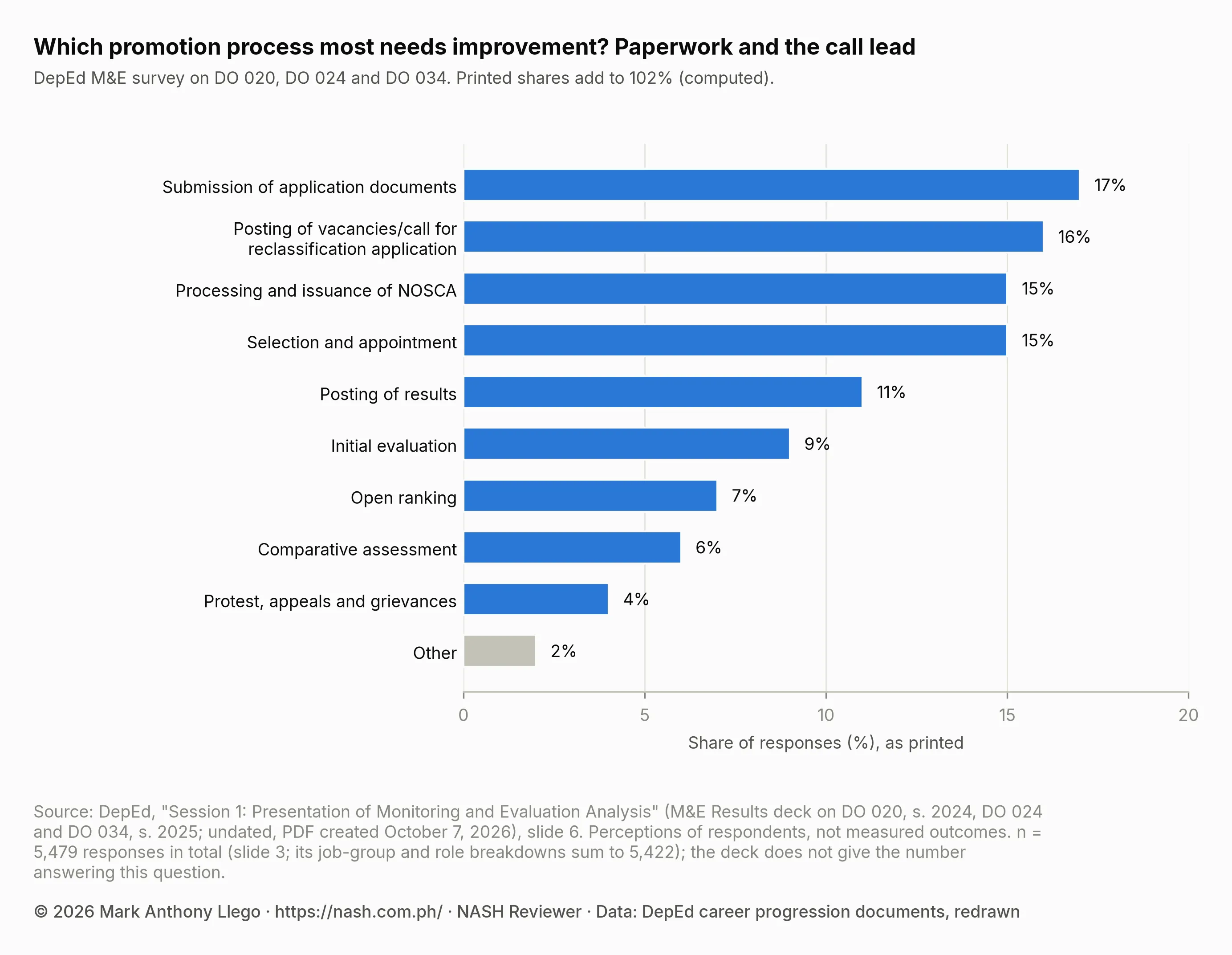
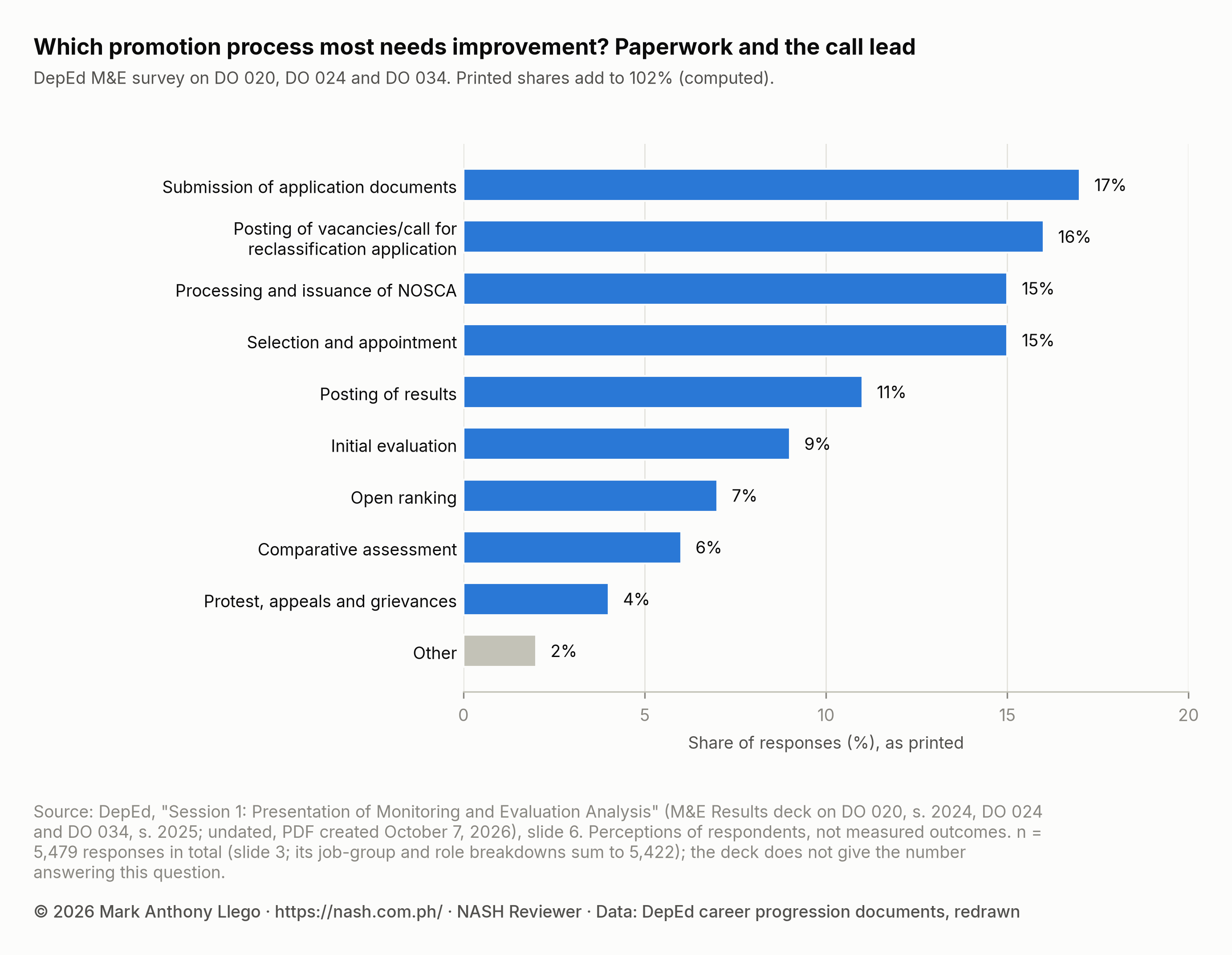
The two most named, submission of documents (17%) and posting of the call (16%), are the first two steps of the process; the comparative assessment drew 6% (slide 6). The deck does not say whether respondents could pick more than one.
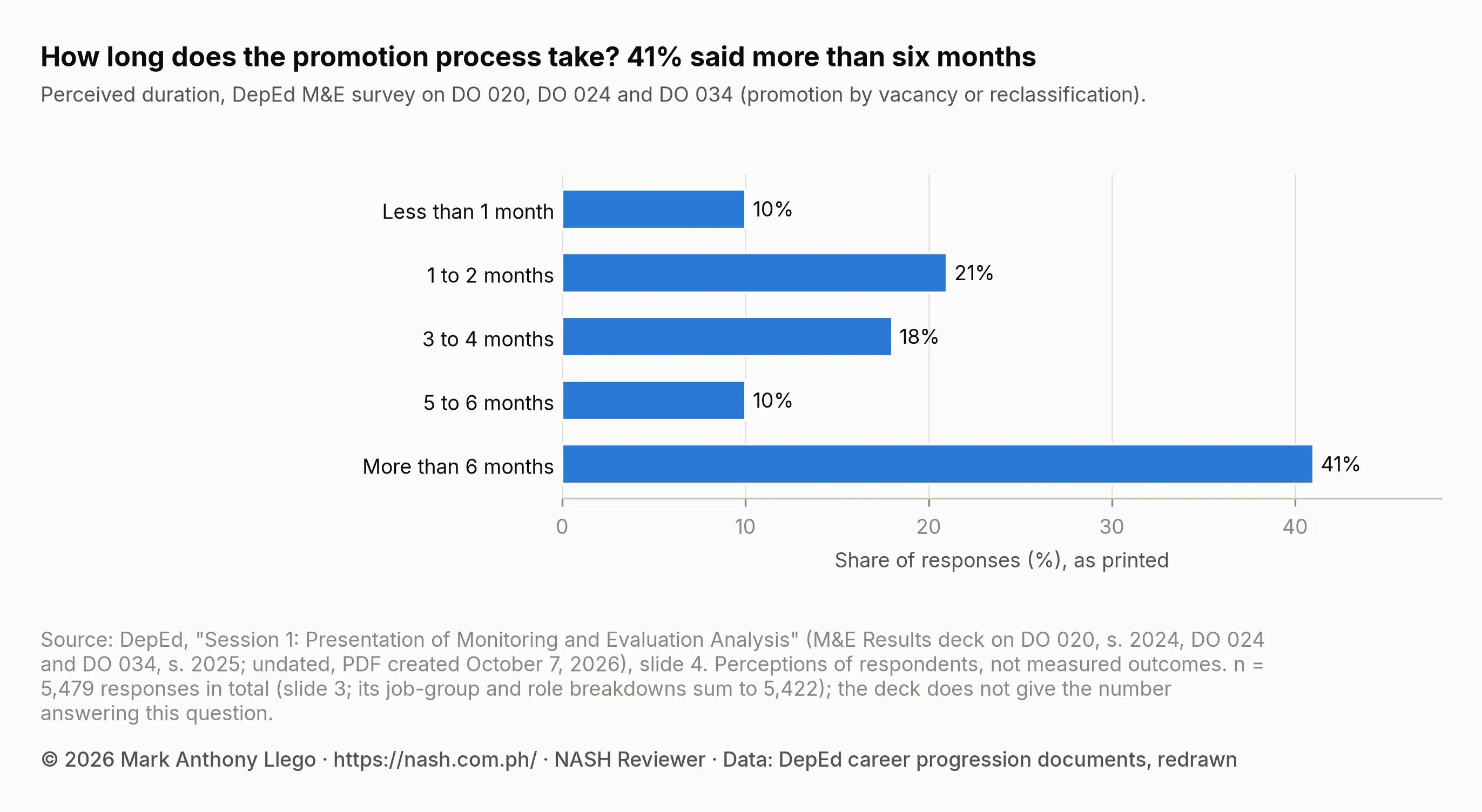
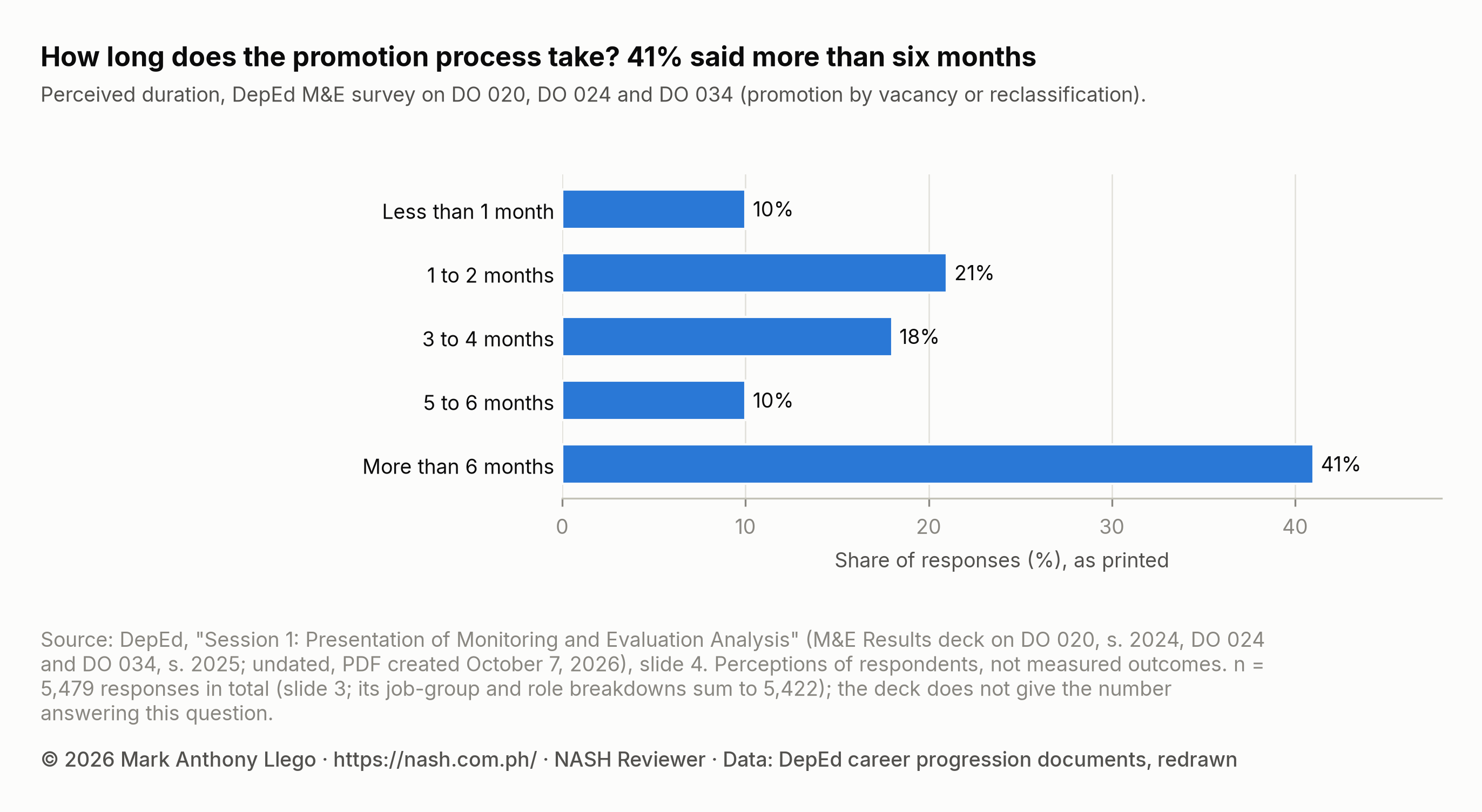
“The largest proportion of respondents (41%) perceived the promotional process to take more than six months” (slide 4). The question covered all three orders, so this is not a measure of reclassification alone.
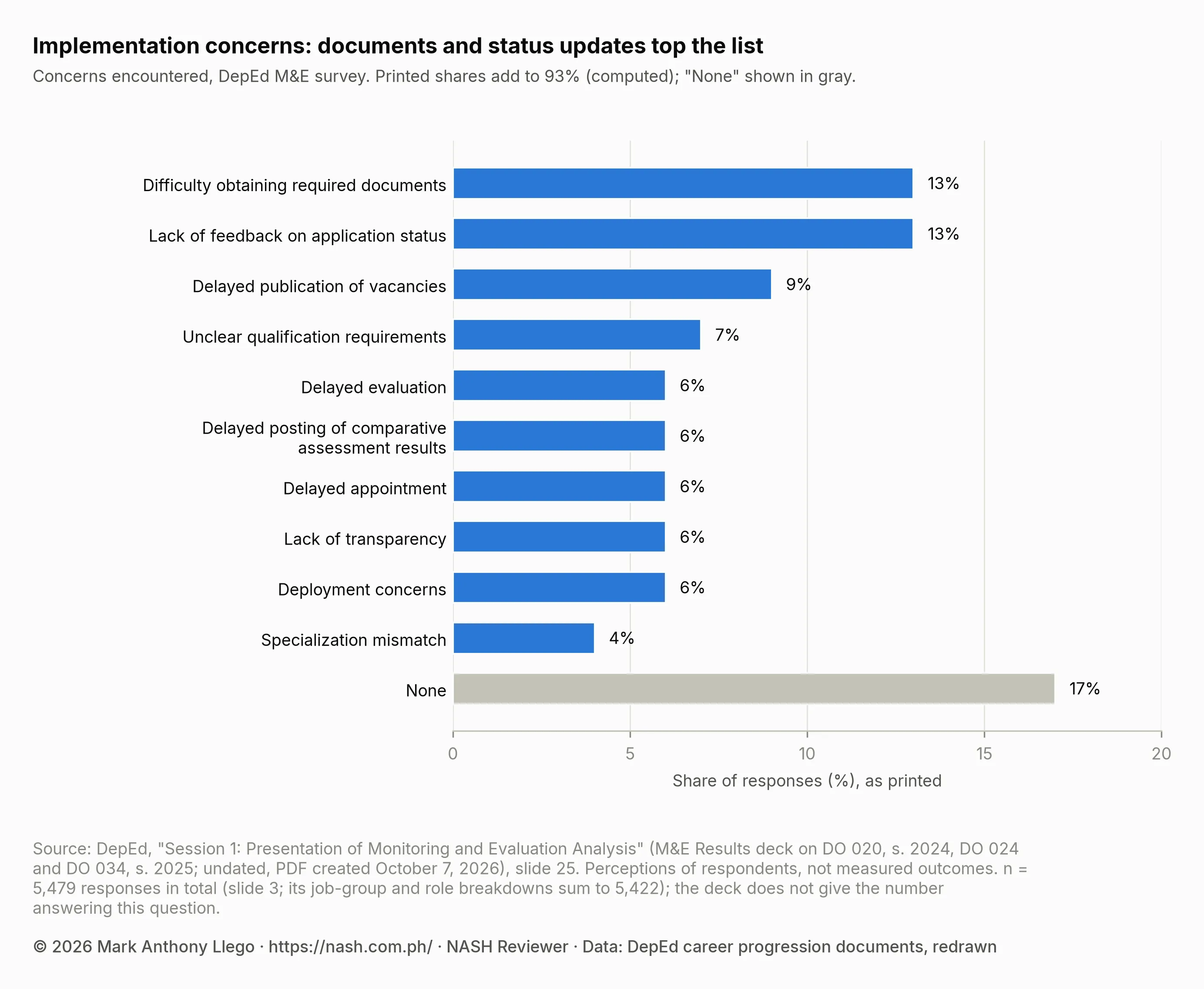
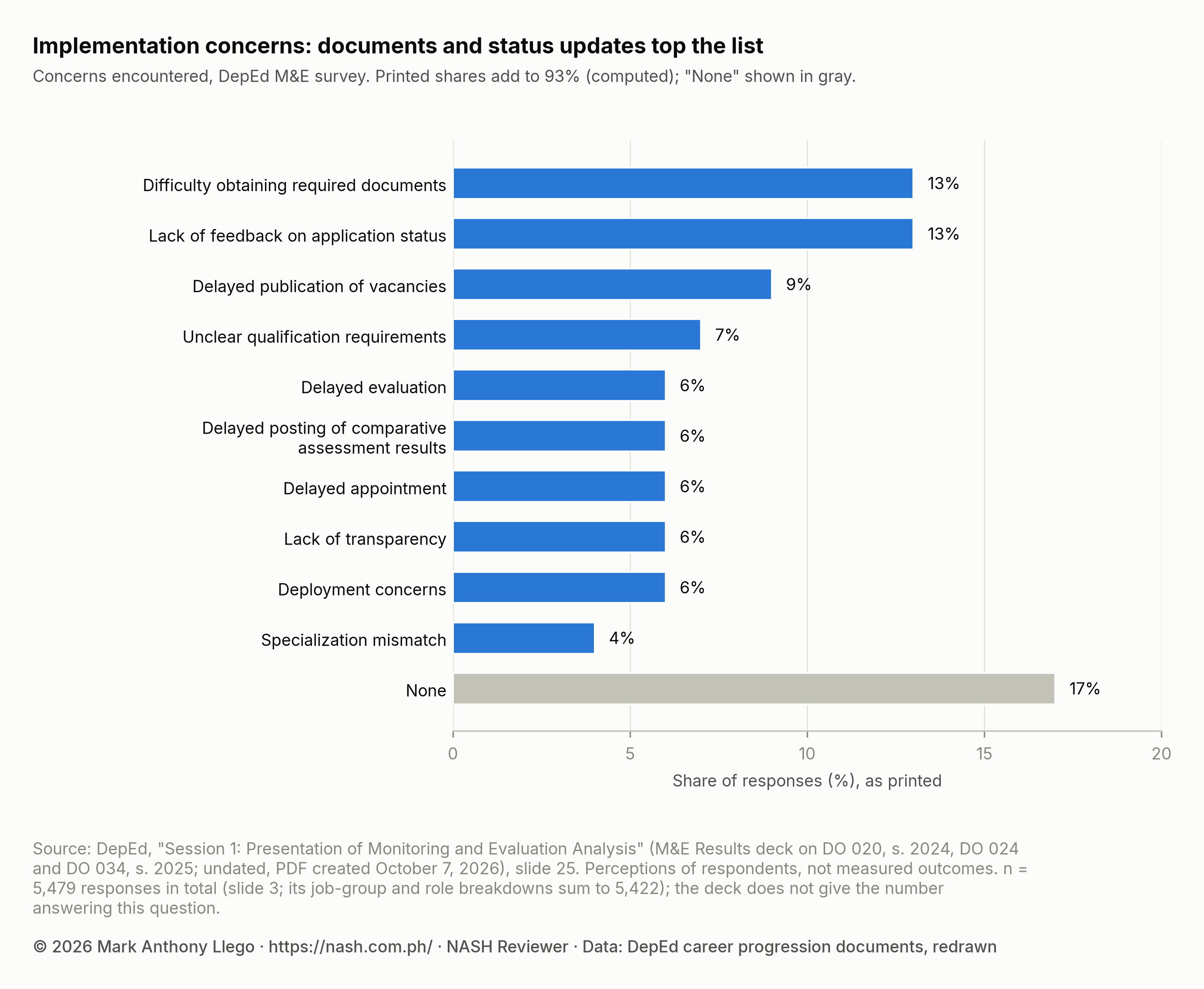
Two other slides bear on the school head’s seat. Respondents raised concerns “that applicants with lower rankings sometimes receive appointments ahead of higher-ranked candidates, undermining trust in the process” (slide 24). Part of this has a written basis: DM-OUHRODI-2026-0802 tells SDOs to prioritize three groups who meet the 50-point cut-off “regardless of their rank in the CAReER” (Sec. III(2)). That is a rule of the memorandum; DO 024 has none like it (see How to Be Reclassified to Teacher IV to VII in DepEd). And “COI (25.4%) and NCOI (21.9%) received the highest recommendations for removal” (slide 18), the parts of the assessment that trained school heads may observe and rate. The survey does not show that these perceptions are right. It does show where a school head can lower friction without changing a rule: help teachers gather documents early, explain the call, and tell applicants where their papers are.
How the ECP work maps to the PPSSH
| ECP work | PPSSH strand | Read more |
|---|---|---|
| Applying DO 024, DO 034 and the yearly memoranda | 1.3 Policy implementation and review | PPSSH Domain 1 |
| The HRMPSB seat, the Master Teacher report, class programs, Master Teachers’ coaching time | 2.4 Management of staff | PPSSH Domain 2; human resource management for school heads |
| IPCRFs, rating sheets and confidential applicant files | 2.1 Records management | PPSSH Domain 2 |
| Observing and coaching before and after a teacher applies | 3.2 Teaching standards and pedagogies; 3.3 Teacher performance feedback | PPSSH Domain 3; instructional supervision |
| Rating and approving IPCRFs; the Commitment Form | 4.4 Performance management | PPSSH Domain 4; the PMES for teachers |
| Coaching and learning action cells on indicators for development | 4.5 Professional development of school personnel | PPSSH Domain 4 |
| Department Head and Assistant School Head designations | 4.6 Leadership development in individuals and teams | PPSSH Domain 4 |
| Telling teachers accurately what reclassification gives and when | 4.7 General welfare of human resources | PPSSH Domain 4 |
| Posting the call and keeping applicants informed | 5.4 Communication | PPSSH Domain 5 |
What this means for school heads
- Read your division’s Office Order to learn whether you sit on the HRMPSB, who your alternate is, and which sub-committee you are on (Merit Selection Plan, para. 85). Treat the seat as “a regular duty” (para. 93).
- Plan backward from the deadlines. In FY 2026 the SDO endorsed by August 15. Promotion observations may be done in the year before applying and stay valid for one year (DO 034, paras. 22–23), so schedule them before the call.
- Finish ratings on time and keep them honest. Approved IPCRFs are the applicant’s performance evidence and 30 of the 100 points (DO 024, Encl. No. 2, Secs. 6.j and 34).
- Check each Commitment Form for no more than three objectives, each one level below the requirement, then give the coaching, observation or LAC work that shows improvement (DO 034, paras. 28–30; FAQ Q56).
- Prepare the Master Teacher report from the latest PSIPOP, counting each teacher once (Annex S-1).
- Do not observe or assess a relative within the third degree (Encl. No. 2, Secs. 37.c and 38.c). On the board itself, no rule requires it, but the safe course is to let your alternate sit and have the minutes record it.
- Keep records: the Office Order, signed rating sheets and Inter-Observer Agreement Forms, Commitment Forms you noted, the uploaded e-IPCRFs, the Annex S-1 report, approved class programs, and posting dates.
You may remind teachers of the documents in DO 024, Encl. No. 2, Sec. 6 and the SDO’s deadline, and receive them if you are designated to a school sub-committee (Sec. 11). You may not require new MOVs (FAQ Q43) or a school endorsement the Order does not provide, and you may not treat the PMES observation as the promotion one (DO 034, para. 22).
How the NASH may test this
The two items below are original practice items, scored 3 (Relational), 2 (Multistructural), 1 (Unistructural) or 0 (Prestructural). An option that breaks a rule scores 0.
Question 1
Indicator 4.4.2, Performance management. Career Stage 2, Situational, Moderate.
You are the principal of an elementary school. Teacher R, a Teacher III, wants to apply for Teacher IV in your division’s FY 2026 call, which closes in two weeks. Her three latest IPCRFs, which you approved, are all Very Satisfactory overall. In the latest, two Proficient indicators that the Teacher IV requirement sets at Very Satisfactory are rated Satisfactory. She asks you to change those two ratings in her e-IPCRF so that she qualifies. What is the most appropriate action?
- A. Keep the approved ratings, and advise her to apply in a later call once a new IPCRF shows both indicators at Very Satisfactory.
- B. Keep the approved ratings; have her list the two indicators on the Teacher’s Commitment Form, which you note, for her to submit to the HRMO; and plan coaching and an observation with her rater on both indicators this year.
- C. Keep the approved ratings, and have her list the two indicators on the Teacher’s Commitment Form, which you note, for her to submit to the HRMO with her application documents.
- D. Revise the two ratings to Very Satisfactory, since her overall rating already meets the requirement and the transition period is meant for teachers like her.
Answer and explanation
Best answer: B. Points: A = 1, B = 3, C = 2, D = 0.
- A (1 point, Unistructural). It protects the ratings but misses the transition route DO 034 opens to her.
- B (3 points, Relational). It keeps the ratings honest, uses the Commitment Form as DO 034 provides, and links the commitment to the coaching and observation she needs to show improvement within the year.
- C (2 points, Multistructural). The ratings and the form are handled correctly, but nothing supports the improvement she has committed to make.
- D (0 points, Prestructural). Altering an approved rating to fit a requirement produces a false document, which DO 024 makes grounds for disqualification and for administrative or criminal cases.
Why. DO 034, s. 2025 lets teachers rated Very Satisfactory overall “but obtained Satisfactory ratings in certain PPST indicators, thereby rendering them ineligible to apply for positions such as Teacher IV” apply during the transition, if they commit to improve “a maximum of three PPST objectives” (para. 28). The form is “noted by the School Principal” and submitted to the HRMO (para. 29), and improvement may be shown through observation or a coaching form “signed by the Rater and school heads” (para. 30). DO 024, s. 2025 makes any “false and fraudulent document” grounds for disqualification (Encl. No. 2, Sec. 9).
Indicator 4.4.2: Implement the performance management system with a team to support the career advancement of school personnel, and to improve office performance.
Sources: DepEd Order No. 034, s. 2025, paras. 28–30; DepEd Order No. 024, s. 2025, Encl. No. 2, Sec. 9; DepEd ECP FAQs, updated November 6, 2025, Q56.
Question 2
Indicator 1.3.2, Policy implementation and review. Career Stage 2, Situational, Difficult.
You are the principal of a junior high school and a trained assessor. The SDS designates you to a district sub-committee that will observe applicants for Teacher IV to VII. One applicant is your husband’s sister, a relative by affinity in the second degree. Another applicant, a teacher in your school, asks you to let her PMES full-period observation next week also count as her observation for reclassification. What is the most appropriate action?
- A. Ask the HRMPSB chair to assign another trained observer for your husband’s sister, and tell the other teacher that you will raise her request with the HRMO.
- B. Observe your husband’s sister with two other observers, since the final rating is a consensus, and let the PMES observation count for both purposes.
- C. Ask the SDS to remove you from the sub-committee altogether, so that no one can question the fairness of any observation you take part in.
- D. Ask the HRMPSB chair to assign another trained observer for your husband’s sister, and explain to the other teacher that her promotion observation must be separate from the PMES one.
Answer and explanation
Best answer: D. Points: A = 2, B = 0, C = 1, D = 3.
- A (2 points, Multistructural). It handles the relationship correctly but passes on a request whose answer is already in DO 034, leaving the teacher uninformed.
- B (0 points, Prestructural). It breaks two rules: observers must not be related to the applicant within the third degree, and the promotion observation must be distinct from the PMES observation.
- C (1 point, Unistructural). It avoids the conflict by withdrawing from a duty the SDS assigned, and it does not answer the other teacher.
- D (3 points, Relational). It puts the relative’s observation in other hands and applies the separation rule, so both applications stay valid.
Why. DO 024, s. 2025 requires two to three observers who “must not be related to the applicant within the third degree of consanguinity or affinity” (Encl. No. 2, Sec. 37.c). DO 034, s. 2025 accepts an earlier observation only if it “is distinct and separate from the scheduled full-period classroom observation” for the PMES (para. 22), and only trained assessors may observe for promotion (para. 24).
Indicator 1.3.2: Undertake policy implementation and review in the school to ensure that operations are consistent with national and local laws, regulations and issuances.
Sources: DepEd Order No. 024, s. 2025, Encl. No. 2, Sec. 37.c; DepEd Order No. 034, s. 2025, paras. 22–24.
Nothing in this guide reproduces or predicts examination content.
Frequently asked questions
Is the school head a member of the HRMPSB for teacher reclassification?
Yes. The special HRMPSB for teaching positions includes the “School Head where the vacancy exists”, with the ASDS as chair (DO 024, s. 2025, Encl. No. 2, Sec. 21). The board for School Principal positions has no such seat (Encl. No. 3, Sec. 20). Each regular member has an alternate named in the division’s Office Order (DO 019, s. 2022, Encl., para. 85).
Does a teacher need the principal’s endorsement to apply for reclassification?
No. None of the documents DO 024 lists is a school head’s endorsement; the letter of intent is addressed to the SDS, and papers go to the HRMO through the Records Unit (Encl. No. 2, Sec. 6). The school head’s part is indirect: approved IPCRFs, a noted Commitment Form where one applies, and, for Master Teacher applicants, the Annex S-1 report.
Who signs the Teacher’s Commitment Form?
The teacher signs it and the School Principal notes it (DO 034, s. 2025, para. 29). The paragraph sends it to the HRMO, while the printed form also has a “Received by” line for the HRMPSB Chair. It covers at most three PPST objectives, each one level below the requirement, until February 24, 2028 (paras. 28 and 33; DepEd ECP FAQs, updated November 6, 2025, Q56).
Can the school head observe a teacher for reclassification?
Yes, if you meet the assessor criteria (at least five years as a school head, or three years in a supervisory post with school management experience; Very Satisfactory for the past three years; trained in the standards and the PMES), have completed the prescribed training, are designated to a sub-committee, and are not related to the teacher within the third degree (DO 024, s. 2025, Encl. No. 2, Secs. 32 and 37.c; DO 034, s. 2025, para. 24). The observation must be separate from the PMES one, and a certified rating sheet is valid for one year (DO 034, paras. 22–23).
What is the FY 2026 deadline for reclassification documents?
SDOs had to endorse to the RO “on or before August 15”, and ROs to the DBM RO by November 30 (DM-OUHRODI-2026-0802, Sec. III(3)). DM-OUHRODI-2026-2789’s later timeline draws submission to the DBM RO in September and October and appointment in November 2026 for the six regions with remaining budget (Annex A). The teacher’s own deadline is the one in the SDO’s call, issued “not later than June 30” (DO 024, Encl. No. 2, Sec. 2). In the 11 deficit regions, new applications go only up to the RO level until funding becomes available (DM-OUHRODI-2026-2789, Sec. III.A.2).
Download the data
- shrole-cycle.csv: the printed deadlines for FY 2025 and FY 2026, the days between them (computed), DepEd’s August 2026 replanning of FY 2026, and the FY 2027 to FY 2029 plan, with approximate months as drawn (DM-OUHROD-2025-2505; DO 024, s. 2025, Encl. No. 2, Sec. 2; DM-OUHRODI-2026-0802, Sec. III(3); DM-OUHRODI-2026-2789, Annex A).
- shrole-me-improvement.csv: shares naming each promotion process as most needing improvement, as printed (DepEd M&E Results deck, slide 6).
- shrole-me-duration.csv: shares by perceived duration of the promotion process, as printed (DepEd M&E Results deck, slide 4).
- shrole-me-concerns.csv: shares reporting each implementation concern, as printed (DepEd M&E Results deck, slide 25).
The CSVs and charts may be reused only with written permission: email support@nash.com.ph. The rules themselves come from DepEd’s issuances, which you can cite directly.
Sources
- DepEd Order No. 024, s. 2025, Guidelines on the Implementation of the Expanded Career Progression System for Teachers and School Heads in the Department of Education, August 28, 2025: Encl. No. 1, Secs. 36.b–d and 44; Encl. No. 2, Secs. 2–3, 5–11, 14.a, 17–34, 37.c, 38.c and 40–61; Encl. No. 3, Secs. 20–23 and 32; Annexes B-1, D-1, D-2, I-3 and S-1.
- DepEd Order No. 034, s. 2025, Amendments and Clarifications to DepEd Order No. 024, s. 2025, October 14, 2025: paras. 20, 22–25, 28–30 and 33, and the Teacher’s Commitment Form.
- DepEd-DBM Joint Circular No. 01, s. 2025, February 19, 2025: Secs. 7.5.3.1, 7.5.3.4, 7.6.1.1, 9.2.1, 9.2.3, 9.2.4 and 9.3; Form No. 4.
- DepEd Order No. 019, s. 2022, The Department of Education Merit Selection Plan: Encl., paras. 67, 81, 82.g, 83–85 and 93–94.
- Civil Service Commission, 2025 Omnibus Rules on Appointments and Other Human Resource Actions (CSC Resolution No. 2500358), Secs. 90, 92, 95 and 117, as filed in DepEd’s career progression toolkit folder; circularized by CSC Memorandum Circular No. 08, s. 2025.
- DepEd Memorandum No. 089, s. 2025, Guidelines on the Multi-Year Performance Management and Evaluation System for Teachers from School Years 2025–2026 to 2027–2028, October 1, 2025: paras. 91 (Table 18) and 94.
- Memorandum DM-OSEC-OUHRODI-2026-0001, Guidance in the Implementation of the PMES for Teachers for SY 2025-2026, March 3, 2026: Secs. E.a–E.b and p. 7.
- Memorandum DM-OUHROD-2025-2505, Commencement of Reclassification of Teaching and School Principal Positions Pursuant to DepEd Order No. 024, s. 2025, September 8, 2025: Sec. III (DepEd’s career progression toolkit folder).
- Memorandum DM-OUHRODI-2026-0802, Guidance on the Reclassification of Teaching and School Principal Positions for Fiscal Year (FY) 2026, March 13, 2026, as posted by SDO Nueva Vizcaya: Secs. III(1)–(3) and IV.
- Memorandum DM-OUHRODI-2026-2789, Funding Strategies and Interim Policy Directions for the Continuous Implementation of the Expanded Career Progression (ECP) System, August 5, 2026: Secs. III.A and IV, and Annex A (DepEd’s career progression toolkit folder).
- Implementing Rules and Regulations of Republic Act No. 12288, done August 17, 2026: Sec. 17, the DepEd-certified copy in DepEd’s career progression toolkit folder, which DepEd shares through DM-OUHROD-2025-3003 (folder).
- DepEd ECP FAQs, Annex A to DM-OUHROD-2025-3003 (October 24, 2025), copy updated November 6, 2025 (also in DepEd’s career progression toolkit folder): Q43, Q44, Q55, Q56, Q63 and Q65. DepEd also posts the October 24 version, which numbers its answers differently (the Q56 answer quoted here is Q53 there, with different wording).
- ECP System Toolkit for Teachers, DepEd BHROD, 2025: p. 35, in DepEd’s career progression toolkit folder.
- DepEd, “Session 1: Presentation of Monitoring and Evaluation Analysis” (M&E Results deck), undated: slides 3, 4, 6, 18, 24 and 25, in DepEd’s career progression toolkit folder.
- DepEd Order No. 024, s. 2020, National Adoption and Implementation of the Philippine Professional Standards for School Heads.
The career progression series
- DepEd Expanded Career Progression (ECP): The Full Guide
- How to Be Reclassified to Teacher IV to VII in DepEd
- How to Become a Master Teacher Under DepEd’s ECP
- ECP Salary Grades for Teachers, MTs and Principals
- ECP Qualification Standards Under DO 019, s. 2025
- ECP Point System: How the HRMPSB Scores Applicants
- School Principal I to IV: Promotion Under the ECP
- The School Head’s Role in ECP Reclassification (this post)
- Head Teacher Retitling: Options Under ECP and RA 12288
- Why ECP Reclassification Was Deferred in 2026
- What RA 12288 Changes in Teacher Career Progression
- Department Head, Assistant School Head and MT Duties
Written by Mark Anthony Llego for NASH Reviewer. Sources: DepEd Orders No. 024 and 034, s. 2025; DepEd-DBM Joint Circular No. 01, s. 2025; DepEd Order No. 019, s. 2022; the 2025 ORAOHRA; DepEd Memorandum No. 089, s. 2025; DepEd memoranda DM-OSEC-OUHRODI-2026-0001, DM-OUHROD-2025-2505, DM-OUHRODI-2026-0802 and DM-OUHRODI-2026-2789; DepEd’s ECP FAQs, toolkit and M&E Results deck. Charts may be reused only with written permission from support@nash.com.ph.