A DepEd public school teacher’s day is eight hours: six “devoted to actual classroom teaching” and two for ancillary tasks such as lesson preparation and checking learners’ work (DepEd Order No. 005, s. 2024, Sec. V.A, item 1). Six hours is also the most a teacher can be required to teach: “A teacher shall not be required to render more than six hours of actual classroom teaching in a day” (DepEd Memorandum No. 053, s. 2024, para. 3.a). Only in the exigency of service may a teacher teach up to two hours more, paid as teaching overload, and never more than eight hours of teaching in a day (Republic Act No. 4670, Sec. 13). A Master Teacher designated Department Head teaches three hours.
Whether six hours is also a minimum is where the documents differ. DO 005 says a teacher “must be able to render thirty (30) hours of actual classroom teaching” a week, and that wording has not been amended. DepEd’s 2026 Q&A says six hours is the maximum: “It should not be interpreted that all teachers are required to render exactly six (6) hours of teaching daily” (No. 1). The Order’s wording stands; DepEd’s guidance describes how DepEd applies it, and no issuance penalizes a teacher whose load is under six hours. The sections below cover what counts as teaching load as of October 31, 2026, the load for each position, what happens below six hours, and what DepEd’s eSF7 data show.
DepEd’s toolkit, meeting decks and question-and-answer sheets are in its Teacher Workload Public Drive. For the hours teachers reported in the 2024 EDCOM II–IDinsight survey, see Teacher Workload and Accountability: EDCOM II Findings.
Key findings
- Six hours is the most a teacher can be required to teach. A teacher “shall not be required to render more than six hours of actual classroom teaching a day” (RA 4670, Sec. 13; restated in DM 053, s. 2024, para. 3.a). The workday is eight hours: six of teaching, two of ancillary tasks (DO 005, s. 2024, Sec. V.A, item 1).
- Overload is capped at two hours a day. Teaching beyond six hours is overload, at most two hours a day or ten a week (DO 005, Sec. III.j), and only “where the exigencies of the service so require” (RA 4670, Sec. 13).
- Ceiling or quota: the Order reads as a quota; DepEd’s guidance reads it as a ceiling. DO 005 says a teacher “must be able to render thirty (30) hours of actual classroom teaching” a week (Sec. V.A, item 2), and that wording stands. DepEd’s 2026 Q&A says six hours is the maximum and “It should not be interpreted that all teachers are required to render exactly six (6) hours of teaching daily” (No. 1). No issuance penalizes a load under six hours.
- What counts. Actual classroom teaching, class advising at one hour a day including the Homeroom Guidance Program, and remediation or enhancement classes (DO 005, Sec. V.A.1, items 2–3), plus ARAL tutoring (DO 018, s. 2025, para. 81) and Hinga check-ins (DO 014, s. 2026, para. 69). Designations, LAC sessions and INSET do not count (2026 Q&A, Nos. 14 and 27).
- A Department Head Designate teaches three hours (DO 024, s. 2025, Encl. No. 1, Sec. 36.c.iv), which DepEd applies over DO 005’s six (2026 Q&A, No. 3). Teachers-in-Charge and designated Assistant School Principals are relieved of teaching unless every teacher already has two hours of overload.
- Fewer than six hours costs no salary. DepEd’s answer is that such teachers “shall not be subject to any salary deduction” (2024 Q&A, No. 1.0; no issuance addresses it). They get the full teaching allowance (DO 005, s. 2025, Sec. V.A.1) and “shall be prioritized” for teaching-related assignments (DO 005, s. 2024, Sec. V.A.4, item 2), but are not eligible for DO 026 overtime pay (Sec. VII.5), and DepEd’s guidance keeps them in school after their classes.
- Average loads sit below six hours. In SY 2024-2025 the eSF7 averages were 5.88 hours a day in elementary, 5.04 in junior high and 4.92 in senior high, with a printed total average of 5.28, across 45,328 public schools (DepEd CO–RO meeting deck, June 2, 2026, p. 37).
What RA 4670 says about teaching hours
Section 13 of Republic Act No. 4670, the Magna Carta for Public School Teachers, approved June 18, 1966, is the base of every DepEd rule on hours:
“Any teacher engaged in actual classroom instruction shall not be required to render more than six hours of actual classroom teaching a day, which shall be so scheduled as to give him time for the preparation and correction of exercises and other work incidental to his normal teaching duties: Provided, however, That where the exigencies of the service so require, any teacher may be required to render more than six hours but not exceeding eight hours of actual classroom teaching a day upon payment of additional compensation at the same rate as his regular remuneration plus at least twenty-five per cent of his basic pay.”
The law limits what a teacher can be required to teach; it sets no minimum. The schedule must leave time for preparation and correction; the two ancillary hours follow from this, though no text says so. Even in the exigency of service, teaching may not exceed eight hours a day, and the extra hours are paid at the regular rate plus at least 25% of basic pay.
DepEd Memorandum No. 057, s. 2026 (September 21, 2026) created a working group whose outputs will feed “recommendations for amending certain provisions of RA 4670” (para. 2). Nothing has been amended; Section 13 stands.
The eight-hour day and the 30-hour teaching week
DO 005, s. 2024 (April 29, 2024) applies the law together with Civil Service Commission Resolution No. 080096 (para. 1):
“A public school teacher shall render eight (8) hours of work per day, of which six (6) hours shall be devoted to actual classroom teaching and two (2) hours shall be allocated for teacher ancillary tasks which may be spent within or outside school premises.” (Sec. V.A, item 1)
Item 2 sets the week: “In a week, a teacher must be able to render thirty (30) hours of actual classroom teaching and ten (10) hours of teacher ancillary tasks.” DepEd’s overtime-pay Order repeats the same day (DO 026, s. 2025, Sec. V.1).
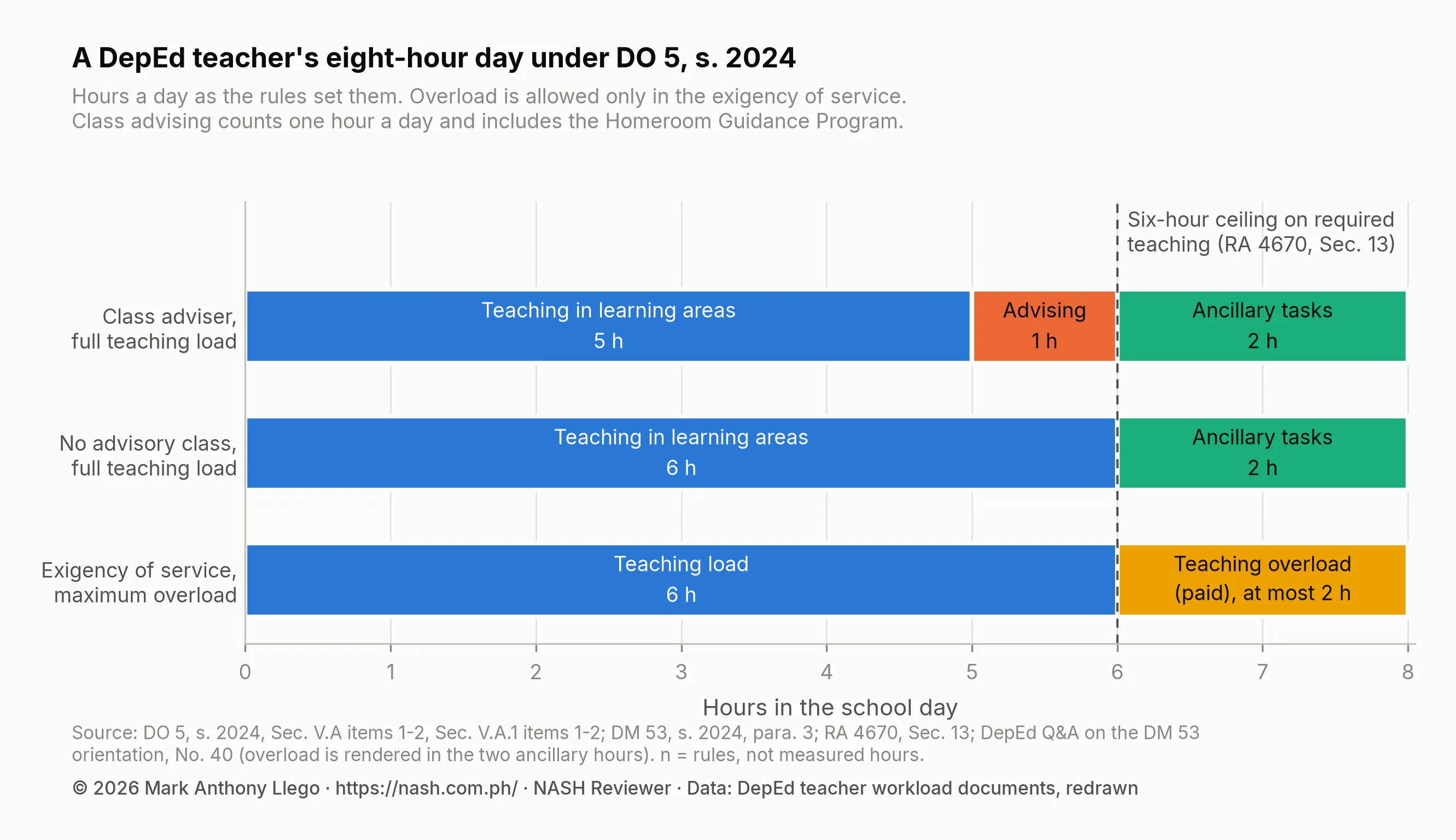
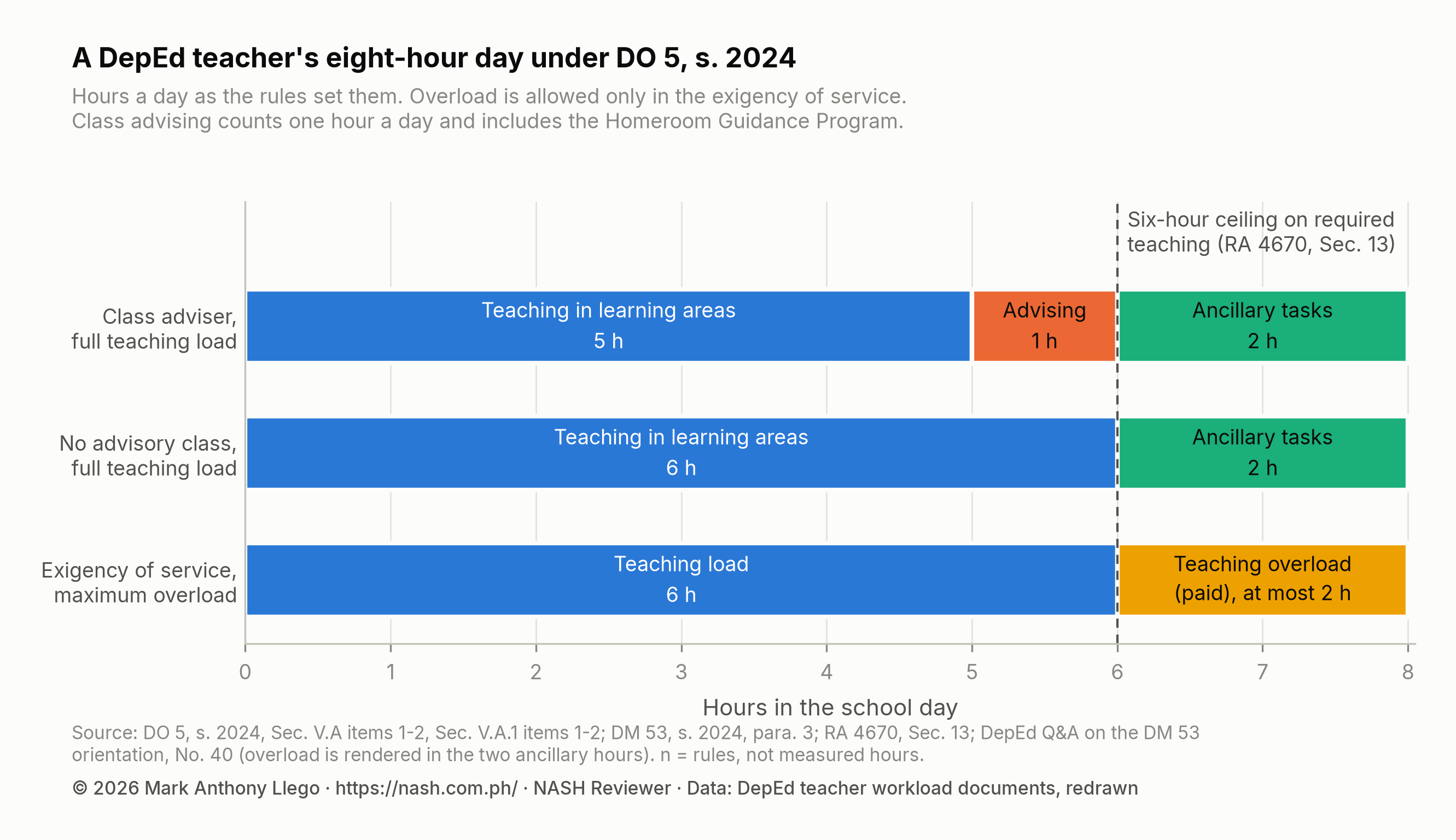
- Six hours of teaching completes the day. DM 053 keeps DO 16, s. 2009, Sec. 2.C in force: teachers whose daily time records (DTR) show six hours of teaching “shall be deemed to have completed the required daily working hours. They must not be considered undertime and must not be subject to salary deductions” (para. 4.a).
- The two ancillary hours may be spent outside the school. “No teacher shall be required to submit documentary evidence or accomplishment reports” on how they are spent outside (DO 005, Sec. V.A, item 1), though DM 053 asks for a logbook entry or locator slip, or a certificate of undertaking, attached to the DTR (para. 4.b). See Can Teachers Leave School After Six Hours of Teaching?
- Class programs must leave preparation time. They must give “ample time for the preparation and correction of exercises and other work incidental to normal teaching duties” (DO 005, Sec. V.A.3, item 4).
- Overload comes last. “All teachers shall render the prescribed number of actual classroom teaching hours before they may be assigned a teaching overload” (Sec. V.A.2, item 4). Pay rules are in DepEd Teaching Overload Pay: Who Qualifies, How Much.
Is six hours a maximum or a requirement?
DepEd’s documents word this differently. Both readings have sources.
| Reading | What the document says | Source | Kind of document |
|---|---|---|---|
| Requirement | “Teachers shall render six (6) hours of actual classroom teaching” | DO 005, s. 2024, Sec. V.A.1, item 1.a.i | DepEd Order |
| Requirement | “In a week, a teacher must be able to render thirty (30) hours of actual classroom teaching” | DO 005, Sec. V.A, item 2 | DepEd Order |
| Requirement | Overload pay is for teaching “beyond the required thirty (30) hours a week”; overload is teaching “in excess of the required six hours” | DO 005, Sec. III.k; cover order, para. 2.d | DepEd Order |
| Requirement | Overload is teaching “in excess of the required six (6) hours per day”; paid overtime only for teachers who “have completed at least six (6) hours of actual classroom teaching per day and a minimum of thirty (30) hours per week” | DO 026, s. 2025, Secs. IV and VII.5 | DepEd Order |
| Unclear | School heads “are also encouraged to safeguard the 6 hours of teaching load for teachers” | DO 017, s. 2026, para. 22.c | DepEd Order |
| Requirement (tool) | Flags a teacher whose load is “below 1,800 minutes per week” as “BELOW 1800” | SSHS teaching load simulator user guide, June 2025, p. 4 | Decision-support tool |
| Ceiling on what may be required (silent on a minimum) | “shall not be required to render more than six hours of actual classroom teaching a day” | RA 4670, Sec. 13 | Law |
| Ceiling on what may be required (silent on a minimum) | “A teacher shall not be required to render more than six hours of actual classroom teaching in a day” | DM 053, s. 2024, para. 3.a | DepEd Memorandum |
| Ceiling (Master Teachers) | “The teaching load of Master Teachers shall be at most six (6) hours per day” | DO 024, s. 2025, Encl. No. 1, Sec. 36.b.iii | DepEd Order |
| Ceiling | “The six (6) hours of teaching load is the maximum, not a required minimum” | Teacher Workload Policy Toolkit, June 2025, p. 26 | Guidance |
| Ceiling | “6 hours (at most)”; “6 Hours of Teaching Load is the MAXIMUM.” (the SDO deck: “6 Hours Teaching Load is the MAXIMUM.”) | DepEd CO–RO meeting deck, June 2, 2026, pp. 8–9; SDO meeting deck, 2026, p. 14 | Meeting decks |
| Ceiling | “while six (6) hours is the maximum, teaching load may vary depending on school needs and staffing conditions. It should not be interpreted that all teachers are required to render exactly six (6) hours of teaching daily.” | DepEd consolidated Q&A, 2026 implementation-status meetings, No. 1 | Q&A |
| Ceiling | No penalty “since the distribution of teaching load is dependent on various factors” | DepEd General FAQs on DO 5, s. 2024, p. 22 | FAQ |
DO 017 does not say whether “safeguard” means keeping loads at six hours or keeping them from going above six.
What governs. The law and the issuances govern; the toolkit, decks, FAQ and Q&A are guidance. On the ceiling there is no conflict: RA 4670 and DM 053 bar requiring more than six hours a day except in the exigency of service, and never more than eight (RA 4670, Sec. 13; DM 053, para. 3.a), but they say nothing about a minimum, so they do not contradict DO 005’s “shall render six (6) hours”. The open question is whether six is also a minimum. On that, DO 005 governs: an Order outranks a Q&A, and no issuance has amended its “shall render six (6) hours” (Sec. V.A.1, item 1.a.i) or “must be able to render thirty (30) hours” (Sec. V.A, item 2). DepEd’s 2026 Q&A, toolkit and decks describe how DepEd applies that wording; they cannot change it. DO 005 restates RA 4670’s ceiling only in its rationale (“actual classroom teaching hours shall not be more than six (6) hours a day”, Encl., Sec. I); the only operative rule worded as a ceiling is DO 024, s. 2025’s, and only for Master Teachers: their load “shall be at most six (6) hours per day” (Encl. No. 1, Sec. 36.b.iii).
No issuance attaches a penalty, salary deduction or other sanction to a load under six hours. DO 005 itself provides for teachers “with less than six (6) hours of teaching load” and gives them priority for teaching-related assignments (Sec. V.A.4, item 2), as does DM 053 (para. 3.b). Six hours works as a threshold: overload pay starts above it, DO 026 overtime pay requires it, and DepEd’s guidance on leaving school depends on it. No issuance puts it this way, but six hours is best read as the full load a school plans toward where staffing allows (DepEd’s 2026 Q&A says load “may vary depending on school needs and staffing conditions”, No. 1), and a teacher below it faces those threshold effects, not a penalty.
What counts as teaching load
“Teaching Load refers to the actual classroom teaching hours or minutes rendered by a teacher” (DO 005, Sec. III.i). It “is not equivalent to the number of sessions or learning areas handled” (Teacher Workload Policy Toolkit, June 2025, p. 24; the 2026 Q&A, No. 2, says the same). A “classroom” is “any learning space whether physical, virtual, or other alternative spaces in communities or households” (DO 005, Sec. III.b).
| Activity | Counts as teaching load? | Source |
|---|---|---|
| Actual classroom teaching per learning area, at the curriculum’s time allotment | Yes | DO 005, Sec. III.i; DM 053, para. 3.c; Toolkit, p. 82 |
| Class advising | Yes: one hour a day or five a week, which includes the Homeroom Guidance Program (HGP) | DO 005, Sec. V.A.1, item 2; 2026 Q&A, No. 4 |
| Remediation and enhancement classes | Yes, when built into the class program | DO 005, Sec. V.A.1, item 3; DM 053, para. 3.d |
| ARAL Program tutorial sessions | Yes, for teachers who serve as tutors | DO 018, s. 2025, para. 81; DM 061, s. 2026, Encl., para. 31.a.i |
| Hinga check-ins during emergencies | Yes | DO 014, s. 2026, para. 69 |
| Asynchronous classes, Strengthened SHS curriculum | “should be reflected in the teacher’s schedule as part of their teaching load” | DO 017, s. 2026, Annex D1 sample schedules (e.g., p. 61) |
| Asynchronous sessions, 2016 K to 12 SHS curriculum, where shifting limits in-person classes | “shall be reflected in both the class program and the teachers’ schedules as part of their teaching load” | DO 017, s. 2026, para. 21 |
| Class relieving duties (covering an absent teacher’s class) | Yes; beyond six hours they count as overload, within the two-hour daily cap | DO 005, Sec. V.A.2, items 2–3; DO 002, s. 2026, Sec. VI.1.h; CO–RO deck, p. 14 |
| Teaching in the End-of-Term Block | Remediation programs only, in DepEd’s reading | DO 009, s. 2026, paras. 15 and 24; SDO deck, p. 25; CO–RO deck, p. 14 |
| Interventions held inside a learning area’s allotted time | No additional load | DO 005, Sec. V.A.1, item 4 |
| Teaching-related assignments (coordinator, adviser, chair) | No | 2024 Q&A, Nos. 31–32; 2026 Q&A, Nos. 4 and 27 |
| LAC sessions, INSET and other training | No; ancillary tasks | 2026 Q&A, No. 14; DO 005, Sec. V.A.3, item 2.a.iii |
| Master Teachers’ coaching, mentoring and technical assistance | No; ancillary tasks | DO 005, Sec. V.A.1, item 1.b.iii; 2024 Q&A, No. 5 |
“2024 Q&A” is DepEd’s consolidated Q&A on the DM 53 orientation (updated November 13, 2024); “2026 Q&A” is its consolidated Q&A from the May and June 2026 implementation-status meetings.
DepEd’s DM 53 orientation deck counts a sample program in minutes: six Grade 4 English classes of 45 minutes, one 30-minute NRP class in Grade 2 and a Grade 4 advisory class at 60 minutes make 270 + 30 + 60 = “360 minutes”, a full six hours (DM 53 orientation deck, 2024, p. 9).
Class advising. “Class advising duties, as part of the ancillary tasks of teachers, shall be treated as a teaching load equivalent to one (1) hour per day or five (5) hours a week. Included in the five (5) hours is the prescribed time for the Homeroom Guidance Program (HGP)” (DO 005, Sec. V.A.1, item 2). The hour is credited “regardless if they meet their advisory class or not”, but advisers “should be able to meet their advisory class at least once a week for their homeroom guidance program” (2024 Q&A, No. 4). For Grades 1 and 2, the HGP “is held once a week for 40 minutes” inside the advisory period (Toolkit, p. 25). A Master Teacher may advise a class, and the advising then “shall form part of the six hours of actual classroom teaching” (DO 005, Sec. V.A.1, item 1.b.ii; 2026 Q&A, No. 6).
Remediation and enhancement. Remediation is “an after-school program with dedicated time, an organized class, and a designated teacher” (DO 005, Sec. III.d). DM 053 asks school heads to fit such classes into class programs “whenever feasible” (para. 3.d), and DepEd adds that they “must be reflected as an official activity authorized by the School Head” (2024 Q&A, No. 8). DM 053’s para. 3.c names only teaching and advising, but para. 3.d and DO 005 add remediation, so all three count.
ARAL tutoring. Under DO 018, s. 2025 (June 13, 2025), tutorial sessions “shall be integrated into their respective teacher’s program and shall be treated as a teaching load”, on “weekdays, weekends, or any available time within the school calendar” (para. 81). Tutoring beyond six hours on regular school days is paid as overload, at most two hours; weekend, holiday and long-vacation tutoring earns vacation service credits outside the 30-day cap (para. 83). DM 061, s. 2026 (September 29, 2026), amending DM 001, s. 2026, makes tutoring by DepEd teachers voluntary: it “shall not be mandatory” (Encl., para. 6.d). Under the three-term calendar of DO 009, s. 2026 (April 16, 2026), ARAL remediation sessions are scheduled in the Instructional Block “after classes, for a duration of 30-60 minutes on designated days, two (2) to four (4) times per week” (para. 13).
Relieving duties and the three-term calendar. Covering an absent colleague’s class is actual teaching; beyond the six hours it is overload, “provided it satisfies the conditions in Items A.2.1 and A.2.2”, the second being the two-hour daily cap (DO 005, Sec. V.A.2, items 2–3). Teachers assigned to cover for colleagues on wellness leave “shall be eligible to teaching overload pay” (DO 002, s. 2026, Sec. VI.1.h). DepEd’s 2026 Q&A says “there is no maximum number of hours allowable for relieving duties” (No. 5); the Order’s two-hour cap governs. Each term of DO 009’s calendar ends with “a two-week End-of-Term Block” (para. 15), inside which teachers get “a two-day wellness break” with no “instructional, administrative, or extracurricular duties” except in emergencies or the exigency of service (para. 24).
Hinga check-ins. DO 014, s. 2026 (June 4, 2026) sets four learning continuity levels; at Hinga, “Learners experience heightened stress and academic demands are heavily reduced” (p. 18). “Hinga check-ins shall be considered as part of teaching load”, compensated under DO 005, s. 2024, and makeup classes are compensated under DO 005 and DO 026, s. 2025 (para. 69). The El Niño continuity guide explains the levels.
Loading mechanics, in brief. The worksheet, period lengths and the senior high simulator belong to How School Heads Plan Teaching Loads Under DO 5. Memorandum DM-OSEC-OUHROD-2025-0002 (June 4, 2025) directs field officials, school heads among them, to “Prioritize Master Teachers in handling Key Stage 1 (Kinder-Grade 3)”, to assign teachers “in their area of specialization”, and to the learning areas and grade levels “for which they have received relevant training”. The toolkit’s cap of “300 minutes or 5 hours” for teachers with more than one learning area or grade level (p. 88) is guidance, not a rule.
Teaching load by position
| Position | Daily teaching load | What else applies | Source |
|---|---|---|---|
| Teacher | Six hours; no more may be required | DO 005 words it as “shall render six (6) hours” (Sec. V.A.1, item 1.a.i); two hours of ancillary tasks | DM 053, para. 3.a; Toolkit, p. 26 (“At most”) |
| ALS and SNED teacher | At most six hours | “shall likewise observe the prescribed work hours for teachers” | DO 005, Sec. V.A.1, item 6; Toolkit, p. 26 |
| Master Teacher | At most six hours (DO 024); “shall likewise render six (6) hours” (DO 005) | Advising counts within the six; the program must leave time for coaching and mentoring as ancillary tasks | DO 024, s. 2025, Encl. No. 1, Sec. 36.b.iii; DO 005, Sec. V.A.1, item 1.b |
| Department Head Designate | Three hours | From the Master Teachers of the learning area; SDS designation order; one-year rotation; Grades 4–6, JHS and SHS (a Grade Level Head in Kindergarten to Grade 3) | DO 024, Encl. No. 1, Sec. 36.c; 2026 Q&A, No. 3 |
| Assistant School Head Designate (a “designated ASP”) | Relieved of teaching | May teach only if every teacher already has two hours of overload; assigned in schools of more than 1,000 learners; incumbent Assistant School Principals who kept their position are grouped with Assistant School Heads (Sec. 36.d.iii) | DO 024, Encl. No. 1, Sec. 36.d |
| Teacher-in-Charge | Relieved of teaching | Same condition; any load “shall form part of their regular work hours”; earns vacation and sick leave credits, not VSC, and is outside DO 026 overtime | DO 005, Sec. V.A.1, item 5; DO 013, s. 2024, Sec. V.A.3; DO 026, s. 2025, Sec. V.7 |
| Head Teacher | Not covered by DO 005; no issuance states the hours | Depends on the incumbent’s choice under DO 024 (see below) | 2024 Q&A, No. 2; DO 024, Encl. No. 1, Sec. 34; DO 034, para. 27 |
Master Teachers. DO 005 says Master Teachers “shall likewise render six (6) hours of actual classroom teaching” (Sec. V.A.1, item 1.b.i). DepEd refused a request for a four-hour load plus two hours of coaching: their “maximum number of teaching load is 6 hours”, and coaching and mentoring are ancillary tasks (2024 Q&A, No. 5). DO 024, s. 2025 (August 28, 2025) words the rule as a ceiling: “The teaching load of Master Teachers shall be at most six (6) hours per day”, with time in the program for coaching and mentoring (Encl. No. 1, Sec. 36.b.iii).
Department Heads. DO 024 sets a different load for one designation, drawn “from the ranks of Master Teachers in the particular subject/learning area/track” (Sec. 36.c.i): “A Department Head Designate shall have three (3) hours of teaching load” (Sec. 36.c.iv). As the later Order, DO 024 governs over DO 005 here, and DepEd’s 2026 Q&A applies it: “the provisions of DO 24, s. 2025 shall apply in cases where Master Teachers are officially designated as Department Heads”, and schools “shall adopt the prescribed 3-hour teaching load” (No. 3). In November 2024 DepEd had answered that “Any issuances providing equivalent teaching load for teaching-related assignments are no longer in effect” (2024 Q&A, No. 32). The two fit together, though neither document says so: Department Head is a designation of the career progression system, named in the IRR of EO 174 and given its terms in DO 024, not one of DO 005’s teaching-related assignments (which include the learning-area chair and carry no load). DepEd’s own reason for the three hours is “their additional supervisory functions” (2026 Q&A, No. 3).
DO 034, s. 2025 (October 14, 2025) adds a transition: retitled secondary Head Teachers “who opt to continue performing their existing function as Department Head shall do so until they vacate the position”, and only then is a Master Teacher designated (para. 27).
Head Teachers. DepEd’s 2024 Q&A put Head Teachers outside DO 005 “in view of the impending change in their career path relative to the enhanced Career Progression” (No. 2). That change came with DO 024, which lets Head Teacher I–IV be retitled as Teacher IV–VII and Head Teacher V as Master Teacher I (Encl. No. 1, Sec. 34), and with Republic Act No. 12288, which lets every incumbent head teacher apply instead to keep the position (Sec. 6); Head Teacher Retitling: Options Under ECP and RA 12288 explains the options. A Head Teacher I–V may “retain their current position title and perform the functions attached to their position, as defined in the Job Description”, or be retitled and then either assume the new position’s functions or “Perform their existing functions in the same school by virtue of designation” (Sec. 34.c). Neither DO 024 nor DO 034 states a Head Teacher’s hours of teaching.
Teachers-in-Charge and Assistant School Principals. A TIC counts as a school head (DO 005, Sec. III.e) and “shall be relieved of teaching and other related duties and perform fully the function of a school head”. In the exigency of service, a TIC “may be given teaching loads on the condition that all teachers in the school have been assigned the maximum teaching overload of two (2) hours”, and work beyond regular hours “shall be compensated accordingly” (Sec. V.A.1, item 5). Two later Orders say how. A TIC with a teaching load “shall earn vacation and sick leave credits only”, not vacation service credits (DO 013, s. 2024, Sec. V.A.3), and is not covered by teachers’ overtime pay but by CSC-DBM Joint Circular No. 02 and DO 30, s. 2016 (DO 026, s. 2025, Sec. V.7). The toolkit’s “Usually exempt from teaching” (p. 26) is softer than the Order, which governs. DO 024 applies the same rule: “a designated ASP shall be relieved of teaching load”, with the same two-hour condition (Encl. No. 1, Sec. 36.d.iv).
What happens if a teacher has less than six hours
DepEd attributes loads below six hours to “various reasons that can be out of their control” (2024 Q&A, No. 1.0). DepEd’s issuances and guidance answer six questions.
| Question | Answer | Source |
|---|---|---|
| Is the salary reduced? | No, in DepEd’s guidance: “Teachers with less than 6 hours of teaching load shall not be subject to any salary deduction”. No issuance addresses it; DM 053, para. 4.a protects only teachers whose DTR shows six hours | 2024 Q&A, No. 1.0; Toolkit, p. 88 |
| Is there a penalty? | “None”; “no penalty shall be imposed on them since the distribution of teaching load is dependent on various factors” | General FAQs on DO 5, p. 22 |
| Is the teaching allowance reduced? | No. Teachers “assigned with teaching load regardless of the hours or minutes” receive “the full amount of Teaching Allowance” | DO 005, s. 2025, Encl., Sec. V.A.1 |
| Do they get designations first? | Yes. They “shall be prioritized in the designation to teaching-related assignments” | DO 005, s. 2024, Sec. V.A.4, item 2; DM 053, para. 3.b |
| Do designations fill the six hours? | No. TRA time “shall not compensate for the deficiency in actual teaching hours since TRAs do not have equivalent teaching loads” | 2024 Q&A, No. 31; Toolkit, p. 88 |
| May they leave after their classes? | No, in DepEd’s guidance, “since their DTR does not reflect a six-hour teaching load” | 2024 Q&A, No. 11; Toolkit, p. 44 |
The DTR. Six hours of teaching in the DTR completes the day (DM 053, para. 4.a); a teacher with less cannot rely on that rule, so DepEd’s guidance keeps the teacher in school, even on a single light day (Toolkit, p. 44; 2024 Q&A, No. 25). DO 005 itself sets no load condition on spending the two hours outside (Sec. V.A, item 1). See the post on leaving school.
Priority for designations is a “shall”. DepEd’s 2026 SDO deck softens it to “MAY be prioritized” (p. 14), and its 2024 Q&A leaves the choice “to the sound discretion of school heads” when a skilled teacher already has six hours (No. 36); DO 005 governs. The toolkit adds that there is “no need to designate Teaching-Related Assignments solely to complete the 6-hour teaching load” (p. 88). Later issuances repeat the priority for some roles. When no Assistant School Head Designate or Head Teacher is available to serve as Learner Formation Officer, priority among teachers goes “to teachers who have less than six hours of teaching load and/or who are not assigned as class advisers” (DM 055, s. 2026, Encl., Secs. II.b and II.c.i). For ARAL tutors, DM 001, s. 2026 said they “shall be prioritized” (para. 31); DM 061, s. 2026 now says the school head “may prioritize” them among willing teachers (Encl., para. 6.d). See Teaching-Related Assignments: The 11 Roles DepEd Allows.
Extra work earns service credits, not overtime pay. A designated teacher below six hours may still be authorized to work beyond regular hours, “compensated with vacation service credits” (2024 Q&A, No. 29). Under DO 026, s. 2025, “Only teachers who have completed at least six (6) hours of actual classroom teaching per day and a minimum of thirty (30) hours per week shall be eligible for paid overtime work” (Sec. VII.5). See Vacation Service Credits and Overtime Pay for Teachers.
What DepEd’s eSF7 data show about teaching loads
Schools record each teacher’s load and designations in the electronic School Form 7 (eSF7), the “School Personnel Assignment List and Basic Profile” (Toolkit, p. 27), and the school head “Ensures strict compliance with the prescribed workload of teachers using eSF7” (DO 005, Sec. V.D.4.d). DepEd’s 2026 meeting decks report the averages.
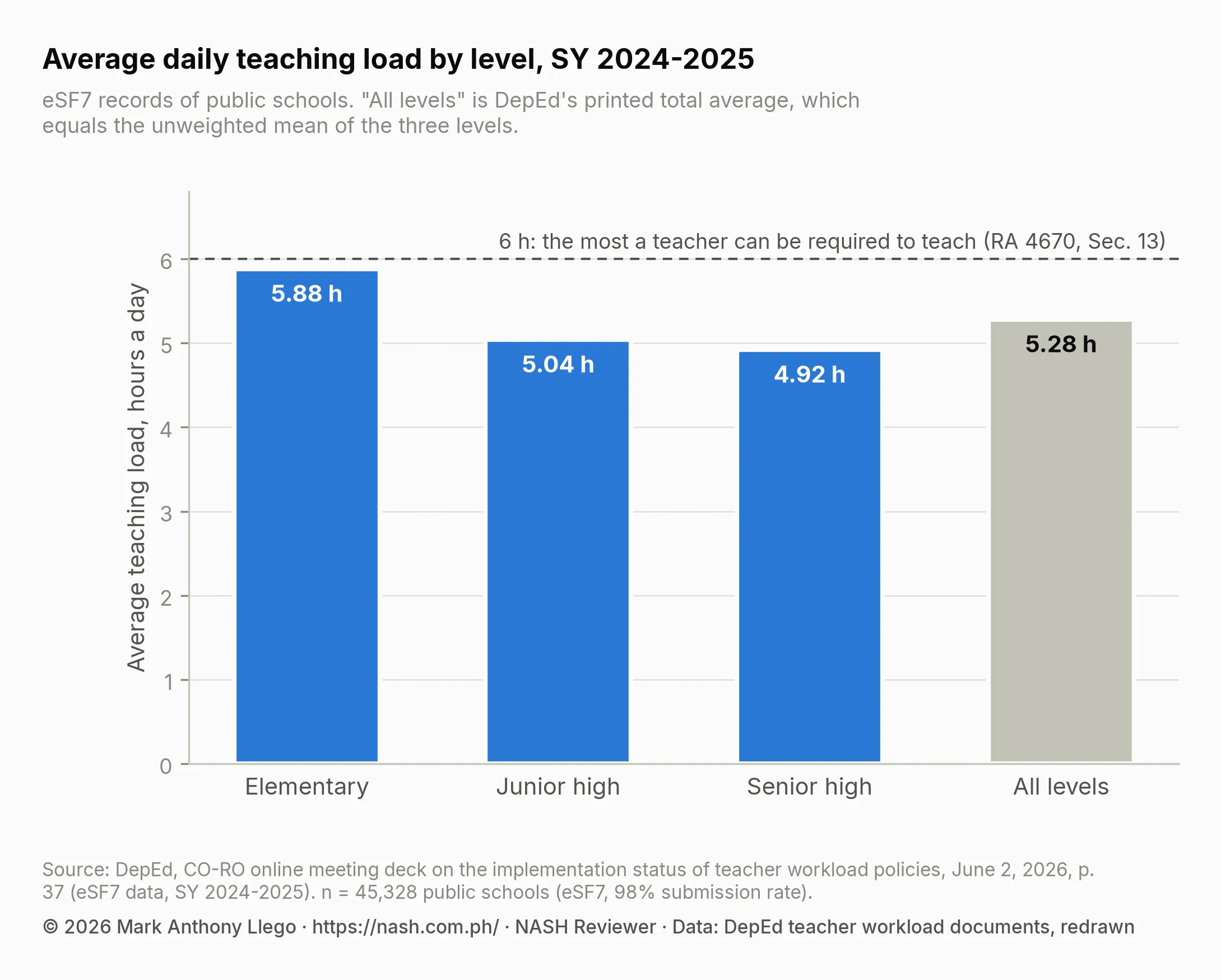
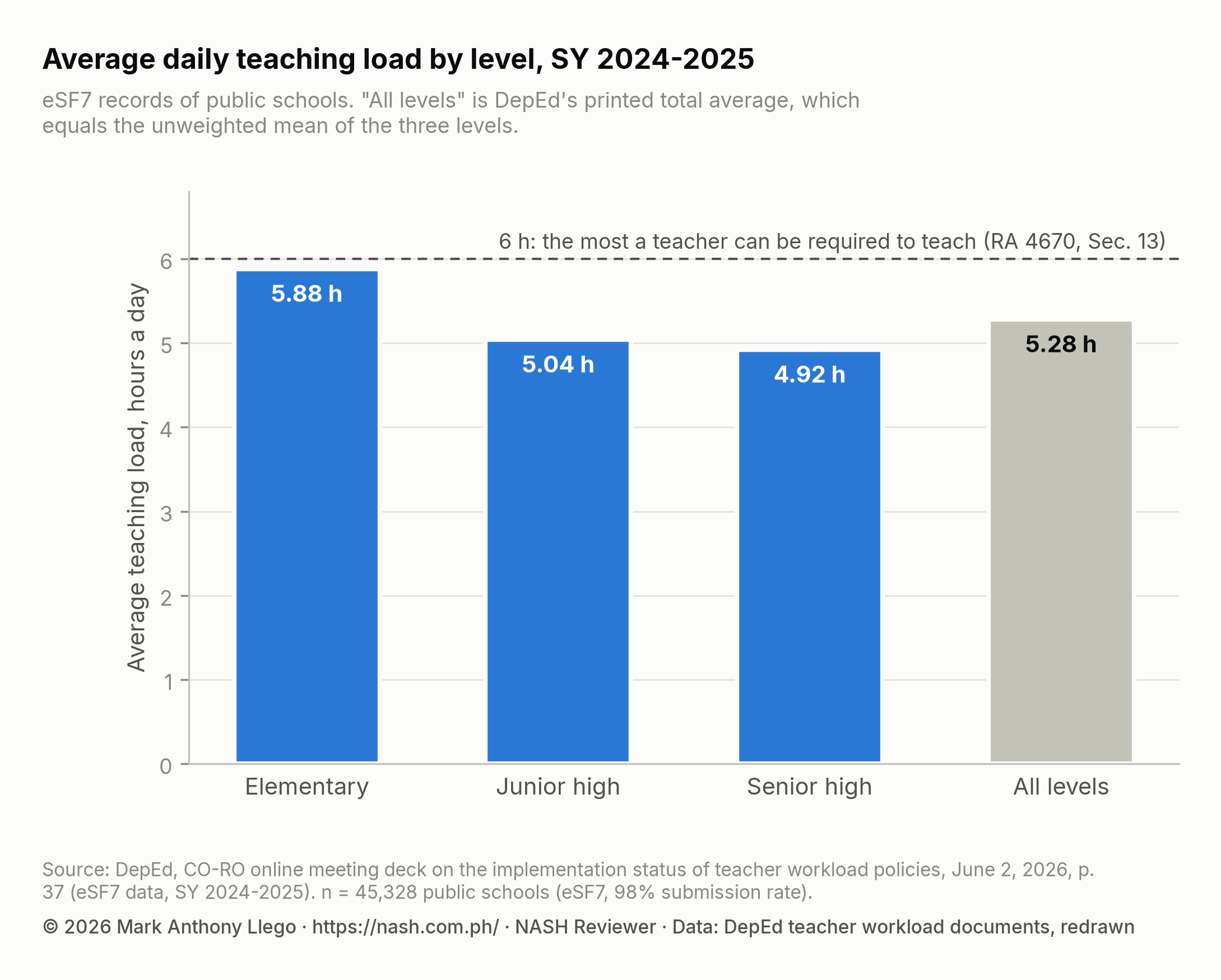
DepEd’s printed total average is 5.28 hours a day. It equals the simple mean of the three level averages, (5.88 + 5.04 + 4.92) ÷ 3 (computed), so it does not weight the levels by how many teachers each has; the deck does not say how it was computed. DepEd’s summary is that the “national average daily teaching load of teachers remains within the six (6)-hour limit prescribed under the Magna Carta” (CO–RO deck, p. 46), and that loading “generally remains compliant with policy standards” while “instructional time remains vulnerable to competing demands” (p. 36).
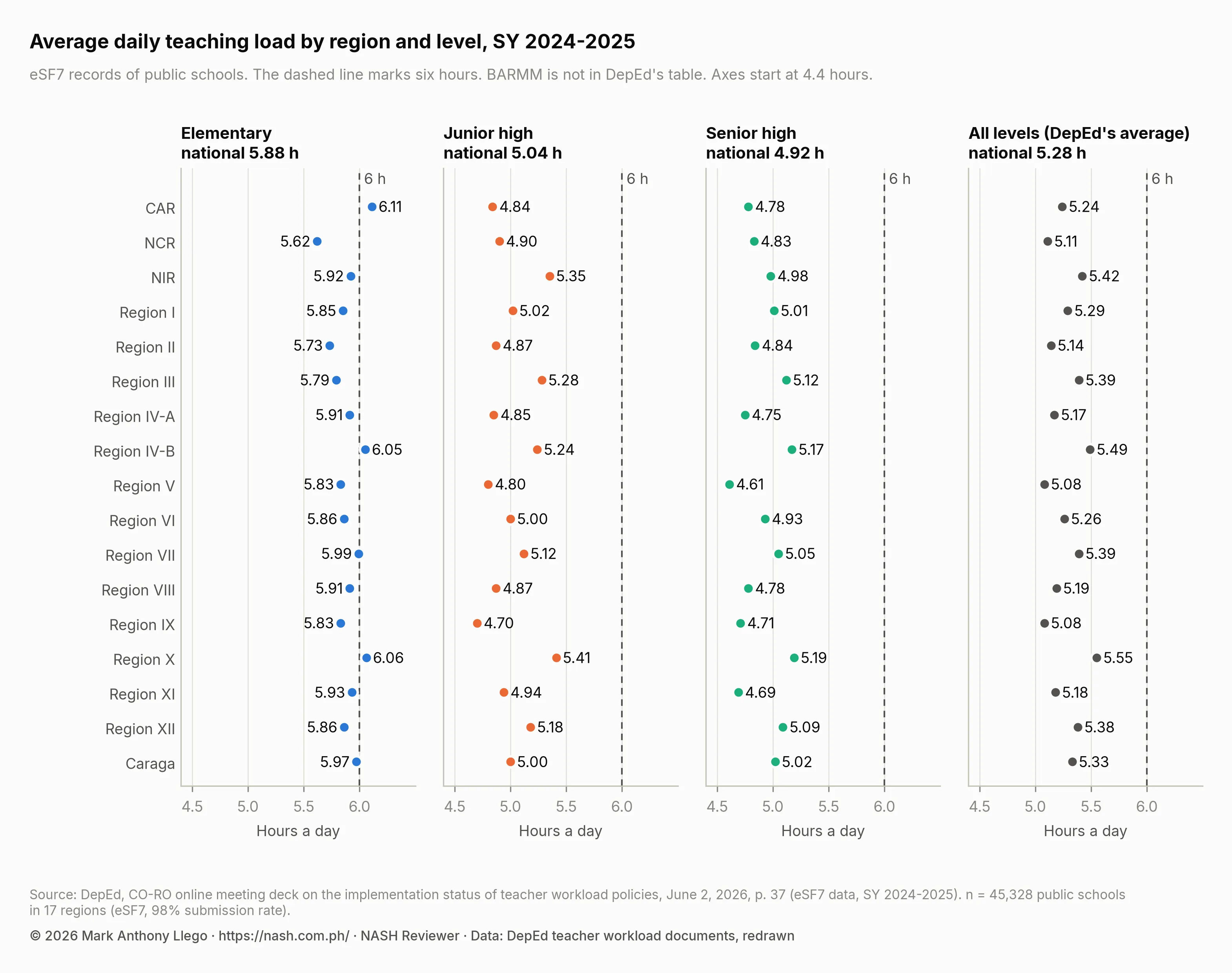
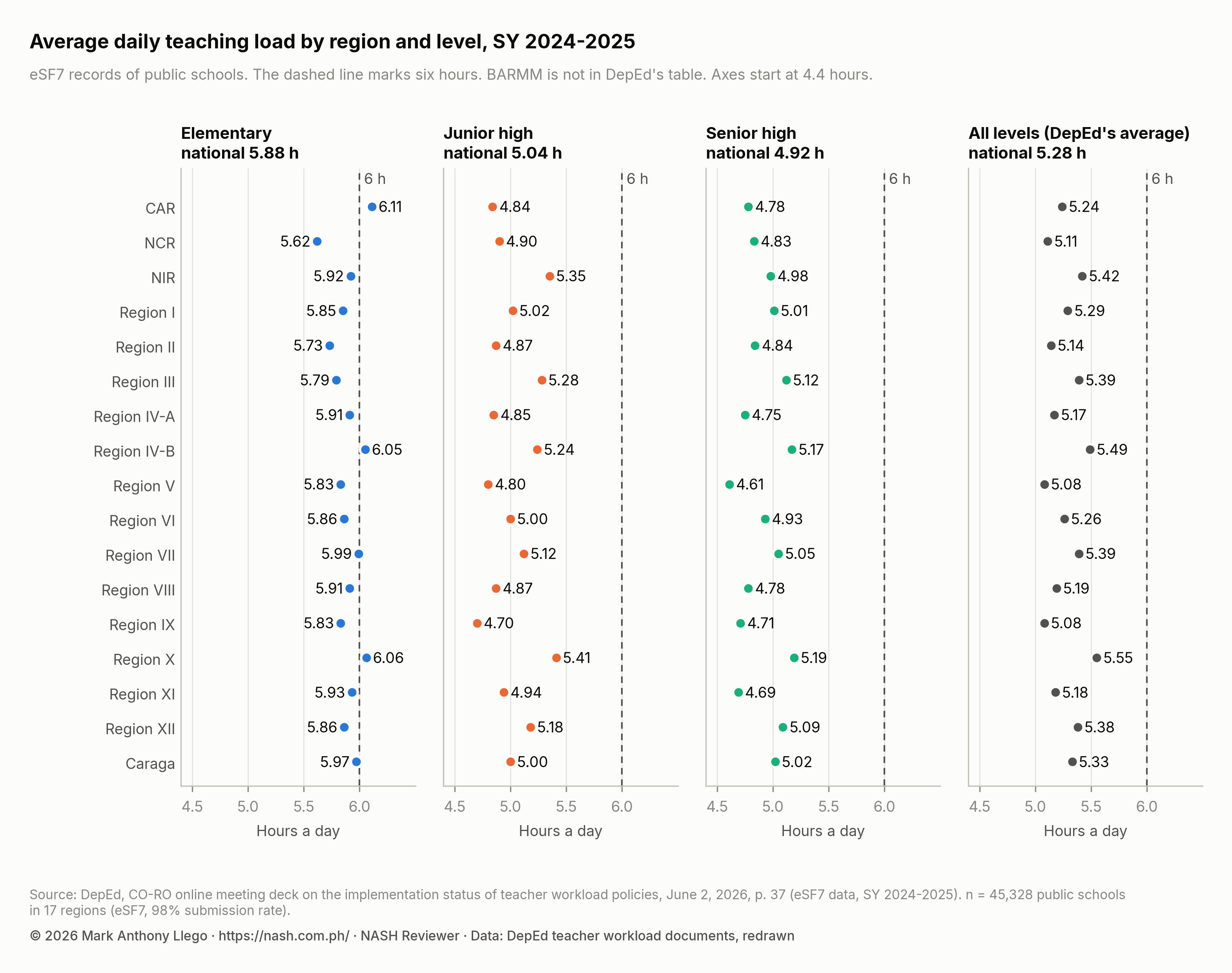
Elementary averages topped six hours in CAR (6.11), Region X (6.06) and Region IV-B (6.05). Region X had the highest junior high (5.41), senior high (5.19) and overall (5.55) averages; Regions V and IX the lowest overall (5.08).
Read these as averages only. The deck does not say how they were computed, whether they include class advising, or how many teachers are above or below six hours. Its “Average” column equals the simple mean of the three levels in 13 regions and differs by 0.01 hour in NCR and Regions II, III and XI (computed). The same records count 348,678 teachers with teaching overload in SY 2024-2025 (p. 48), so averages near five hours mix teachers above six hours with teachers below it; their pay is covered in Why So Few Teachers Get Paid for Teaching Overload.
The deck also gives SY 2025-2026 averages (6.04, 5.21, 4.91 and 5.40), but they rest on “a 52% submission rate as of partial submissions received”, omit Regions III, IV-A and V, and are “still subject to data cleaning” (p. 38). DepEd’s 2026 teacher survey is covered in DepEd 2026 Teacher Workload Survey: What Teachers Said.
What this means for school heads
“The School Heads shall ensure that teaching load is equitably and fairly distributed among teachers” (DO 005, Sec. V.A.1, item 7). In practice:
- Count every program in minutes. Add the learning-area periods at the curriculum’s time allotment, 60 minutes a day for each class adviser, and scheduled remediation, ARAL or Hinga sessions. Do not count sections, subjects, designations, LAC sessions or INSET.
- Load to six hours where staffing allows, and not past it. Overload comes only in the exigency of service, with specialization as the prime consideration (DO 005, cover order, para. 2.d, and Sec. V.A.2, items 2 and 4; DM 053, para. 3.b).
- Apply the special loads. Department Head Designates teach three hours; TICs and designated Assistant School Principals are relieved unless every teacher has two hours of overload; Master Teachers’ programs leave time for coaching (DO 024, s. 2025, Encl. No. 1, Sec. 36; DO 005, Sec. V.A.1, item 5).
- Leave preparation time in every class program (DO 005, Sec. V.A.3, item 4).
- Designate for programs, not to fill loads. Give teachers below six hours priority for designations, and designate only for programs in the SIP or AIP (DO 005, Sec. V.A.4, items 1–2; DM 053, para. 5; Toolkit, p. 88).
- Keep the records. Each teacher’s program, the class schedule and the eSF7, which the school head signs (2024 Q&A, No. 9) and revises for “significant changes/movements of school personnel” (No. 45); DTRs with any logbook entries, locator slips or certificates of undertaking; and the authorized plan for each remediation class.
| A school head may | A school head may not |
|---|---|
| Assign up to six hours of teaching a day | Require more than six hours except in the exigency of service, or more than eight in any case (RA 4670, Sec. 13) |
| Assign paid overload in the exigency of service, at most two hours a day | Assign overload while other teachers lack the prescribed hours (DO 005, Sec. V.A.2, item 4) |
| Require the DTR to reflect the workday | Require documentary evidence or accomplishment reports on ancillary hours spent outside the school (DO 005, Sec. V.A, item 1) |
| Invite teachers to serve as ARAL tutors | Make ARAL tutoring mandatory for DepEd teachers (DM 061, s. 2026, Encl., para. 6.d) |
| Designate teaching-related assignments with the teacher’s concurrence (DO 005, Sec. V.A.4, item 3) | Count a designation as teaching load (2026 Q&A, No. 27) |
For the wider picture, see Human Resource Management for DepEd School Heads and PPSSH Domain 2: Managing School Operations.
How the NASH may test this
The two items below are original practice items in the format of our NASH practice questions, scored 3 (Relational), 2 (Multistructural), 1 (Unistructural) or 0 (Prestructural).
Question 1
Indicator 2.4.2, Management of staff. Career Stage 2, Situational, Difficult.
At the start of SY 2026-2027, the SDS designates Ms. Reyes, a Master Teacher II in Science, as Department Head Designate of a junior high school’s Science department. Her draft program has six hours of Science classes a day. The school’s two other Science teachers, Mr. Cruz and Ms. Lim, each have four hours and thirty minutes of classes. How should the school head finalize the Science loads?
- A. Keep Ms. Reyes at six hours of classes, since DO 005, s. 2024 says Master Teachers render six hours, and schedule her department head duties within her two ancillary hours.
- B. Discuss the change with the three teachers, then reduce Ms. Reyes to three hours of classes, give ninety minutes of her classes each to Mr. Cruz and Ms. Lim, and record the new loads in the eSF7.
- C. Reduce Ms. Reyes to three hours of classes, give ninety minutes of her classes each to Mr. Cruz and Ms. Lim, and record the new loads in the eSF7, without discussing the new programs with them.
- D. Ask the SDS to withdraw Ms. Reyes’s designation, so that she can keep her six hours of Science classes and the department’s draft loads can stay as they are.
Answer and explanation
Best answer: B. Points: A = 0, B = 3, C = 2, D = 1.
- A (0 points, Prestructural). It applies DO 005’s general rule where the later DO 024, s. 2025 sets three hours for a Department Head Designate, as DepEd’s 2026 Q&A confirms.
- B (3 points, Relational). It applies the three-hour load, keeps the freed classes with Science specialists, brings both teachers to the full load without overload, involves the teachers and records the change in the eSF7.
- C (2 points, Multistructural). The loads and the record are right, but it skips the teachers whose programs change, although the toolkit asks school heads to engage them in workload planning (p. 57).
- D (1 point, Unistructural). It sees that the designation changes Ms. Reyes’s load, but undoes a valid designation instead of redistributing the classes.
Why. Indicator 2.4.2 asks the school head to distribute teaching load in adherence to issuances. “A Department Head Designate shall have three (3) hours of teaching load” (DO 024, s. 2025, Encl. No. 1, Sec. 36.c.iv), and schools “shall adopt the prescribed 3-hour teaching load” (2026 Q&A, No. 3). DO 005, s. 2024 gives the school head the distribution (Sec. V.A.1, item 7), to be done “using the eSF7” (Sec. V.D.4.a), with every teacher at the prescribed hours before anyone gets overload (Sec. V.A.2, item 4). The toolkit lists teachers’ part as “Collaborate with the school head in the workload planning” (p. 57).
Indicator 2.4.2: Manage staffing such as teaching load distribution and grade level and subject area assignment in adherence to laws, policies, guidelines and issuances based on the needs of the school.
Sources: DepEd Order No. 024, s. 2025; DepEd Order No. 005, s. 2024; DepEd consolidated Q&A, 2026 implementation-status meetings, No. 3; Teacher Workload Policy Toolkit (2025), p. 57.
Question 2
Indicator 2.4.1, Management of staff. Career Stage 1, Conceptual, Moderate.
An elementary school has more teachers than its classes need. After loading, Teacher Santos, a Grade 3 adviser, has five hours of teaching load a day, including her advisory class. Which statement best describes her situation under DepEd’s current workload rules and guidance?
- A. Her salary may be reduced for the hour she does not teach, because DO 005, s. 2024 says a teacher must be able to render thirty hours of actual classroom teaching a week.
- B. She has priority for teaching-related assignments, since DO 005 gives that priority to teachers with less than six hours, but her pay depends on how the division rules on her case.
- C. She keeps her full salary and teaching allowance, has priority for teaching-related assignments that add nothing to her teaching load, and does her ancillary tasks in school, because her DTR does not show six hours of teaching.
- D. She keeps her full salary and teaching allowance, and she does her ancillary tasks in school, because her DTR does not show six hours of teaching; no other workload rule applies to her case.
Answer and explanation
Best answer: C. Points: A = 0, B = 1, C = 3, D = 2.
- A (0 points, Prestructural). No issuance authorizes a deduction, DepEd’s answer is that such teachers “shall not be subject to any salary deduction”, and it misses DepEd’s position that six hours is the maximum.
- B (1 point, Unistructural). It applies the priority rule but leaves her pay in doubt, although DepEd’s answers and DO 005, s. 2025 settle it.
- C (3 points, Relational). It connects pay, the teaching allowance, the designation priority, the fact that designations carry no load, and the DTR guidance into one accurate account.
- D (2 points, Multistructural). Pay, allowance and the DTR guidance are right, but it misses the priority that DO 005, Sec. V.A.4, item 2 gives her.
Why. Indicator 2.4.1 asks for knowledge of the issuances on managing staff. Such teachers “shall not be subject to any salary deduction” (consolidated Q&A, DM 53 orientation, No. 1.0); the teaching allowance is paid “regardless of the hours or minutes” (DO 005, s. 2025, Encl., Sec. V.A.1); they have priority for teaching-related assignments (DO 005, s. 2024, Sec. V.A.4, item 2), which “do not have equivalent teaching loads” (Q&A, No. 31); and the toolkit keeps them in school for ancillary tasks (p. 44).
Indicator 2.4.1: Demonstrate knowledge and understanding of laws, policies, guidelines and issuances on managing school staff.
Sources: DepEd Orders No. 005, s. 2024 and No. 005, s. 2025; DepEd consolidated Q&A, DM 53 orientation, Nos. 1.0 and 31; Teacher Workload Policy Toolkit (2025), p. 44.
Nothing in this guide reproduces or predicts examination content.
Frequently asked questions
Is the six-hour teaching load a minimum or a maximum?
The governing Order is worded as a requirement: a teacher “must be able to render thirty (30) hours” of teaching a week (DO 005, s. 2024, Sec. V.A, item 2), and that wording has not been amended. RA 4670, Sec. 13 and DM 053, s. 2024, para. 3.a bar requiring more than six hours but set no minimum. DepEd’s guidance applies six hours as a maximum: “while six (6) hours is the maximum, teaching load may vary depending on school needs and staffing conditions” (DepEd consolidated Q&A, 2026 implementation-status meetings, No. 1), and no issuance penalizes a teacher with fewer hours.
How many hours of teaching load does a Master Teacher have?
At most six hours a day, with time in the program for coaching and mentoring (DO 024, s. 2025, Encl. No. 1, Sec. 36.b.iii); DO 005, s. 2024 says Master Teachers “shall likewise render six (6) hours” (Sec. V.A.1, item 1.b.i). A Master Teacher designated Department Head teaches three hours (Sec. 36.c.iv), which DepEd’s 2026 Q&A applies over DO 005 (No. 3).
Is class advising counted in the six hours of teaching?
Yes. Class advising is teaching load of one hour a day or five a week, and that time includes the Homeroom Guidance Program (DO 005, s. 2024, Sec. V.A.1, item 2; DM 053, s. 2024, para. 3.c). DepEd credits the hour even on days the adviser does not meet the class, but advisers should meet it at least once a week for the HGP (consolidated Q&A, DM 53 orientation, No. 4).
Do coordinator and chair designations count as teaching load?
No. Teaching-related assignments such as coordinator, school paper or sports adviser, and grade-level or learning-area chair have no teaching-load equivalent, and issuances that once gave load reductions for them “are no longer in effect” (consolidated Q&A, DM 53 orientation, Nos. 31–32; 2026 Q&A, Nos. 4 and 27). The Department Head Designate of DO 024, s. 2025, with three hours of load, is a separate career progression designation.
Can a teacher’s salary be deducted for having less than six hours of teaching?
No. DepEd answers that teachers with less than six hours “shall not be subject to any salary deduction since there may be various reasons that can be out of their control” (consolidated Q&A, DM 53 orientation, No. 1.0), and its toolkit says the same (p. 88). The teaching allowance is also paid in full regardless of hours (DO 005, s. 2025, Encl., Sec. V.A.1). Such teachers get priority for designations. Under DM 291, s. 2008, which is still in force, a teacher with less than six hours “shall render additional hours of appropriate teaching-related activities and duties … within the school premises to complete six (6) hours”; DepEd’s current guidance goes further and keeps them in school for their ancillary hours too (see Can Teachers Leave School After Six Hours of Teaching?).
Download the data
- /blog/charts/workload/hours-eight-hour-day.csv: the hours of the eight-hour day in three cases (class adviser, no advisory class, maximum overload), whether each part counts as teaching load, and the rule behind it (DO 005, s. 2024, Sec. V.A and V.A.1; DM 053, s. 2024, para. 3; RA 4670, Sec. 13; DepEd consolidated Q&A, DM 53 orientation, No. 40).
- /blog/charts/workload/hours-average-load-by-level.csv: average daily teaching load by level and overall, SY 2024-2025 (DepEd CO–RO meeting deck, June 2, 2026, p. 37; eSF7, 45,328 public schools).
- /blog/charts/workload/hours-average-load-by-region.csv: the same by region and level, with DepEd’s printed regional average and the computed simple mean of the three levels (DepEd CO–RO meeting deck, June 2, 2026, p. 37).
The CSVs and charts may be reused only with written permission: email support@nash.com.ph. The rules themselves come from DepEd’s issuances, which you can cite directly.
Sources
- Republic Act No. 4670, the Magna Carta for Public School Teachers, approved June 18, 1966, Sec. 13.
- DepEd Order No. 005, s. 2024, Rationalization of Teachers’ Workload in Public Schools and Payment of Teaching Overload, April 29, 2024: cover order, paras. 1–2; Encl., Secs. III.b, III.d, III.e, III.i–k, V.A (items 1–2), V.A.1 (items 1–7), V.A.2 (items 2–4), V.A.3 (items 2, 4), V.A.4 (items 1–3) and V.D.4 (items a, d).
- DepEd Memorandum No. 053, s. 2024, Implementation Guidelines for DepEd Order No. 005, s. 2024, September 27, 2024, paras. 3–5.
- DepEd Order No. 013, s. 2024, Revised Guidelines on the Grant of Vacation Service Credits for Teachers, September 18, 2024, Sec. V.A.3.
- DepEd Order No. 005, s. 2025, Additional Implementing Guidelines on the Grant of a Teaching Allowance for Public School Teachers, March 20, 2025, Encl., Sec. V.A.1.
- DepEd Order No. 018, s. 2025, Implementing Guidelines of the Academic Recovery and Accessible Learning Program, June 13, 2025, paras. 81 and 83.
- DepEd Order No. 024, s. 2025, Guidelines on the Implementation of the Expanded Career Progression System for Teachers and School Heads in the Department of Education, August 28, 2025, Encl. No. 1, Secs. 34 and 36.b–d.
- DepEd Order No. 026, s. 2025, Guidelines on the Payment of Overtime Services of Teachers, September 6, 2025, Secs. IV, V.1, V.7 and VII.5.
- DepEd Order No. 034, s. 2025, Amendments and Clarifications to DepEd Order No. 024, s. 2025, October 14, 2025, para. 27.
- DepEd Memorandum No. 001, s. 2026, Guidelines on the Engagement of Academic Recovery and Accessible Learning Program Tutors and Support Aides, January 8, 2026, Encl., para. 31.
- DepEd Order No. 002, s. 2026, Guidelines on the Grant of Wellness Leave for the Department of Education Personnel, February 13, 2026, Sec. VI.1.h.
- DepEd Order No. 009, s. 2026, Guidelines on the Implementation of the Three-Term School Calendar in Basic Education, April 16, 2026, paras. 13, 15 and 24.
- DepEd Order No. 014, s. 2026, Guidelines on Learning Continuity in Emergencies, June 4, 2026, para. 69 and p. 18.
- DepEd Order No. 017, s. 2026, Strengthened Senior High School Curriculum, June 4, 2026, paras. 21 and 22.c and Annex D1 sample schedules (e.g., p. 61).
- DepEd Memorandum No. 055, s. 2026, Clarificatory Guidelines on the Designation of Learner Formation Officers in Schools, September 17, 2026, Encl., Secs. II.b and II.c.i.
- DepEd Memorandum No. 057, s. 2026, Creation of a National Technical Working Group for the Development of a Roadmap for the Magna Carta for Public School Teachers, September 21, 2026, para. 2.
- DepEd Memorandum No. 061, s. 2026, Amendments to DepEd Memorandum No. 001, s. 2026, September 29, 2026, Encl., paras. 6.d and 31.a.i.
- Memorandum DM-OSEC-OUHROD-2025-0002, Additional Guidance on the Assignment of Teaching Load to Teachers, June 4, 2025, items 1–3, in DepEd’s Teacher Workload Public Drive.
- Teacher Workload Policy Toolkit, version 2025-v1, released June 25, 2025 by the BHROD-School Effectiveness Division with Memorandum DM-OUHROD-2025-1641, pp. 24–27, 44, 57, 82, 88 and 101 (toolkit folder in DepEd’s Teacher Workload Public Drive).
- DepEd, “Understanding D.O. 005, s. 2024 … General FAQs”, undated (2024), p. 22, in DepEd’s Teacher Workload Public Drive.
- DepEd, DM 53, s. 2024 orientation deck (School Effectiveness Division, BHROD), undated (issued after DM 53 of September 27, 2024), p. 9, in DepEd’s Teacher Workload Public Drive.
- DepEd, consolidated Q&A from the online orientation on DM 53, s. 2024 (October 22 and November 6–8, 2024; updated November 13, 2024), Nos. 1.0, 2, 4–5, 8–9, 11, 25, 29, 31–32, 36, 40 and 45, in DepEd’s Teacher Workload Public Drive.
- DepEd, CO–RO online meeting deck, “Implementation Status of Teacher Workload Policies”, June 2, 2026, pp. 8–9, 14, 36–38, 46 and 48, in DepEd’s Teacher Workload Public Drive.
- DepEd, SDO online meeting deck, “Implementation Status of Teacher Workload Policies”, 2026, pp. 14, 25 and 54, in DepEd’s Teacher Workload Public Drive.
- DepEd, consolidated Q&A from the online meetings with Regional and Schools Division Offices on the implementation status of teacher workload policies (May 25–26 and June 2, 2026), Nos. 1–6, 14 and 27, in DepEd’s Teacher Workload Public Drive.
- DepEd, Strengthened SHS Program Teaching Load Simulator Tool user guide, June 2025 v1, p. 4, in DepEd’s Teacher Workload Public Drive.
- DepEd’s Teacher Workload Public Drive, the link printed in the toolkit (p. 101).
The teacher workload series
- DepEd Teacher Workload Policies: A Complete Guide
- How Many Hours Must DepEd Teachers Teach a Day? (this post)
- Can Teachers Leave School After Six Hours of Teaching?
- DepEd Teaching Overload Pay: Who Qualifies, How Much
- Why So Few Teachers Get Paid for Teaching Overload
- Teaching-Related Assignments: The 11 Roles DepEd Allows
- Vacation Service Credits and Overtime Pay for Teachers
- Admin Tasks Off Teachers: DO 2 and School Support Staff
- DepEd 2026 Teacher Workload Survey: What Teachers Said
- How School Heads Plan Teaching Loads Under DO 5
- Teacher Workload and Accountability: EDCOM II Findings
Written by Mark Anthony Llego for NASH Reviewer. Sources: Republic Act No. 4670; DepEd Orders No. 005 and 013, s. 2024, No. 005, 018, 024, 026 and 034, s. 2025, and No. 002, 009, 014 and 017, s. 2026; DepEd Memoranda No. 053, s. 2024, and No. 001, 055, 057 and 061, s. 2026; Memorandum DM-OSEC-OUHROD-2025-0002; DepEd’s Teacher Workload Policy Toolkit (2025), FAQs, orientation and meeting decks, and consolidated Q&A (2024 and 2026). Charts may be reused only with written permission from support@nash.com.ph.