Public school teachers in the Philippines work well beyond their standard 40-hour week, and much of the extra time goes to work other than teaching. In an EDCOM II–IDinsight survey of 14,892 teachers in July and August 2024, months after DepEd removed administrative tasks from teachers (DepEd Order No. 002, s. 2024) and set their hours (DepEd Order No. 005, s. 2024), teachers reported 52 hours a week on average, 23.4 of them in teaching. DepEd has since cut their forms from 174 to 75 (DepEd Order No. 006, s. 2025), but the Final Report finds that teachers “continue to shoulder administrative burdens due to chronic shortages in school support staff” (p. 287) and that performance management systems “generate compliance, not improvement” (p. 31).
Below are what the EDCOM II reports found about teacher workload, what has changed since 2024, what the Final Report means by “Redefining Teacher Accountability”, and what a school head should do now, for teachers preparing for the National Assessment for School Heads (NASH) and for researchers. EDCOM II is the Second Congressional Commission on Education, created by Republic Act No. 11899. Page numbers below refer to its Year One Report (2024), Year Two Report (2025) and Final Report, Turning Point (2026), the stand-alone National Education Plan document published with it, and the policy brief the Final Report cites; the DepEd issuances are those in force on October 30, 2026.
For the rules in more depth, see the guides to human resource management for school heads, the DepEd PMES for teachers and the OPCRF for school heads.
Key findings
- Teachers report 52-hour weeks. The EDCOM II–IDinsight survey of 2024 found an average of 52 hours, with 27% working more than 60 (policy brief, p. 2).
- Administrative work outlasted DO 002, s. 2024. After the order, “over half of teachers (56.2%) reported still doing administrative work” (policy brief, p. 1).
- Forms fell from 174 to 75. DepEd Order No. 006, s. 2025 leaves teachers 5 standard forms, 31 for ancillary tasks and 39 for teaching-related assignments (Final Report, pp. 73, 283; National Education Plan document, p. 38). Thirty of the 39 are for advising the learner government (DO 006, Enclosure 3).
- Support staff are still short. Schools have 34,519 of the 46,597 Administrative Officer II items that DepEd’s proposed staffing standards require, and 1,500 of 45,785 Project Development Officer I items (Final Report, p. 288); 25,137 AO II items were filled (p. 453).
- The law caps classroom teaching at six hours a day. Republic Act No. 4670, the Magna Carta for Public School Teachers, allows up to eight only “where the exigencies of the service so require” (Sec. 13, quoted in the Year One Report, p. 192); DO 005, s. 2024 sets 30 teaching hours a week.
- EDCOM II wants accountability tied to learning. It recommends a principal’s OPCRF built on “classroom observation, teacher coaching, and curriculum implementation” (p. 300) and targets “not linked, directly or indirectly, to student promotion or dropout rates” (p. 451). The Teacher Education Council’s essay “Redefining Teacher Accountability” (pp. 302–305) proposes a value-added model for disadvantaged schools.
- Career progression is law. Republic Act No. 12288, the Career Progression System for Public School Teachers and School Leaders Act, was signed on September 12, 2025 (Final Report, p. 73). Its Section 9 bars promotion in the Teaching Career Line based on “the proportion of learners who achieve curricular expectations”. DepEd still applies the system through DO 024, s. 2025, as amended by DO 034, s. 2025; our career progression guide explains how.
How heavy is a public school teacher’s workload?
What the Year One and Year Two Reports found
The Year One Report found that teachers “continue to be burdened by 50 nonteaching or administrative tasks, based on DepEd’s inventory” (p. xxxi). Its Table 1 lists 28 roles given to teachers, from journalism coordinator and canteen manager to 4Ps and DRRM coordinator (pp. 195–196). Summing up its consultations, the report concludes that “the prescribed 6-hour teaching load … is routinely exceeded” (p. 192). Staffing was uneven: Batasan Hills National High School, with 15,117 learners, had 4 non-teaching positions, and Leyte National High School, with 6,047, had 32 (p. 198).
By the Year Two Report, DO 002 and DO 005, s. 2024 were in place (pp. 215–216). It also records, citing an EDCOM II source of February 8, 2024, that teachers were “often required to provide the same data multiple times to various DepEd offices” (p. 247). In an August 2024 survey, “42 out of 124 respondents spent 4–8 hours per week just to fill in or create forms” (p. 249). Hiring support staff could take “6 months or more for a single position”, and critics called “the 60-day deadline for transferring administrative tasks unrealistic” (p. 249).
The EDCOM II–IDinsight survey behind the Final Report
The Final Report’s workload numbers come from a study by IDinsight with EDCOM II and DepEd. Its policy brief, Removing the Burden of Administration from Teachers, reports surveys of 14,892 teachers, 1,713 AO IIs and 2,246 school heads in 2,283 schools, run from July 16 to August 16, 2024 (p. 6), months after DO 002 and DO 005.
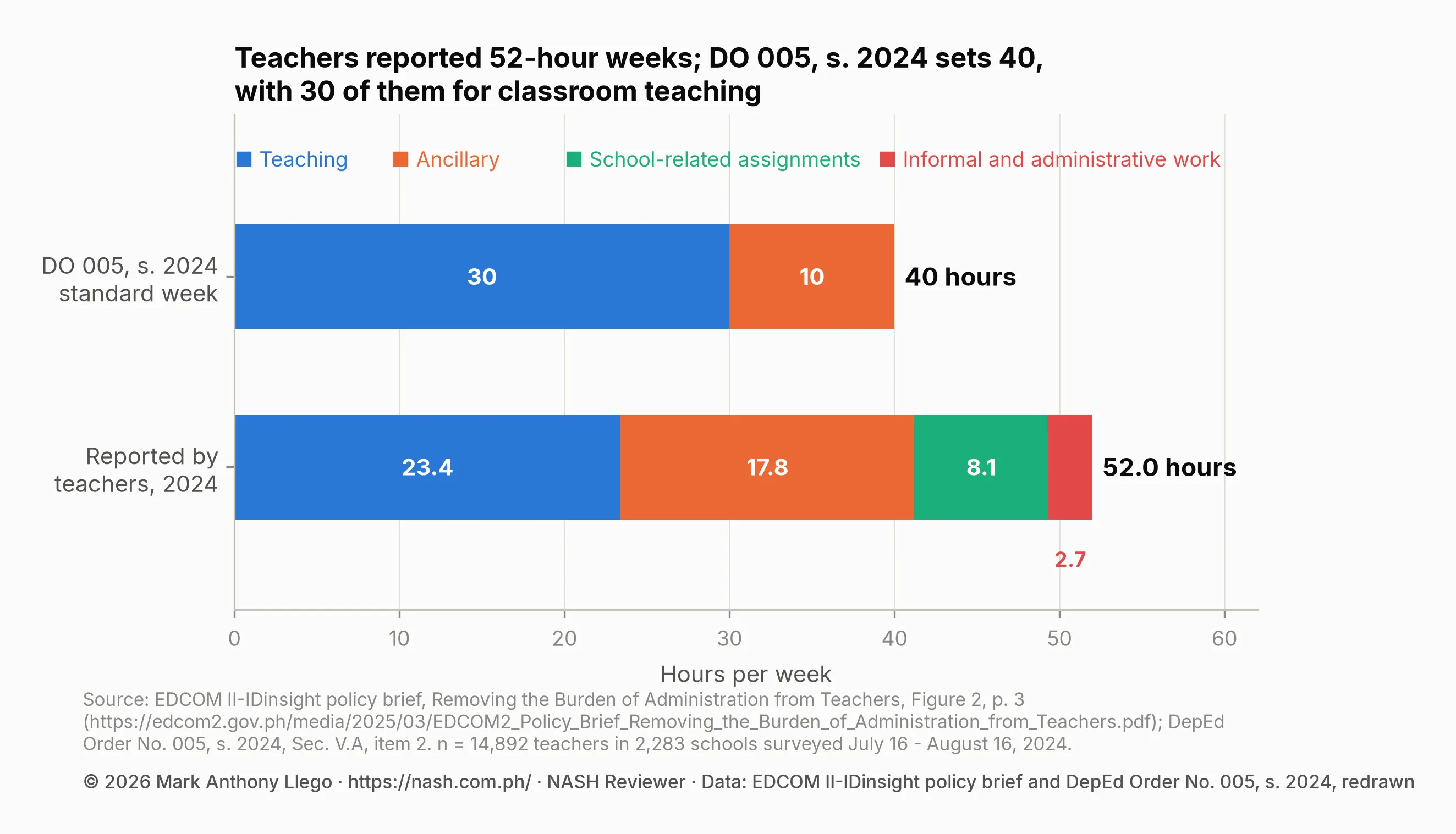
| Work reported by teachers, 2024 | Hours a week | Share |
|---|---|---|
| Teaching | 23.4 | 45.0% |
| Ancillary work | 17.8 | 34.2% |
| School-related assignments | 8.1 | 15.6% |
| Informal and administrative work | 2.7 | 5.3% |
| Total | 52.0 |
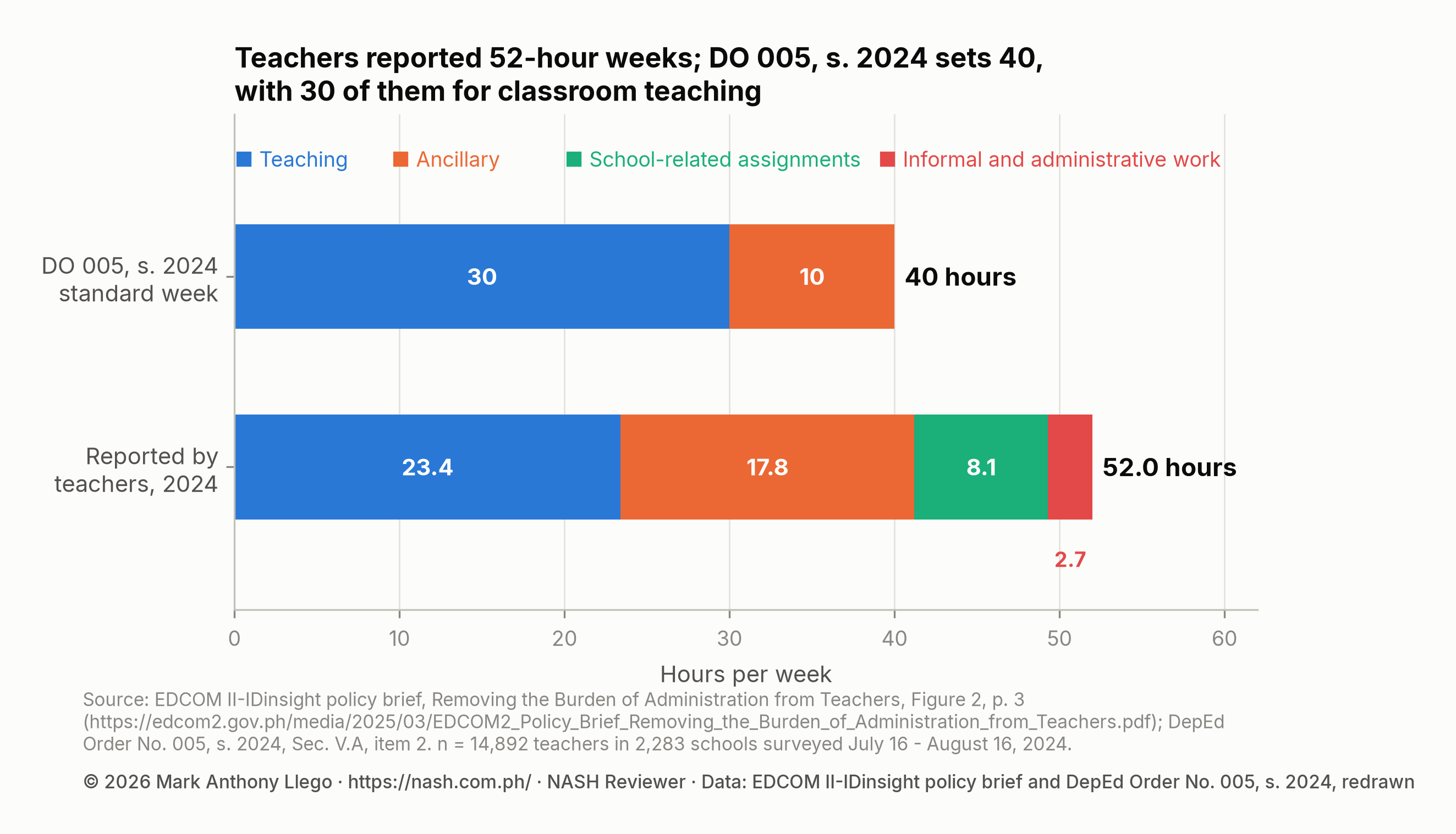
Source: EDCOM II–IDinsight policy brief, Figure 2, p. 3.
The 52 hours include work at home and on weekends, against the “DO 005 mandated 40 hours of work a week” (p. 2). The 23.4 teaching hours are also below DO 005’s 30, a gap the brief does not discuss. DepEd’s own guidance reads the six hours a day as a ceiling, not a quota: “A teacher shall not be required to render more than six hours of actual classroom teaching in a day” (DM 053, para. 3.a). So fewer teaching hours are not in themselves a shortfall in DepEd’s reading; How Many Hours Must DepEd Teachers Teach a Day? sets out both readings. It warns that the 2.7 administrative hours “may be underreported” (p. 3). Three findings matter most to a school head:
- Urgent reports. “The task that frustrated teachers most - and affected classroom teaching - was preparing urgent reports”, often due “within 0-1 days” (p. 3).
- School heads’ views. “77% of school heads believe that program coordination should be part of a teacher’s responsibility”, although DO 002 makes program management administrative work (p. 4).
- School size. Schools of fewer than 250 learners often have no one else to take the work; in large ones, master teachers and department heads end up doing budgets (p. 4).
The Final Report adds that teachers spend “an estimated 4–8 hours per week completing, encoding, or recreating school forms” (p. 288).
One study, five statements
The reports give these figures and, except for the essay, credit them to IDinsight. They do not explain the differences.
| Where | What it says |
|---|---|
| Policy brief, pp. 1–2 | An average of 52 hours a week; 27% worked more than 60 hours |
| Year Two Report, pp. 29, 247 | “two out of three teachers still report working more than 40 hours per week, mostly due to ancillary tasks” |
| Final Report, p. 283 | “nearly half of educators exceed 50 hours of work weekly, with roughly 18 hours spent on ancillary responsibilities and about 8 hours on program-related duties” |
| Final Report, p. 452; National Education Plan document, p. 38 | “42% of teachers work over 50 hours per week, spending around 17.8 hours on additional duties and 8.1 hours on program-related tasks” (the plan document says “more than 50 hours” and “ancillary duties”) |
| Final Report, p. 422 | “Two out of three teachers reported being involved in over 50 non-teaching tasks and working more than 40 hours a week” (Senator Bam Aquino’s essay; no source given; the 50 tasks are the Year One inventory’s) |
The 17.8 and 8.1 hours match the brief’s Figure 2. The 42% is not in the brief: it appears in DepEd’s release of March 17, 2025, credited to “an IDInsight study”, which the plan document repeats (p. 38). The Year Two Report gives no source for its “two out of three”. Calamities and activities also take teaching days; preliminary PIDS findings put the loss at 53 days in SY 2023-2024 (EDCOM 2, June 19, 2024; see the guide to mass promotion and lost instructional time).
What the law and DepEd rules say about teaching hours
Republic Act No. 4670, approved June 18, 1966, is the base. Section 13: “Any teacher engaged in actual classroom instruction shall not be required to render more than six hours of actual classroom teaching a day”. Where “the exigencies of the service so require”, a teacher may be required to teach more than six but not more than eight hours a day “upon payment of additional compensation at the same rate as his regular remuneration plus at least twenty-five per cent of his basic pay”. Section 14 requires “an additional compensation of at least twenty-five per cent of his regular remuneration” for “any other activities outside of what is defined as normal duties” after six hours of teaching (Year One Report, pp. 192–193).
DepEd Order No. 005, s. 2024 applies the law and CSC Resolution No. 080096 (para. 1), and DepEd Memorandum No. 053, s. 2024 implements it. No later issuance expressly amends or repeals either, and 2026 orders still cite DO 005 as current. Three later Orders do change parts of how it works: DO 013, s. 2024 sets new rates and caps for vacation service credits, DO 024, s. 2025 gives a Master Teacher designated Department Head “three (3) hours of teaching load” (Encl., Sec. 36.c.iv), and DO 026, s. 2025 adds overtime pay for some teaching-related work. Our teacher workload series explains DepEd’s rules one by one.
| Rule | What it says | Source |
|---|---|---|
| Work day and week | Eight hours a day: six of actual classroom teaching and two of ancillary tasks; “thirty (30) hours of actual classroom teaching and ten (10) hours of teacher ancillary tasks” a week | DO 005, Sec. V.A, items 1–2 |
| The two ancillary hours | May be spent in or out of school. No documentary evidence or accomplishment report is required “on how the two (2) hours of ancillary tasks are spent outside school premises”. DM 053 instead requires a logbook entry or locator slip when a teacher leaves during vacant periods, or a certificate of undertaking when the tasks are done before or after classes, attached to the daily time record. A teacher whose daily time record shows six hours of teaching has completed the day and “must not be considered undertime” | DO 005, Sec. V.A, item 1; DM 053, paras. 4.a–b |
| Class advising | One hour of teaching load a day, including the Homeroom Guidance Program | DO 005, Sec. V.A.1 (Teaching Load), item 2 |
| Teaching overload | At most two hours a day or ten a week. As a general rule, only in schools with a teacher shortage. Paid quarterly at the Prime Hourly Teaching Rate, annual salary ÷ 1,600 × 1.25, that is, 125% of the hourly rate; converted to vacation service credits when funds are short | DO 005, Secs. III.j, V.A.2 item 3, V.B.1; DM 053, Encl. 1 |
| Teaching-related assignments | Only the listed coordinator, trainer or adviser and chair roles, for programs in the School Improvement Plan, with the teacher’s concurrence | DO 005, Sec. V.A.4; DM 053, paras. 5–6 |
| Overtime pay | Only for a teacher designated to a teaching-related assignment who has taught six hours a day and 30 a week, for work on it inside the school, approved in advance as “extremely necessary”. It counts time “beyond the six (6) hours of actual classroom teaching and class advising duties combined”, is paid only for blocks of at least two hours, at 125% of the actual hourly rate, monthly salary ÷ 22 ÷ 8 (150% on Saturdays and holidays, at most four paid hours a day). Ancillary tasks done in school never qualify | DO 026, s. 2025, Secs. V.2–6 and 8, VI.B.1–2, VII.3, VII.5–6 |
Our teacher workload series takes each rule in turn: the six-hour teaching load, ancillary tasks and leaving school, overload pay, teaching-related assignments and service credits and overtime pay.
What has changed since 2024
| Date | What happened |
|---|---|
| January 26, 2024 | DO 002, s. 2024 removes administrative tasks from teachers |
| April 29, 2024 | DO 005, s. 2024 rationalizes workload and overload pay |
| July 26, 2024 | DepEd Memorandum No. 037, s. 2024 creates a task force on the RPMS and teachers’ workload; its working group mapped the 174 forms (Final Report, p. 286) |
| September 18, 2024 | DO 013, s. 2024 revises vacation service credits: 1.25 hours of credit per hour of authorized work beyond regular hours on school days, 1.5 on weekends, holidays and vacations, up to 30 days a year for most teachers and 45 for late appointees (Sec. V.A, items 1–2); it repeals DO 53, s. 2003 (Sec. XI) |
| March 20, 2025 | DO 006, s. 2025 cuts teachers’ forms from 174 to 75 |
| August 28, 2025 | DO 024, s. 2025 sets DepEd’s guidelines for the Expanded Career Progression System |
| September 6, 2025 | DO 026, s. 2025 sets overtime pay for designated teachers’ approved work inside the school (see the table above) |
| September 12, 2025 | Republic Act No. 12288 on career progression signed |
| October 1, 2025 | DM 089, s. 2025 sets the multi-year PMES for teachers |
| October 14, 2025 | DO 034, s. 2025 amends and clarifies DO 024, s. 2025 |
| April 16, 2026 | DO 009, s. 2026 adopts the three-term calendar partly to “reduce ancillary and non-teaching-related tasks of teachers” (para. 2) |
| May 11, 2026 | DM 029, s. 2026 creates a working group to digitize school forms |
| June 4, 2026 | DO 016, s. 2026 tells school heads to ensure teachers “are relieved of administrative tasks and have ample time for ancillary tasks, including the preparation of lesson plans” (para. 37.c) |
| September 17, 2026 | EDCOM reports the implementing rules of RA 12288 issued (text not yet posted by DepEd) |
| September 21, 2026 | DM 057, s. 2026 creates a working group to “establish a strategic roadmap for the monitoring and evaluation of the implementation of RA 4670” (para. 1); its output is to feed DepEd proposals for “amending certain provisions of RA 4670” (para. 2) |
DO 002, s. 2024: administrative tasks moved to school heads and staff
Under DepEd Order No. 002, s. 2024, “School Heads and non-teaching personnel shall have the sole responsibility to perform the administrative tasks” in personnel administration, property custodianship, general administrative support, financial management, records management, and program management, including feeding and school DRRM (Sec. V.A.1). A designated teacher-in-charge counts as a school head (Sec. III.c). Divisions had 60 calendar days to cluster understaffed schools, up to three per cluster, and turn the tasks over (Sec. IX), and schools may hire contract-of-service or job-order staff from MOOE (Sec. V.A.2.b). By mid-2024, most schools were “still not fully compliant with DO 002” (policy brief, p. 3). DepEd’s 2026 feeding guidelines keep school feeding with “The School SBFP implementers/Non-teaching Personnel/Administrative Officer II (AO II)” (DO 013, s. 2026, Sec. IX.D).
DO 006, s. 2025: teachers’ forms cut from 174 to 75
“On March 20, 2025, DepEd released DepEd Order No. 006, s. 2025 which reduced the number of forms to be accomplished by teachers from 174 to 75” (Final Report, p. 283), a 57% cut (p. 31). Table 3 of the Final Report (pp. 284–286) lists all 174: Nos. 1 to 75 remain, and Nos. 76 to 174, under “Prior to the Issuance of DO 006, S. 2025”, are no longer teachers’ forms.
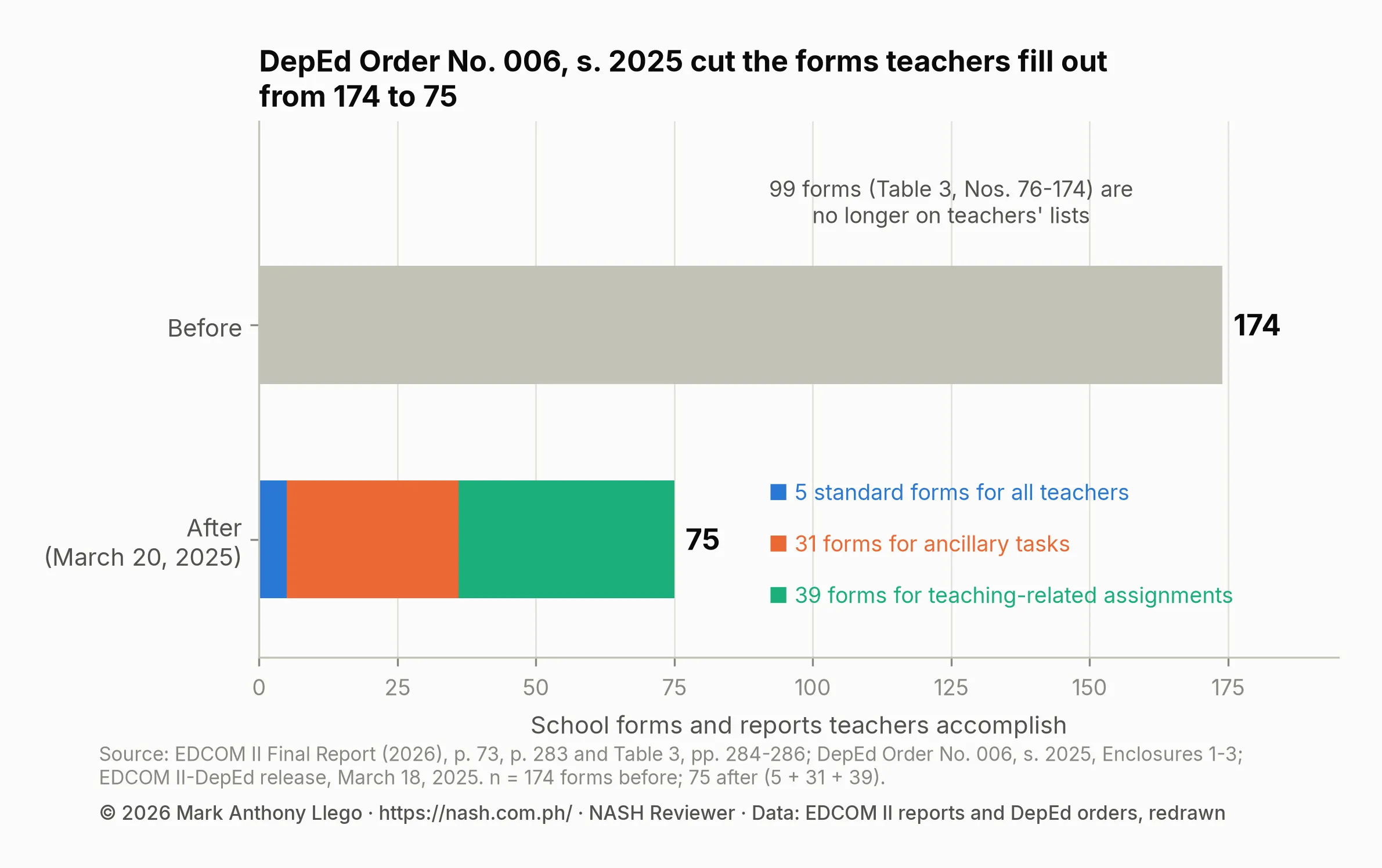
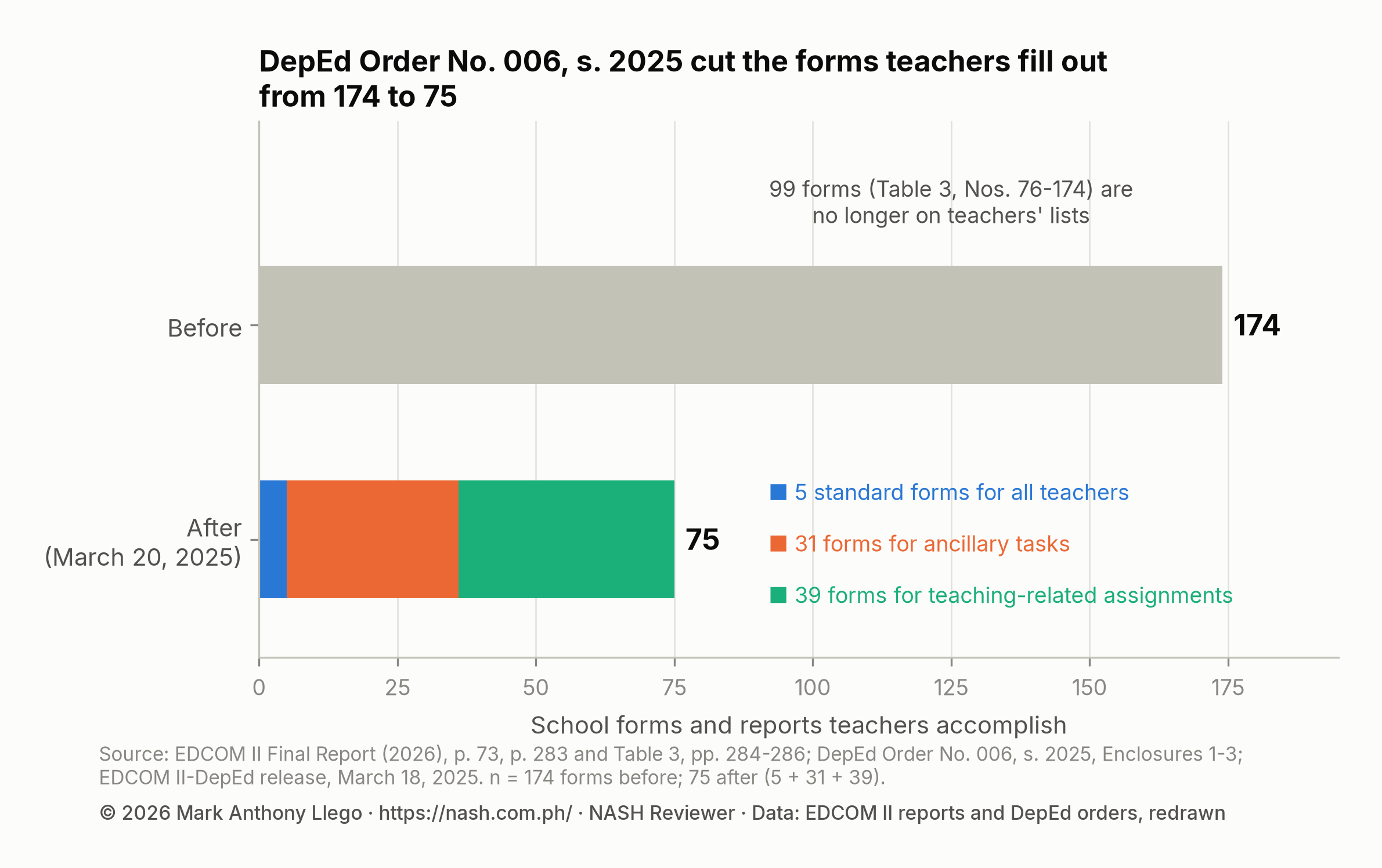
DepEd Order No. 006, s. 2025 sorts the 75 into three enclosures. In the words of the stand-alone National Education Plan document, “Only 5 forms are regularly required, with the accomplishment of the other 31 forms for teacher ancillary tasks and 39 forms for teaching related assignments contingent on the rationalized workload and designation of teachers” (p. 38); DepEd’s own release gives the same split (EDCOM 2, March 18, 2025).
| Enclosure | Largest groups of forms | Forms |
|---|---|---|
| 1. Standard forms for all teachers | Learning outcome assessment, class record, test results, remedial report, individualized learning plan | 5 |
| 2. Ancillary tasks, by learning area, grade level or designation | Homeroom guidance and management (School Forms 1, 2, 3, 5, 5A, 5B, 8, 9 and 10, LIS updating, ALS and test lists): 18; assessment tools such as Phil-IRI and CRLA: 6; coaching and supervision: 4; learning camp and INSET reports: 3 | 31 |
| 3. Teaching-related assignments | Learner government adviser: 30; learning-area chair: 5; guidance coordinator: 2; sports trainer: 2 | 39 |
Source: DepEd Order No. 006, s. 2025, Enclosures 1–3. Counts are the numbered items in each list.
The 99 forms that left teachers’ lists, among them property inventories, MOOE and SBFP liquidation, the OPCRF, the payroll, the School Improvement Plan, the procurement plans, the school report card and School Forms 4, 6 and 7 (Final Report, pp. 284–286), pass to “other school personnel” (pp. 283–284). Teachers who sit on the School Planning Team, School Governance Council or PTA may still be asked to help with that group’s forms, but “as may be practicable, other members aside from teachers shall assume primary responsibility for these forms and reports”, and “the school heads must ensure that under no circumstances shall teachers’ workload be adversely affected” (DO 006, para. 5).
EDCOM II asks DepEd to standardize DO 006 “across all divisions and regions” and to “further reduce and digitize school forms” (pp. 298–299). DepEd Memorandum No. 029, s. 2026 starts on the second with SIGASIG, a system to “consolidate and streamline school forms” and “generate class schedules and teacher loads” (para. 1); it is still in development and does not change the DO 006 lists. The plan document adds IDinsight’s suggestion of “integrated communication platforms for memos, announcements, and report submissions to prevent redundancies in reports” (p. 38).
Administrative officers: how many, and how many filled
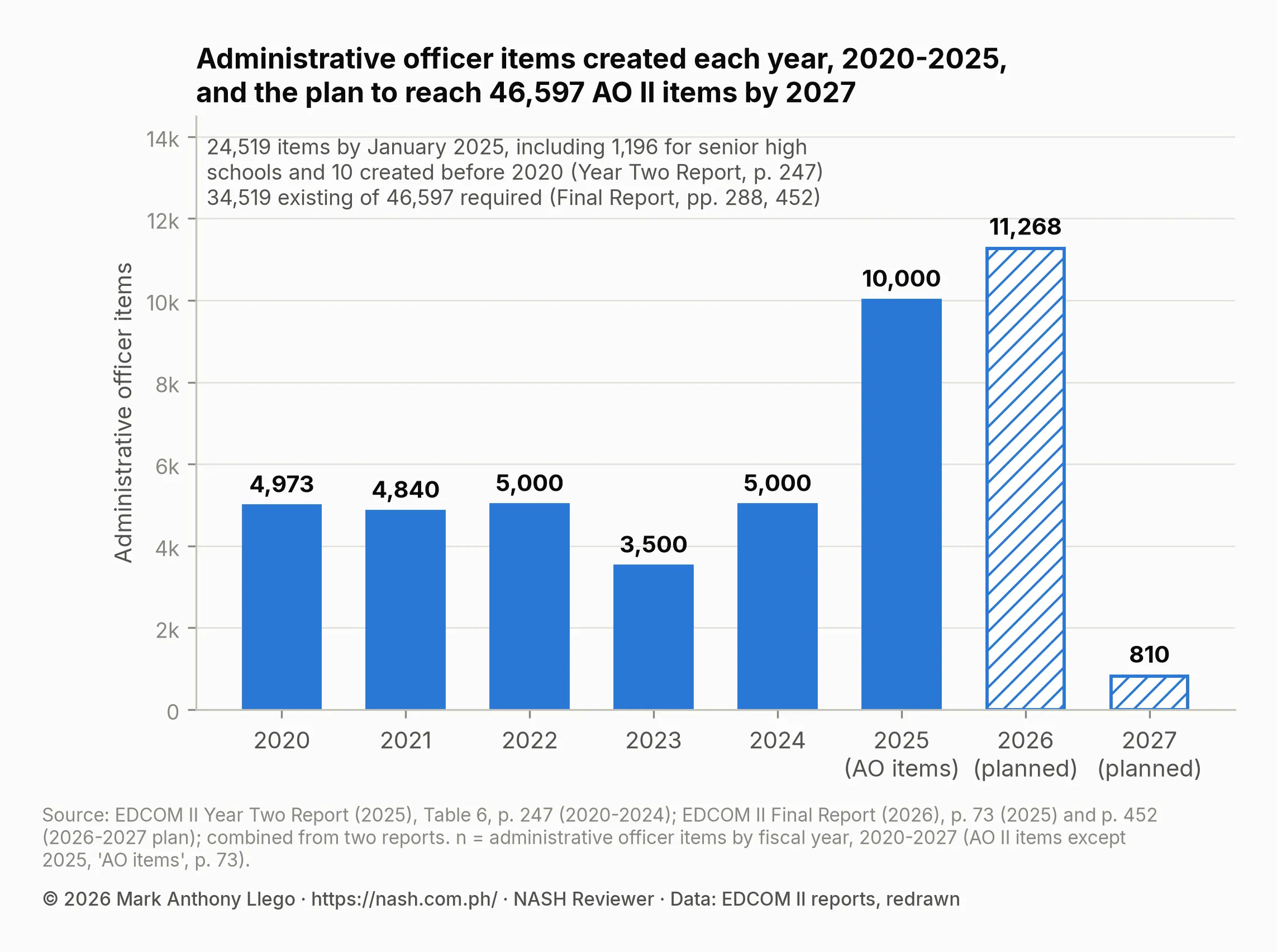
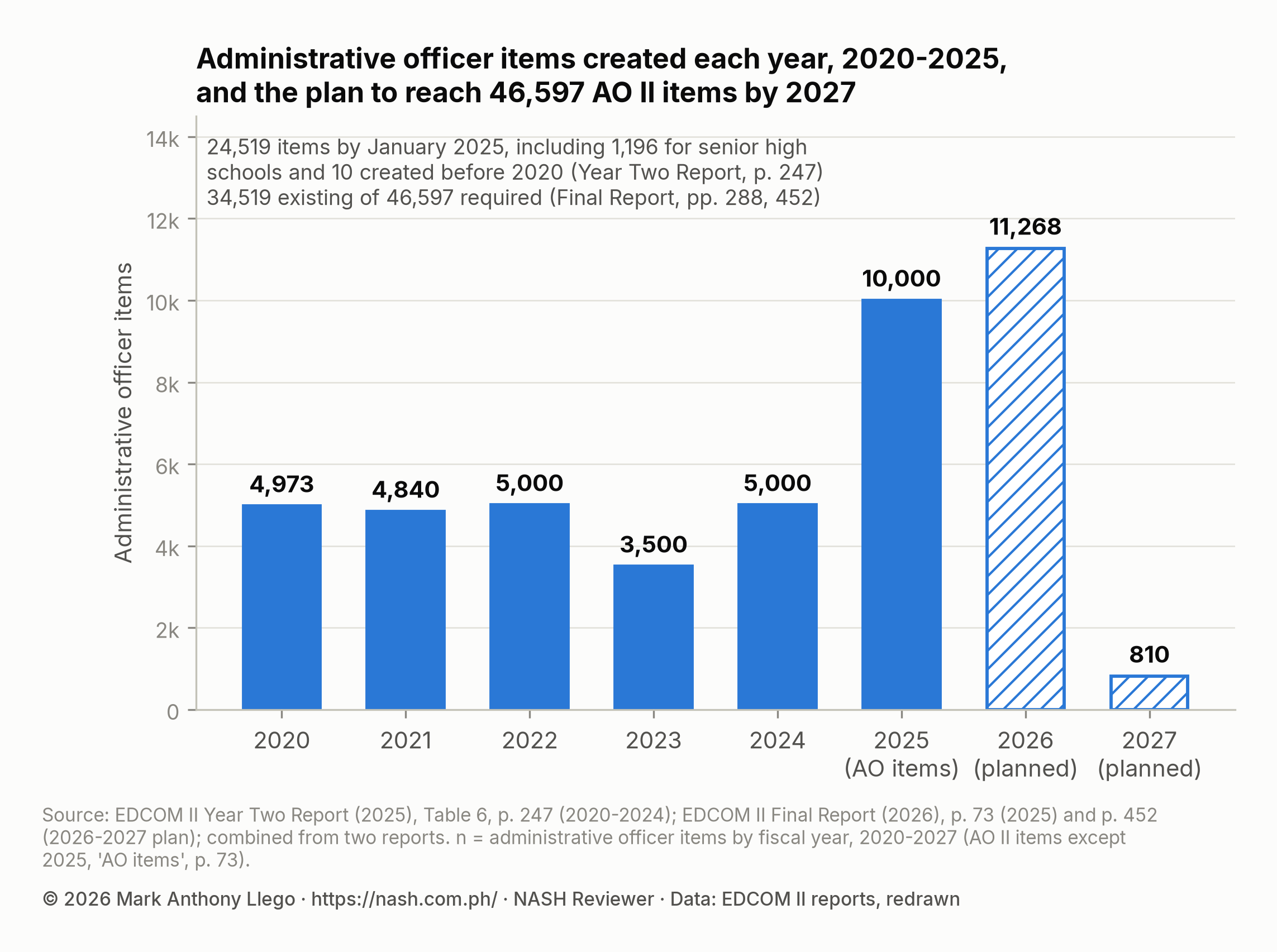
Reducing teachers’ administrative burden is the eighth of the plan’s top 20 recommendations, and its targets are about support staff (Final Report, p. 432; National Education Plan document, p. 11).
| Count | Value | Page |
|---|---|---|
| AO II items created, as of January 11, 2025 (20,680 needed for one per school) | 24,519 | Year Two, p. 247 |
| AO items after 10,000 were added for 2025 | “now totaling 33,313” | Final, p. 73 |
| AO II items existing, in DepEd’s October 2025 staffing submission | 34,519 of 46,597 required | Final, pp. 288, 452; plan document, p. 37 |
| AO II items filled, GMIS data as of June 30, 2025 | 25,137 of 34,519 (73%) | Final, p. 453; plan document, p. 38 and note 16 |
| Vacant school-level administrative officer positions to fill | 12,547 | Final, p. 351 |
The Final Report does not explain why it gives both 33,313 and 34,519. The sum of 24,519 and 10,000 is 34,519, and the gap of 1,206 equals the 1,196 senior high school and 10 pre-2020 items Year Two lists separately. Nor does it reconcile its 12,547 vacant administrative officer positions (p. 351) with the 9,382 unfilled AO II items its p. 453 implies (34,519 − 25,137), or its “1:1 by 2026” (p. 31) with 73% filled.
The officers help most where a school has its own: compared with schools without one, teachers had 18.6% fewer administrative assignments with a shared AO II and 33.8% fewer with a dedicated one (policy brief, p. 5).
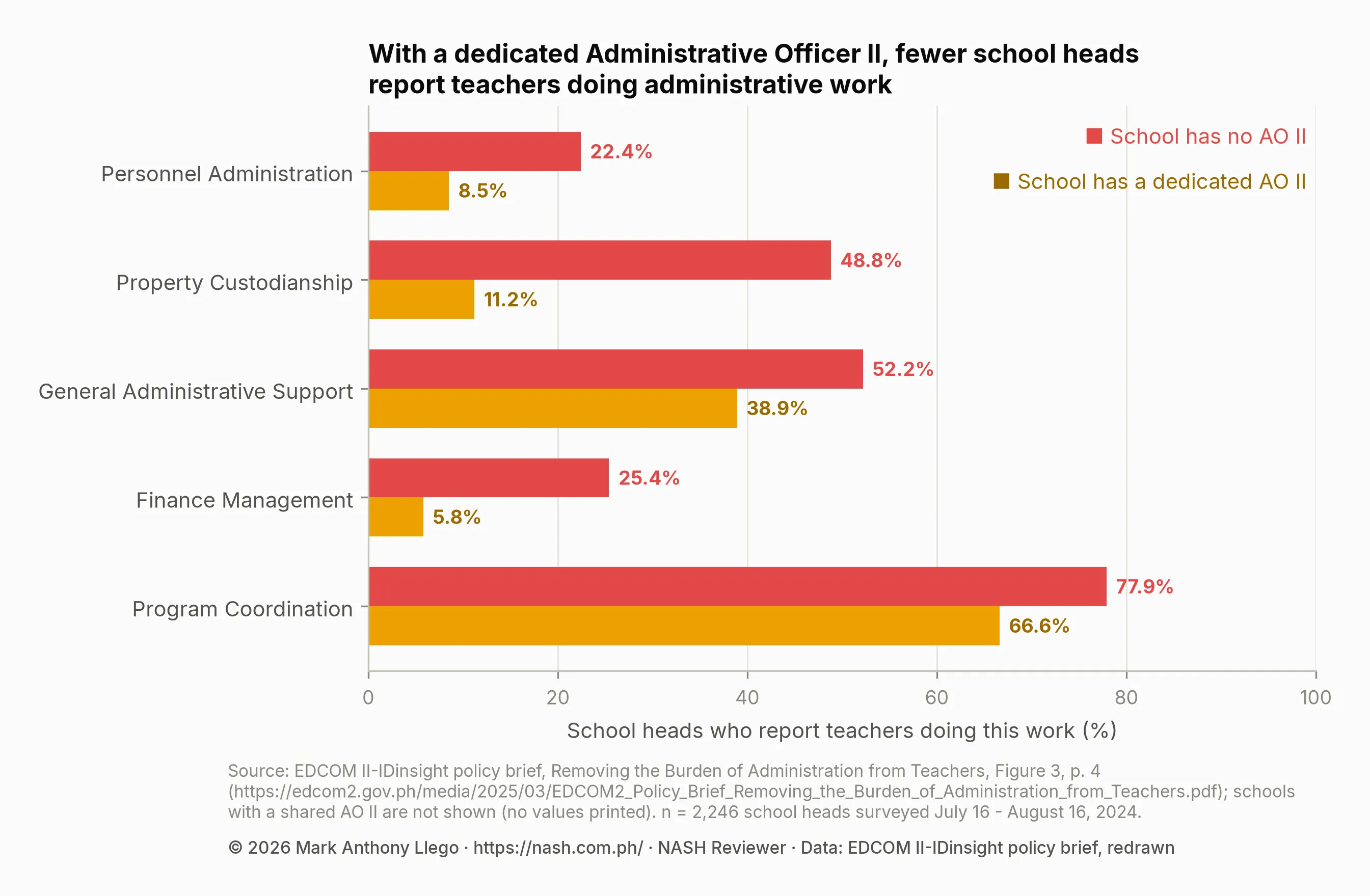
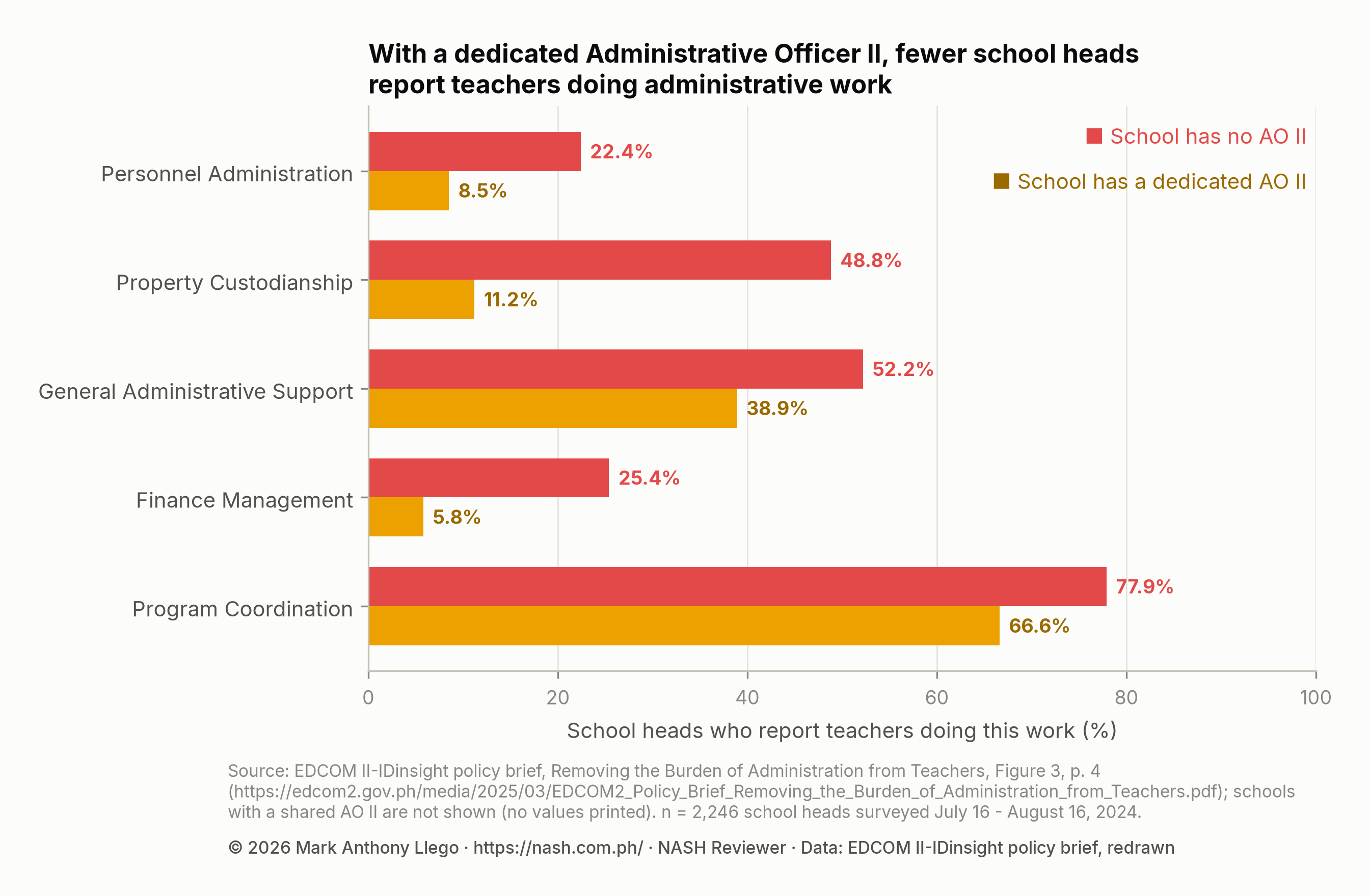
Program coordination stays with teachers even then, which is why the Final Report proposes Project Development Officers “as permanent school-based positions” (p. 287). DepEd’s proposed School Organizational Structure and Staffing Standards (SOSSS), which would replace those of 1997, show the gap.
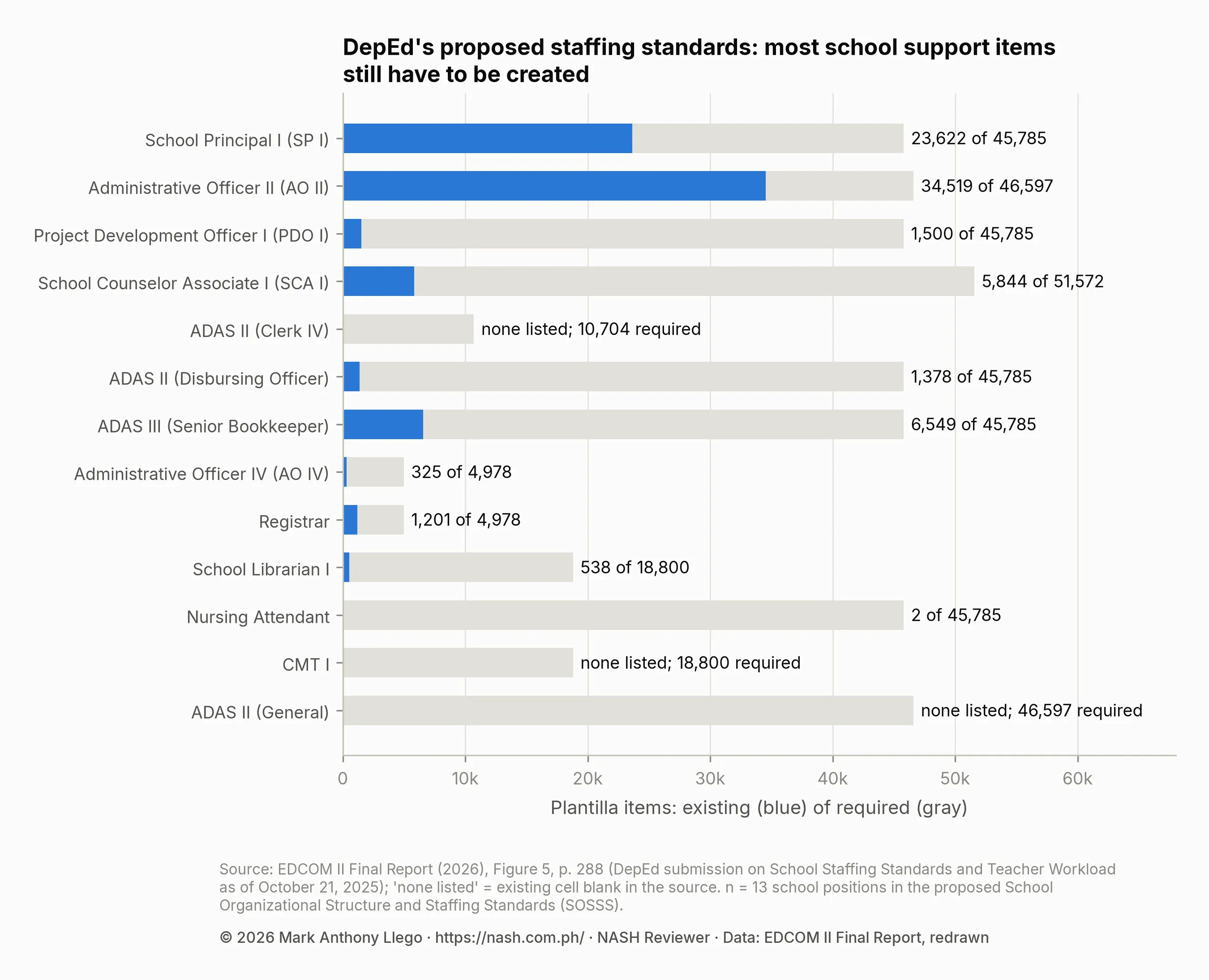
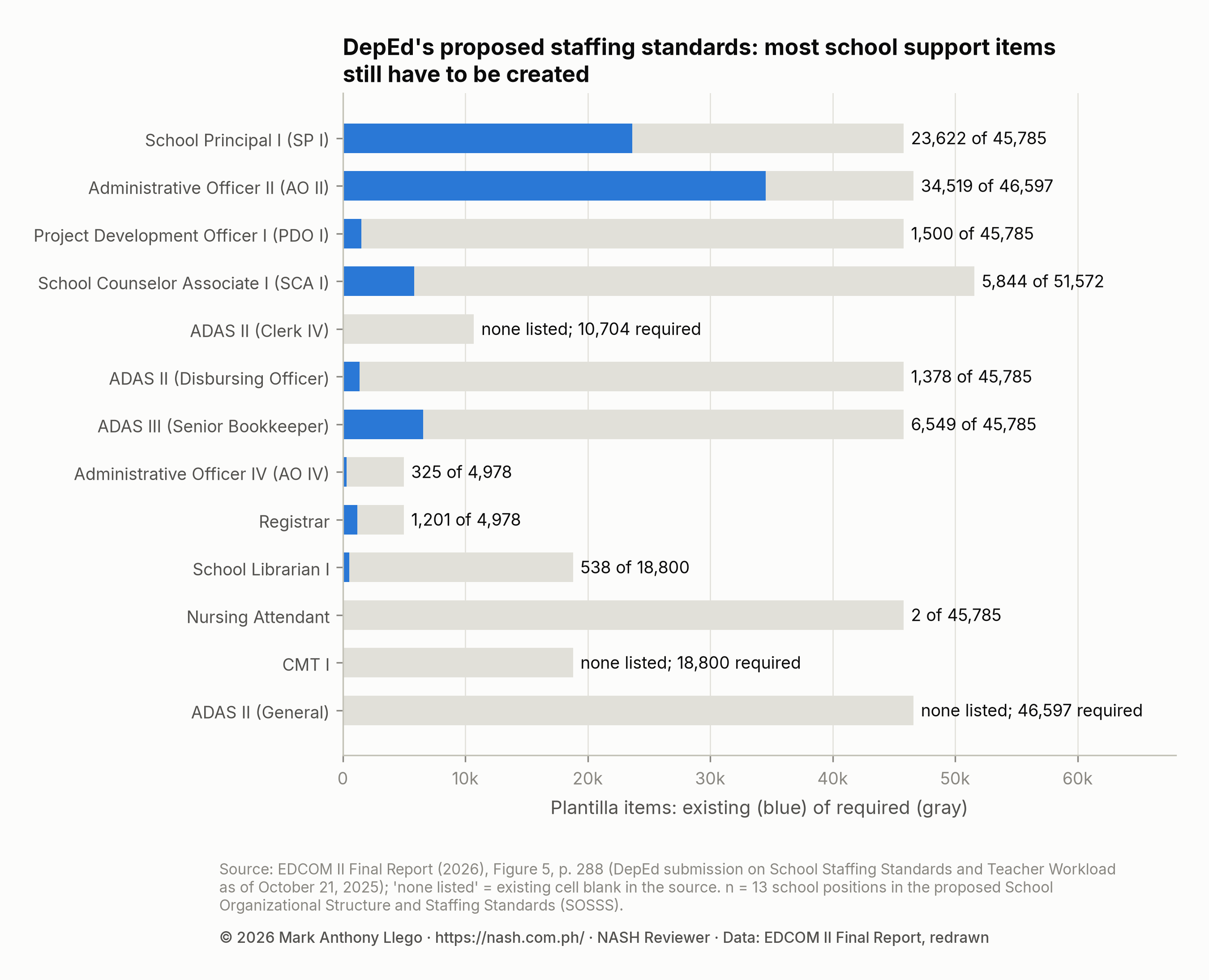
Of the posts in Figure 5 that would take paperwork off teachers, the clerks (none listed of 10,704), disbursing officers (1,378 of 45,785) and project development officers (1,500 of 45,785) have the fewest existing items; bookkeepers have 6,549 of 45,785. EDCOM II asks DepEd and the DBM to “jointly adopt and fund the revised SOSSS” (p. 300); the National Education Plan guide gives the targets to 2028.
Republic Act No. 12288: career progression in law
Republic Act No. 12288, signed September 12, 2025 (Official Gazette), puts into law the Expanded Career Progression system of Executive Order No. 174, s. 2022. Before that program, teachers took “approximately 10 to 20 years to move from Teacher I to Teacher III” (Final Report, p. 289). The law:
- makes Teacher I to Master Teacher I the base positions, after which a Master Teacher I may choose the teaching or school administration line, and directs the Department of Budget and Management to create the position titles Teacher IV to VII, Master Teacher V and VI and School Principal V (Sec. 5). Teacher IV to VII and Master Teacher V already existed under EO 174; Master Teacher VI and School Principal V are new, and the implementing rules place both at Salary Grade 23;
- makes Master Teacher II to VI equivalent to School Principal I to V “in all salaries, benefits, and other privileges” (Sec. 7);
- bases promotion on “merit, fitness, and competence anchored on the professional standards”, and states: “In no case shall promotion in the Teaching Career Line be based on arbitrary criteria such as the proportion of learners who achieve curricular expectations” (Sec. 9);
- sends teachers and school leaders who do not pass two successive Standards-Based Assessments to a free NEAP support program (Sec. 10).
The implementing rules were due within 90 days (Sec. 12), and EDCOM’s Legislative Tracker flagged them as overdue in July 2026 (EDCOM 2, July 31, 2026). EDCOM reported on September 17, 2026 that they had been issued, with ₱8.68 billion released for salary differentials of 93,344 reclassified personnel and ₱12.09 billion proposed for 2027 (EDCOM 2, September 17, 2026). The rules were signed on August 17, 2026. Under their Section 20 they take effect 30 days after publication in a newspaper of general circulation and filing with the Office of the National Administrative Register. As of October 31, 2026, the rules had not been published in the Official Gazette or on deped.gov.ph, so their effective date is not yet known. They start a new three-year transition period from their effectivity, which DepEd may extend by up to two years, and keep ongoing reclassification assessments under the earlier rules (Sec. 17). Until DepEd issues guidelines under them, promotion and reclassification follow DO 024, s. 2025, as amended by DO 034, s. 2025, with the qualification standards of DO 019, s. 2025. The human resource management guide explains DO 024 and DO 034. EDCOM II also wants promotion criteria to “prioritize demonstrable classroom impact … over credentials and paper-based compliance alone”, and it recommends shifting the master’s degree requirement from Master Teacher I to “MT II or School Principal I” (Final Report, p. 299). That has not happened: the qualification standards in DO 019, s. 2025 still require a master’s degree for Master Teacher I.
What EDCOM II means by “Redefining Teacher Accountability”
The Teacher Education Council’s essay (pp. 302–305)
“Redefining Teacher Accountability” is a signed essay in the Final Report by Dr. Jennie Jocson, Executive Director of the Teacher Education Council (TEC) (p. 305). It ends with what the “TEC suggests … for EDCOM II” (p. 305), so it is not one of EDCOM’s own recommendations.
- Two parts. Accountability is “both professional responsibility and a performance mechanism”, measured through the Performance Management and Evaluation System (PMES), “the official successor to the Results-based Performance Management System (RPMS)” (pp. 302–303).
- Paper over teaching. The PMES “often struggles with ‘malicious compliance.’” Its requirements “often overwhelm teachers”, and “The focus shifts from learning to documentation” (p. 303).
- Fairness needs context. A “differentiated accountability” model would set targets on “student growth (value-added), rather than just absolute achievement scores” for low-income and last-mile schools, and recognize barriers “beyond their control”, such as malnutrition, poverty and chronic absenteeism (p. 303).
- Support first. “Accountability cannot exist in a vacuum.” Training, coaching “focused on improvement, not just evaluation” and resources must come first (pp. 303–304).
- Shared duties. “School leaders are accountable for providing a supportive culture, de-bureaucratizing the PMES, and providing instructional coaching” (p. 304).
Its suggestions add a “Threshold Rule”: minimum resources in a school “before it is held to the highest accountability standards”, and a PMES built on “high-value, naturally-occurring evidence” (p. 305).
EDCOM II’s own findings and recommendations
The Commission’s own chapters agree. “The absence of standardized tools for school heads further fragments accountability and support systems” (p. 31). Individual commitments “often track compliance outputs (e.g., trainings conducted, reports submitted) rather than student learning” (p. 36). The Basic Education Development Plan 2030 has 88 indicators, 8 of them on learning, and “for principals, the OPCR lacks standardization across the system” (p. 357): “when rules expand, forms multiply, time slides away from the classroom” (p. 357).
| Recommendation | Page | Status on October 30, 2026 |
|---|---|---|
| Shift performance management “from scattered indicators to focused learning metrics”, with “developmental accountability” and systems “that enable, rather than burden, educational leaders” | p. 359 | DepEd issued the Q-BEDP to cut the indicator set (Final Report, p. 357), but no order revises the RPMS or OPCRF. School heads are rated under DO 2, s. 2015 with the revised OPCRF of 2024 (DM-OUHROD-2024-0586), and PMES tools for school heads were still being drafted in late 2025 (OPCRF guide) |
| Align targets “from the PDP to the GAA to individual IPCRs around a core set of learning outcome indicators” | p. 37 | None issued |
| Revise the RPMS and OPCRF so targets are “not linked, directly or indirectly, to student promotion or dropout rates” (due 2026) | p. 451 | None issued |
| “Revise the Office Performance Commitment and Review (OPCRF) of principals to prioritize instructional leadership functions” | p. 300 | No national issuance; the OPCRF guide describes DepEd’s drafting work |
| Make BHROD “the central clearinghouse for all ancillary tasks, with authority to veto or redirect non-teaching duties” | p. 298 | DO 005 tasks BHROD to review policies for their effect on teacher workload and recommend action to the Secretary (Sec. V.D.1.e) |
For teachers, the PMES under DepEd Memorandum No. 089, s. 2025 already moves toward the essay: “No portfolio for performance assessments shall be collected”, and raters record “timely feedback to the documents presented” (paras. 60–61). For SY 2025-2026, Memorandum DM-OSEC-OUHRODI-2026-0001 required only one full-period classroom observation (see the PMES guide).
What this means for school heads
DO 002 gave school heads and non-teaching staff “the sole responsibility” for administrative work, and DO 005 made the school head responsible for “fair, reasonable, and equitable distribution” of loads and assignments using eSF7 (Sec. V.D.4.a). Five practices follow.
1. Designate teaching-related assignments from the list, and only from the list
DO 005 allows “only the following teaching-related assignments”: coordinator for reading, literacy and numeracy, research, special needs education, ICT, guidance and advocacy, or inclusive education; trainer or adviser for the school paper, sports or the learner government; and grade-level or learning-area chair (Sec. V.A.4.1). New program roles “shall be subsumed” in these (Sec. V.A.4.5), and teachers “must concur” (DM 053, para. 6.b). Set against DO 002 and DO 005, the Year One Report’s roles fall as follows:
| Role in Year One Table 1 (pp. 195–196) | Where it stands now |
|---|---|
| Property custodian; school feeding coordinator; DRRM coordinator | Administrative work for the school head and staff (DO 002, Sec. V.A.1.b and f) |
| Journalism, sports, SPG/SSG, research and ICT coordinators | Allowed teaching-related assignments (DO 005, Sec. V.A.4.1) |
| Canteen manager; 4Ps; Gulayan sa Paaralan; Brigada Eskwela; scouting; GAD; health roles, among others | Not named in DO 005’s list; assign only if the role fits a listed category, otherwise keep it with the school head and staff |
| Teacher-in-charge | A school head under DO 002 and DO 005 |
Base each designation on a School Improvement Plan program, weigh specialization and load, favor teachers with fewer than six hours of teaching, and record it in eSF7 (DO 005, Sec. V.A.4.2–3; DM 053, paras. 5–6). The learner-government adviser alone carries 30 forms. The PPSSH Domain 2 guide covers managing staff.
2. Protect teaching time
- Absorb the administrative work. Use the AO II, clustered staff and, where needed, contract-of-service or job-order personnel paid from MOOE (DO 002, Sec. V.A.2); in a small school without staff, the school head does it (see the MOOE guide).
- Filter urgent reports. Answer division requests from school records first, and ask teachers only for data only they hold. Teachers’ forms and reports are limited to the 75 in DO 006, s. 2025 (para. 4), and school heads are to “reduce unnecessary documentation requirements” (DO 016, s. 2026, para. 37.c).
- Build preparation time into the class program. DO 005 requires programs that “give ample time for the preparation and correction of exercises” (Sec. V.A.3, item 4), and remediation in the program counts as teaching load (DM 053, para. 3.d).
- Give team forms to members other than teachers where practicable on the School Planning Team, School Governance Council and PTA (DO 006, para. 5; see the School Governance Council and PTA guide).
3. Keep within the legal limits on hours
Give a teacher overload only after that teacher carries the full six hours, with regard to specialization, never beyond two hours a day and, as a rule, only in a school with a teacher shortage (DO 005, Sec. V.A.2, items 2–4; RA 4670, Sec. 13). It is paid at 125% of the hourly rate (DM 053, Encl. 1). Authorized work on a designated teaching-related assignment “beyond regular work hours” earns vacation service credits (DO 005, Sec. V.A.4, item 4; DO 013, s. 2024); DM 053, para. 7 words this as work beyond the six hours of teaching load, but the Order governs. Overtime pay under DO 026, s. 2025 is narrower: only for designated teachers with full loads, for approved work of at least two hours inside the school, never for ancillary tasks (Secs. V.2, V.4–6, V.8, VII.3, VII.5). Master teachers teach at most six hours, with time in the program for coaching and mentoring, and the school head rates them (DO 024, s. 2025, Encl., Sec. 36.b); a Master Teacher designated Department Head teaches three hours (Sec. 36.c.iv). Workload complaints go to the grievance machinery of DO 35, s. 2004 (DO 005, Sec. V.E).
4. Keep the records that prove it
| Record | Why | Rule |
|---|---|---|
| eSF7, updated each term | The official record of loads and assignments; the basis for staffing requests | DO 002, Sec. V.C.4; DO 005, Sec. V.A.4.3 |
| Designation orders concurred by each teacher, and the SDS-approved list | Proves each assignment is allowed and voluntary | DO 005, Sec. V.A.4.3; DM 053, para. 6 |
| Weekly overload record | Basis for quarterly overload pay | DO 005, Sec. V.B.1, items 2–3 |
| Authorities to work beyond regular hours, and accomplishment reports | Basis for service credits | DO 005, Sec. V.B.2, item 3 |
| Daily time records with logbook entries, locator slips or certificates of undertaking | Accounts for ancillary hours without extra reports | DM 053, para. 4.b |
5. Set fair performance targets
- Rate on evidence teachers already produce. Under the PMES, documents are shown during the year and no portfolio is collected (DM 089, para. 60). That fits the TEC’s call for “naturally-occurring evidence” and its charge to school leaders of “de-bureaucratizing the PMES” (pp. 304–305).
- Measure growth from the school’s baseline. Value-added accountability is the TEC’s suggestion, not a DepEd rule, but School Improvement Plan targets can still be set on progress from beginning-of-year CRLA, Phil-IRI or RMA results.
- Keep promotion rates out of targets. EDCOM II asks that targets not be linked to promotion or dropout rates (p. 451), and RA 12288 bars promotions in the Teaching Career Line based on the share of learners meeting curricular expectations (Sec. 9).
- Write your OPCRF around instructional leadership. Classroom observation, coaching and curriculum implementation are what EDCOM II wants it to count (p. 300). See the OPCRF guide, the instructional leadership guide and the PPSSH Domain 4 guide.
How the NASH may test this
Under DepEd Memorandum No. 069, s. 2025, the NASH covers “conceptual and situational critical thinking questions” aligned with the PPSSH, “using the SOLO (Structure of the Observed Learning Outcome) taxonomy as an underpinning framework” (para. 3). The two items below are original practice items, scored 3 (Relational), 2 (Multistructural), 1 (Unistructural) or 0 (Prestructural).
Question 1
Indicator 2.4.1, Management of staff. Career Stage 1, Situational, Moderate.
At the start of SY 2026-2027, the division asks a newly designated elementary school head to name a School-Based Feeding Program coordinator, a property custodian and an adviser for the Supreme Elementary Learner Government. The school has one Administrative Officer II. Teacher A teaches six hours a day and advises a Grade 6 class. Teacher B teaches five hours a day and was a campus journalist in college. Which action is most consistent with DepEd policy?
- A. Designate Teacher A to all three roles because she is the most experienced, and grant her service credits for extra hours.
- B. Keep the feeding program and property custodianship with the school head and the AO II, and offer the learner-government adviser role to Teacher B through a designation order she concurs with, submitted to the SDS and recorded in eSF7.
- C. Designate Teacher B to all three roles, since teachers with fewer than six hours of teaching get priority for designations.
- D. Decline all three and tell the division that teachers may no longer be given any work outside classroom teaching.
Answer and explanation
Best answer: B. Points: A = 0, B = 3, C = 2, D = 1.
- A (0 points, Prestructural). It loads administrative work onto the busiest teacher, although DO 002 takes feeding and property custodianship away from teachers.
- B (3 points, Relational). It sorts each role by the order that governs it (DO 002 for feeding and property custodianship, DO 005 for the adviser) and follows the priority, concurrence and eSF7 rules.
- C (2 points, Multistructural). It applies the priority rule, but gives a teacher two tasks that DO 002 assigns to school heads and non-teaching staff.
- D (1 point, Unistructural). It knows administrative work has left teachers, but DO 005 still allows listed teaching-related assignments.
Why. DO 002, s. 2024 makes feeding and property custodianship administrative tasks (Sec. V.A.1); DO 005, s. 2024 lists the learner-government adviser among the allowed assignments (Sec. V.A.4.1), which teachers “must concur” to (DM 053, s. 2024, para. 6.b). EDCOM II found teachers carrying “over 50 ancillary and administrative tasks” (Final Report, p. 283).
Indicator 2.4.1: Demonstrate knowledge and understanding of laws, policies, guidelines and issuances on managing school staff.
Sources: DepEd Orders No. 002 and No. 005, s. 2024; DepEd Memorandum No. 053, s. 2024; EDCOM II Final Report (2026), p. 283.
Question 2
Indicator 4.4.1, Performance management. Career Stage 1, Situational, Moderate.
Before the mid-year review, the master teachers who rate the Grade 4 to 6 teachers propose that every teacher submit a binder of printed lesson plans, tests and reports for the first term. Teachers say the binder will take their weekend. What should the school head do?
- A. Approve the binders, since complete documentation protects the school if the division audits the ratings.
- B. Decline the binders and ask the raters to rate from their classroom observations and the documents teachers show during the year, recording their feedback in the Performance Monitoring and Coaching Form.
- C. Decline the binders and postpone the mid-year review to the end of the year, so that teachers can focus on teaching.
- D. Decline the binders and let each teacher decide what evidence to show, without the raters keeping any record of their feedback.
Answer and explanation
Best answer: B. Points: A = 0, B = 3, C = 1, D = 2.
- A (0 points, Prestructural). It recreates the portfolio that DM 089, s. 2025 dropped, the paper compliance EDCOM II criticizes.
- B (3 points, Relational). It connects the rule (no portfolio), the rater’s duty (feedback recorded in the PMCF) and the purpose (ratings that support improvement without taking teachers’ time).
- C (1 point, Unistructural). It protects teachers’ time but drops the mid-year review, a part of the PMES cycle.
- D (2 points, Multistructural). It applies the portfolio rule but leaves out the recorded feedback that DM 089 requires.
Why. DM 089, s. 2025 says “No portfolio for performance assessments shall be collected” and “Raters shall provide timely feedback to the documents presented which will be recorded in the PMCF” (paras. 60–61). EDCOM II finds that performance systems “generate compliance, not improvement” (Final Report, p. 31), and the Teacher Education Council holds school leaders accountable for “de-bureaucratizing the PMES” (p. 304).
Indicator 4.4.1: Demonstrate knowledge and understanding of the implementation of the performance management system in improving school personnel and office performance.
Sources: DepEd Memorandum No. 089, s. 2025; EDCOM II Final Report (2026), pp. 31, 302–305.
Nothing in this guide reproduces or predicts examination content.
Frequently asked questions
How many hours a day should a public school teacher teach in DepEd?
Six hours of actual classroom teaching, within an eight-hour day whose other two hours go to ancillary tasks (DepEd Order No. 005, s. 2024, Sec. V.A, item 1). Republic Act No. 4670, Section 13, allows up to eight hours only “where the exigencies of the service so require”, with additional pay (Year One Report, p. 192).
What administrative tasks were removed from teachers by DO 002, s. 2024?
Personnel administration, property custodianship, general administrative support, financial management, records management, and program management such as feeding and school DRRM, now the work of school heads and non-teaching staff (DepEd Order No. 002, s. 2024, Sec. V.A.1). A 2024 survey found 56.2% of teachers still doing some administrative work (EDCOM II–IDinsight policy brief, p. 1).
How many school forms do teachers accomplish under DO 006, s. 2025?
At most 75, down from 174 (Final Report, pp. 73, 283). All teachers accomplish 5 standard forms; the other 70, 31 for ancillary tasks and 39 for teaching-related assignments, depend on grade level, learning area and designation (DepEd Order No. 006, s. 2025, Enclosures 1–3; National Education Plan document, p. 38).
Can a school head require a teacher to be a coordinator?
Only for the teaching-related assignments listed in DepEd Order No. 005, s. 2024, Sec. V.A.4.1, and only with the teacher’s agreement: DepEd Memorandum No. 053, s. 2024 says these assignments “are not mandatory” and teachers “must concur with their designation” (para. 6.b).
What is RA 12288?
Republic Act No. 12288, the Career Progression System for Public School Teachers and School Leaders Act, signed September 12, 2025, makes the Expanded Career Progression system law (Final Report, pp. 73, 289). It bars promotion in the Teaching Career Line based on “the proportion of learners who achieve curricular expectations” (Sec. 9). EDCOM reported on September 17, 2026 that its implementing rules had been issued (EDCOM 2). Under their Section 20 they take effect 30 days after publication in a newspaper and filing with the Office of the National Administrative Register. As of October 31, 2026, the rules had not been published in the Official Gazette or on deped.gov.ph, so their effective date is not yet known. A DepEd orientation deck counts their new transition period from September 23, 2026; no DepEd order confirms that date. Until DepEd issues guidelines under them, DO 024, s. 2025, as amended by DO 034, s. 2025, governs promotion and reclassification.
Download the data
- workload-weekly-hours.csv: hours a week by type of work reported by teachers in 2024, with the printed shares, and the DO 005, s. 2024 standard week (EDCOM II–IDinsight policy brief, Figure 2, p. 3; DO 005, Sec. V.A, item 2).
- workload-forms-before-after.csv: forms accomplished by teachers before and after DO 006, s. 2025, by enclosure (Final Report, pp. 73, 283–286; National Education Plan document, p. 38; DO 006, Enclosures 1–3; release of March 18, 2025).
- workload-ao-items-by-year.csv: administrative officer items by fiscal year, 2020–2027 (AO II items except the 2025 “AO items”), with the reports’ totals (Year Two Report, Table 6, p. 247; Final Report, pp. 73, 288, 452–453; National Education Plan document, p. 37).
- workload-ao-effect.csv: share of school heads reporting teachers doing five kinds of administrative work, without an AO II and with a dedicated AO II (EDCOM II–IDinsight policy brief, Figure 3, p. 4).
- workload-staffing-standards-gaps.csv: required, existing and to-be-created items for 13 school positions in DepEd’s proposed staffing standards (Final Report, Figure 5, p. 288).
The CSVs and charts may be reused only with written permission: email support@nash.com.ph. The numbers themselves come from the EDCOM II reports, which you can cite directly.
How to cite this post
Llego, M. A. (2026, October 30). Teacher Workload and Accountability: EDCOM II Findings. NASH Reviewer. https://nash.com.ph/blog/teacher-workload-accountability-edcom-ii
The EDCOM II reports:
- Second Congressional Commission on Education. (2024). Miseducation: The failed system of Philippine education (EDCOM II Year One Report). https://edcom2.gov.ph/media/2024/02/EDCOM-II-Year-One-Report-PDF-022924.pdf
- Second Congressional Commission on Education. (2025). Fixing the foundations: A matter of national survival (EDCOM II Year Two Report). https://edcom2.gov.ph/media/2025/01/EDCOM-2-Year-2-Report-Fixing-the-Foundations-2025.pdf
- Second Congressional Commission on Education. (2026). Turning point: A decade of necessary reform (2026–2035) (EDCOM II Final Report). https://edcom2.gov.ph/media/2026/01/EDCOM-II-Y03-for-web-012626_final.pdf
- Second Congressional Commission on Education. (2026). The National Education Plan (2026–2035) [Part of Turning point: A decade of necessary reform, EDCOM II Final Report]. https://edcom2.gov.ph/media/2026/01/EDCOM-II_Y03_National-Education-Plan.pdf
Sources
- EDCOM II, Final Report (2026), pp. 31, 36–37, 73, 283–289, 298–300, 302–305, 351, 357, 359, 422, 432, 451–453.
- EDCOM II, National Education Plan document (2026), pp. 11, 37–38.
- EDCOM II, Year Two Report (2025), pp. 29, 215–216, 247, 249.
- EDCOM II, Year One Report (2024), pp. xxxi, 192–193, 195–196, 198.
- IDinsight, Removing the Burden of Administration from Teachers, EDCOM II Policy Brief (cited in the Final Report as IDInsight, 2024), pp. 1–6, Figures 2 and 3.
- EDCOM 2, 53 teaching days lost in SY 2023-2024 – EDCOM 2, PIDS, June 19, 2024.
- DepEd, PBBM, DepEd move to cut teachers’ paperwork by 57%, March 17, 2025.
- EDCOM 2, PBBM, DepEd move to cut teachers’ paperwork by 57%, March 18, 2025 (a DepEd release republished by EDCOM).
- EDCOM 2, EDCOM 2 launches Legislative Tracker for priority education reforms, July 31, 2026.
- EDCOM 2, Acidre welcomes IRR of teacher career progression law, September 17, 2026.
- Republic Act No. 12288, An Act Institutionalizing the Career Progression System for Public School Teachers and School Leaders and Appropriating Funds Therefor, signed September 12, 2025 (Official Gazette), Secs. 1, 5, 7, 9, 10 and 12.
- Republic Act No. 4670, the Magna Carta for Public School Teachers, approved June 18, 1966, Secs. 13 and 14; quoted in the Year One Report, pp. 192–193.
- DepEd Order No. 002, s. 2024, Immediate Removal of Administrative Tasks of Public School Teachers, Secs. III.c, V.A, V.C.4 and IX.
- DepEd Order No. 005, s. 2024, Rationalization of Teachers’ Workload in Public Schools and Payment of Teaching Overload, para. 1 and Secs. III.j–k, V.A, V.B and V.D–E.
- DepEd Memorandum No. 053, s. 2024, Implementation Guidelines for DepEd Order No. 005, s. 2024, paras. 3.d, 4.a–b, 5–7 and Enclosure No. 1.
- DepEd Order No. 013, s. 2024, Revised Guidelines on the Grant of Vacation Service Credits for Teachers.
- DepEd Memorandum No. 037, s. 2024, Creation of Task Force Results-Based Performance Management System and Teachers’ Workload.
- DepEd Order No. 006, s. 2025, Guidelines on the Streamlining of School Forms and Reports Accomplished by Teachers, paras. 4–5 and Enclosures 1–3.
- DepEd Order No. 026, s. 2025, Guidelines on the Payment of Overtime Services of Teachers, Secs. V.2–6 and 8, VI.B.1–2, VII.3 and VII.5–6.
- DepEd Memorandum No. 089, s. 2025, Guidelines on the Multi-Year Performance Management and Evaluation System for Teachers from School Years 2025–2026 to 2027–2028, paras. 60–61.
- DepEd Order No. 009, s. 2026, Guidelines on the Implementation of the Three-Term School Calendar in Basic Education, para. 2.
- DepEd Memorandum No. 029, s. 2026, National Technical Working Group for the Digitization of School Forms, para. 1.
- DepEd Order No. 016, s. 2026, Guidelines on Lesson Planning and Learning Design, para. 37.c.
- DepEd Memorandum No. 057, s. 2026, Creation of a National Technical Working Group for the Development of a Roadmap for the Magna Carta for Public School Teachers, paras. 1–2.
- Executive Order No. 174, s. 2022, Establishing the Expanded Career Progression System for Public School Teachers (Official Gazette).
- DepEd Order No. 019, s. 2025, Amended Qualification Standards for Teacher I-III, Master Teacher I-IV, and School Principal I-IV Positions, and the Qualification Standards for Newly Created Teacher IV-VII and Master Teacher V Positions.
- DepEd Order No. 024, s. 2025, Guidelines on the Implementation of the Expanded Career Progression System for Teachers and School Heads in the Department of Education, Encl., Secs. 36.b–c.
- DepEd Order No. 034, s. 2025, Amendments and Clarifications to DepEd Order No. 024, s. 2025, para. 37.
- DepEd Order No. 013, s. 2026, Institutional Guidelines on the Implementation of the School-Based Feeding Program, Sec. IX.D.
- Memorandum DM-OSEC-OUHRODI-2026-0001, Guidance in the Implementation of the Performance Management and Evaluation System for Teachers for SY 2025-2026.
- DepEd Order No. 2, s. 2015, Guidelines on the Establishment and Implementation of the Results-Based Performance Management System (RPMS) in the Department of Education.
- DepEd Memorandum No. 069, s. 2025, Administration of the National Assessment for School Heads for Fiscal Year 2025, para. 3.
- DepEd Order No. 024, s. 2020, National Adoption and Implementation of the Philippine Professional Standards for School Heads (indicators 2.4.1 and 4.4.1).
The EDCOM II series
The reports:
- What EDCOM II Achieved, 2023-2025: Laws, Budgets, Policies
- EDCOM II’s Three Reports: How the Key Numbers Changed
- EDCOM II Final Report: Guide for Aspiring School Heads
- National Education Plan 2026-2035: Guide for School Heads
- 100 Years After the Monroe Report: Education Commissions
- Is the Philippines Spending Enough on Education?
- Education Data, Transparency and Research: EDCOM II
Learners and learning:
- Mass Promotion and Lost Instructional Time: EDCOM II
- PISA, TIMSS, SEA-PLM and the NAT: What EDCOM II Found
- Mother Tongue After RA 12027: Language of Instruction
- Why DepEd Bought Only 27 Textbook Titles in 2012-2023
- RA 12080, Bullying and School Mental Health: EDCOM II
- RA 11650 and Learners With Disabilities: EDCOM II Findings
- Senior High School and Jobs: EDCOM II Workforce Findings
Schools, teachers and governance:
- Teacher Workload and Accountability: EDCOM II Findings (this post)
- Local School Boards and the Special Education Fund
- Local Education Models in EDCOM II: What the Evidence Shows
- Education in the Bangsamoro: EDCOM II Findings for BARMM
Written by Mark Anthony Llego for NASH Reviewer. Sources: EDCOM II Year One (2024), Year Two (2025) and Final (2026) Reports and the National Education Plan (2026–2035) document; the EDCOM II–IDinsight policy brief on teachers’ administrative burden; EDCOM II news releases, 2024–2026; Republic Acts No. 4670 and No. 12288; Executive Order No. 174, s. 2022; DepEd Orders No. 2, s. 2015, No. 002, 005 and 013, s. 2024, No. 006, 019, 024, 026 and 034, s. 2025, No. 009, 013 and 016, s. 2026, and No. 024, s. 2020; DepEd Memoranda No. 037 and 053, s. 2024, No. 069 and 089, s. 2025, and No. 029 and 057, s. 2026, and DM-OSEC-OUHRODI-2026-0001; DepEd’s release of March 17, 2025. Charts may be reused only with written permission from support@nash.com.ph.