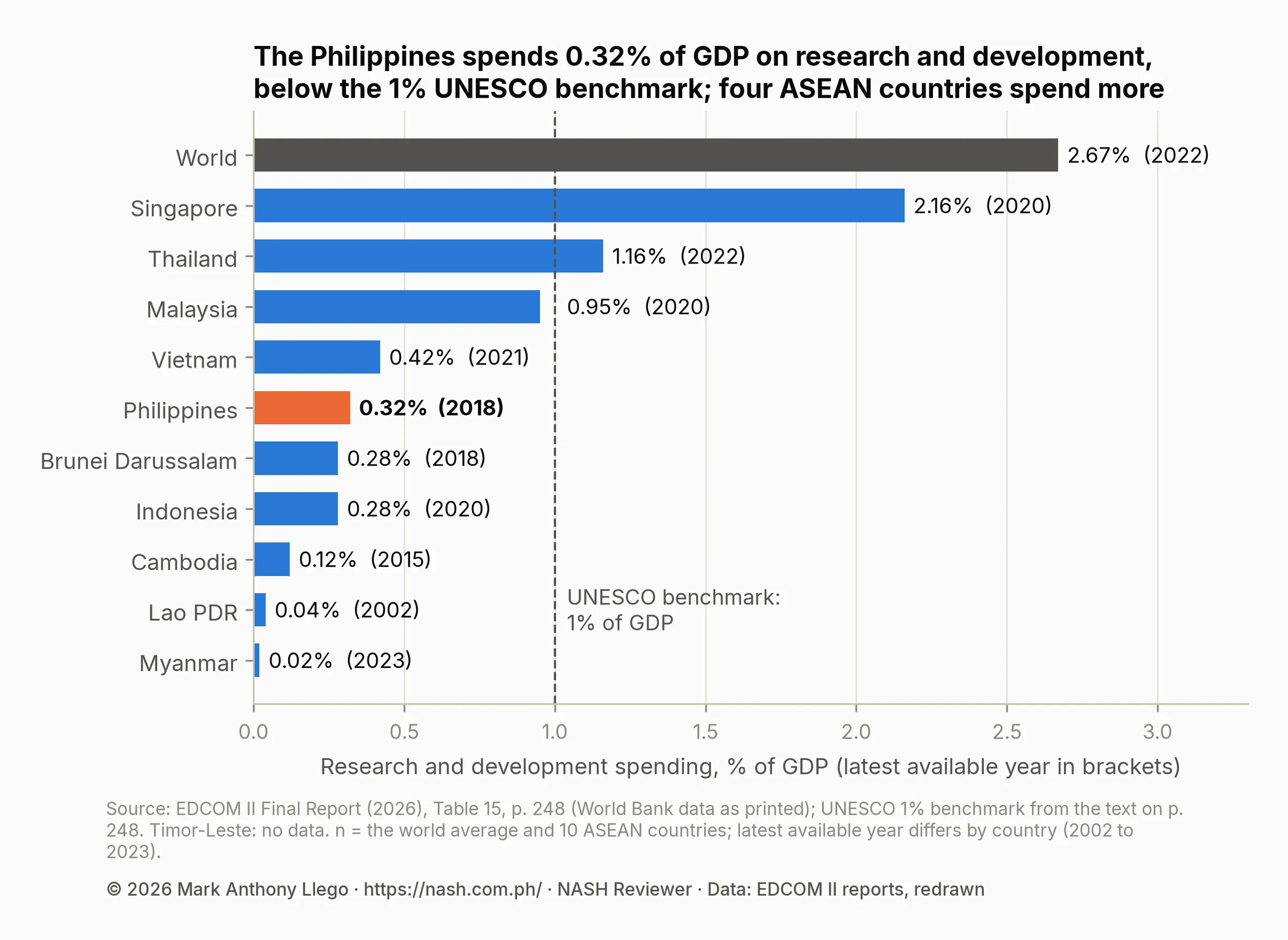
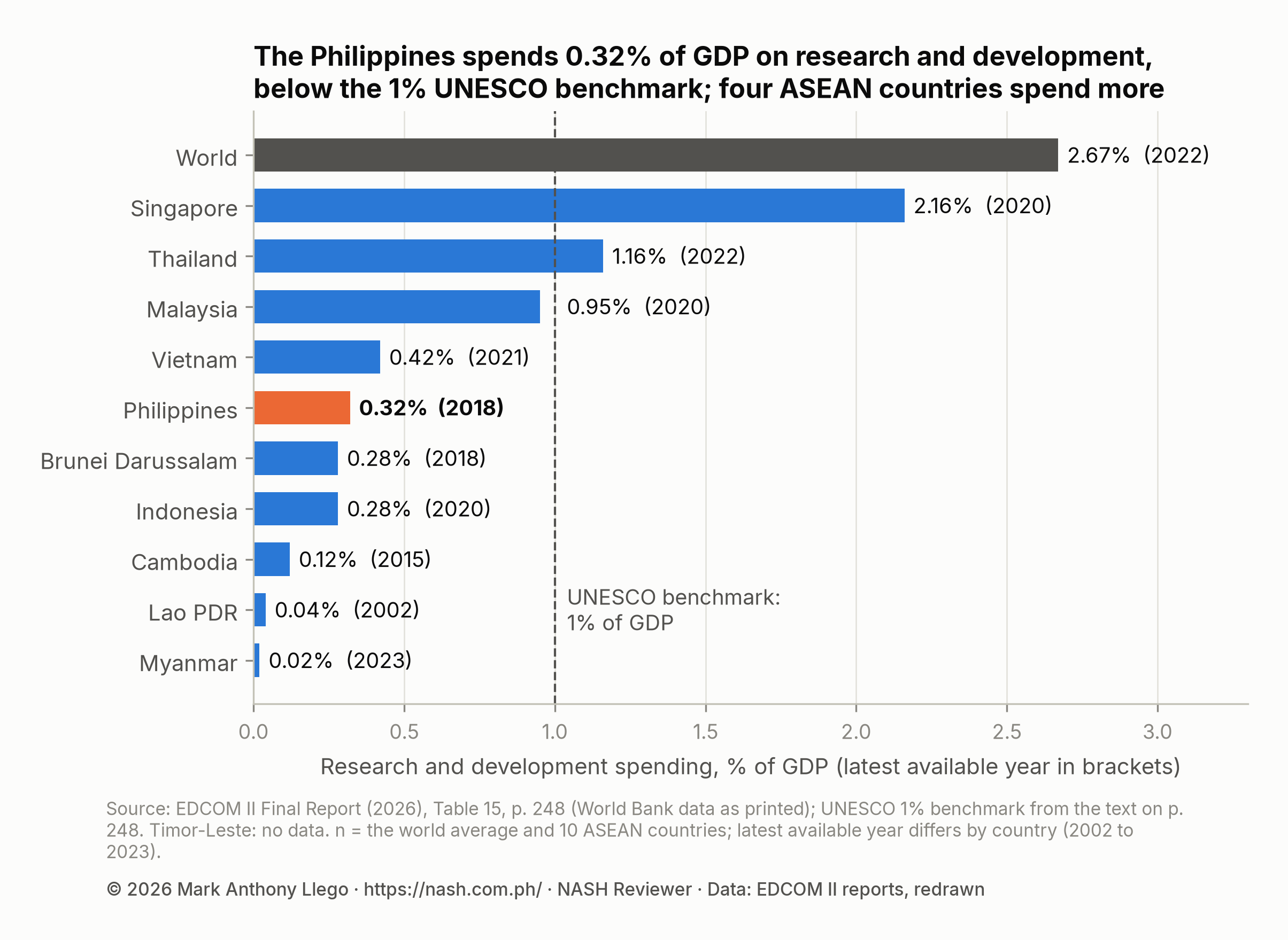
EDCOM II argues that the learning crisis lasted partly because the Philippine education system did not see, release or use its own evidence. National tests ran late or not at all, assessment data were kept from outside analysis, and research is underfunded: the country spent 0.32% of GDP on research and development in 2018, the latest year EDCOM reports, against a 1% benchmark. The Commission welcomes DepEd’s Project BUKAS, which in September 2025 made school-level data public for the first time, and recommends faster and open reporting of results, a unified learner information system and more research. A school head’s part is to use the public data within DepEd’s terms, do action research under DepEd’s research rules, and report the school’s own numbers to its community.
EDCOM II is the Second Congressional Commission on Education, created by Republic Act No. 11899. This guide, for teachers preparing for the National Assessment for School Heads (NASH) and for researchers, draws on its Year One Report (2024), Year Two Report (2025), Final Report, Turning Point (2026), and National Education Plan document, on EDCOM’s and DepEd’s data pages as of October 30, 2026, and on the DepEd orders in force.
The blog’s open-data guides show how to read DepEd’s public data, what an audit of DepEd’s open data found, and where to download cleaned DepEd school data; its action research cluster starts from the DepEd action research guide.
Key findings
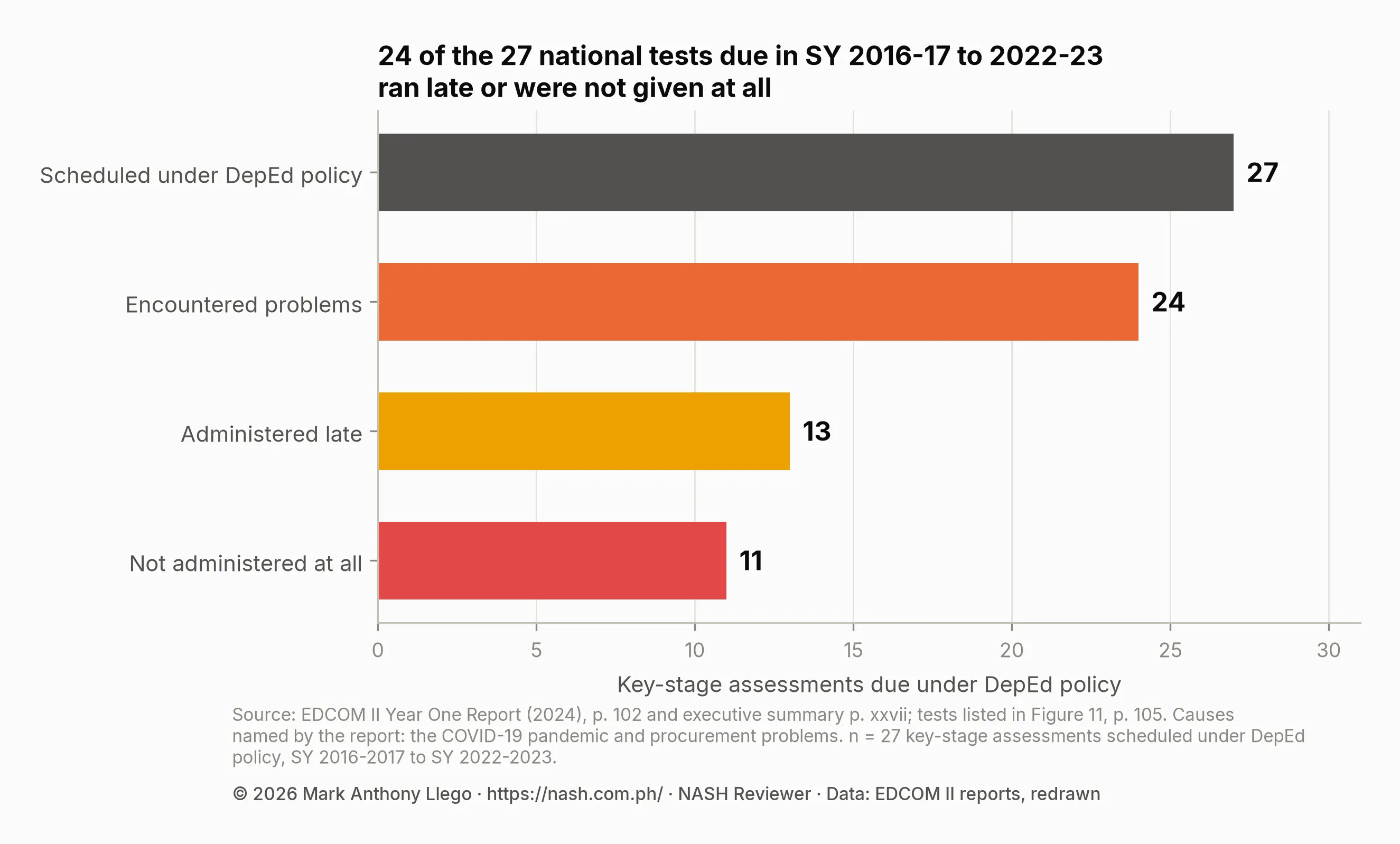
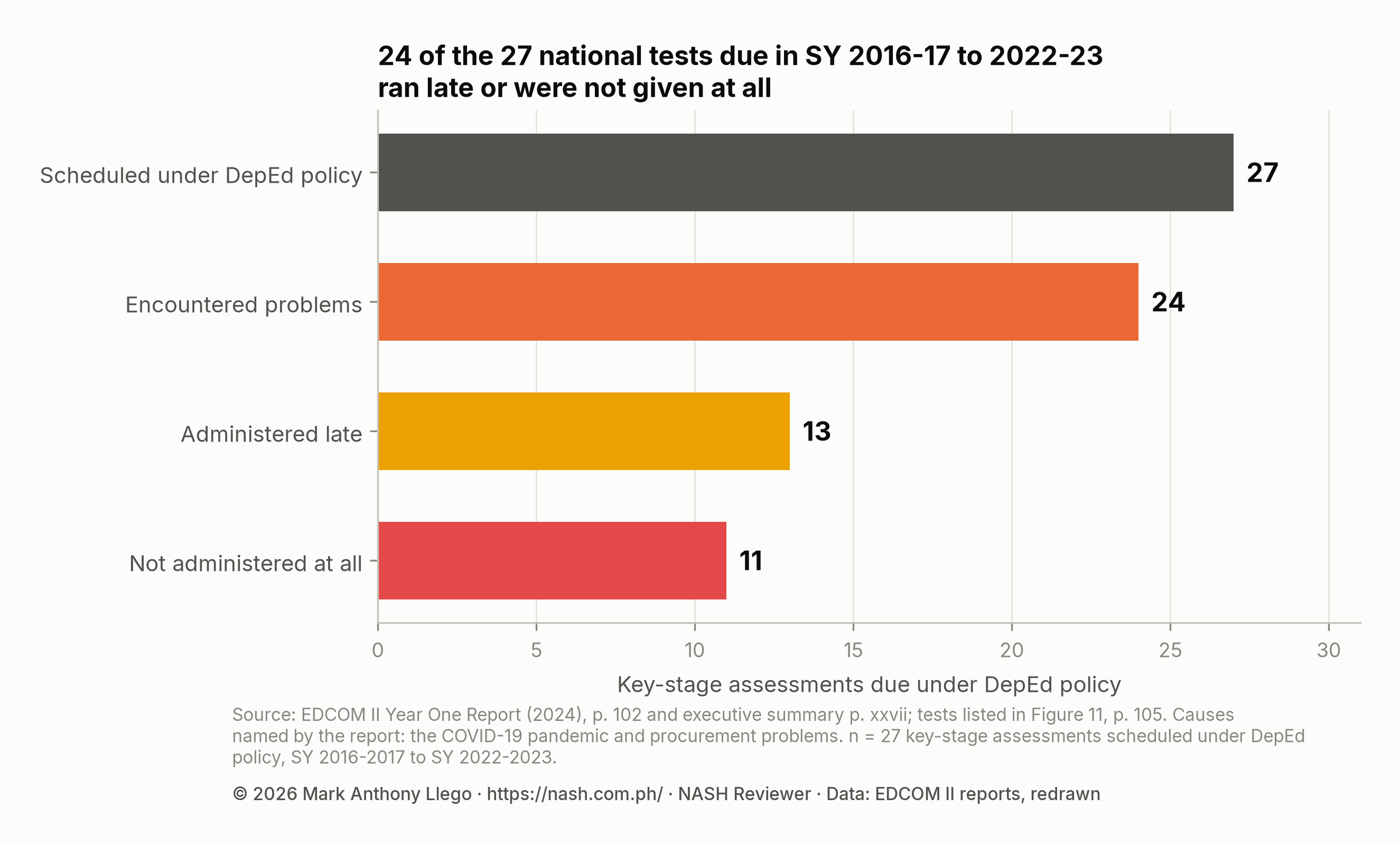
- National tests ran late or not at all. Of 27 key-stage assessments due from SY 2016-2017 to SY 2022-2023, 24 “encountered problems”: 13 were given late and 11 not at all (Year One Report, pp. xxvii, 102).
- Results arrive too late to use. Stakeholders described delays that “often stretch to two or three years”; recent results come faster but still “too late to meaningfully influence planning for the succeeding school year” (Final Report, p. 145).
- Data were held back. EDCOM used its legal powers to scrutinize “data long withheld by agencies from external analysis”, including DepEd’s National Achievement Tests (Final Report, p. 600).
- Project BUKAS changed the default. Announced in September 2025, it is “the first initiative in DepEd’s history” to make school-level data public, starting with Regions I, III, VIII, IX and CAR (Final Report, p. 145).
- Research is underfunded. The Philippines spent 0.32% of GDP on research and development in 2018, against UNESCO’s 1% benchmark and a world average of 2.67% (Final Report, p. 248), and has 172.01 researchers per million people (Year Two Report, p. 200).
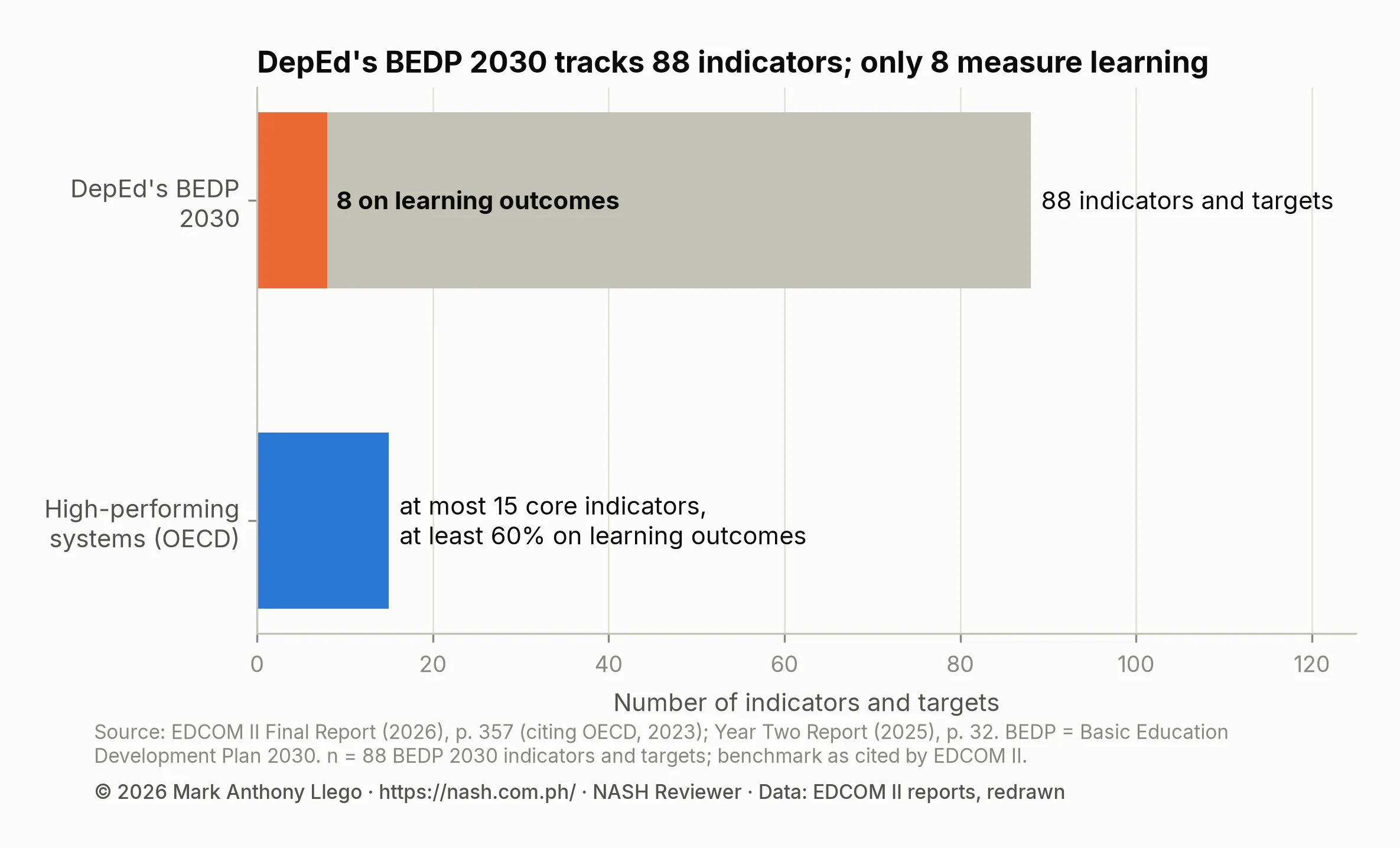
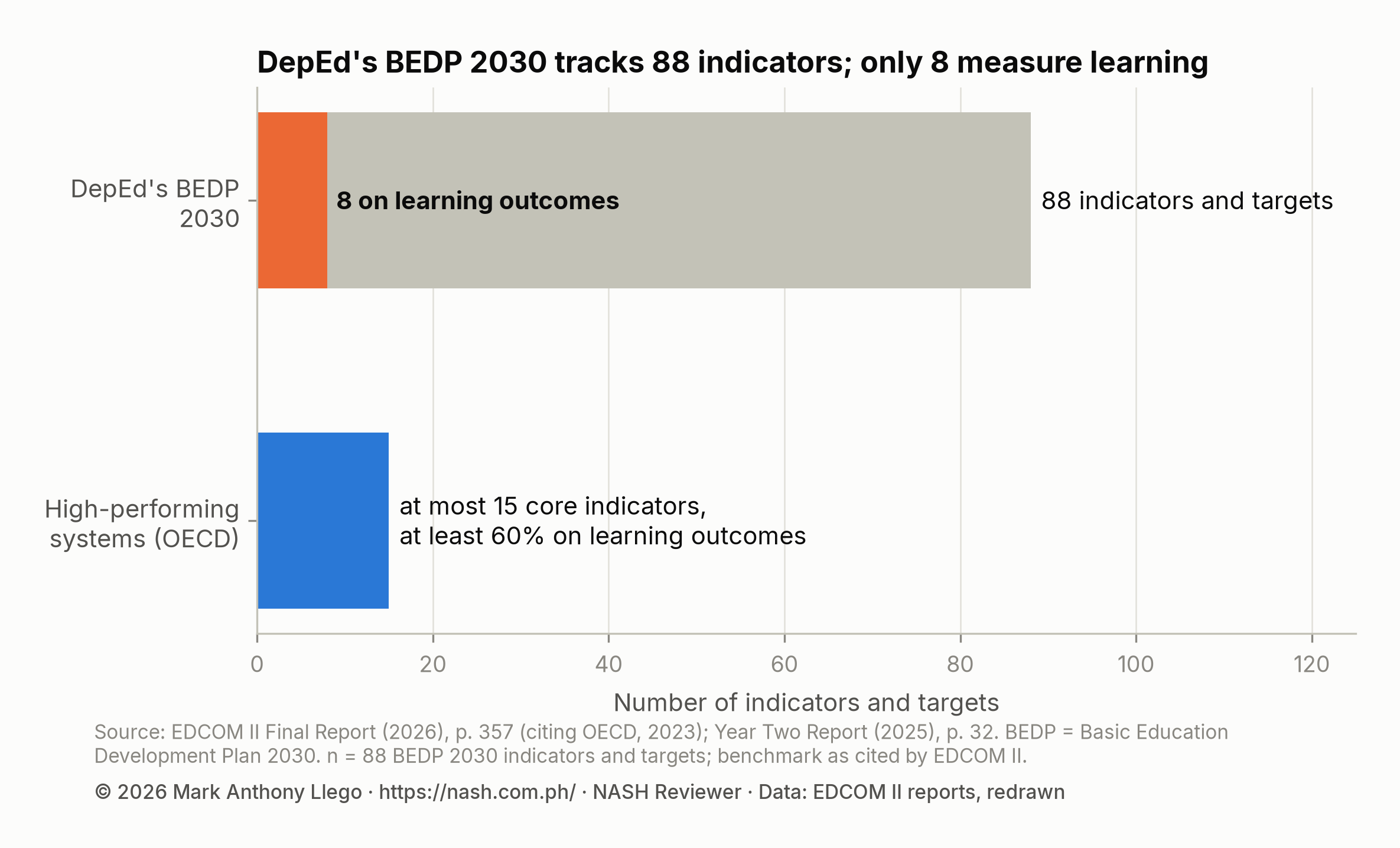
- Performance data do not drive teaching. DepEd’s Basic Education Development Plan (BEDP) 2030 has 88 indicators and targets, only 8 on learning outcomes (Final Report, p. 357; Year Two Report, p. 32).
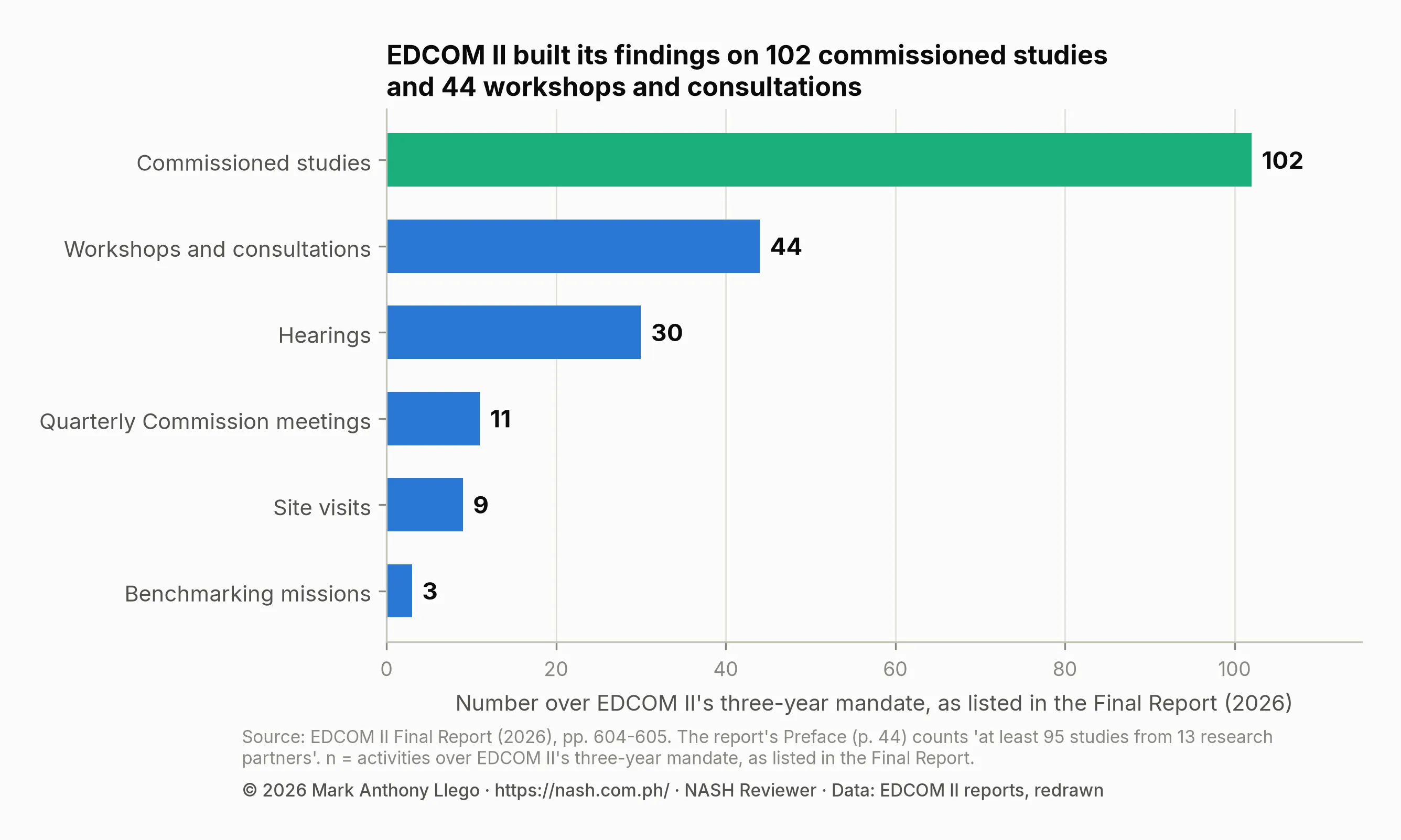
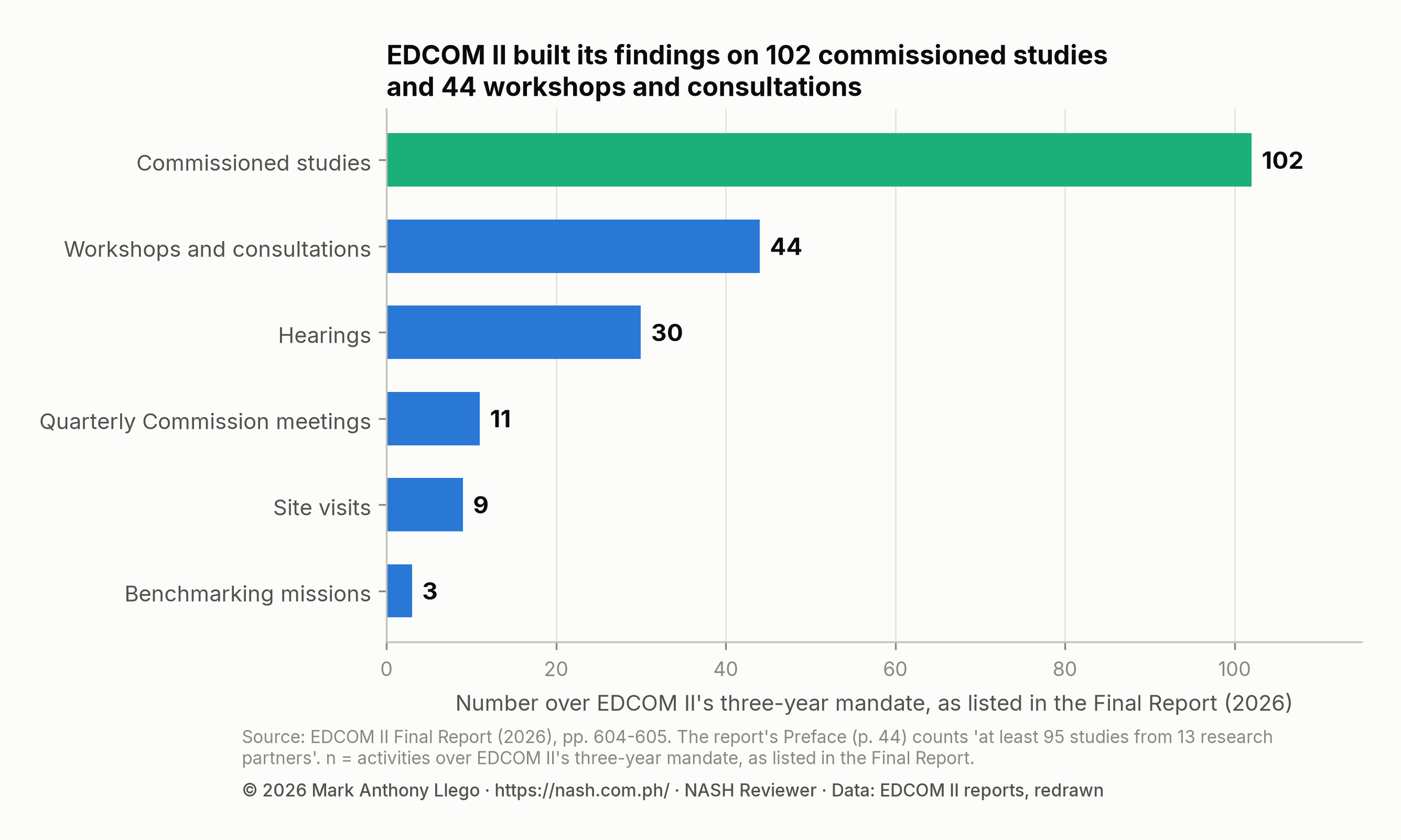
- EDCOM publishes its own data. Its website hosts an Early Childhood Dashboard, an LGU Early Childhood Report Card, a Legislative Tracker and a teacher survey on textbooks (EDCOM II website, October 30, 2026); its findings rest on 102 commissioned studies (Final Report, p. 605).
Why EDCOM II says transparency matters to the learning crisis
The last essay in the Final Report, “Bridging Evidence and Policy: Strengthening Research for Philippine Education Reform”, is by Dr. Aniceto Orbeta, Dr. Vicente Paqueo and Dr. Michael Abrigo. It opens: “The failure to systematically generate and utilize evidence is not a passive shortcoming but an active driver of ineffective reforms in the Philippine education system” (p. 640). PISA and TIMSS alarmed the country “not because the problems were new, but because the data finally made them undeniable” (p. 641). Programs such as mother-tongue-based multilingual education (MTB-MLE) and senior high school were “rooted in sound international evidence” but hampered by implementation, and “the tendency has been to reverse entire programs” (p. 641). The authors conclude that “without a culture of evaluation, it is impossible to distinguish between the two”, a failed design and a failed implementation (p. 642).
In “Reflections on Reform”, the Commission explains its access to data. Republic Act No. 11899 gave it subpoena powers: “This enabled EDCOM to scrutinize data long withheld by agencies from external analysis, including among them the national achievement tests administered by DepEd” (p. 600). Access was not the end of it: “fragmented data systems, incomplete geographic coordinates, and mismatched definitions and variables” got in the way, and the experience “revealed the critical roles of transparency and access to data” (p. 601).
In a signed essay in the Final Report, co-chairperson Sen. Bam Aquino (pp. 47, 420) writes that “when we have access to information and data, we are better equipped to work together and create sustainable and effective reform” (p. 420). His classroom bill would require DepEd “to make public all budget and procurement documents” (p. 421); that is a proposal, not a law.
What data EDCOM II publishes: dashboards, report card and trackers
EDCOM II also publishes its own data.
| Tool | Address | What it holds |
|---|---|---|
| Early Childhood Dashboard | edcom2.gov.ph/eccddashboard/ | Stunting, barangays without a Child Development Center (CDC), and struggling readers in Grades 1 to 3, by locality and school |
| LGU Early Childhood Report Card | edcom2.gov.ph/reportcard/ | A report card for any city, municipality or province on “child nutrition, Child Development Center coverage, and early literacy” |
| Legislative Tracker | edcom2.gov.ph/tracker/ | Priority bills and education laws of the 19th and 20th Congresses, from filing to implementing rules; “Last updated: October 22, 2026” |
| TextbookTracker 2026 | edcom2.gov.ph/textbooktracker/ | An anonymous teacher survey (“9 questions · about 3 minutes”) on whether printed textbooks reached classrooms in SY 2026-2027 |
| Publications | edcom2.gov.ph/publications/ | Reports and research papers, searchable by partner, among them the Philippine Institute for Development Studies (PIDS) |
Sources: the EDCOM II pages listed, opened October 30, 2026.
The Early Childhood Dashboard, announced on August 3, 2026, joins stunting data from Operation Timbang Plus 2025, CDC coverage from the Community-Based Monitoring System, and struggling readers on DepEd’s Comprehensive Rapid Literacy Assessment (CRLA) at the end of SY 2025-2026. It covers “25,869 barangays, 48,255 schools, and 5,127,670 children assessed for reading”, and shows nationally 4.3% of children aged 0 to 2 stunted, 11% of barangays without a CDC and 10% of Grade 1 to 3 learners struggling (EDCOM 2, August 3, 2026). The stunting figure comes from Operation Timbang Plus, which the Final Report says “tends to underestimate the stunting problem” (p. 97); Sen. Aquino’s essay in the same report says “One in every four Filipino children under 5 years old is stunted” (p. 421). The report card page, “powered by Tableau Public”, gives the same picture for one city, municipality or province. Of EDCOM’s tools, these two are the most useful to a school head. The blog documents how the EDCOM dashboard data was cleaned and how the EDCOM classroom data was cleaned.
The Legislative Tracker, announced on July 31, 2026, follows priority measures to “the issuance of implementing rules and regulations” and marks overdue implementing rules in red. The launch release named two laws in red: Republic Act No. 12199, which further strengthens the Early Childhood Care and Development System, and Republic Act No. 12288, which institutionalizes the Career Progression System for Public School Teachers and School Leaders (EDCOM 2, July 31, 2026). EDCOM reported on September 17, 2026 that RA 12288’s implementing rules had been issued (EDCOM 2, September 17, 2026), but as of October 31, 2026 they had not been published in the Official Gazette or on deped.gov.ph. Our RA 12288 explainer tracks its status. TextbookTracker 2026 collects data from teachers: it “is completely anonymous”, and the school’s name is optional.
What EDCOM II found wrong with DepEd’s data systems
Assessment data: late, thin and hard to compare
Under DepEd policy, 27 key-stage assessments were due from SY 2016-2017 to SY 2022-2023; “13 of which were administered late, and 11 were not administered at all due to the COVID-19 pandemic and related procurement challenges” (Year One Report, p. 102).
The Bureau of Education Assessment (BEA) limited its reports “to mean percentage scores only”, and the item analysis and test-taker profiles “are not released, even to internal stakeholders” (Year One Report, p. 106). The Final Report finds the same system three years later:
| Gap | What the Final Report says | Page |
|---|---|---|
| Public reporting | “almost no publicly available school-level historical data” | 141 |
| Comparability | Without test equating, the ELLNA and the Grade 6, 10 and 12 NAT “remain psychometrically distinct” | 142 |
| Tracking learners | A longitudinal study in the early 2000s ended, and “no successor structure was developed” | 142–143 |
| Equity groups | “no systematic mechanism within DepEd to disaggregate, analyze, or report results” for disadvantaged groups | 144 |
| Timeliness | Despite recent improvement, results “still arrive too late to meaningfully influence planning for the succeeding school year” | 145 |
The access rules are in Section 14 of DepEd Order No. 55, s. 2016, the national assessment policy that 2026 orders still cite. Results “should not be used to rank schools and schools divisions”; outside users must write a request, pay a fee and sign an agreement, and receive the data of only “10% of the actual number of examinees per year”, with no named results released without consent. The Final Report’s research essay calls the effect “the fundamental paradox”: DepEd collects valuable data but limits outside access “due to concerns about misuse”, so researchers “remain locked out” (pp. 642–643).
Learner and school records: the LIS, BEIS and NSBI
- Disability in the Learner Information System (LIS). “Disability-related information is rarely encoded in a consistent manner in DepEd’s LIS and school records”, which makes tracking “nearly impossible” (Final Report, p. 172). See the guide to learners with disabilities.
- School buildings. The National School Building Inventory (NSBI), enrollment data and spatial datasets “are not fully interoperable” (p. 185).
- School heads. EDCOM had to combine three datasets, among them the Basic Education Information System (BEIS), “because there is no centralized data system that encompasses all school head plantilla items” (Year Two Report, p. 258).
- Nutrition. Stunting data are “not shared across agencies or made accessible to LGUs” (Final Report, p. 97).
Performance data that do not improve teaching
The BEDP 2030 “is overburdened with an excessive number of indicators and targets (88 in total with only 8 focused on learning outcomes)”, while high-performing systems use “no more than 15 core indicators with at least 60% directly measuring learning outcomes” (Final Report, p. 357, citing the OECD).
Workshop participants told EDCOM that “data systems in place are not effective for tracking progress against targets, nor are they used to improve teaching practices in a targeted way”, and the system “lacks the analytical capacity to transform this information into actionable insights” (p. 358). The public pays too: of “at least 30 mechanisms for people’s participation”, “most of them are true only on paper”, and stakeholders “cite dead ends … due to lack of timely and open data” (Year Two Report, p. 33).
What changed in 2025: Project BUKAS
EDCOM calls Project BUKAS “a significant shift in DepEd’s transparency and data-access practices”. Announced in September 2025, it made school-level data public, including assessment results. Secretary Angara described the intent: “Whatever we know at the Central Office and the regional offices, the public will also know.” The first rollout covered “Regions I, III, VIII, IX, and CAR”, with “assessment results, enrollment, school resources, spending patterns, and teacher-to-student ratios” (Final Report, p. 145). It “does not directly resolve delays” in producing results, but “represents a cultural reform in data openness and public accountability” (p. 145).
By October 30, 2026, the release had grown. DepEd’s Paaralang Bukas dashboard covers SY 2024-2025 for every region (“60,129 Total Schools”, “27,012,758 No. of Learners”), and its School View shows any public school’s enrollment, personnel, MOOE by fiscal year and facilities. Assessment results are still limited: the ELLNA and NAT Grade 6 files for SY 2023-2024 and the CRLA file for SY 2025-2026 on DepEd’s Machine-Ready Files page cover only Regions I, III, VIII, IX and CAR, “for a selected set of schools only” (file READMEs).
Both pages set the terms of use. The data are released as “Information” under Executive Order No. 2, s. 2016 on freedom of information. Users may share and adapt them with credit to DepEd, but the terms also set a “Non-Modification” condition, say derivative works “must” carry “the same license as the original” and “must ensure the accuracy of the contents”, and bar any “indication that DepEd and any of its Authors have been involved” in the user’s work or any use of DepEd’s name or logo “without its prior written consent”. DepEd’s “Guidelines on Assessment Data Usage” add two rules: “No comparison of test scores across school years”, because items and test-takers change, and “No Ranking of schools”; instead, compare a school’s scores “to different benchmarks: the national average, regional average, or division average”.
The state of education research and research funding
Too little money and too few researchers
Research investment is “dismal”: the Philippines “only allocates 0.32% (2018) of its GDP on Research and Development (R&D), significantly below the 1% benchmark recommended by” UNESCO (Final Report, p. 248). To reach the benchmark, “the Philippines must triple its current R&D spending” (Year Two Report, p. 198).
The Year Two Report counts 172.01 researchers per million inhabitants against the World Bank’s 322.51 for lower-middle-income countries in 2021 (pp. 200–201). The Final Report’s plan starts from 270 researchers, scientists and engineers per million (DOST-PCAARRD, 2024) and targets 380 (p. 489).
A weak research and evaluation culture
The research essay lists “evidence and methodological gaps” (Final Report, pp. 642–643), among them:
| Gap | What the authors say | Page |
|---|---|---|
| What drives achievement | “a scarcity of research … that identifies which factors—school, individual/household, or community—have the greatest influence” | 642 |
| Teaching methods | “we lack rigorous experimentation to understand which instructional interventions actually support foundational literacy and numeracy in our specific context” | 643 |
| Cost | Policymakers cannot find “the greatest learning gains per peso spent” | 643 |
The authors name three barriers: “a fractured data and resource foundation”, “a stalled culture of evaluation”, and “a broken system of policy execution” (p. 645).
How EDCOM II built its own evidence base
“To date, there have been 102 commissioned studies, each addressing a Priority Area”, through the Ateneo–EDCOM II Research Fellowship, the UP President Edgardo J. Angara (UPPEJA) Fellowship, De La Salle University and PIDS, “designated as the Commission’s research arm under Section 12 of Republic Act No. 11899” (Final Report, p. 605). The report’s Preface counts “at least 95 studies from 13 research partners” (p. 44) and does not explain the difference.
The work exposed “the limited number of scholars in education research, and the near absence of expertise in ECCD and TVET” (p. 601).
None of the three reports discusses DepEd’s own research agenda or its Basic Education Research Fund (BERF); action research appears once (Final Report, p. 293). DepEd’s BEDP 2030 (DO 024, s. 2022) says the BERF “currently allocates around P2 million to each region”, that “the nature of research in DepEd is about knowledge creation in schools, for schools”, and that DepEd should broaden into system-level research and longitudinal patterns and trajectories.
What EDCOM II recommends on data, transparency and research
| Recommendation | Where | Status, October 30, 2026 |
|---|---|---|
| An independent assessment body to “ensure transparent public reporting” of assessment results | Final Report, pp. 145–146, 498 | A proposal |
| “Accelerate the timely release and transparent dissemination of assessment results”, “potentially within the same school year”, through school-level dashboards and “open-data policies” | p. 147 (Rec. 10); p. 26 | The Paaralang Bukas School View covers every public school, with assessment results for selected schools in five regions; no issuance institutionalizes it |
| Reporting “so LGUs, parents, and civil society organizations can use diagnostic data”; disaggregated reporting for disadvantaged groups | p. 147 (Recs. 8–9) | Recommendations |
| Learning-focused metrics with “annual public dissemination”; “integrated dashboards at division and school levels” | p. 359 (Recs. 1, 3) | School-level dashboards exist in the Paaralang Bukas School View; no issuance |
| A unified learner ID on the Learner Reference Number by 2028, longitudinal tracking by 2031, the full learner life cycle by 2035 | pp. 498–499 | Targets |
| A geocoded NSBI linked with the LIS and EBEIS; a bullying and mental health monitoring system “ideally integrated into Project BUKAS”; a centralized data system for school personnel | pp. 189, 201; Year Two Report, p. 265 | Recommendations |
| The DICT, through the Open Data Task Force, to increase “publicly accessible education datasets” (2026), updated quarterly by 2031; DepEd to build “dashboards for each school (covering outcomes, equity, resources) alongside the roll out of school-level budget and expenditure disclosure platform” (2026) | National Education Plan document, p. 104 | The School View already gives each public school a dashboard, with assessment results only for selected schools in five regions; no DepEd issuance covers it or a disclosure platform |
| “Research centers for evidence-based policymaking”; “annual data quality audits of the harmonized learner information system” | National Education Plan document, p. 105 | Assigned to the Education and Workforce Development Group for 2026 |
| A joint CHED–DepEd evaluation of ARAL interventions | National Education Plan document, p. 35 | CHED’s recommendation, recorded in the plan |
| Research investment toward “a medium-term target consistent with international benchmarks”, with “predictable and competitive research funding”; the essay’s authors want “the UNESCO benchmark of 1% of GDP” | Final Report, pp. 254, 644 | Recommendations |
The National Education Plan document repeats the Final Report’s targets and adds the supporting recommendations with their agencies and timelines.
One related measure has passed Congress. The bill expanding vouchers to Kindergarten to Grade 6, ratified on September 23, 2026, “requires DepEd to establish a public dashboard” of participating private schools (EDCOM 2, September 23, 2026). The enrolled bill, the Basic Education Voucher Assistance Act, reached the President on October 21, 2026; “Unless signed or vetoed earlier, it will lapse into law on November 20, 2026” (Legislative Tracker, updated October 22, 2026). The National Education Plan guide sets these targets in context.
What this means for school heads
Most of the data EDCOM found missing start in schools: the LIS entries, CRLA results, school forms and the funds on the transparency board. Five practices follow.
1. Start from the public data
Before collecting new data, use what is public. DepEd’s Paaralang Bukas School View gives every public school’s enrollment, personnel and resources for SY 2024-2025 and its MOOE for FY 2024 and FY 2025, and the Machine-Ready Files add assessment results for selected schools in Regions I, III, VIII, IX and CAR. EDCOM’s dashboard places the school’s CRLA results beside its barangay’s stunting and day care gaps. The Domain 1 guide treats this as using research “from reliable sources”, and the Domain 2 guide as managing school data.
Follow DepEd’s own rules for reading the results: do not compare a school’s test scores across school years, and do not rank schools; compare the school with the division, regional or national average. Stakeholders also told PIDS that the national tests’ scores are “not straightforwardly comparable to each other” (Final Report, p. 142), and the open data audit documents the files’ gaps.
2. Do action research under DepEd’s research rules
These rules are in force on October 30, 2026; no DepEd order or memorandum of 2025 or 2026 has replaced them.
| Rule | What it does | Guide |
|---|---|---|
| DO 16, s. 2017, Research Management Guidelines | Research committees, calls for proposals, the BERF, ethics, dissemination | Research Management Guidelines |
| DO 26, s. 2021 | Allows virtual processes and remote data collection, and adjusts the BERF allocation, eligible expenses and MOA signing; “All other provisions stated in DO 16 s. 2017 shall remain enforced” | Same |
| DO 39, s. 2016, Basic Education Research Agenda | Four themes (teaching and learning, child protection, human resource development, governance) and three cross-cutting areas. It was “a six-year Research Agenda”, 2017-2022 in the BEDP; that term has ended, and no successor has been issued | Research agenda |
| The BERF, under DO 16, s. 2017 | Grants to every region for approved proposals of regular or permanent DepEd personnel | BERF guide |
| DO 14, s. 2022, E-Saliksik | The research portal, where BERF-funded studies are “required to be archived” | Dissemination |
| DM 028, s. 2022 | The Quality Control Checklist for Completed Basic and Action Research, used in the technical evaluation of finished studies | Dissemination |
| DO 003, s. 2026, AI in basic education | Limits AI in research to “ancillary support functions” | Research ethics |
EDCOM’s gaps (Final Report, p. 643) can point a school’s research to questions that matter beyond the school, such as which reading routine moves Low Emerging readers up a CRLA level, or what each intervention costs per learner who improves. For methods, see the document analysis guide, the CRLA research topics and action research in LAC sessions.
3. Report the school’s numbers to its community
DepEd Order No. 008, s. 2019 already requires the school head to declare “all sources of funding of the school” (Sec. VI.A.1), to post their sources, intended use and actual use on a transparency board “updated every three (3) months” (Sec. VI.A.4), and to present them through the School Report Card (SRC) to the faculty, the PTA, the School Governance Council (SGC) and active local partners (Sec. VI.A.5). Other orders fill in the rest:
- SRC. DO 44, s. 2015 sets out the SRC with the School Improvement Plan; see the SIP guide.
- SGC. DO 026, s. 2022 defines the transparency board as “a publicly accessible tool that can be seen in the school vicinity” (Sec. III, item 20) and asks the SGC to “support the dissemination of pertinent school data and information” (Sec. V, specific function 6).
- PTA. A recognized PTA may “access pertinent information about learners, available in DepEd’s Unified Information Systems”, subject to the Data Privacy Act and the freedom of information order (DO 013, s. 2022, Sec. 23.1.4).
- Public requests. These follow DepEd’s freedom of information manual, DO 019, s. 2021.
EDCOM’s findings add one thing: report learning, not only money, in a form “LGUs, parents, and civil society organizations can use” (Final Report, p. 147). The school MOOE guide, the SIP communication plan, the SGC and PTA guide and the Domain 5 guide show how.
4. Protect learner data while you share it
Openness stops at the learner’s identity. The Data Privacy Act of 2012 (Republic Act No. 10173) protects personal information, and even DO 55, s. 2016 releases no named individual results without consent (Sec. 14). Publish counts and percentages, not lists of learners; in research, use codes and parental consent, as the action research ethics guide explains.
5. Feed the national evidence
Teachers can answer EDCOM’s TextbookTracker 2026 survey, anyone can send a position paper on a pending bill through the Legislative Tracker, and finished action research can go to the division research forum and E-Saliksik.
How the NASH may test this
Under DepEd Memorandum No. 069, s. 2025, the NASH covers “conceptual and situational critical thinking questions” aligned with the PPSSH, “using the SOLO (Structure of the Observed Learning Outcome) taxonomy as an underpinning framework” (para. 3). The two items below are original practice items, scored 3 (Relational), 2 (Multistructural), 1 (Unistructural) or 0 (Prestructural).
Question 1
Indicator 1.4.1, Research and innovation. Career Stage 1, Situational, Moderate.
An elementary school in Region III has seen no improvement in its Grade 2 end-of-year CRLA results for two years. A Grade 2 teacher wants to study a daily reading routine as action research and asks the school head how to begin. Which advice is most consistent with DepEd’s research rules and with the evidence EDCOM II says is missing?
- A. Wait for the next NAT and ELLNA results before choosing a topic, since a study built on national results will carry more weight with the division’s research committee.
- B. Compare the school’s CRLA records with its Project BUKAS data, frame the question under the agenda’s teaching and learning theme, get parental consent, and submit the proposal under DO 16, s. 2017.
- C. Adopt an action research title that another school used last year, since it was already approved by the committee and only the school’s name needs to change.
- D. Frame the question from the school’s CRLA records under the agenda’s teaching and learning theme, and start the routine at once, leaving the proposal and consent forms for later because the study involves only one class.
Answer and explanation
Best answer: B. Points: A = 0, B = 3, C = 1, D = 2.
- A (0 points, Prestructural). National results arrive late, EDCOM II found, and cannot show what works in one Grade 2 class.
- B (3 points, Relational). It connects the evidence, the research agenda, and the process and ethics of DO 16, s. 2017.
- C (1 point, Unistructural). It addresses approval only. A borrowed title answers another school’s problem, not this school’s data.
- D (2 points, Multistructural). The evidence and the theme are right, but it skips the review and consent that DepEd’s research rules call for before data collection.
Why. EDCOM II found that the Philippines lacks “rigorous experimentation to understand which instructional interventions actually support foundational literacy and numeracy in our specific context” (Final Report, p. 643). DepEd Order No. 16, s. 2017 governs how such a study is proposed, reviewed and shared.
Indicator 1.4.1: Identify relevant research findings from reliable sources in facilitating data-driven and evidence-based innovations to improve school performance.
Sources: DepEd Orders No. 39, s. 2016 and 16, s. 2017; EDCOM II Final Report (2026), pp. 142, 643.
Question 2
Indicator 2.2.1, Financial management. Career Stage 1, Conceptual, Moderate.
A PTA president asks what the school must disclose about its MOOE and a cash donation from an alumni group. Which statement best describes the school head’s reporting duty under DepEd Order No. 008, s. 2019?
- A. Report MOOE and donations to the division and the Commission on Audit; parents who want details may file a freedom of information request, since the school has no separate duty to publish.
- B. Post the MOOE liquidation on the transparency board each quarter; donations from alumni and other private groups are recorded in the school’s books but need not be posted.
- C. Declare every source of funds, post their sources, intended use and actual use on a public transparency board updated every three months, and present them through the School Report Card.
- D. Show the vouchers to PTA officers on request but keep them off public boards, since posting school finances could expose the school to complaints.
Answer and explanation
Best answer: C. Points: A = 1, B = 2, C = 3, D = 0.
- A (1 point, Unistructural). Reporting upward and freedom of information requests are real channels, but the order gives the school its own duty to publish.
- B (2 points, Multistructural). Posting the MOOE each quarter is right, but the order requires the school to declare “all sources of funding”, including donations.
- C (3 points, Relational). It joins the three duties in the order: declare every source, post sources and uses on the board every three months, and present them through the SRC.
- D (0 points, Prestructural). It keeps from the public what the order requires the school to make public.
Why. DepEd Order No. 008, s. 2019 sets all three duties (Sec. VI.A.1, 4–5), including a board “updated every three (3) months”. Parents and organizations told EDCOM II they meet “dead ends” in civil society participation in DepEd’s governance “due to lack of timely and open data” (Year Two Report, p. 33).
Indicator 2.2.1: Demonstrate knowledge and understanding of policies, guidelines and issuances in managing finances such as allocation, procurement, disbursement and liquidation aligned with the school plan.
Sources: DepEd Order No. 008, s. 2019; EDCOM II Year Two Report (2025), p. 33.
Nothing in this guide reproduces or predicts examination content.
Frequently asked questions
What is DepEd’s Project BUKAS?
Project BUKAS is DepEd’s public release of school-level education data, announced in September 2025. EDCOM II calls it “the first initiative in DepEd’s history to make school-level education data publicly accessible”; its first rollout covered Regions I, III, VIII, IX and CAR (Final Report, p. 145). On October 30, 2026, DepEd’s Paaralang Bukas dashboard covers every public school, and the Machine-Ready Files page holds the downloads and the terms of use.
Does EDCOM II publish its own data?
Yes. Its website hosts an Early Childhood Dashboard, an LGU Early Childhood Report Card, a Legislative Tracker and the TextbookTracker 2026 survey, besides its reports and research papers; the Final Report says all outputs “are preserved in the EDCOM II repository” (p. 605).
Why are NAT results released so late?
EDCOM II traces the delays largely to procurement: most test administration is outsourced and few vendors bid (Year One Report, pp. 102–104). Stakeholders told EDCOM that delays “often stretch to two or three years”; recent results come faster but still too late for the next year’s planning. EDCOM recommends results “potentially within the same school year” (Final Report, pp. 145, 147).
Is DepEd Order No. 16, s. 2017 still in force?
Yes. The Research Management Guidelines, as amended by DepEd Order No. 26, s. 2021, still govern DepEd research and the BERF on October 30, 2026; DO 26 says the rest of DO 16 “shall remain enforced”. No 2025 or 2026 order has replaced them. The research agenda they point to, DO 39, s. 2016, was a six-year agenda whose term has ended without a successor.
How much does the Philippines spend on research and development?
About 0.32% of GDP in 2018, the latest year EDCOM reports, against UNESCO’s 1% benchmark and a world average of 2.67%; Singapore, Thailand, Malaysia and Vietnam spend more (Final Report, p. 248). The Year Two Report says the country “must triple its current R&D spending” to reach the benchmark (p. 198).
Download the data
- transparency-key-stage-assessments.csv: key-stage assessments scheduled, with problems, given late and not given, SY 2016-2017 to SY 2022-2023, with the printed wording (Year One Report, pp. xxvii, 102).
- transparency-bedp-indicators.csv: BEDP 2030 indicators and targets and those on learning outcomes, with the benchmark EDCOM cites (Final Report, p. 357; Year Two Report, p. 32).
- transparency-rd-spending-asean.csv: research and development spending as a percentage of GDP, world and ASEAN, with each latest year (Final Report, Table 15, p. 248).
- transparency-edcom-evidence-base.csv: EDCOM II’s commissioned studies, hearings, workshops, meetings, site visits and benchmarking missions (Final Report, pp. 604–605).
The CSVs and charts may be reused only with written permission: email support@nash.com.ph. The numbers themselves come from the EDCOM II reports, which you can cite directly.
How to cite this post
Llego, M. A. (2026, October 30). Education Data, Transparency and Research: EDCOM II. NASH Reviewer. https://nash.com.ph/blog/education-data-transparency-research-edcom-ii
The EDCOM II reports:
- Second Congressional Commission on Education. (2024). Miseducation: The failed system of Philippine education (EDCOM II Year One Report). https://edcom2.gov.ph/media/2024/02/EDCOM-II-Year-One-Report-PDF-022924.pdf
- Second Congressional Commission on Education. (2025). Fixing the foundations: A matter of national survival (EDCOM II Year Two Report). https://edcom2.gov.ph/media/2025/01/EDCOM-2-Year-2-Report-Fixing-the-Foundations-2025.pdf
- Second Congressional Commission on Education. (2026). Turning point: A decade of necessary reform (2026–2035) (EDCOM II Final Report). https://edcom2.gov.ph/media/2026/01/EDCOM-II-Y03-for-web-012626_final.pdf
- Second Congressional Commission on Education. (2026). The National Education Plan (2026–2035) [Part of Turning point: A decade of necessary reform, EDCOM II Final Report]. https://edcom2.gov.ph/media/2026/01/EDCOM-II_Y03_National-Education-Plan.pdf
Sources
- EDCOM II, Final Report (2026), pp. 26, 44, 47, 97, 141–147, 172, 185, 189, 201, 248, 254, 293, 357–359, 420–421, 489, 498–499, 600–601, 604–605, 640–645.
- EDCOM II, Year Two Report (2025), pp. 32–33, 198, 200–201, 258, 265.
- EDCOM II, Year One Report (2024), pp. xxvii, 102–106.
- EDCOM II, National Education Plan (2026–2035) document (2026), pp. 35, 104–105.
- EDCOM II website, opened October 30, 2026: Early Childhood Dashboard, LGU Early Childhood Report Card, Legislative Tracker (updated October 22, 2026), TextbookTracker 2026, Publications.
- EDCOM 2, EDCOM 2 launches Legislative Tracker for priority education reforms, July 31, 2026.
- EDCOM 2, EDCOM 2 launches Early Childhood Dashboard to help LGUs target nutrition and literacy efforts, August 3, 2026.
- EDCOM 2, Acidre welcomes IRR of teacher career progression law, September 17, 2026.
- EDCOM 2, Congress ratifies measure expanding voucher system to cover Kinder to Grade 6, September 23, 2026.
- DepEd, Paaralang Bukas (dashboard, School View and terms of use) and Machine-Ready Files (downloads, file READMEs and Guidelines on Assessment Data Usage), opened October 30, 2026.
- Republic Act No. 10173, Data Privacy Act of 2012, approved August 15, 2012 (Official Gazette).
- DepEd Order No. 55, s. 2016, Policy Guidelines on the National Assessment of Student Learning for the K to 12 Basic Education Program, Sec. 14.
- DepEd Order No. 39, s. 2016, Adoption of the Basic Education Research Agenda.
- DepEd Order No. 16, s. 2017, Research Management Guidelines.
- DepEd Order No. 26, s. 2021, Amendment to DepEd Order No. 16, s. 2017, paras. 2–5.
- DepEd Order No. 14, s. 2022, Adoption of E-Saliksik: The DepEd Research Portal, Sec. VI.
- DepEd Memorandum No. 028, s. 2022, Adopting Tools to Improve Quality Management of Completed Research at the Department of Education.
- DepEd Order No. 024, s. 2022, Adoption of the Basic Education Development Plan 2030, research section.
- DepEd Order No. 003, s. 2026, Foundational Guidelines on Artificial Intelligence in Basic Education, Sec. VI.1.3.
- DepEd Order No. 008, s. 2019, Revised Implementing Guidelines on the Direct Release, Use, Monitoring and Reporting of MOOE Allocation of Schools, Sec. VI.A.
- DepEd Order No. 44, s. 2015, Guidelines on the Enhanced School Improvement Planning (SIP) Process and the School Report Card (SRC).
- DepEd Order No. 026, s. 2022, Implementing Guidelines on the Establishment of School Governance Council, Secs. III and V.
- DepEd Order No. 013, s. 2022, Omnibus Guidelines on the Regulation of Operations of Parent-Teacher Associations, Sec. 23.1.4.
- DepEd Order No. 019, s. 2021, Revised Department of Education People’s Freedom of Information Manual and Implementing Details.
- DepEd Memorandum No. 069, s. 2025, Administration of the National Assessment for School Heads for Fiscal Year 2025, para. 3.
- DepEd Order No. 024, s. 2020, National Adoption and Implementation of the Philippine Professional Standards for School Heads (indicators 1.4.1 and 2.2.1).
The EDCOM II series
The reports:
- What EDCOM II Achieved, 2023-2025: Laws, Budgets, Policies
- EDCOM II’s Three Reports: How the Key Numbers Changed
- EDCOM II Final Report: Guide for Aspiring School Heads
- National Education Plan 2026-2035: Guide for School Heads
- 100 Years After the Monroe Report: Education Commissions
- Is the Philippines Spending Enough on Education?
- Education Data, Transparency and Research: EDCOM II (this post)
Learners and learning:
- Mass Promotion and Lost Instructional Time: EDCOM II
- PISA, TIMSS, SEA-PLM and the NAT: What EDCOM II Found
- Mother Tongue After RA 12027: Language of Instruction
- Why DepEd Bought Only 27 Textbook Titles in 2012-2023
- RA 12080, Bullying and School Mental Health: EDCOM II
- RA 11650 and Learners With Disabilities: EDCOM II Findings
- Senior High School and Jobs: EDCOM II Workforce Findings
Schools, teachers and governance:
- Teacher Workload and Accountability: EDCOM II Findings
- Local School Boards and the Special Education Fund
- Local Education Models in EDCOM II: What the Evidence Shows
- Education in the Bangsamoro: EDCOM II Findings for BARMM
Written by Mark Anthony Llego for NASH Reviewer. Sources: EDCOM II Year One (2024), Year Two (2025) and Final (2026) Reports and the National Education Plan document; EDCOM II’s website and news releases, 2026; DepEd’s Paaralang Bukas and Machine-Ready Files pages; Republic Act No. 10173; DepEd Orders No. 44, s. 2015, 39 and 55, s. 2016, 16, s. 2017, 008, s. 2019, 024, s. 2020, 019 and 26, s. 2021, 013, 14, 024 and 026, s. 2022 and 003, s. 2026; DepEd Memoranda No. 028, s. 2022 and 069, s. 2025. Charts may be reused only with written permission from support@nash.com.ph.