EDCOM II’s Final Report (2026) gives the Bangsamoro Autonomous Region in Muslim Mindanao (BARMM) its own chapter, “Education in the Bangsamoro: Governance, Challenges, and Reform Priorities” (pp. 372–384). It finds that BARMM has the country’s highest stunting rate, 34.3% of children under five, and a functional literacy rate of 64.7%, and that “no formal coordination mechanism” linked the Ministry of Basic, Higher, and Technical Education (MBHTE) with DepEd, CHED or TESDA (pp. 38–39). Its recommendations center on early childhood care, teacher education and a formal coordination framework. In July 2026, the MBHTE, DepEd, CHED, TESDA and the Professional Regulation Commission (PRC) signed an agreement creating the Bangsamoro Education Coordination Forum.
The sections below set out what the reports found on governance, deprivation and financing, what they recommend, what has happened since, the status of Sulu, which changed before the report was published, and what it all means for school heads in BARMM and for school heads elsewhere who serve Muslim or Indigenous learners. The guide is written for teachers preparing for the National Assessment for School Heads (NASH) and for researchers who need the page behind each number.
EDCOM II is the Second Congressional Commission on Education, created by Republic Act No. 11899. The guide draws on its Year One Report (2024), Year Two Report (2025) and Final Report, Turning Point (2026), on the stand-alone National Education Plan document (2026), on EDCOM’s news releases, and on official texts for events outside the reports. DepEd’s school-level data for the region are in Classroom Shortage in BARMM and CRLA Results SY 2025-26 in BARMM; this post does not repeat them.
Key findings
- Children start behind. BARMM has the country’s highest stunting (34.3%), anemia (16.9%) and household food insecurity (48.2%), against 23.6%, 11.4% and 31.4% nationally (2023 National Nutrition Survey; Final Report, pp. 38, 373–374).
- Early childhood services are thin. EDCOM heard that 89.5% of children aged 3 to 4 are not in preschool (p. 373). The region has 1,903 functional Child Development Centers of the 9,042 needed (p. 38).
- Local governments spend the least on young children. BARMM’s local government units (LGUs) spent ₱239.11 per child aged 0 to 8 in 2020, “the lowest in the country” and 55% of the national average (p. 379).
- Learning gaps appear early. At the start of SY 2025-2026, 49.44% of Key Stage 1 learners were “low emerging” readers (p. 375); functional literacy is 64.7%, and 32.7% in Tawi-Tawi (pp. 376–377).
- Teachers are short. EDCOM heard of ratios “reaching 80-100 students per teacher” (p. 373), and elementary licensure pass rates fell “as low as 4.5%” in 2017 (p. 380).
- Coordination depended on personal relationships. “No formal coordination mechanism currently governs the relationship between MBHTE and DepEd, CHED, or TESDA”, and national programs are “sometimes unavailable or delayed” in BARMM (p. 39).
- Two things the Final Report does not reflect. The Bangsamoro Education Coordination Forum was established by agreement on July 28, 2026 (EDCOM release). And Sulu, which the Supreme Court excluded from BARMM in 2024 and Executive Order No. 91, s. 2025 declared part of Region IX, still appears among BARMM’s provinces in the report’s figures (pp. 375–378).
How education in BARMM is governed
A subsystem of the national education system
BARMM was established through Republic Act No. 11054, the Organic Law for the Bangsamoro Autonomous Region in Muslim Mindanao, signed on July 27, 2018 (Official Gazette). The Final Report calls it “a historic milestone in the pursuit of lasting peace and genuine autonomy in Mindanao” (p. 372). It quotes Article IX, Section 16: the Bangsamoro Government shall “establish, maintain, and support a complete and integrated system of quality education, which shall be a subsystem of the national education system” (p. 372), one that must “conform to the minimum standards set by the National Government” (p. 373).
EDCOM says this “dual mandate of autonomy with alignment presents both opportunity and complexity” (p. 373). The executive summary is blunter: the subsystem is mandated, “but interpretation remains in question” (pp. 38–39).
The MBHTE and the Bangsamoro Education Code
The MBHTE administers basic, higher, technical and Madaris education in the region; state universities and colleges keep their own charters. The law that governs it is the Bangsamoro Education Code of 2021, Bangsamoro Autonomy Act No. 18, passed by the Bangsamoro Parliament on May 18, 2021 (Bangsamoro Official Gazette, signature page). The EDCOM II reports do not discuss the Code. These are the provisions a school head in BARMM works under:
| Section | What it provides |
|---|---|
| Sec. 6 | Administration, supervision and regulation are “vested to the Ministry of Basic, Higher, and Technical Education” |
| Sec. 21 | Schools Division Offices for basic and Madaris education in Lanao del Sur, Maguindanao, Sulu, Basilan and Tawi-Tawi, the cities of Marawi, Lamitan and Cotabato, and the Special Geographic Area |
| Secs. 57, 85 | School-based management: schools “shall enjoy greater autonomy in decision-making concerning local matters” |
| Sec. 62 | Islamic Subjects and Arabic Language Curriculum “shall be taught to Muslim learners” |
| Secs. 86–87 | “Moral governance” in school-based management, and “engaged-time-on-task” with fewer non-teaching duties |
| Sec. 88 | “Subject to existing laws”, financing public schools is “the responsibility of the Bangsamoro Government”; the Ministry issues guidelines, with LGUs and local school boards, for all education funds, “including the Special Education Fund (SEF)” |
Source: Bangsamoro Autonomy Act No. 18, Bangsamoro Education Code of 2021.
Section 21, passed in 2021, still lists Sulu; the Supreme Court excluded Sulu from BARMM in 2024.
Where national and regional mandates meet
Teacher education. The MBHTE “has authority over basic and higher education within the region, but CHED continues to exercise oversight over higher education program standards, while PRC controls licensure examinations” (p. 38). Graduates of BARMM’s teacher education institutions (TEIs) “encounter uncertainty about whether their credentials will be recognized nationally” (p. 38). A separate BARMM curriculum would need a separate licensure examination, because the Teacher Professionalization Act of 1994 “mandates a uniform national examination structure” (p. 381).
National programs. The report quotes Article VI, Section 13 of RA 11054: national programs such as the Pantawid Pamilyang Pilipino Program and the School Building Program “shall continue to be funded by the National Government” (p. 382). Yet BARMM stakeholders “expressed concerns that some national programs, particularly those managed by the ECCD Council and the National Nutrition Council have been pulled back” after the Organic Law was ratified. The report calls this a “perception” and notes that the 4Ps and the Sustainable Livelihood Program “continue to operate in the region” (p. 382). DepEd’s learning recovery initiatives, CHED scholarships and TESDA training “are sometimes unavailable or delayed in BARMM due to unresolved questions about funding channels, eligibility, and agency jurisdiction” (p. 39).
Coordination. “Engagement happens ad hoc, dependent on personal relationships rather than institutional protocols” (p. 39). At the October 9, 2025 hearing, DepEd described its link as “program-based coordination with MBHTE through the Bureau of Education Assessment”, and CHED confirmed that state universities and colleges in BARMM receive Free Higher Education, the Tertiary Education Subsidy and Tulong Dunong. The PRC reported “significant confusion” over recognizing program compliance certificates issued by the MBHTE versus CHED, but “expressed willingness to establish institutional arrangements with MBHTE for joint inspection and monitoring” (p. 382). TESDA has a Joint Memorandum Circular with the MBHTE for fund transfers but, by EDCOM’s account, encounters “challenges with liquidation” (EDCOM 2, October 30, 2025). Inside the region, early childhood is split across ministries: the Ministry of Health (MOH) for ages 0 to 2, the Ministry of Social Services and Development (MSSD) for ages 3 to 4 and the MBHTE for ages 5 to 6 (p. 38).
What EDCOM II found on nutrition, learning and schools
The chapter states its finding in a heading: “Despite progress in governance reforms and budget expansion, BARMM continues to face severe deprivation in nutrition, learning outcomes, and educational infrastructure” (p. 373). It draws on EDCOM’s July 8–9, 2024 consultations with the MBHTE in Cotabato City, the October 2025 hearing and two 2025 studies by The Asia Foundation (pp. 373, 377, 380).
Nutrition
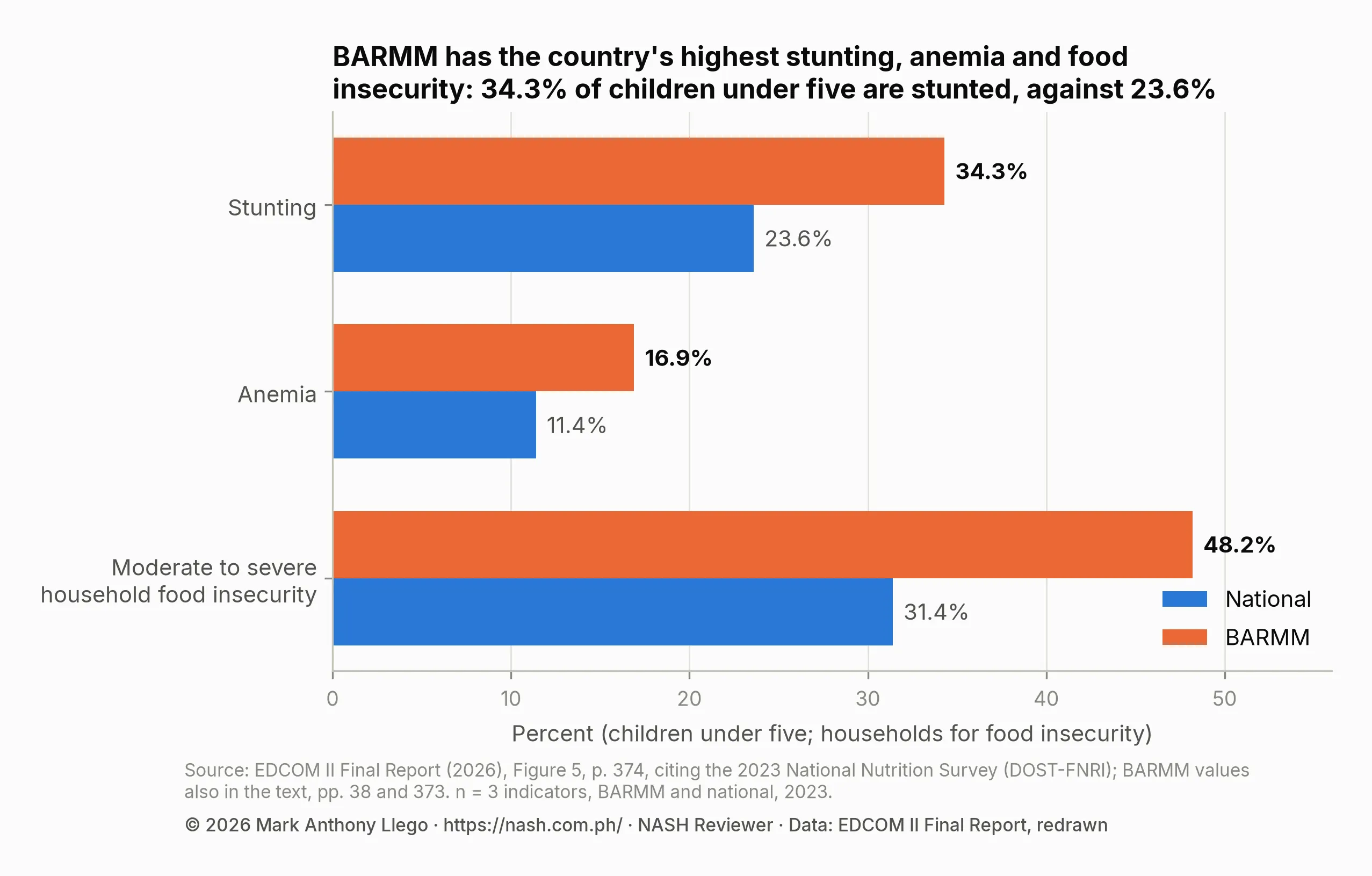
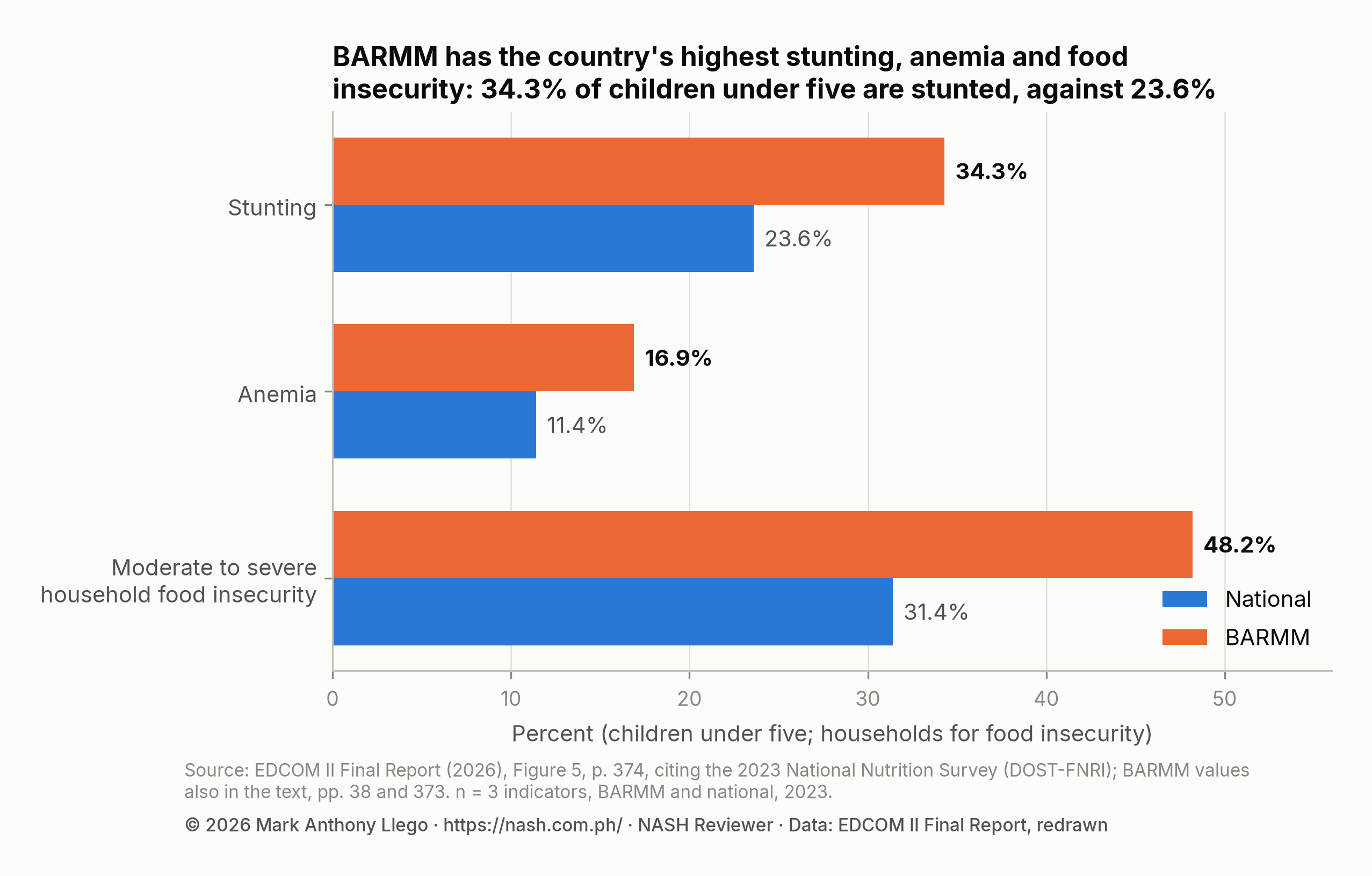
| Indicator (2023) | BARMM | National |
|---|---|---|
| Stunting, children under five | 34.3% | 23.6% |
| Anemia | 16.9% | 11.4% |
| Moderate to severe household food insecurity | 48.2% | 31.4% |
These deficits “have profound implications for children’s readiness to learn” (p. 373). Nationally, a newer survey is worse: EDCOM reported in June 2026 that the DOST-FNRI’s 2025 Updating Survey puts national stunting at 25.3%, with the highest prevalence “in the Bangsamoro Autonomous Region in Muslim Mindanao at 36.0%” (EDCOM 2, June 17, 2026). That survey ran from April 2025 to March 2026, after Sulu’s exclusion, and the release does not say whether it counts Sulu in BARMM or in the Zamboanga Peninsula (34.6%), so the 2023 and 2025 BARMM rates may not cover the same area. There is progress too: the region raised its First 1,000 Days Program budget “from PHP 26.8 million in 2023 to PHP 202.5 million in 2025” (p. 377), though the 2024 consultations also found “discontinued feeding programs” (p. 373).
Early childhood care and development
The report’s counts come from different sources, years and age groups, so they should not be read as one series.
| Measure | Figure | Source as given | Page |
|---|---|---|---|
| Children aged 3 to 4 not in preschool | 89.5% | MBHTE consultations, July 2024 | 373 |
| Children aged 3 to 5 in no ECCD program | 44% | Executive summary | 38 |
| ECCD participation, ages 3 to 4 | 25.82% (country 29.12%) | APIS 2024, Table 6 | 109 |
| ECCD participation, ages 3 to 4 | 20.65% (country 33.54%) | APIS 2024, plan baseline | 437 |
| Functional Child Development Centers | 1,903 of 9,042 needed | Executive summary | 38 |
| Barangays without a CDC | 870 of 2,595 (33.53%) | CBMS; APIS 2024, Table 4 | 101 |
| Barangays lacking CDCs | about 396; 30 with no functional CDC in 2024 | The Asia Foundation, 2025 | 377 |
| Barangays without centers | “nearly 700” | Recommendation 4 | 39 |
| Child Development Workers | 2,732, “meeting only 15%” of 18,084 needed | Executive summary | 38 |
| Workforce gap | “78%” | Recommendation 6 | 39 |
The report reconciles neither the two APIS 2024 rates, nor the counts of barangays without centers, nor the 15% coverage with the “78%” gap, but the direction is clear. None of BARMM’s 2,777 day care centers had been converted into a model CDC (pp. 101–102), and BARMM produced no early childhood education graduates in SY 2021-2022 and had no active ECCD bachelor’s program in SY 2024-2025 (pp. 103–104), and “areas in Sulu and Lanao del Sur faced severe deficits in both infrastructure and personnel” (p. 377). The national picture is in Stunting, Day Care Centers and Early Reading.
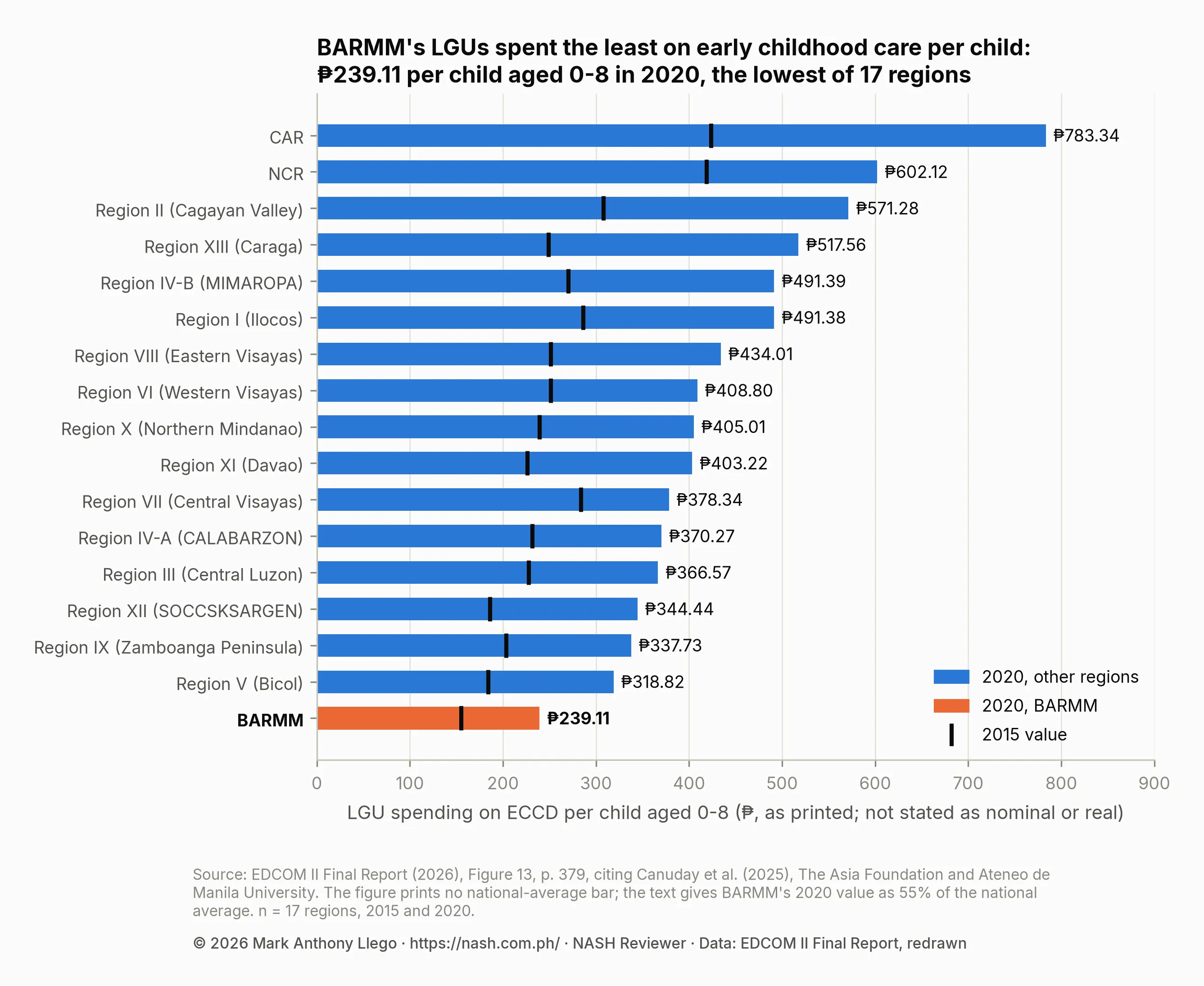
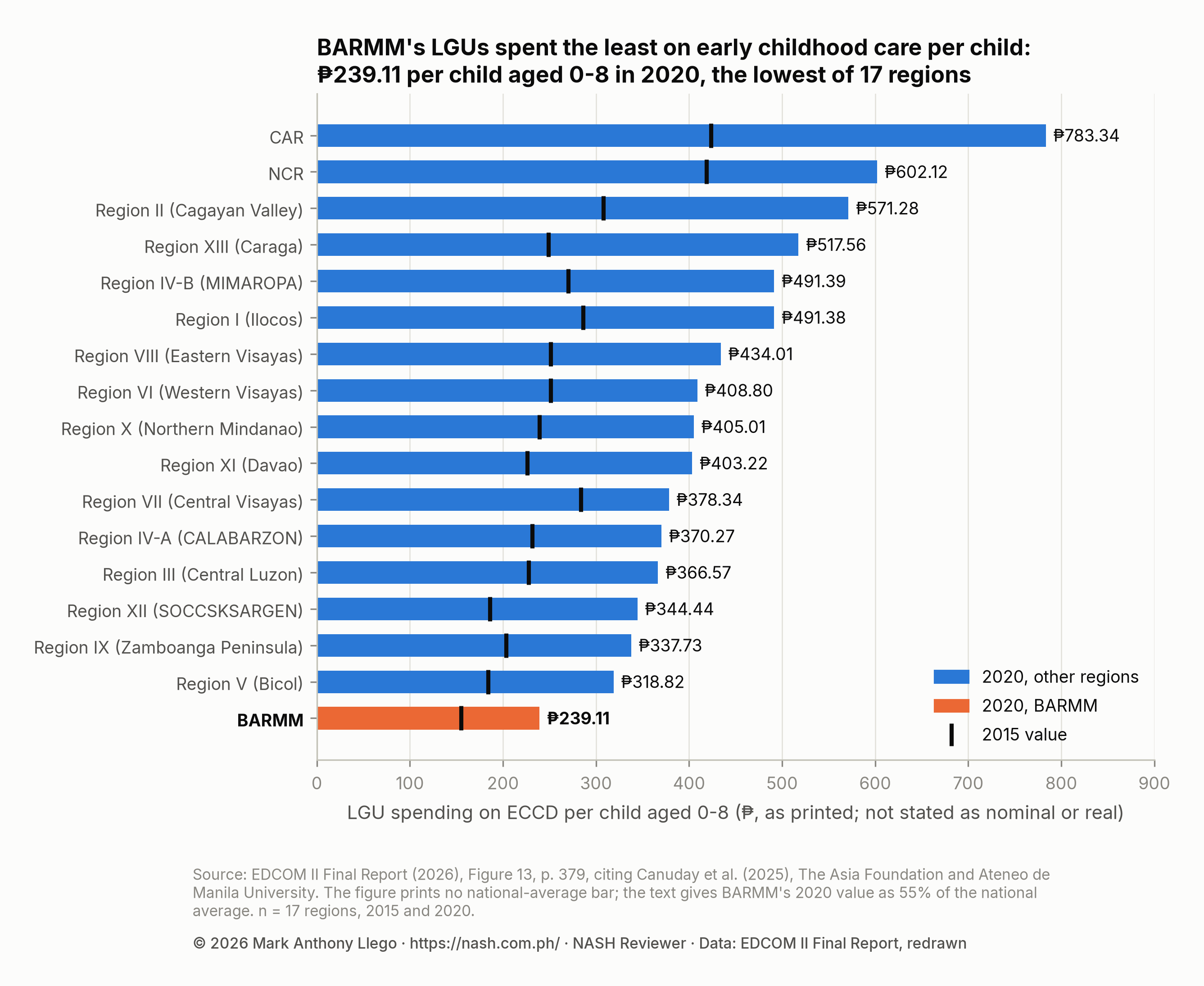
The Asia Foundation found that BARMM’s LGUs “allocate minimal shares of their budgets to social services and nutrition, often prioritizing economic infrastructure instead” (p. 379). Their spending rose from ₱155.06 per child in 2015 to ₱239.11 in 2020 (Figure 13).
Learning outcomes
DepEd’s beginning-of-year assessments in SY 2025-2026 found that “31.44% of Key Stage 1 learners in BARMM are ‘nearly proficient’ in mathematics (the largest category) while 49.44% are classified as ‘low emerging’ readers” (p. 375). Figures 6 and 7 give the counts by schools division, including a row for Sulu, but the two percentages match those counts only without Sulu’s row. The report does not say which was intended.
How far behind? The chapter says Bangsamoro students average “two years behind their peers by Grade 4” (p. 373) and, citing UNICEF’s 2024 annual report, “approximately two years behind curriculum expectations” (p. 375). The executive summary gives 3 to 4 years in literacy and 2 to 3 in mathematics (p. 38), the ranges at which, per Figures 8 and 9, “students in BARMM and other locations were modeled” during COVID (p. 376). The report does not reconcile the two.
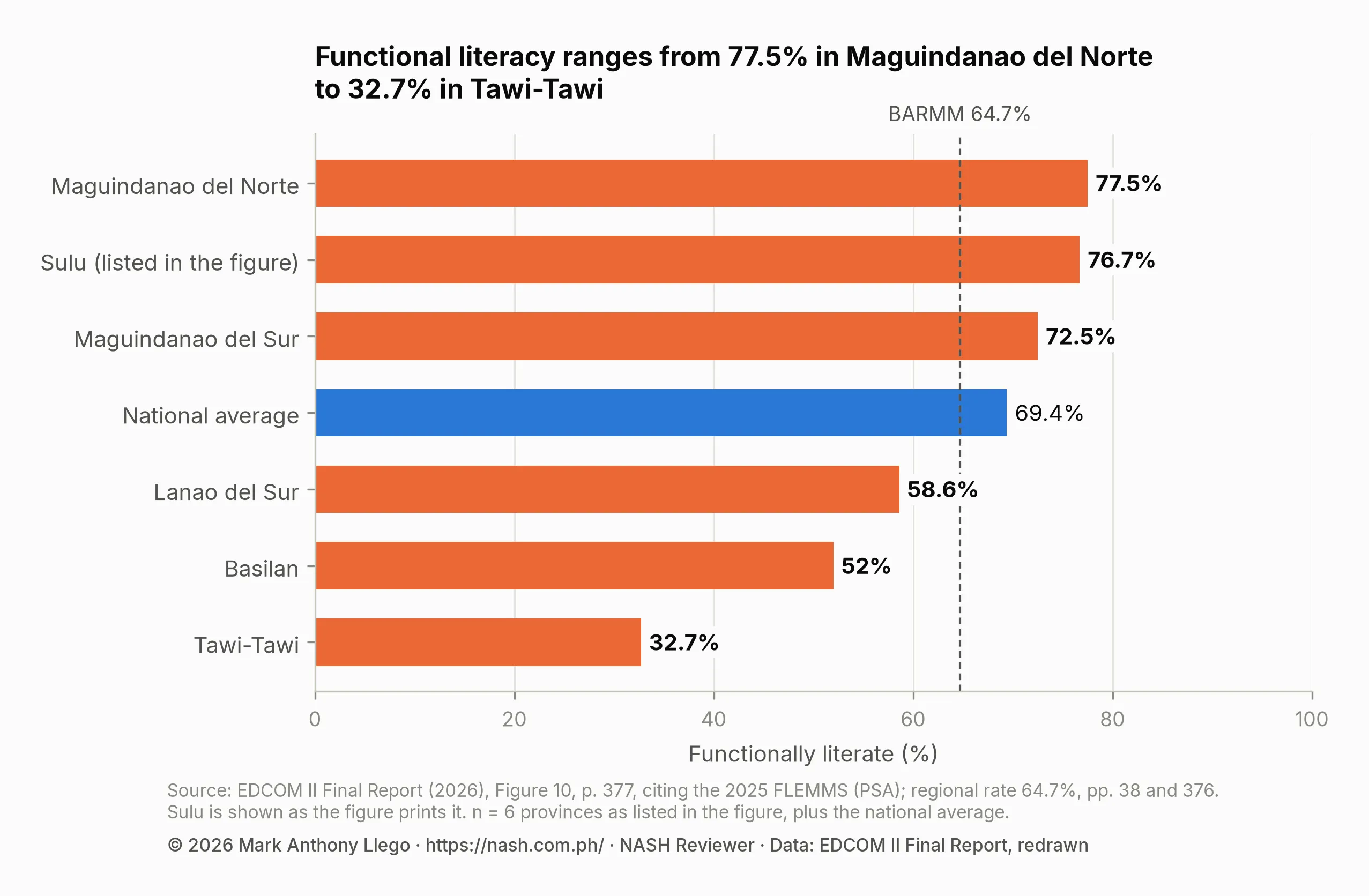
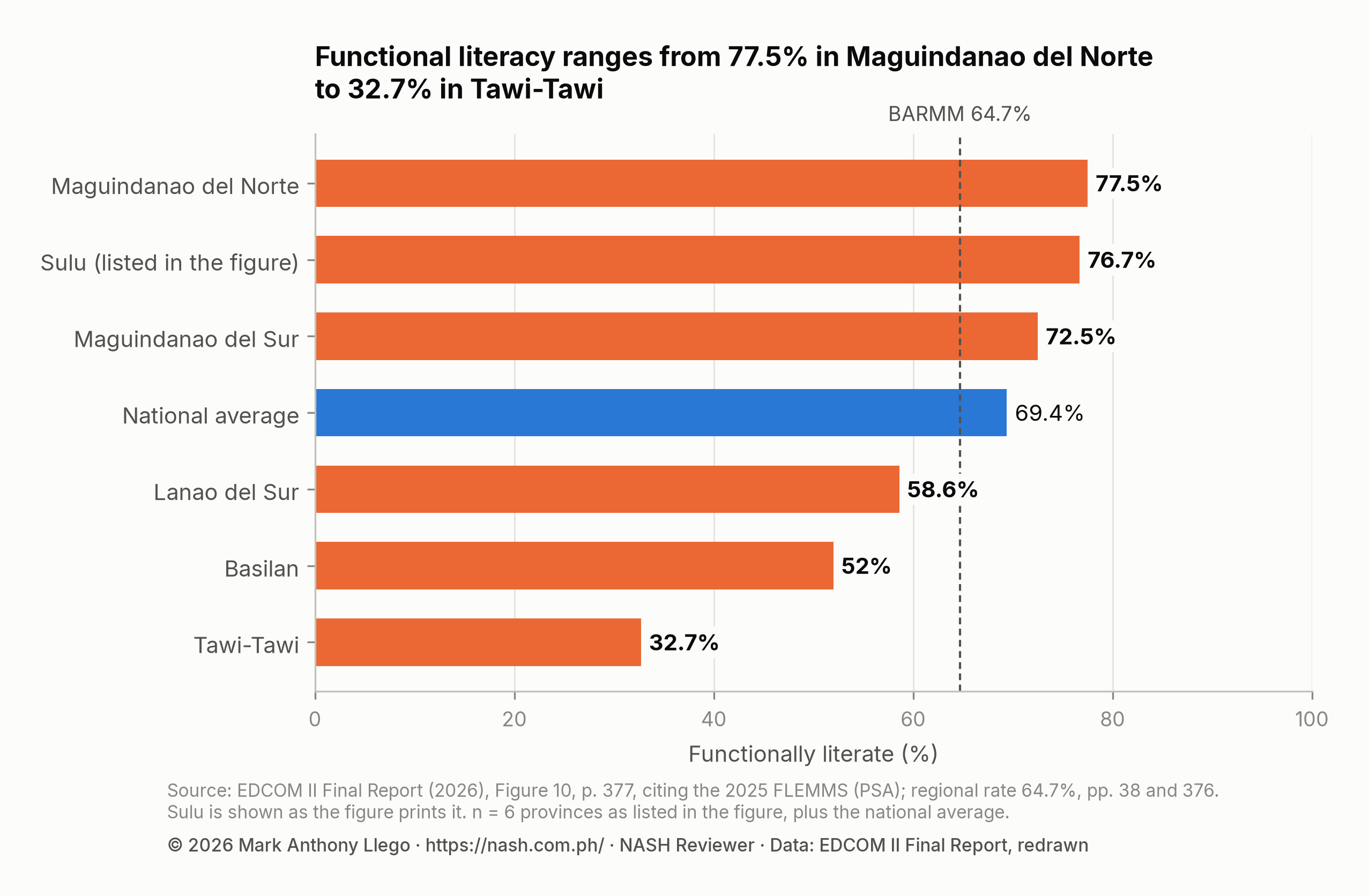
The regional rate of 64.7% is “among the lowest in the country” (p. 376); the chapter’s opening calls it “the country’s lowest” (p. 373). DepEd’s end-of-year CRLA results for the region, by division and grade, are in CRLA Results SY 2025-26 in BARMM; they measure a different point in the year, so the numbers differ.
Participation beyond the early grades
- Out-of-school youth. EDCOM’s visit pointed to “the 46% of youth aged 16-24 who are out-of-school” (p. 373).
- Indigenous learners, as the report classifies them. The report puts BARMM’s participation rate for Indigenous learners at 62%, against 87% in SOCCSKSARGEN, a gap it ties to “conflict exposure, mobility constraints, and linguistic marginalization” (p. 173). Its Figure 17, whose title ends “by Region and Major IP Groups”, lists “Badjao, Tausug, Maranao, Maguindanaon” for BARMM and counts 124,300 IP learners in the region (p. 174). That grouping is the report’s classification. The Bangsamoro Education Code speaks of “the Bangsamoro People and the Indigenous People” (Sec. 9(d)), and EDCOM’s 2026 research agreement names “non-Moro and minority Indigenous Peoples communities” separately (EDCOM 2, August 20, 2026).
- Higher education. Participation is 18.7%, the lowest of the regions, and attrition “a staggering 93.4%” (Year Two Report, pp. 25, 175); the Final Report adds 95.56% for 2023 (Table 6, p. 224).
Classrooms, water and electricity
The 2024 consultations found that the MBHTE completed “only 62.7% of targeted classroom construction despite receiving 30% of the regional budget”, and that “only two schools achieved three-star ratings” for water, sanitation and hygiene as of March 2023 (p. 373). The Final Report puts BARMM’s classroom shortage at 13,237, the third largest after Region IV-A and NCR (Figure 19, p. 179). That count includes Sulu: it equals the 11,064 classrooms for the rest of BARMM plus Sulu’s 2,173 in Classroom Shortage in BARMM.
The Year Two Report adds that BARMM is among the regions with “the highest number of aisle learners” (p. 131); that in its junior and senior high schools “congestion may be caused by the schools being geographically dispersed and remotely located” (p. 141); and that Sulu, with 118 schools, is among the five provinces holding most schools without electricity (pp. 139–140).
Teachers and teacher education
The consultations heard of a “severe teacher shortage, with ratios reaching 80-100 students per teacher” (p. 373). A 2025 Asia Foundation study by Radam, summarized in the chapter, found hiring centralized in the MBHTE Office of the Minister, which “constrains schools’ flexibility to respond quickly to staffing needs”; widespread subject-specialization mismatch; TEI classes of “up to 50 students per section”; and no institutionalized Training Needs Assessment, with “post-training integration and classroom application” rarely monitored (p. 381).
Licensure results are low. PRC data show BARMM “consistently ranked as the lowest-performing region in Mindanao”, with pass rates “fluctuating dramatically—from as low as 4.5% for elementary teachers in 2017 to 30.2% in 2022” (p. 380). The Year Two Report gives overall passing rates of 15.8% for elementary and 12.6% for secondary (Year Two Report, p. 245).
Initial results of a Year Two survey of teacher educators found BARMM with “low percentages of licensed, graduate-degree-holding, and tenured faculty”; 45.33% were tenured, the lowest share of any region (Year Two Report, pp. 231–232). The National Education Plan’s baseline for the share of BARMM’s 83 TEIs with accredited undergraduate programs is 0 (Final Report, p. 460), and the plan document lists BARMM among the regions “without any COEs”, or teacher education Centers of Excellence (National Education Plan document, p. 51).
How education in BARMM is financed
The reports discuss financing in pieces:
- The regional budget. The MBHTE received “30% of the regional budget” (p. 373).
- National funds. RA 11054 keeps programs such as the School Building Program on national funding, and Government Assistance to Students and Teachers in Private Education (GASTPE) subsidies of an estimated ₱900 million to ₱1 billion flow to BARMM (p. 382). The Final Report writes that EDCOM Commissioner Rep. Zia Alonto Adiong underscored that nationally funded programs must continue operating in BARMM and that the block grant is not a substitute for national education support (p. 383).
- Fiscal coordination. DBM’s Local Government and Regional Coordination Bureau “acknowledged the need for stronger intergovernmental fiscal mechanisms” (p. 383).
- Local spending. Beyond the low LGU spending on early childhood (p. 379), the National Education Plan document proposes “a unified per-child funding floor for the foundational years (0–8), equity-weighted for GIDA, BARMM, IP learners, those from the poorest quintiles” (National Education Plan document, p. 103).
- The Special Education Fund. The Year One Report’s SEF analysis left BARMM out: “BARMM LGUs were excluded due to incomplete data” (Year One Report, p. 284; also p. 285). Local School Boards and the Special Education Fund explains the SEF.
Three weeks after the hearing, EDCOM convened agencies on October 30, 2025 over “differing interpretations” on whether core services “should be funded through national budgets or considered covered by the BARMM’s annual block grant”. It counted 23 laws needing clarification and asked the Department of Justice and DBM for a legal opinion (EDCOM 2, October 30, 2025). As of October 28, 2026, EDCOM had not reported that opinion.
What EDCOM II recommends for BARMM
The executive summary’s nine recommendations
| Area | Recommendation (Final Report, p. 39) |
|---|---|
| Nutrition and foundational learning | 1. Fast-track integrated nutrition and early learning interventions, prioritizing the provinces with the highest stunting and lowest literacy |
| 2. Expand the First 1,000 Days program with MOH, MSSD and MBHTE, with dedicated funding and unified monitoring | |
| 3. Prioritize Key Stage 1 learning recovery with contextualized materials and intensive teacher support | |
| Early childhood care and development | 4. Accelerate Child Development Center construction and conversion in the “nearly 700 barangays currently without centers” |
| 5. Unify ECCD governance under a single coordinating body within the Bangsamoro Government | |
| 6. Recruit and train Child Development Workers to close the “78% workforce gap” | |
| Teacher education and licensure | 7. Convene MBHTE, CHED and PRC to issue a joint memorandum on program recognition, accreditation and licensure eligibility for graduates of BARMM-based TEIs |
| National-regional coordination | 8. Issue a Joint Memorandum Circular among DepEd, CHED, TESDA and MBHTE establishing a formal coordination framework for planning, budgeting and program implementation |
| 9. Clarify through an interagency issuance how national programs apply within BARMM, “including funding flow, eligibility, and reporting requirements” |
The chapter adds recommendations from The Asia Foundation’s studies (pp. 383–384). For early childhood: phased devolution to capable LGUs; a whole-of-government structure “with the BARMM Chief Minister as convener, MSSD as coordinating agency”; a fiscal mechanism between DBM and the Bangsamoro Ministry of Finance, Budget and Management (MFBM); and an ECCD roadmap “legislated by the BARMM Parliament”. For teachers: an MBHTE–CHED–PRC–TEC Joint Coordinating Council; a Bangsamoro Teacher Education and Development Reform Code; “a hybrid hiring scheme that balances regional oversight with division-level responsiveness”; annual Training Needs Assessments “at regional, division, and school levels”; and an Islamic Studies and Arabic Language (ISAL) bridging framework “to integrate ISAL teachers into the mainstream education system”. The hearing also called for “an inventory of all national education programs” in BARMM (p. 383).
Targets in the National Education Plan
The ten-year plan sets equity targets for BARMM beside the national ones (Figure 4); the stand-alone plan document prints the same values (National Education Plan document, pp. 14, 18, 28, 30). It also plans a Special Needs Education degree program in BARMM by 2028, under the MBHTE and the Teacher Education Council (TEC), and accredited undergraduate programs in all BARMM TEIs by 2028, under the MBHTE (pp. 460, 471).
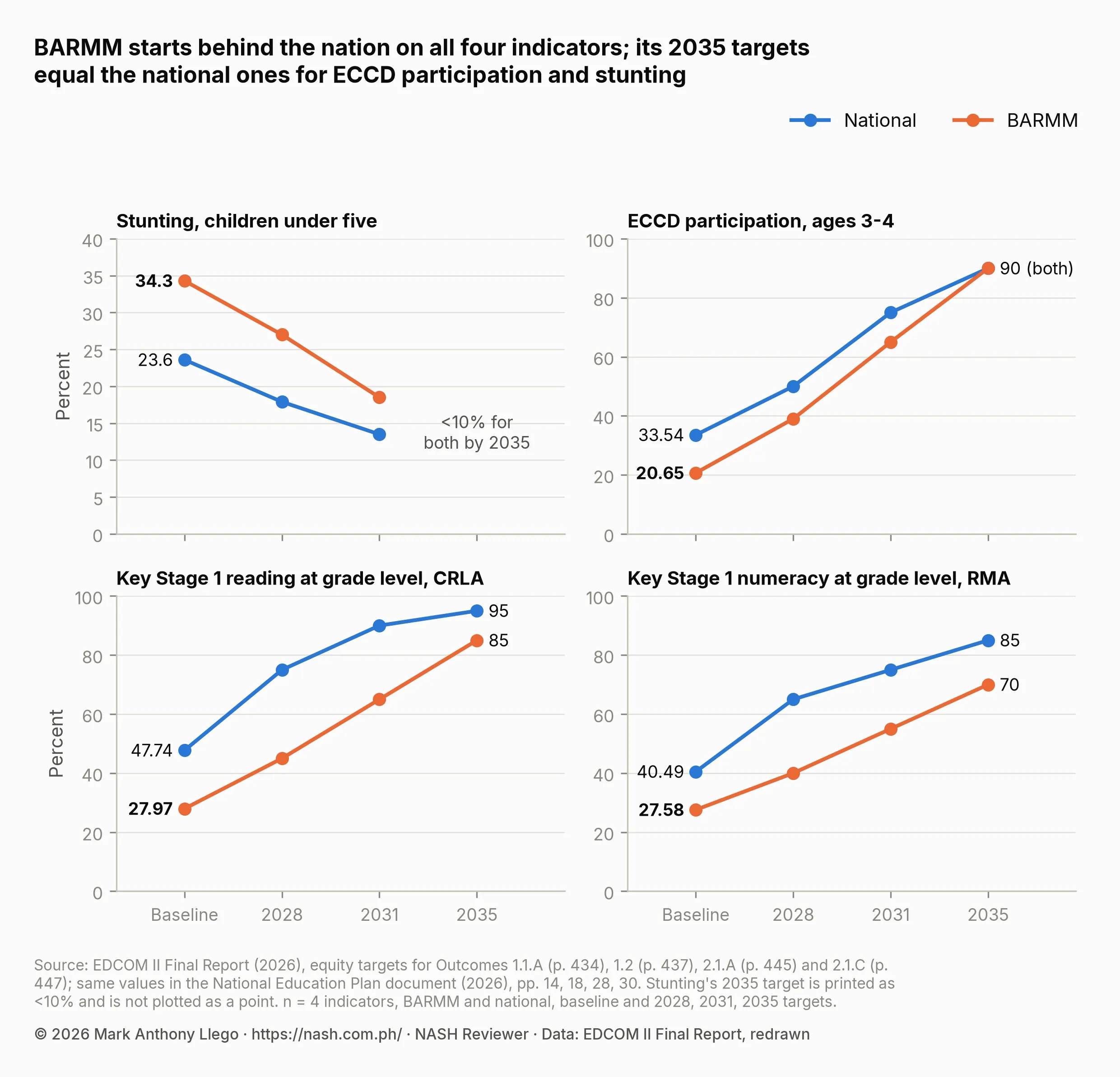
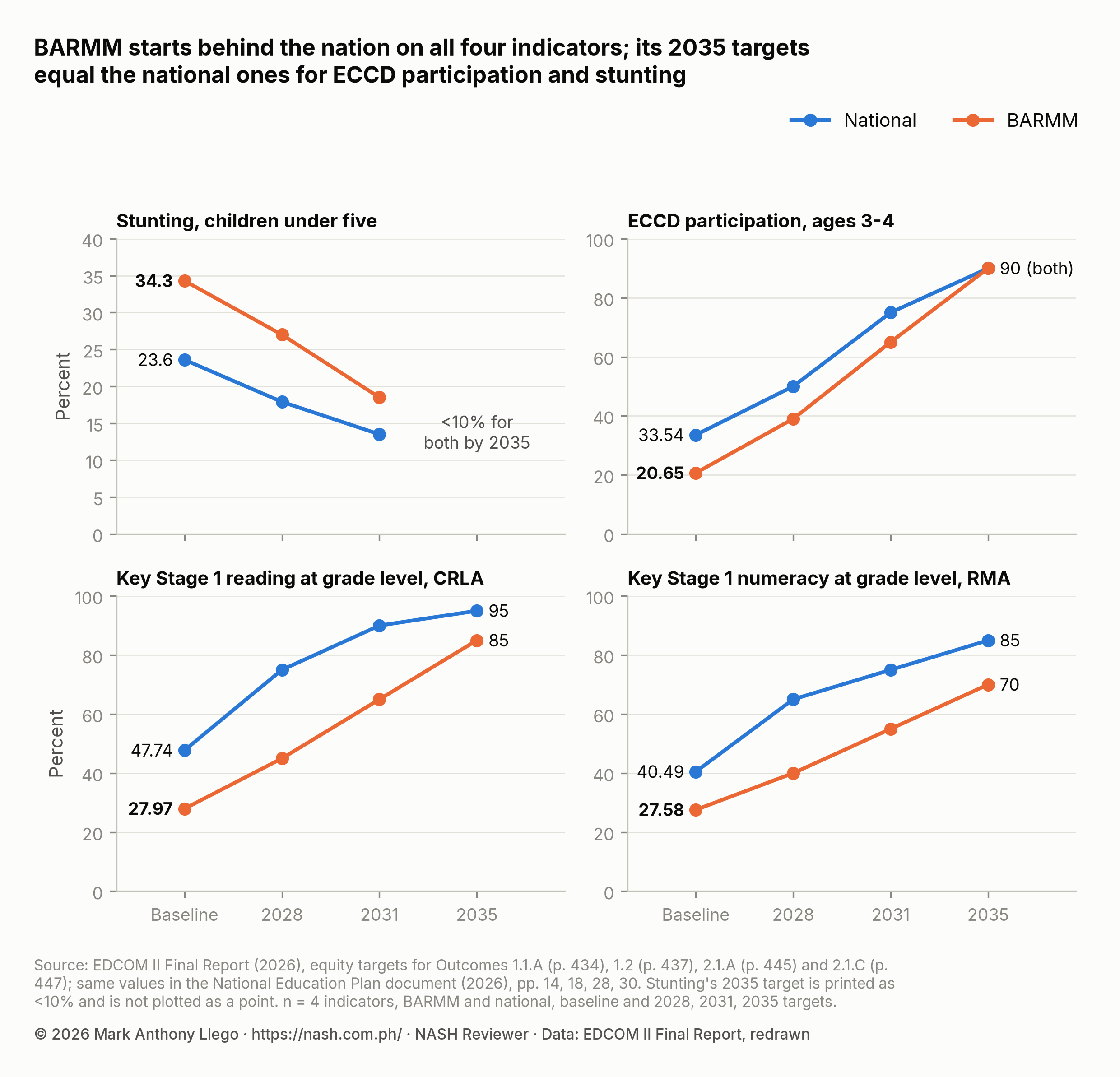
| Indicator | Area | Baseline | 2028 | 2031 | 2035 | Page |
|---|---|---|---|---|---|---|
| Stunting, children under five | BARMM | 34.3% | 27.0% | 18.5% | <10% | 434 |
| National | 23.6% | 17.9% | 13.5% | <10% | 434 | |
| ECCD participation, ages 3 to 4 | BARMM | 20.65% | 39% | 65% | 90% | 437 |
| National | 33.54% | 50% | 75% | 90% | 437 | |
| Key Stage 1 reading at grade level (CRLA) | BARMM | 27.97% | 45% | 65% | 85% | 445 |
| National | 47.74% | 75% | 90% | 95% | 445 | |
| Key Stage 1 numeracy at grade level (RMA) | BARMM | 27.58% | 40% | 55% | 70% | 447 |
| National | 40.49% | 65% | 75% | 85% | 447 |
On numeracy, the targets leave BARMM 15 points behind the nation in 2035, more than the 12.91 points at baseline. The guide to the National Education Plan covers the plan as a whole.
What has changed, and Sulu’s status
From hearing to coordination forum
| Date | Event | Source |
|---|---|---|
| March 24, 2026 | Final Report turned over to the Bangsamoro Parliament at the 4th meeting of the Philippine Congress–Bangsamoro Parliament Forum, which created a Technical Working Group for Education | EDCOM 2 |
| July 28, 2026 | Memorandum of Agreement establishing the Bangsamoro Education Coordination Forum (BECF), signed by MBHTE, DepEd, CHED, TESDA and PRC | EDCOM 2 |
| August 19, 2026 | EDCOM and MSU-Iligan Institute of Technology sign a research agreement covering topics that include Madrasah Education and “non-Moro and minority Indigenous Peoples communities” | EDCOM 2 |
| September 3–4, 2026 | Technical preparatory workshop for the BECF’s first meeting, with UNICEF | EDCOM 2 |
At the March turnover, the MBHTE Minister said the ministry “will be recalibrating our program and performance targets to ensure the priorities recommended in the report are met, such as early childhood development, school building, and reading interventions”. The release also reports EDCOM’s executive director pointing to a bright spot: “BARMM Grade 3 learners actually scored higher than the national average in most mathematics competencies” (EDCOM 2, March 24, 2026). It does not name the assessment.
The BECF is meant to be “a permanent platform for aligning priorities, strengthening coordination, and improving education outcomes” (EDCOM 2, July 28, 2026). Two cautions apply. The Final Report asked for a Joint Memorandum Circular (p. 39); what was signed is a Memorandum of Agreement creating a forum. And the September workshop was to prepare “a proposed decision package” for the forum’s inaugural meeting (EDCOM 2, September 3, 2026), which EDCOM’s releases to October 28, 2026 do not report.
Sulu left BARMM before the Final Report
Sulu left BARMM before the Final Report was published, but the report still lists it among BARMM’s divisions and provinces in Figures 6, 7 and 10 to 12 (pp. 375–378), and notes “severe deficits” in early childhood services in “areas in Sulu and Lanao del Sur” (p. 377). Its National Education Plan, by contrast, counts Sulu’s schools in DepEd’s baseline for principal items, which uses SY 2024-2025 school data “including 467 schools in Sulu” (p. 495); the plan document says “467 schools in SDO Sulu” (National Education Plan document, p. 94).
The legal position is settled. In Province of Sulu v. Medialdea (G.R. Nos. 242255, 243246 and 243693; called Province of Sulu v. the Executive Secretary in EO 91), the Supreme Court’s decision of September 9, 2024 declared RA 11054 void “in so far as it includes petitioner Province of Sulu” and held that “The Province of Sulu shall not be part of the Bangsamoro Autonomous Region”; the rest of the law, “based on the challenges raised in these petitions”, is “NOT UNCONSTITUTIONAL”. On November 26, 2024, the Court denied the motions for partial reconsideration “with FINALITY” and declared the decision “FINAL AND IMMEDIATELY EXECUTORY”. That Resolution opens: “The result of the plebiscite is clear. The people of Sulu voted against ratifying the Bangsamoro Organic Law.” It also applied “the doctrine of operative fact to recognize and give legal effect to all acts performed prior to the declaration of unconstitutionality”, so decisions taken while Sulu was part of BARMM “shall not be summarily nullified”. And it kept political status apart from identity: “Not being part of the Bangsamoro Autonomous Region does not reduce the identity of the Tausug as Bangsamoro” (Supreme Court E-Library, Resolution of November 26, 2024).
Executive Order No. 91, s. 2025, signed July 30, 2025, declares Sulu “a part of Region IX (Zamboanga Peninsula)” and directs national agencies to include it under Region IX “for regional administration, development planning, investment programming and budgeting” (Sec. 3). It made FY 2025 an interim period and provides that from FY 2026 all programs, activities and projects in Sulu “shall be fully implemented by the NGAs concerned” and the provincial and local governments (Sec. 2). Its Technical Working Group is chaired by the DBM Secretary and includes the DepEd Secretary and an Assistant Regional Secretary of the MBHTE (Sec. 4). Affected permanent personnel may transfer to BARMM, to national agencies or to LGUs, or retire with benefits (Secs. 6–8). Those who retire or separate may not be reemployed in the Executive Branch for five years, “except as teaching or medical staff in educational institutions and hospitals” (Sec. 10).
For Sulu’s schools, the transition has gone in steps:
-
November 2024. DepEd asked UNICEF to help support “the transition of Sulu from BARMM back to DepEd supervision” (DepEd, November 20, 2024).
-
February 2026. “BARMM committed to shoulder the salaries of basic education personnel in Sulu for FY 2026”, with “administrative supervision to be jointly exercised with the Department of Education (DepEd)”, which was to provide the schools’ maintenance and other operating expenses (MOOE). The MBHTE, DepEd and CHED were to “issue a joint memorandum clarifying the shared supervision of schools in Sulu”, salary requirements were to be submitted “by the Schools Division Office of Sulu” to the MBHTE, and “Affected personnel shall continue reporting to BARMM until the transition is fully completed” (DBM, February 9, 2026).
-
March 2026. The Technical Working Group backed measures allowing the Bangsamoro Government “to fund the salaries of Islamic Studies and Arabic Language (ISAL), Abot Kaalaman sa Pamilyang Bangsamoro (AKAP), and para-teachers in Sulu for FY 2026”; “the renewal of all contracts of service (COS) workers will proceed under standard MBHTE processes”, and a “Joint Memorandum Circular on Personnel Options” was being finalized with the Civil Service Commission and BARMM (DBM, March 6, 2026).
-
May 2026. DepEd set aside “1,467 posisyon para sa Teacher I” (1,467 Teacher I positions) for the Division of Sulu among Region IX’s new items (DepEd, May 18, 2026).
-
October 2026. DepEd announced “ang pormal na pag-anib ng Schools Division Office (SDO) ng Sulu sa Department of Education (DepEd) Region IX (Zamboanga Peninsula)”, the formal integration of the Sulu Schools Division Office into DepEd Region IX (DepEd, October 20, 2026). A week later DepEd welcomed the DBM’s approval of 3,627 teaching and teaching-related positions “for the newly established Schools Division Office (SDO) of Sulu” (DepEd, October 27, 2026).
As of October 2026, no DepEd order or memorandum covers the transfer itself.
Reading BARMM figures now. The Key Stage 1 percentages leave Sulu out (p. 375), the classroom shortage of 13,237 includes it (p. 179), and the CRLA and classroom data posts leave Sulu out of their BARMM figures. Before comparing two BARMM figures, or quoting one in a school plan, check whether it includes Sulu.
What this means for school heads
In BARMM
- Start with the youngest learners. EDCOM’s first three recommendations are nutrition, early learning and Key Stage 1 recovery (p. 39). Set reading targets for Grades 1 to 3 from your school’s own beginning-of-year results, not the regional figure, in the School Improvement Plan.
- Find out which national programs reach your school. EDCOM found them “sometimes unavailable or delayed” (p. 39). Record what your school receives and what it does not, and raise gaps through your division and the MBHTE; at the agency level, the BECF has been created to settle such questions.
- Work with the barangay, the LGU and the health and social services offices. Early childhood services are split among the MOH, the MSSD and the MBHTE (p. 38), and LGUs spend on them too (p. 379). Knowing which feeder barangays have a functioning center tells you which Kindergarten learners arrive without early schooling. The Domain 5 guide covers such partnerships.
- Make training count. EDCOM recommends Training Needs Assessments down to the school level (p. 384): assess needs before nominating teachers, and check that training shows up in lessons (Domain 4 guide).
- Use the autonomy the Code gives. Schools “shall enjoy greater autonomy in decision-making concerning local matters” (Secs. 57, 85), much like DepEd’s school-based management.
In Sulu
Under the arrangements agreed in February 2026, BARMM committed to pay basic education salaries for FY 2026, supervision was to be shared with DepEd, DepEd was to provide MOOE, and personnel were to keep reporting to BARMM until the transition is fully completed (DBM, February 9, 2026). Keep enrollment, learner, property and personnel records in order, since acts taken while Sulu was in BARMM keep their legal effect (Supreme Court Resolution of November 26, 2024). Make sure teachers know their options under Executive Order No. 91, s. 2025 (Secs. 6–8) and its exception for teaching staff (Sec. 10). The Domain 2 guide covers records and staffing.
Elsewhere, with Muslim or Indigenous learners
The reports speak of “Indigenous Peoples (IPs) and Muslim learners”, and their findings here are national, not specific to BARMM:
- “[A]round 20% of Muslim ethnic groups and 10% of IPs lack birth registration”, and “About half of Indigenous and Muslim learners do not progress beyond elementary education, compared to less than one‑third among non-Indigenous peers” (Final Report, p. 173).
- In the Grade 10 National Achievement Test, only 2,847 learners nationwide reached proficient or highly proficient; in priority school types the counts were 69 in GIDA schools, 42 in Last Mile schools, 18 in Hardship Post schools, 4 in IPEd schools and 133 in schools with the Madrasah Education Program (MEP) (p. 174).
- 343,672 learners, 20.5% of 1,676,470 school-age Muslim children, are in Arabic Language and Islamic Values Education (ALIVE) (DepEd, SY 2023-2024); the plan aims for 46% by 2028, 72% by 2031 and 100% by 2035 (p. 469). The plan document notes that this baseline “Includes BARMM enrollment data” (National Education Plan document, p. 58). IP enrollment is 60.4%, with targets of 75%, 85% and 95% in the summary table (p. 467) but 70%, 80% and 90% in the detailed table (p. 469); the plan document has the same two sets (pp. 55, 57).
The plan’s support measures include: “Train principals and teachers on MEP Implementation”; train them on “culturally responsive school improvement planning and IPEd implementation, especially for IP-majority areas”, and “Ensure the representation of IPs in School Governing Councils of IP-majority schools” (pp. 475–476). The Final Report adds “school–community partnerships, and coordination with PSA and LGUs to resolve documentation barriers such as missing birth registration” (p. 176).
Funding for ALIVE classes follows DepEd Order No. 011, s. 2024, which amends DepEd Order No. 025, s. 2021. Program Support Funds go to schools division offices with “organized ALIVE classes, having a total of at least 10 Muslim learners per class” (Item 17.1.1; reprinted in the National Education Plan document, p. 66), so a school head who knows how many Muslim learners are in each class can tell the division whether the school qualifies. DepEd Enhanced ALS, Inclusive Education and Special Programs explains the MEP and IPEd.
How the NASH may test this
Under DepEd Memorandum No. 069, s. 2025, the NASH covers “conceptual and situational critical thinking questions” aligned with the Philippine Professional Standards for School Heads (PPSSH), “using the SOLO (Structure of the Observed Learning Outcome) taxonomy as an underpinning framework” (para. 3). The item below is an original practice item, scored 3 (Relational), 2 (Multistructural), 1 (Unistructural) or 0 (Prestructural).
Question 1
Indicator 5.3.1, Inclusive practices. Career Stage 1, Situational, Moderate.
A public elementary school outside BARMM has 14 Muslim learners in one Grade 2 class and 12 in one Grade 3 class. Parents ask whether their children can study Arabic and Islamic values in school; a teacher says the school cannot afford it. What should the school head do first?
- A. Agree with the teacher, since religious instruction is a family matter and the MOOE is already committed.
- B. Count the Muslim learners in each class, ask the schools division office whether the school can organize ALIVE classes under the Madrasah Education Program, and meet the parents and local Muslim leaders about how the classes would run.
- C. Start ALIVE classes at once with a community volunteer paid from the school’s MOOE.
- D. Ask the schools division office about ALIVE classes, and tell the parents the result when it replies.
Answer and explanation
Best answer: B. Points: A = 0, B = 3, C = 1, D = 2.
- A (0 points, Prestructural). It treats a DepEd program as outside the school’s concern and dismisses the families.
- B (3 points, Relational). It connects the evidence (learners per class), the policy channel (the division, which receives MEP Program Support Funds) and the community whose support the classes need.
- C (1 point, Unistructural). It responds to the parents but bypasses the program’s funding channel.
- D (2 points, Multistructural). It uses the right channel but skips the class-by-class count the division needs and brings the parents in only at the end.
Why. Under DepEd Order No. 011, s. 2024, MEP Program Support Funds go to schools division offices with “organized ALIVE classes, having a total of at least 10 Muslim learners per class” (Item 17.1.1). EDCOM II asks for “school–community partnerships” for Muslim and IP learners (Final Report, p. 176) and for training principals “on MEP Implementation” (p. 476).
Indicator 5.3.1: Demonstrate knowledge and understanding of inclusive practices, such as gender sensitivity, physical and mental health awareness and culture responsiveness, to foster awareness, acceptance and respect.
Sources: DepEd Order No. 011, s. 2024; EDCOM II Final Report (2026), pp. 173–176, 476.
Nothing in this guide reproduces or predicts examination content.
Frequently asked questions
What did EDCOM II find about education in BARMM?
The Final Report finds the country’s highest stunting (34.3%), a functional literacy rate of 64.7% and teacher ratios reaching “80-100 students per teacher” (pp. 38, 373–376), and no formal mechanism coordinating the MBHTE with DepEd, CHED or TESDA (p. 39).
Is DepEd in charge of public schools in BARMM?
No. Under the Bangsamoro Education Code, the administration, supervision and regulation of education in the region is “vested to the Ministry of Basic, Higher, and Technical Education” (Sec. 6). The Organic Law makes it “a subsystem of the national education system” bound by national minimum standards (Final Report, pp. 372–373). On July 28, 2026, the MBHTE, DepEd, CHED, TESDA and PRC signed a Memorandum of Agreement creating the Bangsamoro Education Coordination Forum; EDCOM’s releases to October 28, 2026 do not yet report its first meeting.
Is Sulu still part of BARMM?
No. The Supreme Court ruled on September 9, 2024 that “The Province of Sulu shall not be part of the Bangsamoro Autonomous Region” and made the ruling final on November 26, 2024. Executive Order No. 91, s. 2025 declared Sulu part of Region IX (Sec. 3), and DepEd announced the formal integration of the Sulu Schools Division Office into DepEd Region IX on October 20, 2026. Some BARMM figures in the Final Report still list Sulu (pp. 375–378).
What does EDCOM II recommend for BARMM?
Nine recommendations in four areas: nutrition and foundational learning, early childhood care, teacher education and licensure, and national-regional coordination (Final Report, p. 39). They include unifying ECCD governance, a joint memorandum on recognizing BARMM teacher graduates, and a Joint Memorandum Circular among DepEd, CHED, TESDA and MBHTE. The chapter adds hybrid hiring, school-level training needs assessments and an ISAL bridging framework (p. 384).
Download the data
- barmm-nutrition-vs-national.csv: stunting, anemia and household food insecurity, BARMM and national, 2023 (Final Report, Figure 5, p. 374; pp. 38, 373).
- barmm-functional-literacy-provinces.csv: functional literacy by province as printed, with the national average (Final Report, Figure 10, p. 377; regional rate, pp. 38, 376).
- barmm-lgu-eccd-spending.csv: LGU spending on early childhood per child aged 0 to 8, 17 regions, 2015 and 2020 (Final Report, Figure 13, p. 379).
- barmm-nep-equity-targets.csv: National Education Plan baselines and 2028, 2031 and 2035 targets for BARMM and the nation on four indicators (Final Report, pp. 434, 437, 445, 447; National Education Plan document, pp. 14, 18, 28, 30).
The CSVs and charts may be reused only with written permission: email support@nash.com.ph. The numbers themselves come from the EDCOM II reports, which you can cite directly.
How to cite this post
Llego, M. A. (2026, October 30). Education in the Bangsamoro: EDCOM II Findings for BARMM. NASH Reviewer. https://nash.com.ph/blog/bangsamoro-education-barmm-edcom-ii
The EDCOM II reports:
- Second Congressional Commission on Education. (2024). Miseducation: The failed system of Philippine education (EDCOM II Year One Report). https://edcom2.gov.ph/media/2024/02/EDCOM-II-Year-One-Report-PDF-022924.pdf
- Second Congressional Commission on Education. (2025). Fixing the foundations: A matter of national survival (EDCOM II Year Two Report). https://edcom2.gov.ph/media/2025/01/EDCOM-2-Year-2-Report-Fixing-the-Foundations-2025.pdf
- Second Congressional Commission on Education. (2026). Turning point: A decade of necessary reform (2026–2035) (EDCOM II Final Report). https://edcom2.gov.ph/media/2026/01/EDCOM-II-Y03-for-web-012626_final.pdf
- Second Congressional Commission on Education. (2026). The National Education Plan (2026–2035) [Part of Turning point: A decade of necessary reform, EDCOM II Final Report]. https://edcom2.gov.ph/media/2026/01/EDCOM-II_Y03_National-Education-Plan.pdf
Sources
- EDCOM II, Final Report (2026), pp. 38–39, 101–104, 109, 173–176, 179, 224, 372–384, 434, 437, 445, 447, 460, 467, 469, 471, 475–476, 495.
- EDCOM II, National Education Plan (2026–2035) (2026), stand-alone document, pp. 14, 18, 28, 30, 51, 55, 57–58, 66, 94, 103.
- EDCOM II, Year Two Report (2025), pp. 25, 131, 139–141, 175, 231–232, 245.
- EDCOM II, Year One Report (2024), pp. 284–285.
- EDCOM 2, Clarity needed on the implementation of 23 national education laws in BARMM, October 30, 2025.
- EDCOM 2, EDCOM 2 turns over Final Report to Bangsamoro Parliament; Forum creates dedicated Technical Working Group for education, March 24, 2026.
- EDCOM 2, Stunting rate rises to 25.3% – first increase in 10 years, June 17, 2026.
- EDCOM 2, Bangsamoro Education Coordination Forum established, July 28, 2026.
- EDCOM 2, EDCOM 2 and MSU-IIT forge research partnership to drive education reform in BARMM, August 20, 2026.
- EDCOM 2, National, Bangsamoro officials come together to tackle priority education reforms in BARMM, September 3, 2026.
- Republic Act No. 11054, An Act Providing for the Organic Law for the Bangsamoro Autonomous Region in Muslim Mindanao, signed July 27, 2018 (Official Gazette); Article IX, Section 16 and Article VI, Section 13 as quoted in the Final Report, pp. 372–373, 382.
- Bangsamoro Autonomy Act No. 18, Bangsamoro Education Code of 2021 (Bangsamoro Official Gazette), Secs. 3, 5–6, 9(d), 21, 57, 62, 85–88 and signature page.
- Supreme Court, Province of Sulu v. Medialdea, G.R. Nos. 242255, 243246 and 243693, Resolution of November 26, 2024, quoting and affirming the Decision of September 9, 2024.
- Executive Order No. 91, s. 2025, Further Ensuring the Continuity of Governmental Operations and Uninterrupted Delivery of Critical Public Services in the Province of Sulu, Declaring the Province of Sulu as Part of Region IX (Zamboanga Peninsula), and for Other Purposes, signed July 30, 2025 (Official Gazette), Secs. 2–4, 6–8, 10.
- Department of Budget and Management, National Government, BARMM seal people-first transition plan to ensure uninterrupted services in Sulu, February 9, 2026.
- Department of Budget and Management, TWG on Sulu Transition Fast-Tracks Measures to Ensure Uninterrupted Education Services, March 6, 2026.
- DepEd, DepEd convenes with UNICEF for joint learning interventions, November 20, 2024.
- DepEd, Higit 32K bagong teaching positions, nakuha ni Angara para sa mga pampublikong paaralan, May 18, 2026.
- DepEd Order No. 025, s. 2021, Revised Implementing Guidelines on the Utilization of Fund for Madrasah Education Program.
- DepEd Order No. 011, s. 2024, Amendment to DepEd Order No. 025, s. 2021, Item 17.1.1.
- DepEd Memorandum No. 069, s. 2025, Administration of the National Assessment for School Heads for Fiscal Year 2025.
- DepEd Order No. 024, s. 2020, National Adoption and Implementation of the Philippine Professional Standards for School Heads (indicator 5.3.1).
The EDCOM II series
The reports:
- What EDCOM II Achieved, 2023-2025: Laws, Budgets, Policies
- EDCOM II’s Three Reports: How the Key Numbers Changed
- EDCOM II Final Report: Guide for Aspiring School Heads
- National Education Plan 2026-2035: Guide for School Heads
- 100 Years After the Monroe Report: Education Commissions
- Is the Philippines Spending Enough on Education?
- Education Data, Transparency and Research: EDCOM II
Learners and learning:
- Mass Promotion and Lost Instructional Time: EDCOM II
- PISA, TIMSS, SEA-PLM and the NAT: What EDCOM II Found
- Mother Tongue After RA 12027: Language of Instruction
- Why DepEd Bought Only 27 Textbook Titles in 2012-2023
- RA 12080, Bullying and School Mental Health: EDCOM II
- RA 11650 and Learners With Disabilities: EDCOM II Findings
- Senior High School and Jobs: EDCOM II Workforce Findings
Schools, teachers and governance:
- Teacher Workload and Accountability: EDCOM II Findings
- Local School Boards and the Special Education Fund
- Local Education Models in EDCOM II: What the Evidence Shows
- Education in the Bangsamoro: EDCOM II Findings for BARMM (this post)
Written by Mark Anthony Llego for NASH Reviewer. Sources: EDCOM II Year One (2024), Year Two (2025) and Final (2026) Reports and the National Education Plan document (2026); EDCOM II news releases, 2025–2026; Republic Act No. 11054; Bangsamoro Autonomy Act No. 18; the Supreme Court’s Resolution in G.R. Nos. 242255, 243246 and 243693; Executive Order No. 91, s. 2025; DBM and DepEd releases on Sulu; DepEd Orders No. 025, s. 2021 and 011, s. 2024; DepEd Memorandum No. 069, s. 2025. Charts may be reused only with written permission from support@nash.com.ph.