Under DepEd Order No. 005, s. 2024, the school head must ensure “that teaching load is equitably and fairly distributed among teachers” (Sec. V.A.1, item 7) and record it in the electronic School Form 7 (eSF7) (Sec. V.D.4). No teacher may be required to teach more than six hours, or 360 minutes, a day (DepEd Memorandum No. 053, s. 2024, para. 3.a). DepEd’s Teacher Workload Policy Toolkit (June 2025) breaks the planning into three steps: a school situational analysis, a workload planning session, and workload rationalization, in which administrative tasks leave teachers first, teaching loads are distributed next, and teaching-related assignments come last (pp. 59, 78). A memorandum of June 4, 2025, DM-OSEC-OUHROD-2025-0002, sets who teaches what: Master Teachers first in Kindergarten to Grade 3, every teacher in their specialization, and teachers in the areas and grades they were trained for.
The sections below cover the mechanics: the teacher requirement, period lengths, the Toolkit’s worked example, advisers, senior high loads under the 2026 curriculum and calendar, and the eSF7. The six-hour rule and the load of each position are in How Many Hours Must DepEd Teachers Teach a Day?, designations in Teaching-Related Assignments, and overload pay in DepEd Teaching Overload Pay. The Toolkit, the simulator guide and DepEd’s Q&A sheets are guidance; where they differ from an order or memorandum, the issuance governs.
Key findings
- Three steps, in order. Situational analysis, workload planning and workload rationalization; within the last, administrative tasks, then teaching loads, then teaching-related assignments (Teacher Workload Policy Toolkit, June 2025, pp. 59, 78). The Toolkit is “a supplementary resource material rather than a prescriptive set of instructions” (p. 9).
- Three rules on who teaches what. Master Teachers first for Key Stage 1, specialization, and relevant training; the Curriculum Implementation Division audits loads “using the eSF7 or similar tools” (DM-OSEC-OUHROD-2025-0002, pp. 1–2).
- 300 minutes is guidance, not a rule. The Toolkit’s 300-minute limit for teachers with more than one learning area or grade level (p. 88) is in no order or memorandum. The binding limit is 360 minutes a day.
- The worked example stays under 360. With 221 learners in 6 classes and 9 teachers (8 required), five teachers carry 330 minutes a day, three carry 270 and one carries 240 (Toolkit, pp. 85–87).
- Period length changes the count. DO 012, s. 2024 allows 45-minute daily periods or uniform 50-, 55- or 60-minute periods in Grades 3 to 10 (para. 2.a). A teacher without an advisory class fits 8 sections of a 45-minute subject within 360 minutes every day, but 6 of a 60-minute daily subject (computed).
- Senior high counts differently in 2026. The pilot simulator uses a “1,800-minute weekly teaching load limit” and its guide never mentions class advising (User Guide, June 2025, p. 3). Its Grade 11 core subjects total 1,200 minutes a week per section (p. 21); Option 1 of DO 017, s. 2026 gives 1,800 (computed: 5 subjects × 4 × 90 minutes; Table 8), though both set 160 hours a year per subject. Asynchronous time “shall” be reflected as load for 2016-curriculum classes (para. 21); for Strengthened SHS classes, notes in the Grade 12 sample schedules say it “should be reflected in the teacher’s schedule as part of their teaching load” (Annex D.1).
- The eSF7 is due by the fourth Friday. The school head accomplishes it at the beginning of the school year, and it is due “on or before the fourth Friday from the opening of classes” (DM 052, s. 2023, Encl. items 1 and 9).
What DO 5 asks of the school head when assigning loads
DO 5 sets an eight-hour workday with six hours of actual classroom teaching, and DepEd reads the six hours as a ceiling: “The six (6) hours of teaching load is the maximum, not a required minimum” (Toolkit, p. 26). Load is counted in minutes, “and not on the number of learning areas handled” (DepEd consolidated Q&A, SY 2026-2027 implementation meetings, No. 2). Three things count:
| Counts as teaching load | Minutes | Source |
|---|---|---|
| Actual classroom teaching per learning area | The curriculum’s time allotment | DO 5, Sec. V.A.1; Toolkit, p. 82 |
| Class advising, including the Homeroom Guidance Program (HGP) | 60 a day, or 5 hours a week | DO 5, Sec. V.A.1, item 2 |
| Remediation and enhancement classes | As set by the program | DO 5, Sec. V.A.1, item 3; DM 53, para. 3.d |
An intervention held “during the allotted time per learning area shall not account for an additional teaching load” (DO 5, Sec. V.A.1, item 4), and teaching-related assignments “do not carry an equivalent teaching load” (Toolkit, p. 90). Class programs must give teachers “ample time for the preparation and correction of exercises” (DO 5, Sec. V.A.3, item 4). Overload is the exception, “In the exigency of service” and at most two hours a day (DM 53, para. 3.b), with specialization “a prime consideration” (DO 5, Sec. V.A.2, item 4). Two 2026 orders add cases: Hinga check-ins in emergencies “shall be considered as part of teaching load” (DO 014, s. 2026, para. 69), and teachers the school head assigns to relieve colleagues on wellness leave “shall be eligible to teaching overload pay” (DO 002, s. 2026, Sec. VI.1.h).
The Toolkit’s three steps for planning workload
The Teacher Workload Policy Toolkit, version 2025-v1, was released on June 25, 2025 with Memorandum DM-OUHROD-2025-1641 and is filed in DepEd’s Teacher Workload Public Drive. Its three steps (pp. 58–92):
| Step | Parts | What it gives the loading plan | Pages |
|---|---|---|---|
| 1. School situational analysis | Gather data; review the SIP and AIP; personnel self-assessment | Enrollment, organized classes, classrooms, teachers and their specialization, and the question “Do we have enough teachers?” | 60–68 |
| 2. Workload planning | Planning session; school-wide orientation; collaborative planning | Agreements and action points under “What the policy says?”, “Where are we?” and “Action Point” | 69–76 |
| 3. Workload rationalization | Administrative tasks; distribution of teaching load and ancillary tasks; designation of teaching-related assignments | The Tasking Matrix, the class program and teachers’ programs, designation orders | 77–92 |
“The steps may overlap and may be adjusted based on your strategy as a school head” (p. 59). Data should drive loads: if end-of-year CRLA results show low emerging readers in Grade 3 English, “you might assign language teachers to conduct remediation classes” (p. 63). The School Improvement Plan guide covers the SIP review.
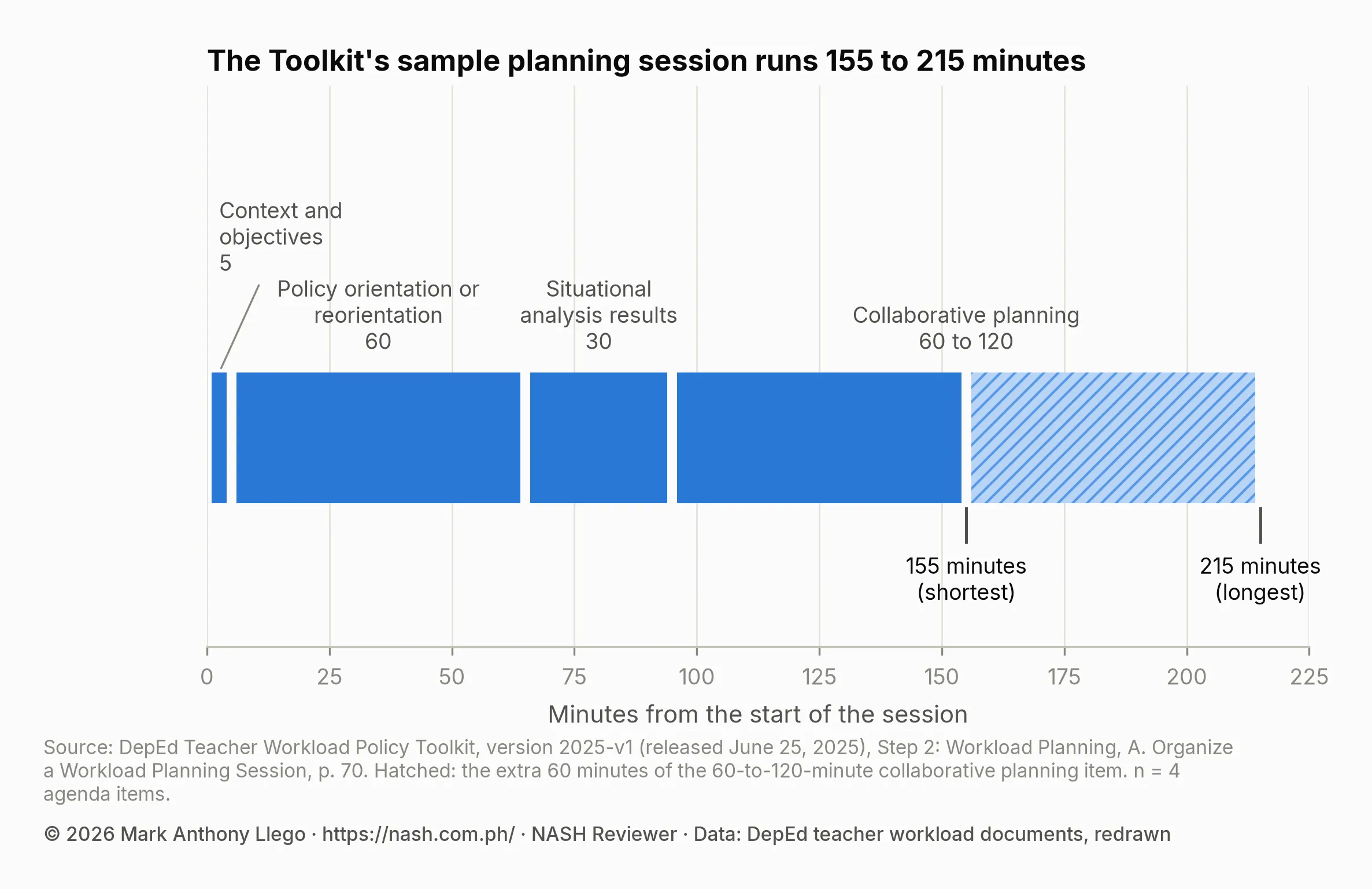
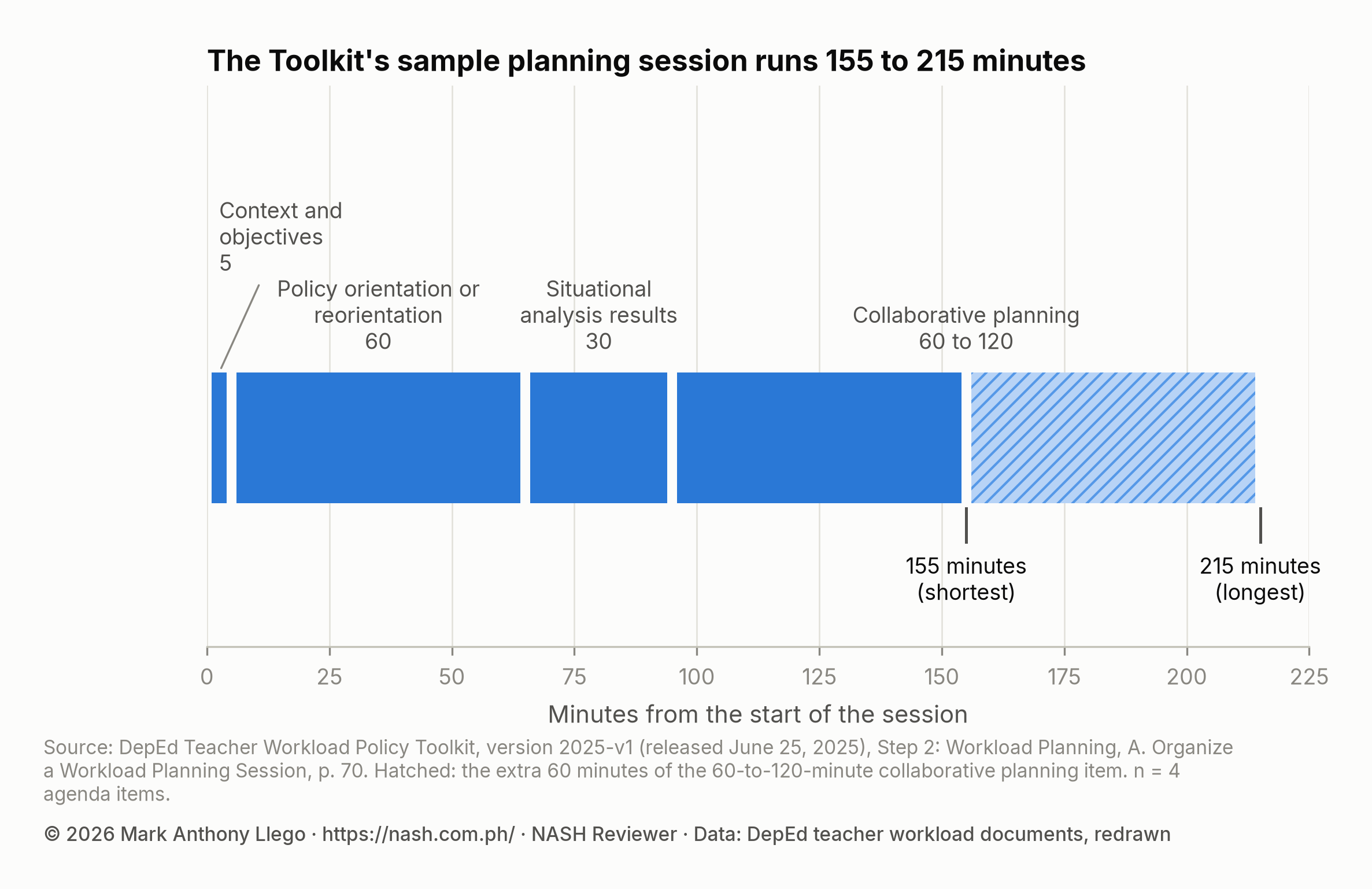
The Toolkit suggests holding the session “as part of your Beginning of School Year (BOSY) preparations or Balik-Eskwela meetings” (p. 70), with “SGC members and PTA officers” invited to the orientation (p. 71), and asks school heads to “Document agreements, action points, pain points” (p. 72). For a Math shortage its sample action is to “request for additional items OR identify in the class programming teacher/s who may render overload hours and document properly for compensation” (p. 74). DM 53 puts designations in the same planning: the school head, “during their planning activities at the start of the school year, shall identify the teachers to be designated” (para. 6.a).
How to work out how many teachers you need
In the Toolkit’s method, enrollment and classrooms set the classes organized, the classes set the teacher requirement, and the requirement is compared with the teachers on hand to show “SUFFICIENT/ SHORTAGE/ EXCESS” (pp. 83–84). A school that needs five Math teachers but has two qualified ones has a shortage, and “the available teachers may need to take on additional teaching hours or render teaching overload” (p. 84).
The Toolkit gives no formula; one that works is to divide the weekly minutes each learning area needs by what one teacher can carry. Six sections of Filipino at 45 minutes, five days a week, need 1,350 minutes. A teacher can carry 1,800 a week (6 hours × 5 days), or 1,500 if a class adviser, before the daily check below. Minutes alone understate the need where each learning area needs its own specialist. In the Toolkit’s sample, the 8 learning areas need 10,800 minutes a week (8 × 6 × 225), enough for six full loads, yet the Toolkit counts 8 required teachers (p. 85), which matches one per learning area; most teachers there are “assigned one subject based on their specialization” (p. 87). So work the sum learning area by learning area and round each up to whole teachers.
Where a school has excess teachers but lacks a specialist in one area, “schools may assign teaching overload to ensure the continuity of instruction” (DepEd consolidated Q&A, SY 2026-2027 implementation meetings, No. 17), but the overload claim is “subject for justification” at the division (No. 16). Why So Few Teachers Get Paid for Teaching Overload covers claims.
Who should teach what: the June 2025 memorandum
DM-OSEC-OUHROD-2025-0002, “Additional Guidance on the Assignment of Teaching Load to Teachers” (June 4, 2025), is signed by Undersecretary and Chief of Staff Atty. Fatima Lipp D. Panontongan and Undersecretary Wilfredo E. Cabral. It is filed under DO 5 in the Teacher Workload Public Drive and is not posted on deped.gov.ph. The Toolkit repeats two of its three parameters without citing it:
| DM-OSEC-OUHROD-2025-0002, p. 1 | The Toolkit’s version, p. 88 |
|---|---|
| 1. “Prioritize Master Teachers in handling Key Stage 1 (Kinder-Grade 3) to maximize their competencies for the foundational years of learners.” | The same words |
| 2. “Teachers shall be assigned to teach in their area of specialization based on their educational attainment, relevant training and experience, and professional teaching license.” Education unit earners “should follow the Professional Regulation Commission (PRC) Taxonomy” | The first sentence only |
| 3. “Teachers should be assigned to the learning areas and/or grade levels for which they have received relevant training.” | Replaced by a 300-minute limit |
The memorandum outranks the Toolkit, so its third parameter still applies. The division’s Curriculum Implementation Division is to “Ensure the accuracy of the declared area of specialization of teachers in the electronic School Form 7 (eSF7)” and “Conduct a regular audit of teaching load using the eSF7 or similar tools to ensure that teachers are handling learning areas aligned with their licenses and training”. Divisions “shall continue to prioritize hiring based on the needed specialization of schools” (p. 2). The memorandum ends “For strict compliance.”
Two later rules bear on the first parameter. Master Teachers teach “at most six (6) hours per day” (DO 024, s. 2025, Encl. 1, Sec. 36.b.iii). A Department Head Designate is assigned in Grades 4 to 6, junior high and senior high; in Kindergarten to Grade 3 the designate “shall serve as a Grade Level Head”. The designate comes from the Master Teachers of the learning area, or a lower-ranked teacher where there is none, serves one year on rotation, and has “three (3) hours of teaching load” (Sec. 36.c). In secondary schools, a retitled Head Teacher who opts to keep serving as Department Head does so “until they vacate the position” (DO 034, s. 2025, para. 27). Neither order says how a school with few Master Teachers should balance Key Stage 1 classes against these roles; that is the school head’s call.
The Supreme Court has held that the subjects a teacher handles are “a matter for his principal and the DECS regional director to determine” (Layug v. Quisumbing, 1990); see Oppression Cases: How Principals Must Treat Teachers.
Is the 300-minute limit a DepEd rule?
No. The Toolkit lists it as a strategy: “Teachers assigned to teach more than one (1) learning area or grade level should only have a maximum of 300 minutes or 5 hours of teaching load to allow them more time for teacher ancillary tasks considering that their assignments may incur additional time for preparation” (p. 88). No DepEd order or memorandum of 2024 to 2026 sets it, and it sits where the memorandum’s training parameter should be. The issuances set the limit at six hours (DM 53, para. 3.a).
The Toolkit’s own examples exceed it: a self-contained Grade 2 teacher at “320 minutes” (p. 25), quiz teachers across Grades 2, 4 and 5 at “450 mins” and “510 mins” (pp. 38–39), and, in its sample junior high, five teachers at 330 minutes who each teach one area across Grades 7 to 10 (p. 86). So a load between 300 and 360 minutes breaks no rule, and those minutes are not overload, which begins after six hours (DO 5, Sec. V.A.2, item 1). A school may still adopt 300 minutes as its own target for teachers with several preparations, as long as it is not presented as DepEd’s rule.
Period lengths: 45, 50, 55 or 60 minutes
DO 012, s. 2024 (September 18, 2024) gives Grades 3 to 10 three options (para. 2):
| Option | Learning areas | HGP |
|---|---|---|
| a.i | “All learning areas for 45 minutes a day each for five days” | 45 minutes once a week |
| a.ii | Uniform periods of “50, 55, or 60” minutes: English, Mathematics, Science and GMRC/Values Education five times a week; EPP/TLE, MAPEH, Araling Panlipunan and Filipino four times a week | Once a week |
| b | Other combinations with learning contact time of “at least five hours and 30 minutes a day” and weekly minimums (225, 200 and 45 minutes), approved by the schools division superintendent | At least 45 minutes a week |
Divisions “shall ensure that technical assistance is provided to schools in the preparation of class programs” (para. 4). The Toolkit uses both lengths without calling them options: one example follows “the 60-minute time allotment per learning area as specified in DepEd Order No. 12, s. 2024” (p. 32), and the sample loading uses 45 minutes (p. 86). Both are valid; neither is prescribed. The simulator accepts “45, 50, 55, 60 minutes” for junior high (User Guide, p. 16).
DepEd tests overload by the day: “The point of analysis on whether a teacher is granted overload pay or not is on a daily basis” (DepEd consolidated Q&A, DM 53 orientation, No. 6). So each day must stay within 360 minutes:
| DO 012 option and subject | Meetings a week | Minutes per section a week | Sections within 360 minutes every day, no advisory class | Sections for a class adviser |
|---|---|---|---|---|
| 45 minutes, every learning area | 5 | 225 | 8 | 6 |
| 50 minutes, five-day subjects | 5 | 250 | 7 | 6 |
| 50 minutes, four-day subjects | 4 | 200 | 8 | 7 |
| 55 minutes, five-day subjects | 5 | 275 | 6 | 5 |
| 55 minutes, four-day subjects | 4 | 220 | 7 | 6 |
| 60 minutes, five-day subjects | 5 | 300 | 6 | 5 |
| 60 minutes, four-day subjects | 4 | 240 | 7 | 6 |
Computed from DO 012, s. 2024, para. 2.a; not a DepEd table. It assumes one subject per teacher, each section meeting on different days, and 60 minutes a day of advising for an adviser.
With 45-minute periods, 8 sections fill exactly 360 minutes every day. With 50-minute periods in a four-day subject, 9 sections would fit the 30-hour week exactly (9 × 200 = 1,800 minutes), but their 36 meetings cannot fit five days at seven a day, so one day would carry eight periods, 400 minutes, which is overload. Hence 8.
A worked example: the Toolkit’s loading worksheet
The Toolkit’s “Sample Teacher Loading” (pp. 85–87) is a junior high school with 221 learners in 6 classes (Grade 7: 52 in 1; Grade 8: 56 in 2; Grade 9: 65 in 2; Grade 10: 48 in 1). It needs 8 teachers and has 9: one each for Filipino, English, Math, Araling Panlipunan, MAPEH, Values, Science and TLE, and a second Math teacher. Each learning area runs 45 minutes in each class, 270 minutes a day; the National Mathematics Program (NMP) runs 30 minutes a class, 180 minutes; class advisory counts “60 mins based on DO 5, s. 2024”.
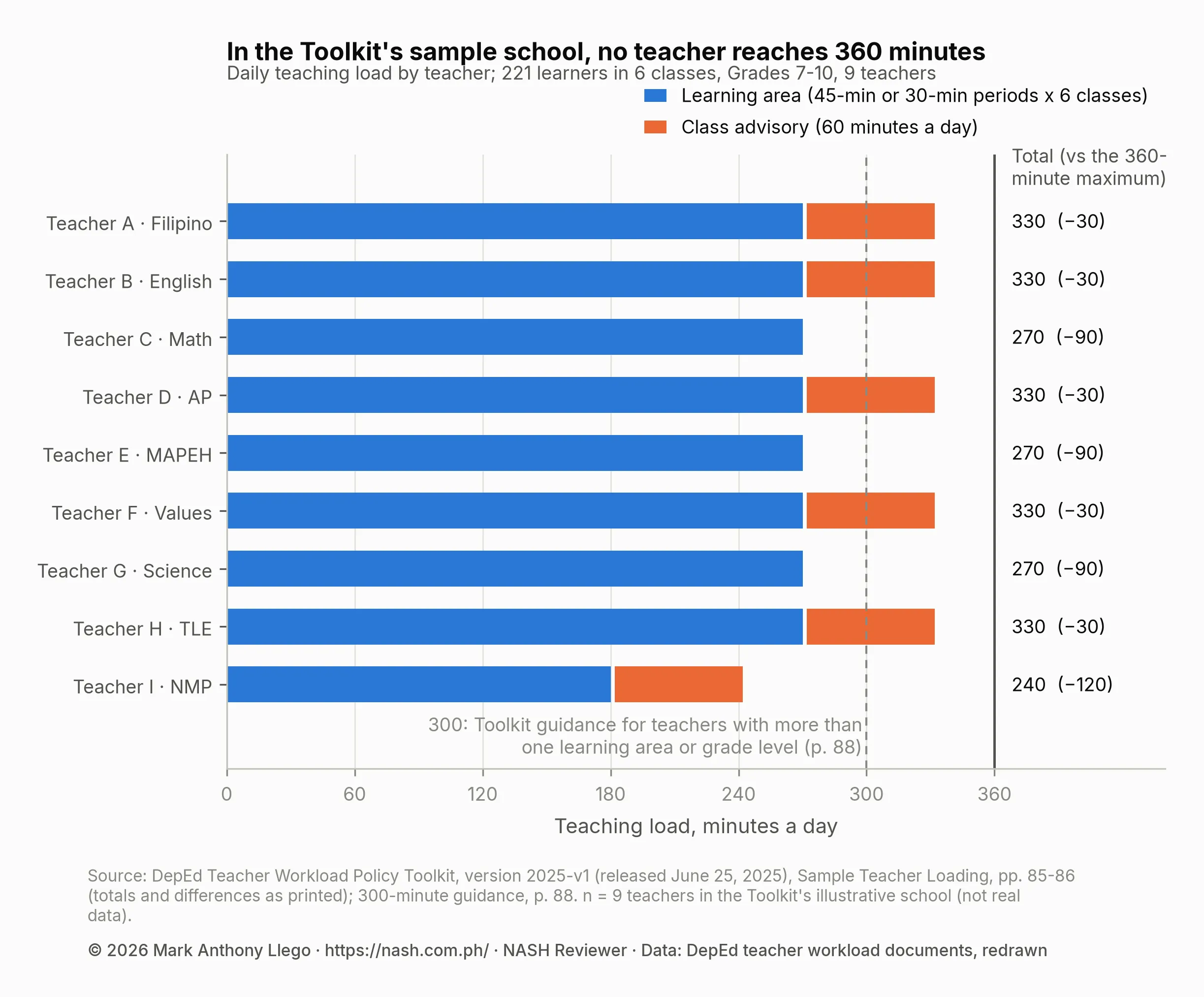
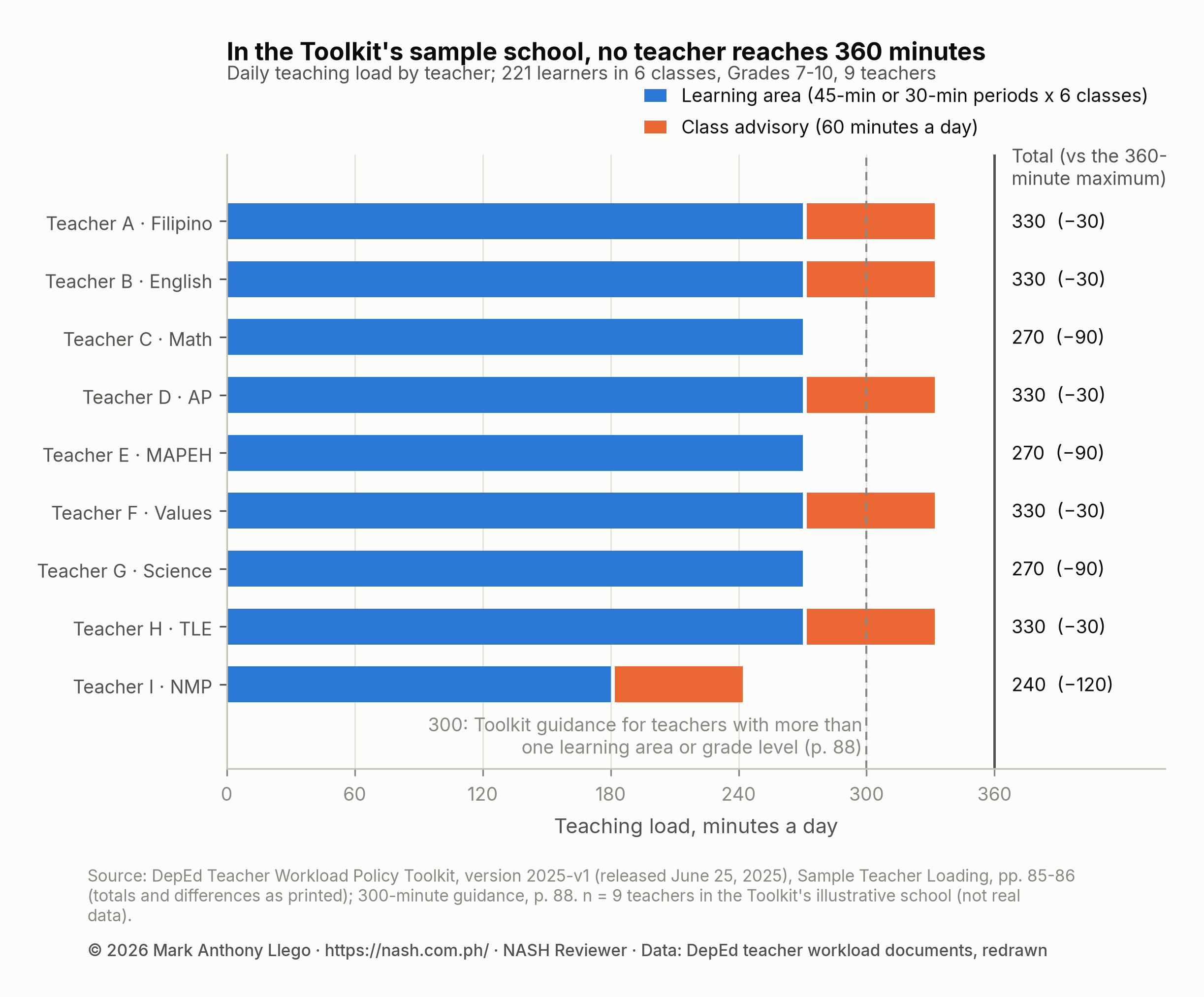
The Toolkit concludes that “all teachers have teaching load that stay within the daily 360-minute maximum teaching load” (p. 87). Its follow-up rules (p. 88): teachers over six hours are “subject for payment of teaching overload”; teachers under six are “priority for designation to teaching-related assignments”, “should not be subjected to salary deductions”, and need no designation “solely to complete the 6-hour teaching load”.
What to copy from it:
- One learning area per teacher, in their specialization. The second Math teacher takes the NMP sessions, not another subject.
- Advising counted from the start. Six teachers advise the six classes, and their 60 minutes are in the load before anything is added.
- Room left for remediation. The school uses 2,700 of a possible 3,240 teacher-minutes a day (computed). ARAL remediation runs after classes “for a duration of 30-60 minutes” on two to four days a week (DO 009, s. 2026, Encl. para. 13), and tutors’ sessions are “treated as a teaching load” (DO 018, s. 2025, para. 81). But under DM 061, s. 2026, tutoring by DepEd teachers “shall not be mandatory”; the school head “may prioritize teachers with less than six (6) hours of actual teaching load”, and tutors are not assigned to their own learners (Encl. para. 6.d). If a teacher at 330 minutes agrees to tutor for 30 minutes, the day reaches 360; anything beyond is overload.
Advisers first, designations last
Class advising “shall be treated as a teaching load equivalent to one (1) hour per day or five (5) hours a week. Included in the five (5) hours is the prescribed time for the Homeroom Guidance Program (HGP)” (DO 5, Sec. V.A.1, item 2). The HGP period inside that hour varies by level: “once a week for 40 minutes” in Grades 1 and 2 (Toolkit, p. 25), once a week in Grades 3 to 10 (DO 012, para. 2.a), and “At least 1 hour a week” in the Strengthened SHS curriculum (DO 017, Table 8). The hour counts every day: it “is provided to teachers regardless if they meet their advisory class or not”, though advisers “should be able to meet their advisory class at least once a week” (DepEd consolidated Q&A, DM 53 orientation, No. 4). School paper, sports and learner government advisers are different; they are teaching-related assignments that “do not have an equivalent teaching load” (DepEd consolidated Q&A, SY 2026-2027 implementation meetings, No. 4).
So name the advisers before splitting subjects: an adviser has at most 300 minutes a day left for classes. Name any Department Head Designate early too: the designate teaches three hours, and DepEd’s answer is to “adopt the prescribed 3-hour teaching load” (same Q&A, No. 3), so the freed hours go to other teachers.
Teaching-related assignments come after the loads (Toolkit, p. 78). Teachers under six hours “shall be prioritized”, and school heads “shall consider the specialization of teachers who shall be assigned, along with their respective workloads” (DO 5, Sec. V.A.4, item 2). The assignments “are not mandatory”, so teachers “must concur” (DM 53, para. 6.b), and each is “reflected in the electronic School Form 7 (eSF7)” (DO 5, Sec. V.A.4, item 3). The newest designation follows the same pattern. Learner Formation Officer is a teaching-related assignment under DM 055, s. 2026; where a teacher is designated (Assistant School Head Designates and Head Teachers come first), priority goes to “teachers who have less than six hours of teaching load and/or who are not assigned as class advisers”, and their work beyond regular hours is paid as overtime under DO 026, s. 2025 (Sec. II.b–c). Teaching-Related Assignments: The 11 Roles DepEd Allows has the steps and forms.
Senior high school loads in SY 2026-2027
DM 048, s. 2025 piloted the Strengthened Senior High School (SSHS) curriculum in Grade 11 from June 16, 2025, with core subjects “offered throughout the entire year (two semesters)” (Encl. para. 13). DM 012, s. 2026 directed all senior high schools to use it for incoming Grade 11 from SY 2026-2027 (para. 4). DO 017, s. 2026 (June 4, 2026), the curriculum order, puts all public senior high schools on the three-term calendar, while private schools may keep two semesters (para. 20). It keeps Grade 12 under the 2016 curriculum this year except in pilot schools (para. 19, Table 4).
What the SSHS simulator does and leaves out
The simulator’s user guide, “June 2025 v1”, is marked “TO BE USED BY PILOT SCHOOLS ONLY” (p. 1); the Toolkit links it at tinyurl.com/SSHSSimulator (p. 89). It assigns loads under two constraints, “learning areas are aligned with teacher specialization” and a “1,800-minute weekly teaching load limit” (p. 3), and flags “SHORTAGE” where no teacher can take a section and “BELOW 1800” where a teacher’s load is under 1,800 minutes a week (p. 4). Its teacher inventory comes from “the school’s ESF7 report for SY 2023–2024. Update as necessary” (p. 16).
The 1,800 minutes equal DO 5’s 30 hours a week. The guide never mentions advising, homeroom guidance, overload, remediation, Master Teachers, Department Heads or class size, and that matters:
| Left out | Why it matters | Rule |
|---|---|---|
| Class advising and HGP | An adviser filled to 1,800 subject minutes carries 2,100 minutes of load, 60 a day over six hours | DO 5, Sec. V.A.1, item 2 |
| The daily test | A week within 1,800 minutes can still hold days over 360 | DepEd consolidated Q&A, DM 53 orientation, No. 6 |
| Department Heads | A Department Head Designate teaches three hours | DO 024, s. 2025, Encl. 1, Sec. 36.c |
| Who may teach Life and Career Skills | The tool maps it to Values Education only; DM 048 and DO 017 also name HOPE and Personal Development teachers | DM 048, Table 1; DO 017, Table 5 |
Is “BELOW 1800” a shortfall? DO 5’s text reads like a quota (“In a week, a teacher must be able to render thirty (30) hours of actual classroom teaching”, Sec. V.A, item 2), and the Toolkit calls the same flag “UNDERLOAD” (p. 89). DepEd’s implementing memorandum and later answers read six hours as a ceiling: a teacher “shall not be required to render more than six hours” (DM 53, para. 3.a), and “It should not be interpreted that all teachers are required to render exactly six (6) hours of teaching daily” (DepEd consolidated Q&A, SY 2026-2027 implementation meetings, No. 1). Under that reading, which DepEd now applies, “BELOW 1800” marks spare capacity, not a shortfall, and brings no salary deduction (DepEd consolidated Q&A, DM 53 orientation, No. 1.0). The guide itself says “schools retain full discretion to finalize teacher assignments” (p. 18).
Grade 11 core minutes: the pilot and DO 017
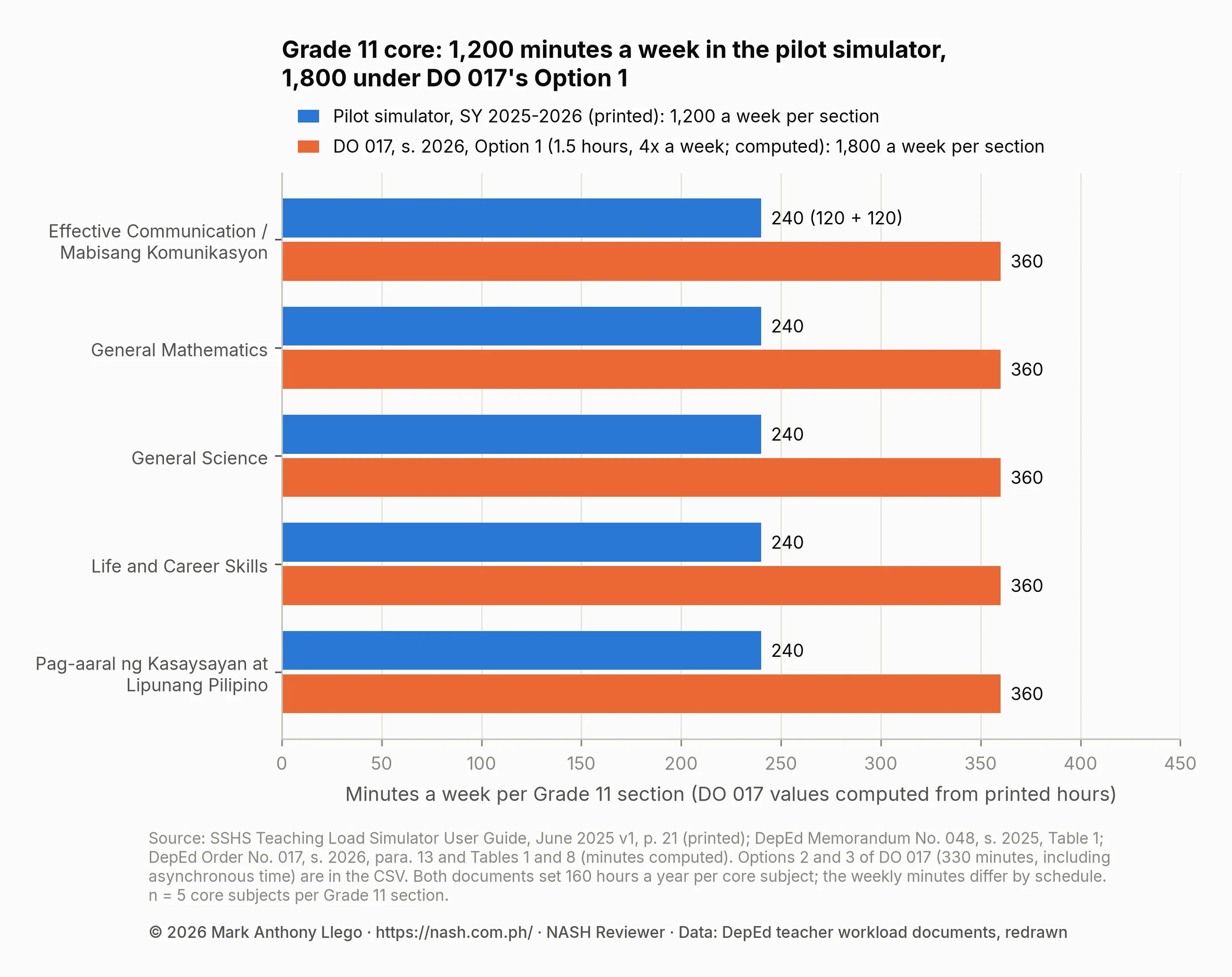
Both DM 048 and DO 017 count Effective Communication and Mabisang Komunikasyon as one of five core subjects, and both set 160 hours a year per core subject (DM 048, Encl. para. 13 and Table 1; DO 017, para. 13 and Table 1). DM 048 split that subject into 80 hours of each, 2 hours a week each, which the simulator encodes as two 120-minute subjects (p. 21), for 1,200 minutes per section. DO 017 lists it at 160 hours without the split and still assigns “English and Filipino teachers” (Table 5), without saying how the time divides. Its suggested schedules (Table 8) are Option 1, “1.5 hours, 4x a week” (360 minutes), and Options 2 and 3, one hour four or five times a week plus asynchronous time (330), “recommended for schools implementing double shifts”. The sample Grade 11 regular-shift schedule runs the core subjects in 90-minute blocks in all three terms (Annex D.1). So the gap in Figure 3 is scheduling, not content. DO 017 does not show how its options add up to 160 hours; 6 hours a week over SY 2026-2027’s 168 Instructional Block days is about 200 hours (computed). As of October 31, 2026, the Public Drive holds only the pilot simulator, with core subjects pre-encoded at 1,200 minutes on a two-semester basis (“No need to modify them”, p. 21), so its output does not reflect DO 017 or the three-term calendar.
| Core subject schedule | Minutes per section a week | Sections, no advisory class (minutes a week) | Sections for a class adviser (minutes a week, with 300 of advising) |
|---|---|---|---|
| Pilot simulator, 2 × 60 (either half of Effective Communication / Mabisang Komunikasyon) | 120 | 15 (1,800) | 12 (1,740) |
| Pilot simulator, 4 × 60 (the other four) | 240 | 7 (1,680) | 6 (1,740) |
| DO 017 Option 1, 4 × 90 | 360 | 5 (1,800) | 3 (1,380) |
Computed from the User Guide, p. 21 and DO 017, s. 2026, Table 8; not a DepEd table. Each count stays within 1,800 minutes a week and 360 minutes every day and assumes one teacher per subject in each section; DO 017 assigns Effective Communication and Mabisang Komunikasyon to English and Filipino teachers without saying how they share it. Options 2 and 3 (330 minutes, asynchronous time included) allow 5 sections, or 4 for an adviser.
Option 1 catches advisers. Four sections fit an adviser’s week (1,740 minutes), but 16 periods of 90 minutes cannot fit five days at three a day, so one day would carry four periods plus advising, 420 minutes. Within six hours every day, an adviser in Option 1 takes three core sections.
Asynchronous classes and teaching load
DO 017 treats asynchronous time as load in two places, with different force. Para. 21, headed “Subject Scheduling for the 2016 K to 12 SHS Curriculum”, covers classes still under the old curriculum (this year, Grade 12 outside the pilot schools): where shifting limits in-person classes, “Such asynchronous sessions shall be reflected in both the class program and the teachers’ schedules as part of their teaching load.” For Strengthened SHS classes, the basis is a note in the Order’s Grade 12 sample schedules: “Note: The asynchronous class schedule should be reflected in the teacher’s schedule as part of their teaching load” (Annex D.1, for example printed p. 61). That is “should”, in a sample-schedule note; the Grade 11 samples list an “Asynchronous Learning Allocation” without it. DM 036, s. 2026 prints the same note for the Grade 12 pilot (Annex B), limits that pilot to the schools that ran Grade 11 in SY 2025-2026 (para. 4), and sets Grade 12 elective periods of “one and one-half (1.5) hours, or longer” (Encl. para. 14).
DO 017’s loading rule: “Teacher workload shall be governed by existing DepEd policies, including RA No. 4670 … Teaching loads should be equitably distributed, considering preparations for new Core Subjects and Electives under the SSHS Curriculum. School heads are also encouraged to safeguard the 6 hours of teaching load for teachers” (para. 22.c). The Order does not say whether “safeguard” means keeping loads within six hours or filling them to six; read with DepEd’s answer that six hours is a maximum, the first is the safer reading. Core subject teachers are assigned by “subject matter competence, relevant training, availability, and prior teaching experience” (para. 22.a), and core classes have a maximum of 40 learners, though schools that cannot comply may run larger classes (Table 7).
How the three-term calendar changes loading
DO 009, s. 2026 runs SY 2026-2027 from June 8, 2026 to April 8, 2027, with 201 class days (para. 4), partly to “reduce ancillary and non-teaching-related tasks of teachers, and ensure more manageable teaching workloads” (para. 2). For this year, “each term shall consist of 65 to 69 days of engaged teaching and learning” (Encl. para. 16). DepEd’s 2026 meeting decks show what load goes in each block:
| Block | Length in SY 2026-2027 (DO 009, Encl. para. 16, Figure 3) | Load in the block (DepEd decks) |
|---|---|---|
| Opening Block, Term 1 only | 4 days | No teaching load listed; teacher ancillary tasks only. DO 009 gives the block to orientation, assessments, health checks and data such as school forms (Encl. para. 12) |
| Instructional Block | 55, 56 and 57 days in Terms 1 to 3 (61–62 in the general model, Encl. para. 11) | “Actual Classroom Teaching”, “Class Advising Duties”, “Class Relieving Duties”, “Remediation/Enhancement Classes (e.g. ARAL Program)”; teaching-related assignments “allowed only after classes” |
| End-of-Term Block | 10, 9 and 10 days | “Remediation Programs Only”; teaching-related assignments for scheduled co- and extra-curricular activities |
Sources: DO 009, s. 2026, Encl. paras. 11–12 and 16 and Figure 3; DepEd CO & RO meeting deck on implementation status, June 2, 2026, p. 14; DepEd SDO meeting deck on implementation status, 2026, p. 25. The deck columns are DepEd’s interpretation; DO 009 governs.
The decks add that “teachers are allowed to accomplish school forms within the instructional block” (CO & RO deck, p. 14). DO 009 puts professional development “for two (2) days during the End-of-Term Blocks, for a minimum of thirty-two (32) hours annually” (Encl. para. 21), and gives teachers a two-day wellness break per End-of-Term Block, when they “shall not be assigned instructional, administrative, or extracurricular duties” except in “emergency or exigency of service” (Encl. para. 24).
For loading, this means: the teachers’ programs cover the Instructional Block, and End-of-Term days need their own remediation plan; the ARAL sessions of teachers who agree to tutor go into their programs (DO 018, para. 81); and because senior high electives change by term in DO 017’s samples, each teacher’s load should be rechecked at the start of every term.
Recording loads in eSF7 and how the division monitors them
The eSF7 is School Form 7, the “School Personnel Assignment List and Basic Profile”, in electronic form, adopted from SY 2023-2024 by DM 052, s. 2023 (September 5, 2023). Its enclosure sets the routine:
| Rule | DM 052, Encl. |
|---|---|
| Accomplished at the beginning of the school year by the school head, with non-teaching personnel assisting | Item 1 |
| Senior high schools also update it “at the beginning of the Second Semester (Third Grading Period)” | Item 2 |
| Updated “In case of personnel movement during the school year” | Item 3 |
| The Daily Program shows “subjects taught, advisory class (if applicable), and ancillary/administrative assignments” | Item 5 |
| Excel file and signed PDF due “on or before the fourth Friday from the opening of classes” | Item 9 |
Item 2 was written for semesters; under three terms, we suggest updating senior high entries whenever subject assignments change at a new term. The “administrative assignments” of item 5 predate DO 002, s. 2024, which removed administrative tasks from teachers (Admin Tasks Off Teachers). DepEd names the eSF7 as its tool for distributing workload (DepEd consolidated Q&A, DM 53 orientation, No. 61); “The signatory of the esf7 is the school head” (No. 9); and “the updated SF7 should be attached” to overload claims (No. 45). ARAL schedules belong on it too: “The schedule and additional manpower to implement this program shall be reflected in the School Form 7” (DO 018, para. 82). DepEd is also developing SIGASIG, a system that includes “an automated engine to generate class schedules and teacher loads” (DM 029, s. 2026, para. 1).
| Office | What it does with the loads | Source |
|---|---|---|
| School head | Distributes workload, overload and teaching-related assignments “using the eSF7” and ensures compliance “using eSF7” | DO 5, Sec. V.D.4.a and d |
| Division, CID | Checks declared specializations and audits loads “using the eSF7 or similar tools” | DM-OSEC-OUHROD-2025-0002, p. 2 |
| Division, SGOD and Personnel | SGOD “Consolidates eSF7 and submits to the Regional Office”; Personnel conducts “personnel and workload audits” | DO 5, Sec. V.D.3 |
| Regional Office, Personnel | Workload audit “through the checking of the consolidated report on eSF7” | DO 5, Sec. V.D.2 |
DepEd’s 2026 SDO deck proposes that divisions “Monitor teacher loading through eSF7” and “Deploy teachers to schools based on their needed specialization” (p. 86). For pilot senior high schools, the CID gives “technical assistance on class scheduling, elective offerings, and teacher deployment” (DM 036, Encl. para. 42), and under the three-term calendar, regional offices and divisions submit periodic reports on “teacher workload indicators” (DO 009, Encl. para. 38). DO 5 states the purpose: the eSF7 “shall serve as basis for future management action and decision on workload assignments or request for additional manpower” (Sec. V.A.4, item 3).
What this means for school heads
A loading plan for SY 2026-2027, in order:
- Before the planning session, pull enrollment, classes, classrooms and the teacher inventory, and correct last year’s declared specializations in the eSF7.
- Choose the period option (DO 012 for Grades 3 to 10; DO 017 Table 8 for Grade 11) and check the derived tables for how many sections each teacher can take.
- Name the advisers and any Department Head Designate first. Advisers have 300 minutes a day left for classes; a Department Head Designate teaches three hours.
- Assign subjects by specialization and training, with Master Teachers first in Kindergarten to Grade 3 where you have them.
- Check each teacher day by day against 360 minutes, remediation and any agreed ARAL tutoring included. Overload is for the exigency of service only, at most two hours a day, to teachers already at six hours in the needed specialization (DM 53, para. 3.b; DO 5, Sec. V.A.2, item 4).
- Designate teaching-related assignments last, where the SIP or AIP needs them, first to teachers under six hours, with their concurrence.
- Submit the eSF7 by the fourth Friday from the opening of classes, and update it when personnel move or senior high assignments change.
Records to keep: the class program and teachers’ programs (Toolkit, p. 27), the signed eSF7, the planning session’s documented agreements (p. 72), designation orders with the SDS-approved list, and the weekly overload record.
A school head may set 300 minutes as the school’s own target for teachers with several preparations, and may assign overload where a learning area lacks a specialist (DepEd consolidated Q&A, SY 2026-2027 implementation meetings, No. 17), with the required pay and papers. A school head may not require more than six hours of teaching except in the exigency of service, and then at most two hours more (DM 53, para. 3.a–b), or designate teaching-related assignments without the teacher’s concurrence (DM 53, para. 6.b). DepEd’s guidance adds that teachers under six hours “should not be subjected to salary deductions” and that a designation is not needed “solely to complete the 6-hour teaching load” (Toolkit, p. 88; DepEd consolidated Q&A, DM 53 orientation, No. 1.0).
These practices fall under managing staff in the PPSSH Domain 2 guide; see also the human resource management guide and, for EDCOM II’s evidence, Teacher Workload and Accountability.
How the NASH may test this
Under DepEd Memorandum No. 069, s. 2025, the NASH covers “conceptual and situational critical thinking questions” aligned with the PPSSH, “using the SOLO (Structure of the Observed Learning Outcome) taxonomy as an underpinning framework” (para. 3). The item below is an original practice item, scored 3 (Relational), 2 (Multistructural), 1 (Unistructural) or 0 (Prestructural).
Question
Indicator 2.4.2, Management of staff. Career Stage 2, Situational, Moderate.
You are the school head of a junior high school that uses 45-minute periods. Your draft gives each teacher one learning area across six classes, 270 minutes a day, and six teachers also advise a class, 330 minutes. One Grade 10 Mathematics class is unassigned. A Values Education teacher with 270 minutes and no advisory class asks for a coordinator role to “complete” six hours, and a senior teacher suggests giving her the Mathematics class. What is the most appropriate action?
- A. Give the Mathematics class to the Values Education teacher and designate her Reading Coordinator, so that she reaches six hours and the class is covered.
- B. Assign the Mathematics class to a Mathematics teacher within six hours a day, keep the Values Education teacher at 270 minutes with no effect on her pay, offer a coordinator role only if the SIP needs one and she agrees, and record the loads in the eSF7.
- C. Assign the Mathematics class to a Mathematics teacher within six hours a day, record the loads in the eSF7, and set aside the Values Education teacher’s request until the midyear review.
- D. Assign the Mathematics class to whichever Mathematics teacher has the fewest minutes, and leave the rest of the draft and the Values Education teacher’s request as they are.
Answer and explanation
Best answer: B. Points: A = 0, B = 3, C = 2, D = 1.
- A (0 points, Prestructural). It puts a teacher outside her specialization and uses a designation to fill six hours, both ruled out.
- B (3 points, Relational). It staffs the class by specialization within the limit, treats a load under six hours as allowed, ties any designation to the SIP and the teacher’s consent, and records it.
- C (2 points, Multistructural). The class is staffed and recorded correctly, but the teacher’s priority for needed designations is left unaddressed.
- D (1 point, Unistructural). It staffs the class by specialization, but does not check the six-hour limit day by day, record the loads or answer the teacher’s request.
Why. DM-OSEC-OUHROD-2025-0002 requires that “Teachers shall be assigned to teach in their area of specialization”. The Toolkit says there is “no need to designate Teaching-Related Assignments solely to complete the 6-hour teaching load” and that teachers under six hours “should not be subjected to salary deductions” (p. 88). DO 5 gives them priority for designations (Sec. V.A.4, item 2), and DM 53 requires their concurrence (para. 6.b).
Indicator 2.4.2: Manage staffing such as teaching load distribution and grade level and subject area assignment in adherence to laws, policies, guidelines and issuances based on the needs of the school.
Sources: DepEd Order No. 005, s. 2024; DepEd Memorandum No. 053, s. 2024; DM-OSEC-OUHROD-2025-0002; Teacher Workload Policy Toolkit (June 2025), p. 88.
Nothing in this guide reproduces or predicts examination content.
Frequently asked questions
How many minutes of teaching load should a DepEd teacher have per day?
At most 360 minutes, or six hours, of actual classroom teaching, class advising and remediation combined (DM 53, s. 2024, para. 3.a; DO 5, s. 2024, Sec. V.A.1). It is a ceiling, not a quota: “The six (6) hours of teaching load is the maximum, not a required minimum” (Teacher Workload Policy Toolkit, June 2025, p. 26). Teaching beyond 360 minutes is overload, allowed only in the exigency of service and for at most two hours a day.
Is the 300-minute teaching load a DepEd rule?
No. It appears only in the Teacher Workload Policy Toolkit, for teachers “assigned to teach more than one (1) learning area or grade level” (p. 88), and no order or memorandum sets it. The binding limit is six hours a day (DM 53, s. 2024, para. 3.a), though a school may use 300 minutes as its own planning target.
When is the eSF7 due, and who signs it?
The school head accomplishes it at the beginning of the school year, and the Excel file and the PDF signed by the school head go to the division “on or before the fourth Friday from the opening of classes” (DM 052, s. 2023, Encl. items 1 and 9). An updated eSF7 is submitted when personnel move (item 3). “The signatory of the esf7 is the school head” (DepEd consolidated Q&A, DM 53 orientation, No. 9).
Do asynchronous classes count as teaching load in senior high school?
They are treated as load, with different force by curriculum. For classes still under the 2016 curriculum, DO 017, s. 2026 says asynchronous sessions “shall be reflected in both the class program and the teachers’ schedules as part of their teaching load” (para. 21). For Strengthened SHS classes, the Grade 12 sample schedules in DO 017 (Annex D.1) and DM 036, s. 2026 (Annex B) carry a note that the asynchronous schedule “should be reflected in the teacher’s schedule as part of their teaching load”.
Download the data
- loading-toolkit-worksheet.csv: the nine teachers in the Toolkit’s sample school, with subject, subject minutes, class advisory minutes, total and difference from 360 minutes a day (Teacher Workload Policy Toolkit, June 2025, pp. 85–86).
- loading-grade11-core-minutes.csv: weekly minutes per section for the five Grade 11 core subjects in the pilot simulator (printed) and under DO 017, s. 2026, Options 1 to 3 (computed from the printed hours), with the 160 hours a year both documents set (SSHS Teaching Load Simulator User Guide, June 2025, p. 21; DM 048, s. 2025, Table 1; DO 017, s. 2026, Tables 1 and 8).
- loading-planning-session-agenda.csv: the four items of the Toolkit’s sample workload planning session and their minutes (Teacher Workload Policy Toolkit, June 2025, p. 70).
The CSVs and charts may be reused only with written permission: email support@nash.com.ph. The rules themselves come from DepEd’s issuances, which you can cite directly.
Sources
- DepEd Order No. 005, s. 2024, Rationalization of Teachers’ Workload in Public Schools and Payment of Teaching Overload, April 29, 2024, Secs. V.A.1 (items 1–4 and 7), V.A.2 (items 1 and 4), V.A.3 (item 4), V.A.4 (items 2–3) and V.D.2–4.
- DepEd Memorandum No. 053, s. 2024, Implementation Guidelines for DepEd Order No. 005, s. 2024, September 27, 2024, paras. 3.a–d and 6.a–b.
- Memorandum DM-OSEC-OUHROD-2025-0002, Additional Guidance on the Assignment of Teaching Load to Teachers, June 4, 2025, pp. 1–2, in DepEd’s Teacher Workload Public Drive (I. Issuances, DO 5, s. 2024).
- DepEd Bureau of Human Resource and Organizational Development, Teacher Workload Policy Toolkit, version 2025-v1, released June 25, 2025 with Memorandum DM-OUHROD-2025-1641, pp. 9, 25–27, 32, 38–39, 58–92, 101 and 103, in DepEd’s Teacher Workload Public Drive.
- DepEd, Strengthened SHS Program Teaching Load Simulator Tool: User Guide, June 2025 v1, pp. 1–4, 16, 18 and 21, in DepEd’s Teacher Workload Public Drive (III. Forms, SSHS Pilot Schools Simulator SY 2025-2026).
- DepEd, Consolidated Questions and Answers, Online Orientation on DM 53, s. 2024 (updated as of November 13, 2024), Nos. 1.0, 4, 6, 9, 45 and 61, in DepEd’s Teacher Workload Public Drive.
- DepEd, Consolidated Question and Answer from the Online Meeting with Regional and Schools Division Offices on the Implementation Status of Teacher Workload Policies (May 25–26 and June 2, 2026), Nos. 1–4, 16 and 17, in DepEd’s Teacher Workload Public Drive.
- DepEd, CO & RO Online Meeting on the Implementation Status of Teacher Workload Policies (deck), June 2, 2026, p. 14; and Online Meeting on the Implementation Status of Teacher Workload Policies, SDO deck, 2026, pp. 25 and 86, in DepEd’s Teacher Workload Public Drive.
- DepEd Order No. 012, s. 2024, Amendment to DepEd Order No. 010, s. 2024 (Policy Guidelines on the Implementation of the MATATAG Curriculum), September 18, 2024, paras. 2 and 4.
- DepEd Memorandum No. 052, s. 2023, Adoption of the DepEd Electronic School Form 7 (eSF7), September 5, 2023, paras. 1–2 and Enclosure items 1–3, 5 and 9.
- DepEd Order No. 024, s. 2025, Guidelines on the Implementation of the Expanded Career Progression System for Teachers and School Heads in the Department of Education, August 28, 2025, Encl. 1, Secs. 36.b.iii and 36.c.
- DepEd Order No. 034, s. 2025, Amendments and Clarifications to DepEd Order No. 024, s. 2025, October 14, 2025, para. 27.
- DepEd Order No. 002, s. 2026, Guidelines on the Grant of Wellness Leave for the Department of Education Personnel, February 13, 2026, Sec. VI.1.h.
- DepEd Order No. 014, s. 2026, Guidelines on Learning Continuity in Emergencies, June 4, 2026, para. 69.
- DepEd Order No. 018, s. 2025, Implementing Guidelines of the Academic Recovery and Accessible Learning Program, June 13, 2025, paras. 81–82.
- DepEd Memorandum No. 048, s. 2025, Pilot Implementation of the Strengthened Senior High School Curriculum for Grade 11 in School Year 2025-2026, June 14, 2025, para. 3 and Encl. para. 13 and Table 1.
- DepEd Memorandum No. 012, s. 2026, Full Implementation of the Strengthened Senior High School Curriculum in School Year 2026-2027, February 27, 2026, para. 4.
- DepEd Memorandum No. 029, s. 2026, National Technical Working Group for the Digitization of School Forms, May 11, 2026, para. 1.
- DepEd Memorandum No. 055, s. 2026, Clarificatory Guidelines on the Designation of Learner Formation Officers in Schools, September 17, 2026, Sec. II.b–c.
- DepEd Memorandum No. 061, s. 2026, Amendments to DepEd Memorandum No. 001, s. 2026, September 29, 2026, Encl. para. 6.d.
- DepEd Order No. 009, s. 2026, Guidelines on the Implementation of the Three-Term School Calendar in Basic Education, April 16, 2026, paras. 2 and 4; Encl. paras. 11–13, 16, 21, 24 and 38, and Figure 3.
- DepEd Memorandum No. 036, s. 2026, Pilot Implementation of the Strengthened Senior High School Curriculum for Grade 12 in School Year 2026-2027, May 28, 2026, para. 4, Encl. paras. 14 and 42, and Annex B.
- DepEd Order No. 017, s. 2026, Strengthened Senior High School Curriculum, June 4, 2026, paras. 13 and 19–22, Tables 1, 4, 5, 7 and 8, and Annexes D.1 and D.2.
- DepEd Memorandum No. 069, s. 2025, Administration of the National Assessment for School Heads for Fiscal Year 2025, para. 3.
- DepEd Order No. 024, s. 2020, National Adoption and Implementation of the Philippine Professional Standards for School Heads (indicator 2.4.2).
The teacher workload series
- DepEd Teacher Workload Policies: A Complete Guide
- How Many Hours Must DepEd Teachers Teach a Day?
- Can Teachers Leave School After Six Hours of Teaching?
- DepEd Teaching Overload Pay: Who Qualifies, How Much
- Why So Few Teachers Get Paid for Teaching Overload
- Teaching-Related Assignments: The 11 Roles DepEd Allows
- Vacation Service Credits and Overtime Pay for Teachers
- Admin Tasks Off Teachers: DO 2 and School Support Staff
- DepEd 2026 Teacher Workload Survey: What Teachers Said
- How School Heads Plan Teaching Loads Under DO 5 (this post)
- Teacher Workload and Accountability: EDCOM II Findings
Written by Mark Anthony Llego for NASH Reviewer. Sources: DepEd Orders No. 005 and 012, s. 2024, No. 018, 024 and 034, s. 2025, and No. 002, 009, 014 and 017, s. 2026; DepEd Memoranda No. 052, s. 2023, No. 053, s. 2024, No. 048 and 069, s. 2025, and No. 012, 029, 036, 055 and 061, s. 2026; Memorandum DM-OSEC-OUHROD-2025-0002; the Teacher Workload Policy Toolkit (June 2025), the SSHS Teaching Load Simulator User Guide (June 2025), and DepEd’s 2024 and 2026 workload Q&A sheets and 2026 meeting decks. Charts may be reused only with written permission from support@nash.com.ph.