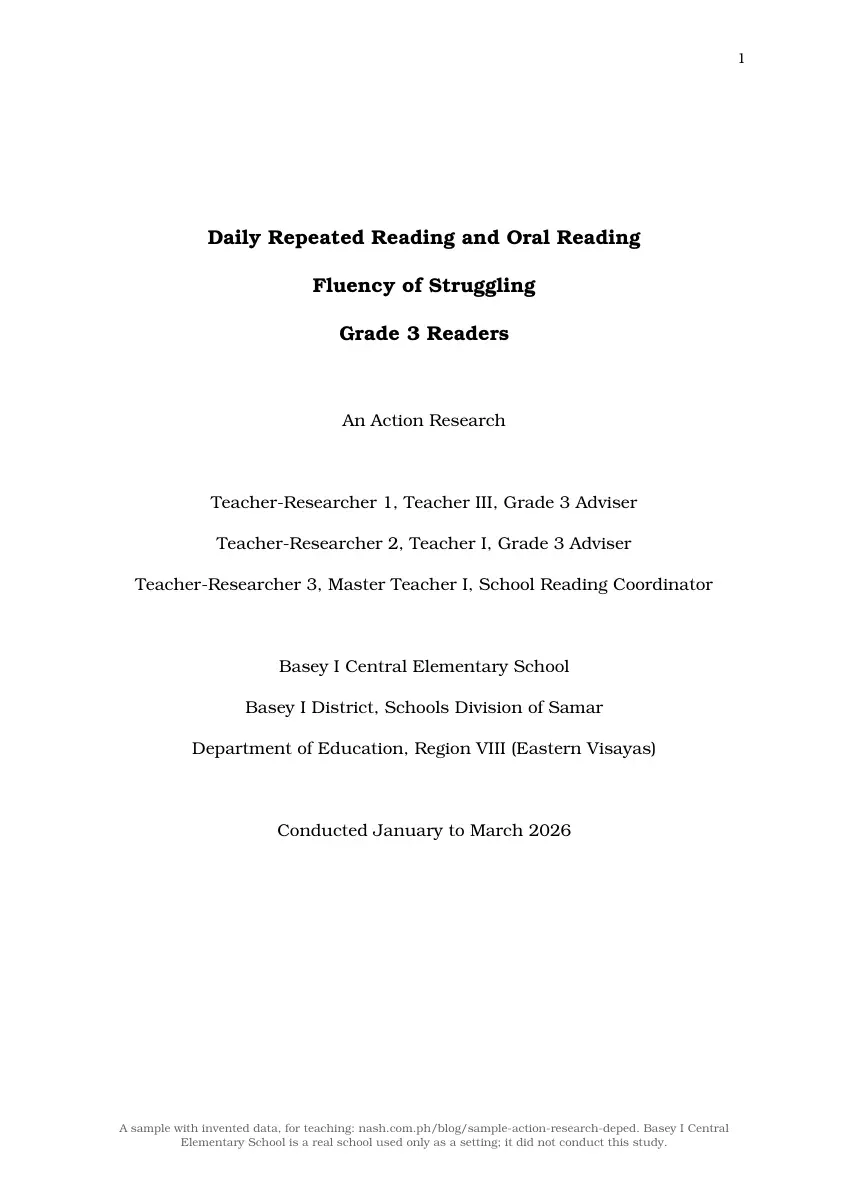


These action research samples are complete papers in DepEd format, each one a PDF: sixteen completed reports and two proposals, from Kindergarten to Grade 11. Every study is invented, the completed ones with data generated for teaching, and each has a post on this blog that shows how it was planned and, for the reports, how it was carried out and analyzed.
What each PDF holds
The completed reports follow the parts that DepEd’s Research Management Guidelines, DepEd Order No. 16, s. 2017, set for a completed action research in Annex 6: title page, abstract, acknowledgment, context and rationale, innovation, intervention and strategy, action research questions, action research methods, discussion of results and reflection, action plan, references, and financial report. Appendices follow: the data set (printed in full in the first sample, described with its Excel workbook in the others), the instruments and materials the study used, and a declaration of AI use. The signed letters and consent forms stay with the school, out of the archived report. Each report is written in APA 7 style on A4 paper and runs from 26 to 39 pages.
No paper names its researchers, and each says on its first page that it is an invented sample.
The two proposals follow the action research template in Annex 2 of the same order: context and rationale, action research questions, the proposed innovation, intervention and strategy, methods, work plan and timelines, cost estimates, plans for dissemination and utilization, and references. Their appendices hold the instruments, the training or session plans and the consent forms. One proposes learner peer navigators for help-seeking in Grade 8 advisory classes; the other, a series of learning action cell (LAC) sessions on lesson plan annotations for learners from indigenous groups, for the teachers of Grades 1 to 6.
Samples by grade and subject
- Elementary: Kindergarten (number board games), Grade 3 (daily repeated reading in Filipino) and Grade 4 Mathematics (the Good Behavior Game).
- Junior high school: Grade 7 English and Mathematics; Grade 8 Mathematics, English writing, Physical Education and Araling Panlipunan; Grade 9 Science; and Grade 10 Science, English speaking and TLE Cookery.
- Senior high school: Grade 11 General Mathematics.
- School programs: a junior high school’s tiered follow-up of absences, and the ARAL Summer-Mathematics for incoming Grades 2 to 4, studied by a school head at the Rapid Mathematics Assessment’s cut.
Their designs range from one group tested before and after to crossovers, an ABAB reversal and a regression discontinuity, and their statistics from a paired t test in Excel to mixed-effects models in Python. Action Research in Mathematics for High School: A Sample compares all eighteen in one table: each study’s design, what it measures, its statistics and its software.
Word files, data and analysis
Each sample’s post also offers the paper as a Word file, for its headings, tables and spacing. The completed studies’ posts add their data, all but one as an Excel workbook, and most add a Jupyter notebook that runs the analysis. The first sample prints its data in Appendix A instead.
Using a sample without copying it
A sample shows what each part of a report holds and how each number is reached. It cannot be submitted, even in part: its learners and scores do not exist, and no school conducted the study.
A proposal sent to a research committee goes with the Declaration of Anti-Plagiarism and Absence of Conflict of Interest (DO 16, s. 2017, Annex 3). In it the proponent commits that “all deliverables and the final research study emanating from this proposal shall be of original content.” Under the same order, anyone found to have plagiarized “will be blacklisted from availing of any other research grant mechanism in the Department.” A real report takes its data from the researcher’s own learners, and cites any sample whose routine or instrument it adapts.