

This sample action research proposal asks whether three Learning Action Cell (LAC) sessions can improve the lesson plan annotations that teachers without learners from indigenous groups must now write under strand 3.5 of the Philippine Professional Standards for Teachers (PPST). It follows the minimum parts DepEd sets for an action research proposal (DepEd Order No. 16, s. 2017, Annex 2.B), from Context and Rationale to References, and plans the study for Term 3 of School Year 2026–2027, with its preparation in the last weeks of Term 2.
The rule behind it is new. Since November 9, 2026, a teacher whose class has no learners from indigenous groups is observed on strand 3.2 and must “annotate their lesson plans to indicate culturally appropriate teaching strategies that may be employed to address the learning needs of learners from indigenous groups, consistent with the indicator under PPST Strand 3.5” (Memorandum DM-OSEC-OUHRODI-2026-0003, item 15.b). The memorandum does not say what an annotation contains or how it is rated. The proposal answers with a four-question annotation protocol, a three-session LAC series that reaches three grade-level clusters in turn, and two blind raters who score every weekly annotation for research only. Every file is free to download: the proposal in Word and PDF, the rubric, three sample annotated lesson plans, the LAC session plans with the rater training protocol, the consent form and the proposal deck.
The school and its plans are invented. No school, teacher or learner is behind the sample, and it reports no results: the rule it serves began on November 9, 2026, so no study of it could have been finished yet. The DepEd rules, the calendar, the curriculum competencies and the research the proposal cites are real. Use it to see how each part of a proposal is built; your proposal must come from your own school.
Key points
- The problem: item 15.b of the PMES memorandum for School Year 2026–2027 asks teachers without learners from indigenous groups to annotate their lesson plans for such learners, and rates the annotations under strand 3.5. The memorandum and the four SY 2026–2027 rating tools name the annotated lesson plan as evidence but say nothing of its content or how it becomes a rating.
- The innovation: a protocol of four questions every annotation answers (what I may do; which learning need it addresses; where in the lesson; whose context, and how I would learn it properly), with exemplar annotations for three Term 3 lessons.
- The design: a multiple-baseline design across three grade-level clusters of 12 teachers, the order drawn by lot, with one short annotation a week from each consenting teacher in the plan they already prepare, weeks 1 to 10 of Term 3 (January 4 to March 12, 2027). The clusters start after 3, 5 and 7 weekly annotations.
- The measures: a four-criterion rubric built from the COT rubric’s own words for strand 3.5, scored by two raters blind to the teacher and to the order of the clusters; a self-efficacy scale of eight items published under a Creative Commons license; and the teachers’ LAC reflection notes.
- The safeguards: the research scores never reach PMES; consent and withdrawal never affect a rating; and no indigenous community is studied, since a lesson that draws on a community’s knowledge needs that community’s permission (DepEd Order No. 51, s. 2014).
- The cost: PhP 6,030.00 from the school’s MOOE, which may fund LACs (DepEd Order No. 35, s. 2016, item 11).
Download the sample proposal, rubric, lesson plans and deck
The seven files are free to download. The proposal describes an invented school; the rubric, the plans, the session plans and the consent form are written so a school can adapt them.
- The proposal in Word (DOCX, 43 KB), a blind review copy of 40 pages on A4 in DepEd’s order for an action research proposal: Bookman Old Style, 14-point bold title, 13-point headings and 12-point text, double-spaced and justified, 1-inch margins, a running head and page numbers at 10 point, APA 7 headings, nine tables, references with hanging indents, and five appendices, the self-efficacy items printed in full.
- The proposal as a PDF (398 KB), for reading on a phone.
- The annotation rubric and annotation guide (DOCX, 19 KB, 6 pages): the four-question protocol, a guide for writing the annotation in the ILAW plan (not a form), the four criteria with their levels and the COT words each uses, the scoring rules, six exemplar annotations scored, and a rating sheet.
- Three sample annotated lesson plans (DOCX, 18 KB, 6 pages): Grade 2 Mathematics, Grade 4 Science and Grade 6 Science, Term 3, each in the order of the ILAW guide (DepEd Order No. 016, s. 2026, Annex B) with its competency quoted from DepEd’s budget of work and an annotation that answers all four questions.
- The LAC session plans and rater training protocol (DOCX, 19 KB, 6 pages): the LAC plan in the columns of DO 35, s. 2016’s Annex 1, the three sessions and the closing session minute by minute, the reflection prompts, the documenter’s checklist, and the raters’ training with its thresholds and eight scored anchors.
- The teacher consent form (DOCX, 14 KB, 3 pages): what taking part means, the right to withdraw with no effect on PMES, how scores stay out of PMES, privacy, and the signature lines.
- The proposal deck (PPTX, 68 KB, 14 slides) with speaker notes: each slide’s time in a 12-minute talk, what to say, and the Annex 4.b criterion the committee scores.
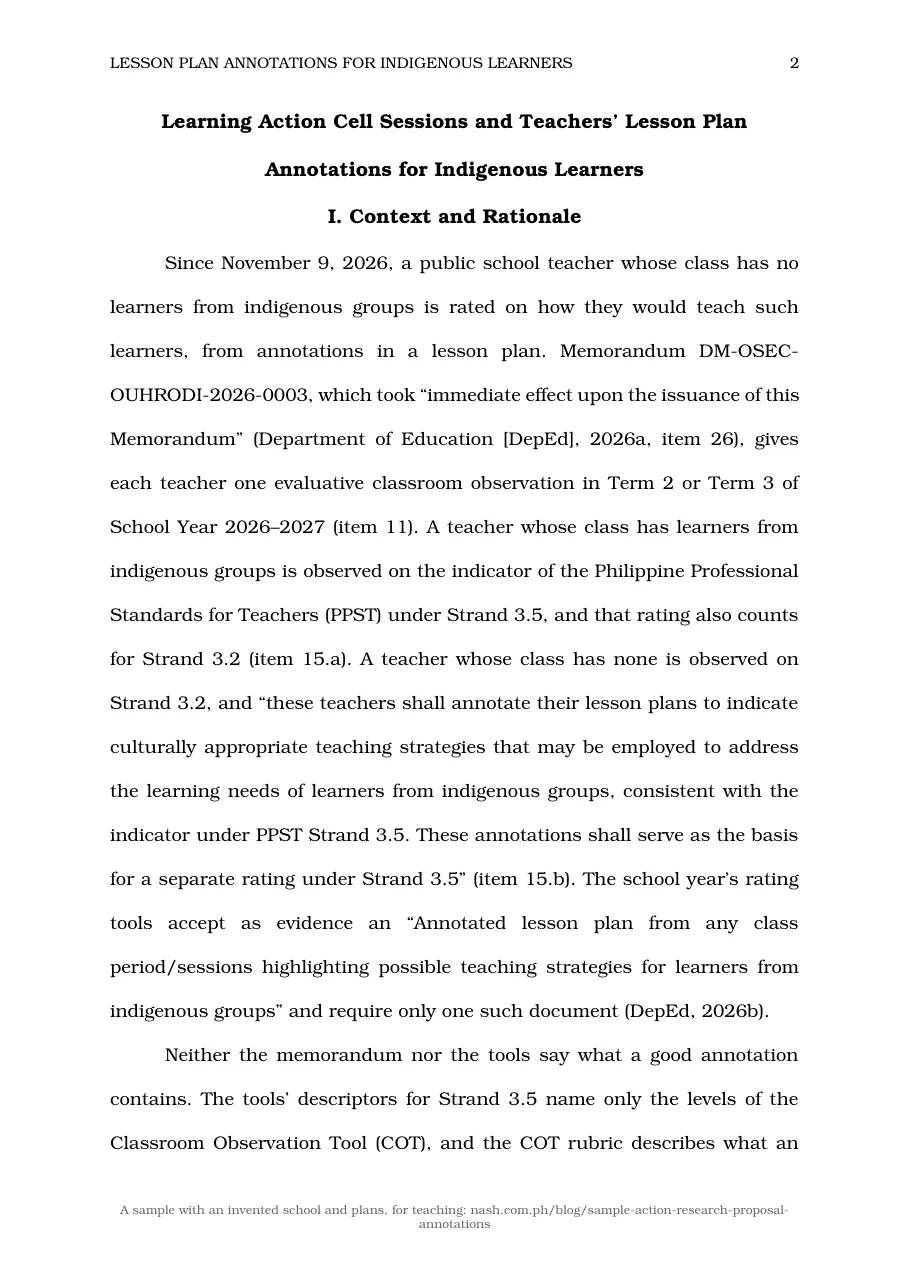
The two pages below are the proposal’s blind title page and the first page of its Context and Rationale.
Which sample action research to follow
The sample on this page is a full proposal written before any data exist, for a study of teachers rather than learners. The completed samples show what the same parts look like once the data are in.
| Sample | What it shows | Design | Closest to this proposal in |
|---|---|---|---|
| This sample: lesson plan annotations, Grades 1 to 6 teachers | A full proposal with its instruments, before any data | Multiple baseline across three clusters of teachers, the order drawn by lot | — |
| Peer navigation, Grade 8 learners (a proposal) | A full proposal on a mental health program, with instruments, consent and assent forms and a disclosure protocol, before any data | Eight sections drawn by lot into an early and a delayed start | The proposal’s parts, its files and its deck |
| DepEd Action Research Proposal Format, With a Sample | Each part of a proposal and its points, with a short sample on Grade 1 reading | One group, before and after | The format and the scoring |
| Grade 7 English | A completed study with staggered starts | Four sections started one at a time (stepped wedge, multiple baseline), randomization test over 24 orders | The staggered design |
| Grade 8 writing | A completed study scored on a rubric by two blind raters | Two sections, one a comparison group | Weighted kappa and the ICC |
| Students’ behavior | A completed single-case study | ABAB reversal in one class | Visual analysis and nonoverlap of all pairs |
| Sample Action Research in DepEd Format | The blog’s first complete sample, with the completed report’s eleven parts | One group, pretest and posttest | The report that follows a proposal |
The other complete samples, from response cards in a large Grade 8 Araling Panlipunan class to the least mastered competencies of a Grade 7 Mathematics class, are listed in each sample’s own table. Before submitting, the action research checklist runs a proposal through the checks an evaluator makes.
What item 15.b asks: annotations for learners from indigenous groups
Item 15.b of Memorandum DM-OSEC-OUHRODI-2026-0003, dated November 9, 2026, splits teachers by their class. A teacher handling learners from indigenous groups is observed on strand 3.5, and “The rating obtained for the indicator under PPST Strand 3.5 shall also serve as the official rating for the indicator under PPST Strand 3.2” (item 15.a). A teacher without them is observed only on strand 3.2, and “these teachers shall annotate their lesson plans to indicate culturally appropriate teaching strategies that may be employed to address the learning needs of learners from indigenous groups, consistent with the indicator under PPST Strand 3.5. These annotations shall serve as the basis for a separate rating under Strand 3.5” (item 15.b). The guidance PMES for SY 2026-2027 for teachers sets out the rest of the memorandum: one evaluative observation in Term 2 or Term 3 (item 11), and twelve indicators.
| Class with learners from indigenous groups (item 15.a) | Class without them (item 15.b) | |
|---|---|---|
| Observed in the one evaluative observation | Strand 3.5 | Strand 3.2 |
| Strand 3.2 rated from | The strand 3.5 observation | The observation |
| Strand 3.5 rated from | The observation | Annotations in a lesson plan |
| Evidence the tools name | COT Rating Sheet or Inter-Observer Agreement Form (Master Teachers: COT Rating Sheet and proof of attendance of colleagues) | “Annotated lesson plan from any class period/sessions highlighting possible teaching strategies for learners from indigenous groups” |
| What the memorandum says about content | The COT rubric for strand 3.5 | Nothing beyond item 15.b’s sentence |
The four SY 2026–2027 tools add that “Only one (1) MOV shall be required for the applicable indicator.” They also say that teachers without learners from indigenous groups “shall annotate in their lesson plan possible teaching strategies for learners from indigenous groups, which shall serve as the basis for a separate rating for the indicator under PPST Strand 3.5.” Their descriptors for the objective name only COT levels “as shown in the COT rating sheet.” Under the multi-year guidelines of DepEd Memorandum No. 089, s. 2025, strand 3.5 had been one of the indicators observed in the year’s second observation, with no split by class (DM 089, s. 2025 explained); the split is the memorandum’s.
Who counts as a learner from an indigenous group? DepEd’s enrollment policy defines an “Indigenous Peoples (IP) learner” as “a learner born of either or both parents who are IP as defined in R.A. No. 8371” (DepEd Order No. 017, s. 2025, Sec. IV.g), and the enrollment form asks families to declare it. The Basic Education Development Plan warns that “a degree of trust is a prerequisite to self-disclosure of IP identity” (DepEd Order No. 024, s. 2022, Sec. 3.1.2), so a class recorded as having none may still have learners whose families did not declare it. The proposal writes “no declared learners” for that reason.
The indicator a teacher is rated on depends on the position. For Teachers I to VII it is 3.5.2, “Adapt and use culturally appropriate teaching strategies to address the needs of learners from indigenous groups” (DepEd Order No. 42, s. 2017); Master Teachers are rated at 3.5.3 or 3.5.4, as the Master Teacher IPCRF guide shows. The PPST guide lists all seven domains, the e-SAT for 2025-2028 is where a teacher rates their own practice on the strand, and coaching after the annotations goes on the PMCF. The COT rubric’s nine levels for strand 3.5 are in COT Rubric Levels 1-9, and they are written for a lesson someone watches, not a page someone reads.
How to annotate a lesson plan for learners from indigenous groups
An annotation for learners from indigenous groups is a short note in your own lesson plan that names a culturally appropriate strategy, the learning need it addresses, the step of the lesson it changes and, where a community’s knowledge would come in, how you would learn it properly. The sample proposal turns item 15.b’s sentence into four questions an annotation answers:
| Question | What the annotation states | What it avoids |
|---|---|---|
| 1. What may I do? | A strategy concrete enough for another teacher to carry out | A good intention with no action (“respect IP culture”) |
| 2. Which learning need does it address? | The literacy, oral expression, numeracy, problem solving, knowledge, skill, value or attitude the competency asks for | A trait given to a whole people (“IP learners are visual learners”) |
| 3. Where in the lesson? | The part of the ILAW plan, the step, and how you will check that it worked | “During the lesson,” with no step |
| 4. Whose context, and how would I learn it properly? | The learner’s own community, and the channel: the learner and family, the Division IPEd Focal Person, culture bearers the community recommends | Costume, imitation, artifacts or symbols without permission, and knowledge not validated with the community |
The questions come from DepEd’s own words. The COT rubric’s clarifications define “learning needs” as “essential learning tools (literacy, oral expression, numeracy, and problem solving) and the basic learning content (knowledge, skills, values, and attitudes),” and at Level 5 the teacher “employs strategies which are culturally appropriate” (DM 089, s. 2025, Annex E-1, pp. 48–49). The PPST glossary defines culturally appropriate teaching strategies as “Teaching strategies that respect cultural differences between and among students and teachers” (DO 42, s. 2017).
Write the annotation in the plan you already prepare. The ILAW plan’s part “Opportunities for integration and contextualization” asks teachers to “incorporate relevant real-life, cultural, or community-based contexts that enrich learner understanding and engagement” (DepEd Order No. 016, s. 2026, item 7.b.iv), and its guide adds that teachers “may use brief notes, integrated responses, or omit sections that are not applicable” (Annex B). No separate form is needed, and none may be required: offices and schools “shall not require additional or expanded lesson plan templates, supplementary forms, or documentation” (item 21), and “No separate demonstration lesson or specially prepared lesson plan shall be required solely for PMES” (memorandum, item 12). Write it yourself, too: DepEd bars AI from “designing learning experiences and instructional strategies (i.e. the ILAW Framework)” (DO 016, s. 2026, item 25.a). How to write an ILAW lesson plan walks through the plan’s parts, and the school head’s role under DO 016 covers what a head may ask for.
What an annotation may plan, and what needs a community’s consent
The fourth question matters most, because an annotation can plan what DepEd’s rules on indigenous culture forbid. DO 51, s. 2014 applies to every public school and lists what a lesson that uses aspects of a community’s culture must observe:
| An annotation may plan | It needs the community’s permission first | DepEd rules it out |
|---|---|---|
| Starting from what each learner brings: words used at home, examples the learner chooses to share | Presenting “aspects of indigenous culture” (“the appropriate process of seeking permission from the community … should be observed”) | Calling indigenous clothing a costume: “Indigenous clothing or garments should not be referred to as “costume”” |
| Accepting answers in the learner’s home language | Using artifacts (“In the absence of an opportunity to appropriately seek permission, the use of the artifact/s should be deferred”) and symbols | Imitating members of a community: “imitating the physical appearance of members of the community as part of a presentation should not be done” |
| Asking the Division IPEd Focal Person which materials a community has validated | Inviting a resource person, who “should be recommended by the community” | Teaching indigenous knowledge “with interpretations and understanding not validated with the community” (one of the concerns the order answers) |
The Indigenous Peoples Education Curriculum Framework adds that strategies “coming from outside the community shall be discussed with the community,” and that “The conduct of rituals related to particular IKSPs to be learned shall be the purview of the community, and shall be planned with community elders” (DepEd Order No. 32, s. 2015, Sec. V.B.2). DepEd Contextualization, Localization and Indigenization explains the three terms the COT rubric uses.
Two more traps are not rules but evidence. Castagno and Brayboy (2008) argue that writing on culturally responsive schooling for Indigenous youth “is too easily reduced to essentializations, meaningless generalizations, or trivial anecdotes”: an annotation such as “IP learners learn best through hands-on activities” gives one trait to many peoples. And a sentence that only says “respect the culture” names no strategy at all.
Weak and full annotations for one lesson
The six annotations below were written for one Grade 4 Science lesson of Term 3, whose competency reads “Observe and identify sources and uses of light, sound, and heat energy at school, at home and in the local community.” The rubric’s scores are on the four criteria, in order.
| Annotation | Scores | What it shows | |
|---|---|---|---|
| A | “N/A” | 0, 0, 0, 0 | No strategy, need, place or context |
| B | “IP learners learn best through hands-on activities, so I will use hands-on activities.” | 1, 0, 0, 1 | The same strategy for every learner; a trait given to all indigenous peoples |
| C | “Pre-lesson: Let the learners wear indigenous costumes and act out how their ancestors cooked with fire.” | 2, 0, 2, 0 (flagged) | Placed at a step, but it plans what DO 51 rules out |
| D | “During the lesson, use examples of light and sound sources from indigenous communities, such as their musical instruments and torches.” | 2, 0, 1, 1 | Culture in general terms; “indigenous communities” as one |
| E | Pre-lesson: each learner names two sources in their own home, in the word they use at home, with the Filipino or English term beside it; this builds oral expression and the competency’s “at home and in the local community.” | 3, 2, 2, 2 | A concrete strategy tied to the competency and placed at a step; it does not say how community content would be checked |
| F | The same, with a formative check (each learner sorts their own examples into light, sound and heat), learners invited to suggest examples from their community, and anything beyond what a learner chooses to share checked first with the family and the Division IPEd Focal Person | 3, 3, 3, 3 | Answers all four questions |
Try it in the figure below with three lessons from Term 3’s budgets of work. It shows which of the COT rubric’s words each answer can show on paper; it gives no score and no level, because no DepEd rule converts an annotation into a COT level.
A self-check, not a rating · 3 Term 3 lessons · 4 questions
An annotation in the margin: which words of the COT rubric can it show?
Pick a lesson, then one answer to each question. The note gathers your answers beside the step of the plan it changes, and the panel names the words of the COT rubric for strand 3.5 that each answer can show on paper. No DepEd rule turns an annotation into a COT level: the rating is your PMES rater's. Nothing you choose is kept or sent anywhere.
Grade 2 Mathematics, Term 3, Week 2
Competency (DepEd's words) Solve multiplication problems using the 2, 3, 4, 5, and 10 multiplication tables, including problems involving money.
- Pre-lessonSkip counting by 5s and 10s with play coins; learners name things their families buy, sell or share in equal groups.
- Lesson flowModel a problem with counters; pairs solve with play coins; independent practice on four problem cards.Note: hereNote: here
- Formative assessmentExit ticket: two problems, one with money; each learner explains one.Note: the check
- Ways forwardWrite one equal-groups problem from home with a family member.
Annotation for learners from indigenous groups (PPST 3.5)
During the lesson: Lesson flow, independent practice: Lesson flow, independent practice: Be sensitive to the culture of IP learners. Give more practice problems. Use word problems about indigenous livelihoods, such as farming and weaving. Write two of the four problem cards from the situations learners give in the pre-lesson (things their families buy, sell, share or count in equal groups), in the learners' own words. IP learners find mathematics hard. This makes the lesson interesting. This builds numeracy and problem solving, as the competency asks. This builds numeracy and problem solving, as the competency asks, with problems about situations each learner knows rather than ones the teacher imagines for them. Show a picture of an IP family in traditional costume as the family in every problem. Include IP traditions in the problems. Use only the situations learners offer, in their own words. Use only the situations learners offer, and give no community a "typical" livelihood; to draw more on a community's practices, ask the learner's family and the Division IPEd Focal Person first. Formative assessment: each learner explains one problem with counters, in Filipino, English or the language used at home.
Where? This note names no step of the plan.
Where? This note names no step of the plan.
What this annotation can show on paper
- 1. StrategyNone. An intention is not a strategy; Level 1 reads "The teacher does not employ strategies to address the learning needs of learners from indigenous groups."Level 2's words: "employs strategies but fails to address the learning needs of learners from indigenous groups." The strategy would be the same for any learner.Levels 3 and 4's words: "somewhat culturally appropriate" or "partially culturally appropriate." The strategy points to culture without saying what the teacher does.Full answer. Level 5's words: "culturally appropriate." A concrete strategy another teacher could carry out.
- 2. Learning needNone. It gives learners from indigenous groups a trait as a whole.None yet. A general aim names no learning need.The rubric's "learning needs": "essential learning tools (literacy, oral expression, numeracy, and problem solving) and the basic learning content (knowledge, skills, values, and attitudes)."Full answer. Level 7's words: the "individual and group of learners." It starts from what each learner brings.
- 3. Place in the lessonNothing. The note names no step, so a reader cannot see where it fits.Nothing yet. "During the lesson" names no step.One step of the ILAW plan, with what learners do there.Full answer. Level 6's words: "a variety of strategies." Two parts of the plan work together, and the check shows whether it worked.
- 4. Context and channelNothing it may keep. It plans what DepEd's rules on indigenous culture rule out.None. "IP culture" treats many peoples as one.The learner's own home knowledge, without saying how community content would be checked.Full answer. Level 8's words: learners "suggest ways in which instruction or lessons might be modified or contextualized"; Level 9's "contextualization." It names the channel through which a community's knowledge is learned.
Caution. "too easily reduced to essentializations, meaningless generalizations, or trivial anecdotes" (Castagno and Brayboy (2008), on culturally responsive schooling for Indigenous youth)
Caution. "Indigenous clothing or garments should not be referred to as "costume" since the cultural context of these materials is not for show." (DepEd Order No. 51, s. 2014)
Grade 4 Science, Term 3, Weeks 1 to 2
Competency (DepEd's words) Observe and identify sources and uses of light, sound, and heat energy at school, at home and in the local community.
- Pre-lessonStop and notice: what learners can see, hear and feel in the classroom right now; then each learner names two sources in their own home.Note: hereNote: here
- Lesson flowGuided observation around the room; a three-column chart of light, sound and heat; the home sources from the pre-lesson added.
- Formative assessmentEach learner sorts six cards and their own examples into light, sound and heat.Note: the check
- Ways forwardList with the family the sources of light, sound and heat used at home in the evening.
Annotation for learners from indigenous groups (PPST 3.5)
During the lesson: Pre-lesson: Pre-lesson: Respect the culture of learners from indigenous groups. Use group activities. Use examples from indigenous communities, such as their musical instruments and torches. Ask each learner to name two sources of light, sound or heat in their own home, in the word they use at home, and write the Filipino or English term beside it. IP learners learn best through hands-on activities. This helps them understand the lesson. This builds oral expression and the competency's "at home and in the local community." This builds oral expression and the competency's "at home and in the local community," and starts from what each learner knows instead of what the teacher assumes about a community. Let the learners wear indigenous costumes and act out how a community cooks with fire. Add IP culture to the lesson. Use the words and examples each learner brings from home. Learners may suggest examples from their community for the class chart; anything about a community's practices beyond what a learner chooses to share is checked first with the family and the Division IPEd Focal Person. Formative assessment: each learner sorts their own examples into light, sound and heat, and the teacher notes who needs help.
Where? This note names no step of the plan.
Where? This note names no step of the plan.
What this annotation can show on paper
- 1. StrategyNone. An intention is not a strategy; Level 1 reads "The teacher does not employ strategies to address the learning needs of learners from indigenous groups."Level 2's words: "employs strategies but fails to address the learning needs of learners from indigenous groups." The strategy would be the same for any learner.Levels 3 and 4's words: "somewhat culturally appropriate" or "partially culturally appropriate." The strategy points to culture without saying what the teacher does.Full answer. Level 5's words: "culturally appropriate." A concrete strategy another teacher could carry out.
- 2. Learning needNone. It gives learners from indigenous groups a trait as a whole.None yet. A general aim names no learning need.The rubric's "learning needs": "essential learning tools (literacy, oral expression, numeracy, and problem solving) and the basic learning content (knowledge, skills, values, and attitudes)."Full answer. Level 7's words: the "individual and group of learners." It starts from what each learner brings.
- 3. Place in the lessonNothing. The note names no step, so a reader cannot see where it fits.Nothing yet. "During the lesson" names no step.One step of the ILAW plan, with what learners do there.Full answer. Level 6's words: "a variety of strategies." Two parts of the plan work together, and the check shows whether it worked.
- 4. Context and channelNothing it may keep. It plans what DepEd's rules on indigenous culture rule out.None. "IP culture" treats many peoples as one.The learner's own home knowledge, without saying how community content would be checked.Full answer. Level 8's words: learners "suggest ways in which instruction or lessons might be modified or contextualized"; Level 9's "contextualization." It names the channel through which a community's knowledge is learned.
Caution. "too easily reduced to essentializations, meaningless generalizations, or trivial anecdotes" (Castagno and Brayboy (2008), on culturally responsive schooling for Indigenous youth)
Caution. "To avoid stereotyping and inappropriate representation, imitating the physical appearance of members of the community as part of a presentation should not be done." (DepEd Order No. 51, s. 2014)
Grade 6 Science, Term 3, Week 11
Competency (DepEd's words) Gather information from local indigenous community members or from reliable secondary sources to investigate ways that indigenous people of the Philippines represented and communicated understandings of: a. the predictability of solar and lunar eclipses b. patterns /interpretations in the night sky and their use for tracking time
- Pre-lessonReview the Sun-Earth-Moon model with a ball and a flashlight.
- Lesson flowGroups read sources on how a people tracked time by the sky; a class comparison chart with the source of each idea.Note: hereNote: here
- Formative assessmentExit slip: one idea, how it compares with the model, and its source.Note: the check
- Ways forwardRead one more source from the class list and add one idea, with its source.
Annotation for learners from indigenous groups (PPST 3.5)
During the lesson: Lesson flow, reading in groups: Lesson flow, reading in groups: Value indigenous knowledge. Assign a research report on constellations. Discuss indigenous beliefs about eclipses. Groups read secondary sources that the Division IPEd Focal Person identifies as validated by the community concerned, and compare how a people tracked time by the sky with the Sun-Earth-Moon model. Indigenous peoples are closer to nature, so this suits them. This makes learners appreciate culture. This builds the competency's knowledge of how indigenous peoples tracked time and eclipses. This builds the competency's knowledge, and lets a learner from an indigenous community, if one joins the class, share only what their family allows, never as the class's expert. Have learners interview elders on their own and act out an eclipse ritual for the class. Use indigenous astronomy in general. Ask learners what their families say about the night sky. Invite a culture bearer only when the community recommends one and agrees to the session, through the Division IPEd Focal Person; until then, use only sources validated by the community. Formative assessment: an exit slip on which each learner names one idea and its source.
Where? This note names no step of the plan.
Where? This note names no step of the plan.
What this annotation can show on paper
- 1. StrategyNone. An intention is not a strategy; Level 1 reads "The teacher does not employ strategies to address the learning needs of learners from indigenous groups."Level 2's words: "employs strategies but fails to address the learning needs of learners from indigenous groups." The strategy would be the same for any learner.Levels 3 and 4's words: "somewhat culturally appropriate" or "partially culturally appropriate." The strategy points to culture without saying what the teacher does.Full answer. Level 5's words: "culturally appropriate." A concrete strategy another teacher could carry out.
- 2. Learning needNone. It gives learners from indigenous groups a trait as a whole.None yet. A general aim names no learning need.The rubric's "learning needs": "essential learning tools (literacy, oral expression, numeracy, and problem solving) and the basic learning content (knowledge, skills, values, and attitudes)."Full answer. Level 7's words: the "individual and group of learners." It starts from what each learner brings.
- 3. Place in the lessonNothing. The note names no step, so a reader cannot see where it fits.Nothing yet. "During the lesson" names no step.One step of the ILAW plan, with what learners do there.Full answer. Level 6's words: "a variety of strategies." Two parts of the plan work together, and the check shows whether it worked.
- 4. Context and channelNothing it may keep. It plans what DepEd's rules on indigenous culture rule out.None. "IP culture" treats many peoples as one.The learner's own home knowledge, without saying how community content would be checked.Full answer. Level 8's words: learners "suggest ways in which instruction or lessons might be modified or contextualized"; Level 9's "contextualization." It names the channel through which a community's knowledge is learned.
Caution. "too easily reduced to essentializations, meaningless generalizations, or trivial anecdotes" (Castagno and Brayboy (2008), on culturally responsive schooling for Indigenous youth)
Caution. "The conduct of rituals related to particular IKSPs to be learned shall be the purview of the community, and shall be planned with community elders." (DepEd Order No. 32, s. 2015, Sec. V.B.2.a)
The figure’s fullest notes run to 109 to 118 words, a short paragraph in a plan. Annotation F above is the kind of note the series aims for: the first three questions answered within the lesson, the fourth by naming who must be asked before a community’s knowledge comes in.
Part 1. How the proposal was planned
Choosing the problem and the participants
The proposal starts from a rule that covers almost every teacher in the sample’s school. All 36 teachers of Grades 1 to 6 have no declared learner from an indigenous group, so all fall under item 15.b; the three Kindergarten teachers each have one and are observed under item 15.a. Nationally, the Basic Education Development Plan counted IP learners in “41,731 public schools nationwide, or 79.19% of all public schools” in School Year 2019–2020 (DO 024, s. 2022, Sec. 3.1.3). A school with a few such learners still has many classes without any, and its teachers write the annotations.
The study measures the teachers’ plans because there are no learners from indigenous groups in their classes to measure. That is also its main limit, which the proposal states at the outset: it can show that annotations improve, not that the strategies work with any community’s children. The limitations of action research explains how to state such a limit without weakening the study.
Why a multiple-baseline design, not a stepped-wedge trial
A multiple-baseline design measures each cluster repeatedly and starts the intervention at a different time in each, so a rise that comes only when each cluster starts is hard to explain by anything else. The What Works Clearinghouse’s pilot standards ask for “at least three attempts to demonstrate an intervention effect at three different points in time,” and each phase “must have a minimum of three data points”; a multiple-baseline design meets the standards with reservations with “a minimum of six phases with at least 3 data points per phase,” and fully with 5 (Kratochwill et al., 2010, pp. 15–16).
Three clusters give six phases. Term 3’s Instructional Block runs from January 4 to March 23, 2027, and its last two weeks hold the Term 3 examinations (DepEd Order No. 009, s. 2026, Annex B), which leaves ten weekly data points. Starting the clusters after weeks 3, 5 and 7 gives 3 and 7, 5 and 5, and 7 and 3 points. No three different start weeks give every phase five points within ten weeks, so the proposal meets the standards with reservations and says so.
The figure below shows the schedule on Term 3’s class days. Choose an order, draw one, or try other start weeks against the standards.
Term 3, SY 2026-2027 · 3 clusters of 12 teachers · 10 data weeks
The staggered start: who meets the Learning Action Cell when
Each row is a cluster; each column, a week of Term 3's Instructional Block. A week's annotation is handed in by Friday noon, before that Friday's session, so a session week still counts as before. Choose the order the lot gives the clusters, or draw one; below the table, try other start weeks against the design standard. Nothing you choose is kept or sent anywhere.
| Cluster | Week 1Jan 4–8Term 3 opens January 4 | Week 2Jan 11–15 | Week 3Jan 18–22 | Week 4Jan 25–29January 25: first teacher-made summative test | Week 5Feb 1–5 | Week 6Feb 8–12 | Week 7Feb 15–19February 16: second teacher-made summative test | Week 8Feb 22–26 | Week 9Mar 1–5 | Week 10Mar 8–12Closing session for all three clusters, Friday, March 12 | Week 11Mar 15–19March 15-16: Term 3 examination, moving up and graduating | Week 12Mar 22–23March 22-23: Term 3 examination, other grade levels |
|---|---|---|---|---|---|---|---|---|---|---|---|---|
| Grades 1-2firstsecondthird | BeforeBeforeBefore | BeforeBeforeBefore | BeforeLAC 1 · Jan 22BeforeBefore | AfterLAC 2 · Jan 29BeforeBefore | AfterLAC 3 · Feb 5BeforeLAC 1 · Feb 5Before | AfterAfterLAC 2 · Feb 12Before | AfterAfterLAC 3 · Feb 19BeforeLAC 1 · Feb 19 | AfterAfterAfterLAC 2 · Feb 26 | AfterAfterAfterLAC 3 · Mar 5 | AfterAfterAfter | No dataNo dataNo data | No dataNo dataNo data |
| Grades 3-4firstsecondthird | BeforeBeforeBefore | BeforeBeforeBefore | BeforeLAC 1 · Jan 22BeforeBefore | AfterLAC 2 · Jan 29BeforeBefore | AfterLAC 3 · Feb 5BeforeLAC 1 · Feb 5Before | AfterAfterLAC 2 · Feb 12Before | AfterAfterLAC 3 · Feb 19BeforeLAC 1 · Feb 19 | AfterAfterAfterLAC 2 · Feb 26 | AfterAfterAfterLAC 3 · Mar 5 | AfterAfterAfter | No dataNo dataNo data | No dataNo dataNo data |
| Grades 5-6firstsecondthird | BeforeBeforeBefore | BeforeBeforeBefore | BeforeLAC 1 · Jan 22BeforeBefore | AfterLAC 2 · Jan 29BeforeBefore | AfterLAC 3 · Feb 5BeforeLAC 1 · Feb 5Before | AfterAfterLAC 2 · Feb 12Before | AfterAfterLAC 3 · Feb 19BeforeLAC 1 · Feb 19 | AfterAfterAfterLAC 2 · Feb 26 | AfterAfterAfterLAC 3 · Mar 5 | AfterAfterAfter | No dataNo dataNo data | No dataNo dataNo data |
Before: the annotation precedes the cluster's first session After: the series has begun LAC 1 to 3: the cluster's sessions, Friday, 3:00 to 4:00 p.m.Week 10: closing session for all three clusters, after the last annotation
The Grades 1-2 cluster meets first, on January 22, January 29 and February 5: 3 annotations before its series and 7 after. The Grades 3-4 cluster meets second, on February 5, February 12 and February 19: 5 annotations before its series and 5 after. The Grades 5-6 cluster meets third, on February 19, February 26 and March 5: 7 annotations before its series and 3 after.
The Grades 1-2 cluster meets first, on January 22, January 29 and February 5: 3 annotations before its series and 7 after. The Grades 5-6 cluster meets second, on February 5, February 12 and February 19: 5 annotations before its series and 5 after. The Grades 3-4 cluster meets third, on February 19, February 26 and March 5: 7 annotations before its series and 3 after.
The Grades 3-4 cluster meets first, on January 22, January 29 and February 5: 3 annotations before its series and 7 after. The Grades 1-2 cluster meets second, on February 5, February 12 and February 19: 5 annotations before its series and 5 after. The Grades 5-6 cluster meets third, on February 19, February 26 and March 5: 7 annotations before its series and 3 after.
The Grades 3-4 cluster meets first, on January 22, January 29 and February 5: 3 annotations before its series and 7 after. The Grades 5-6 cluster meets second, on February 5, February 12 and February 19: 5 annotations before its series and 5 after. The Grades 1-2 cluster meets third, on February 19, February 26 and March 5: 7 annotations before its series and 3 after.
The Grades 5-6 cluster meets first, on January 22, January 29 and February 5: 3 annotations before its series and 7 after. The Grades 1-2 cluster meets second, on February 5, February 12 and February 19: 5 annotations before its series and 5 after. The Grades 3-4 cluster meets third, on February 19, February 26 and March 5: 7 annotations before its series and 3 after.
The Grades 5-6 cluster meets first, on January 22, January 29 and February 5: 3 annotations before its series and 7 after. The Grades 3-4 cluster meets second, on February 5, February 12 and February 19: 5 annotations before its series and 5 after. The Grades 1-2 cluster meets third, on February 19, February 26 and March 5: 7 annotations before its series and 3 after.
Start weeks and the design standard
- Met:Three demonstrations at three different times.The clusters start in weeks 3, 5 and 7: three changes, each at its own time.
- Met:Each phase has at least 3 data points (Meets Standards with Reservations).Before and after: 3 and 7; 5 and 5; 7 and 3.
- Not met:Each phase has at least 5 data points (Meets Standards).Ten data weeks cannot give three different start weeks 5 points on each side; only a start in week 5 does, and only one cluster can start there.
- Met:Every session meets on a Friday before the examination weeks.The last series ends on March 5.
- Met:The closing session on Friday, March 12 comes after every series.Every cluster's third session is over by March 5.
- Met:No Friday holds more sessions than the two facilitators can lead.February 5 holds 2 and February 19 holds 2; the facilitator and the co-facilitator take one cluster each.
With three clusters there are six possible orders, so a randomization test of the order cannot give a p value below 1/6 ≈ .17.
Monthly measures would have fit fewer than three points into a phase, which is why each consenting teacher writes one short annotation a week. The burden stays small because the annotation goes into a plan the teacher prepares anyway, and the memorandum itself forbids more: teachers “shall not be required to create, reproduce, reformat, print, bind, or otherwise repack documents solely for PMES where sufficient authentic evidence is already available from the regular performance of their duties” (item 18).
The design resembles a stepped-wedge trial, in which clusters cross over in a random order, but three clusters are too few for its usual models, and its main threat applies in full: “the effect of the intervention might be confounded with any underlying temporal trend” (Hemming et al., 2015). The clusters still waiting are the check on that threat. The order is drawn by lot so that no one starts with the cluster expected to do best. With six possible orders, a randomization test cannot give a p below 1/6, about .17, so the proposal rests its main answer on the graph, as single-case standards do, and adds a pooled test.
What is measured, and why two blind raters
The rubric scores each annotation from 0 to 3 on the four questions, for a total of 0 to 12, using the COT rubric’s words that an annotation can show on paper. Rubrics give more reliable scores when they are “analytic, topic-specific, and complemented with exemplars and/or rater training” (Jonsson & Svingby, 2007, p. 130), so the raters train on anchor annotations until their quadratic-weighted kappa reaches .60 on each criterion, the minimum the clearinghouse accepts for Cohen’s kappa on a study’s data (Kratochwill et al., 2010, p. 15). Quadratic weights usually give a higher kappa than the unweighted statistic, so the proposal aims for .80. The total’s agreement is an intraclass correlation of absolute agreement, never Pearson’s r, which can be perfect while one rater scores every annotation higher.
Blindness matters more than usual here, because the raters’ colleagues wrote the annotations. The research coordinator types each annotation with only a code and the lesson’s competency, removes names, dates, grade levels and sections, and shuffles all 360 into one order after week 10. A competency can still show a rater the grade band, which is the cluster, and through the budget of work roughly the week. The raters are therefore not told the order of the clusters and are not at the lot, and for one annotation in ten they record a guess of the phase as a check on blinding.
The self-efficacy scale uses the eight items of Comstock et al. (2023), published under a Creative Commons Attribution 4.0 license, with a stem added: “How confident are you that you could do the following for learners from indigenous groups, if they were in your class?” Comstock et al. shortened the items and adapted them from two earlier scales, one of them Siwatu’s (2007). The proposal names those sources and does not reprint Siwatu’s 40-item scale, which was published in a copyrighted journal article. Self-ratings are secondary: Bottiani et al. (2018) note that self-reports of culturally responsive practice are prone to social desirability bias, and recommend combining measures.
Keeping research scores out of PMES
The research scores never reach PMES. The memorandum allows formative support, including LAC sessions (item 6), but “Formative activities shall not substitute for evaluative classroom observation, generate unofficial performance ratings, or be imposed as additional rated observations” (item 10). So the raters rate no teacher in PMES, the facilitator’s comments in the sessions carry no score or level, the scores are reported only by cluster, and the teacher chooses which annotated plan to submit for their own rating. The sample’s school has no Master Teacher, and the school head rates every teacher, with the Assistant Schools Division Superintendent approving (DM 089, s. 2025, Table 18). Where a school has one, the Master Teacher rates its elementary teachers. A Master Teacher who facilitated the series would then read every draft by name; the series needs a facilitator who rates none of the teachers. Every cluster finishes its series by March 5, 2027, before the year-end review, so the cluster drawn last loses nothing.
Ethics without an indigenous community in the data
DepEd’s research guidelines add steps for “researches that will involve Indigenous Peoples (IP) learners, Indigenous Cultural Communities (ICCs), Indigenous Knowledge Systems and Practices (IKSPs), and Indigenous Learning Systems (ILSs)” (DO 16, s. 2017, Sec. V.B.ii.a): a discussion with community representatives, the rights-based approach of the IPEd framework, and free, prior and informed consent (Sec. VI.C; Annex 9). The National Commission on Indigenous Peoples’ research guidelines cover research on IKSPs and customary laws, from academic studies to research in aid of policy (NCIP Administrative Order No. 1, s. 2012, Sec. 7), and its 2026 consent guidelines list “Non-IKSP Research Studies: Research not requiring Philippine Health Research Ethics Board clearance, and similar studies” among exempt activities (NCIP Administrative Order No. 3, s. 2026, Sec. 40).
The sample’s study recruits no learner, collects nothing from or about any community, and documents no IKSP, so none of those steps is triggered, and the proposal says so in its Methods to pass the initial screening for “Non-conformance to research ethics” (DO 16, s. 2017, Sec. V.B.ii.a). It also binds itself: if the design ever changed to consult elders or record a community’s knowledge, it would need the community’s consent before any planning and a new review. NCIP Research Permit and FPIC for Studies With IP Learners covers the studies that do need them, and DepEd action research ethics covers consent and privacy for teachers as participants.
Funding from MOOE, not the Basic Education Research Fund
The study costs PhP 6,030.00, paid from the school’s MOOE: “Funds for the LACs may be sourced from the school’s Maintenance and Other Operating Expenses (MOOE), subject to its utilization guidelines” (DO 35, s. 2016, item 11), and the series goes into the school’s Annual Implementation Plan, since school MOOE funds activities “as specifically determined in the Annual Implementation Plan (AIP)” (DepEd Order No. 008, s. 2019, Sec. V.D, item 1). A school-level grant from the Basic Education Research Fund follows its own yearly call, often months before Term 3; research on “other fund sources will follow the research management procedures in evaluating and approving research proposals” (DO 16, s. 2017, Sec. V.C.ii). The Basic Education Research Fund guide covers applying in a later call.
Sample size and power
The 36 teachers are the whole population item 15.b covers in the school, so no sample is drawn. With 36 pairs of means, before and after, a two-sided paired test at α = .05 has 80% power to detect dz = 0.48; one cluster of 12 could detect only dz = 0.89. A meta-analysis of 60 causal studies of coaching found “pooled effect sizes of 0.49 standard deviations (SD) on instruction” (Kraft et al., 2018, p. 547), close to what the pooled test can detect, though the two are measured on different scales. Action research sample size explains power analysis.
Part 2. The proposal as submitted
Each part below is the proposal’s text in the order Annex 2.B of DO 16, s. 2017 gives, with the blind title page first. Annex 2.B has no heading for ethics, so the consent, privacy and scope rules sit inside Action Research Methods. The Word file holds the same text with its tables in APA style.
Title page
Learning Action Cell Sessions and Teachers'Lesson Plan Annotations for Indigenous Learners
An Action Research Proposal
[Copy for blind review: the proponents' names,positions, school and schools division areremoved. The final copy lists them here.]
To be conducted December 2026 to May 2027
I. Context and Rationale
Since November 9, 2026, a public school teacher whose class has no learners from indigenous groups is rated on how they would teach such learners, from annotations in a lesson plan. Memorandum DM-OSEC-OUHRODI-2026-0003, which took “immediate effect upon the issuance of this Memorandum” (Department of Education [DepEd], 2026a, item 26), gives each teacher one evaluative classroom observation in Term 2 or Term 3 of School Year 2026–2027 (item 11). A teacher whose class has learners from indigenous groups is observed on the indicator of the Philippine Professional Standards for Teachers (PPST) under Strand 3.5, and that rating also counts for Strand 3.2 (item 15.a). A teacher whose class has none is observed on Strand 3.2, and “these teachers shall annotate their lesson plans to indicate culturally appropriate teaching strategies that may be employed to address the learning needs of learners from indigenous groups, consistent with the indicator under PPST Strand 3.5. These annotations shall serve as the basis for a separate rating under Strand 3.5” (item 15.b). The school year’s rating tools accept as evidence an “Annotated lesson plan from any class period/sessions highlighting possible teaching strategies for learners from indigenous groups” and require only one such document (DepEd, 2026b).
Neither the memorandum nor the tools say what a good annotation contains. The tools’ descriptors for Strand 3.5 name only the levels of the Classroom Observation Tool (COT), and the COT rubric describes what an observer sees in a lesson: at Level 5, “The teacher employs strategies which are culturally appropriate in addressing the learning needs of learners from indigenous groups”; at Level 6, “a variety of strategies”; at Level 7, strategies for the “individual and group of learners from indigenous groups” (DepEd, 2025a, Annex E-1, p. 48). An annotation is a few lines on paper, written for learners the teacher does not have. Which of these words it can show, and how a rater should read it, are left to each school.
All 36 teachers of Grades 1 to 6 in our school fall under item 15.b. None of their classes has a learner whose enrollment record declares membership in an indigenous cultural community; the three Kindergarten teachers each handle a class with such a learner and are observed under item 15.a. An indigenous peoples learner is “a learner born of either or both parents who are IP as defined in R.A. No. 8371” (DepEd, 2025b, Sec. IV.g), and the record depends on families declaring it: the Basic Education Development Plan notes that “a degree of trust is a prerequisite to self-disclosure of IP identity” (DepEd, 2022, Sec. 3.1.2). Our classes may therefore include learners whose families have not declared it, and they may receive transferees from the upland districts of our schools division, where several indigenous cultural communities live. Nationally, “IP learners are in 41,731 public schools nationwide, or 79.19% of all public schools. IP learners represented 9.48% of enrollment in SY 2019-2020” (DepEd, 2022, Sec. 3.1.3).
The annotations carry two risks besides an uncertain rating. The first is the one Castagno and Brayboy (2008) name in their review of the writing on culturally responsive schooling for Indigenous youth, advocated for over 40 years: they suggest that it “has had little impact on what teachers do because it is too easily reduced to essentializations, meaningless generalizations, or trivial anecdotes” (Abstract). An annotation such as “IP learners learn best through hands-on activities” assigns one trait to many peoples. In the Philippines, the implementation of the education provisions of the Indigenous Peoples’ Rights Act has been described as “more of a tokenism” (Eduardo & Gabriel, 2021, Abstract). The second risk is harm to the communities themselves. DepEd Order No. 51, s. 2014 lists the concerns that communities raised, among them that “Indigenous knowledge is being tackled in class with interpretations and understanding not validated with the community,” and rules that “Indigenous clothing or garments should not be referred to as ‘costume’ since the cultural context of these materials is not for show” (DepEd, 2014, Policy Background; On the Use of Indigenous Clothing and Related Paraphernalia). The Indigenous Peoples Education Curriculum Framework adds that teaching strategies “coming from outside the community shall be discussed with the community” (DepEd, 2015, Sec. V.B.2.c). A teacher who annotates without these rules in mind can plan exactly what the policies forbid.
What should a good annotation do instead? Ladson-Billings (1995) set three criteria for culturally relevant teaching: “an ability to develop students academically, a willingness to nurture and support cultural competence, and the development of a sociopolitical or critical consciousness” (p. 483). The first two can show in a lesson plan: a strategy that keeps the lesson’s competency and starts from what learners bring. The COT rubric’s own clarifications point the same way, defining learning needs as “essential learning tools (literacy, oral expression, numeracy, and problem solving) and the basic learning content (knowledge, skills, values, and attitudes)” and culture-based education as “an education that is grounded in the context of the indigenous communities’ life” (DepEd, 2025a, Annex E-1, p. 49). Studies of culturally responsive teaching in the Philippines have so far examined teachers who already teach indigenous learners: Tañon et al. (2026) found that teachers without training in Indigenous Peoples Education (IPEd) who were assigned Subanen learners adapted through “contextualization, translanguaging, use of indigenous materials, and collaborative learning” (Discussion). The teachers item 15.b addresses have no such learners in their classes.
How teachers learn to plan this way is less settled than the advocacy suggests. A systematic review of in-service programs for culturally responsive practice found “just 10 empirical studies” of their impact, and “none employed rigorous design features to allow causal inference” (Bottiani et al., 2018, p. 367). The review advises programs that coach teachers, let them practice and refine new skills on the job, and monitor and reinforce what they do in class (Bottiani et al., 2018). Teachers in a professional learning community on culturally responsive teaching changed their attitudes, but “need more time and detailed information on how to improve teaching materials” (Alhanachi et al., 2021, Abstract). In a randomized trial, teams of educators assigned to lesson study with a resource kit improved their own and their students’ knowledge of fractions more than the comparison teams (Lewis & Perry, 2017), and feedback from a teacher educator improved written lesson plans more than self-evaluation or peer evaluation (Ozogul et al., 2008).
DepEd already has the structure for such work. A Learning Action Cell (LAC) “is a group of teachers who engage in collaborative learning sessions to solve shared challenges encountered in the school” (DepEd, 2016a, item 9), and the memorandum names LAC sessions among the formative support schools may give (DepEd, 2026a, item 6). LAC sessions continue “within the Instructional Block” of the three-term calendar (DepEd, 2026c, item 22). The new lesson planning guidelines give the annotation a home: the ILAW plan’s part “Opportunities for integration and contextualization” asks teachers to “incorporate relevant real-life, cultural, or community-based contexts that enrich learner understanding and engagement” (DepEd, 2026d, item 7.b.iv), and teachers “shall not be required to include components beyond those prescribed in the framework” (item 10).
This action research will test whether a three-session LAC series, built on a four-question annotation protocol and exemplar annotations, improves the quality of the annotations our teachers write, without adding a form, a separate plan or a rating that the memorandum does not allow. It addresses the Basic Education Research Agenda’s theme of teaching and learning, whose topics on instruction include “Continuing professional development and support (e.g. coaching and mentoring, Learning Action Cell [LAC]),” “Lesson planning and creation of Instructional Materials (IMs),” and “Indigenous Peoples Education (IPEd),” and its cross-cutting theme of inclusive education (DepEd, 2016b).
II. Action Research Questions
Main question: Does a three-session Learning Action Cell series with a four-question annotation protocol and exemplar annotations improve the quality of the lesson plan annotations for learners from indigenous groups written by teachers whose classes have no declared learners from indigenous groups?
- How do the teachers’ weekly annotation scores, in total and on each of the rubric’s four criteria, compare before and after their cluster’s LAC series?
- Does each cluster’s annotation quality change when its own series begins, while the clusters still waiting stay as they were?
- Is there a significant difference between the teachers’ mean annotation scores before and after their cluster’s LAC series?
- Is there a significant difference between the teachers’ self-efficacy for culturally responsive teaching before and after the LAC series?
- What do the teachers’ reflection notes say about writing strategies for learners from indigenous groups whom they do not now teach?
Two null hypotheses will be tested at the .05 level of significance:
H₀1: There is no significant difference between the teachers’ mean annotation scores before and after their cluster’s LAC series.
H₀2: There is no significant difference between the teachers’ culturally responsive teaching self-efficacy scores before and after the LAC series.
III. Proposed Innovation, Intervention, and Strategy
Innovation
The innovation is a four-question protocol for writing a Strand 3.5 annotation, with exemplar annotations for the lessons our teachers teach. Each question turns one part of the memorandum’s sentence, or one rule on the use of indigenous culture, into something a teacher writes (Table 1).
Table 1
The Four-Question Annotation Protocol
Question What the annotation states Words of the COT rubric for Strand 3.5 it can show What it avoids 1. What may I do? A strategy concrete enough for another teacher to carry out “culturally appropriate” (Level 5) A good intention with no action (“respect IP culture”) 2. Which learning need does it address? The literacy, oral expression, numeracy, problem solving, knowledge, skill, value or attitude the competency asks for “learning needs” (Levels 1 to 7 and 9); “individual and group of learners” (Level 7) A trait given to a whole people (“IP learners are visual learners”) 3. Where in the lesson? The part of the ILAW plan, the step, and how the teacher will check that it worked “a variety of strategies” (Level 6), with a check that it worked or strategies at two or more parts “During the lesson,” with no step 4. Whose context, and how would I learn it properly? The learner’s own community, and the channel through which its knowledge would be learned and checked: the learner and family, the Division IPEd Focal Person, culture bearers the community recommends “contextualization” (Level 9); learners “suggest ways in which instruction or lessons might be modified or contextualized” (Level 8) Costume, imitation, artifacts or symbols without permission, and knowledge not validated with the community (DepEd, 2014) Note. The level words are quoted from DepEd (2025a, Annex E-1, p. 48). Which words an annotation can show on paper is the protocol’s reading; no DepEd issuance converts an annotation into a COT level.
Teachers write the annotation in the ILAW plan they already prepare for the week, in its part “Opportunities for integration and contextualization” or as a note beside the step it changes. DepEd’s lesson planning guide already allows short notes: teachers “may use brief notes, integrated responses, or omit sections that are not applicable” (DepEd, 2026d, Annex B). The protocol card is a guide for that writing, not a form; schools “shall not require additional or expanded lesson plan templates, supplementary forms, or documentation” (DepEd, 2026d, item 21). Teachers write the annotations themselves, since DepEd bars the use of artificial intelligence for “designing learning experiences and instructional strategies (i.e. the ILAW Framework)” (DepEd, 2026d, item 25.a).
Intervention
The intervention is a series of three weekly LAC sessions of 60 minutes for each grade-level cluster, held on Fridays from 3:00 to 4:00 p.m., after classes, within Term 3’s Instructional Block (Table 2). A one-hour weekly session is the length DepEd recommends: “One to two hours a week is strongly recommended” (DepEd, 2016a, item 17.5). The school’s LAC coordinator, a Teacher III, facilitates the sessions; on the two Fridays when two clusters meet, the school’s research coordinator leads one of them with the same session plan.
Table 2
The Three Sessions of the LAC Series
Session Focus What the teachers do What they leave with 1 The indicator and the protocol Read item 15.b and the COT rubric’s words for Strand 3.5; sort six exemplar annotations by the four questions they answer; mark the ones that essentialize or break DepEd Order No. 51, s. 2014; draft an annotation for the next week’s own lesson plan A first draft and the protocol card 2 Feedback on the drafts Exchange drafts in groups of three and write, for each of the four questions, one thing the draft does and one thing to add; read the facilitator’s written comments on each draft; revise A revised annotation 3 Where cultural content needs consent Study the rules of DepEd Order No. 51, s. 2014 and DepEd Order No. 32, s. 2015 with the Division IPEd Focal Person, invited as resource person; rewrite one annotation so that its fourth answer names the channel; plan the next weeks’ annotations An annotation that answers all four questions Note. A closing session for all three clusters on March 12, 2027, after the last annotation is collected, shares one annotation from each teacher and lists what the school still needs, as DepEd Order No. 35, s. 2016 asks members to “report back” (item 19).
The design of the sessions follows the evidence above. Teachers practice on their own lesson plans (Bottiani et al., 2018), with a resource kit (Lewis & Perry, 2017) that holds the protocol card, the COT rubric’s page for Strand 3.5, the relevant rules of DepEd Orders No. 51, s. 2014 and No. 32, s. 2015, and exemplar annotations for three lessons of Term 3’s budgets of work. Feedback is written and tied to the four questions. A study of lesson study in a Philippine school found that “cultural norms often hinder open critique,” naming pakikisama and hiya (Espinosa & Elipane, 2025, Abstract), and written comments by question make it easier to say what a colleague’s draft lacks. The facilitator’s comments name what a draft does and one thing to add; they carry no level, score or mark, because formative activities “shall not … generate unofficial performance ratings” (DepEd, 2026a, item 10).
Strategy
The intervention reaches the three clusters in turn, in an order drawn by lot, and every consenting teacher writes one short annotation a week in the lesson plan they already prepare. The clusters still waiting show what happens to annotations in the same weeks without the series, under the same memorandum and the same observation season. The extent of the intervention is small by design: about ten minutes a week of writing in an existing plan, three sessions, and no new document. The memorandum itself warns against more: teachers “shall not be required to create, reproduce, reformat, print, bind, or otherwise repack documents solely for PMES” (DepEd, 2026a, item 18).
The study has limits that the proponents state at the outset. It measures what teachers plan, not what learners from indigenous groups learn, since no such learner is in the participating classes. It does not test whether a strategy works with any community, and it collects nothing from or about any community. A three-session series cannot replace the partnership between a school and a community that IPEd rests on (DepEd, 2015, Sec. V.A.1); it can only teach teachers when and through whom to seek it.
Five criteria for success are set before any data are collected:
- The series runs as planned: every session follows at least 90% of the steps on the documenter’s checklist, and at least 90% of the participating teachers attend all three sessions or a make-up session within the same week.
- The raters agree: a quadratic-weighted kappa of at least .60 on each criterion, and an intraclass correlation for the total score whose 95% confidence interval has a lower bound of at least .75.
- Visual analysis shows an improvement in each of the three clusters when, and only when, its own series begins.
- The teachers’ mean annotation scores after the series are higher than before, significant at the .05 level.
- The annotation stays small: the teachers’ median time spent on an annotation is no more than 15 minutes.
IV. Action Research Methods
Research Design
The study uses mixed methods. Its quantitative strand is a multiple-baseline design across three grade-level clusters, with the order in which the clusters start drawn by lot, and its qualitative strand is a reflexive thematic analysis of the teachers’ LAC reflection notes. The two strands are analyzed separately and compared at the end.
In a multiple-baseline design, each cluster is measured repeatedly before and after the intervention, and the intervention starts at a different time in each. If annotation quality rises in each cluster when its own series starts, and not when another cluster’s starts, the change is hard to explain by anything but the series. The What Works Clearinghouse’s standards for single-case designs ask for “at least three attempts to demonstrate an intervention effect at three different points in time,” and for a phase to count, it “must have a minimum of three data points” (Kratochwill et al., 2010, p. 15). A multiple-baseline design meets the standards with reservations with “a minimum of six phases with at least 3 data points per phase,” and meets them fully with at least 5 (p. 16). Three clusters give six phases, and the schedule in Table 3 gives every phase at least three weekly data points.
The design resembles a stepped-wedge trial, in which clusters cross from control to intervention in a random order until all have it (Hemming et al., 2015). With three clusters, the analyses of such trials do not apply well, and its main threat applies fully: since more clusters have the intervention late in the study, “the effect of the intervention might be confounded with any underlying temporal trend” (Hemming et al., 2015, Summary points). The multiple-baseline reading answers that threat by watching the clusters still waiting.
One threat is particular to a single school: teachers of a waiting cluster may see the protocol card or the exemplars before their own series begins. The resource kits are given out at each cluster’s first session, teachers are asked not to pass them on before the closing session, and each week’s slip asks whether the teacher has seen the protocol; annotations from teachers who have are flagged in the analysis.
The order of the clusters will be drawn by lot on Friday, January 8, 2027, in front of the participating teachers; the two raters are not present and are not told the order. Each of the six possible orders has the same chance. The lot keeps the proponents from starting with the cluster they expect to do best, and it allows a randomization test (Koehler & Levin, 1998), though with six orders such a test cannot give a p value below 1/6, or about .17.
Table 3
Schedule of the LAC Series and the Weekly Annotations, Term 3, School Year 2026–2027
Cluster, by the lot LAC sessions (Fridays) Weeks before the series Weeks after it began First January 22, January 29 and February 5, 2027 Weeks 1 to 3 (3 annotations) Weeks 4 to 10 (7) Second February 5, February 12 and February 19, 2027 Weeks 1 to 5 (5) Weeks 6 to 10 (5) Third February 19, February 26 and March 5, 2027 Weeks 1 to 7 (7) Weeks 8 to 10 (3) Note. Week 1 begins January 4, 2027, the first day of Term 3, and week 10 ends March 12, 2027 (DepEd, 2026c, Annex B). The annotation of a week is handed in by noon on Friday, before that day’s session, so a week with a cluster’s first session still counts as before the series. Weeks 11 and 12 hold the Term 3 examinations (March 15–16 for moving-up and graduating learners, March 22–23 for other grade levels) and no data are collected.
a. Participants and/or other Sources of Data and Information
The participants will be all 36 teachers of Grades 1 to 6 of our school in School Year 2026–2027, six advisers in each grade, whose classes have no learner declared as a member of an indigenous cultural community. No sample is drawn: every teacher whom item 15.b covers in the school is invited. The three Kindergarten teachers, whose classes have such learners, are not participants. The school has no Master Teacher, so the school head rates every teacher in the Performance Management and Evaluation System (PMES), with the Assistant Schools Division Superintendent as approving authority (DepEd, 2025a, Table 18). The teachers already meet in three grade-level LACs, which become the study’s clusters (Table 4); DepEd allows LACs of “five (5) to 15 members” grouped “by key stage, grade level, learning area, or programs offered by the school” (DepEd, 2016a, item 17.3).
Table 4
Participants by Cluster
Cluster Grade levels Teachers Learning areas they plan for A Grades 1 and 2 12 All learning areas of their grade B Grades 3 and 4 12 All learning areas of their grade C Grades 5 and 6 12 All learning areas of their grade Total 36 Note. Cluster letters name the grade pairs; the lot decides which cluster is first, second and third.
Sample Size
The number of teachers is fixed by the school. For the third research question, each teacher gives a pair of scores, the mean before and the mean after the series. With 36 pairs, a two-sided paired test at α = .05 has 80% power to detect a standardized mean difference of dz = 0.48, computed in Python’s statsmodels (Seabold & Perktold, 2010); a Wilcoxon signed-rank test needs slightly more. A meta-analysis of 60 causal studies of teacher coaching found “pooled effect sizes of 0.49 standard deviations (SD) on instruction” (Kraft et al., 2018, p. 547). Those effects compare coached teachers with others in standard deviations of the outcome, while dz is in standard deviations of each teacher’s change; the two match when a teacher’s before and after means correlate at about .5, so the study can detect an effect of that size if they correlate at least that much. One cluster of 12 teachers alone could detect only dz = 0.89, so the comparisons within a cluster are descriptive. Teachers in a cluster share a facilitator and a session, so their scores are not fully independent, which lowers the effective number of pairs; the proponents report this as a limit.
Other Sources of Data and Information
Besides the teachers’ annotations, self-ratings and reflection notes, the study uses the documenters’ checklists and attendance sheets of the LAC sessions, the teachers’ note of the minutes each annotation took, and the school’s enrollment records only to confirm which classes have declared learners from indigenous groups.
Consent and Withdrawal
The LAC series is the school’s professional development on a requirement every teacher must meet, so every teacher attends it. The study’s own tasks are for consenting teachers only: the weekly annotations it collects and the self-efficacy scale. A teacher who declines writes only the one annotated lesson plan PMES asks for (DepEd, 2026b), and their reflection notes stay in the LAC’s records. At the orientation on Monday, January 4, 2027, after classes, the proponents will explain the study and give each teacher a consent form; a teacher returns it signed or not, in a sealed envelope, to the research coordinator by January 7. A teacher may withdraw at any time by telling the research coordinator, without giving a reason; their data are then removed. Taking part, declining and withdrawing have no effect on any teacher’s performance rating, and the school head, who rates every participant in PMES, will not know who consented.
b. Data Gathering Methods
The data gathering methods follow the questions: weekly annotations scored with a rubric answer the first three questions, a self-efficacy scale the fourth, and reflection notes the fifth. Table 5 links each instrument to its question and its timing.
Table 5
Instruments, Research Questions and Timing
Instrument Research questions Who gives it When Annotation rubric, applied to one annotated lesson plan a week 1, 2, 3 Two trained raters, blind to the teacher and to the order of the clusters Annotations from weeks 1 to 10, rated March 15–24, 2027 Culturally responsive teaching self-efficacy scale, 8 items 4 The teachers themselves Week 1 (January 8) and week 10 (March 12, 2027) Reflection notes, three prompts 5 The teachers themselves At the end of each of their three LAC sessions Documenter’s checklist and attendance Success criterion 1 Each session’s documenter Every session Minutes spent on the annotation Success criterion 5 The teachers themselves Every week, on the slip clipped to the copy The Annotation Rubric
The rubric scores each annotation on four criteria, one for each question of the protocol, from 0 to 3 (Appendix A). Its level descriptors use the words of the COT rubric for Strand 3.5 that an annotation can show on paper (“culturally appropriate,” “a variety of strategies,” “individual and group of learners,” learners who “suggest ways” the lesson might be “contextualized”) and the rules of DepEd Orders No. 51, s. 2014 and No. 32, s. 2015. The fourth criterion gives its lowest score to an annotation that plans what those orders forbid or that stereotypes a people, and its highest to one tied to a specific community’s context through the channels those orders name. Scores range from 0 to 12. The rubric is analytic and specific to its topic, and the raters train on scored exemplars, the conditions under which rubrics give reliable scores (Jonsson & Svingby, 2007). The rubric’s scores are research data only: they are not COT levels, and no score is converted into one.
Content validity will be checked by eight reviewers in December 2026: the Division IPEd Focal Person, the schools division’s Senior Education Program Specialist for planning and research, a Public Schools District Supervisor, two Head Teachers of IPEd-implementing schools in the division, a school head of another school, and two teachers who teach learners from indigenous groups. Each reviewer will rate each criterion, each level descriptor and each item of the self-efficacy scale as “essential,” “useful but not essential,” or “not necessary.” For each, the content validity ratio is CVR = (nₑ − N/2) / (N/2), where nₑ is the number of reviewers who rate it essential and N the number of reviewers (Lawshe, 1975). With eight reviewers, the critical value is .75 in both Lawshe’s table and Ayre and Scally’s (2014) exact recalculation, so a descriptor or item stays only if at least seven reviewers call it essential; one that does not is revised and rated again.
Raters and Their Training
The two raters are Kindergarten teachers of our school. They teach learners from indigenous groups, rate no teacher in PMES, take no part in the LAC series, and are not told which teacher wrote an annotation or the order of the clusters. They will be trained in two 90-minute sessions in weeks 8 and 9, after classes, on 45 anchor annotations that the proponents write for other lessons of the budgets of work: 15 scored anchors to study and two sets of 15 for practice; no study annotation is used in training. Following the frame-of-reference method, the raters first study the rubric with the scored anchors until they share one picture of each level (Roch et al., 2012). Each then scores a set of 15 practice annotations alone, the weighted kappa is computed, the disagreements are discussed and the descriptors’ wording is clarified, and the round is repeated with the second set until the kappa reaches at least .60 on every criterion, the minimum the What Works Clearinghouse accepts for Cohen’s kappa (Kratochwill et al., 2010, p. 15); if a third round is needed, the first set is scored again in a new order. Koh (2013) trained raters in rounds in the same way and reached at least .80 before rating the rest of a study’s lesson activities, and the proponents aim for .80, since quadratic weights usually give a higher kappa than the unweighted statistic on a scale of ordered levels. Setting this level before rating, and reporting it, is the usual practice when raters are trained (Hallgren, 2012).
The Self-Efficacy Scale
Self-efficacy for culturally responsive teaching will be measured with the eight items of Comstock et al. (2023), on their scale of 0 to 10. Comstock et al. adapted the items from the scales of Guyton and Wesche (2005) and Siwatu (2007), shortened them in their published table, and published them under a Creative Commons Attribution 4.0 license. Their items speak of “my students”; since our teachers have no learners from indigenous groups, a stem is added, “How confident are you that you could do the following for learners from indigenous groups, if they were in your class?”, and the words for the learners change (Appendix B). The reworded items go through the same content validation as the rubric, and Cronbach’s alpha is computed at both administrations, with .70 as the least acceptable. At both administrations every teacher receives the scale with a printed code and drops it, filled in or blank, into a closed box, so no one sees who answered; the research coordinator, who holds the key, keeps only consenting teachers’ sheets and shreds the rest. Self-reports of culturally responsive practice are prone to social desirability bias (Bottiani et al., 2018), which is why the scale is secondary to the blind-rated annotations.
Reflection Notes
At the end of each session, each teacher writes a short note in answer to three prompts: what they changed in their annotation and why; what they still do not know about the learners their annotation is written for; and what would help them write it better. The notes are part of the LAC’s own documentation (DepEd, 2016a, item 35.6); only those of consenting teachers are copied for analysis.
Procedure
Each consenting teacher will hand the research coordinator a photocopy or photograph of one annotated lesson plan of the week by noon on Friday, from week 1 (January 4–8, 2027) to week 10 (March 8–12, 2027): 360 annotations if all consent. The teacher chooses the lesson. A slip clipped to the copy records the minutes the annotation took and, before the teacher’s own series, whether they have seen the protocol card. The research coordinator types each annotation, with the lesson’s competency, into a rating file under a random code and keeps the key; names, dates, grade levels and sections are removed. The competency stays, since an annotation is read against it, so a rater could infer the grade band, which is the cluster, and from the budget of work roughly the week. The raters are therefore not told the order of the clusters and are not present at the lot, and for one annotation in ten they record their guess of its phase, which is reported as a check on blinding. After week 10, the 360 annotations are shuffled into one order, with 36 of them repeated to check whether a rater’s standards drift, and each rater scores all of them alone, after classes from March 15 to 24, 2027, around the end-of-year early childhood development checklist their own classes take from March 15 to 19 (DepEd, 2026c, Annex B). Agreement is computed before any discussion; the score analyzed is the mean of the two raters’ totals.
Data Recording and Storage
Paper forms are kept in a locked cabinet in the research coordinator’s room, and the typed files in a password-protected folder on the school’s laptop. Only the research coordinator holds the key that links codes to names, and it is destroyed when the report is accepted. A teacher’s name, scores and notes are personal information under the Data Privacy Act of 2012 (Republic Act No. 10173, Sec. 3(g)). No personal information will be entered into any artificial intelligence tool, which DepEd prohibits (DepEd, 2026e, Sec. VI.1.3), and the study uses no such tool for its data.
Keeping Research Scores Out of PMES
The rubric’s scores are produced by the two raters, held by the research coordinator, and reported only as cluster medians and group statistics. No teacher’s score is shown to the school head, the facilitator or any PMES rater, and none is used in PMES. The teacher chooses which annotated plan to submit as PMES evidence, and the school head, the teacher’s rater, rates it under DepEd’s rules. Every cluster finishes its series by March 5, 2027, before the year-end performance review, so a teacher in the cluster drawn last loses nothing in PMES.
Scope: No Indigenous Community Is Studied
The study’s participants are teachers, and its data are their annotations, self-ratings and reflection notes. It recruits no learner, collects no information from or about any indigenous community, and documents no Indigenous Knowledge Systems and Practices (IKSPs). DepEd Order No. 16, s. 2017’s provisions for researches “that will involve Indigenous Peoples (IP) learners, Indigenous Cultural Communities (ICCs), Indigenous Knowledge Systems and Practices (IKSPs), and Indigenous Learning Systems (ILSs)” (DepEd, 2017, Sec. V.B.ii.a) therefore do not apply. An annotation names what a teacher “may” do. A lesson that would actually draw on a specific community’s knowledge or cultural expressions lies outside the study and needs that community’s permission through the Division IPEd Focal Person, as DepEd Orders No. 51, s. 2014 and No. 32, s. 2015 require. If the design were ever changed to consult elders, record community knowledge or include learners from indigenous groups, it would need the community’s consent before any planning (DepEd, 2017, Annex 9) and would be resubmitted for review.
c. Data Analysis Plan
The analysis follows the five questions. Table 6 summarizes it.
Table 6
Data Analysis by Research Question
Research question Data Analysis 1. Scores before and after Mean of the two raters’ scores, total and by criterion Each teacher’s mean before and after; the cluster’s median and range 2. Change when each series begins Weekly cluster medians of the total score Visual analysis of the multiple-baseline graph; nonoverlap of all pairs; randomization test over the six orders 3. Difference in mean scores (H₀1) Each teacher’s mean before and after Wilcoxon signed-rank test with the matched-pairs rank-biserial correlation; paired t test with dz and its 95% confidence interval as a check 4. Difference in self-efficacy (H₀2) Each teacher’s mean of the eight items, week 1 and week 10 Wilcoxon signed-rank test with the matched-pairs rank-biserial correlation; Cronbach’s alpha 5. Reflection notes 108 notes, if all consent Reflexive thematic analysis in six phases Rater agreement Both raters’ scores of all 360 annotations Quadratic-weighted kappa per criterion; intraclass correlation for the total For the first question, each teacher’s mean score before and after the series is described with the median and range of each cluster, in total and for each criterion, with the number of annotations the raters flag for planning what DepEd Orders No. 51, s. 2014 or No. 32, s. 2015 rule out.
For the second question, the weekly median of each cluster’s total scores is plotted in three panels, one per cluster, with a line where its series begins. The graph is read for the six features the standards name: “level,” “trend,” “variability,” “immediacy of the effect,” “overlap,” and “consistency of data patterns across similar phases” (Kratochwill et al., 2010, p. 18). An effect is demonstrated in a cluster when its median rises after its series begins and the clusters still waiting stay within their earlier range. The overlap between each cluster’s weeks before and after is measured with the nonoverlap of all pairs (Parker & Vannest, 2009). A randomization test compares the mean change of the real order with the changes the five other orders would have given; it is reported, but with six orders its smallest possible p is about .17, so the conclusion rests on the graph and the effect sizes.
For the third question, each teacher’s mean score after the series is compared with their mean before it in a Wilcoxon signed-rank test, two-sided, at the .05 level, with the matched-pairs rank-biserial correlation as its effect size (Kerby, 2014). A paired t test with dz and the 95% confidence interval of the mean difference checks the result. This comparison does not adjust for time, as Hemming et al. (2015) warn of within-cluster comparisons, which is why the second question watches the waiting clusters. As a sensitivity analysis, a linear mixed model of the weekly scores will include the week and the cluster as fixed effects, whether the teacher’s series has begun, and a random intercept for each teacher. With only three clusters, it is reported as exploratory.
For the fourth question, the same signed-rank test compares each teacher’s self-efficacy in week 1 and week 10.
For the fifth question, the reflection notes are analyzed with reflexive thematic analysis in Braun and Clarke’s (2006) six phases: familiarizing oneself with the data, generating initial codes, searching for themes, reviewing themes, defining and naming themes, and producing the report. The phases are recursive, not a line (Braun & Clarke, 2006, p. 86). The first proponent, who facilitates the sessions, writes a reflexivity statement before coding, since reflexive thematic analysis treats the researcher’s subjectivity as a resource and its themes as interpretations the researcher builds, not patterns waiting in the data (Braun & Clarke, 2019). No inter-coder agreement is computed for the notes: Braun and Clarke (2021) argue that measuring coding reliability does not fit reflexive thematic analysis. Agreement statistics belong to the rubric scores.
Rater agreement is computed before the raters discuss any score. For each criterion, the quadratic-weighted kappa (Cohen, 1968) is reported. For the total score, the intraclass correlation is computed as a two-way random-effects model of absolute agreement (Koo & Li, 2016), for a single rater, held to the threshold in the success criteria, and for the mean of the two raters, the score analyzed. The 36 repeated annotations give each rater’s agreement with themselves. Pearson’s correlation is not used for agreement, since two raters can correlate perfectly while one scores every annotation higher.
The analysis uses Microsoft Excel for the graphs, descriptive statistics and nonoverlap of all pairs; jamovi for the Wilcoxon and t tests and Cronbach’s alpha; and Python, with the pingouin, scikit-learn and statsmodels packages, for the intraclass correlations, the weighted kappas, the randomization test and the mixed model. The reflection notes are coded in a spreadsheet.
V. Action Research Work Plan and Timelines
The study runs from December 2026 to May 2027, within the six months DepEd allows a school-level action research funded by the Basic Education Research Fund (DepEd, 2017, Sec. V.C.i.2). Table 7 gives each activity, its dates and the persons responsible.
Table 7
Work Plan and Timelines
Activity Dates Persons responsible Endorsement by the school head; submission to the Schools Division Office November 27, 2026 Proponents, school head Content validation of the rubric and the scale by eight reviewers; revisions December 1–11, 2026 Proponents, reviewers Expected action on the proposal by the Schools Division Office By December 17, 2026 Schools Division Office Anchor annotations and exemplar annotations written; resource kit printed December 7–14, 2026 Proponents Orientation; consent forms, returned by January 7 January 4, 2027 Proponents, school head Lot for the order of the clusters; self-efficacy scale (first administration) January 8, 2027 Proponents Weekly annotations collected January 4 to March 12, 2027 (weeks 1 to 10) Teachers, research coordinator LAC series, first cluster January 22 and 29, February 5, 2027 Facilitator LAC series, second cluster February 5, 12 and 19, 2027 Facilitator, co-facilitator LAC series, third cluster February 19 and 26, March 5, 2027 Facilitator, co-facilitator Rater training February 22 to March 5, 2027 (weeks 8 and 9) Proponents, raters Self-efficacy scale (second administration); closing session for all clusters March 12, 2027 Proponents, teachers Rating of all annotations March 15–24, 2027 Raters Analysis; preliminary results at the INSET March 29 to April 1, 2027; April 5, 2027 Proponents Report writing and submission May 10–31, 2027 Proponents Results to the School Governance Council and the Annual Implementation Plan June 2027 Proponents, school head Note. Dates follow DepEd Order No. 009, s. 2026, Annex B. No activity falls in the Year-End Break (December 19–31, 2026) or the teachers’ end-of-school-year break (April 9 to May 9, 2027). The Schools Division Office’s time comes from the DepEd Citizen’s Charter 2026, which gives its service on research proposals a total of 11 days, 4 hours and 5 minutes.
VI. Cost Estimates
The study will be funded from the school’s Maintenance and Other Operating Expenses (MOOE), since “Funds for the LACs may be sourced from the school’s Maintenance and Other Operating Expenses (MOOE), subject to its utilization guidelines” (DepEd, 2016a, item 11). The LAC series is included in the school’s Annual Implementation Plan for 2027, since school MOOE funds activities “as specifically determined in the Annual Implementation Plan (AIP)” (DepEd, 2019, Sec. V.D, item 1). A grant from the Basic Education Research Fund follows its own yearly call and could not start in Term 3; any later application would follow that call. The budget has no meals, honoraria or equipment (Table 8).
Table 8
Cost Estimates
Activity Item Quantity Unit cost (PhP) Total (PhP) Justification LAC series Bond paper, A4, 70 gsm 6 reams 260.00 1,560.00 Resource kits, consent forms, scales, reflection forms, rating files LAC series Black ink for the school’s printer 4 bottles 350.00 1,400.00 Printing the same LAC series Plastic folders with slide fasteners 40 20.00 800.00 One resource kit for each of 36 teachers, the facilitator, the co-facilitator and the two raters LAC series Manila paper 20 sheets 6.00 120.00 Sorting the exemplar annotations in Session 1 LAC series Permanent markers 12 35.00 420.00 The same LAC series Sticky notes, 3 x 3 inches 6 pads 55.00 330.00 Written peer feedback in Session 2 Data gathering Long brown envelopes 50 8.00 400.00 Sealed consent forms, each session’s reflection notes and the rating files Dissemination Printing and binding of the report 4 copies 250.00 1,000.00 Copies for the school, the Schools Division Office, the LAC files and the proponents Total 6,030.00
VII. Plans for Dissemination and Utilization
The results will be shared first with the teachers who took part, then with the school’s governance bodies and the schools division (Table 9). DepEd asks researchers to discuss results “in the area/office/governance level where the study was conducted, preferably attended by the respondents,” and names LAC sessions, in-service training, the School Governing Council, the School Improvement Plan and the School Report Card as venues (DepEd, 2017, Sec. V.B.viii).
Table 9
Dissemination and Utilization Plan
Audience Channel Message Timing Evidence of use The 36 teachers Closing session; INSET Which questions of the protocol their annotations answered better after the series, by cluster March 12 and April 5, 2027 The protocol kept in the school’s LAC plan for School Year 2027–2028 School head and LAC coordinator Written summary What the annotations show and what the series needs to continue May 2027 The series in the 2028 Annual Implementation Plan School Governance Council Council meeting What teachers now plan for learners from indigenous groups, and the school’s channel to the IPEd office June 2027 Minutes of the meeting Schools Division Office Report; division research forum, if one is held The protocol, the rubric and the results May 2027 onward Requests for the kit from other schools Note. The results describe teachers’ plans. Any presentation that showed a community’s knowledge would first need that community’s permission (DepEd, 2017, Sec. VI.C); the study collects none.
VIII. References
Alhanachi, S., de Meijer, L. A. L., & Severiens, S. E. (2021). Improving culturally responsive teaching through professional learning communities: A qualitative study in Dutch pre-vocational schools. International Journal of Educational Research, 105, Article 101698. https://doi.org/10.1016/j.ijer.2020.101698
Ayre, C., & Scally, A. J. (2014). Critical values for Lawshe’s content validity ratio: Revisiting the original methods of calculation. Measurement and Evaluation in Counseling and Development, 47(1), 79–86. https://doi.org/10.1177/0748175613513808
Bottiani, J. H., Larson, K. E., Debnam, K. J., Bischoff, C. M., & Bradshaw, C. P. (2018). Promoting educators’ use of culturally responsive practices: A systematic review of inservice interventions. Journal of Teacher Education, 69(4), 367–385. https://doi.org/10.1177/0022487117722553
Braun, V., & Clarke, V. (2006). Using thematic analysis in psychology. Qualitative Research in Psychology, 3(2), 77–101. https://doi.org/10.1191/1478088706qp063oa
Braun, V., & Clarke, V. (2019). Reflecting on reflexive thematic analysis. Qualitative Research in Sport, Exercise and Health, 11(4), 589–597. https://doi.org/10.1080/2159676X.2019.1628806
Braun, V., & Clarke, V. (2021). One size fits all? What counts as quality practice in (reflexive) thematic analysis? Qualitative Research in Psychology, 18(3), 328–352. https://doi.org/10.1080/14780887.2020.1769238
Castagno, A. E., & Brayboy, B. M. J. (2008). Culturally responsive schooling for Indigenous youth: A review of the literature. Review of Educational Research, 78(4), 941–993. https://doi.org/10.3102/0034654308323036
Cohen, J. (1968). Weighted kappa: Nominal scale agreement provision for scaled disagreement or partial credit. Psychological Bulletin, 70(4), 213–220. https://doi.org/10.1037/h0026256
Comstock, M., Litke, E., Hill, K. L., & Desimone, L. M. (2023). A culturally responsive disposition: How professional learning and teachers’ beliefs about and self-efficacy for culturally responsive teaching relate to instruction. AERA Open, 9, Article 23328584221140092. https://doi.org/10.1177/23328584221140092
Department of Education. (2014). Guidelines on the conduct of activities and use of materials involving aspects of indigenous peoples culture (DepEd Order No. 51, s. 2014). https://www.deped.gov.ph/2014/12/19/do-51-s-2014-guidelines-on-the-conduct-of-activities-and-use-of-materials-involving-aspects-of-indigenous-peoples-culture/
Department of Education. (2015). Adopting the indigenous peoples education curriculum framework (DepEd Order No. 32, s. 2015). https://www.deped.gov.ph/2015/07/29/do-32-s-2015-adopting-the-indigenous-peoples-education-curriculum-framework/
Department of Education. (2016a). The learning action cell as a K to 12 basic education program school-based continuing professional development strategy for the improvement of teaching and learning (DepEd Order No. 35, s. 2016). https://www.deped.gov.ph/2016/06/07/do-35-s-2016-the-learning-action-cell-as-a-k-to-12-basic-education-program-school-based-continuing-professional-development-strategy-for-the-improvement-of-teaching-and-learning/
Department of Education. (2016b). Adoption of the basic education research agenda (DepEd Order No. 39, s. 2016). https://www.deped.gov.ph/2016/06/10/do-39-s-2016-adoption-of-the-basic-education-research-agenda/
Department of Education. (2017). Research management guidelines (DepEd Order No. 16, s. 2017). https://www.deped.gov.ph/2017/03/20/do-16-s-2017-research-management-guidelines/
Department of Education. (2019). Revised implementing guidelines on the direct release, use, monitoring and reporting of maintenance and other operating expenses allocation of schools, including other funds managed by schools (DepEd Order No. 008, s. 2019). https://www.deped.gov.ph/2019/05/02/may-2-2019-do-008-s-2019-revised-implementing-guidelines-on-the-direct-release-use-monitoring-and-reporting-of-maintenance-and-other-operating-expenses-allocation-of-schools-including-other-fu/
Department of Education. (2022). Adoption of the basic education development plan 2030 (DepEd Order No. 024, s. 2022). https://www.deped.gov.ph/2022/05/30/may-30-2022-do-024-s-2022-adoption-of-the-basic-education-development-plan-2030/
Department of Education. (2025a). Guidelines on the multi-year performance management and evaluation system for teachers from school years 2025–2026 to 2027–2028 (DepEd Memorandum No. 089, s. 2025). https://www.deped.gov.ph/2025/10/01/october-1-2025-dm-089-s-2025-guidelines-on-the-multi-year-performance-management-and-evaluation-system-for-teachers-from-school-years-2025-2026-to-2027-2028/
Department of Education. (2025b). Revised basic education enrollment policy (DepEd Order No. 017, s. 2025). https://www.deped.gov.ph/2025/06/13/june-13-2025-do-017-s-2025-revised-basic-education-enrollment-policy/
Department of Education. (2026a). Guidance in the implementation of the performance management and evaluation system (PMES) for teachers for SY 2026-2027 (Memorandum DM-OSEC-OUHRODI-2026-0003).
Department of Education. (2026b). PMES tools for teachers, SY 2026-2027 [Enclosures to Memorandum DM-OSEC-OUHRODI-2026-0003].
Department of Education. (2026c). Guidelines on the implementation of the three-term school calendar in basic education (DepEd Order No. 009, s. 2026). https://www.deped.gov.ph/2026/04/16/april-16-2026-do-009-s-2026-guidelines-on-the-implementation-of-the-three-term-school-calendar-in-basic-education/
Department of Education. (2026d). Guidelines on lesson planning and learning design (DepEd Order No. 016, s. 2026). https://www.deped.gov.ph/2026/06/04/june-4-2026-do-016-s-2026-guidelines-on-lesson-planning-and-learning-design/
Department of Education. (2026e). Foundational guidelines on artificial intelligence (AI) in basic education (DepEd Order No. 003, s. 2026). https://www.deped.gov.ph/2026/02/20/february-20-2026-do-003-s-2026-foundational-guidelines-on-artificial-intelligence-ai-in-basic-education/
Eduardo, J. P., & Gabriel, A. G. (2021). Indigenous peoples and the right to education: The Dumagat experience in the provinces of Nueva Ecija and Aurora, in the Philippines. SAGE Open, 11(2). https://doi.org/10.1177/21582440211009491
Espinosa, A. A., & Elipane, L. E. (2025). Cultural and linguistic factors in the effective use of lesson study with mathematics and science teachers in the Philippines. International Journal of Innovation in Science and Mathematics Education, 33(1), 29–50. https://doi.org/10.30722/33.01.003
Guyton, E. M., & Wesche, M. V. (2005). The Multicultural Efficacy Scale: Development, item selection, and reliability. Multicultural Perspectives, 7(4), 21–29. https://doi.org/10.1207/s15327892mcp0704_4
Hallgren, K. A. (2012). Computing inter-rater reliability for observational data: An overview and tutorial. Tutorials in Quantitative Methods for Psychology, 8(1), 23–34. https://doi.org/10.20982/tqmp.08.1.p023
Hemming, K., Haines, T. P., Chilton, P. J., Girling, A. J., & Lilford, R. J. (2015). The stepped wedge cluster randomised trial: Rationale, design, analysis, and reporting. BMJ, 350, Article h391. https://doi.org/10.1136/bmj.h391
Jonsson, A., & Svingby, G. (2007). The use of scoring rubrics: Reliability, validity and educational consequences. Educational Research Review, 2(2), 130–144. https://doi.org/10.1016/j.edurev.2007.05.002
Kerby, D. S. (2014). The simple difference formula: An approach to teaching nonparametric correlation. Comprehensive Psychology, 3, Article 11.IT.3.1. https://doi.org/10.2466/11.IT.3.1
Koehler, M. J., & Levin, J. R. (1998). Regulated randomization: A potentially sharper analytical tool for the multiple-baseline design. Psychological Methods, 3(2), 206–217. https://doi.org/10.1037/1082-989X.3.2.206
Koh, J. H. L. (2013). A rubric for assessing teachers’ lesson activities with respect to TPACK for meaningful learning with ICT. Australasian Journal of Educational Technology, 29(6), 887–900. https://doi.org/10.14742/ajet.228
Koo, T. K., & Li, M. Y. (2016). A guideline of selecting and reporting intraclass correlation coefficients for reliability research. Journal of Chiropractic Medicine, 15(2), 155–163. https://doi.org/10.1016/j.jcm.2016.02.012
Kraft, M. A., Blazar, D., & Hogan, D. (2018). The effect of teacher coaching on instruction and achievement: A meta-analysis of the causal evidence. Review of Educational Research, 88(4), 547–588. https://doi.org/10.3102/0034654318759268
Kratochwill, T. R., Hitchcock, J., Horner, R. H., Levin, J. R., Odom, S. L., Rindskopf, D. M., & Shadish, W. R. (2010). Single-case designs technical documentation. What Works Clearinghouse. https://ies.ed.gov/ncee/wwc/Docs/ReferenceResources/wwc_scd.pdf
Ladson-Billings, G. (1995). Toward a theory of culturally relevant pedagogy. American Educational Research Journal, 32(3), 465–491. https://doi.org/10.3102/00028312032003465
Lawshe, C. H. (1975). A quantitative approach to content validity. Personnel Psychology, 28(4), 563–575. https://doi.org/10.1111/j.1744-6570.1975.tb01393.x
Lewis, C., & Perry, R. (2017). Lesson study to scale up research-based knowledge: A randomized, controlled trial of fractions learning. Journal for Research in Mathematics Education, 48(3), 261–299. https://doi.org/10.5951/jresematheduc.48.3.0261
Ozogul, G., Olina, Z., & Sullivan, H. (2008). Teacher, self and peer evaluation of lesson plans written by preservice teachers. Educational Technology Research and Development, 56(2), 181–201. https://doi.org/10.1007/s11423-006-9012-7
Parker, R. I., & Vannest, K. (2009). An improved effect size for single-case research: Nonoverlap of all pairs. Behavior Therapy, 40(4), 357–367. https://doi.org/10.1016/j.beth.2008.10.006
Republic Act No. 10173. (2012). Data Privacy Act of 2012. https://lawphil.net/statutes/repacts/ra2012/ra_10173_2012.html
Roch, S. G., Woehr, D. J., Mishra, V., & Kieszczynska, U. (2012). Rater training revisited: An updated meta-analytic review of frame-of-reference training. Journal of Occupational and Organizational Psychology, 85(2), 370–395. https://doi.org/10.1111/j.2044-8325.2011.02045.x
Seabold, S., & Perktold, J. (2010). Statsmodels: Econometric and statistical modeling with Python. In Proceedings of the 9th Python in Science Conference (pp. 92–96). https://doi.org/10.25080/Majora-92bf1922-011
Siwatu, K. O. (2007). Preservice teachers’ culturally responsive teaching self-efficacy and outcome expectancy beliefs. Teaching and Teacher Education, 23(7), 1086–1101. https://doi.org/10.1016/j.tate.2006.07.011
Tañon, J., Monte, G., Cordova, J. M., Anghag, J. M., Labang, S. C., & Naparan, G. B. (2026). Navigating intercultural teaching in Indigenous Peoples’ Education schools: A case study on the lived experiences of non-IPED teachers working with Subanen learners. Journal of Education and Learning Reviews, 3(3), Article e3039. https://doi.org/10.60027/jelr.2026.e3039
Appendices
Appendix A. Annotation Protocol and Rubric. The four criteria and their levels, 0 to 3, with the words of the COT rubric each level uses, are in the separate file of the rubric and annotation guide. Total scores range from 0 to 12. The scores are research data and are never converted into COT levels.
Appendix B. Culturally Responsive Teaching Self-Efficacy Scale. Stem: How confident are you that you could do the following for learners from indigenous groups, if they were in your class? Answer from 0 (not at all confident) to 10 (completely confident). 1. Adapting instruction to meet their needs. 2. Using a variety of teaching methods. 3. Using developmentally appropriate practices. 4. Creating positive relationships in the classroom. 5. Using their cultural backgrounds to help make learning meaningful. 6. Adapting instructional materials to appropriately represent cultural groups. 7. Helping them feel like important members of the classroom. 8. Explaining new concepts using examples from their everyday lives. The items are adapted from Comstock et al. (2023, Table 2), whose article is published under a Creative Commons Attribution 4.0 license; Comstock et al. shortened the items for their table and adapted them from Guyton and Wesche (2005) and Siwatu (2007). The stem, the anchor words and the words for the learners are the proposal’s.
Appendix C. Sample Annotated Lesson Plans. Three ILAW lesson plans from Term 3’s budgets of work (Grade 2 Mathematics, Grade 4 Science, Grade 6 Science), each with an annotation that answers the four questions, are in the resource kit.
Appendix D. LAC Session Plans and Rater Training Protocol. The plans of the three sessions and the closing session, with the documenter’s checklist, and the raters’ training protocol are in a separate file.
Appendix E. Teacher Consent Form. The consent form is a separate file.
Part 3. How the proposal meets DepEd’s scoring guide
DepEd’s committees score an action research proposal out of 100 points with the guide in Annex 4.b of DO 16, s. 2017, and “To qualify for approval, the proponent must have a minimum score of 70%” (Sec. V.B.ii.b). The table puts each criterion’s top descriptor beside the part of the sample that answers it.
| Criterion (points) | Top descriptor, in part | Where the sample answers it |
|---|---|---|
| Context (15) | “The nature, extent and salience of the identified problem or issue are comprehensively discussed.” | Item 15.b, the 36 teachers, the risks of essentializing and of DO 51 breaches, the thin evidence on training |
| Proposed intervention, innovation, strategy (15) | “The rationale, extent and limitation of the intervention, innovation or strategy are explained in detail.” | The protocol (Table 1), the sessions (Table 2), the limits, five success criteria set in advance |
| Action research questions (30) | “The research question(s) logically proceed from the context of the inquiry.” | A main question naming the series and the change, five questions, two null hypotheses |
| Participants and other sources (10) | “Details are provided about the target participants (ex: number, characteristics, sampling procedure, if any)” | 36 teachers in three clusters (Table 4), why no sample, power, other sources, consent |
| Data gathering methods (10) | “The data gathering method(s) is aligned with the research question(s).” | Table 5, the rubric’s validity (CVR) and reliability (kappa, ICC), blind rating, the scale, the notes |
| Data analysis plan (10) | “The selected method of data analysis is shown to be appropriate to the nature of the data” | Table 6, each question’s test and software |
| Work plan and timelines (5) | “A detailed work plan is provided covering start to completion of the action research.” | Table 7, from November 27, 2026 to June 2027, on DepEd’s calendar |
| Cost estimates (5) | “A detailed breakdown of items with their corresponding costs is furnished.” | Table 8, PhP 6,030.00 |
Plans for Dissemination and Utilization and References carry no points in Annex 4.b but are required parts of the proposal. The deck presents the proposal in 14 slides in the same order, with the research design on its own slide before the participants, and speaker notes for a 12-minute talk; Research Proposal Defense explains how to present and answer the committee.
How to adapt this proposal
- For teachers with learners from indigenous groups. Item 15.a teachers are observed on strand 3.5, so the outcome changes from annotations to observed practice, and the study would involve learners from indigenous groups: DO 16’s community discussion and consent rules then apply (Sec. V.B.ii.a; Sec. VI.C).
- For a smaller school. A LAC holds “five (5) to 15 members” (DO 35, s. 2016, item 17.3). Three clusters of five still give three demonstrations, but the pooled test loses power: with 15 teachers it detects only about dz = 0.78.
- For two clusters. Two starts give two demonstrations, below the standards’ three. Use a third group, such as one cluster split by grade, or present the study as descriptive.
- For a research fund’s call. Move the timeline into the call’s research period, and keep the weekly annotations inside an Instructional Block, where DO 009, s. 2026 places LAC sessions (item 22).
- For another strand. The protocol’s shape (strategy, need, place, context) suits other COT indicators whose evidence is a plan; replace the fourth question with what that strand’s rules require.
Common mistakes this proposal avoids
- A separate annotation form. DO 016, s. 2026 bars requiring one (item 21); the annotation goes in the plan’s own part.
- Scoring teachers in the LAC. The memorandum bars unofficial ratings (item 10); the session feedback names what a draft does and one thing to add.
- Raters who know the phase. Annotations are typed, coded and shuffled after week 10, and the raters are not told the order of the clusters, so the rating is less likely to favor the weeks after a series began.
- Pearson’s r for agreement. Weighted kappa and an absolute-agreement ICC measure agreement; a correlation measures only consistency.
- Inter-coder statistics on reflexive thematic analysis. Braun and Clarke (2021) argue that measuring coding reliability does not fit reflexive thematic analysis; agreement belongs to the rubric.
- Studying a community without its consent. The study collects nothing from any community; lessons that would draw on one go through the Division IPEd Focal Person.
- A copyrighted scale reprinted. The proposal does not reprint Siwatu’s 40-item scale; it uses the eight items Comstock et al. published under CC BY 4.0, with their sources named.
- A one-group pretest and posttest. Three staggered clusters separate the series from the season.
What this means for school heads
The school head is the PMES rater in the sample, which has no Master Teacher (DM 089, s. 2025, Table 18), and the person who decides how much paperwork the annotations become.
- Ask for nothing extra. The annotation goes in the teacher’s own ILAW plan. Offices and schools “shall not require additional or expanded lesson plan templates, supplementary forms, or documentation” (DO 016, s. 2026, item 21), and Regional and Schools Division Offices ensure “that no additional local classroom observations, MOV requirements, formative activity quotas, or other PMES requirements inconsistent with national policy are imposed on teachers” (memorandum, item 24).
- Keep formative support formative. A LAC series on annotations is formative support the memorandum names (item 6), held “within the Instructional Block” (DO 009, s. 2026, item 22). Its feedback must not turn into scores (item 10).
- Open the channel to the IPEd office. The fourth question needs a person to ask. The Division IPEd Focal Person is the school’s route to a community’s consent and to materials a community has validated (DO 51, s. 2014; DO 32, s. 2015).
- Fund it from MOOE and put it in the plan. LAC costs may come from MOOE (DO 35, s. 2016, item 11), within the Annual Implementation Plan (DO 008, s. 2019, Sec. V.D, item 1).
- Endorse and route the proposal. The school head endorses a teacher’s proposal; the Schools Division Office’s Planning and Research Section reviews it, in 11 days, 4 hours and 5 minutes under the DepEd Citizen’s Charter 2026. Approval letter to conduct research in school covers the letters.
These tasks are PPSSH indicators. Implementing “professional development initiatives to enhance strengths and address performance gaps among school personnel” is 4.5.2, implementing “the performance management system with a team to support the career advancement of school personnel” is 4.4.2 (PPSSH Domain 4), and exhibiting “inclusive practices, such as gender sensitivity, physical and mental health awareness and culture responsiveness, to foster awareness, acceptance and respect” is 5.3.2 (PPSSH Domain 5). Using “relevant research findings from reliable sources in facilitating data-driven and evidence-based innovations to improve school performance” is 1.4.2 (PPSSH Domain 1), all in DepEd Order No. 024, s. 2020. The DepEd LAC sessions guide and LAC session problems and solutions cover running the sessions.
Frequently asked questions
What is an annotated lesson plan in DepEd?
An annotated lesson plan is a teacher’s own lesson plan with short notes that explain a choice, here the culturally appropriate strategies the teacher may use for learners from indigenous groups. For SY 2026–2027, teachers without such learners annotate their plans, and the annotations are the basis of their strand 3.5 rating (Memorandum DM-OSEC-OUHRODI-2026-0003, item 15.b). DO 016, s. 2026’s guide adds that teachers “may use brief notes, integrated responses, or omit sections that are not applicable” (Annex B).
How do you annotate a lesson plan for PPST 3.5?
Answer four questions in a few lines of the plan you already prepare: what you may do, which learning need of the competency it addresses, where in the lesson it goes and how you will check it, and whose context it draws on and how you would learn it properly. Write it in “Opportunities for integration and contextualization” or beside the step, never on a separate form (DO 016, s. 2026, items 7 and 21).
What are culturally appropriate teaching strategies for indigenous groups?
The PPST glossary defines them as “Teaching strategies that respect cultural differences between and among students and teachers” (DO 42, s. 2017). In a plan, they start from what each learner brings, such as words used at home, and leave a community’s own knowledge, rituals, clothing and artifacts to the community’s permission (DO 51, s. 2014; DO 32, s. 2015).
What is the format of an action research proposal in DepEd?
DO 16, s. 2017, Annex 2.B sets eight parts: Context and Rationale; Action Research Questions; Proposed Innovation, Intervention, and Strategy; Action Research Methods (participants, data gathering, data analysis); Work Plan and Timelines; Cost Estimates; Plans for Dissemination and Utilization; and References. Committees score it out of 100 and approve at 70% (Annex 4.b; Sec. V.B.ii.b).
Is this a real action research proposal?
No. It is a sample with an invented school, written to show every part of a DepEd action research proposal on a rule that began on November 9, 2026. The DepEd rules, the calendar, the competencies and the research it cites are real; it reports no results.
Sources
DepEd issuances
- Memorandum DM-OSEC-OUHRODI-2026-0003, Guidance in the Implementation of the Performance Management and Evaluation System (PMES) for Teachers for SY 2026-2027, November 9, 2026 (PDF): items 6, 7, 10, 11, 12, 15, 18, 24 and 26; and its four PMES tools for SY 2026–2027, Objective 6 (strand 3.5)
- DepEd Memorandum No. 089, s. 2025, Guidelines on the Multi-Year Performance Management and Evaluation System for Teachers from School Years 2025-2026 to 2027-2028, October 1, 2025: item 91, Table 18; Annex E-1, COT Full Rubric, Indicator 17, pp. 48–49
- DepEd Order No. 16, s. 2017, Research Management Guidelines, March 20, 2017: Secs. V.B.ii, V.B.viii, V.C.i, V.C.ii, VI.C; Annexes 2.B, 4.b and 9
- DepEd Order No. 35, s. 2016, The Learning Action Cell as a K to 12 Basic Education Program School-Based Continuing Professional Development Strategy for the Improvement of Teaching and Learning, June 7, 2016: items 9, 11, 15.1, 15.5, 17.3, 17.5, 19 and 35.6
- DepEd Order No. 016, s. 2026, Guidelines on Lesson Planning and Learning Design, June 4, 2026: items 7, 10, 11, 21, 25 and 27; Annex B
- DepEd Order No. 009, s. 2026, Guidelines on the Implementation of the Three-Term School Calendar in Basic Education, April 16, 2026: item 22; Annex B
- DepEd Order No. 51, s. 2014, Guidelines on the Conduct of Activities and Use of Materials Involving Aspects of Indigenous Peoples Culture, December 19, 2014
- DepEd Order No. 32, s. 2015, Adopting the Indigenous Peoples Education Curriculum Framework, July 29, 2015: Secs. II, V.A.1 and V.B.2
- DepEd Order No. 42, s. 2017, National Adoption and Implementation of the Philippine Professional Standards for Teachers, August 11, 2017: Domain 3, strand 5; glossary
- DepEd Order No. 017, s. 2025, Revised Basic Education Enrollment Policy, June 13, 2025: Sec. IV.g
- DepEd Order No. 024, s. 2022, Adoption of the Basic Education Development Plan 2030, May 30, 2022: Secs. 3.1.2 and 3.1.3
- DepEd Order No. 39, s. 2016, Adoption of the Basic Education Research Agenda, June 10, 2016: Theme 1, Instruction; cross-cutting theme 3
- DepEd Order No. 008, s. 2019, Revised Implementing Guidelines on the Direct Release, Use, Monitoring and Reporting of Maintenance and Other Operating Expenses Allocation of Schools, May 2, 2019: Sec. V.D
- DepEd Order No. 003, s. 2026, Foundational Guidelines on Artificial Intelligence (AI) in Basic Education, February 20, 2026: Sec. VI.1.3
- DepEd Order No. 024, s. 2020, National Adoption and Implementation of the Philippine Professional Standards for School Heads, September 7, 2020: indicators 1.4.2, 4.4.2, 4.5.2 and 5.3.2
- DepEd budgets of work, Term 3: Grade 2 Mathematics, Grade 4 Science and Grade 6 Science
- DepEd Citizen’s Charter 2026 (2nd Edition): Schools Division Office service “Request for Approval of Research Proposal and Completed Research”
Laws and other agencies
- Republic Act No. 10173, Data Privacy Act of 2012, August 15, 2012: Sec. 3(g)
- National Commission on Indigenous Peoples, Administrative Order No. 1, s. 2012, The IKSPs and Customary Laws Research and Documentation Guidelines of 2012: Sec. 7; and Administrative Order No. 3, s. 2026, The 2026 Guidelines on Free and Prior Informed Consent and Related Processes: Sec. 40
Research cited in the post and the proposal
- Bottiani, J. H., Larson, K. E., Debnam, K. J., Bischoff, C. M., and Bradshaw, C. P. (2018). Promoting educators’ use of culturally responsive practices: A systematic review of inservice interventions. Journal of Teacher Education, 69(4), 367–385: p. 367.
- Castagno, A. E., and Brayboy, B. M. J. (2008). Culturally responsive schooling for Indigenous youth: A review of the literature. Review of Educational Research, 78(4), 941–993: abstract.
- Comstock, M., Litke, E., Hill, K. L., and Desimone, L. M. (2023). A culturally responsive disposition: How professional learning and teachers’ beliefs about and self-efficacy for culturally responsive teaching relate to instruction. AERA Open, 9: Measures and Table 2 (CC BY 4.0).
- Kratochwill, T. R., Hitchcock, J., Horner, R. H., Levin, J. R., Odom, S. L., Rindskopf, D. M., and Shadish, W. R. (2010). Single-case designs technical documentation. What Works Clearinghouse: pp. 15, 16 and 18.
- Hemming, K., Haines, T. P., Chilton, P. J., Girling, A. J., and Lilford, R. J. (2015). The stepped wedge cluster randomised trial: Rationale, design, analysis, and reporting. BMJ, 350, h391.
- Jonsson, A., and Svingby, G. (2007). The use of scoring rubrics: Reliability, validity and educational consequences. Educational Research Review, 2(2), 130–144: p. 130.
- Kraft, M. A., Blazar, D., and Hogan, D. (2018). The effect of teacher coaching on instruction and achievement: A meta-analysis of the causal evidence. Review of Educational Research, 88(4), 547–588: p. 547.
- Ladson-Billings, G. (1995). Toward a theory of culturally relevant pedagogy. American Educational Research Journal, 32(3), 465–491: p. 483.
- Braun, V., and Clarke, V. (2006, 2019, 2021), on reflexive thematic analysis; Koo, T. K., and Li, M. Y. (2016), on intraclass correlations; Lawshe, C. H. (1975), and Ayre, C., and Scally, A. J. (2014), on the content validity ratio; and the other studies listed in the proposal’s References.
- Siwatu, K. O. (2007). Preservice teachers’ culturally responsive teaching self-efficacy and outcome expectancy beliefs. Teaching and Teacher Education, 23(7), 1086–1101.
Written by Mark Anthony Llego for NASH Reviewer. The school, its teachers and its plans are invented; the proposal reports no results. Sources: Memorandum DM-OSEC-OUHRODI-2026-0003; DM 089, s. 2025; DO 16, s. 2017; DO 35, s. 2016; DO 016, s. 2026; DO 009, s. 2026; DO 51, s. 2014; DO 32, s. 2015; Kratochwill et al. (2010); Comstock et al. (2023). NASH Reviewer is not affiliated with DepEd.