

The PMCF in DepEd is the Performance Monitoring and Coaching Form, the rater’s running record of each teacher’s school year. Under DepEd Memorandum No. 089, s. 2025, the multi-year Performance Management and Evaluation System (PMES) for teachers, the rater writes in it the “Significant incidents observed and feedback provided to Ratees” (item 39). Each walkthrough and its feedback go there too (item 37.e), and so does the feedback given on the documents a teacher shows for the indicators rated from evidence (item 61). It is Annex D of the memorandum’s tools.
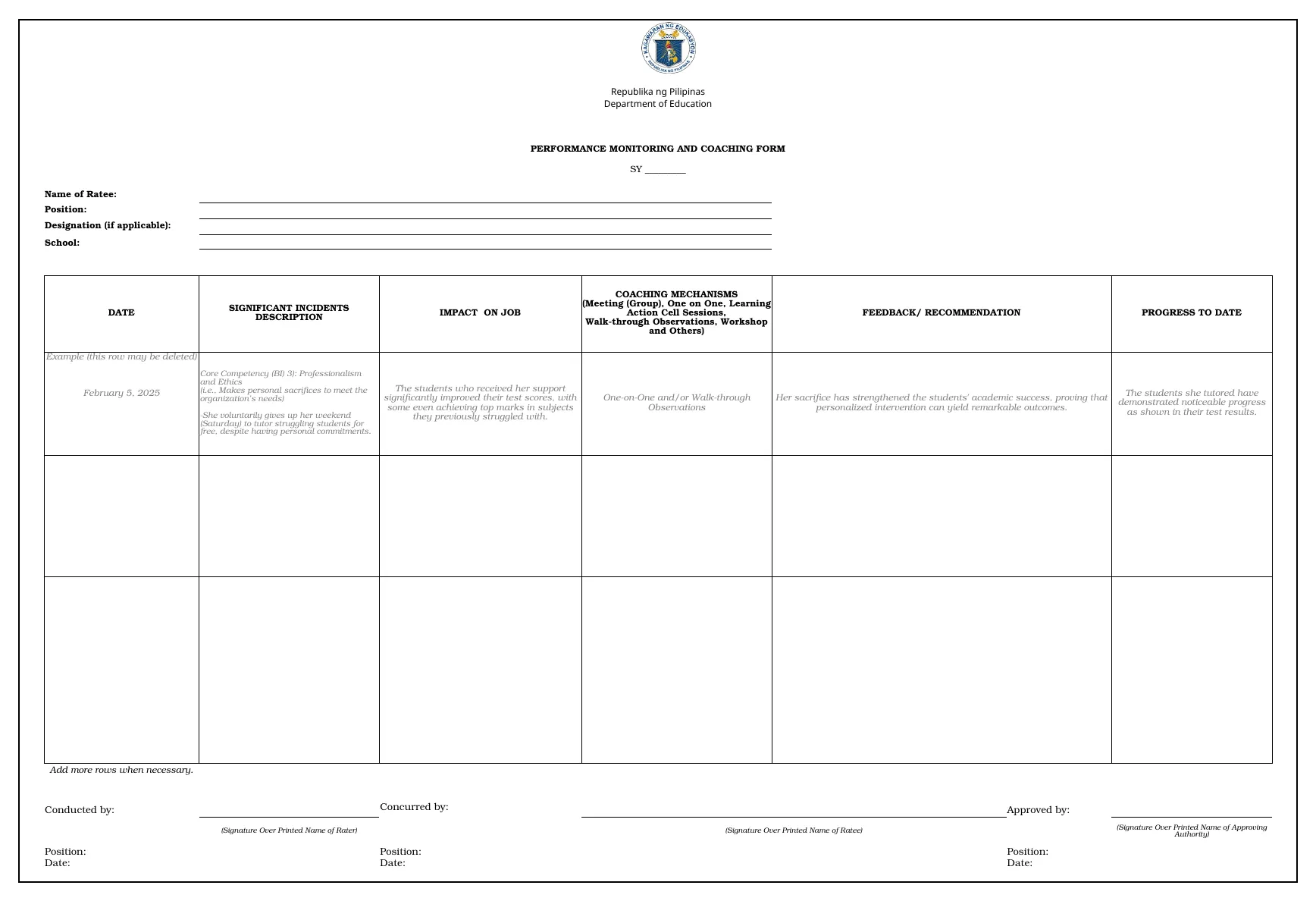
DepEd’s form is an Excel workbook whose working sheet, “PMCF-Teaching”, has six columns: the date, the incident, its impact on the job, the coaching mechanism, the feedback or recommendation, and the progress to date. The rater signs it as “Conducted by”, the teacher as “Concurred by” and the approving authority as “Approved by”. Its rows feed the mid-year and year-end reviews, and for School Year (SY) 2026-2027, Memorandum DM-OSEC-OUHRODI-2026-0003 of November 9, 2026 keeps the walkthroughs and coaching they record non-rated.
The rules below are those in force on November 26, 2026. The filled sample on this page is invented: one teacher, one school, one year of rows.
Key findings
- The rater keeps the PMCF, not the teacher. “Significant incidents observed and feedback provided to Ratees shall be recorded by the Rater using the Performance Monitoring and Coaching Form” (DM 089, item 39); “Observer-mentors” record each walkthrough there (item 37.e).
- Six columns, one working sheet. DepEd’s workbook opens on “PMCF-Teaching”: DATE, SIGNIFICANT INCIDENTS DESCRIPTION, IMPACT ON JOB, COACHING MECHANISMS, FEEDBACK/ RECOMMENDATION and PROGRESS TO DATE. Two other sheets, general forms, are hidden.
- A significant incident is a fact. DepEd’s RPMS order defines significant incidents as “actual events and behaviors in which both positive and negative performances are observed and documented” (DepEd Order No. 2, s. 2015, item 31).
- No PMCF row rates the observed teacher’s classroom observable indicators. Their ratings come from the full-period observation as recorded in the Observation Notes Form (DM 089, item 55), except 3.5.2 in a class without learners from indigenous groups, which is rated from the lesson plan annotation (DM-OSEC-OUHRODI-2026-0003, item 15.b). The PMCF records the coaching around them.
- SY 2026-2027 keeps coaching formative. Walkthroughs are “non-rated”, no minimum number of walkthroughs or coaching sessions may be required, and formative activities may not “generate unofficial performance ratings” (DM-OSEC-OUHRODI-2026-0003, items 8 and 10).
- Master Teachers can use their PMCF entries as evidence. DepEd’s SY 2026-2027 tools for Master Teachers list the PMCF among the possible evidence of “Coaching, mentoring, guidance, and collaborative professional support provided to colleagues”.
- DepEd’s file prints without its last column. Its print area stops at column H, which leaves off PROGRESS TO DATE and the approving authority’s signature line.
Download the PMCF template and a filled sample
DepEd’s template: Performance Monitoring and Coaching Form, Annex D to DM 089, s. 2025 (Excel, 74 KB), DepEd’s file unchanged. DepEd’s own copy is in the PMES tools folder that DM 089 links (tinyurl.com/MultiYearPMESTeachers), which opens only with an official DepEd email address (item 96).
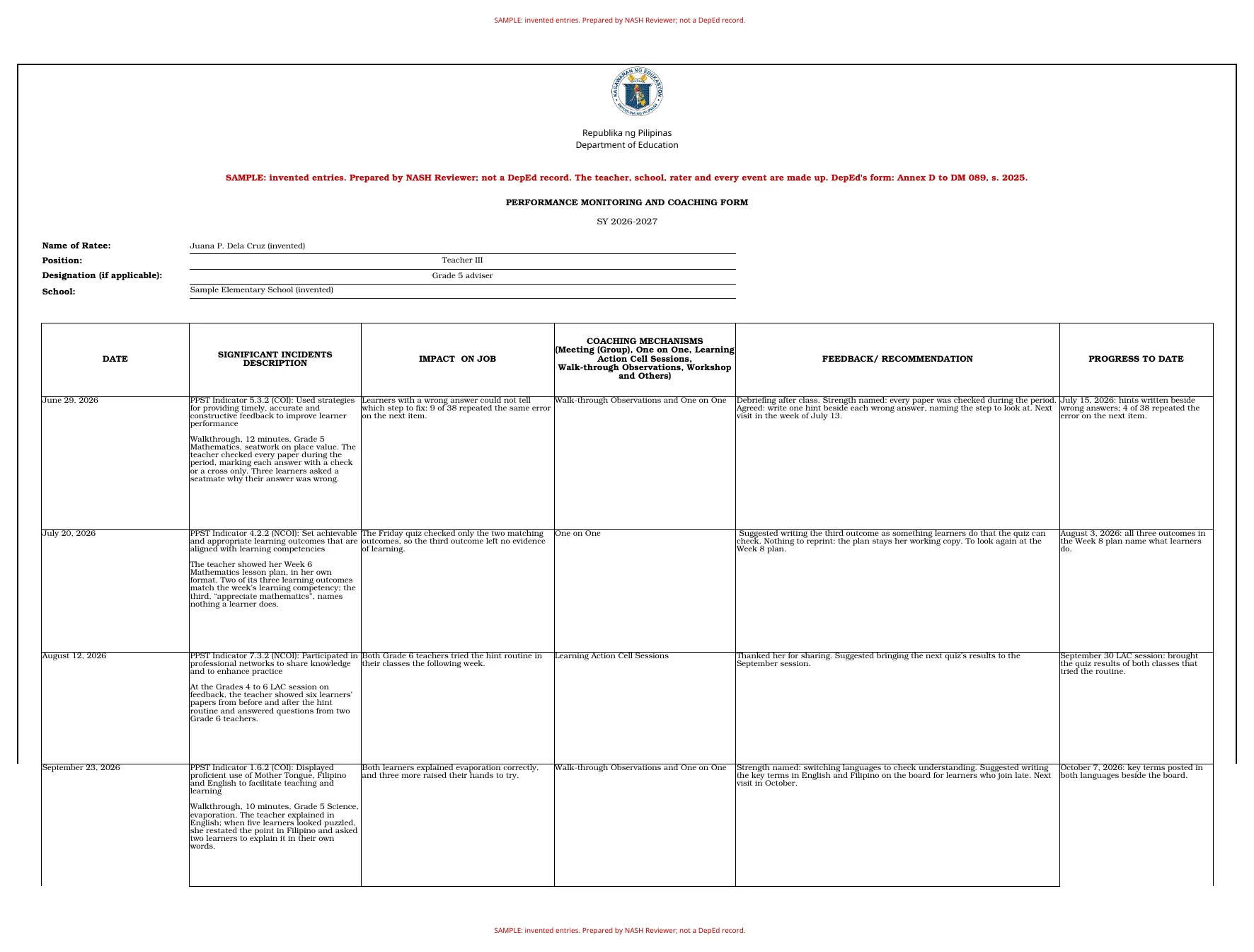
A filled sample: PMCF sample entries for SY 2026-2027 (Excel, 116 KB) and the same sample as a PDF (3 pages, 111 KB). It is a copy of DepEd’s workbook with twelve invented rows for one invented Grade 5 teacher, a Teacher III, across SY 2026-2027, each on a class day of DepEd Order No. 009, s. 2026’s calendar. Every sheet carries the line “SAMPLE: invented entries”, and so does the header and footer of every printed page. Copy its way of writing, never its facts.
What the PMCF is and who fills it
The PMCF is the form “intended for capturing the significant incidents” (DO 2, s. 2015, definition xii), and DM 089 makes it the record of Phase II of the PMES, Performance Monitoring and Coaching. Its Table 1 assigns the “Rater: Performance Monitoring and Coaching Form (PMCF)” to two activities, “Frequent short-period and walkthrough observations” and “Regular monitoring and provision of technical assistance on practices that support the teaching and learning process”, “Regularly from 1st Quarter to 4th Quarter”. Its Figure 1 lists the PMCF again among the tools of Phase III, Performance Review and Evaluation, beside the Individual Performance Commitment and Review Form (IPCRF).
Three items of DM 089 say what goes in it:
| What is recorded | DM 089’s words |
|---|---|
| Each walkthrough and its feedback | “Observer-mentors shall maintain a record of each observation in the Performance Monitoring and Coaching Form (PMCF) and the associated feedback to track progress over time” (item 37.e) |
| Significant incidents and feedback | “Significant incidents observed and feedback provided to Ratees shall be recorded by the Rater using the Performance Monitoring and Coaching Form” (item 39) |
| Feedback on the documents a teacher shows | “Raters shall provide timely feedback to the documents presented which will be recorded in the PMCF for reference in the year-end performance evaluation” (item 61) |
The rater is the person DM 089’s Table 18 names for the teacher, and the approving authority signs last:
| Ratee | Rater | Approving authority |
|---|---|---|
| Teacher, elementary | Master Teacher | School Head |
| Teacher, elementary, with no Master Teacher | School Head | Assistant Schools Division Superintendent |
| Teacher, junior high school | Master Teacher, Department Head or Assistant School Head | School Head |
| Teacher, senior high school | Master Teacher or Assistant School Head | School Head |
| Master Teacher; Head Teacher with a teaching load | School Head | Assistant Schools Division Superintendent |
| ALS teacher in a community learning center | Functional Division Chief for CID | Assistant Schools Division Superintendent |
Selected rows of DM 089, Table 18. A junior high school teacher with no Master Teacher or Department Head, and a senior high school teacher with no Master Teacher or Assistant School Head, are rated by the School Head and approved by the Assistant Schools Division Superintendent.
The rows follow a plan. The rater prepares an Instructional Supervisory (IS) Plan “guided by the Individual Development Plans (IDPs) of teachers being handled as ratees” (DM 089, item 27), and each IDP starts from the teacher’s self-assessment, which the guide to the e-SAT explains (item 26). Others coach too. For SY 2026-2027, “School personnel with instructional supervisory functions, including School Heads, Master Teachers, Head Teachers, and Department Heads shall provide formative support” (DM-OSEC-OUHRODI-2026-0003, item 5), and the guide to instructional supervision sets out how a school divides that work. Under DM 089 the rater records significant incidents (item 39) and observer-mentors record their walkthroughs (item 37.e); the teacher reads the rows and signs.
The PMCF-Teaching sheet, column by column
DepEd’s Annex D workbook has three sheets, and it opens on the only visible one, “PMCF-Teaching”. Its header asks for the “SY”, the “Name of Ratee”, the “Position”, the “Designation (if applicable)” and the “School”. The table under it has six columns:
| Sheet column | Header as printed | What a rater writes there |
|---|---|---|
| C | DATE | The day of the incident or the feedback |
| D | SIGNIFICANT INCIDENTS DESCRIPTION | What the teacher did and what the learners did, as seen or heard, after the indicator or competency it concerns |
| E | IMPACT ON JOB | What it changed for the learners or the work |
| F | COACHING MECHANISMS (Meeting (Group), One on One, Learning Action Cell Sessions, Walk-through Observations, Workshop and Others) | How the support was given, in the column’s own words |
| G and H | FEEDBACK/ RECOMMENDATION | The feedback given and the next step agreed |
| I | PROGRESS TO DATE | What changed by the follow-up, with its date |
DepEd’s example row is marked “Example (this row may be deleted)” and dated February 5, 2025. Its description opens with the competency it records, “Core Competency (BI) 3): Professionalism and Ethics”, then the incident: “She voluntarily gives up her weekend (Saturday) to tutor struggling students for free, despite having personal commitments.” Its coaching mechanism reads “One-on-One and/or Walk-through Observations”. Under the rows, the sheet says “Add more rows when necessary”, and the signature block follows: “Conducted by:” over “(Signature Over Printed Name of Rater)”, “Concurred by:” over “(Signature Over Printed Name of Ratee)”, and “Approved by:” over “(Signature Over Printed Name of Approving Authority)”, each with a position and a date.
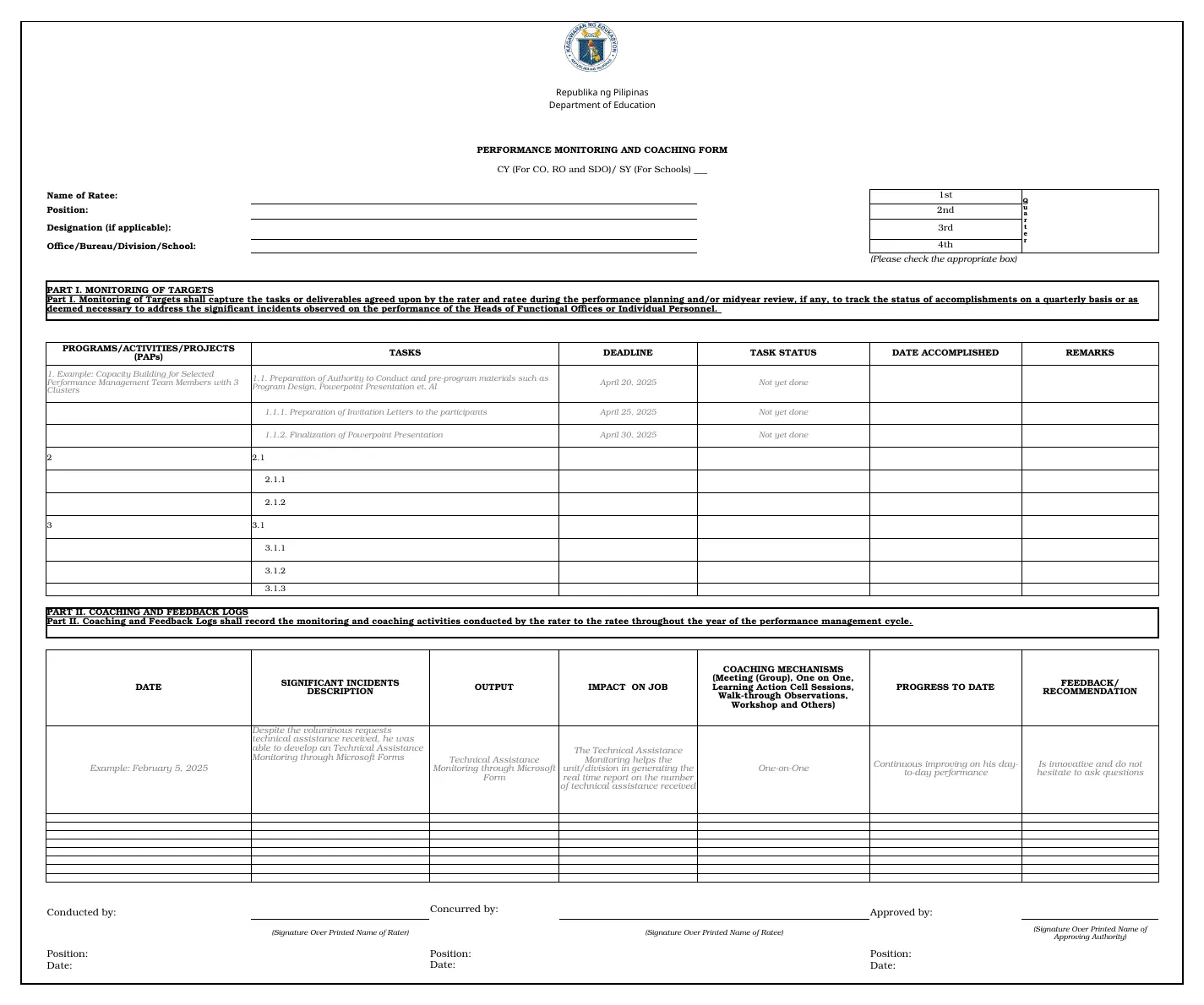
The two hidden sheets are general forms, not the teachers’ sheet. “Annex G_PMCF” is headed “CY (For CO, RO and SDO)/ SY (For Schools)” and adds a quarter to check, a “PART I. MONITORING OF TARGETS” for “the tasks or deliverables agreed upon by the rater and ratee”, and a “PART II. COACHING AND FEEDBACK LOGS” with an OUTPUT column, PROGRESS TO DATE placed before FEEDBACK/ RECOMMENDATION. The third, “CSC Performance Monitoring”, is a “PERFORMANCE MONITORING FORM” with TASK, ACTION OFFICER, OUTPUT, DATE ASSIGNED, DATE ACCOMPLISHED and REMARKS. A teacher’s rater uses PMCF-Teaching.
How to write a PMCF entry
A PMCF entry is written the day it happens, from notes taken then, and shown to the teacher. Fill the columns in the sheet’s order:
- DATE. The day of the walkthrough, the conference or the look at the documents.
- SIGNIFICANT INCIDENTS DESCRIPTION. Start with the indicator or competency, as DepEd’s example row does, then write what was seen and heard: the class and subject, how long you stayed, what the teacher did, what the learners did, with a count or a quotation. Leave out verdicts.
- IMPACT ON JOB. What the incident changed: how many learners finished, which error repeated, what the next lesson used.
- COACHING MECHANISMS. Use the column’s own words: “Walk-through Observations”, “One on One”, “Learning Action Cell Sessions”, “Meeting (Group)”, “Workshop” or “Others”.
- FEEDBACK/ RECOMMENDATION. The strength you named, the one next step you agreed on, and when you will look again. DM 089 asks for a brief debriefing after each walkthrough “to discuss findings, celebrate successes, and outline actionable steps for improvement” (item 37.d).
- PROGRESS TO DATE. Leave it for the follow-up visit, then write what you saw, with its date.
The figure below reads a row column by column. It starts with an invented first draft of a walkthrough row, and a note under each column says what to change.
Try it: the PMCF-Teaching sheet
Write a PMCF row, column by column
The fields are the PMCF-Teaching sheet’s columns, in its order. The draft below is invented: fix it, or clear it and write your own. Each field is read when you leave it.
8 notes to read; 2 rest on a DepEd text.
Columns: DepEd’s Annex D, PMCF-Teaching sheet. Notes quote DepEd Memorandum No. 089, s. 2025, item 39; Memorandum DM-OSEC-OUHRODI-2026-0003 (November 9, 2026), item 10; andDepEd Order No. 2, s. 2015, item 31. Calendar:DepEd Order No. 009, s. 2026, Annex B.
The draft and the finished row describe the same twelve minutes. The draft’s “unprepared” and “poor” tell the teacher nothing to do next. The finished row says that the teacher checked every paper during the period, marking each answer only with a check or a cross, and that 9 of 38 learners repeated the same error. So the agreed step (a hint beside each wrong answer) follows from the facts, and the progress note two weeks later, 4 of 38, shows whether it worked. The STAR template for classroom observation notes shows how notes written in that order trace to a PMCF row, and the guide to teacher performance feedback shows how to word the feedback.
What counts as a significant incident, and what does not
A significant incident is something the rater or an observer-mentor saw happen that shows the teacher’s practice, good or poor. DO 2, s. 2015 defines significant incidents as “actual events and behaviors in which both positive and negative performances are observed and documented” (item 31), and DM 089 records “Significant incidents observed” (item 39). The test is whether it happened, whether you saw it or saw its evidence, and whether it bears on an indicator of the Philippine Professional Standards for Teachers (PPST) or a core competency.
| Event | In the PMCF? | Where it goes |
|---|---|---|
| A walkthrough, even when all went well | Yes | A row for each, with the debriefing’s feedback (DM 089, items 37.d and 37.e) |
| A lesson plan, assessment record or parent communication log a teacher shows for an NCOI | Yes | A row with your feedback on it (item 61) |
| A LAC session where the teacher shared a practice | Yes | A row with “Learning Action Cell Sessions” as the mechanism |
| Behavior that shows a core competency, such as preparing the grade level’s reading passages with the other teachers | Yes | A row naming the competency, as DepEd’s example does |
| The rated full-period observation | No | The COT Observation Notes Form and Rating Sheet (DM 089, items 53.a, 55 and 75); the post-observation conference’s feedback may take a row |
| A parent’s complaint you did not witness | Not as an incident | Check it first; record what you then observe and the feedback you give |
| A rating, a score or a level for a walkthrough | Never | Walkthroughs and coaching are non-rated (DM-OSEC-OUHRODI-2026-0003, items 8 and 10) |
| A learner’s name, grades or family situation | Leave out | Write counts (“6 learners absent 5 or more days”), not names |
DO 2’s definition counts positive performance as well as negative, so a PMCF that records only lapses leaves out the positive performances the definition counts.
How PMCF entries feed the mid-year and year-end reviews and the IPCRF
PMCF entries are the record the reviews read, but they rate nothing by themselves. DM 089 holds the Mid-Year Review and Assessment “five (5) months after the official opening of classes” (item 7.b), which for SY 2026-2027, with classes opening on June 8, 2026, falls around November 8, 2026. It “serves as a formative evaluation that allows ratees and raters to reflect on progress and identify areas for growth” (item 64), and its review of the non-classroom observable indicators (NCOIs) gives “meaningful feedback” on activities “such as LAC sessions, coaching and mentoring, professional development programs” (item 67). The year-end review comes “after the last day of classes and before the first day of classes of the succeeding school year” (item 7.b), here after April 8, 2027.
What each kind of row does there:
| Row | What it does at review time | Rule |
|---|---|---|
| Feedback on NCOI evidence (4.2.2, 5.5.2, 6.2.2, 7.3.2, 7.4.2) | Kept “for reference in the year-end performance evaluation”; the rating rests on the practice the evidence shows | DM 089, item 61; DM-OSEC-OUHRODI-2026-0003, item 17 |
| Walkthroughs on classroom observable indicators (COIs) | Show the coaching given; rate nothing | DM 089, item 55; DM-OSEC-OUHRODI-2026-0003, items 8 and 10 |
| The annotated lesson plan for 3.5.2, in a class without learners from indigenous groups | Records feedback; the rating comes from the annotation itself | DM-OSEC-OUHRODI-2026-0003, item 15.b |
| Behavior for a core competency | Evidence for Part II-A, rated on the five-point competency scale | DM 089, items 79 and 80 |
| A need the feedback carries forward | Goes into next year’s Individual Development Plan (IDP): “Coaching and mentoring needs as discussed throughout the performance cycle” | DM 089, item 89.b |
DepEd’s own self-assessment tool draws the same line to the IDP. The instruction on the IDP sheet of the e-SAT for Teachers 2025-2028 has the plan updated in “Phase II – Performance Monitoring and Coaching, based on the agreements in the Performance Monitoring and Coaching Form”. DO 2, s. 2015, the RPMS order that DM 089 lists among its references, has the same intent in plainer words: “The significant incidents as reflected in the PMCF shall be considered for the actual results” (item 40). The figure below runs the sample teacher’s twelve rows through five questions a rater asks before a review.
Sample entries, invented: one teacher’s SY 2026-2027
What each PMCF row can do at review time
One teacher’s school year of PMCF rows, invented. Choose a question a rater asks before a review: each row says whether to use it, and why.
Which rows can the mid-year review of November 9, 2026 draw on?
5 of 12 rows come before the mid-year review of November 9, 2026.
“the Mid-Year Review and Assessment serves as a formative evaluation that allows ratees and raters to reflect on progress and identify areas for growth”
DM 089, s. 2025, item 64
Which rows bear on the ratings of the five non-classroom observable indicators?
5 of 12 rows record feedback on evidence for the five NCOIs, one row for each.
“Raters shall provide timely feedback to the documents presented which will be recorded in the PMCF for reference in the year-end performance evaluation.”
DM 089, s. 2025, item 61
“Evaluation of NCOIs shall focus on teacher's professional practice against the applicable PPST indicator and performance standard, not on the Means of Verification (MOV) itself.”
the November 2026 guidance, item 17
Which rows rate her classroom observable indicators?
No row rates her COIs. 5 rows bear on them: the coaching, the conference and the annotated plan’s feedback.
“The rating for the teacher's performance shall be solely based on the actual classroom observation as recorded in the Observation Notes Form.”
DM 089, s. 2025, item 55
“Formative activities shall not substitute for evaluative classroom observation, generate unofficial performance ratings, or be imposed as additional rated observations.”
the November 2026 guidance, item 10
Which rows bear on the core competencies of Part II-A?
2 of 12 rows record behavior for a core competency.
“The Core Competencies shall be assessed based on the ratee's demonstration of these in different contexts, conditions, or job-related scenarios.”
DM 089, s. 2025, item 79
Which rows carry a need into the annual Individual Development Plan?
3 of 12 rows carry a need into next year’s IDP.
“Coaching and mentoring needs as discussed throughout the performance cycle”
DM 089, s. 2025, item 89.b
June 29, 2026 · PPST COI 5.3.2 (feedback to learners) · Walk-through Observations, One on One
Walkthrough, 12 minutes, Grade 5 Mathematics, seatwork on place value. The teacher checked every paper during the period, marking each answer with a check or a cross only. Three learners asked a seatmate why their answer was wrong.
FEEDBACK/ RECOMMENDATION: Debriefing after class. Strength named: every paper was checked during the period. Agreed: write one hint beside each wrong answer, naming the step to look at. Next visit in the week of July 13.
Mid-year review: Use it. Dated before the review: bring it to the talk on progress and areas for growth (DM 089, s. 2025, items 64 and 67).
The five NCOIs: Not this time. Not about one of the five NCOIs.
The COIs: Bears on it, rates nothing. A non-rated walkthrough (the November 2026 guidance, items 8 and 10): it shows the coaching on 5.3.2, whose rating comes from the one full-period observation (the November 2026 guidance, item 11).
Core competencies: Not this time. Not about a core competency.
Next year’s IDP: Not this time. Its feedback settles the matter within the year.
July 20, 2026 · PPST NCOI 4.2.2 (learning outcomes) · One on One
The teacher showed her Week 6 Mathematics lesson plan, in her own format. Two of its three learning outcomes match the week’s learning competency; the third, “appreciate mathematics”, names nothing a learner does.
FEEDBACK/ RECOMMENDATION: Suggested writing the third outcome as something learners do that the quiz can check. Nothing to reprint: the plan stays her working copy. To look again at the Week 8 plan.
Mid-year review: Use it. Dated before the review: bring it to the talk on progress and areas for growth (DM 089, s. 2025, items 64 and 67).
The five NCOIs: Use it. Feedback on what the teacher showed for 4.2.2, kept for the year-end evaluation (DM 089, s. 2025, item 61). The rating rests on the practice the evidence shows, not on the document itself (the November 2026 guidance, item 17).
The COIs: Not this time. Not about a classroom observable indicator.
Core competencies: Not this time. Not about a core competency.
Next year’s IDP: Not this time. Its feedback settles the matter within the year.
August 12, 2026 · PPST NCOI 7.3.2 (professional networks) · Learning Action Cell Sessions
At the Grades 4 to 6 LAC session on feedback, the teacher showed six learners’ papers from before and after the hint routine and answered questions from two Grade 6 teachers.
FEEDBACK/ RECOMMENDATION: Thanked her for sharing. Suggested bringing the next quiz’s results to the September session.
Mid-year review: Use it. Dated before the review: bring it to the talk on progress and areas for growth (DM 089, s. 2025, items 64 and 67).
The five NCOIs: Use it. Feedback on what the teacher showed for 7.3.2, kept for the year-end evaluation (DM 089, s. 2025, item 61). The rating rests on the practice the evidence shows, not on the document itself (the November 2026 guidance, item 17).
The COIs: Not this time. Not about a classroom observable indicator.
Core competencies: Not this time. Not about a core competency.
Next year’s IDP: Not this time. Its feedback settles the matter within the year.
September 23, 2026 · PPST COI 1.6.2 (language use) · Walk-through Observations, One on One
Walkthrough, 10 minutes, Grade 5 Science, evaporation. The teacher explained in English; when five learners looked puzzled, she restated the point in Filipino and asked two learners to explain it in their own words.
FEEDBACK/ RECOMMENDATION: Strength named: switching languages to check understanding. Suggested writing the key terms in English and Filipino on the board for learners who join late. Next visit in October.
Mid-year review: Use it. Dated before the review: bring it to the talk on progress and areas for growth (DM 089, s. 2025, items 64 and 67).
The five NCOIs: Not this time. Not about one of the five NCOIs.
The COIs: Bears on it, rates nothing. A non-rated walkthrough (the November 2026 guidance, items 8 and 10): it shows the coaching on 1.6.2, whose rating comes from the one full-period observation (the November 2026 guidance, item 11).
Core competencies: Not this time. Not about a core competency.
Next year’s IDP: Not this time. Its feedback settles the matter within the year.
October 14, 2026 · PPST NCOI 6.2.2 (parents and community) · One on One
The teacher showed her September record of home visits and text messages to the parents of 6 learners absent 5 or more days.
FEEDBACK/ RECOMMENDATION: Suggested agreeing with each parent on one day a week to look at the learner’s notebook together. To look again at the mid-year review.
Mid-year review: Use it. Dated before the review: bring it to the talk on progress and areas for growth (DM 089, s. 2025, items 64 and 67).
The five NCOIs: Use it. Feedback on what the teacher showed for 6.2.2, kept for the year-end evaluation (DM 089, s. 2025, item 61). The rating rests on the practice the evidence shows, not on the document itself (the November 2026 guidance, item 17).
The COIs: Not this time. Not about a classroom observable indicator.
Core competencies: Not this time. Not about a core competency.
Next year’s IDP: Not this time. Its feedback settles the matter within the year.
November 18, 2026 · Core competency: Teamwork · Meeting (Group)
With the two other Grade 5 teachers, she divided the 12 reading passages for the Term 2 ARAL sessions, wrote her four, and checked the other teachers’ questions before the grade-level meeting.
FEEDBACK/ RECOMMENDATION: Acknowledged at the grade-level meeting. No follow-up needed.
Mid-year review: Not this time. Dated after the mid-year review: it waits for the year-end review.
The five NCOIs: Not this time. Not about one of the five NCOIs.
The COIs: Not this time. Not about a classroom observable indicator.
Core competencies: Use it. Behavior shown for Teamwork, rated at year-end on the five-point competency scale (DM 089, s. 2025, items 79 and 80).
Next year’s IDP: Not this time. Its feedback settles the matter within the year.
December 3, 2026 · PPST COI 2.2.2 (fairness, respect and care) · Walk-through Observations, One on One
Walkthrough, 15 minutes, Grade 5 English, group work. The teacher called on 14 different learners, four of them seated at the back. When a learner laughed at a classmate’s answer, she pointed to the class agreement on the wall, “Listen first.”
FEEDBACK/ RECOMMENDATION: Strength named: calling on learners across the room and holding to the class agreement. Next focus agreed: asking questions after group work, from January.
Mid-year review: Not this time. Dated after the mid-year review: it waits for the year-end review.
The five NCOIs: Not this time. Not about one of the five NCOIs.
The COIs: Bears on it, rates nothing. A non-rated walkthrough (the November 2026 guidance, items 8 and 10): it shows the coaching on 2.2.2, whose rating comes from the one full-period observation (the November 2026 guidance, item 11).
Core competencies: Not this time. Not about a core competency.
Next year’s IDP: Use it. Its feedback names a need to carry into next year’s IDP (DM 089, s. 2025, item 89.b).
January 27, 2027 · PPST COI 3.5.2 (learners from indigenous groups) · One on One
The teacher’s class has no learners from indigenous groups. She showed a Science lesson plan annotated with two culturally appropriate strategies she would use for such learners, one of them “begin from how families in the community dry and store food.”
FEEDBACK/ RECOMMENDATION: Suggested adding how learners would show what they learned under the second strategy. To look again at her next annotated plan, in February.
Mid-year review: Not this time. Dated after the mid-year review: it waits for the year-end review.
The five NCOIs: Not this time. Not about one of the five NCOIs.
The COIs: Bears on it, rates nothing. Her class has no learners from indigenous groups, so 3.5.2 is rated from the annotated lesson plan itself (the November 2026 guidance, item 15.b). This row records the feedback on it.
Core competencies: Not this time. Not about a core competency.
Next year’s IDP: Not this time. Its feedback settles the matter within the year.
February 12, 2027 · PPST COI 5.3.2 (feedback to learners) · One on One
Post-observation conference on the rated observation of February 10, 2027 (Grade 5 Science), held from the observers’ notes. The teacher named her hints on learners’ work as her strength and her questions after the group task as the part to improve.
FEEDBACK/ RECOMMENDATION: Agreed: plan two “why” questions for the end of each group task. Next walkthrough in March. The ratings are on the COT Rating Sheet, not in this row.
Mid-year review: Not this time. Dated after the mid-year review: it waits for the year-end review.
The five NCOIs: Not this time. Not about one of the five NCOIs.
The COIs: Bears on it, rates nothing. Feedback after the rated observation of February 10, 2027. Its ratings come from the observation notes (DM 089, s. 2025, item 55) and go on the COT’s forms, not here.
Core competencies: Not this time. Not about a core competency.
Next year’s IDP: Use it. Its feedback names a need to carry into next year’s IDP (DM 089, s. 2025, item 89.b).
February 17, 2027 · Core competency: Service Orientation · Others
At dismissal a parent asked, “How can I help my child with fractions at home?” The teacher wrote two worked examples from the week’s lessons in the child’s notebook and explained them to the parent.
FEEDBACK/ RECOMMENDATION: Acknowledged in a short talk the next morning. No follow-up needed.
Mid-year review: Not this time. Dated after the mid-year review: it waits for the year-end review.
The five NCOIs: Not this time. Not about one of the five NCOIs.
The COIs: Not this time. Not about a classroom observable indicator.
Core competencies: Use it. Behavior shown for Service Orientation, rated at year-end on the five-point competency scale (DM 089, s. 2025, items 79 and 80).
Next year’s IDP: Not this time. Its feedback settles the matter within the year.
February 24, 2027 · PPST NCOI 5.5.2 (assessment data) · One on One
The teacher showed the item analysis of her first Term 3 Mathematics summative test: fewer than half of 38 learners answered three of its 30 items correctly, all three on adding dissimilar fractions. She regrouped learners for two remedial sessions.
FEEDBACK/ RECOMMENDATION: Suggested keeping the same regrouping when the class reaches decimals later in Term 3.
Mid-year review: Not this time. Dated after the mid-year review: it waits for the year-end review.
The five NCOIs: Use it. Feedback on what the teacher showed for 5.5.2, kept for the year-end evaluation (DM 089, s. 2025, item 61). The rating rests on the practice the evidence shows, not on the document itself (the November 2026 guidance, item 17).
The COIs: Not this time. Not about a classroom observable indicator.
Core competencies: Not this time. Not about a core competency.
Next year’s IDP: Not this time. Its feedback settles the matter within the year.
March 10, 2027 · PPST NCOI 7.4.2 (improvement plan (IDP)) · One on One
The teacher showed her updated Individual Development Plan (IDP): feedback on learners’ written work marked as met, and questioning after group tasks added as next year’s goal, citing the walkthrough of December 3 and the conference of February 12.
FEEDBACK/ RECOMMENDATION: Agreed to bring the IDP to the year-end review.
Mid-year review: Not this time. Dated after the mid-year review: it waits for the year-end review.
The five NCOIs: Use it. Feedback on what the teacher showed for 7.4.2, kept for the year-end evaluation (DM 089, s. 2025, item 61). The rating rests on the practice the evidence shows, not on the document itself (the November 2026 guidance, item 17).
The COIs: Not this time. Not about a classroom observable indicator.
Core competencies: Not this time. Not about a core competency.
Next year’s IDP: Use it. The IDP itself, updated from this year’s rows; it is finalized after the year-end review (DM 089, s. 2025, items 88 and 89).
Rules: DepEd Memorandum No. 089, s. 2025, items 7.b, 55, 61, 64, 67, 79, 80, 88 and 89;Memorandum DM-OSEC-OUHRODI-2026-0003 (November 9, 2026), items 8, 10, 11, 15.b and 17. Calendar:DepEd Order No. 009, s. 2026, Annex B.
One question has no row to show: no row rates her COIs. In SY 2026-2027 each teacher has “only one (1) full-period evaluative classroom observation during either Term 2 or Term 3” (DM-OSEC-OUHRODI-2026-0003, item 11), and its ratings come from the COT’s own forms. The guide to the COT rubric covers those forms, and the guide to DM 089’s PMES covers the IPCRF’s weights and the final rating.
PMCF rules for SY 2026-2027
The PMCF is the same form in SY 2026-2027; the rules for walkthroughs, coaching and the rated observation changed around it. DM-OSEC-OUHRODI-2026-0003 keeps DM 089 for “all PMES matters not expressly addressed in this Memorandum, including among others, rating procedures, observer qualifications, rater arrangements, forms, and appeals” (item 4), and DepEd’s PMES tools folder holds one Annex D workbook, not a version for each school year. The rules that bear on the PMCF:
| Rule | Item of DM-OSEC-OUHRODI-2026-0003 |
|---|---|
| Walkthroughs are “brief, focused, non-rated, and formative classroom visits, lasting approximately ten (10) to fifteen (15) minutes” | 8 |
| Walkthroughs “shall minimize disruption to instruction and focus on observable classroom practice” | 9 |
| “Formative activities shall not substitute for evaluative classroom observation, generate unofficial performance ratings, or be imposed as additional rated observations” | 10 |
| “No minimum number of walkthroughs or coaching sessions shall be required before the evaluative observation” | 10 |
| One full-period evaluative observation, in Term 2 or Term 3 | 11 |
| Teachers “shall not be required to create, reproduce, reformat, print, bind, or otherwise repack documents solely for PMES” where their regular work already gives the evidence | 18 |
| No “additional local classroom observations, MOV requirements, formative activity quotas, or other PMES requirements inconsistent with national policy” | 24 |
So a division or school cannot set a number of PMCF rows per teacher (item 24), turn walkthrough rows into scores (item 10), or have teachers fill or print PMCF rows for a folder (item 18). The guide to PMES 2026-2027 covers the year’s twelve indicators and its one observation.
Master Teachers. DepEd’s SY 2026-2027 PMES tools for Master Teachers name the PMCF as evidence of their work with colleagues. Each tool ends with a “Reference Matrix of Possible Means of Verification”. In the tool for Master Teachers I and II, the matrix lists the “Performance Monitoring and Coaching Form (PMCF)” for objectives 2, 7, 9, 10, 11 and 12, as evidence of “Coaching, mentoring, guidance, and collaborative professional support provided to colleagues”. The tool for Master Teachers III to V lists it for objectives 2, 3, 4, 7, 8, 9, 11 and 12, as evidence of “Coaching, mentoring, technical assistance, guidance, feedback, and support provided to colleagues”. Some of those objectives are classroom observable indicators that the tools rate twice, once from the observation and once from documents of the support given to colleagues, the PMCF among them: 1.6.3 for Master Teachers I and II, and 1.6.4, 2.1.4, 2.2.4 and 5.3.4 for Master Teachers III to V. A Master Teacher who rates and coaches teachers builds that evidence row by row. The tools for Teachers I to VII do not list the PMCF. The guide to the Master Teacher IPCRF sets out the rest of their evidence.
Fair and lawful PMCF records
A PMCF entry is an official record about a named teacher, signed by three people, so it must say only what happened and be shown to the teacher. Five practices follow from the texts:
- Facts, not judgments. Significant incidents are “actual events and behaviors” (DO 2, s. 2015, item 31). “Unprofessional” is a conclusion; “arrived at 8:20 for an 8:00 class, and learners waited without a task” is a fact the teacher can answer.
- What was observed. DM 089 records “Significant incidents observed” (item 39). Treat a report from someone else as a reason to look, not as a row.
- The teacher’s signature means agreement. The sheet has the teacher sign as “Concurred by”. DM 089 does not say when the teacher signs; DO 2, s. 2015 has the rater and the ratee “sign each significant incident recorded in the PMCF to ensure that agreement has been reached” (item 33). The course that meets both texts: show each row to the teacher when you write it, settle the wording of the facts then, and have both of you sign or initial that row; sign the form’s block at the mid-year and year-end reviews.
- The approving authority checks it. The approving authority of DM 089’s Table 18 signs as “Approved by”. Before signing, the approving authority should read the rows and return any that rests on a verdict rather than a fact.
- Personal information, kept to what is needed. A PMCF entry is personal information under the Data Privacy Act of 2012 (Republic Act No. 10173, Sec. 3(g)). It must be “Accurate, relevant” and “Adequate and not excessive in relation to the purposes for which they are collected and processed” (Sec. 11(c) and (d)), and the teacher may see it and “Dispute the inaccuracy or error” in it (Sec. 16(c) and (d)). Learners appear as counts, never by name. The guide to the Data Privacy Act in schools covers who else may see such records.
When a teacher disagrees with a row, neither DM 089 nor the form says what to do. Talk through the facts until the description says only what both accept, and write the teacher’s own account in the same row when you cannot agree.
Common PMCF mistakes
- Verdicts in place of facts. “Poor classroom management” names no event. Write what happened and what the learners did.
- Writing the whole PMCF in April. A year-end review built on memory rewards the last month. Write each row the day it happens.
- Scoring walkthroughs. A walkthrough row with “Very Satisfactory” or “Level 5” is an unofficial rating, which item 10 of DM-OSEC-OUHRODI-2026-0003 forbids.
- Handing the PMCF to teachers. The rater records (DM 089, item 39). Asking teachers to fill or print it for a folder adds the work item 18 of the guidance forbids, and “No portfolio for performance assessments shall be collected” (DM 089, item 60).
- Recording what others reported. Check a complaint before it becomes a row, as the guide to teacher performance feedback sets out.
- An empty FEEDBACK column. DM 089 records the feedback provided, not only the incident (item 39). A row without feedback is an observation with no coaching.
- Using the hidden general sheet. “Annex G_PMCF” is a general form, with targets and an OUTPUT column; a teacher’s PMCF is the PMCF-Teaching sheet.
What this means for school heads
- Know who keeps each teacher’s PMCF. Under DM 089’s Table 18 a Master Teacher may rate and the school head approve, or the school head may rate and the Assistant Schools Division Superintendent approve. List each teacher’s rater and approving authority at the start of the year.
- Agree on one way of writing rows. Use the sheet’s columns in order, the indicator or competency first, facts with counts, and feedback with a next step and a date. Calibrate with the raters on two or three sample rows, such as the sample workbook’s.
- Record as you go. A row after each walkthrough, conference and look at NCOI evidence, from notes taken then. Set no minimum number of rows (DM-OSEC-OUHRODI-2026-0003, items 10 and 24).
- Keep rows and ratings apart. No scores in the PMCF; a teacher’s COI ratings come from the COT forms of the one rated observation (item 11).
- Bring the PMCF to both reviews. Read the rows with the teacher at the mid-year review, and use them at the year-end review for the NCOIs, the core competencies and the IDP.
- As approving authority, read before signing. Send back a row that rests on a verdict, names a learner, or records what no one observed.
- Look across rows at the end of each term. A need that recurs across teachers is a topic for the learning action cell and the school’s technical assistance plan.
This is the work of two strands of the Philippine Professional Standards for School Heads (PPSSH) of DepEd Order No. 024, s. 2020: strand 3.2, Teaching standards and pedagogies (“Provide technical assistance to teachers on teaching standards and pedagogies within and across learning areas to improve their teaching practice”, indicator 3.2.2), and strand 4.4, Performance management (“Implement the performance management system with a team to support the career advancement of school personnel, and to improve office performance”, indicator 4.4.2). The guides to PPSSH Domain 3 and PPSSH Domain 4 cover the two strands, and the guide to DepEd’s core behavioral competencies covers the competencies a PMCF row can record.
Frequently asked questions
What is the meaning of PMCF in DepEd?
PMCF stands for Performance Monitoring and Coaching Form. It is Annex D of the PMES tools of DM 089, s. 2025, in which the rater records “Significant incidents observed and feedback provided to Ratees” (item 39), each walkthrough (item 37.e) and the feedback on documents a teacher shows (item 61). DO 2, s. 2015 calls it the form “intended for capturing the significant incidents”.
Who fills out the PMCF, the teacher or the rater?
The rater. DM 089 says significant incidents and feedback “shall be recorded by the Rater” (item 39), and its Table 1 assigns the PMCF to the rater. The teacher reads the rows and signs as “Concurred by”; the approving authority signs as “Approved by”.
Does the PMCF give a rating?
No. A teacher’s PMCF rates nothing for that teacher: walkthroughs and coaching are non-rated and may not “generate unofficial performance ratings” (DM-OSEC-OUHRODI-2026-0003, items 8 and 10), and COI ratings come from the full-period observation’s notes (DM 089, item 55). The PMCF holds the feedback the reviews read, for the NCOIs, the core competencies and the IDP. For Master Teachers, the PMCF they keep as raters is among the documents for the second, support-to-colleagues rating of some of their own COIs.
Is there a PMCF template for SY 2026-2027?
The form is the same. DepEd’s PMES tools folder holds one Annex D workbook for the multi-year PMES, and DM-OSEC-OUHRODI-2026-0003 keeps DM 089’s forms (item 4). DepEd’s file and a filled sample for SY 2026-2027 are in the download section above.
Can a Master Teacher use the PMCF as evidence?
Yes. DepEd’s SY 2026-2027 PMES tools for Master Teachers list the PMCF among the possible evidence of support to colleagues: objectives 2, 7, 9, 10, 11 and 12 for Master Teachers I and II, and objectives 2, 3, 4, 7, 8, 9, 11 and 12 for Master Teachers III to V. The rows a Master Teacher writes as a rater are that evidence.
Sources
DepEd issuances
- DepEd Memorandum No. 089, s. 2025, Guidelines on the Multi-Year Performance Management and Evaluation System for Teachers from School Years 2025–2026 to 2027–2028, October 1, 2025: items 7.b, 26, 27, 37, 39, 53, 55, 60, 61, 64, 67, 75, 79, 80, 88, 89 and 96, Figure 1 and Tables 1 and 18 (deped.gov.ph).
- DepEd, Annex D, Performance Monitoring and Coaching Form (Excel workbook: sheets “PMCF-Teaching”, “Annex G_PMCF” and “CSC Performance Monitoring”), in the PMES tools for teachers linked in DM 089 (tinyurl.com/MultiYearPMESTeachers).
- Memorandum DM-OSEC-OUHRODI-2026-0003, Guidance in the Implementation of the Performance Management and Evaluation System (PMES) for Teachers for SY 2026-2027, November 9, 2026: items 4, 5, 8 to 11, 15, 17, 18 and 24 (PDF).
- DepEd, Electronic Self-Assessment Tool (e-SAT) for Teachers 2025-2028, version 2 (November 2025): the instruction on the IDP sheet (Annex A of the PMES tools).
- DepEd, PMES Tool for Highly Proficient Teacher (MTI-MTII) and PMES Tool for Distinguished Teacher (MTIII-MTV), SY 2026-2027: the Reference Matrix of Possible Means of Verification at the end of each tool.
- DepEd Order No. 2, s. 2015, Guidelines on the Establishment and Implementation of the Results-Based Performance Management System (RPMS) in the Department of Education, February 6, 2015: definition xii and items 31, 33 and 40 (deped.gov.ph).
- DepEd Order No. 009, s. 2026, Guidelines on the Implementation of the Three-Term School Calendar in Basic Education, April 16, 2026: Annex B, the calendar of SY 2026-2027 (deped.gov.ph).
- DepEd Order No. 024, s. 2020, National Adoption and Implementation of the Philippine Professional Standards for School Heads, September 7, 2020: indicators 3.2.2 and 4.4.2 (deped.gov.ph).
Laws
- Republic Act No. 10173, Data Privacy Act of 2012: Secs. 3(g), 11(c) and (d), and 16(c) and (d) (Lawphil).
Written by Mark Anthony Llego for NASH Reviewer. Sources: DM 089, s. 2025 and its Annex D; DM-OSEC-OUHRODI-2026-0003; DepEd’s SY 2026-2027 PMES tools; DO 2, s. 2015; DO 009, s. 2026; RA 10173.