

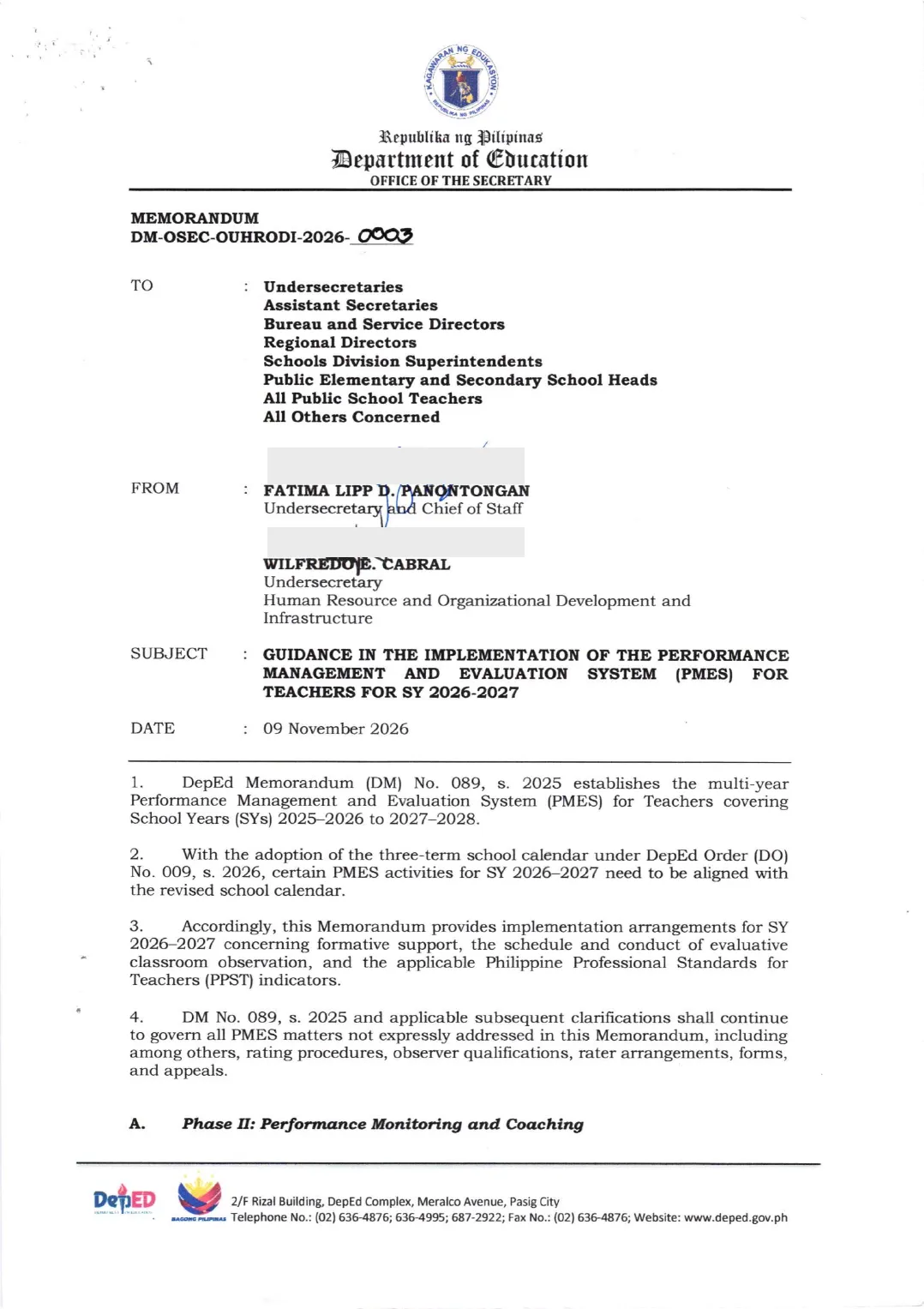
The Performance Management and Evaluation System (PMES) for School Year (SY) 2026-2027 gives each teacher one rated full-period classroom observation, held in Term 2 or Term 3, and rates 12 indicators of the Philippine Professional Standards for Teachers (PPST) instead of 14. The Department of Education (DepEd) set these rules in Memorandum DM-OSEC-OUHRODI-2026-0003 of November 9, 2026, which its Bureau of Human Resource and Organizational Development (BHROD) published on November 26, 2026. The memorandum fits the multi-year PMES of DepEd Memorandum No. 089, s. 2025 to the three-term calendar of DepEd Order No. 009, s. 2026. DM 089 and its later clarifications still govern every matter the new memorandum does not address, “including among others, rating procedures, observer qualifications, rater arrangements, forms, and appeals” (item 4).
The observed lesson is a regular one: no demonstration lesson or specially prepared lesson plan may be required for it. Indicators rated from documents are rated from what a teacher’s regular work already produced, and one document may serve several of them. Walkthroughs and coaching stay non-rated, with no minimum number before the rated observation, and regional and division offices are told to stop any local requirement that adds to these rules. DepEd’s PMES tools for SY 2026-2027, in the folder the memorandum links, rate the same 12 indicators for each career stage.
School heads rate Master Teachers, approve the ratings Master Teachers and other raters give, and set the school’s observation schedule, so the new rules reach every school head this term.
Key findings
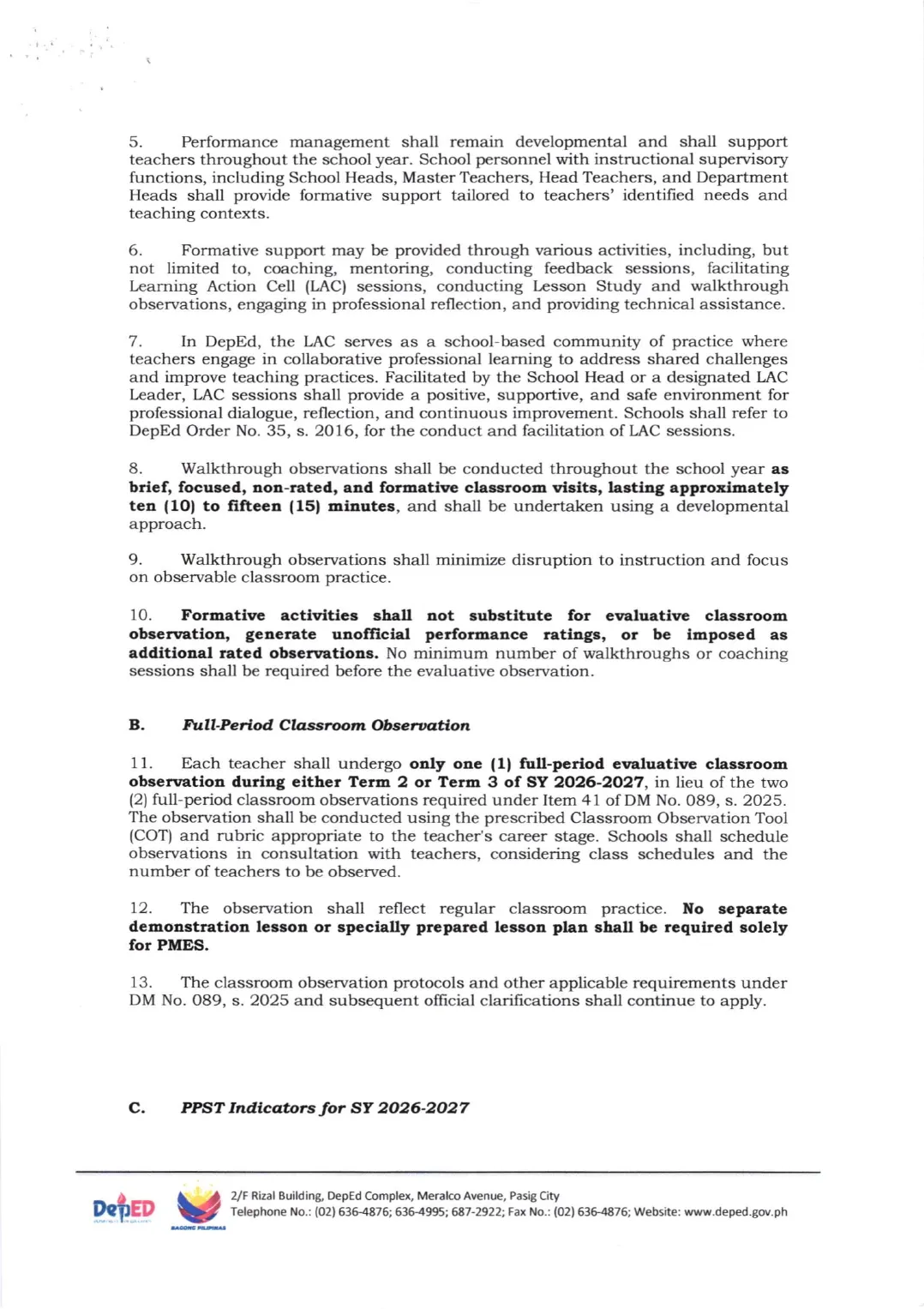
- One rated observation. “Each teacher shall undergo only one (1) full-period evaluative classroom observation during either Term 2 or Term 3 of SY 2026-2027, in lieu of the two (2) full-period classroom observations required under Item 41 of DM No. 089, s. 2025” (DM-OSEC-OUHRODI-2026-0003, item 11).
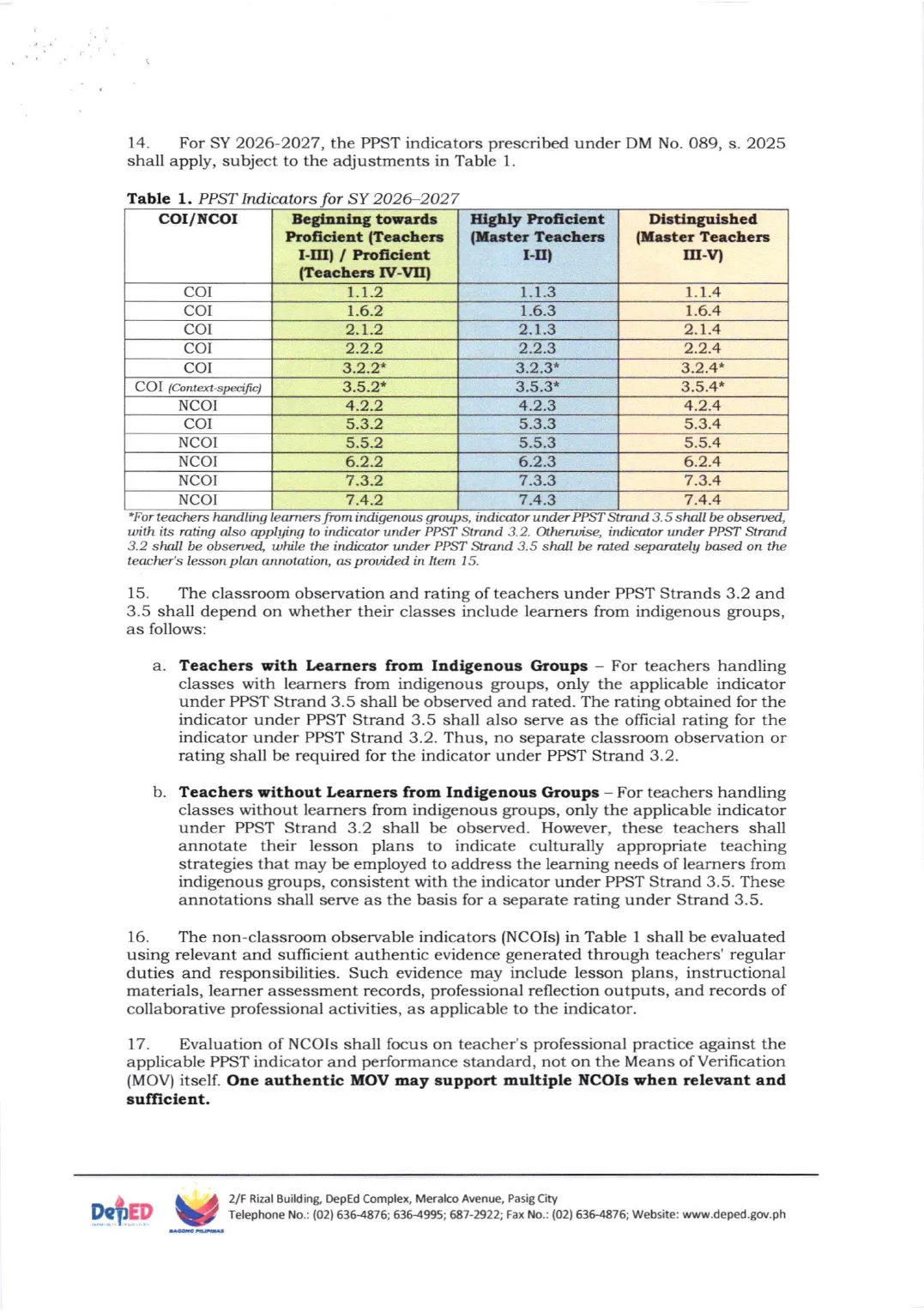
- Twelve indicators. The year rates strands 1.1, 1.6, 2.1, 2.2, 3.2, 3.5 and 5.3 by observation and 4.2, 5.5, 6.2, 7.3 and 7.4 by evidence. DM 089’s strands 1.4 and 1.5 are not rated in SY 2026-2027 (item 14, Table 1).
- Strand 3.2 or 3.5, by class. A teacher with learners from indigenous groups is observed on 3.5, and that rating also counts for 3.2. A teacher without them is observed on 3.2 and rated on 3.5 from annotations in a lesson plan (item 15).
- A regular lesson. “No separate demonstration lesson or specially prepared lesson plan shall be required solely for PMES” (item 12).
- Evidence from regular work. “One authentic MOV may support multiple NCOIs when relevant and sufficient”, and no teacher may be required to “create, reproduce, reformat, print, bind, or otherwise repack documents solely for PMES” where regular work already supplies the evidence (items 17 and 18).
- Formative support stays formative. Walkthroughs last “approximately ten (10) to fifteen (15) minutes”, and “No minimum number of walkthroughs or coaching sessions shall be required before the evaluative observation” (items 8 and 10).
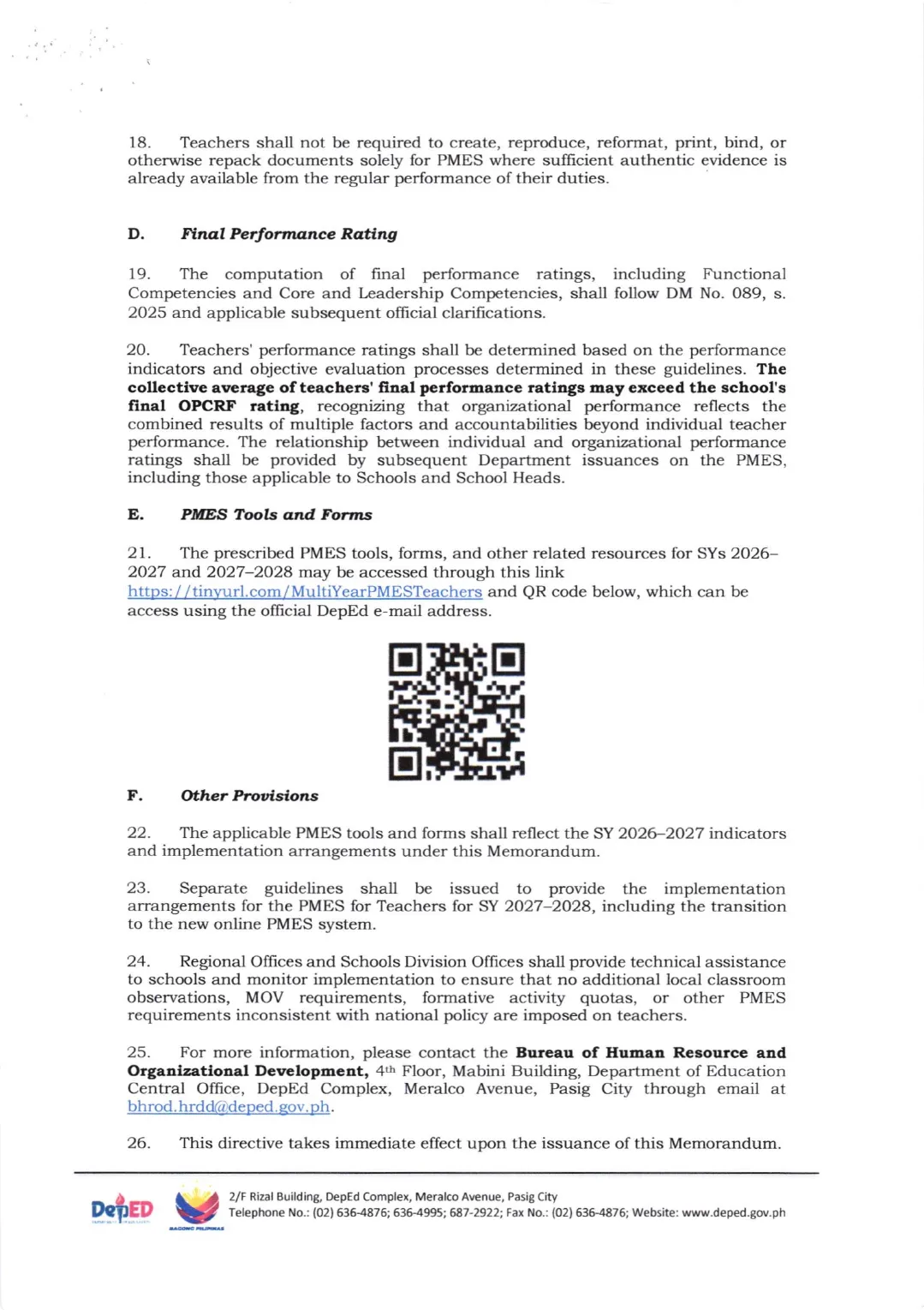
- Ratings are not capped by the school’s. “The collective average of teachers’ final performance ratings may exceed the school’s final OPCRF rating” (item 20). SY 2027-2028 will have separate guidelines, “including the transition to the new online PMES system” (item 23).
Download the PMES 2026-2027 memorandum (PDF)
Download: DM-OSEC-OUHRODI-2026-0003, PMES for Teachers for SY 2026-2027 (PDF, 4 pages, 1.6 MB), the signed memorandum as DepEd’s BHROD published it. The PMES tools and forms it names are in DepEd’s own folder, opened with an official DepEd email address (item 21); a teacher without one requests it from the division’s Information Technology Officer (DM 089, Part VI).
What changed from DM 089 for SY 2026-2027
The November 2026 guidance changes the observation, the indicators and the evidence for one school year and leaves the rest of DM 089 in place.
| Topic | DM 089, s. 2025 | SY 2026-2027, under the November 2026 guidance |
|---|---|---|
| Rated full-period observations | Two each school year (item 41): one in the 1st or 2nd quarter, one in the 3rd or 4th (item 42) | One, in Term 2 or Term 3 (item 11) |
| PPST indicators rated | 14 a year (item 17; Tables 3 to 5) | 12 (item 14, Table 1) |
| Strands 1.4 and 1.5 | Observed in both observations of SY 2026-2027 (Tables 7 to 9) | Not rated |
| Strands 3.2 and 3.5 | Both observed in the second observation | One observed, by class; 3.5 otherwise rated from lesson plan annotations (item 15) |
| The observed lesson | Lesson plan to the observer a day before, reflecting what is “actually employed during regular class days” (items 50 and 51) | The same rules (item 13), and no demonstration lesson or specially prepared lesson plan (item 12) |
| Walkthroughs | About 10 to 15 minutes, “non-rated, formative, and developmental” (item 37) | The same, with no minimum number and no unofficial ratings (items 8 and 10) |
| Evidence for indicators rated from documents | Shown during the year; “No portfolio for performance assessments shall be collected” (item 60) | Authentic evidence from regular duties; one MOV for several indicators; nothing made only for the PMES (items 16 to 18) |
| Weights | 6.786% for each of 14 indicators, 95% in all (item 74) | Computation follows DM 089 (item 19); no weight restated for 12 indicators |
| Teachers’ ratings and the school’s OPCRF | Not addressed | Their average may exceed the school’s final OPCRF rating (item 20) |
What did not change: the PPST-based Classroom Observation Tool (COT) and its rubric for each career stage (item 11), DM 089’s observation protocols (item 13), the conversion of COT levels to PMES ratings, and the rater for each teacher in DM 089’s Ratee-Rater-Approving Authority Matrix (Table 18). The guide to DM 089’s PMES for teachers explains those rules in full.
The 12 PPST indicators of PMES 2026-2027
PMES 2026-2027 rates seven classroom observable indicators (COIs) and five non-classroom observable indicators (NCOIs). Table 1 of the memorandum lists each at three career stages: Teachers I to VII are rated on the Career Stage 2 indicators (codes ending in .2), Master Teachers I and II on Career Stage 3 (.3), and Master Teachers III to V on Career Stage 4 (.4). The wording below is the PPST’s Career Stage 2, from DepEd Order No. 42, s. 2017.
| Indicator | Type | PPST wording (Career Stage 2) | How it is rated in SY 2026-2027 |
|---|---|---|---|
| 1.1.2 | COI | Apply knowledge of content within and across curriculum teaching areas. | The one observation |
| 1.6.2 | COI | Display proficient use of Mother Tongue, Filipino and English to facilitate teaching and learning. | The one observation |
| 2.1.2 | COI | Establish safe and secure learning environments to enhance learning through the consistent implementation of policies, guidelines and procedures. | The one observation |
| 2.2.2 | COI | Maintain learning environments that promote fairness, respect and care to encourage learning. | The one observation |
| 3.2.2 | COI | Establish a learner-centered culture by using teaching strategies that respond to their linguistic, cultural, socio-economic and religious backgrounds. | The one observation, or the 3.5 rating where the class has learners from indigenous groups |
| 3.5.2 | COI (context-specific) | Adapt and use culturally appropriate teaching strategies to address the needs of learners from indigenous groups. | The one observation where the class has learners from indigenous groups; otherwise lesson plan annotations |
| 4.2.2 | NCOI | Set achievable and appropriate learning outcomes that are aligned with learning competencies. | Evidence |
| 5.3.2 | COI | Use strategies for providing timely, accurate and constructive feedback to improve learner performance. | The one observation |
| 5.5.2 | NCOI | Utilize assessment data to inform the modification of teaching and learning practices and programs. | Evidence |
| 6.2.2 | NCOI | Build relationships with parents/guardians and the wider school community to facilitate involvement in the educative process. | Evidence |
| 7.3.2 | NCOI | Participate in professional networks to share knowledge and to enhance practice. | Evidence |
| 7.4.2 | NCOI | Develop a personal professional improvement plan based on reflection of one’s practice and ongoing professional learning. | Evidence |
The one observation therefore rates six indicators: 1.1, 1.6, 2.1, 2.2 and 5.3, and either 3.2 or 3.5. DM 089 had scheduled 1.4 (literacy and numeracy strategies) and 1.5 (higher-order thinking) for both of SY 2026-2027’s observations; the November 2026 guidance leaves them out of the year. Under DM 089’s own tables, 1.4 is rated again in SY 2027-2028, whose guidelines DepEd will issue separately (item 23).
Each position is rated on five of the COT’s nine levels, and the top of the five converts to Outstanding. The rubric and its forms use the Proficient wording for every position, which DepEd’s tools for Master Teachers explain: “The COT Rubric and Forms use the Proficient Career Stage wording as they follow the nine-level PPST performance continuum, from Beginning to Distinguished.”
| Position | Career stage | COT levels | Outstanding (5) | Poor (1) |
|---|---|---|---|---|
| Teacher I to III | Beginning towards Proficient | 2 to 6 | Level 6 | Level 2 |
| Teacher IV to VII | Proficient | 3 to 7 | Level 7 | Level 3 |
| Master Teacher I and II | Highly Proficient | 4 to 8 | Level 8 | Level 4 |
| Master Teacher III to V | Distinguished | 5 to 9 | Level 9 | Level 5 |
The levels come from DM 089 (item 18 and Tables 10 and 13), the March 2026 guidance (Part C) and DepEd’s SY 2026-2027 PMES tools, which read each COI this way. DM 089 places Master Teacher III two ways: its item 15 lists Master Teachers III to V as Distinguished, while its Tables 10 and 13 group Master Teacher III with the Highly Proficient (Levels 4 to 8). DepEd’s March 2026 guidance, Memorandum DM-OSEC-OUHRODI-2026-0001, placed Master Teachers III to V at Distinguished, Levels 5 to 9, for SY 2025-2026 (Part C). For SY 2026-2027, Table 1 of the November 2026 guidance heads its column “Distinguished (Master Teachers III-V)”, and the SY 2026-2027 tool for Master Teachers III to V reads Level 9 as Outstanding and Level 5 as Poor. The guide to the COT rubric sets out the words that separate each level.
When the one observation happens: Term 2 or Term 3
The rated observation of SY 2026-2027 is held in Term 2 or Term 3, and “Schools shall schedule observations in consultation with teachers, considering class schedules and the number of teachers to be observed” (item 11). Under DO 009, s. 2026 (Annex B), Term 2 runs from September 16 to December 18, 2026, with class days of its Instructional Block until December 4 and an End-of-Term Block from December 7 to 18. Term 3 runs from January 4 to April 8, 2027, with an Instructional Block until March 23 and an End-of-Term Block from March 24 to April 8.
The memorandum came out on November 26, 2026, with five class days left in Term 2’s Instructional Block. For most schools, the dates leave Term 3 for most observations, though the memorandum allows either term. The guide to the three-term school calendar has the full calendar.
DM 089’s protocol still applies to the one observation (item 13):
- Agree on the date. The rater and the teacher agree on it, and “The schedule must be set at least three (3) working days before the CO” (DM 089, item 46). A date that falls through is reset at once to a time that suits both.
- Hold the pre-observation conference. The two review the COT rubric for the teacher’s career stage and the indicators to be observed (item 49).
- Send the lesson plan. The teacher submits it “at least one (1) day before the scheduled classroom observation” (item 50). It is the plan for the regular lesson, since “The observation shall reflect regular classroom practice” (November 2026 guidance, item 12).
- Observe the whole period. “For purposes of rating the performance, classroom observations shall be done for the entire class period” (DM 089, item 52).
- Rate, then agree. Each observer rates alone from the Observation Notes Form, and several observers settle a difference by “reasoned and consensual judgment”, never an average (items 55 and 56).
- Hold the post-observation conference “immediately after the observation or within three (3) days thereafter” (item 57).
A Master Teacher is also “observed by at least one (1) teacher-ratee as part of mentoring and coaching activities” (item 54).
The figure below lays a rater’s observations on the class weeks that remain.
Try it: SY 2026-2027, on DepEd’s calendar
Plan each teacher’s one rated observation
Enter the teachers you rate and how many rated observations you can hold in a week. The plan places them on the class days left, week by week, up to March 23, 2027.
8 observations at 2 a week take 4 class weeks: the last falls in the week of January 25, 2027, with 8 class weeks of Term 3’s Instructional Block left after it.
Does not fit.
This is the plan for 8 teachers at 2 a week from January 4, 2027; the planner needs scripting to change it.
Around each observation
- At least 3 working days beforeAgree on the date with the teacherDM 089, item 46
- At least 1 day beforeThe teacher sends the regular lesson planDM 089, item 50; memorandum, item 12
- The dayOne full class period, observedMemorandum, item 11
- Right after, or within 3 daysThe post-observation conferenceDM 089, item 57
Term 2’s last class days: December 1 to 4, 2026
Week of
4 class daysBonifacio Day, November 30
2 observationsLast
December 7 to 18, 2026 is Term 2’s End-of-Term Block, and the Year-End Break follows: the plan places no observation there.
Term 3’s Instructional Block: January 4 to March 23, 2027
Each row is a week, named by its Monday.
Week of
5 class days
2 observationsLast
Week of
5 class days
2 observationsLast
Week of
5 class days
2 observationsLast
Week of
5 class days
2 observationsLast
Week of
5 class days
NoneLast
Week of
5 class days
NoneLast
Week of
5 class days
NoneLast
Week of
5 class days
NoneLast
Week of
5 class days
NoneLast
Week of
5 class days
NoneLast
Week of
5 class days
NoneLast
Week of
2 class daysThe End-of-Term Block begins March 24
NoneLast
March 24 to April 8, 2027 is Term 3’s End-of-Term Block.
The rules, word for word
Memorandum DM-OSEC-OUHRODI-2026-0003, November 9, 2026
“Each teacher shall undergo only one (1) full-period evaluative classroom observation during either Term 2 or Term 3 of SY 2026-2027, in lieu of the two (2) full-period classroom observations required under Item 41 of DM No. 089, s. 2025.”
Item 11
“Schools shall schedule observations in consultation with teachers, considering class schedules and the number of teachers to be observed.”
Item 11
“The observation shall reflect regular classroom practice. No separate demonstration lesson or specially prepared lesson plan shall be required solely for PMES.”
Item 12
“The classroom observation protocols and other applicable requirements under DM No. 089, s. 2025 and subsequent official clarifications shall continue to apply.”
Item 13
DepEd Memorandum No. 089, s. 2025, whose protocols item 13 keeps
“The ratee (teacher) and rater/s (observer/s) shall agree on the schedule of classroom observations (CO). The schedule must be set at least three (3) working days before the CO.”
Item 46
“Ratees (Teachers) to be observed shall submit their lesson plan to the observer/s at least one (1) day before the scheduled classroom observation.”
Item 50
“Ratees under the Highly Proficient and Distinguished Teachers Career Stages shall be observed by at least one (1) teacher-ratee as part of mentoring and coaching activities.”
Item 54
“The rater/s (observer/s) shall conduct a post-observation conference with the ratee immediately after the observation or within three (3) days thereafter to discuss his or her experience and performance during the classroom observation, allowing the ratee to reflect on his or her strengths and areas for improvement.”
Item 57
Sources: Memorandum DM-OSEC-OUHRODI-2026-0003 (November 9, 2026), items 11 to 13; DepEd Memorandum No. 089, s. 2025, items 46, 50, 54 and 57; DepEd Order No. 009, s. 2026, para. 13, Annex A and Annex B.
A school may already have observed teachers under DM 089’s schedule: a first observation in Term 1, or in Term 2 on DM 089’s first-observation list of 1.1, 1.4, 1.5, 1.6, 2.1 and 2.2, which lacks 3.2, 3.5 and 5.3. The memorandum does not say whether such an observation counts as the year’s one. For SY 2025-2026, the March 2026 guidance counted observations already held (Part A, Scenarios 1 and 2), but it covers that year only. A school with one should ask its Schools Division Office (SDO) before scheduling the teacher again.
Strands 3.2 and 3.5: classes with and without learners from indigenous groups
Whether a teacher is observed on strand 3.2 or 3.5 depends on the learners in the class (item 15):
- With learners from indigenous groups, “only the applicable indicator under PPST Strand 3.5 shall be observed and rated. The rating obtained for the indicator under PPST Strand 3.5 shall also serve as the official rating for the indicator under PPST Strand 3.2. Thus, no separate classroom observation or rating shall be required for the indicator under PPST Strand 3.2.”
- Without learners from indigenous groups, “only the applicable indicator under PPST Strand 3.2 shall be observed. However, these teachers shall annotate their lesson plans to indicate culturally appropriate teaching strategies that may be employed to address the learning needs of learners from indigenous groups, consistent with the indicator under PPST Strand 3.5. These annotations shall serve as the basis for a separate rating under Strand 3.5.”
The SY 2026-2027 tools name the evidence for 3.5 as the COT rating sheet or inter-observer agreement form “or Annotated lesson plan from any class period/sessions highlighting possible teaching strategies for learners from indigenous groups”, and add: “Only one (1) MOV shall be required for the applicable indicator”. The annotated plan can come from any lesson; it need not be the observed one.
Neither the memorandum nor the tools say how annotations become a rating. The tools’ descriptors for 3.5 name only COT levels “as shown in the COT rating sheet”. The COT rubric’s words for strand 3.5 are therefore the nearest guide. At Level 5 “The teacher employs strategies which are culturally appropriate in addressing the learning needs of learners from indigenous groups”; at Level 6 “The teacher employs a variety of strategies which are culturally appropriate”. The rubric’s clarifications define a “culture-based education” as “an education that is grounded in the context of the indigenous communities’ life, recognizes their Indigenous Knowledge Systems and Practices (IKSPs), and is inclusive of their cultural perspectives”, citing DepEd Order No. 32, s. 2015, the Indigenous Peoples Education Curriculum Framework.
Item 15.b asks the annotations to name culturally appropriate strategies and the learning needs they address; noting the part of the lesson each one changes also shows the rater where it fits. For a Grade 5 Science lesson on the parts of a plant, an invented example reads:
Annotation, Motivation: With learners from an indigenous community, open with the plants the community grows and names, and ask learners to share the names they use at home, so the lesson starts from their knowledge. Annotation, Practice: Let learners sort plant parts using examples from their family’s farm or forest, and accept answers in their home language before stating the science term.
A teacher who writes such notes for several lessons can present one plan; the tools require only one MOV for the indicator.
Evidence for the five NCOIs in SY 2026-2027
The five NCOIs are rated from “relevant and sufficient authentic evidence generated through teachers’ regular duties and responsibilities”, such as “lesson plans, instructional materials, learner assessment records, professional reflection outputs, and records of collaborative professional activities” (item 16). The rating weighs the practice, “not on the Means of Verification (MOV) itself”, and “One authentic MOV may support multiple NCOIs when relevant and sufficient” (item 17).
The SY 2026-2027 tool for Teachers I to III lists these MOVs and descriptors. The tool for Teachers IV to VII lists the same MOVs and sets each descriptor about one step higher.
| NCOI | MOVs the tool accepts | Outstanding (5), Teachers I to III | Satisfactory (3), Teachers I to III |
|---|---|---|---|
| 4.2.2 Learning outcomes | “At least one (1) lesson plan used in actual instruction, in any format, showing learning outcomes aligned with the intended learning competencies.” | Outcomes achievable, appropriate and aligned, with “clear progression within the lesson or learning sequence” | Outcomes “achievable, appropriate to the intended learners, and aligned with the intended learning competencies” |
| 5.5.2 Using assessment data | Assessment results and analysis; an annotated or modified lesson plan; reflection notes on changes made from assessment; intervention or program records | Used the data to identify needs, changed teaching, “and reviewed learner progress following the modifications” | Used the data to identify learners’ difficulties and changed teaching to match |
| 6.2.2 Parents and community | Parent or guardian communication or conference records; home visitation records; stakeholder engagement records; records of joint activities or follow-up | “Maintained collaborative relationships” and facilitated parents’ or the community’s participation | “Established positive relationships” that facilitated their involvement |
| 7.3.2 Professional networks | LAC or network records and outputs; meeting notes showing contributions; resources shared with colleagues; lesson plans or reflections applying what was learned | Participated, shared, “and contributed insights or possible solutions to teaching challenges” | Participated and shared experiences, knowledge or practices from one’s own teaching |
| 7.4.2 Improvement plan | “Updated Individual Development Plan (IDP)”, with reflection notes, learning records or self-assessment results where they apply | A plan with “prioritized development needs and specific, achievable improvement actions” | A plan with development needs and corresponding actions, based on reflection |
Indicator 6.2.2 is the only NCOI with a second measure, timeliness: engaging parents and the community “at appropriate times” is Satisfactory, and doing it “ahead of planned activities or anticipated opportunities” is Outstanding. The tools no longer count quarters, as the SY 2025-2026 tools did for some indicators.
The tools end with a “Reference Matrix of Possible Means of Verification”, which says: “Teachers are not required to prepare additional documents solely for performance evaluation.” It also warns raters: “The identification of applicable objectives does not automatically establish performance. Raters shall assess whether the MOV sufficiently demonstrates the specific practice and performance criteria for each objective.” A lesson plan used in class, with notes on how the class’s quiz results changed the next lesson, can serve 4.2.2 and 5.5.2 at once; a Learning Action Cell (LAC) session’s minutes showing the teacher’s contribution can serve 7.3.2.
The memorandum closes the matter of printed folders: “Teachers shall not be required to create, reproduce, reformat, print, bind, or otherwise repack documents solely for PMES where sufficient authentic evidence is already available from the regular performance of their duties” (item 18). DM 089 had already ruled that “No portfolio for performance assessments shall be collected” (item 60).
Walkthroughs, coaching and LAC sessions stay non-rated
Performance management “shall remain developmental”, and school heads, Master Teachers, Head Teachers and Department Heads “shall provide formative support tailored to teachers’ identified needs and teaching contexts” (item 5). The support may be coaching, mentoring, feedback sessions, LAC sessions, Lesson Study, walkthrough observations, professional reflection or technical assistance (item 6). LAC sessions follow DepEd Order No. 35, s. 2016 and “shall provide a positive, supportive, and safe environment for professional dialogue, reflection, and continuous improvement” (item 7).
Walkthroughs “shall be conducted throughout the school year as brief, focused, non-rated, and formative classroom visits, lasting approximately ten (10) to fifteen (15) minutes” (item 8), and they “shall minimize disruption to instruction” (item 9). Item 10 sets the limit: “Formative activities shall not substitute for evaluative classroom observation, generate unofficial performance ratings, or be imposed as additional rated observations. No minimum number of walkthroughs or coaching sessions shall be required before the evaluative observation.”
A walkthrough checklist scored on the COT’s levels is an unofficial rating under item 10, even if nothing reaches the Individual Performance Commitment and Review Form (IPCRF). DM 089 has observers record each walkthrough and its feedback in the PMCF (item 37.e), for “constructive feedback” and growth rather than a score (item 37.b); the classroom observation notes template shows a format, and the guide to teacher performance feedback shows how to use them in a conversation.
What a school or division may not add
Regional Offices and SDOs “shall provide technical assistance to schools and monitor implementation to ensure that no additional local classroom observations, MOV requirements, formative activity quotas, or other PMES requirements inconsistent with national policy are imposed on teachers” (item 24). The figure below sorts common local practices against the memorandum’s own words.
PMES for teachers, SY 2026-2027
Allowed or not in the PMES for SY 2026-2027
Twelve things a school or a division office might ask of teachers. Choose Allowed or Not allowed for each card: DepEd’s answer and the words it rests on open under it.
1 The school head schedules two rated full-period observations for every teacher this school year, one in each half.
You said Allowed. DepEd’s rules do not allow it.
You said Not allowed, as DepEd’s rules do.
DepEd’s rules: Not allowed
“Each teacher shall undergo only one (1) full-period evaluative classroom observation during either Term 2 or Term 3 of SY 2026-2027, in lieu of the two (2) full-period classroom observations required under Item 41 of DM No. 089, s. 2025.”
Memorandum DM-OSEC-OUHRODI-2026-0003, item 11
2 The teacher to be observed must prepare a demonstration lesson, with a lesson plan written just for the observation.
You said Allowed. DepEd’s rules do not allow it.
You said Not allowed, as DepEd’s rules do.
DepEd’s rules: Not allowed
“The observation shall reflect regular classroom practice. No separate demonstration lesson or specially prepared lesson plan shall be required solely for PMES.”
Memorandum DM-OSEC-OUHRODI-2026-0003, item 12
3 The teacher gives the observer the lesson plan for the class to be observed at least one day before.
You said Allowed, as DepEd’s rules do.
You said Not allowed. DepEd’s rules allow it.
DepEd’s rules: Allowed
This is the plan the teacher already uses for that class. What item 12 of the memorandum rules out is a lesson plan prepared only for the PMES.
“Ratees (Teachers) to be observed shall submit their lesson plan to the observer/s at least one (1) day before the scheduled classroom observation.”
DM No. 089, s. 2025, item 50, which the memorandum’s item 13 keeps
4 The date of the rated observation is agreed with the teacher at least three working days ahead.
You said Allowed, as DepEd’s rules do.
You said Not allowed. DepEd’s rules allow it.
DepEd’s rules: Allowed
“Schools shall schedule observations in consultation with teachers, considering class schedules and the number of teachers to be observed.”
Memorandum DM-OSEC-OUHRODI-2026-0003, item 11
“The ratee (teacher) and rater/s (observer/s) shall agree on the schedule of classroom observations (CO). The schedule must be set at least three (3) working days before the CO.”
DM No. 089, s. 2025, item 46, which the memorandum’s item 13 keeps
5 A teacher must first have three walkthroughs before the rated observation.
You said Allowed. DepEd’s rules do not allow it.
You said Not allowed, as DepEd’s rules do.
DepEd’s rules: Not allowed
“No minimum number of walkthroughs or coaching sessions shall be required before the evaluative observation.”
Memorandum DM-OSEC-OUHRODI-2026-0003, item 10
6 Walkthroughs are scored on the Classroom Observation Tool (COT), and the scores count in the teacher’s IPCRF.
You said Allowed. DepEd’s rules do not allow it.
You said Not allowed, as DepEd’s rules do.
DepEd’s rules: Not allowed
“Formative activities shall not substitute for evaluative classroom observation, generate unofficial performance ratings, or be imposed as additional rated observations.”
Memorandum DM-OSEC-OUHRODI-2026-0003, item 10
7 The school head drops in on classes through the year for walkthroughs of about 10 to 15 minutes, with feedback and no rating.
You said Allowed, as DepEd’s rules do.
You said Not allowed. DepEd’s rules allow it.
DepEd’s rules: Allowed
“Walkthrough observations shall be conducted throughout the school year as brief, focused, non-rated, and formative classroom visits, lasting approximately ten (10) to fifteen (15) minutes, and shall be undertaken using a developmental approach.”
Memorandum DM-OSEC-OUHRODI-2026-0003, item 8
8 Teachers hand in a printed, bound folder of means of verification (MOVs), with a copy made for each non-classroom indicator.
You said Allowed. DepEd’s rules do not allow it.
You said Not allowed, as DepEd’s rules do.
DepEd’s rules: Not allowed
“Teachers shall not be required to create, reproduce, reformat, print, bind, or otherwise repack documents solely for PMES where sufficient authentic evidence is already available from the regular performance of their duties.”
Memorandum DM-OSEC-OUHRODI-2026-0003, item 18
9 A lesson plan already used in class is the evidence for two non-classroom indicators (NCOIs): 4.2.2, on learning outcomes, and 5.5.2, on using assessment data.
You said Allowed, as DepEd’s rules do.
You said Not allowed. DepEd’s rules allow it.
DepEd’s rules: Allowed
Only when the plan shows both: learning outcomes aligned with the competencies, and changes made because of assessment results.
“One authentic MOV may support multiple NCOIs when relevant and sufficient.”
Memorandum DM-OSEC-OUHRODI-2026-0003, item 17
10 A teacher whose class has no learners from indigenous groups annotates a lesson plan with teaching strategies for such learners.
You said Allowed, as DepEd’s rules do.
You said Not allowed. DepEd’s rules require it.
DepEd’s rules: Allowed (required)
“However, these teachers shall annotate their lesson plans to indicate culturally appropriate teaching strategies that may be employed to address the learning needs of learners from indigenous groups, consistent with the indicator under PPST Strand 3.5. These annotations shall serve as the basis for a separate rating under Strand 3.5.”
Memorandum DM-OSEC-OUHRODI-2026-0003, item 15.b
11 A teacher whose class has learners from indigenous groups is observed for the Strand 3.5 indicator, then observed and rated again, separately, for Strand 3.2.
You said Allowed. DepEd’s rules do not allow it.
You said Not allowed, as DepEd’s rules do.
DepEd’s rules: Not allowed
“The rating obtained for the indicator under PPST Strand 3.5 shall also serve as the official rating for the indicator under PPST Strand 3.2. Thus, no separate classroom observation or rating shall be required for the indicator under PPST Strand 3.2.”
Memorandum DM-OSEC-OUHRODI-2026-0003, item 15.a
12 The schools division office adds a rated classroom observation of its own for every teacher.
You said Allowed. DepEd’s rules do not allow it.
You said Not allowed, as DepEd’s rules do.
DepEd’s rules: Not allowed
“Regional Offices and Schools Division Offices shall provide technical assistance to schools and monitor implementation to ensure that no additional local classroom observations, MOV requirements, formative activity quotas, or other PMES requirements inconsistent with national policy are imposed on teachers.”
Memorandum DM-OSEC-OUHRODI-2026-0003, item 24
None of the 12 cards sorted yet.
Rules: Memorandum DM-OSEC-OUHRODI-2026-0003 (November 9, 2026), items 8, 10, 11, 12, 15, 17, 18 and 24;DepEd Memorandum No. 089, s. 2025, items 46 and 50, which the memorandum’s item 13 keeps.
Master Teachers in SY 2026-2027
Master Teachers I and II are rated on the Career Stage 3 indicators and COT Levels 4 to 8; Master Teachers III to V on Career Stage 4 and Levels 5 to 9 (Table 1 and the SY 2026-2027 tools). DM 089 gives Master Teachers “a dual function as classroom teacher and mentor” (item 45), and the SY 2026-2027 tools rate that function in two ways.
- A colleague in the room. Every COI of a Master Teacher takes as evidence the “Classroom Observation Tool (COT) Rating Sheet and proof of attendance of colleague/s”.
- A second rating for work with colleagues. For some COIs the tools add a second quality rating from existing documents of the support given to colleagues, such as the Performance Monitoring and Coaching Form (PMCF). In SY 2026-2027 these are 1.6.3 for Master Teachers I and II, and 1.6.4, 2.1.4, 2.2.4 and 5.3.4 for Master Teachers III to V. DM 089’s Table 11 had also listed 1.4.3, which the year no longer rates. The tool’s note reads: “Both components collectively reflect the full expectations of the PPST indicator and shall be assessed separately.”
A Master Teacher’s NCOIs are about colleagues too. Indicator 4.2.3 asks a Master Teacher I or II to have “Modeled to colleagues the setting of achievable and challenging learning outcomes”, and 5.5.3 to have “Worked collaboratively with colleagues to analyze and utilize assessment data”.
The SY 2026-2027 tool for Master Teachers III to V prints Levels 7 to 3 for its objectives 4 (2.2.4) and 8 (5.3.4), where its other COIs read Levels 9 to 5. Table 1 places all of them at the Distinguished stage, which the March 2026 guidance (Part C) and DM 089’s Table 13 rate on Levels 5 to 9; a rater who meets the two lower ranges should confirm the conversion with the SDO before encoding. The guide to Master Teachers’ PMES ratings works through a Master Teacher’s rating for SY 2026-2027.
How the final rating is computed in SY 2026-2027
“The computation of final performance ratings, including Functional Competencies and Core and Leadership Competencies, shall follow DM No. 089, s. 2025 and applicable subsequent official clarifications” (item 19). Each COI’s COT level converts to the PMES 5-point scale by DM 089’s Table 13, with a Master Teacher III read on Levels 5 to 9 (March 2026 guidance, Part C; Table 1; the SY 2026-2027 tool). With one observation, DM 089’s averaging of a repeating COI’s two ratings (item 77) has nothing to average.
DM 089 gives the PPST indicators 95% of the final rating, at 6.786% for each of 14 (item 74). The November 2026 guidance lists 12 indicators and restates no weight, and as of November 26, 2026 the e-IPCRF in DepEd’s PMES folder is still the SY 2025-2026 tool. For SY 2025-2026, the March 2026 guidance set core competencies at 5% for teachers without supervisory functions, and core and leadership competencies at 2.5% each for Master Teachers and others with supervisory functions. No issuance has yet set either set of weights for SY 2026-2027.
Item 20 adds a rule on the school’s rating: “Teachers’ performance ratings shall be determined based on the performance indicators and objective evaluation processes determined in these guidelines. The collective average of teachers’ final performance ratings may exceed the school’s final OPCRF rating, recognizing that organizational performance reflects the combined results of multiple factors and accountabilities beyond individual teacher performance.” A school head may not lower teachers’ ratings to fit the school’s Office Performance Commitment and Review Form (OPCRF) rating. Later issuances, “including those applicable to Schools and School Heads”, will set how the two relate; the guide to the OPCRF for school heads covers the school’s own rating.
What the November 2026 guidance leaves open
The memorandum leaves these to DM 089, to the SDO or to later issuances, as of November 26, 2026:
- The weights of the 12 indicators, and of the competencies, for SY 2026-2027 (see the section above).
- An observation already held in Term 1, or in Term 2 on DM 089’s first-observation list, before the memorandum came out.
- The mid-year review. DM 089 holds it five months after the opening of classes, around early November 2026, and bases the review of COIs on “the first full-period observation” (item 66). The memorandum does not say how the review treats COIs when the year’s one observation comes after it.
- A scheduled indicator not observed. The SY 2025-2026 rating sheets gave such an indicator the lowest level of the position’s range. DepEd’s PMES folder holds no COT rating sheet for SY 2026-2027, and the memorandum is silent on the point.
- The forms. “The applicable PMES tools and forms shall reflect the SY 2026-2027 indicators and implementation arrangements under this Memorandum” (item 22). The inter-observer agreement forms DepEd issued with DM 089 still list 1.4.2 and 1.5.2 on their SY 2026-2027 pages.
For any of these, ask the SDO first; for more information, item 25 of the memorandum gives BHROD’s email address.
SY 2027-2028: separate guidelines and an online PMES
“Separate guidelines shall be issued to provide the implementation arrangements for the PMES for Teachers for SY 2027-2028, including the transition to the new online PMES system” (item 23). Until they come, DM 089’s tables for SY 2027-2028 are the only published plan: 14 indicators, with 1.1 and 1.4 observed in both observations. The tools for SY 2027-2028 will be in the same folder as this year’s (item 21).
What this means for school heads
- Set the observation schedule now. List the teachers each rater observes, agree on dates with each teacher, and keep the dates in the Instructional Supervisory (IS) Plan, as DM 089 requires (item 28). Leave room for dates that fall through: a deferred observation must be rescheduled at once to a time that suits both (DM 089, item 46).
- Tell teachers the lesson is a regular one. No demonstration lesson, no new lesson plan written for the observation (item 12). Observers are discouraged from giving technical assistance on the lesson plan to be used in the rated observation (DM 089, item 50).
- Find the classes with learners from indigenous groups. Their teachers are observed on 3.5; every other teacher is observed on 3.2 and prepares an annotated lesson plan for 3.5 (item 15). Tell teachers which case applies before the pre-observation conference.
- Stop local add-ons. Drop any school rule that sets a number of walkthroughs before the observation, scores walkthroughs, adds a rated observation, or asks for printed or bound MOV folders (items 10, 18 and 24).
- Plan the evidence from what exists. Agree with each teacher which existing lesson plans, assessment records, parent communication records, LAC records and IDP will serve the five NCOIs, and record your feedback in the PMCF as you see them (DM 089, item 61).
- Rate on evidence, not on the school’s rating. Teachers’ ratings may average above the school’s OPCRF rating (item 20); a rating lowered to fit it breaks the memorandum’s rule that ratings rest on “the performance indicators and objective evaluation processes”.
- Keep coaching apart from rating. Walkthroughs and coaching continue through the year, without quotas and without scores (items 8 and 10).
This work belongs to strand 4.4, performance management, of the Philippine Professional Standards for School Heads (PPSSH), and to strands 4.5 and 3.3 on professional development and teacher feedback; the guides to PPSSH Domain 4 and PPSSH Domain 3 explain them.
Frequently asked questions
How many classroom observations are required in PMES 2026-2027?
One. Each teacher has “only one (1) full-period evaluative classroom observation during either Term 2 or Term 3 of SY 2026-2027”, in place of the two that DM 089 requires (DM-OSEC-OUHRODI-2026-0003, item 11). Walkthroughs continue, but they are not rated and no minimum number is required (items 8 and 10).
What are the PMES indicators for SY 2026-2027?
Twelve PPST indicators: 1.1, 1.6, 2.1, 2.2, 3.2, 3.5 and 5.3, rated by classroom observation, and 4.2, 5.5, 6.2, 7.3 and 7.4, rated from evidence (item 14, Table 1). Teachers I to VII are rated at Career Stage 2 (1.1.2 and so on), Master Teachers I and II at Career Stage 3, and Master Teachers III to V at Career Stage 4. Strands 1.4 and 1.5 are not rated in SY 2026-2027.
Is a demonstration lesson required for the PMES classroom observation?
No. “The observation shall reflect regular classroom practice. No separate demonstration lesson or specially prepared lesson plan shall be required solely for PMES” (item 12). The teacher still submits the lesson plan for the observed class at least a day before (DM 089, item 50).
Is a portfolio of MOVs required in PMES 2026-2027?
No. Evidence comes from regular work, one MOV may serve several NCOIs, and no teacher may be required to “create, reproduce, reformat, print, bind, or otherwise repack documents solely for PMES” when regular work already supplies the evidence (items 16 to 18). DM 089 had already ruled that no portfolio shall be collected (item 60).
What if my class has no learners from indigenous groups?
You are observed on indicator 3.2, and you annotate a lesson plan from any class with culturally appropriate strategies you could use for learners from indigenous groups; the annotations are the basis of your rating on 3.5 (item 15.b). A teacher whose class has such learners is observed on 3.5 instead, and that rating also counts for 3.2 (item 15.a).
Sources
DepEd issuances:
- Memorandum DM-OSEC-OUHRODI-2026-0003, Guidance in the Implementation of the Performance Management and Evaluation System (PMES) for Teachers for SY 2026-2027, November 9, 2026. Items 1 to 26 and Table 1.
- DepEd Memorandum No. 089, s. 2025, Guidelines on the Multi-Year Performance Management and Evaluation System for Teachers from School Years 2025-2026 to 2027-2028, October 1, 2025. Items 17, 18, 28, 37, 41, 42, 45, 46, 49 to 57, 60, 61, 66, 74 and 77; Tables 3 to 5, 7 to 11, 13 and 18; Part VI.
- Memorandum DM-OSEC-OUHRODI-2026-0001, Guidance in the Implementation of the Performance Management and Evaluation System for Teachers for SY 2025-2026, March 3, 2026. Parts A (observations already held), C (positions and COT levels) and D (weights).
- DepEd Order No. 009, s. 2026, Guidelines on the Implementation of the Three-Term School Calendar in Basic Education, April 16, 2026. Annex B.
- DepEd Order No. 35, s. 2016, The Learning Action Cell as a K to 12 Basic Education Program School-Based Continuing Professional Development Strategy for the Improvement of Teaching and Learning, June 7, 2016.
- DepEd Order No. 42, s. 2017, National Adoption and Implementation of the Philippine Professional Standards for Teachers, August 11, 2017.
- DepEd Order No. 32, s. 2015, Adopting the Indigenous Peoples Education Curriculum Framework, July 29, 2015.
DepEd’s PMES tools (tinyurl.com/MultiYearPMESTeachers, opened with an official DepEd email address):
- PMES Tools for Teachers, SY 2026-2027 (Annex C): Beginning towards Proficient (Teachers I-III), Proficient (Teachers IV-VII), Highly Proficient (Master Teachers I-II) and Distinguished (Master Teachers III-V), each with its Reference Matrix of Possible Means of Verification.
- PPST-based Classroom Observation Tool, full rubric, Levels 1 to 9 (Annex E-1 to DM 089), strand 3.5 and its clarifications.
Written by Mark Anthony Llego for NASH Reviewer. Sources: DepEd Memorandum DM-OSEC-OUHRODI-2026-0003 and DM 089, s. 2025; DepEd’s PMES tools for SY 2026-2027; DO 009, s. 2026.