

DepEd’s school-based deworming program is the Department of Health’s mass drug administration (MDA) against intestinal worms, given to learners in their schools twice a year, in a January round and a July round. Since January 2026, under Memorandum OM-OUGOPS-2026-08-08029 of DepEd’s Office of the Undersecretary for Governance and Operations, each round’s report counts the learners dewormed in three age groups (1-4, 5-14 and 15-19 years old). The January round’s report is due on March 31 and the July round’s on September 30.
The program is DOH’s, and DepEd supports it through the School Health Division of its Bureau of Learner Support Services (BLSS-SHD). Local government health personnel bring and give the tablets, the Schools Division Office’s school health and nutrition personnel schedule each school, and the school gets the learners ready: parents’ written consent, the master list, a time and place, and health personnel on hand while the tablets are taken. DepEd’s 2025 advisory on the program makes school heads answerable for one thing by name: to “monitor and promptly report any adverse reactions to deworming medicines to local health units for immediate action”.
The rules below are those in force on November 25, 2026. The next round is in January 2027, and its report is due on March 31, 2027.
Key findings
- Two rounds a year, named for their months. The rounds are the “January Round” and the “July Round”, reported by “Every March 31st” and “Every September 30th” (OM-OUGOPS-2026-08-08029, Part A; DOH Department Circular No. 2025-0537, item 2.a).
- Three age groups since January 2026. The report counts learners aged 1-4, 5-14 and 15-19; the soil-transmitted helminthiasis MDA covers ages 1 to 19, and the schistosomiasis MDA in endemic areas ages 5 to 65 (OM-OUGOPS-2026-08-08029, Part A; DOH DC 2025-0537, item 1.b).
- School heads report every adverse reaction. “School Heads are required to monitor and promptly report any adverse reactions to deworming medicines to local health units for immediate action” (DepEd Memorandum OM-OUOPS-2025-08-80848, item e).
- No tablet without written consent. “Written consent from parents or guardians must be obtained before administering deworming medicines” (OM-OUOPS-2025-08-80848, item b), and advisers encode each answer in the class master list (DM 059, s. 2026, Encl. No. 1, Part B, item 2.b).
- A teacher hands out tablets only with health personnel in the school. Advisers may distribute them “provided that health personnel are present in the school to provide the necessary monitoring of learners and respond to any adverse events” (DM 059, s. 2026, Encl. No. 1, Part B, item 4.d.i).
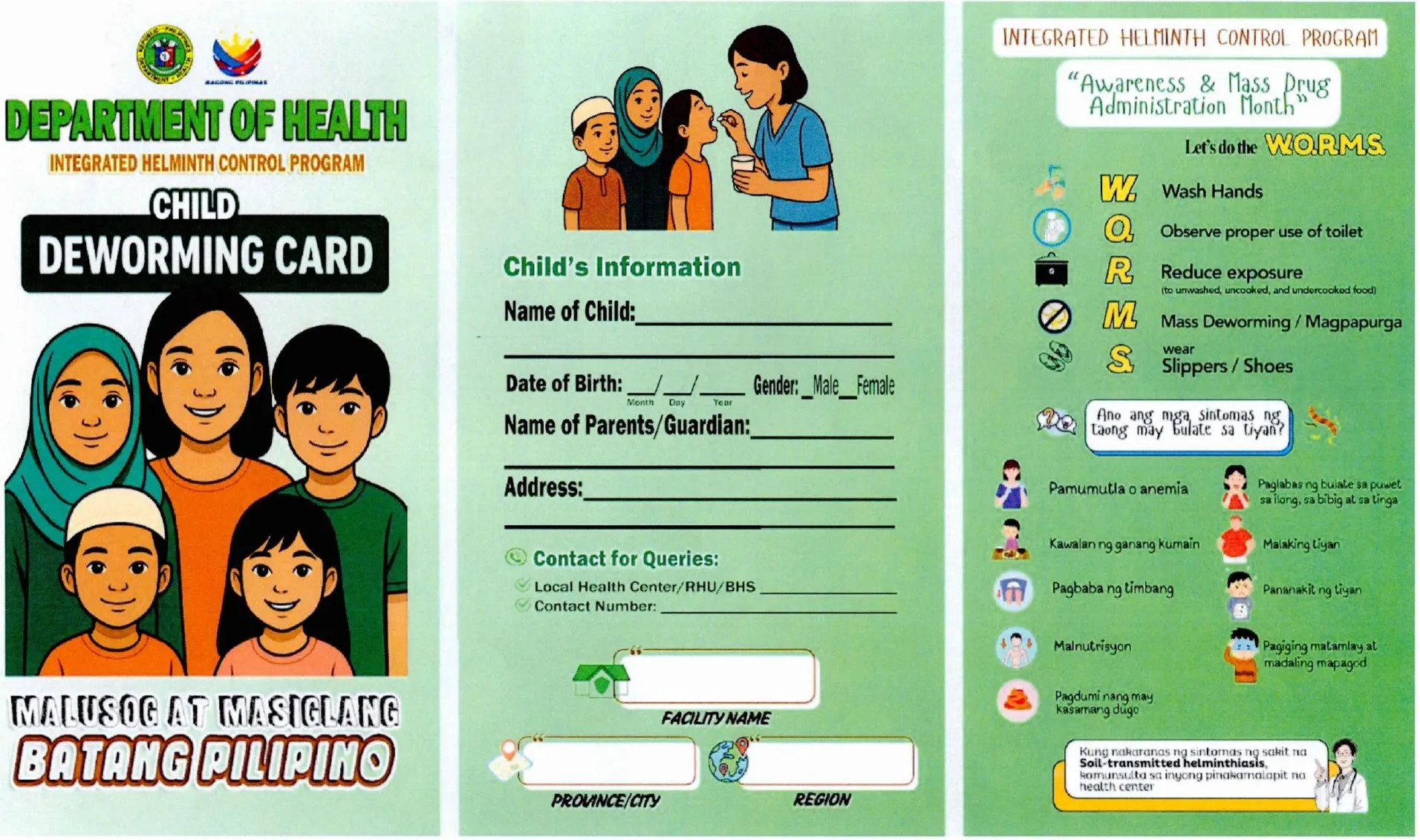
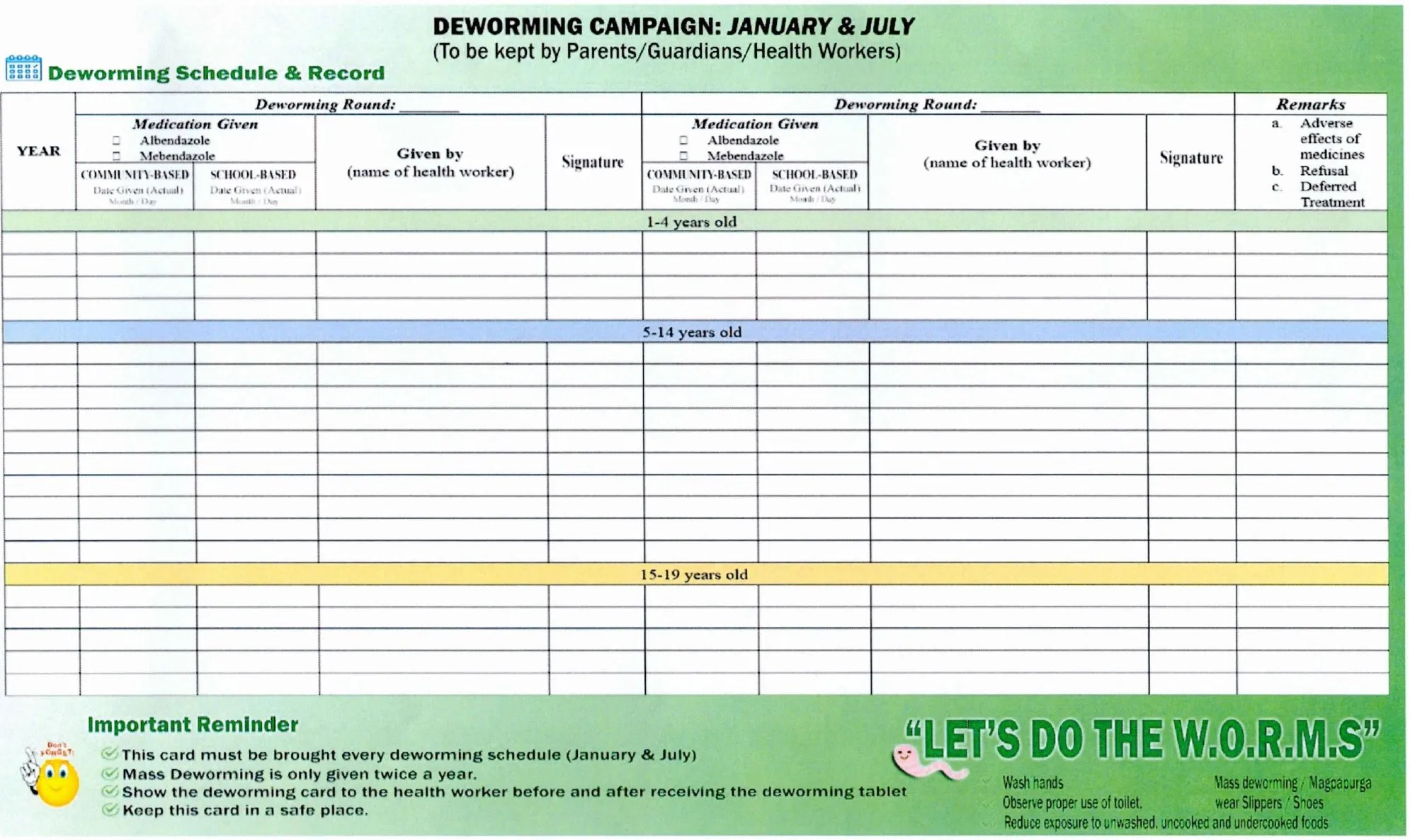
- Each child has a deworming card. From January 2026, every child aged 1 to 19 gets a DOH deworming card, which “shall serve as the official documentation for the receipt of deworming medicines” (DOH DC 2025-0537, item 3.c).
- Coverage is far below target. In 2024, MDA coverage was 28.26% for ages 5 to 9 and 21.68% for ages 10 to 19, against “the program target of 85% coverage” (DOH DC 2025-0537).
What the school-based deworming program is
The school-based deworming program is the part of DOH’s Integrated Helminth Control Program (IHCP) that reaches children through schools. Soil-transmitted helminthiasis (STH) is infection with intestinal worms (roundworm, whipworm and hookworm) that “are transmitted by eggs present in human faeces, which contaminate the soil in areas where sanitation is poor” (World Health Organization). DOH treats it by mass drug administration: every learner takes one chewable tablet, albendazole 400 mg or mebendazole 500 mg, in each round, whether or not the learner is known to be infected (DOH Administrative Order No. 2015-0054, Secs. IV.4, V.1 and V.3). In provinces where schistosomiasis (SCH) is endemic, DOH’s Schistosomiasis Control and Elimination Program (SCEP) adds praziquantel, and “the co-administration of praziquantel and albendazole is permissible during MDA activities” (DOH DC 2025-0537, item 4.a).
For DepEd, deworming is one of the standards of Water, Sanitation and Hygiene in Schools (WinS). DepEd Order No. 10, s. 2016 sets its target, “At least 85 percent of all students shall be dewormed semi-annually” (Sec. III), and its standard: “Deworm all students semi-annually subject to DOH recommendations based on the results of the current prevalence index survey” (Sec. IV.A). Under DepEd Order No. 28, s. 2018, Oplan Kalusugan sa DepEd, each school agrees with its local health office on the year’s joint health activities, “such as deworming and provision of deworming tablets” (Sec. V.C.2.c).
Who does what in a deworming round
DOH supplies the medicine and its health workers give it; DepEd’s offices prepare the learners and the records.
| Who | What they do | Source |
|---|---|---|
| DOH, through its Center for Health Development (CHD) | Runs the program, supplies the medicines, sets the report templates and receives the reports | DOH DC 2025-0537, items 1 and 2; DM 059, s. 2026, Encl. No. 1, Part B, item 4.a |
| Local government health personnel | Bring the tablets to the school “based on the Master List”, give them, watch for adverse events and record each dose on the child’s card | DM 059, s. 2026, Encl. No. 1, Part B, item 4.d; DOH DC 2025-0537, item 3.b |
| Schools Division Office’s school health and nutrition (SHN) personnel | Coordinate with the local health office, schedule the schools from their master lists, and “closely coordinate with the DOH Center for Health Development (CHD) STH MDA program managers” on the rounds and the reports | DM 059, s. 2026, item 7; OM-OUGOPS-2026-08-08029, Part A |
| School head | Coordinates the round with the local health unit, sees that written consent is in before any tablet is given, has the class lists combined and sent to the division, and reports every adverse reaction to the local health unit | OM-OUOPS-2025-08-80848, items a, b and e; DM 059, s. 2026, Encl. No. 1, Part B, item 2.d.i |
| Class adviser | Explains the service, collects consent, keeps the class master list, and may hand out the tablets to the advisory class while health personnel are present | DM 059, s. 2026, Encl. No. 1, Part C, items 1, 7, 9 and 10 |
| Parent or guardian | Consents or refuses in writing, keeps the child’s deworming card, and brings or sends it each round | OM-OUOPS-2025-08-80848, item b; DOH DC 2025-0537, item 3 |
Few schools have a health worker of their own: in School Year 2023-2024, 0.8% of public schools reported a nurse from any funding source (DepEd school counselors, nurses and librarians data). In most schools the health personnel who must be present during a round come from the rural health unit or city health office.
What the 2025 advisory requires of schools and school heads
DepEd’s own instructions to schools on deworming are in Memorandum OM-OUOPS-2025-08-80848, Advisory on the School-Based Deworming Program, issued by the Office of the Undersecretary for Operations on January 23, 2025. It opens: “The resumption of the School-Based Deworming Program is hereby advised pending the signing of the Joint Administrative Order (JAO) on Health Services between and among the Departments of Education, Health and Interior and Local Government”. Until then, schools follow its “Interim Guidelines for Implementation”:
a. Schools will coordinate with local health units to ensure adequate technical support and the provision of deworming medicines;
b. Written consent from parents or guardians must be obtained before administering deworming medicines;
c. All personnel involved must adhere to prescribed health and safety protocols;
d. Conduct of orientation sessions for school staff, parents, and learners to address concerns and provide accurate information;
e. School Heads are required to monitor and promptly report any adverse reactions to deworming medicines to local health units for immediate action;
f. Deworming activities should be integrated into broader health education initiatives to highlight their benefits and importance; and
g. Implementation schedules should be arranged in collaboration with school authorities, local health units and communicated clearly.
DOH’s circular of November 2025 reiterates the advisory: it “requires for schools to be in close coordination with their respective local health units, to ensure harmonious conduct of MDAs” (DOH DC 2025-0537, item 1.a). The advisory is addressed to principals, school heads and teachers-in-charge, so a teacher-in-charge running a school carries the same duties.
When deworming happens in school
In School Year 2026-2027, deworming may be done on the class days of the Instructional and End-of-Term Blocks from July 13, 2026, “except during Wellness Breaks” (DepEd Memorandum No. 059, s. 2026, item 3.d). The memorandum’s schedule names the two rounds, “[July 2026, January 2027]”, with the “final schedule subject to availability of commodities” (Encl. No. 1, Part A). DOH runs each round over “the entire months of January and July” (DOH Department Circular No. 2024-0249, item 4) and holds “a catch-up activity in the following month” (item 7), so learners missed in July are reached in August and those missed in January in February. A school may start earlier: commodity-based services are “generally scheduled beginning July 13”, but “schools are not precluded from conducting such activities as early as the Opening Block, if within their capacity” (Encl. No. 1, Part A, note 2).
The learners’ wellness breaks of DepEd Order No. 009, s. 2026 fall on September 10, 11, 14 and 15 and on December 17 and 18, 2026 (Annex B), and no deworming is done on them. To keep class time whole, DM 059 recommends giving the tablets “during breaks/outside class hours, or during Homeroom Guidance Program time” (Encl. No. 1, Part A).
Calendar · School Year 2026-2027
Two deworming rounds on the school calendar
Each square is a day, June 2026 to April 2027. Choose a round to light its days, its report’s deadline and its steps.
- Class day deworming may use
- Class day before July 13: consent and master list; deworming only where the school has the capacity
- Learners’ wellness break: no deworming
- No classes
- A round’s days
- Catch-up month
- Report deadline
- Master list updates due
The whole year
Deworming may use 171 class days from July 13, 2026 to April 8, 2027: the Instructional and End-of-Term Blocks, less the learners’ wellness breaks (September 10, 11, 14 and 15, and December 17 and 18, 2026). The two rounds fall in July and January, each with a catch-up in the next month, and each round’s report has its own national deadline.
- July round: 15 class days, July 13 to 31, 2026; catch-up over 19 class days the next month; report due September 30, 2026.
- January round: 20 class days, January 4 to 29, 2027; catch-up over 20 class days the next month; report due March 31, 2027.
July round
15 class days, July 13 to 31, 2026, and 19 class days of catch-up the next month. Report due September 30, 2026.
June 8 to July 3, 2026
Advisers collect each parent’s consent and prepare the class master list; the school consolidates it.
DM 059, s. 2026, item 3.b; Encl. No. 1, Part B, item 2.d
Before the division’s schedule
The school submits its master list to the Schools Division Office once; the division schedules the school and the local health office brings the tablets for the learners with consent.
DM 059, s. 2026, Encl. No. 1, Part B, items 2.d.iii and 4.d
From July 13, 2026
Health personnel give the tablets, or advisers hand them out with health personnel present, during breaks, outside class hours or in Homeroom Guidance time.
DM 059, s. 2026, item 3.d; Encl. No. 1, Part A and Part B, item 4.d.i; DOH DC 2024-0249, item 4
August 2026
The catch-up month: learners who were absent or deferred in July are reached.
DOH DC 2024-0249, item 7
September 30, 2026
Deadline of the July round’s report, counted in three age groups: 1-4, 5-14 and 15-19 years old.
OM-OUGOPS-2026-08-08029, Part A
December 18, 2026
The school’s updates of the master list are due for every service given up to December 2, the July round included.
DM 059, s. 2026, item 14.b and Table 1
January round
20 class days, January 4 to 29, 2027, and 20 class days of catch-up the next month. Report due March 31, 2027.
Since enrollment
The consent parents gave at the start of the year covers both semi-annual rounds; advisers get it from transferees and update the class master list.
DO 10, s. 2016, deworming standards; DM 059, s. 2026, Encl. No. 1, Part B, item 2.b
January 4 to 29, 2027
The second round, on the class days of January, as the division and the local health office schedule it.
DM 059, s. 2026, item 3.d; Encl. No. 1, Part A; DOH DC 2024-0249, item 4
February 2027
The catch-up month for learners missed in January.
DOH DC 2024-0249, item 7
March 31, 2027
Deadline of the January round’s report, in the same three age groups.
OM-OUGOPS-2026-08-08029, Part A
April 5, 2027
The year’s last updates of the master list are due, for services given up to April 2.
DM 059, s. 2026, item 14.b and Table 1
DepEd Memorandum No. 059, s. 2026, item 3.d and Encl. No. 1; DepEd Order No. 009, s. 2026, Annex B; Memorandum OM-OUGOPS-2026-08-08029, Part A; DepEd Order No. 10, s. 2016
Parents’ consent and the master list
Deworming needs a parent’s written consent; the health assessment does not. DM 059 draws the line plainly: the Learners’ Health Assessment and Screening, the baseline nutritional assessment included, “shall not require consent”, while “Consent shall likewise be required for all commodity-based services, including but not limited to deworming, supplementation, immunization, and fluoride varnish application” (Encl. No. 1, Part B, item 2.b). Advisers distribute and collect DepEd’s omnibus consent form and encode each answer in the class master list. Under DO 10, s. 2016, consent “for semi-annual deworming is obtained during enrolment or the first few days of school prior to the first deworming sessions” (Sec. IV.A), so one consent covers both rounds of the year; a learner who transfers in during the year needs one before the next round.
The master list is the school’s list of every learner, with the results of the baseline nutritional assessment and the services each learner’s parent consented to. Class advisers prepare it for their classes, “while the School Head shall designate appropriate non-teaching personnel to consolidate the lists per grade level and school-wide, and ensure complete, accurate, and timely submission” (DM 059, s. 2026, Encl. No. 1, Part B, item 2.d.i). The school submits it to the Schools Division Office once, “before the SDO-scheduled commencement of the LHAS and delivery of commodity-based services” (item 2.d.iii), and the school’s updates for School Year 2026-2027 are due on December 18, 2026, for services given up to December 2, and on April 5, 2027, for services up to April 2 (item 14.b and Table 1). On DOH’s side the list is the first of the five steps of a school-based MDA, “Prepare master list of enrolled children” (DOH DC 2025-0537, Annex A).
The master list holds learners’ health data, and all such information is to “be handled with strict confidentiality, and in accordance with the provisions of Republic Act No. 10173” (DM 059, s. 2026, Encl. No. 2, item 4), the Data Privacy Act as it applies in schools.
Teachers’ part stops at their own class. DM 059 limits teachers’ part in school health services to ten tasks, citing DepEd Order No. 005, s. 2024 on teachers’ workload. Among them: disseminate information, “Distribute or assist in the distribution of health commodities (e.g., deworming tablets and WIFA supplements) to identified learners in their advisory class”, “Secure parents’ consent for health services”, and prepare the master list “and update only sections of the master list for which they have direct knowledge” (Encl. No. 1, Part C).
How a deworming round runs in school
DOH sets out a school-based round in five steps: prepare the master list of enrolled children; “Conduct orientation and health education to parents and students”; “Inspect and prepare logistics (MDA and supportive drugs)”; “Conduct MDA and M&E for adverse events”; and “Submit final report” (DOH DC 2025-0537, Annex A).
The person who hands out the tablet may be a teacher, but never alone. DOH defines the mass drug administration provider as “a person who administers the deworming drugs. This can be any teacher supervised by a health worker” (AO 2015-0054, Sec. IV.5), and DO 10, s. 2016 says that “Mass deworming is done by health personnel or by teachers in the presence of a health personnel” (Sec. IV.A). From age 2 the dose is one tablet, albendazole 400 mg or mebendazole 500 mg, every six months (AO 2015-0054, Sec. V.3).
Learners eat first. DO 10, s. 2016 requires that “Deworming is done on a full stomach to help reduce adverse events” (Sec. IV.A), and DepEd’s guide for tablet givers asks them to “ensure that the children will take deworming drugs on full stomach” and “that each child chewed and swallowed the tablet” (DepEd Memorandum No. 80, s. 2015, Annex A). In a feeding school, the beneficiaries of the School-Based Feeding Program are dewormed before feeding starts (Republic Act No. 11037, Sec. 4(e); DepEd Order No. 013, s. 2026, Sec. VI.C).
Some learners should not take the tablet that day. DOH gives the drug “IN CAUTION” to a “Seriously ill child”, “Children experiencing abdominal pain”, “Children with diarrhea”, “Children who previously suffered hypersensitivity to the drug” and severely malnourished children with medical complications, and has their condition managed first (AO 2015-0054, Sec. V.5). DepEd’s 2015 guide adds high fever to the list and explains why a sick child waits: “This is not because of any danger of adverse events, but to prevent the potential misperception that the deworming medicine caused the illness” (DM 80, s. 2015, Annex A). The card records such a learner as “c. Deferred Treatment”.
Each child aged 1 to 19 now has a DOH deworming card. “The card shall be safekept and maintained by the parent, guardian, or health worker responsible for the child”, is brought to the school or rural health facility at each round, and the health worker who gives the tablet “is responsible for recording the date, confirmation of receipt of deworming, and other pertinent information” (DOH DC 2025-0537, items 3.a and 3.b). Its back records two rounds a year from age 1 to 19, in a school-based or community-based column, with three remarks: “a. Adverse effects of medicines”, “b. Refusal” and “c. Deferred Treatment”.
The reporting mechanism since January 2026
The reporting mechanism for school-based deworming changed in January 2026. “Following the issuance of the DOH Department Circular No. 2025-0537”, Memorandum OM-OUGOPS-2026-08-08029 of January 5, 2026 adopts two changes, “effective January 2026 onwards”:
| What changed | Since January 2026 | Source |
|---|---|---|
| Age groups in the report | 1-4 years old, 5-14 years old, 15-19 years old | OM-OUGOPS-2026-08-08029, Part A |
| Names of the rounds | January Round, July Round | OM-OUGOPS-2026-08-08029, Part A |
| Deadline of the January Round’s report | Every March 31 | OM-OUGOPS-2026-08-08029, Part A |
| Deadline of the July Round’s report | Every September 30 | OM-OUGOPS-2026-08-08029, Part A |
The memorandum is signed by Undersecretary Malcom S. Garma and addressed to all regional directors, schools division superintendents and “School Heads Concerned”. It names no school form and no school deadline: “School Health and Nutrition personnel are encouraged to closely coordinate with the DOH Center for Health Development (CHD) STH MDA program managers for the facilitation of the deworming rounds and submission of reports based on the updated reporting mechanism” (Part A). Regions and divisions set the forms and dates for their schools. DepEd’s 2015 forms for the National School Deworming Day had the class adviser report each class and the school point person a school-level report that “must be signed by the principal” (DM 80, s. 2015, Annex B).
The groups are ages, not grades. A Grade 8 learner who has turned 15 belongs in 15-19. Regions have mapped grade levels to the groups for their own reports (DepEd CALABARZON’s Regional Memorandum No. 105, s. 2026 counts “Kinder to G8 + Special Needs Education (SNED)” as 5-14 and “G9 to 12 + Alternative Learning System (ALS)” as 15-19), but a master list with each learner’s birth date gives the true count.
DOH’s circular explains what the counts feed. There are two reports, “a separate reporting form for the Program and Field Health Services Information System (FHSIS) … until such time that the target population is harmonized” (item 2.a). The program report “recommends the use of Actual Population based on the masterlists obtained”, uses “a Program prescribed template … disaggregated by age and implementation unit: province or city-based for STH and municipality-based for SCH”, and its deadlines bind catch-up rounds too: “catch-up MDA reporting must strictly observe the following deadlines” (item 2.a). The FHSIS report uses the “Projected Population” and DOH’s revised indicators for 2026 (item 2.b). In schistosomiasis-endemic areas the SCH report has its own age groups (5-14, 15-19, 20-59, and 60 and above) and one deadline, “January MDA: Every March 31st” (item 2.a).
For a school this means two numbers matter in every round: who is on the master list, and who took the tablet. DOH counts coverage against the “Actual Population”, which it defines as “the number of 1 to 19 years old based on the master list in schools and in communities” (DOH Department Circular No. 2024-0249, item 2), so a learner whose parent did not consent stays in the count as not dewormed. The figure below works one round through for an invented integrated school.
Calculator · one invented integrated school
Who gets counted in a deworming round
An integrated school of 760 learners, Kindergarten to Grade 12. Move the sliders to see how consent and attendance set the numbers the round’s report gives. Nothing you set is kept or sent anywhere.
| Age group | On the list | Consented | Dewormed | Share |
|---|---|---|---|---|
| 5-14 years old | 556 | 445 | 427 | 76.8% |
| 15-19 years old | 196 | 157 | 151 | 77% |
| 20 years old and over | 8 | Outside STH’s ages of 1 to 19: not in the report | ||
- Report’s coverage, ages 5 to 19
- 76.9%
- Most consent allows
- 80.1%
- WinS deworming stars
- 2 of 3
578 of 752 learners aged 5 to 19 dewormed: 76.9%, which falls short of DOH’s 85% target. Consent caps the round at 80.1%. Over all 760 learners, 76.1% earns 2 WinS stars.
- 1 star: 50 to 74% of school students dewormed (D.S1-2)
- 2 stars: 75 to 84% of school students dewormed (D.S2-2)
- 3 stars: at least 85% of school students dewormed (D.S3-2)
Memorandum OM-OUGOPS-2026-08-08029, Part A; DOH Department Circulars No. 2025-0537, items 1.b and 2.a, and No. 2024-0249, item 2; DepEd Memorandum No. 194, s. 2018, Encl. No. 1; DepEd Memorandum No. 059, s. 2026, Encl. No. 1, Part B, items 2.b and 4.d
The school’s other deworming records
| Record | What it holds | When | Source |
|---|---|---|---|
| Master list, updated | Who was dewormed, refused or deferred, by class | Once before the round; updates due December 18, 2026 and April 5, 2027 | DM 059, s. 2026, Encl. No. 1, Part B, item 2.d.iii; item 14.b and Table 1 |
| WinS monitoring form | “Is deworming done semi-annually?” and “What is the total number of students dewormed?” | Uploaded each year; the division’s validated report follows | DepEd Memorandum No. 194, s. 2018, item 6; Encl. No. 3a, items 48 and 49 |
| WinS report to the division | The status of the program, deworming included | Every six months | DO 10, s. 2016, Sec. VI |
| Oplan Kalusugan accomplishment report (Form B) | Learners and personnel examined and given interventions, filled in by the school head | First week of March | DO 28, s. 2018, Sec. V.H.5 |
| School-Based Feeding Program | Deworming of each beneficiary before feeding starts | Before the feeding days | RA 11037, Sec. 4(e); DO 013, s. 2026, Sec. VI.C |
The WinS star levels read deworming coverage the way the DOH target does. One star is 50 to 74% “of school students were dewormed”, two stars 75 to 84%, and three stars “At least 85%” (DM 194, s. 2018, Encl. No. 1, indicators D.S1-2 to D.S3-2), and every level also requires that deworming be “done semi-annually, in the presence of a health personnel, in coordination with DOH, and with parent’s consent”. DM 059 leaves the reports from divisions to regions and from regions to the Central Office to “the Omnibus Guidelines on the Reporting of School Health Data and Activities for Fiscal Year 2026, to be issued separately” (item 14.d).
Is deworming in school safe?
Yes, for nearly every learner: the tablets’ side effects are common but mostly mild and short. WHO’s guideline reports that “A review of drug-safety trials involving more than 6500 administrations of albendazole and mebendazole showed no occurrence of severe adverse events”, and that “All adverse effects (9.7% for albendazole and 6.3% for mebendazole) were minor and transient, with durations of less than 48 h” (WHO guideline, 2017, p. 12). DOH’s circular says that albendazole may cause “local hypersensitivity, erratic worm migration, mild abdominal pain, and diarrhea”, praziquantel “abdominal discomfort, recurrent diarrhea, fever, drowsiness, syncope, headache, malaise, sweating, and urticarial reactions”, and that “These side effects may occur within 10 hours to 1 week after administration of praziquantel or albendazole” (DOH DC 2025-0537, item 4.a). Health workers “must monitor the patients closely both during and after the administration of the medication and manage adverse events according to severity”, on four levels (Annex E).
DOH Department Circular No. 2025-0537, Annexes E and F
After the tablet: four levels of adverse events
These side effects may occur within 10 hours to 1 week after administration of praziquantel or albendazole. Choose a level to see what DOH says to do and how far the case travels.
- Health worker at the schoolThe LGU health personnel who give the tablets
- Government hospitalAny government hospital
- MESU/CESU and PESUThe municipal or city, and the provincial, epidemiology and surveillance units
- RESUThe regional epidemiology and surveillance unit
- DOH CO, EB, FDAThe DOH Central Office, its Epidemiology Bureau, and the Food and Drug Administration
Mild: handled at the school
- Annex E
- “Associated with the use of ALB/ MBD/ PZQ/ DEC/ IVM but not affecting daily activity”
- Management
- “Observe, document and provide supportive drugs as necessary.”
- What the school does
- The learner stays where the health worker can see them. The health worker records the effect and writes remark a, “Adverse effects of medicines”, on the learner’s deworming card. The school head reports the reaction to the local health unit, and the adviser tells the parent.
Moderate: handled at the school
- Annex E
- “Those affecting performance of daily activities”
- Management
- “Observe, document and provide supportive drugs as necessary.”
- What the school does
- The health worker takes over and decides whether the learner rests in the clinic or goes home. The school head reports the reaction to the local health unit and calls the parent; the adviser gives catch-up activities later if the health worker advises them.
Severe: referred and reported up
- Annex E
- “Those requiring total rest and/ or medication”
- Management
- “Refer immediately to any government hospital”
- “MESU/CESU and PESU to initiate investigation and alert upper levels”
- “RESU to validate report and alert DOH CO, EB, FDA”
- What the school does
- The learner goes to a government hospital at once, through the referral links the school set up for the effects of commodity-based services. The school head reports to the local health unit at once, calls the parent, sends a staff member with the learner, and keeps a written account of what happened and when.
Serious: referred and reported up
- Annex E
- “Those requiring prolonged hospitalization or those that result to death.”
- Management
- “Refer immediately to any government hospital”
- “MESU/CESU and PESU to initiate investigation and alert upper levels”
- “RESU to validate report and alert DOH CO, EB, FDA”
- What the school does
- The same referral and report at once. The surveillance units investigate, so the school keeps its master list, the round’s schedule and the names of the health workers present, and the school head also tells the division’s school health and nutrition personnel.
Common effects: Albendazole for STH
- Local sensitivity or allergy
- Give antihistamine
- Mild abdominal pain
- Give antispasmodic
- Diarrhea
- Give oral rehydrating solution
- Erratic worm migration
- Pull out the worms from mouth /nose
Common effects: Praziquantel for SCH
- Local sensitivity or allergy
- Give antihistamine
- Mild abdominal pain, discomfort
- Give antispasmodic
- Diarrhea
- Give oral rehydrating solution
- Fever, headache, dizziness
- Give analgesic/ anti-inflammatory drugs; Give antivertigo drugs, if necessary
At every level, DepEd’s 2025 advisory on the program applies: “School Heads are required to monitor and promptly report any adverse reactions to deworming medicines to local health units for immediate action”. And DOH’s circular: “During the conduct of the MDA, healthcare workers must monitor the patients closely both during and after the administration of the medication and manage adverse events according to severity (Annex E).”
DOH Department Circular No. 2025-0537, item 4.a and Annexes C, E and F; DepEd Memorandum OM-OUOPS-2025-08-80848, item e; DepEd Memorandum No. 059, s. 2026, Encl. No. 1, Part B, items 4.d.i and 6
The 2015 National School Deworming Day showed how fear can spread in a school round. After that first national day on July 29, 2015, 7,330 adverse events were reported among almost 12 million children dewormed, 85% of them in the Zamboanga Peninsula. DOH’s investigation found that “All 24 albendazole samples conformed to the drug standard of active component” and that the cases “were primarily due to epidemic hysteria”, fed by a text message claiming deaths and by “insufficient orientation … to the schools and parents about the expected side-effects” (Peñas et al., 2018). The 2025 advisory’s orientation sessions for “school staff, parents, and learners” (item d) answer that lesson.
A learner died after a school round in July 2026. On July 2, 2026 a Grade 4 learner in Trece Martires City, Cavite, was given albendazole in a school deworming activity with the city health office and died on July 3. DepEd said that “Several learners felt unwell afterward” and that it was “taking this opportunity to review our own health and safety protocols” (Philstar, July 13, 2026). The death certificate gave a central nervous system infection that led to septic shock; DOH kept the program running and said the link to albendazole had yet to be determined pending the National Bureau of Investigation’s autopsy; its spokesperson added that albendazole does not cause infection (ABS-CBN News, July 14, 2026). Some divisions paused their rounds that month (SDO Bohol, Division Advisory No. 10, s. 2026).
DO 10, s. 2016 makes DOH’s rules the school’s: “Any adverse events shall be handled based on the Guidelines on Deworming, Drug Administration, and Management of Adverse Events Following Deworming in compliance with DOH directive” (Sec. IV.A). DM 059 asks every school to link to a referral system for, among other things, the “management of the possible effects of commodity-based services”, to keep a directory of local health service providers, and to orient all school personnel “on the mechanisms on when and how to refer health concerns” (Encl. No. 1, Part B, item 6). DOH’s adverse event reporting form may be filled in by a health worker, “parent, or teacher” (AO 2015-0054, Sec. VI.4.C), and DOH’s circular advises healthcare providers “to report suspected ADRs to the FDA through their online reporting platform” or with the FDA’s form in Annex D (DOH DC 2025-0537, item 4).
Why schools deworm
Worms take food from children who already have little. WHO’s fact sheet says that “The worms feed on host tissues, including blood, which leads to a loss of iron and protein”, and that heavier infections “can cause … intestinal manifestations (diarrhoea and abdominal pain), malnutrition, general malaise and weakness, and impaired growth and physical development”. Children pick up the eggs from soil and unwashed hands and food, and hookworm through bare feet, which is why DOH’s card pairs the tablet with the W.O.R.M.S. habits: wash hands, use the toilet properly, reduce exposure to unwashed and undercooked food, mass deworming, and slippers or shoes.
Filipino schoolchildren carry them. In the last national survey, from 2013 to 2015, 28.4% of 26,171 public school children aged 5 to 16 had at least one soil-transmitted helminth, and 32.2% of the infections were of moderate or heavy intensity. Both figures were above DOH’s targets of below 20% prevalence and below 2% moderate and heavy infection, and provincial prevalence ranged from 0.5% to 89.5% (Tangcalagan et al., 2022). Twenty-eight provinces are endemic for schistosomiasis, most of them in the Visayas and Mindanao (Tabilin et al., 2025). WHO recommends deworming every school-age child once a year where 20% or more are infected and twice a year where more than 50% are (WHO guideline, 2017).
The tablets clear worms; whether they raise grades is less certain. A Cochrane review found that programs that regularly treat all children “do not appear to improve height, haemoglobin, cognition, school performance, or mortality”, and that the effect on attendance is unknown (Taylor-Robinson et al., 2019). In Kenya, a school program “reduced school absenteeism in treatment schools by one-quarter” but showed no gain in test scores (Miguel and Kremer, 2004). A re-analysis that corrected coding errors found a similar gain inside the treated schools but little evidence of a spillover to nearby schools, and the combined gain for treated children, 3.9%, was “no longer statistically significant” (Aiken et al., 2015). Twenty years on, the children who received more years of deworming earned more (Hamory et al., 2021). A 2024 analysis found gains in children’s weight where prevalence is over 20% (Croke et al., 2024). What a school can tell parents is that the tablet clears worms and helps most the children who carry many of them; it should not promise higher grades.
DOH’s own numbers show how far the program is from its goal. “According to the 2024 report from the Epidemiology Bureau - Field Health Services Information System (EB-FHSIS) the national coverage for MDA for the IHCP is 53.58% for the 1 to 4 years old age groups, 28.26% for the 5 to 9 years old age groups, and 21.68% for the 10 to 19 years old age groups.” Overall IHCP coverage was 41%, and “Based on the reported MDA coverage from the past five years, the program target of 85% coverage for both IHCP and SCEP MDA has not been reached” (DOH DC 2025-0537). The school-age children whom schools can reach most easily had the lowest coverage.
The National Parasite Prevalence Survey
The National Parasite Prevalence Survey (NPPS) measures how many Filipinos carry intestinal worms and schistosomes, and DepEd’s regional and division offices are asked to help it. DOH and the Research Institute for Tropical Medicine (RITM) began a new survey in 2025, to “establish an updated baseline data to support national set targets” and to guide “the frequency of mass drug administration (MDA) for both diseases” under the Philippine Multi-Disease Elimination Plan 2024-2030, which aims to cut heavy-intensity schistosomiasis infection to below 1%; it “will take 2-3 years” (DOH Department Circular No. 2025-0404).
DepEd’s part began in 2025 with Memorandum OM-OUGOPS-2025-08-05567, a regional orientation and planning workshop that “involved survey sites in Region III and CAR”. For 2026 the Undersecretary asked for “the assistance and support of Regional and School Division Offices (ROs and SDOs) through the School Health and Nutrition Unit”. Their Compliance Officers for Privacy see that the survey follows the Data Privacy Act; DOH and RITM pay for accommodation, and DepEd participants’ transport and other expenses “shall be charged to local funds or program support funds (PSF)” (OM-OUGOPS-2026-08-08029, Part B).
A school chosen as a survey site may see its round moved, since stool samples are taken months after the last tablets. DepEd Region XII’s memorandum of July 7, 2026 explains that “stool specimen collections must occur at least three months post-MDA to maintain survey integrity”, and because its survey was set for June to September 2026, the STH MDA “in designated schools and grade levels is temporarily deferred until October 2026” (Regional Memorandum ESSD-2026-158, item 5).
What this means for school heads
- Get written consent early. Have the omnibus consent form explained at the parents’ orientation and collected by advisers in the first weeks, since the tablets come only for consented learners. Follow up each form not returned: a learner without consent still counts as not dewormed in a report built on the actual population.
- Name the person who consolidates. Designate non-teaching personnel, not teachers, to combine the class lists by grade level and for the school; send the list before the division’s schedule, and keep the updates on time, December 18, 2026 and April 5, 2027 (DM 059, s. 2026, Encl. No. 1, Part B, item 2.d; item 14).
- Set the day with the health unit. Agree on the round’s dates with the division and the local health unit (OM-OUOPS-2025-08-80848, items a and g), put them in the school’s Oplan Kalusugan action plan and AIP (DO 28, s. 2018, Sec. V.B.3), and schedule them in breaks, outside class hours or in Homeroom Guidance time.
- Orient staff, parents and learners first. Tell them what the tablet does, the common side effects, and what to do if a child feels unwell (OM-OUOPS-2025-08-80848, item d).
- Never run a round without health personnel. Advisers hand out tablets only while health personnel are in the school (DM 059, s. 2026, Encl. No. 1, Part B, item 4.d.i). Learners eat first, chew the tablet, and stay where an adult can see them; a sick learner is deferred.
- Report every reaction. Report any adverse reaction to the local health unit at once (OM-OUOPS-2025-08-80848, item e), keep the referral directory current, and keep a written account of what happened and when.
- Keep the count straight. See that each learner’s card is marked, that refusals and deferrals are recorded as such, that the absent learners’ names are kept for the catch-up month, and that the school’s count reaches the division by the date the division sets.
Deworming is part of managing “a learner-friendly, inclusive and healthy learning environment”, Strand 3.6 of the PPSSH’s Domain 3, and of working with the local health unit under Strand 5.5, community engagement, of Domain 5. Its counts sit beside the other WASH records of the school in DepEd’s WASH data.
Frequently asked questions
Is deworming in school free?
Yes. DOH’s National Deworming Program “provides free Albendazole tablets every January and July to children aged one to 19 years” (Philippine Information Agency, August 3, 2026), and “The DOH, in partnership with DepEd, facilitates the distribution of MDA commodities in schools to eligible learners” (DM 059, s. 2026, Encl. No. 1, Part B, item 4.a). WHO says that albendazole and mebendazole “are donated to national ministries of health through WHO in all endemic countries for the treatment of all children of school age”.
Can a teacher give the deworming tablet?
A class adviser may hand out the tablets to the advisory class, but only while health personnel are in the school. DM 059, s. 2026 lists “Distribute or assist in the distribution of health commodities (e.g., deworming tablets and WIFA supplements) to identified learners in their advisory class” among teachers’ tasks (Encl. No. 1, Part C, item 7), “provided that health personnel are present in the school to provide the necessary monitoring of learners and respond to any adverse events” (Part B, item 4.d.i). DOH’s definition goes further: the teacher who gives the drug is “supervised by a health worker” (AO 2015-0054, Sec. IV.5), so the health worker should be where the tablets are given, not only somewhere in the school.
Can parents refuse deworming?
Yes. “Written consent from parents or guardians must be obtained before administering deworming medicines” (OM-OUOPS-2025-08-80848, item b), and consent “shall likewise be required for all commodity-based services, including but not limited to deworming” (DM 059, s. 2026, Encl. No. 1, Part B, item 2.b). A learner without consent is not given the tablet, and the deworming card has a remark for “b. Refusal” (DOH DC 2025-0537, Annex C).
What if a learner is absent or sick on deworming day?
DOH schedules “a catch-up activity in the following month” after each round, February and August (DOH Department Circular No. 2024-0249, item 7), and catch-up doses are reported by the same deadlines, March 31 for the January round and September 30 for the July round (DOH DC 2025-0537, item 2.a). Record the names of absent learners so they can be reached then. A learner who is sick on the day is deferred, which the card records as “c. Deferred Treatment” (Annex C).
When is the deworming report due?
The July round’s report is due every September 30 and the January round’s every March 31 (OM-OUGOPS-2026-08-08029, Part A). The memorandum sets no separate date for schools: school health and nutrition personnel coordinate the reports with DOH’s Center for Health Development, and the division’s school health personnel support each school (DM 059, s. 2026, item 7), so a school’s date is the one its division sets.
Sources
DepEd issuances
- DepEd, Office of the Undersecretary for Governance and Operations. Memorandum OM-OUGOPS-2026-08-08029, Updated Reporting Mechanism for School-Based Deworming Program and Conduct of National Parasite Prevalence Survey (NPPS), January 5, 2026. Parts A and B. As enclosed in DepEd Region VII Regional Memorandum No. 055, s. 2026 (PDF), with DOH Department Circulars No. 2025-0537 and 2025-0404.
- DepEd, Office of the Undersecretary for Operations. Memorandum OM-OUOPS-2025-08-80848, Advisory on the School-Based Deworming Program, January 23, 2025. As enclosed in DepEd NCR Regional Memorandum No. 160, s. 2025 (PDF).
- DepEd Memorandum No. 059, s. 2026, Guidelines on the Delivery of School Health Services for School Year 2026-2027, September 26, 2026. Items 3, 7 and 14; Encl. No. 1, Parts A, B and C; Encl. No. 2.
- DepEd Order No. 10, s. 2016, Policy and Guidelines for the Comprehensive Water, Sanitation and Hygiene in Schools (WinS) Program, February 19, 2016. Secs. III, IV.A and VI.
- DepEd Memorandum No. 194, s. 2018, Implementing Guidelines to DepEd Order No. 10, s. 2016, December 21, 2018. Item 6; Encl. No. 1 (deworming indicators); Encl. No. 3a, items 48 and 49.
- DepEd Memorandum No. 80, s. 2015, Guidelines on the Implementation of the National School Deworming Day (NSDD), July 24, 2015. Annexes A and B.
- DepEd Order No. 28, s. 2018, Policy and Guidelines on Oplan Kalusugan sa Department of Education, July 6, 2018. Secs. V.B, V.C, V.H and VI.D; Form B.
- DepEd Order No. 013, s. 2026, Institutional Guidelines on the Implementation of the School-Based Feeding Program, June 4, 2026. Sec. VI.C.
- DepEd Order No. 009, s. 2026, Guidelines on the Implementation of the Three-Term School Calendar in Basic Education, April 16, 2026. Annex B.
- DepEd Order No. 005, s. 2024, Rationalization of Teachers’ Workload in Public Schools and Payment of Teaching Overload, April 29, 2024.
- DepEd Region IV-A CALABARZON, Regional Memorandum No. 105, s. 2026, Updates on the School-Based Deworming Program, February 9, 2026. As enclosed in SDO Imus City Division Memorandum No. 354, s. 2026 (PDF).
- SDO Bohol, Division Advisory No. 10, s. 2026 (PDF), Temporary Suspension of School-Based Deworming Activities Pending Central Office Directive, Safekeeping of Medicines, and Reiteration of DOH Safety Standards, July 20, 2026. Item 3.
- DepEd Region XII, Regional Memorandum ESSD-2026-158, Updated Reporting Mechanism for the School-Based Deworming Program and the Conduct of the National Parasite Prevalence Survey (NPPS) (PDF), July 7, 2026. Item 5.
Laws
- Republic Act No. 11037, Masustansyang Pagkain para sa Batang Pilipino Act, June 20, 2018. Sec. 4(e).
Department of Health issuances
- DOH Department Circular No. 2025-0537, Advisory on the Conduct of Harmonized Mass Drug Administration Activities for Schistosomiasis and Soil-transmitted Helminthiasis, November 12, 2025. Items 1 to 4; Annexes A to F. Enclosed in DepEd Region VII Regional Memorandum No. 055, s. 2026, above.
- DOH Department Circular No. 2025-0404, Advisory on the Conduct of the National Parasite Prevalence Survey for Schistosomiasis and Soil-Transmitted Helminthiasis by the Research Institute for Tropical Medicine (Phase I), August 28, 2025. Enclosed in the same regional memorandum.
- DOH Department Circular No. 2024-0249, Guidelines on the Conduct of Mass Drug Administration (MDA) for Soil-Transmitted Helminthiasis (STH) for July 2024, June 25, 2024. Items 2, 4 and 7. DOH DC 2025-0537 supplements it.
- DOH Administrative Order No. 2015-0054, Revised Guidelines on Mass Drug Administration and the Management of Adverse Events Following Deworming (AEFD) and Serious Adverse Events (SAE), December 22, 2015. Secs. IV, V and VI.
Research and reports
- World Health Organization. Guideline: Preventive Chemotherapy to Control Soil-Transmitted Helminth Infections in At-Risk Population Groups, 2017. Pp. 3 and 12.
- World Health Organization. Soil-transmitted helminth infections, fact sheet, January 18, 2023.
- Tangcalagan, D. A., et al. (2022). The 2013-2015 nationwide prevalence survey of soil-transmitted helminths (STH) and schistosomiasis among school-age children in public schools in the Philippines. PIDSP Journal, 23(1), 75-96.
- Tabilin, E. J., et al. (2025). Schistosomiasis in the Philippines: A comprehensive review of epidemiology and current control. Tropical Medicine and Infectious Disease, 10(2), 29.
- Peñas, J. A., et al. (2018). Epidemic hysteria following the National School Deworming Day, Zamboanga Peninsula, Philippines, 2015. Western Pacific Surveillance and Response Journal, 9(4), 1-6.
- Taylor-Robinson, D. C., et al. (2019). Public health deworming programmes for soil-transmitted helminths in children living in endemic areas. Cochrane Database of Systematic Reviews, CD000371.
- Aiken, A. M., et al. (2015). Re-analysis of health and educational impacts of a school-based deworming programme in western Kenya: A pure replication. International Journal of Epidemiology, 44(5), 1572-1580.
- Miguel, E., & Kremer, M. (2004). Worms: Identifying impacts on education and health in the presence of treatment externalities. Econometrica, 72(1), 159-217.
- Hamory, J., et al. (2021). Twenty-year economic impacts of deworming. PNAS, 118(14), e2023185118.
- Croke, K., et al. (2024). Meta-analysis and public policy: Reconciling the evidence on deworming. PNAS, 121(25), e2308733121.
News
- Chi, C. (2026, July 13). Student dies of septic shock after school deworming activity, says DepEd. Philstar.com.
- Delizo, M., & Ambrosio, Z. (2026, July 14). DOH says deworming remains safe, won’t suspend program after Grade 4 pupil’s death. ABS-CBN News.
- Philippine Information Agency (2026, August 3). DOH reaffirms safety of national deworming program to protect Filipino children.
Written by Mark Anthony Llego for NASH Reviewer. Sources: DepEd Memoranda OM-OUGOPS-2026-08-08029, OM-OUOPS-2025-08-80848, DM 059, s. 2026, DM 194, s. 2018 and DM 80, s. 2015; DO 10, s. 2016, DO 28, s. 2018 and DO 013, s. 2026; DOH Department Circulars No. 2025-0537 and 2025-0404 and Administrative Order No. 2015-0054; WHO.