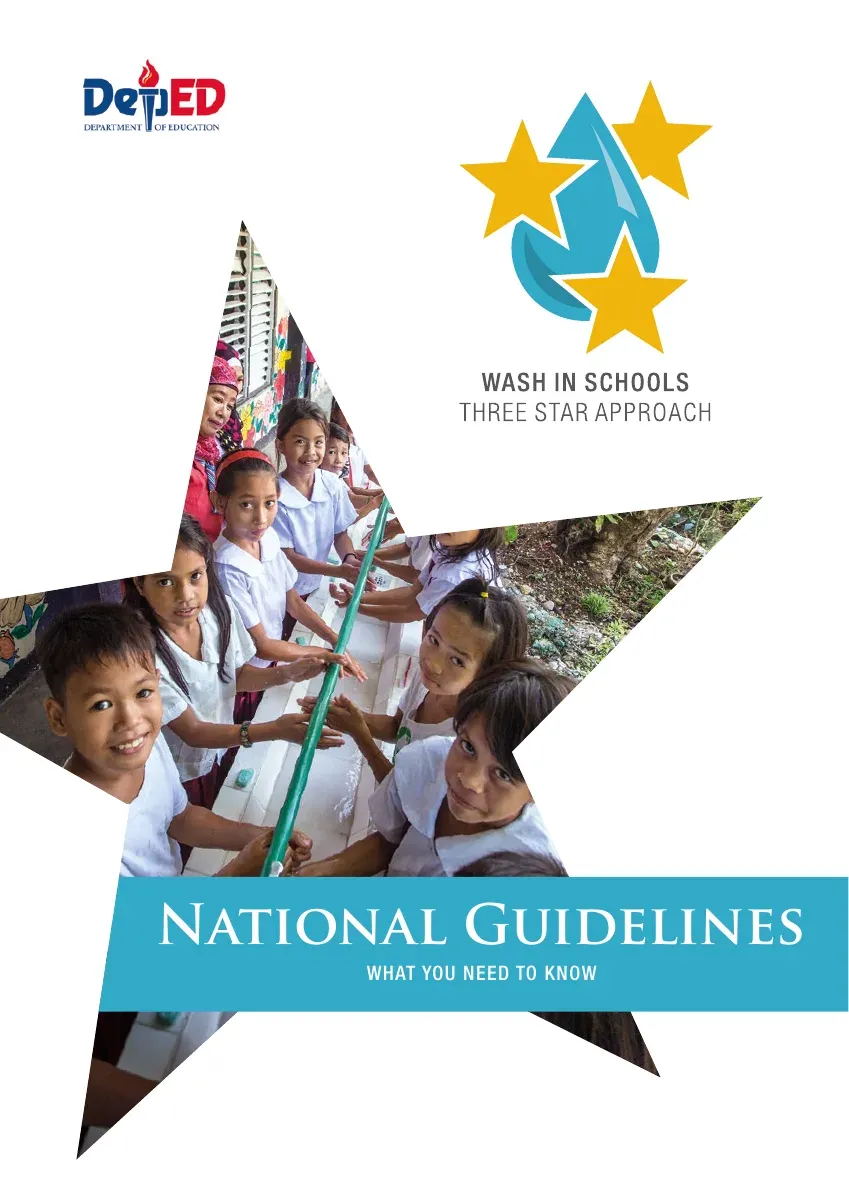
WASH in Schools Three Star Approach: National Guidelines, What You Need to Know is the Department of Education’s brochure on its Water, Sanitation and Hygiene in Schools (WinS) program and the Three Star Approach (TSA), the system schools use to rate their own WASH conditions and improve them a level at a time. DepEd published it in 2017, with support from German Cooperation (GIZ), International Medical Corps, Save the Children and UNICEF. It explains DepEd Order No. 10, s. 2016, Policy and Guidelines for the Comprehensive Water, Sanitation and Hygiene in Schools (WinS) Program, which applies to all public and private elementary and secondary schools, learning centers included.
The download is one 17-page PDF: the six-page brochure, a divider page, then the full text of DO 10, s. 2016 with its enclosure. The order sets the WinS policy; the Three Star Approach itself comes from the memoranda below.
Is it still current?
Yes, though DepEd has since set out the rating process in more detail. As of November 8, 2026, DO 10, s. 2016 is still in effect: no later DepEd order has replaced it, and DepEd Memorandum No. 064, s. 2026 on the 2026–2027 Super El Niño directs schools, “consistent with DO 10, s. 2016”, to assess their water sources, toilets and handwashing facilities. The stars still count: the ARAL School Readiness and Responsiveness Audit in DM 056, s. 2025 rates a school’s sanitation, health education and water by the stars it was awarded.
Two things have changed since the brochure:
- The rating process. The brochure shows a four-part cycle and says to submit the monitoring form “to the system: www.deped.gov.ph”. DM 194, s. 2018 set the process out in five steps, and DM 068, s. 2021 amended it. The five steps: preparation, self-assessment, validation by the Schools Division Office (SDO), recognition, and translating the results into action. Schools submit the form through DepEd’s online WinS Monitoring System, and a school that misses any of the five crucial indicators (safe drinking water, gender-segregated toilets, a group handwashing facility with soap, group handwashing activities, and access to sanitary pads) is rated zero stars, whatever its other ratings; after a calamity, a school gets a one-year moratorium instead of dropping to zero. Three stars earn a Recognition Award from the Regional Director, and three straight years at three stars a Seal of Excellence from the Central Office.
- Toilets in new buildings. DO 10 aims at one toilet for every 50 learners, for boys and for girls. For school building projects funded from FY 2027, DO 022, s. 2026 sets its own ratios: one toilet per 20 to 25 girls and per 25 to 30 boys, on each floor; the Educational Facilities Manual guide compares the standards.
What is inside
- The Secretary’s message, by Leonor Magtolis Briones.
- School-Based Management for WinS: the TSA cycle (know your star level, get results, level up, get recognition), and how its report feeds the School Improvement Plan, MOOE spending and Brigada Eskwela.
- The Three Star criteria: what one, two and three stars mean in hygiene, sanitation, water, deworming and health education.
- DO 10, s. 2016: its targets, the basic requirements and standards for water, sanitation, hygiene, health education and deworming, the roles of each office, of schools and of partners, funding, and monitoring.
The star criteria
| Area | What it rates | One star to three stars, for example |
|---|---|---|
| Hygiene | Handwashing, toothbrushing, menstrual hygiene | Daily supervised group handwashing led by teachers (one star), by teachers and students (two), by student leaders (three) |
| Sanitation | Toilets, waste, food safety | 101 or more learners per toilet seat (one star), 51 to 100 (two), 50 or fewer, counted by sex (three) |
| Water | Drinking water, testing, water for cleaning | Learners bring their own drinking water (one star); the school provides it, but not regularly (two); free for every learner at all times (three) |
| Deworming | Semi-annual deworming | 50 to 74% of learners dewormed (one star), 75 to 84% (two), at least 85% (three) |
| Health education | Materials, WinS teams, INSET, parents | Materials only on the school board or wall (one star); in classrooms and strategic places, with WinS in INSET (two); plus WinS learning materials and planned activities for parents (three) |
Why it matters for aspiring school heads
DO 10 is plain about who answers for it: “The school head plays a crucial role in ensuring that the basic requirements and standards of this policy are met.” The school puts WinS in its SIP and AIP, reports on it to the SDO every six months, and pays for repairs, upkeep and drinking water from its MOOE.
In the Philippine Professional Standards for School Heads (PPSSH, DO 024, s. 2020), this is strand 3.6 of Domain 3, Focusing on Teaching and Learning, managing “a learner-friendly, inclusive and healthy learning environment”. Repairs fall under strand 2.3, school facilities and equipment, in Domain 2, and WinS in the school plan under strand 1.2 in Domain 1.
DepEd’s SY 2023-2024 WASH data counts learners per toilet and handwashing facilities by region, and school toilets for girls, boys and learners with disabilities breaks the counts down by sex. The school canteen guide covers food safety, and the Super El Niño guide the water measures for 2026–2027.