Public schools in the Philippines now run on three terms instead of four quarters. DepEd Order No. 009, s. 2026, signed by Secretary Sonny Angara on April 16, 2026, sets the Three-Term School Calendar from school year (SY) 2026-2027. SY 2026-2027 opened on Monday, June 8, 2026 and ends on Thursday, April 8, 2027, with 201 class days: Term 1 from June 8 to September 15, 2026, Term 2 from September 16 to December 18, 2026, and Term 3 from January 4 to April 8, 2027.
Each term has an Instructional Block for teaching and an End-of-Term Block of up to ten days for grades, remediation, contests, report cards, teacher training, and wellness breaks; Term 1 also opens with a short Opening Block. The order covers all public elementary and secondary schools and community learning centers (CLCs). It changes when tests are given, when report cards go out, where contests and celebrations fit, and how many days of local holidays and other disruptions a school may cover with alternative delivery such as modular or online learning.
For aspiring school heads preparing for the National Assessment for School Heads (NASH), the calendar is the frame for most of the year’s decisions. It touches policy implementation (strand 1.3 of the Philippine Professional Standards for School Heads, or PPSSH), management of staff (strand 2.4), and learning assessment (strand 3.5).
Key findings
- Three terms replace four quarters from SY 2026-2027. DO 009 repeals DepEd Order No. 012, s. 2025, the four-quarter calendar, in full, and amends the transfer and enrollment provisions of DepEd Order No. 017, s. 2025 (DO 009, item 5; para. 41).
- SY 2026-2027 has 201 class days: 69 in Term 1, 65 in Term 2, and 67 in Term 3. It runs from June 8, 2026 to April 8, 2027 (DO 009, item 4; Annex B).
- 168 of the 201 class days are in Instructional Blocks. The End-of-Term Blocks take 29 days and the Opening Block 4 (DO 009, Annex B summary table).
- Each term has two teacher-made summative tests during the Instructional Block and a term examination in its last week. Progress reports go to parents at a conference in each End-of-Term Block (paras. 27 and 28).
- Contests and training move out of class time. Central Office activities, division and regional contests, and INSET are held in the End-of-Term Blocks, and legislated celebrations are taught within lessons (paras. 18 to 21).
- Teachers get a two-day wellness break and learners a four-day one in each End-of-Term Block. Teachers may not be assigned duties during theirs except in an emergency or exigency of service (paras. 23 and 24).
- Alternative delivery (modular, online, or other remote learning) may cover at most five days of local holidays and other disruptions per term (para. 32). ARAL Program sessions run after classes, 30 to 60 minutes, two to four times a week (para. 13).
What DO 009, s. 2026 changed
DO 009 replaced the “existing four-quarter school calendar” with three terms (DO 009, item 2). It took effect beginning SY 2026-2027 upon its approval and publication (para. 42). It repeals DepEd Order No. 012, s. 2025, the multi-year calendar guidelines that governed SY 2025-2026, in its entirety. It also amends the transfer and enrollment provisions of DepEd Order No. 017, s. 2025, the enrollment policy (item 5; para. 41).
Who it covers. The order applies to all public elementary and secondary schools and CLCs (para. 5). Private schools, Philippine Schools Overseas, and state or local universities and colleges offering basic education “may adopt” it, as long as they keep the required number of class days and the legal opening date (item 3; para. 6). For senior high school, DepEd Order No. 017, s. 2026 “highly” encourages private schools to adopt three terms but lets them keep a two-semester calendar if they meet the prescribed instructional hours (para. 20).
The law it works within. Republic Act No. 7797 caps the school calendar at “not more than two hundred twenty (220) class days” (Sec. 1). Its Section 3, as amended by Republic Act No. 11480 (approved July 17, 2020), says the school year “shall start on the first Monday of June but not later than the last day of August”, lets the President set a different date in a state of emergency or calamity, and leaves the end of the school year to the Secretary of Education. DO 009 restates both limits (para. 10). Its general model fills the 220-day maximum with terms of 77, 72, and 71 days and allows a year of 200 to 220 class days (DO 009, Figure 1).
Later school years. Before each school year, DepEd will issue a memorandum with the schedule of each term and of school activities (item 4; para. 7). DO 009’s own calendar covers only SY 2026-2027 (Annex B).
Why DepEd moved to three terms
The order gives its reasons in the cover order and the rationale. A review of the four-quarter calendar “revealed limitations, including recurring class disruptions that compress instructional time and contribute to learning gaps, increased teacher workload, and reduced learning engagement, especially among vulnerable learners” (item 2). Quarterly breaks and short assessment cycles “fragment learning continuity” (para. 2). Longer terms are meant to allow “deeper mastery of competencies”, fewer transitions, and fewer ancillary tasks for teachers, and to support the Academic Recovery and Accessible Learning (ARAL) Program (paras. 3 and 4).
The numbers behind the argument came from outside the order. At a joint Senate committee hearing on March 3, 2026, DepEd officials said 53 school days were disrupted in SY 2023-2024, 32 of them by climate-related events (GMA News). The EDCOM II Final Report counts “around 191 actual class days per year” in DepEd’s calendars since 2018 (pp. 168-169; see Mass Promotion and Lost Instructional Time).
How the calendar was adopted
| Date | Step |
|---|---|
| February 13, 2026 | DepEd proposes a three-term calendar for SY 2026-2027 that divides 201 school days into three terms (GMA News) |
| March 3, 2026 | Joint hearing of the Senate committees on basic education and finance |
| March 19, 2026 | The Economy and Development Council, chaired by President Ferdinand R. Marcos Jr., approves the plan (GMA News) |
| March 23, 2026 | DepEd announces the shift, citing consultations since January 2026 (GMA News) |
| April 16, 2026 | Secretary Angara signs DO 009, s. 2026 |
| June 8, 2026 | SY 2026-2027 opens on the date DO 009 set (GMA News) |
DepEd said it held 12 major consultations from January 29, 2026 and ran a national online survey and regional workshops until March 11 (GMA News). EDCOM II reported that a Senate hearing urged DepEd “to ensure that the minimum number of 180 instructional days are strictly protected and met” under the new calendar (EDCOM 2, March 4, 2026). Teacher groups differed. The Alliance of Concerned Teachers questioned how broad the consultation had been and whether all end-of-term activities could fit in ten days (GMA News, Daily Tribune). The Teachers’ Dignity Coalition asked for pilot testing before full rollout, while the National Parents-Teachers Association backed longer terms as more time for remedial classes (Philstar, Philstar). EDCOM II’s executive director, Karol Mark Yee, said the commission was not against the proposal, provided schools were ready and teachers were consulted (GMA News).
Four quarters and three terms compared
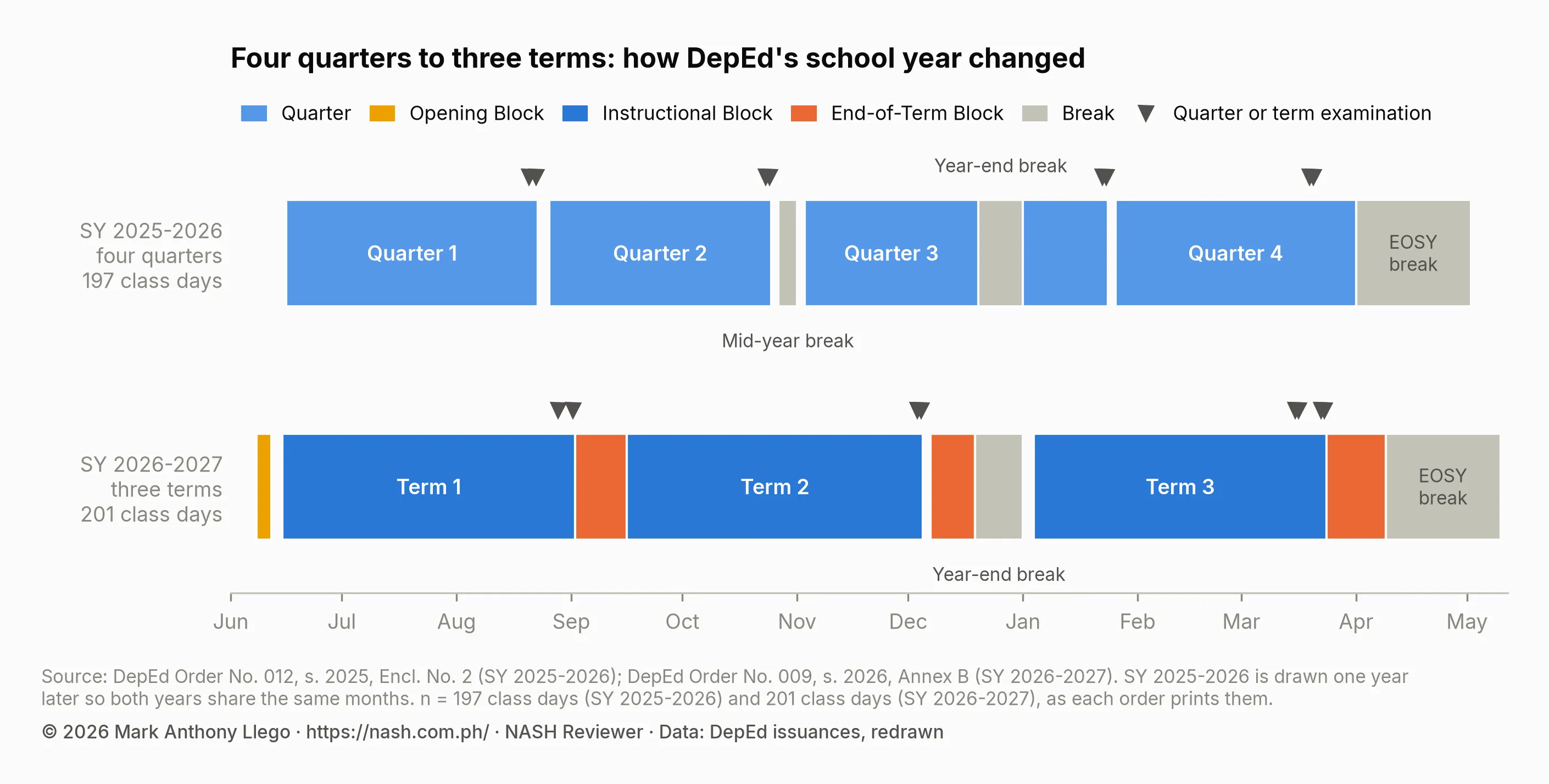
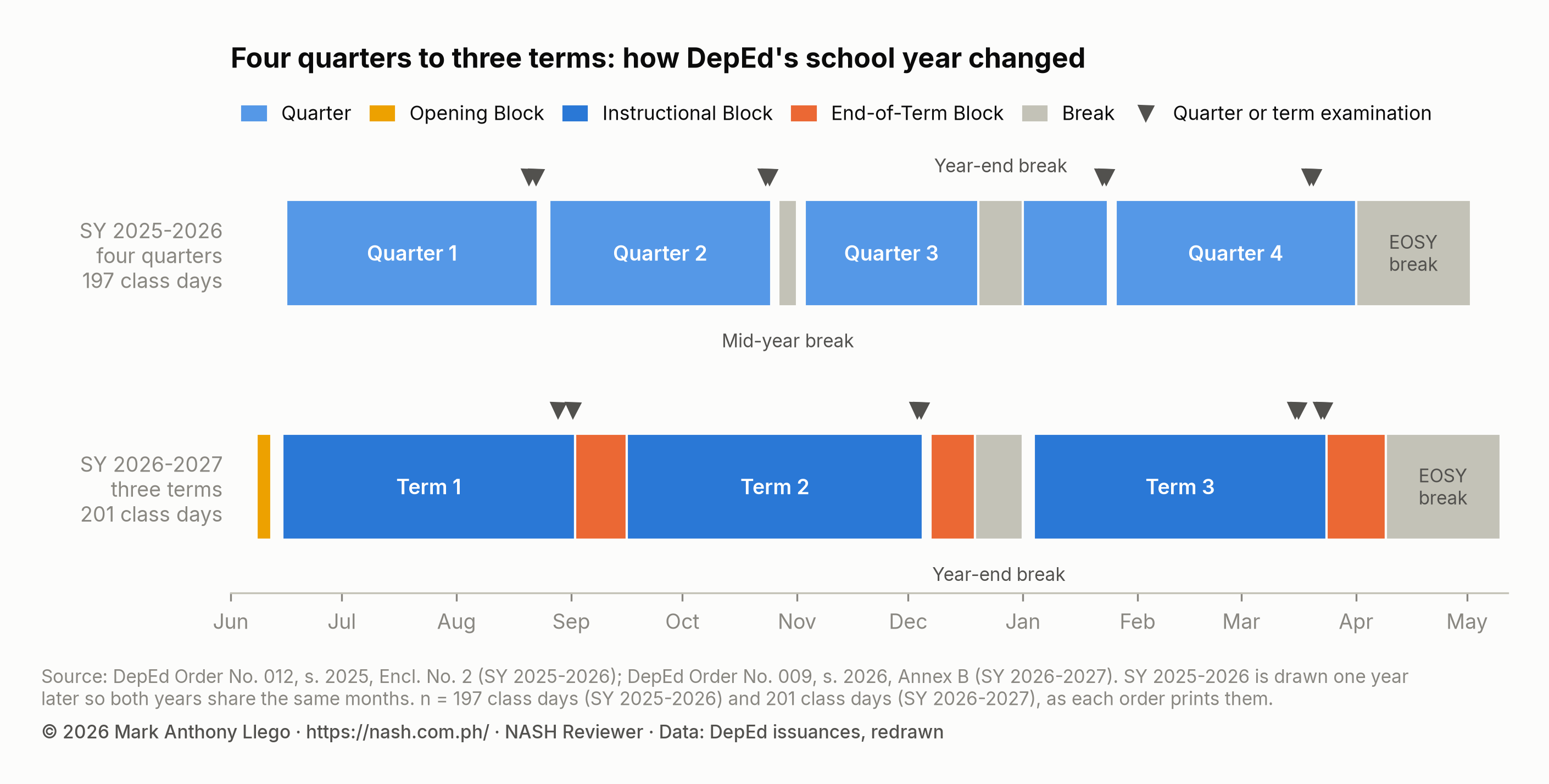
| SY 2025-2026: four quarters (DO 012, s. 2025) | SY 2026-2027: three terms (DO 009, s. 2026) | |
|---|---|---|
| Opening and close | June 16, 2025 to March 31, 2026 | June 8, 2026 to April 8, 2027 |
| Class days | 197, “inclusive of the End-of-School-Year (EOSY) Rites” | 201 |
| Grading periods | Four quarters, each ending with a quarter examination | Three terms, each with two summative tests and a term examination |
| Report cards | At a parent-teacher conference “on a Saturday, one to two weeks after quarterly examinations” (weekday allowed for the last quarter) | At a parent-teacher conference on a working day in each End-of-Term Block |
| Breaks inside the year | A mid-school-year break in the last week of October, and a holiday break in the last two weeks of December | Wellness breaks in the End-of-Term Blocks, and a Year-End Break from December 19 to 31, 2026 |
| INSET | No fixed INSET days; the October 27 to 31, 2025 mid-school-year break served teachers’ performance review and professional development | Two days in each End-of-Term Block, 16 hours per term, at least 32 hours a year |
| Co-curricular activities | “On class days, preferably after school hours”; a learning area’s time could be cut by up to ten minutes once every two weeks | In the End-of-Term Block; school-based activities only after class hours during the Instructional Block |
| Teachers’ end-of-year break | 30 days, April 1 to May 1, 2026 | 30 days, April 9 to May 9, 2027 |
Sources for the table: DO 012, s. 2025, cover order item 4 and Enclosure, items 16, 24 to 26, 28 and 29, and Enclosure No. 2; DO 009, s. 2026, paras. 21 and 28 and Annexes A and B.
Both orders count some break days as class days. DO 012 counted its October 27 to 31, 2025 mid-year break within October’s 23 class days, and DO 009 counts every End-of-Term Block day, wellness break days included, among the 201.
SY 2026-2027 term dates and class days
| Term | Class days | Start | Instructional Block | End-of-Term Block | End |
|---|---|---|---|---|---|
| Term 1 | 69 | June 8, 2026 | Opening Block June 8 to 11 (4 days), then June 15 to September 1, 2026 (55 days) | September 2 to 15, 2026 (10 days) | September 15, 2026 |
| Term 2 | 65 | September 16, 2026 | September 16 to December 4, 2026 (56 days) | December 7 to 18, 2026 (9 days) | December 18, 2026 |
| Term 3 | 67 | January 4, 2027 | January 4 to March 23, 2027 (57 days) | March 24 to April 8, 2027 (10 days) | April 8, 2027 |
| Total | 201 | 168 days (plus 4 in the Opening Block) | 29 days |
Source: DO 009, s. 2026, Annex B, “Summary of Three-Term School Calendar for School Year (SY) 2026-2027”. Block totals are the sums of the printed figures.
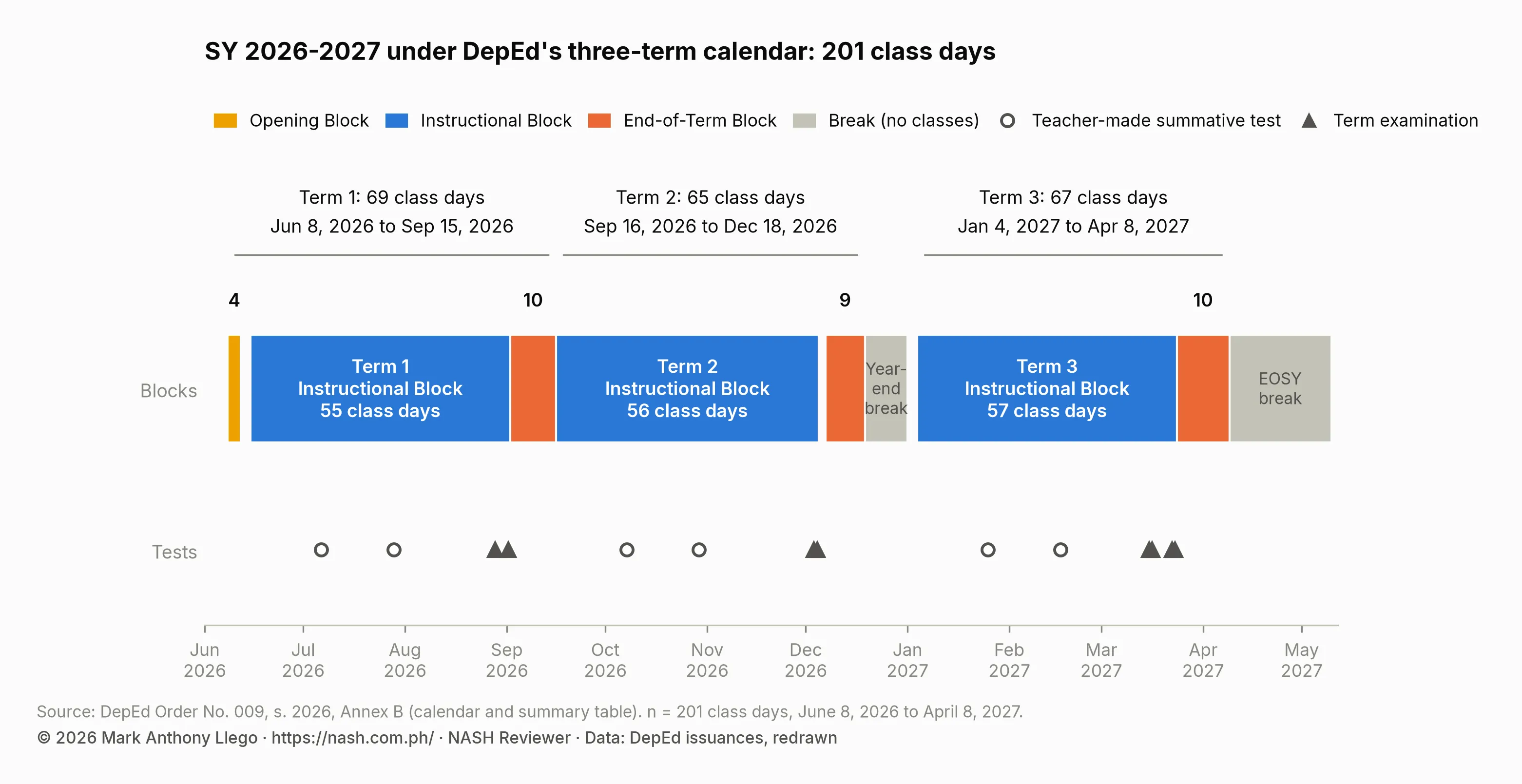
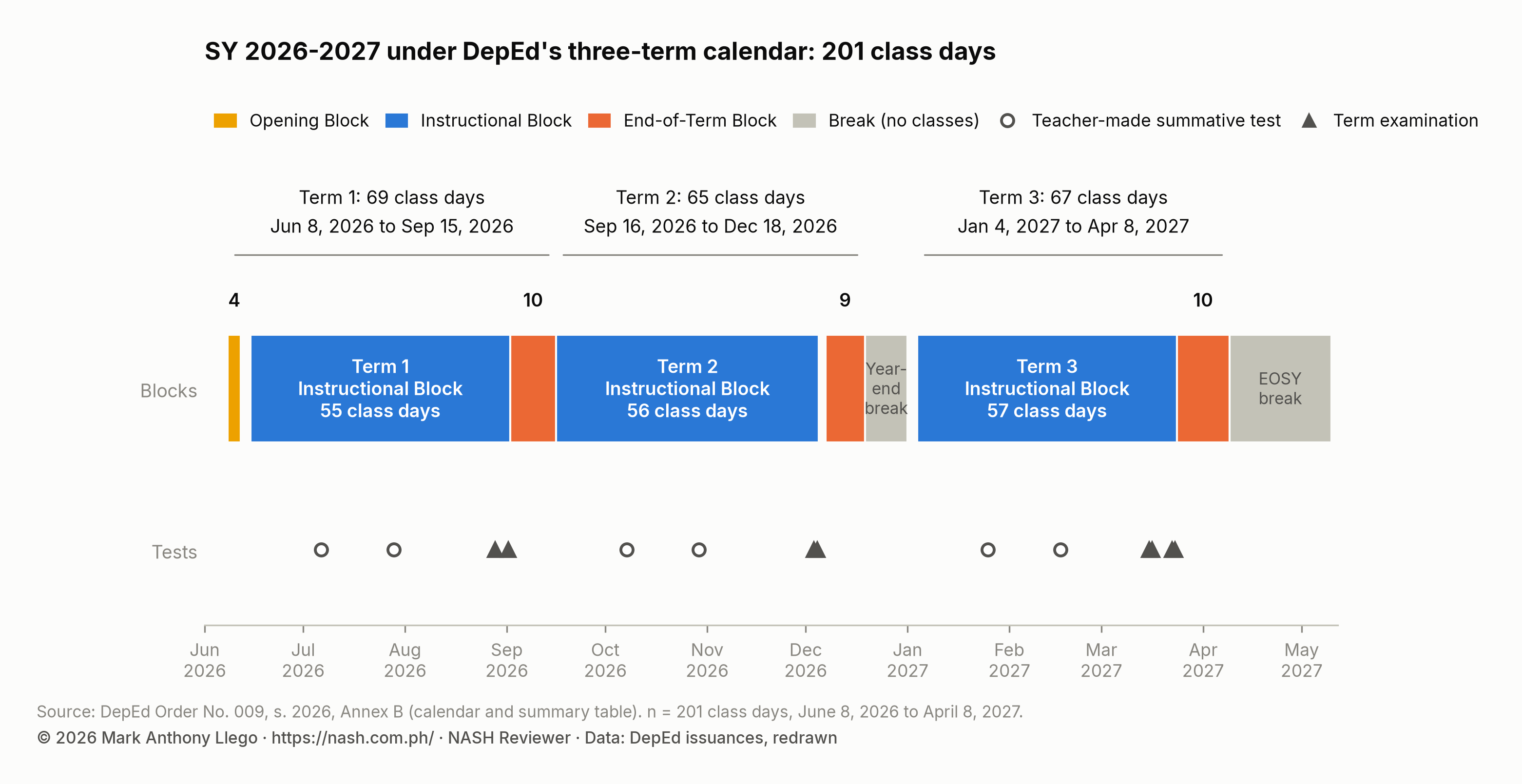
Paragraph 16 of the order says each SY 2026-2027 term has “65 to 69 days of engaged teaching and learning, excluding weekends and legal holidays”. Those totals include the End-of-Term Blocks. The Instructional Blocks alone are 55, 56, and 57 days, shorter than the 61 to 62 days of the order’s general model (DO 009, Figure 2) because SY 2026-2027 has 201 class days rather than the 220 maximum.
Class days per month (Annex B):
| Month | Class days | Month | Class days |
|---|---|---|---|
| June 2026 | 16 | December 2026 | 13 |
| July 2026 | 23 | January 2027 | 20 |
| August 2026 | 19 | February 2027 | 20 |
| September 2026 | 22 (11 in Term 1, 11 in Term 2) | March 2027 | 21 |
| October 2026 | 22 | April 2027 | 6 |
| November 2026 | 19 | Total | 201 |
Breaks. The Year-End Break runs from December 19 to 31, 2026, as a wellness break for learners and teachers, and Term 3 opens on January 4, 2027. After the last class day, teachers have a 30-day end-of-school-year break from April 9 to May 9, 2027. Annex B then sets a training window for teachers, school heads, and teaching-related personnel from May 10 to June 4, 2027, and the end-of-school-year intervention program from May 10, 2027.
Next school year. Annex B also lists early registration for incoming Kindergarten, Grade 1, Grade 7, and Grade 11 learners, out-of-school children, youth and adults, and transferees from January 30 to February 26, 2027, and Brigada Eskwela and enrollment for SY 2027-2028 from June 7 to 11, 2027. The memorandum for SY 2027-2028 will confirm these dates (para. 7).
Holidays. Annex B already subtracts the national holidays that fall on school days: June 12, August 21, August 31, November 2, November 30, and December 8, 2026, and March 25 and 26, 2027. These match Proclamation No. 1006, s. 2025 for 2026 and Proclamation No. 1427, s. 2026 for 2027. February 25, 2027, the EDSA anniversary, is a special working day, so classes are held.
Local and later proclamations can still take class days that Annex B does not show. Proclamation No. 1447, s. 2026, signed on September 17, 2026, declares November 16 to 18, 2026, a Monday to Wednesday, special (non-working) days in the National Capital Region for the 49th ASEAN Summit, so NCR schools lose three Term 2 class days. Eid’l Fitr is proclaimed separately each year, and Proclamation No. 1427 leaves its 2027 date to a later proclamation; on current projections it falls on a weekday around March 9 or 10, 2027, inside Term 3. Paragraphs 20.ii and 32 apply to such days: asynchronous activities within the five-day limit, or make-up classes in the End-of-Term Block.
Changes so far. The order allows adjustments “through subsequent issuances” (item 4). As of November 9, 2026, no DepEd order or memorandum has changed the term dates. One Term 1 date did move. A Central Office joint memorandum of September 4, 2026 adjusted the schedule for distributing the Term 1 progress reports and holding the parent-teacher conference, and divisions then set their final dates. The Schools Division Office of Dasmariñas, for one, cited the memorandum and its own reason, that final e-class records and School Form 9 were not yet ready (Division Memorandum No. 686, s. 2026). A memorandum of September 8, 2026 confirmed the teachers’ wellness break on September 14 and 15, 2026 (see “INSET, learning action cells and wellness breaks” below).
What happens in each block of a term
DO 009 builds every term from the same parts. Term 1 opens with a short Opening Block. Each term then has an Instructional Block for teaching and ends with an End-of-Term Block (para. 11).
| Block | When | Length in DO 009’s general model (its Figure 2) | SY 2026-2027 | What it is for |
|---|---|---|---|---|
| Opening Block | Start of Term 1 only | 4 to 5 days | June 8 to 11, 2026 (4 class days) | Beginning-of-school-year (BOSY) activities: orientation of learners and parents, BOSY assessments, the first mandatory health assessments and screening, and data such as language mapping and school forms (para. 12) |
| Instructional Block | Every term | 61 to 62 days per term | 55, 56 and 57 class days | Teaching and learning of the prescribed competencies, with scheduled ARAL Program sessions after classes (para. 13) |
| End-of-Term Block | Every term | 8 to 10 days per term | 10, 9 and 10 class days | Grades and school forms, ARAL Program sessions, co-curricular and extra-curricular activities, report cards, INSET and wellness breaks (para. 8.b; Annex A) |
The Opening Block
The Opening Block is for getting learners ready, not for regular lessons. Annex A lists five days of suggested activities for each key stage. For Key Stage 1 they run from getting-to-know-you activities and classroom routines to the BOSY assessments, a socio-emotional check, the mandatory health assessments, and an orientation for parents. For Key Stages 2 to 4 they include homeroom guidance, learning area orientations, a general assembly such as an anti-bullying campaign, the BOSY assessments, goal setting, and a presentation of the lesson outline for the year.
Health assessments and screening may run past the Opening Block when they depend on resources outside the school (para. 12). In SY 2026-2027 the mandatory learners’ health assessment ran from June 8 to July 3, 2026, and the BOSY testing window for the CRLA, the Rapid Mathematics Assessment (RMA) and the Phil-IRI ran from June 8 to July 10, 2026 (Annex B).
The Instructional Block
The Instructional Block belongs to teaching. DO 009 asks for “minimal disruptions of non-academic activities” (DO 009, Figure 2), and Annex A turns that into rules a school head enforces:
- ARAL Program sessions. Structured remediation sessions are scheduled for all grade levels after classes, for 30 to 60 minutes on designated days, two to four times a week (para. 13).
- Learner support programs. Activities such as the School-Based Feeding Program and mental health services are scheduled “preferably outside class hours” when they must happen during the Instructional Block (para. 14). For SY 2026-2027, DepEd Memorandum No. 059, s. 2026 allows learners’ health assessment and screening, and the interventions that follow, in both Instructional and End-of-Term Blocks from July 13, 2026, except during wellness breaks unless an intervention is urgently needed (para. 3.c).
- Co-curricular activities. School-based co-curricular activities are held only after class hours. Annex A also says: “School heads must ensure that no co-curricular and extra-curricular activities, including preparations and rehearsals, are conducted during the Instructional Block.” Read together, nothing of the kind takes class time, and school-level clubs and activities wait until classes end.
- Learning action cells. LAC sessions continue within the Instructional Block (para. 22).
ARAL Program sessions follow their own guidelines as well. DepEd Order No. 018, s. 2025 allows pull-out tutorials during class hours as well as sessions before or after school (paras. 60.1 and 60.2), and DepEd Memorandum No. 060, s. 2026 starts ARAL-Mathematics in Term 2 of SY 2026-2027 “or once schools are fully prepared and ready” (para. 2), with weekday sessions of no more than one hour (para. 17).
Annex A’s sample class programs show how this looks. In the Key Stage 1 sample, classes run from 7:00 a.m. to 1:00 p.m., and the ARAL Program takes 1:00 to 2:00 p.m. on Tuesdays and Thursdays. In the Key Stage 2 and 3 samples, ARAL sessions take the last period on two days and an after-class hour on two others. The multigrade samples for Grades 1 to 6 end each week with a “Consolidated Assessment Day” on Friday. The Grades 1 and 2 sample holds two ARAL periods inside the class day every day, Friday included; the Grades 3 to 6 samples hold one ARAL period from Monday to Thursday (Annex A, Tables 7 to 9). These are samples: the order sets the ARAL frequency and length, not the timetable.
The End-of-Term Block, day by day
Each term ends with “a two-week End-of-Term Block” (para. 15). Annex A sets it at eight to ten days and gives a ten-day model (Table 10):
| Days | Activities (Annex A, Table 10) |
|---|---|
| 1 to 5 | ARAL Program sessions, computation of grades and completion of school forms, and co-curricular and extra-curricular activities, held side by side |
| 6 | Distribution of progress or performance reports to parents or guardians, with a conference on each learner’s progress |
| 7 to 8 | INSET for teachers, 16 hours per term; learners start a four-day wellness break with guided asynchronous activities on what they learned in the term |
| 9 to 10 | Learners’ wellness break continues; teachers take a two-day wellness break |
Schools “may design and implement their own schedules” as long as they meet the minimum hours of the ARAL Program and the required days for co-curricular activities, wellness breaks, and other authorized programs (Annex A). Annex A gives four sample schedules for days 1 to 5. Models A.1 and A.2 run ARAL sessions, grade computation, and activities on all five days. Models B.1 and B.2 give days 1 and 2 to grades and forms and days 3 to 5 to ARAL sessions and activities. In small schools, ARAL sessions are scheduled so teachers can manage their other tasks, and “External tutors may be engaged to facilitate ARAL Program sessions” (Annex A, a.1).
Tests, term examinations and report cards
Teachers give regular formative assessments during the Instructional Block to track progress and adjust teaching. To check mastery, they give “two teacher-developed summative assessments” before the term examination, which falls in the last week of the Instructional Block (para. 27). DO 009 states the aim plainly: “to attain mastery and not simply breadth”, so critical learning competencies come first in assessments (para. 27).
Progress or performance reports go out after each term. They show the learner’s cumulative performance on the competencies covered in that term and are handed to parents at a parent-teacher conference on a working day in the End-of-Term Block (para. 28). DO 009 left the grading rules to a separate issuance, which came out on June 4, 2026 as DepEd Order No. 015, s. 2026. That order times the first summative test “around the 16th instructional day” and the second around the 32nd (para. 26), and computes the final grade in each learning area as the average of the three term grades (para. 52). The guide to DO 015, s. 2026 covers its weights, item counts, and transmutation.
The SY 2026-2027 calendar fixes the test dates (Annex B):
| Term | First summative test | Second summative test | Term examination | Report cards and PTA meeting |
|---|---|---|---|---|
| Term 1 | July 6, 2026 | July 28, 2026 | August 28 and September 1, 2026 | September 9, 2026 (later adjusted; see “Changes so far”) |
| Term 2 | October 7, 2026 | October 29, 2026 | December 3 and 4, 2026 | December 15, 2026 |
| Term 3 | January 25, 2027 | February 16, 2027 | March 15 and 16, 2027 (learners moving up or graduating); March 22 and 23, 2027 (other grade levels) | April 8, 2027 |
Term 3 runs in two tracks. Learners who are moving up or graduating take the term examination first; their grades are computed and deliberated from March 17 to 23, 2027, and Academic Excellence awardees are announced on March 24. The end-of-school-year rites follow on April 6 and 7, 2027 (Annex B).
National assessments and screening windows
The Bureau of Education Assessment schedules national assessments for the grades they cover, as far as possible near the end of an Instructional Block or in an End-of-Term Block, so other learners lose as little class time as possible (para. 29). Annex B sets these windows for SY 2026-2027:
| Assessment | Who takes it | Window |
|---|---|---|
| Beginning-, middle- and end-of-school-year assessments (CRLA, Rapid Mathematics Assessment, Phil-IRI and others) | Grades the tools cover | June 8 to July 10, 2026; September 21 to October 23, 2026; February 1 to March 12, 2027 |
| Philippine Early Childhood Development (Phil ECD) Checklist | Kindergarten | June 22 to 26, 2026; March 15 to 19, 2027 |
| Multi-Factored Assessment Tool (MFAT) | Grade 1 | July 13 to 17, 2026 |
| National Career Assessment Examination (NCAE) | Grade 10 | September 16 to December 4, 2026 |
| National Achievement Test (NAT) | Grade 10 | October 5 to 9, 2026 |
| NAT | Grade 12 | February 15 to 19, 2027 |
| Early Language, Literacy, and Numeracy Assessment (ELLNA) | Grade 3 | March 1 to 5, 2027 |
| NAT | Grade 6 | March 8 to 12, 2027 |
| Philippine Educational Placement Test (PEPT) | Registered examinees | November 15, 2026 |
The Phil ECD Checklist is given to Kindergarten learners at the start and end of the year under DepEd Order No. 47, s. 2016, and the MFAT to Grade 1 learners under DepEd Order No. 29, s. 2018.
Contests, celebrations and learner activities
DO 009 does not drop co-curricular and extra-curricular activities. It moves them. Activities initiated by the Central Office are held “in a structured and programmed manner” in the End-of-Term Block at every governance level, and regional offices schedule the layered activities and eliminations within those blocks (para. 18). National-level activities wait for the end-of-school-year break, so learners who qualify at lower levels can take part (para. 19). For SY 2026-2027, Annex B sets the 2027 National Schools Press Conference on April 19 to 23, the National Festival of Talents on April 26 to 30, and the Palarong Pambansa on May 3 to 7, 2027.
Annex A suggests what fits each level of the End-of-Term Block. Schools hold clubs, intra-school academic, sports and cultural activities, and assemblies. Divisions hold division-wide competitions, training, and eliminations. Regions hold regional competitions and the selection of national delegates. DepEd Memorandum No. 058, s. 2026 follows this pattern: division science and technology fairs in the Term 1 End-of-Term Block, on September 2 to 4, 2026, and regional fairs in the Term 2 block, on December 9 to 11, 2026 (para. 8). The national fair is set for February 27 and 28, 2027, a weekend in Term 3 (para. 1).
Legislated celebrations follow a stricter rule. They are conducted “strictly within the classroom through integration into regular teaching and learning processes”: teachers build the theme into lessons, discussions, outputs, or formative tasks (para. 20.i). Annex D lists the celebrations month by month, from National Dengue Awareness Month in June to World No Tobacco Day in May, with their legal bases and suggested activities. The 2026 celebration memoranda cite the rule. DepEd Memorandum No. 045, s. 2026, for Nutrition Month, says its activities “shall not hamper instructional time and must comply with DO 009, s. 2026” (para. 7). DepEd Memorandum No. 051, s. 2026, for National Teachers’ Month, says the same, but it also encourages “school-based celebration activities on 5 October 2026”, a Monday class day (para. 7). Annex D itself suggests school-level culminating activities for some celebrations, such as Nutrition Month and Buwan ng Wikang Pambansa.
When a local celebration or holiday falls in the Instructional Block, the school gives asynchronous learning activities or, when needed, holds make-up classes in the End-of-Term Block (para. 20.ii). A separate issuance from the Bureau of Learner Support Services on school clubs and organizations is still to come; as of November 9, 2026, none has been issued (para. 20.iii).
INSET, learning action cells and wellness breaks
INSET. Professional development follows the standards of the National Educators Academy of the Philippines (NEAP). It is held for two days in each End-of-Term Block, for at least 32 hours a year (para. 21). Annex A sets the INSET on days 7 and 8 of the block, at 16 hours per term, “contributing to the completion of the minimum 32-hour professional development provision per school year”. Annex B also sets training windows for teachers, school heads, and teaching-related personnel outside the school year: May 4 to 29, 2026, and May 10 to June 4, 2027. End-of-Term INSET that is fully funded by the government and held on weekdays within official time earns no vacation service credit: DepEd Order No. 013, s. 2024 excludes government-funded in-service training held on weekdays within official time (Sec. V.A.10.a).
Learning action cells. LAC sessions stay within the Instructional Block under DepEd Order No. 35, s. 2016. DO 009 promises a later issuance on how LAC sessions are scheduled (para. 22); as of November 9, 2026, none has been issued.
Wellness breaks. Learners get four days and teachers two, both in the End-of-Term Block:
- Learners’ wellness break: four days for “rest, reflection, and the processing of learning experiences”, with guided asynchronous activities on reflection and consolidation (para. 23).
- Teachers’ wellness break: two days, after the timely completion of all end-of-term activities. “Teachers shall not be assigned instructional, administrative, or extracurricular duties during wellness breaks, except in cases of emergency or exigency of service” (para. 24).
- Formal instruction and academic tasks are suspended during a wellness break (para. 8.h).
A memorandum Secretary Angara issued on September 8, 2026 for the Term 1 break, held on September 14 and 15, 2026, spelled the rule out: “No meetings, trainings, Learning Action Cell sessions, school activities, reporting, submissions, asynchronous deliverables, or other official work shall be required of teachers during the Wellness Break” (GMA News, September 9, 2026).
Annex B does not follow the ten-day model in every term of SY 2026-2027. Term 1’s block does: INSET on September 10 and 11, the learners’ wellness break from September 10 to 15, and the teachers’ on September 14 and 15, 2026. Term 2’s block has nine class days because of the December 8 holiday. It holds INSET and the learners’ wellness break on December 17 and 18, and the Year-End Break from December 19 to 31, 2026 then serves as the “Wellness Break of Learners & Teachers”. Term 3’s block, March 24 to April 8, 2027, lists no wellness break. It holds INSET on April 2 and 5, the end-of-school-year rites on April 6 and 7, and report cards on April 8, and the teachers’ 30-day break starts on April 9, 2027.
Wellness break or Wellness Leave? They are different. DO 009 says so in its definition: for teachers, the wellness break “is different from the Wellness Leave as provided for by DO 002, s. 2026” (para. 8.h). The wellness break is a calendar period that applies to every teacher at once. The Wellness Leave under DepEd Order No. 002, s. 2026 is a leave of up to five days that eligible personnel apply for; when a teacher takes it, the school head assigns relievers for their classes. The wellness leave guide explains who may take it and how.
Class disruptions, make-up classes and alternative modalities
In-person learning stays the main modality in all schools and CLCs (para. 31). DO 009 limits the alternatives: “Alternative learning delivery modalities may be implemented only during local holidays and other class disruptions for a maximum of five (5) days per term” (para. 32). The cap does not apply to Flexible Learning Programs, which have their own issuance. For local celebrations and holidays in the Instructional Block, the order gives two remedies: asynchronous learning activities or, when necessary, make-up classes in the End-of-Term Block (para. 20.ii).
Suspensions for typhoons, floods, heat, and other emergencies fall under other issuances, which work alongside DO 009:
- When make-up classes are required. “Makeup classes shall be required if the number of actual class days, considering class suspensions and holidays, falls below 90% of the mandatory contact days outlined in the school calendar”, and their scheduling is “left to the discretion of the school heads” (DepEd Order No. 014, s. 2026, para. 68). Teachers who hold them are paid under the workload and overtime rules (para. 69).
- Term examinations. “If a periodical exam is affected by a class suspension, the school shall reschedule the exam” (DO 014, s. 2026, para. 70).
- When and how. DepEd Order No. 022, s. 2024 lets school heads hold make-up classes for all levels except Kindergarten “during extended hours or on Saturdays” (Sec. III.8).
- Heat. For the 2026-2027 Super El Niño, DepEd Memorandum No. 064, s. 2026 says extreme heat “shall not automatically result in class suspension” (para. 6) and uses the heat levels of DO 014 for modified schedules. It does not change the term dates.
- New suspension rules. Executive Order No. 130, s. 2026, signed on October 28, 2026, sets a new framework for suspending and resuming classes and gives DepEd 30 days to issue guidelines (Sec. 7). School DRRM and Class Suspensions explains which rules apply until then.
Emergencies follow DO 014’s own counting. That order repeals the earlier definitions of alternative delivery modes, separating Flexible Learning Programs from education in emergencies, and has schools report the learning experiences they provide during a disruption “In lieu of reporting ADMs” (paras. 6.d and 6.i). It counts a Hinay or Hinga day as half a class day missed and a Hinto day as a full day, and it moves schools to a flexible learning program when Hinga or Hinto conditions are prolonged (para. 64 and the table after para. 67). DO 009 exempts Flexible Learning Programs from its five-day cap (para. 32); no issuance says whether Hinay or Hinga days count toward it.
Late enrollment, transfers and ALS
Late enrollment. A late enrollee is admitted if they meet 80% of the prescribed class days, or enroll no later than the second summative test of Term 1 (para. 34). In SY 2026-2027, that test fell on July 28, 2026. The 80% route runs a little longer: a learner who enrolled by August 4, 2026, the 41st class day, could still attend 161 of the 201 class days, which is 80.1%. Attendance matters for grades as well. Under DO 015, s. 2026, a learner whose absences exceed 20% of the prescribed class days gets a failing grade and no credit unless the absences are justified (Annex D, item 22).
DO 017, s. 2025 had let a school accept a late enrollee who could still meet 80% of school days “and the quarterly requirement”, and let the school head use “his/her discretion to accept the enrollee and implement catch-up activities or interventions” when the learner could not. DO 009 amends those provisions (item 5) and restates only the two tests. It does not say whether the school head’s discretion survives; the guide to DepEd’s enrollment policy discusses the point.
Transfers. Learners who transfer during the school year are admitted once their official records, including the results of their beginning-of-school-year assessments, are submitted and transferred (para. 35). DO 009 sets no cut-off date for transfers within the school year.
Alternative Learning System. ALS intervention classes open on the same day as formal schools. Their length and pacing stay flexible and learner-centered, guided by the Individual Learning Agreement, pre-assessments, and Recognition of Prior Learning, and follow the three-term calendar “where applicable” (para. 36). Under DepEd Order No. 001, s. 2026, learners who come to ALS after classes begin “shall still be accepted” (para. 18).
Senior high school under three terms
Senior high school moved from two semesters to three terms with the rest of the system. All public schools offering either the 2016 senior high school curriculum or the Strengthened Senior High School (SSHS) curriculum use the three-term calendar from SY 2026-2027 (DO 017, s. 2026, para. 20). In SY 2026-2027, every school starts Grade 11 on the SSHS curriculum, while Grade 12 stays on the 2016 curriculum except in the SSHS pilot schools (DO 017, s. 2026, para. 19 and Table 4).
| Subject or component | Time under the SSHS curriculum (DO 017, s. 2026) |
|---|---|
| Core subjects, Grade 11 only | 160 hours per core subject over one school year, across the three terms (para. 13; Table 3) |
| Academic electives | 80 or 160 hours in one term (Table 3) |
| Work immersion, Grade 12 | 320 to 640 hours, in any term of Grade 12 (para. 16) |
For Grade 12 learners still under the 2016 curriculum, schools design subject schedules across the three terms, following prerequisites and co-requisites (DO 017, s. 2026, para. 21). Under the SSHS curriculum, work immersion, field exposure, and arts apprenticeship may be scheduled in any term, in line with the implementation models and existing industry agreements. Grade 12 learners on the old curriculum still follow the work immersion standards of DepEd Order No. 30, s. 2017, as amended by DepEd Order No. 39, s. 2018, and DepEd Order No. 021, s. 2019 (DO 009, para. 30). In the schools piloting SSHS Grade 12, DepEd Memorandum No. 036, s. 2026 offers work immersion for the Academic Track only in the third term (para. 16).
Who monitors the calendar, and when it will be reviewed
The Learning Systems Strand oversees implementation with the regional Curriculum and Learning Management Divisions and the division Curriculum Implementation Divisions. Regional and division offices give technical assistance and submit periodic reports on compliance, learning outcomes, the implementation plan for the End-of-Term Block, and “teacher workload indicators” (para. 38). The calendar is reviewed every year, with a comprehensive review after five school years (para. 39). A monitoring and evaluation tool is to come in a separate issuance (para. 40); as of November 9, 2026, none has been issued. Expenses are charged to authorized funding sources under existing budget, accounting, auditing, and procurement rules (para. 37).
What this means for school heads
DO 009 gives the school head the job of protecting class time while fitting everything else into the blocks around it. In practice, that means these steps for each term.
Before the term opens
- Build the class program around the Instructional Block. Schedule ARAL Program sessions after classes, 30 to 60 minutes, two to four times a week, for all grade levels (para. 13), and keep the feeding program, health services, and other support programs outside class hours where possible (para. 14).
- Write the school’s End-of-Term Block plan early. Regional and division offices report on the “implementation plan for the End-of-Term Block” (para. 38), and the plan decides who runs ARAL sessions, who computes grades, and which activities happen on days 1 to 5. In a small school, check whether external tutors can take some ARAL sessions (Annex A).
- Put the term’s dates where teachers and parents see them: the two summative tests, the term examination, the parent-teacher conference, INSET, and the wellness breaks (Annex B for SY 2026-2027; the yearly memorandum after that, para. 7).
During the Instructional Block
- Keep contests, rehearsals, and preparations out of class time. School-based co-curricular activities happen only after class hours, and legislated celebrations are integrated into lessons (para. 20.i; Annex A).
- Track every day lost. For local holidays and celebrations, alternative delivery may cover at most five days per term (para. 32); after that, or when asynchronous work cannot make up the lesson, hold make-up classes in the End-of-Term Block (para. 20.ii). For typhoons, floods, heat, and other emergencies, follow DO 014, s. 2026: count Hinay and Hinga days as half a class day missed and Hinto days as a full day, and hold make-up classes, scheduled at your discretion, when actual class days fall below 90% (para. 68).
- Hold LAC sessions within the Instructional Block (para. 22), and use the budget of work as a guide to pacing, not as a fixed number of days per competency (para. 25).
- Admit late enrollees who meet the 80% rule or arrive before the second summative test of Term 1, and admit transferees once their records, including BOSY results, arrive (paras. 34 and 35).
In the End-of-Term Block
- Check that grades and school forms are done in days 1 to 5, and hold the parent-teacher conference and report card distribution on a working day, usually day 6 (para. 28; Annex A).
- Run the two-day INSET to NEAP standards, so teachers reach at least 32 hours of professional development a year (para. 21).
- Protect the wellness breaks. Assign teachers no instructional, administrative, or extracurricular duty on their two days except in an emergency or exigency of service, and give learners guided asynchronous activities on their four days (paras. 23 and 24).
Records to keep: the class program with ARAL slots, the End-of-Term Block plan and its attendance records, the log of days lost and how each was recovered, INSET attendance and hours, and the reports the division asks for on compliance, learning outcomes, and teacher workload (para. 38).
Several PPSSH strands meet in this work. Applying DO 009’s limits to the school’s own schedule is policy implementation, strand 1.3 in Domain 1, Leading Strategically. Distributing ARAL sessions, grade computation, and contest coaching among teachers is management of staff, strand 2.4 in Domain 2, Managing School Operations and Resources. The assessment cycle and remediation fall under strands 3.4 and 3.5 in Domain 3, Focusing on Teaching and Learning, and INSET and LAC sessions under Domain 4, Developing Self and Others. The parent-teacher conference at the end of each term serves Domain 5, Building Connections.
How the NASH may test this
The items below are original practice items, scored 3 (Relational), 2 (Multistructural), 1 (Unistructural) or 0 (Prestructural). An option that breaks a rule scores 0.
Question 1
Indicator 2.4.2, Management of staff. Career Stage 2, Situational, Moderate.
You are the school head of a three-teacher multigrade elementary school. The End-of-Term Block starts on Monday. In its first five days, your teachers must hold remediation sessions for learners who are behind, compute grades, complete school forms, and coach two learners for a division contest. One teacher proposes finishing the school forms on the two wellness break days set for teachers at the end of the block. What is the most appropriate action?
- A. Approve the proposal and schedule the school forms for the two wellness break days, so that the first five days are left for the remediation sessions and the contest coaching.
- B. Plan the first five days so the teachers take turns at remediation, grades and forms, and contest coaching, with a tutor for some sessions, so that all work ends before the wellness days.
- C. Assign every remediation session to one teacher for all five days, so that the other two teachers can finish their own grades and school forms and coach the two contestants on schedule.
- D. Report the teachers’ heavy workload to the district supervisor and ask for guidance, so that the division knows the school may not finish every task within the five days.
Answer and explanation
Best answer: B. Points: A = 0, B = 3, C = 2, D = 1.
- A (0 points, Prestructural). DO 009 bars assigning teachers instructional, administrative, or extracurricular duties during their wellness break except in an emergency or exigency of service. School forms are an administrative duty that the order schedules for days 1 to 5, so finishing them late is planned work, not an exigency.
- B (3 points, Relational). It fits all four tasks into days 1 to 5 as the order intends, shares them so no teacher carries everything, uses the external tutors the order allows for ARAL sessions in small schools, and keeps the wellness break free.
- C (2 points, Multistructural). It keeps the tasks inside the first five days, but it loads every session on one teacher, whose own grades and forms are still due. The order asks small schools to schedule sessions so teachers can manage their multiple tasks.
- D (1 point, Unistructural). It sees the overload and keeps the division informed, but it plans nothing. Scheduling the End-of-Term Block’s tasks among the staff is the school head’s job.
Why. This aligns with Career Stage 2 expectations because the school head must distribute work among a small staff in line with the issuance on the school calendar. Annex A of DO 009 runs ARAL sessions, grade computation, and co-curricular activities side by side on days 1 to 5, asks small schools to schedule sessions so teachers can manage their multiple responsibilities, and allows external tutors; paragraph 24 protects the teachers’ wellness break. The 2-point option meets the deadline but does not share the load.
Indicator 2.4.2: Manage staffing such as teaching load distribution and grade level and subject area assignment in adherence to laws, policies, guidelines and issuances based on the needs of the school.
Sources: DepEd Order No. 009, s. 2026, paragraphs 15 and 24 and Annex A (End-of-Term Block, a.1 and Table 10).
Question 2
Indicator 1.3.2, Policy implementation and review. Career Stage 2, Situational, Difficult.
You are the school head of a public junior high school. In the Instructional Block of Term 2, classes stopped for two days of the town fiesta and three days of a provincial founding anniversary, and each time your teachers gave asynchronous learning activities. A local holiday has now been declared in the town for next Friday. Teachers ask how to handle that day’s lessons. What is the most appropriate action?
- A. Give learners another set of asynchronous activities for next Friday, since the school has handled the other local holidays this term in the same way.
- B. Schedule a make-up class for next Friday’s lessons in the End-of-Term Block and tell parents the date, since the five days of alternative delivery allowed this term are used up.
- C. Schedule make-up classes in the End-of-Term Block for all six holiday days, replacing the asynchronous activities the teachers already gave, so that no instructional time is lost this term.
- D. Report the holiday to the Schools Division Office and wait for its advisory, so that the school handles next Friday’s lessons in the way the division prefers.
Answer and explanation
Best answer: B. Points: A = 0, B = 3, C = 2, D = 1.
- A (0 points, Prestructural). DO 009 allows alternative learning delivery during local holidays and other class disruptions for a maximum of five days per term. The school has used all five, so a sixth day of asynchronous work goes beyond the order.
- B (3 points, Relational). It applies the remedy the order gives for local holidays once the five days of alternative delivery are used up: a make-up class in the End-of-Term Block. Telling parents the date is good practice that helps learners attend.
- C (2 points, Multistructural). It chooses the right remedy and the right window, but it ignores that the first five days were validly covered by asynchronous activities, and six make-up days crowd the block’s time for ARAL sessions and grades.
- D (1 point, Unistructural). It keeps the division informed, but it waits for instructions on a matter the order gives to the school: “schools shall implement” the asynchronous activities or make-up classes.
Why. This aligns with Career Stage 2 expectations because the school head must apply an issuance’s limits to the school’s actual situation. DO 009 paragraph 20.ii provides asynchronous activities or, when necessary, make-up classes in the End-of-Term Block when local holidays fall in the Instructional Block, and paragraph 32 allows alternative delivery during local holidays for a maximum of five days per term. Read together, a sixth day calls for a make-up class. The 2-point option has the right remedy but applies it to days that were already covered.
Indicator 1.3.2: Undertake policy implementation and review in the school to ensure that operations are consistent with national and local laws, regulations and issuances.
Sources: DepEd Order No. 009, s. 2026, paragraphs 20.ii, 31 and 32, and Annex A (End-of-Term Block).
Question 3
Indicator 1.3.1, Policy implementation and review. Career Stage 1, Conceptual, Moderate.
Under the three-term school calendar, grade computation, in-service training, report cards, division and regional contests, and wellness breaks are scheduled in an End-of-Term Block at the close of each term. Which statement best explains the purpose of this design?
- A. It frees the Instructional Block for teaching and remediation by giving other school activities their own time each term, so that lessons are not interrupted.
- B. It groups grade computation, in-service training, report cards, contests, and wellness breaks into fixed dates, so that schools can plan these tasks a year ahead.
- C. It sets aside two weeks each term for rest instead of learning, so that learners and teachers can start the next term refreshed and ready.
- D. It gives teachers a two-day wellness break each term, so that they can rest after the heavy work of computing grades and finishing school forms.
Answer and explanation
Best answer: A. Points: A = 3, B = 2, C = 0, D = 1.
- A (3 points, Relational). It ties the design to its purpose. The order schedules activities, training, reporting, and rest in the End-of-Term Block “without disrupting the Instructional Block” (Annex A), so teaching time is protected.
- B (2 points, Multistructural). It names the block’s real contents correctly and sees the value of fixed dates, but it misses the reason the order gives: to protect instructional time by keeping these tasks out of the Instructional Block.
- C (0 points, Prestructural). It misreads the block. ARAL Program sessions, contests, the parent-teacher conference, and INSET all happen in it, and even the learners’ wellness break has guided asynchronous activities.
- D (1 point, Unistructural). It names one real feature of the block, the teachers’ wellness break, and leaves out the rest of what the block is for.
Why. This aligns with Career Stage 1 expectations because an aspiring school head must understand what a policy is meant to achieve before implementing it. DO 009 adopts the calendar to “optimize instructional time” (paragraph 9), schedules Central Office activities in the End-of-Term Block “Consistent with the Department’s intent to protect instructional time” (paragraph 18), and lists what the block is for (paragraph 8.b). The 2-point option lists the block’s contents but not the reason they were placed there.
Indicator 1.3.1: Demonstrate knowledge and understanding of policy implementation and review to ensure that school operations are consistent with national and local laws, regulations and issuances.
Sources: DepEd Order No. 009, s. 2026, paragraphs 8.b, 9, 18, 21, 23, 24 and 28, and Figure 2.
Nothing in this guide reproduces or predicts examination content.
Frequently asked questions
When does SY 2026-2027 start and end in DepEd?
SY 2026-2027 opened on Monday, June 8, 2026 and ends on Thursday, April 8, 2027, with 201 class days (DO 009, s. 2026, item 4). Term 1 runs from June 8 to September 15, 2026, Term 2 from September 16 to December 18, 2026, and Term 3 from January 4 to April 8, 2027 (Annex B).
Are there still quarterly exams in public schools?
No. From SY 2026-2027, public schools give two teacher-made summative tests and one term examination in each of the three terms, and report cards go out after each term (DO 009, s. 2026, paras. 27 and 28). Private schools that have not adopted the three-term calendar may keep their own grading periods, within the class-day rules of RA 7797 as amended by RA 11480: DO 009 lets them adopt it (item 3), and DO 015, s. 2026 binds public schools and only encourages private schools to follow its grading rules (paras. 5 and 6).
Do teachers have a wellness break, and is it a leave?
Teachers get a two-day wellness break in each End-of-Term Block, during which they “shall not be assigned instructional, administrative, or extracurricular duties”, except in an emergency or exigency of service (DO 009, s. 2026, para. 24). It is not a leave. The Wellness Leave of up to five days under DO 002, s. 2026 is separate, and DO 009 says the two are different (para. 8.h).
Can private schools keep the four-quarter calendar?
Yes. Private schools, Philippine Schools Overseas, and state or local universities and colleges “may adopt” the three-term calendar, but they must keep the required number of class days and the opening date set by RA 7797 as amended by RA 11480 (DO 009, s. 2026, item 3 and para. 6). Private senior high schools may keep a two-semester calendar if they meet the prescribed instructional hours (DO 017, s. 2026, para. 20).
When can a learner still enroll late under the three-term calendar?
A late enrollee is admitted if they enroll no later than the second summative test of Term 1, or can still meet 80% of the class days (DO 009, s. 2026, para. 34). In SY 2026-2027, the second summative test was on July 28, 2026, and a learner who enrolled by August 4, 2026 could still attend 161 of the 201 class days.
Download the data
three-term-sy-2026-2027-timeline.csv: each block of SY 2026-2027 with its start and end dates and class days, and the dates of the summative tests and term examinations, from DepEd Order No. 009, s. 2026, Annex B.three-term-quarters-vs-terms.csv: the quarters, breaks, and quarter examinations of SY 2025-2026 from DepEd Order No. 012, s. 2025, Enclosure No. 2, and the blocks, breaks, and term examinations of SY 2026-2027 from DepEd Order No. 009, s. 2026, Annex B.
The CSVs and charts may be reused only with written permission: email support@nash.com.ph. The rules themselves come from DepEd’s issuances, which you can cite directly.
Sources
DepEd issuances
- DepEd Order No. 009, s. 2026, Guidelines on the Implementation of the Three-Term School Calendar in Basic Education, April 16, 2026: cover order items 1 to 8; enclosure paras. 1 to 42 and Figures 1 to 3; Annex A (block scheduling), Annex B (SY 2026-2027 calendar and summary), Annex C (holidays), Annex D (legislated celebrations), and Annex E (budget of work).
- DepEd Order No. 012, s. 2025, Multi-Year Implementing Guidelines on the School Calendar and Activities, April 15, 2025 (repealed): cover order item 4; enclosure items 16, 24 to 26, 28 and 29; Enclosure No. 2.
- DepEd Order No. 017, s. 2025, Revised Basic Education Enrollment Policy, June 13, 2025: Sec. VI.D.
- DepEd Order No. 015, s. 2026, Revised Guidelines on Classroom Assessment, Grading System, and Awards and Recognition for the K to 12 Basic Education Program, June 4, 2026: paras. 26 and 52; Annex D, item 22; enclosure paras. 5 and 6.
- DepEd Order No. 017, s. 2026, Strengthened Senior High School Curriculum, June 4, 2026: paras. 13, 16, 19 to 21; Tables 3 and 4.
- DepEd Order No. 014, s. 2026, Guidelines on Learning Continuity in Emergencies, June 4, 2026: paras. 6.d, 6.i, 64, 67 to 70, and the table after para. 67.
- DepEd Order No. 002, s. 2026, Guidelines on the Grant of Wellness Leave for the Department of Education Personnel, February 13, 2026.
- DepEd Order No. 001, s. 2026, Implementing Guidelines of the Enhanced Alternative Learning System, January 19, 2026: para. 18.
- DepEd Order No. 018, s. 2025, Implementing Guidelines of the Academic Recovery and Accessible Learning Program, June 13, 2025: paras. 60.1 and 60.2.
- DepEd Order No. 013, s. 2024, Revised Guidelines on the Grant of Vacation Service Credits for Teachers, September 18, 2024: Sec. V.A.10.a.
- DepEd Order No. 022, s. 2024, Revised Guidelines on Class and Work Suspension in Schools During Disasters and Emergencies, December 23, 2024: Sec. III.8.
- DepEd Order No. 35, s. 2016, The Learning Action Cell as a K to 12 Basic Education Program School-Based Continuing Professional Development Strategy for the Improvement of Teaching and Learning.
- DepEd Order No. 47, s. 2016, Omnibus Policy on Kindergarten Education.
- DepEd Order No. 29, s. 2018, Policy on the Implementation of Multi-Factored Assessment Tool, July 10, 2018.
- DepEd Order No. 30, s. 2017, Guidelines for Work Immersion; DepEd Order No. 39, s. 2018, Clarifications and Additional Information to DepEd Order No. 30, s. 2017 (Guidelines on Work Immersion); DepEd Order No. 021, s. 2019, Policy Guidelines on the K to 12 Basic Education Program.
- DepEd Memorandum No. 036, s. 2026, Pilot Implementation of the Strengthened Senior High School Curriculum for Grade 12 in School Year 2026-2027, May 28, 2026: para. 16.
- DepEd Memorandum No. 045, s. 2026, 2026 Nutrition Month Celebration, July 9, 2026: para. 7.
- DepEd Memorandum No. 051, s. 2026, 2026 National Teachers’ Month, National Teachers’ Day, and World Teachers’ Day Celebrations, August 29, 2026: para. 7.
- DepEd Memorandum No. 058, s. 2026, National Science and Technology Fair for School Year 2026-2027, September 23, 2026: paras. 1 and 8.
- DepEd Memorandum No. 059, s. 2026, Guidelines on the Delivery of School Health Services for School Year 2026-2027, September 26, 2026: para. 3.c.
- DepEd Memorandum No. 060, s. 2026, Guidelines on the Implementation of the Academic Recovery and Accessible Learning Program in Mathematics, September 28, 2026: paras. 2 and 17.
- DepEd Memorandum No. 064, s. 2026, Anticipatory Action, Preparedness, and Protective Measures for the 2026-2027 Super El Niño, October 26, 2026: para. 6.
- DepEd Order No. 024, s. 2020, National Adoption and Implementation of the Philippine Professional Standards for School Heads.
- Schools Division Office of Dasmariñas City, Division Memorandum No. 686, s. 2026, Corrigendum to Division Memorandum No. 662, s. 2026, Re: Implementation of the End-of-Term 1 Block for SY 2026-2027, September 7, 2026.
Laws and executive issuances
- Republic Act No. 7797, An Act to Lengthen the School Calendar from Two Hundred (200) Days to Not More Than Two Hundred Twenty (220) Class Days, August 25, 1994: Sec. 1.
- Republic Act No. 11480, An Act Amending Section 3 of Republic Act No. 7797, July 17, 2020.
- Executive Order No. 130, s. 2026, October 28, 2026: Sec. 7.
- Proclamation No. 1006, s. 2025, the regular holidays and special days for 2026, September 3, 2025.
- Proclamation No. 1427, s. 2026, the regular holidays and special days for 2027, September 8, 2026.
- Proclamation No. 1447, s. 2026, Declaring 16-18 November 2026 as Special (Non-Working) Days in the National Capital Region, September 17, 2026.
Reports and news
- Second Congressional Commission on Education (EDCOM II), Turning Point: A Decade of Necessary Reform (2026-2035), Final Report, January 2026: pp. 168-169.
- EDCOM 2, EDCOM 2 to DepEd: Protect 180 instructional days in proposed three-term calendar shift, March 4, 2026.
- GMA News reports on the proposal (February 14, 2026), EDCOM II’s position (February 22, 2026), the Senate hearing (March 3, 2026), the Economy and Development Council’s approval (March 20, 2026), DepEd’s announcement (March 23, 2026), the consultations and teachers’ reactions (March 25, 2026), the opening of classes (June 8, 2026), and the teachers’ wellness break memorandum (September 9, 2026). Links are in the text.
- Philstar reports on the National Parents-Teachers Association’s position (February 22, 2026) and the Teachers’ Dignity Coalition’s call for a pilot (April 22, 2026).
- Daily Tribune report on the Alliance of Concerned Teachers’ questions about the End-of-Term Block (April 20, 2026).
Written by Mark Anthony Llego for NASH Reviewer. Sources: DepEd Order No. 009, s. 2026 and its Annexes A to E; DepEd Orders No. 012, s. 2025, No. 017, s. 2025, No. 015, s. 2026, No. 017, s. 2026, No. 014, s. 2026, No. 002, s. 2026, No. 013, s. 2024 and No. 022, s. 2024; DepEd Memoranda No. 036, 045, 051, 058, 059, 060 and 064, s. 2026; Republic Acts No. 7797 and No. 11480; Proclamations No. 1006, s. 2025, No. 1427, s. 2026 and No. 1447, s. 2026. Charts may be reused only with written permission from support@nash.com.ph.