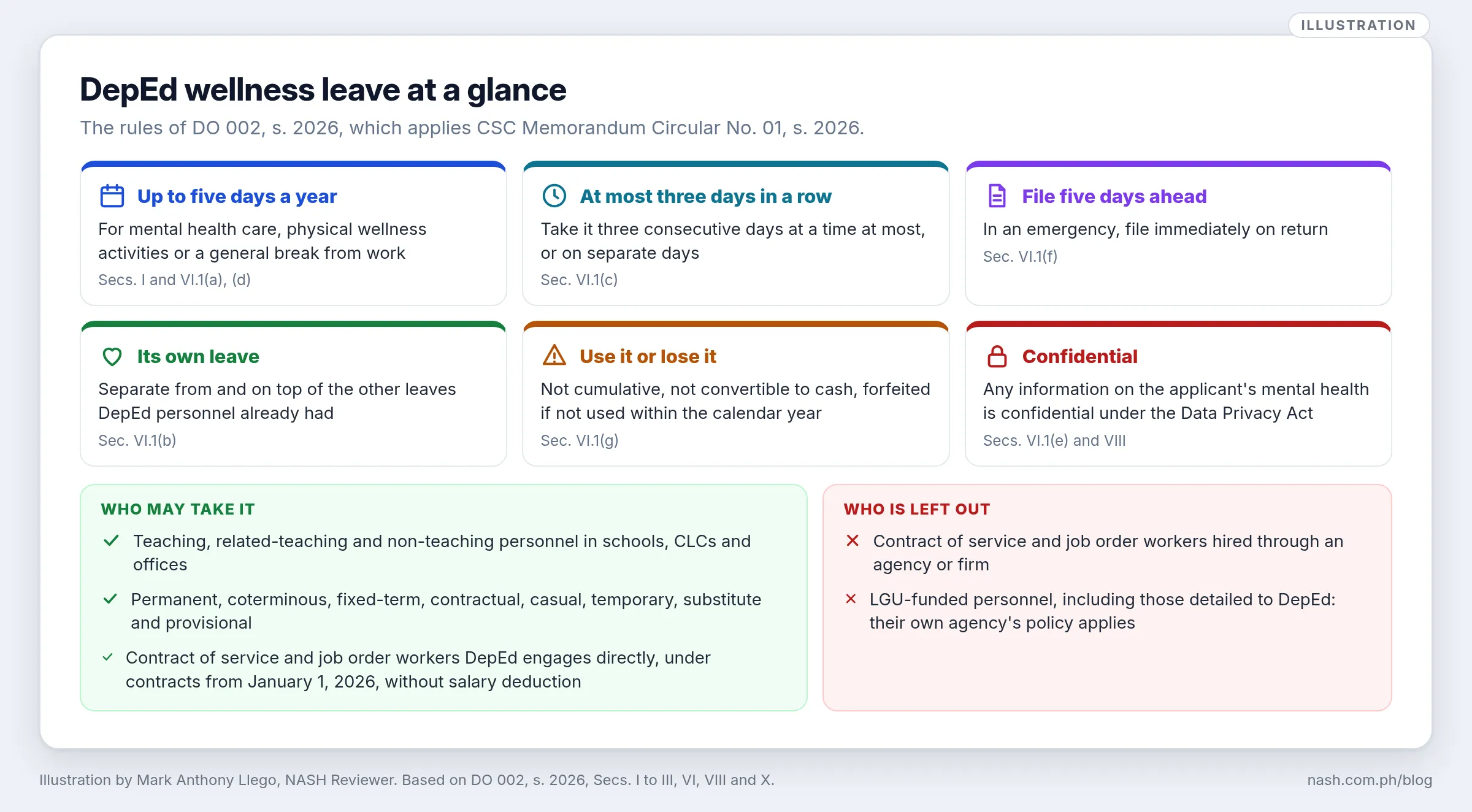
DepEd teachers and employees may take up to five days of wellness leave a year, with pay, under DepEd Order No. 002, s. 2026, the Guidelines on the Grant of Wellness Leave for the Department of Education Personnel, dated February 13, 2026. The leave is for “mental health care, physical wellness activities, or a general break from work”, may be taken at most three days in a row, is filed on CSC Form No. 6 at least five days ahead (or on return, in an emergency), and is lost if unused by December 31. Teachers may take it on class days: the school head recommends the leave, the Assistant Schools Division Superintendent (ASDS) acts on it, and the school head assigns a reliever, who may earn teaching overload pay.
The order applies the Civil Service Commission’s (CSC) Memorandum Circular No. 01, s. 2026, the Wellness Leave Policy, which took effect for the whole government on January 1, 2026. Two later DepEd memoranda answer the questions schools raised: a set of frequently asked questions in June 2026, and an August 10, 2026 memorandum on leave during class days.
Key findings
- Up to five days a year, at most three in a row. The leave is granted “up to a maximum of five days” and “may be taken either consecutively for a maximum of three days at a time, or on separate non-consecutive days” (DO 002, s. 2026, Sec. VI.1(a) and (c)).
- Nearly everyone in DepEd is covered: teaching, related-teaching and non-teaching personnel under permanent, coterminous, fixed-term, contractual, casual, temporary, substitute and provisional status, and contract of service (COS) and job order (JO) workers DepEd engages directly (Sec. II). Agency-hired COS and JO workers and LGU-funded personnel are excluded (Sec. III).
- File at least five days ahead, “except in emergency cases, wherein it shall be filed immediately upon the officials’ or employees’ return” (Sec. VI.1(f)). No medical certificate is required (DepEd FAQ, DM-OUHRODI-2026-1911, No. 9).
- Use it or lose it. The leave is “non-cumulative, non-commutable to its monetary equivalent, and forfeited if not availed within the calendar year” (Sec. VI.1(g)); it is separate from all other leave (Sec. VI.1(b)).
- Class days are no bar. “The scheduling of classes on a particular day shall not, by itself, prevent a teacher from availing of approved WL”, and the need for a reliever “shall not be used as a basis for denying, delaying, or unduly restricting” it (DepEd memorandum of August 10, 2026, paras. 3 and 5).
- The school head assigns the reliever, and teachers with relieving duties “shall be eligible to teaching overload pay, in accordance with DO 005, s. 2024” (Sec. VI.1(h)), for teaching beyond six hours a day, up to two hours a day and ten a week.
- Mental health information stays confidential under the Data Privacy Act of 2012 (Secs. VI.1(e) and VIII).
Where the rule comes from
| Date | Issuance | What it did |
|---|---|---|
| November 13, 2025 | CSC Resolution No. 2501292 | The CSC adopted the Wellness Leave Policy |
| December 16, 2025 | Publication in the Daily Tribune | Started the 15-day period before effectivity |
| January 1, 2026 | The policy took effect for government officials and employees (CSC MC No. 01, s. 2026, closing paragraph) | |
| January 12, 2026 | CSC MC No. 01, s. 2026, Wellness Leave Policy | Circulated the policy to all agencies |
| February 13, 2026 | DepEd Order No. 002, s. 2026 | Set DepEd’s rules and procedures; took effect “immediately upon its approval, issuance, and publication on the DepEd website” (item 5) |
| June 1, 2026 | DM-OUHRODI-2026-1911 | Issued DepEd’s frequently asked questions, orientation videos and slides |
| August 10, 2026 | Office of the Secretary memorandum | Clarified that teachers may take wellness leave on class days |
The CSC circular covers “all government officials and employees, whether permanent, temporary, substitute, coterminous, fixed term, contractual, or casual”, in national agencies, government-owned or -controlled corporations with original charters, LGUs and state universities and colleges (Sec. 1(a)). It authorizes agencies to grant the leave “subject to the agency’s discretion, up to a maximum of five (5) days”, “separate and exclusive from the fifteen (15) days Vacation Leave, fifteen (15) days Sick Leave, and three (3) days Special Leave, available from the date of assumption of duty” (Sec. 2). DepEd used the full five days for every eligible employee (DO 002, Sec. VI.1(a)) and added its own rules for teachers, relievers and COS and JO workers.
In announcing the policy, the CSC cited Gallup’s State of the Global Workplace 2025 report, which found that 47% of Filipino employees experienced stress “a lot of the day”, the second-highest share in Southeast Asia (CSC Resolution No. 2501292, footnote 2; Gallup, 2025). DepEd’s order cites the same report (Sec. I). In the same report, 33% of Filipino employees reported daily loneliness, the highest in the region (Gallup, 2025, Southeast Asia tables).
The leave also answers the Mental Health Act. Republic Act No. 11036 requires employers to “develop appropriate policies and programs on mental health in the workplace” (Sec. 25), and educational institutions to develop “policies and programs for students, educators, and other employees” (Sec. 24); DO 002 names it as a basis (Sec. V.2).
Who may take wellness leave
The order “shall apply to all eligible DepEd officials and employees in the CO, Regional Offices (ROs), Schools Division Offices (SDOs), schools, and community learning centers (CLCs), under permanent, coterminous, fixed-term, contractual, casual, temporary, substitute, and provisional status” (Sec. II). That covers teaching, related-teaching and non-teaching personnel alike (item 2), and the leave is granted “regardless of age, sex, disability, gender identity, religion, familial status, and ethnicity” (Sec. VI.1(a)).
| Group | Covered? | Rule |
|---|---|---|
| Teachers, master teachers, school heads and other teaching and related-teaching personnel | Yes | Sec. II; item 2 |
| Non-teaching personnel in schools and offices (Administrative Officers, clerks and others) | Yes | Sec. II; item 2 |
| Personnel under permanent, coterminous, fixed-term, contractual, casual, temporary, substitute or provisional status | Yes | Sec. II |
| Contract of service (COS) and job order (JO) workers “directly engaged by contract of the Department” | Yes, under contracts commencing January 1, 2026 onwards, written into the contract, with no salary deduction | Secs. II, VI.2(c) and X |
| COS and JO workers “engaged through agency/firm (e.g., manpower services)” | No | Sec. III |
| LGU-funded personnel, including those “detailed or assigned to DepEd” | No; their wellness leave follows “the WL Policy of their mother agency” | Sec. III |
Two groups need a closer look. A substitute teacher is covered by name (Sec. II). DO 002 does not name teachers paid by the local school board. Their pay comes from the LGU, so the rule for LGU-funded personnel in Sec. III is the closer fit: their wellness leave, if any, follows the LGU’s policy and their contract.
Wellness leave matters most to teachers because of how their leave works. Public school teachers “are not entitled to the usual vacation and sick leave credits but to Proportional Vacation Pay” (DepEd Memorandum No. 040, s. 2026, item 1, citing CSC MC No. 9, s. 2012). Apart from leave under special laws, such as maternity, paternity or study leave, a teacher’s absences during the school year are covered by vacation service credits earned for extra work, which may be used only for “absences related to illness or to offset proportional deduction in vacation pay due to absences for personal reasons or late appointment” (DepEd Order No. 013, s. 2024, Sec. V.A.5). Wellness leave gives teachers five paid days a year that they do not have to earn and may use for rest.
How many days, and how they may be taken
| Rule | What the order says | Section |
|---|---|---|
| Days a year | “up to a maximum of five days” | VI.1(a) |
| Consecutive days | “either consecutively for a maximum of three days at a time, or on separate non-consecutive days” | VI.1(c) |
| Purpose | “mental health care, physical wellness activities, or a general break from work”, among others | VI.1(d) |
| Relation to other leave | “separate and exclusive from other leaves, if any, enjoyed by DepEd Personnel prior to the issuance of these Guidelines” | VI.1(b) |
| Unused days | “non-cumulative, non-commutable to its monetary equivalent, and forfeited if not availed within the calendar year” | VI.1(g) |
| Pay | With pay; for COS and JO workers, “without salary deduction” | Annex A; VI.2(c)(4) |
The five days run by calendar year, not school year (Sec. VI.1(g)). A teacher who has used none by December loses them on December 31, and January 1 brings five new days; they cannot be carried into the next year or converted to cash.
The three-day limit allows several patterns. A teacher may take three days in a row and two more later, or two and two and one, or five single days across the year. Four or five days in a row are not allowed (Sec. VI.1(c)).
Wellness leave is not the wellness break
The three-term calendar created a second, unrelated thing with a similar name. The teachers’ wellness break is “a scheduled and protected period within the End-of-Term Block”, two days long, “following the timely completion of all end-of-term activities”, during which teachers “shall not be assigned instructional, administrative, or extracurricular duties”, “except in cases of emergency or exigency of service” (DepEd Order No. 009, s. 2026, paras. 8(h) and 24). DO 009 says so itself: “For teachers, the wellness break is different from the Wellness Leave as provided for by DO 002, s. 2026” (para. 8(h)).
| Wellness leave | Teachers’ wellness break | |
|---|---|---|
| Rule | DO 002, s. 2026, applying CSC MC No. 01, s. 2026 | DO 009, s. 2026, paras. 8(h) and 24 |
| Who decides when | The employee applies for the dates | Set by the school calendar |
| Length | Up to five days a year, at most three in a row | Two days in the End-of-Term Block (para. 24); in SY 2026-2027, September 14 and 15, 2026, then the Year-End Break of December 19 to 31, 2026 for Term 2 (Annex B) |
| Application | CSC Form No. 6, at least five days ahead | None |
| Charged to credits | Wellness leave credits | Nothing |
| Covers | All eligible DepEd personnel | Teachers (learners have a separate four-day break) |
A wellness break does not use up wellness leave. The employee applies for the dates of wellness leave (DO 002, Sec. VI.1(f)), and no rule lets a school head move it into the wellness break. The guide to the three-term calendar gives the break’s dates for SY 2026-2027.
How to apply
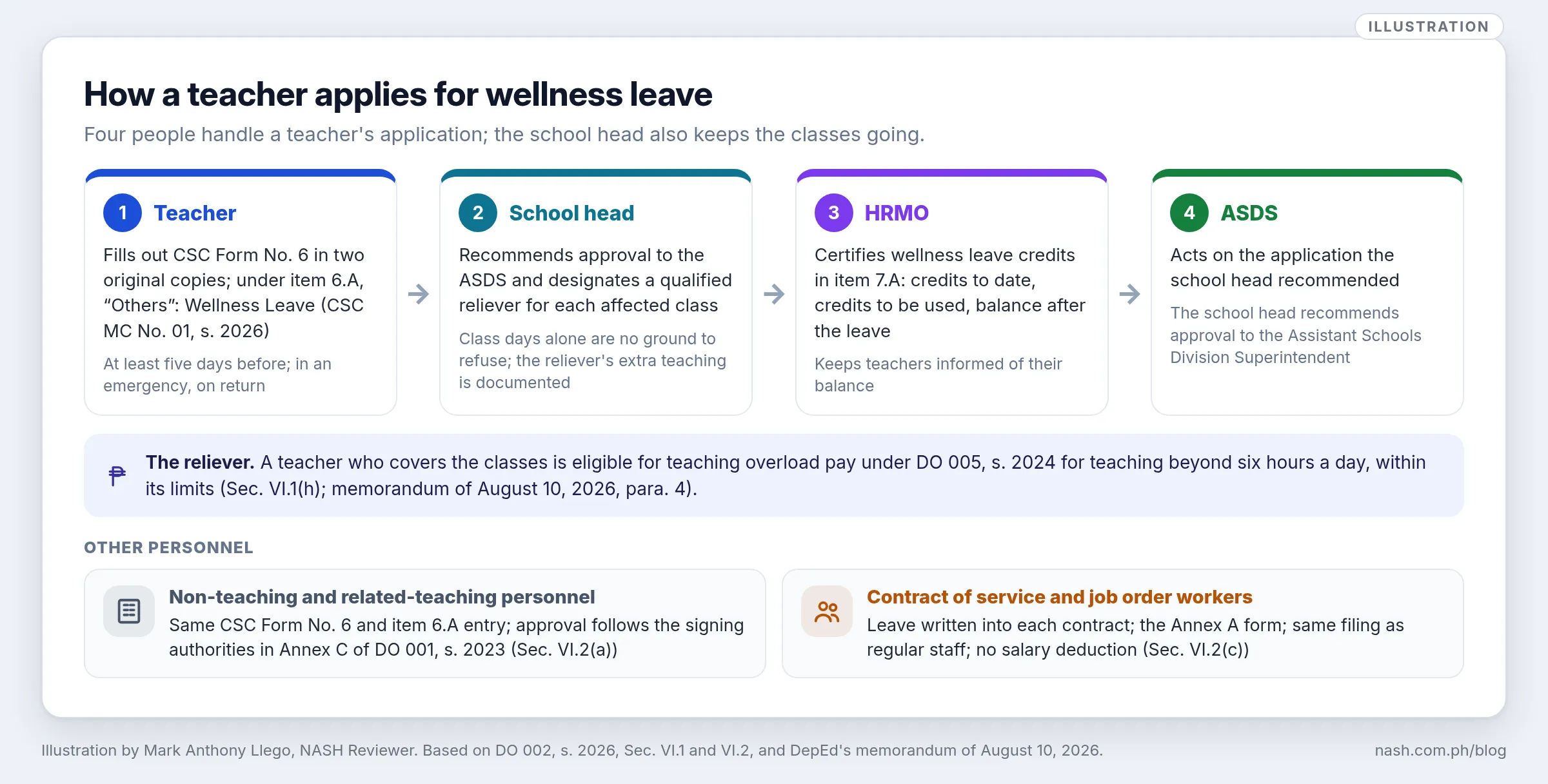
When to file. “The application for WL shall be filed at least five days before its availment, except in emergency cases, wherein it shall be filed immediately upon the officials’ or employees’ return from such leave” (Sec. VI.1(f)). An emergency is “any sudden or significant deterioration of the mental or emotional state of the eligible personnel that makes them unable to safely or effectively perform their essential job functions”, which may follow “bereavement, accident, calamity, or any extreme conditions and/or situations that may significantly contribute to mental and emotional distress or trigger existing mental health condition” (Sec. IV.1). A teacher whose parent dies on a Sunday night may stay home on Monday and file on return.
Teachers. Teachers use CSC Form No. 6, the Application for Leave, “in duplicate original copies (2 copies)”. “Until the CSC officially issues the newly revised Form 6, all applications for WL shall be indicated under the category ‘Others’ in item 6.A, by indicating ‘Wellness Leave (CSC MC No. 01, s. 2026)’” (Sec. VI.2(b)(1)). Then:
- “The School Head shall recommend the approval of the application to the Assistant Schools Division Superintendent (ASDS)” (Sec. VI.2(b)(2)).
- The Human Resource Management Officer (HRMO) fills in item 7.A, the Certification of Leave Credits, with the teacher’s wellness leave credits to date, the credits to be used and the credits left after the leave (Sec. VI.2(b)(3)).
- “The HRMO shall regularly update the teachers on the number of their Wellness Leaves” (Sec. VI.2(b)(4)).
Non-teaching and related-teaching personnel. They file “in the same manner as filing for Vacation Leave, Sick Leave, and other leave privileges”, on the same CSC Form No. 6 with the same item 6.A entry, and approval follows the signing authorities in Annex C of DepEd Order No. 001, s. 2023 (Sec. VI.2(a)).
Contract of service and job order workers. Their wellness leave “shall be indicated in the individual contracts and other relevant issuances covering their engagement”; they file the way regular non-teaching staff do, on the form in Annex A, under the same signing authorities; and the leave is “without salary deduction”, so they “continue to receive their full salary during the days they utilize the WL” (Sec. VI.2(c)). Only service agreements “commencing 1 January 2026 onwards” carry it (Sec. X). Annex A asks for the worker’s name, position, office and school, the dates and number of days, and a purpose: mental health care, a general break from work, physical wellness activities or others.
What DepEd’s FAQ adds
DepEd’s Office of the Undersecretary for Human Resource and Organizational Development, and Infrastructure released frequently asked questions on June 1, 2026 (DM-OUHRODI-2026-1911). Its answers fill in points the order leaves open:
| Question | DepEd’s answer | FAQ No. |
|---|---|---|
| Is a medical certificate required? | “No. Unlike Sick Leave, no medical certificate is required.” | 9 |
| Is a letter of intent required? | “No.” Only CSC Form No. 6 is submitted | 11 |
| May it be used for travel, including abroad? | “Yes, subject to compliance with Travel Authority (TA) guidelines. An approved TA must accompany the Wellness Leave form.” | 10 |
| What about leave taken before the order? | “Any leave of absence filed prior to the issuance of the DO shall be charged against the existing leave credits of the employee.” | 3 |
| Does it affect overtime? | “Wellness Leave days are considered leave days and do not count toward the required 40-hour work week for overtime eligibility.” | 8 |
| Contract of service and job order workers | Contracts effective January 2026 onwards carry the leave; “Effective January 2027, Wellness Leave shall be included in all contracts”, and it is taken “with full pay” | 3 and 12 |
For teachers, DepEd Order No. 026, s. 2025 measures classroom hours instead: paid overtime requires “at least six (6) hours of actual classroom teaching per day and a minimum of thirty (30) hours per week” (Sec. VII, item 5). DO 026 does not mention wellness leave, but a leave day is not a day of classroom teaching, so a teacher who takes one may fall short of thirty hours that week. The travel answer points to DepEd’s travel rules, DO 043, s. 2022 as amended by DO 046, s. 2022 (FAQ, note 1).
Who approves
DO 002 points to DO 001, s. 2023 for the signing authorities. Its Annex C, Part G sets them for leave of up to 60 calendar days at school level:
| Applicant | Recommends approval | Approves | Source |
|---|---|---|---|
| Teaching and non-teaching personnel of a school | School head | ASDS | DO 001, s. 2023, Annex C, Part G; DO 002, Sec. VI.2(b)(2) |
| School head, head teacher or teacher-in-charge | ASDS | Schools Division Superintendent | DO 001, s. 2023, Annex C, Part G |
| SDO personnel below division chief | Division chief | ASDS | DO 001, s. 2023, Annex C, Part G |
Part G names sick, vacation, study, maternity and paternity leave; DO 002 applies its approvals to wellness leave by reference (Sec. VI.2(a)(3) and (c)(3)), and its own text has the school head recommend and the ASDS act on teachers’ applications (Sec. VI.2(b)(2)).
Confidentiality
“Any information related to the applicant’s mental health condition shall be bound by the rules of confidentiality and in compliance with the Data Privacy Act of 2012” (Sec. VI.1(e)). Offices processing wellness leave treat “all sensitive personal information, including mental health-related information collected from DepEd officials or personnel”, as confidential, “used solely for legitimate purposes with prior written consent”, and report any breach to DepEd’s Data Privacy Officer and the National Privacy Commission (Sec. VIII). For a school head, that means a teacher’s application is not discussed in faculty meetings, the purpose ticked on a form is not shared, and the reliever is told only which classes to cover.
Wellness leave on class days, and the reliever
A teacher’s leave usually falls on class days, and the order meets that with a reliever, not a refusal. “All Heads of Office or School Heads shall ensure the continuous delivery of services and/or classes in granting WL to personnel. For teaching personnel, the school head shall specifically assign relievers to fill in for the classes of those on wellness leave” (Sec. VI.1(h)).
An Office of the Secretary memorandum dated August 10, 2026, Clarification on the Availment of Wellness Leave by Teachers During Class Days, signed by the Undersecretary and Chief of Staff, settled the question schools were asking:
- “Teachers may avail themselves of WL during class days, subject to the applicable provisions of DO 002, s. 2026, CSC MC 01, s. 2026, and other existing laws, rules, and regulations on the grant of leave” (para. 2).
- “The scheduling of classes on a particular day shall not, by itself, prevent a teacher from availing of approved WL.” The school head “shall designate qualified teachers as relievers for classes affected by the approved WL, taking into consideration their qualifications, existing teaching loads, availability, and welfare” (para. 3).
- “The designation of relievers shall not be used as a basis for denying, delaying, or unduly restricting the approved availment of WL” (para. 5).
- School heads “shall ensure that WL applications are processed in accordance with existing policies and that additional teaching or relieving duties are properly documented” (para. 6).
The reliever is the school head’s task, not the applicant’s. Asking the teacher on leave to find a substitute, or holding the application until one volunteers, runs against para. 5.
Overload pay for relievers
“The teachers with relieving duties shall be eligible to teaching overload pay, in accordance with DO 005, s. 2024” (Sec. VI.1(h)). The August 10, 2026 memorandum repeats this, “subject to the applicable guidelines and conditions under DO 005, s. 2024” and to “budgetary, accounting, and auditing requirements” (para. 4). DepEd Order No. 005, s. 2024 sets the terms:
| Point | Rule | Source |
|---|---|---|
| When relief counts as overload | Relieving duties “which are beyond the normal teaching hours and affecting vacant periods shall also be considered teaching overload”, if they meet the six-hour and two-hour conditions | DO 005, Sec. V.A.2, item 3 |
| Limit | Overload “shall not exceed two (2) hours a day or ten (10) hours a week” | DO 005, Sec. III(j) |
| Rate | “at least twenty-five percent (25%) of a teacher’s regular remuneration” | DO 005, Sec. III(k) |
| Payment | Quarterly, “subject to the extent of allotment”; if funds run short, overload hours “shall be converted to earned VSC” | DO 005, Sec. V.B |
| Computation | “Teaching Overload Pay = Total Teaching Overload Hours x PHTR”, with “PHTR = 0.000781 x AR” (annual salary) | DM 053, s. 2024, Encl. 1 |
DepEd’s answers to schools add that relievers “can avail for teaching overload pay if their total teaching load exceeds the presrcibed [sic] at most six (6) hours” (2026 consolidated questions and answers on teacher workload, No. 8). A reliever who covers one class in a vacant period and still teaches six hours that day earns no overload; one who teaches seven hours earns one hour. The overload pay computation guide works through examples, and the guide to claims and funds covers the paperwork.
What this means for school heads
- Tell every staff member about the leave early in the year. The five days run by calendar year and are forfeited on December 31 (Sec. VI.1(g)). Explain the three-day limit, the five-day filing rule and the emergency exception at the start of the year, and remind staff in the last quarter, when unused days are about to lapse. COS and JO workers directly engaged by DepEd are covered too (Sec. II).
- Act on applications promptly and recommend them to the ASDS. Check only what the rules require: the dates, the three-day limit, the filing period, and the HRMO’s certification of credits (Secs. VI.1 and VI.2(b)). Do not ask for a medical certificate (FAQ No. 9) or a letter of intent (FAQ No. 11), and do not ask for more than the form asks.
- Never make the leave depend on a reliever. Class days are no ground to refuse, and relievers “shall not be used as a basis for denying, delaying, or unduly restricting” the leave (memorandum of August 10, 2026, paras. 3 and 5). Finding the reliever is your job, not the applicant’s.
- Choose relievers fairly and record their hours. Consider “qualifications, existing teaching loads, availability, and welfare” (memorandum, para. 3), spread relief across teachers, stay within two hours of overload a day and ten a week (DO 005, s. 2024, Sec. III(j)), and document relieving duties so overload pay can be claimed (memorandum, para. 6; DM 053, s. 2024). The overload claims guide explains the certification and the funds.
- Accept emergency applications on return. Bereavement, accident, calamity and similar events allow filing “immediately upon the officials’ or employees’ return” (Secs. IV.1 and VI.1(f)). Arrange relief on the day itself.
- Keep mental health information confidential. Do not discuss a teacher’s application in meetings or with the reliever; store the form with personnel records; report any breach to the Data Privacy Officer (Secs. VI.1(e) and VIII).
- Keep wellness leave and wellness breaks apart. Do not tell teachers to save their leave for the wellness break, and do not charge the break to their leave (DO 009, s. 2026, para. 8(h)).
- Take your own leave. A school head’s application goes to the ASDS for recommendation and the SDS for approval (DO 001, s. 2023, Annex C, Part G). Arrange who acts for you while you are away.
- Check COS and JO contracts. The leave “shall be indicated in the individual contracts” (Sec. VI.2(c)(1)), and DepEd’s FAQ says it will be in all contracts from January 2027 (FAQ No. 12). A worker whose contract began on or after January 1, 2026 is entitled now (Sec. X).
These steps serve the PPSSH indicators on managing staff (Domain 2, strand 2.4) and on the general welfare of human resources (Domain 4, strand 4.7). The school head’s guide to human resource management places wellness leave among a school head’s other HR duties.
How the NASH may test this
The items below are original practice items, scored 3 (Relational), 2 (Multistructural), 1 (Unistructural) or 0 (Prestructural). An option that breaks a rule scores 0.
Question 1
Indicator 4.7.2, General welfare of human resources. Career Stage 2, Situational, Moderate.
You are the school head of a small elementary school. Early on Monday, a Grade 3 adviser messages that her father died overnight and that she is too distraught to teach on Monday and Tuesday. Two colleagues cover her class in their vacant periods. She has used none of her wellness leave this year. When she returns on Wednesday, she asks how her absence will be treated. What is the most appropriate action?
- A. Have her file wellness leave now as an emergency case, recommend its approval to the ASDS, and record the relieving hours of the two colleagues who covered her class.
- B. Have her file wellness leave now as an emergency case and approve it yourself, then record the relieving hours of the two colleagues who covered her class.
- C. Have her charge the two days to the vacation service credits she earned during the last school year, and remind her that leave should be filed at least five days ahead the next time.
- D. Record the two days as absence without official leave, since wellness leave must be filed at least five days before the dates on which it is taken.
Answer and explanation
Best answer: A. Points: A = 3, B = 2, C = 1, D = 0.
- A (3 points, Relational). It applies the emergency rule, which allows filing on return, uses the school head’s role to recommend approval, and documents the relief so the colleagues’ extra teaching can be counted.
- B (2 points, Multistructural). It applies the emergency rule and documents the relief, but the school head only recommends a teacher’s wellness leave; the ASDS acts on it.
- C (1 point, Unistructural). It gives the teacher paid leave of a kind, but it uses up earned credits when the wellness leave rules cover a bereavement and allow filing on return.
- D (0 points, Prestructural). It ignores the emergency exception, which lets the application be filed “immediately upon the officials’ or employees’ return”, and penalizes a grieving teacher.
Why. This aligns with Career Stage 2 expectations because the school head applies the rules on personnel benefits to protect a teacher’s welfare. DO 002, s. 2026 counts bereavement among emergency cases and lets the application be filed on return; the school head recommends approval to the ASDS, and teachers with relieving duties are eligible for overload pay under DO 005, s. 2024, with relieving hours documented. The option in which the school head approves the leave gets the emergency rule and the relief right but uses the wrong authority.
Indicator 4.7.2: Implement laws, policies, guidelines and issuances on the rights, privileges and benefits of school personnel to ensure their general welfare.
Sources: DO 002, s. 2026, Secs. IV.1, VI.1(f) and (h), and VI.2(b); DepEd memorandum of August 10, 2026, paras. 4 and 6; DO 005, s. 2024, Sec. V.A.2.
Question 2
Indicator 2.4.2, Management of staff. Career Stage 2, Situational, Moderate.
You are the school head of a national high school. A Grade 9 science teacher files wellness leave ten days ahead for a Thursday and Friday, both class days. She has used none of her wellness leave this year. Her department head says no teacher is free and suggests that she find a colleague willing to cover her classes or move the leave to the last week of the term. What is the most appropriate action?
- A. Recommend approval, and assign her classes to whichever teachers happen to have vacant periods on those two days, without checking their loads.
- B. Recommend approval, and designate qualified relievers after checking their loads, and leave it to them to claim any overload they incur.
- C. Recommend approval, and designate qualified relievers for her classes after checking their loads, then record the hours they teach beyond six as overload.
- D. Hold the application until she finds a willing colleague to cover her classes, or recommend approval only if she moves the leave to the last week of the term.
Answer and explanation
Best answer: C. Points: A = 1, B = 2, C = 3, D = 0.
- A (1 point, Unistructural). It respects the leave and covers the classes, but picks relievers by chance, without regard to qualifications, loads or welfare, and records nothing.
- B (2 points, Multistructural). It recommends the leave and chooses relievers properly, but leaves the record of overload hours to the relievers, when the school head documents relieving duties and keeps the record of hours beyond six.
- C (3 points, Relational). It grants the entitlement and keeps classes going through relievers chosen by qualification, load and welfare, and documents their overload.
- D (0 points, Prestructural). It makes the leave depend on a reliever, which the August 10, 2026 memorandum forbids, and shifts the school head’s duty to the applicant.
Why. This aligns with Career Stage 2 expectations because the school head manages staffing to keep classes running while honoring personnel policies. DepEd’s August 10, 2026 memorandum states that class scheduling “shall not, by itself, prevent a teacher from availing of approved WL”, that the school head designates qualified relievers considering “their qualifications, existing teaching loads, availability, and welfare”, and that relievers “shall not be used as a basis for denying, delaying, or unduly restricting” the leave. The option that leaves the overload claim to the relievers chooses them well but skips the record the school head must keep.
Indicator 2.4.2: Manage staffing such as teaching load distribution and grade level and subject area assignment in adherence to laws, policies, guidelines and issuances based on the needs of the school.
Sources: DO 002, s. 2026, Sec. VI.1(h); DepEd memorandum of August 10, 2026, paras. 2 to 6; DO 005, s. 2024, Secs. III(j), V.A.2 and V.B.1.
Question 3
Indicator 4.7.1, General welfare of human resources. Career Stage 1, Conceptual, Easy.
What purpose do DepEd’s wellness leave rules give for keeping any information about an applicant’s mental health condition confidential?
- A. It lets only the school head judge whether the applicant’s reason is serious enough to justify the leave days.
- B. It lets personnel take the leave for mental health reasons without fear of stigma, as the information is protected.
- C. It keeps the school within the Data Privacy Act, because mental health information is sensitive personal information.
- D. It lets the school head recommend the leave without a medical certificate, since the rules require none.
Answer and explanation
Best answer: B. Points: A = 0, B = 3, C = 2, D = 1.
- A (0 points, Prestructural). It is a misconception: the reason is not for the school head to judge, and confidentiality keeps the information from others, not for the school head alone.
- B (3 points, Relational). It links the rule to its purpose: the order binds mental health information by confidentiality “To promote safe spaces” for personnel who take the leave for mental health reasons.
- C (2 points, Multistructural). The Data Privacy Act applies, but the answer stops at compliance and misses the purpose the order states.
- D (1 point, Unistructural). No medical certificate is required, but that is a separate rule and not the reason for confidentiality.
Why. This aligns with Career Stage 1 expectations because an aspiring school head must understand the rights and privileges of personnel. DO 002, s. 2026 states that “To promote safe spaces in officials’ and employees’ availment of WL due to mental health reasons, any information related to the applicant’s mental health condition shall be bound by the rules of confidentiality and in compliance with the Data Privacy Act of 2012.” The option about the Data Privacy Act names the law but not the purpose.
Indicator 4.7.1: Display knowledge of laws, policies, guidelines and issuances on the rights, privileges and benefits of school personnel to promote their general welfare.
Sources: DO 002, s. 2026, Secs. VI.1(e) and VIII; DepEd FAQ, DM-OUHRODI-2026-1911, No. 9.
Nothing in this guide reproduces or predicts examination content.
Frequently asked questions
Can teachers take wellness leave on class days?
Yes. “Teachers may avail themselves of WL during class days”, and “The scheduling of classes on a particular day shall not, by itself, prevent a teacher from availing of approved WL” (DepEd memorandum of August 10, 2026, paras. 2 and 3). The school head assigns relievers for the classes (DO 002, s. 2026, Sec. VI.1(h)).
Is a medical certificate needed for wellness leave?
No. DepEd’s FAQ states: “Unlike Sick Leave, no medical certificate is required” (DM-OUHRODI-2026-1911, No. 9). Any information about the applicant’s mental health that does come up is confidential (DO 002, s. 2026, Sec. VI.1(e)).
Can I take all five days of wellness leave at once?
No. The leave “may be taken either consecutively for a maximum of three days at a time, or on separate non-consecutive days” (DO 002, s. 2026, Sec. VI.1(c)). Three days now and two later, or five single days, are allowed.
Is wellness leave deducted from vacation service credits or vacation pay?
No. As of November 9, 2026, no issuance charges it to them. Wellness leave is “separate and exclusive from other leaves” (DO 002, s. 2026, Sec. VI.1(b)), and the HRMO certifies it as wellness leave credits on the form (Sec. VI.2(b)(3)). The CSC made it “separate and exclusive from” the vacation, sick and special leave of other employees (CSC MC No. 01, s. 2026, Sec. 2). Deductions from teachers’ vacation pay are based on “absences without pay” (DM 040, s. 2026, item 6), and wellness leave is leave with pay.
Can unused wellness leave be carried over or converted to cash?
No. It is “non-cumulative, non-commutable to its monetary equivalent, and forfeited if not availed within the calendar year” (DO 002, s. 2026, Sec. VI.1(g)). Unused days lapse on December 31.
Sources
DepEd issuances
- DepEd Order No. 002, s. 2026, Guidelines on the Grant of Wellness Leave for the Department of Education Personnel, February 13, 2026, items 1 to 7, Secs. I to XIV and Annex A.
- Office of the Secretary, Memorandum of August 10, 2026, Clarification on the Availment of Wellness Leave by Teachers During Class Days, paras. 1 to 8.
- DM-OUHRODI-2026-1911, Dissemination of Frequently Asked Questions (FAQs), Video Recordings, and Reference Materials on the Implementation of DepEd Wellness Leave Policy (DO No. 02, s. 2026), June 1, 2026, and its FAQ, Nos. 1 to 12, as disseminated by SDO Muntinlupa City Memorandum No. 293, s. 2026.
- DepEd Order No. 009, s. 2026, Guidelines on the Implementation of the Three-Term School Calendar in Basic Education, April 16, 2026, paras. 8(h), 23 and 24.
- DepEd Order No. 005, s. 2024, Rationalization of Teachers’ Workload in Public Schools and Payment of Teaching Overload, April 29, 2024, Secs. III(j), III(k), V.A.2 and V.B.
- DepEd Memorandum No. 053, s. 2024, Implementation Guidelines for DO 005, s. 2024, September 27, 2024, Encl. 1.
- DepEd Order No. 001, s. 2023, Revised Designation of Undersecretaries and Assistant Secretaries to Their Strands and Functional Areas of Responsibilities and Revised Signing Authorities, January 9, 2023, Annex C, Part G.
- DepEd Order No. 013, s. 2024, Revised Guidelines on the Grant of Vacation Service Credits for Teachers, September 18, 2024, Sec. V.A.5.
- DepEd Memorandum No. 040, s. 2026, Guidelines on Public School Teachers’ Proportional Vacation Pay for School Year 2025–2026, June 24, 2026, item 1.
- DepEd Order No. 026, s. 2025, Guidelines on the Payment of Overtime Services of Teachers, September 6, 2025.
- DepEd consolidated questions and answers from the May 25-26 and June 2, 2026 meetings on the implementation status of teacher workload policies, No. 8, in DepEd’s teacher workload materials folder (bit.ly/TeacherWorkload_ToolsandProcedure, named in DM 053, s. 2024, item 9).
Civil Service Commission and laws
- CSC Memorandum Circular No. 01, s. 2026, Wellness Leave Policy, January 12, 2026, Secs. 1 to 4.
- CSC Resolution No. 2501292, Wellness Leave Policy, promulgated November 13, 2025, footnote 2.
- Republic Act No. 11036, Mental Health Act, June 20, 2018, Secs. 24 and 25.
Report
- Gallup. State of the Global Workplace: 2025 Report. Southeast Asia country tables (stress and loneliness).
Written by Mark Anthony Llego for NASH Reviewer. Sources: DepEd Order No. 002, s. 2026 and DepEd’s memoranda of June 1 and August 10, 2026 on wellness leave; DepEd Orders No. 009, s. 2026, No. 013 and 005, s. 2024, No. 026, s. 2025 and No. 001, s. 2023; DepEd Memoranda No. 040, s. 2026 and No. 053, s. 2024; CSC Memorandum Circular No. 01, s. 2026 and Resolution No. 2501292; RA 11036; Gallup.