The Education Center for AI Research (ECAIR) is the Department of Education’s center for artificial intelligence (AI) research and development. DepEd Order No. 013, s. 2025, dated April 29, 2025, sets it up as a partnership between DepEd and the Southeast Asian Ministers of Education Organization (SEAMEO). The center “will operate primarily for DepEd” (para. 4), but the Order “does not make ECAIR a governmental office” (para. 8). ECAIR says it builds and pilots AI and data systems with DepEd offices before handing each to the office that will run it; TAHANAN, a data blueprint, is the first it has handed over. Its systems include LIGTAS+ for school hazards, SIGLA for nutrition screening, and DUNONG, which scores the National Assessment for School Heads (NASH).
ECAIR says it reports to the Office of the Undersecretary for the PQF Secretariat, Policy and Planning Service, and ECAIR (OUPPE), headed by Undersecretary Rafaelita M. Aldaba, and that it is “hosted operationally by SEAMEO INNOTECH”, SEAMEO’s Regional Center for Educational Innovation and Technology. The rules that every AI system in DepEd must meet, ECAIR’s included, are in DepEd Order No. 003, s. 2026, the Foundational Guidelines on Artificial Intelligence in Basic Education.
ECAIR’s project pages and DepEd’s announcements report progress and plans. They do not set duties for schools; a school’s duties come from DepEd’s orders and memoranda.
Key findings
- ECAIR was launched on February 20, 2025 and established by DO 013, s. 2025 on April 29, 2025. DepEd called it “the first-ever hub for AI research in education in the Philippines”, building on the Center for AI Research (CAIR) started in 2024 (DepEd, February 20, 2025; DO 013, s. 2025, para. 2).
- It is not a government office. Its employees and officers “are not deemed employees of the government or public officers”, and its research costs for DepEd programs are charged to Office of the Secretary funds (DO 013, s. 2025, paras. 7 and 8).
- The Order names the Undersecretary and Chief of Staff as its oversight head (para. 6). DepEd’s Central Office directory, as of September 22, 2026, lists ECAIR with the PQF Secretariat and the Planning Service under Undersecretary Rafaelita M. Aldaba.
- ECAIR lists 17 active projects, each with a DepEd office as its partner or process owner. LIGTAS+ was launched nationwide on August 26, 2026; DUNONG has scored two NASH administrations; SIBOL’s method guided the PHP 1-billion 2026 Library Hub allocation (ECAIR project pages, 2026).
- The systems that touch learners are still pilots. SIGLA (nutrition screening) was in NCR schools in mid-2026, with wider use expected by early 2027; SABAY (Grade 2 screening) has an NCR prototype; TALAAN (dropout risk) is preparing a pilot in three Las Piñas high schools (ECAIR; BusinessMirror, June 18, 2026).
- DO 003, s. 2026 requires a Privacy Impact Assessment and a DepEd AI Registry entry before any AI system is deployed in DepEd offices or schools, and keeps every final decision with DepEd personnel (Secs. VI.1.4, VII.1.6 and VII.1.7).
- ECAIR’s headline numbers count different things. Its 21,803 “aspiring principals” are the FY 2023 NQESH completers that the SIKAP study analyzed (DM 059, s. 2024), and its “27% to 39%” rise compares the last NQESH with the first NASH batch, two tests that were scored differently and count different levels as passing (DM 059, s. 2024; DM 097, s. 2025).
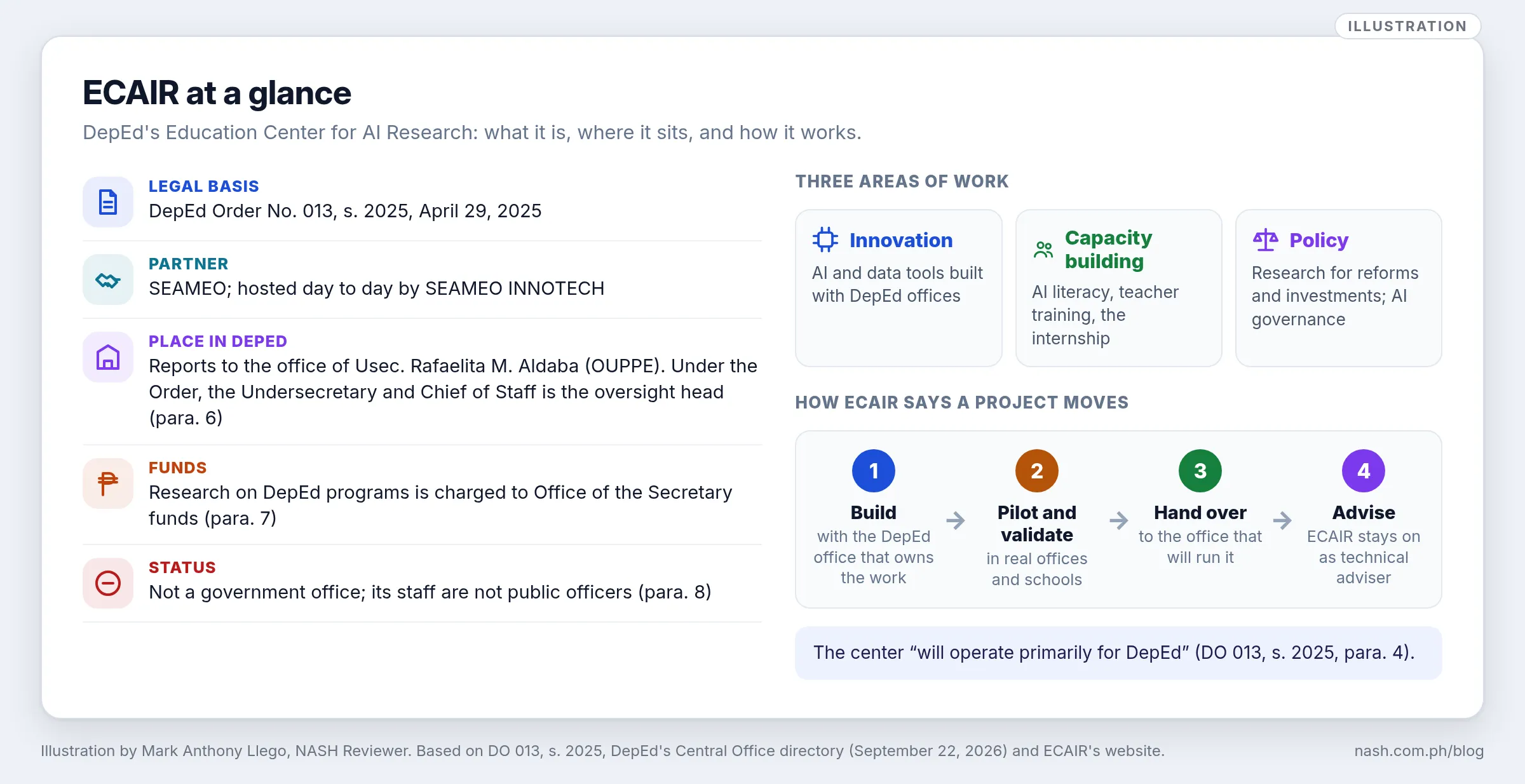
What DO 013, s. 2025 says about ECAIR
DO 013, s. 2025 has no enclosure. Its paragraphs set ECAIR’s purpose, its tasks, its place in DepEd and its status:
| Subject | What the Order says | Para. |
|---|---|---|
| Partnership | DepEd “has partnered with the Southeast Asian Ministers of Education Organization (SEAMEO) for the establishment of the Education Center for AI Research (ECAIR)” | 2 |
| Who works there | “a specialized pool of highly technical experts in the fields of data science, artificial intelligence, and emerging technologies” | 3 |
| Whom it serves | It “will operate primarily for DepEd”, working with other national and local agencies and industry partners | 4 |
| Its tasks | Five responsibilities, listed below | 5 |
| Oversight | It works “in direct coordination with the Office of the Secretary (OSEC)”; the Undersecretary and Chief of Staff is “the oversight head of the Center” | 6 |
| Funds | Research costs “in relation to DepEd programs shall be charged against OSEC funds, subject to the usual accounting and auditing rules and regulations” | 7 |
| Status | “does not make ECAIR a governmental office and its employees and officers are not deemed employees of the government or public officers” | 8 |
| Effectivity | Immediately upon approval, issuance and publication on the DepEd website | 9 |
The five responsibilities in para. 5 are to:
- integrate AI research and development into educational technologies to improve learning outcomes;
- develop policies and initiatives that foster the use of AI in schools and other educational institutions;
- promote research collaborations among educational institutions, technology companies and AI experts;
- support the “responsible, inclusive, and strategic integration of AI” in basic education, in policy development, curriculum enhancement, research and capacity building; and
- help align AI in the curriculum with the Philippine Qualifications Framework (PQF), so that AI learning outcomes fit national qualifications and labor market needs.
Para. 8 explains why the Order exists at all: it is issued “for proper alignment of initiatives among the strands in the Department vis-a-vis ECAIR, and to provide clarity on ECAIR’s relationship with and roles in the Department.” ECAIR works for DepEd, but it is not a DepEd office, and its people are not DepEd officials. It follows from para. 8, though no text says so, that ECAIR has no authority of its own over schools: a request for school data or a pilot carries authority only when the DepEd office that owns the project, or the division, issues it.
Who oversees ECAIR, and who runs it
Under para. 6, the Undersecretary and Chief of Staff monitors ECAIR’s operations, gives it strategic alignment and sees that its tasks follow DepEd’s priorities. DepEd’s directory places ECAIR under another undersecretary. The Central Office directory, as of September 22, 2026, lists Undersecretary Rafaelita M. Aldaba in the Office of the Secretary for three units: the Philippine Qualifications Framework Secretariat, the Planning Service (which ECAIR calls the Policy and Planning Service), and the “Education Center for Artificial Intelligence Research (ECAIR)”. ECAIR calls her office OUPPE and says it “reports to” it, while also working under “the Department’s leadership, including Secretary Sonny Angara and Undersecretary and Chief of Staff Atty. Fatima Lipp D. Panontongan”. As of November 9, 2026, no DepEd order has amended para. 6, so the Order’s oversight head and the reporting line in the directory sit side by side.
ECAIR’s managing director and Chief AI and Data Officer is Dr. Erika Fille T. Legara, and its deputy Chief AI and Data Officer is Dr. Sebastian C. Ibañez. Its staff are data scientists, AI and data engineers, software developers and policy researchers, with heads of innovation, AI research, data engineering and policy, a learning and development lead, and a data and AI governance lead. OUPPE executive assistants and SEAMEO project coordinators support the center (ECAIR website, “About us”).
Where ECAIR came from
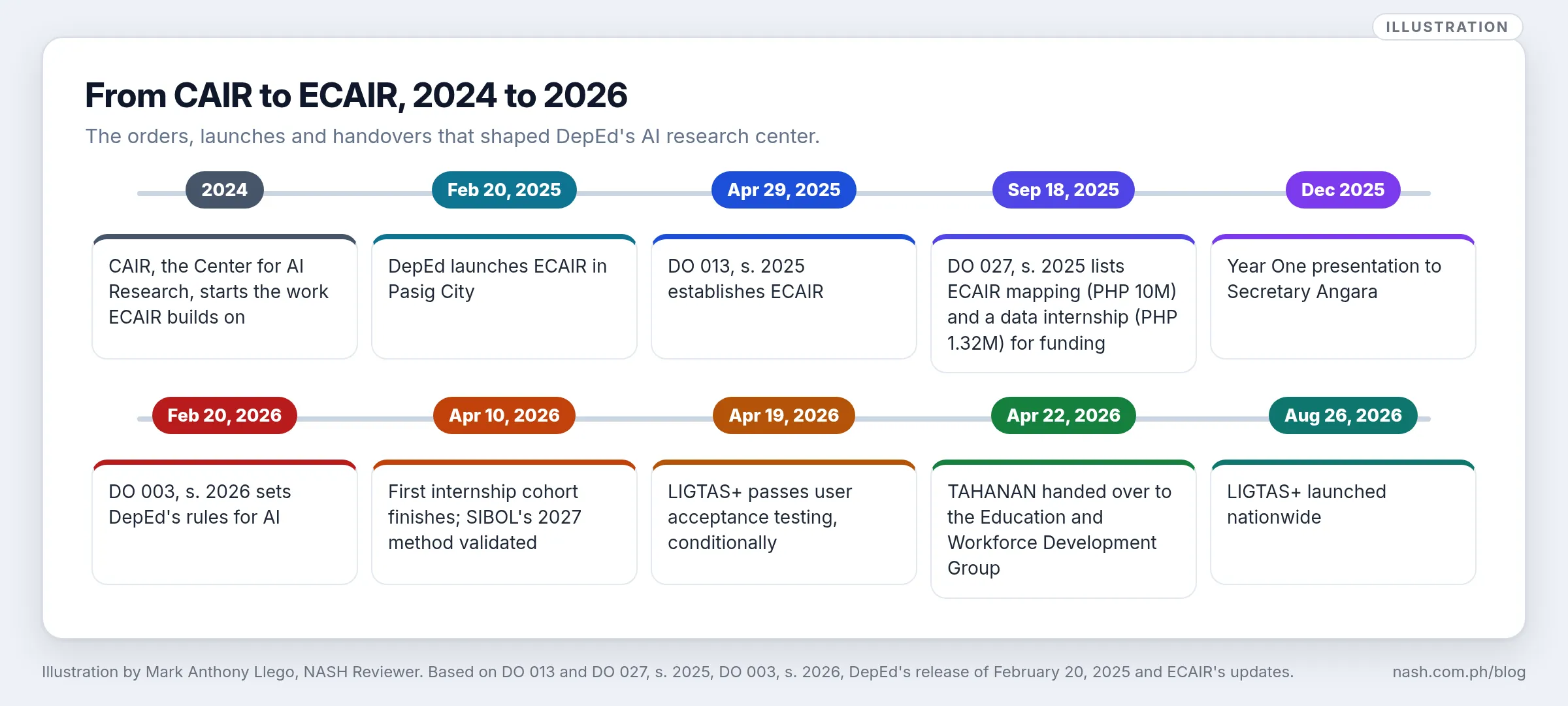
DepEd launched ECAIR in Pasig City on February 20, 2025. Its release said the center “builds on the pioneering efforts that the Center for AI Research (CAIR) has started in 2024” and would develop “AI-driven tools that enhance teaching, learning, and school administration.” Work already under way, it said, included voucher distribution, screening of stunted and wasted learners, screening of learners with disabilities, hazard mapping of public and private schools, Adopt-A-School partnerships and the competencies of school heads. Each is now a named project: PAARAL, SIGLA, SABAY, LIGTAS+, TALINO, and DUNONG with SIKAP.
Beyond the Office of the Secretary funds in para. 7, DepEd has set aside other money for ECAIR’s work. DepEd Order No. 027, s. 2025 (September 18, 2025), which reallocated unobligated FY 2025 funds of the Learning Systems strand, lists “Education Center for AI Research (E-CAIR) Mapping” at PHP 10,000,000 and an “Education data internship in partnership with E-CAIR” at PHP 1,320,000 among the priority projects to be funded from those balances (Annex C). The internship’s first cohort of four finished on April 10, 2026 (ECAIR, April 10, 2026). EdTech Hub’s AI Observatory & Action Lab also supports DepEd and ECAIR. The Philippines is one of six countries, and the only one in Southeast Asia, chosen for the Observatory’s Ministry of Education AI Challenge, an engagement supported by the United Kingdom’s Foreign, Commonwealth & Development Office (DepEd, February 26, 2026).
How ECAIR works: build, pilot, hand over
ECAIR sorts its work into three areas: innovation (machine learning, computer vision and geospatial tools built with DepEd offices), capacity building (AI literacy programs for DepEd and TESDA staff, teacher training and the internship) and policy (research for DepEd’s reforms and investments, and the governance framework for its own systems). It describes its method as “developing and piloting systems with DepEd offices before transitioning them to the unit that will run them permanently.”
Most project pages name a process owner: the DepEd office that owns the work the system supports and that would run it after handover. TALAAN’s and SALIKSEEK’s long-term owners are still being defined, and the PISA research belongs to ECAIR’s own research and policy team. The Disaster Risk Reduction and Management Service (DRRMS) owns LIGTAS+; the Bureau of Learning Resources (BLR) owns SIBOL; the Bureau of Human Resource and Organizational Development (BHROD) and the National Educators Academy of the Philippines (NEAP) own DUNONG and SIKAP. ECAIR builds the system, tests it with that office, and moves to an advisory role once the office takes it over, as it has for TAHANAN.
At the AI Impact Summit in New Delhi in February 2026, ECAIR set out four conditions for taking an AI pilot to the whole school system: technical readiness for nationwide deployment, clear ownership within DepEd, governance built into the system’s design, and open implementation that keeps the public’s trust (DepEd, February 26, 2026).
ECAIR’s projects
ECAIR lists 17 active projects, plus its contribution to national AI governance. The figures below group them by whom they reach first. The status of each is what its ECAIR page reports on the date shown.
Projects that reach schools and learners
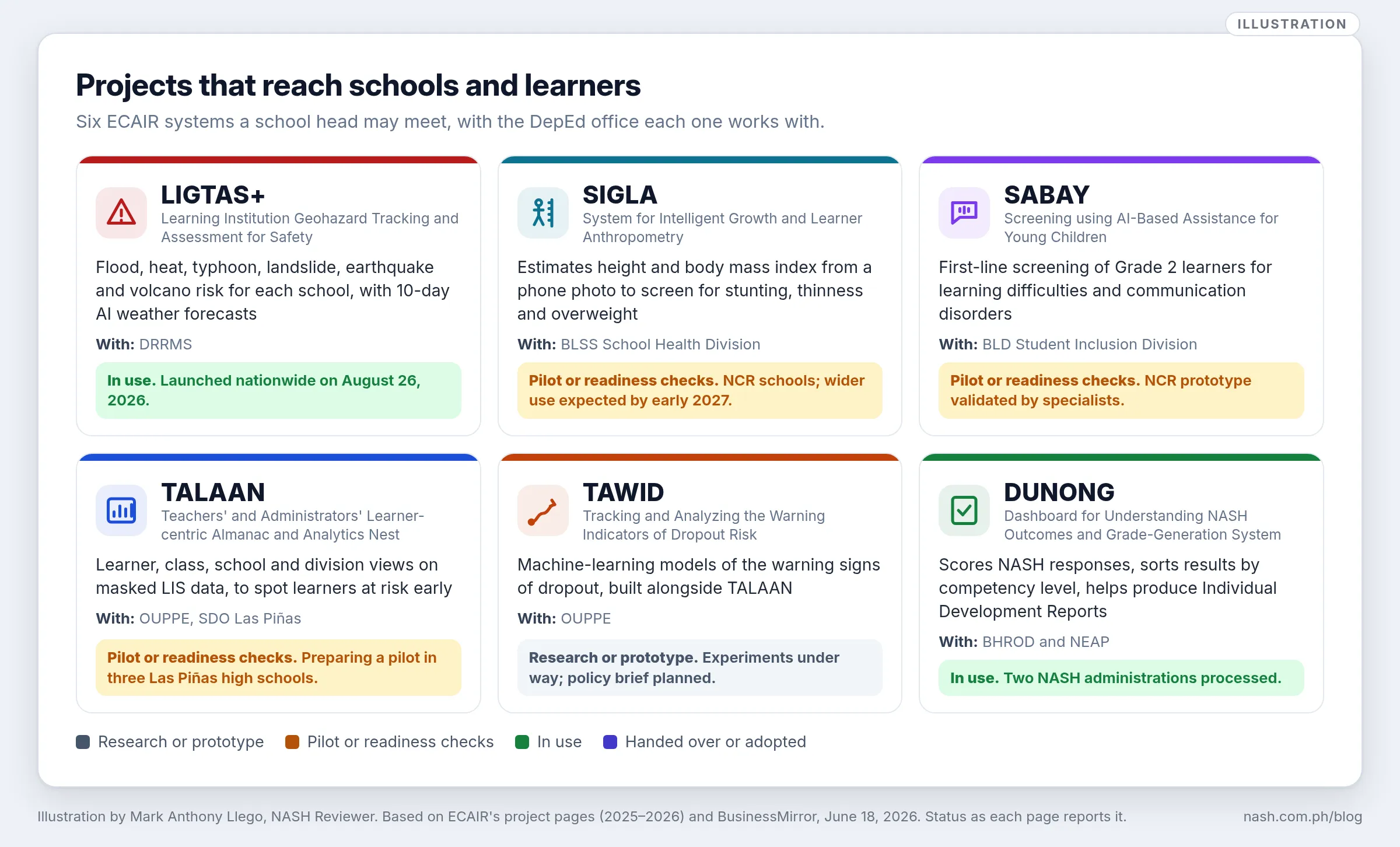
LIGTAS+ (Learning Institution Geohazard Tracking and Assessment for Safety) turns flood, heat-index, typhoon, landslide, earthquake and volcano data into a hazard profile for each school. It draws on PAGASA, PHIVOLCS, the Mines and Geosciences Bureau, the US National Oceanic and Atmospheric Administration and the EU’s Copernicus satellites, and runs three AI weather models for 10-day forecasts (ECAIR, April 30 and August 26, 2026). It completed user acceptance testing with the DRRMS on April 19, 2026 and earned conditional acceptance, and DepEd launched it nationwide in Makati City on August 26, 2026. By ECAIR’s account it gives localized safety information for “more than 47,000 public schools”, and it “supports, but does not replace, official advisories, protocols, or field assessments.” Undersecretary for Governance and Operations Malcolm Garma said DepEd had drafted recommendations for deciding suspensions and resumptions school by school, still under review on launch day (GMA News, August 26, 2026). DepEd Memorandum No. 064, s. 2026 names LIGTAS+ among the “available authorized monitoring platforms” the DRRMS uses (Sec. VII). Its public pages include the Walang Pasok learning continuity monitor and the Field Incidents reports.
SIGLA (System for Intelligent Growth and Learner Anthropometry) estimates a learner’s height and body mass index from a photo taken on a phone, to screen for stunting, thinness, overweight and obesity. It is built with the Bureau of Learner Support Services’ School Health Division (BLSS-SHD), which owns the work. ECAIR says the NCR pilot met the performance threshold the division set, and the next step is a 10-school calibration cohort. BusinessMirror reported on June 18, 2026 that SIGLA had been tested in two NCR schools, would be tested in eight more, and was expected to reach wider use by early 2027. DepEd estimated in February 2026 that SIGLA could save about 60,000 hours a year for about 34,000 teachers. These are estimates and plans, not results. The school’s Baseline Nutritional Assessment, which decides who joins the School-Based Feeding Program, is still the height and weight measurement that DepEd Memorandum No. 059, s. 2026, Guidelines on the Delivery of School Health Services for School Year 2026-2027, sets for Kindergarten to Grade 6 (Encl. No. 1, Part B, item 2(c)); a SIGLA estimate does not replace it.
SABAY (Screening using AI-Based Assistance for Young Children) is a first-line screening tool for learning difficulties and communication disorders in Grade 2, built with the Bureau of Learning Delivery’s Student Inclusion Division (BLD-SID). ECAIR says it “is designed to support early referral and follow-up, not to replace teachers, health professionals, or formal assessment.” DepEd tied it to the child find system of Republic Act No. 11650, the inclusive education law (DepEd, April 28, 2025). The NCR prototype has been validated by medical, allied health and special needs education specialists, and the Philippine Association of Speech-Language Pathologists endorsed it in 2026 (ECAIR, May 15 and June 30, 2026). Learners with disabilities under RA 11650 covers the law SABAY would serve.
TALAAN (Teachers’ and Administrators’ Learner-centric Almanac and Analytics Nest) gives teachers, school heads and division staff learner, class, school and division views built on masked Learner Information System (LIS) data, “without requiring schools to maintain a parallel reporting system.” Its pilot covers three secondary schools in Las Piñas: Las Piñas National High School, Las Piñas East National High School and Golden Acres National High School. Its data governance framework was signed by Undersecretaries Rafaelita Aldaba and Malcolm Garma. In workshops in May 2026, teachers consistently pointed to attendance as a common sign of dropout risk, and the Schools Division Office recommended piloting with Grade 7 learners rather than Grade 10 (ECAIR, May 12 and June 30, 2026). TAWID (Tracking and Analyzing the Warning Indicators of Dropout Risk) is the machine-learning work behind TALAAN’s risk signals, still in experimentation, with a policy brief planned.
DUNONG (Dashboard for Understanding NASH Outcomes and Grade-Generation System) scores NASH responses, sorts results by competency level and helps DepEd generate Individual Development Reports. ECAIR built it with BHROD and NEAP and says it has processed the September 2025 and May 2026 administrations. DepEd’s results memoranda set the method it applies. DUNONG: The Platform That Scores the NASH compares ECAIR’s figures with DepEd’s. The policy study behind it, SIKAP, is under the data and policy projects below.
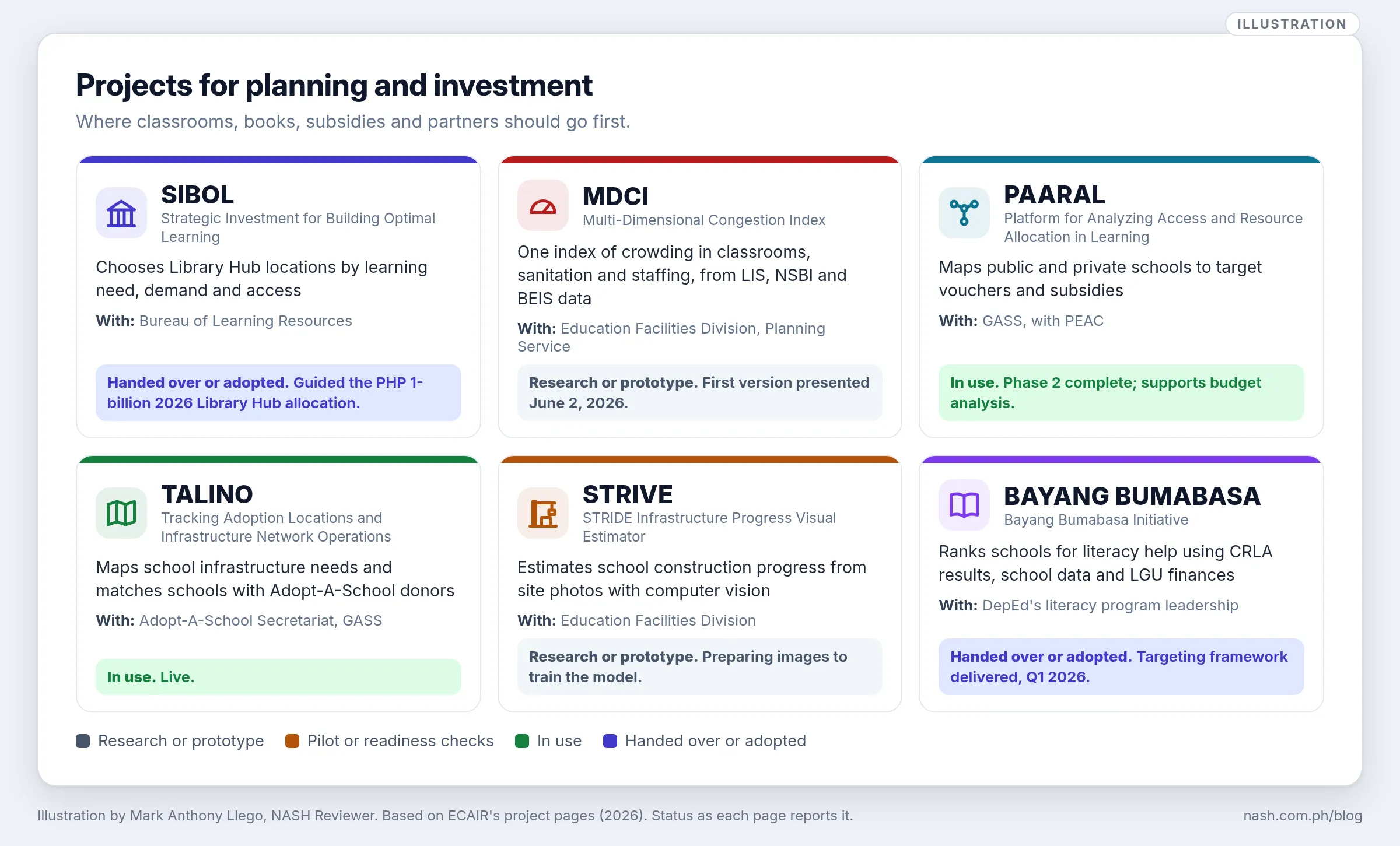
Projects for planning and investment
| Project | What it does | DepEd partner | Status (ECAIR page date) |
|---|---|---|---|
| SIBOL (Strategic Investment for Building Optimal Learning) | Chooses Library Hub locations by learning need, demand and access | Bureau of Learning Resources | Guided the PHP 1-billion 2026 Library Hub allocation; a five-step method for the 2027 cycle was validated with the BLR on April 10, 2026 (June 30, 2026) |
| MDCI (Multi-Dimensional Congestion Index) | One school-level index of crowding in classrooms, sanitation and WASH facilities, and staffing, from LIS, NSBI and BEIS data | Education Facilities Division and Planning Service | First version presented to the Executive Committee on June 2, 2026; still being validated (June 30, 2026) |
| PAARAL (Platform for Analyzing Access and Resource Allocation in Learning) | Maps public and private schools to target vouchers and subsidies | GASS, with PEAC | Phase 2 analytics complete; ad hoc analysis continues (March 31, 2026) |
| TALINO (Tracking Adoption Locations and Infrastructure Network Operations) | Maps school infrastructure needs and matches schools with Adopt-A-School donors | Adopt-A-School Program Secretariat and GASS | Live (March 31, 2026) |
| STRIVE (STRIDE Infrastructure Progress Visual Estimator) | Estimates school construction progress from site photos | Education Facilities Division | First large batch of site photos received; moving toward annotation at the scale model training needs (June 30, 2026) |
| Bayang Bumabasa Initiative | Ranks schools for literacy interventions using CRLA results, school data and local government finances | DepEd’s literacy program leadership | Targeting framework delivered in the first quarter of 2026 (March 31, 2026) |
SIBOL is the clearest case of a project changing a decision. DepEd said in April 2026 that the Library Hubs under the 2026 Basic Education Facilities Fund would be placed using an ECAIR tool that identifies schools by learning need, expected use and equity (DepEd, April 16, 2026), and ECAIR says the BLR adopted its priority list. PAARAL’s early study of the Senior High School Voucher Program found that, on average, students still needed about PHP 20,000 out of pocket despite a PHP 9,000 government subsidy (PIDS, June 19, 2025). TALINO was already in use by the Adopt-A-School Secretariat in 2025, according to ECAIR’s midyear report, which DepEd presented (GMA News, September 24, 2025).
Projects on data, policy and the workforce
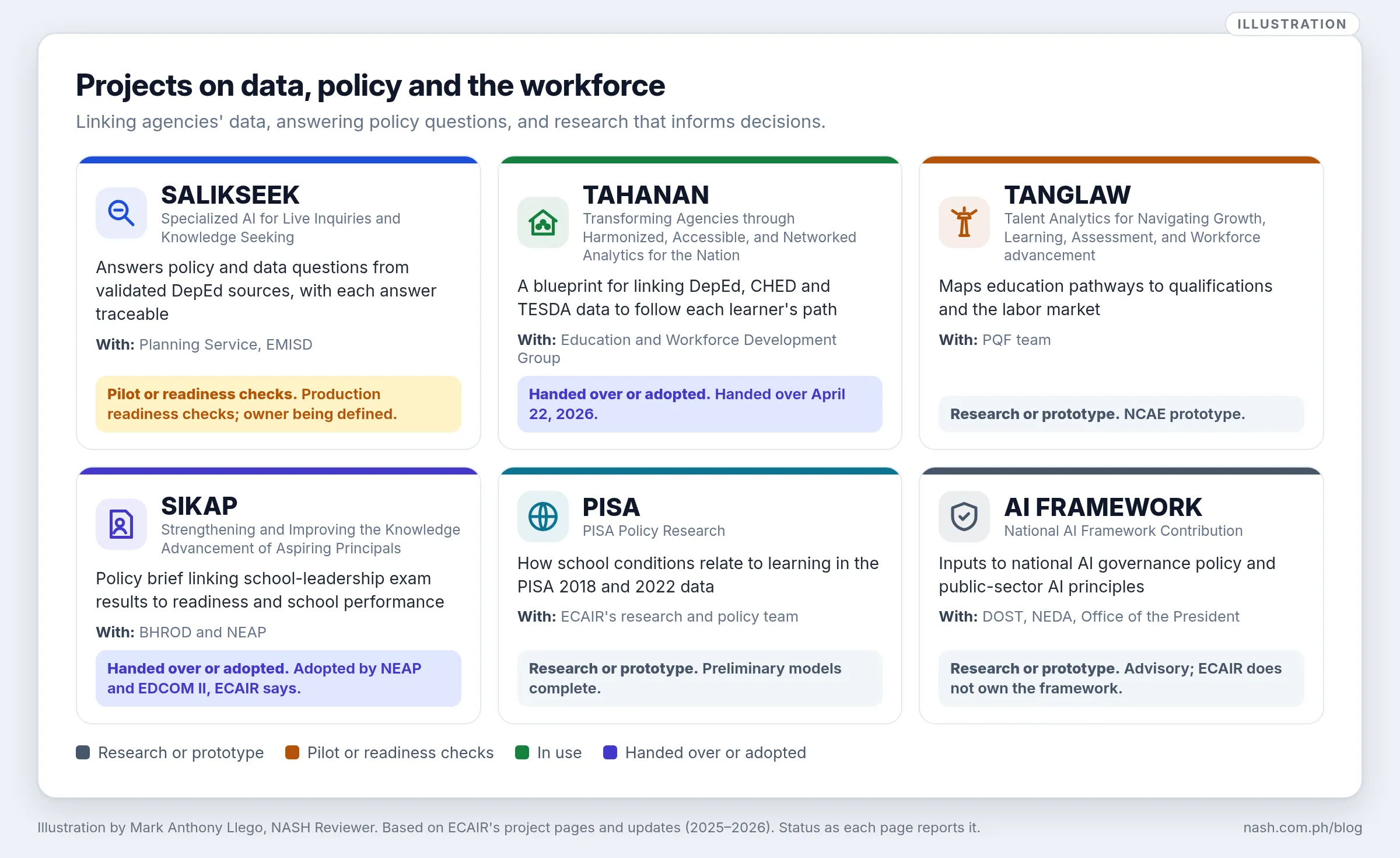
SALIKSEEK (Specialized AI for Live Inquiries and Knowledge Seeking) answers policy and education-data questions from validated DepEd sources, using retrieval-augmented generation, so that each answer can be traced to its source. The Planning Service owns it, with the Education Management Information System Division (EMISD). ECAIR says it passed proof-of-concept and structured testing and is completing production readiness checks while a permanent owner is defined (ECAIR, March 31, 2026).
TAHANAN (Transforming Agencies through Harmonized, Accessible, and Networked Analytics for the Nation) is a blueprint for linking the data of DepEd, CHED and TESDA, so that a learner’s path from basic education into college, training and work can be followed. ECAIR handed it over to the Education and Workforce Development Group on April 22, 2026, and a memorandum of agreement among DepEd, CHED, TESDA and Analytiks, Inc. to put it into operation was signed in July 2026. At the same event, ECAIR launched Project Ugnay, a map of education institutions and the pathways between them for the three agencies (ECAIR, April 22 and July 17, 2026).
TANGLAW maps education pathways to qualifications and the labor market for the PQF team; it has reached an NCAE prototype. The PISA Policy Research project studies how school conditions relate to learning in the PISA 2018 and 2022 data; its exploratory analysis and preliminary modeling are complete. ECAIR also counts its National AI Framework Contribution, inputs to national AI governance with DOST, NEDA and the Office of the President, as policy advice rather than a system it owns.
SIKAP (Strengthening and Improving the Knowledge Advancement of Aspiring Principals) is ECAIR’s first policy study. Published by SEAMEO INNOTECH with ECAIR, it analyzed the FY 2023 NQESH results of 21,803 teachers and proposed ten changes to how principals are prepared. ECAIR says the brief was turned over to NEAP and “adopted by NEAP and EDCOM II.” The SIKAP study explained sets out its findings and what has changed since.
Who the projects serve
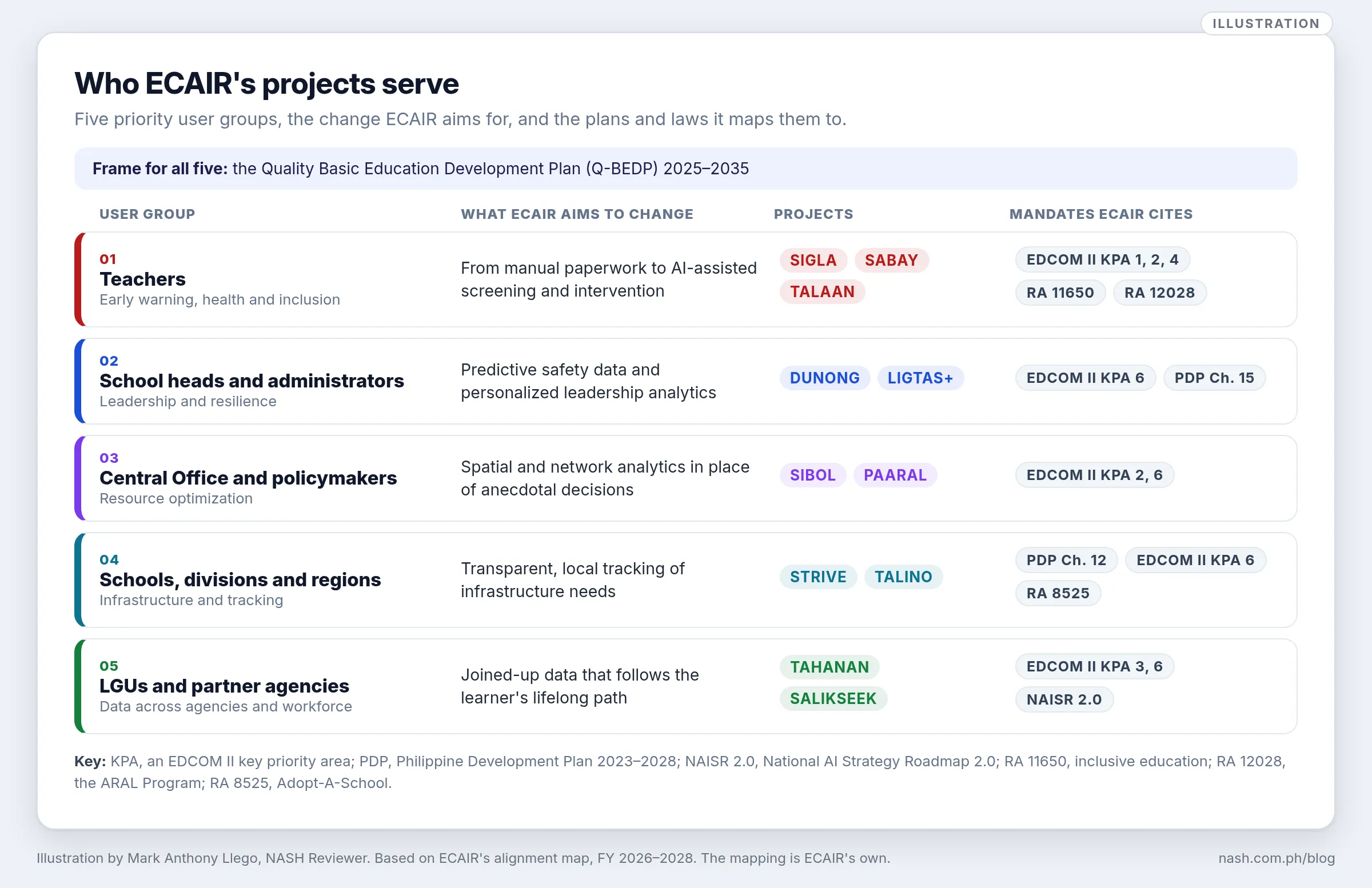
ECAIR maps its portfolio to five groups of users and, for each, to national plans and laws. The mapping is ECAIR’s own; it shows what each project is meant to serve, not a mandate DepEd has given it.
| User group | What ECAIR aims to change | Projects | Mandates ECAIR cites |
|---|---|---|---|
| Teachers | “Shift from manual administrative burden to AI-assisted screening and intervention.” | SIGLA, SABAY, TALAAN | EDCOM II priority areas 1, 2 and 4; RA 11650 (inclusive education); Republic Act No. 12028, the Academic Recovery and Accessible Learning (ARAL) Program Act |
| School heads and administrators | “Empower principals with predictive safety data and personalized leadership analytics.” | DUNONG, LIGTAS+ | EDCOM II priority area 6; Philippine Development Plan, Ch. 15 |
| Central Office and policymakers | “Replace anecdotal policy decisions with spatial and network analytics.” | SIBOL, PAARAL | EDCOM II priority areas 2 and 6 |
| Schools, divisions and regions | “Transparent, localized tracking of massive infrastructure needs.” | STRIVE, TALINO | Philippine Development Plan, Ch. 12; EDCOM II priority area 6; Republic Act No. 8525, the Adopt-a-School Act of 1998 |
| LGUs and partner agencies | “Address data silos to track the lifelong journey of the Filipino learner.” | TAHANAN, SALIKSEEK | EDCOM II priority areas 3 and 6; National AI Strategy Roadmap 2.0 |
ECAIR places all five groups within the Quality Basic Education Development Plan 2025-2035.
ECAIR’s figures and what each counts
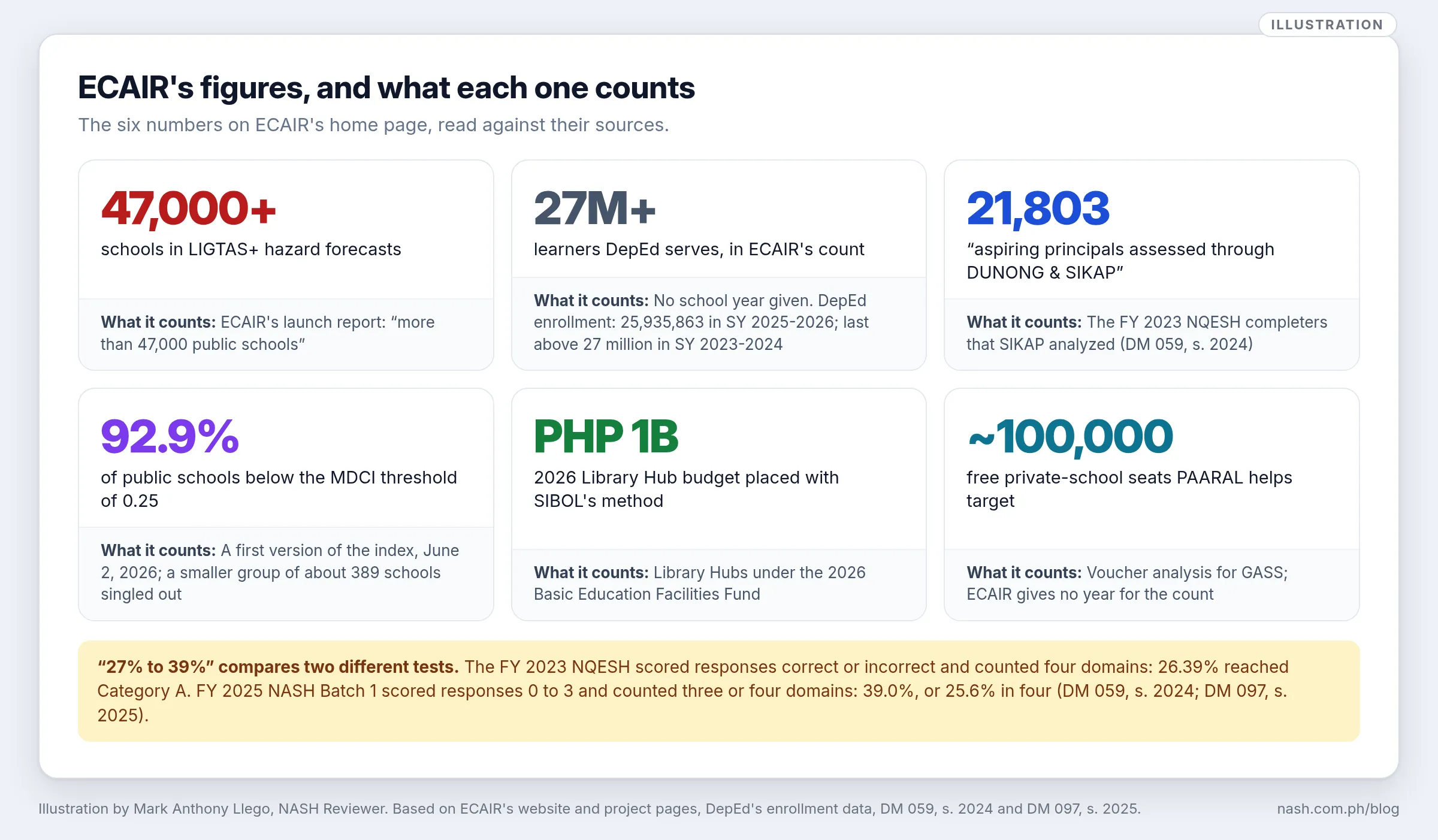
ECAIR’s home page leads with six numbers. Each counts something narrower or different from what a quick reading suggests:
| ECAIR’s figure | What it counts |
|---|---|
| 47,000+ schools covered by LIGTAS+ | The schools in the LIGTAS+ hazard profiles; ECAIR’s launch report says “more than 47,000 public schools”, and its project page “47,000+ schools and offices” |
| 27M+ learners DepEd serves | ECAIR’s figure, with no school year. DepEd’s enrollment data count 25,935,863 learners in SY 2025-2026, 22,078,460 of them in public schools; the total last passed 27 million in SY 2023-2024, at 27,081,292 (enrollment trends, 2017 to 2026) |
| 21,803 aspiring principals “assessed through DUNONG & SIKAP” | The FY 2023 NQESH completers (21,803 of 22,000 examinees) whose results SIKAP analyzed (DepEd Memorandum No. 059, s. 2024, para. 1). ECAIR’s 2025 midyear report, as DepEd presented it, said DUNONG “automates the processing” of the NQESH (GMA News, September 24, 2025); it later scored both FY 2025 NASH batches |
| 92.9% of public schools below the MDCI threshold | A first version of the index presented on June 2, 2026: 92.9% of public schools scored below 0.25, and “a smaller group of approximately 389 schools emerged as requiring more focused attention.” The 389 are not the other 7.1%, which would be thousands of schools. The index is still being validated |
| PHP 1 billion | The 2026 Library Hub allocation that SIBOL’s priority list guided |
| About 100,000 free private-school seats | Seats in private schools that PAARAL’s voucher analysis helps GASS target; ECAIR gives no year for the count |
A separate claim needs the same care. ECAIR reports that DUNONG “supported” BHROD while “the NQESH passing rate rose from 27% in 2024 to 39% in 2025” (ECAIR, December 31, 2025). The two figures come from two tests that differ in how they were scored and in what counted as passing. In the FY 2023 NQESH, whose results came out in October 2024, “each response was evaluated as either correct or incorrect” (DM 059, s. 2024, para. 5). Only Category A, 65 or higher overall and in at least four domains, made a taker eligible for appointment: 5,753 of 21,803 completers (26.39%). The 3,553 (16.30%) who reached 65 in three domains could only retake the test (para. 6). In Batch 1 of the FY 2025 NASH, each response was scored from 0 to 3, and both the four-domain level, 2,899 takers (25.6%), and the three-domain level, 1,509 (13.3%), became prospective candidates (DepEd Memorandum No. 097, s. 2025, paras. 3 to 5). Together that is 4,408 of 11,308, or 39.0% (computed; the printed shares add to 38.9%). At the same cut-off, the share fell: from 26.4% to 25.6% at four domains, and from 42.7% to 39.0% at three or more (computed). ECAIR’s 27% matches neither memorandum. Both memoranda also standardize scores within each batch “using z-statistics” (DM 059, s. 2024, para. 5; DM 097, s. 2025, para. 4). The NASH replaced the NQESH under DepEd Memorandum No. 069, s. 2025. NASH vs NQESH and NASH results 2025 explained cover both.
How DepEd’s AI rules apply to ECAIR’s systems
DO 003, s. 2026 does not name ECAIR or any of its projects. It covers “the adoption and use of artificial intelligence (AI) in basic education”, including “education governance and operations across all DepEd governance levels” (Sec. II), which takes in systems like LIGTAS+, SIGLA and TALAAN. Its rules for teachers, learners and school heads are explained in DepEd AI Guidelines: What DO 003, s. 2026 Allows and Bans.
| Rule | What DO 003, s. 2026 requires | Section |
|---|---|---|
| Human decisions | AI in school and office operations “shall not, under any circumstance, make final decisions”; “final decisions shall still be made by DepEd personnel” | VI.1.4 |
| Risk classes | Uses are sorted into unacceptable, high, limited and minimal risk. AI used for grading, admissions, scholarships, discipline or placement is high risk and needs a completed PIA, human oversight, audit logging and an appeal mechanism | VI.1.5 |
| Biometric data | Emotion recognition is an unacceptable risk, but “health-, developmental-, or assistive-oriented analyses using biometric data, limited to the identification of potential support needs and not involving automated decision-making, are permitted subject to applicable approval, safeguards, consent, clearance and oversight” | VI.1.5(i) |
| Personal data | Documents with personally identifiable information “shall not be uploaded, shared, or processed through AI platforms”; processing “within internally governed DepEd AI systems may be permitted solely for approved research or operational purposes”, with data minimization, anonymization, consent where applicable and safeguards | VII.1.1 |
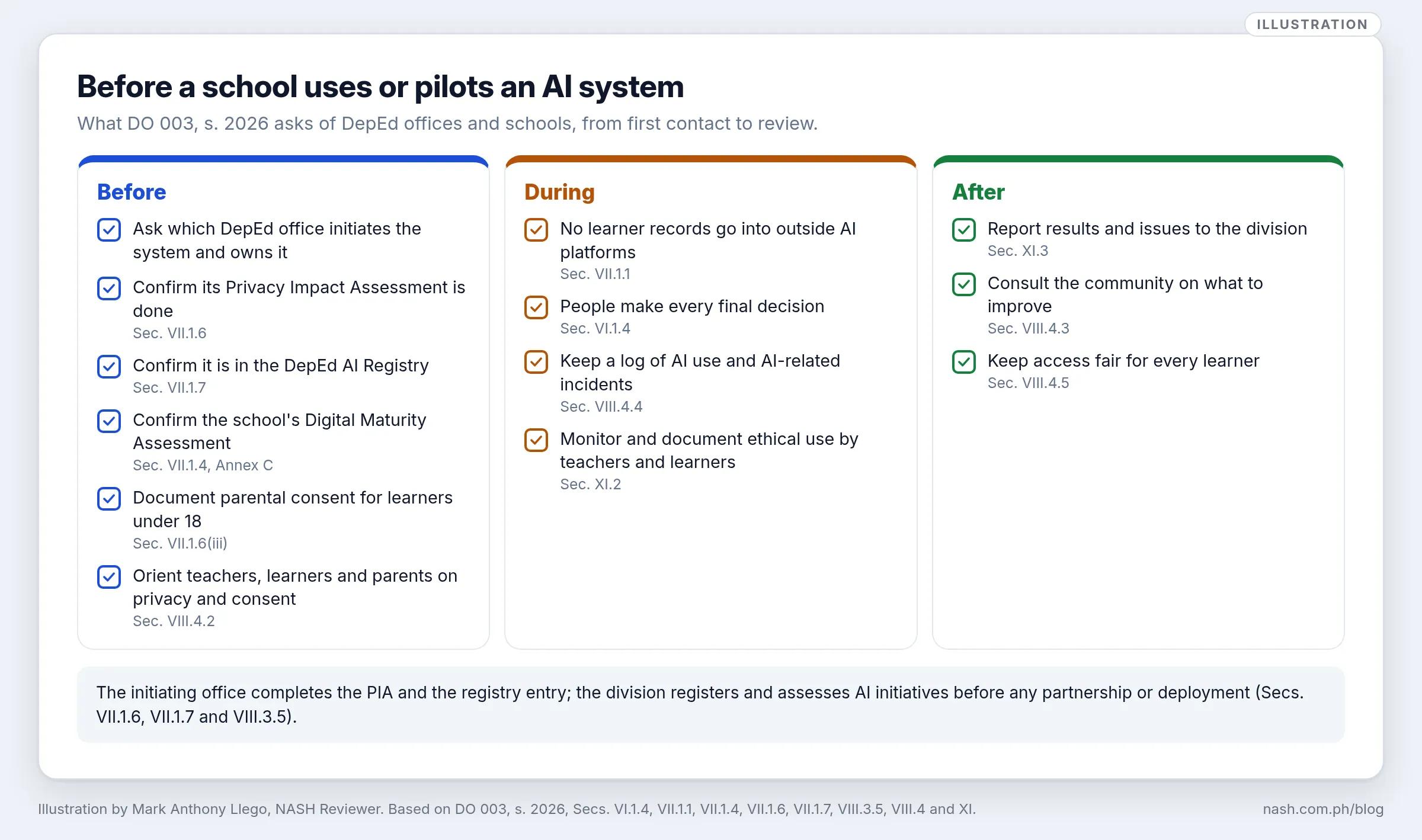
| Privacy Impact Assessment | “Before deploying AI tools in DepEd systems or schools, the initiating office shall conduct a PIA”; “Parental consent is mandatory for learners under 18 years old” | VII.1.6 |
| DepEd AI Registry | “each AI system shall be registered prior to use”, with its purpose, risk class, PIA results and responsible officers; the initiating office registers it | VII.1.7 |
| Vendor warranties | Warranties against commercial training on DepEd data, for content provenance and for 72-hour breach reporting are required, but “shall not apply to AI systems developed or operated internally by DepEd for approved research, development, or capacity-building purposes” | VII.1.5 |
Screening tools that read a learner’s photo or speech, such as SIGLA and SABAY, are the kind of health and developmental analysis the biometric exception allows, as long as they only identify support needs and leave every decision to people; ECAIR’s pages describe both that way, though the Order names neither. Annex B’s nearest example for learners, AI used to “support early identification of wellness concerns”, is listed as High-Risk AI, “permitted subject to strict safeguards”: a completed PIA, human oversight, audit logging and an appeal mechanism (Sec. VI.1.5). SABAY also meets Sec. VI.1.1. Grade 2 is in Key Stage 1, where AI use “is limited exclusively to teacher preparation and the development of differentiated instructional materials”, and learners aged 13 and below may use AI tools only under teacher supervision and with prior parental notification. No issuance says whether a screening game counts as “direct learner engagement with AI tools”; a school asked to pilot SABAY can ask the BLD-SID how the pilot meets Sec. VI.1.1. Annex B also lists among unacceptable uses “using AI to determine or recommend what strand a Grade 10 student should take in SHS”, which any learner-level use of TANGLAW’s NCAE work would have to avoid.
Two provisions on personal data pull against each other. Sec. VI.1.3 says that in data and research work “the input, processing, or storage of personal and sensitive information within AI systems is categorically prohibited”, while Sec. VII.1.1 permits such processing in “internally governed DepEd AI systems” for approved purposes. No issuance reconciles them. None says either whether a system ECAIR builds is “developed or operated internally by DepEd” (Sec. VII.1.5): ECAIR is not a government office (DO 013, s. 2025, para. 8), and every partnership must be governed by “a Memorandum of Agreement, Data Sharing Agreement, or any similar agreement” (Sec. VI.3.5). A school can ask the initiating office which agreement covers the learner data a system uses.
The school head’s own duties are in Sec. VIII.4: provide teachers professional development on AI, orient teachers, learners and parents on data privacy and informed consent, consult the community, keep a record of AI tool use and AI-related incidents, and ensure equitable access.
What this means for school heads
- Know who owns each system. ECAIR builds, but a DepEd office owns: the DRRMS for LIGTAS+, BLSS-SHD for SIGLA, BLD-SID for SABAY, BHROD and NEAP for DUNONG. Questions about how a system is used, and requests for school data, go through that office and the division.
- Treat LIGTAS+ as a source of information, not an order. Class suspensions still follow DepEd Order No. 022, s. 2024, and learning continuity reporting follows DepEd Order No. 014, s. 2026. Class suspensions and school DRRM and the 4H levels and the heat index explain both. Use the platform’s hazard profile in the school’s risk assessment and contingency plan.
- Before a pilot starts in your school, check what DO 003, s. 2026 requires. The Strategic Management and Learning Systems strands and the ICTS “shall review, assess, and evaluate any AI tool or technology proposed for use in DepEd offices and public schools” (Sec. VI.3.5). Ask for the PIA and the AI Registry entry (Secs. VII.1.6 and VII.1.7), confirm that the school has been assessed with the Digital Maturity Assessment Tool (Sec. VII.1.4, Annex C), make sure parental consent is documented for every learner under 18 (Sec. VII.1.6(iii)), and keep the school’s own record of the tool’s use and any incident (Sec. VIII.4.4).
- Keep the human work that a screening tool feeds. A SIGLA flag or a SABAY result points to a learner who may need a closer look; ECAIR designs both to support referral and follow-up, not to replace health professionals or formal assessment. DO 003, s. 2026 treats AI used for placement decisions as high risk (Sec. VI.1.5), and final decisions stay with DepEd personnel (Sec. VI.1.4). The Baseline Nutritional Assessment needs no consent (DM 059, s. 2026, Encl. No. 1, Part B, item 2(b)(i)), but parental consent is required before an AI tool processes a learner’s data (DO 003, s. 2026, Sec. VII.1.6(iii)).
- Keep the school’s data clean. MDCI and TALAAN are built on data schools already report: the Learner Information System (LIS), the National School Building Inventory (NSBI) and the Basic Education Information System (BEIS). A wrong enrollment count or a missing classroom record follows the school into every ranking built on it.
- Use DUNONG’s output if you take the NASH. The Individual Development Report it helps produce is the guide to your development program; NASH TDP and PDI covers what follows each result.
This work serves the PPSSH: data-based planning and resource decisions in Domain 1, school safety and the management of school data in Domain 2, and partnerships such as Adopt-A-School in Domain 5.
Frequently asked questions
What is ECAIR in DepEd?
ECAIR, the Education Center for AI Research, is DepEd’s center for AI research and development, established by DO 013, s. 2025 through a partnership with SEAMEO. It says it builds and pilots AI and data systems such as LIGTAS+, SIGLA and DUNONG with DepEd offices before handing each to the office that will run it. It “will operate primarily for DepEd” (para. 4).
Is ECAIR a government office?
No. DO 013, s. 2025 “does not make ECAIR a governmental office”, and its employees and officers “are not deemed employees of the government or public officers” (para. 8). Its research costs for DepEd programs are paid from Office of the Secretary funds (para. 7), and it is hosted day to day by SEAMEO INNOTECH.
Who heads ECAIR?
ECAIR’s managing director and Chief AI and Data Officer is Dr. Erika Fille T. Legara. Under DO 013, s. 2025, the Undersecretary and Chief of Staff is the oversight head (para. 6). DepEd’s directory, as of September 22, 2026, lists ECAIR under Undersecretary Rafaelita M. Aldaba, whose office ECAIR calls OUPPE.
Can my school use LIGTAS+ or SIGLA now?
LIGTAS+ was launched nationwide on August 26, 2026, and its public pages, including the Walang Pasok monitor, are open at ligtas.cair.ph/preview; Undersecretary Garma said schools will be able to access the platform (GMA News, August 26, 2026). SIGLA is still a pilot in NCR schools, with wider use expected by early 2027 (BusinessMirror, June 18, 2026). Before any AI pilot in a school, DO 003, s. 2026 requires the checks in item 3 of “What this means for school heads” above.
Does ECAIR run the NASH?
No. ECAIR’s DUNONG platform scores the NASH responses and helps generate the Individual Development Reports. BHROD’s Human Resource Development Division administers the assessment, and DepEd’s results memoranda set the scoring method and the competency levels (DM 097, s. 2025, paras. 3 to 5).
Sources
DepEd issuances
- DepEd Order No. 013, s. 2025, Establishment of the Center for Artificial Intelligence Research for the Department of Education, April 29, 2025, paras. 1 to 9.
- DepEd Order No. 027, s. 2025, Guidelines on the Use of Balances from Fiscal Year 2025 (Republic Act No. 12116) Funds under the Learning Systems Strand, September 18, 2025, Annex C.
- DepEd Order No. 003, s. 2026, Foundational Guidelines on Artificial Intelligence (AI) in Basic Education, February 20, 2026, Secs. II, VI.1.1, VI.1.3 to VI.1.5, VI.3.5, VII.1.1, VII.1.4 to VII.1.7, VIII.3.5, VIII.4 and XI, and Annex B.
- DepEd Order No. 022, s. 2024, Revised Guidelines on Class and Work Suspension in Schools During Disasters and Emergencies, December 23, 2024.
- DepEd Order No. 014, s. 2026, Guidelines on Learning Continuity in Emergencies, June 4, 2026.
- DepEd Memorandum No. 059, s. 2024, Results of the Fiscal Year 2023 National Qualifying Examination for School Heads and Fiscal Year 2021 NQESH Category B Evaluation and Certification, October 18, 2024, paras. 1, 5 and 6.
- DepEd Memorandum No. 069, s. 2025, Administration of the National Assessment for School Heads for Fiscal Year 2025, August 11, 2025.
- DepEd Memorandum No. 097, s. 2025, Results of the National Assessment for School Heads for Fiscal Year 2025 Batch 1, October 21, 2025, paras. 3 to 5.
- DepEd Memorandum No. 059, s. 2026, Guidelines on the Delivery of School Health Services for School Year 2026-2027, September 26, 2026, Encl. No. 1, Part B, item 2.
- DepEd Memorandum No. 064, s. 2026, Anticipatory Action, Preparedness, and Protective Measures for the 2026–2027 Super El Niño, October 26, 2026, Sec. VII.
DepEd releases and directory
- DepEd. DepEd launches AI center for education. February 20, 2025.
- DepEd. Groundbreaking initiatives para sa inclusive education, pinapangunahan ng DepEd. April 28, 2025.
- DepEd. DepEd at EdTech Hub, inilatag ang Filipino-led AI innovation sa edukasyon sa global AI summit. February 26, 2026.
- DepEd. Angara, ikakasa ang P1-B Library Hubs gamit ang AI. April 16, 2026.
- DepEd. Angara, isinusulong ang AI solutions bilang tugon sa education system gaps. April 30, 2026.
- DepEd. Central Office Directory. As of September 22, 2026.
ECAIR
- Education Center for AI Research. ECAIR: “About us”, “Governance & leadership”, “The numbers so far” and “Alignment with the national mandate”. Accessed November 9, 2026.
- ECAIR project pages: LIGTAS+, SIGLA, TALAAN, SABAY, SIBOL, STRIVE, MDCI, TAWID, PISA Policy Research (June 30, 2026); DUNONG (May 31, 2026); TAHANAN (April 30, 2026); TALINO, PAARAL, SALIKSEEK, Bayang Bumabasa Initiative (March 31, 2026); SIKAP, TANGLAW (December 31, 2025); National AI Framework Contribution (March 31, 2025).
- ECAIR updates: DUNONG strengthens DepEd’s school leadership pipeline (December 31, 2025); ECAIR celebrates the first cohort of its Education AI Research Internship (April 10, 2026); SIBOL research guides DepEd’s Library Hub investments into a second cycle (April 10, 2026); ECAIR turns over TAHANAN Blueprint at inaugural EWDG convening (April 22, 2026); LIGTAS+ earns conditional acceptance in UAT with DRRMS (April 30, 2026); TALAAN advances pre-pilot with school leaders and teacher ideation workshops (May 12, 2026); SABAY earns endorsement from speech-language pathologists (May 15, 2026); ECAIR launches Project Ugnay (July 17, 2026); DepEd launches LIGTAS+ nationwide (August 26, 2026).
News reports
- GMA News. DepEd says AI-powered reforms will boost integrity, resource allocation. September 24, 2025.
- Philippine Institute for Development Studies. PIDS-UP forum explores AI use to address class disruptions, education subsidies. June 19, 2025.
- Ogerio, B. A. AI enters school health checks with 2027 expansion. BusinessMirror, June 18, 2026.
- Untalan, S. DepEd’s Project LIGTAS+ aims for school-level class suspensions, resumptions. GMA News, August 26, 2026.
Written by Mark Anthony Llego for NASH Reviewer. Sources: DepEd Orders No. 013 and 027, s. 2025, and No. 003, s. 2026; DepEd Memoranda No. 059, s. 2024, No. 069 and 097, s. 2025, and No. 059 and 064, s. 2026; DepEd releases; ECAIR’s website, project pages and updates; GMA News, BusinessMirror and PIDS.