The Field Incidents view on DepEd’s LIGTAS+ platform shows the incident reports that schools filed after typhoons, earthquakes, floods and other hazards. At 5:10 p.m. on November 4, 2026 (Philippine time), it held 48,429 reports dated January 1, 2025 to November 4, 2026, from 24,333 schools. Added together, the reports record 82,393 classrooms with minor damage, 26,832 with major damage and 24,778 totally damaged. Schools file such reports because DepEd Order No. 21, s. 2015 requires every school to “Conduct rapid assessment of damages after every hazard and submit RADaR (See Annex A and B) within 72 hours”, and DepEd Order No. 033, s. 2021 repeats the duty for typhoons and floods.
Read every total with three limits. The totals are sums across reports, so a classroom, facility or learner that appears in two reports is counted twice. They cover only the schools that reported into this system, not all disaster damage in the country. And every report carries the status “Imported”: as of November 4, 2026, no issuance calls these reports verified, and the view does not show which ones a division has vetted.
Class suspensions and the 4H learning continuity levels that schools report are covered in the post on the LIGTAS+ Walang Pasok monitor.
Key findings
- 48,429 incident reports from 24,333 schools, dated January 1, 2025 to November 4, 2026: 26,694 in 2025 and 21,735 in 2026. The reporting schools equal half of the 48,129 public schools in DepEd’s SY 2025-2026 enrollment data. (LIGTAS+ Field Incidents, as of 5:10 p.m., November 4, 2026)
- Typhoons: 22,520 reports (46.5%); earthquakes: 10,996 (22.7%); heavy rainfall: 7,825 (16.2%); floods: 3,532 (7.3%). Earthquake reports record 8,729 totally damaged classrooms and typhoon reports 8,643. (LIGTAS+ Field Incidents)
- Typhoon reports dated November 2025 (Tino and Uwan) number 10,139 and record 4,788 totally damaged classrooms, 55.4% of those in all typhoon reports. Earthquake reports dated September 30 to October 8, 2025 (Cebu), October 9 to 31, 2025 (Davao Oriental) and June 2026 (Sarangani) each record more than 2,300. (LIGTAS+ Field Incidents)
- 42,869 reports (88.5%) record a class suspension and 4,668 (9.6%) a school used as an evacuation center. The average report gives 3.09 learning-loss days. (LIGTAS+ Field Incidents)
- Schools asked most often for DepEd’s Disaster Preparedness and Response Program (DPRP) fund for clean-up, clearing and minor repairs: 15,415 reports, 68.2% of the 22,605 needs raised. Major repairs follow with 3,233. (LIGTAS+ Field Incidents)
- A school submits its Rapid Assessment of Damages Report (RADaR) within 72 hours of any hazard, and the division verifies it. DepEd’s central office then has engineers assess classroom and furniture damage and prepare a program of work for repair funds. (DO 21, s. 2015, Sec. IV.A.1.q, IV.A.2.t and V.B; DO 44, s. 2018, Annex A)
What the Field Incidents view is
LIGTAS+ is DepEd’s hazard platform for schools, run by the Disaster Risk Reduction and Management Service (DRRMS) with the Education Center for AI Research (ECAIR). Field Incidents is listed under “Views” on ligtas.cair.ph/preview and needs no sign-in. It filters by date, hazard, region and division, and shows headline counts, damaged facilities, the support schools requested, report status, charts and a table of school records in which “Reporter contact details are not shown.”
Each record is one report about one incident at one school. The classroom counts follow RADaR 1 of DO 21, s. 2015 (classrooms totally damaged, with major damage and with minor damage), and the chairs, learning materials and IT equipment counts follow RADaR 2 (armchairs, learning materials and computer equipment); the forms have no WASH or ancillary-facility item. As of November 4, 2026, no issuance says whether the view draws on RADaR submissions, and the view does not name its source.
Which DepEd issuances require schools to report incidents and damage
DO 21, s. 2015 sets the duty: schools “shall be the primary source of data” (Sec. IV.A.1) and submit the RADaR “within 72 hours” after any hazard, by text message on its 2015 forms (Sec. IV.A.1.q and V.B). DO 033, s. 2021 adds a 24-hour update and the 72-hour RADaR for typhoons and floods (paras. 26 and 27). DepEd Order No. 022, s. 2024 tells schools to “abide by” the protocols of DO 21, s. 2015 (Sec. V) and has engineers inspect school facilities “to vet damages as reported by school DRRM coordinators” (Sec. III.9). DepEd Order No. 014, s. 2026 routes incident reporting “through the official mechanism anchored in the DRRMS incident management reporting system” (para. 52). DepEd Memorandum No. 064, s. 2026, on the 2026-2027 Super El Niño, has schools report “significant risks, incidents, service disruptions, and resource gaps through established channels”, with no separate El Niño reporting system (enclosed guidelines, Sec. 9.1 and 9.4). The steps, in the order a school meets them, are under “What this means for school heads” below.
Who files. Since DO 033, s. 2021, the school DRRM coordinator “shall be different from the School Head”: one teaching or non-teaching staff member, preferably non-teaching, with an alternate (paras. 13, 14 and 35, amending DO 21, s. 2015). The school head stays accountable for damage caused by “negligence and/or non-compliance to disaster preparedness measures” (para. 12), and whoever sends the RADaR 2 form certifies “that the information sent is true and accurate” (DO 21, s. 2015, Annex B).
Who checks. The SDO verifies the RADaRs that schools submit (DO 21, s. 2015, Sec. IV.A.2.t and IV.B.2.k) and, after a typhoon or flood, submits a vetted consolidated RADaR 48 to 72 hours after landfall, which the regional office validates (DO 033, s. 2021, Encl. No. 3). A division whose schools had no damage and housed no evacuees submits “a certification of no damages and no schools were used as evacuation centers” (DO 21, s. 2015, Sec. V.B).
How many incidents schools have reported since January 2025
The view’s counts change as reports arrive, so give any figure from it with its time.
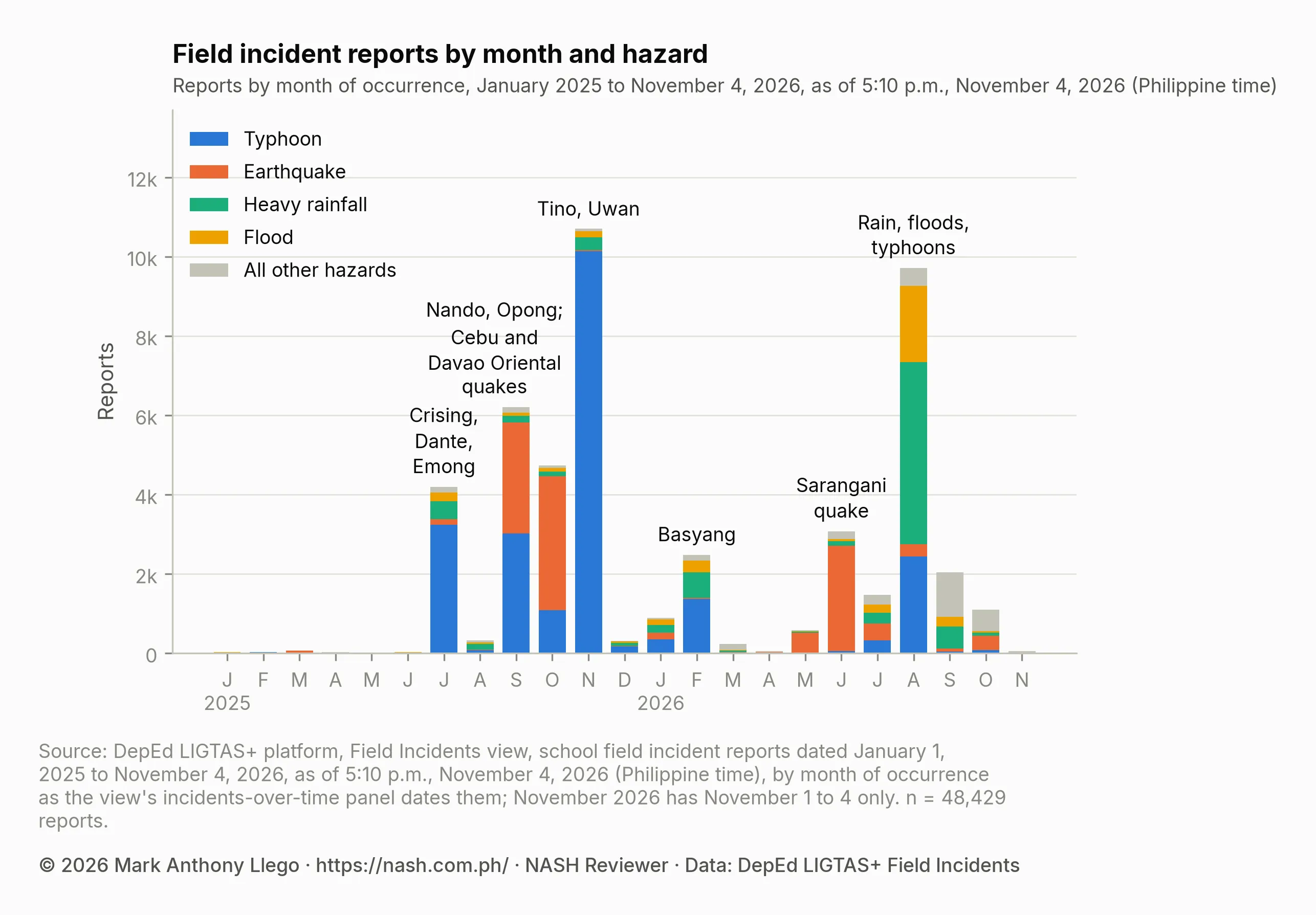
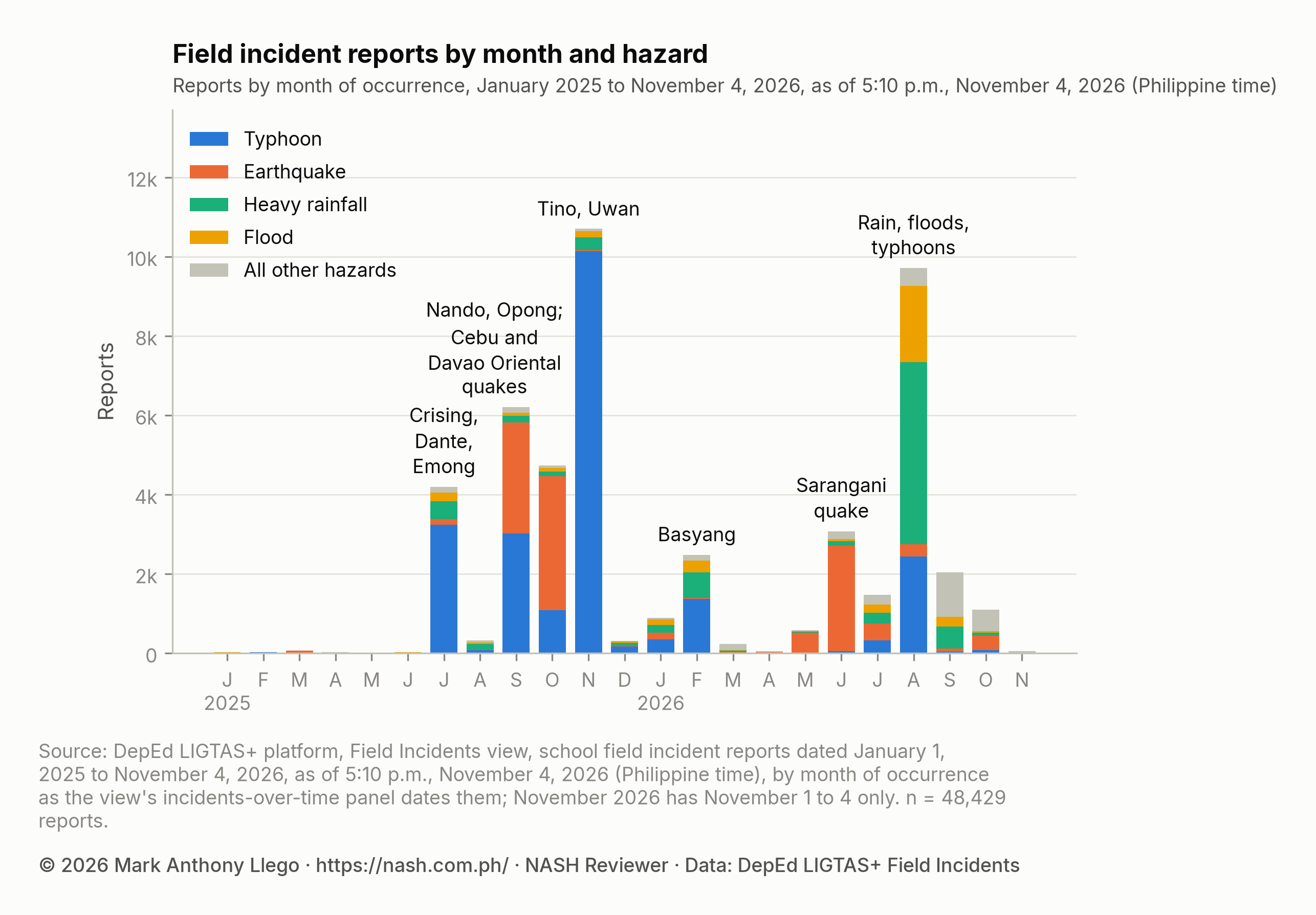
Reports are few before July 2025: 194 in the first six months of 2025. From July 2025 they follow the big events. After typhoons, earthquakes, heavy rainfall and floods, human-induced incidents account for 1,101 reports (2.3%) and all other hazards, from fires to tsunamis, for 2,455 (5.1%); Figure 2 below gives the classroom damage for each.
The events behind most of the reports
Many 2025 reports name their storm, from Crising to Uwan, and some February 2026 reports name Basyang. Many August 2026 typhoon reports say only “Tropical Cyclone”, and earthquake reports name no event.
| Reports dated | Hazard | Event | Reports | Schools | Classrooms, totally damaged |
|---|---|---|---|---|---|
| July 1-31, 2025 | Typhoon | Crising, Dante and Emong, each with the southwest monsoon | 3,232 | 2,548 | 1,393 |
| September 1-30, 2025 | Typhoon | Nando and Opong, each with the southwest monsoon | 3,025 | 2,695 | 1,041 |
| September 30-October 8, 2025 | Earthquake | Magnitude 6.9, Bogo City, Cebu (September 30) | 2,882 | 2,855 | 2,774 |
| October 9-31, 2025 | Earthquake | Magnitude 7.4, Manay, Davao Oriental (October 10) | 3,248 | 3,154 | 2,338 |
| November 2-6, 2025 | Typhoon | Tino, with the shear line | 2,321 | 2,273 | 1,024 |
| November 8-12, 2025 | Typhoon | Uwan | 7,396 | 7,169 | 3,666 |
| February 1-28, 2026 | Typhoon | Basyang | 1,370 | 1,268 | 149 |
| June 1-30, 2026 | Earthquake | Magnitude 7.8, off Sarangani (June 8) | 2,658 | 2,642 | 2,372 |
| August 1-31, 2026 | All hazards | Heavy rainfall, floods and typhoons | 9,707 | 5,326 | 4,727 |
Sources: DepEd LIGTAS+ Field Incidents, as of 5:10 p.m., November 4, 2026, by hazard and date; storm names as the reports give them. Earthquakes: GMA News, October 11, 2025, and GMA Regional TV, June 8, 2026.
The earthquakes stand out: a November 2025 typhoon report records, on average, under half a totally damaged classroom, a Cebu earthquake report almost one, and the three earthquake windows hold 7,484 of the 8,729 totally damaged classrooms in all earthquake reports. The June 8, 2026 earthquake struck on the first day of SY 2026-2027, set by DepEd Order No. 009, s. 2026, and June 2026 earthquake reports give the highest average loss of class days of these windows, 4.70.
August 2026 had the most reports of any month in 2026, 9,707, but fewer schools behind them (5,326) than Uwan alone. More than half came from Region III, where 2,066 schools filed 5,110 reports that month.
Where the reports come from
| Region | Reports | Schools reporting | Public schools, SY 2025-2026 | Schools reporting per 100 public schools |
|---|---|---|---|---|
| Region III | 7,657 | 2,671 | 3,763 | 71.0 |
| Region I | 5,309 | 2,143 | 2,866 | 74.8 |
| Region V | 5,211 | 2,648 | 3,884 | 68.2 |
| Region VII | 4,571 | 2,292 | 2,840 | 80.7 |
| CAR | 4,283 | 1,393 | 1,843 | 75.6 |
| Region VIII | 2,764 | 1,581 | 4,197 | 37.7 |
| Region XI | 2,375 | 1,725 | 2,233 | 77.3 |
| Region XII | 2,256 | 1,677 | 2,171 | 77.2 |
| CARAGA | 2,245 | 1,073 | 2,107 | 50.9 |
| Region IX | 2,156 | 1,045 | 3,025 | 34.5 |
| Region II | 2,031 | 1,205 | 2,547 | 47.3 |
| NIR | 1,891 | 1,215 | 2,253 | 53.9 |
| Region IV-A | 1,649 | 1,156 | 3,592 | 32.2 |
| Region X | 1,643 | 773 | 2,540 | 30.4 |
| MIMAROPA | 1,050 | 783 | 2,415 | 32.4 |
| Region VI | 867 | 640 | 2,841 | 22.5 |
| NCR | 460 | 302 | 828 | 36.5 |
| BARMM | 11 | 11 | 2,184 | 0.5 |
| Total | 48,429 | 24,333 | 48,129 | 50.6 |
Sources: DepEd LIGTAS+ Field Incidents, reports dated January 1, 2025 to November 4, 2026, as of 5:10 p.m., November 4, 2026; public schools from DepEd’s SY 2025-2026 enrollment data. “Schools reporting” counts schools with at least one report and can include a few outside DepEd’s public-school list (the Dagupan City division: 40 reporting schools, 39 public schools).
The reporting schools are mostly public: all 2,469 schools in the July 2025 typhoon reports that match DepEd’s SY 2025-2026 enrollment data are public. Nationally, schools with at least one report equal 50.6 for every 100 public schools; in Region VII, home of the Cebu earthquake and of the most Tino reports, 80.7; in Region VI, 22.5.
Region III has the most reports (7,657, or 15.8%) and the most totally damaged classrooms (4,004); with Region I, Region V and Region VII it filed 47.0% of all reports. Among divisions, Abra filed the most reports (2,035), followed by Nueva Ecija (1,981) and Cebu (1,788), which had the most schools reporting (1,058). BARMM, whose schools are under its own Ministry of Basic, Higher and Technical Education, has only 11 reports, which say nothing about how often its schools are hit.
How much damage the reports record
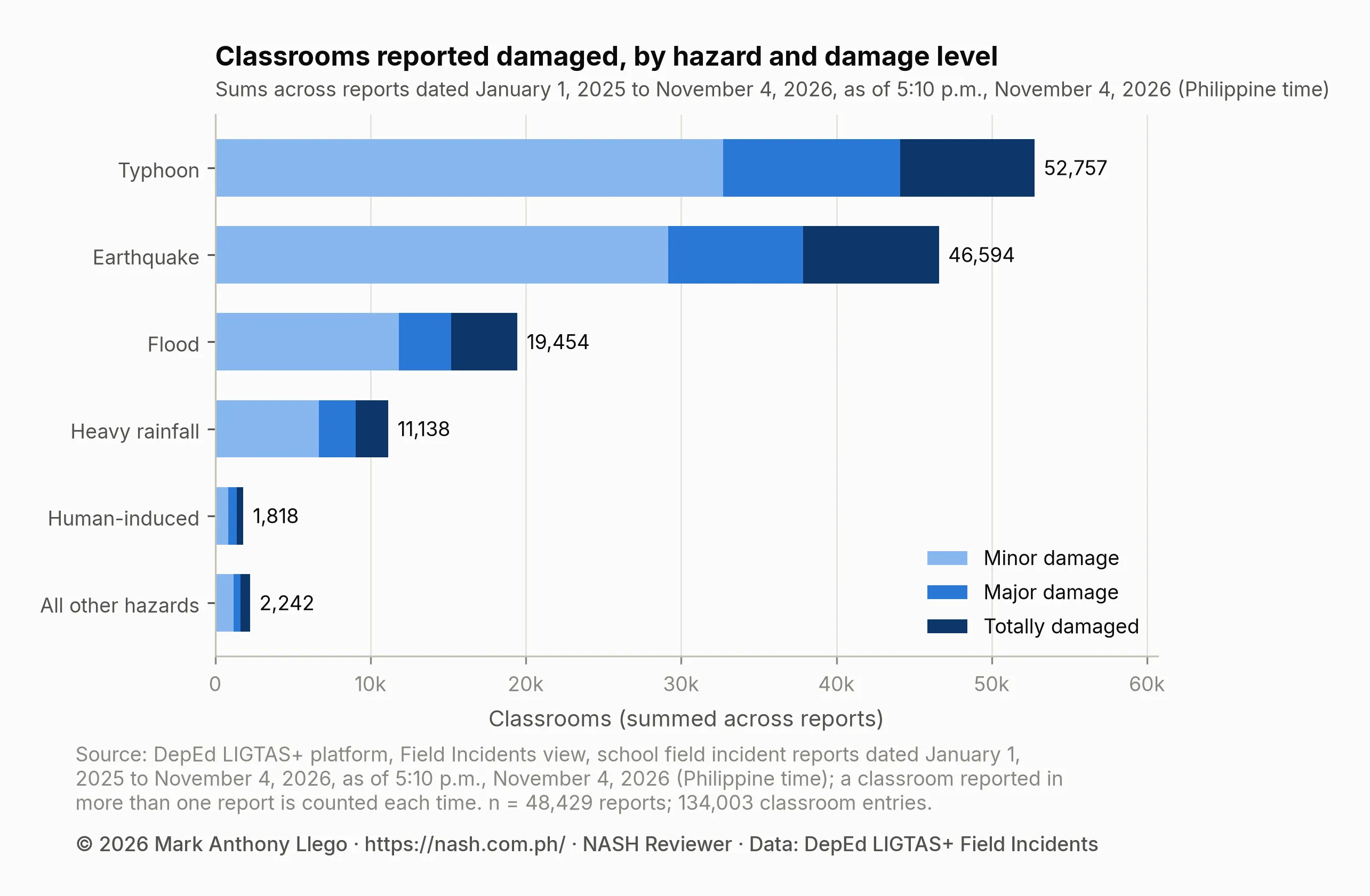
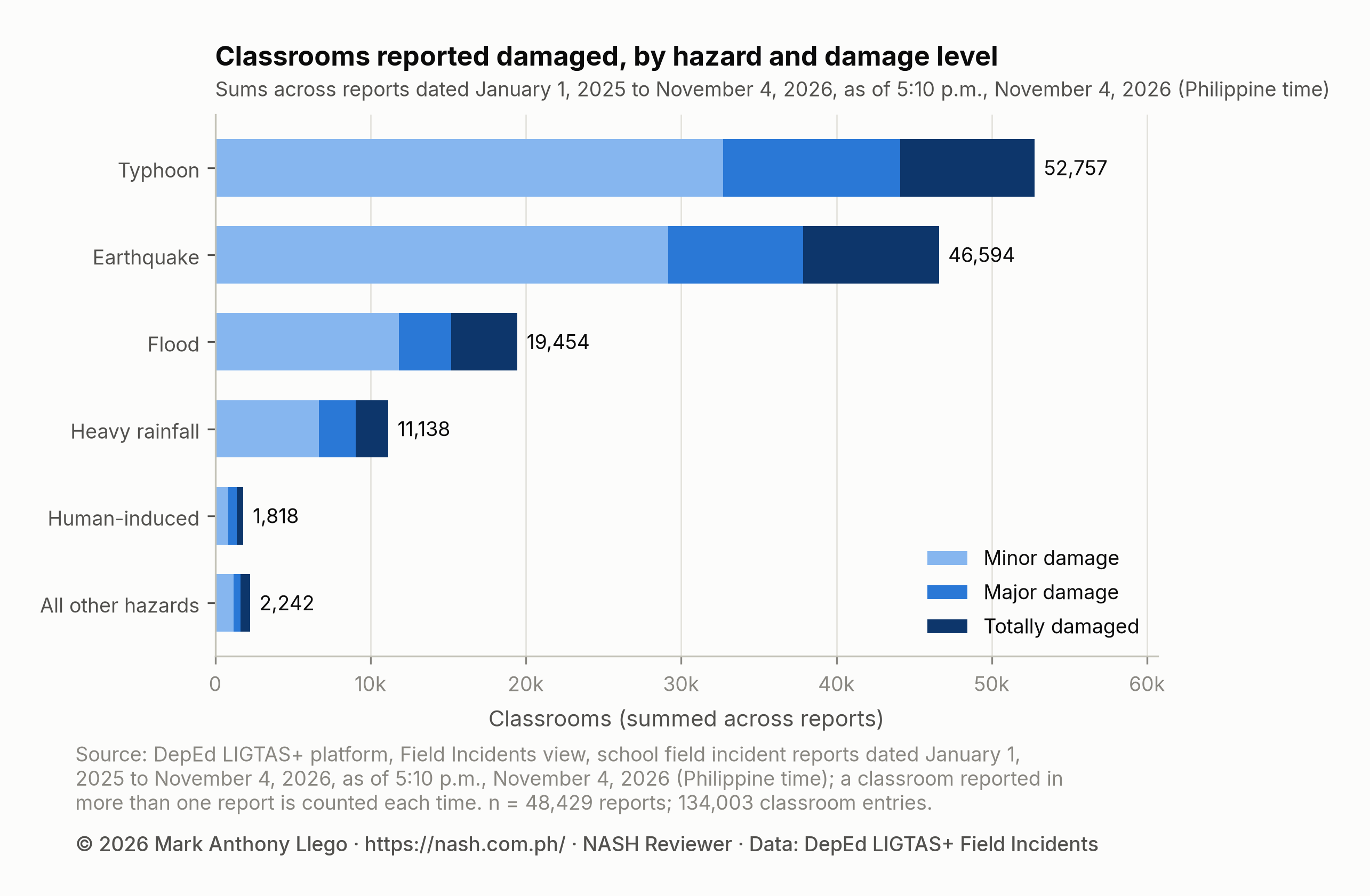
The reports record 134,003 classroom entries across the three damage levels. Typhoons and earthquakes account for 75.1% of the minor damage, 75.0% of the major damage and 70.1% of the totally damaged classrooms. Flood reports, though fewer than heavy rainfall reports, record twice as many totally damaged classrooms (4,278 against 2,083).
| Facilities and materials damaged | Reported | Note |
|---|---|---|
| Learning materials | 1,153,900 | Abra (154,647) and Catanduanes (128,808) lead |
| Chairs | 305,007 | Pampanga (34,484) and Dagupan City (24,914) lead |
| Ancillary facilities | 216,609 | 200,123 of them (92.4%) are recorded for one division, Sorsogon, nearly all in reports dated during Typhoon Uwan (November 8 to 12, 2025). Without Sorsogon: 16,486 |
| IT equipment | 30,008 | Cebu (3,938) and Sarangani (3,028) lead |
| WASH facilities | 9,677 | Pampanga (604) leads |
Source: DepEd LIGTAS+ Field Incidents, reports dated January 1, 2025 to November 4, 2026, as of 5:10 p.m., November 4, 2026; divisions as the reports name them.
Sorsogon’s figure would mean more than 400 ancillary facilities for each of its 467 reporting schools, which points to an entry error, not damage. Read the national total without it, and check any division’s facility total against its number of schools before using it.
The view’s counts and DepEd’s situation reports
After Tino, DepEd reported that its situation report at noon on November 7, 2025 counted 3,260 classrooms with some damage. The view now holds 6,412 classroom entries (3,903 minor, 1,485 major and 1,024 totally damaged), summed across 2,321 typhoon reports dated November 2 to 6, 2025. The two figures come from different moments and count differently. For a figure that will be cited, use DepEd’s own situation report or the division’s validated RADaR.
How the incidents affected learning
Of the 48,429 reports, 42,869 (88.5%) record a class suspension and 4,668 (9.6%) a school used as an evacuation center. The average report gives 3.09 learning-loss days (“Average class days lost” in the view), and the highest single report gives 60. Region XII has the highest regional average, 4.65 days, followed by BARMM (4.33, from 11 reports) and Region XI (4.06).
Learners and personnel affected. Summed across reports, the view counts 3,790,851 affected learners and 220,473 affected personnel. These are not counts of people. In the Dagupan City division, 287 reports from 40 schools add up to 177,108 affected learners, while all 72 schools in the city, public and private, enrolled 48,133 learners in SY 2025-2026. A single report usually counts the school’s whole enrollment: among 999 July 2025 typhoon reports matched to SY 2025-2026 enrollment, the median count is 97% of enrollment, and 271 give more learners than the school enrolled.
Learning delivery. The view counts the delivery modes that reports name: Modular Distance Learning 29,838, Blended Learning 4,993, Flexible Learning Option 2,041 and Online Distance Learning 1,609. DO 014, s. 2026 repealed the ADM and FLO definitions (para. 6.d) and changed what schools report: “In lieu of reporting ADMs, schools shall report the learning experiences implemented during periods of in-person class disruption” (para. 6.i). No report in the view names one of those learning experiences.
Injuries and casualties. The reports also carry injury and casualty counts: 2,099 learners and 389 teachers injured, and 2,678 learner and 339 teacher “casualties”. The data do not define “casualties”, and the numbers should not be read as deaths: the 1,054 learner “casualties” in July 2025 typhoon reports, for example, come from just four of the 3,232 reports.
What support schools asked DepEd for
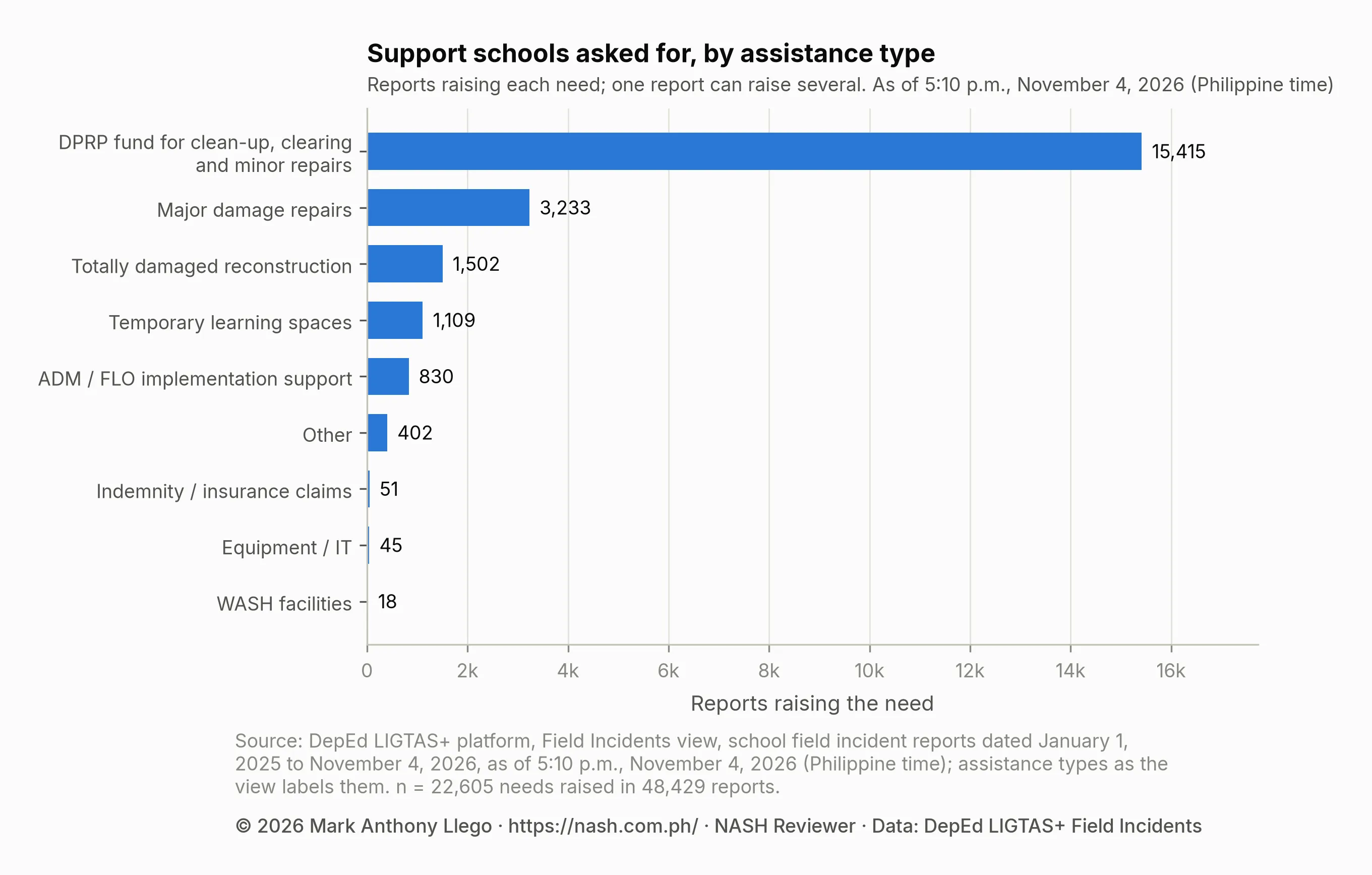
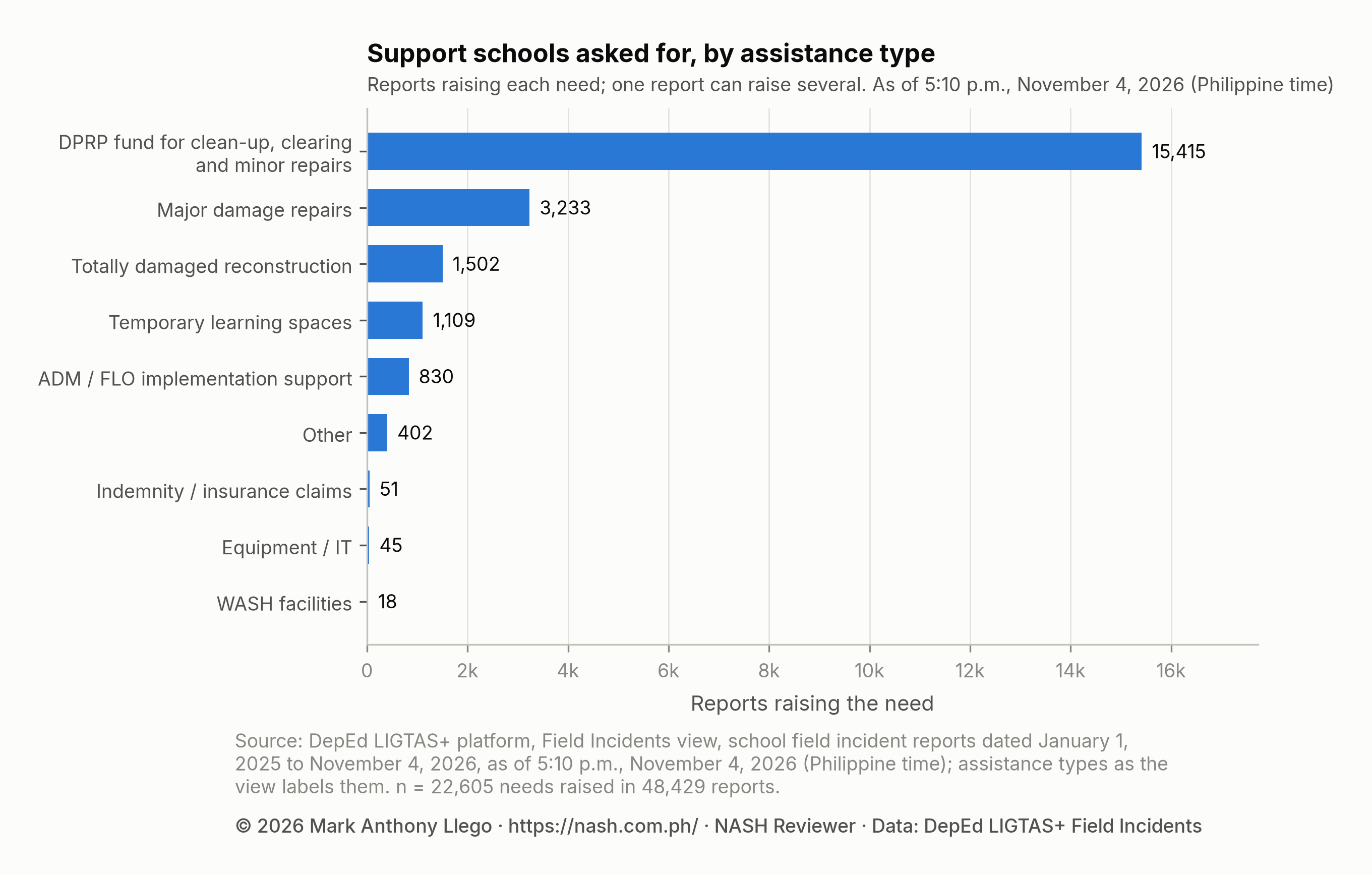
The reports raise 22,605 needs. “DPRP Fund Augmentation for Clean Up, Clearing and Minor Repairs” is raised in 15,415 reports, 31.8 for every 100 reports and 68.2% of all needs. Few ask for “Indemnity / Insurance Claims” (51), “Equipment / IT” (45) or “Water, Sanitation & Hygiene (WASH) Facilities” (18).
| Need | Where the money comes from |
|---|---|
| Clean-up, minor repairs and temporary learning spaces | DPRP funds of the DRRMS, downloaded “for affected schools with vetted RADaR” (DepEd Order No. 44, s. 2018, Annex A; Basic Education Development Plan 2030 of 2022, DepEd Order No. 024, s. 2022, Sec. 3.5.3) |
| Major repairs and reconstruction | The Quick Response Fund, which the same plan described as about PHP 2 billion a year “solely for the repair and reconstruction of disaster-affected schools” (Sec. 3.5.3); and the Basic Education Facilities Fund, which replaces and repairs buildings damaged by calamities and whose savings go second to calamity-damaged schools, on the basis of the RADaR as validated by the Division Engineer and the Division DRRM Coordinator (DepEd Order No. 018, s. 2023, Encl., Sec. V.3 and V.10) |
| Minor repairs a school can pay for itself | School MOOE, which may fund “minor repairs of facilities, building and grounds maintenance necessary for the upkeep of the school” (DepEd Order No. 008, s. 2019, Sec. V.D.4); see the school MOOE guide |
| Repairs to a school used as an evacuation center | The LGU, responsible for “general cleaning, fumigation, payment of utilities, and repair of schools used as evacuation centers” (DO 033, s. 2021, para. 23) |
For DPRP funds and BEFF savings, the validated report, not the raw one, opens the way; for the 2026-2027 El Niño, requests for more DPRP funding “shall be supported by validated needs assessments” (DM 064, s. 2026, enclosed guidelines, Sec. VIII).
What the data do not show
| Figure | What it counts | How to read it |
|---|---|---|
| Total reports | Reports, not schools or events | 48,429 reports came from 24,333 schools. One school can file several reports: in July 2025, most schools with more than one typhoon report filed one for each storm, first Crising, then Dante or Emong |
| Classrooms, facilities, learners | Sums across reports | A school that files an initial and an updated report counts its classrooms twice. In July 2025, 3,232 typhoon reports came from 2,548 schools; for Uwan, 7,396 from 7,169 |
| Status “Imported” | Every report in the view | As of November 4, 2026, no issuance calls these reports verified, and the view does not show which reports a division has vetted |
| Coverage | Schools that reported into this system | Schools that did not report are missing, and reports are few before July 2025. The totals are not all disaster damage in the country |
| Facility counts | Sums across reports | One division’s entry can dominate a national total, as Sorsogon’s does for ancillary facilities |
| Casualties | An undefined field | Not a death count |
What this means for school heads
The steps follow DO 21, s. 2015, DO 033, s. 2021, DO 022, s. 2024 and DO 014, s. 2026 in the order a school meets them.
| When | What the school does | Basis |
|---|---|---|
| Before any hazard | Designate a school DRRM coordinator other than the school head, preferably non-teaching, and an alternate; keep baseline data current; store records, equipment and learning materials on upper floors in waterproof containers; pre-identify places for temporary learning spaces | DO 033, s. 2021, paras. 13, 14 and 20.a, b and j |
| Before any hazard | Plan in the Learning and Service Continuity Plan how to report when power or mobile networks fail, “e.g. sms-based reporting, two-way radios”; sign a memorandum of agreement with the LGU if it may use the school as an evacuation center | DO 014, s. 2026, para. 44; DO 033, s. 2021, para. 22.a |
| Within 24 hours of an advisory | Update the Division DRRM Coordinator on preparations and on the hazard’s effects | DO 033, s. 2021, para. 26 |
| During the disruption | Notify the SDS of any suspension and its reason, and report the school’s learning continuity level within 12 hours | DO 022, s. 2024, Sec. IV; DO 014, s. 2026, para. 44 |
| Within 72 hours | If it is safe, have the coordinator assess the damage and submit the RADaR; then list damaged textbooks and prepare details on damaged computers | DO 21, s. 2015, Sec. IV.B.1.k and V.B; DO 033, s. 2021, para. 27.a |
| Before classes resume | Keep learners out of damaged rooms until authorized inspectors declare them safe; after an earthquake of Intensity VI or higher, or one that leaves major damage, ask the DPWH, local building officials or division engineers to assess the buildings | DO 014, s. 2026, para. 65; DO 022, s. 2024, Sec. III.5.c and III.5.h.iii |
| Recovery | Report recovery progress and the closing of any evacuation center in the school to the SDO, and report damage to a school used as an evacuation center to the LGU | DO 21, s. 2015, Sec. IV.B.1.l and m; DO 033, s. 2021, para. 23 |
| After every emergency | Have the coordinator write a quick incident management report, and submit the term’s reports to the SDO | DO 014, s. 2026, paras. 73 and 76 |
How a school’s report turns into help
Under DO 21, s. 2015, DepEd’s central office endorses reported classroom and furniture damage “for detailed assessment, preparation of program of work and fund allocation for repair and reconstruction” (Sec. V.B). DO 44, s. 2018 sets the current steps: the Education Facilities Division has regional and division engineers “start the detailed infrastructure assessment in affected areas, immediately upon the receipt of the summary of RADaR 1 from DRRMS”, then submits the programs of work and a repair and reconstruction plan “based on POWs” (Annex A). The DRRMS also sends the vetted RADaR to the Bureau of Learning Resources and the Information and Communication Technology Service “to mobilize immediate response interventions” (DO 033, s. 2021, Encl. No. 3).
A school that does not report is not among the schools with a vetted RADaR that receive clean-up funds, and one that overstates its damage breaks the sender’s certification.
What a school head may and may not do
The incident management report of DO 014, s. 2026 is meant for learning: “Information documented in this report shall not be used for punitive or disciplinary purposes” (Annex E.3).
These duties serve PPSSH indicator 2.5.2, adopted through DepEd Order No. 024, s. 2020: “Manage school safety for disaster preparedness, mitigation and resiliency to ensure continuous delivery of instruction.” Repairing damaged facilities through the right channel is strand 2.3 (PPSSH Domain 2); reading the view’s numbers with their limits is data use (PPSSH Domain 1). See also the Super El Niño 2026 guide, classroom and school building data and learning continuity spaces in the SBP 2026 list.
How the NASH may test this
The items below are original practice items, scored 3 (Relational), 2 (Multistructural), 1 (Unistructural) or 0 (Prestructural). An option that breaks a rule scores 0.
Question 1
Indicator 2.5.2, School safety for disaster preparedness, mitigation and resiliency. Career Stage 2, Situational, Moderate.
You are the school head of a central elementary school in a coastal town. A typhoon passed two days ago. Your school DRRM coordinator reports that the roof is torn off two classrooms, the ceilings of three others are sagging, and about 200 armchairs and many textbooks are soaked. Barangay officials offer to sweep the damaged rooms so that classes can resume in them on Monday. What is the most appropriate action?
- A. Close the five damaged rooms and move their classes to the library and the covered court, have the coordinator send the damage report within 72 hours, and wait for the repairs.
- B. Accept the barangay’s offer so that classes resume in the swept rooms on Monday, and send the damage report to the division after the learners are settled back in their classrooms.
- C. Send the division a full damage report with photos before the 72-hour deadline, and wait for its instructions on whether the damaged rooms may be used for classes on Monday.
- D. Keep learners out of the five damaged rooms and hold their classes in other safe spaces, have the coordinator send the damage report within 72 hours, and ask the division to inspect the rooms.
Answer and explanation
Best answer: D. Points: A = 2, B = 0, C = 1, D = 3.
- A (2 points, Multistructural). Closing the rooms, moving the classes and filing the rapid report on time are right, but the rooms are never inspected: engineers vet the damage the school reports, and authorized inspectors must declare the rooms safe before classes return to them.
- B (0 points, Prestructural). Resuming classes in damaged rooms before authorized inspectors declare them safe breaks the rule on resumption and puts learners under sagging ceilings; the late report adds a second lapse.
- C (1 point, Unistructural). The timely report is the one right step, but waiting for instructions leaves the school head’s own duties undone: keeping learners out of unsafe rooms and arranging where their classes will meet.
- D (3 points, Relational). This protects learners first, keeps their classes going in safe spaces, files the rapid report within the 72 hours, and gets the rooms inspected before anyone uses them, in the order the issuances set.
Why. This aligns with Career Stage 2 expectations because indicator 2.5.2 asks the school head to manage school safety so that instruction continues. Within 24 to 72 hours of landfall, the school, if safe, assesses the damage and submits the RADaR, and deploys learning continuity interventions (DO 033, s. 2021, para. 27.a and d). In-person classes resume in damaged facilities only “after these are declared safe by authorized inspectors” (DO 014, s. 2026, para. 65), and engineers inspect “to vet damages as reported by school DRRM coordinators” (DO 022, s. 2024, Sec. III.9). The option that waits for repairs keeps learners safe and reports on time but skips the inspection that vets the damage and clears the rooms.
Indicator 2.5.2: Manage school safety for disaster preparedness, mitigation and resiliency to ensure continuous delivery of instruction.
Sources: DepEd Order No. 21, s. 2015, Sec. IV.A.1.q and V.B; DepEd Order No. 033, s. 2021, para. 27; DepEd Order No. 014, s. 2026, para. 65; DepEd Order No. 022, s. 2024, Sec. III.9; DepEd Order No. 024, s. 2020.
Question 2
Indicator 2.3.1, School facilities and equipment. Career Stage 1, Conceptual, Moderate.
After an earthquake, a school’s rapid damage report lists two classrooms with major damage. Which statement best describes how DepEd’s issuances move such a report toward the repair of those classrooms?
- A. The division adds the two classrooms to its facilities development plan, so that their repair is programmed together with other school needs in a later year.
- B. The division verifies the report, the central office endorses the damage for a detailed assessment by engineers, and their program of works is the basis for repair funds.
- C. The report authorizes the school head to contract the repairs directly and pay for them at once, since the damage to the classrooms has already been documented.
- D. The central office allots repair funds on the basis of the counts in the report, and the division engineer then prepares a program of works and checks the finished repairs.
Answer and explanation
Best answer: B. Points: A = 1, B = 3, C = 0, D = 2.
- A (1 point, Unistructural). Facility plans are updated when calamities damage schools, but treating the repair as routine programming for a later year misses the disaster channel that starts with the rapid report.
- B (3 points, Relational). This follows the report through each check: the division verifies it, the central office endorses the damage for detailed assessment, and the engineers’ program of works becomes the basis for funding.
- C (0 points, Prestructural). A damage report is not an authority to contract or spend; repairs wait for the engineers’ assessment and a program of works, and the division verifies the report first.
- D (2 points, Multistructural). Central funding and the program of works are both part of the process, but funds are allocated after the detailed assessment, not on the raw counts before it.
Why. This aligns with Career Stage 1 expectations because indicator 2.3.1 asks for an understanding of the issuances on repairing school facilities. The SDO verifies the school’s RADaR (DO 21, s. 2015, Sec. IV.A.2.t), and the central office then endorses “reported classroom and school furniture damages” for “detailed assessment, preparation of program of work and fund allocation for repair and reconstruction” (Sec. V.B). DO 022, s. 2024 has engineers carry out the detailed assessment “for purposes of developing the Program of Works” (Sec. III.9), and DO 44, s. 2018 bases the repair and reconstruction plan on the programs of work (Annex A). The option that funds on the raw counts names the right steps but puts the money before the check.
Indicator 2.3.1: Demonstrate knowledge and understanding of policies, guidelines and issuances on acquisition, recording, utilization, repair and maintenance, storage, and disposal in managing school facilities and equipment.
Sources: DepEd Order No. 21, s. 2015, Sec. IV.A.2.t and V.B; DepEd Order No. 022, s. 2024, Sec. III.9; DepEd Order No. 44, s. 2018, Annex A; DepEd Order No. 018, s. 2023, Encl., Sec. V.1 and V.3; DepEd Order No. 024, s. 2020.
Nothing in this guide reproduces or predicts examination content.
Frequently asked questions
What is the RADaR, and when must a school submit it?
The Rapid Assessment of Damages Report is the form on which a school reports damaged classrooms, furniture, learning materials and computers, personnel casualties, and classrooms used by evacuees (DO 21, s. 2015, Annexes A and B). DO 21, s. 2015 requires it “within 72 hours” after any hazard (Sec. IV.A.1.q and V.B), and DO 033, s. 2021 sets the same window after a typhoon or flood, “If safe” (para. 27.a). For schools hit by Typhoon Pepito, DepEd Memorandum No. 064, s. 2024 allowed “either the RADaR application or offline RADaR template” (item 3.b).
Are the LIGTAS+ field incident figures official?
They are DepEd’s data as schools reported them, but every report carries the status “Imported” and, as of November 4, 2026, no issuance calls them verified. Division offices verify RADaRs, and engineers inspect damage before repair funds are programmed (DO 21, s. 2015, Sec. IV.A.2.t and V.B; DO 022, s. 2024, Sec. III.9). For a figure to cite, use DepEd’s situation report or the division’s validated report.
Who repairs a school that was used as an evacuation center?
The LGU is responsible for cleaning, fumigation, utilities and repair of a school used as an evacuation center, and the school head reports the damage to the LGU right away (DO 033, s. 2021, para. 23). Under Republic Act No. 10821, a school may be used as an evacuation center only when no other place is available, open spaces are used before classrooms, and use beyond 15 days needs written documentation from the LGU (Sec. 5).
Download the data
- field-incidents-reports-by-month.csv: reports by month of occurrence and hazard. Source: DepEd LIGTAS+ Field Incidents, as of 5:10 p.m., November 4, 2026.
- field-incidents-classrooms-by-hazard.csv: reports and classrooms by damage level and hazard, summed across reports. Source: as above.
- field-incidents-support-requested.csv: reports raising each type of support, with the number per 100 reports. Source: as above.
- field-incidents-by-region.csv: reports, schools reporting, public schools, classrooms by damage level, affected learners and learning-loss days, by region. Sources: DepEd LIGTAS+ Field Incidents; DepEd SY 2025-2026 enrollment data, from the cleaned DepEd school data.
The CSVs and charts may be reused only with written permission: email support@nash.com.ph. The rules themselves come from DepEd’s issuances, which you can cite directly.
Sources
DepEd issuances
- DepEd Order No. 21, s. 2015, Disaster Risk Reduction and Management Coordination and Information Management Protocol, June 1, 2015; Sections IV.A.1, IV.A.2, IV.B.1, IV.B.2 and V.B, and Annexes A and B (RADaR 1 and RADaR 2).
- DepEd Order No. 033, s. 2021, School-Based Disaster Preparedness and Response Measures for Tropical Cyclones, Flooding, and Other Weather-Related Disturbances and Calamities, August 20, 2021; paras. 12 to 14, 20, 22, 23, 26, 27 and 35, and Enclosure No. 3.
- DepEd Order No. 022, s. 2024, Revised Guidelines on Class and Work Suspension in Schools During Disasters and Emergencies, December 23, 2024; Sections III.5.c, III.5.h, III.9, IV and V.
- DepEd Order No. 014, s. 2026, Guidelines on Learning Continuity in Emergencies, June 4, 2026; paras. 6.d, 6.i, 44, 52, 65, 73 and 76, and Annex E.3.
- DepEd Memorandum No. 064, s. 2024, Ensuring Safety, Protection, and Learning Continuity of Schools Affected by Typhoon Pepito, November 18, 2024; item 3.b.
- DepEd Memorandum No. 064, s. 2026, Anticipatory Action, Preparedness, and Protective Measures for the 2026–2027 Super El Niño, October 26, 2026; enclosed guidelines, Sections VIII, 9.1 and 9.4.
- DepEd Order No. 44, s. 2018, Formation of the Department of Education Disaster Risk Reduction and Management Team in the Central Office, September 27, 2018; Annex A.
- DepEd Order No. 024, s. 2022, Adoption of the Basic Education Development Plan 2030, May 30, 2022; Basic Education Development Plan 2030, Section 3.5.3.
- DepEd Order No. 018, s. 2023, Revised Multi-Year Guidelines on the Allocation, Receipt, Utilization, Monitoring, and Reporting of the Basic Education Facilities Funds (BEFF), July 20, 2023; Enclosure, Sections V.1, V.3 and V.10.
- DepEd Order No. 008, s. 2019, Revised Implementing Guidelines on the Direct Release, Use, Monitoring and Reporting of Maintenance and Other Operating Expenses Allocation of Schools, Including Other Funds Managed by Schools, May 2, 2019; Section V.D.4.
- DepEd Order No. 009, s. 2026, Guidelines on the Implementation of the Three-Term School Calendar in Basic Education, April 16, 2026; para. 4.
- DepEd Order No. 024, s. 2020, National Adoption and Implementation of the Philippine Professional Standards for School Heads, September 7, 2020; indicators 2.3.1 and 2.5.2.
Laws
- Republic Act No. 10821, Children’s Emergency Relief and Protection Act, May 18, 2016; Sec. 5.
Data
- DepEd LIGTAS+ platform, Field Incidents view, ligtas.cair.ph/preview, DepEd Disaster Risk Reduction and Management Service with the Education Center for AI Research: school field incident reports dated January 1, 2025 to November 4, 2026, as of 5:10 p.m., November 4, 2026 (Philippine time).
- DepEd school enrollment data, SY 2025-2026, as cleaned in Download Cleaned DepEd School Data, SY 2017-18 to 2025-26.
News reports
- Department of Education. (2025, November 7). DepEd, pinagulong ang agarang rehabilitasyon at paghahanda ng paaralan sa bagyo. DepEd news release.
- Cordero, T. (2025, October 11). Why was Cebu’s magnitude 6.9 earthquake more disastrous than Davao Oriental’s 7.4? GMA News.
- GMA Regional TV News. (2026, June 8). First day of classes marred by M7.8 quake off Saragani [sic]. GMA Regional TV.
Written by Mark Anthony Llego for NASH Reviewer. Sources: DepEd Orders No. 21, s. 2015, No. 033, s. 2021, No. 022, s. 2024, No. 014, s. 2026 and No. 44, s. 2018; DepEd Memoranda No. 064, s. 2024 and No. 064, s. 2026; DepEd’s LIGTAS+ Field Incidents view; DepEd SY 2025-2026 enrollment data. Charts may be reused only with written permission from support@nash.com.ph.