Hayo, Hinay, Hinga and Hinto are DepEd’s four levels of learning continuity in emergencies, set by DepEd Order No. 014, s. 2026. Hayo (Continue) keeps in-person classes, Hinay (Ease in) moves to structured distance learning, Hinga (Check-in) reduces learning to check-ins and light distance learning, and Hinto (Stop) suspends all forms of learning. For extreme heat, DepEd Memorandum No. 064, s. 2026 ties each level to a heat index: below 27°C is Hayo, 27°C to 32°C Hinay, 33°C to 41°C Hinga, and 42°C and above Hinto.
The heat index that counts is the classroom’s own. Schools read calibrated thermometers with hygrometers at 8:00 a.m., 12:00 noon and 2:00 p.m. and look up the result on the DOST-PAGASA Heat Index Chart; that heat index “shall be the basis for decisions on school-level suspension and the shift to appropriate distance learning modalities” (DM 064, s. 2026, Sec. 6.1). Heat still does not suspend classes by itself: “Extreme heat conditions shall not automatically result in class suspension” (para. 6).
Key findings
- Four levels, one framework. DO 014, s. 2026 bases each level on “teachers and learners’ circumstance and the status of their well-being” and uses it to set learning delivery, learning experiences and minimum standards during an emergency (Sec. V.A, para. 11).
- The school head decides the level. “School heads shall exercise sound professional judgment in determining level of learning continuity during class suspensions” (para. 12), and report it on the EiE: Learning Continuity dashboard “within the first 12 hours of any disruption” (para. 44).
- Heat has four bands. Below 27°C (Hayo, Manageable Conditions), 27°C–32°C (Hinay, Caution), 33°C–41°C (Hinga, Extreme Caution), and 42°C and above (Hinto, Danger and Extreme Danger) (DM 064, s. 2026, Sec. 5.2.2). The memorandum stays in effect until DOST-PAGASA’s final advisory on the 2026–2027 El Niño (para. 7).
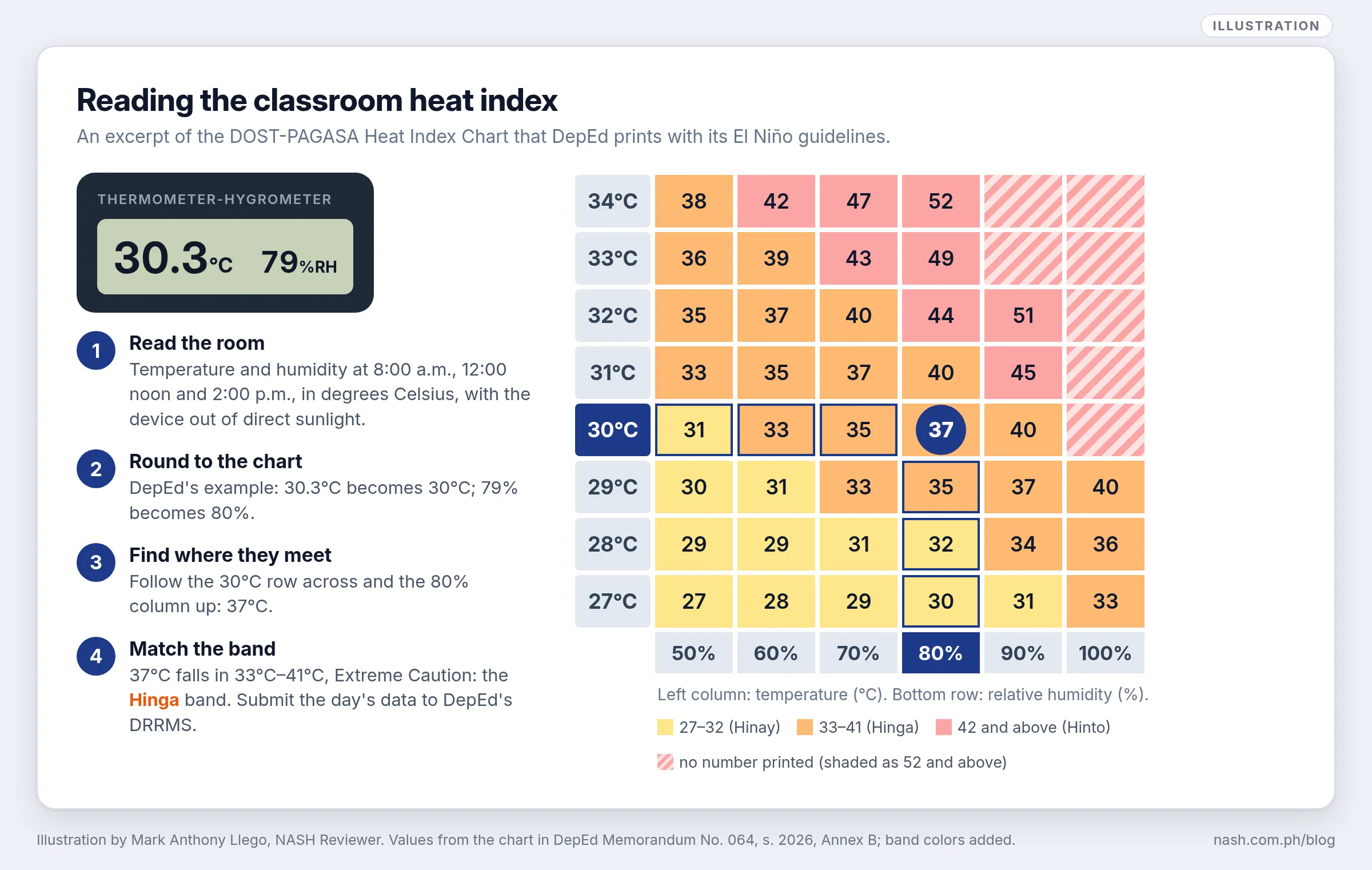
- Readings come from the classroom, three times a day. In DepEd’s own example, 30°C at 80% relative humidity gives a heat index of 37°C, which falls in the Hinga band (DM 064, s. 2026, Annex B).
- No level suspends classes on its own. The framework “shall not be used to automatically suspend classes, reduce academic expectations, or substitute lighter learning resources when learners are demonstrably safe and cognitively ready” (DO 014, s. 2026, para. 13).
- Each level costs class days. Hayo counts no class day missed, Hinay and Hinga half a day, and Hinto a full day; a school may stay at Hinay for up to 3 consecutive class days, Hinga 4 and Hinto 5; past that, Hinay narrows learning goals to essentials and Hinga and Hinto shift to a flexible learning program (Secs. V.J and V.K).
What Hayo, Hinay, Hinga and Hinto mean
DO 014, s. 2026 calls the four levels its Learning Continuity Framework, “a levels-based decision-making system that guides schools and CLCs in determining appropriate learning priorities, responses, and supports” (para. 9). DepEd pairs each Filipino word with an English label, and DM 064, s. 2026 calls the set the “4H Scenario Continuum” (Sec. 5.2.2). The aim is always to return to Hayo: “to maintain or restore a sense of safety, stability, and connection, while preventing harm and minimizing learning loss” (para. 10).
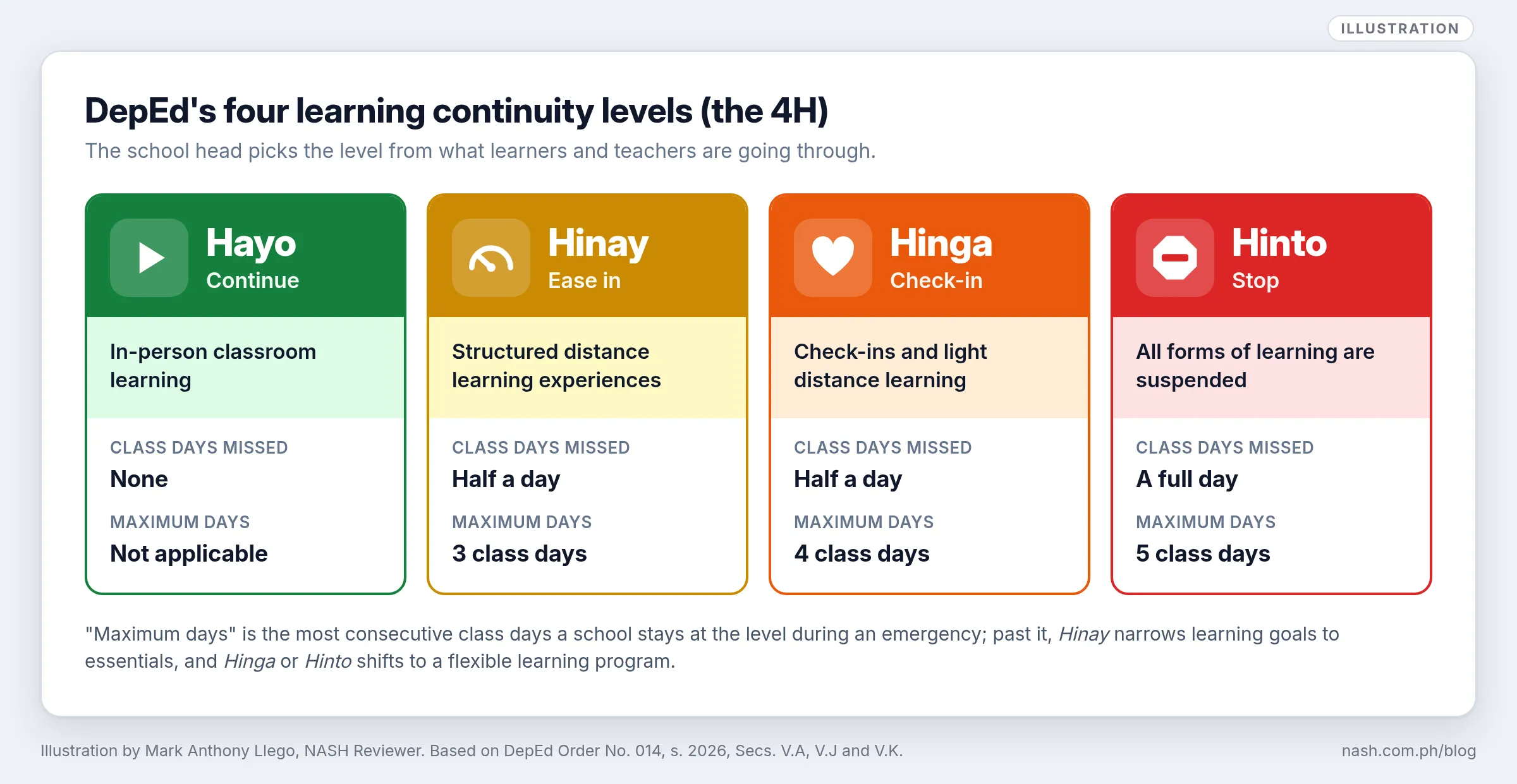
| Level | Learners’ circumstance | What learning looks like | Assessment |
|---|---|---|---|
| Hayo (Continue) | “physically safe, emotionally regulated, and cognitively ready to engage in sustained learning”; families and communities function normally | Regular in-person classes with full lesson guides; remediation programs are delivered | As usual |
| Hinay (Ease in) | “Minor to moderate disruptions to in-person classes”; mild stress; uneven access to learning spaces or support at home | Learning “intentionally slowed down”: fewer subjects a day, shorter activities, and online synchronous classes, digital or print modules or broadcast materials; family kits for parents | Focused on essential competencies; summative assessment “limited in number and scope” |
| Hinga (Check-in) | “heightened stress due to the impact of emergencies, crises, or disasters”; community recovery ongoing | Academic demands “heavily reduced”; well-being check-ins, which count as teaching load; broadcast materials, learning packets and check-in guides, offline resources first | Low-stakes or optional; summative assessment deferred until the school returns to Hinay or Hayo |
| Hinto (Stop) | Safety and basic needs at risk; “distress or displacement is highly likely” | “Academic learning is halted completely”; protection, emergency response, basic needs and mental health and psychosocial support (MHPSS) | None: “No assessments shall be conducted at the HINTO (Stop) level” |
Sources: DO 014, s. 2026, Sec. V.A; DepEd Order No. 015, s. 2026, Annex A, Sec. C, paras. 14–16.
The framework also works below school level. Teachers may use it for “targeted supports for individuals or classes affected by small-scale learning disruptions”, such as a fire in a classroom, a death in the family or displacement (DO 014, s. 2026, para. 15).
The heat index for each level
DM 064, s. 2026, “Anticipatory Action, Preparedness, and Protective Measures for the 2026–2027 Super El Niño”, sets the heat index bands for the 2026–2027 El Niño. Schools “shall adopt the 4H Scenario Continuum in determining appropriate learning delivery arrangements during class suspensions arising from extreme heat, drought, water shortages, and other El Niño-related disruptions” (Sec. 5.2.2).
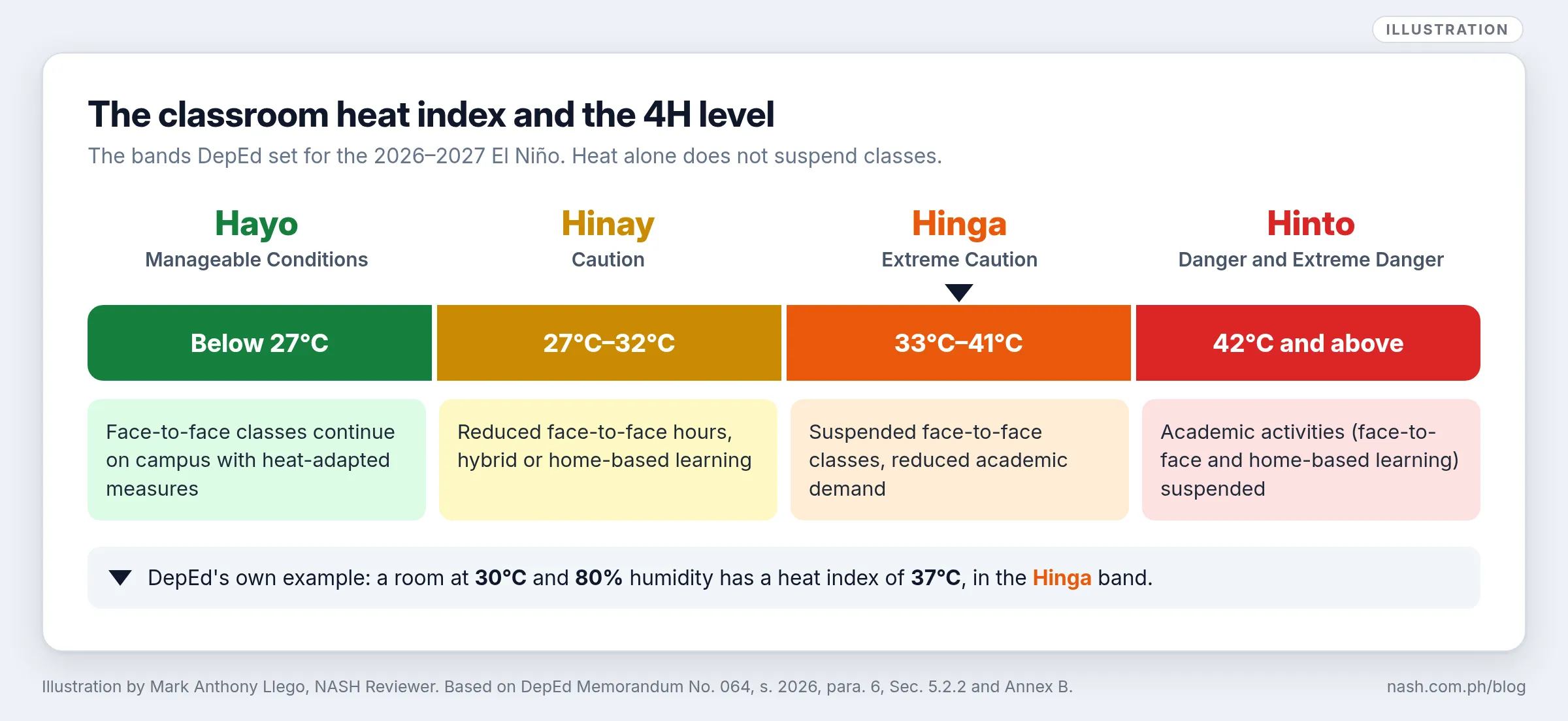
| Heat index | Level | Learning arrangements | Measures |
|---|---|---|---|
| Below 27°C | Hayo (Manageable Conditions) | “Face-to-face classes continue on campus with heat-adapted measures, as needed.” | Regular classes, outdoor activities during cooler periods, safe drinking water, hydration breaks, ventilated classrooms |
| 27°C–32°C | Hinay (Caution) | “Reduced face-to-face hours, hybrid or home-based learning.” | Modified schedules (“e.g., 6–10 a.m.; 2–6 p.m.”), hybrid instruction or structured home-based learning |
| 33°C–41°C | Hinga (Extreme Caution) | “Suspended face-to-face classes, reduced academic demand.” | Light learning tasks, learning packets, DepEd TV and radio, well-being check-ins |
| 42°C and above | Hinto (Danger and Extreme Danger) | “Academic activities (face-to-face and home-based learning) suspended.” | Suspended activities, communication, safety checks, referrals for support |
Source: DM 064, s. 2026, Sec. 5.2.2.
The heat index is not the only input. Decisions also weigh “the DOST-PAGASA heat index forecasts, ventilation, water availability, exposure to heat, and learners’ circumstances at home”, and “In cases of unbearable heat, even when the heat index has not reached the Danger and Extreme Danger threshold mentioned above, the school authority may still suspend classes based on the prevailing conditions in their localities” (Sec. 5.2.2).
DO 014, s. 2026, the standing order, has its own heat column in Annex A.1: “No extreme heat” for Hayo, “Caution 27-32°C” for Hinay, “Extreme Caution 33-41°C” for Hinga and “Extreme Danger 42-52°C” for Hinto. DM 064, s. 2026 is the later issuance and sets Hinto at “42°C and Above”, so any reading of 42°C or more is Hinto while it is in effect. After DOST-PAGASA’s final advisory ends the El Niño, the memorandum lapses and DO 014’s matrix remains.
The Super El Niño 2026 guide for school heads covers the rest of DM 064: water, school feeding, fire safety, attire and funding.
How to read the classroom heat index
DM 064, s. 2026 relies on an earlier directive: “In accordance with Memorandum No. DM-OUOPS-2025-07727 on the Installation of Thermometers with Hygrometers in Classrooms, school heads shall ensure that classrooms are equipped with calibrated thermometers with hygrometers to monitor actual temperature and humidity levels.” Devices “must be placed in areas free from direct sunlight and light-emitting appliances to ensure accurate readings”, and environmental sensors may be used where a school has them (Sec. 6.1). Annex B gives the steps.
- Install the devices “in a representative sample of classrooms per school”.
- Record the readings “at least three (3) times daily: at 0800H in the morning (8:00 a.m.), 1200H at noon (12:00 p.m.), and 1400H in the afternoon (2:00 p.m.)”.
- Use degrees Celsius. A device that shows Fahrenheit needs converting first.
- Round to the chart. “30.3°C is rounded off to 30°C; 79% relative humidity is rounded off to 80% relative humidity.”
- Find where the row and column meet. Temperature runs down the left column and humidity along the bottom row. “Following the 30°C row across and the 80% relative humidity column upward, the intersection of the values indicates a heat index of 37°C.”
- Submit the data daily to DepEd’s Disaster Risk Reduction and Management Service (DRRMS) through the link in Annex B, bit.ly/PHExtremeHeat.
Humidity matters as much as temperature. In the same chart, a room at 32°C and 70% humidity reads 40°C, in the Hinga band; at 33°C and 70%, it reads 43°C, in the Hinto band. The chart prints no number in its hottest, most humid corner, for example 30°C at 100% humidity, but shades those cells in the same color as its readings of 52°C and above, so a room there is in the Hinto band: protect learners at once.
Does a high heat index suspend classes?
No, not automatically. DepEd Order No. 022, s. 2024 says: “There will be no automatic suspension of classes due to Extreme Heat Conditions. However, in case of unbearable heat, the LCE may still exercise its authority to facilitate localized class suspension based on the situation in their localities” (Sec. III.5.e). Without an automatic suspension or a declaration from the local government, the school head may suspend classes “In case the temperature in classrooms or learning spaces is not conducive to learning and affects the health and safety of the learners and teachers”, “provided that there is the necessary coordination with the LCE and SDS” (Sec. III.5.h), and must “immediately notify their respective SDS of the suspension of classes and/or work, including the reason for such suspension.” Executive Order No. 130, s. 2026 now calls this a granular suspension, declared “in coordination with the concerned LCE” on “documented site-specific conditions” (Sec. 4.c); the Annex B log of classroom readings documents those conditions. DO 014’s Annex A.2 repeats “There is no automatic suspension of classes” at every heat level, Hinto included.
The levels describe learning once a suspension exists. DM 064, s. 2026 applies them to learning arrangements “during class suspensions” (Sec. 5.2.2), and DO 014, s. 2026 says “The policy shall be enacted once the school head, Local Chief Executive (LCE), or other relevant government agencies declare suspension” (para. 12). No provision states the sequence in one place; read together, these passages mean the heat index tells the school head which level fits, and a declaration still suspends classes. The El Niño guide works through how the two rules fit.
Protection does not wait for that declaration. “Where available measures cannot maintain safe learning conditions, school heads shall immediately implement appropriate protective actions, coordinate with the SDO and LGU on any necessary adjustments to school operations, consistent with existing DepEd policies” (DM 064, s. 2026, Sec. 6.1). Section 6.1’s own measures include drinking water and hydration, shaded or cooler rest areas, rescheduling, moving or stopping strenuous activity and outdoor assemblies when unsafe, and first aid and referral for any learner with signs of heat illness.
EO 130 also sets automatic suspensions tied to thresholds that its implementing guidelines will set. As of November 8, 2026, those guidelines have not been issued; DepEd’s November 5, 2026 release said a Joint Memorandum Circular was being finalized. The guide to school DRRM and class suspensions covers the order and the rules that apply meanwhile.
How a school head chooses and changes the level
DO 014, s. 2026 gives school heads a four-question guide in Annex E.1. The questions run from safety to access, readiness and the size of the disruption, and the first “no” decides the level.
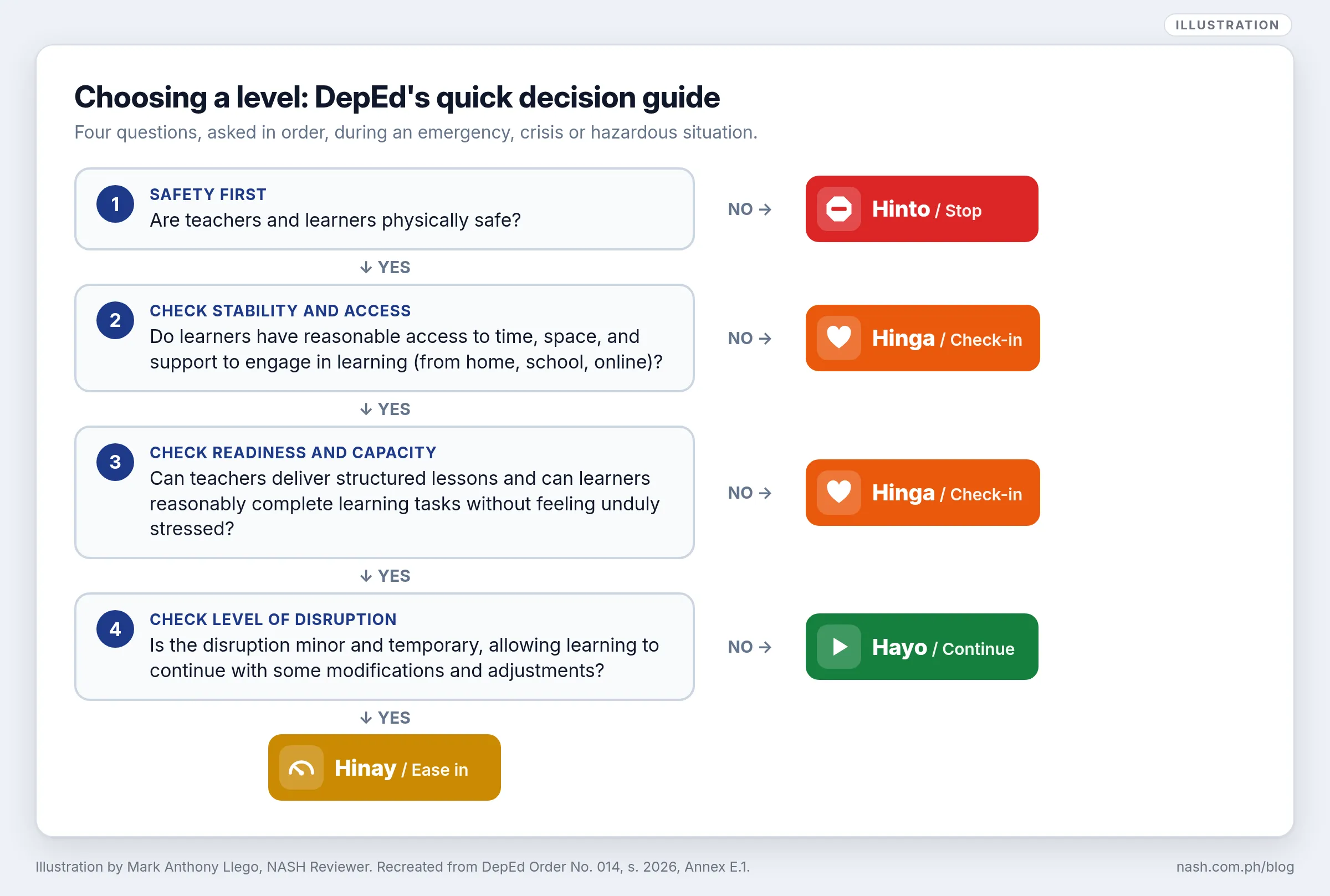
The order sets the rules for moving between levels:
- Evidence first. “Movement from one level to another shall be based on clear evidence of the school’s community conditions reported by the school heads” (para. 55).
- Up when learning cannot continue; down only when people are ready. Escalation comes “when the disruptions compromise the ability to sustain regular learning”, and de-escalation “only … when learners, teaching, and non-teaching personnel are demonstrably fit to resume, appropriate resources are available, and psychosocial readiness has been established”, guided by agencies such as PAGASA (para. 56).
- Several hazards at once, the higher level. School heads “shall consider applying modalities and interventions for the higher level of learning continuity” (para. 57).
- Local knowledge counts. Decisions include “local community views, including cultural considerations and local knowledge on the environment and hazards” (para. 14).
- Good faith is protected. “Actions taken in good faith and in compliance with this policy shall not subject school heads or teachers to personal liability” (para. 12).
The 4H levels for other hazards
Heat is one column of DO 014’s matrix. For the other hazards, Annex A.1 matches each warning to a level:
| Hazard | Hinay | Hinga | Hinto |
|---|---|---|---|
| Typhoons and tropical cyclones | Wind Signal 1-2 | Signal 3 | Signal 4 |
| Heavy rainfall and flood | Yellow rainfall warning; alarm water level | Orange warning; critical water level | Red warning; critical water level |
| Earthquakes and landslides | Intensity IV and below | Intensity V | Intensity VI and above |
| Power outages | During class hours | 2-3 days | 4 or more days |
| Low air quality or volcanic fog | Unhealthy (Orange) to Red | Acutely Unhealthy (Purple) | Emergency (Maroon) |
| Human-induced incidents | Transportation strikes | Bomb threats | Armed conflict; critical incidents |
Source: DO 014, s. 2026, Annex A.1. Some of these warnings also suspend classes automatically under DO 022, s. 2024; heat and power outages never do.
Reporting the level, and what each level costs
- Report within 12 hours, then every change. School heads report the level through the EiE: Learning Continuity dashboard’s mobile application “within the first 12 hours of any disruption” (para. 44), and report every change of level, including the return to Hayo (para. 92). The system is built to take reports “at 24-hour intervals until the school has transitioned back to Hayo” (para. 51). Without data service, they report by SMS, two-way radio or other means (para. 44); if the school cannot report in time, the SDO reports for it (para. 53).
- Report the learning experience. At Hinay, Hinga or Hinto, the school also reports “the learning experience and materials used” (para. 46).
- Send learners home with materials. A school that shifts levels during in-person classes without having distributed learning resources provides “a week’s worth of printed materials and emergency learning kits … before learners are sent home” (para. 47).
- Count the class days. Half a class day is counted as missed at Hinay and Hinga, and a full day at Hinto. “Makeup classes shall be required if the number of actual class days, considering class suspensions and holidays, falls below 90% of the mandatory contact days outlined in the school calendar” (para. 68).
- Exams and immersion wait. “Periodical exams shall only be delivered during in-person classes or Hayo level days” (para. 70); under DO 015, s. 2026, issued the same day, the end-of-term exam is the Term Examination (Sec. III). And work immersion days under Hinay, Hinga and Hinto “shall not be permitted” (para. 71).
- Check-ins are teaching. “Hinga check-ins shall be considered as part of teaching load” (para. 69).
Check a school’s level on TeacherPH Walang Pasok
When classes are called off, teachers and parents ask the same thing: does my school have walang pasok today, and at what level? TeacherPH Walang Pasok, a site run by the author of this guide, answers it in one place. It checks DepEd’s LIGTAS+ list of reported suspensions every 10 minutes and lists the schools with no classes by region, Schools Division, province and city, each with its 4H level and the dates reported to DepEd.
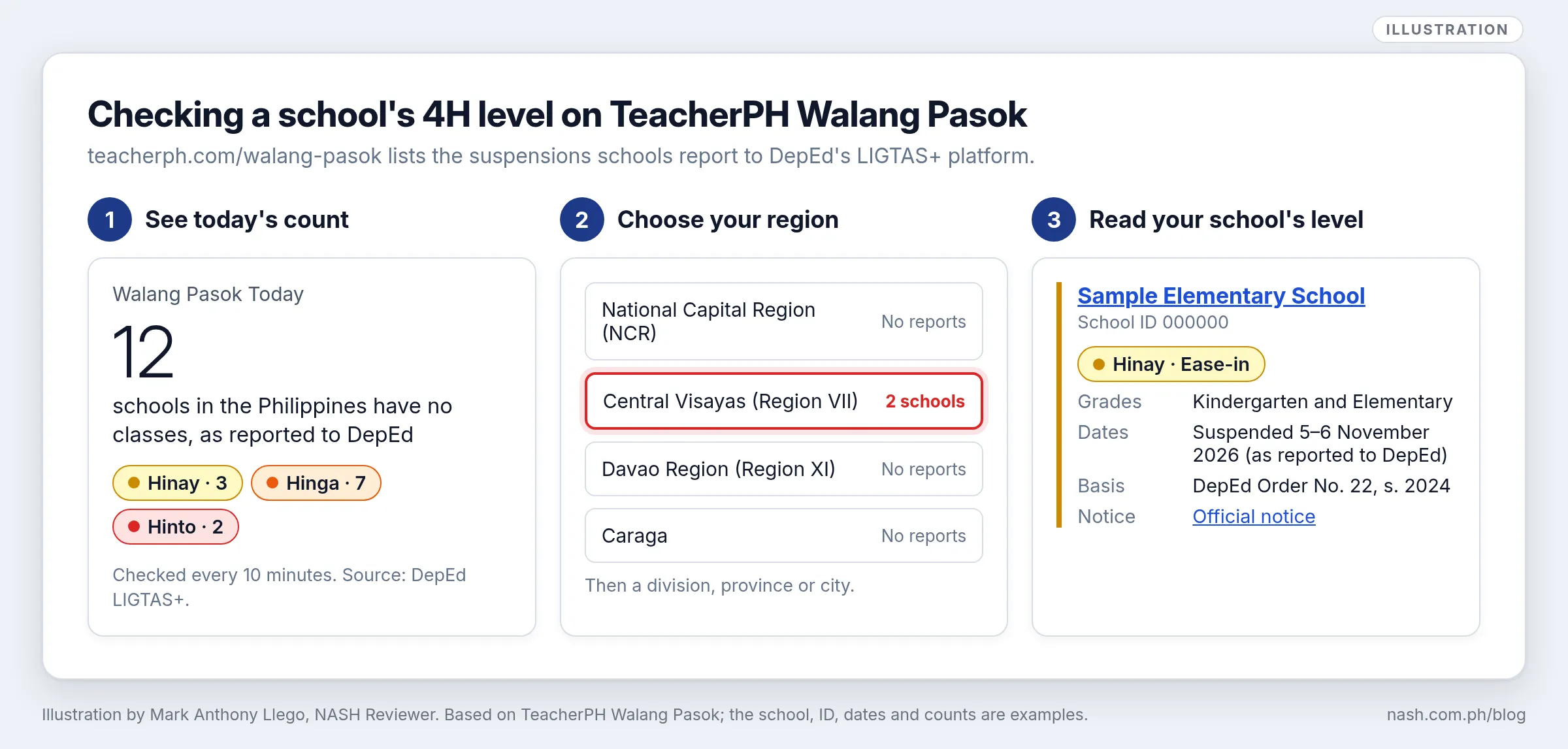
- Today’s count at a glance. The home page shows how many schools have no classes, as reported to DepEd, with the number at each level and the time of the last check.
- Your school by place. Choose a region, then a division, province or city. A city page lists every school with its status, including “No reported suspension”.
- The days off, not the reopening day. LIGTAS+ records the day classes resume as a suspension’s end date (its school cards label that date “resumes”), so a report of 3 to 5 November reads “Suspended 3–4 November 2026 (as reported to DepEd)”. Where a school’s official notice gives different dates or a different level, the page uses the notice and says so.
- What the levels mean. The home page explains Hayo, Hinay, Hinga and Hinto in plain words.
Read it with its limit in mind: “Only schools that reported a suspension to DepEd are listed. Local governments may announce suspensions that are not here yet.” It is a convenience for finding a school, not an official source, and it is not affiliated with DepEd. The local government’s and the Schools Division Office’s announcements decide whether there are classes. Walang Pasok Data: DepEd’s Learning Continuity Monitor explains the DepEd list behind it and what its data do not show.
What this means for school heads
- Measure before you decide. Install the devices and assign who takes the Annex B readings above; keep the log, which also documents any school-level suspension, and submit the data daily to the DRRMS (DM 064, s. 2026, Sec. 6.1 and Annex B).
- Plan each level before the emergency. The Learning and Service Continuity Plan names the learning delivery arrangements, experiences and resources “for each key stage under Hayo, Hinay, Hinga, and Hinto” (DM 064, s. 2026, Sec. 4.2), and parents are oriented on it during the Opening Block (DO 014, s. 2026, para. 39).
- Protect first, then coordinate. At a Hinga or Hinto reading, or when learners show signs of heat illness, apply the Section 6.1 measures above that day, then coordinate any suspension with the SDS and the LCE.
- Report the level on time. Within 12 hours of the disruption, then at every change of level until the school is back at Hayo, with the learning experience used (DO 014, s. 2026, paras. 44, 46 and 92).
- Tell families where to look. Share the school’s own announcements first, and point teachers and parents to TeacherPH Walang Pasok to see the levels reported across the division.
Keeping learners safe while learning continues is school operations work under PPSSH Domain 2; see PPSSH Domain 2 for the NASH: Managing School Operations. Orienting parents on the plan is part of Domain 5, Building Connections.
Frequently asked questions
What do Hayo, Hinay, Hinga and Hinto mean?
They are DepEd’s four learning continuity levels under DO 014, s. 2026: Hayo (Continue), in-person classes; Hinay (Ease in), structured distance learning; Hinga (Check-in), check-ins and light distance learning; and Hinto (Stop), all forms of learning suspended (Sec. V.A).
What heat index is Hinga?
A heat index of 33°C to 41°C, which DM 064, s. 2026 calls Extreme Caution. Below 27°C is Hayo, 27°C to 32°C Hinay, and 42°C and above Hinto (Sec. 5.2.2).
Are classes automatically suspended at Hinga or Hinto?
No. “Extreme heat conditions shall not automatically result in class suspension” (DM 064, s. 2026, para. 6), and DO 014’s Annex A.2 says the same at every heat level. The local chief executive may suspend classes, and so may the school head with the necessary coordination with the LCE and SDS (DO 022, s. 2024, Sec. III.5; EO 130, s. 2026, Sec. 4.c). Protective measures cannot wait for either (DM 064, s. 2026, Sec. 6.1).
How often do schools read the classroom heat index?
At least three times a day: 8:00 a.m., 12:00 noon and 2:00 p.m., in degrees Celsius, with the data submitted daily to DepEd’s DRRMS (DM 064, s. 2026, Annex B).
How do I know if my school has walang pasok today?
Follow your local government’s and your Schools Division Office’s announcements, which decide. TeacherPH Walang Pasok lists the schools that reported a suspension to DepEd’s LIGTAS+, with each school’s 4H level, checked every 10 minutes. A school that has not reported shows “No reported suspension” on its city’s page, which does not mean classes are on.
Sources
DepEd issuances
- DepEd Order No. 014, s. 2026, Guidelines on Learning Continuity in Emergencies, June 4, 2026: paras. 9–15, 39, 44–47, 51, 53, 55–57, 68–71, 92; Secs. V.A, V.J, V.K; Annexes A.1, A.2 and E.1
- DepEd Memorandum No. 064, s. 2026, Anticipatory Action, Preparedness, and Protective Measures for the 2026–2027 Super El Niño, October 26, 2026: paras. 6–7; Secs. 4.2, 5.2.2, 6.1; Annex B (with the DOST-PAGASA Heat Index Chart)
- DepEd Order No. 022, s. 2024, Revised Guidelines on Class and Work Suspension in Schools During Disasters and Emergencies, December 23, 2024: Sec. III.5.e and III.5.h
- DepEd Order No. 015, s. 2026, Revised Guidelines on Classroom Assessment, Grading System, and Awards and Recognition for the K to 12 Basic Education Program, June 4, 2026: Annex A, Sec. C, paras. 14–16
Executive issuances and releases
- Executive Order No. 130, s. 2026, Establishing a Framework for the Suspension and Resumption of Classes and Activities, and Onsite Work in Educational Institutions and Learning Centers, October 28, 2026: Secs. 4.a and 4.c
- DepEd, “Bagong patakaran sa class suspension, batay sa datos – DepEd”, press release, November 5, 2026
Data
- TeacherPH Walang Pasok, from DepEd’s LIGTAS+ list of reported suspensions
Written by Mark Anthony Llego for NASH Reviewer. Illustrations by Mark Anthony Llego; they may be reused only with written permission from support@nash.com.ph. Sources: DepEd Orders No. 014 and No. 015, s. 2026, and No. 022, s. 2024; DepEd Memorandum No. 064, s. 2026; Executive Order No. 130, s. 2026; DepEd’s November 5, 2026 release; TeacherPH Walang Pasok. NASH Reviewer is not affiliated with DepEd.